Using the Twirl Series to Supplement the Single Wing Offense

By Dan Woolley
Offensive Coordinator
Scott High School (KY)
Twitter: @thecoachwoolley


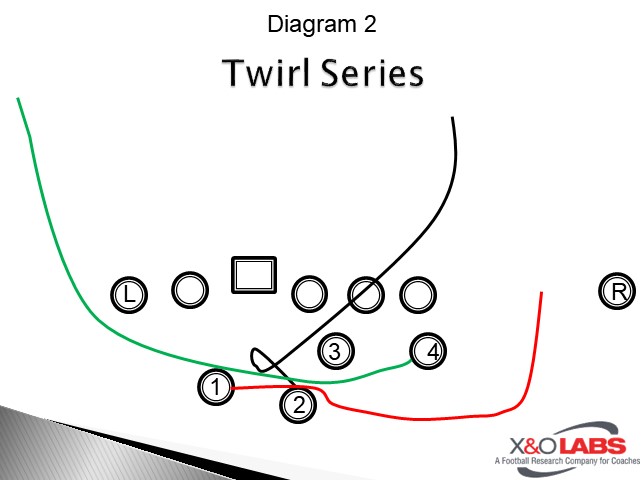
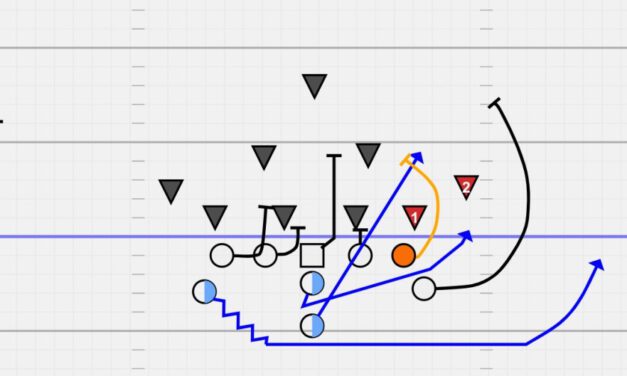
I have previously detailed the basics of our overbalanced offense in the report “Adapting Single Wing Principles to Ignite Your Run Game.” One of the series not detailed in the report that we have used with great success is our Twirl Series. The Twirl Series is where our HB takes the snap and completes a full 360° spin while meshing with the QB and WB away from the line of scrimmage.


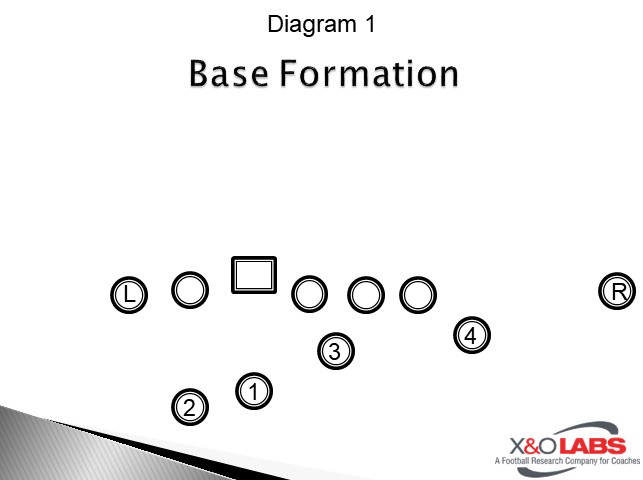
Note: Our 1 Back= QB, 2 Back= HB, 3 back = FB, 4 Back= WB, L= TE, and L=WR

We feel like using the Twirl Series is like a pitcher changing speeds. While we are executing the same running plays as our base single wing set: Power, Sweep Strong, Sweep Weak, Wedge, the timing of the plays is different and usually causes the defense to hesitate. We feel this hesitation will slow the defense down so we can continue to run our base series. We have preferred to run this series to spark our offense when our base series is not as effective as we would like.


If we feel the defense is hesitant when we run the Twirl Series, we will run Power or Sweep Strong. When the defense reacts to stop these plays, we will counter with Sweep Weak and Wedge. We also have a Twirl Pass that we can run to exploit teams who creep up to stop the run and Twirl Screen to run vs. teams that try to get upfield and create havoc.

We run this series with our base personnel, but I feel that if a team had a plethora of RBs that this could be a great “wildcat” series since you have RBs attacking the middle and both flanks of the defense simultaneously. This deception and the defense’s unfamiliarity with the series since we feel that there is no way the opponent can simulate it in practice, allows us to overcome the loss of a strongside blocker, who is now engaged in the mesh.

One of the other advantages of this series is that all our plays look very, very similar. With the HB, QB, and WB running the same path every time, the defense does not know what the play is until they can find the football. This is much harder than it sounds. With the HB spinning and the QB and WB meshing with him, a lot of movement is going on in the backfield and it makes it hard for eyes to focus and find the football. We have found that even the most disciplined teams in terms of reading keys get caught staring in the backfield trying to find the ball instead of reading their keys. It is not uncommon for players at the first, second, and even third levels to slow down and try to find the ball, take themselves out of the play by chasing someone who doesn’t have the football or attempt to tackle someone who doesn’t have the ball. Besides making it much easier on us when the defender takes himself out of the play, it puts doubt in the minds of the defenders, and we feel it slows him down for the rest of the game.


Install

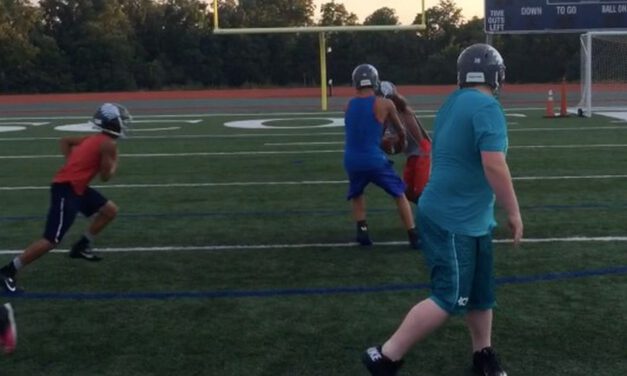
Though the Twirl Series seems very complex we have found that the basic mesh point can be installed in a small amount of time. The clip below is from our Freshman team in June 2014, when we first started installing the Twirl Series. We initially installed it with them before we did with the varsity. This allowed us to work some kinks out. They have had approximately 15 minutes of install time. Before this clip, there were a few cases of players bumping into each other, but as you can see after a short amount of time, they have the basics down. The mesh is a little slow and mechanical, but overall it gets the job done.


Editor’s Note: Coach Woolley has provided narration for each clip below:


Clip #1– HB is going to keep the ball. Even with no offensive line, it is tough to see who has the ball as all 3 RBs carry out fakes. Notice how HB double skins it as he is coming into the line of scrimmage. This creates a lot of deception.

This clip is important for another reason: it allows you to get a feel of the defensive perspective. It is hard to figure out who has the ball when you only watch it once. It is important to note that in this clip there is not an offensive line in the way to further obscure the vision of the defense. Adding the offensive line combined with the ball carriers hiding the ball from the defense through “double skinning” or placement on hip make it extremely hard for a defense to find out who has the ball.

Read More

Combatting Common Defensive Adjustments to the Flexbone Offense (Part 1)

By Matt Morrison
Head Coach
Francis Parker High School (CA)
Twitter: @CoachMMorrison


In the 2017-2018 offseason, we decided as a coaching staff that we needed to go in a different direction offensively. I had just finished my first season as the head coach at Francis Parker and to say that we struggled to move the ball would be putting it politely. We couldn’t drive the ball, we hardly made any explosive plays, and our team only scored over the 20 points twice in 10 games. While some of that could have been attributed to a young team, the reality was that we had done a poor job of putting our players in the best position for them to have success.

At Francis Parker, we are a small team, both literally and figuratively. As a small school (250 boys) that offers a full variety of sports, our program numbers are typically in the mid-30s for grades 9-12. Additionally, while our kids do a great job of training to build strength and speed, we will go into nearly every game on our schedule as the undersized team. In 2019, our roster had only 3 players who weighed in at over 200 pounds.

It was the combination of all those factors that led us to the flexbone offense. While there are numerous advantages to running the flexbone, the ones that have made the biggest difference for us are:

  • It allows us to play to the strengths of our offensive lineman (smarts, angles, quickness, leverage), while hiding weaknesses (size)
  • It allows us to attack the entire width of the field and the entire structure of the defense
  • It creates more balance within our offense, allowing us easier ways to get the ball to all of our different skill players
  • It allows us to control the tempo and pace of the game. In addition to being able to keep a talented offense off the field for extended periods of time, it also can shorten the number of total snaps in a game.  This has been critical at times for us competing against teams with bigger rosters, as all of our players play offense, defense, and multiple special teams.


In the spring of 2018, we did a deep dive and began studying several teams at both the high school and college levels who have had success running the offense. We then spent the remainder of the offseason working as a staff on the best way to build, package, and install the offense so that it would transform from just a series of plays into a system that our players could execute with speed and precision on a weekly basis. This is where I believe we have seen our biggest advantage of the offense.

The flexbone is unique.  While several teams will run certain plays that you may see from a traditional flexbone offense (Veer, Midline, Trap, Belly, etc.), there are only a few in our section who run the entire gamut of the offense. This has provided us two advantages that I believe have made us a very tough team to defend:

  1. The flexbone is exceedingly difficult to simulate in practice. While it might be possible to train your scout team to run one or two of the flexbone core plays efficiently over the course of a game week, it is highly unlikely to do so for the entire offense.  As you will see throughout the rest of the article, our core plays are Inside Veer, Rocket Toss, Midline Follow, and Midline Triple, but we also will run Belly, Trap, Trap Option, Counter, and Counter Iso, not to mention our quick pass and play-action game.  While we have been blessed to have skill players with good speed, I have no doubt that a large part of our success is our ability to get the defense to play slower because they have rarely played anyone like us offensively.
  2. It has simplified the adjustments that we make both during and between games. Because we have truly built an offensive system, both our players and coaches have a solid understanding of how our plays fit together, and in turn, how we will need to adjust vs a variety of different defensive schemes that we might see over the course of a season.  As I mentioned before, all of our players will play on both sides of the ball and in the kicking game.  This means that we do not have extended time during games to consult with our position groups during the game.  Even during halftime, our time is limited, as we must cover all 3 phases. Because of those circumstances, it is even more important that our communication is simple, organized, and efficient.  I am excited to share some of the go-to adjustments that we will use against common defensive tactics vs our flexbone offense.


DEFENSIVE ADJUSTMENT 1: SPINNING OR RUNNING SAFETIES TO SLOT MOTION

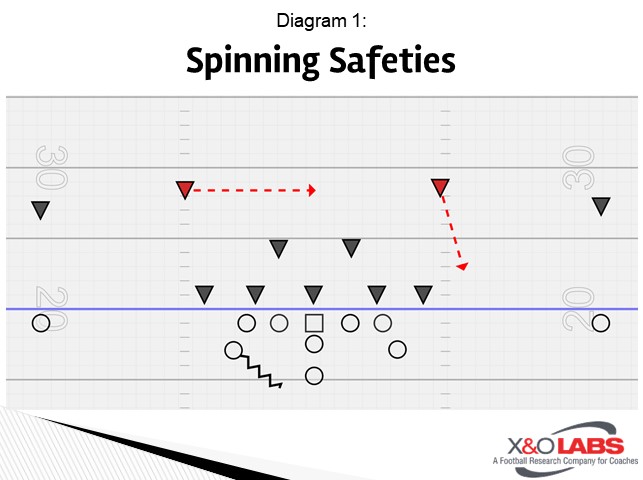
One of the most common strategies that we will see from our opponents is for teams to spin their safeties once we motion one of our slots.  They are usually doing this for 1 of 2 reasons.  Either they are looking to be able to force the ball faster and set a harder edge on the perimeter, and/or they want to put their pitch player into a better position to play his option responsibility.  This is especially common for teams that base out of a two-high coverage structure.

Read More

Combatting Common Defensive Adjustments to the Flexbone Offense (Part 2)

By Matt Morrison
Head Coach
Francis Parker High School (CA)
Twitter: @CoachMMorrison


In the 2017-2018 offseason, we decided as a coaching staff that we needed to go in a different direction offensively. I had just finished my first season as the head coach at Francis Parker and to say that we struggled to move the ball would be putting it politely. We couldn’t drive the ball, we hardly made any explosive plays, and our team only scored over the 20 points twice in 10 games. While some of that could have been attributed to a young team, the reality was that we had done a poor job of putting our players in the best position for them to have success.  This report is the 2nd of two and starts with the 3rd and 4th defensive adjustments to stop the offense.


DEFENSIVE ADJUSTMENT 3: DL SCHEMING TO TAKE AWAY THE FULLBACK

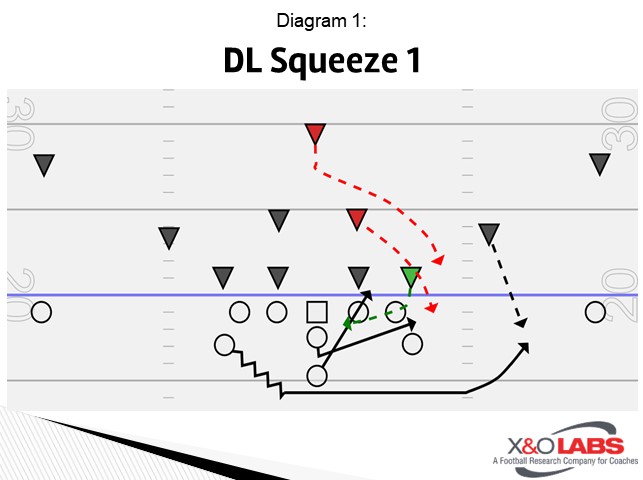
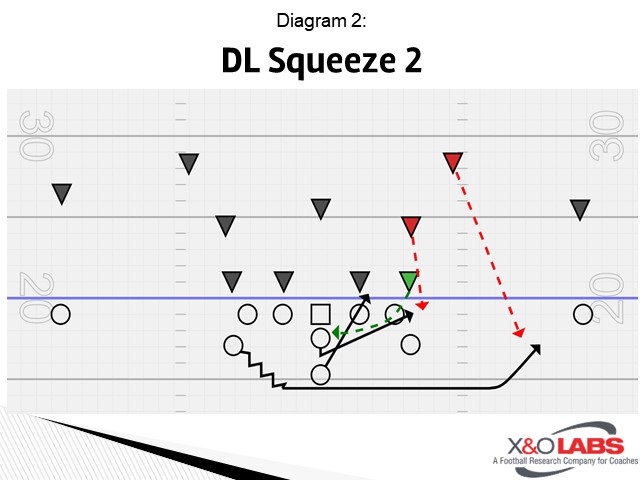
Since the Inside Veer play is one of the staples of the offense, another one of the more common defensive adjustments that we will see is teams aggressively pinching and slanting their defensive line with the goal of eliminating the fullback as a ball-carrying threat.  There are several different thoughts as to why this is an effective strategy against the flexbone.  Among others, this tactic will put the ball in the hands of the quarterback much more often, giving the defense more opportunities to hit him when he disconnects and declares himself as a runner.  This also enables 2nd and/or 3rd level defenders to pursue faster, as they know that the DL is eliminating the dive phase of the triple option.  When the defensive ends are squeezing, you will also see the linebackers and free safety running the alley much more aggressively.  This is similar to the gap/scrape exchange technique that has become a popular way for defenses to defend the shotgun zone read.


Offensive Answer 1: Displace or Block the Quarterback Player

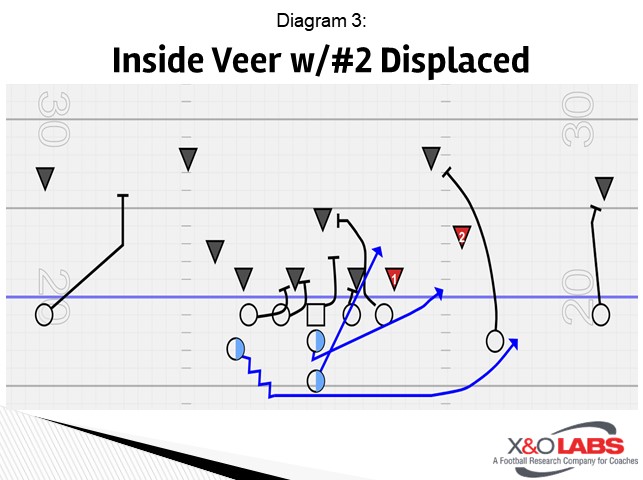
As a flexbone offense, we are resigned to the fact that our quarterback is going to take some hits.  More than speed, quickness, arm strength, or even decision making, I am of the belief that the most important quality that a flexbone quarterback must possess is toughness.  If your quarterback is not a legitimate threat to carry the ball, it will be difficult to sustain any success in this offense.  We never want to give the defense the opportunity to repeatedly tee off on him. The easiest way for us to accomplish this when the defense is scheming to cancel the dive is to either displace or block the defender responsible for playing the quarterback phase of the triple option.


Here we have moved our playside slot from his traditional wing alignment to that of a true slot receiver (you can also do this through personnel substitutions as well depending on the skills of your players).  This forces the #2 defender to widen his alignment, giving the QB more time and space to make his decision to keep or pitch once the DE tackles the dive.


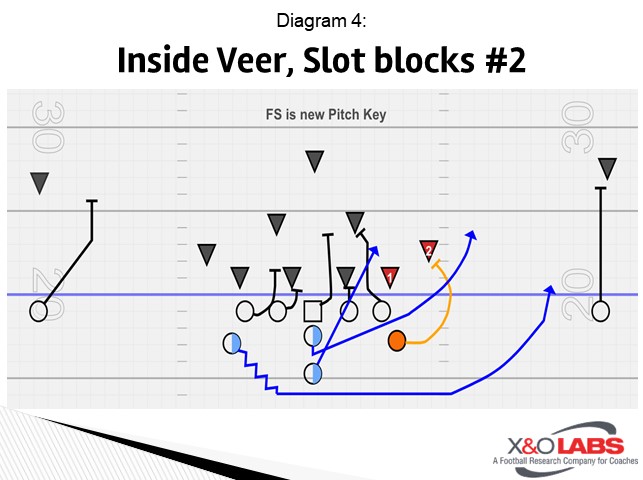
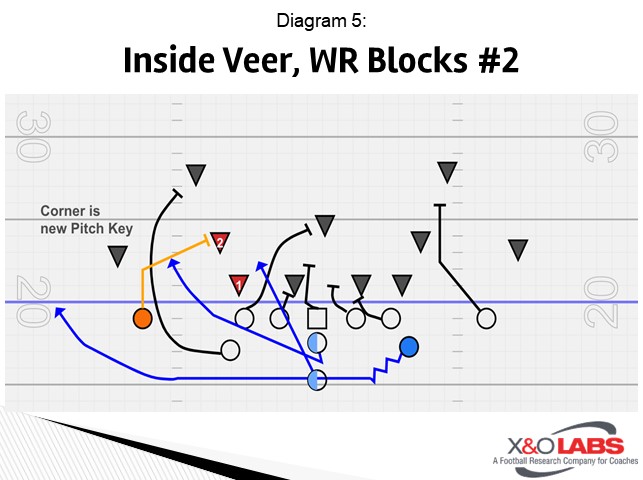
The other tactic that we will use is to block the quarterback player and ID another defender to read as our pitch key.  We can do that with either our slot (Diagram 20) or our wide receiver

Read More

Variations of the Sail Concept

By Jim Glover
Offensive Coordinator
Centennial High School (TN)
Twitter: @jimballcoach


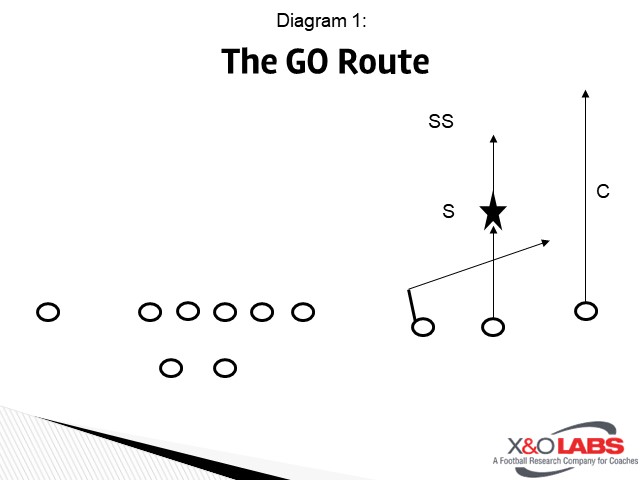
The Run and Shoot “GO” Route is a staple of the offense. Since the day Mouse Davis put it in, it has been a winner because of its morphing qualities. Correctly taught, it can be one of your more consistent plays that carries a big-play potential.


WHAT IS THE GO ROUTE?

At the onset, the “GO” route looks like there is nothing special about it. And it is a basic flat route that gets the offense a consistent 5 yards for each completion. As a play-caller, I like a consistent 5 yards. So, calling this play repetitively is something I am happy with. But what makes the “GO” route worthy of a whole article? Well, it is the “magic” that happens once defenses try to take away the basic flat route.

We have been running this play as part of our offense since 1992. It has evolved from an under-center quick game route to a shotgun intermediate yardage play. The reads have adapted from a simple flat defender read to being able to handle the multiple zones and combo man coverages we see today. This article will give you the drills and answers to the common defensive adjustments we see.


SEAM READ – Everyone Does It

As you can see the basic route package consists of a Mandatory Outside Release (MOR) by the #1 receiver, a Seam Read by the #2 receiver, and a Shoot route by the #3 receiver. These are basic routes except for the Seam Read. This is the route we spend most of our time teaching and drilling. All three receivers will be drilled on this route due to our variations of the play.


PRACTICE DRILLS

Where is SAM?

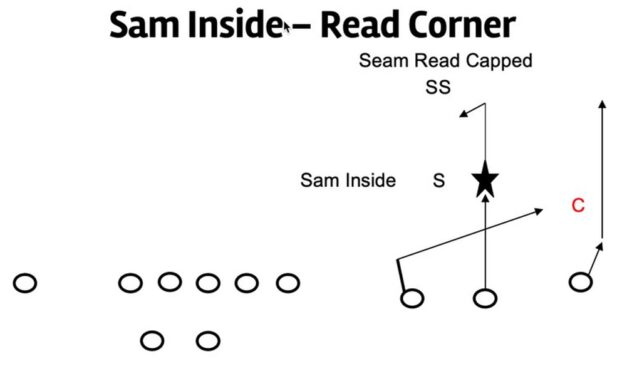
The #2 receiver will run his Seam Read after answering two questions. 1) Where is the Sam Linebacker and 2) “Is my route capped?” We want the Seam Read to attack the outside shoulder of the Sam Linebacker. Once he is even with the Sam, we want him to “gear down” and “rub”, making it difficult for the Sam to get to the Shoot route. In drills, we will place the Sam inside the #2 and then outside the #2. If the Sam is inside the #2 then the “rub” is easy. If the Sam is outside the #2, then the “rub” may not happen. We still want the #2 to attack the outside shoulder of the Sam. If the Sam plays over the top and slides to the outside, the #2 will look for the ball on his back shoulder if the route is capped by the safety. If he is not capped, his route should continue up the field. All three receivers will run the Seam Read drill. This is first taught without a ball being thrown. Once all receivers get a feel for the Seam Read, we will bring the QB in and throw the route with three defenders. The Sam, Strong Safety, and the Cornerback.


QB Reads

The QB’s reads start with the same questions asked by the Seam Read route, “Where is the Sam?” and “Is the route capped?” For the QB, if the Sam is inside the #2 receiver, we want to read the CB. He will high/low the CB with the Shoot and MOR. If the Sam is outside the #2 then we will read the Sam and high/low him with the Seam Read and Shoot routes. The “capped” Seam Read should get a back-shoulder throw to protect him from the safety. If the seam read is uncapped, then we can throw the ball out in front of him.

We want the ball out of the QB’s hand quickly. Once the QB catches the snap he will take 3 quick drop steps on an angle toward the GO route. On his third step, the ball should be delivered. If not, he should pump fake and then hit the open receiver in his secondary route.

Read More

Read Pressures Out of Multiple 3-4 Spacing

By Chris DiLella
Associate Head Coach and Defensive Coordinator
Rhodes College (TN)
Twitter: @Coach_DiLella


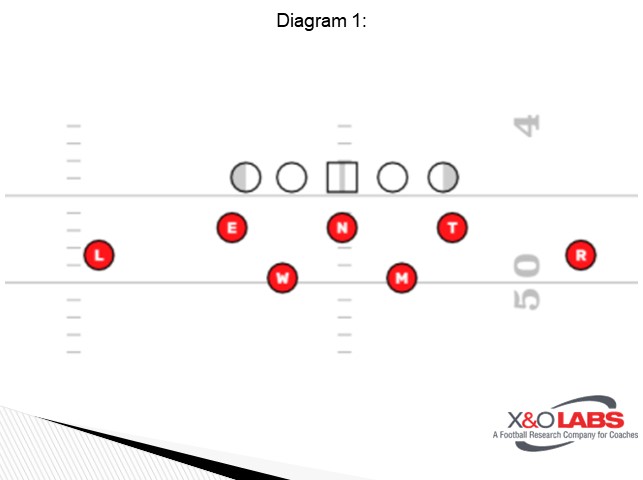
First, I want to mention how grateful I am to X&O Labs for allowing me to talk about something that I believe we have had a good amount of success running these last few years. Our read pressure system has allowed us to always make sure we have at least a 4th rusher in the passing game, while also allowing us to be gap sound vs. any run we may see. When speaking about this I am specifically talking about our 4 linebackers, our call/boundary side OLB- Rush, our call/boundary side ILB- Mike, our away/field OLB- Lynx, and our away/field ILB- Will.


What I mean when I call these a “read pressure” is that each defensive player has a specific offensive player that he reads when blitzing and that tells him how he should react. The variation of who is coming when causes confusion for both the QB and OL. It allows our players to play fast against any offense we see because of the minimal rules and techniques that we teach them. Our alignment rules are simple and by day 2 of installs, we can run any pressure out of any coverage that we have. Below, I will be going into detail on what we teach our players when we run Razor (rush), Laser (lynx), Max (mike), Wax (will), Rome (rush or mike), Waco (lynx or will).


OLB Pressures (Rush and Lynx)

When calling our defense, we are generally going to be sending the rush about 60% of the time.  Because of this, we like him to be a very good pass rusher and our best run defender.  On the other side, our lynx is going to be better in space and better in coverage.


Alignment:

When it comes to teaching our OLB alignment, we like to speak in general terms and have them follow a few simple rules.

  1. Align for Success! Be able to execute your assignment from where you are
  2. Apex Split #1 or split #2 at 3-5 yds.
  3. Attached TE w/ no split #1 align in a loose 7 at 1-3 yds
  4. Attached TE or H w/ split WR apex to wide 9 depending on splits
  5. You have the freedom to “prowl” into position pre-snap


Pressure Rules

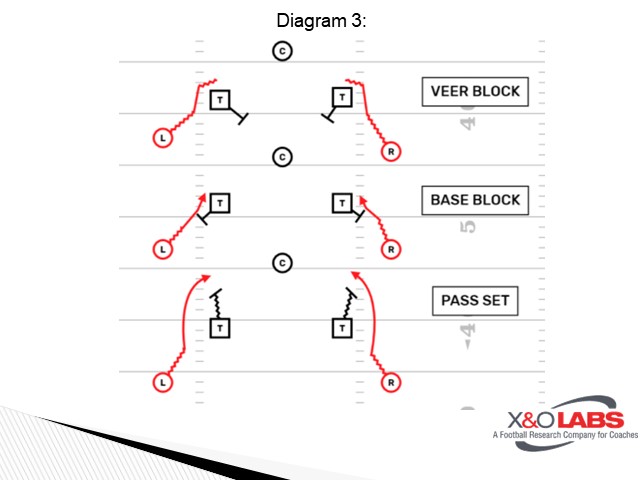
In normal, non-blitz, situations we teach our OLB’s to read their “triangle” which is EMOL through to mesh point.  This transitions seamlessly to our razor and laser technique because we will always be C gap players reacting to the tackle’s block.

  • Read “V” of the neck of the tackle
  • Attached TE shock and rip into C
    • If you can’t rip into the C gap then put his body in it


When teaching this I have found the hardest thing for younger players to pick up on is that they are not just blitzing off the edge (or running up the field). They need to understand that they are responsible for a specific gap and what they do needs to be dictated by what we are seeing from the offense.

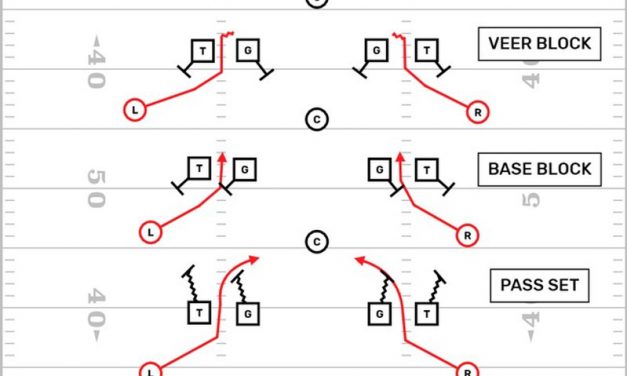
We teach 3 basic block recognitions to them.

  • Veer (tackle away). Shuffle and squeeze responsible for QB on mesh/boot. Spill anything across.
  • Base (tackle to). Shock/Release in C gap. Do not widen or come inside
  • Pass Set. Transition to pass rush technique. RB to you beat outside for contain. You are an outside pass rusher. Aim for the back shoulder of WB


The drill below is done twice a week. Once they are comfortable with each one, it is at the coaches’ discretion as to what they are seeing.  We will add a TE into the drill depending on what we need to prepare for.


Read More

Offensive Game Planning and Thought Progression by Formation

By Dylan Ziegler
Offensive Coordinator
Beaver Dam High School (WI)


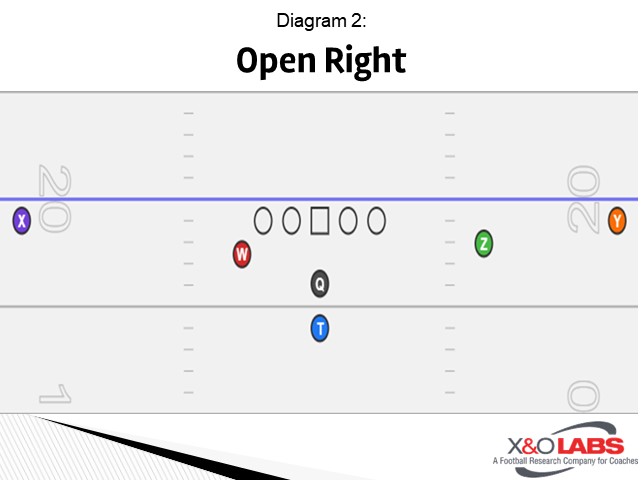
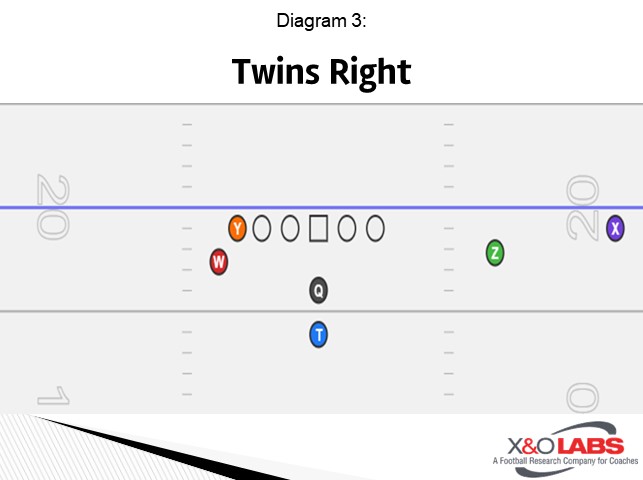
Many offenses are condensing the number of formations in their playbook to make things simpler for their players. Only running plays out of 2-4 formations avoids errors in your offensive alignment. However, I believe this allows the defense to have very few checks, to diagnose certain plays, and take certain things away from the offense. We have not had the benefit of having the talent to overpower our opponents, so we had to find a different way to get easy yards. The coaching staff at Beaver Dam High School has developed a system of tagging formations. Each tag affects the alignment of very few people on offense. I believe this gives us an advantage because we make very few alignment errors while forcing the defense to be ready for a multitude of formations. The tags are the same no matter what formation they are attached to which makes it easier for the players to align properly while also keeping the offense truly diverse.


Base Formations

We have three base formations:

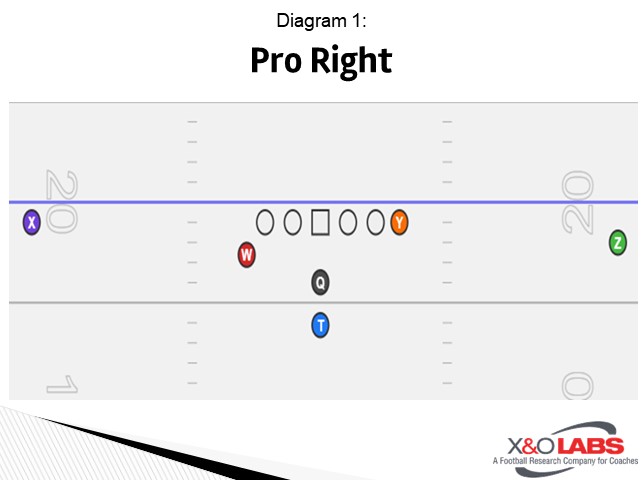
Pro:


Open:


Twins:


We can attach tags to any of the base formations (and at times, two tags to a formation) to create an arsenal of alignments.


Formation Tags

We have 19 tags in total, but we certainly do not use all the tags every year. Some tags are designed for a QB that is more of a throwing threat than as a running threat and vice versa. We also have tags that are designed to take advantage of the different skill sets of personnel at the wing, tailback, and Y position. We focus on how we can put our players in the best position for that year and stick to those tags. For this report, I will focus on our most commonly used tags. Below is a chart matching the tag and formation adjustment:

Tag Formation Adjustment
King Wing moves to strength (keeps wing alignment)
Empty T moves to WR split on the weak side
Split Wing aligns in the backfield, offset the QB to the strong side of the formation
Bunch Wing moves to king position, the two WR’s move to “snug” position to condense the formation. Create an off the LOS, on LOS, off LOS “bunch”.
Tight WR’s to weak side tighten splits to condense the formation (does not apply to Twins formation)
Devil X or Y (depending on base formation) and wing “stack” in the slot and Z split to Y’s normal alignment. (Does not apply to Pro formation)
Out Wing takes WR split
Trips  Wing moves to strength with a WR split
Stack WR’s to the same side of formation will align one WR in front of the other. Their split will be the midpoint between their normal alignment (their split can change slightly based on the concept) (Does not apply to Pro formation)
Jack Wing goes to “king” alignment. T moves “king” alignment just inside the wing
Jill T moves to a “queen” (wings natural alignment) alignment inside of the wing


Read More

Methods in Freeing the Mike LB in a Stack Front

By Adam Siwicki
Associate Head Coach/Defensive Coordinator/Linebackers Coach
Culver-Stockton College (MO)
Twitter: @AdamSiwicki


The challenge for a defensive coordinator is to find the fine line of keeping your system simple enough for your athletes to play confident and fast but complex enough to keep the opposing coordinator guessing. We use a wristband to communicate the plays we run. I prefer the wristband over signals because it is position-specific and I can put tips and reminders on certain player’s wristbands to make the information more quickly accessible to the player. It also allows for flexibility when changing run fits but yet keeping it simple for our players. We constantly change up the way we fit runs here at Culver-Stockton College and yet we have had very few misfitted run plays due to the simplicity of our defense. We play a 3-3-5 odd front, two-high defense. In our conference, we see multiple styles of offenses ranging from Air Raid to Wing T. I wanted a system that is flexible and adaptive to the various styles we see without drastically changing each week.

When game-planning for an opponent, I am always trying to figure out how to add an extra number to the play side. I have coached in many systems and generally, that number comes from the secondary. Our system does allow for us to fit runs that way, but I also like to try and add an extra number in the box, opposed to having it always come from the secondary. We are a gap sound defense and want our linebackers who are responsible for a gap to play fast and downhill. We will free up a linebacker in the box for him to scrape over and fix any misfit defensive lineman or linebackers. Which linebacker we make free varies based on formation, play direction tendencies, or back sets the offense presents us with. For this report, I will talk about how we free up our middle linebacker. To free up an inside linebacker we will slant our defensive line. Which way we slant is based upon game plan and can change by series or quarter.


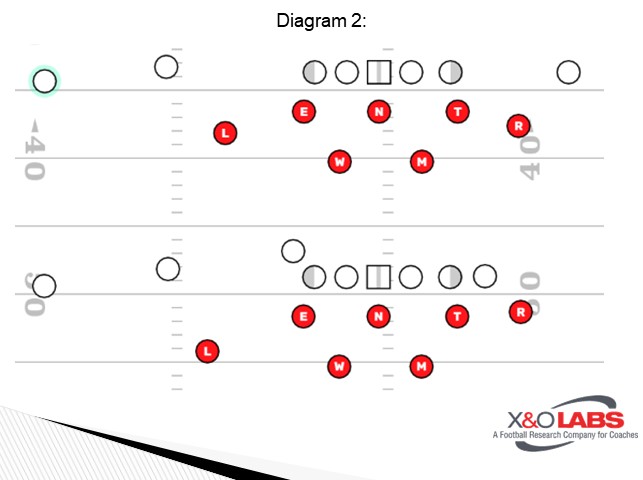
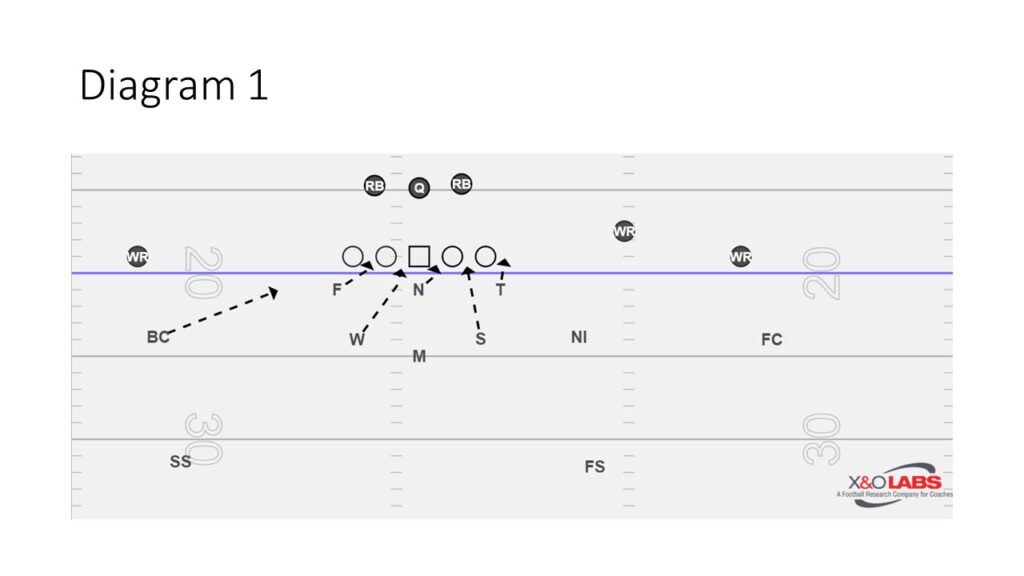
In Diagram #1 you can see we slant the line to the field and free up our Mike linebacker in a Tampa 2 coverage.

DB RUN FITS: Our boundary corner is the force player while our strong safety has all of #1. They have the flexibility to swap responsibilities making the safety fit the C gap and the corner play all of #1. We feel having a corner trap to the field is not putting that player in a successful position, so we allow them to communicate the switch.

FREEING UP LB’s: I made our Mike linebacker the free player in this formation. As mentioned previously, he will scrape over and fix any misfit defensive lineman or linebackers while maintaining the responsibility of being the spill player. No matter where the extra RB inserts himself in Diagram #1, we will have our middle linebacker there to fill the created gap or be the extra fitter in the box. Our overhang (Nickel) is a force player responsible for the C gap along with the DE to his side. Depending on what plays you get you may choose to keep him out of the gap and place him outside the #2 WR. Again, having a system that allows you the flexibility is something I thoroughly like about this scheme.

Read More

Practice Planning One Word Tempo Packages

By Patrick Cotter
Head Coach/Offensive Coordinator
Fairbanks High School (OH)
Twitter: @CoachPCotter


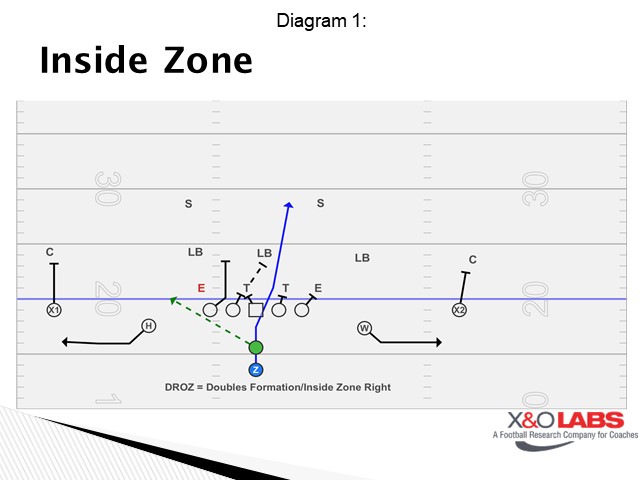
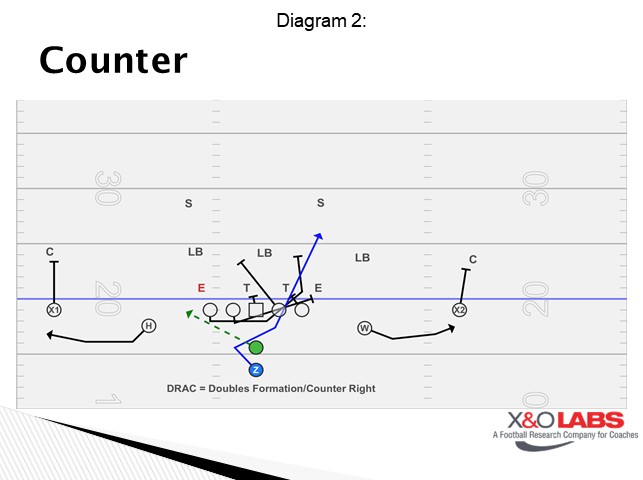
During my career as an assistant coach, coordinator, and now a Head Football Coach, I have attempted to mold what we do to the athletes we have. When I came to Fairbanks High School in 2015, we were talented but needed to dedicate time to our fundamentals. So, to do that we installed a simple inside zone scheme with some wrinkles and increased our no-huddle tempo to a speed I had never attempted before. This took time, but paid off, I inherited a 1-9 football team and in 4 season our boys were conference champions and earned the school’s first trip to the playoffs in 11 years. The one-word concepts allowed our players to play fast and think slow while doing our most fundamental plays and formations. What I love about installing these concepts is that you can mold it to anything you run, Wing-T, Spread, Veer, it doesn’t matter. If you are no-huddle or huddle you can use these concepts to change tempo and gain an edge at different times in the game.


Choosing Plays/Formations to Use

When I installed these, I didn’t want to overload my players, I adapted this from Chip Kelly when he was at Oregon and refined them with the help of Mike Yurcich when he was at Oklahoma State. But, in college they have way more time with their players than we do in the preseason, trying to package everything we do, just is not possible. So, our staff decided to use two blocking schemes and two formations to incorporate our one-word packages. We chose our inside zone scheme and our counter scheme; these were the first two blocking schemes we installed those years, and our kids knew them the best and did not have to think when running them. With both of these concepts, we attach bail-out passing options for your quarterback. This allows us to be multiple with only one call. I would suggest using plays that you feel most comfortable with, if you are a Wing-T team and a trap is your best play, use it. Don’t overthink it and don’t try to get cute, do what you do best.


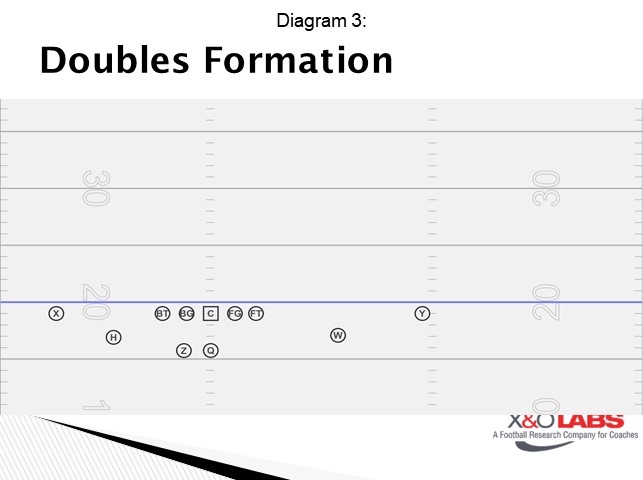
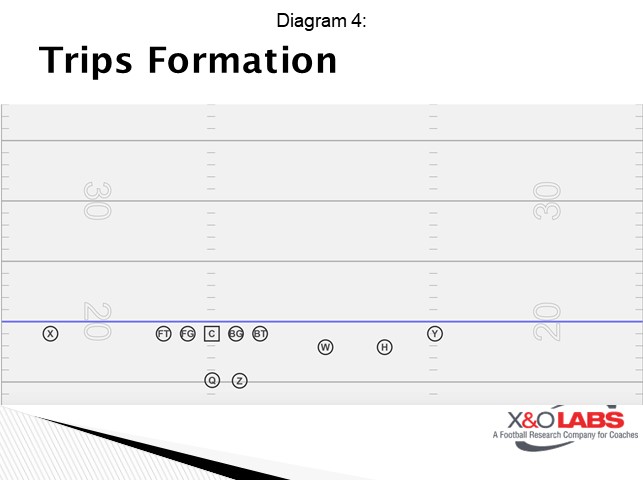
Next, we chose our two formations to marry to these schemes. We used our base doubles and trips formations because these are the formations, we used the most at the time. I have used under center formation for this in the past. Use the formation you use the most because defenses know you use them the most and you can do the most out of them and it forces them to become quite simple with their defensive calls.


Another version of our one-word packages is to marry a run scheme with a pass concept. We run these combination packages with only one run scheme and one formation while attaching a small group of passing schemes. For our one-word run/pass packages we used our empty formation to get more spacing and stretch the defense so we can play in space. For instance, we will use our inside zone scheme to the boundary with our quarterback and run a quick pass scheme to the field and boundary, such as bubble, hitch, or stick. These allow your quarterback to make the defense wrong all the time. We will teach our quarterback to count numbers, 5 or less in the box = run it, 6 or more in the box = throw it. We tried to make it quite simple and allow our quarterback to quickly identify what he needs to do.

Read More

1-Word Play Packages in the Tempo Offense

By Austin Embrey
Pass Game Coordinator/Wide Receivers Coach
Bixby High School (OK)
Twitter: @CoachEmbrey_


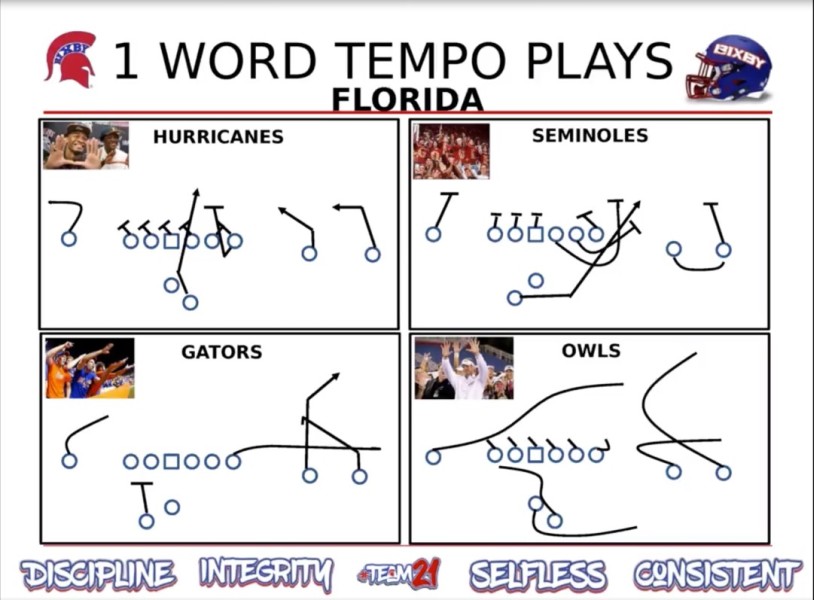
At Bixby High School, we believe that running a tempo offense gives us the best chance to put as many points on the scoreboard as possible.  We believe that the more plays we can run, the more opportunities our best players have to touch the football while forcing the defense into a more basic look. Tempo also allows us to disguise our base plays and reduce the defenses ability to recognize tendencies.  We have developed a package that allows our players to get lined up quickly and execute our favorite plays out of our most efficient formations.

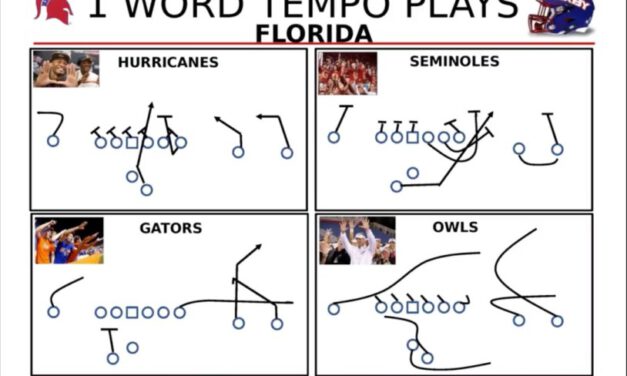
We built our one-word package by dividing our favorite plays into families.  We chose to use states for our families. We named our one-word plays after college teams within those states. Conveniently, almost every college team has some sort of hand signal that their fans use.  Each STATE will tell which formation the players should line up in.  The specific COLLEGE will tell which play is to be ran out of the formation.


“Florida” Tempo Family:


In the above diagram, we have chosen the state of “Florida” to build our first family of one-word tempo plays.  Any hand signal representing a college from the state of Texas would alert players that they should line up in the 10 personnel “trips” formation shown above, with the 3-receiver side always aligned to the field. The hand signal itself would tell the players which specific play to run out of that formation. For example, if the University of Miami’s “U” is signaled, players know that they should line up in the 10 personnel trips look and run our inside zone RPO. Another example is giving the Florida Atlantic University’s “Owl” signal. Since it is a Florida school, players know to line up in trips to the field and run our favorite variation of our “4-verticals” play.  In our system, the offensive line is blocking each run scheme/pass protection as if it were called into the boundary. We will never call a direction with the play. That allows the package to remain as simple as possible and enables us to use only one hand signal.

Read More

Weekly Practice Plan for Teaching QB the LOS Check System

By Brian Francis
QB Coach/Offensive Coordinator
Parsippany Hills High School (NJ)


Offenses are expected to score points. Whatever offensive scheme you use, an audible system can make it much easier to do just that. I believe in using an audible system to take advantage of certain defensive fronts or coverages and get easy yards to continue to move the chains. The basic concept I teach my quarterbacks is to recognize an uncovered area and to audible to direct one of our players into it.  This is not only done through the passing game but the run game as well.  We are trying to take advantage of a defense’s weakness.  It’s a concept that can conceivably be used on every snap.  I’ve used it for an entire quarter, for a series here and there, as well as sporadically throughout a game.  One of the most important uses and most basic is to get us out of a bad play.  Using an audible system is something we do daily from our first summer workout on through to the end of the season.  I believe, if practiced effectively, it can be used successfully in any offensive system whether you marry the concept or just occasionally date it.

Each year, in my very first quarterback meeting, I introduce our audible system and go through how to check, recognizing when to check, and what to check to.  Over the past 20 years of coaching, I’ve used this audible concept in a variety of base offensive sets.  Whether I’ve run 10, 11, 21 personnel, 3 backs, or an Empty set, we’ve been able to take advantage of opposing defenses using audibles.  If my QB can give me a good reason why he changed a play, I give him the freedom to audible whenever he thinks it will help us.  We practice this so often and it’s such a big part of my offensive philosophy that I must be confident in the fact that I’ve taught my QB well enough to make the right reads and audibles when they present themselves.  Even if it is 3rd and 1 and he checks to a pass, which has happened more than a few times, I must live with it.  If you’re not as confident in your QB making those crunch-time decisions then you can always tell him when he can audible or just tell him “No Checks”, for example when it’s short yardage.

We can audible with using colors, numbers, and words in our cadence. The LIVE color/# will change from week to week if needed. The QB can also use hand signals and sometimes wristbands to communicate the audible.

Over the past few years, we’ve been mainly a 10 and 11 personnel team.  We’ve had some good skill players and I’m always looking to take advantage of mismatches and get my skill players in space.  This has worked with all types of quarterbacks from a first-year freshman starting varsity, two- and three-year starters, as well as a senior transfer during this past season.

After the initial install, since the majority of our audibles are quick game routes, we do a quick game period of 5-10 minutes, depending on the day, and run the routes on air, vs coverage, then with adjustments like when a hitch is called and a DB stems to press.  Once we get to camp and into the regular season the quick game period becomes a daily period of 10 minutes on Offensive days and 5 minutes on Defensive days.

Read More

5 In-Season Ways to Improve Wellness of the Offensive Line

By Sam Parker
Offensive Line/Run Game Coordinator
Ferris State University (MI)
Twitter: @coachparker


My name is Sam Parker, and I am the offensive line coach and run game coordinator at Ferris State University. We are truly fortunate for the success we’ve had at Ferris State. We were voted the #5 team of the decade for Division 2 football. We’ve also had a lot of success on the offensive line with 6 All-American selections and 16 All-Conference selections in 4 years. We aren’t blessed with the most talented athletes in the country, but you’d be hard-pressed to find guys who work harder. Our culture is a “blue-collar mentality, roll up your sleeves” environment.

We must be tough by nature because we don’t have the support you dream of at the college level. We have some of the worst facilities at the D2 level. We must shovel the field when it snows if we want to practice. Our coaches must be nutritionists, therapists, equipment managers, tutors, custodians, and anything else that it takes to ensure our players are getting the best experience possible. But that’s why we’re successful. There’s a great deal of fun and love that we have on our staff. A lot of the things I’ll cover in this article as it relates to development, you might have someone be able to make a better effort than yourself. I recommend utilizing a nutritionist or a strength and conditioning coach if you have access to one. If you don’t, this article will be a good start.


The purpose of this report is to accelerate the development and progression of a healthy offensive line. There are several different ways to improve the health of an offensive line, but I will be covering in-depth 5 of them. The healthier the offensive line is the less fatigue they have. The less fatigue they have will lead to better on-the-field performance which will impact the game. No bench press, 40 times, or broad jump has ever decided a game, but the health of a player/unit certainly has.

Writing this report is through the eyes of a coach who doesn’t have the resources that many others have, and usually most of the things I’ll cover can be done with no equipment on a flat open surface. I want to be sure no matter where my players are that they will never be hindered by not having access to equipment. Everything that we will cover is quality training at any age level or skill level.

The 5 ways to improve the health of your offensive line: culture, body care, mobility flow, practice preparation, and rotation.


1) Culture

Just like everything that comes with football, if you don’t have a culture to support this, it won’t work. Just telling guys to prioritize health over anything else isn’t enough. It must be a priority that is ingrained into your culture for a change to occur. Making your guys aware of its importance is not the same as teaching them and showing them why it’s important.

Our culture at Ferris State is being in the FOLD (faith, order, love, discipline.) It is not a culture with a foundation of grinding guys to their breaking points and seeing who is left standing. Our culture values trust. When a player tells us that his shoulder is bothering him, we value what he says. He is not marred with being called “soft” or “weak.” We take that information and apply it to our daily habits. We believe in the honesty of our players leading to a stronger culture.

The culture of the offensive line room is forever changing like fashion. Never branching out past our key foundational principles that our team establishes, but always taking on the identity of the group. Every year is different and takes on the personality of the individuals in the room. It’s my job to lay down the foundation and give the guys the core things that we have and will do. As it relates to practice, meetings, schemes, workouts, etc., we have standards and expectations. Some of these have never changed, but if there’s a better way about going about it, I’m open to hearing about it. I’ve made changes to several things, and my guys have always helped me with that. By being open-minded and listening to the players, it allows for changes for the positive to occur.

When we implemented a more health-conscious mindset, it was meant with some resistance. I made the point to the offensive line that I was more interested in them having good flexibility than a good bench number. I cared more about their recovery than how fast their 40-yard dash was. The biggest thing that put a shock into their system was the fact that I wanted to play more than 5 guys consistently during a season. The starters didn’t like the idea of having fewer snaps. The backups were a little apprehensive to upset the pecking order. The younger guys were worried that they would screw up. There were a lot of concerns and rightfully so. Their entire lives, coaches, including myself, instilled the importance of certain movements and priorities. I wasn’t expecting a smooth transition, but I was expecting open-mindedness and that’s what I got.

One of the things I sold my guys on this new mentality was asking the room, “How many of you have played on a team that had the same starting offensive line for every game in the season?” Nobody raised a hand. I made the point that injuries are inevitable. You cannot play this sport successfully trying to avoid injuries during the game. I told them, “What if your broken ankle could be a sprain? Wouldn’t you want to train that way? Why not make it our goal to feel as fresh for week 20 as you did week 1?” Once I laid it out to the guys that my number one priority was to make them feel better and that in turn would lead to us being more successful, they responded positively to that.

It was all about the culture of the room and getting the guys to buy into this new philosophy. I told them we would try this out in the spring and summer when we weren’t having games. Working on our mobility, flexibility, nutrition, etc. If we didn’t see progress, we would go back to our conventional way of doing things. In those off-season workouts, we added a period of stretching and some basic nutrition review in our meetings. Some days we would do yoga instead of our standard positional workouts. I also dialed back our periods, focusing on smaller fewer taxing techniques to save their legs for team periods.

The results were astounding. We went through the spring with no injuries and greater technique. Going into the 2019 football season we continued our emphasis on health over anything. We rotated 9 guys consistently throughout the season on top of all our prehab work. Even developing and getting the younger guys ready to roll by using them in practice. 13 offensive lineman rotations in practice to keep up with our high tempo offense and practicing our substitution system in practice to make sure we were all on the same page for the games.

The results of that season were amazing. We had no critical injuries. Only two minor injuries (sprained ankle, and shoulder separation), which neither guy was out for more than two weeks. Our performance increased, and guys were bought in. For the most part, they loved the new emphasis and style of playing. There were times where they were frustrated, but I assured them that this will make them better players and have better results in the game. It led to us having a great year making it to the national semifinals game losing to West Florida, who won the national championship the next week.

That’s why culture is so important as it relates to implementing the tools it takes to be a healthier offensive line. It’s the most important because I can assure you if guys don’t think it’s important, then your results will be disappointing. If there is only talk about it and no execution, then the guys won’t execute as well as they should be. I don’t think there’s been a season of football for any team that injuries didn’t occur, so if it seems like a guarantee, then why not make it a focus: to limit those injuries, to limit the severity of those injuries, and develop and prepare the inevitable replacement? That’s what drives our emphasis on this philosophy.


Read More

“The Foster 5” – The Culmination: Evolving the AFC (Automatic Front/Coverage) System to Defend Modern Offense

By Mike Kuchar
Senior Research Manager/Co-Founder
X&O Labs
Twitter: @MikeKKuchar


Here is where Bud Foster’s innovation comes full circle. Ideologies 1-5 took you through the foundations of his system. This section is centered around the culmination of putting the pieces together to not defend, but attack offenses, which has always been his mindset. In this section, I report on how he takes the wealth of information in his operating system and applies it to attacking modern offenses. He calls it playing “anticipative defense” and I will tell you that many of these responsibilities fall on training his players during game week and on game day to make these adjustments and put themselves in the right position to make plays.

Having his players make these real-time adjustments became a necessity with the various tempos he encounters on a seasonal basis. To play anticipative defense, it was the players that had to interpret and communicate the checks. “Any indicator we can get (alignment, motion, split, cadence) is positive for the defense,” Bud said. “They line up a certain way for a certain reason, whether it be backfield sets, splits of receivers, alignments of tight ends or H backs, level of linemen. These are all indicators. I wanted to have our players know their positions so well that we are coaching them on offense, not a defense. In other words, they know an offense is running this because of this.”

Like much of what Coach Foster does, this process is all front-loaded in early spring and summer camp. Then it becomes a continual repetitive process he will introduce early and rep late during game week. This section is about how he sees formations, offenses, personnel, and how it devises his weekly check system to attack each of these.
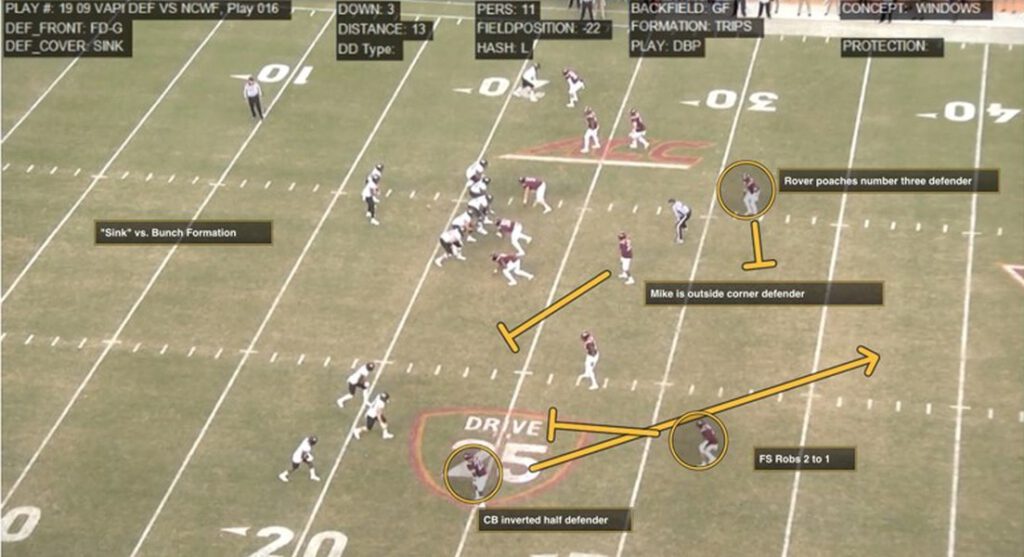
 

Formation Recognition:

One of my first objectives in meeting with Bud was to get his interpretation of how he sees formation structures, particularly as he begins his game-planning process. I wanted to explore how he sees surfaces, pre-snap alignments, and other offensive “pictures” when preparing to attack offenses. I wanted to examine how he envisions attaining structural and personnel weaknesses against offenses. He told me he will start his instructional process by introducing 21 personnel structures first and he’ll use more of a Socratic method when talking to his players about the possibilities of “breaking” each formation. “We’ll talk about what does this mean? What are the possible formations? What do we call them? Then we get into backfield sets. For example, this is an “I formation.” This is “King” (back strong) this is “Queen” (back weak). This is “Split Gun,” etc. You can’t assume players know anything when they get here. Some (players) are coached really well while others have no idea what a pin and pull run game is. So, they need to have formation awareness and recognition because we may want to check out of certain formations. It starts with personnel and formations.”

To say he is extremely particular about teaching formations may be the biggest understatement of my visit. He classified over four dozen in his defensive binder, simply too much to go into here. Of course, coaches are free to tag any formations how they’d like but the emphasis here is to name them, specifically. This way players can reiterate them in the same verbiage. After all, that is how language is taught. This is the progression he follows to teach his players to make the recognition and the corresponding adjustments during the heat of the moment.


Protocols in Pre-Snap Formation Recognition:

Before getting into formation recognition, which is the bigger picture of the puzzle, I wanted to provide insight into the nuances of how he sees the pieces of the formation. Several of these touchpoints were addressed during our sessions, many of which lie in pre-snap alignments. He’s big on the recognition offensive splits, but I believe the difference is how he teaches it and how he has his players communicate it. He builds this communication around what he calls “color” calls, which are explained below:

“Red” Calls- These are run predictors when an offensive line is leaning forward in their stances. These are usually communicated by defensive linemen in front of them.

“Blue” Calls- These are pass predictors when an offensive line is indicating some sort of pass demeanor. These are communicated by the defensive linemen in front of them.

“Yellow” Calls- These are pull predictors, when an offensive line is indicating pull movement by leaning back in their stance. These are communicated by the defensive line in front of them.

He told me these were utilized heavily on non-consequential (first and second downs) where there wasn’t a huge tendency based on the scouting report. “That goes into our scouting report,” he said. “We talk about watching film and asking them why an offense had a big play? What did they do that made it good? Were there any indicators? Were they setting back in their stances?”


Y Off Sniffer Alignment:

Aside from recognizing the alignment of the offensive linemen in front of them, defensive ends are asked to recognize the horizontal and lateral alignment of the sniffer. Communication is made on the following indicators:

  1. Is he on the line of scrimmage or off the line of scrimmage?
  2. How tight is he to the Tackle or Tight end next to him?
  3. How deep he is off the line of scrimmage?


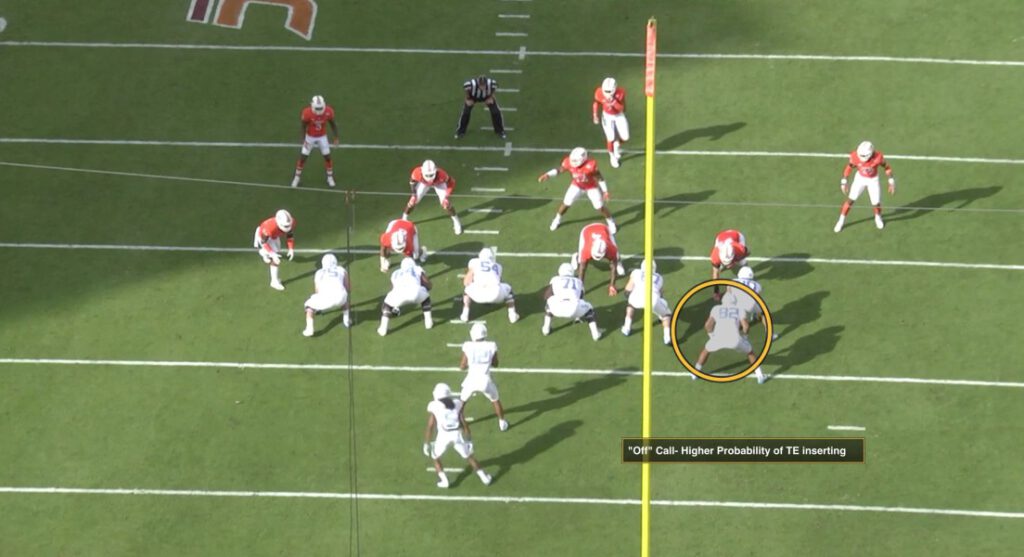
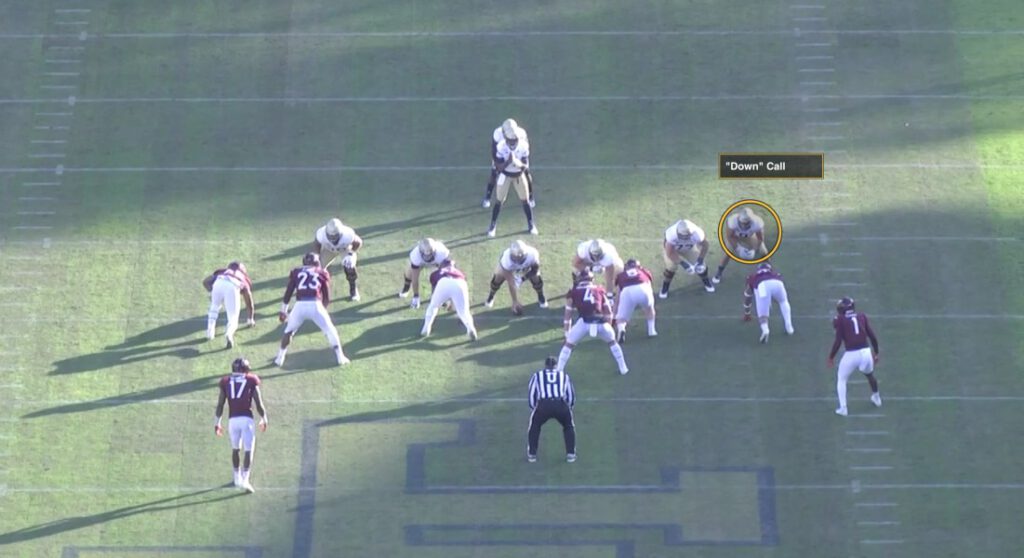
“These sniffers bring different value,” he told me. “Some are fullbacks and tight ends used as blockers and some are athletes that they want to get the ball. You have to look at where they position them. Maybe there are coverages or fronts to use based on if they will use runs if he’s on the ball or off the ball. If he’s on the ball, we always anticipate some type of sweep game or power read game. If he’s off the ball, it can be more gap scheme oriented. Will he be an arc guy across the formation or a lead blocker to the point of attack? If so, we can chain our safeties off him or you can lock the safety down to the side of the tight end so he can track him.”

The following calls are used to identify the alignment of the sniffer as it pertains to the heels of the offensive line.

“Off” Call- Sniffer is set off the line of scrimmage. The predictors are insert zone concepts
 

“Down” Call- Sniffer is down on the line of scrimmage. The predictor is wide zone concepts or concepts where the tight end will stay play side.
 

RB Alignment:

This gets translated to the alignment of the back, which is the responsibility of the Mike and Backer to each identify pre-snap. Each of the following alignments is communicated by that verbiage before the ball is snapped.

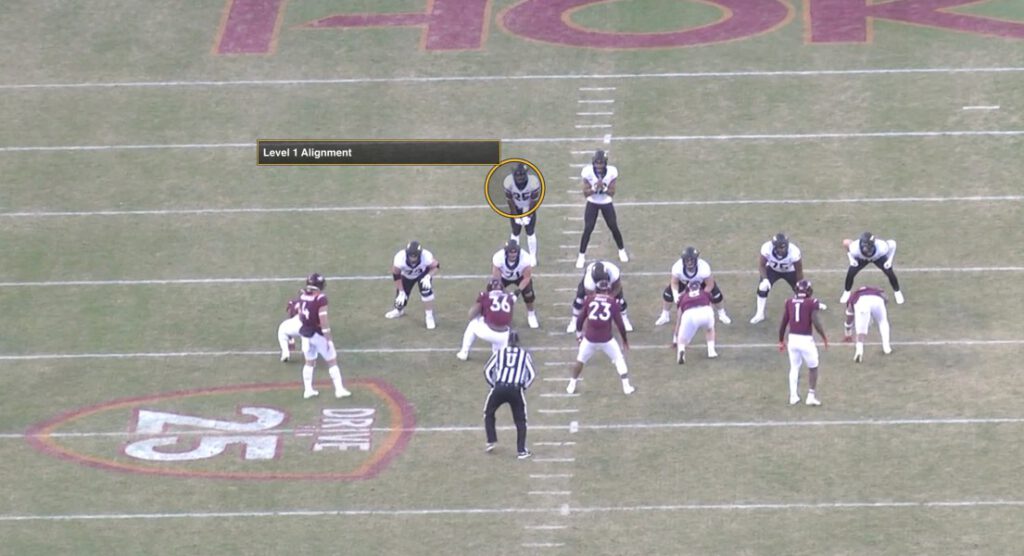
“Level 1”- The running back is even. Predictors are to expect fast flow, perimeter concepts, or pass.
 

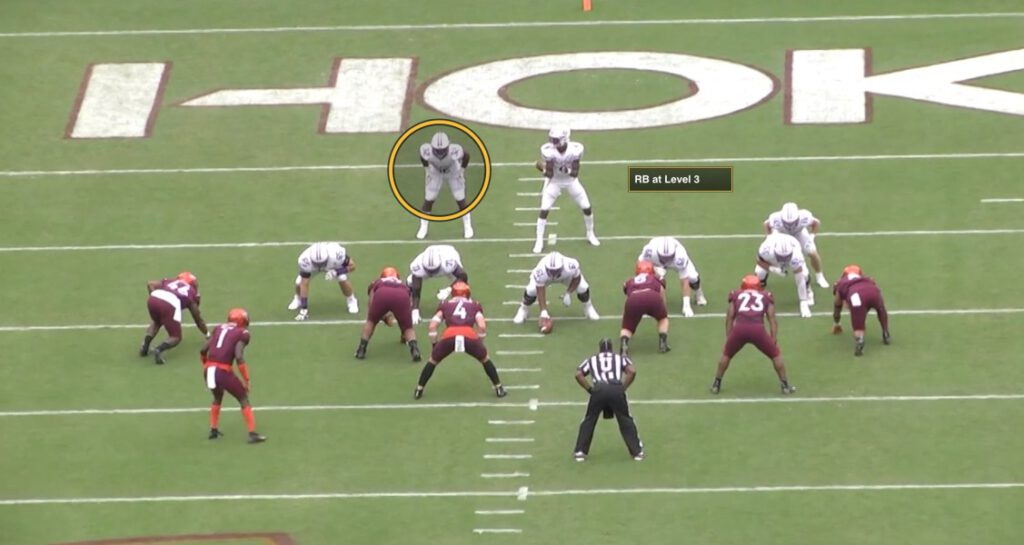
“Level 3”- The running back is deeper. The predictor is gap schemes or tight zone run schemes.
 

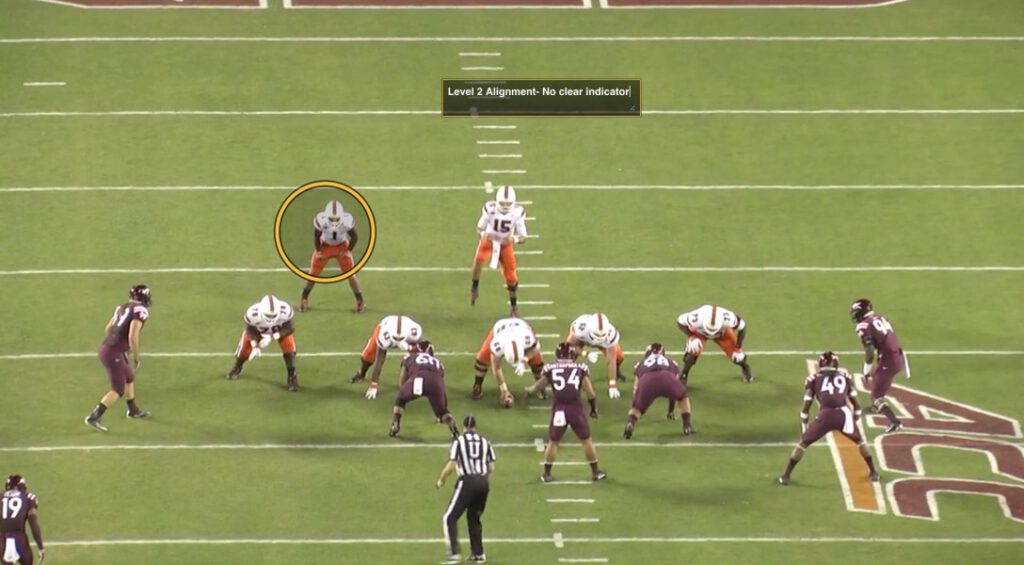
“Level 2”- The running back is between Level 1 and Level 3. No clear predictor.
 

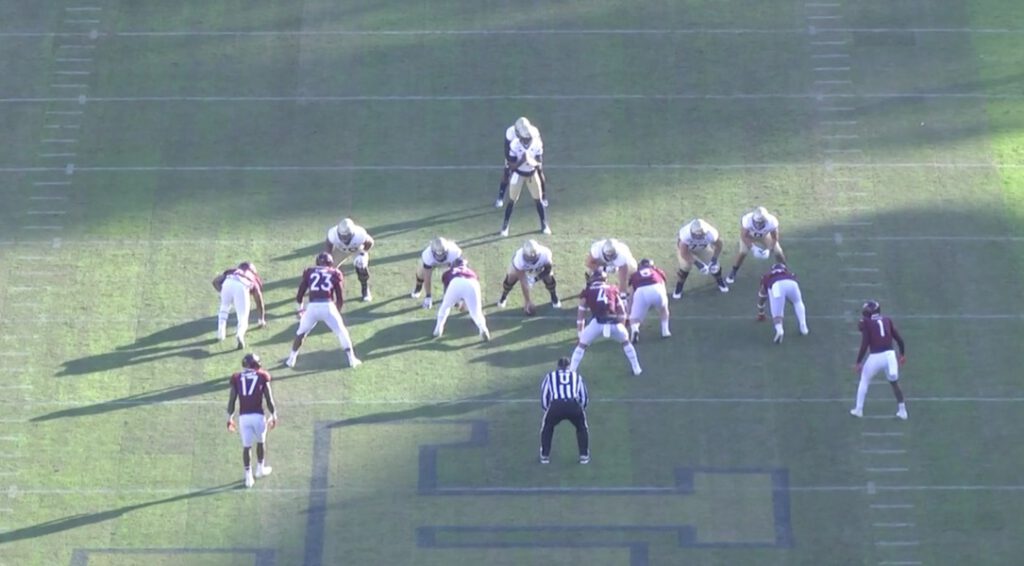
“Pistol”- Clearly, this is a lot easier to ascertain. There are no indicators of power read, though maybe pure power. Expect zone reads, wide zones, and stretch schemes.
 

“Chow”- This means “Cheated Out Wide,” a predictor of the back being involved in the passing game. This would trigger those “Bingo” calls addressed in Ideology 4.
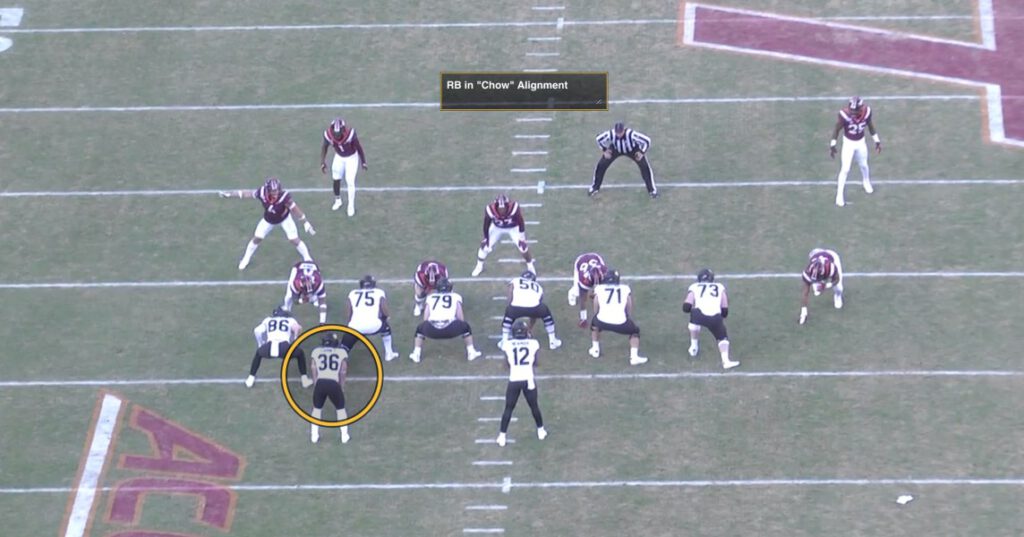
 

In his base communication system, the Mike linebacker is responsible for calling run strength, while the Backer will call out the level of the back. The defensive ends will make the sniffer call. The Free Safety makes a “Rip/Liz” call for the strength and any pressures that are built-in. This may seem like a considerable amount of information for players to retain and communicate pre-snap, but once the expectation is set it gets carried over from week to week. “It goes back to exposing your kids to enough stuff during the week so that they can adjust themselves,” he told me. “I wanted to prepare our defense for the whole season not fragments of it. Of course, there are going to be priorities as opposed to others. But there are going to things we will run later in the year that I will introduce our kids to early so that they can make an adjustment. Some groups can handle it more than others. That’s when you find out who you can rely on. All you are trying to do is give them enough information and rep it enough where it’s possible to retain and understand. Coaches naturally think that way, but players have to start thinking that way.”

When I started my sessions with Bud, I wanted to see how these pieces get put together into identifying formation structures. So, I pulled a formation reel together and sat with him to talk about how he sees certain formation structure. Admittedly, one of the mistakes I made is assuming that most coaches classify each of these formation types (3×1 open, 3×1 closed, 2×2 open, 2×2 closed, etc.) in that same way. It’s something I’ve done as a defensive coordinator myself by placing almost formation types into one of those buckets, without taking back location and pre-snap alignments into consideration. That was certainly not the case with Bud. He looked at everything- from backfield alignment, sniffer alignment and offensive line splits- all to give his players the best information to make the right pre-snap check before the ball is snapped. Because, after all, they were the ones making the checks. This is purely a jumping-off point for Bud. He’s so wired into the intricacies of a formation (splits, alignments, body demeanor, etc.) it was hard to get his mind to think holistically, and not specifically, about a formation type. It was a valuable lesson learned during day one of my visits. But, thankfully his teaching progression builds gradually as time waned.

While the entire narrated footage is included in the Film Room, I summarized some of our conversation below based on several specific formation types. They are in no particular order.

Read More

“The Foster 5” – Innovation 5: The Face Read Fundamental to Defend QBR and “Plus One” Run Game

“Offenses now continue to negate your speed players by manipulating them. So, we continually had to find ways in allowing our players to play fast and attack the offense.”
– Bud Foster, former Defensive Coordinator, Virginia Tech University


By Mike Kuchar
Senior Research Manager/Co-Founder
X&O Labs
Twitter: @MikeKKuchar


The Ideology: Cleans Reads so LB’s can Play Fast

Bud Foster had opportunities to coach positions other than linebacker, he simply chose not to. After all, these were his babies. And he knew they were the pulse of his defense. Ask him who his favorites were and names like Vince Hall, Xavier Adibi, Andrew Motuapuaka and current Hokie Dax Hollifield are some of the first names he mentions. While Penn State may be linebacker U, few programs have had the stardom at the second level then Tech. But there were two reasons for it: one, they had Bud Foster coaching them every day and two, the entire scheme was designed to allow them the freedom to make plays. The premise of the Hokie defense has continually been to stop the run game first. This became a necessity to use all eleven defenders in doing so, particularly in this day and with the running quarterback. So, in order to have these linebackers free to run down plays, he had to take as much responsibility off them as possible. In his scheme there were always build-in force and cutback defenders to protect linebackers who can go run and make plays. “I’ve always had linebackers be able to fast flow with cutback players to help them,” he told me. “I always wanted to turn combination blocks into single blocks right now. I wanted to dictate to the offense.” The premise was to continually have one more defender than an offense can block. “Teams like the Al Groh Virginia teams would change their entire offense by running wildcat when they played us because they thought they would have an extra hat in the run game,” he said. “We believed in not giving up explosive plays in the run game. Over the years we’ve been good because we’ve allowed teams to be one dimensional.”

His entire defensive system is built around diagnosing concepts quickly and triggering fast. But in order to do that he relied on teaching a linear, universal method to all second level defenders. By loading the box, up to seven defenders can have run responsibilities on each play. In order to get all this taught he had to conceptualize it by teaching base principles that can be applied to any second level defender.
This teaching is summarized below:


Numerical Conceptual Reads for Box Defenders:

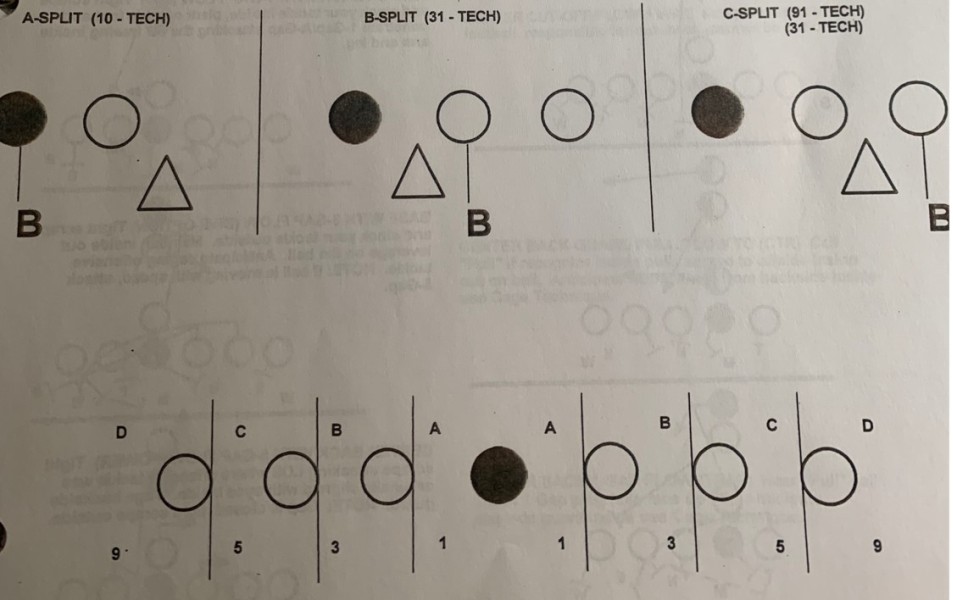
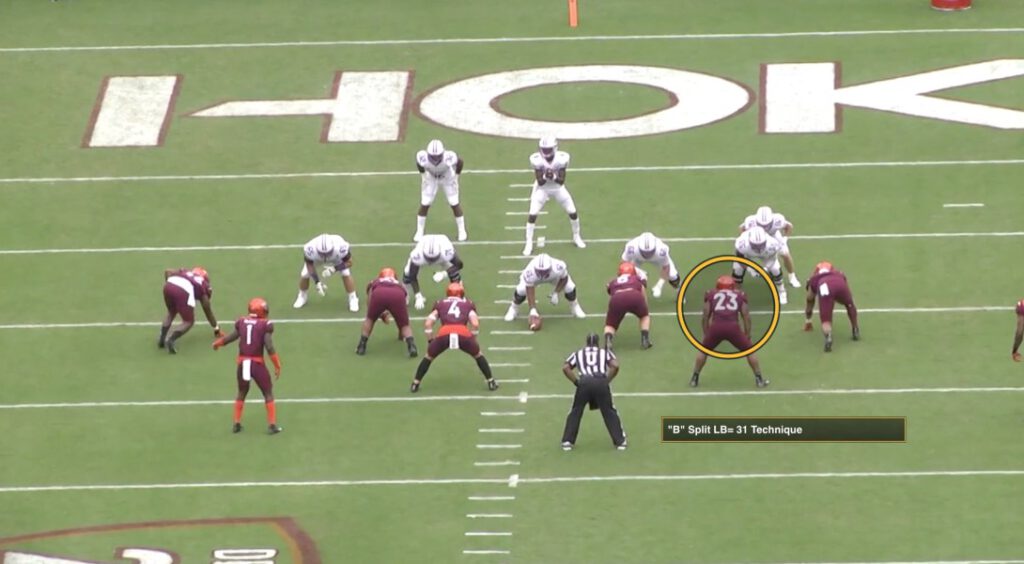
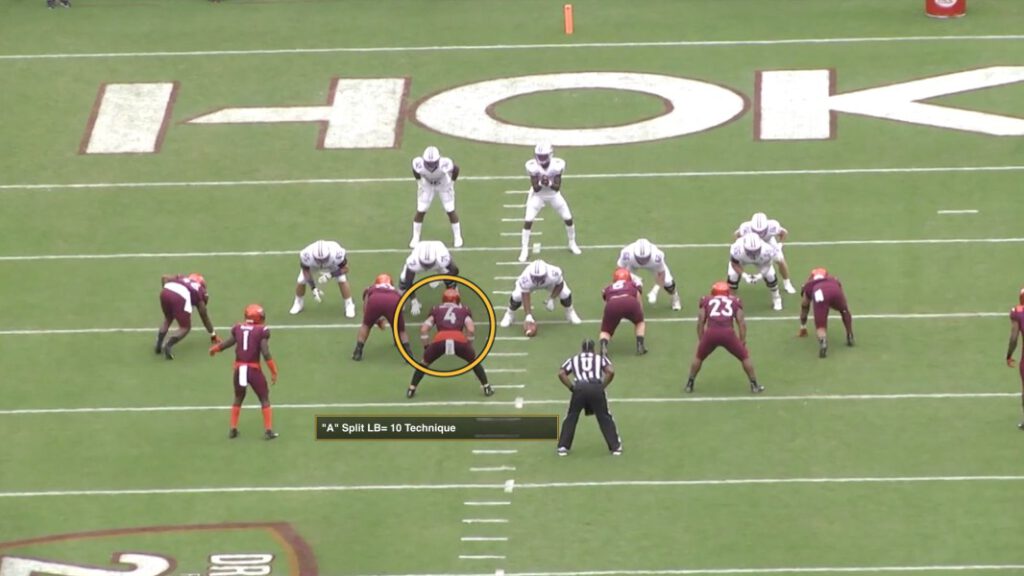
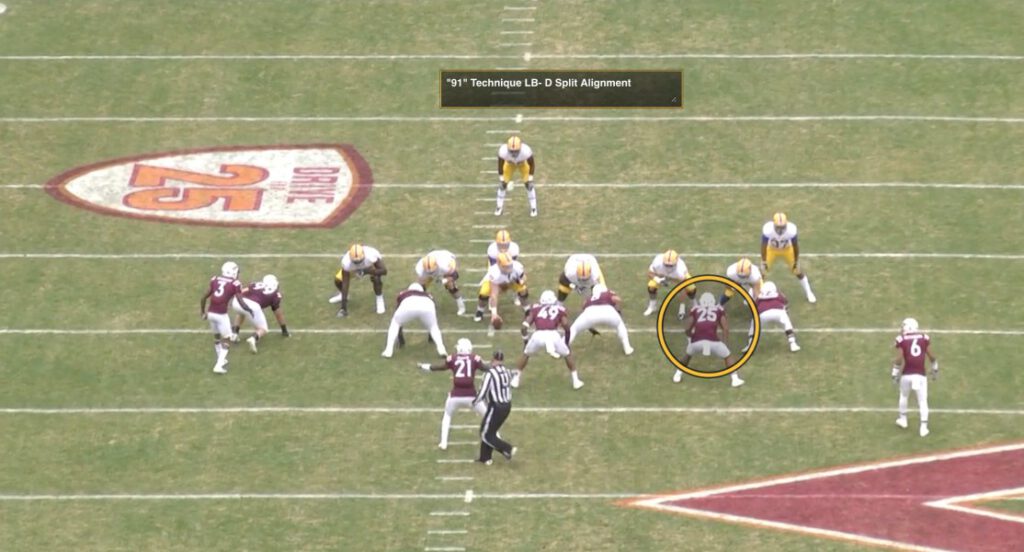
In order to keep reads clean for his linebackers, Coach Foster taught three distinct reads that were universally taught to any second level defender. These coincide with their primary, then secondary gap responsibility:
  • “10” Technique Read- “A” Gap Split Read
  • “31” Technique Read- “B” Split Read
  • “91” Technique Read- “C” Split Read


Any second level defender is either aligned to a two surface or three surface formation. Clearly this depends on the where the 3-technique is set. Those that are aligned to a two-surface, are called a “31” technique defenders. If they are aligned to a three surface picture, they are called “10” technique defenders. There will be circumstances where they will get cheated to a 91 technique based on handle formation overloads, which I explain in a later ideology. And in Bud Foster’s defense, he would set the front using the following protocols:

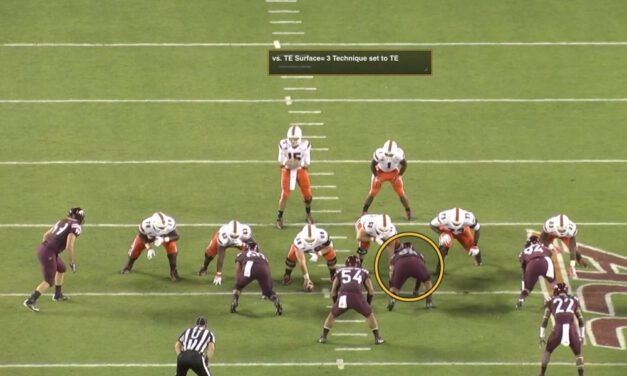
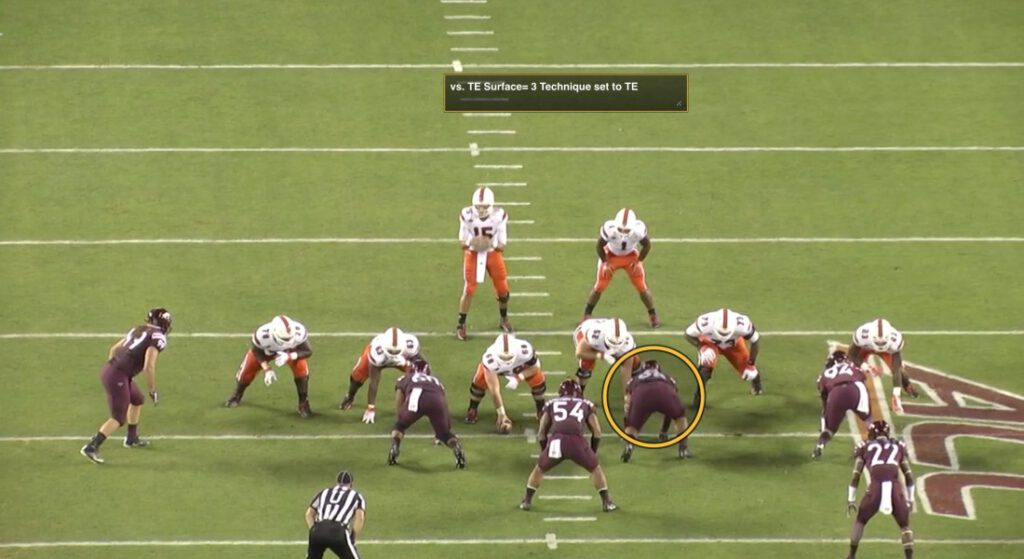
  • 3-Technique usually set to Tight End in three-man surfaces


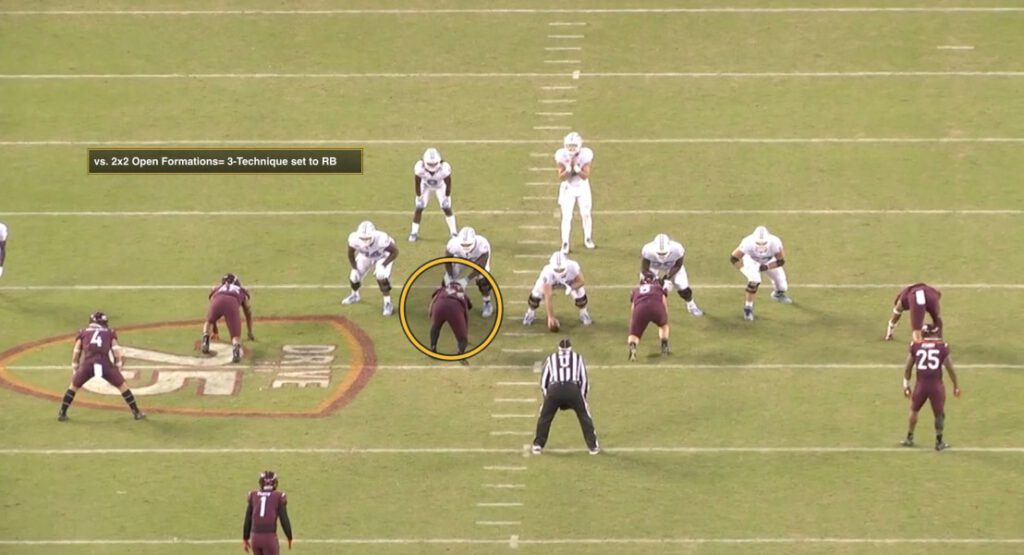
  • In 2×2 open formations, 3-technique was predominantly set to the back


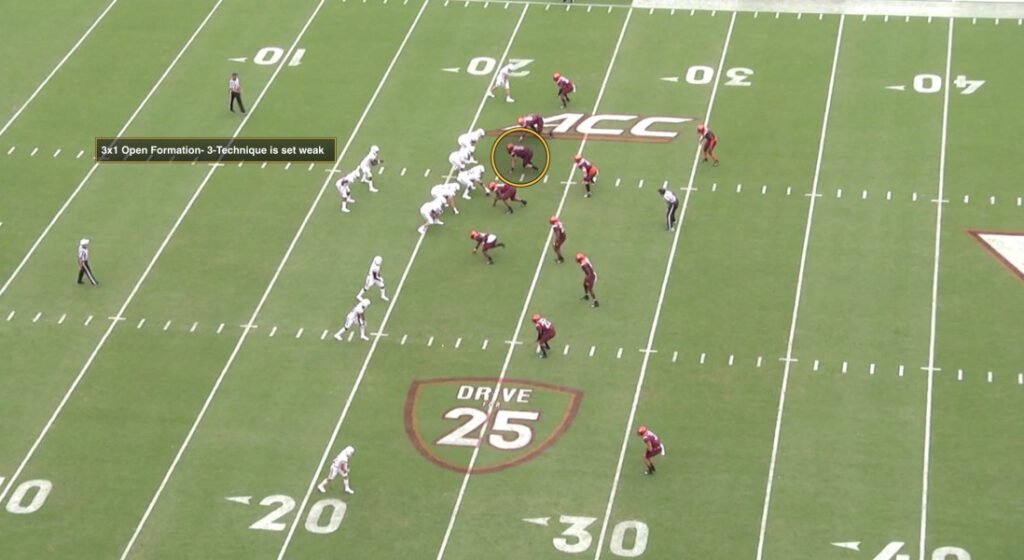
  • In 3×1 open formations, the 3-technique was set weak in order to be gap accountable. There would be times when the 3-technique was set strong if Coach wanted the Rover to be the cutback player.


  • In any man coverage scenarios, the 3-technique would be set to the back but against speed option teams, he may be set away to eliminate the Tackle working to the 10 technique linebacker. “We found teams would check to speed option when they saw us in this look,” he said.
  • If QB was Under Center- the 3-technique was always set to field or passing strength.


Then once the ball is snapped it becomes “flow to” vs. “flow away” reads and open and closed windows. In his system, he differentiates lines of sight between upper planes (what you see) and lower plans (what you feel). For example, in defending Y off run game, box linebackers are expected to see the Y with an upper plane, but feel the line with a lower plane. If players can’t use both those planes, they might be moved to become edge defenders as was the case when James Anderson came into the Hokie program. Originally tabbed as a Mike, when he was moved to play in space as an edge defender he became much more productive.


“31” Technique Reads (B Split Defender):


Alignment: This becomes similar to a 50 linebacker read. His split varied from a B gap split alignment (2i), to shoe to shoe on the Tackle or even stacking the Tackle depending on the back alignment and game plan. If offenses were not outside run threat teams, this player may be cheated towards the B split. If they did have a potent outside run game they may get cheated to go stacking the Tackle. This can also be dependent on the level of the back. Deeper backs signified interior runs (thus a tighter split) while wider backs signified exterior runs (thus a wider split).

Flow To: With flow to, the linebacker is always given the opportunity to gap swap with the defensive end to his side of the window is closed. For any open windows, he’s free to close it, with a responsibility of being a B to C gap player. Many times, he is also given the freedom to close out gaps pre-snap by making a Black call (DE takes B gap) so he can play the C gap. It’s something that Bud used frequently as a “get out of jail free” card to alleviate any second level player of an interior run gap. And it’s a concept referenced continually in this study.

Flow Away: He is free runner in zone coverages and the cutback defender in man coverages. “We would read tailback to line key,” said Bud. “He must feel pullers, but that is their initial read. The play side blocking threat is the Tackle. If there was a threat of bubbles, we gave him the option to close that gap out.”


“10” Technique Reads (A Split Defender):  


Alignment: Split the Guard and Center

Read: Here, Bud felt that the Center is the truest read and this player will read the Center to triangle (both Guards). His rule is the A gap to the ball.


“91” Technique Read (D Split Defender):


Alignment: His alignment is to a 3-man surface. “91” meant he was a D to A gap player reading the tailback to offensive line. “He has to identify who may be the play side blocking threat,” said Bud. “It can be a tight end or the tackle. He will often have the alley as the force defender.”

Flow To: D gap player.

Flow Away– A gap player.


“51” Technique Read (D Split Defender):


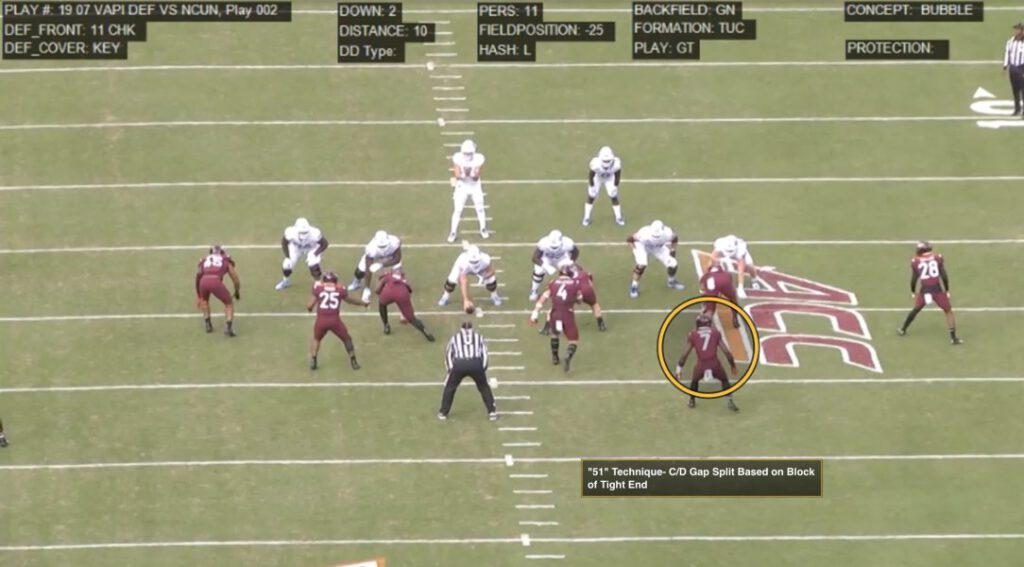
Alignment: This could be something the Corner needs to be in if it against a Nub set. He will have C or D gap based on block of tight end. If the tight end fans, he enters the C gap. If the tight End blocks down, he would scrape outside. Of course, there would be instances when Bud would swap the Rover and Corner to get quicker run support against three-man surfaces.


Block Destruction Rules:

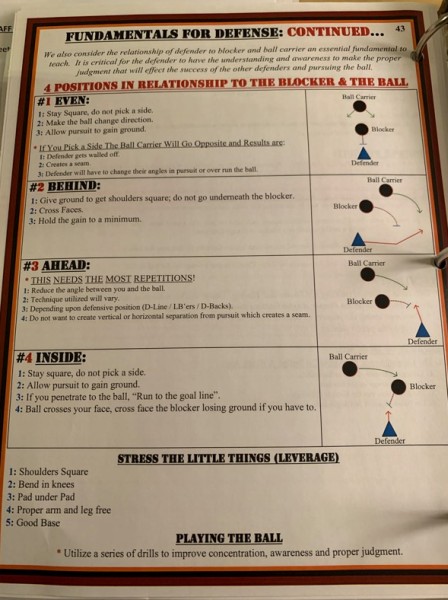
This universal teaching of alignment and flow correlates with universal base block destruction rules taught to each position. Each defender is taught how to attack and disrupt blocks as it pertains to four distinct scenarios:

  • “Even”- Defender is even with blocker
  • “Behind”- Defender is behind blocker
  • “Ahead”- Defender is ahead of blocker
  • “Inside”- Defender is inside of ball carrier


This teaching is detailed from his playbook below:


The Impediment: The Advent of the Dual Threat QB and QB Designated Runs

Back in the mid 1990’s when Bud Foster took control of the defensive reigns in Blacksburg, there was one program majoring in option concepts: Syracuse. And while they ran their lethal midline option flawlessly, it was one of the few times that he had to defend a legitimate dual threat quarterback. By the time he retired in 2019, every opponent on the schedule had a signal caller that could be a run threat, some more so than others. Which means he couldn’t just sit in a base six man box and expect to match hats. He had to get creative, particularly in the way he was teaching run fits. This came with using a similar progression he taught linebackers and carrying that over to teach safeties who were often asked to be the additional run fitters to combat this offense.

Read More

“M.L.B.” Progression in Offensive Red Zone Design

By Nicholas Marcella
Offensive Coordinator
Rensselaer Polytechnic Institute, (NY)
Twitter: @Coach_Marcella


There are few things truly routine about a football game. You have the coin toss. You have the National Anthem. You have a parent yelling the invaluable coaching point, “Hit somebody” on the opening kickoff. The rest is unpredictable, especially when it comes to modern defense. Turn on the TV on Friday, Saturday, or Sunday and you will see more 4i’s than 3-techniques and base alignments with three safeties. Defensive coaches have entire clinics on “sim-pressures”, they have cornerback athletes playing their overhangs, and what they are presenting pre-snap is vastly different than their post-snap fit. An exception to the chaos and evolution of defensive football is that defenses still predominantly play man coverage in the Red Zone and Goal Line. Man coverage allows the defense to be plus 1 in all run situations and Cover 0 gives them answers for QB pull and run game. Defenses have even added zone aspects to their man structures to combat rub or pick concepts. At RPI we have a three-step game plan progression to exploit coverage in the Red area which we call MLB: Matchups, Levels, and Behind the Line.


Matchups:

The first step in the progression is Matchups. Rick Flair once said, “To be the man, you have to beat the man.” Something all offensive coordinators will agree on is that you need to design plays to get your best players the football. If you have a matchup that you can consistently win, that should be your first option.


Coaching Points:

Because we call a run play and tag it with “Choice” the QB must be coached on the situations in which you want to go to the matchup. An easy way to control this as a coach is to simply not call choice and run the ball. If you call choice, and he takes the shot, you cannot be angry with him for taking that chance. Additionally, taking a deep dive into a film can help you discover the matchups you want. If your best receiver is a slot, there is no harm in aligning him up as the widest receiver. Formation tags or my favorite, “Hey, you two switch here” are great ways to get the look that you want. To call the Choice route, the QB communicates to the WR via hand signals. They create them on their own, and I do not know what the signals are. It is key that the QB gives the signals on run plays or plays not tagged with a choice. Another crucial element to the success of this play is to specify the protection you want triggered to prepare your offensive line and running backs for the check.

We practice our Choice routes every single day. Where the QBs and WRs get the most reps is during special teams’ periods where they are not on the depth chart. Some days this will mean that they get an entire 20-minute period to work, and other days they may only steal a few reps. At RPI you can see QBs and WRs that get to practice early or stay after for extra reps working on Choice. Even when it is just the QB and WR working, the coaches reinforce that the QB should be triggering the protection of the week that accompanies Choice.

To find matchups we like, we grade the opponent’s secondary in man coverage situations.  Each defender in man will receive a (+) grade if they have covered their man, a (-) if their man was open, and a (n) neutral if you cannot determine. We want our best players matched up with the defensive players that have accumulated the most (-) grades.

How we accomplish this at RPI is to present a run-heavy formation from a tendency standpoint. We will call a play, run, or pass, with a “Choice” tag. If the QB likes a matchup, he will call off the initial play, verbally trigger the protection, and exploit the matchup. The QB will give the route to the WR via hand signals that they create independently. Our play communication works in the traditional Formation, Play, Tag format.

Read More

Complete 3-High Defense Pressure Package

By Adam O’Neill
Defensive Coordinator
Manhattan High School (KS)
Twitter: @23adamoneill


As 2020 went, our preparation in summer and preseason was as difficult as ever.  After our first 3 games, it was clear that some of our normal coverages and pressures were going to be difficult to implement.  In a normal summer, we would have participated in weekly 7 on 7’s and attended several contact camps.  During the summer we work to install our base defense and our different pressures.  At Manhattan High, we play a 3-4 2 high safety structure.  We like the flexibility it gives us to change fronts and coverages.  Generally, we have lots of opportunities to install our coverages, heavy in quarters concepts, live against several schemes and formations.  We also like to play some 1-high concepts to close the middle of the field with our pressures.  Because of the uncertainty of 2020, we began looking at more man concepts as we were concerned that we could lose players to illness and quarantine.  We hoped some man concepts would be easier to plug and play if we needed to borrow from our offensive platoon.  However, as we did get into situations where we needed to move some kids around in the first few weeks, we simply became short in the secondary.  Though some of our man pressure concepts were effective, the jump ball became an issue.  We often like to solo the single WR and that became difficult as well.  We needed a way to protect some of our smaller corners and we needed some simple ways to get to our zone concepts against some mobile quarterbacks and speedy skill players.  What we needed was the ability to play with zone eyes and continue to help our backers and secondary play aggressively.  We felt like some simple 3-safety concepts could help us continue to put pressure on offensive pass pro and give our secondary clearer and simpler rules as we needed to change personnel from week to week.

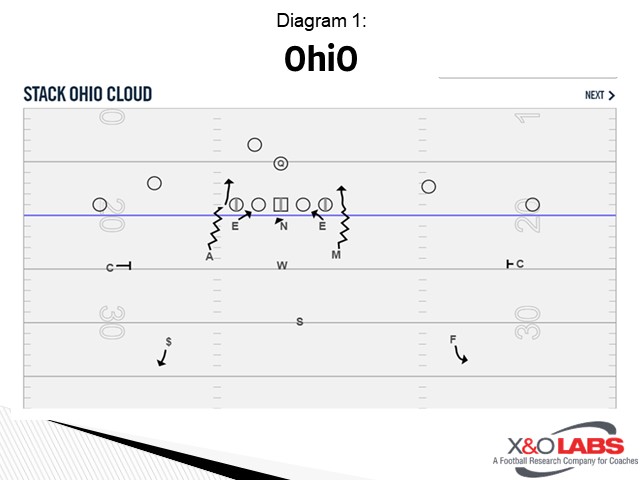
We started by installing two main 5-0 pressures with zone concepts behind them.  These pressures could have easily evolved to man pressures, but this year we did not want to have too many.  At Manhattan, we believe in teaching concepts and as many one-word calls as we can so that we can easily transition to up-tempo teams.  Our 5-0 stack pressures are named after states because there are 50 (5-0) states.  Ohio was our first installation and an effective pressure we use against Inside Zone and sticks throwing 10 personnel teams from our 3-4 base.  It is a simple edge pressure paired with a pinch to a bear front.


Our boundary Anchor backer simply stacks to a wide 5 and our Will and Mike slide to 0 and wide 5.  For our inside backers, these are alignments that we will use sometimes against trips, so the stack was an inexpensive install.  Our Anchor is often walked to 3×3 from the end man on the line of scrimmage, so this alignment was not uncomfortable for him either.  Our 0 (Will) backer can mirror the back or play the low hole against the pass.  Our D-line remained in a 4-0-4 front.  The first O in Ohio speaks to the stack backers telling them to creep and blitz a hug or peel technique on the back.  The second O in Ohio speaks to the secondary telling the most Outside defender or the corner that they have flat and force. Our Safeties then essentially pre-aligned in Tampa and played a simple Tampa concept.  Our nickel is our main adjuster.  He moves to the high hole.  He reads the mesh for run/pass.

Individual Coaching Points

  • OhiO = Rush 5
  • Anchor and Mike hug rush C gap
  • Will mirror back to low hole
  • Mike and Will yell “pinch” for D-line to execute Bear fits
  • Corners hear the last syllable “O” and know they are force/flat cloud defenders
    • The O speaks to the corners because they are the furthest Outside defenders
  • Safeties are aligned inside the corners, so they play Tampa
  • Spartan (nickel) aligns middle of the field with eyes on the mesh to the high hole or game plan


Speed Option and other flexbone concepts have highly influenced many of the offensive teams we see, and we always must be ready for those types of option plays.  A common check for offenses against Bear-type fronts is to run speed option.  Many of our opponents will attack bear fronts with edge QB runs.  In this alignment, our squat corners are ready to attack quick game and set the edge versus outside run and option.  Our nickel can also run downhill and is often unaccounted for in the blocking scheme.

The pressure paired with pseudo-Tampa coverage gives several advantages on third downs situations.  Each offensive lineman is going to be occupied in pro.  We will likely get a good matchup with a good athlete coming off the edge and we present scanning issues because all of our opponents know that our defensive linemen are not going to stay static.  In our scheme, our defensive linemen will either slant to the next offensive lineman’s hip, gap to the near hip of the offensive lineman he is aligned over, or angle 2 gaps on a long stick.

In coverage, we all have zone eyes.  The pressure we are going to call mostly in passing situations and the edge pressure usually is going to get the ball out quick.  The front remains solid versus many runs as most offensive coaches are not going to get excited about blocking a bear front.  We like this pressure against teams that like to throw wide receiver screens in third and long situations.  Also, many teams will not be shy about trying to take shots at their best receivers on third-down scenarios.  If the best receiver is a split end, we get a one under one over double in coverage and the 3 high alignment creates some ways to double slots, as well.

Read More