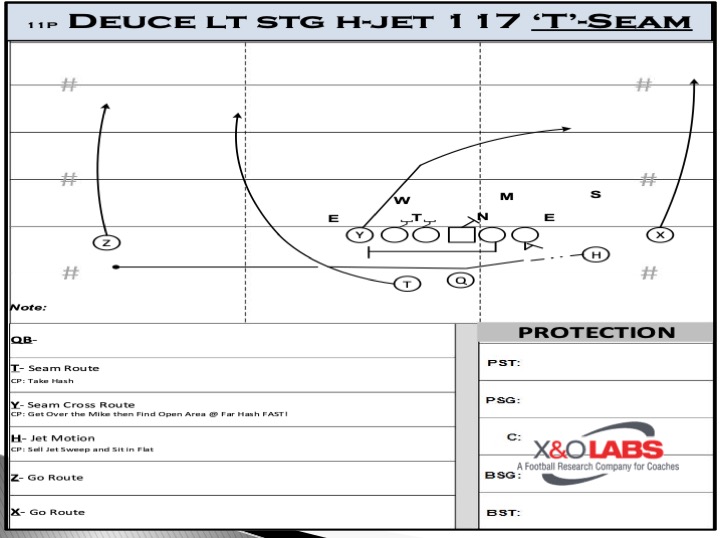
The Bench Route Series and Tags

By Danny Dupaix
Offensive Coordinator/Quarterbacks Coach
Southern Virginia University (VA)
Twitter: @coachdandupaix


Entering my 5th season at Southern Virginia (DIII), we have made good progress towards our goal of competing for the conference title annually, but we still have plenty of work to do! We’ve seen improving success year-over-year for the past 4 seasons on the offensive side of the ball.

When I became the OC, I was tasked with transitioning a traditional flex bone triple-option offense into a power-run spread offense. We are still based on triple-option principles in our run and RPO game and we run out of many different formations, personnel groups, and shifts. As we continue to build the program here at SVU, we want to continue to grow and evolve as an offense to be on the cutting edge of innovation while running the offense behind our strengths, especially at QB. In the past, we’ve been better runners than passers and so we’ve utilized a lot of zone read. This past year, our QB could throw a decent ball and so we called more plays in the pocket.

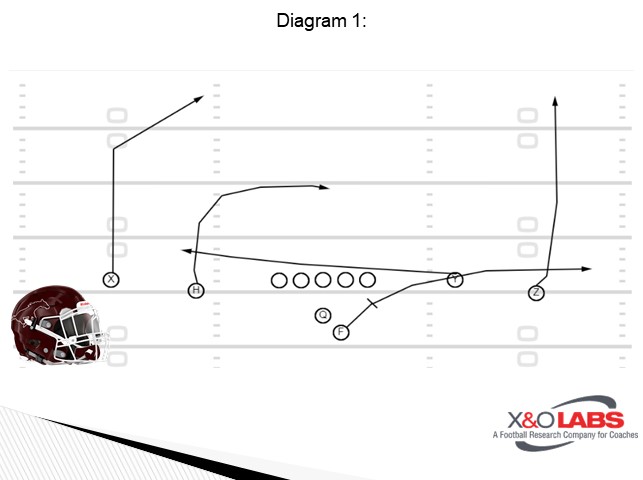
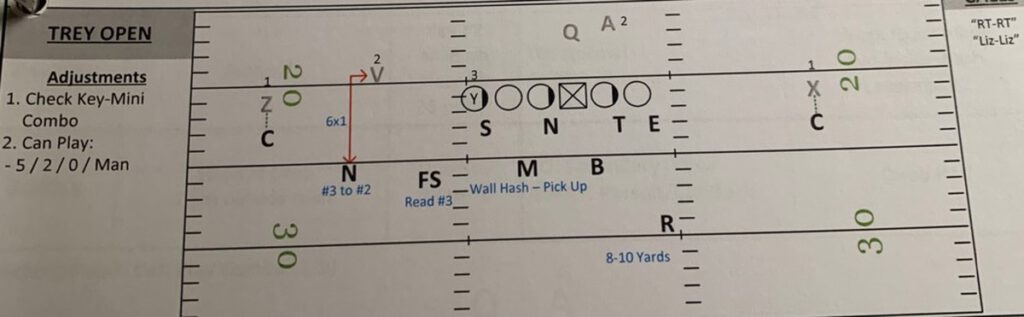
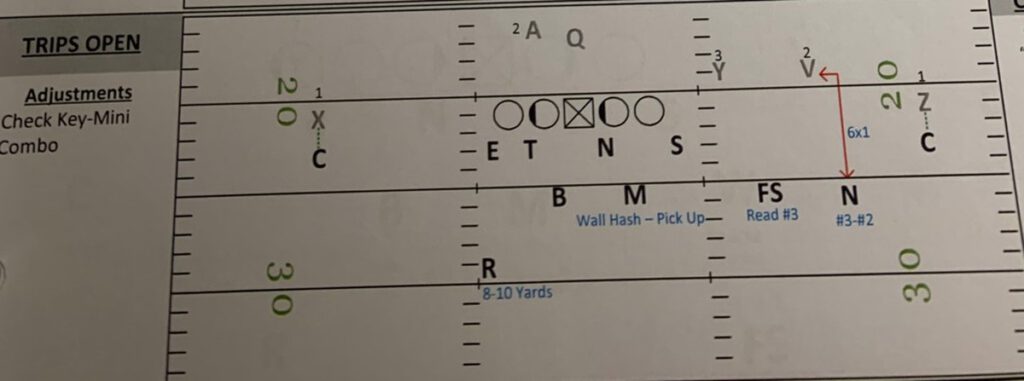
In this report, I want to highlight the bench, one of our route concepts that we arguably need to call more often. I have always loved the bench route. When it’s thrown on time, it is really hard to defend in Man and Cover 3. Against Cover 2 and 4, our route combos can cause havoc on the conflict defender.

We track stats from our team period vs scouts knowing full well that it is not a true indicator of success. For our bench route, we’ve had great success in practice- calling it only 5% of the time. In-game, we regrettably only called it 1% of the time and it produced 6% of our offense, averaging over 13 yards per completion and creating multiple explosive plays (16+ yards). It is an every-down call and works in open field and RedZone situations.

What I will convey in this report is how to have a simple route concept that is easy to install and has the ability for big plays. I will also show a few variations that can be tagged on to support it.


PROTECTION

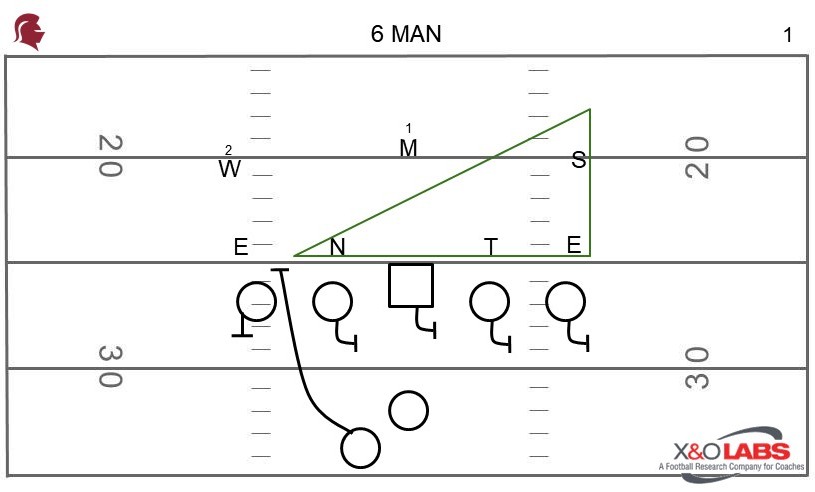
Everything begins upfront. Although this play often gets the ball out quickly, we want to be polished and sound. I will not, however, detail out the OL techniques in this report. The first protection is a six-man half slide.


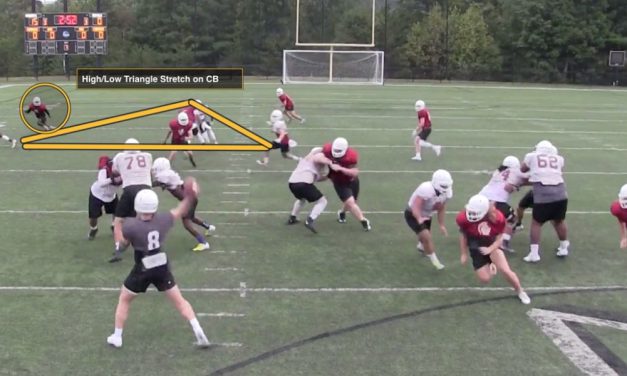
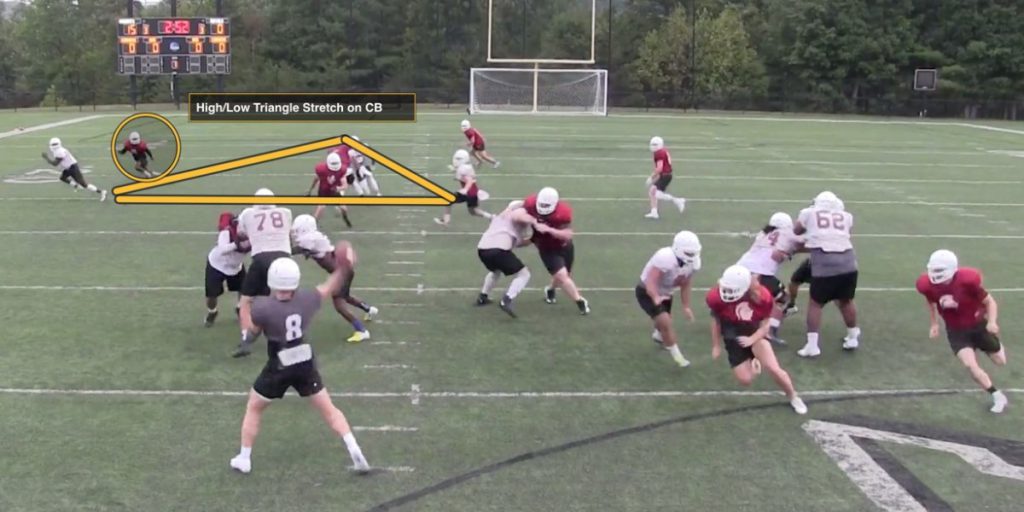
  1. The first uncovered OL working BS to PS will begin the slide. Each man will protect the PS gap. In this diagram, the PS is right.
  2. The slide side will account for the DL and LBs to the PS.
  3. The PST will stay big on big.
  4. The RB will account backside for the Lbs. Reading inside-out he will take the most dangerous man (MIKE to WILL).


The second way you’ll see in this report on how we protect is through play-action. We’ll look at two protections: inside zone (similar to six-man half slide) and split zone (seven-man full slide).  These plays sell beautifully and we end up with a lot of 1-on-1 matchups.

Read More

The Hunt Route in the Shallow Cross Concept

By Chris Norton
Head Football Coach
Perryville High School (AR)
Twitter: @Coach_Norton


Shallow is one of our bread-and-butter pass game concepts and a day one install for us here at Perryville High School.  Offensively, we practice and plan like an Air Raid program and believe that Shallow (91) – an Air Raid staple – is one of the most efficient concepts available in the passing game. You provide a simple read for your quarterback, three underneath options to get the ball to, and have a chance to put it in the hands of a fast kid in space.

While I still glean a tremendous amount of information from Coach Leach, Coach Riley, Coach Hatcher, and other Air Raid guys at the collegiate level, we do have some stark differences offensively. Foremost, we choose not to install traditional mesh (92). I find it too expensive, whereas Shallow gives some of the same benefits with a much “cheaper” installation. Breaking from the traditional Air Raid rules for 91, we also utilize some different route rules that we believe have made this an even easier read for our QBs.


The Rules


In the diagram above, we have Y Shallow called from an open 2×2 look. We are a concept-based team offensively and work extremely hard to teach the rules of each concept and how they fit together – allowing us to get creative formation-wise once those rules have been taught and grasped. We will build on some of these additional formations soon.

As above, we’ve tagged the Y on the Shallow cross. Our coaching point with the crosser is to take the easiest available release, replace the heels of the defensive line and run like his hair is on fire and his butt is catching. One of the issues you run into installing Shallow is the crosser’s hesitance in the middle of the field as they are concerned about LBs aggressively collisioning them. That is why it is critical to sprint the Shallow – it’s much more difficult to hit a moving target. Further, as we install the concept, we work to make a point that if the LB collisions the Shallow aggressively, chances are high that we can fit the Hunt route in behind them, as you can see below.


We utilize the Hunt route differently than a traditional dig when we call Shallow. I stole this idea from a friend of mine in the profession and think as he did, that it helps the concept time up better in the middle of the field. Our rules on the Hunt are simple – take an outside release on the head-up or inside-most defender to keep the crosser from flashing their eyes and “banana” the route into the middle of the field working to find grass 7 to 10 yards over the ball vs. zone. The receiver does not necessarily have to stay outside the defender – we just look to force him to open away from the crosser. There is no stick and break as you’d typically see with a dig. In the event we get man coverage, we tell the Hunt to continue running to the opposite sideline. We ID man coverage simply – if the Hunt sees someone chasing the crosser, it’s man, so keep running.

Our outside WR to the Shallow side will run a MOR (mandatory outside release) route. He is trying to take the top off and clear out room in the middle of the field for the Hunt or Post. His responsibility is to get vertical as quickly as possible.

To the Hunt side, the outside receiver is running a Post at 10 yards. This route creates levels in the middle of the field – the crosser underneath, the Hunt at LB level, and the Post over to the top to hold safeties.

Our running back has a check release shoot route to the Shallow side, so in the diagram above, the Y is running the Shallow therefore the RB is running his shoot to the right side. First, we must follow our pass pro rules, if pressure presents itself the RB must stay in to protect. If his blitz responsibility drops, we get into our route. The rules we use for the shoot are simple – work one yard past the line of scrimmage toward the sideline getting width fast. We want to force the opposition to defend the flat.

Read More

Double Cloud Coverage Drill Work from 3-High Alignments

By Marty Gibbons
Head Coach & Defensive Coordinator
Lake Catholic High School (OH)
Twitter: @Marty_Gibbons


Do you find yourself spending a lot of time teaching man and zone match concepts to your players? Are you struggling to find a complement where your players can play fast without thinking and not worry about matching up with your opponent? Would you like to create more takeaways in passing situations and get your players excited about defending the pass? Vision and break coverage may be the tool that can answer these questions for you and your players.


Vision and Break Coverage System

At Lake Catholic High School our defense deploys vision and break coverage within our 4-under 3=deep coverages in a call system. Our base coverage is to play zone or man match, so we feel it is important to have true zone elements within our defense to create takeaways and give our players the ability to play instinctively off the quarterback.

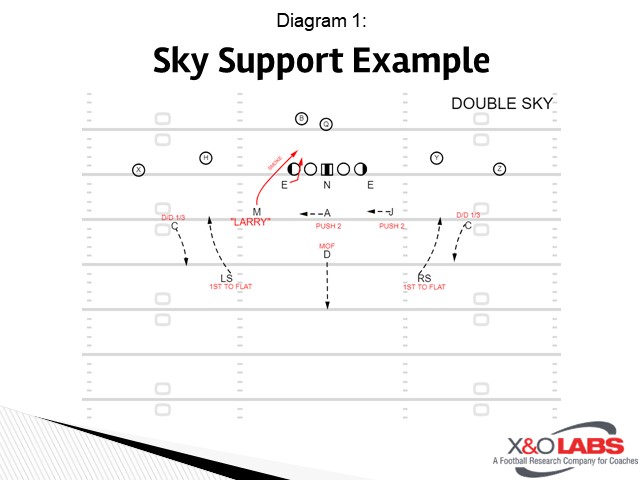
We will play this style of coverage out of sky support with one safety deep and two corners deep.


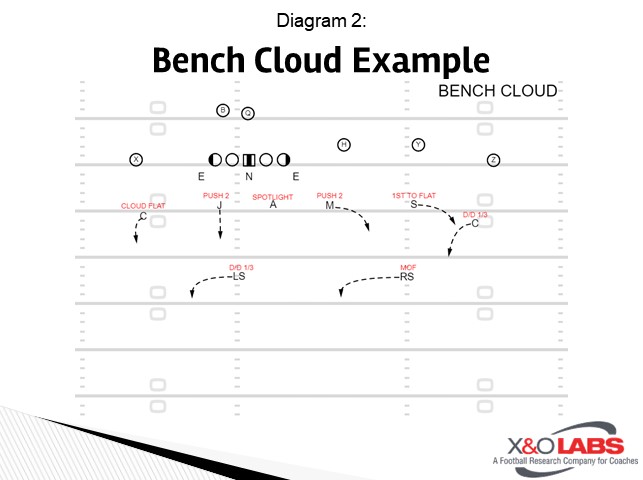
We will also play with cloud support and backer support with two safeties deep and one corner deep.


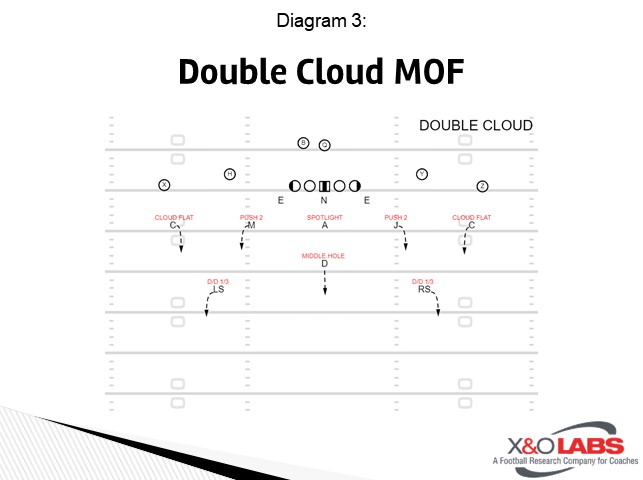
In this report I am going to focus on playing with double cloud support. In this structure we play a Tampa 2 based coverage, which is still 4 under 3 deep.

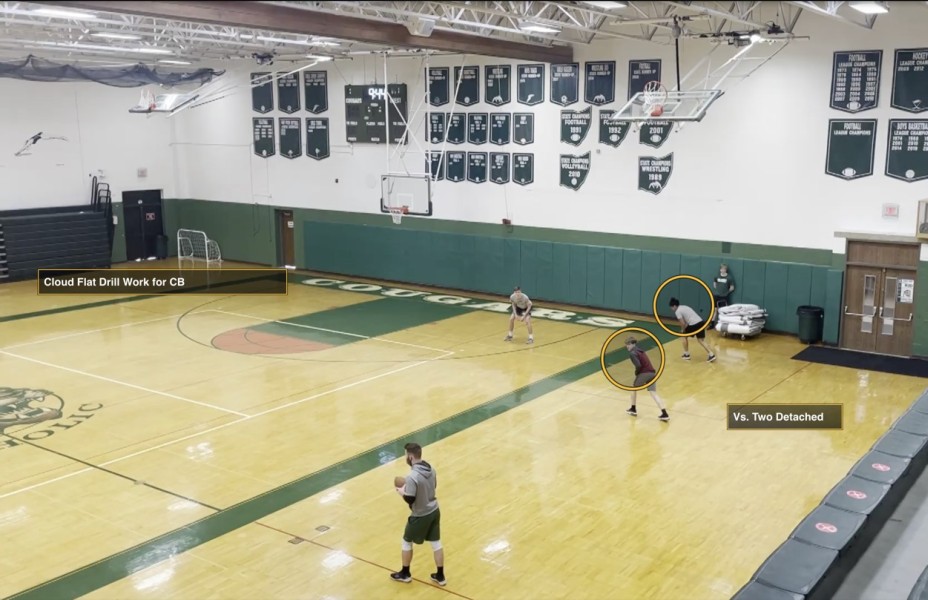
Our Corners are cloud flat defenders.

Our Apex Defenders are hook defenders.

Our Safeties are Deep 1/3 defenders.

Our Dime plays a low hole technique.

Middle of Field (MOF) Alignment Rules:


Corners: 1×5 Inside #1 Receiver. (Depth can change based on situation)

Apex Defenders: On or slightly inside hashes. (Depth varies based on situation)

Safeties: 4 Yds Outside Hash 12-15 Yards Deep.

Dime: 8-10 Yards Deep on Goalpost.

ILB: 4th Rusher. Spotlight technique means they will hug rush the QB after clearing screen.


Hash Alignment Rules:

Read More

9-Technique Training Manual in Odd Structures

By Brian Klee
Defensive Coordinator
Coloma High School (MI)
Twitter: @coachklee


Dynamic play by outside linebackers within a base 3-4 personnel defensive scheme can provide a defensive coordinator the flexibility to adjust multiple formations and offensive schemes that can vary greatly from week to week or sometimes even within a single game. This aligns with a “Keep It Simple but Sound” coaching philosophy where a coach decides to give their scheme the best combination of simplicity with enough answers to problems.  Within a base 3-4 scheme, the key to this principle is the outside linebacker positions. Therefore, the best all-around football players with a good combination of overall athleticism and football IQs typically should play at outside linebacker. While those outside linebackers will often develop strengths when playing from the different alignments or executing specific fundamentals, all of them are coached up to have the skills necessary to be successful and provide the versatility to make a base 3-4 personnel defensive scheme sound.


ALIGNMENTS


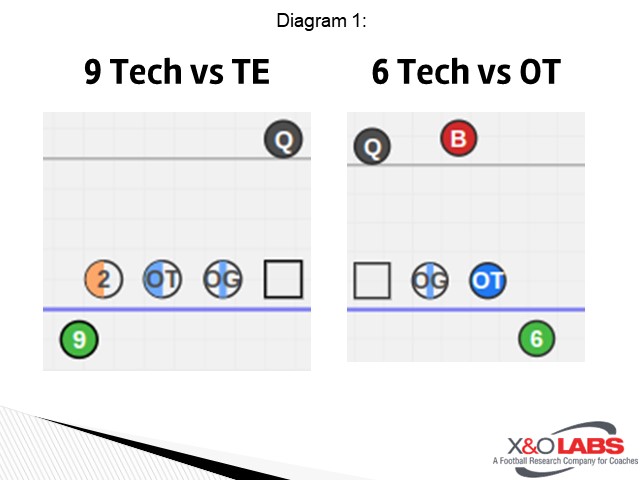
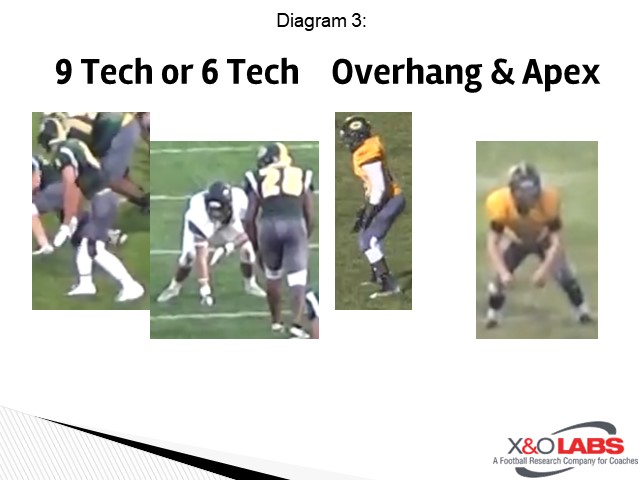
We ask a lot from our outside linebackers in terms of playing from multiple alignments. First and foremost, our outside linebackers must be able to play as a 9-technique on a Tight End or as a 6 technique outside the offensive tackle over a “ghost” Tight End. Regularly playing up on the line of scrimmage is probably the biggest difference between a 3-4 outside linebacker and outside linebackers in other base personnel groupings as calls will often align 5 defenders on the line of scrimmage.


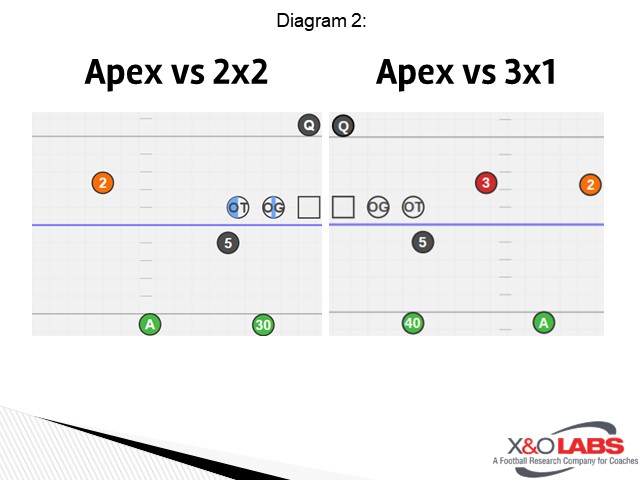
Based on game planning and situations such as down and distance, we also obviously will have our outside linebackers play as overhangs 5×4 off the end man on the line against 2-back sets, apex between the offensive tackle and number two receiver against 10 personnel 2×2 sets or apex between the number two and three receivers in 3×1 sets. While outside linebackers remain run first defenders from these alignments, they play a key role in some of our pattern match coverages.


STANCE


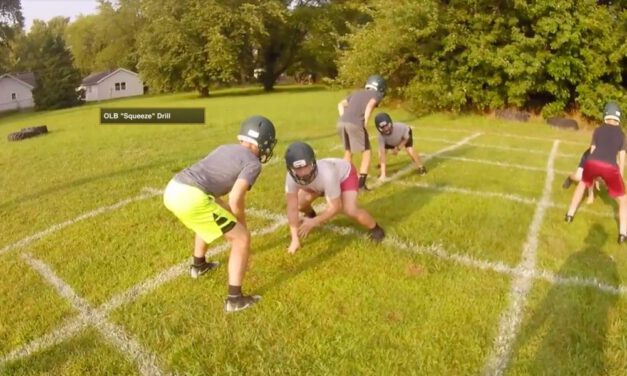
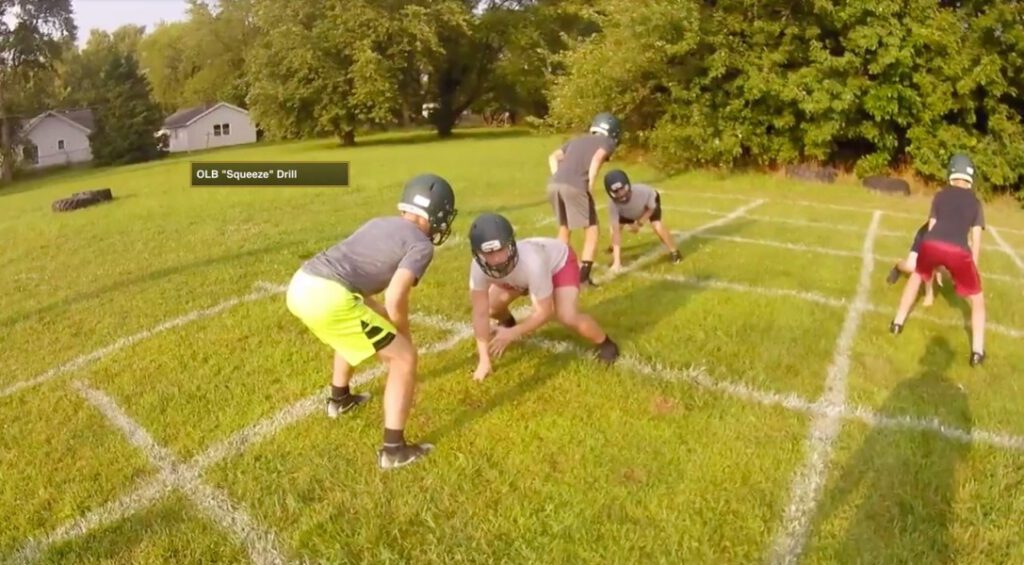
Our outside linebackers utilize 2 stances. Both stances have a shoulder width base with a “z” in the knees and ankles creating power angles.  When aligned on the line of scrimmage the stance is a heel-to-toe stagger. In previous seasons we’ve coached an outside foot forward and inside foot back because it matched the stance of our defensive lineman. This past season we coached an inside foot forward and outside foot back with the rationale that it allows for our outside linebackers to maintain outside leverage more easily against a reach block. When aligned off the line of scrimmage, the stance is more balanced with no stagger just like our inside linebackers to allow for quick movement in any direction to react off our key read.


9-technique FUNDAMENTALS

In a 3-4 defense, the use of a 9-technique outside linebacker aligned in an outside shade on a Tight End with their inside foot on the outside foot of the Tight End is crucial to making the defensive versatile against the variety of formations that utilize 32, 22, 21, 12 and 11 personnel. The fundamentals needed to effectively play as a 9-technique include:

Start, Step & Strike
Stretching a Reach Block
Squeezing a Down Bock
Spilling a Kick Out Block (Cannon)
Forcing a Kick Out Block (Dog)
Hip Pocketing a Puller


9-TECHNIQUE: Start, Step, and Strike

We begin by drilling the start, step, and strike. The point of the step and strike is to control the block of the Tight End. To emphasize low pad level, we often do the drill coming out of chutes. The 1st step is with the outside/back foot while beginning to throw the strike. This is followed by the 2nd step with the inside/up foot before delivering the strike aiming to contact with the outside hand on the lower rib just outside the breastplate and the other hand at the bottom of the sternum just under the breastplate. Each step should be “out of the footprint” with the heel landing slightly in front of the previous alignment of the toe. By the 4th step, we want the outside linebacker to have made his read and reaction to destroy the block.

Read More

Drive Catch Technique in Sprint Out Protection

By Nathan Tanner
Head Coach
Parkersburg South High School (WV)
Twitter: @Mr_Tanner23


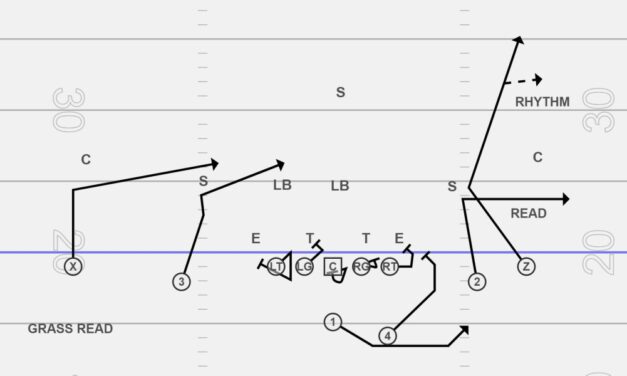
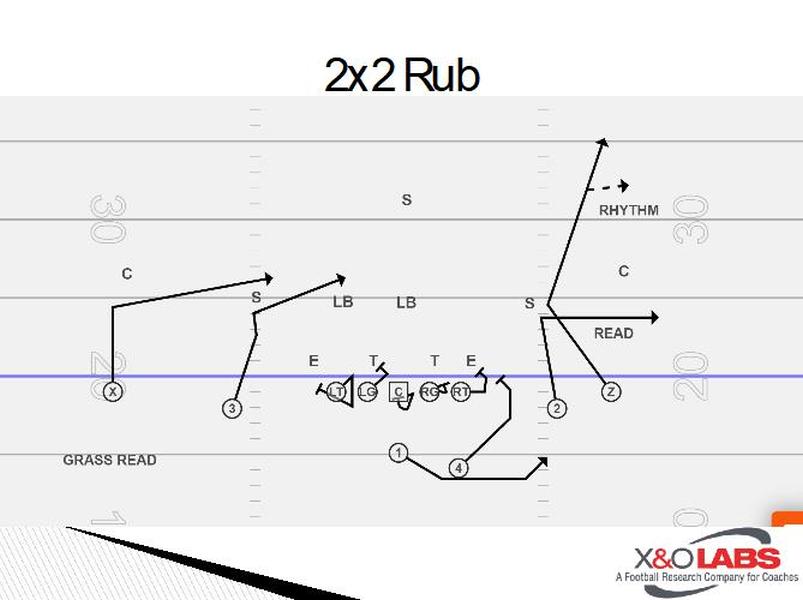
Our sprint out rub package has been an integral part of our offense at all 3 schools I have been the head coach over the past 8 years. This concept is very inexpensive and provides an easy way to help a quarterback that is less skilled as well as getting your best athletes the ball. This package has been great for us on 1st down, 3rd down, and red-zone situations. We also use this concept within the fastest tempo in our offense.

The goal of our sprint-out rub package is to put pressure on the edge as fast as possible while putting the defense’s flat defender in conflict of assignment. Also, we use this package to keep things as simple as possible for our QB so he can get into a rhythm, have confidence, and be successful. This package also helps us get our athletes the ball in space. At Parkersburg South we face cover 0, cover 1, cover 2, cover 3, quarters, cover 6, and 2 read. This package of concepts has proven to be effective vs every coverage we have faced over the last 8 seasons.

We will drill this package of concepts when we do our group pass drill during individual with our QBs and WRs. Within the drill, a coach will stand as the defender over the #2 WR. The coach will vary what he does from getting depth to trying to jump the out route. Our QBs and WRs get several reps throughout the season because we do this drill daily throughout the summer and fall.


OL

Block outside zone without climbing to the second level.

If no one is in their gap they are reaching, hinge backside.


RB/H

Block outside zone.

The goal is to help set the edge to give the quarterback a clean sight of the vision.


QB

Identify pre-snap CAP (space the rhythm route is going).

Uses sprint out footwork to the play side.

Uses R4 progression. 1st read (rhythm)- rub corner, 2nd read (read)-burst out, 3rd read (rush/release)- hitch out (3wr) in trips/ QB run outside zone.


WR

#1 WR (Z or X) cheats his alignment down to where he can “rub” the defender that is over the #2 WR.

#2 WR has at least a 4-yard split from the tackle. He jogs off the line and runs a “burst” out once the rub on his defender happens.

On the backside of the concept, we have done a variety of concepts from double slant quick game to dragging the #2 WR and running a backside post with #1 WR.

Read More

“The Foster 5” – Innovation 4: The Mobile QB and Dual Threat RB

“The challenge lies in finding a defender with equal ability to match the skill set of the QB. More often than not you’ll need two skill defenders to handle that responsibility.”
– Bud Foster, former Defensive Coordinator, Virginia Tech University


By Mike Kuchar
Senior Research Manager/Co-Founder
X&O Labs
@MikeKKuchar


The Ideology: Getting a Plus One Rush

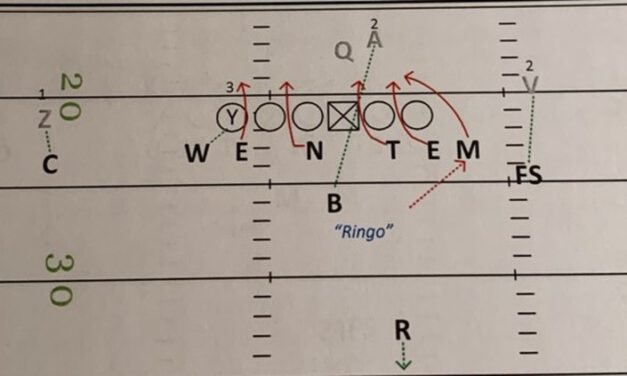
The premise is simple. Find the back in protection and overload him. It’s a philosophy that defensive coaches work tirelessly to achieve when designing their pressures. Truth is, Bud Foster was already building in these add-on rushes from a man cover perspective for years.  During my visit, I was extremely impressed with the sophistication of his add-on rush system and how it was communicated by the front seven. This system consists of man pressures from the Mike, Backer, Rover, and Whip/Nickel position. They can be run as single huddle calls or built-in adjustments based on formation. All blitzes are communicated with a “Ringo” call meaning it’s coming from the right or a “Lucky” call meaning it’s coming from the left. Most are complemented with 5-Rat coverage, which is pure man free coverage although they can be used with Mini and Lock coverage as well. I’ve noticed he tends to call these on the first call of the game to generate some pressure on openers.

The rules of this system are below:


Defensive End to Blitz:

  • Pinch Technique- step to Tackles crotch and cross over


Defensive Tackle to Blitz:

  • 3-Technique= Tag (take the A gap)
  • 2-Technique- Play normal
  • Secure the opposite A gap, key the Center


Defensive Tackle Away from Blitz:

  • 3-Technique- Play Normal
  • 2-Technique= Spark into the opposite B gap


Defensive End Away From Blitz:

  • Normal


The base man pressure calls in the system are as follows: Mike, Backer, Tango, and Rover.

These pressures are five-man pressures and can be run with the following base coverages:

  • 5 Rat (man-free)
  • Mini coverage
  • Key coverage
  • Quarters


It’s important to note that in man-free coverage these blitzers are in “shoot support,” meaning they will be asked to hammer the ball back inside to one another. All other defenders are in man coverage.


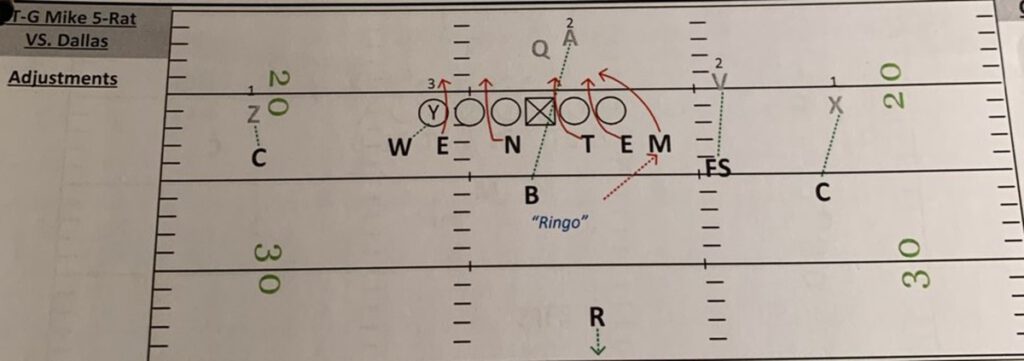
Mike Pressure:

Here is what the Mike pressure looks like vs. 2×2 formations:
 

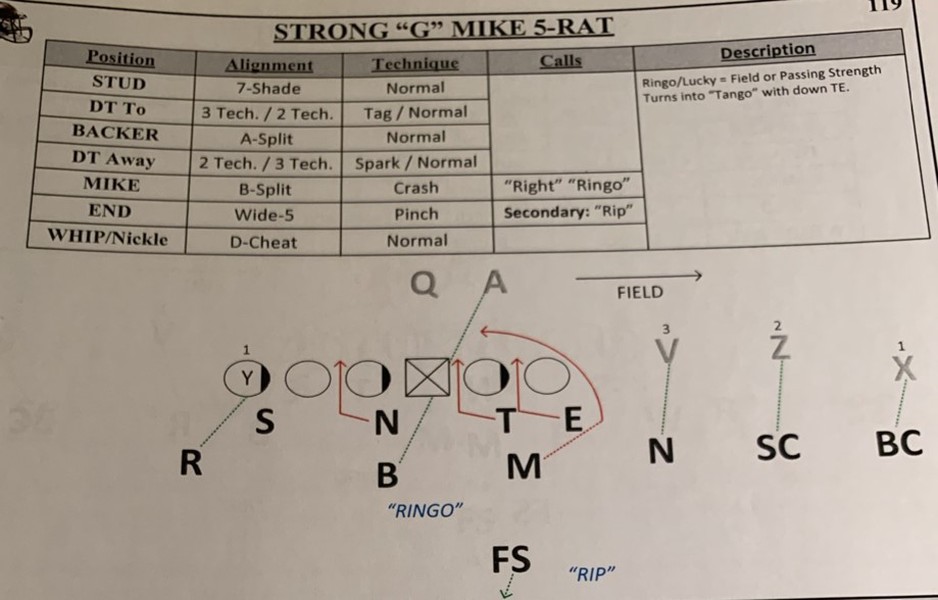
Here is what the Mike pressure looks like vs. 3×1:
 

Backer Pressure:

Here is what the Backer pressure looks like vs. 2×2:
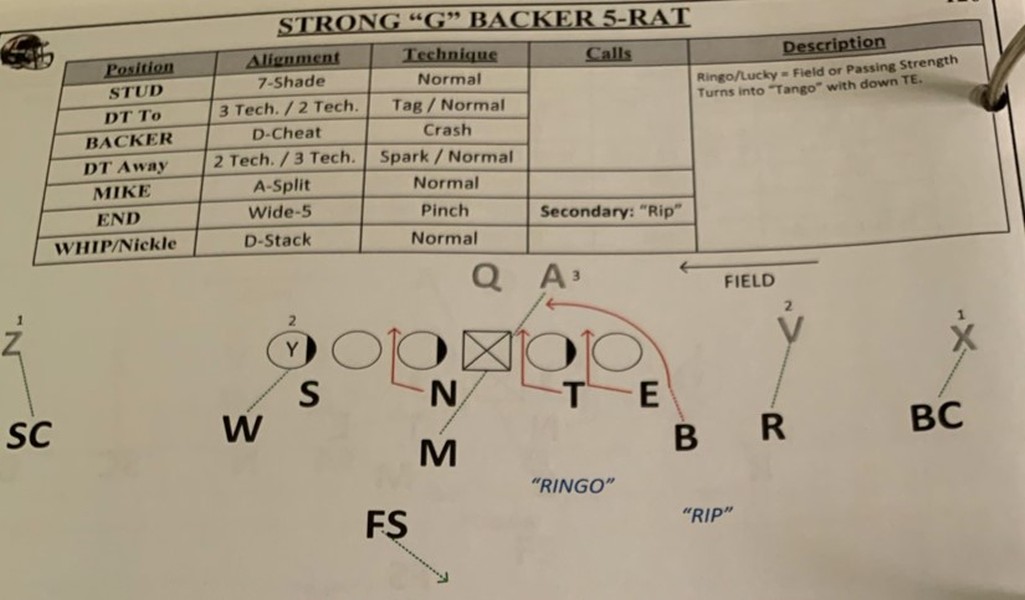
 

Here is what Backer pressure looks like vs. 3×1:
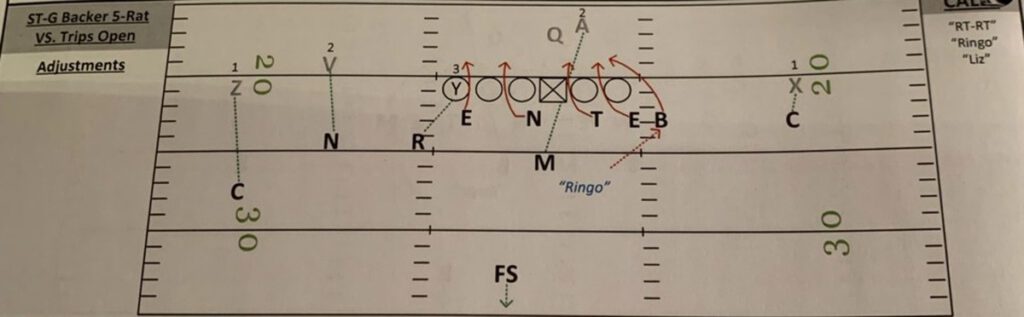
 

“Tango” (Whip/Nickel) Pressure:

Tango was predominantly a Nickel/Whip pressure off the tight end surface. It would be used against offenses that had a strong tendency as a tight end run team because it brought pressure right off the edge.

Here is what Tango pressure looks like vs. 2×2 formations to the field:
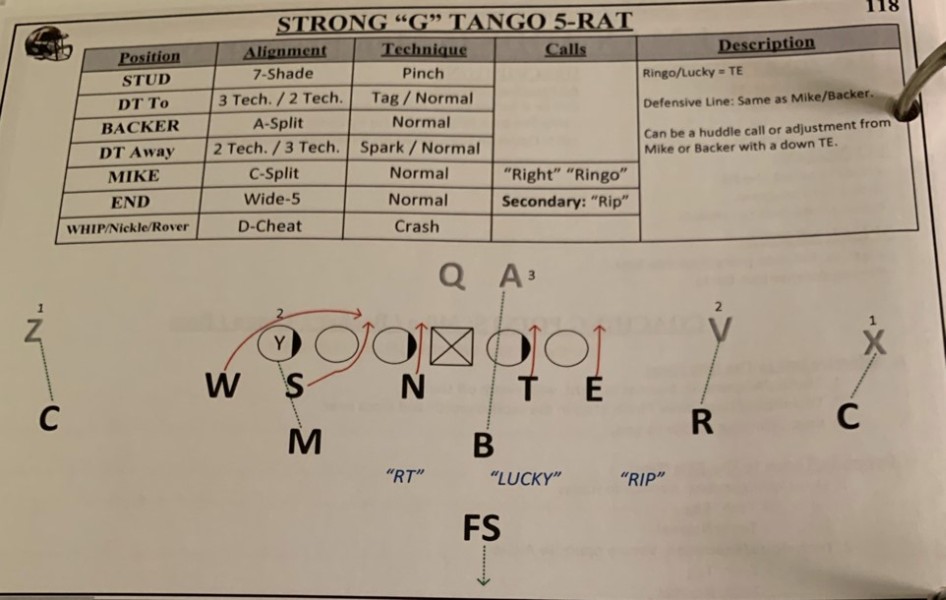
 

Here is what Tango pressure looks like vs. 3×1 formations to the field:
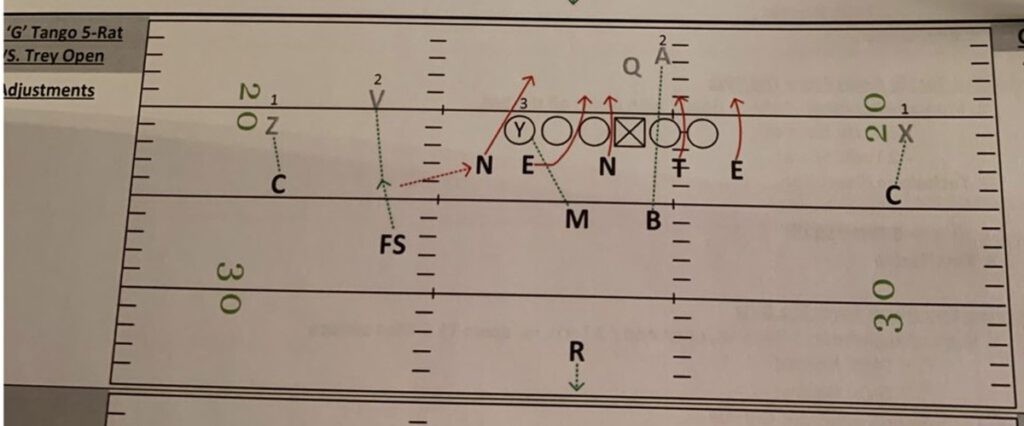
 

But now, here’s where his man pressure system progresses. Tango can often be used as a pressure check for any defender to pressure off a down tight end. Consider the scenarios below

  • If the tight end is to the field (as in the diagrams above) the Nickel/Whip could blitz a down tight end.
  • If it’s 2×2 with the tight end to the boundary, the Rover could be the blitzer.
  • If it’s a Nub formation with the tight end into the boundary, the boundary corner could be the blitzer.
  • If the tight end was off the ball in a sniffer alignment, the Mike or Backer could be the blitzer.


Essentially, whatever defender responsible for the tight end would be the pressure defender and the Mike or Backer would cover the tight end man to man. If the tight end stayed in to block, they would be scrape blitzers off his edge which is described below. Bud’s thought process was to just let cover players cover and be more gap controlled in the run game. The scrape pressures element to the blitz.

So much of his man pressure system is allowing the defenders the freedom to be in advantageous pressure alignments based on formation surface. Blitzer abided by unwritten rules like if the pressure is coming from a two-surface formation, the blitzer can be crash blitzer from depth and will automatically be the run support defender.

The clip below best illustrates this coaching point:


But if the blitzer is aligned to a three-surface formation, he is mandated to walk up and blitz from the edge to ensure that he cannot get sealed in the run game. “We don’t need to show it right away,” said Coach Foster. “But we can’t be in a position to get pinned.”

The clip below best illustrations this coaching point:


It’s important to note that he treats H/Y off formations like three-surface formations so the Mike would walk up and pressure the edge, leaving the Whip to play the Tight End. The safeties can now “chain” off the Y (because it’s a man coverage concept) or the safety to the side of the tight end can track him. Meaning, if the tight end blocks, the safety can add to the fit and be a bonus defender.

The clip below best illustrates this coaching point:


Since these are man pressure concepts, linebackers are told to gap fit and first-level defenders don’t wipe as they would in his zone pressure package (which is presented in the next ideology). Instead, the box linebacker not pressuring has an A gap to the ball responsibility.

The clip below best illustrates this coaching point.


One of the main coaching points for that A gap to ball player is to slow down and expect the ball to come back to him. In the Mike pressure clip below, the Backer is too fast over the top and the ball cuts back behind him.

The clip below best illustrates this coaching point.


One of the things that should help the box backer vs. gap schemes is having the “Tagger” or defensive tackle to the side of the pressure cross face of the Center on any backblocks. This automatically cancels the play side A gap and allows the linebacker to flow to the ball. Those same run game responsibilities cannot be overlooked in this add-on pressure system. Crash blitzers must know that they are force defenders with run action to them. The opposite linebacker (Mike or Backer) must also understand that they immediately become the force defender opposite the blitz, which he calls this “shoot support.” They must be A gap to ball players. Again, if at any time they felt out-leveraged pre-snap they always were given the freedom to make “Black” calls alerting first-level defenders to cancel gaps in front of them. It would help get the ball pushed out in the run game.
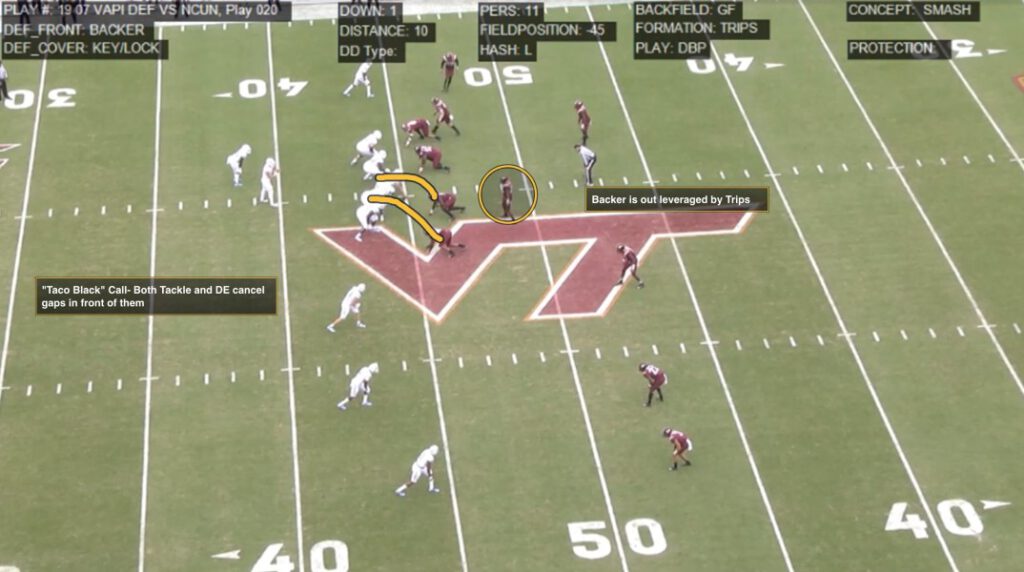
 

I’ve noticed there have been several instances where these defenders lose leverage on the perimeter giving up a big run because defensive backs are in man coverage.

The clip below against North Carolina is an example of this:


In the passing game, these pressures get translated into two on one matchup on the back when the tight end blocks. Against pure slide protect teams, I’ve found that he will continually make “Tango” calls, which tells the defender to the side of the tight end to blitz. And if the tight end blocks, the Mike or Backer to his side becomes another scrape rusher.  This is where you get two on one with the back.

The clip below best illustrates this coaching point:


One of his built-in adaptations vs. slide protection was for first level defenders to the side of the pressure to cross the face of linemen that were setting the slide to them. As shown in the image below, this can alter the protection schemes and promote the possibility of a free rusher.
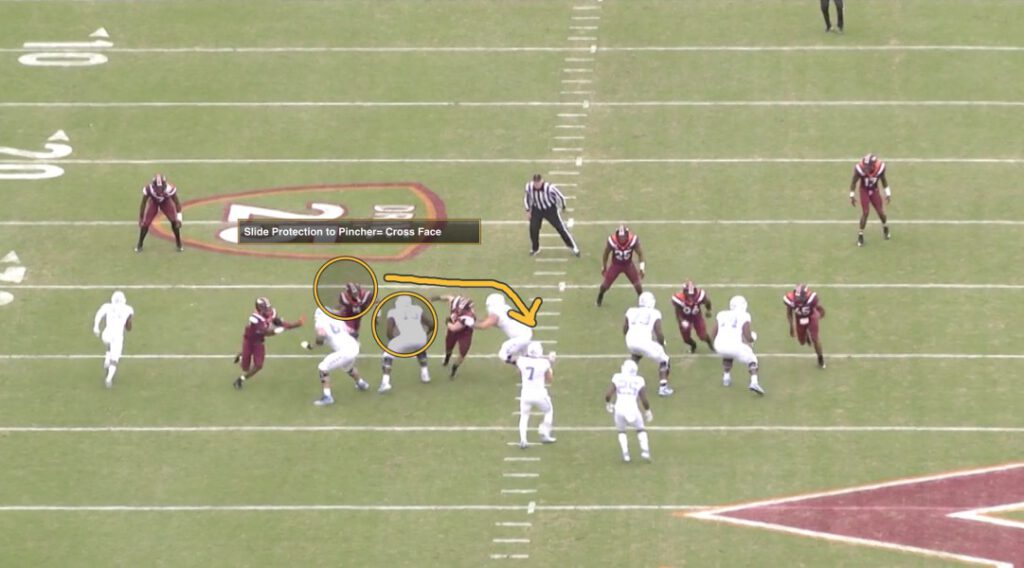
 

BTB (Blitz the Back) Pressures:

All of these man pressure concepts were then built around what Bud called his “Blitz the Back” or “Blitz” package. Now the defender (either the Mike or Backer) that was aligned to the back would execute the blitz, which can essentially become a “Mike” or “Backer” pressure. The same-add on principles applied if any offensive player blocked. So, if the back starts in one location and switches to the next, the call gets redeclared from a “Ringo” to a “Lucky” call. The blitzer can either walk up and come from the line of scrimmage (against a three-surface formation) or he can scrape and come from depth (against a two-surface formation). The remaining linebacker will be the A-gap player to the ball. If the RB blocked he can add to the pressure.

The clip below illustrated this coaching point:


BOB (Blitz Opposite the Back) Pressures:

Once offenses got clued to the Hokies adding to the back, they would work to cross their back in protection to eliminate the extra add on blitzer. So, when offenses would start to “scan” the back in protection by having him work opposite, “B.O.B.” pressures (Blitz Opposite the Back) principles were built in. The linebacker (either Mike or Backer) would be the blitzer while the other would play A gap to ball or add-on as an additional rusher and he may choose to swipe the front to the side of the pressure.

The clip below illustrated this coaching point:


The Impediment: RB’s Becoming Viable Pass Options/Mobile QB’s

When Bud Foster first came into the Big East in 1995 running backs had two jobs: run downhill and don’t fumble. Things have changed in the last 25 years. Running backs at the FBS level now are multi-purpose players who can not only stretch the field horizontally but can stretch it vertically as well. They are often recruited to be dual threat players in the run and pass game. In the ACC alone in 2019, his last year as a coordinator, opposing running backs accounted for over 180 receptions. This forced him to implement several adjustments in his base defense and pressure system to account for threats out of the backfield.

Mobile quarterbacks were also few and far between when he started his career. The Big East and ACC were stocked with pocket style signal-callers. In fact, there was one in his conference in 1995- Donovan McNabb at Syracuse. Yes, he was one of the best that ever played. But now several quarterbacks have the ability to break the pocket and extend plays. It’s forced him to completely change the way he’s evaluated quarterbacks. Prior assessment tools such as arm strength, the timing of the release, the level of his shoulders on throws and pre-snap indicators have been supplanted with measuring the QB’s ability to escape while keeping his eyes downfield. “We look at how well he throws on the run,” Bud told me. “Can he throw from hash to hash? What is his true skill set? You want to make sure you contain him. You may want to get some twists to get up in his face so he gets spooked. QB’s that can extend the pocket are very difficult to defend. If you spy on him these days then you’re giving up someone in coverage or in the rush.” The challenge lies in finding a defender with equal ability to match the skill set of the QB. Chances are that won’t be a defensive lineman. More often than not you’ll need two skill defenders to handle that responsibility. It’s something that Bud was forced to do when defending Notre Dame QB Ian Book in 2019.

Read More

Man vs. Zone Adjustments in the Dig Route
By Dan Brainard
Former Offensive Coordinator and Quarterback Coach
Husson University (ME)
Twitter: @DBrainard18


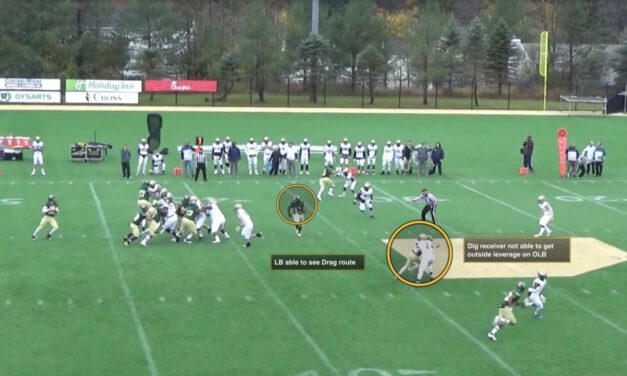
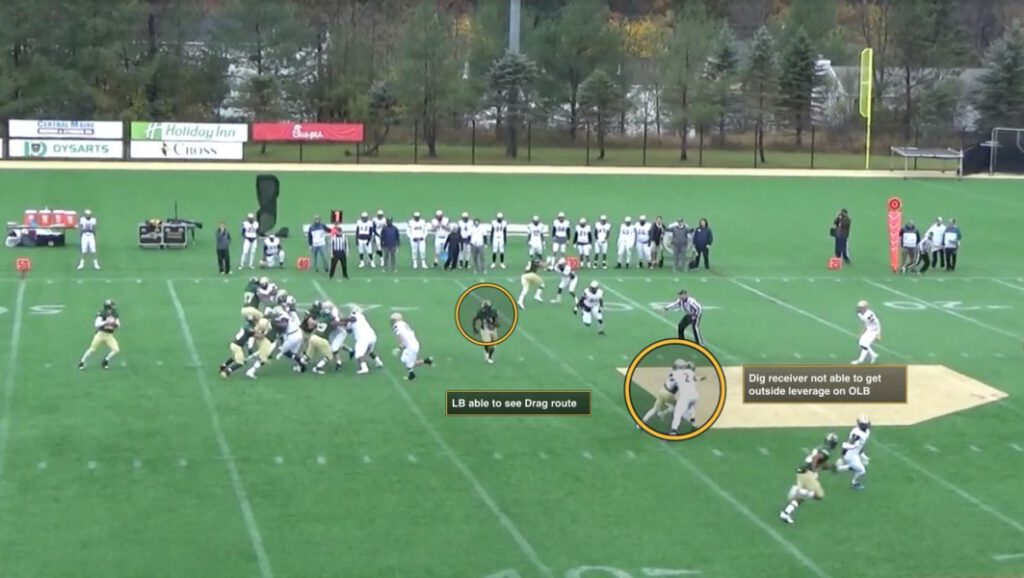
At Husson, we make sure to bring 4-5 packages in the passing game that will be effective against all coverages. As analytical as we can get, we can never be completely certain what the defense will show up in. Within these packages, we make the progression as simple as possible for our QB. One package is our Drag/Dig Package. It doesn’t matter for him what coverage the defense is in, the only thing that matters for him is the one defender he is responsible to read. This package applies to every formation we run, and the read for the QB is always the same, depending on if the defense is in man or zone. It is a very efficient package that we use almost every possession. It is a great way to get your playmakers the ball in space while on the run. We have found success with this package in all down and distance situations.

We use the drag package in almost every down and distance scenario, with success in all spots. During the 2019 season, we had the most success running it on 2nd and long, completing over 90% of our passes for an average of 11 yards. It is also a great package for 3rd and medium, as an over-aggressive linebacker core will leave the dig wide open.


The rules:

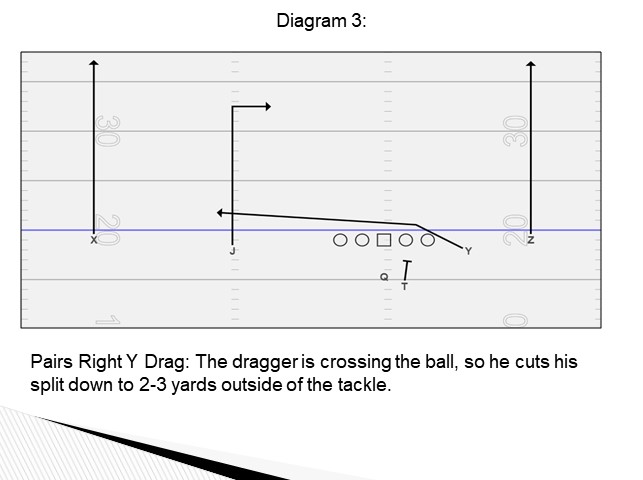
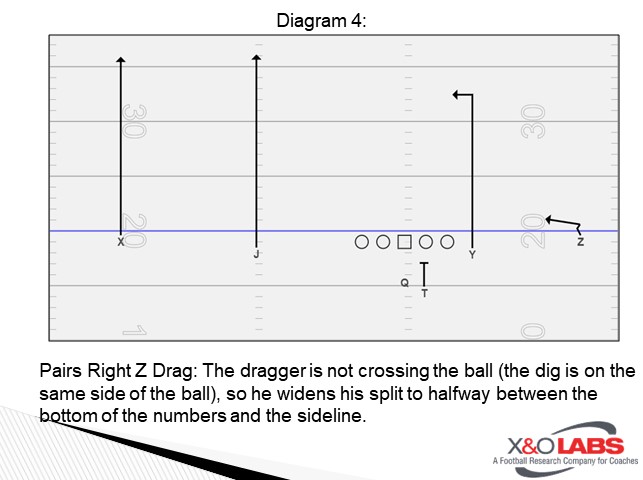
  1. The tagged receiver runs a drag. Our drag is a 1-2-yard flat crossing route.
  2. The first receiver the tagged receiver (the drag) crosses runs a dig. Our dig is a 12-15-yard-deep in.
  3. All other spread receivers run a go route.


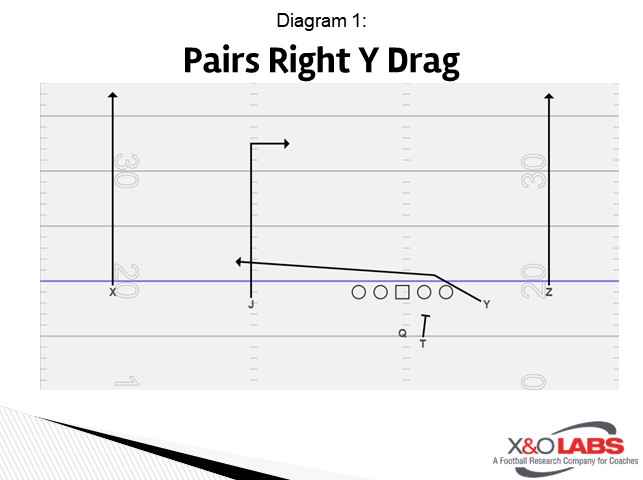
Example play call: Pairs Right Y Drag


The formation – Pairs Right

  1. The Y runs a drag
  2. The J runs a dig
  3. The X and Z run go’s


Coaching Points:

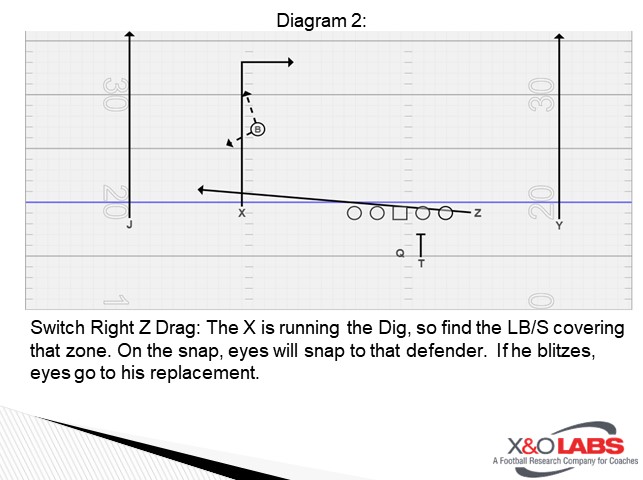
QB: This concept is remarkably simple for the QB. READ the backer over the dig. No matter what formation and whichever receiver is tagged, the QB is always responsible for finding the backer/safety that is responsible for the dig. If he’s a seam player, he will likely carry the dig and the drag will be open. If he gets his eyes inside and sniffs out the drag, the dig will come open. If the QB sees man, he will choose his match up.


Drag Receiver: The drag receiver needs to know 2 things.

1) Is he crossing the ball?

If yes, he will get cut his split down. If he is aligned to the field, he will cut down to be 3 yards inside the hash. If he is the slot to the boundary, he will align 2 yards outside the tackle. Speed is important for him in this case. His job is to get across the ball fast enough that the inside linebackers cannot react and cover him.


If no, then he will widen his split to halfway between the sideline and the bottom of the numbers. We do this because we want to create space between the drag and the dig, causing the defender in that zone to have more space to cover. The drag, in this case, will be slightly delayed and ran slowly. If zone, he will stop at the hash.


2) Is it zone or man?

If it is Zone:

If he is crossing the ball (drag and dig are on opposite sides of the formation): Step flat with his inside foot and go right now. The route is fast to beat the inside linebackers across the formation. If he is not crossing the ball (the Dig and Drag are on the same side of the formation): Delay and settle at the hash.

If it is Man:

When it’s man coverage, it does not matter if we are crossing the ball or not.  When man, work an outside release, working to get the defender to turn his hips away from where we are going, then beat him on the drag.

If it is an off man look (6 yards or deeper), the receiver will go right now and win the route with speed.

Read More

Multiple Bracket Coverage Variations from 2-High Shell

By Keith Phillips
Defensive Coordinator
Wheeling Park High School (WV)
Twitter: @Racetotheball


I think that some of the most important aspects of a defensive scheme is having the ability to fit your scheme and concepts to your current personnel while having the ability to evolve and adjust to the always-changing offenses. Another must that every defense must have is the ability to make quick adjustments without any confusion. You will always hear coaches and players talk about half-time adjustments, and they are a particularly important part of the game. If you wait until half time, too much damage may have already been done. We must have a way to put out fires, especially in high school, where some players go both ways. We try to combat this by fusing some adjustments into our defensive schemes. We use split field coverages inserting verbiage tags into the coverage concepts to help adjust quickly. The verbiage tags keep all the concepts like the players and if we need to add something, it is much easier. I also think it is especially important to make any necessary adjustments to coverages that you learn and add to fit into your scheme. One of the ways we will disguise our coverages is by making them look the same. Always remember that no confusion equals fast physical play.  There have been many influences for me as a defensive coordinator. Some of the concepts I have learned, and I am using now are being taught by Don Brown, Kirby Smart, Brent Venables, and Nick Saban. Sometimes the best teacher is trial and error with your schemes. For this report, I would like to talk about the system we use to merge our quarters and Cover 1 concept and schemes.


Since we play a high percentage of quarters coverage, we like to play Cover 1 from a two shell. We play a 4-man front and will morph into and play both a 4-3 over/under look and a 4-2.  The Sam/Star linebacker is the adjuster; he will move in and out of the box depending on the call. We can use two types of players in this position. Everyone wants that true hybrid player and if we have one, he is the obvious choice. We also will have certain secondary players learn the Sam/Star position. As coaches, we will get the personnel matchups we want but we will not have to teach another scheme. The scheme will stay the same while we adjust the calls for the personnel in the game along with the down and distance, personnel grouping, and all the other variables the offense brings to the game.  We will give the same look while making it easier for the secondary to adjust.  By using the 2-shell concept, one of the safeties is responsible to carry out different assignments depending on the tag.  One aspect of this scheme is a “top the fit or cap player”, a free hitter (Don Brown – city coverage).  This scheme will help vs RPO’s. We do not want our linebackers to have to worry about defending the RPO pass. This coverage will help us keep the integrity of the box, letting them play the run.  We can use our safety to help the “conflict defender” depending on the tag that is called. This system allows the coverage to be set to get your safety where he is needed. 80-85 percent of RPO’s we see come from the side of the back. We also will coordinate the coverage scheme with where we set the three-technique.

Since quarters is the first coverage concept that we install we teach the coverage and its variations and from there we will install our Cover 1 schemes.  The Cover 1 package starts from a two-deep look; this will mimic our quarters’ coverage pre-snap look, so the defense looks the same when combining the two schemes. This also allows the secondary to stay fluid when making formation checks. This package does not need to have quarters with it to be effective as you can use it and morph it to fit your specific needs.


Cover 1-Concept Tags

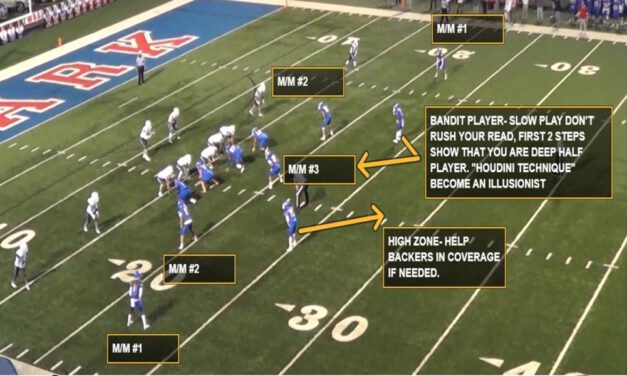
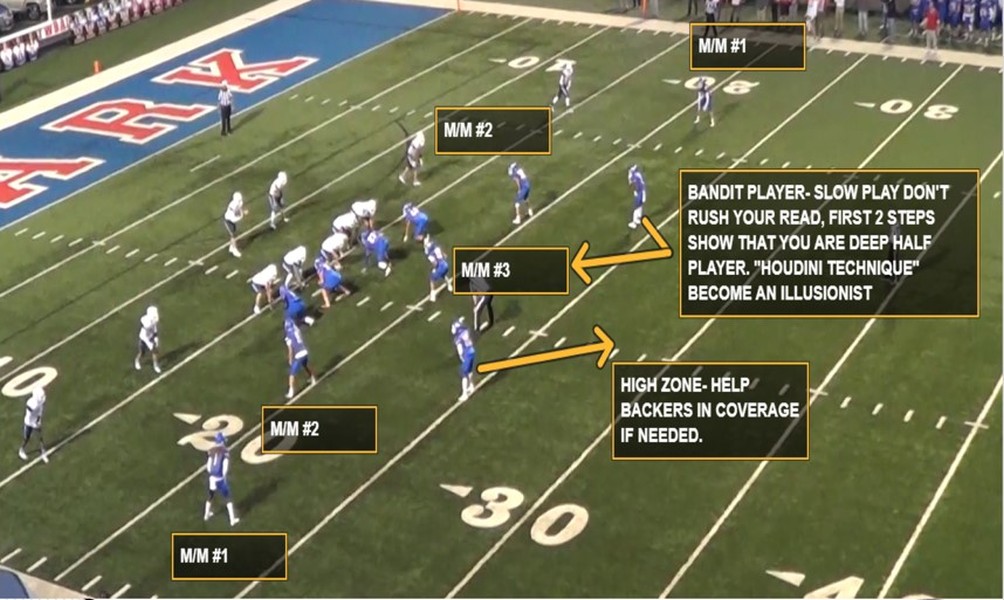
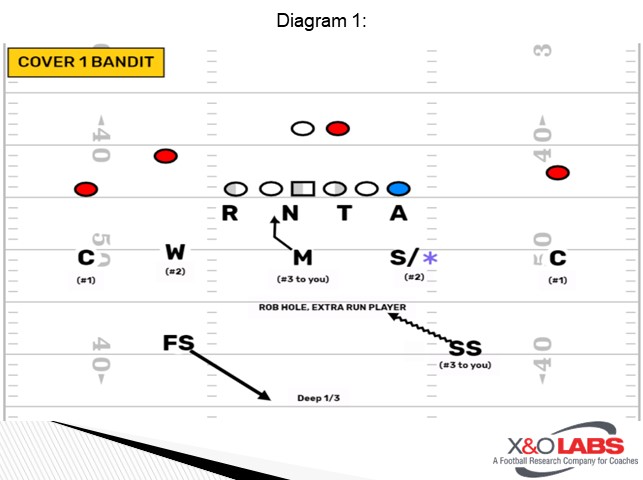
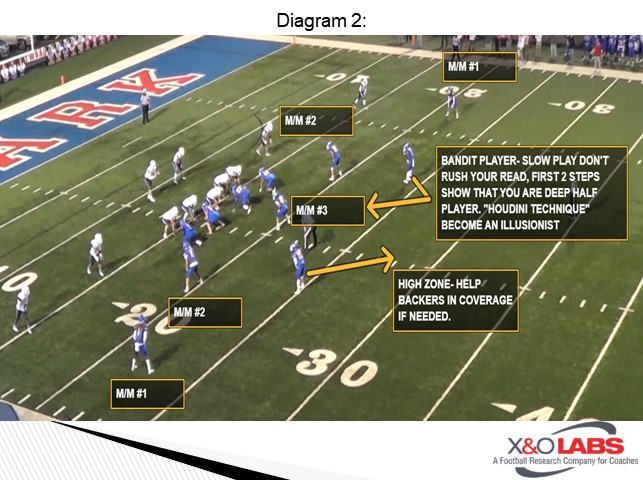
Bandit: This concept will allow the SS to come down into the box post-snap. The SS and the M can “duo” the back (pick up in coverage depending on the release); if a pass the M or SS, who is not in coverage can play “Rat” or Blitz depending on what you want. Other aspects that can be used are providing gap protection for a blitzing M or provide coverage for the S/* when he blitzes. When game planning with the bandit player, you can place him where you want based on formation for example. This would be done post-snap keeping the integrity of the two-shell. After analyzing the opponent breakdowns, you can have an alert call for a specific formation, down and distance, or whatever you feel the need to. If an offense runs certain route combos out of certain personnel groupings, practice that during the week and alert it with your defensive calls.  For example,” Over Mod alert Bandit” we are playing mod unless we get 11 pers ace pro and we will check to bandit and the bandit player will rob the TE.


Concept Coaching Points:

  1. Disguise Bandit technique, push out hard showing the QB a cover 2 safety, and becomes the Bandit
  2. Disguise Bandit technique, move two-high safety look around – different depths
  3. Disguise Bandit technique, off the line of scrimmage into a Bandit position
  4. Teach Bandit player to be patient, don’t rush read progression
  5. If a pass, let the routes declare, then become a “robber”
  6. Game plan certain formations or looks to have Bandit player steal
  7. Rat progression, cut crossers, screen – draw, QB break out


Read More

Tagging “Hug” and “Hole” Defenders in Odd Pressures

By Mike McElroy
Defensive Coordinator
Bethel University (MN)
Twitter: @McElroy26


Here at Bethel University, we get the opportunity to play in one of the most competitive leagues in Division 3. The Minnesota Intercollegiate Athletic Conference (MIAC) saw 3 teams finish in the top 16 scoring nationally in 2019 and has had at least one team in the Elite 8 since 2015. We see great QBs and the top four offenses in the league all run quite different schemes. We needed a call we could play on first and second down for the choice downs that are hardest to plan for. We wanted a call that held up to the run and to the RPO game but didn’t give the QB the option to throw a quick hitch or slant and get in front of the chains.

We employ a 6-man box here at Bethel. We will move between 2-4, 3-3, and 4-2. Our guys have simple movement rules and fits. Below is our color package. Any color tells our secondary we are man free and they have their man free rules (motions, tight splits, empty, etc.). We simplify the rules for the 6 box players based on the call. This report will focus on the box fits and teaching points.


Coaching Points: Back/Face Reads

When any of our backers are interior blitzers they have Back Face rules. As they blitz the B gap, they are reading the Guard. If they get the guards face (think zone scheme) they cross it and work to get vertical. If they get the Guards, they back chase it. We don’t want to cross a guy not trying to block us. We teach them to slip off the back of their hip. We love this against pass sets. The rule is if he sets to you, you cross his face; if he goes down, get off his hip then press vertically.

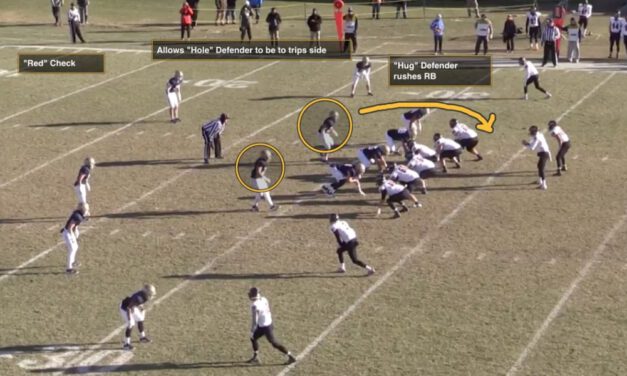
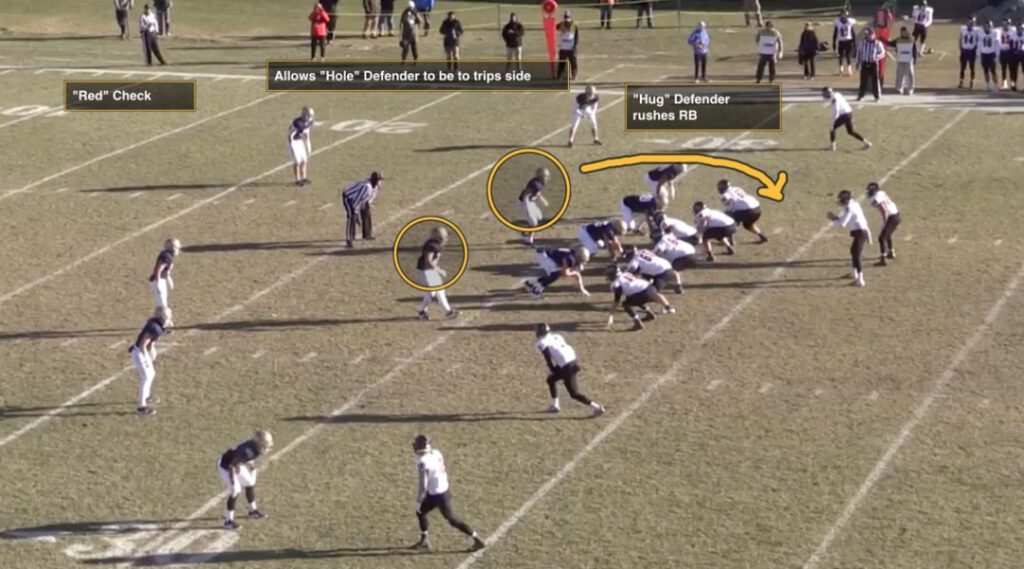
Hug Players: In Red/Maroon this is always the Will.  In White it matters where the back aligns (field or boundary). We want him to have a little more depth so he can work through the junk on run game. In the pass we tell him he is blitzing the running back. Make him stay in protection and then add in.

Hole Players: Our Hole players must know where the RB is. If the RB is opposite of you, be ready for an immediate downhill run. If the RB is to you, you’re thinking QB player on anything zone read or option, but you can be a little quicker out because of the no immediate downhill run threat. On pass your base rules would be 5 yards over the ball reading the eyes of the QB. They need to know if we are spying a certain WR that week. They are also the trigger player on the QB for scramble. If the QB breaks the pocket you must pull it up as we are in man and most guys will have their backs turned. If the QB is a run threat, we will tell the Hole player to trigger as soon as the QB is off his spot.

Read More

Tagged Verticals Shots of Bubble Screens

By Chase Hansen
Head Coach/Co-Offensive Coordinator
Sterling College (KS)
Twitter: @ChaseHansen71


At Sterling College (SC), we are known as a team that will attack the perimeter with our bubble screen passing game. We take pride in ‘Owning the Perimeter’ and we consider blocking on the perimeter one of our base rules for any offensive skill players. We have multiple ways to block our bubble screen and we can throw the ball to any one of our four players (3×1 + RB). At SC, the bubble is known as an ‘inside run play’ outside the numbers and is engrained into our culture. It takes a great deal of investment (time and energy) but we know that our investment will be greater than the opposing defenses’ and that is why we are successful with the concept. Over the past several seasons, defenses have tried to commit even more numbers to slow down our bubble and we needed a way to keep the defenses honest. We have always had the “choice” variation to our bubble where the #1 WR had a choice to slip a CB if he was coming down hard on our bubble action and we could throw the ball into the soft spot before the safety. This was effective but if we gave our WR an option to run vertical, he did, every single time, whether it was the correct read or not. So, instead of trying to fight that battle, we decided that we would expand our options of down the field throws by running our 4-verts concept off of our bubble look. We have found that the threat of verticals has improved our bubble game because it causes DBs to hesitate due to the fear of being beat deep. And, if we can get guys out of position there is a chance for a big play.


Base Pre-Snap Alignment

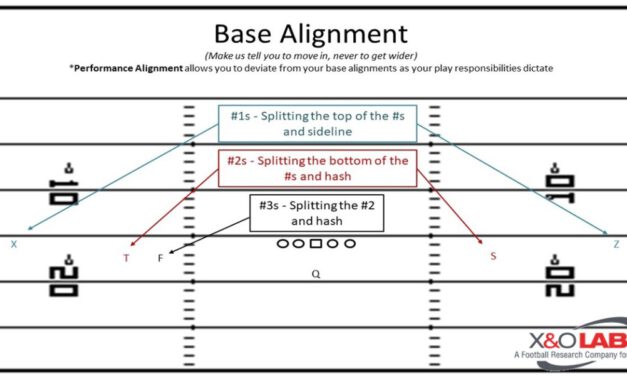
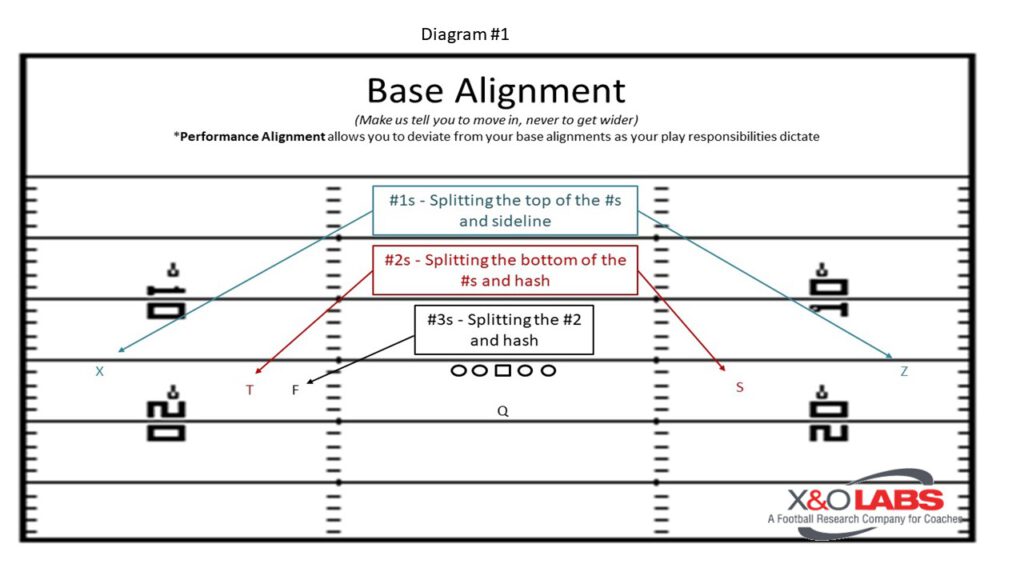
Spacing is important when it comes to running any 4 vertical concept. First, we want our WRs to stretch the field horizontally as much as possible with their pre-snap alignment. We ask the #1 WR to start by splitting the top of the numbers and the sideline, #2 to split the bottom of the numbers and the hash marks and #3 to split #2 and the hash. There will be times that WRs will need to ‘Performance Align’, which allows them to deviate from their base alignment depending on their assignment on the given play.


Landmarks and Options for Verticals

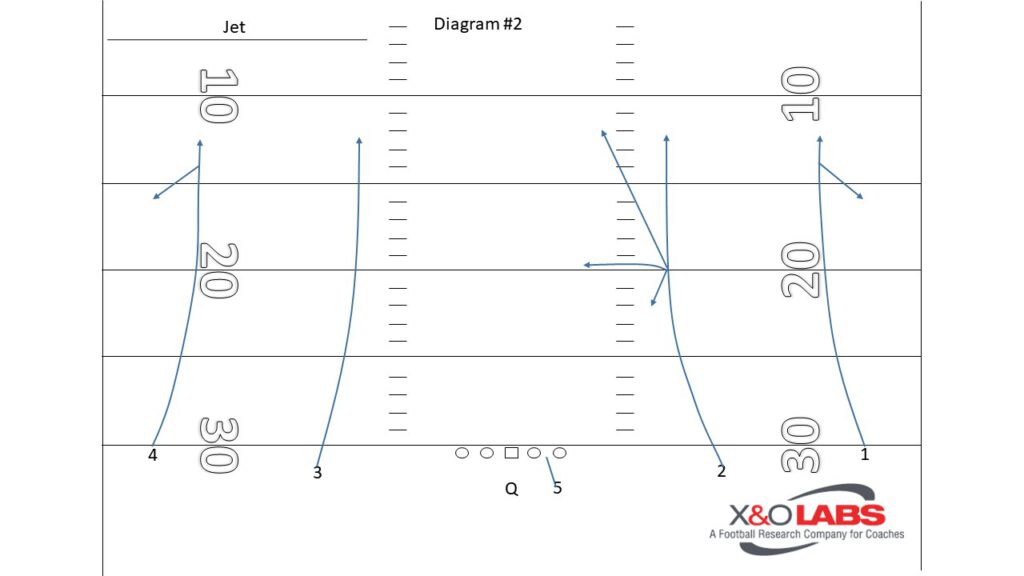
We want to continue to use spacing as we move into our concept. To keep this consistent with all our receivers, we use landmarks on the field to teach them what proper spacing is. If you are running the outside vertical route, then we would like the route to be run at the bottom of the numbers. If you are running one of the inside, vertical routes then we would like you on the ‘sweet spot’, which we define as 2 yards outside the hash. Consistency in hitting your landmarks helps build trust between the QB and WR. It also allows a QB to use his eyes to manipulate defenders and deliver an accurate ball to a spot with good timing.

We also give options to our WRs depending on how a defender is playing the route. This gives the WR confidence in knowing that he is never running a ‘dead’ route and he always has a chance to get the ball. For our outside vertical, we tell him to decide on 12 yards. If there is a DB over top of him at 12, then he will run a comeback route at 16 yards. If there is no one over top of him or he is even with the DB then he will continue his route along the bottom of the numbers, saving space toward the sideline for the QB to deliver the football. For the inside vertical, we tell him to decide on 8 yards. He will run his option at 10 yards depending on the DBs in his area. He has more defenders to consider and therefore has more options than we give him. He can stay vertical, skinny post, dig, or hitch. If he is continuing vertical, then the safety has vacated the hash or has widened enough so that he can beat him on a skinny post. If there is a safety over the top of him, then he can hitch or dig depending on the underneath coverage. This route takes multiple reps but can be highly effective with a QB and WR that are on the same page.


Read More

“The Foster 5” – Innovation 3: The Multiple RPO System

“I don’t ask Mike linebackers to carry the seam and handle the run game. You can’t do both of those things with the RPO game today.”
– Bud Foster, former Defensive Coordinator, Virginia Tech University


By Mike Kuchar
Senior Research Manager/Co-Founder
X&O Labs
@MikeKKuchar


The Ideology: Alleviate Stress for LB’s in Intermediate Coverage

You get what you get with Bud Foster, there isn’t much grey area in his persona. He’s as genuine as they come. So, it’s not surprising that the man’s personality matches his philosophy when it comes to dual reads in offensive football. He doesn’t believe in double-talking players, or as he continually referred to as “fork tonguing” them. I’ve never heard the term before my trip. So, by the fourth time he uttered it I was scrambling to find out if it had a deeper meaning. From a linguistic standpoint, the phrase means to say one thing and do something else. But from a football standpoint, it simply means instruct your players to have one responsibility and do it well.

Quite simply, Coach Foster wants his linebackers to do one thing- stop the run. And if he has any say about it he will not ask them to play both the run and pass in any particular down. “I don’t ask Mike linebackers to carry the seam and handle the run game,” he told me. “You can’t do both of those things with the RPO game today. Offenses will find that and try to manipulate him as much as possible. We want to take linebackers off stress and put the safeties over the top of them. We will put him in a position to not compromise the run.”


Sink Coverage:

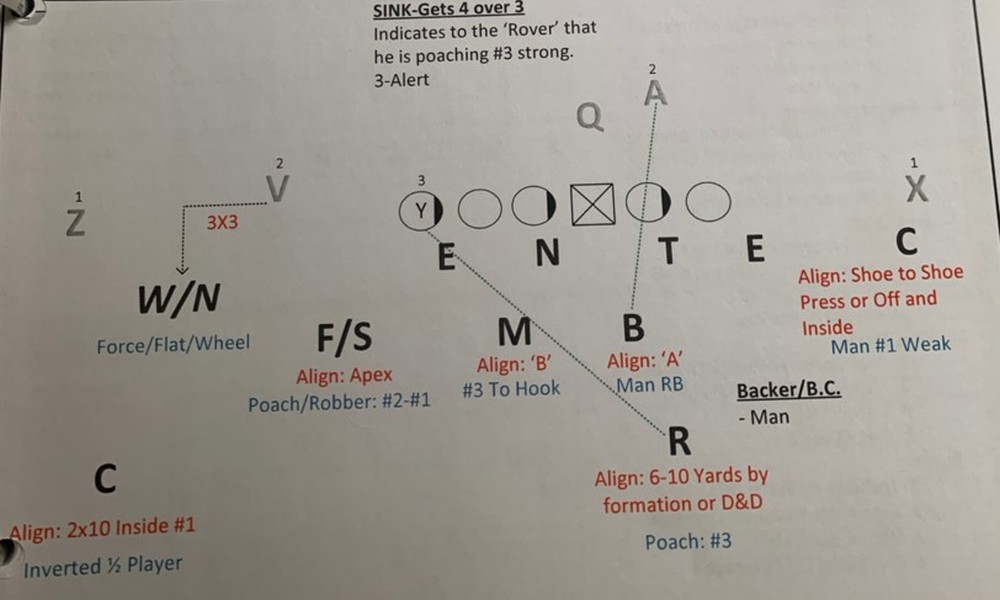
The basepoint for accomplishing this is what he calls “Sink” coverage, which is nothing more than what other defensive coordinators call “Poach” or “Alert.” It was the complement to any zone coverage (Quarters, Robber, etc.) when offenses aligned in 3×1 formations. The backside safety (Rover in his scheme) is asked to handle any number three vertical threat, alleviating the Mike completely from any pass responsibility.

The base rules are below:


Field Corner (Robber Side)- Alignment- 2×10 inside number one. Inverted deep half defender

Whip/Nickel- Alignment– 3×3 off detached number two receiver. Force, flat, wheel

Free Safety– Alignment- Apex number two and number three vs. extended number two. If number two is flat, rob curl. If number two is vertical, play man to man.

Backer– Play number two man to man or back out in trips

Mike– Work off number three. Read to hook defender.

Boundary Corner– Man to man on number one weak.

Rover– Poach number three receiver strong. “We cheat him over the strong Guard and he will read the Tackle area to identify run vs. pass,” he told me. “Maybe it’s the Center that gives the best read. Because he has to snap the ball and make his block on one side or the other.”


As evidenced in the clip below, it was a solid answer in safely defending the middle of the field.


But while the passing game may be shored up in trips, it left poor support in weakside runs, pitting a corner in primary support particularly in three surface formations into the boundary.


The clip below best illustrates this coaching point:


While “Sink” was a good answer in long-yardage situations, it wasn’t a good fit to hold water in early run downs. “You always have to analyze what is your best package for run and pass,” he told me. “What will give you the best support in the run game? If an offense is running spacing routes and snags I’m not worried about it and we can run Sink. You can match all that stuff up. But if they start running vertical switches and double moves, that’s where they can stress a defense. But can they put all that together? That’s the challenge”


The Impediment: Glances, Pops, and Intermediate RPO’s

So, when the football world was flipped on its ear with the advent of Run/Pass options, offenses, like the system at the University of North Carolina, were using single-side RPO’s to isolate two their studs at X- Dyami Brown and Dazz Newsome. So, in his preparation, Coach Foster was presented with a choice. He can live by his man methodology by matching up his boundary corner with the X and continuing to tie the Rover into the field side. But that was too tall of a task for him to handle in the RPO world. He had to find ways to bracket the X with both the boundary corner and the Rover.  “I figured let’s match things up to contest all throws,” he said. “Essentially, I wanted to turn everything into quarters or man free. I felt like we can contest all throws and be sound in the run game. I didn’t want to give them anything cheap.”

As shown in some of the clips below, this decision is not made arbitrarily with an understanding of risk. The risk is giving up big plays because of being isolated in man coverage to the field side. To him, the reward of contesting throws was well worth the risk of having QB’s fit throws into tight windows. “You could play three-deep zone but they will stress you somewhere with a seam,” he said. “In zone there is too much space where a 5-yard pass can convert to an explosive play. In man, you can constrict a 5-yard play and you can cloudy the read in Quarters. The bottom line is I don’t want to give them a seam. If I’m going to give them a seam it’s going to be a seam where I can contest the throw.”


The Adaptation: Mini and Key Coverage

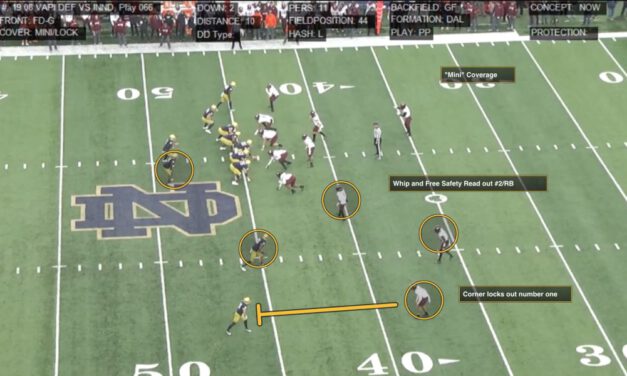
So, Coach Foster went to using more match-up man principles in defending the RPO game by playing “Key” coverage to defend 3×1 formations. He locked out number one with the field corner and played a matchup zone with the Nickel and Free Safety on number two and number three. It was a built-in adjustment and an AFC (Automatic Front/Coverage) call when defending RPO heavy teams like the University of North Carolina and Wake Forest University. Playing this adjustment provided him two man advantages:

  1. Bracket coverage on the number two receiver strong in trips- which often was the target of vertical throws in the RPO game.
  2. Bracket coverage on the boundary X, which protected against intermediate RPO’s such as glance and pop routes.


Key is an alert call, so any 2×2 to 3×1 motion will check “Key.”

The responsibilities are below for the field side defenders:


Key Coverage:


Field Corner:

  • Man on or off Man on number one
  • Press or 8×1 alignment off number one
  • Man key


Whip/Nickel:

  • Force/Flat Wheel
  • Alignment- 6×1 outside number two
  • Key number three to number two


Free Safety:

  • Read number three to number two (play three vertical)
  • Alignment- outside eye of number three


To him, defending RPO’s in man coverage is all about where the matchup issue advantage is defensively. That usually came with slot receivers working off the Nickel. “A lot of teams worked us on number two tying up our FS or play action and running #2 on posts,” he said. “The conflict is going to be a matchup on the inside receivers. So, Key coverage alleviated some of those matchup issues by having the Nickel and Free Safety bracket number two strong. Now with QB-generated RPO’s, you have to play man coverage but you need to do it with vision.” He expects his back half to play with man eyes by using a simple analogy- put your pecker on his inside hip. “He should not cross your face unless it’s a shallow cross,” he told me. “To do that we teach to slow play it with a slide and glide technique. You need to be off so you can see the route and drive on it.”

As shown below, the defender must work to fight to gain leverage once number two is vertical.


This slide and glide technique can also be used by the Free Safety driving on number three in key coverage.

The clip below best illustrates this coaching point:


Key coverage was also used against heavy personnel outfits like the University of Pittsburgh to defend its boot and play-action game. It provided for sound coverage against flood concepts like the one below:


Since it is part of the quarters/man free coverage family, Key coverage can be utilized with any 5-man blitz package. Bud would prefer to pair it with Cowboys to trigger the backside corner. A major advantage in playing Key coverage is the run support provided at the point of attack. Since the Whip/Nickel is involved in potential man coverage responsibilities, the Mike linebacker has an A gap to ball rule and asked to hammer any run game back to the Backer and Rover who would be the free hitter vs. trips. Again, if the Mike feels stressed in having to play an interior gap, he’s always given the responsibility to make a “Taco” or “Black” call to clear the gaps in front of him.

The clip below best illustrates this coaching point:


The Free Safety can now become a bonus defender against the run if he gets a true run read from number three. Clearly, if number three is attached to the core and not detached this can be diagnosed much quicker.

The clip below best illustrates this coaching point:


Read More

“Collect” Technique to Block Movement in Gap Runs

By Arthur Ray Jr
Offensive Line Coach/Recruiting Coordinator
Northwood University (MI)
Twitter: @CoachLA73


One of the oldest plays in football at all levels, even with the newfound love of zone football most coaches who want to run the ball still have a version of the Power Gap scheme run. My time as a player at Michigan State under my OL coach Dan Roushar this was a staple play in our offense. With the rise of Spread football, this play has evolved but the principals have for the most part stayed the same. Today we will dive into the ways I believe in and teach power from a technique standpoint, especially aiming points on our double teams, as well as blocking power vs. blitzes/movement.


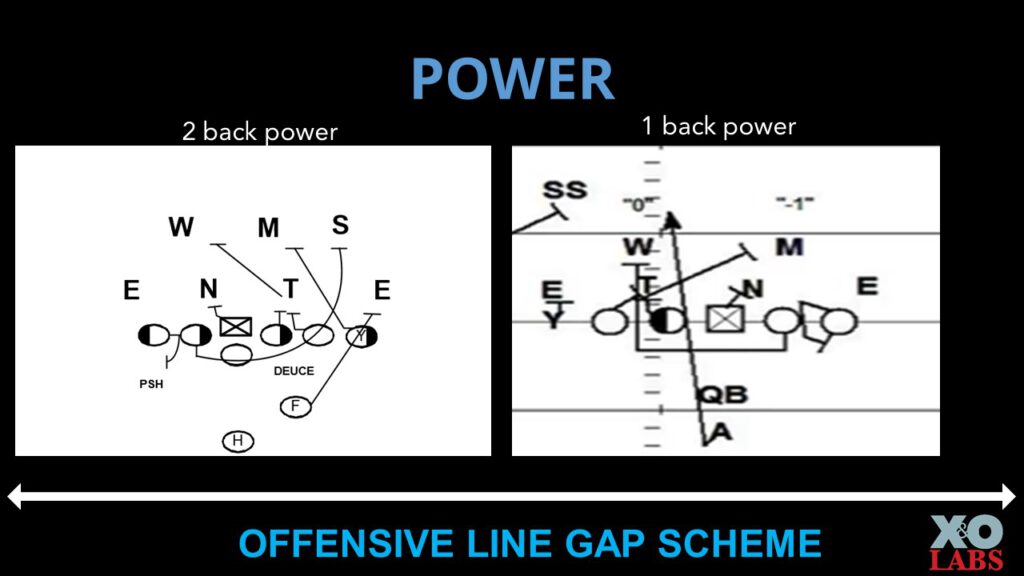
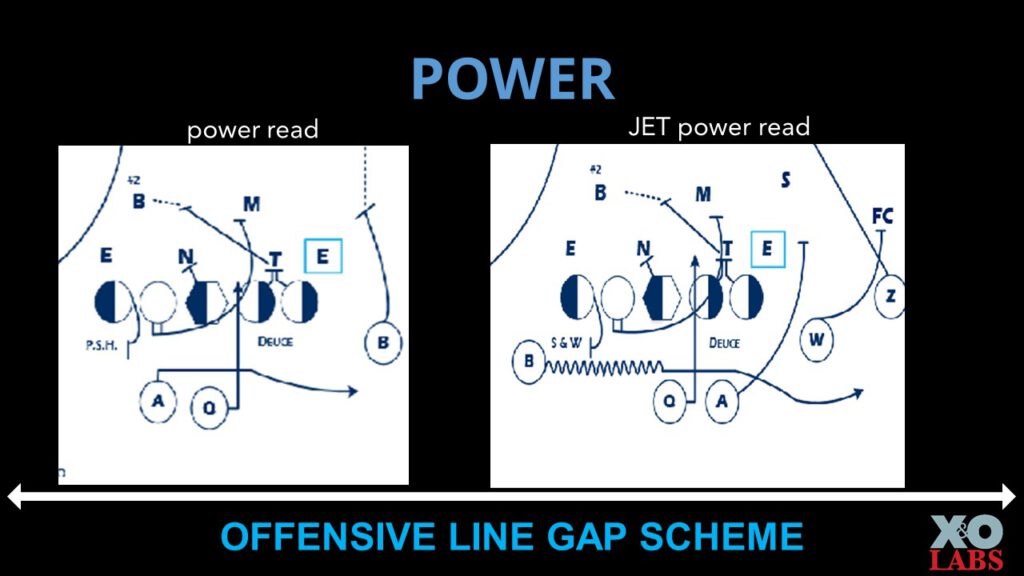
In this first diagram, I want to explain how we teach Power. Traditionally Power was always a 2 Back play, but now with additions of Power Read/Jet Power, we are still finding ways to modify most offensive coaches’ favorite run play. Today we will dive into the spread concept of 1 Back power and the most effective way I feel to block it. We ran various versions of Power/Read involving our QB so primarily that is what you will see in the clips!


Here is an image of Power 2 back and 1 back.

Here are the base rules for the OL:

Playside Tackle: Secure B Gap, If 3 Tech Double team (Deuce Block) to Backside LB. If B Gap is open work through under control to Backside LB.  You MUST GET MOVEMENT AT POINT OF ATTACK!

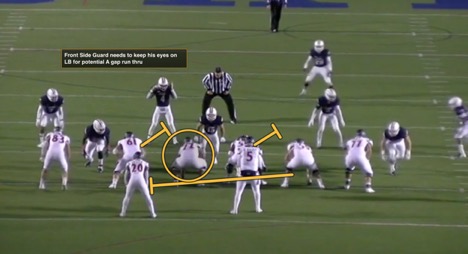
Playside Guard: Secure Front side A Gap, if 3-Tech “Deuce” Block with Tackle to the backside LB with eyes up for A-Gap run through. If there is a Shade or “2I” work drive block fundamentals knowing Tackle will secure the B Gap with movement.

Center: Gap Down and secure backside A Gap! Do not allow a DL to Cross Your Face. If there’s a 3-tech, work flat shuffle technique to down block principles.

Backside Guard: Square/Skip Pull with maintaining EYES on P.S. LB/ if he bails outside on jet eyes immediately go to backside LB or first guy Inside. Make sure we are getting enough depth so we can sort through the trash and adjust

Backside Tackle: Post, Seal, Hinge! Secure Backside Backer than Hinge for DE. If you have a 3-tech backside Jab down hard on 3-tech until you feel the Center’s presence, then Hinge for DE.

Read More

Inside/Outside Puller Fits to Defend Gap Runs from Mint Front

By Lawson Green
Defensive Coordinator
Oak Grove High School (LA)
Twitter: @lawson_green45


We are a base 3-4, 2-high team with our defensive linemen aligned in a 4-0-4 front.  Our defensive line is usually bigger kids that must demand a double team and can eat up blocks. Our End is the more athletic of the two tackles. He will bump to a 5-tech at times. Our Tackle is a true Defensive Tackle that will have to play 3 at times. We teach our Defensive linemen a Shade technique for when they are lined up on the shoulder of an offensive lineman and a Head technique for when they are lined head up. Our inside linebackers are decent runners, but they must be able to get off blocks and make tackles. Our outside linebackers must be able to play the curl area in the pass and set the edge or play a 9/6 tech against a Tight end. Our Corners are our best cover guys, and our safeties need to be our best tacklers. We have adapted our defense over the years to try to stop the spread attack. We no longer start our defensive installation by defending the Pro formation.  We now start with defending 2×2. When talking about run fits in our defense our players must understand that our coverage leverage is going to dictate their fit in the run. If their coverage places them outside the box, they are going to fit according to our rules based on the alignment of the back. If they are inside the box, they fit based on the blocking scheme they get. When defending 1 back gap scheme teams we always want to make sure that we have someone inside and outside of each puller. When a lineman pulls, they are creating two new gaps to the side they are pulling to, so we must make sure we have someone in each one of them.


Aligning to 10 personnel

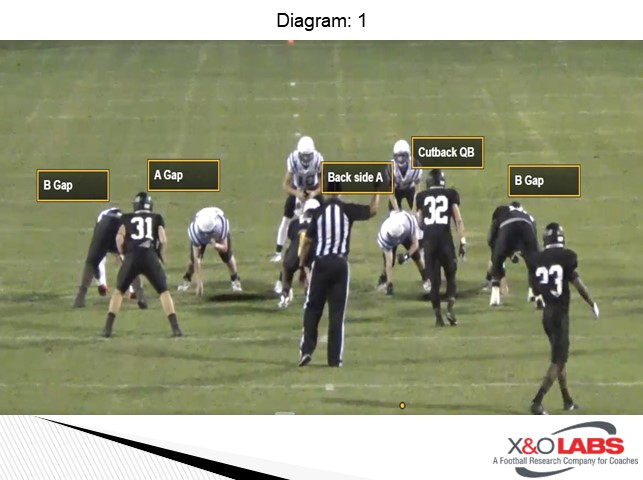
The Front Five: We align our front five to the field when in our base 3-4 front. We want to take away gaps from the inside out. We play our tackles in 4s or 4Is depending on their ability, they will utilize our head technique. They are responsible for the B gap on runs and they are contain rushers against the pass. Our nose is aligned in a zero. He is the backside A gap player. We want our nose to disrupt the middle as much as possible while maintaining the backside A gap. If our nose gets a double team, he will sit his hips down in the crack and fight pressure against the double team.  Our ILBs align in 20s and are frontside A gap players on runs to and cutback/Quarterback players on run away. The ILBs are fast-run fitters.


Outside Linebackers (OLBs)vs 10: Our Sam and Jack will apex the #2 receiver and the offensive tackle. They will align 5 yards off the ball with their inside foot up.


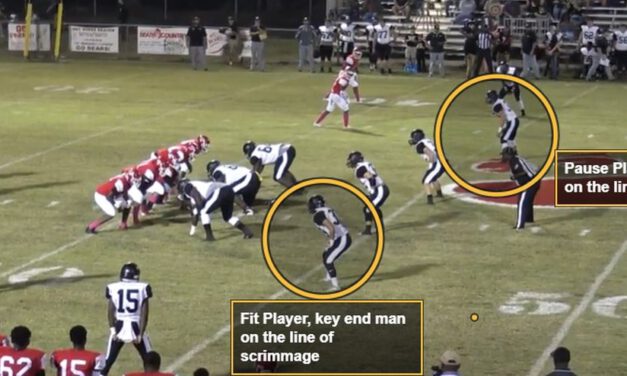
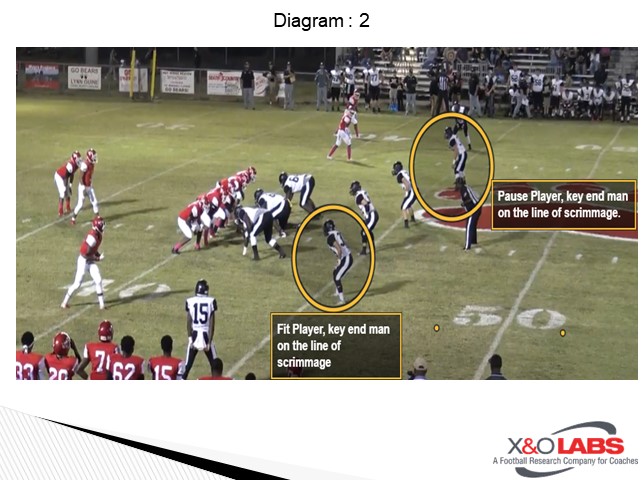
Sam and Jack are either a “Pause” or a “Fit” player based on the alignment of the back. If the back is aligned to their side, they are a Pause player, meaning that they will hang in the slot window for a pass then play Qb to cutback. If the back is aligned opposite of them then they are a Fit player, meaning that if they get run action, they are going to attack the line and get square to force the ball back inside.

Safeties vs 10: The Strong and Free Safety will align off of the #2 receiver based on the coverage call. They are pass-first players. Their job is to fit outside in vs any run to their side and to play long cutback away from him. The Free Safety will align 5×7 off the offensive tackle to the single receiver side. He has the same responsibility as the Strong.

Corners: The Corner aligns from the #1 receiver based on the coverage call. He is a pass 1st player with secondary contain responsibility vs run to him and last man pursuit vs run away.

Read More

“The Foster 5” – Innovation 2: Converting the G Defense to Defend the 11 Personnel Run Game

“In G defense I can close my eyes and know how teams were going to block and manipulate us. We couldn’t protect the backside linebacker in gap runs.”
– Bud Foster, former Defensive Coordinator, Virginia Tech University


By Mike Kuchar
Senior Research Manager/Co-Founder
X&O Labs
@MikeKKuchar


The Ideology: A Single Gap Control Mentality

Bud Foster defenses know how to get after the quarterback. In fact, since he arrived in Blacksburg in 1995, the Hokies have led all FBS programs in sacks (894) and sack yardage (-6,110). And while he realizes that the days of the 50 sack per year season tally has dissipated, he still works tirelessly to put less and less on the shoulders of the defensive ends in his system. It’s a far contrast from many defensive coaches who expect these players to handle multiple responsibilities in the run and pass game. For years in Blacksburg a defensive end’s job description was two parts:  get off the ball and create havoc. And with the success of many under his tutelage- Jason Worilds, Darryl Tapp, Cornell Brown, and Corey Moore to name a few- who is to argue? Coach Foster built his G defense around spill principles in the run game, asking first level players to bend down the line of scrimmage to spill blocks so that linebackers can be free to make plays. This philosophy stayed true to keeping those precious linebackers free to flow to the ball, and came with first level defensive lineman playing single gap control in most situations. He never tinkered with the two-gap technique, mainly because he felt he didn’t have the type of personnel to do so. “You don’t see many defenses that can line up and play two-gap that can just man-handle people like Alabama can,” he said. “We couldn’t get those guys. We can play with smaller guys that are every bit as physical.” So, he had to create one on one situations that allowed players to play faster. And since most offenses work to manipulate edge defenders in the read game, it didn’t make sense to ask him to do multiple things. “Edge players are our most dynamic players,” he said. “You want them to be playmakers. Offenses continually try to negate speed players and manipulate them, so we try to find ways to allow them to play fast and attack the offense. If we slowed them down, it affected our pass rush. Instead, we turned them loose.”


The Impediment: Lack of Protection for Box LB’s in 11 Personnel Run Game

Back in 2015 when I last visited with Bud, he was enamored with the Bear defense, and for good reason. The Hokies had just come off a 35-21 win at 8th ranked Ohio State, where he used the Bear front exclusively to draw off double teams to hold the Buckeyes’ potent run game to 108 yards on the ground, down from the 264 yards per game they averaged that season. The plan worked until the following season when OSU rushed for 359 yards in a redemption win. RB Ezekiel Elliot wasn’t a great matchup for the Mike linebacker (who would be?) and QB Cardale Jones was able to avoid the 5-6 man pressures to extend plays and just like that the Bear defense was shelved. But according to Bud, that outcome wasn’t the sole impetus that drew the change.

Part of the role of turning first level defenders loose was allowing them to be bend players and not read players. These were called “Free Calls,” in Bud’s system where the defensive end was able to bend down the line of scrimmage to play the first level of the option concept. It was an easy technique for first-level defenders that were able to get the ball spilled to the perimeter so that second and third-level defenders can run things down. It fit with the premise of the G defense because it got everything spilled. But the problem was the upfield natural movement of that defensive end allowed for offensive linemen to get angles on second level linebackers who were not able to get over the top of blocks in gap concepts. So, in a sense, the ball was getting spilled to grass.


The Adaptation: The 50 Defense

So, in 2017, Coach Foster went back into the lab and produced what he felt was the perfect hybrid between the Bear and his vaunted G defense. He called it his 50 defense.


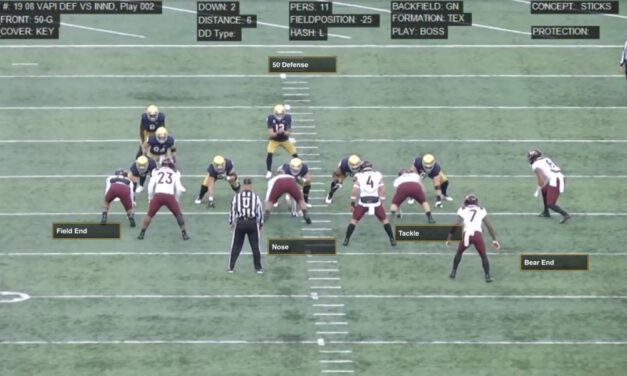
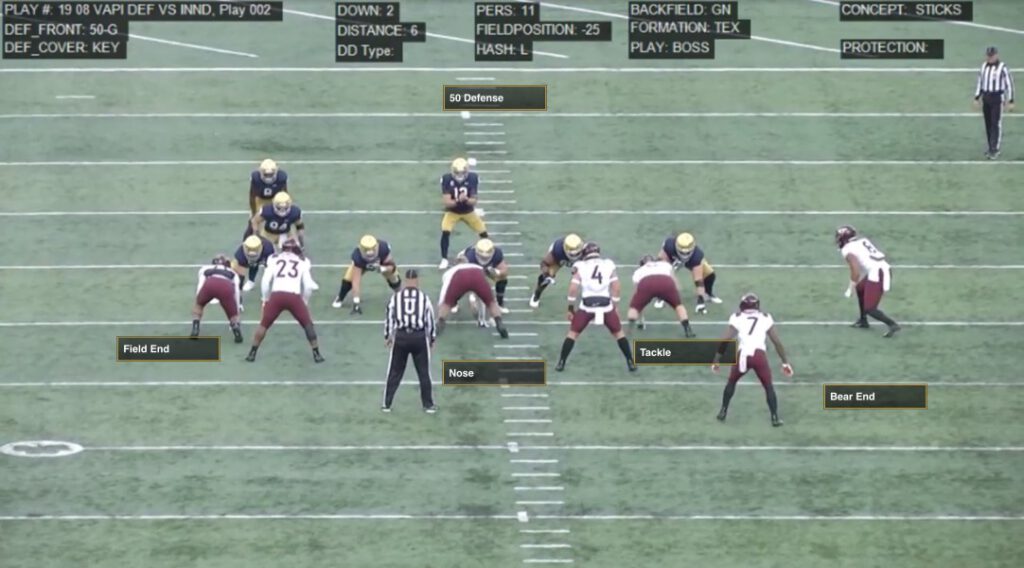
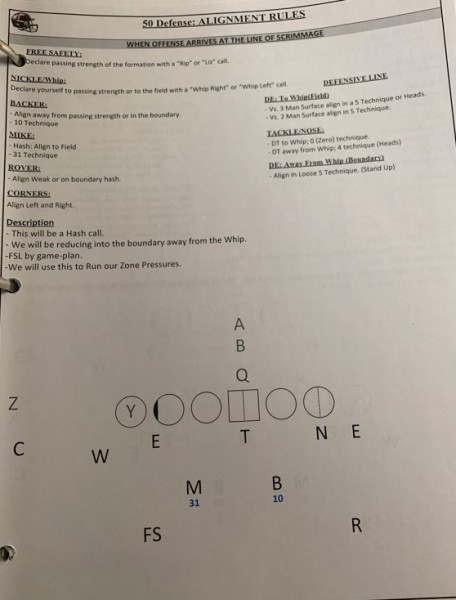
Without changing personnel, he tabbed what he called a “Bear” End who would be allowed to be in a standup position at the line of scrimmage. The other 5-technique defensive end would align with the Whip/Nickel, the Nose would reduce to a pure 0 technique, and the Tackle would play a 3-technique to the side of the “Bear End.”


The Bear End can be set to the following surfaces based on specific preferences:

  • To the Boundary– This provided alley support to boundary corner in field zone pressures


The clip below best illustrates this coaching point:


  • To the Field– This provided immediate support in any perimeter runs like jet sweep


The clip below best illustrates this coaching point:


  • To the Back– This provided immediate mesh disruptions for speed options teams.


The clip below best illustrates this coaching point:


  • Away from the Back– This provided immediate mesh disruption on dual options like power read.
  • To the Tight End– This provided a better edge for outside runs


To get these protocols straightened out, the Bear End would align to the strength called by the Mike. The Mike would set the front to any of those possible scenarios above while the coverage would adjust accordingly. But if there were pressures called, the base rule was to have the Bear End align to the boundary or away from passing strength.

The 50 defense was something he wanted to use exclusively against the 11 personnel run game because the presence of a backside B gap responsible first level defender made it hard for linemen to get to the backside linebacker in run schemes. “You get two linebackers in the box and usually one of them is clean,” he told me. “It was a big help in defending spread gap schemes that we’re seeing now like counters.” According to Bud, it also allowed the field defensive end to play both the C and B gap in his “pop pinch” technique described below. The Mike linebacker was able to overlap concepts and run them down.

Read More

Vertical PAPs off Power Read and Power Pitch Run Action

By Gabe Luvara
Offensive Coordinator/Quarterbacks Coach
Robert Morris University (PA)
Twitter: @gluvara

Four verticals is one of the oldest, and most time-trusted pass concepts in football. In our offense, as well as most others across the country I’m sure, it is a day one install concept. Like most staple plays, it allows for great variation across most any formation and opens options for creative play designers to layer different receivers in the landmarks spread across the field. At RMU, it is also a major point of emphasis in our play-action game from week to week. As we build our plan in the run game we always keep an eye on what defenders will be activated in run the respective run fits and how, if possible, we can take advantage of empty field space created down the field w vertical variations. These plays are low-cost concepts for us as they have great carryover for the QB’s and receivers from the initial install of the drop-back pass play. Incorporating the play-action versions allow the ball to come out even quicker in the seams because of the initial step to fit of the LB’s. Pass rush can be influenced thanks to the different protection schemes (run looks) we use and allow us to hopefully get the ball out quick while defensive linemen are still beginning to alert themselves into a pass rush transition.

WR Jet Play-Action Verticals

Use of Jet sweeps in some form or fashion are a possibility for us in any game as an option to fill our perimeter run plan. One of our first versions of PAP verticals comes off this action.

This is a 5-man protection with a slightly moving pocket as the QB will set up in approximately the pre-snap B gap area after shuffling with the mesh of the WR. The action we are selling in this instance is our power read play to the jet sweep. The front-side tackle is responsible for the B gap and wants to sell the “deuce” combo for the first 3 steps before gearing down and transitioning into a pass pro mirror technique. Once the ball is snapped, he must keep his eyes in his gap and if there is no immediate threat (3-tech) he should leave an inside drag arm and look for any work coming to fill his gap. A pre-snap coaching point is that the tackle be alert to any potential edge pressure showing off the front side. If needed he can make a call to alert the front side of the OL and the pulling guard of the possibility of pressure. In this case the guard and tackle should emphasize staying square to collect any inside movement of the DL and freeing up the pulling guard to connect w the blitzer.

Read More