Air Raid Concept Designs from Compressed Formations

By Pete DeWeese
Offensive Coordinator & Quarterback’s Coach
Sprayberry High School (GA)
Twitter: @coachdeweese

@nbsp;

In the world of offensive football, compressed (or Tite) formations are nothing new. Teams have been using Tite Bunch formations in Pro and Spread offenses for decades. Several other offensive systems have used Double-Wing and Double Slot formations to condense offensive sets and put the defense in a bind. I think that football has seen a bit of a resurgence of compressed sets in recent years from NFL teams like the Rams, Chiefs, and 49ers as well as college teams from across the county. LSU used compressed sets as a big part of their National Title run in 2019.

Our offensive staff at Sprayberry has used compressed formations in some fashion since we arrived before the 2017 season. As the offense grew, we found ourselves building more and more Tite formations into our system. By the time that we entered the 2019 season we had built a solid catalog of compressed sets that aided our offense production.

One of our primary reasons for transitioning to Tite sets was for our run game, as we felt that we could use the formations to gain numbers for our edge run game. The other advantage that we sought to gain from our compressed sets was the ability to alter coverage structures. Sprayberry is in a highly competitive 6A region here in the metro Atlanta area. Several of our opponents have outstanding defensive coaching staffs and are stocked with incredibly talented players. The best teams that we play want to play some variation of match coverage and they all want to be physical at the line of scrimmage with their secondary. Utilizing compressed sets can force teams to utilize checks that may get them out of their coverage comfort zone, and that is our goal. As we moved to more and more condensed sets, we found ourselves needing to adapt our traditional passing attack into our Tite sets. We believe that any offense can take many of the common staples of modern offenses and easily execute them from condensed formations.

SMASH CONCEPT

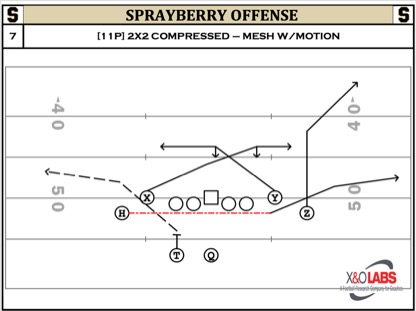
Smash is certainly nothing new. Many offenses utilize different variations of the traditional Hi/Low stretch that Smash places on a flat defender. Whether you are facing a Cover 3 defense or a 2-High team that will Cloud the coverage, good defenses can easily find ways to blurry the picture for a Quarterback when you are utilizing traditional splits. I have found that compressing the formation makes the read even easier for the quarterback and often seems to make it more difficult on the defense. Instead of using some form of a hitch, condensing the formation allows you to put the receiver into the same space with a different angle of departure. Whether you choose to put the #1 receiver, the #2 receiver, or a RB into the flat, you easily place a quick threat to that area of the field and force a quick reaction by the defense. Our primary method of running Smash puts the outside receiver on a speed out. Any corner that wants to be a hard-flat player gets pulled outside as the angle of our route often forces him to turn his hips and match the path of the route to the sideline. If he does not turn his hips but instead sinks off to protect the safety, he is giving up leverage and leaving your flat route open. The other option that we see is defenses that want to protect the CB by aligning him 3-4 yards outside of the formation. When defenses give you that soft edge, they are now more vulnerable in the run game and open themselves up to some of our other concepts.

The most common response we see from 2-High teams is either play a “SINK” version of Cover 2 or Pattern Match off the release of the #2 receiver. Because of this, we have found that 2-High teams typically keep the safety both more inside and a little deeper than they may be otherwise. This allows continues to put the CB in a bind as we pair our speed out with the traditional corner route. If the Safety is deep and inside, we have created the leverage that we need for our route and given the QB an extremely easy read.

One-High defenses must decide where they are going to put their alley defender. If they put him outside of the #2 receiver, or even outside of the #1 receiver, you have been able to take advantage of the interior run gap that the alignment has created. You also must take advantage of what has likely become the free release of your #2 receiver against that look. We think Smash allows you to do just that.

Read More

3-2 and 3-1 Box Run Fits from 3-Safety Defense

By Josh Runda
Defensive Coordinator & Linebackers
Bluffton University (OH)
Twitter: @Rundatheball


At Bluffton University we base out of the 4-2-5. However, when I became the Defensive Coordinator, I knew I wanted to be able to run the 3-High Safety defense as well. This would allow us to be multiple and make offenses prepare for 4-man fronts and 3-man fronts. The trick was finding a way to marry the two defenses and be able to have variations of the Same coverages out of both looks. Our identity is simplicity and at the end of the day, we want our players to play fast and playing with confidence. Our goal is to be able to run our coverages in our 4-2-5 and 3-High Safety defense without changing the language. The 3-High Safety defense also gives us the ability to run different variations of drop 8 coverages.


The Basics
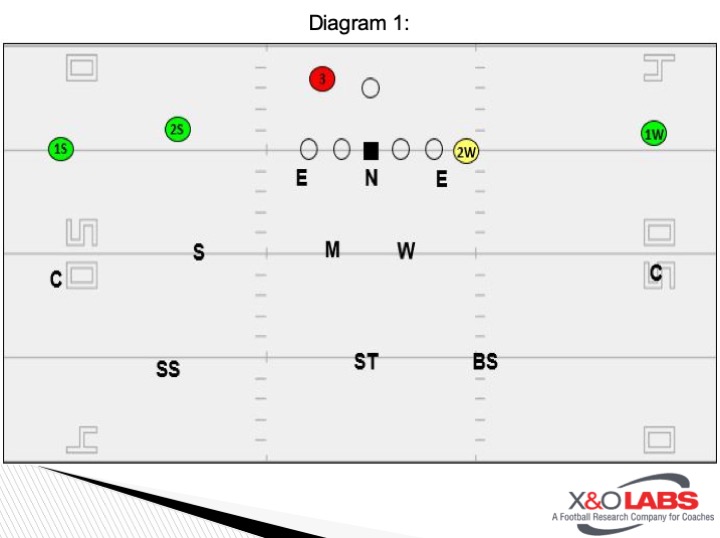
If you aren’t familiar with the 3-High Safety defensive structure, here is a look at our base alignment to a 2×2 attached tight end formation.


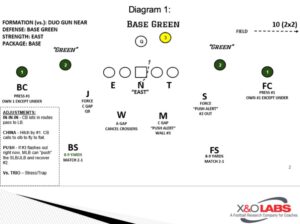
Positionally upfront we play with an End (E), Nose (N), and End (E). At linebacker, we play with two in the box linebackers, our Mike (M) and Will (W). Our Sam (S) is a true field player. In the secondary, we play with two Corners (C), a Strong Safety (SS) which travels to the field, our Boundary Safety (BS), and our Star (ST). The Star is our middle safety.


Our Base Coverage
We are a split field coverage team working in triangles. Our strong safety works with the Sam and the corner to their side and the boundary safety works with the will and the corner to their side. Our safeties align on the outside shoulder pad of the #2 WR to their side. Based on their alignment, they decide if they can give help to the corner to their side. If they do think they can give help they will put us in a “Read” (Cover 2) call to that side. This means all three defenders are going to read off the #2 WR’s release. If the safety does not think they can give help they will put us in a “Nail” (Cover 4) call to their side. In both coverages, the Mike is going to have eyes to #3.


We are a +1 mentality to the box and because we often count the Star as a run-first defender, we utilize him as a “takeaway” defender in our base coverage. This simply means that we will utilize the Star to take away something the opposing team does well in the passing game. We also can add him on to the rush or use him as a spy vs. a mobile quarterback.


“Read Coverage”


Corners:


Alignment: 1x 6-7 yds I/S

Responsibility: Flat/Deep Quarter

Key: #2

Goes in – Sink with #1

Goes out – Drive Flat

Goes Vert – Use Mesh technique on #1


Safeties:

Alignment: O/S Shoulder of #2 10-12 yds

Responsibility: Deep Half

Key: #2 / Skooch steps at the snap

Goes in – Eyes to #1

Goes out – Over the top of #1

Goes Vert – Man to Man


“Nail Coverage”

Corners:

Alignment: 1x 6-7 yds I/S

Responsibility: Deep Quarter

Key: Mesh technique on #1. If #1 is under, zone off


Safeties:

Alignment: O/S Shoulder of #2 10-12 yds

Responsibility: Deep Quarter

Key: #2 / Flat Foot

Goes in – Eyes to #1

Goes out – Eyes to #1

Goes Vert – Man to Man

Read More

Gap Double Teams vs a 3-Down Nose

By Tom Doddy
Offensive Line Coach & Run Game Coordinator
Rowan University (NJ)


I believe that to be a championship football team, you must be able to run the football at high efficiency, not only against advantageous run boxes but against stacked boxes when everyone in the stadium knows you are going to run the football. Today’s defenses pose problems that defenses back in 1983, the year I started coaching, did not pose. We see more multiple fronts, stemming, and movements than ever before. As a result, our run scheme and blocking techniques are simple but flexible enough, to handle all the different looks that we are going to see week in and week out.  It is my philosophy, like the late Coach Howard Mudd, that we will do a few things and will do them extraordinarily well.  Our run game consists of zone runs (inside, mid, outside) and gap runs (power, counter, and dart).  Power is a staple in our offense.  It is an “Alka-Seltzer” run play for us. If things are getting unsettled, running Power will allow us to be able to calm things down and get us back on track.

My philosophy as an Offensive Line Coach has been shaped by my experiences playing the position in high school and college and coaching the position at the collegiate and high school level.   My experiences coaching other positions in football (QB, RB, TE, DL, LB, and Safeties) and coaching other sports (baseball, women’s softball and throws in track and field) have also shaped my teaching progression.  I believe that you teach linemen HOW to block before you teach them whom to block. As you will see, our teaching progression will be broken down into the following:

  1. What is my job?
  2. How do I do it?
  3. Do it
  4. Repeat

By breaking it down into this simple progression, it will help our players become problem solvers on the field. If something goes awry, they will know how to go back and correct themselves appropriately.

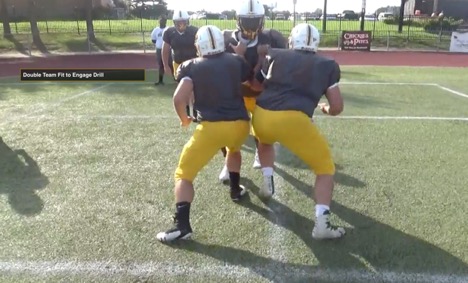
Today, I would like to present to you the C/G double team technique, versus a 3-down front, we teach in our gap run game at Rowan University.  When running Power, Counter, or Dart, all our double teams, are executed with the same technique. It is a unified technique.  We are going to take two adjacent OL and apply mass and force onto the Nose.  For teaching purposes, we break down our responsibilities and techniques into a Post Man (Center) and Drive Man (Play Side Guard).

The double team block intends to displace the Nose vertically and/or horizontally.  As a result, our technique must match the intent of the block.  In doing so we will be able to displace the defender vertically (drive him to LB depth) or horizontally (widen a defensive gap) based on how the Nose plays the block.    Our thought process is we must dominate the first level first before we can even think about climbing to the second level.  Our shoulders and hips must stay as square to the LOS as possible and play with great eye discipline.    This will allow us to deal with defensive movement and or pressure, allow our hips to fuse, and utilize the complete width of our blocking surface.   In essence, we will not provide many open windows for defenders to exploit.

Read More

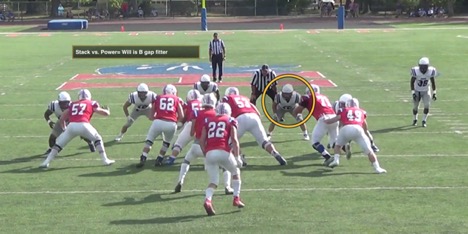
“The Foster 5” – Innovation 1: Designing Pressures to Manipulate the Modern QB

“For a time, offenses got away from 3×1 open because of protection issues. Now they are using it more to either manipulate you down the middle of the field or to isolate your boundary corner. You have to protect him. You will not always get the matchup that favors him.”
– Bud Foster, former Defensive Coordinator, Virginia Tech University


By Mike Kuchar
Senior Research Manager/Co-Founder
X&O Labs
@MikeKKuchar


The Ideology: Varying Coverage and Insertion Points to Exploit Mismatches

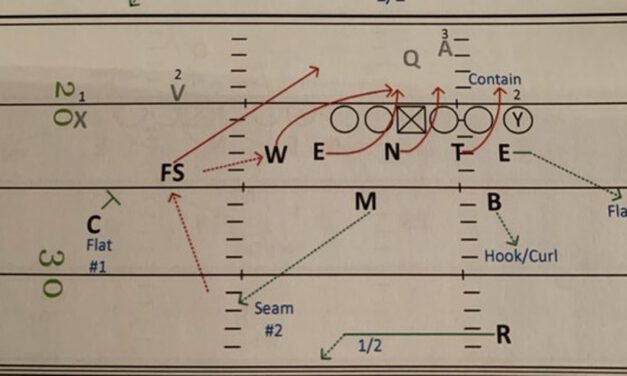
Let’s start with a foregone conclusion: Bud Foster loves to pressure offenses. That has never changed. But how he decides to manufacture pressure has been a continual development in the mind of the legendary defensive coordinator. We’ve all seen the grainy footage of Virginia Tech’s Whip Dogs and Cane Dogs of the early 2000s. If you haven’t, we’re willing to show it again. Those samplings are included in the Film Room section of this study. You need to see how Xavier Adibi and Corey Moore got after the QB. But his evolution now has come in the form of altering two main aspects of his zone pressure system: varying insertion points for his pressure people and building out the coverages on the back end.

He tells me that in a good year, he will be 15-18% zone pressures, 30% man free pressures, and 55% zone coverages. There are also be years where they are not a good pressure team so he will play more base. The difference lies in how many coverages are used to support them on the back end. “In any of our pressure patterns, we can play Cover 7, Man Free, Trap, Cloud, Robber, or Quarters he told me. “It can change week to week for us. It’s based on whether an offense is a run team, an RPO team, or a pure drop-back team. That is where we’ve been different.”

One of the more interesting things I garnered from my sessions with Bud is noticing how different he is in classifying his zone pressure system. Most coaches I’ve worked with classify their zone pressures based on the concept type and would follow this traditional format:

  • 3-deep, 3-Under zone pressures
  • 3-deep, 2-Under zone pressures
  • 2-deep, 4-Under zone pressures


Each one of these categories will have a distinct amount of pressure patterns tied to it. For example, a “Bark,” pressure pattern would continually be with always be utilized with 3-deep, 3-under zone pressure coverage. But Coach Foster doesn’t classify his pressures in that regard. Instead, he’ll build coverages off the pressure pattern. And because he varies the coverage behind these patterns, most of his pressures are grouped by name, not by coverage. For example, a Whip (Nickel) zone pressure alone can be supported by several coverages on the back end. I assumed this could be confusing for players but the more time I spent with him the more I realized that players knew by alignment who was involved in the pressure. And that knowledge came with the understanding of the offensive formation presented. I’ll have more on that in the next section.

Like most coaches, Coach Foster teaches the back end of coverage before creating the pressure pattern. He is a self-reported coverage-loaded coach. “Our people have to understand invert coverage concepts first then we build our pressures around them,” he said. “It’s coverage first then we plug the blitz pattern in. You don’t mess with the coverage. You can plug people into the coverage.” This placement is the culmination of the process of finding mismatches in protection and coverage, both of which I elaborate on below.

  • Cover 7– This was a strong thirds rotation coverage that would replace the blitzer to the field. He liked to use these against spread offenses that took vertical shots on the perimeter. This softer coverage matched up well against deeper routes.
  • Cover 5 (Trap)– I noticed he used this coverage to get immediate protection in the flat to defend the horizontal pass game. It was something he built in when offenses started to identify pressure indicators and attack the flanks.
  • Cover 2 (Robber)– This coverage he used to soften the leverage of corners who had to defend speedy receivers to the field. I noticed it was something he used a great deal of against Miami who had faster receivers outside.
  • Cover 9 (Quarters)– This was used as a tighter fit coverage to contest intermediate throws and RPO’s. It played out more like man coverage with boundary pressure.
  • Cover 5 Switch/Cover 2 Switch– This is the coverage he progressed to protect seams. It’s part of his adaptation and is explained below.


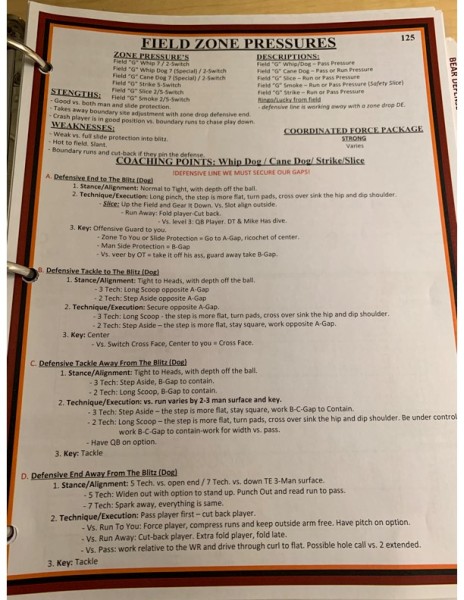
But there are certain staples in Coach Foster’s zone pressure catalog that need to be understood before digging deeper into his methodology. The number one rule is simple: the first level must secure their gaps, either with their bodies or the bodies of their opponents. That is a non-negotiable and that wording is littered all over his 500-page defensive manual.  There are several pre-snap movement verbiages tied to his system, which is explained below.


First Level Movement Categories:

  • “Tag”- 3-Technique works from B gap to A gap.
  • “Spark”- Same as Tag but 2i defender goes from A gap to B gap.
  • “Long Pinch”- C gap to B gap movement. Used by defensive ends to the side of the pressure. They will read the block of the Guard. If the Guard fans, he comes underneath the block. If the slide goes away from the pinch, he has to work back into the C gap.
  • “Long Scoop”– Used by Nose and Tackle to cross the face of the Center. This defender needs to be deep enough to get over the top of the Center. The same rules apply above. Center works slide to him, they cross face.
  • “Stem”- Nose and Tackle pre-snap movement. Each will stem from a 2-technique to a 3-technique. These stems are called. “We can’t play with two 3-techniques,” said Coach Foster. “If they get caught on first down, they are both sparking.”


Except for Stems, all of these calls are built into the call. Players are notified of the side of the pressure by “Lucky” calls (blitz is coming from the left) and “Ringo” calls (blitz is coming from the right). Any two-shade in Lucky tells them they are an A gap penetrator. Any three-shade in Lucky tells them they are tagging.


Zone Pressure Principles:

Pressure defenders at the second level are either contain rushers or benders. Each of these responsibilities is below:

  • Contain rushers= crash stunt. This is taught to Backers, Nickels, Whips, Rovers, Corners, FS. They would play pitch on the option and have flare control in the passing game. They have the contain element of the concept.
  • Benders- D crashers. According to Coach Foster, this defender cannot be flat enough. They will take the ball/dive player on option or the QB if no dive element. They must spill everything with a free rush. Corners or Nickels and Rovers can all be benders.


In most scenarios, the initial penetrator would be an outside edge defender and then LB would be contain. I’ve noticed many breakdowns in the technique of the D-crasher when I was sitting down with Coach Foster to not come tight enough down the line of scrimmage. He teaches this by using his Hoops Drill, which is available in the Film Room section of this report.

With a pressure catalog as extensive as his, I was curious to see how he assesses blitzers. He told me that although different years bring different personnel, he found that the Nickel in his system usually was a better pressure defender than a cover defender. This is why he relied more on them to pressure than to play more coverage. The same could hold true with the Rover. “It’s all about timing, anticipating, and the ability to slip blocks,” he said. “They need to play with good leverage and not be allowed to get pushed.” He teaches this by using his Skate Drill, which is available in the Film Room section of this report.

Bud felt that the hardest thing to get pressure players to understand is to make sure they have a plan before they rush. “Those second-level players can’t have hesitation,” he said. “The worst-case scenario is to bull rush or power rush the blocker but I don’t want to get run by the QB where he can dip up and run away. I want them to play fast. You don’t want QB’s to step up and attack seams, etc. It’s the same thing with our front four. We want to push the pocket with our defensive ends. There are different QB that can turn and run or slide out with vision downfield. We need to keep the launch point in a certain area and close the pocket. We need to limit the passing lane.”


Zone Pressure Installation:

He follows a progression when installing his zone pressure catalog. I include his complete fall and spring installation in the Appendix, but from a general standpoint he uses this framework:

  • Field Fire Zones first
  • Boundary Fire Zones second
  • Pipe (Middle) Fire Zones third


“Once you have those patterns put in it just becomes concepts like insertion points, long pinches, and wipe techniques,” he said. “We would have a full run-through in practice to emphasize two back offense to get our base rules. Then we move to one-back offense. I want to get base fundamentals done.”

The man pressures described in Section 4 get installed first. Then, he progresses to teaching his zone pressures. We will follow the order below when detailing them in this section:

  • Whip
  • Whip Dog
  • Cane Dog
  • Slice
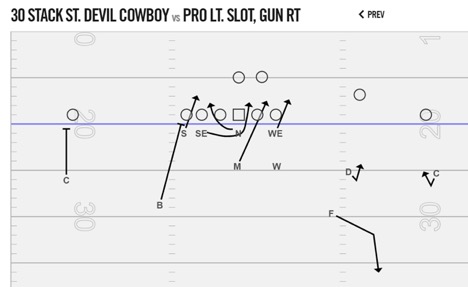
  • Devil
  • Cowboy
  • Rover
  • Cab
  • Clippers (30 Pressure)
  • Boundary Dog (30 Pressure)


Field Pressure Patterns:

How he classifies these pressures has so much clarity, particularly for the defenders upfront. All of his field fire zones abide by the following outline below:


The field pressures are all the same to the pressure side. “It’s only different for the Nickel, Free Safety, and Mike linebacker based on coverage,” he said. There is a lot of text in that outline above, but essentially Field fire zone rules follow the format below:

  • The defensive end to the pressure side is either long pinching or he’s up the field like he would be on the “Slice” pattern.
  • Tackles are long scooping.
  • The Nose is sparking away
  • The Defensive end to the boundary is dropping.


The following pressures are included in Coach Foster’s field zone pressure catalog:

  • Whip
  • Whip dog
  • Cane Dog
  • Strike
  • Slice


What I wanted to do first is introduce these pressure patterns and when to use them. Then I’ll address how he went about altering the coverage structure behind them to attain mismatches in either protection or personnel.

Read More

Varying Uses of Middle Safety in 3-High Structure

By Bobby Curran
Defensive Coordinator
Conway High School (SC)
Twitter: @CoachCurran42


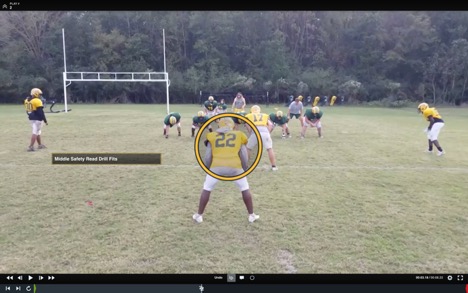
Three-high safety defense is the most trending topic in defensive football recently. Foundationally, we are a Tite front, 3-4 defense. Going into the season we wanted to be able to paint a different picture for the offense than our “base” without changing personnel. In doing so we incorporated the three-safety defense as a changeup for us. Getting into the three-safety defense and changing as little as possible was our goal. To do this, we took our MLB and told him to align as the deep middle safety (8-10 yards). There are a lot of philosophies out there that allow for many different players to fill the role of the middle safety in a three-deep shell. What we found is, if you want to keep your teaching the same across all positions, the easiest position to move is one of the middle linebackers from our base 3-4. The MLB being deeper does not change anything for him. His run fits are the same. His pass responsibilities are the same. The secondary shell is the same.

As a quick note, we will line up our three-high package against anything. We’ve run it against 10 personnel, and we’ve run it again 32 personnel when a team got heavy on us. This just furthers the point that if you keep the rules and fits consistent, it doesn’t matter what you see on Friday night, your kids can line up and play ball.

A frequently asked question to me when talking about going back and forth from a 3-4 to a 3 high is, “How do you deal with the last #3 and pass distribution?” Our base foundation is press quarters so when we hear #3, the first thing that pops in our heads is a “push” call that is a staple in every quarter’s toolbox. With three-high safeties and only one inside linebacker, we do not want him leaving the box to chase anything. We’d like to take the thinking off his hands and just have him focus on the box.


Teaching Progression

Basic Picture: This is a picture of our base defense. As in any defense, we have a multitude of ways we fit things. We can box, spill, and use various players in different roles, which is why we love the 3-4 defensive structure.


Ways We Use our 3rd Player

In pass coverage, we must relate to #3. After the pass routes distribute themselves, the #3 usually becomes the in-breaking route because no matter where they start, the inside player is always going to turn into #3. Thinking with the end in mind, we know what his assignment is going to be. This being known, we can now move his alignment to put him in the most advantageous position for him. This means we can change his alignment. With our three-safety package, we can use him as our QB player in the run game, we can spy him on a particular player, we can use him as a robber, and, as you’ll see on film, we can use him as an RPO hunter.

Coaching Points:

Alignment: Our M will align stacked directly behind our W, depth will be decided by game plan and down and distance. Typically, if we are in a running situation, we’ll have him around 8 yards. The deeper in the down and distance, the deeper his alignment will take him. We use his heels as our key for alignment. If I want him at 8, that means his heels are at 8, etc. Again, he will relate to #3 if #3 is removed. That’s the only thing that will take him out of his stacked alignment. If #3 is in the backfield, he’ll stay stacked. The stacked alignment, for us, simply makes his assignment and angle harder to pick up for the offense.

Read/Key:

Reads for our MLB to stay the same regardless of his alignment. As a caveat, I will say, in spring/summer, when we work on reads, I teach our LB how to read backfield and linemen. I do this because every player is different. Some are exceptionally good at reading guards. They can decipher a down block vs. a reach block, etc., and get where they need to go. Others are outstanding backfield readers. I give them a bit of freedom in deciding what works best for them if it fits our system. He will get his pass read just as he would in the box, the high hat from the offensive line. His keys will change week to week given the game plan. For example, if we are going to be heavy 3 high safety for a given week, we will have him key the #2 WR if we know we’ll get a strong RPO game, etc.

Read More

Pass/Screen and Screen/Screen Options Off Number 3 Defender

By Robin Bowkett
Head Football Coach/Offensive Coordinator
Souhegan High School (NH)
Twitter: @coachbowkett


We would classify ourselves as a multiple spread option offense. We have a read key or two on pretty much all our plays and concepts. We took this into account when building our screen game as well. Historically, our program has been a real solid screen team as our personnel upfront and on the perimeter helps dictate that. We devote a ten-minute screen period during our offensive practices in the preseason which helps emphasize the importance of screens within our offense. We feel the benefits of running read screens include, tagging off our base plays, carry over for the offensive line, can call on any down, gets athletes in space, and forces the defense to defend the whole field.


TB Slip Screen

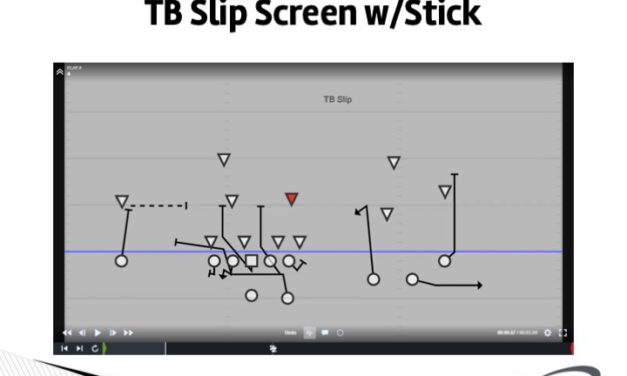
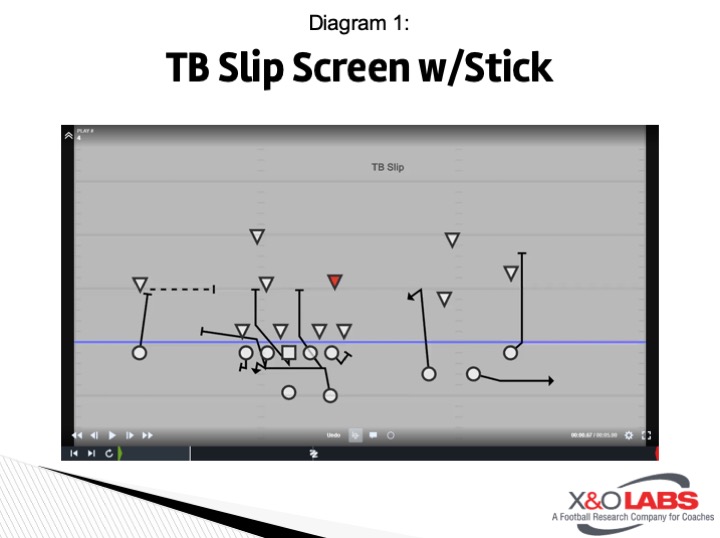
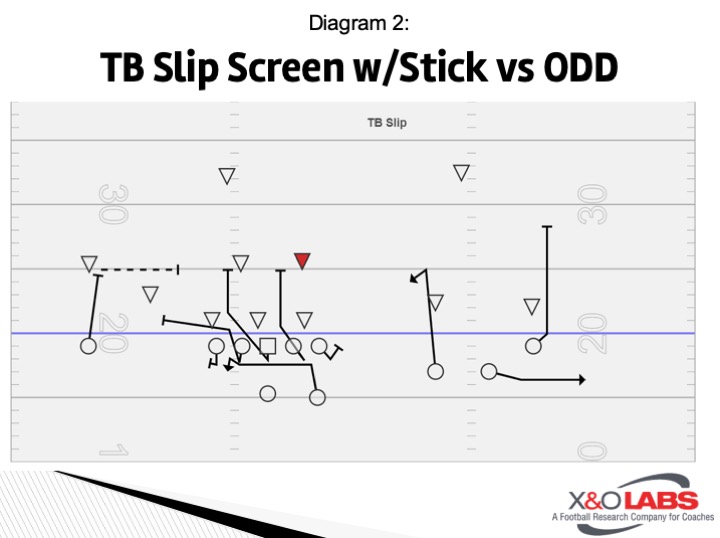
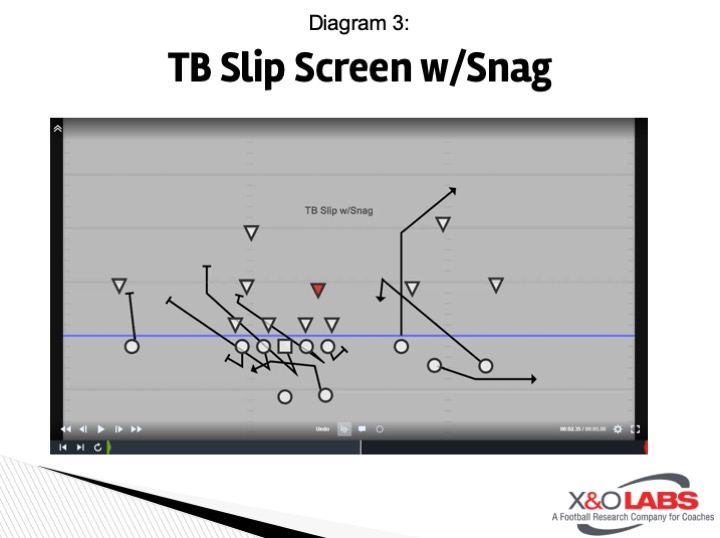
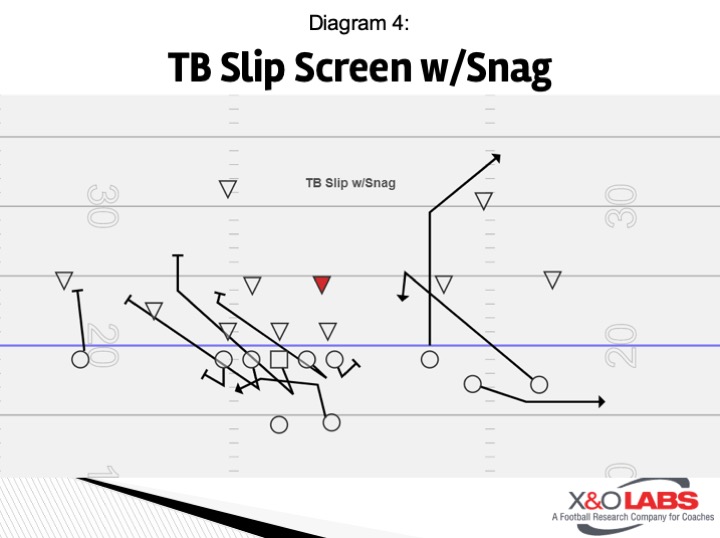
The first screen we will talk about and install is TB Slip Screen. This screen generally is a PSO (pass screen option) and we like to pair it with one of our base pass concepts. We install this screen first because it marries up with our base pass protection. We like it best vs off zone coverage, but you can run vs man. This past year, we ran the stick concept with slip but in the past, we have mainly run 3-man snag. We like to run this out of 3×1 as we feel it is less crowded for the offensive line and simplest for the QB. We also like this screen because it an easy read for the QB regardless if the defense is in an Even or Odd front.  Versus a four-man front, the Read will be the Playside backer, the Sam in a 43 or the Mike in a 42 box.  Against a 34 look, the read is still the Mike backer and vs a stack look, the read will be the Frontside stack.   This is a great play vs pressure as long as the OL can account for the defender responsible for the back.

Read More

Targeting the Weakside Safety in the Y Cross Concept

By Tye Hiatt
Offensive Coordinator/Quarterbacks Coach
Shepherd University (WV)
Twitter: @HiattShepherdU


The cross scheme (Y-Cross) is a base concept for our offensive staff at Shepherd. It is a scheme that has answers to different coverages and is a concept that we can adjust to our personnel. This concept is one that we can add to as the season progresses and make adjustments as needed. One of the factors we stress with our players when installing this offensive scheme is that we want our players to understand the “big picture” of the play. We want players to understand how they fit within the base concept. This play gives us the freedom to move players around the field and put players in multiple positions to be successful.


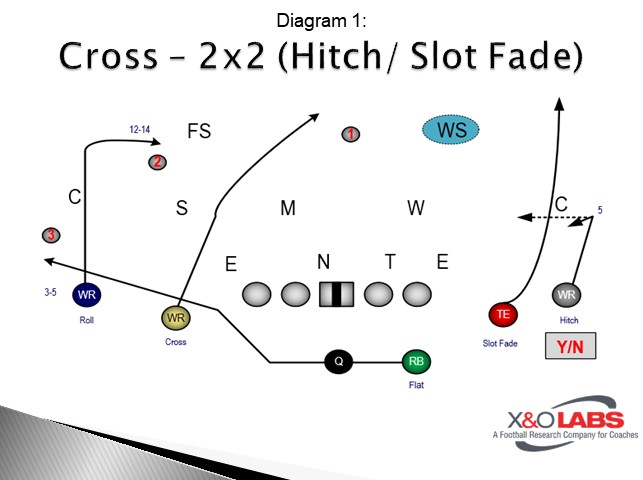
In this first diagram, we will go over our base install for the concept.

Hiatt Cross Diagram 1


Here are our base install rules:

Boundary WR #1: 5-Step Hitch – Work down the line vs Man
Boundary WR #2: Slot Fade – Release to the bottom of the #’s, hold the line at 13-15 Yds (Stem and hold vs man coverage)
Field WR #1: Roll – 12 to 14 Yds on depth – Stay flat to negative
Field WR #2: Cross – Work inside apex defender and attack vertical, do not run past the center, allow the QB to throw to grass (Man coverage – work inside, vertical stem and flatten)
RB: Flash fake, funnel edge defender to Tackle and release to flat (Anticipate the ball coming out quick vs pressure)
QB: Flash Fake – 5-Step Series


Using the eyes of the quarterback to work through this play, here are the key reads we look at within the concept:


Pre-Snap Key

  • Identify the WS (Or the player who is defending this area). The quarterback wants to get a pre-snap view of where this defender is aligned and his demeanor.
  • The quarterback wants to look at Y/N Hitch – With the pre-snap picture he will ask himself “can I complete the hitch?” If this is a yes, come off the flash fake and throw the 5-Step hitch. If No or if the picture is not clear, work to the key read.


Post-Snap Key

  • Work the post-snap key read on the WS (Or the player who is defending this area).
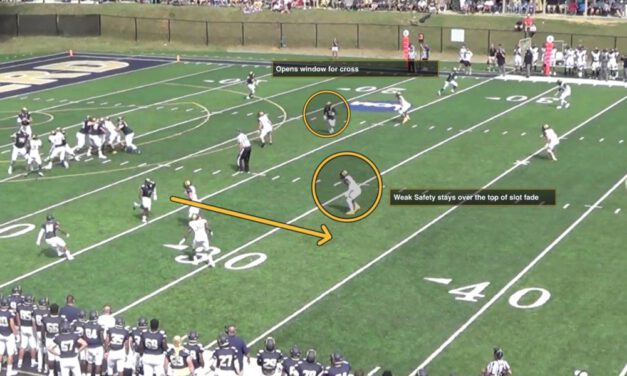
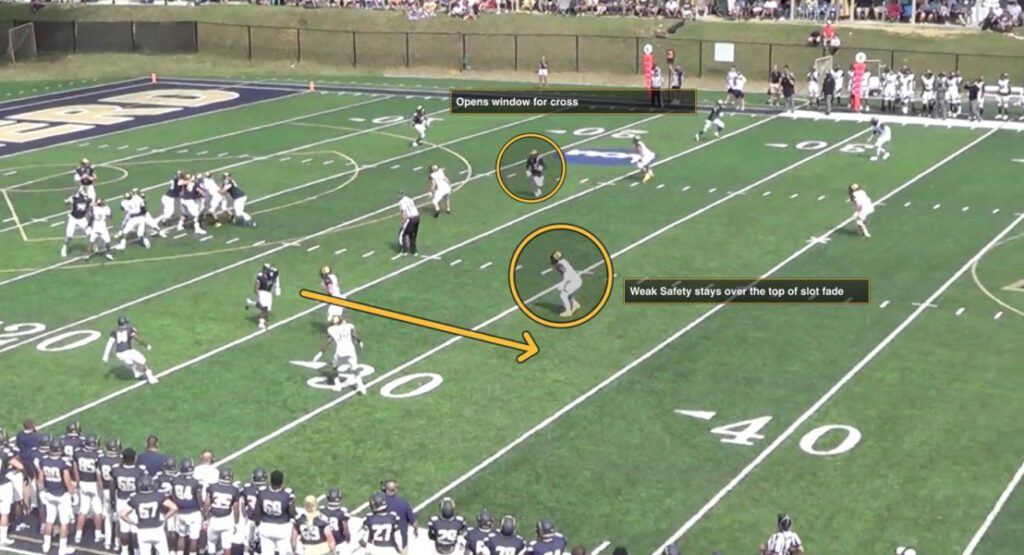
  • If the WS works inside the hash toward the middle of the field, the quarterback will work the high/low into the boundary.
  • If the WS works outside the hash toward the boundary or drops vertically on the hash the quarterback will progress cross, roll, back.


Read More

Targeting the Weakside Curl/Flat Player in the Drive Concept

By Tye Hiatt
Offensive Coordinator/Quarterbacks Coach
Shepherd University (WV)
Twitter: @HiattShepherdU


When we throw the football at Shepherd University there are two key factors that we look at. The first one is protection. We never want to install a pass concept that we feel we cannot protect with our offensive line and running backs. Within this key item of protection is also the ability to run the concept with a five or six-man protection, while also having routes built-in for our QB to throw the football vs pressure and/or the blitz.

The second factor we look at is the ability to complete the concept at a high level. We want to give our eligible receivers the ability to create separation from defenders and keep the teaching progression consistent for the QB. The drive concept is a foundation play for us at Shepherd and is a play that fits two of the most important factors that we look at when throwing the football.


In this first diagram, we will go over our base install for the concept.

Hiatt Drive Diagram 1


Here are our base install rules:

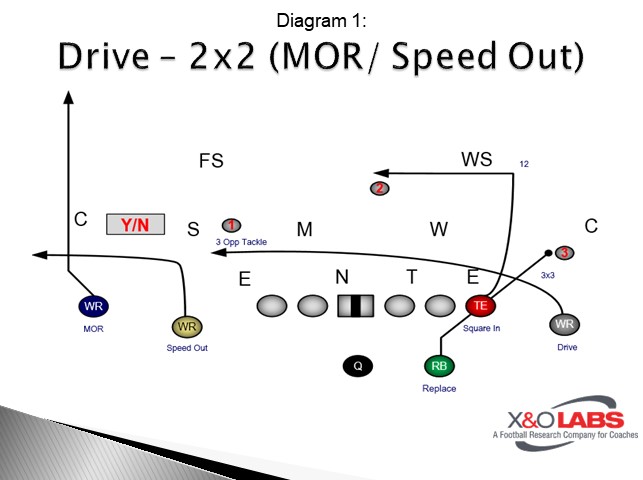
Boundary WR #1: Drive – Align 4 Yds from #2 WR – Work through the heels of the near DL – read the opposite C/F defender and adjust vs zone – Be alert to middle pressure
Boundary WR #2: Square In – Outside release – 12 Depth – Flat to negative, get separation
Field WR #1: MOR (Mandatory Outside Release) – Vertical stem and outside release the corner. Hold the line and win vertically. Look for a potential vertical shot
Field WR #2: Speed Out – 4-6 Yd depth. Stem and win leverage toward the sideline. Anticipate the ball on your outside shoulder
RB: Replace – funnel edge defender to Tackle and release on the replace route. The aiming point is 3 yds deep x 3 yds wide over an attached #2 WR
QB: 5-Step Series


Using the eyes of the quarterback to work through this play, here are the key reads we look at within the concept.


Pre-Snap Key:

  1. Identify the curl/flat player away from the drive. The quarterback wants to get a pre-snap view of where this defender is aligned and his demeanor.
  2. Look at Y/N Speed Out – With the pre-snap picture can the quarterback complete the speed out? If this is a Yes, rocker and throw the field speed out. If No OR if the picture is not clear, work the key read back across the field.


Post-Snap Key

  1. Work the post-snap key read on the weakside curl/flat player.
  2. Once we identify what the curl/flat player does with the speed out we want to work through the drive progression:
    • Drive – 5 and throw (3 and throw in the gun)
    • Square In – 5 and gather (3 and gather in the gun)
    • Replace – 5 and gather (3 and gather in the gun)


Read More

Designating Attack vs. Free Rushers to Defend Screens and Draws

By Rick Scheidt
Defensive Coordinator
Fresno City College (CA)
Twitter: @ScheidtRick


One of the most frustrating outcomes for any defense is when a draw or screen hits for a big gain. This was a common problem for me as a young coach especially against teams that had success throwing the ball. In this report, I will go over various concepts for either controlling a pass rush or controlling a pressure out of a 4-2-5 defensive scheme.

The most important point when introducing a controlled pass rush or pressure to your defensive players is the concept of attacking technique. Attacking technique in a gap-controlled defense emphasizes using two hands engaged on the offensive player (sternum and bicep) while creating an air pocket for vision in each player’s respected gap. When introducing a controlled pass rush or controlled pressure, it is important to identify the players that are responsible for attacking technique because these will be the players designated for recognizing draws and screens.

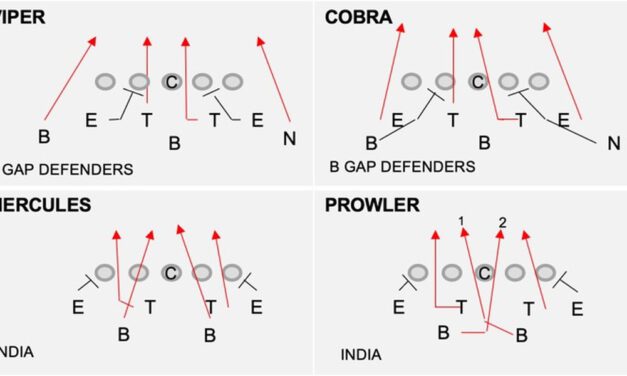
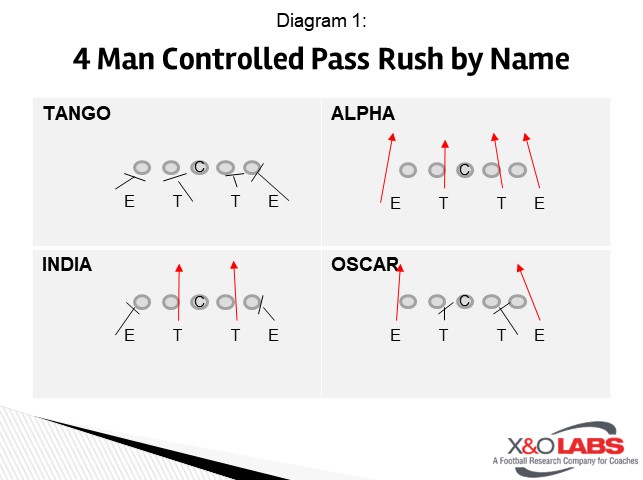
Designating which players will attack technique versus which players are free to rush the passer can be communicated either by a word or it can be communicated numerically.  For a controlled 4 man pass rush we use words or numbers based on the personnel of the offense as well as the down and distance tendency of the offense. I’ve listed the following examples of communication from the military alphabet for a controlled 4 man pass rush:

  • Tango – All 4 defensive linemen are attacking technique
  • Alpha – All 4 defensive linemen are free to rush the passer
  • India – The defensive tackles are free to rush the passer, while the defensive ends are attacking technique
  • Oscar – The defensive ends are free to rush the passer, while the defensive tackles are attacking technique


Scheidt Diagram 1


Read More

Split Field Pressure Coverages From Odd Stack Spacing

By Travis Roland
Head Football Coach, and Defensive Coordinator
Flagler Palm Coast High School (FL)
Twitter: @COACH217ROLAND


At Flagler Palm Coast, we utilize what we call 30 Stack or what most call a 3-3-5 defensive front. We transitioned to this front for two reasons, one because we had an abundance of hybrid style players, and this front (or personnel grouping) allowed us to maximize the talent we had.  Secondly, we chose this front due to the lack of size on our defensive line unit, and using this front allowed us to slant, loop, twist, and turn, utilizing our player’s strengths at the point of attack. This front allowed us to become much more athletic as a total defense.

Our philosophy at Flagler Palm Coast High School is to use the strength of our kids, which is their aggression and speed. Our sole goal on almost every defensive possession is to try and create all one-on-one matchups at the point of attack. We feel that if we can get to one-on-one matchups, our players’ speed and aggression will put us in a place to be successful. Upon my arrival at FPC, I was a big man-to-man play-caller. Our Linebacker coach, Brian Cox, sat down with me and discussed how we could slow up the QB’s reads versus our pressures if we split the field coverage with a man side and a zone side. There are also situations where we split the field with two different zone coverages. This allows us to present a multitude of looks to the opposing team to create confusion and flexibility in certain situations to allow us to be successful. There are times we take a basketball approach to our 6-man zone coverages and play matchup zone. We understand that there are always hots but our players understand the leverage they start with they must keep.

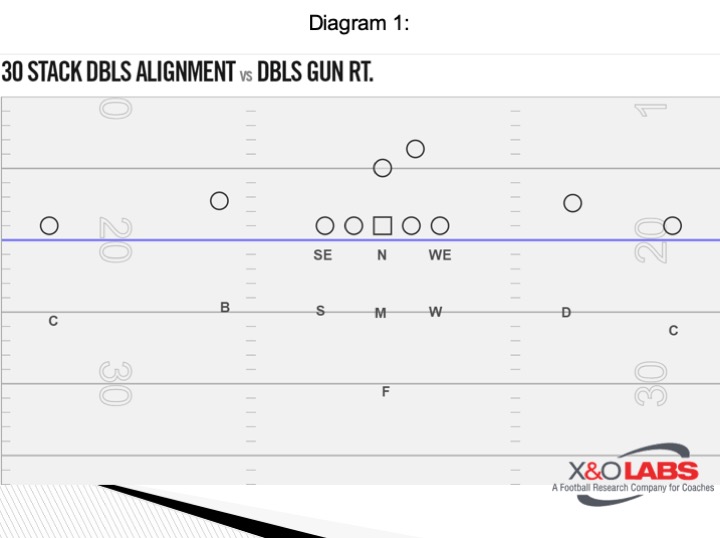
Who’s Who: Look at the following chart to see what names we call our positions. Our defense is broken down into Strong and Weak, but not your typical way. The left side is considered the “Strong Side” of the defense and the right side is considered the “Weak Side” of the defense.

Roland Diagram 1


In this diagram, you could see how we line up versus a balanced 2×2 formation if we chose to be one high pre-snap. As stated in the introduction, our players do not have to ever flip sides. Our Strong End, Sam, and Bull are always on the Left/Strong side of the defense. Our Weak End, Will, and Dog are always on the Right/Weak Side of the defense. Our Corners also play Left & Right (Strong and Weak). The “F” (Free Safety) is always the High Safety and in the middle of the field. He does not declare a side until post-snap (that’s our goal).

SE Left Side Defensive End- 4 TECH
NOSE Traditional Nose Guard- 0 TECH
WE Right Side Defensive End- 4 TECH
Sam/S Left Side Stack Backer – Stack on End
Mike/M  Middle Stack Backer – Stack on Nose
Will/W Right Side Stack Backer – Stack on End
BULL Left Nickel Safety
DOG Right Nickel Safety
FS Free Safety
C Corner


Read More

Listen, Learn and Advocate: Inside the Re-Branding of the Iowa Culture

By Mike Kuchar
Co-Founder & Senior Research Manager
X&O Labs


Wednesday, June 3, 2020, is a day cemented in Iowa head coach Kirk Ferentz’s memory just as permanently as his wedding anniversary and the birth of his five children. This one, however, is significant in a more dubious distinction. It was two days before the first tweet that questioned racial disparities within the Iowa football program, composed by former Iowa offensive lineman James Daniels. It was when two separate, but current, Iowa football players (one senior and one first-year player) reached out to Ferentz directly to petition him in allowing them to tweet their feelings about the social unrest occurring around the country in the wake of George Floyd’s death. Sure, they knew about his longtime Twitter ban policy, but they didn’t care. They wanted to be heard. So, after calling a staff meeting to discuss it, Ferentz allowed players to make their statements about how they felt. Little did he know what would come next.

The allegations started to pour in. Over 60 former Iowa players spoke publicly about a football culture they say demeaned their racial identity. It resulted in the firing of former strength and conditioning coach Chris Doyle and an ongoing lawsuit involving 13 black former players that claim they suffered racial discrimination under Coach Ferentz’s watch. It rocked the longest-tenured coach at the FBS level to the core, making him completely question his purpose as a coach. “You coach 21 years thinking we had a little bit of grip on things, but you don’t,” he said. “There is always a better way to do things and always something to be learned.”

Looking back, he should have known. They all should have known. Maybe they did. There were signs. In January 2011, 13 Iowa players were hospitalized with rhabdomyolysis, a stress-induced syndrome that can damage cells and cause kidney damage, following a strenuous squat workout led by Doyle. Offensive coordinator and Kirk’s son, Brian Ferentz admitted days before the scandal broke that they didn’t respect the Twitter platform enough and they weren’t doing enough to support the African-Americans demographic on their roster. A roster where over thirty percent is African-American, at a university where black students represent only 3.3 percent of the student body in a city that is 82.5 percent white. “If you’re a minority here in Iowa City, you can stick out,” the younger Ferentz told me. “It’s the corn belt.”

But admittedly, Iowa was mired in its hubris, wrapped up in feeling good about themselves fresh off its first 10-win season since 2015 that culminated in a 49-24 win over USC in the Holiday Bowl. “Anybody that was on the field that night would have assumed this was a healthy team with a healthy culture,” Kirk said. Yet here they were, several months later, a proud program marred under the alleged dredge of inequality. It left Ferentz feeling blind-sighted and searching for answers. So, he did what any competent coach does. In a moment of despair, he put his ego aside and re-connected with his network, personally calling 25 of his former players dating back to his inaugural season in 1999. He was only a few calls in when he got the answer he was afraid to hear. A former Hawkeye great turned NFL coach (we’ll let you connect the dots) told him, “The answers are in your program. Talk to your players.” It was the push he needed to begin the process of re-evaluating, re-branding, and re-committing his program’s culture. Not sure of what he would encounter, he prepared his staff for the worst, sending a mass text that Saturday morning on June 6th when he said bombs were flying off. “I told them I wasn’t sure what the days ahead were going to bring here, but it’s going to be rough. Whatever the issues are, we are going to work through this.” But before his staff went to work on repairing its culture, they had to be willing to listen, unequivocally, to the concerns of their players. So, on June 8th (three days after the tweet that shocked Hawkeye nation), staff and players held a town-hall meeting once players came back to campus. It drew 100 percent attendance. Some players, including veterans, walked out, leaving Ferentz to wonder if he’d even have a job again. “It hit me smack in the face,” he said of the experience.

He decided to approach the concerns as he would preparing for game week. Once the team meeting concluded the roster got segmented into six break-out sessions to continue the dialogue. The staff was segmented in the same way and were asked to track and record information from each of those sessions where players openly admitted they didn’t feel they can be themselves and shared their stories. Once the players left, the staff compiled all the feedback, threw it up on the whiteboard, and engaged in the same exercise the following day in leu of workouts. Soon, the dynamic shifted from damage control to damage repair as they began to work through these issues. Call it a watershed moment, but it was a meeting that served as the basepoint for several of the call to actions below that Iowa instituted. “We got a lot of candid feedback about how guys were feeling and what they were asking us to consider,” Ferentz told me. “What really came out of this whole thing is to re-evaluate some policies or expectations and modify those.”

This re-branding was approached on two levels- immediate and long-term. The immediate items on the table got altered quickly while the long-term modifications are continuing to be developed.

Immediate Modifications:

Repeal of Twitter Ban

Step one was lifting the Twitter ban, a policy which Coach Ferentz admitted was “one of the stupidest policies” he had in place. “My sole purpose in not having guys tweet was to keep them out of Twitter jail, that predictable sequence where someone says something emotionally and four hours later they grant an apology or statement that someone wrote for them,” he told me. “But that week made me realize that it is a fight not worth fighting right now.” Instead of spending time worrying about them getting into trouble, he decided to spend more time and energy investing in education. This reform came with a free expression for players who are permitted to tweet about what they choose, providing they understand the consequences. “We figured, why not open it up and just emphasize the educational part?” he said. “It’s the same thing we do when we have players talk to the media. We try to equip them and make sure they understand that you can’t take things back. That changed how we look at it.”

Repeal of Dress Code Policies

This newfound freedom of self-expression carried over into the physical domain as well, where Coach Ferentz lifted prior bans like wearing earrings and baseball caps in the facility. He said it was a policy instituted more in the vein of uniformity when he took over in 1999; something that he clung to far too long. “Twenty-two years ago, the earring thing was important because we had 100 guys going in 100 different directions when I got here,” he said. “I realized it’s not so critical right now. We looked at how to be welcoming so these guys feel comfortable in their own skin in the building. I wanted to make sure we work on the things that are important to this program and to this team at this point.”

While many African-Americans claimed they were targeted because of their appearance, citing a double standard in the “Iowa Way,” assistant coach Brian Ferentz credited how this one change empowered all players to be themselves. “The guys that I saw the biggest shift in how they dress or acted were white kids,” he told me. “When we reported back for camp this fall, I noticed a difference in how they presented themselves. It was more than I was used to seeing. I think it became more of a generational thing more than a racial thing.” The staff struggled with the balance of power that lied in the management of individual freedom of expression while adhering to a collective display of solidarity. “Yes, our rules were restrictive but they were done for a reason,” said Brian Ferentz. “The lines can’t get blurred between being an individual and being a good teammate. If you want to come in here and have tattoos on your face, then I’m good with that as long as you show up every day and you’re a good teammate.”

The fight against inequities went beyond racial bounds. In the past, players were publically shamed for missing class or academic meetings in front of the team. Their names would be posted right on the main bulletin board in the locker room. Gone are those declarations, and Kirk Ferentz has even gone as far as to modify the point totals that are generated in the Hawkeye championship model, the off-season program where incentives and disincentives are measured in a competitive format. “We looked at the grading scale and found we were probably being unfair in how we gave out points,” he said. “So, if a guy missed something like a meeting he might lose 500 points yet if he did an hour of community service he’d only get a 100 point incentive. We put those things more in balance with each other.” He even went as far as to adjust the rigorous strength and conditioning policies that Doyle had in place by re-classifying the bodyweight categories for skill players (QB, RB, WR, DB), semi-skill players (TE’s and LB’s), and linemen in the program, extending the margins from four to six pounds in each grouping. It opened up the margin for error in a previously tight window.

The Long-Term Modifications:

Re-Branding of the Core Values

Next came the continuous soul searching, and it started with re-evaluating the program’s core values. “Smart, Physical and Tough” had been the identity of Iowa football since Kirk Ferentz took over in 1999, but did players know what those words meant? Many had no idea. “Our signage hasn’t changed since my playing days,” said Brian Ferentz who graduated in 2003. “We never defined them. It seemed everybody had their own take on it.”

So, in an attempt to streamline the messaging, the elder Ferentz began holding hour-long culture talks with his staff this off-season on re-branding those three core values. He asked each staffer to provide their definitions of each of those words. Each interpretation was put on the whiteboard for talk-throughs. “I always equated toughness to be more mental than anything else; the ability to do the right thing for the team,” said Brian Ferentz. “But not everyone on the staff felt that way. I would not have known that in the ten years in which I’ve coached here because we’ve never done it. We had to define things better and have clearer expectations of our standards. We had to tighten the message down and clearly define that.” This same exercise is being conducted with players. “Your players and making sure they understand why these things are important,” Brian said.

Diversification of Leadership Groups:

The Iowa players that spoke out continually claimed that communication is the major obstacle in the program, where players are hesitant to come forward about the problems they experience. They desired a platform where they can openly express themselves without fear of consequences. The pathway came in expanding the leadership group this summer from 14 to 22 players with the expectation that additional personalities will beget more a more eclectic dialogue. The criteria of entry were no longer seniority or experience-based. Instead, it now consisted of those players that were most vocal in those town-hall breakdown sessions.

Topic lists shifted as well, from rudimentary issues like what to wear on game day, to issues of identity, awareness, and bias. There wasn’t one complaint about how hard the team works or the expectations in practice. Instead, the focal point was more about how messages were being delivered. “It was clear that we crossed the line from being demanding to demeaning,” Kirk Ferentz said. These sessions became a continual reformation on these issues. Are they getting resolved? Are they still on-going? It was a continual process of soliciting and retaining information from a more racially diverse grouping. “If you have an environment where players don’t feel like they can bring up an issue, that’s a problem,” he said. “It gave us a better forum for talking about the things that we heard from our players. And more importantly, it gave them ownership.”

While Iowa always had a leadership council in place for years, a newly formed Advisory Committee which consisted of 11 former players, became a soundboard for Coach Ferentz to get a better feel for how the program was perceived publically. “It encouraged me to ask more questions, better questions,” he said. “What I learned is that guys on your team were afraid to say some things. But the further guys are away from their playing days, the more candid they become. I learned things through them that were valuable and that gave me exposure to things I missed.”

The Path Forward

While Ferentz is the first to admit this culture shift is still a work in progress, he credits these initial modifications for finishing an abbreviated season with six straight wins, despite starting 0-2. “The work that we did in June set the table for us to move forward,” he said. “It enabled us to operate like a football team and focus on beating our opponent.” While the staff admitted the day-to-day grind in-season supplanted some dialogue regarding these issues, once players reconvened after semester break in January, racial inclusion was the first topic on the agenda.
“If we don’t stay on top of that then what did we learn,” said Brian Ferentz. “Nothing. Before, I think our culture may have been designed to eliminate people.” Kirk Ferentz calls this past season one of the most gratifying seasons he’s had as a coach. A sentiment that would be hard to believe back in June. Yet he realizes his job of communicating and advocating is not over. It’s a continual process that he learned the hard way can’t be neglected or assumed, not for a minute. “One promise I made to our team was that, we made changes with great dialogue, but we are going to take a midterm and finals on this, too,” he said. “We are going to continue on this path of dialogue and operate in that way. I want feedback and if there is anything that we said we are going to do as a coaching staff and we are not executing it, that’s on you guys to let us know. I have to keep talking and keep asking.”

Maybe this time, they will tell him.

Read More

The “Tempo the Center” Philosophy in Buffalo’s Wide Zone Concept

By Mike Kuchar with Andy Kotelnicki and Scott Fuchs
Offensive Coordinator and Offensive Line Coach
University at Buffalo (NY)
@Kotelnicki @CoachFuchs


Anyone who watched the University of Buffalo run the football this season saw a thing of beauty – a physical offensive line with two downhill backs over powering defenses at the first and second level. It only took me a series of studying UB’s cutups to discern what it hangs its hat on- the wide zone run scheme. I was amazed at the rhythm of the scheme, the technique of the line play and the patience of the back. Most importantly, I was impressed by the distortion it created at the first level. Clip after clip, I saw defensive fronts getting stretched then punctured. And when the season wrapped up, the numbers behind the concept were astronomical. The Bulls finished second in the country (behind Air Force) in rushing offense, averaging over 287 yards per game and the wide zone run accounted for 7.9 yards per carry. It registered at an 83.7% efficiency according to Pro Football Focus and over 25% of carries (29 out of 118 carries) resulted in explosive plays.

While many programs run the wide zone concept, I’m not sure that any programs run it more explosively. But this doesn’t happen by mistake; the offensive staff in Buffalo is intentional in its teaching of explosive play culture. And that explosivity is perhaps generated in one monumental coaching point- teaching the ball carrier to stay in-phase with the Center. In-phase is defined by being within a half-man of the Center’s block. I thought that was the significant difference in how they teach the play. While most programs talk about chasing the hip of the EMLOS, Buffalo keeps tempo with its Center. “If you’re behind on it that’s a problem and if you’re in front of it that’s a problem,” offensive coordinator Andy Kotelnicki told me. “We talk about shading him about half a man. And if the Center is running, the back better be running. The most explosive plays we’ve had are generated through the backside A gap to front side B gap. They usually don’t get way outside that.” When you see how it hits on the film below, it’s clear how many second level players misfit the play. “When the ball goes out the front door, the run fit is easier for the defense,” he said. “An interior entry point challenges the secondary and LB’s to fit the play correctly. We aim for that lateral distortion.”


Distinctions Between Vertical Leverage vs. Horizontal Leverage:

Before getting into the specifics of why this concept can generate explosivity in the A gap, it’s important to understand how to get the concept to hit in the play side A gap. It’s all about distortion and for offensive line coach Scott Fuchs it begins with teaching his players the difference between vertical and horizontal leverage.

Read More

Segment Teaching Kick vs. Pull Techniques in Pin and Pull Schemes

By Hussam Ouri
Offensive Line Coach and Football S&C Coordinator
Shepherd University (WV)
Twitter: @CoachHussamOuri


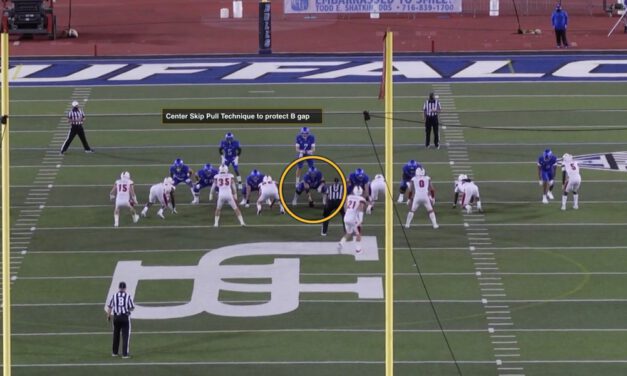
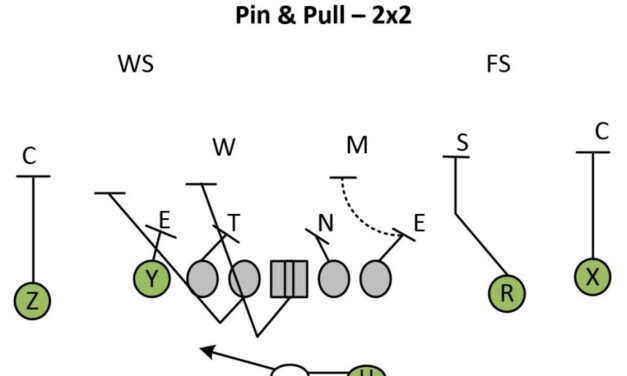
One of the most overlooked aspects of coaching the Pin and Pull scheme is the coaching of the individual blocks. Both the Pin aspect of the play and the Pull. At Shepherd University, we as coaches do our best to put our players in a position to be successful. That is accomplished by providing the players with multiple tools (not every tool has to be used on every play) and teaching them when those tools are necessary. These tools and the knowledge of when to use them are sharpened through proper drill work and consistent reinforcement.

The first diagram will explain our base teaching of Pin and Pull.

Ouri Diagram 1


Install Rules:

Front/Play side TE: If the play side tackle is covered, down block. If the play side tackle is uncovered, drive block 1st defender that is head up to outside. You are responsible for setting the edge. If the defender crosses your face, drive him to the angle that you capture him.
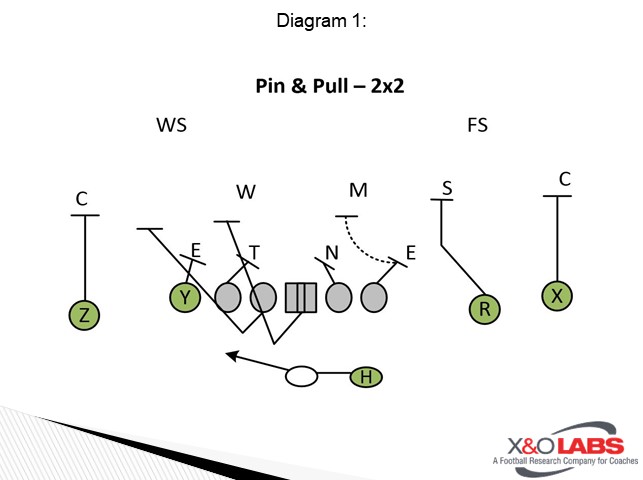
Front / Play side Tackle: If the play side guard is covered, down block. If the play side guard is uncovered, mirror pull to the force defender.

  • If you’re the first puller out, get outside of the pin
  • This helps us maintain proper leverage on the force defender
  • Do not let an opposite color jersey cross your face (pressure or missed blocks)


Front / Play side Guard: If the Center is covered, down block. If the Center is uncovered, mirror pull to the force defender.

  • If you’re the first puller out, get outside of the pin
  • This helps us maintain proper leverage on the force defender
  • Do not let an opposite color jersey cross your face (pressure or missed blocks)


Center: Mirror pull to the first linebacker in the box to the play side.

  • You will be the 2nd puller out which means you have to read the down block of the TE
  • If the down block of the TE is effective, get around the block. If the down block is forced to expand, cut it up and insert it inside of the down block
  • In-game adjustments can be made if the Center is unable to pull or if the backside nose is getting upfield too quick (Pin and Pull now becomes true Buck Sweep)
  • Do not let an opposite color jersey cross your face (pressure or missed blocks)


Backside Guard: Zone scoop the backside A gap defender VS an even front. Mirror pull to the 2nd linebacker in the box to the play side VS an ODD front.

  • If pulling, make sure to get proper depth so you don’t get picked off


Backside Tackle:  Zone scoop the backside B gap using a 2 for 1 technique or mirror pull for the Mike linebacker if you have a TE or FB on the backside that can cut off the DE.

  • The 2 for 1 technique is used to create a wall on the backside DE (the speed of the defender dictates how long we stay on the block). Once the backside edge is secured, take a proper angle of departure to the backside linebacker (his play side armpit)
  • The backside tackle pull can only happen with a TE or FB attached to the backside so that we can properly secure the backside edge and gain leverage on the backside linebacker (this is communicated by the BST and backside TE)
  • Backside TE (12 Personnel): Zone scoop the C gap
    • Communicate with the BST about a potential pull


Coaching Points:

The down block “PIN”: The down block is one of the oldest and most used blocks in football, but it does not mean that we as coaches can assume that the players know exactly what to do so we provide them with these coaching points. The first step taken on a down block should be a flat angle step to the defender’s near neck V. This step must be intentional and serve a purpose. That purpose is to STOP upfield penetration. We tell our guys that the wider the defender, the flatter the step needs to be to STOP the up-field rush. This block must happen from the ground up so that the OL is not lunging at the defender with our upper body.

The second step taken is a vertical angle step (upfield and towards the defender) to the defenders near foot/hip.  The purpose of this step is to keep the defender “pinned” and do not allow the defender to cross face. This step is used only once the up-field penetration is STOPPED with the first step. Our players must know not to step up the field on their first step to not allow any penetration. Once the first and second steps have been taken, we then coach our players to lockout their up-field arm (if you’re down blocking someone to your right, it would be your left arm). This lockout process allows us to apply more pressure on the defender’s outside breastplate and assists us with maintaining proper down block angles and leverage.

Read More

B.T.B. and B.O.B. Pressures to Eliminate Conflict Defenders in RPO’s

By Ty Gower
Former Defensive Coordinator
Princeton High School (TX)
Twitter: @coachgower


Although the triple option has been around for a long while, offensive guys have found ways to change Run-Pitch-Option into a Run-Pass-Option, making it yet again, another headache for defenses to combat. Think about how the original RPO (Run-Pitch-Option) also known as the Veer Offense came to be. Coaches got tired of asking OL to block a DL that was a really good player, so what did coaches do. “Let’s not block that guy, let’s read him.” The idea is no different from the “21st RPO scheme”

Think about most modern defenses; where do many defenses put their really good player…That’s right, the Sam/Star/Nickel position. Why is that?

  1. 75%-80% of the game is played on the hash
  2. Due to #1, we want our better athlete/so-called “hybrid player” to be the field LB, and we want our hybrid player to be on the field to play in space and play all the 3×1 combinations.
  3. Due to #2, Offenses know who you’re really good defender is and offenses want to read or put him in “conflict.”


Now before you read too much further, I will be discussing how we take the conflict player out of the 3-4. Now before you 4-down front guys stop reading, this could be a great install to help combat the RPO.

Regardless of what defense you run, offenses will find your conflict defender. Whether you base out of 2-high, single-high, 3-3, 3-4, 4-3, it doesn’t matter. The offense will find the conflict defender. When the RPO first became en vogue, it seemed like one of the answers was to spin to cover 3 to the RB, and although that is a good idea, and an idea that we have used, I always had a problem with that “Cover 3” answer. Cover 3 is not something that we hang our hat on. Side note: I want to be as multiple as possible, but at what price? I love to run all the 3 Under/3 Deep Fire Zones, Tite Front Drop 8, 4 -down fronts with the same personnel, implement 3rd Down Packages, and install multiple 3×1 coverages that have been vital to our success.

This leads me to my next point if you want to stop the RPO, which we all do, and we all want to have this or that answer, we can drive ourselves insane trying to come up with all the answers and adjustments for how to stop the RPO.  The question is how much practice time you are willing to devote to teaching man technique to play Cover 1, squat technique in Cover 2 (and canceling gaps), and the variations of Cover 3 (who the buzz player is, who is SCIF player, teaching divider leverage, Rip/Liz 3, spot drop 3), which leads me to our world.  I believe in what we do by installing 2-High, basing out of 2-High, playing 2-high, and defending the RPO in 2-High. Again, let me reiterate, there are multiple ways to stop the RPO game, and I love to be multiple about stopping it, but we wanted to find a way that was inexpensive for us, meaning how do we stop the RPO from 2-High and take the conflict player out of conflict! Our answer:


BACK BLITZ

Back blitz is an answer for us in defending the RPO game for multiple reasons:

  1. Allows us to use our base blitzes and base coverages to alleviate the conflict of our RPO conflict players
  2. Set hard edges in our Tite front (4i-0-4i)
  3. Gives us options to blitz the RB side or opposite the RB to change up how we alleviate the conflict from our RPO player.
  4. Which in turn, makes the QB change his perspective about who to read as it relates to his “option” of handing it to the RB or throwing it to WR.


Sometimes you may hear this called B.T.B. or B.T.F.  In this report, we will discuss why understanding the backset is simple and vital in being effective in blitzing the RPO.

Where to Start:

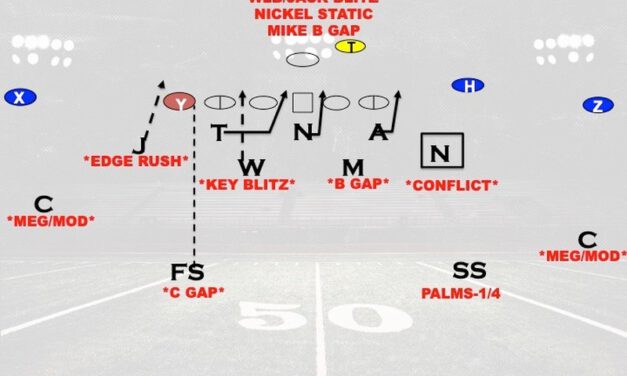
  1. Install your base blitzes: Yes, as I stated we install our fire zones 3 Under-3 Deep pressures like everyone else in America. Get these installed, find a word association/word family so your kids know the blitz pattern and that each strong and weak blitz are the same. For example, within our blitz package the terms “Sugar/Water” are the same pressure with one ILB and one OLB blitzing to create a 5-man pressure, however, the “S” or “W” word tells us that blitz is coming from the strong or weak side. To continue, it’s easy to play 3 Deep-3 Under with these blitzes, but for those of us who like 2-high coverage, we had to find ways to carry over our base coverages into your blitz packages. Thus, through the years, we have been able to bring a 4-man/5-man pressure and still play 2-high Coverage.
  2. Coach how important RB set is: Don’t get me wrong, offenses are finding ways to throw off the overhang LB whether the RB is to or away from the read side, but most RPO’s are still thrown off the same side as the RB. Thus, you must go back to step #1 with installing your base blitz. So why is the RB important, in a 2×2 formation, who is the #3 WR? that’s right the RB. If you want to be effective in blitzing the RPO, you must know where the RB is.
  3. Coach how important RB set as it relates to formation: Again, remember Blitz the Back. You and your kids must understand how “Blitz the Back” tells everyone the blitz and coverage as it relates to the RB set and the formation.


Read More

Identifying and Blocking Pressure in 6-Man Protection Schemes

By Jerrod Clowes
Offensive Line Coach
Utica College (NY)
Twitter: @CoachClowes


The key to having a great pass protection scheme is to keep it simple and to rep the scheme multiples times against your most common looks/pressures. It is vital that the offensive line communicates with each other every play and that we are all on the same page.

Here at Utica, we are a base 6-man protection: man-slide team. We have been fortunate enough to have great offensive linemen, that have a great sense of understanding and communication. We have also been fortunate to have quarterbacks that understand where pressure is coming from and that throw the ball on time.


Our success:

In 2019 we averaged over 31 points per game, 2nd in most passing touchdowns, and gave up the least amount of sacks.

We believe in these three pillars when teaching the players, in order:

1) Know what to do.

2) Know how to do it.

3) Execute.

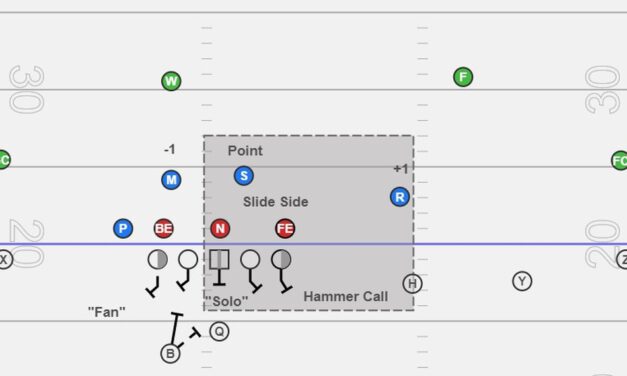
We start all of our teachings with defensive identification. We do not put as much emphasis on what type of front we see, as opposed to am I covered or uncovered/on my body or of my body. This will affect how many are on the slide. We then Identify our “Point”. Center calls the “Point” – which is the first LB type in the box to the call-side. We then identify “+1 from the Point” – which is the next 2nd level defender outside of the point, to the call-side. We then Identify “-1 & -2 from the Point” – which are the next two LB type defenders from the backside of the Point.


WHAT TO DO:


Our Pass Protection Philosophy:

Tackles set the width – GCG set the depth.

We are a Man – Slide Protection.


Calls:

4 man slide – Rocket or Laser, based on slide direction.

3 man slide – River or Lake, based on slide direction.

2 man slide – HammeR or NaiL based on slide direction.

Man – BIG, BOB, Solo, Vader

Fan – used for BST. Fan call creates an auto Hammer or Nail call.

Bump – Used for PST


Rules:


To the Slide Side:

PST is responsible for C Gap.

PSG is responsible for B Gap.

Center is responsible for A Gap.

BSG is responsible for A Gap (If applicable).

You are only allowed to let 1 defender cross your face (post-snap) if no defenders are aligned behind you pre-snap.

If you have a defender aligned behind you pre-snap, then you can not let any defenders cross your face post-snap.

The slide side is responsible for the Point to the +1.

If the center or guard are uncovered to their gap, they will have their eyes through the gap and up to the point. Wherever the point goes in a blitz, their eyes should follow. They would either pick up the blitz or pick up a slanting defensive lineman and exchange with their fellow offensive linemen to the stunt side.

Tackles will “bump” any edge blitz – as long as they have backside help.


Man Side:

Defender on my body – Big on Big.

Defender off my body – Part of the Slide (Communicate).

We will “Fan” to any walk OLB outside of the Tackle – as long as the guard has no one on his body. The guard will then make a “Solo” call to the center – letting the center know he has no backside help.

We will use what we call “Lock Squeeze Technique”. This technique allows us to handle any long stick stunts that are in combo with blitzes. When a defender will try to long stick two gaps over, we will squeeze it down and pass it off to the guard or center (whichever applicable). We will then move our eyes directly up for the blitzer.

Read More