
Incorporating Midline and Veer Concepts into a Wing T Offense

By Jeremy Christensen
Head Football Coach/Offensive Coordinator
Minneswaka High School (MN)
Twitter: @coachC_LakerFB


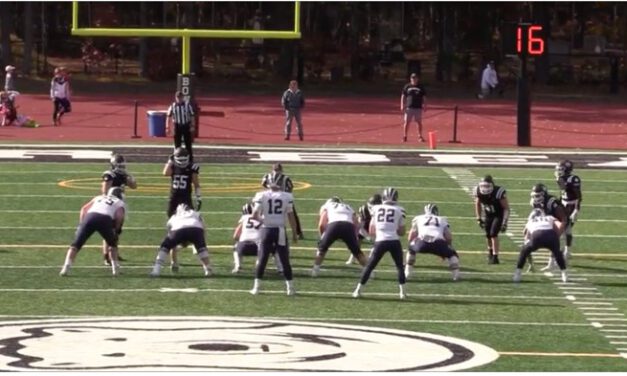
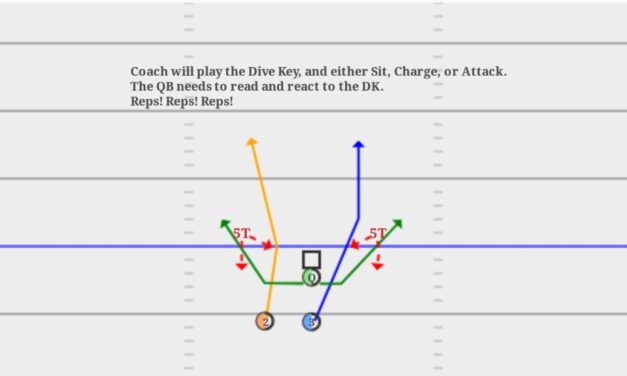
The offensive schemes I have been around as a player and coach are the Wing T and Triple Option, and I love each of them! Both schemes are great but can provide a lethal running game as a combination. The under-center Wing T and Triple Option share some similarities that make the combination possible. They both are great for small and mid-sized schools that do not regularly get offensive linemen that are 6’5″ and 300 lbs. (although when you do get those student-athletes it is the icing on the cake!). Instead, these schemes utilize “regular-sized” athletes upfront, as well as angles and double teams to help those athletes be successful. Depending on how you run your offense you can even share blocking rules between both systems. Both offenses also control the clock with the running game, while utilizing multiple ball carriers, and play-action passing to keep defenses honest. So why not combine them and try to get the best of both worlds? When done correctly it can be a great fit but be careful not to overextend yourself and attempt to add too much Triple Option to your Wing T scheme or vice versa. Both schemes are detail-oriented and expensive, so you must pick the pieces that fit best for your team and needs. In my opinion, when adding option concepts to the Wing T, that is Midline (as a double option) and Inside Veer. These option attacks are different from the more common Wing T Options like Trap Option and Belly Option because they involve a Dive Read for the QB instead of just a Pitch Read. Yes, this is more time consuming to teach your QB’s but they are more deceptive Options in my opinion than Trap and Belly Option. We melded the two together for about 12 years, before falling completely in love with the Triple Option and running it exclusively for the last two seasons. The following information is what we used from 2007-2017 with success at two different schools.

We are basic in our Wing T formations, running most of our offense from Base 100/900 and Split 100/900, but we also use Over 100/900 to get a numbers advantage at times, and Pro 100/900 to give defenses a little different look. We feel being simple in formations allows us to be more complex (multiple schemes) in our running game. Most of these formations also allow us to run our plays to either side as we are still balanced three RB sets. That allows us to allow our QB check plays at the line of scrimmage. If the defense aligns a certain way, we can simply “Check opposite! Check opposite!” and run the called play to the other side of the formation without shifts or motions.


Base Wing T Alignment:

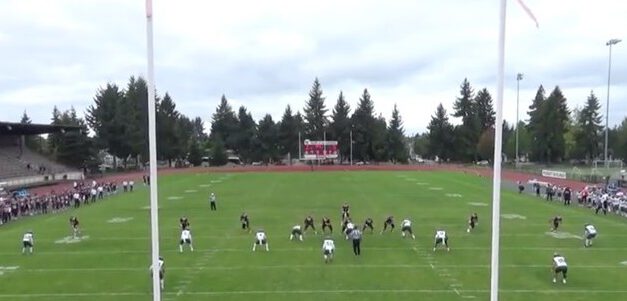
Our OL uses 2-3-foot splits depending on the play call, and the ability of our personnel upfront. The more athletic we are the wider our splits will be. If we have an offensive line that is a little slower footed, we’ll use smaller splits. 2. Our FB is at a depth of 5 yards from the LOS at his heels in a three-point stance. 3. Our HB is at a depth of 4-5 yards (depending on quickness) at his heels in a two-point stance and stacked right in the G-T split. 4. Our WB is in a two-point stance 1′ x 1′ from our Tackle’s outside leg. We have our WB face straight forward so he can easily scan the defense. The Split Ends will be at the top of the numbers unless we tell them differently.

Read More

Alabama A&M’s One-Word Tempo RPOs

By Jason Mai
Quarterbacks Coach and Director of Operations
Alabama A&M University
Twitter: @Jaymai18


Tempo is an extremely valuable weapon in any offense. Particularly with the use of Run Pass Options (RPO) because it gives offenses and quarterbacks the ability to truly “have the pen last” on any given play. The difficult part of developing a Tempo / RPO System is understanding that just because you are a “Tempo” doesn’t mean we are always going fast, however, when we do want to go fast getting plays in as quickly as possible can be a challenge. This challenge is generally overcome by developing plays that can be called with one word, picture, or signal. Meaning that one word, picture or signal tells the entire offense the shift, formation, backset, motion, protection or run scheme and any tags or RPO’s you want to attach to the play. While this is without a doubt the more efficient than say sending in a call like, “A Push to Doubles Right Near H Jet 46 Stay Omaha / Bronco” (Yes that is an actual play call and yes I’ve had to signal that into a game), as a coach it can be very scary to tell your players “we are just going to call that Bronco and we will run it from Doubles Right unless we are on the Right hash when we will flip the whole play the other direction.” Even now almost six years into running tempo calls I imagine the blank stares I expect to get back from the players in my room.

It is hard to believe that as many times as I have called that paragraph of a play call telling everyone on the field exactly what to do and then watched in disbelief as guys on the field completely blow the play or even worse freeze up and give you that blank stare like they’ve never heard of that play before. So, you can imagine the look on my face when on a professional development visit to another school a few years back a very good coach told me “we carry 25 to 30 one word plays into a game.” I cannot remember if I laughed or not but I certainly didn’t believe it even when he went on to say “the players remember them better and are way more productive at the tempo plays than when we gave them full calls.” On the drive home from that visit myself and offensive coordinator Duane Taylor talked about testing that theory. We started out with three RPO based plays that we would install as our tempo package and tried them out in spring ball. By the fourth practice we had expanded our tempo package well beyond RPO’s and as of 2019 we were carrying about 30 tempo plays into a game and had at least by my last count 60 on the shelf. These three or some variation of them is where it all started.


Mars Concept

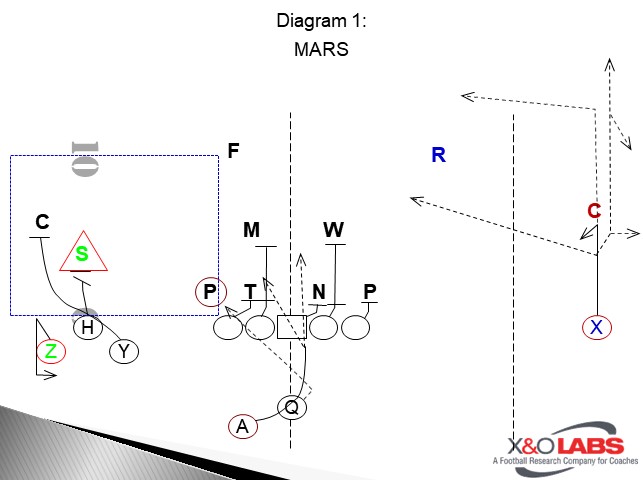
I’m a nerd, there is no doubt about it, but one of my many nerdy tendencies helped with the development of our tempo package, which is my affinity towards all things space related. So, our first three tempo calls were planets in our solar system. The first was Mars, as a whole play call from the left hash Mars is “True Left Pull Near 46 Zone Read Uno / Eat” the call stays the same in the middle of the field and on the right hash the call flips to “True Right Pull 47 Zone Uno / Eat”

Mai Diagram 1


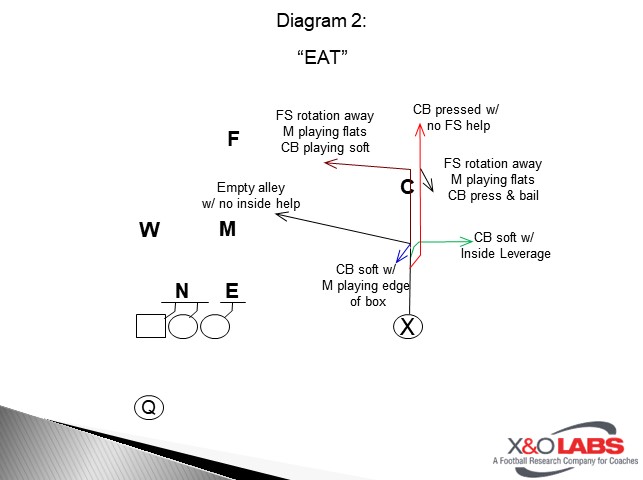
Broken down in raw terms it is 3 x 1 stacked with the formation into the boundary (F.I.B.). Inside zone to the field with an “Uno” screen meaning a step back screen to the number 1 WR in the boundary and an “Eat” concept to the single receiver side. An Eat concept is what we like to call “Free Access” quick game, essentially the quarterback and the single side receiver try to select the best quick game route between a Hitch, Slant, Speed Out, Fade, five step Bang Post or a back shoulder fade route. The “Eat” route defaults as a Hitch route and the Quarterback uses a pre-snap alignment read to find the best “grass” to put the route in. When in doubt he will leave the default on the term I like to use is “error on the side of stupid.”


Pre-Snap Progression

We teach our quarterbacks that the tempo is generated by sprinting to the ball spot and getting our players line up early. However, getting everyone lined up quickly and getting the ball snapped is useless if he is in such a rush that he misses vital information and puts us into a bad situation. We tell our quarterback he needs to be “decisive and accurate” but we never tell him HE needs to go fast; it is critical that he go through his progression and be sure about his decision.


Yes / No the “Eat” Free Access Quick Game

The first step in our progression is to Yes / No the free access “Eat” concept to the field. Our “Eat” concept can be used as a quick game passing concept OR as an RPO. It is designed to give a single WR the ability “Eat” by giving him one side of the field and a choice of routes in order to take advantage of a match up or in the case of Mars a defense that is over playing formation into the boundary. The default route is a hitch, but this can be changed pre-snap by evaluating the half field coverage tips.

Mai Diagram 2


Read More

Teaching Plug, Crash, Nail and Rail Technique into Multiple 5-Man Pressure Patterns

By Tom Elder
Defensive Coordinator
Wilkes University (PA)
Twitter: @coache57


Our defense and our defensive staff here at Wilkes University pride ourselves in our ability to be multiple on Saturday. At the end of the day, multiplicity is great, but if your players do not understand the concepts and are thinking too much, your multiplicity is a recipe for disaster. We focus ourselves on teaching on a three-tier system: mentality (culture and effort), technique, and then scheme.

The mentality is another conversation because, without the right mindset, the technique and scheme do not matter. Second, technique. If we can effectively teach our young men all the techniques to be successful, then we feel like we can have our young men understand the big picture when it comes to our scheme. To us, it is equally important for our players to understand all the details of a technique, as it is for them to understand the physical demands in performing said technique. In this way, we can then just drag and drop players and tell them what their overall technique will be on this call, and with that, they should know all the responsibilities included in that technique.

Our defense loves to pressure and move. Throughout the 2019 season, we brought pressure or some type of movement over 48% of our calls. Our goal is to do our best to put offenses into 2nd and long situations that will allow us as defensive play-callers to open our playbook and create big plays. Also, we want the ability to be creative with our pressures to attack what offenses do well.

When we call our pressures, we will generally run 3 under, 3 deep coverage behind. We feel that it matches up with our primary base cover 3 principles the most to ensure that (again) we are multiple, but we keep things simple for our players. To do that, we need to be very thorough in our teaching of both pressure techniques, movement techniques, and coverage responsibilities. Throughout this article, we will talk about how we define and teach our different types of pressures, movements, and coverages.


Personnel

We first want to introduce our personnel, so you can get a better understanding of whom we are talking about with our film and diagrams. We are a multiple front defense, out of 3-4 personnel. Our personnel is as follows:

Bandit: Our field outside linebacker/strong safety

Read Linebacker: Our two inside linebackers are very interchangeable because when we flip our fronts, we also flip our linebackers. So, both ILBs need to be able to play in space

Kall Linebacker: The biggest difference with our ILBs is that when we are in our even front, the Kall is always to the side of the 3-tech. So with him being constantly covered, we like for that guy to be a little better in space since he needs to be able to run and play off spills

Quick: He is our boundary outside linebacker in our odd front and our stand-up end in our even front. He is a true outside linebacker/defensive end hybrid

End: Field end in our odd fronts, can be on either side in our even fronts

Nose: Our standard nose tackle

Tackle: Our boundary end in our odd front, and our 3-tech in our even

Hero: Field safety

Free Safety: Boundary safety

Field Corner / Boundary Corner

Read More

How West Conn Used Google Sheets to Build a Wristband Communication System

By Joe Loth
Head Football Coach
Western Connecticut State University
Twitter: @CoachLoth


We currently use a combination of offensive wristbands and one-word plays on offense at Western Connecticut State University. The wristband system has allowed us to run a high volume, alignment specific offense without having the meeting time a major college program has in the season, off-season, and summers. We will lean on our wristbands if we are a young team and utilize more 1-word calls if we are a more veteran squad. It allows us to operate seamlessly when there has been offensive staff turnover. Most importantly, it removes a tremendous amount of rogue memorization for our players which allows them to play faster and handle a larger volume of offense.

We have been running our core spread offense since 2007 when I was the head coach at Otterbein University.  Starting in 2006, we originally used a simplified wristband process with only our quarterback wearing one.  He used the wristband like how the NFL uses their wristbands. We signaled in a wristband number to the quarterback and he read the formation and play to the offense in the huddle.  The biggest challenge we had back then was having to put 2 calls on the wristband for every play to account for what hash the ball was on. It also did not allow us to go fast. In addition to finding a play to call we had to match the hash to the call in. In 2012 when I became the head coach at Western Connecticut, we transitioned our offense to a true no-huddle, signaling in the formation and play from the sideline. We utilized that for one full season but ended the season frustrated when our best player struggled with the rogue memorization of learning the signals and then pulling his specific assignment and alignment from our calls. We felt we had to simplify our system at times. We ultimately had to develop a specific set of signals specifically for him, sometimes just yelling in what he had on that play.

After the 2012 season, I had hired a local CT high school coach, Chuck Lynch, on my staff to coach running backs. He talked to me about how he used a wristband system for his entire offense and had a wristband for every position at his former high school. I arrogantly dismissed the idea thinking it was just a high school thing that wouldn’t work. Plus, the system he talked about didn’t fit our offense.  It had left and right WR’s and had limited to no motion calls. We were a field/boundary-based passing offense and an even/odd running game.  Two weeks before spring practice began, we started to put our install together for our no-huddle signal-based offense. We once again faced the obstacle of how we get all of our best players to play fast, memorize a high-volume offense plus getting our best player to just operate within this system. How do we create signals for all our operations? We sat down as a staff and created a wristband system that allowed us to play with field and boundary receivers, allows us to play fast, be multiple, and ultimately has allowed our skill players to eliminate the amount of rogue memorization of play calls to allow them to play quicker and to handle a larger volume of plays.

The benefits of using our system for our players have been the following. Our skill players are told their specific alignments and assignments on every play. Once they learn our basic alignments and assignments this can be applied to multiple calls. Giving them specific landmark alignments has allowed us to create consistent spacing in our passing game.  We have also developed an easy to learn blocking assignment system that defines not only whom to block but with what kind of leverage and technique. The Quarterback has the entire call on his wristband, this call has the formation and play and sometimes a QB cheat word on it to help him operate the play. We have created a very systematic RPO system that ties blocking responsibilities together with the perimeter receivers and offensive line and identifies the defender for the QB and offensive line that we are putting in conflict.  The offensive line will know on every play whom we are reading on the perimeter in the RPO game.

We feel we have solved some of the issues for people that may already be using wristbands. These issues include not having to create left and right hash calls but a universal call that works on both hashes, the ability to specifically align players with landmark alignments, the ability to easily print the wristbands. We have created a signal board system to call the system.  We have also tied our online database to our physical playbook. We have also created a process of categorizing our plays to make practice and game day sheets easier for the coaches to utilize. Lastly tying our base wristband columns to specific formations has allowed us to freeze formations and make calls from them, but just as importantly align in practice to do a walk-thru.

Read More

Tagging Single Side RPOs on Zone and Gap Runs

By Jacob Knight
Offensive Coordinator/Quarterback Coach
Waverly High School (OH)
Twitter: @CoachKnight55


When it comes to RPOs we have been through several phases in our years calling the offense. We have used field RPOs, Boundary RPOs, Pre-Snap Reads, and Post Snap Reads. Before 2017 we had only used 2 and 3-receiver combinations focused on post-snap reads, with boundary gift throws. During the middle of the season 2017, we began tagging some single side RPOs (Outs, and slants) and did have success using these. During the 2018 season and early 2019 season we had gotten away from using these for various reasons, but during the mid-2019 season single side RPOs now using more glance, hitch, and out became big staples of our offense.

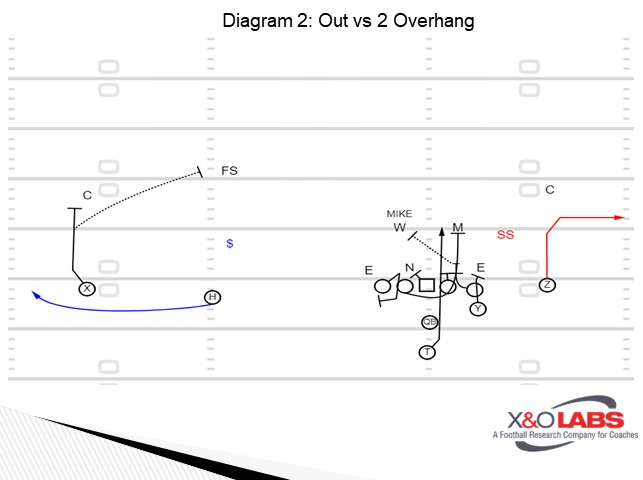
Evolution: in 2017 when we began using these single side RPOs we wanted to use 3-step slants to attack boundary overhang players. This we felt gave us answers to teams that wanted to load the box using a true 4-3 defensive structure or play single high with two overhang defenders in a 4-2-5 structure.

2018/2019: In 2018 we were starting a new sophomore quarterback and had some younger receivers in spots, and we decided to do different things within our RPO game (not a decision I would make today). In hindsight using single-side RPOs would have simplified things for him and allowed him to make RPOs reads in a way that better fit his play style. Therefore, late in the 2019 season, we moved to use RPOs again and helped our offense grow in a season where due to some circumstances we had to run the football a great amount and saw a great deal of 7-, and the 8-man box looks. At this time, we began using 4-step out routes and 5 step glance routes to attack the single side.

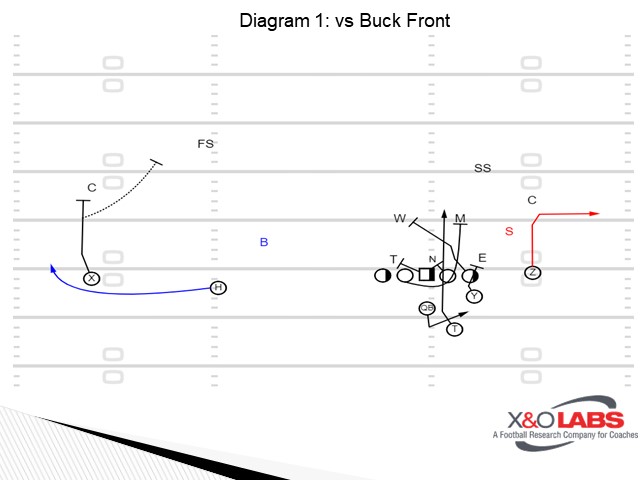
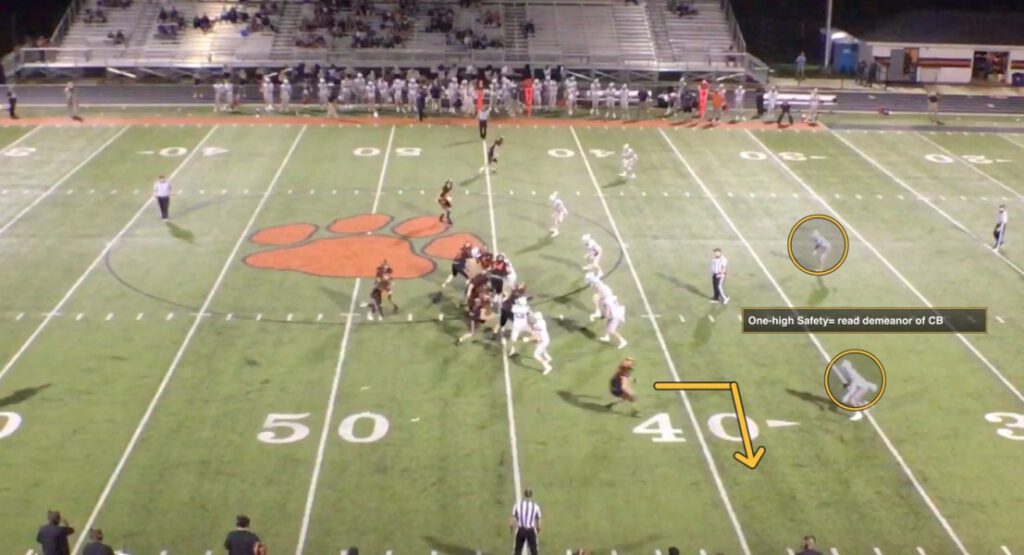
Trends in 2020: In the 2020 season we started seeing a lot more odd front, and a lot of Okie/buck front (5, shade, 4i) to Y off formations. This led us to look for answers, and because of this, we began using 4-step outs to attack these defenses. We felt like the boundary overhang was a run-first player, so because of this, we set the back to the boundary, and either a gap or zone run and tag out to his side. We teach the quarterbacks to read the demeanor of this defender, and if he steps downhill at all to throw the out.

Knight Diagram 1

Knight Diagram 2


Out RPO:

Basics of the Concept: When building this concept, we look at a couple of things. The first thing is the alignment of the boundary wide receiver. Regardless if we are running Glance, Hitch, or Out we want him to play with his alignment on the numbers. We encourage the boundary receiver to vary his split if he stays on the number, we typically tell him “Top, Middle, Bottom” we then teach them from there we have to adjust our release and stem based on the route, and leverage of the corner.


Read More

Correlating Verbiage in Building a Multiple Zone Pressure System

By Jason Brown
Linebacker Coach
St. Charles Catholic High School (LA)


As always it is a pleasure to represent the St Charles Catholic Football Program writing this article for X&O Labs. It is my goal with this article to share some of our thoughts on Pressure Defense. As a disclaimer, I will always say that it is not my intent to sell you on anything only to share the thoughts that we have on a topic and stimulate thought within the X and O community. Believe me, I was told a long time ago, “there are a lot of different ways to get to Chicago”. These are some of the thoughts that we think get us there until of course, we find a better way to do it. These concepts have been developed and tested over 30 plus years in defensive football. We don’t have all the answers, for sure, but we have OUR answers. As with all coaches, the answers have changed over the years. Some things were great, some things looked great, but we could never teach it good enough, or some answers we just simply got beat in and we had to find a better way to do it. Because of the length limits of this report, there may be times it is necessary to just touch on something and not get too involved. If the article is lacking in some detail, I do apologize but the main goal, as always, is to stimulate thought because that is where I think true growth in this profession starts.


Rationale for Pressure:

  1. Part of an attacking culture in the football program.
  2. Get the ball back for the offense in positive field position.
  3. Defense is an attitude!
  4. The complexity of running attacks in today’s offenses makes it harder and harder to read and fit plays effectively down after down.
  5. With the advent of the RPO game, we must have a way to distort the QBs reads and make him make decisions quicker. Disguise can cause QB mistakes, but the question always is “what are you disguising?”.
  6. With the advent of Passing Leagues in the summer, passing games are becoming more and more sophisticated and the QB and skill are getting better and better executing within these systems.
  7. Offensive Menus are growing at an alarming rate and in response, the defenses must have a way to respond to all of this.
  8. Must have a way to aggressively take away time and space from the offense. Make them speed up the decision-making process.
  9. In modern football tackles for loss, turnovers, penalties caused, and three and outs are a big indicator for defensive success. Hard to get these things in modern football unless you force the issue. Do not allow the opposing offense to occupy the ball.
  10. Must be able to snatch momentum back within a game. Defensively we have the best chance to gain the momentum back for our team.
  11. Have answers to the puzzle that the offense is presenting during a series. It does no good if you must get to the sideline to fix a problem. Usually, you are getting to the sideline because the offense has scored on that series.
  12. The addition of pressure and movement adds to the effectiveness of our static defend principles because it lightens the steps of the offensive lineman in the running game and creates doubt in the mind of QBs and receivers in the passing game.


Making the Pressure Package Player Friendly

When in the installation process it is important to teach pod concepts to the players that define their techniques within the pressure package. That way they can just start plugging in their technique based on the call. Again, this allows the pressure to make sense to the player on a total level.


Defensive Line Zone Pressure Concepts:

Short Stick (Gap slants): Step-dip-rip to the V of the neck of the next offensive lineman in the direction of the movement. Read him as you would if you would have lined up on him.

Long Stick (Face Slants): Step to the face of the player that he is supposed to read. If he gets his face, he will cross it right now. If he gets his butt he will chase it.

Make the Trip: Tackle to the pressure side is long sticking to the Center and the Tackle away from the pressure is looping into the OT. When you have a “Cop” designation you must handle the run in the B gap first, then work outside to contain on a pass.

Anchor: The End in a 3-man front to the backside of the pressure plays a true 5-technique

Take: Penetrate the designated gap on the snap.

Loop-Squeeze: Loop outside with eyes still on your alignment key. If he blocks down, you must squeeze back inside and “Dent” whatever shows.

Belly Button: Step to the belly button of your alignment key. If your key blocks down squeeze off his butt, if your key blocks out slip underneath him.

Sprint: puts the End on the outside path of the pressure side.

Visual: DE visual key the OT. If he blocks down squeeze off his butt. If the OT blocks out twist into the A gap.

Linebacker and Secondary Zone Pressure Concepts: Outside Track: Outside pressure path where the aiming point is the hip of the deepest back in the backfield. If Gun, it is the hip of the closest hip of the QB and RB. Stay on the track and defend the first threat through that track.

Inside Track: Could either be face of the Guard, Face of the OT, or the Face of the Center depending on the call. Pressure the Face of the key: If the key blocks down squeeze tight off his hip. If the key blocks on or out go inside the block and squeeze from there.

Gap: Penetrate the designated gap on the snap reading the inside blocker. Read the V of the neck of the blocker and react accordingly to the blocking scheme. Blocks down= squeeze, blocks you= keep your hat in the crack, pulls= get in the hip pocket. If pass understand your lane in the pass rush.

Key: If you are on a key blitz you have a designated spot in the pattern if it is pass or if the flow is to the pressure side. If it is none of the above, you play football.

Visual: Read the OT. If the OT blocks down, you will squeeze off his butt. If the OT blocks on or out, you will twist into the A gap. It is important to note, as a camp rule, we play linebackers at 4 ½ yards deep and have a downhill attitude based on our keys. When we have pressure happening in front of them, they are instructed to play more in a sideways shuffle to let the pressure pattern work for them. “Go when you know”.  Also, if they are part of the pressure, they must scoot their alignment up to 3 yards as a “camp rule”.

Read More

11 Personnel Counter and Power Read Triple Concepts

By Trenton Fields
Offensive Coordinator/Quarterbacks Coach
Lexington Catholic High School (KY)
Twitter: @CoachFields01


At Lexington Catholic I implemented a spread, 11 personnel, multiple formation offense that attacked defenses vertically as well as horizontally. We wanted to create space and open grass for our athletes with personnel groupings and alignments, putting our skill players in one-on-one opportunities. One way we attacked open grass and created one on one opportunities was by attaching a quarterback read and a bubble screen on the backside of our guard/tackle counter and on the frontside of power read. By attaching a quarterback read and bubble screen on the backside and frontside of our gap scheme, we forced the defensive box players to play run and the defensive secondary to play screen creating large creases in the defense. This strategy kept the defense off balance and put our athletes in one-on-one situations allowing them to make explosive plays.


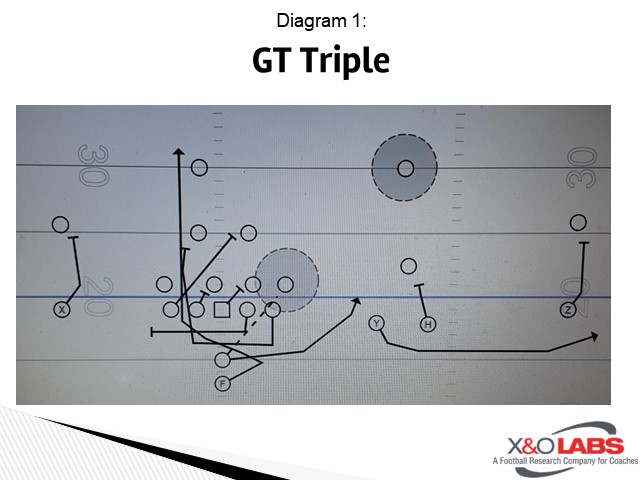
Guard/Tackle Counter Triple

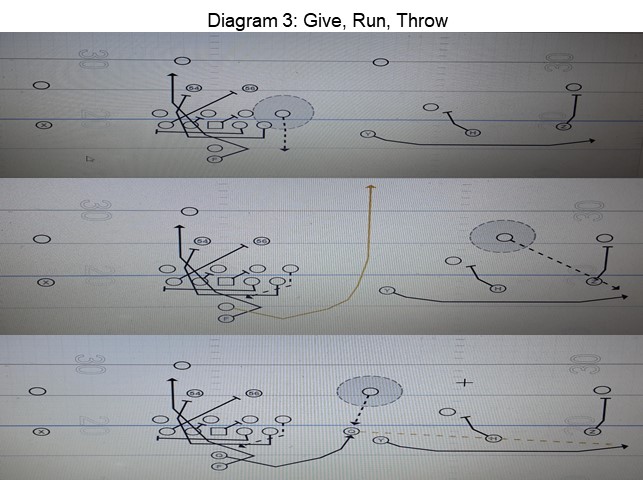
Traditionally, we would backside cut off the end man on the line of scrimmage when we ran GT counter. In spread formations it’s difficult to get that assignment executed without bringing a player in motion or putting a tight end/fullback/sniffer on the backside of the formation. Majority of teams we played squeezed the pulling tackle so hard, it is impossible to hand the tailback the ball without him being tackled for a loss. Instead of blocking the end man on the line of scrimmage we decided to read him, like zone read, and throw the bubble or pitch off the ally defender.

Fields Diagram 1


It All Starts in the Box

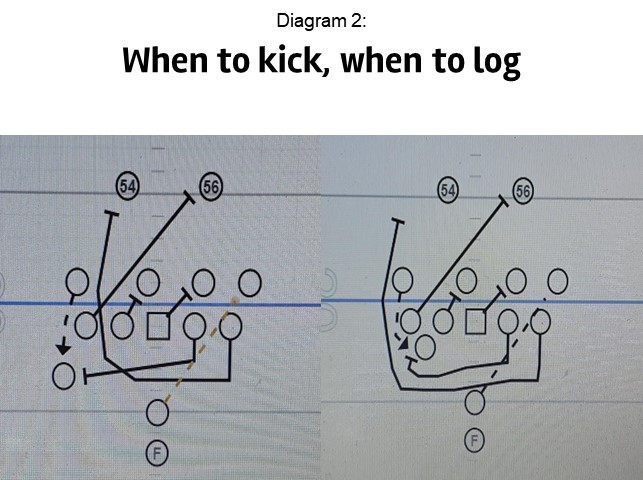
For counter triple to be as effective as possible, all aspects of the play (GT counter, QB run and the bubble) must be executed and it all starts in the box. Step one, the offensive line must decide who the backside tackle is pulling for by declaring the one. We declared who we are working to because we wanted to create landmarks, but we teach our guys they are responsible for their gap and if someone showed up in their gap they must take them. We determined the one by the first linebacker in the box playside. The playside tackle will declare who the one is by saying, “54 is the one, 54 is the one, 54 is the one!”. By declaring the one, that allowed the offensive line to all be on the same page. Our backside pulling guard understood he is kicking out or logging the C gap defender, not the end man on the line of scrimmage. The guard understands he is responsible for the first body that shows up off the playside tackle’s butt. If the C gap defender comes up field, he will kick him. If the C gap defender squeezes the gap down, he will log him. We teach our tackles to be patient and read the guard’s block. If the guard kicks, the tackle will insert for one. If the guard logs, the tackle will come as tight as possible off the guard’s butt and take the first opposite hat that shows.

Fields Diagram 2


Must be able to Read

Our quarterback reads the end man on the line of scrimmage. If the end man on the line of scrimmage chases the pulling tackle, the quarterback pulls the ball and attacks the open grass. I explained in quarterback meetings who the QB is throwing/pitching off (alley defender) but I did not over coach him. If a defender is immediately in your face to make a tackle, throw the football. If there is open grass and you can get 5 to 10 yards, run the football. If the end man on the line of scrimmage comes up field, the quarterback gives the hand off and sells his fake by attacking the open grass. Our coaching point for the quarterback, if he is not going to tackle the back, hand the ball off.

Fields Diagram 3

Read More

“Fixed” vs. “Read” Stunts to Attack Protections From 4-Down Spacing

By Jeff Long
Defensive Coordinator
John Carroll University (OH)
Twitter: @CoachLongJCU


Defenses with a 4 down structure have a variety of options in attacking protections with various line games and pressures. Living and dying by 5- or 6-man pressures to create pressure on the QB can be a dangerous game to play. The stunt world is one that can give additional opportunities to pressure the pocket while still playing your base coverages. The tough task for coaches is to find the stunts that can get you the most bang for your buck while still being able to fit the run properly.

Within our defense, we have two types of stunts: “Fixed” stunts and “Read” stunts. A “Fixed” stunt is going to be executed when called no matter if the offense calls a run or a pass play. These are high risk, high reward: when called in the right situation, they can create an explosive play for the defense. When called in the wrong situation, they can leave you vulnerable to a big play because of their volatile nature when talking about base run fits. A “Read” stunt is ONLY going to be executed if the offense gives a pass read. If the offense gives a run read, then we will play our base front rules. The benefit of investing in “Read” stunts is two-fold: First, they allow your staff to teach and prioritize fanatical eye discipline and get off out of your front four. Secondly, opposing offenses will never know if or when they have been called them unless they give a pass read, thereby hiding tendencies of base vs a movement rush.

In this report, we are going to focus on 3 of our basic “Read” stunts out of the 4 down the defensive front.


Front 4 – Basics


Long Diagram 1


The basic over front vs a 5-man surface will have your defensive ends aligned in 5-techniques and some combination 3 technique/2i technique over the guards. With each defensive lineman in a shaded alignment, their visual key is the tip of the pad of the offensive lineman they are aligned on. From their initial stance, the biggest coaching point will be their eyes. The tip of the pad is going to give our run pass key within the snap of the football. If that pad gains ground = run read if it retreats = pass read. The first step of the defensive lineman must be vertical whether he gets a run or pass read.

The goal against a run read is to create vertical knockback on the offensive lineman you are aligned on.  The goal against a pass read is to beat the offensive lineman to the set line to execute your pass rush plan.  Proper eye discipline will allow the defensive lineman precise hand placement vs the run and proper rush leverage vs the pass. Without getting into all the specifics of basic defensive line play, this teaching point will be consistent as you progress into teaching the “Read” stunts.  Within these “Read” stunts, priority will be placed on their technique as the key to success vs the run or the pass.


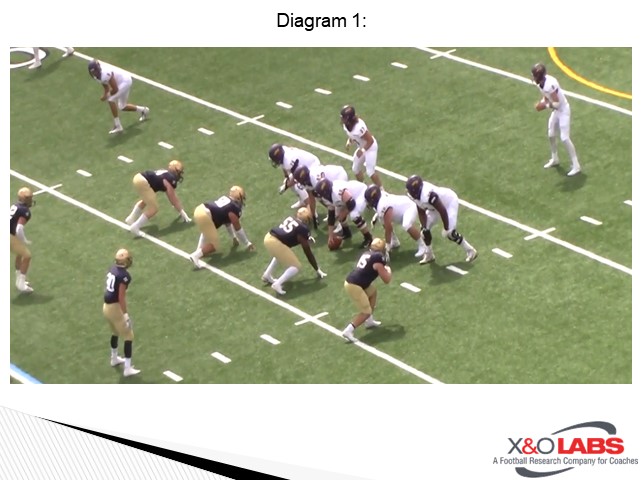
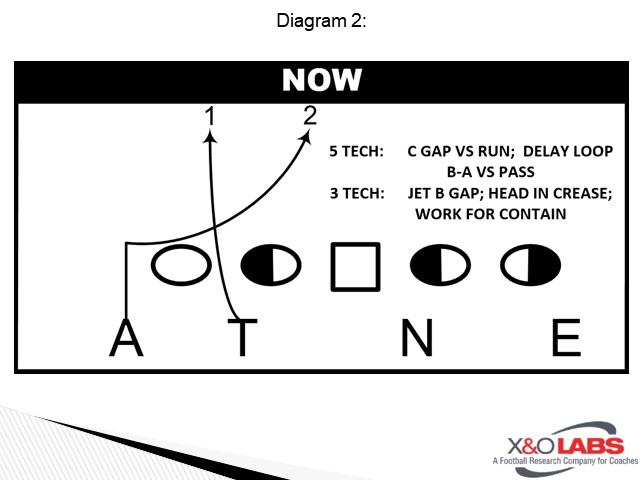
Read Stunt 1: “Now” Stunt to the 3-tech

Long Diagram 2


Purpose: The “Now” stunt is going to attack protections to the side of your 3 technique.

3-Technique (Penetrator) – When given a pass set, the 3 technique’s goal is to “jet” the B gap. Jetting the B gap is defined as getting the helmet “in the crease” of the guard (getting your helmet, behind his outside shoulder pad).  When he achieves this positioning, he will become the contain player through the B gap. If given a run read, the 3 technique will play his normal B gap by attacking the outside third of the guard straining for vertical knockback.

5-Technique (Looper) – When given a pass set, the 5-technique’s goal is to delay the loop to the B/A gap depending on the slide of the protection.  He must sell his up-field rush to press the offensive tackle vertically.  Once the 3 technique has entered the crease, the 5-technique will loop tight off his butt and take the first open window (B or A gap based on the slide of the offensive line) to the quarterback.  If given a run read, the 5-technique will play his normal C gap by attacking the outside third of the tackle straining for vertical knockback.

Read More

“Plus” vs. “Minus” Tags in the Dart Run Concept

By Steven Alesi
Offensive Coordinator
Longwood High School (NY)
Twitter: @CoachAlesi


Here at Longwood, our entire offense is broken down into families.  In the run game, we have 4 frontside families and 4 backside families.  Before teaching any concept we teach these 8 families.  When teaching a concept, the players first learn which frontside and backside family the play is a part of.  Each family will always have the same rules.  This allows the players to immediately know the core rules of the concept based on the family it falls in.  We feel that this greatly increases the player’s ability to not only increase the rate in which they learn but retain more information.

Dart for us is a day 1 install.  This is because of how few rules the concept has and its adaptability to so many different looks.  It also provides great blocking angles and is sound vs interior pressure.  It is the core of our offense and we spend a great deal of time and effort protecting this play.  We also feel that it is one of the most forgiving plays in football.  With the back on a tight inside aiming point and the backside puller taught to clean up any opposite color that shows up.  We have found it much easier to collect those difficult run-throughs and correct any missed blocks on the line of scrimmage compared to other run concepts.  This concept can be utilized as a 1 back or a multi-back concept that can also be a great compliment to many common 2-back run schemes such as power.  This article will consist of many clips where we had made a mistake somewhere and we were able to sort it out and gain yards.

The OL rules are broken up into playside and backside.


Front-side Rules “Over – Down” (Man Scheme)

  • Over- Block the defender over you on the line of scrimmage
  • Down- Second LB play-side


Adjustments

  • Minus- when every inside gap is covered playside
  • Plus- when the EMLOS is double covered


Backside Rules- Assume Frontside Rules (Tackle Pull)

  • Over- Down


BS Tackle Rules

  • Peak pull for the first LB front-side “Backer”.
  • Keep your head inside and make contact with your outside (play-side) shoulder. Near foot-near shoulder.  Velocity!!
  • Make your linemen right, never bypass a free defender!


The Backfield Mesh

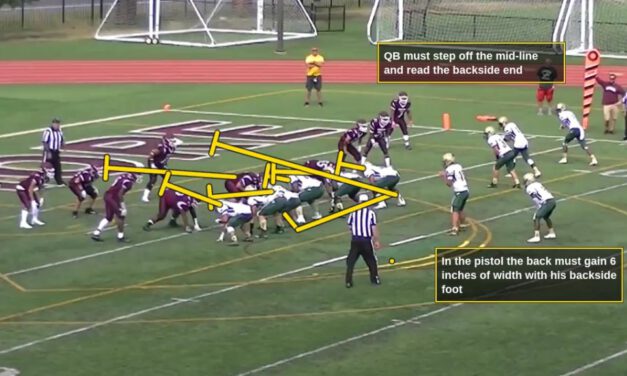
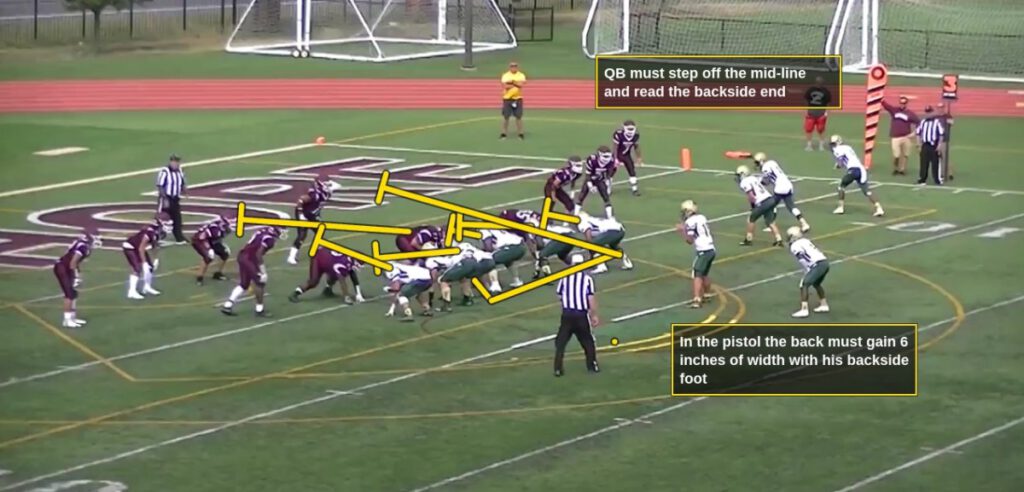
The QB has the same footwork if the ball carrier is in the pistol or sidecar position.  His primary goal is to give the back the midline and point his belt buckle at his backside read.  He will step with his backside foot first and step toward the play side, pointing it at his backside read.  He will next step with his play side foot squaring up to his read and reestablishing his shoulder width base.  The QB will push the ball back as far as he can and make his decision by the time the ball reaches his belt buckle.  The ball carrier in the pistol will take a 45-degree, 6-inch step with his backside foot and then press his aiming point of the play side hip of the center.  If the A gap is open, he will hit it.  If it is closed, he will get on the inside up hip of the puller and follow him into the next available gap.  In the sidecar position, only the 1st step is different.  The back will shuffle keeping his shoulders square and dropping his inside foot back.


Tail Back Rules

  • Aiming point- playside foot of the center (inside out)
  • If the frontside A gap is open hit it! If not follow your lead blocker
  • 1 cut
  • Expect the ball to hit inside
  • If a defender comes free get downhill now and get positive yardage. No negative plays!


Fullback Rules

Since this is a 1 back run you will be tagged to block a specific player


Quarterback Rules

  • Step off the midline with the backside foot
  • Read the backside EMLOS unless tagged to read an interior defender


Read More

Quarterback Run/RPO Manipulations from Empty Formations

By Eric Struck
Offensive Coordinator/Quarterback’s Coach
Lincoln High School (SD)
Twitter: @EricStruck


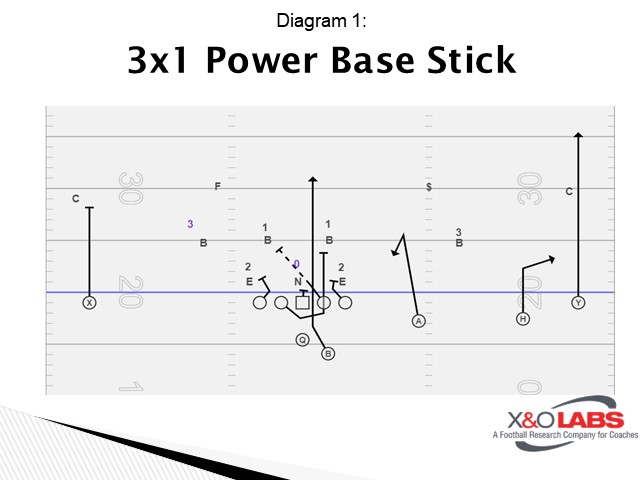
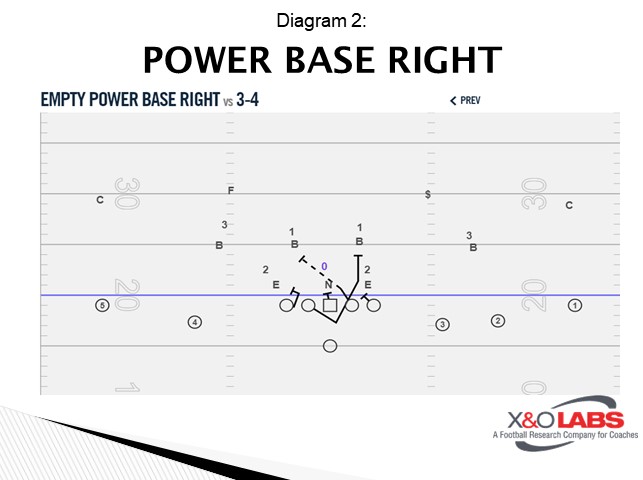
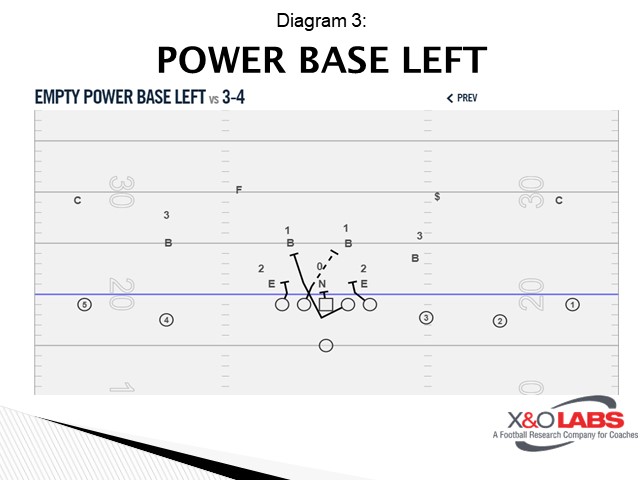
Over the last two seasons, the empty formation has become a big part of what we do offensively at Lincoln High. It has given us the ability to get our best athletes on the field and be able to attack with the pass as well as the run. We ran some Jet Sweep from empty, but we wanted/needed something in the run game that would be able to attack the middle of the defense. Versus empty we generally see an Odd Front from the defense and a 4 or 5 man box. When we see a lot of Odd Front defenses our go-to run play from 3×1 or 2×2 is our Power scheme. When we run it from open sets, we tag a “Base” call so our playside tackle knows he must stay on the end man on the line of scrimmage and not block down like he would in our regular Power scheme.

Struck Diagram 1


Our go-to RPO when we are running this scheme from 3×1 is our Stick RPO. It was an easy transition for us to incorporate this running scheme and RPO scheme into our Empty Package.

As was stated earlier, we like this scheme versus Odd Fronts. It allows us to double team on the Nose to the Backside Linebacker with our Playside Guard and Center. Both of our tackles will base out the end man on the line of scrimmage.

Struck Diagram 2

Struck Diagram 3


We typically put the three-receiver side away from the side we will be running the ball. To the three-receiver side, our #1 receiver or the farthest receiver outside will be running an outside release fade route. Our #2 receiver will run a three-step arrow route towards the sideline. Our #3 receiver will run a 3-5 step hitch route, settling in the open grass between the inside Linebacker and the outside linebacker. If a linebacker is covering our #3 receiver and the next linebacker inside is in the box, our receiver will look to run his route in the space between the two defenders.

Read More

Creating and Communicating “If/Then” Controls for an Empty Package Menu

By Jeff Thomas and David Carskie
Head Football Coach and Offensive Line Coach
University of Puget Sound (WA)
Twitter: @jeffthomas4 @CoachCarskie


What does a team that throws the ball nearly 70% of the time have in common with a wing t or option attack? We believe a lot at the University of Puget Sound.  Our approach to offensive football is to have a rationale for calling plays based on putting a specific player in conflict.  This loosely based approach to Wing T football applies to all personnel groupings in both the run and pass.  We build our playbook with If/Then statements like what you see a Wing T or option system use.  Our core belief is to always have complementary answers to whatever a defense gives us. Over the last two seasons, we have lined up in 5-Wide Receiver sets nearly 50% of the time. In our offense, we will always have a screen component in every scenario.  We will cover one screen or rub play and one drop back play per If/Then statement. Ideally, these calls are made by me from the sideline in normal down and distance situations. However, we have progressed towards teaching our quarterbacks to make these calls at the line of scrimmage. The scope of this report is to go through one of our decision trees of why we call what type of play at a specific time.

For this report, we will break down our If /Then statements working from Cover 2, to Cover 3 to Man coverage. This report will not cover each scenario or cover specific coverages we might face from specific opponents. Since we line up in 5 Wide Receiver sets so often, we get a myriad of “special” coverages each week. However, the base premise is the same as how we go through to figure out the best form of attack rather than picking a random play.


Control 1: If 5 man or less box…then run the ball

The first area we look at is to count how many players are in the box.  We define the box as horizontally from TE to TE (whether we have one on the field or not) to 5 yards deep.  If there is less than 6 in the box, we will determine if we have angles and space to run the ball with the QB. Often, we will have only 5 in the box but an outside linebacker close enough to get a hit on our QB if we called a designed run play for him. In our designed QB run plays, the QB must get 5 yards before an unblocked player can get to him or we have better options.

Diagram 1


Editor’s Note: The staff at Puget Sound has provided narration for each clip below:


Clip 1: Notice how there are only 4 in the box. This is a best-case scenario to run the QB.  We get this look often, especially when teams are playing any version of 2 man in a 4 DL look.

Clip 2: Even though they end up bringing pressure, they only have 4 in the box pre-snap.


 “If/Then” Protocols to 3 Receiver Side:

We are going to focus this part of the report on working the 3 WR side of the formation.  Later we will discuss throwing the ball to the 2 WR side. We also in our offense have full-field reads that have multiple ways to get WR’s across the field. For this report, we will leave full-field reads out of the report. The primary point is to develop a thought process to fit your offense, rather than specifically copy what we have come up with at Puget Sound


Read More

2-Under, 3-Deep Pressures from 2-4-5 Spacing

By Adam Hovorka
X&O Labs Managing Editor

with BJ Hammer
Head Football Coach/Defensive Coordinator
Bowdoin College (ME)
Twitter: @CoachBJHammer


Coach Hammer utilizes what he calls a 2-4-5 defense. Even though he mixes in 4-man and 3-man fronts he is playing with only two traditional down-lineman on the field. This was born of necessity as it is tough to recruit Defensive Lineman at the DIII level. This is also true at the high school level and playing this style of defense will get your better athletes on the field.


Philosophy:

Coach Hammer, the Head Football Coach and Defensive Coordinator for Bowdoin College, says his defensive philosophy is based on three components:

1) Get the ball back to the offense by forcing turnovers or getting three and outs.

2) Stopping the run by forcing all runs to bounce to the outside by mixing fronts, stunts, coverages, blitzes, and emphasizing run fits, tackling and pursuit.

3) Pressuring the Quarterback by bringing 5,6,7 and 7+ form all different angles and paying attention to blitz fits.  Attacking protections from the inside out and bluffing pressure.  Coach Hammer and Bowdoin want to force their opponents to make mistakes and feel by bringing pressure this will force the opponent into mistakes.


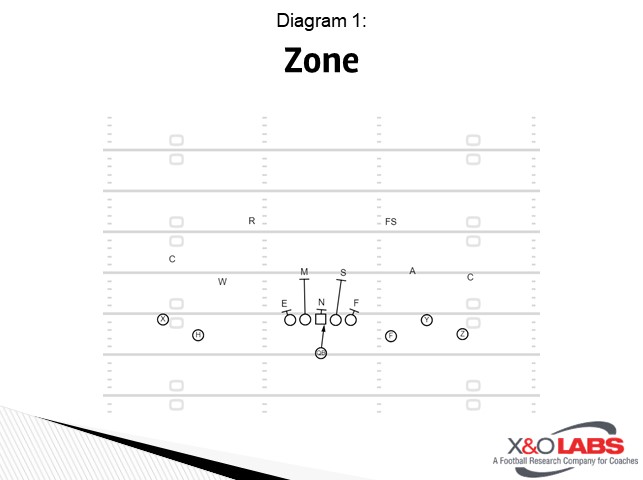
The focus of this report is Coach Hammer’s Texas pressure family, which is a pressure characterized by sending six defenders, with the ability to send three A-Gap rushers and play Cover 5 (Hot Coverage) behind it.


Personnel:

Look at the following chart to see what Coach Hammer names his position and the qualities he is looking for in those positions.

R Traditional 3 Tech – DT
E Traditional 3 Tech – DT
H Strong Side Hybrid OLB – Looking for a 3-4 OLB type
V Weak Side Hybrid OLB – Looking for a 3-4 OLB type
W Weak Side ILB – More of a down-hill run stopper
M Strong Side ILB – Bigger FS type
S Strong Safety –Run Stopper and Ability to play the Post
FS Weak Safety – Run Stopper and Ability to play the Post
SS Slot Corner
CB Cover Guy
CB Cover Guy


Communication:

Coach Hammer uses wrist coaches to communicate his blitzes and feels that enables his guys to be comfortable in their assignments.  Coach Hammer will call pressures to the open side (away from TE), to the TE, from the field or boundary, and to the RB and away from the RB.  A key component of this pressure family is the fact that it will not change based on the offensive formation or motion.  Coach feels strongly that if calls pressure he wants that specific pressure and doesn’t want to check out of it.  The only check they will need to make is if the offense comes out in empty.  Coach Hammer will have specific pressures that the players will check to just for empty. Coach Hamer will go into a game with two or three pressure checks for empty along with some form of drop 8 coverage.

Read More

“Inside out to Down” Read Progression in Double Post Concept

By Joe Gerbino
Offensive Coordinator/Quarterback’s Coach
Utica College, (NY)
Twitter: @CoachGerbino


Double posts have been a great addition to our offense. The concept allows us to be aggressive and read a third-level defender, but also have a shallow component for completions. It is a “shot play” with a built-in check down (without using the back).  Double posts have been compatible with our 10, 11, 12, and 21 personnel packages. The concept meshes well with our play-action and drop back pas protections. We have clips of completing this play versus every coverage, whether it be man, one high/two high zones, or split field variations. We have run a variety of double posts since 2015. Over the years we have built the concept to help us every week, regardless of opponent. We have grown to like it so much, that in 2019, it was our most frequently called pass play.


Why Run Double Posts?

Many Offensive Coordinators are looking for a “high completion percentage play” but also understand “big plays” help you win. At Utica, we think Double Posts accomplish both. There is a component to take a shot versus one high structures, split the safeties of two high structures, or get the ball underneath to “throw short, run long.” Our quarterbacks and skill players love this concept because they feel every route can be thrown.


QB

First, three-step footwork. We coach our QB’s to always check our back-side receiver to see if that ball can be completed. We tell our quarterbacks a defense must “pay the price of admission,” and force us to make a read and take a drop. Anytime we can take our X receiver we will. We determine the depth and leverage of the boundary CB, along with the pre-snap alignment of the weak safety regarding the hash.  Once we have determined we cannot take the “free access” throw, we will then get into the concept itself. We will read our double posts inside-out to down. This is base installed out of 2×2 formations – low post by the play side #2, high post by the play side #1, and then shallow cross from our backside #2 – that will eventually get into our play side vision (should not have to move “the stripe on our helmet”).

When talking coverage with QB’s, they know which routes are ideal versus specific looks, but the read will ultimately remain the same, inside-out to down. For a given opponent we will quicken the reads based on the game plan. For example, against a cover three defense, we will be quicker progressing from the high post to the shallow, keeping in mind that the safety is splitting the hashes. Against a cover 4 team, we will be quicker on our first read to the low post, knowing that safety will play it, man, past a certain point, and opens up the high post over top. Ideally, these are the routes we want versus specific coverages.

Cover 2: Low post splitting safeties.

Cover 3: High post convert vs squeeze corner or shallow underneath LB.

Cover 4: High post behind strong safety.


Man Coverage:

0 high man: Low post is closest to us and will press toes and cross face vs man defender.

1 high man: High post convert to the field or shallow cross with man defender trailing.

2 high man: Which post wins? Most likely shallow cross – let’s not be in third and long for teams to get into this.

Read More

The Player Driven Culture System: Introduction

“Every time you’re in front of your team everything you say matters and it has to be intentional.”
-Dabo Sweeney, head football coach, Clemson University


By Mike Kuchar
Senior Researcher/Co-Founder
X&O Labs
Twitter: @MikeKKuchar


This wasn’t the introductory team meeting that players were expecting. It was 2004 and Louisiana native Ed Orgeron has just been hired to lead the program at Ole Miss, one of the gems of southern college football. In his deep Cajun-like drawl, instead of projecting how physical his team was going to be, he pontificated on how tough he was. Before players knew it, “Coach O” was ripping off his shirt and challenging some of them to a fistfight. Luckily, no one obliged. “It was the strangest thing I’ve ever seen in my life,” a former player said. “I mean, we had plenty of guys on that team from some really bad places. He would’ve been jumped or shot or both. I still can’t figure out if he knew that, that no one would try and fight their new head coach.”

Turns out his coaching staff wasn’t spared this brunt of tirades either. During that first season in Oxford, he’d wear them down both emotionally and physically, treating each as if they were defensive linemen—the only position he coached before getting the promotion. Ultimately, he strangled the life out of the program, finishing 10-25 over three seasons from 2005 to 2007. In hindsight, he says going 100 mph, on and off the field, “broke people, it broke the team.” He was using the wrong messaging and it had a catastrophic consequence on the progression of the program.

Now the 2020 version of “Coach O” has made a 180-degree transformation, thanks in part to the experiences he had in that first go around. Coming off a national championship campaign at Louisiana State University, Coach Orgeron told me it took him over a decade to learn two very important lessons: number one, don’t have kickers and quarterbacks compete in the Oklahoma Drill (seriously) and two, never take for granted an opportunity to message the core values of the program.

Read More

The Player Driven Culture System Case 1: Collaboration

The Pathway: Teaming


“Tell me and I will forget, show me and I may remember; involve me and I will understand.”
– Confucius


By Mike Kuchar
Senior Researcher/Co-Founder
X&O Labs
Twitter: @MikeKKuchar


“Nobody washes a rented car.” If you spend enough time around North Forney High School (TX) head coach Randy Jackson, you’ll probably hear that gem on more than one occasion. A layman’s translation: if something isn’t owned, what responsibility do people have to take care of it? A football program’s culture must be owned, not rented, and it must be owned by every player and every staffer that associates with it. And if the landing is ownership, then the launch must be a collaboration, where players are given the opportunity to work with coaches in protecting the culture. For those like Coach Jackson, this competency is more about accommodating a lifestyle inherent in this generation more than any generation that came before it. “Kids have information available to them now everywhere,” he says. “They don’t need us for information. Their voice is heard by liking and sharing things all day on social media. How can we not give them a voice, but they are getting it everywhere else?” How players are given this stake will be the focus of this competency. So, for many reasons, I felt impelled to begin my research with this collaboration. Without collaboration, there is no ownership. And without ownership, there is no player-driven culture.


Collaboration as a Competency

One of the base foundations of establishing a player-driven culture system is generating ownership through collaboration. While the head coach and his staff are responsible for building the program’s culture- which I elaborated on in the Prologue- in order for players to feel as if they have an investment in the culture, they need to be entrusted with the process of defending it. The behavior of collaboration is without question more relevant now than it has ever been. The players that coaches are working with now are used to having a voice. It’s the social media generation, where every “like” is quantified and every voice, regardless of source, is equitable.


Why Collaboration is Essential to Creating Player-Driven Culture

Coaches are now using collaboration to empower players with various ways in which they can have ownership in the program, all of which I present in this study. The science behind the positive effects of collaboration is overwhelming, and perhaps too lengthy to go into detail here. Quite simply, collaboration is one of the prime behaviors that lead to ownership, and this collaborative effort between a coaching staff and its players is developed through an act known as “teaming.” The Harvard Business Review defined teaming as the process of identifying and briefing essential collaborators to work together in accomplishing a goal. Consider the “goal” as the core values described in the Prologue. While this competency of “teaming” may be a mainstay in the business world among adult professionals, it has only started garnering traction in football programs. It’s the goal of any player-driven model to build a culture where teaming expected and begins to feel like a natural part of the developmental culture.

Read More