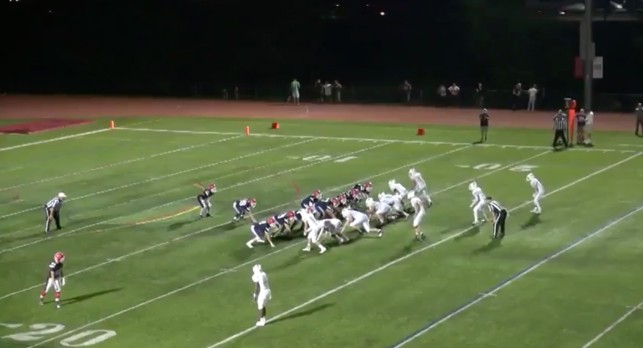

Adjusting the Slot Fade Concept to Fit Receiver Skill Set

By Luke Dawson
Offensive Coordinator/Wide Receivers
Shiloh Christian School (AR)
Twitter: @coachldawson


If you happened to watch any college football this year, specifically certain spread teams such as LSU, Oklahoma, or Clemson, you most certainly saw one of football’s newest favorite passing concepts – the slot fade. The country’s top college coaches like the concept for the same reasons you should:  taking a vertical shot play to one of your best athletes in a lot of grass. The play is also very versatile and can be run against a variety of coverages.

When I arrived at Baptist Prep in 2018, the Eagles were riding a 27-game losing streak and running the double-slot triple option. It became clear early on that, although we were going to be in the gun, we were not going to be an air raid team by any means. We built an offensive identity on our downhill gap scheme run game. This past offseason we decided to make our vertical passing game a focus point to complement our 20/21 personnel run game, and the slot fade became an essential part of this vertical passing game.
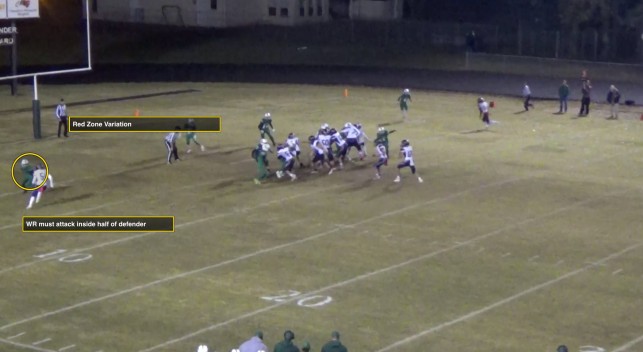
 

Molding the Slot Fade to Your Personnel & Opponent

Some of you reading this will understand when I say this, but at Baptist Prep, we were not going to outrun any DB we would face from the WR position. This is what scared me the most as a play-caller about the slot fade concept. When you watch Oklahoma or LSU run the concept on TV, the dudes they are doing it with a look a little different than ours. We had WRs with good hands and could run decent routes, but we needed to find a way to stretch teams vertically with players that were not built to do so. We also knew that we were going to see almost exclusively 2-high (quarters or man) coverage shells the entire season. 

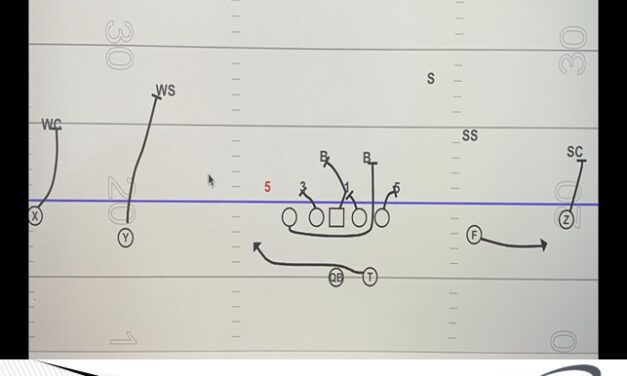
Thus, the idea of an adjustable slot fade was formed. But before we get into the top-end adjustable portion of the route, we need to know the important coaching points about the first half of the route.


The First Half of the Route

We had to make it clear to our receivers early on that they must be able to avoid contact. Since we were not exactly the fastest group, any contact on a slot from an OSLB would slow down our route (even more than it already was). Thus, we needed to avoid any contact before we got to the safety we were trying to attack. They also could not get shoved too far inside or out. Thus, they must practice and prepare to avoid contact by the OSLB to get to the third level. There are many good resources to find WR releases, and we made many of these available for our guys to use at their discretion.

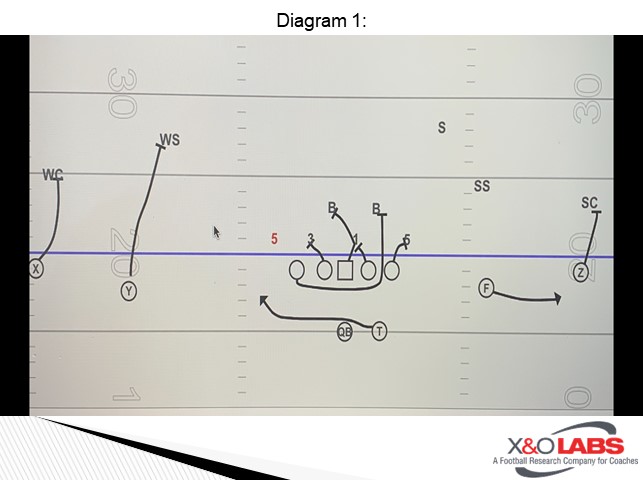
Once we avoid the OSLB by whatever release we choose, we must press the safety’s inside shoulder to either retain his inside leverage or, more desirably, flip his hips toward the inside. This is the key to the first half of the route. We must make that DB believe that we are trying to beat him to the inside. If that can be done, we have already won the route.
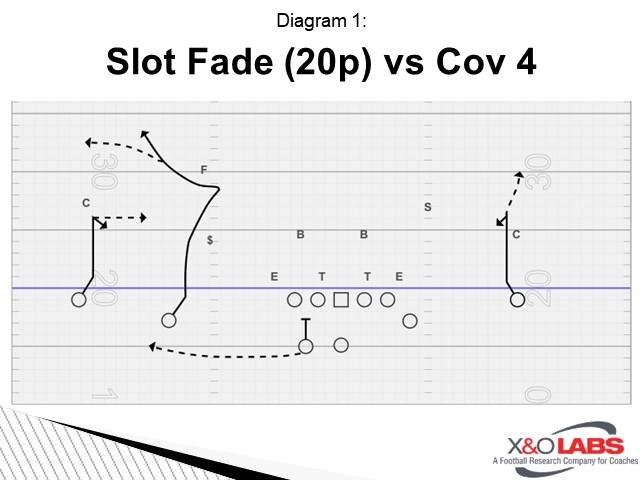
Diagram 1


The Second Half of the Route

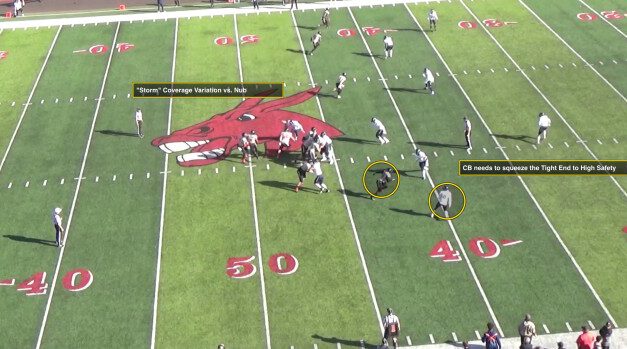
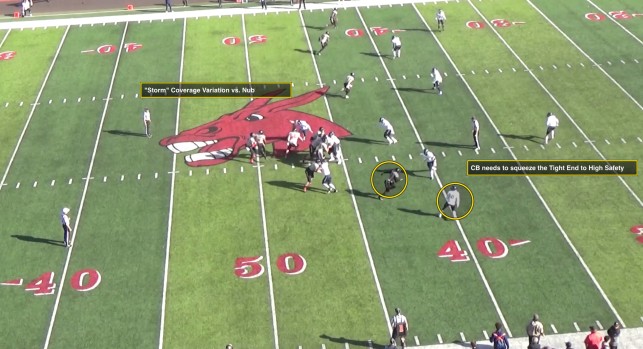
The second half of the route is where the adjustability of the route comes into play. Let us assume at this point that we have controlled the safety’s leverage by the first half of the route, and he is protecting the inside (as is typical in most 2-high structures). The next step in adjusting the route is to know where the corner will be:  is he jumping the short route underneath, or retaining his depth to shelter under the slot fade? 
Read More

Rip/Liz Match Principles vs. to Defend Specific Formations

By Owen Jordan
Defensive Backs & Special Teams Coordinator
Lincoln University (MO)
Twitter: @LUCoachJordan


Whether you plan on using Cover 3 as one of multiple coverages that your defense runs or as a staple of your defense. It is important to be able to match formations, as well as put your players in the best position to be successful. I will break down the ways we use Cover 3 to match up versus multiple formations. The versatility that we get from playing multiple variations of our Cover 3 helps us to change the run fits and disguise the box count.

We can present a different post-snap picture while maintaining consistent coverage principles. Throughout the report, you will read how we can change the look of the flat defender. This may seem like an elementary variation, but the benefit of changing the flat defender is the ability to change leverage as well to change the picture that the quarterback is seeing from snap to snap. It will make the quarterback find the flat defender instead of automatically being able to find the outside linebacker or safety knowing who will play the flats. The rhythm and timing of each player are different which will change the look for the quarterback, he will not be able to develop as much rhythm and manipulate the flat defender based on previous snaps.

Terminology

Before we get into the breakdown of how we utilize our Cover 3, it is important to understand how we label the zones and positions for each player to give you an understanding while reading the terminology used in the article. In our Cover 3, we are a spot drop defense that will carry and pass routes through our zone. Each zone from sideline to sideline is roughly 8 yards of horizontal cover with the overlap of the zones.

Diagram 1

Zones

Seam/Flat: Often referred to as the Curl/Flat. We use the term “Seam” to emphasize a re-route of the #2 receiver. We define the “Seam” as roughly 2 yards outside the hash to 2 Yards inside of the numbers. The “Flat” is 2 yards inside the numbers to the sideline.

Strong Hook: Fieldside hash plus 4 yards on either side.

Middle: The middle of the field 3 yards inside the hash marks.

Weak Hook: Boundary side hash plus 4 yards on either side.

Positions

Sam: Field linebacker with Seam/Flat and Strong Hook responsibilities.

Mike: Middle linebacker with Strong and Weak Hook responsibilities.

Will: Boundary linebacker with Seam/Flat and Weak Hook responsibilities.

Rover: Boundary Safety with Seam/Flat, Weak Hook, and Deep Middle responsibilities.

Free Safety: Field Safety with Seam/Flat, Strong Hook and Deep Middle responsibilities.

Base Cover 3

Our base Cover 3 principles are strong and weak rotations. For teaching purposes, we will describe the zones of a Cover 3 strong rotation with the Free Safety outside the Sam in a 3×1 attached formation with the back set to the single wide receiver. In all our zone coverages we will have a 5-yard “No-Cover Zone”. We don’t want the underneath defender to drive underneath routes until the throw. We will maintain our leverage on routes while keeping our depth. Everyone on our defense must understand their landmark as well as the first threat to their zone. If we get a condensed formation, we will adjust our landmarks according to the #2 receiver. We will hold a two-high shell in our pre-snap alignment. The alignment of the safeties will be 10-12 yards deep. The boundary safety will align 1 yard inside the hash. The field safety will align 1-2 yards inside the receiver he will be rolling down to. The base alignment for the corners will be 7×2, 7 yards off and 2 yards inside the widest receiver.  To a single receiver side, we want to press bail based on the alignment of the running back. If the running back is aligned to the single receiver side, we will bail with our back to the sideline so we can get our eyes to the running back out of the backfield. If the running back is away, we can man turn and play the single receiver. Our linebackers will adjust their alignment based on front and coverage responsibility. Our base alignment to 3×1, the Will is going to be in a “30” aligned in the B-gap, the Mike will be aligned in a “20” over the guard, the Sam will align 2 yards inside the #3 receiver.

Free Safety (Seam/Flat): In a 3×1 detached formation the safeties will start showing a two-high shell with a depth of 10-12 yards. The free safety will align 2 yards inside the #2 receiver. We align based on the split of the wide receiver so that we can adjust to the formation and route alignment of the receivers. The free safety will start his rotation on the snap rolling from an inside position to the outside shoulder of the #2 receiver. We want to attack the outside shoulder for two reasons. We want to force the inside release and shorten the divide for the rover rotating to the middle third, we also don’t want to get pinned by the #2 receiver who is trying to occupy the flat defender. The free safety must be patient in his rotation while reading the release of the #2 receiver. We want the free safety to hold the seam as long as he can while working to the flat. Once the free safety gets his hands on the #2 receiver, we want his eyes to go to the #1 receiver. The free safety needs to take his eyes to the #1 receiver to determine where he is going to go after rerouting the #2 receiver.  

Sam (Strong Hook): The Sam will align on the inside shoulder of the #3 receiver. The Sam will be responsible for the strong hook. The Sam will push to the hash on his spot drop looking to collision the #3 receiver. If the #3 receiver takes an immediate inside shallow release the Sam will give an “Under-Under” call to alert the Mike of something coming low into his zone. Once the Sam makes the “Under-Under” call he will take his eyes to the #2 receiver looking for the next threat to his zone. Once the Sam levels off he needs to be aware of an “Under-Under” call from the Mike to indicate a route working shallow across the field or an “In-In” call from the free safety or corner to indicate a route working inside with depth. After the initial spot drop, the Sam needs to be able to work horizontally in his zone. The Sam needs to be able to push out with horizontal stretch from the

Read More

Adding Pistol and RPOs to Traditional Triple Option

By Danny DuPaix
Offensive Coordinator/QBs
Southern Virginia University
Twitter: @coachdandupaix


When I came to Southern Virginia, a small, liberal arts college competing in NCAA Division 3, they had just finished their 2nd season out of NAIA with a combined 1-19 record. The initial roster of 27 including just 2 seniors. We knew we had work to do! Our offensive staff has had great success running the triple option throughout our careers including multiple FBS and FCS post-season appearances, four High School State Championships, and over a dozen region and conference championships. We are schooled by the traditional rushing powers of Navy, Army, Georgia Tech, and Air Force. However, we enjoy seeing the new wrinkles these past couple seasons that New Mexico, Jacksonville, Davidson, and others run with great success. The triple option is not fading, and different variations can be seen throughout all levels of football today.

What I will convey in this report is how to marry the two to help your staff and players make the change in presentation without changing many rules. This will allow for teams to add RPOs while keepi­­­­­ng the core foundation of the triple option.


Triple Option Foundations

The traditional under the center triple option is not a week-in and week-out offense. It requires the defense to be fundamentally sound and play assignment football where one small mistake can lead to huge chunk plays and demoralize a sound game plan. Many teams will invest part of their spring practice AND their fall camp to install their “Option Package” for the one game they face a triple option team. Even then, it is hard to simulate a full speed option attack that will be seen on game day.

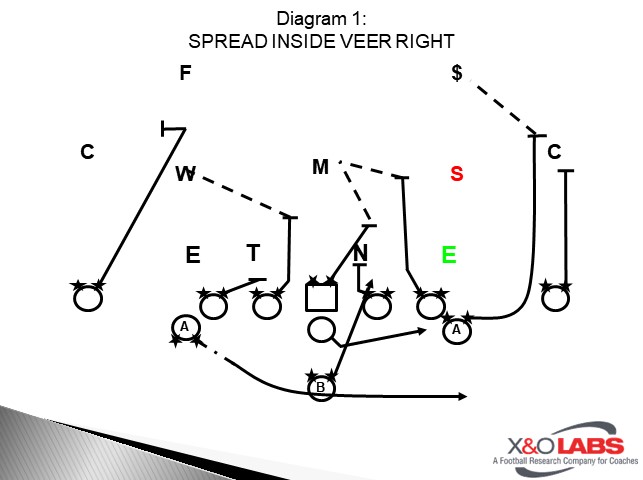
Our base play is the Triple Option under center.  

Diagram 1


I will not be getting into the nuts and bolts of this scheme.  However, the foundational keys to our offense are:

  1. PST does not touch the first read man (dive key). He needs to take the easiest release to his assignment (LB in this case)
  2. QB footwork is to align his toes parallel with the track of the fullback. His eyes are on the first read man. 
  3. Mesh is critical, but don’t over complicate it. The QB, staying in an athletic position, reaches the ball as far back as reasonably possible and rides the mesh of the fullback from QB’s back hip to front hip while making his decision.  Once the ball reaches the QB’s front hip, he needs to pull or release the football.  When he pulls the ball, he needs to have a “violent disconnect” which alerts the FB to the not clamp down.
  4. PS slotback takes care of the primary run support on the perimeter while the BS slotback works into a 5×1 yard pitch relationship with the QB. He doesn’t leave that path unless he gets the ball.


Pistol Zone Triple Option

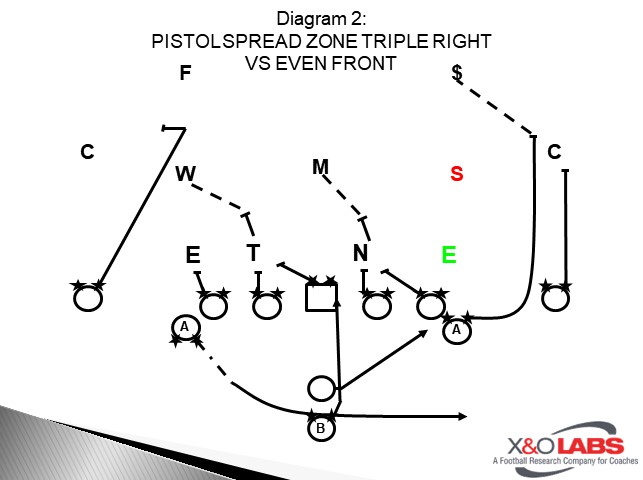
When teams load the box or we want to throw a curve ball, we go to our Pistol Zone Triple Option.  Shown here against an even front.

Diagram 2


With our use of a dual-threat QB, putting him in the Pistol is a no-brainer. Because we begin by teaching the traditional triple option under center, the QB is already proficient in reading defenders and making quick decisions for the dive, keep or pitch. By putting him in the pistol, we increase the time and space he has to decide while opening the door for RPOs. 

One hurdle that comes with putting the QB in the pistol is how to simplify the mental load. We have done this by making a majority of his reads, techniques, and footwork similar if not the same as the majority of the under center run game. The same goes for our OL and skill positions.

Read More

“Falcon” and “Heavy” Adjustments to Defend Big Personnel from 4-2-5 Spacing

By George Karafantis
Defensive Assistant
St. Anthony’s High School (NY)
Twitter: @greek42e


One of the perceived weaknesses of playing a 4-2-5 defense is the extra safety type body that it requires, as opposed to a bigger more physical linebacker that a traditional 4-3 or 4-4 utilize. This additional safety type can make defending a big power-run based offense, challenging. Most run heavy offensive coordinators will salivate when they see 5 defensive backs on the field. We as a defense want to have simple alignment rules and reads in order to allow us to play fast and efficient. We also want to matchup with all offensive personnel without major changes to our defensive personnel. We have three adjustments that are simple adjustments used mostly against 21, 22 & 32 personnel. Two of those are formation based adjustments that are worked throughout the summer and preseason and one is a personnel driven adjustment.


1. Base

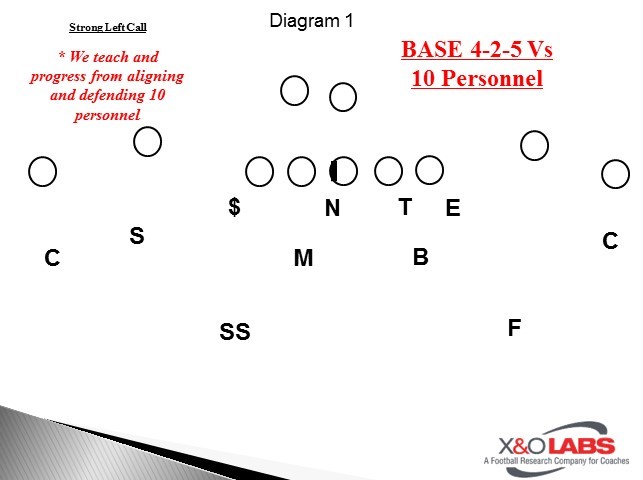
We are a Base 4-2-5 defense that plays predominantly an under front with the strength of the secondary going to the field, or passing strength. Our Sam (Overhang), SS, and Mike all travel together, and our FS and Bandit (weak side Middle LB) travel together.

Diagram 1


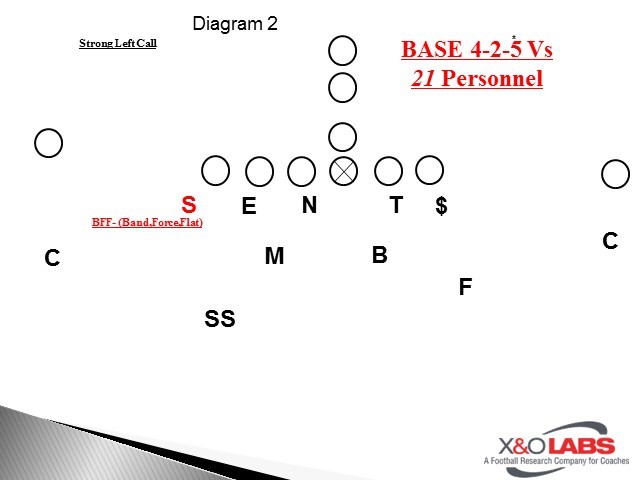
Verse traditional 21 personnel we like to keep our under front and walk up the Sam to what we call a BFF (Bang, Force, Flat) technique. He is in a two point stance -outside eye alignment off the TE, with outside foot back and hands in the holsters. This technique is part of the Sam’s everyday drill work. He must be able to collision (bang) the TE and force the ball while redirecting to the flat if pass shows. The FS, who is our down safety to the boundary, also works BFF since he will be in that technique vs Double Tight, at times.

Diagram 2


Our philosophy to stop power heavy run teams is to get them into 3rd and Long situations. We accomplish this by:

  • Aligning Properly
  • Spilling and Overlapping all gap schemes.
  • Attacking the play before it develops. We get the secondary involved in the run game.
  • Stressing the importance of getting 3 and outs early in the game.


The most basic alignment vs team that uses at least one tight end and 2 or 3 backs is to be aligned in a 6-2 defense that was prevalent at the HS level until offenses became more multiple, diverse and pass capable. While we do occasionally align in this it is not the ideal alignment for us in our 4-2-5.

Diagram 3


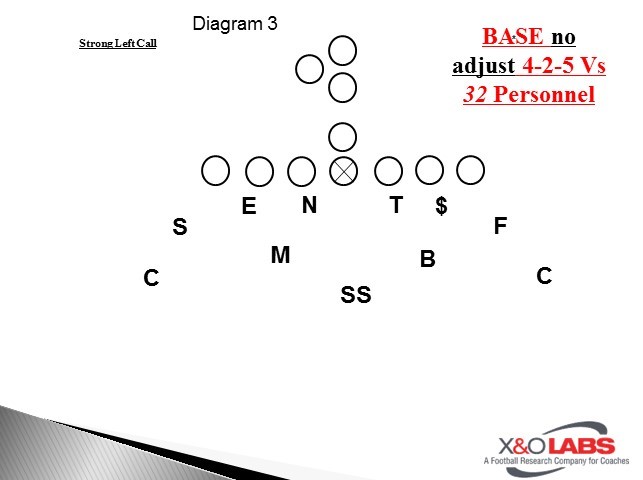
Clip #1 shows our Base call alignment vs 32 personnel. We only call this if we lock in a base call to our defense in certain situations.

Read More

Press Technique Toolbox to Defend Multiple Routes

By Brock McCullough
Defensive Coordinator
Shenandoah University (VA)
Twitter: @BrockMcCullough


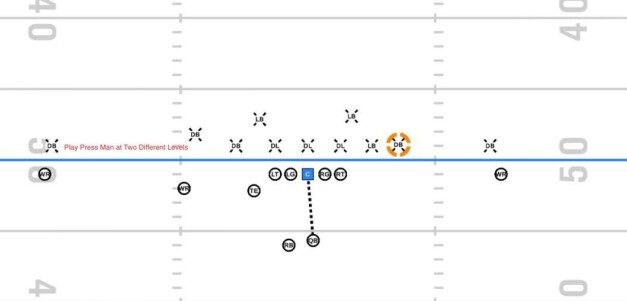
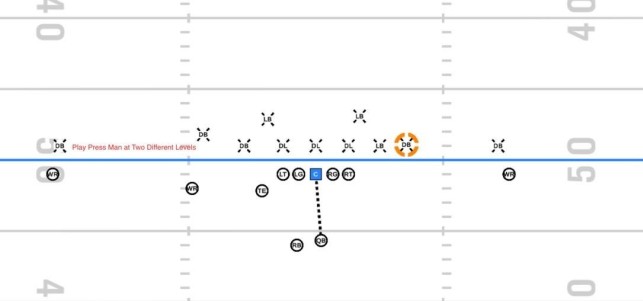
Situational press man coverage has merit at most levels of football. Typically, our press man coverage is paired with bringing more defenders than the offense can block (Cover Zero). A quarterback allows defenses to outnumber the offense’s protection. Press man eliminates the modern quick game, easy access, high percentage throws which offenses love to take. We teach a heavy inside press alignment to help discourage easy, in-breaking routes by the offense. This approach and alignment allow us to force out-breaking throws which are completed at a lower percentage. Our teaching progression starts thereby eliminating those types of throws simply by our alignment. A key point to this article is disruption. Press man is disruptive. Any wide receiver loves a free release. If he runs a 4.6 forty and is allowed a free release, he still runs his 4.6 forty. However, receivers at every level hate being disrupted. By disruption, they likely now will run a 5.0 forty because we are in the way as defenders. Also, you will often hear radio broadcasters and television commentary on how the receiver “dropped an easy touchdown pass.” What they hardly ever consider is that receivers hate to be touched. They often complain to the official when they are touched. The reason they likely dropped that “easy” touchdown pass is often because they were disrupted off of the line of scrimmage therefore, they dropped the pass three steps later. Or they have been disrupted with thoughts that a 230-pound linebacker was within a foot of their pattern.  Disruption is especially important for defenses. This article will talk about one form of defensive disruption: press-man coverage.

Man coverage from a press position all starts with great alignment. We always start any coverage with alignment as the first thing on our checklist. We want our corners, nickel, and press safeties to take a hard-inside ability alignment. First, we want to educate you on the difference between a “man turn” and a “zone turn.” We drill these types of turns daily. A zone turn by a defender means that we see the quarterback and the ball throughout the entirety of the play. We feel this visual key increases our chances for turnovers and provides more eyes on the football for tackling. A man turn involves turning our back to the quarterback and the football while focusing our vision on our man. We feel this has merit at times throughout a football game as well. Man turn technique is what we will be focusing on in this article. Man coverage means we are canceling out one offensive player with one defensive player. We want to melt to this man and eliminate him. Our teaching progression for all coverages/concepts is A.S.K.I.R. I will take you through our press man Alignment, Stance, Keys, Initial reaction, and Responsibility.

Inside press man generally invites lower percentage throws to the perimeter of the field.

Read More

The QB Dart Concept

By Kyle Wagner
Offensive Coordinator & QB Coach
Lutheran North High School (MO)
Twitter: @THECoachKdub


The QB dart play is an excellent addition to any spread offensive attack. The dart play in its essence is a “tackle iso” play. It stresses defenses preparing to handle inside zone read because the defensive end being read is now away from the back. The play is also versatile in the way that your back and quarterback can switch roles from year to year depending on whom you want to be the primary ball-carrier when the play is called. QB dart can be effectively tagged with key game RPOs to be even more deadly and save the offense valuable yards in case of a missed block or assignment. This play was a key part of our 14-0 season and provided us with an answer in critical moments throughout the playoffs.

Why Run QB Dart?
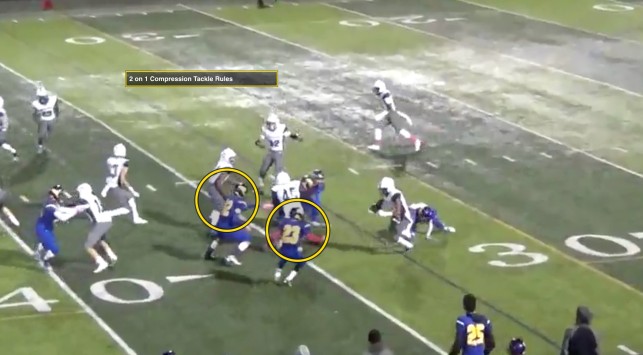
The QB dart is a rather inexpensive play to install. The blocking assignments are rather simple especially if you already incorporate any iso into your offense. It is a great way to allow your dual-threat Quarterback to make easy decisions and get him out in space with a lead blocker. The misdirection of the play makes it tough for the defender to remain consistent in their eye discipline. Also, being able to tag RPOs onto the play makes it even more of a headache for the defense both in preparation and on the field. The QB dart play is also a way to break inside zone read tendencies, which is what originally intrigued me. It’s an Inside Zone tendency breaker because usually we are reading the Defensive End on the same side as the back and now we are reading the end away from the back.  The games defenses play to stop the Zone play with exchanging gaps are now less effective. In a day and age where explosive plays are king, QB dart is just that. Every run is a big play possibility unless the defense concedes numbers on the perimeter. Finally, the play is versatile, and it can be very simple or you can use motions, etc. to make it more complex.

Coaching Points:

The major coaching point at getting good at running this play is the same as most, reps! As the quarterback’s coach, we try to get at least 10-15 minutes a day of working our mesh at an extremely fast pace. We will rep all our run read plays at least four or five times each way during this period. During the period we have our offensive line hose rolled out and have a defender playing as the read defender. The job of the defender is to try to confuse the quarterback into making a mistake. The QB meshes with the back keeping his eyes on the defender. I tell him to “feel” the flow of the defender and trust his instincts. It is important that if you have a QB who can run that you tell him to keep it unless the defensive end can get to him as opposed to keep it if the defensive end takes the back. The fact that we only must spend a few reps on the play is why I consider it an inexpensive, explosive play!

Game Planning the Dart Scheme:

You want to run to the side of the 1-technique vs a split look (5-3-1-5 defensive front). If you are a heavy spread team you will see this look quite a bit. If you face a 30-front that slants, you just have to find out what formation dictates the way that they slant and run the QB dart towards the way they are slanting as it will become their “1-5 bubble”. PST will block the play-side defensive end. PSG will work a double-team with the center on the 1-technique. The center will block on a double-team and work back to backside backer. BSG takes the 3-technique to turn him out and BST pulls for play side backer. QB reads the backside end for a keep or give read. If the defensive end attacks the back, the QB keeps the ball and follows the tackle on the Dart play.  (It is also effective to have the PST pass set to induce a pass rush by the PSE.)

Diagram 1

Diagram 2

Variations:

To add in a built-in safety net into the play, add key screen RPOs that will be thrown off the overhang defender. Here is an example of how the key screen saved us 13 yards in our semifinal game.

Some of the key variations to spice up the play a bit and make it look like a different play are using jet motions to provide misdirection and utilizing an H-back for additional blocking. You will see both in the play below. We end up getting called for holding on the edge then come back and score the next play on QB Dart from a different look adjusting to a different front. Versatility.

Using different formations to manipulate the defensive front into the look you want is pivotal and using an H-back is a sure-fire way to get the 1 tech where you need him.

The final adjustment that we utilized this season was to leave the BST on the backside end and pull the H back for play side backer. This was an adjustment to stop defensive ends from trying to shoot the gap vacated by the pulling tackle. Making this adjustment allowed us to run QB dart from empty and opened key screens as well.

To study game film of this concept, click on the video below:

Read More

Using The Lag Technique to Slow Down Wide Zone Runs

By Joseph M. Purvis
Defensive Coordinator/Linebackers Coach
Franklin Parish High School (LA)
Twitter: @FPCoach_Purvis


I first came across the lag technique several years ago as I was doing research on defensive line drills. I was watching Rex Ryan talk about defensive line techniques while he was at the University of Cincinnati. He utilized the lag technique with his “two” gaping nose guard. At the time we were a true Jimmy Johnson 4-3 defense playing mostly over and under fronts, but I believed that utilizing the lag technique would help our defense due to the type of defensive line we had on the team most years, and with the heavy shades we played.

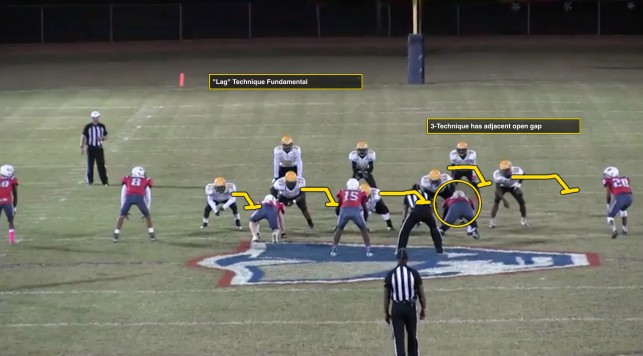
The reason we felt that the lag technique would be a great fit for us here at Franklin Parish High School was that we typically have an undersized defensive line compared to the offensive line we see each and every week. Due to the large size difference, we incorporate as many outside shades as we can because a 185-230lb average defensive line would not withstand the constant down blocking an inside shade would get and hold up verse 265-315lb offensive line. We play a very tight outside shade and utilize the two gap-one gap concept (Bully). Together the two gap-one gap (Bully) technique vs downs and on blocks pair very well with the lag technique on reach/zone schemes.


When to Lag?

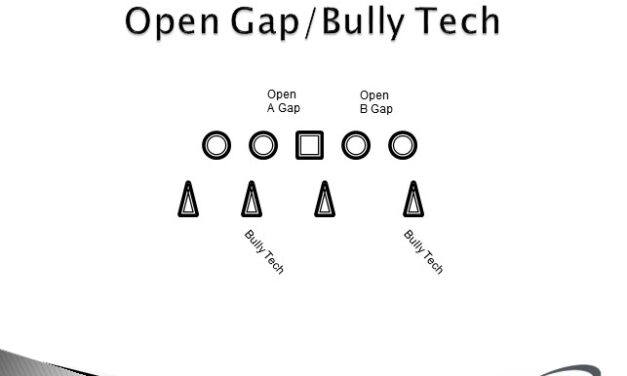
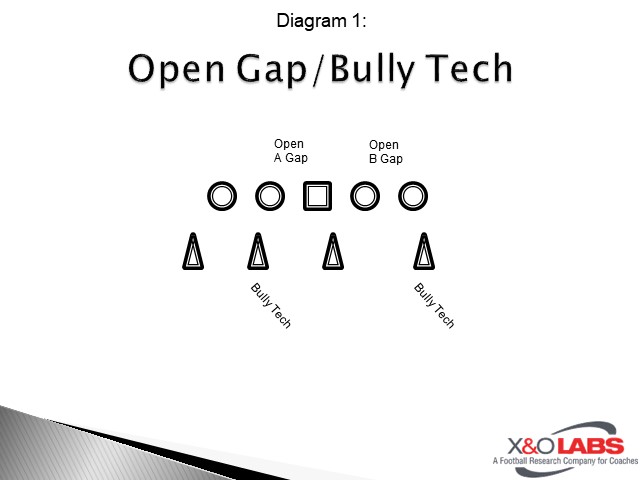
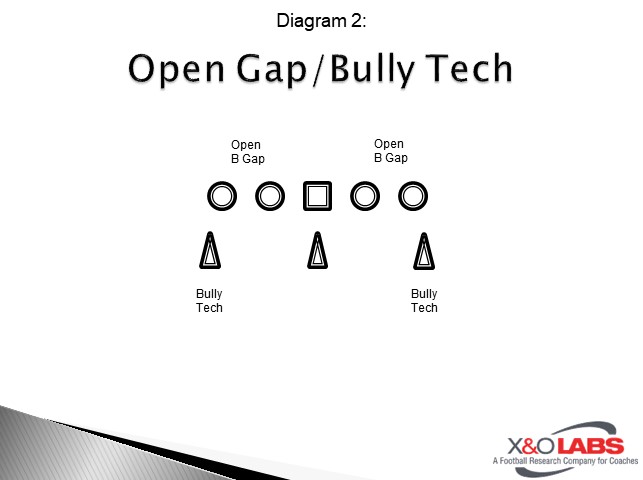
The defensive line must understand that there are open gaps and closed gaps.

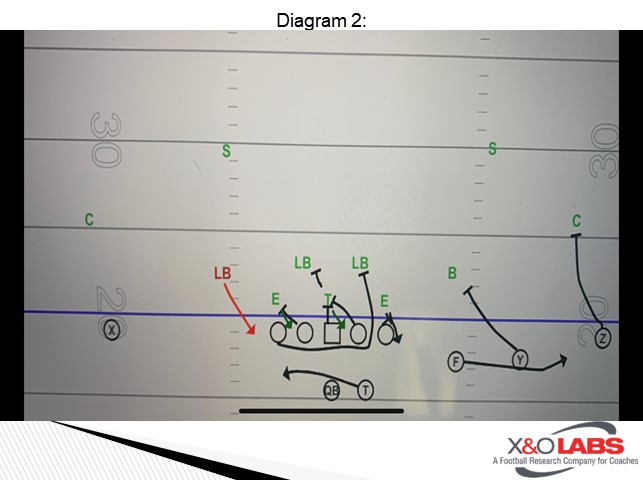
Diagram 1

Diagram 2


If the defensive lineman has an open gap inside of him, he will play a bully technique (very tight and aggressive outside shade).

When the defensive line plays a bully technique, we are telling him we expect the offensive lineman he is aligned on will likely down block and we are overplaying the down block to keep our linebackers clean and free to fast flow. This also allows our defensive lineman to take the inside gap as if they were playing an inside shade if the offensive line on blocks or to lag if they run a reach scheme.

In our opinion, we do not believe that a defensive lineman can effectively play the aggressive style versus the down block attacking the offensive line and be able to play the reach block effectively. The way we can sell the idea to our defensive line is that we do not care about the reach/zone block. The typical defensive lineman in most high schools will struggle at mastering the disruption of multiple blocks, so we really focus on the down block as the most important block we must disrupt. By disrupting the down, we feel we will put ourselves in a great position to be successful versus several offensive schemes (Power/Counter, Veer, Wing T) we see each year. 

The first thing we must have as a defensive line is violent hips and hands! Our goal is to attack the offensive line and attack the inside armpit of the offensive line, by using this aiming point we can put our defensive line in great position verse the down block. The downside of the bully technique, before we started using the lag technique, is that when you faced a reach/zone team they could get to our outside shoulder very easy and it would be difficult for our defensive line to fight back across successfully.


How to Lag

Once the OL has taken the reach step and the DL has taken his first step and realized that he is being reached, he must shoot his hands and press the inside shoulder of the offensive line up and out. Doing this will prevent the OL you are aligned on from getting to the next level and will also not allow the next inside offensive lineman to reach you. We tell our guys that if you are bullying then you can get reached by the man you are aligned on but must never allow the next guy to reach you. We run this technique because it will place the body of the defensive line in the cut back lanes and allows the linebackers to be aggressive fast flow players to anything outside.

Looking at Diagram 3 you can see how this will allow a single defensive lineman to eat two blocks. Lagging behind the reach and not allowing the next offensive lineman to reach you will allow the linebacker to run free. This will also play well with teams that utilize a quarter’s coverage system allowing for the back-side safety to be responsible for the backside B gap from depth allowing him to be slow to run fits and helping with any type of RPO or Read scheme backside.

Read More

Vertical Pass Concepts Off Jet Motion

By Dan Hughes
Head Coach/OC
Sioux Valley High School (SD)
Twitter: @CossackFootball @SVGuybrarian


Jet motion forces the defense to react pre-snap, stress horizontally, and most importantly, force the DB’s to fit the run. In doing so it grabs the defensive backs’ attention as they play an integral role in defending the perimeter. In the following clips take special note to how the DB’s must honor the jet and flow to the ball.

It’s interesting to note the different fronts and looks the defense will utilize to defend the perimeter. In nearly every instance a defensive back must interpret run, defeat a block, and pursue the ball carrier. Stress is placed on DB’s because of the amount of open field, lack of numbers, and the speed of the play.  These factors make defensive backs vulnerable to the play-action pass, especially off jet motion.

The vertical passing game compliments the Jet sweep by putting defensive backs in conflict. You will see it only takes a peek or slight hesitation from a corner or safety to create a big-play opportunity. Whether your team’s identity is under center, shotgun, the zone or power running game, the Air Raid, or wing-t, a single vertical scheme combined with Jet motion can give your offense some much-needed explosiveness.

This strategy can be incorporated into any offense regardless of formation or personnel group. Simple verbiage or a hand signal is more than adequate to add this extra layer of deception to your offense. In our system we use the buzz words “Trump” and “Hillary” to communicate jet motion to the right/left respectively. Hand signals are great as well, but our DC is a very political guy and I feel like he appreciates it.

On each of the clips in this report, you will notice a defensive back looking at the backfield. The location of their eyes keeps them from adequately covering the WR. It communicated to the QB which DB we want to attack.  These clips show the QB completing vertical passes to each third of the field.


Jet Player & Quarterback Technique: Under Center

In our system, the motion is initiated by the cadence and the jet player is responsible for sending himself in motion; the target for the jet motion is a spot 20” behind the QB. This spacing gives the QB room to do a 180-degree pivot and execute a proximity fake to the jet motion player. The QB keeps the ball secured with two-hands in his belly while the jet player, using high-cradle position with his hands/arms, creates the fake.

  1. Pre-Snap Motion initiated by QB cadence.
  2. QB does a 180-degree pivot and executes proximity fake
  3. “Giant Step” straight back with plant foot
  4. On rhythm deliver the ball to the window above the #1 WR


Clip note: Notice how the DB is in press coverage, but our WR’s role stays consistent, “get behind the defense.” In this clip, you can clearly see the CB only peeks for a split second. This is all our receiver needed to get behind him.  This clip also shows how the receiver stayed on top of his landmark, which in this case is the numbers.  This game the QB an area to throw and prevented the free safety from being a factor in the play.

Read More

Training Trap Corners in the Run Game

By Jamison M. Bisch
Defensive Coordinator
Bemidji State University (MN)
Twitter: @coachbisch


At Bemidji State, we believe all 11 players on Defense should have the ability to defeat blocks and make tackles when given the opportunity. I am fortunate to have an upper-echelon defensive staff here at Bemidji State that starts with our passionate Head Coach and former DC Brent Bolte, two DB coaches Rich Jahner and Sheldon Tucker, DL coach Darius Carey, and Sam/Nickel coach Alex Gray.  Rich Jahner is a former Defensive Coordinator with over 20 years of experience overseeing the Secondary, and Sheldon Tucker a young, cutting edge coach who focuses on the CBs. More than anything we have a group of selfless young men who buy into our system, our coaches, and each other, they play with relentless effort, communicate, and have a team-first mindset. We were fortunate to have 3 All-Conference DB’s in 2018 as well as an All-American in Gunner Olszewski #36 who played both CB and Safety. Players make plays, players win games!

We will play a variety of different concepts in a given game plan including Quarters, Man, Cover 3, Cover 2, and Pressures. Being multiple means, we must train each player on the field how to fit the run accordingly. While it is not our main concept, we have played some variation of Cover 2 or Cover 3 roughly 20% of the time in 2018. In doing so we typically ask one or both Corners to fit the run game whether it is Cover 2 or Cover 3. When we play Cover 2, we usually play one of the following variations: 2-Man, 2-Carry, 2-Carry with pressure, or Tampa 2. In the coverages we usually allow the CB to play pass first except for Tampa 2, where he becomes a primary run defender and a Curl-Flat pass defender essentially. Likewise, within our Cover 3 calls, we can roll the secondary strong, roll the secondary weak, insert the safeties strong/weak, or cloud/trap the CB’s strong or weak. When we trap the CB’s strong or weak, they become primary run defenders much like Tampa 2 and we will teach the run fit and eye progressions the same in 3 Trap/Cloud and Tampa 2. Therefore, for this article I will focus on the CB run fits in Tampa 2 and 3 Trap/Cloud calls.

Coaching Points

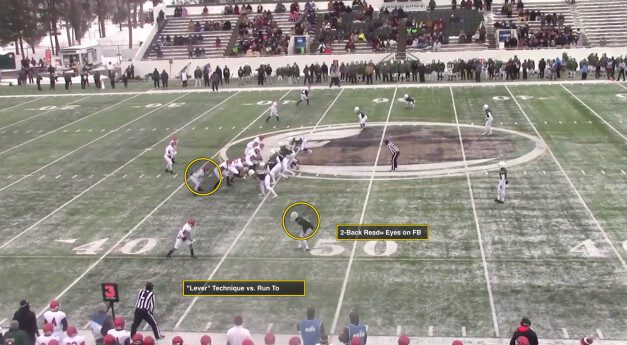
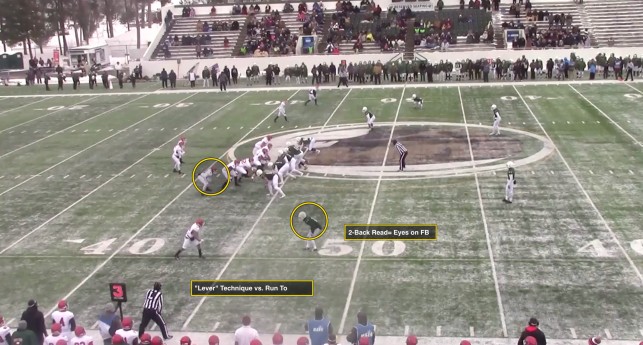
Whether we are playing Tampa 2 or 3 Trap/Cloud the rules for our CB’s become the same. Both Tampa 2 and 3 Trap/Cloud are what we consider “Even” fit systems. In other words, we will have an even number of fitters vs the run as the opponent has gaps/blockers. In our “Even” fit systems we will use the Lever-Spill-Lever concept with our LB’s/Secondary. We define a lever player as someone who attacks Fullback outside in, keeping outside arm/leg free, keeping the ball inside, not letting it bounce. We define a spill player as someone who attacks Fullback inside out, wrong shoulder, to make the ball bounce/spill outside to the lever player.

Basic rules for the Trap CB are as follows:

Vs 2 or 3 WR

  1. Eyes: QB thru 3 Step
  2. Run Fit: Primary Force (Outside 2)
  3. Pass: Curl-Flat, field-side CB can be slower to landmark if working outside-in


Vs 1 WR:

  1. on Fullback if applicable, no Fullback key QB thru 3 Step
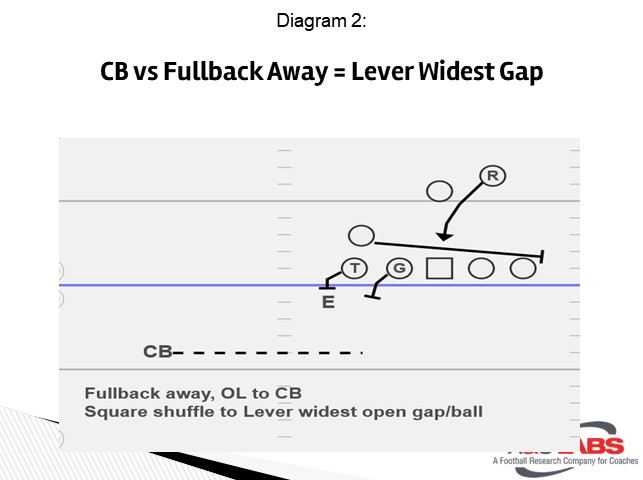
  2. Run Fit: Lever Fullback. If FB to = Lever. If FB away = Lever widest gap/ball. Must be aggressive vs run.
  3. Pass: Curl-Flat


We allow our CB’s to have some freedom to play off at 6-8 yards or to play closer to the line of scrimmage from a press look when they are the trap CB. We base their alignment on formation, field position, field/boundary, type of player, and other factors based on the game plan. Both an alignment and a press alignment have their advantages and disadvantages when playing trap technique.

Off Alignment

Advantages: Broad vision, Angle to run fit, reduces whole shot vs pass

Disadvantages: Further away from the line of scrimmage to fit, WR can scoop or crack him with a good angle

Stance/Technique: 6-8 yards off, can play it at 10-12 yards off to field in certain situations. Heal-Toe alignment with inside foot back, hips angled in at QB. Versus run trigger with downhill angle.

Press Alignment

Advantages: Closer to the line of scrimmage to beat the block of WR, can jam WR while keying run game (good vs game-changer at X)

Disadvantages: Vision/Angle not always ideal vs run, opens whole shot down sideline more than off alignment.

Stance/Technique: 1-2 yards offline of Scrimmage, can loosen up slightly for vision. Square stance. Make it look just like press man. Versus run trigger with a flat angle parallel to the line of scrimmage to find an appropriate fit.

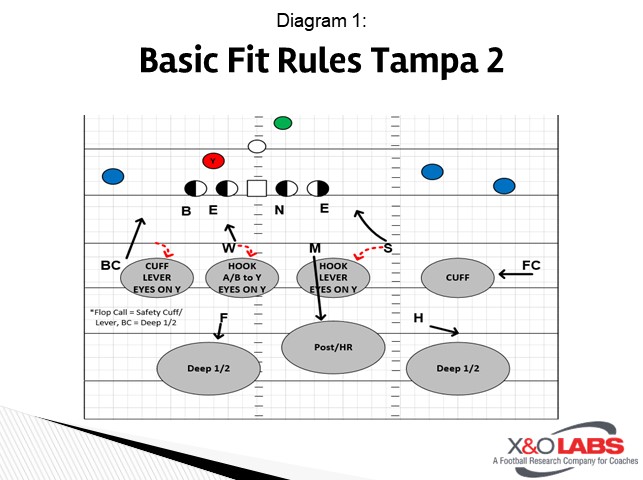
I prefer initially teaching off what we call Flex Formation, which is illustrated below with some coaching points for Tampa 2. From this formation, you can move the Y (Fullback) to get 2×2 and 3×1 formations and the fits remain the same based on where Y is at. For reference Cuff = Curl/Flat.

Diagram 1

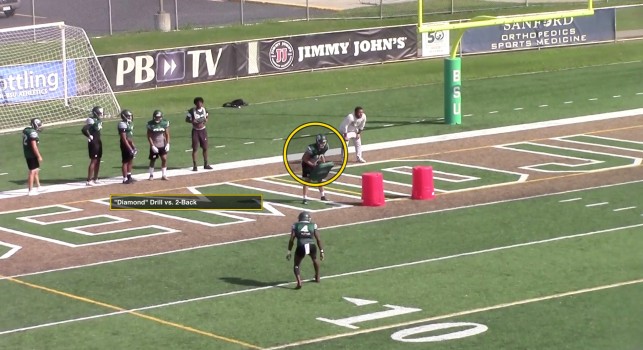
Game Film Vs. 2-Back Formations:

Diagram 2

Vs Flex. Right CB: Shows press, eyes inside on fullback, trigger vs the run, lever widest open gap

Read More

10 Total Techniques: A “Small College and High School” Approach to Training O-Linemen

By Anthony Franz
Offensive Line & Offensive Coordinator
Trinity International University (IL)


Reps Win

First, let me tell you that this type of training comes from my belief in repetition. I believe that the team/unit who has more reps of a scheme/technique will win that play. If my OL base block drill gets more reps than your DL base defeat drill… I believe I will win that rep or at least increase the probability that we will. I am not saying that athletic ability does not play into my thought process, what I am saying is that I can create talent through quality repetitions. Thus, closing the athletic (talent) gap between your defense and my offensive linemen.

I do not have the luxury of having the pick of the litter when it comes to O-linemen therefore, I must be intentional about my player development. Developing complete O-linemen is a long process and I believe I have created a system that speeds up that time.

There is only so much time in the week. So, when building your practice plan keep in mind:

  • We are trying to master techniques that show up on game day
  • If it doesn’t show up on game film… We don’t rep it
  • If we don’t rep it… We don’t run it


Simplified Approach

Small college football has taught me how to get the most “bang for my buck” out of limited resources and limited time. Because of this, I have also simplified my O-Line techniques to maybe 10 total techniques that they must master in order to be able to execute our entire playbook. I do this because if we can rep 10 techniques 10,000 times and our opponents practice 30 techniques 5,000 times…We will win. I am looking for mastery of skills and techniques, I do not want to create a Jack of all trades and a master of none.

Read More

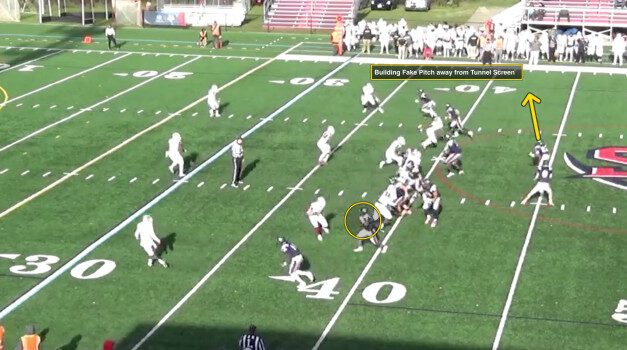
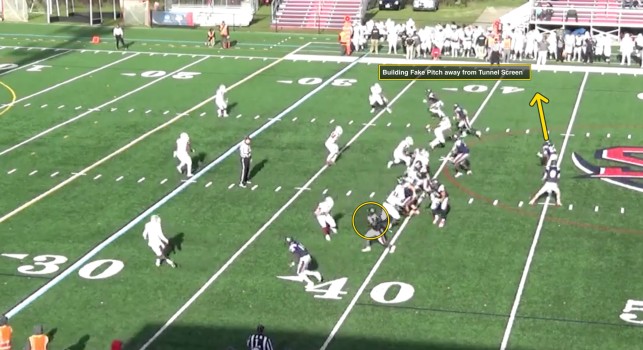
Using the “Biff” Technique in Tunnel Screens

By Stan Hodgin
Offensive Coordinator
Shenandoah University (VA)
Twitter: @S_Hodgin


At Shenandoah University, we attempt to use concepts and schemes that best fit the players we have in any given season.  The value of our screen game is measured in our production in three areas.  First, how effective are we in producing explosive plays? Second, how well do we alter pass rushing aggressiveness? And third, how can we use what the defense knows about us against them?  Specifically, with the tunnel screen, we believe we can greatly impact all three areas and produce measurable results that benefit the other aspects of our offensive attack.

The presentation we give the opponent is tied to our game plan in the run game and pass game. It is also influenced by the style of defense we expect to face on Saturday. The presentation can vary game-to-game and series-to-series. We will cover this later in the article.


Offensive Line Responsibilities:

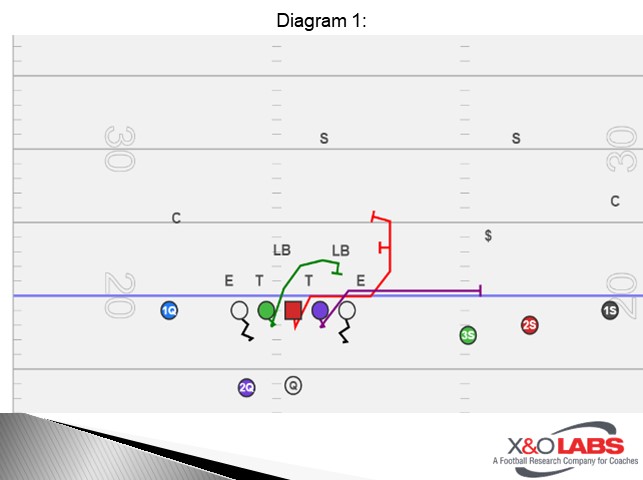
Our Tackles are responsible for the widest defensive linemen.  Let’s identify them as Des for this article.  Our Tackles will try to invite a C-Gap rush lane and “lose” in the C-Gap, but the play will end with a push by of the DE by our tackles.  If the DE attempts to cross the face of our tackle and pressure through the B-Gap, our tackle must engage the DE and collapse him inside to the midpoint of the formation. The play side Guard will pass set and release flat down the line of scrimmage and kick-out the “force” player. Our guard is taught to release flat down the line of scrimmage and identify the first wrong color jersey that shows.  We attempt to educate our guys each week on who and from what alignment the force player will be, but the path of the guard is consistent, and the force player will present himself as the play unfolds.

The Center will pass set and then work flat down the line of scrimmage turning up and looking inside for the first wrong-color jersey pursuing from inside-out.

Our backside Guard will pass set and then work down the line of scrimmage looking for the first retracing defensive lineman that has recognized the screen. All three interior linemen will initially attempt to get the interior pass rushers off balance with some variation of a “biff” technique before releasing for the screen. 

We attempt to “biff” the down linemen rushing the QB.  We pass set them and work opposite their rush lane responsibilities.  As we vertical set, we allow the defensive linemen to get inside of our punch zone, so they believe they have an advantage. As they continue, we want our interior linemen to nudge them forward hoping to get them off balance and as a result, be much slower to retrace or react to the screen pass.

Diagram 1


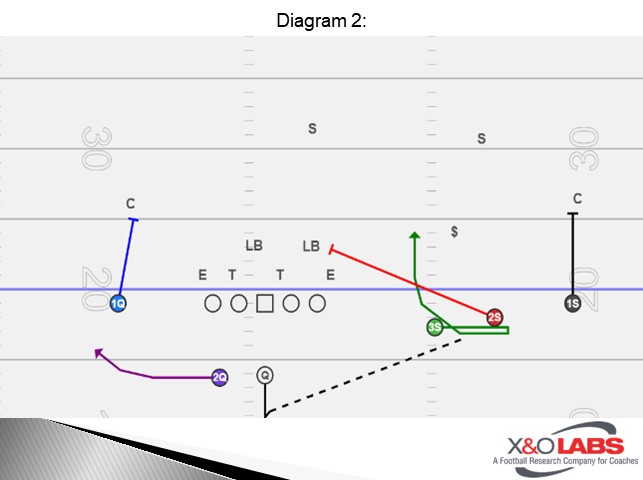
On the perimeter, our receivers are assigned specific defenders for blocking on the tunnel screen.  Beginning from outside-in, our number 1 receiver not catching the screen is responsible for the widest defender, usually the Corner. Our second receiver not getting the football is responsible for cracking the inside linebacker nearest the play side.

Diagram 2

Read More

Applying Leverage and Pursuit Rules in Pop Kickoffs

By Steve Erxleben
Head Football Coach
Southern High School (MD)
Twitter: @CoachErxleben


The execution of Kickoff coverage is, especially at the high school level, one of the most opportune times to either make an explosive play, or in the case of the coverage unit, give up an explosive play that either ends in 6 points or creates a short field. In most cases, the typical H.S. kicker has the ability to roughly hit the 5, 10, or 15 yard line so in most cases, kicking the ball into the end zone for an automatic touchback (federation rules) is out the question for most High School Teams. In the end, a Kickoff is a defensive play that asks all 11 players to close the distance between themselves and the ball carrier, avoid unnecessary blocks, defeat necessary blocks, and in most cases tackle in an open field or “ball away” situation. Therefore, like any play in football, the scheme and the skills needed to execute it are extremely important in limiting yards during the return and improving field position for the Defense. At Southern High School we have incorporated a “Pop 30” philosophy in our coverage scheme. However, the execution of our scheme is really how we have incorporated our established Force and alley rules as well as our Rugby-tackling and “ball away” principles to open field tackling that ultimately make our kickoff coverage unit a successful part of our special teams structure.


Open Field Rugby Tackling Principles:

Even though from a schematic aspect this article is dedicated to Kickoff Coverage, an explanation of the applied defensive skills with regards to Open Field tackling and Force/Alley rules are needed before applying them to our Kickoff Scheme

As a Defensive Staff both at Southern, and before that South River High Schools, we have completely dedicated ourselves to a rugby tackling style methodology. As a staff we do not feel you can be an effective tackling team in either Defensive or special teams play without completely drilling the concepts of tracking the near hip or pec, contacting with a same foot/shoulder fit, wrapping and pulling tight to the body, and finishing with either a drive for 5 steps or a hawk roll situation. We drill these principles continuously throughout every practice and in many ways, they are drilled in as many non-contact as contact situations. Like many Rugby style schemes, we split our tackles up into three scenarios that really fit into one of two categories.

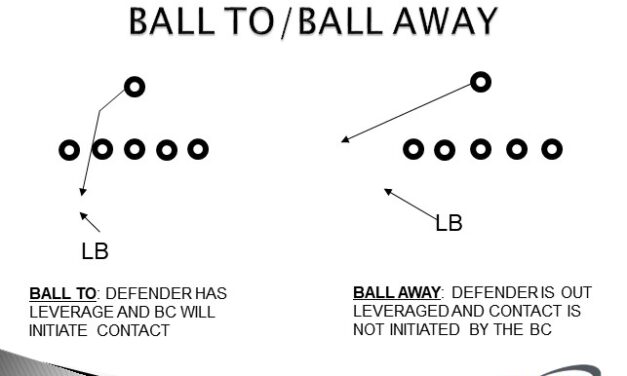
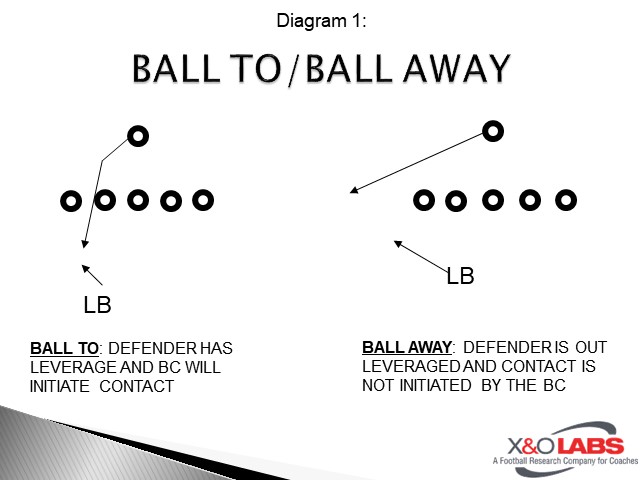
  1. Ball To situations
  2. Ball Away Situations


Diagram 1


Editor’s Note: Included with this report is a tackling clinic cut up we have used as a staff that highlights the coaching points of both a ball to and ball away tackle.  It is at the end of this report.


“Ball To” Scenario:

Even though this article is about open field tackling and how it applies to Kickoff Coverage, it is warranted to first begin to talk about a Ball To scenario. A “Ball To” situation is a situation where the defender has leverage on a ball carrier and there will be contact initiated by the ball carrier. For example, an inside linebacker playing downhill on an Isolation or power play. In this situation the Defender is going to have to initiate contact as well and can use the pec or upper body as the primary key to fit same shoulder/same foot on the ball carrier. In most cases a Ball To tackle, which we refer to as a profile tackle, is an in the box situation or near the line of scrimmage, so it usually is not going to be a solo tackle. In this case we are contacting, wrapping, and really focusing on driving for 5 and limiting yards after contact while also providing a head out of contact situation in a high contact area.


“Ball Away” Scenarios:

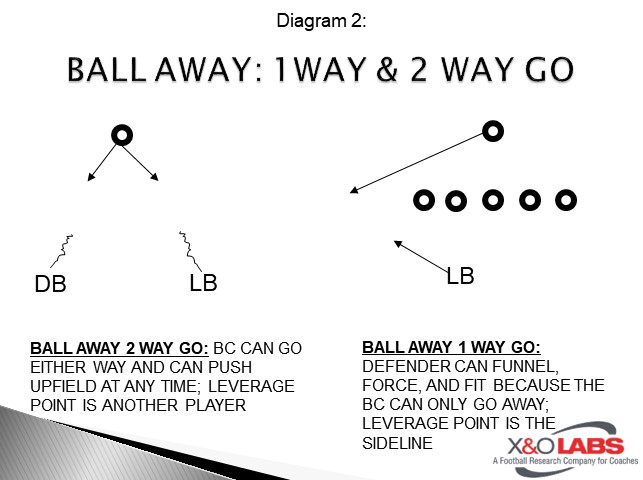
Ball Away situations in our methodology really have two scenarios that can both apply to kickoff coverage. Ball away situations are situations where the defender has either lost leverage or comes to balance in a no leverage situation and must properly fit to either funnel to an adjacent defender with leverage or must regain leverage in a 1 way go situation where the ball carrier is not initiating contact.

Diagram 2


One-Way Go:

The first situation is when leverage is lost in either the open field or away from the box/leverage position and the ball carrier changes direction or bounces into the alley with a 1 way go. We refer to this as a “Hawk” Tackle in our verbiage. In this situation the defender has lost leverage and now must use the near hip as the primary point of contact with eyes, near foot, and near shoulder. Since the hip is a smaller surface than the pec, the wrap and squeeze of the legs is an imperative detail to effectively bringing the ball carrier to the ground because in most cases, there will not be an immense amount of contact to aid in getting a solid fit same shoulder-same foot. The last detail that is important is the concept of rolling towards and not away from leverage, which does not provide the opportunity for a broken or missed tackle.

Read More

“Box and Triangle” Coverage Tags to Weak Side of 4-2-5

By Zach Watkins
Defensive Coordinator/Secondary
Washburn University (KS)
Twitter: @Zach_Watkins


Our base defensive structure here at Washburn University is the 4-2-5 and our base coverage is cover 4.  We feel that cover 4 gives us the flexibility, disguise, and effectiveness to be our “go-to” coverage.  Like most teams that base out of quarters, our scheme has a variety of checks and adjustments that allow us to look very multiple to opposing offenses while maintaining simplicity for our players.  Quarters also allows us to play the best coverage possible regardless of what the offense aligns in.  A defensive coordinator’s game plan must always include how to defend 3×1 sets the opponent utilizes.  Many offenses get into 3×1 sets to isolate their best WR on the backside, usually being singled up vs. the boundary CB.  Using quarters coverage and our away side “tags”, we have confidence in how we combat 3×1 offensive sets.

STRUCTURE

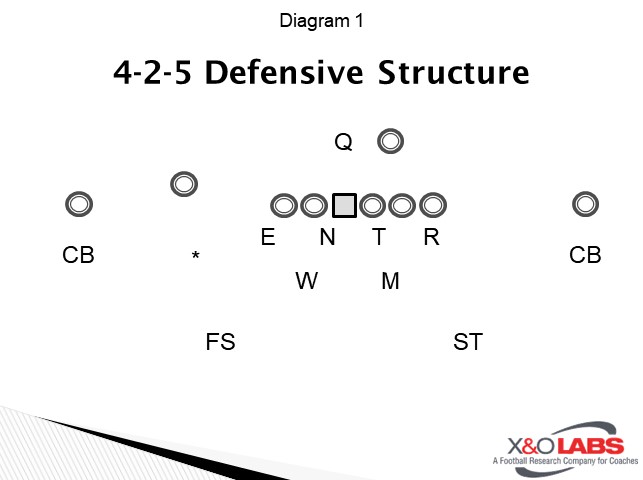
In our 4-2-5 structure, we have a “read-side” and an “away side”.  The read side is the side of the offensive formation that has the most receivers (or most dangerous threats based on game plan).  The free safety (FS) and star (*) align to the read side.  The away side is the side of the offensive formation that has a lesser number of receivers (or less dangerous threats based on game plan).  The stud (ST) aligns to the away side.  Mike (M) aligns to the front strength and the Will (W) aligns away from front strength.

Diagram 1

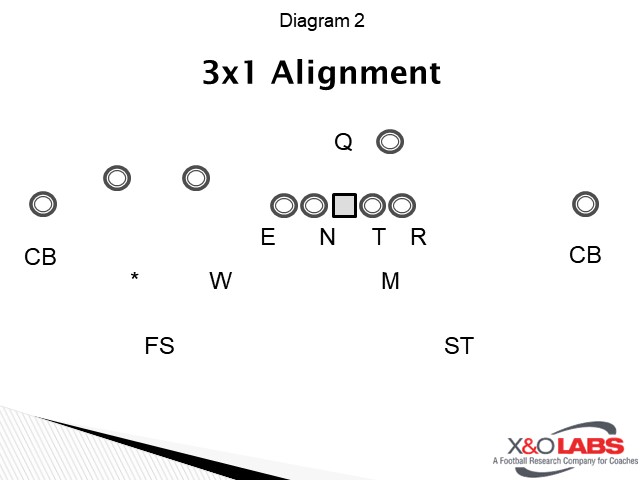
We call our front strength away from three WRs (under front) so that the Will backer can expand out of the box and get himself out of his run/pass conflict. 

Diagram 2

With that terminology, we will discuss “box” coverages to the read side and “triangle” coverages (“tags”, when discussing cover 4) to the away side vs. 3×1 formations.

“BOX” and “TRIANGLE” COVERAGES

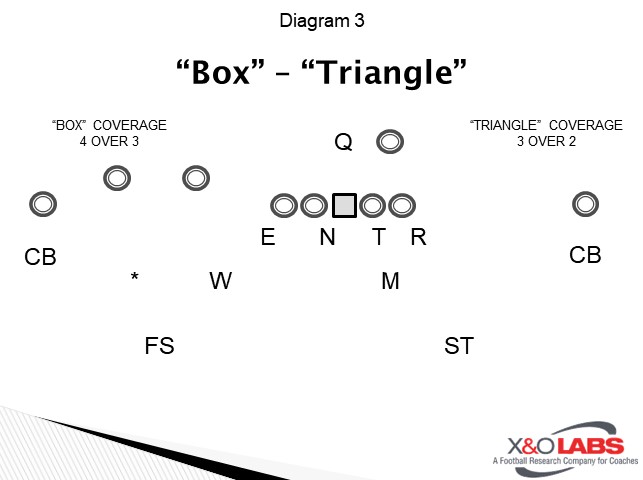
We define “box “coverage as four defenders over three offensive players.   We define “triangle” coverage as three defenders over two offensive players.  We call these variations of triangle coverages “tags” when talking about quarters specifically.  In Diagram 3, the read side CB, *, FS, and W are playing the box coverage and the away side CB, M, and ST are playing the triangle coverage.  Anytime the ST is not involved in the read side box coverage, (spinning to the read side, poaching #3 vertical, etc.) any of our triangle coverages can be played on the away side. 

Diagram 3

As you have realized, box coverages are always played to the read side and triangle coverages are usually played to the away side.  Triangle coverages can be played to the read and away side if the formation isn’t 3×1.  For this report, I will only discuss two box coverages that we utilize so that I can elaborate on the away side “tags”.

BOX COVERAGES

MATCH

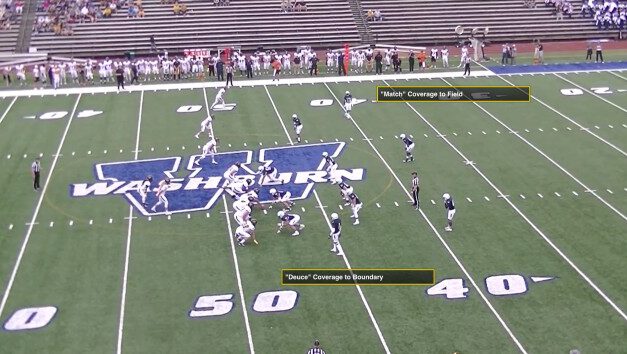
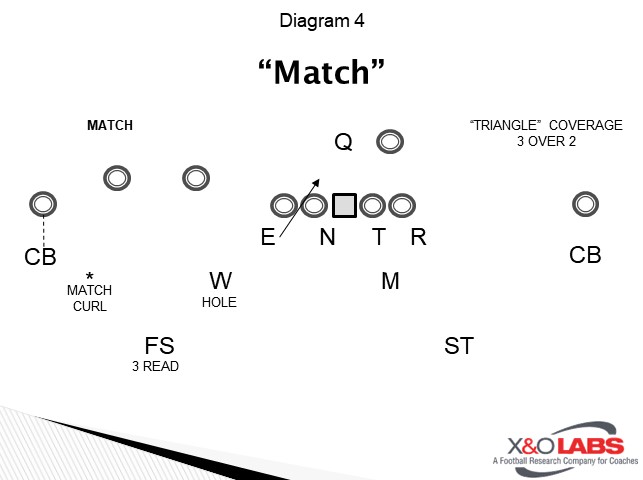
Our preferred box coverage is “match”.  Most coaches know it as a variation on “Palms” or “2 Read”.  Simply put, CB plays man to man on #1.  The *, FS, and W are playing a 2-read concept on #2 and #3.

Diagram 4

The aligns outside of #2, usually 5-7 yards deep, and is termed a “match curl” player.  The match curl player plays all routes of #2 unless #3 gets width (under LBs, usually 5 yards), then he must leverage/man #3.  If #3 doesn’t get the width, the * is man on #2.  The FS is termed a “3 read” player.  The 3 read player reads #3 just like in our quarters’ scheme.  If #3 is vertical past LB depth, FS plays him, man.  If #3 goes out or under, (under LBs, usually 5 yards) he becomes a read player.  If #3 goes out, FS will weave and play #2.  If #3 goes under, FS will play curl/dig/post (CDP) of #2 just like in quarters.  W will play the “hole”. The hole player plays #3 shallow and will disrupt/re-route #3 on any vertical.  Depending on the away side “tag”, W’s responsibility may change to a cut/wall player.

STRESS

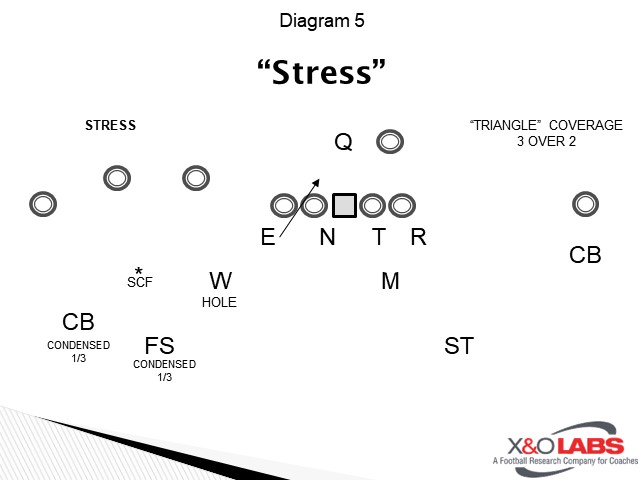
The second box coverage we install is “stress”.  Stress is a way to play zone coverage to the read side and force the QB to make a very long throw to the read side #1, something most offenses aren’t willing or able to do.

Diagram 5

The rules for stress are complementary to other coverages we run.  The CB and FS are playing condensed 1/3s over the 3 WRs.  The * is a seam/curl/flat player (SCF).  W is again the “hole” player.  The * and W MUST disrupt and re-route the #2 and #3 WRs.  The read side flat will be a late break and rally, forcing the QB to make the long throw to the field.  Depending on the away side “tag”, W’s responsibility may change to a cut/wall player.

These coverages can be played interchangeably to the read side, with no effect on which tag you choose to play to the away side.

TRIANGLE COVERAGES – “TAGS”

Once we have determined what our read side box coverages will be, we can dive into the expansive menu of triangle coverage “tags”.  The only thing limiting what types of tags we play is if the ST “spins” to the read side and cannot be involved in the triangle coverage.  We break our tags down into two categories: coverage tags and pressure tags.

COVERAGE TAGS

DEUCE

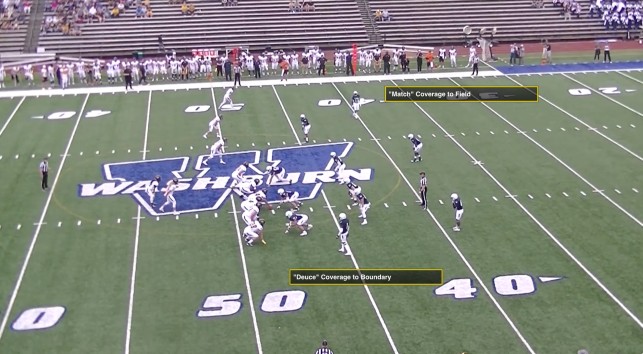
Deuce is one of our primary tags.  Deuce is cover 2 on the away side.  CB, ST, and M are playing their normal cover 2 drops.  CB’s technique is jam/funnel/ride (JFR) and plays the flat.  M is a seam dropper, rerouting any WR out of the “seam” (two yards on each side of the hash).  ST plays the true deep 1/2.  With only one WR to the away side, the CB can play heavy on #1 until a receiver gets width to his flat.

Read More

Using “On” and “Off” Calls to Defend Option in Odd Fronts

By Isaac Sturgis
Defensive Coordinator and Inside Linebacker Coach
Guerin Catholic High School (IN)
Twitter: @IsaacSturgis


We play multiple teams that use an element of option in their offense.  I think when you have to defend option, you have to be pretty basic in your design, or kids get confused. Unsound defense leads to big plays.  To combat option teams (teams that use what I call Zone Read, Triple Option, and Power Read) we use a simple On/Off call.  On means a gap exchange between the C Gap and B Gap defender, is onOff means a gap exchange between the C Gap and B Gap defender, is off.  All of my calls are ON by default.  If I want the gap exchange off, then I signal off (My signal is I act like I am turning off a switch). For us, we want to be simple but appear to be multiple to the offense. 

The On/Off call helps us give multiple looks to the offense.  We don’t want the QB to become comfortable making his give or keep read.  We try to show different looks to create confusion for the QB.  I want to dictate to the offense.  I want to give the QB a keep read, then stunt to stop him or I want to give the QB a give read and then stunt to stop the RB.  The On/Off system, allows our defense to do just that.  All of your calls need to be synced with the On/Off Principle in mind.  I know when I call a particular stunt/blitz or coverage I need to tell the defense that we are in our off.  You have to think about this ahead of time, so there aren’t Friday night mistakes. 

We are a Slant/Angle 3-4 defense.  We play Cover 3 (& variations), Cover 2 (& variations), Man Free, 0, 3 under 3 deep or 4 under 2 deep.  We try to have as many responsibilities and techniques for our players be similar or “Just Like” in everything we do.  The On/Off principle is the same.

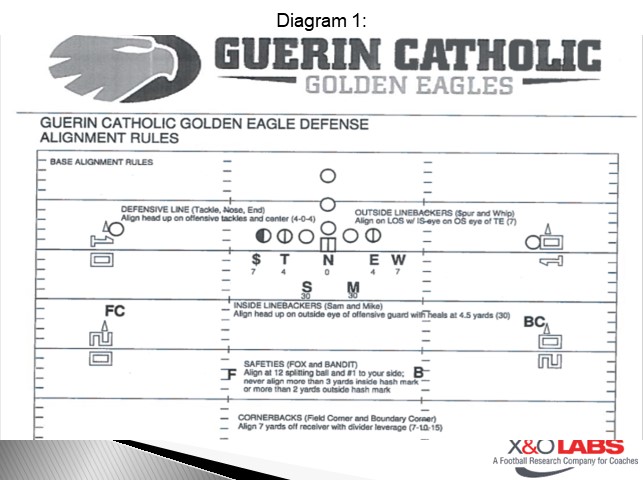
Our Base Defensive Alignment in below in diagram 1.  We want to show this look every time the offense breaks the huddle.

Diagram 1

If Off is called, our defenders know that if they are playing an off technique (Outside Blitzer, Straight Defensive End) then they are responsible for the QB in Zone/Triple and the Jet against Power Read.  This is the same principle in all of our calls.  If Off is called and you are a C gap rusher, you have the outside portion of option.  If no Off (on) is called and you are a C gap rusher then you become a chase player responsible for the dive while the ILB to that side is the QB player.

If you are an Edge rusher (Cover 0) then you have QB (Zone Read) or Pitch (Triple or Speed Option), or Jet against Power Read.  Nothing can get outside of you.  You must also know that if you are on or off you can spill or wrong arm against a puller.  If you are and edge rusher you cannot spill the ball. 

*Important coaching point is that I think it is very important to have flexibility in your defense to be able to call the strength where you want it.  I like calling the strength to the back against option teams, but also want to have the ability to call the strength away.  Maybe you don’t want to call strength to the back for a particular reason, but want to call it to the field or boundary or the TE.  Don’t box yourself into only defending the Field or Boundary in your defense. 

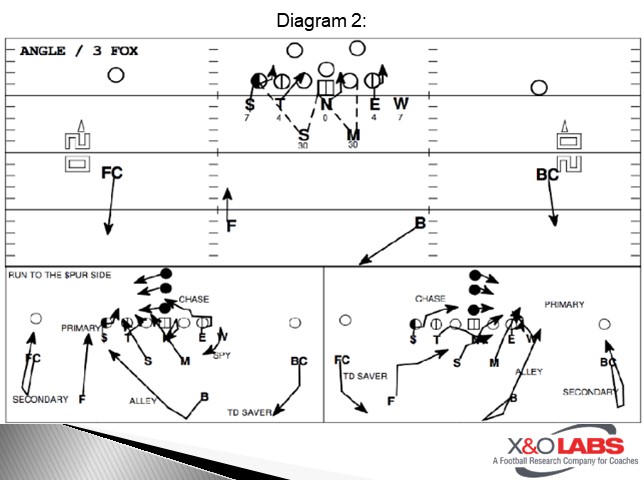
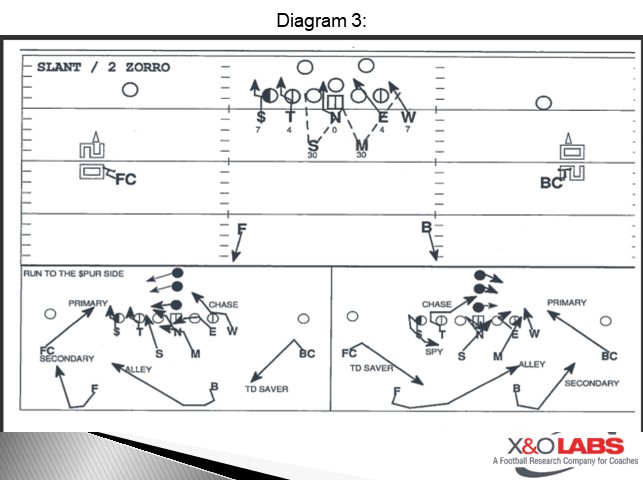
Diagram 2 and 3 are our base calls.  Diagram 2 shows “Angle 3” and Diagram 3 is our “Slant 2” These are our two major looks that we use.  *If we are playing an option team, then we will most likely end up playing these two looks the majority of the time.

Diagram 2

Diagram 3

The very first thing we do as a defensive staff when playing an Option team is decide who we want to carry the ball.  If the QB is dangerous we want to give him as many give reads as possible, then stunt to the back.  If we want the QB to carry the ball because he’s not as dangerous as the RB, then we will give him as many keep reads as possible.  At the end of the day, our kids have to know only a few things.

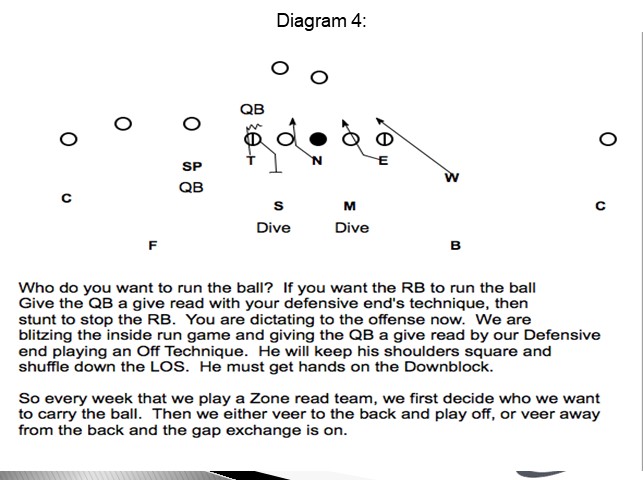
If we are veering to the back, then we are going to be in Off most of the game.  Defensively that means that we want the RB to carry the ball, we don’t want the QB to carry the ball, and we are going to give the QB a give read and stunt to stop him.  See Diagram 4.

Diagram 4

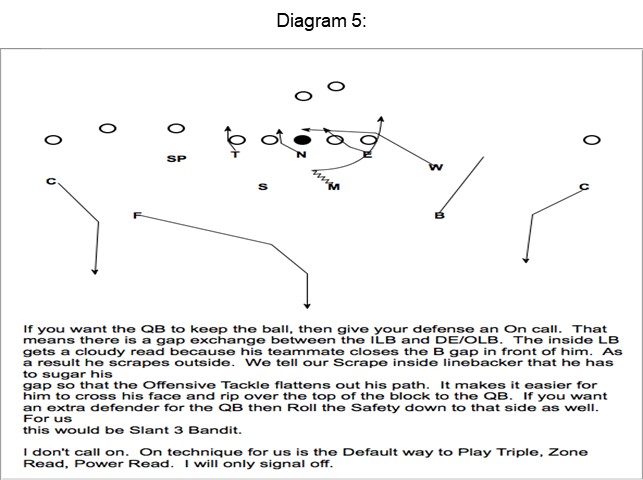
If we want the QB to keep the ball, then we will be veering away from the back.  When we veer away from the back, our OLB knows he is in chase technique and our ILB is in scrape technique. 

Diagram 5 shows Veer away from the back – There will be no Off call made, so we are ON by default

Diagram 5

To study game film of this concept, click on the video below:

Read More

Inside Zone: 17 Solutions to Increase Production

By Justin Iske
Offensive Line Coach
Southwestern Oklahoma State University
Twitter: @justiniske

iskeIntroduction:

The most important on the field job of any coach is to improve your players’ technique. Here at SWOSU, we use practice and game film to point out errors in technique and, more importantly, how to fix them.

This clinic report will review the main coaching points for the offensive line on the Inside Zone play and how to correct common mistakes based on whether they are facing a play side shade, back side shade, or if they are uncovered.

Common Errors Against a Play Side Shade:

Rule/Footwork: The initial six-inch step works for width with play side foot. The second step mirrors the first step with the back side foot. As he moves, he must keep his toes slightly outside of ankles and knees inside of ankles to maintain power angles. He must also pound the insteps of his feet into the ground to create power.

Error #1: Lineman is not gaining width on first step

The player is stepping underneath himself with first step and not gaining width. A major coaching point to fix this is to have him put the majority of his weight opposite the direction he is going. This allows him to push off that foot and forces him to step with the correct foot.

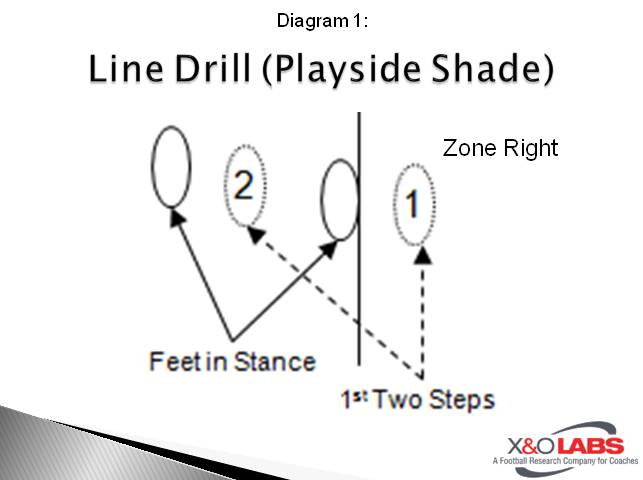
Solution #1:  The Line Drill

Have the player(s) line up with play side foot directly next to a line on the field. This gives a visual landmark to show the player that they are gaining width on their first step. When we don’t have lines, I often use a rolled up towel or t-shirt can be used instead.

Coaching Points:

    • OL starts in two or three-point stance with play side foot directly next to a line on the field.
    • On command, he will take his first step over the line for width.
    • Drill can be done for one step, two steps, or through a whistle.
    • Drill can be done on air or versus a defender.

Slide1

Solution #2:  Hand Technique

We want to get our hands on the defender as soon as possible. To accomplish this, our players must not load up their elbows. We want the player’s hands as tight as possible to each other to get inside hand leverage. Upon contact, we want the player to be heavy with the back side hand so he can’t be thrown by a defender as they react to the runner cutting back.

Error #2: Hands too wide on contact

This not only decreases power, but it will result in holding penalties by grabbing outside the framework of the defender. 

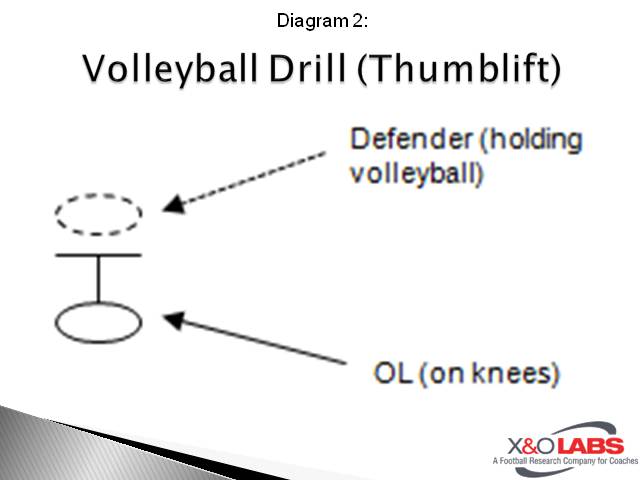
Solution #1: Clap/Volleyball Drill

One way to get the hands tighter is to have your players clap their hands together in front of their body as they execute the punch. This also takes care of anyone with the habit of loading their elbows. We also use volleyballs or medicine balls instead of hand shields to force our players to get their hands tighter. We teach them to “aim small, miss small.”

Coaching Points:

    • OL starts on his knees with hands on thigh boards and butt on heels. Partner stands in front of him with a slight bend in the knees holding a volleyball in the middle of his chest to give the OL a target.
    • On the command, drive hands to bottom of the volleyball while driving hips through. Strike on the rise. Stress hips and hands!
    • Knees and feet do not move. As upper body and hips follow through, the OL should end up with chest on the ground.

Slide2

Read More