Southern Oregon’s 4 Every Day Drill OL Circuits


By Chris Fisk
Offensive Line
Southern Oregon
Twitter: @CoachFisk

Introduction:

southernoregonNational championships are won one yard at a time. Here at Southern Oregon, we believe that each of those yards is hard won as a result of detailed technical drills. Over the past 3 years, we have averaged over 4.5 yards per play and less than one sack per game. This consistency and production is a direct result of the detailed focus we take into our drills. In this clinic report, we will look at four drill circuits that have been and will be critical to our success.

Before we get into the drills, it is worth mentioning that these drills reflect the rules that we expect our linemen to live by. Those rules include:

  1. No one touches our QB! (From 2012 – 2014, we only gave up 1 sack for every 30 passing attempts.)
  2. Be smart!
  3. Bet the best!
  4. Out-hustle everyone!
  5. Do it the SOU way!
  6. Block through the echo of the whistle and FINISH the play!

Each of these drills is done EVERYDAY in the spring, summer, and preseason. From there, we will do some every day and others every other day through the season. We believe these are the cornerstones to what has made us effective in all parts of our blocking game.

Circuit #1: Agility Circuit

Be great in space.

We do these because we do a lot of screens. This is done every day in the summer and every other day in the season. These skills are essential to the success with our screens.

Drill 1: Angle Cuts (cones)

We treat this like WRs. Toe in at the top of the cone and toe out with of the inside foot at the next cone. Chin over chest and chest over knees.

Drill 2: Fast Feet (cones)

We are trying to get our guys to lower their center of gravity with their chin over chest and chest over knees. This allows them to change their direction in space.

Drill 3: You Chop, I Chop (line)

This teaches our guys to identify the target, and when the target converts to a chop, they need to chop. This is a concept that we got from our special teams drills and we think it connects well to what linemen do in space.

Drill 4: Mirror Drill (line)

Read More

Complete Installation: Odd Robber Defense

By Adam Hovorka with Rob Everett
Former Defensive Coordinator
Bridgewater College (VA)
Twitter: @nineinthebox


Editor’s Note: Coach Everett uses several play simulations in this report. More information on these products can be found at Go Army Edge.


Defending the modern spread offense has become increasingly more difficult as offenses continue to stress defenses with RPOs, option run game, QB designated run game and shifting/motioning. Defenses have had to counter and recent adjustments for many coaches is the Odd Front robber looks that are being played by Iowa State courtesy of Coach Campbell and Coach Heacock. If you think only the Big 12 has these defensive challenges, you couldn’t be more wrong. High school defensive coordinators, and small college coaches around the country, are continually searching for answers to the riddle that is the RPO and spread game. For Coach Rob Everett, former DC of Bridgewater College and currently a defensive staff member of Coach Mike Singletary’s Memphis Express of the AAF; the answer was and is to play odd front robber.


Advantages of Dime Robber Package:

  • Allows for 50/34 defense to stay in its base personnel
  • Play a version of two high coverages
  • Account for two overhang players
  • Adding a middle of the field third level player to help in coverage and more importantly an extra hat in the run game


At Bridgewater College, Coach Everett’s odd robber package held offenses to 3.1 yards per attempt and was 60% efficient (65% when blitzing). Most importantly, his system allowed his players to line up fast and play aggressive because he was utilizing it with his base quarters personnel. This defense helped Bridgewater to a 6-4 2018 record and their middle linebacker won Defensive Player of the year in their conference.


Adjusting to Base Defense

Bridgewater College is a quarters outfit by trade, so this was not anything different, it was just deploying people in a different fashion. So, they played it on all downs. The thing Coach Everett likes the most about it is that you get a four-man rush (with the late inserting Mike) and because of the front, pass protection is forced into a full slide or big on big with bad leverage. In addition, the middle hole Robber plays as the “number three relater” that the Mike normally does but he is a better athlete and “closes” the middle of the field because they play match coverage enough. It may not be a great answer against 22 personnel because, like in most odd defenses, speed personnel have to match with bigger offensive linemen.


Base Personnel and Alignments:

Below are the base personnel he’ll use with this package:


Nose: O-technique defender

Tackles: Two 4i-technique defenders

Mike LB: 10-technique defender; 3 yards off the ball (tighter than normal alignment)

Whip: Field overhang, apex end man on line of scrimmage and number two receiver

Backer: Boundary overhang defender; apex end man on line of scrimmage and number two defender.

Bronco: The “robber” (called Bronco in this defense)

Free Safety: 10 yards over #2 to the field

Rover: 10 yards over #2 to the boundary

Corners: 8 yards over #1 receiver


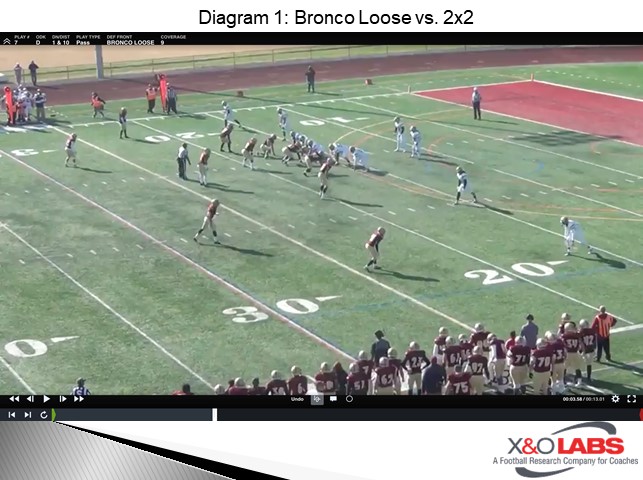
Below are the alignments based on common offensive formations. It’s important to note that a “loose” call tells the Backer and Whip to get depth off the line of scrimmage. A pure Bronco call will put the Whip and Backer closer to the line of scrimmage.


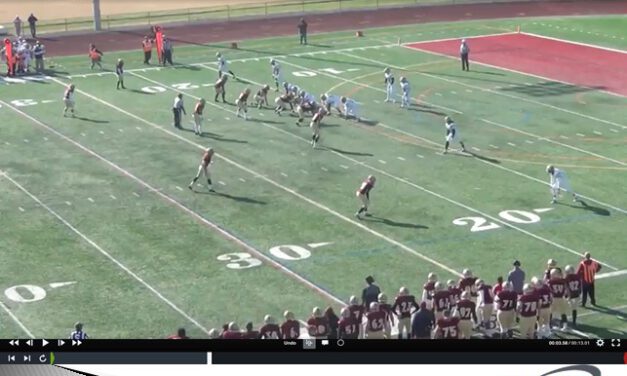
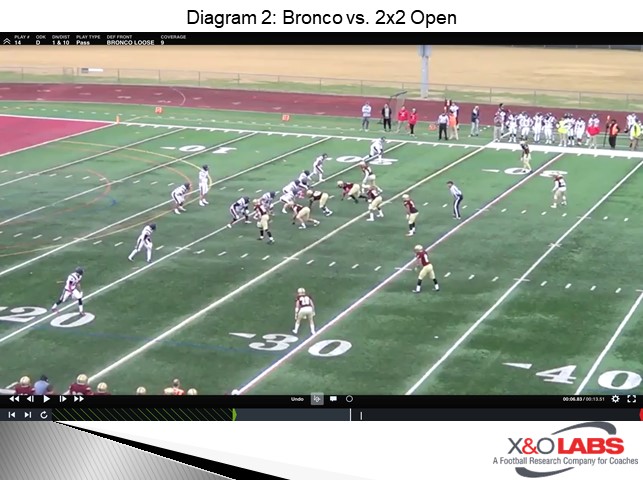
Bronco Loose Vs. 2×2 Open

Diagram 1


Bronco vs. 2×2 Open

Diagram 2

Read More

Track Blocking the Wide Zone

By Andrew Coverdale & Mike Kuchar
X&O Labs Research Staff
Twitter: @XandOLabs


Introduction

Many offensive systems package the wide zone run concept as part of its offensive play menu. Many of these same offenses are teaching horizontal zone combination blocks on the front side of the play to create space for entry points for the running back. While zone combinations could be a viable way to block the scheme, we’ve found other coaches are finding that “track” blocking the scheme can be a better solution, particularly for inexperienced offensive linemen in a tempo offense.

We heard Coach Coverdale speak about how track blocking the wide zone concept has fostered his tempo offense and made it easier on younger linemen to block the play. So, we reached out to Coach Coverdale to talk about his most efficient run concept. It’s been the foundation in the Trinity offensive system, but this season its merits were tested. Working through continually attrition on the offensive line, Trinity had to still find ways to run the scheme. Because of this inexperience, Coach Coverdale and his offensive staff (head coach Bob Beatty and offensive line coach Cliff Dawson) leaned more on track blocking the wide zone concept, rather than using combination blocks.

Though he will teach both tracking and combination blocking, according to Coach Coverdale, there are three main reasons why track blocking can be more effective:

  1. Alleviates confusion: “If you are getting a lot of multiplicity and your talent is not great, we tend to use tracking, “ he said. “It is more simplistic and you will not get negative plays with this scheme. That is the first layer of preventing negative plays because of the communication.”
  1. Cultivates Tempo: “We are a multiple tempo team. We are not a no huddle team per say but we use a speed break from our huddle. We want to get on the ball and snap it. That does not allow for a tremendous amount of communication at the line of scrimmage.”
  1. Provides protection against line stunts: “If we are getting a lot of long sticks, two gap exchanges, or zone dogs, we always carry more tracking into those kinds of situations,” he said.

Track Blocking vs. Combination Blocking

It is possible to teach both combination blocking and track blocking and it’s beneficial to carry both in an offensive play menu. “Why do we need both ways of blocking the wide zone?,” he asked. “We have to use the strengths and weakness of both types. Sometimes we start with tracking and use the combination blocking later. Often times we do it just the opposite. It depends on the players we have and the situation.”

If our linemen were more thumpers we would lean to more combination schemes because it’s more physical, but it’s harder to teach,” he told us. “The combination blocking takes more time. If you have years where you have more continuity the combination block methodology may work better but if you have years where there are young players or you go through injuries, tracking is easier to learn. It’s about running off the ball and take your chances.” Other factors, such as defensive structure are factored into the decision making process. “If there are linebackers in leveraged positioned or stacked behind the ends in three down, we would want to track it because we couldn’t combination to them,” he told us. “If they were in traditional techniques like 20 techniques, we would combo it.

Pairing Tracking with Sugar Huddle Tempo

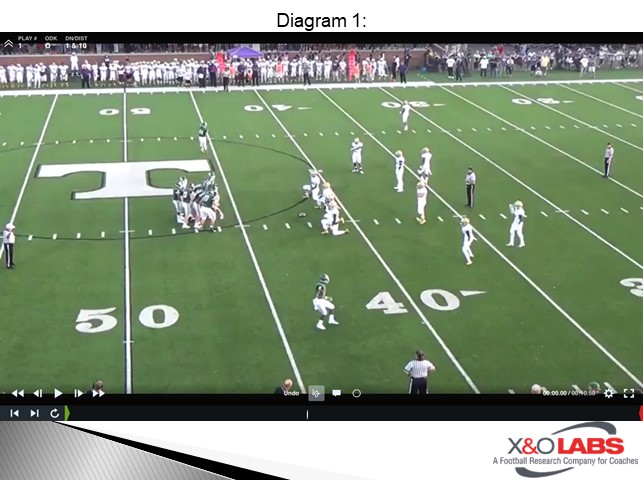
One of the major advantages of the tracking system is that it correlates with tempo offenses. Since there is little to no pre-snap communication like identification of Mike points for combination blocks, it’s really about getting off the ball and going. While Trinity High School is a tempo team, it has paired the wide zone scheme with a sugar huddle formation, similar to what is being used at Auburn (Diagram 1). “We need to have a lot of weapons against players with great get off and the sugar huddle is one of those mechanisms,” he told us. “We will huddle within two yards of the ball. We are not afraid of people hearing us. We want our linemen to just be able to turn around, snap the ball and go. It helps us to go fast. We’re going to shift, present four man surfaces and it creates urgency. The tracking allows us to still play fast in the middle of uncertainty and chaos. We love chaos and we get used to functioning that way.”

Slide1

Trinity will have two or three different kinds of the sugar huddle. It may release the receivers first or release everyone all at once. “If we want to be more disruptive to the core (defensive box), we will have a sugar huddle for at least the outside receivers first and then we break so there is no response time in the core,” said Coach Coverdale. In these cases, he wants to snap it within two seconds of breaking the huddle. “If we want to be more disruptive to the secondary or the defenses support mechanisms then we will release everybody all at once so they don’t get as long a look at the overall formation,” he said. While the timing may be slower on this one, the issue is getting receivers on or set and the quarterback doesn’t snap it before they are set. “Kids will lose their edge over time if you over do it,” he said. “You have to enforce it in practice.”

Read More

21-Hour Football Program: Building a Competitive Weight Room Atmosphere

By Jeff Wood
Head Football Coach
Bedford High School (MI)

And

Don Stewart
Strength Coordinator
Bedford High School (MI)

Editor’s Note: X&O Labs is continuing its study into how coaches are advancing their programs to achieve higher levels of success in an ever-changing culture, society and world. We’re calling our study The 21-Hour Football Program because these concepts focus on the 21 hours before and after practice that build a winning culture. In this report, Coach Jeff Wood and Coach Don Stewart outline how they used competition in the weight room to build support for a “doom and gloom” football program. The results are stunning. To access our brand-new study, The 21-Hour Football Program, please go here.

Introduction

In 2008, the Bedford Kicking Mules football program began a weightlifting program that included all sports in the building. We took over a football program that had dilapidated facilities, no money to fund it and an overall “gloom and doom” attitude towards football with only 9 winning seasons in 58 years. We stressed quick, 45 minutes lifting sessions with base core lifts and auxiliaries to enhance the muscle groupings. Our players observed results immediately.

In 2010, we began looking in to ways to take the gains that we were seeing in the weight room and enhance them through team building. We spent particular time studying ways to create methods of competition in the weight room as a means to foster this team building. Our future Senior players mentor our future Juniors and Sophomores while improving their bodies for the upcoming season.

The bond that was built during these workouts and competitions has been immeasurable in how it has impacted our program. We have had 9 winning seasons in the past 10 years, won the conference 3 times and won 3 district championships. We believe very strongly that the key to this change has come from how we coach in the offseason in our weight room. Furthermore, the competitive nature of our weight room created a “refuse to lose” attitude on the football field. We have won over 3 close games (10 or less points) each year since putting this system into place.

Lifting System Basics

We lift 4 days a week, Monday to Thursday for 1 hour. We have lifting times at 5:30am-7am before school and 2:40 – 4pm after. Players must lift 4 times per week, it is their choice of when. We have found that lifting 3 days a week for 90 to 120 minutes did not make the gains necessary to compete. The 4-day system has worked much better for our athletes and it also doesn’t require nearly as much attention span to lift for 60 minutes. We also found that lifting on Friday was a terrible idea.   It seemed that all “non-players” found an excuse to miss on Friday. Instead, we changed and held them accountable for missing workouts, which is where Competitive Weight Room entered the scene. 

Read More

Defending Mobile Quarterbacks with the “Cage” Concept

By Holden Whitehead
Special Teams Coordinator/Defensive Line Coach
Alfred University (NY)
Twitter: @hwhitehead45


It is safe to say that the evolution and utilization of the mobile QB have become a staple in many successful offenses, at all levels of football. As a defensive-minded coach, having to game plan to stop a mobile QB, who can make things happen and extend plays with his feet, to hurt you with his arm, is a challenge that more and more defenses face every Saturday. Here at Alfred University, we embrace the challenge of being a relentless pass-rushing team, accumulating 113 sacks in 4 seasons. A large part of our success is since we look at our D-Lineman as playmakers, not sacrificial lambs. We want our D-Lineman to make plays, whether it is stopping the run, setting up the blitz, or our four-man pass rush, we utilize The Cage. The Cage works to give each player in our scheme a job to execute beyond just owning their gap. We utilize our cage in four-man, five-man, and six-man rushes. We stress to our players that if everyone does their job correctly in The Cage, then everyone will eat. We look at everyone in the backfield as food for the defensive line and we are the wolves that must embrace the hunt. Each wolf has a specific and crucial role.


Cage Concept:

In our defense, we want our guys playing fast, not thinking, so we keep the concepts as simple as possible. What the cage presents is a vision beyond maintaining your gap. On day one, we present the cage to our men as being comprised of the four cage players, two high cage players, and two low cage players.  This gives each of our defensive linemen one of these responsibilities.  Pass Rushing is an art, but at the end of the day it comes down to three things: get off, having a plan, and the finish. Our read keys are simple, and we call them the “Three B’s”- Ball, Block, Backfield, and we read them with our eyes. When seeing movement we get off, exploding low off the ball. Then, our eyes go to the block, where we read the offensive lineman’s pass set and technique. Finally, once we defeat the block, our eyes move to the backfield. Now we are ready to dive into The Cage.
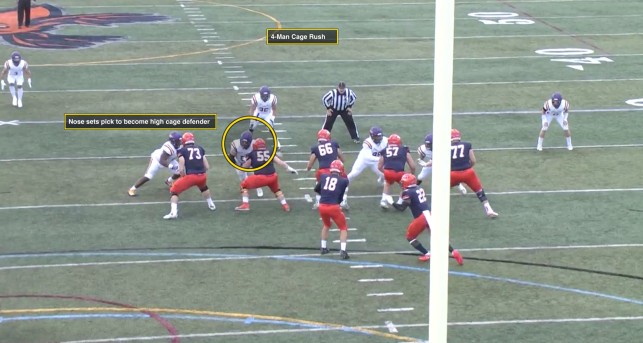
 

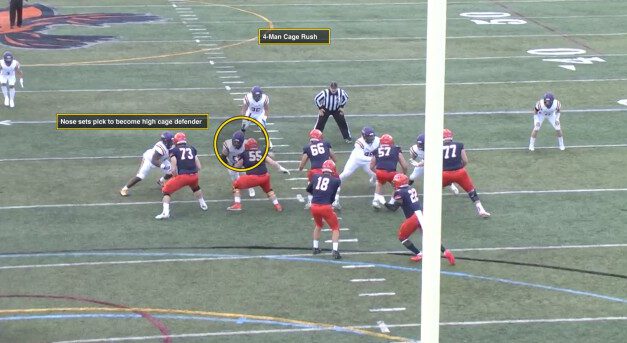
Our base four-man front is comprised of a 5-tech defensive end (our End) and 1 Tech Nose Tackle on the strong side, with a 3-tech defensive Tackle and a 5-tech defensive end (which we call our Rush) on the weak side based on our defensive call. Both the End and Rush are declared to be high cage players, with the low cage players being our interior Nose and Tackle. Each player must understand where they fit in the run scheme with their gap assignment first, then implement their cage responsibility. Everything starts up front, and our guys must take ownership of their jobs, playing for the man next to him, and the defense as a whole. That is when we have something special. Our cage players work in unison to condense, squeeze, and suffocate the backfield. Notice, we never use the phrase “contain the QB.” I cannot reiterate enough the shackles that it puts on a defensive lineman when you say contain. We never want to contain our players; we want to unleash them. Our words reflect our mentality and using terms such as condense, squeeze, and suffocate motivates our players and allows our guys to play relentlessly. Diagram 1 shows our four-man cage and the responsibility for each player.


Four-Man Cage Concept
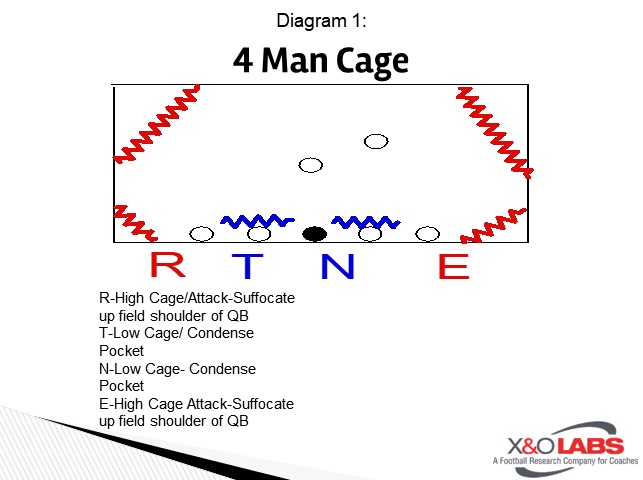
Diagram 1


Our four-man cage gives us four chances to disrupt the QB. We preach to our guys that we need 25% from each of them, for each defensive lineman to execute his role and responsibility, and that is all it takes to end a football play. We begin with the job of our low cage players, the interior defensive linemen. These are our bigger bodies, capable of eating and beating double teams, and we owe a great deal of gratitude to these monsters up front. Their jobs are to “CONDENSE” the pocket, squeeze the passing lanes.


Low Cage Defenders

Our low cage is the first wave when it comes to defending the quick pass and RPO game that has taken football by storm in recent years. The low cage players know they must suffocate any step-up lane in their gap and with quick passes they need to fire their hands up to disrupt the vision of the QB. Even if the low cage player has no chance of getting a shot on the QB we can still do a great job of disrupting the timing of the QB’s mechanics with a relentless low cage rush, and by getting into and removing the quarterback’s throwing windows. Our low cage players know why they cannot leave their rush lane because that will compromise the cage, which goes down as a minus in the film room. Our players are keenly aware of this fact. An example of compromising the low cage is when that defender rushes outside of our high cage player to make his play or is displaced by the block of the offensive linemen. The two low cage players work to suffocate the QB in their portion of the cage by working off each other. This philosophy requires an unselfish mentality that reinforces playing for the guy next to you.  Our guys utilize a half-man technique on every single play, whether it is run or pass. We continually preach that half of a man is easier to defeat than a full man.


High Cage Defenders

The second phase of our cage is the high cage players. Our two high cage players in the four-man cage are the End and Rush. The End and Rush target their key, which is the up-field shoulder of the QB. The Ends never let the QB outside of them, this is the constant battle many teams have against the mobile QB.  Again, our verbiage never uses the word contain- we want to Condense, Squeeze, and Suffocate. Based on opponent tendencies, our defense uses specific calls to signal to our defensive line that we anticipate a pass. This will trigger them to have their plan ready pre-snap. Pass rushers on our team will build their moves off of their skill set, we will never ask a player to do something that does not fit their skill, strength, or comfort level. We always emphasize having a plan, a secondary move, countermove, and finish. Every day we practice the fundamentals, working our hands and feet, always preaching the importance of a relentless pass rush. High cage players work together to condense the pocket and track the QB’s upfield shoulder. Again, we revert to the Three B’s for the Ends as the key to getting to their aiming point. Ball, Block, Backfield, are our focal points throughout the entire play. Going back to another of our philosophies, we have a saying within our defense- “Be the giraffe, not the turtle.” We want to see everything that is going on around us to make the best football plays.

Read More

Horizontal Reads off Tight Zone Runs

By Braden Layer
Offensive Coordinator/QB coach
Bowdoin College (ME)
Twitter: @Coach_Layer


Our offensive philosophy here at Bowdoin College is “Players, Formations, Plays,” and we are very purposeful on that order. We want to be able through motions, formations, or alignment changes, to isolate our best matchups or ensure numbers to where our offense can be successful. Furthermore, because the NESCAC has some strict limitations on practice time and the abilities to meet with players once the season has concluded, we must be very concise and clear with our installs each fall. If our goal is to play the best football player regardless of age, it doesn’t make any sense to design and implement an offense impossible for an 18-year-old freshman to walk on campus and digest. We want to run a few schemes well, and tweak or adjust those to fit our personnel best each year.

Over the course of the last 7 years as an offensive coach (Denison University, Sewanee, Allegheny, and now Bowdoin) in a pistol, spread-based offense, we have run many zone variations, and inside zone has always been one of our staples. Another huge piece of our offense has been centered on simple jet motion from our best perimeter threat. We used outside zone most often and were a true reach and run team. Our tailback was athletic enough to keep in pistol which was huge for our self-scout to eliminate tendencies. He blocked the first dirty-jersey in the alley, inside-out (aware not to cut back to the middle of the field).
When I got to Allegheny College as the offensive coordinator in 2017, our slot receiver was one of the most-feared athletes in the conference. A true burner, he possessed the ability to score any time he touched the football. Thus, his “influence” on a jet sweep was incredibly powerful. We found that by devoting a handful of plays each game to the jet action with the original goal of challenging the perimeter, we were in turn able to dramatically influence the box, specifically in the zone read game.

This became a great fit when we didn’t necessarily have a dominant H-back that could consistently handle DEs on zone/split zone, and our QB was limited in his keep ability on zone read. We needed a way to encourage a handoff while still feeling solid about our numbers and angles, and matching zone read with jet motion allowed us to do just that. We married two different components of our offense without installing any new techniques or major learning, keeping it simple.


Zone Read With Jet Motion

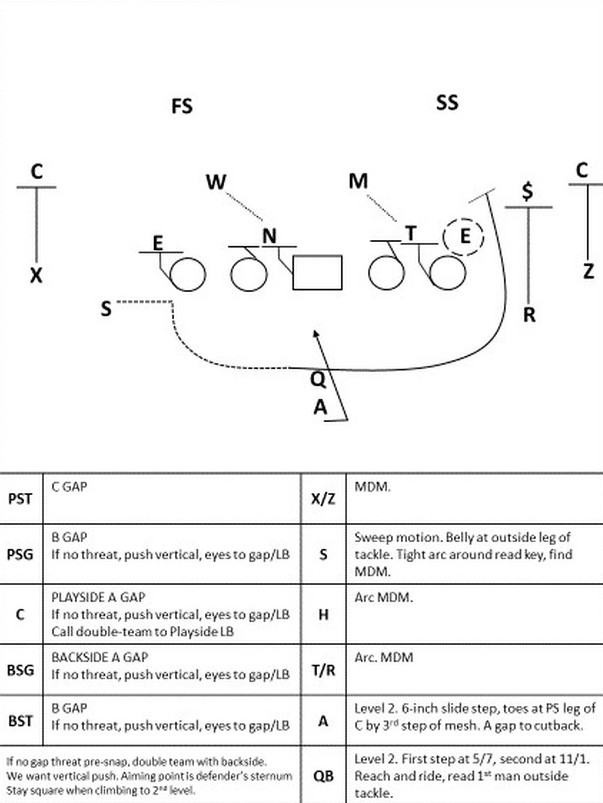
On this play, our quarterback oversees putting the slot in motion. He aims to snap the football when the S receiver hits the outside leg of the tackle for our jet motion. Because we want to encourage our receiver to reach the mesh as close to full speed as possible, he tracks the motion in more of a banana path. Flat to the outside leg of the tackle, then bellies to directly in front of the quarterback.

On the snap, the quarterback turns and reads the defensive end towards the side the S will finish his motion. There is no dummy fake or show to the motion-man. Again, with the threat of the S receiver getting outside and finding a perimeter running lane, we are hoping to influence the read key to widen on the snap. Should the defensive end crash, our S now becomes an extra alley blocker for the QB on any keep read (can handle a hard squeeze/scrape).


At Allegheny and now as the OC at Bowdoin, we have clear visual keys for what is a keep read for our QB. Another reason we love this zone variation is that is allows us to encourage the give read if we are not the most dynamic runners at the QB position. Unless the defensive end turns his shoulders to chase and reaches a landmark of the BSG on his crash, we aimed to give. Obviously, depending on the ability of your QB, this read changes for your offense.

The jet sweep threat allowed our tailback to feel VERY comfortable with his backside cutback. Our aiming point on the zone play is the playside leg of the center, and our tailback is taught to press the heels of the center, reading the A gap. If we have a solid double team and get vertical displacement, our tailback is free to bang the playside open gap. If he sees a muddy A gap and no vertical push, we teach a one-cut rule on his cutback. He is free to jump-cut and find the open gap all the way back to the C-gap defender.

With the jet motion, we are hopefully encouraging a much clearer C-gap for our tailback. If he doesn’t find playside A-gap to be open, he is naturally thinking “hit backside C.”


Adding Bubble

Changing the technique of the S on this zone-read variation post-snap has given us the option of now throwing bubble on the perimeter.

Read More

Adjusting 5, 6 & 7-Man Protection Schemes to Handle Superior Personnel and Pressure

By Grant Gower
Offensive Coordinator/QB Coach
Oklahoma Baptist University
Twitter: @OBUCoachGower

and Greg Gothard
Offensive Line Coach
Oklahoma Baptist University


Protecting the quarterback at all levels of football is of primary importance for any offense.  Regardless of your style of offense, it is imperative to not allow sacks and give up negative yardage to the defense.  At Oklahoma Baptist University, we are a spread, no-huddle, up-tempo offense that likes to attack all areas of the field.  Within our throwing game, we have become very successful in passing offense and limiting the number of sacks allowed.  In 2018, we had 506 passing attempts and only allowed 3 sacks in 11 games.  In 2017, we had 423 passing attempts with only 9 sacks allowed, for a 2 year total of 929 attempts with 12 sacks, while completing 60% of our passes.  This was coming off of 2016 where we allowed 22 sacks in 362 attempts.  So how were we able to decrease the number of sacks while increasing our number of attempts dramatically?  This report will explain some of those concepts and ingredients that have been beneficial for us.


Body/Coaching Points

To be able to be effective in any offense, it involves everyone to be on the same page and executing each play successfully.  Obviously, the challenge that we all face is to be able to do that consistently day in day out and game in game out.  Here are some of those key ingredients for our position groups:

  • Offensive Line-Continuity/Consistency-all 5 must work together seamlessly regardless of who the personnel is on the field. In 2018, we had 3 senior offensive linemen that had played a lot of games together and were very experienced.  Having that was a huge asset, but another key ingredient that we have utilized is rotating our OL guys in throughout practice and games.  We travel 10 offensive linemen and it is important for all of them to know and understand each other and their assignments.  We like to play at a very fast pace, and having a deep OL unit really enables us to work together and stay fresh as well.
  • Tight Ends/H Backs-Pass Blocking or Receiving-our TE/H Back is a key ingredient not only from a blocking perspective, but also to be able to get out in routes. We will have our tight ends stay in at times for our 7 man protection, but also will release him into the route concepts as well.  It is important for them to be strong enough to block a defensive end, and also agile enough to block a blitzing linebacker or defensive back.
  • Running Backs-Pass Blocking or Receiving-our running backs not only are the main ball carriers but have an integral role in the passing game. One of those key ingredients is their pass blocking ability.  Whether it is in a 6 man or a 7 man protection, he has to be able to pick up the rush or a stunt and “make us right”.  When he is on the route, it is important for him to be able to catch the ball and become a playmaker.
  • Wide Receivers-Getting off of coverage-one of the major ingredients of not allowing sacks is for wide receivers to get open. Receivers must understand how the DB is playing him, whether that is in a zone look or in a press man coverage.  The key is in varying releases off the ball to create the space necessary and beat the leverage that the defensive back is applying to the receiver.
  • Quarterbacks-Pulls it all together-the main job of the quarterback is to keep everyone functioning as one unit. That entails many variables.  His mobility and his ability to escape pressure if it does break down, recognizing coverages and where blitzes are coming from, and where his hot receivers are, all make for a quarterback that will be very effective.  It is also important for him to know when and where to throw the ball away to avoid the sack.


For all of the moving parts to function effectively, there are several key ingredients.  It starts by introducing the pass protection concept.  We utilize a multitude of protections, and it is important for all the position groups to know and understand when and why we will use a certain protection scheme.


OL Pass Pro/Coaching Points

 Bison Pass Protection Absolutes

  1. Knowing job/responsibility (Eyes)
  2. Trigger first
  3. Staying square/pad level
  4. Hands/Feet


First of all, we must know our job, who or what gap am I responsible for, and we must train our eyes to stay on our responsibility and not chase false reads.  I must trigger or get my hand out of the grass first; if I start behind I will never catch up. It is imperative that we keep our hips square and our pad level down.  By doing that, it allows us to maintain our leverage on our defender we are responsible for blocking.  Keeping our hands and feet active throughout the play is key in keeping our defender off the QB. Our blitz pick up is no doubt the most important thing we do for pass protection, and we are able to work on these 4 Absolutes repeatedly at game speed.

Read More

Adapting the Shuffle Reach on the Backside of Zone and Gap Runs

By Mike Kuchar
Co-Founder/Senior Research Manager X&O Labs
OL Coach/Run Game Coordinator
Rahway High School (NJ)
Twitter: @MikeKKuchar


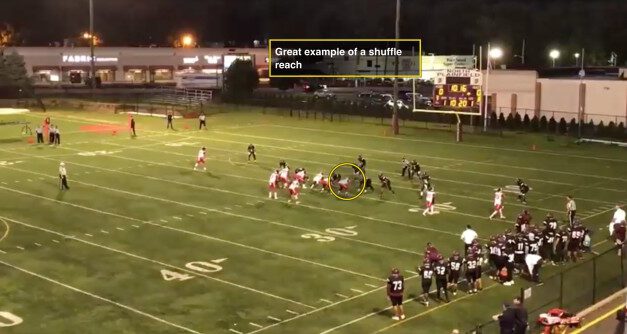
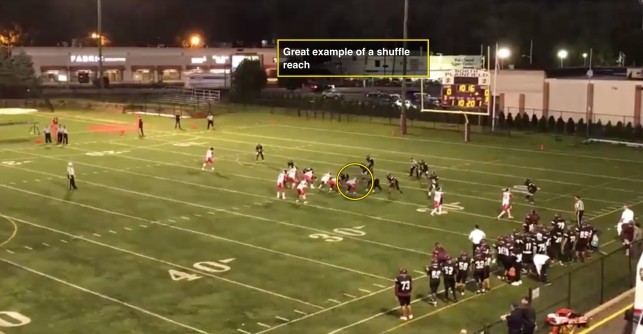
In all my time as an offensive line coach, I had been teaching the hinge block on the backside of gap schemes mainly because that is what I knew. I remember giving my lineman the visual of how a door opens and correlating that to how his hips should open to block the interior B gap. Of course, I was not the only one that was teaching this technique. But I found that my lackluster way of teaching it yielded lackluster efforts in return often times letting a backside B gap defender run unobstructed to the ball carrier.  It made it seem as if that block wasn’t important to the overall concept.

It was only recently that I took what longtime NFL offensive line coach Bill Callahan was doing with teaching the two-step and four-step shuffle reach for uncovered lineman in his zone schemes and incorporated it for my backside Tackle in both zone and gap runs. I found it to be extremely productive for several reasons. For most young players, a shuffle technique is a common movement. It’s something even non-basketball players have done before. Keeping their shoulders squared allowed for greater surface area when making the block. So, this season I made it an effort to implement a shuffle technique for my offensive Tackles on the backside of both zone and gap runs.  And in doing so, I’ve found the shuffle reach to be more productive than the hinge for the following reasons:

It’s More Assertive Block Than a Hinge:

The backside hinge was a staple in gap schemes. The Tackle was asked to secure the B gap defender before working out to the C gap. Problem with that is teaching 45 degree step footwork required on the hinge cultivated a weaker block. There wasn’t enough body surface needed to clean up the B gap. First level defensive lineman with tremendous get off were able to dent the B gap and cause problems to the scheme. Using the shuffle reach helped in securing that gap.

It’s Non-Athlete Proof:

I say this all out of love: offensive lineman are not the best athletes on the team. After all, they don’t call them the “big uglies” for a reason. They are a usually an inclusive group of awkward teenagers that don’t get the credit they deserve. We all know this, so they deserve a little more love when we coach them up.  I’ve found that just by using this technique instilled confidence in their ability  to get their job done and as a result as football players. We had a left tackle this year as a senior that didn’t play a down of varsity football in his career, but at 6-0, 345 pounds with good hands had the potential to be a solid offensive lineman. So naturally, we ran most of our gap and zone schemes away from him and he became a master of the shuffle reach block. Getting 350 pounds plus to move laterally with his shoulders square shut down any thought of  penetration in the B gap. As it turns out this same novice was an All-Division selection for us this year.

It’s Effective Against 4i Technique Defenders:

Like many other offensive coordinators, I’m constantly pressed with the task on how to prevent backside B-gap penetration most synoymous in Odd fronts. More than have of our opponents this season operated out of a three-down outfit and not surprisingly the best players along the front played the 4i technique. So, in order to get that B gap sealed off, we would cut our splits down in the B gap with the Tackle and get him reached. And if we couldn’t reach him, we would cut him. This was rarely the case. In most cases, we were able to get the block done.

It Negates Assistance From Center:

Back blocking a 3-technique on power is a hard enough task, but executing the same block against a 4i defender can be nearly impossible. Using the shuffle reach on the backside B gap from the Tackle allowed our Center to stay on the front side of the run game, either by Ace blocking the Nose with the play side Guard (if he’s uncovered) or base blocking the Nose alone. 

Shuffle Reach Technique:

Quite simply, the shuffle reach technique is mainly a two-step shuffle footwork with a landmark of the play side “V” of the neck of the B gap defender. Once we have the inside landmark, we work to extend the play side arm (we call this a strong arm technique, many call it a drag hand technique) while working to secure ourselves in the B gap. It’s the same block in principle as a reach block, with the difference being we want out shoulders squared. We felt that was a better way to negate penetration.  

Incorporating the Shuffle Reach for Various Concepts:

We were able to implement the shuffle reach technique on the following for the following run concepts:

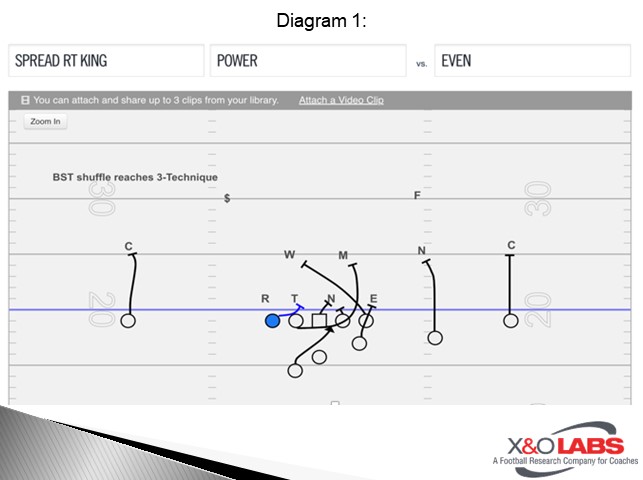
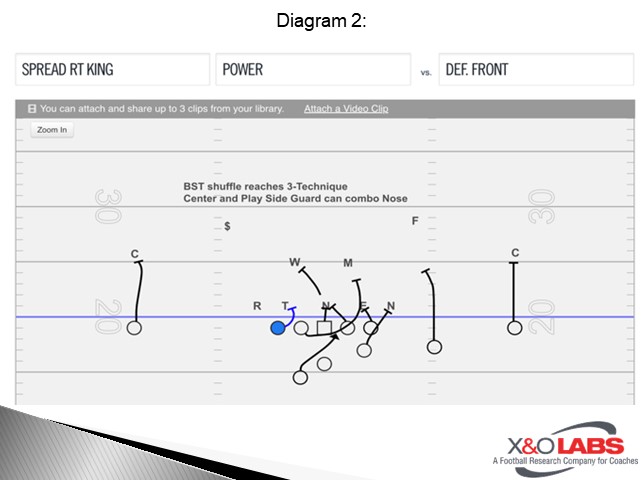
Power Concept:

Here we were able to double the Nose with the Center and play side Guard. We would turn the C gap defender loose in power and shuffle reach the Tackle. In most cases, he wouldn’t be involved in the play. If he was, we would simply read him and make it a double option concept.

Vs. Even Front

Diagram 1

Vs. Odd Front

Diagram 2

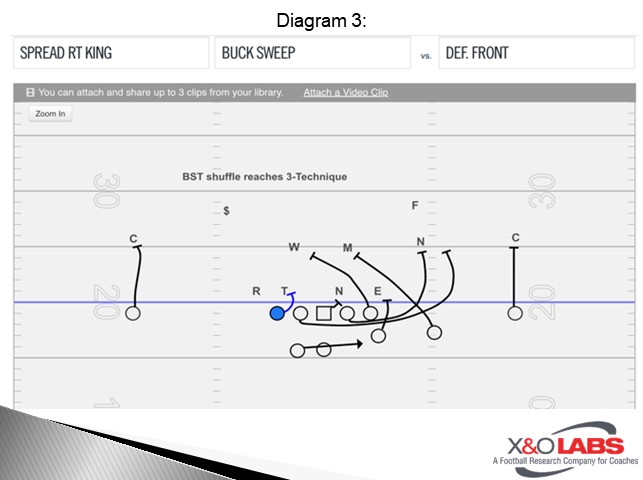
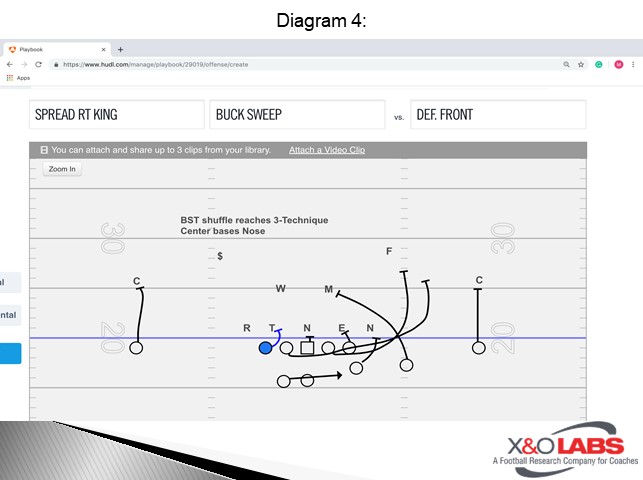
Buck Sweep Concept:

Even though buck sweep mainly hit to the front side, using the shuffle reach with the Tackle allowed the Center to stay on the front side of the scheme. We were able to pick up an extra hat to the play side.

Vs. Even Front

Diagram 3

Vs. Odd Front

Diagram 4

Read More

The Pistol Triple Option and PAP Package with Duo Blocking

By Eric Davis
Head Football Coach/Offensive Coordinator
Mankato East High School (MN)
Twitter: @davismn6


Why the Pistol Triple Option?

The Triple Option is one of the most prolific rushing attacks ever invented. When combined with elements of the modern passing game, we believe it provides us with the best way to attack high school defenses. Our offense attempts to blend some proven offensive philosophies into a cohesive system that fits our program. Simply put, we are going to align in Flexbone formations and force our opponents to defend the Triple Option along with an Air Raid-style vertical game. Our experience has been that the threat of the Option keeps pass coverages relatively simple and the threat of a competent Passing Game makes exotic option-specific defenses difficult to execute. We use the Option and the Quick Game to move the ball while we look to take our shots and score points with the Play-Action Pass (PAP).

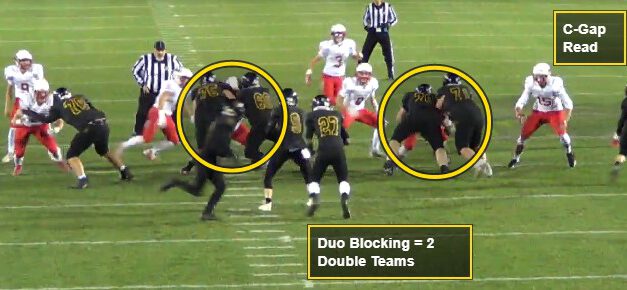
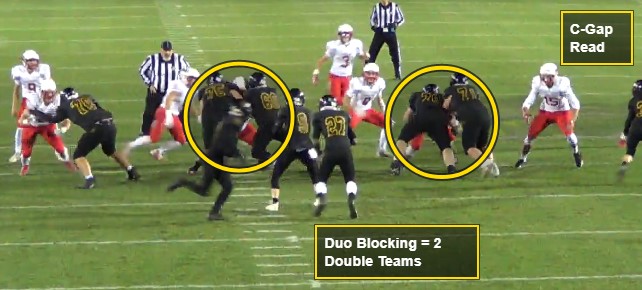
We ran the Flexbone from 1999–2007 and it is a great offense. Nothing written here is intended to disparage a system which is enjoying yet another resurgence with the recent success of the military academies. Our use of Flexbone formations is intended to create 8 Gaps for the defense and our use of Air Raid concepts and coaching techniques is intended to present 4 credible vertical threats. Our blocking scheme for the Triple can best be described as Duo Blocking with a C-Gap Read.


We run our offense from the Pistol for the following reasons:

Enhanced Passing Game: today’s high school players are far more proficient at throwing and catching the ball than they were when the Triple Option was invented 50+ years ago. We’ve averaged 18-19 passes per game in our two seasons of running this offense. Our QB depth is 4 yards, which simplifies all of our pass drops and helps our pass protection.

Easier Mesh: our experience is that our Pistol Mesh is much easier to master and maintain than the Inside Veer Mesh from under center. This frees up practice time for us to diversify our offense. It also allows our QB to get downhill off the Mesh even if we’re getting no better than a stalemate upfront. We don’t have specific Mesh Drill periods each week as we did in the Flexbone. Rather, we film our Inside Run periods with the offense coming off the sideline and the ball being snapped on a stripe, meaning the Center, QB, and TB are all straddling a straight white line pre-snap with the camera behind the TB. We originally did this to give the TB a landmark to follow on Midline, but we have found it useful for other phases of our offense, including the Triple. The QB is also getting more realistic reps with the offensive and defensive fronts out there as he reads defenders.

Adaptable Dive: rather than trying to pry open a crease in the defense, we are trying to push the Front vertically with double teams and gap blocking. Our Dive can hit anywhere from the frontside B-Gap to the backside B-Gap, meaning that the Triple can act as its own counter-play. This also allows us to run the play to 3 technique side of the defensive front, which is a common deployment against the Triple Option. Finally, the depth of our TB opens up a large menu of complimentary runs. Last season we ran Duo, Isolation, Trap, and Tackle Wrap as changeups to the Triple Option.

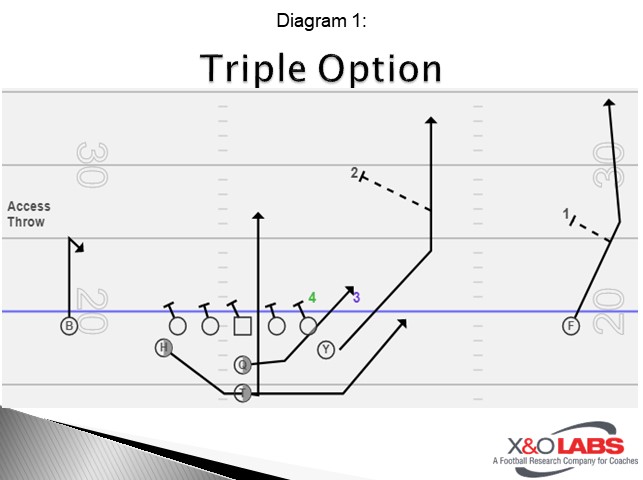
Some of the position labelings in the following diagrams may be confusing.  We don’t use traditional X and Z designations.  Instead, we have Field (F) and Boundary (B) WRs.  Our slots (H and Y) can be running backs, wide receivers, or tight ends, depending on what we are trying to do. For the purposes of this article, we will refer to the slot who goes in motion as the H and the slot who is either the lead blocker for the Triple or the #2 Receiver in the PAP concept as the Y.


The Triple Option

We have taken the Air Raid’s 3-Day Install plan and fit it to our offense.  The 3-Day Install provides focus during training camp. For those not familiar with this model, we basically install our offense in 3 days as the name would suggest. We then go back and repeat our Day 1 Install on Day 4, adding formations and tags to certain concepts each time we go through it.  We repeat our installation process three times before we begin specific preparation for our 1st opponent. Each installation has a set of skills that must be emphasized for each position in our offense, and this provides a roadmap for our position coaches as they plan their Monday, Tuesday, and Wednesday Indy periods during the regular season. On Day 1 we will install the Triple Option:

Diagram 1


Assignments:

PSWR: Elimination PS Slot (Y): Elimination Seam
PST: Gap Block B-Gap to PSLB PSG: Gap Block A-Gap to PSLB
C: Gap Block Backside A-Gap to BSLB BSG: Fan the B-gap
BST: Fan the C-Gap BS Slot (H): Sprint to Pitch Relationship
BSWR:  Access Throw QB/TB:  Triple Mesh


Our offense is designed to eliminate defenders from the point of attack and create space. Defenders are eliminated by blocking them, reading them, and/or deceiving them. Option purists will notice an outside-in count system, as opposed to the traditional inside-out Flexbone count. We’ve used both, but in the context of marrying the Triple with the PAP, it’s helpful to count the defense from outside-in, as the old Wishbone teams did. Our WR will eliminate #1 (usually the CB) by running a Fade. Y will eliminate #2 by running a Seam route. The QB is typically responsible for reading #4 and pitching off #3, but that can vary based on how the defense aligns and reacts.

Read More

Bracket Coverage Concepts From 3-High Safety Structures

By Jacob Gill
Defensive Coordinator/Safeties
Shiloh Christian School (AR)
Twitter: @Coach_JGill


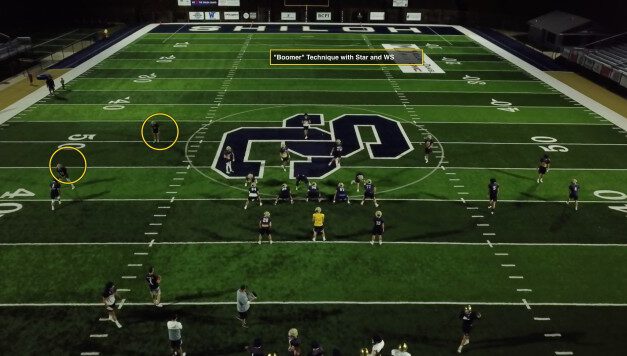
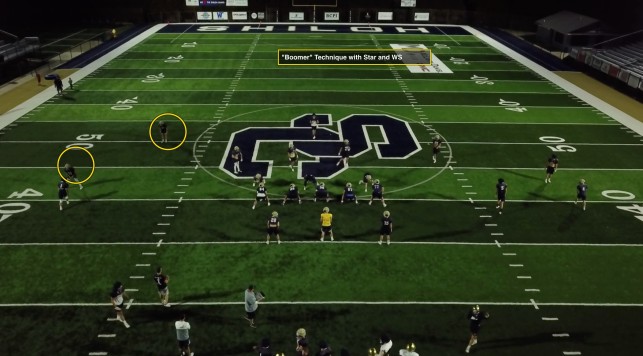
As you break down your opponents every weekend you start to see trends, concepts, and preferences from your opponent that you know you’re going to have to defend in the week to come. One of the hardest match-ups to equalize is when your opponent has a “go-to” receiver and they go to him… a lot. It’s hard to defend people who have an explosive player and even harder to do when they know how to get him the ball and they consciously find ways to get him touches. At times we will all play someone who has this type of player and will need to find solutions within our schemes that allow us to successfully defend this player without compromising the integrity of our scheme. In 2019 we saw a few of these players and this is how we bracketed those players.

At Shiloh Christian, we base out of 4 down / even spacing concepts but get to 3 down / odd spacing concepts quite often. Additionally, in the past few years, we’ve added to our 3 down concepts by using a 3-safety structure as well. We’ve modeled a lot of what we do based on what Iowa State has made popular in recent years and what one of my mentors, Adam Gaylor (@CoachAdamGaylor), has run successfully everywhere he’s been. We normally prefer this structure in long yardage, end of the half, and 2-minute situations, but at the tail end of our 2019 season, this became a base of sorts when we would play teams that majored in 10 personnel sets. From this came the need to figure out a way to be able to bracket another team’s best-receiving threat and still play good defense with our other 9 players. Here is how we used this concept in our second-round playoff game this year.


Front Alignment

We checked the front based on the offensive formation. If the bracket was to any 3 WR or 1 WR formation we were going to play our version of the “TITE” or “MINT” front (4i / SHADE / 4i). If the offense lined up in 2 WR formation to the side of the bracket we wanted to play outside leverage on the #2 wide receiver to the side of the bracket so we were going to play a shade/5 to the side of the bracket and a 4i on the backside. So, we gave a single front call with this coverage concept and our linebackers checked the front based on where the bracket was and how many other receivers were on that side.

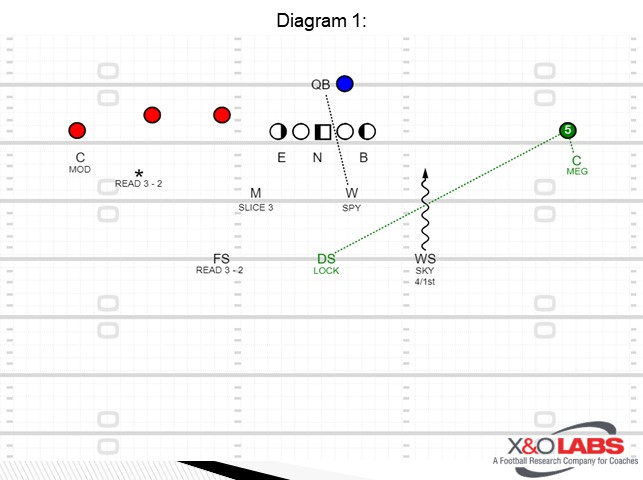
Diagram 1


“Lock” Defender:

We knew that our opponent was mostly a 10 personnel team and tended to put their best receiving threat to their left regardless of formation. We knew when we were wanting to “lock” their best receiver we were going to use our second-best corner and play outside leverage trail man while utilizing one of the 3-high safeties to play the inner half of the bracket. We knew their best receiver would be lined up as the outside receiver most of the time, but had he been aligned in the slot, we would’ve doubled him with our strong safety (*) and one of the 3 high safeties. We hadn’t seen him in the slot very much and hadn’t seen him run very many routes across the formation so we believed this alignment would allow us to keep the pre-snap integrity of our defense without tipping our hand by moving the corner to the slot.  In ‘Lock” the defender locking the Wr is not involved at all in the run fit.  His job is to cover the receiver and not worry about the run until late.  The defender doubling the Wr should remain inside and on top of the Wr at all times.  

Read More

A/B Gap Divide Runs vs. Odd and Bear Fronts

By Mike Kuchar with Brian Gabriel
Run Game Coordinator/OL Coach
Monmouth University (NJ)
Twitter: @CoachGabeMU


The split zone and insert zone concepts have proven to be effective concepts against Even front defenses because of the presence of a B gap bubble somewhere along the front. This allows for a clean release for the backside Tackle to work to the backside linebacker in split zone concepts.

Diagram 1


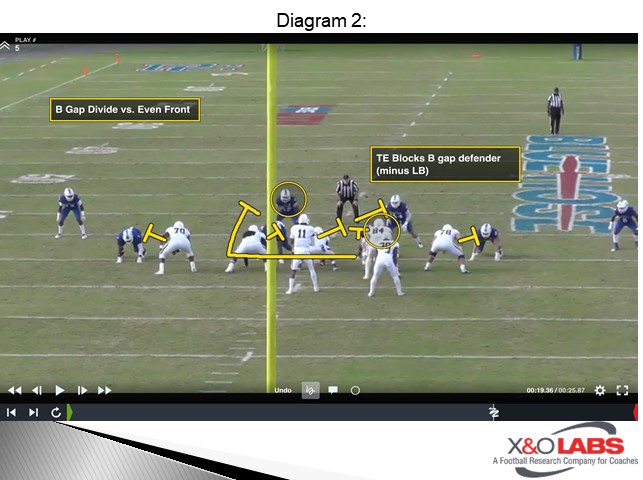
It also can provide for a cleaner entry point for the tight end in zone insert concepts.

Diagram 2


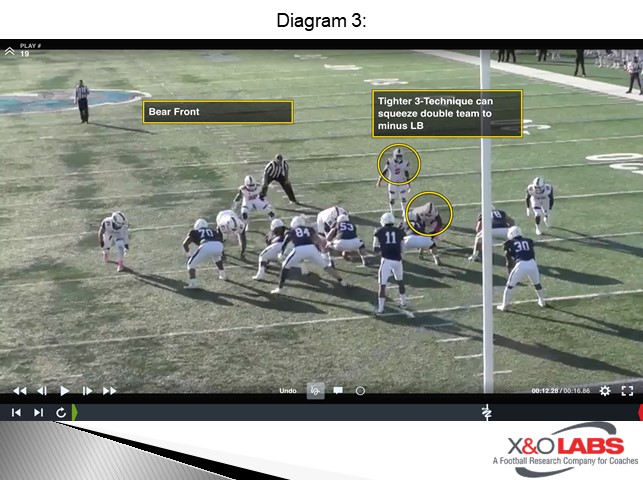
But the increasing popularity of the Bear front has placed a great deal of pressure on the backside B gap combination block in tight zone runs. Often times, the backside Guard cannot find his way to backside linebacker because of a heavy 3-technique that can squeeze the combination block.

Diagram 3


And the Bear front is a prevalent early down defense for good reasons- it draws double teams off zone and gap concepts in the run game and becomes nearly impossible to create movement along the run box. So, in order for offenses to get traction in the run game it becomes vital to split the front at the seams. And perhaps the best way to do so is by using some form of A gap divide principle, or better known as the “Wham” concept. While Monmouth University calls it “Able,” it has been a productive add for the Hawks this season, tallying a 7.6 yards per play efficiency.

The concept is built off tight zone by dividing the backside B gap or A-gap defender, rather than the C-gap defender most common in divide zone schemes. “We feel like we needed another way to divide the defense, rather than having the backside Tackle/Guard cut off the B gap,” said run game coordinator Brian Gabriel. “So, we divide at the 3-technique rather than the 5-technique. Some of the A gap divide worked us as well. We wanted to change the divide point from split flow zone and change who we’re cutting off, particularly against blocks we’re having trouble with.”


Concept Installation

Like most inside zone teams, Monmouth University uses three different concepts in its base A gap zone installation and has the ability to insert the tight end on the front side or on the backside of the concept based on the tag. Often times, it becomes a check at the line of scrimmage.

Below are three tags Monmouth uses off its tight zone scheme. In each of these concepts, the backside is locking or “fanning” away.  

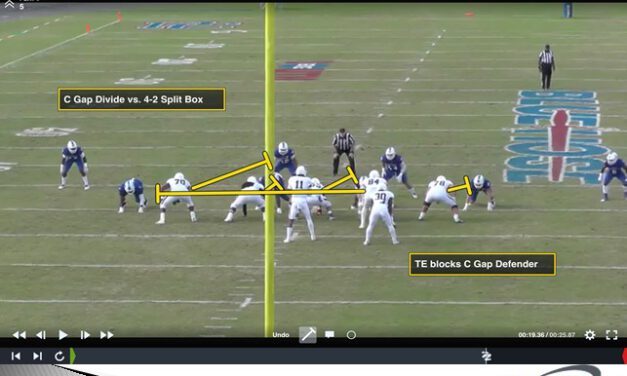
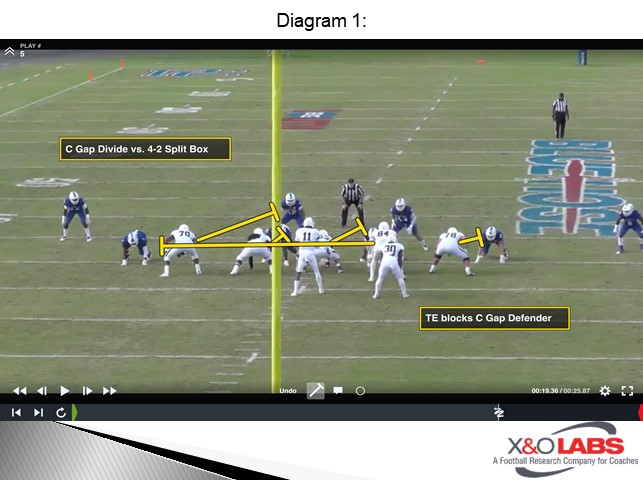
“Easy”: This is a C gap divide concept. Tight end would come across the ball and kick out C gap defender. This is the most common form of divide zone.

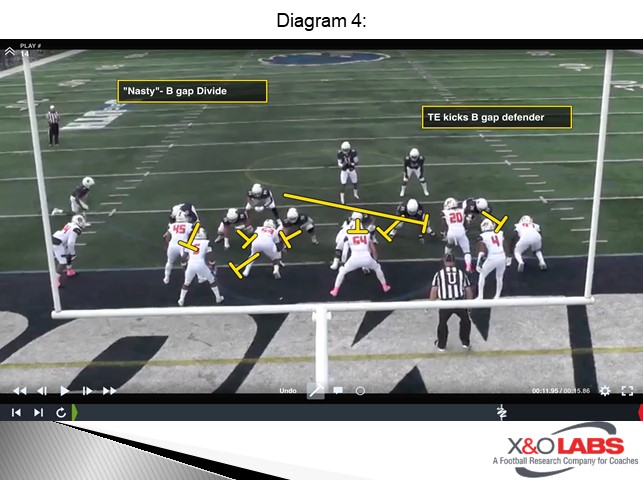
“Nasty”: This is a B gap divide concept where the Guard takes his best release to the minus linebacker and the tight end will block the 3-technique defender. “This became a bear check for us,” said Coach Gabriel. “We prefer it to the 3-technique because that is the best release for the Guard. Good against Bear and Under fronts with 4i techniques”

Diagram 4


“Able”: This is an A gap divide concept where the tight end will block the A gap defender weak, which can be the Nose in Odd fronts. According to Coach Gabriel, it’s a solid fix if you can get a tell against Odd outfits that move the Nose post-snap, but may be more of a challenge against the two-gap technique Nose. “One of our opponents this season were crossing the Nose so the Center was disciplined enough to keep going play side and the tight end would block the Nose,” he said. Many defenses are not true Odd teams with movement so you can live with it. We tell the Center to block him like he’s coming to your gap. If he disappears go and the tight end will insert.”

Read More

QB Power/Flare RPO

By Virgil Romer
Offensive Coordinator
Shoreham-Wading River High School (NY)
Twitter: @CoachRomer


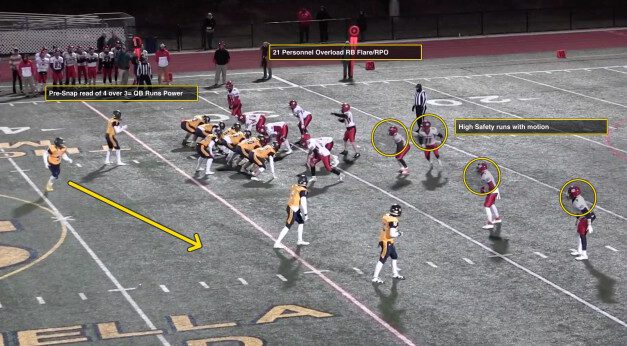
At Shoreham-Wading River High School, we employ a run-heavy offense built on a foundation of inside zone, power, and counter. Because of this, we see many packed boxes and Cover-0 looks throughout the season. Around the mid-season mark, we were looking for ways to add some wrinkles to the offense that brought big results and required minimal learning for our athletes. During one of our post-game film sessions, our head coach Aden Smith – the man who deserves the credit for introducing myself to the concept – brought up the idea of running a QB power paired with a flare-motion by the RB – The QB would make a pre-snap read of the playside-support defender (or any other adjuster) and either throw the flare or keep the QB power. This added wrinkle to our offense yielded large gains to our offense and helped us on our way to winning a Long Island Championship.


Overview:

Before beginning, I would like to mention that I am extremely fortunate to work with an incredible coaching staff – Head Coach Aden Smith, line coaches Tom Foley and Bobby Puckey, and running backs coach Nick Mauceri. This package I am about to present does not achieve the success it does without their hard work and input. 

We initially installed this concept to be run out of a 21 personnel-look with the fullback in the sniffer position and the running back offset-weak in the gun. Teaching it to our kids was very simple for us as we just combined two concepts we were already using in our offense. We had our line, tight end, and fullback block power, while the frontside WR stalked for the flaring RB.  While we didn’t stress it at first, we eventually had the backside WR run a slant route.


Coaching Points:


QB:

While some flare-type RPOs can be considered post-snap reads, we felt strongly about making this a pre-snap read. We were fortunate to have an incredible athlete at QB, and we didn’t want him wasting any time after the snap, in deciding if he should keep the ball or throw it. If he wasn’t sure as to what to do, he was instructed to keep the ball.

As mentioned before, we initially noticed that the defender that adjusted to the motion would “slow-play” the flare, almost as if to believe that we were never going to throw it. Of course, his slow adjustment would trigger our QB to keep the ball and sometimes get tackled by the adjusting defender. It’s important that the QB knows that there needs to be a full commitment by the adjuster to attack the flare – If the QB is reluctant to throw the flare when it’s there because he’s not sure from his point of view, instruct him too! The defense must respect the flare motion in order to open up the QB run.

The most important thing we had to do in practice (aside from reps) to make this concept efficient was practice our flare throws. During our special teams’ periods, we had our QBs throw flares to any kids who weren’t on the field during our special teams periods.  The amount of throws kids can get over the course of two five-minute periods is unbelievable if they are focused.


RB/Flare-Motion Player:

The flare motion must be run in a manner that puts horizontal stress on the defense.  We are looking to create distortions with our motion, just as you would when you run a full-speed jet-motion. This means that the flare motion should be run as fast as possible that allows the athlete to maintain the ability to adjust to and catch the football.  If the motion is too slow, the defender adjusting to the motion may be able to make the play on the QB if the QB keeps the ball – something that we don’t want to happen. The motion should also stretch as wide as the QB’s arm allows him to throw.


OL/TE:

Even though we are running a basic power with a fullback kick-out, it’s important to note that there will most likely be defensive flow to the flare motion, especially after you run the concept a few times.  At this point, you can take the approach of blocking power as if you were running power read – Prepare your pulling guard to possibly take a wider track to the play side LB, and have your double team be alert to the backside LB scraping to the play side a little sooner.  I will include some constraint plays towards the end of the article to help combat the fast flow of the defense in this case.

Read More

Using “Sticky” Alignment Techniques to Defend Gap Schemes

By George Karafantis
X&O Labs Board of Advisors
Twitter: @greek42e


Great defense begins with stopping the run. Defenses that are dominant will always be great against the run. This requires a strong front 6 that play sound, physical and fast defense. One of the most challenging run schemes that great offensive rushing teams possess are gap scheme runs. For the sake of this article we will focus on defending these gap schemes. Gap schemes will include Guard pulls, Tackle pulls, G and T pulls as well as any combination of OL / Back pull or wrap blocks.

The modern gap schemes are run from traditional under center, shotgun and/ or pistol backfield sets. They utilize pullers at the point of attack that can be lineman or backs. They come from play side or backside or a combination of those. Some are run from one back or two back, others from empty. As defensive coaches we understand that offensive structure changes fits however, I believe that there are five simple steps and/or requirements that a defense must follow in order to help themselves stop any and all gap runs.

The first step a defense should incorporate to help defend gap scheme is to employ a sticky defensive line.

“Sticky” DL

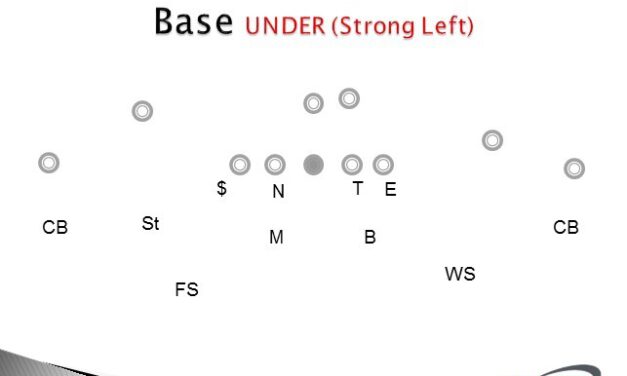
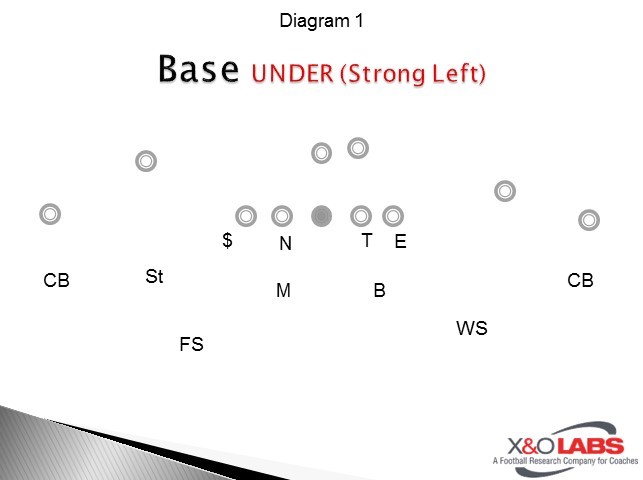
Any great run defense with have a strong front six in addition to a back 5 that is not afraid to get involved in the run game. Defense comes down to ability to align properly, desire and effort, and position integrity. Defending gap scheme is no different. We base out of an even front with our DL playing “sticky” to the OL. This sticky alignment helps our front four use their hands against an offensive lineman. This is a critical prerequisite to controlling the line of scrimmage. We have four DL that, ideally, will include two physical DT’s, a hybrid type DE/OLB type and a fast/disruptive DE. We call these positions a Stud (Strong End), Weak End (DE), Nose (Strong DT) and a weak defensive tackle (DT). Our base and most utilized front is an under front shown in diagram 1.

Diagram 1

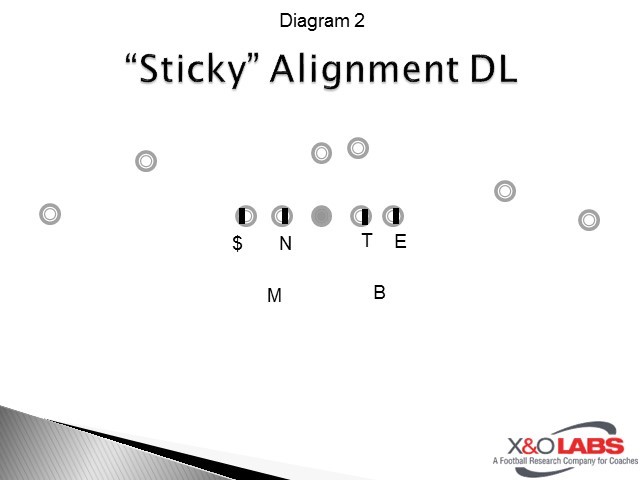
Some successful defensive coordinators swear by utilizing penetrating and disruptive DL that aim to attack gaps and cause havoc through penetration, we DO NOT. We use the stud as the primary disrupter and allow him to play with slightly more freedom when it comes to alignment and responsibility. All other DL are taught from day 1 to be “Sticky” to the OL that they are aligned on. This means heavier alignment on their physical key. The sticky nature of alignment is to help them use their hands, which is a requirement of any defensive linemen we play.

Diagram 2

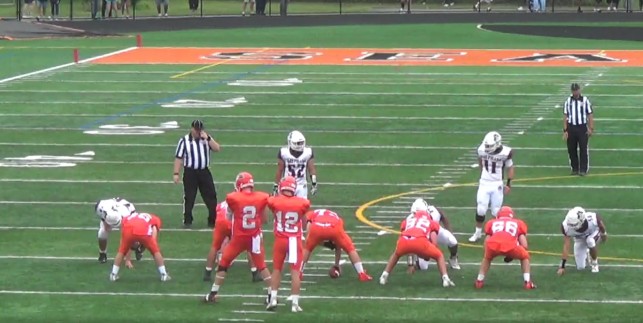
We tell our DL that their nose should align with the OL’s outside number on their jersey. We utilize both right- and left-hand stances and their stance depends on the alignment technique. A simple rule we tell them is, whichever hand is closest to the man they are aligned on, goes down (3 pt stance). Diagram 3 is a screenshot of our sticky alignment with the strength being to the offensive right. 

The $tud is the strong DE to the right. He is allowed more flexibility with alignment whereas the other three DL are more head up or sticky. The weak end on the left is slightly wider than I would have liked here and can be even stickier. The tackles are almost head up, but not quite.

Why Sticky?

The thought process for having stickier defensive linemen is that our aggressive and physical get offs will disrupt the down blocks that are synonymous with gap scheme. Because of the closer proximity to the OL that they are aligned on, they could prevent a clean “release” of the OL onto another DL or second level defender. This is done with hand placement and extension against their physical key.

From the offensive line perspective, they will also make the back block, by whoever covers for the puller, much more difficult to execute. We want to reduce the size of gaps that the offense thrives on. Stickier, aggressive and physical DL play helps with this. We bend one, or both of our ends, so if they see a down-block they should be flying down the line of scrimmage and if the OL is slow to pull or have tight splits, the backside bending end can factor into a front side power or counter.

To study game film of this concept, click on the video below:

Read More

Installing the Choice Package in the Pass Game

By Jim Glover
Offensive Coordinator
Centennial High School (TN)


In the Run and Shoot one of the first things we try to establish is the threat of the QB rolling and throwing to the field. At the high school level, this is a great way to put your playmakers in space. However, defensive coaches soon realize what you are doing and commit defenders to the field. The “Run and Shoot’s” answer to that is to be able to throw to the boundary.

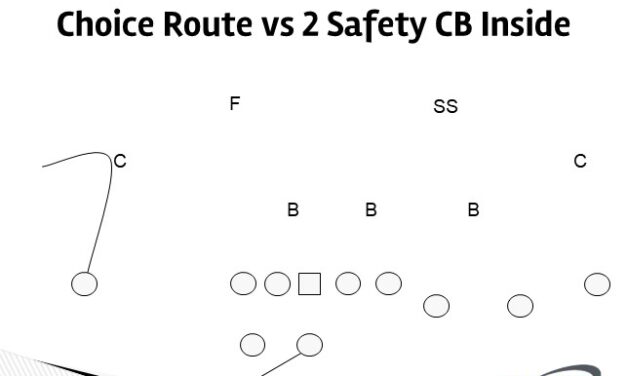
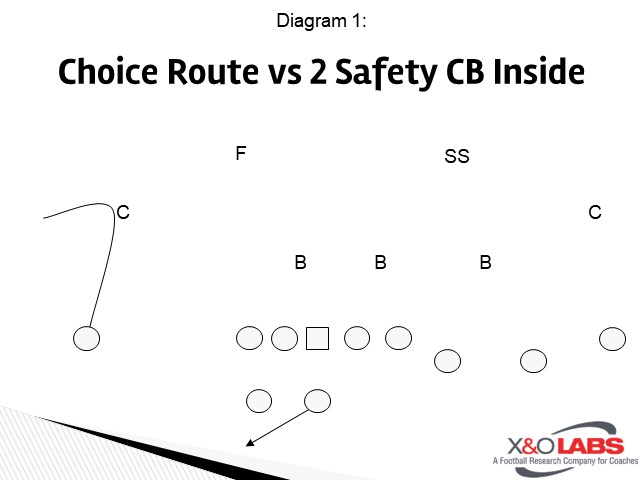
One of the first package of routes we put in to accomplish this is the “Choice Package.” In the traditional Run and Shoot, this would come from a 3×1 formation with the single receiver to the boundary. (Our “Choice Package” also gives us the ability to run it from a balanced set as well as putting the single receiver to the field.) As the name of the package intimates, we give the single receiver a “choice” of routes to run based on the coverage/leverage of the cornerback. Properly read by the WR and the QB, it puts us in the correct play without having to check to another set of routes. The backside or three receiver side will also have its own set of reads.

When we start teaching this route, we want to teach it versus the coverage we will see most often. For us, that is a two shell. After identifying the safeties, the receivers and quarterback will scan the under coverage for the leverage and locate open spaces. The single receiver seeing two safeties could possibly get a cornerback with “off inside leverage, off head-up to outside leverage, press inside leverage, or press head-up to outside leverage.” Each of these would designate a different route the single receiver could run.

Off coverage to us is defined as more than six yards cushion. When we get off coverage, we instruct the receiver to run a seven-step stem at the leverage of the cornerback. (If the cornerback has inside leverage, we want to run a stem that has a slight inside angle. The same would be true if we see head up to outside leverage. His stem will have a slight outside angle.) We do this to create more space for the route we are going to run. The seven-step stem ran at full speed will put the receiver around 9-12 yards deep.


Speed Out Concept:

For a CB that is off and has inside leverage with two safeties, the WR will run a “speed cut out” on his seventh step. (We do not want him to drop his hips or chop his feet.) This is done to maximize the timing of the route with the QB and take advantage of the spacing created. The quarterback seeing the inside leverage will also know the WR is running an out and will throw the ball at the top of his drop. The ball should be on the way when the receiver comes out of his break. (We execute this in practice and in our warm-ups enough that the QB and WR get a feel for the timing.)

Diagram 1


Skinny Post Concept:

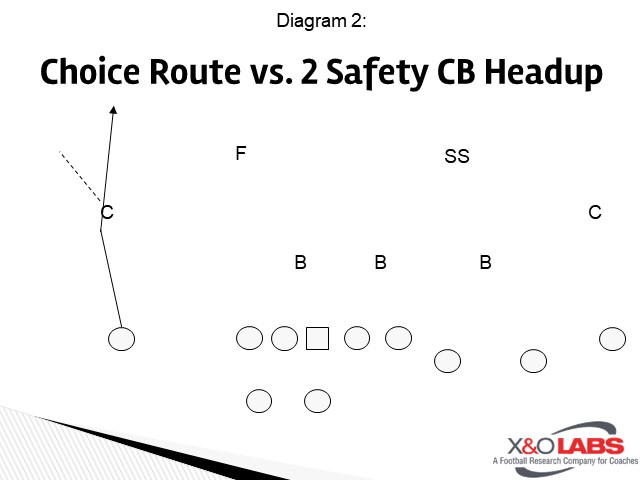
If the QB and WR see the cornerback is in an off—head up or outside position with two safeties, we are now thinking skinny post. We will attack the CB with the same seven-step stem with a slight outside angle. On his seventh step, if the CB is still head up to outside, he will now break off his outside foot and get inside leverage on the CB. This is not a dramatic break to the middle of the field. We want the WR to get inside position and never cross the hash mark. (As a coaching point, the WR must feel comfortable with a defender running on his hip. Some WRs will run away from the defender putting them in closer proximity to the safety.) The farther he can stay away from the hash, the more room the QB has to place the ball.

Diagram 2


To study game film of this concept, click on the video below:

Read More

Multiple Pressure Concepts from Double A Gap Front

By Adam Gaylor
Defensive Coordinator
Jenks High School (OK)
Twitter: @coachadamgaylor


From Jimmy Johnson’s Philadelphia Eagles and the Chicago Bears defenses of the 2000s to Mike Zimmer and Jim Schwartz, the Double-A Gap/Split Mug front has become extremely popular in modern football. A favorite on 3rd & long situations, it gives the offense the illusion of max blitz but gives the defense the flexibility of max blitz, zone pressure, max coverage, or the use of simulated pressures.


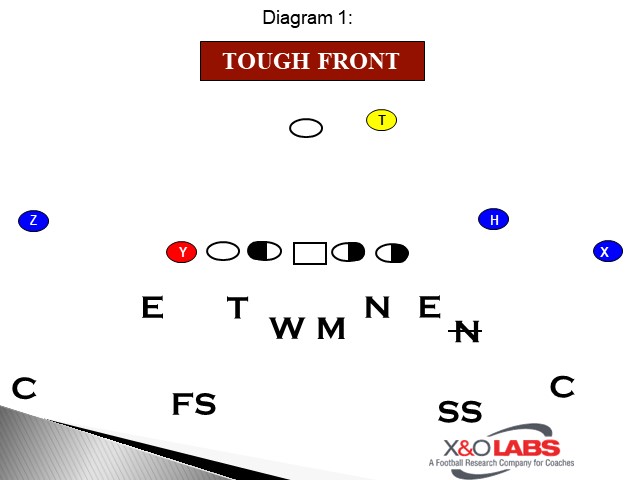
The Double-A Gap front is our “Tough” front, most often utilized during 3rd & 7+ down and distance situations. This front is played with two wide 3-techniques and the ends are in wide 5-techniques or 9 techniques. The Mike and Will are “mugged” into the A gaps showing pressure. Based on coverage responsibility, we like to “Hollywood”, or give the illusion of blitz, with the Sam/Nickel and the FS. 

Diagram 1


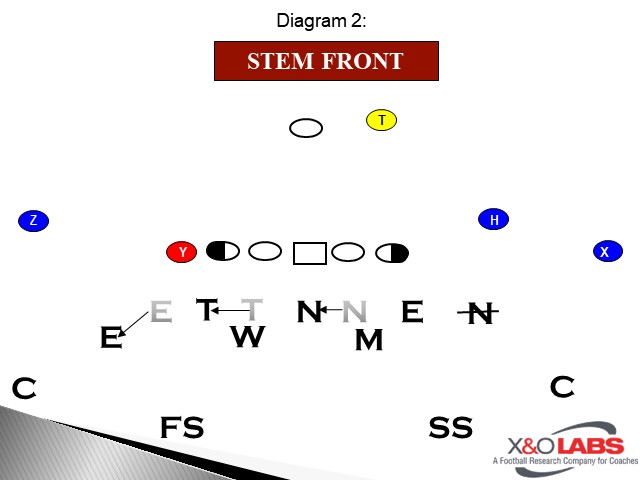
The adjustment to the “Tough” front is to move from a “Tough” front into a 3-4 front; the call for this is simply, “Stem”. By doing this, the defensive front knows to align in our “Tough” front and then on the “Move” call from our Mike, move into our 3-4 pass rush front or our “Falcon”

Diagram 2


“Addy” Pressure:

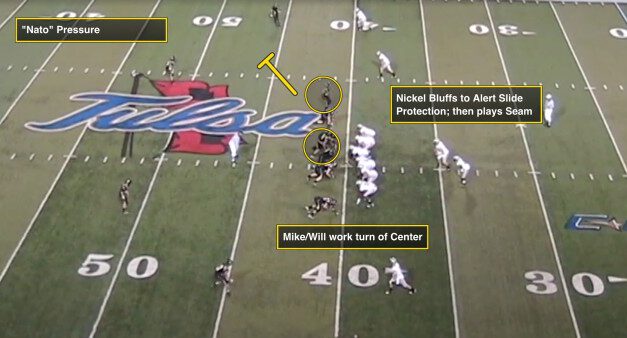
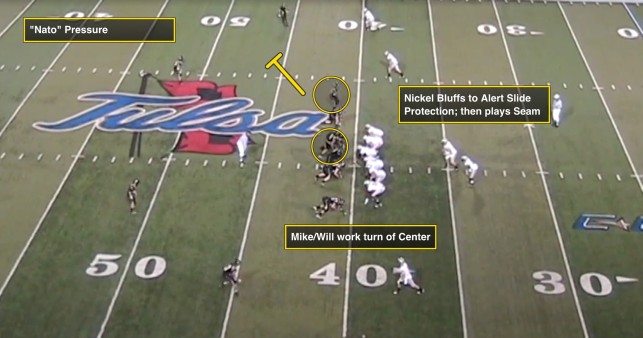
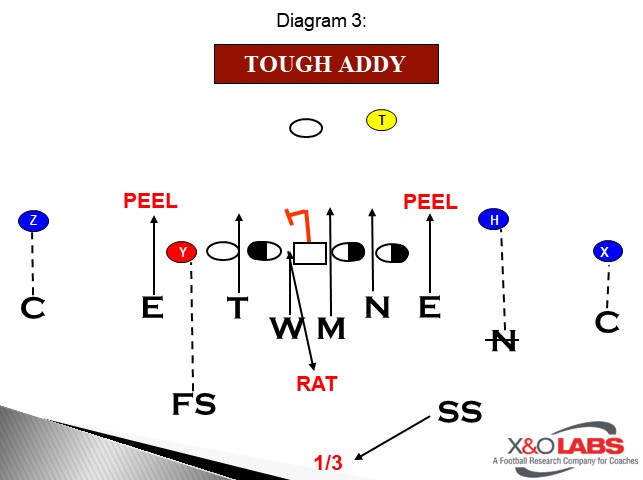
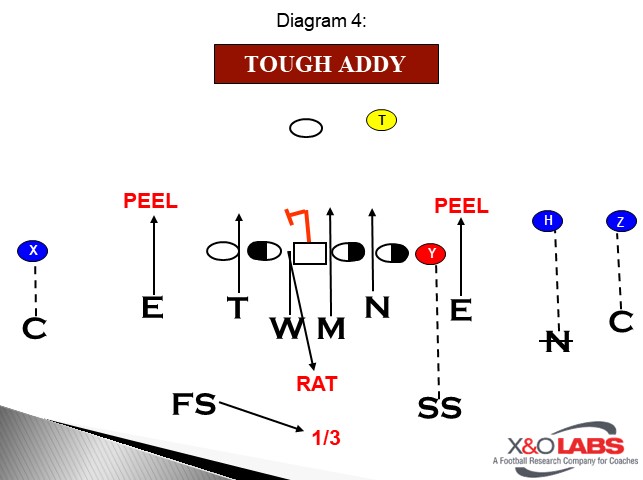
The first pressure installed in the Tough front is “Addy”, or Double-A Gap blitz. Cover 1 is usually played behind this blitz, but “Hot” or 3 deep 2 under can be played as an alternative. “Addy” can be utilized as either a blitz or a simulated pressure. “Addy” is first installed as a simulated pressure. In this case, the Mike and the Will both blitz their A gap; both read the turn of the center. Whichever way the center turns, that linebacker will “dent” or drop out and become the “Rat” player or low hole cut player.

Diagram 3

Diagram 4


Any normal split by the inside receivers or the Tight End, outside leverage will be used by the inside cover guys. When this occurs, one of the inside linebackers becomes a “Rat” or low hole player. Blitzers are taught that they are all responsible for the coverage on the running back. Blitzers need to understand to “peel” if the RB flares/swings out of the backfield and will “Bury” the RB when he remains in the pass protection. If we “Bury” the RB, we want to engage him and drive him back to the QB. By doing this, we prevent the possibility of the RB releasing out into a screen.

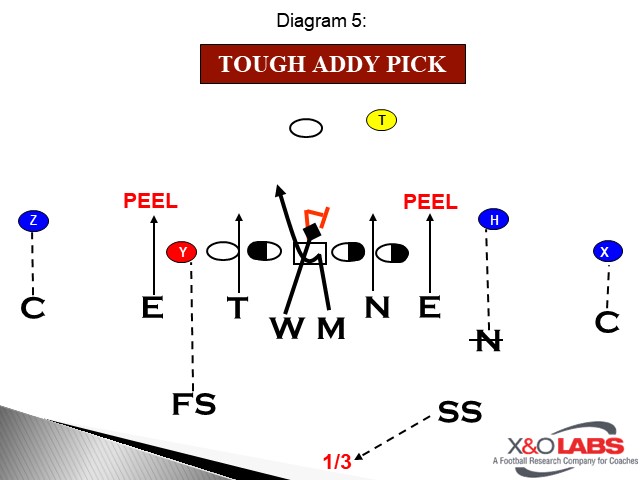
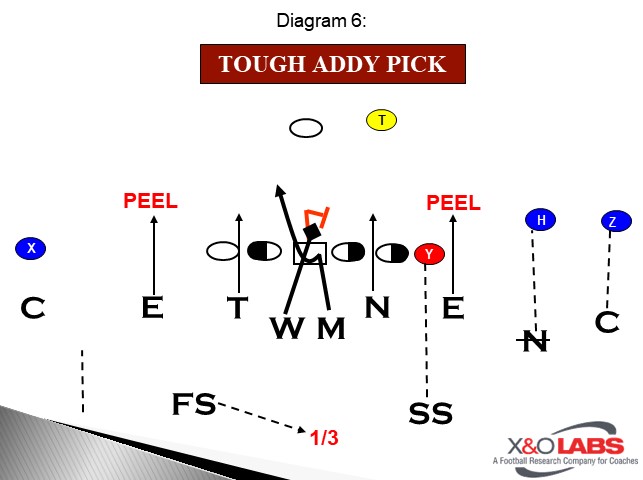
The alternate blitz pattern of Addy is called “Pick”. Pick is similar because the blitzing inside linebackers will still read the turn of the center. However, with “Pick”, the LB away from the turn of the center will “Pick” and work through his near hip. The LB to where the center turns will wrap tight from the picking LB, like a defensive line twist or game.

Diagram 5

Diagram 6


To study game film of the Addy Pressure, click on the video below:

Read More