
Six Pressures from the Mug Double A Gap Look

By P.J. Gibbs
Defensive Coordinator/DB Coach
Palmetto Ridge High School (FL)
Twitter: @coachpjgibbs


At Palmetto Ridge our defense has a lot of influences from many coaches from levels all of over the country. 1st and foremost my high school head coach at Manasquan High School Vic Kubu has his imprints all over our defense. Coach Kubu has 11 state titles on his resume as an HC and multiple when he was the DC under Coach Warren Wolf at Brick HS prior to Manasquan. Coach Kubu taught us to be fundamentally sound and to keep things simple. That is why we have these multiple pressures from the same look to keep it simple for our players. My Defensive Coordinator Pete Cahill, Don Reid and Linebacker coach Jay Price at Manasquan echoed the same principles that Coach Kubu taught all of us in his system, influenced by Coach Welsch at UVA especially. As time went on I started to pick up more pressures and coverages from Coach Don Brown at Michigan and also having the opportunity to speak with Coach Chris Partridge, Coach Devin Bush Sr. and Coach Anthony Campanile to really help make the connections with what we wanted to develop into as a defense. We want to be aggressive, have multiple pressures, play fast and physical but remain fundamentally sound in what we do, everyone has a job to execute for our defense to be successful.

We will discuss 6 of the 15 double A gap pressures that we run at Palmetto Ridge. We really like the fact that we have so many out of the same look because it allows us to audible if need be but also our opponent has to prepare for all of these each week because we will run a majority of them but week 4 of the season as we get into district play. I will discuss each one against 10 personnel, but if you have any questions regarding any other type of personnel please contact me and I will help you out as much as I can. All the pressure are from our Hudl playbook, the 1st blitz is our Clemson blitz.
 

“Clemson” Pressure
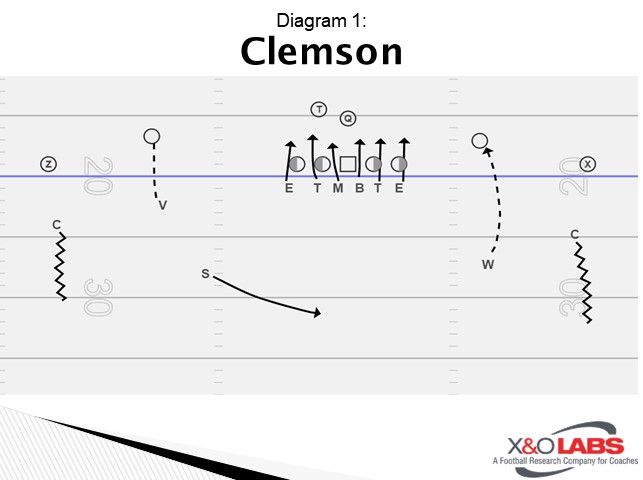
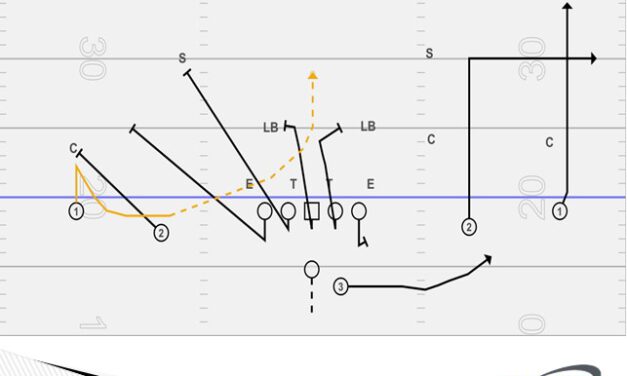
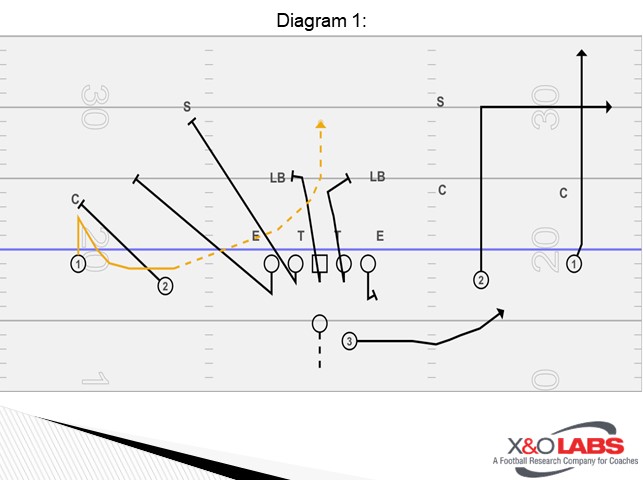
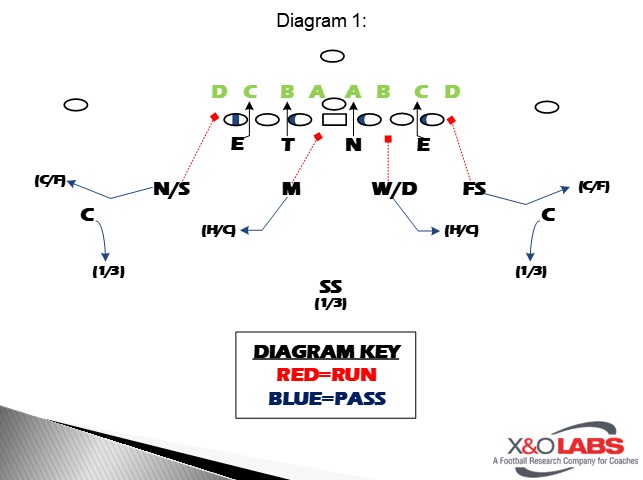
Diagram 1


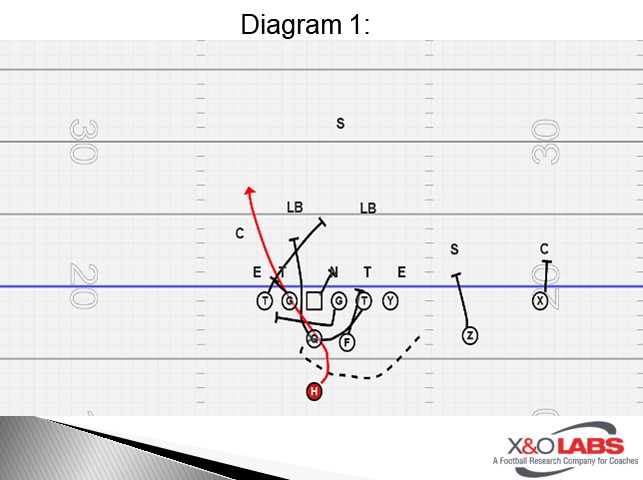
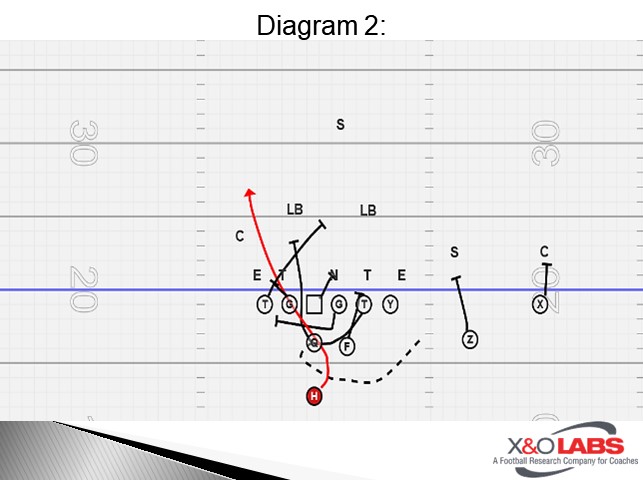
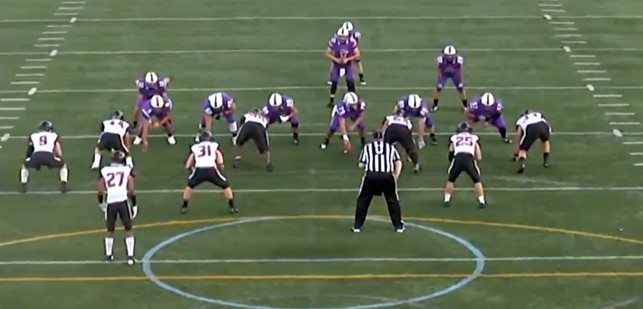
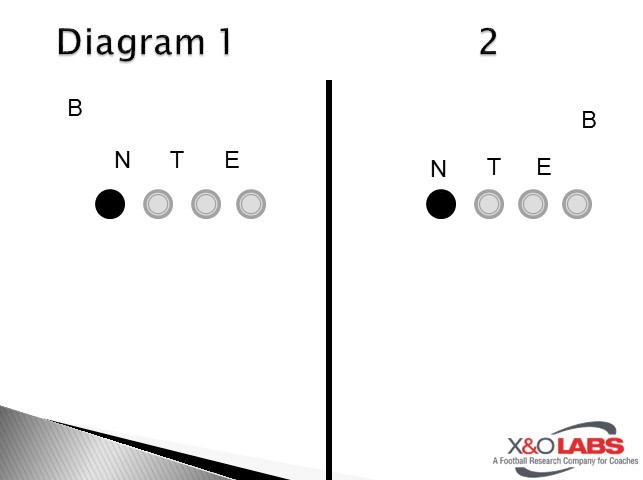
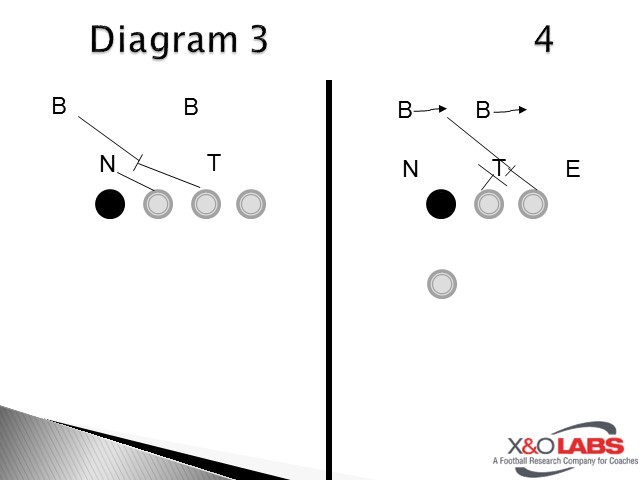
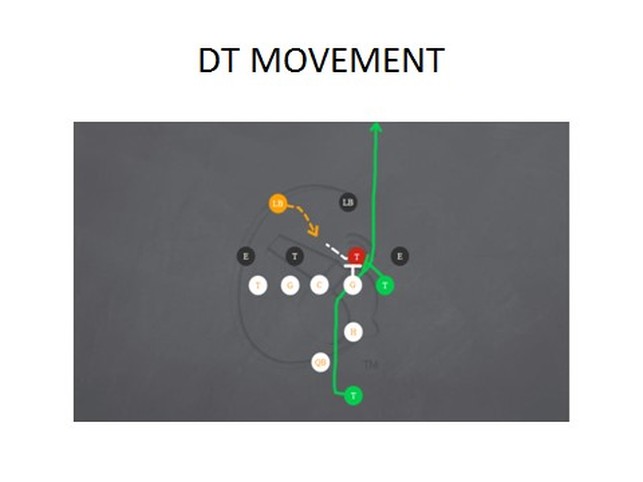
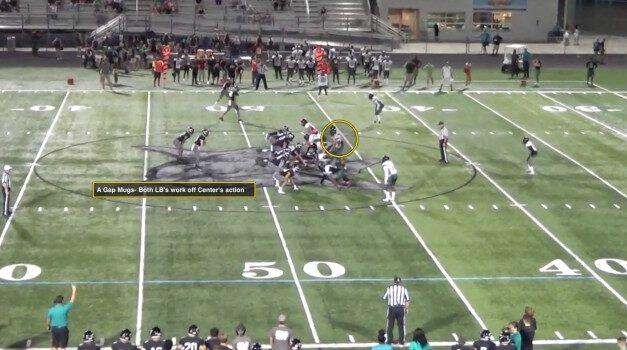
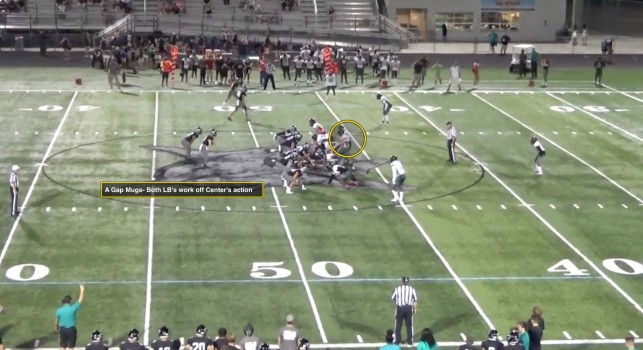
We have both inside LB’s mugged-up, two 3 techs and two 5 techs. This blitz is really three pressures in one, the biggest coaching point I can give you is to look at the blocking schemes and tendencies of the O-line. Our coverage behind it is usually man-free or Poach coverage depending on the route combo’s we breakdown on film. We always start in a two-high look and move on the snap to give the QB a pre-snap open middle read. Man-free is self- explanatory, if we are sending six but playing man free the defensive ends or wide rushers must be schooled on running with the swing of the back.  In our Poach coverage, we start in a Two High shell with the corners press/bail into 1/3’s, the Safety away from Viper comes down on the snap and works inside #2 to Flat- the Viper has same responsibility to the other side. Safety to the Viper becomes the Middle of the field player if we are playing Poach, we are essentially playing cover 3 but out of the press/bail look.

To study game film of this concept, click on the video below:
Read More

Using the “FAT” (FB+Tackle) Double Team to Block 4i’s in Gap Schemes

By Sanders Davis
Run Game Coordinator/Offensive Line
Catholic High School of Baton Rouge (LA)
Twitter: @sdavischs


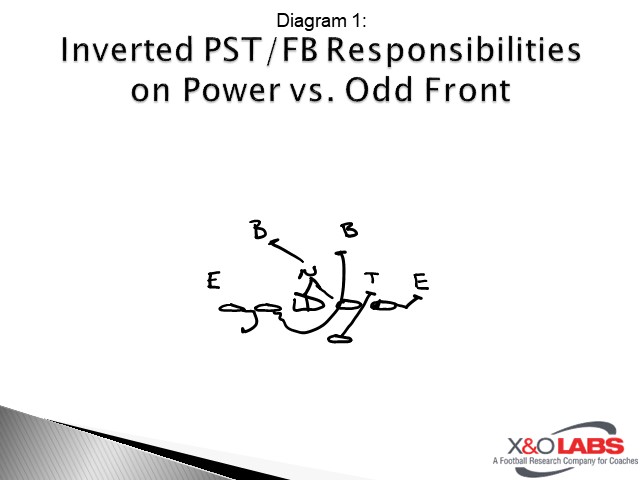
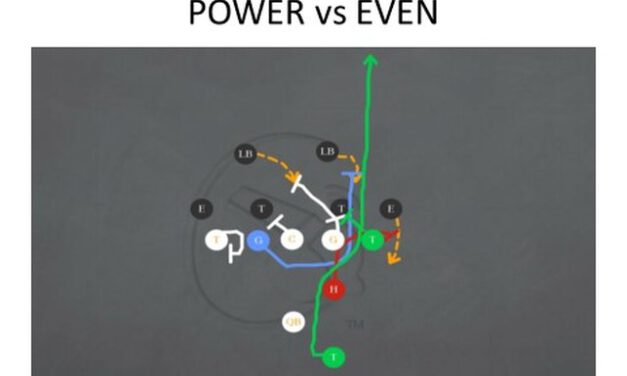
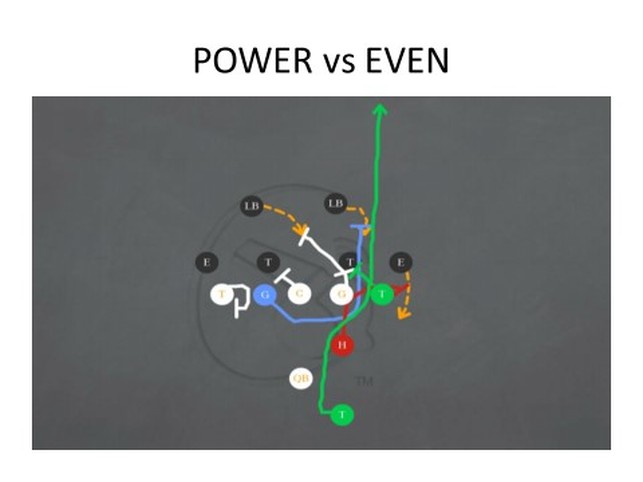
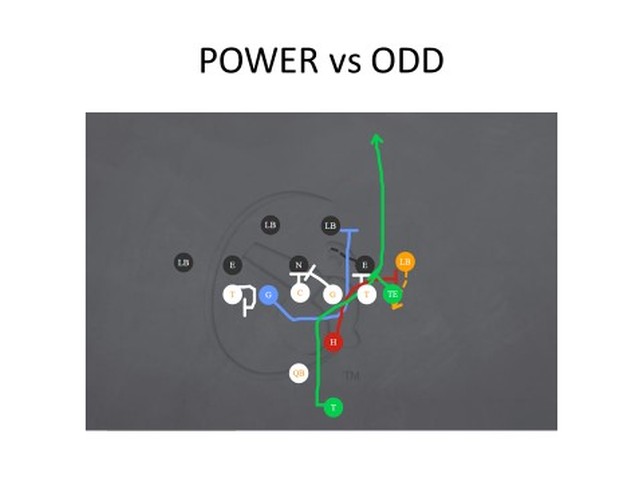
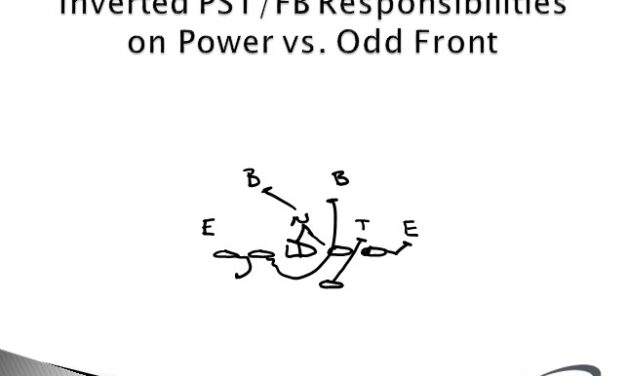
Over the past 4 years, our primary run play at Catholic High has been Power. On average, we have run the play 100+ times per season and averaged 7.4 yards per carry. However, in the 2017 season, our yards per carry on the play reduced. After studying our season, we realized that we significantly struggled running Power to odd fronts, specifically those that aligned their defensive ends in 4’s or 4i’s, and we needed an answer – we certainly weren’t going to stop running Power against these looks. After much trial and error, our outcome was an unconventional double team involving the H/sniffer or fullback and the play-side tackle; we refer to this technique as the FAT (fullback and tackle) technique. Notably, we removed the need to win a 1-on-1 battle at the point of attack. This minor adjustment was possibly our most influential and innovative tweak to our run game this year.


Editor’s Note: This report solely focuses on the development of our Fullback/Tackle double team. For more information on how we teach power against odd front, including our center-guard double team, you can find the following article written by our head coach, Gabe Fertitta on X&O Labs: Cardinal Double Team Technique in Gap Schemes


Trial-and-Error (Potential Answers):

Our first attempt to solve this issue of running A-Gap Power against odd front involved switching the responsibilities of our fullback and play side tackle. Instead of the tackle blocking the 4 or 4i and the fullback kicking the edge defender, the tackle would work out to the edge defender and the fullback would kick the 4 or 4i. We felt that we could potentially widen the 4/4i with the tackle’s movement allowing the fullback to kick the 4/4i with inside leverage. While this technique works well against teams that play the tackle’s shoulder with the 4i or play a static front, we found that this technique was not resilient against front movement or 4i’s that simply play the B-Gap.

Diagram 1


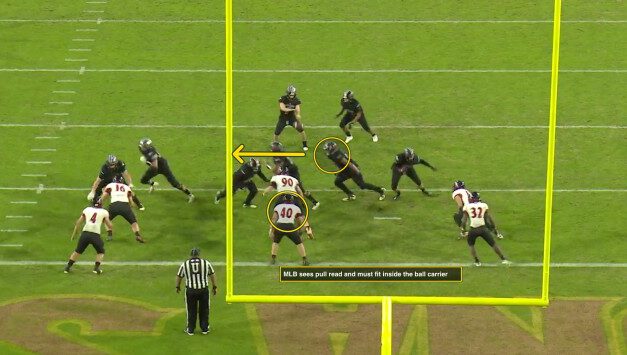
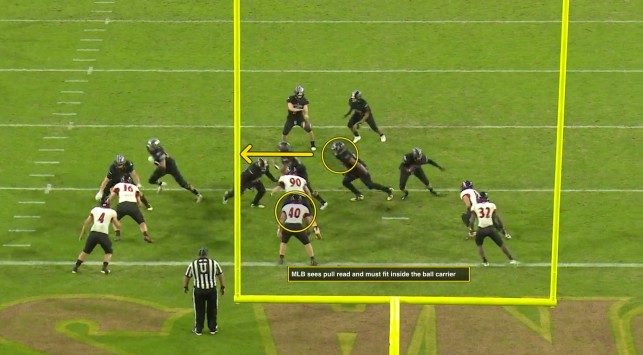
Clip 1: Notice how the exchange of responsibility between the fullback and RT allow for inside leverage on both blocks. This change allows us to maintain the A-gap and run our ideal track for power.

Read More

LB Rules and Fits in a 3-High Safety Defense

By Ryan Desrochers
LB Coach
Liberty High School (AZ)
Twitter: @CoachRDes58


Iowa State took the coaching world by storm this past year with their 3-high safety, 4-man box version of the 3-3-5 defense. One of the first questions that are often asked is “how do you stop the run with only 4 in the box?” After running a very watered-down version of this defense in our two biggest games of the 2018 season, our head coach decided to fully invest in this defense. As a result, we went to Iowa State to learn from the source.

One of the most important aspects of this style of defense is putting your personnel in the best possible positions. Your personnel needs to be strong right down the middle of the defense. Your defensive lineman who demands a double team on every play is your nose guard, any pass rush ability is a bonus for this position. Your best linebacker at reading/ most disciplined needs to play the middle stack backer because his job is to force the ball outside to others if he does not make the play himself. Your best football player needs to play the middle safety, he will be asked to trigger on run plays, play underneath zones on the pass, play deep thirds to deep halves on other pass plays, and play man-to-man coverage on slot receivers. Your second-best middle safety type player should play your outside backer to passing strength/the field. On any given play he will need to spill fullbacks and offensive lineman, play up on Tight Ends and set and edge, fight off blocks from slot receivers and be able to play man-to-man coverage on slot receivers within the same series. As far as secondary goes, your personnel can be predicated on what coverages you plan on calling during the game/season. We base out of a modified Cover 2 system, so our corners are slightly more athletic linebackers due to having primary run responsibility. Our safeties are usually very athletic ball-hawking type players who do not have primary run fit responsibilities. One of the key points in writing this article is that we are a 3-man front, 4-man box, 3-high safety team, not a team that runs this defense as a package.


Coaching Points:

One of the benefits of our system is that the techniques that we teach as our base do not change regardless of alignment. It does not matter if you are aligned in a 5 tech, 3 tech, 4i, 2i, or a Shade, the technique and keys will not change for our defensive line. For our linebackers, their techniques are a simple as understanding if you are a box linebacker or outside the box linebacker. For our secondary, the coverage will dictate who is our force player and who is our ‘hang player.” For simplicity, we will say that our corner is our force player and his read is the end man on the line of scrimmage. The “hang player” is responsible for anything that happens late of the snap, he will not trigger on the run until the ball crosses the LOS.  The wild card to all of this is our middle safety who can be used to fit wherever necessary which can clean up and wrong fits by the front.

Before addressing the specific reads of the linebackers in this scheme, it’s important to detail other players responsibilities as it all fits in.


Defensive Ends

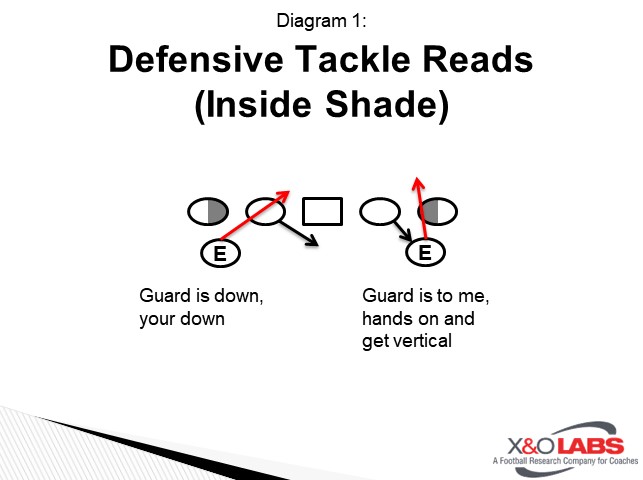
Attack your shade, read the adjacent OL toward the ball

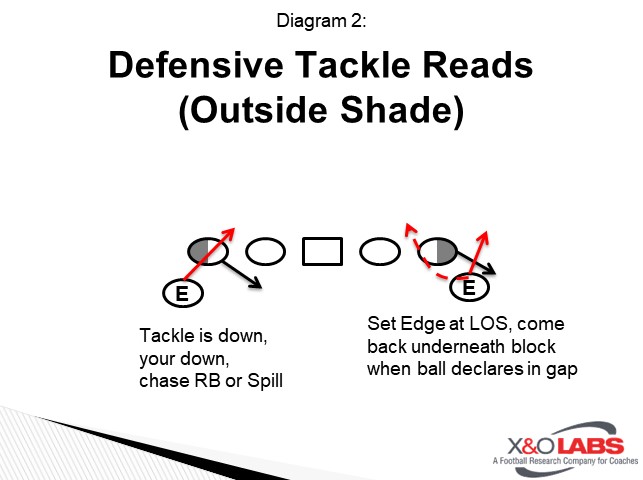
  • If the adjacent OL comes to you, take your hands off your shade and violently attack the man coming towards you. A key point to this is to keep your shoulders square to the line of scrimmage and push the OL towards the ball condensing the hole/gap. You can cross face into the gap when the ball declares into the gap. If they are running zone to you, we want to cut the zone off right then and there.
  • If the adjacent OL work away from you, shuffle, keeping square, and work to the hip of the OL going away from you. If you are still engaged with your shade, such as a double down block, and you see a puller, get vertical and try to pick it off. If your shade is working down and you are in a 5, you will need to spill any blocks coming back at you in any gap scheme (counter/power).
  • If your adjacent OL pulls towards the direction of the shade, like Pin and Pull or Buck Sweep, rip off your shade and get to the upfield hip of the puller, then get flat. We get to the upfield hip to avoid getting pinned by the down block.


Diagram 1

Diagram 2


Nose

The nose is the defensive lineman that plays a shade technique the least. If he is head up on the center, he will bridge explode into the center, trying to get a good knockback. After he will read the block coming at him. If the center stays square and gets help from a guard, he will attack the crease between the two defenders while having control of the center with his hands. If he gets zone where the center is trying to work away from him, he will play fast and keep the center and the backside guard working towards him, playing on the front side of the zone and allowing the middle linebacker to play fall back.


Linebackers

As a Linebacker, inside or outside the box, you will see 3 types of run blocks: zone, down, and pull. On any base play, our linebackers will have one of three jobs, edge setter/spiller, inside fitter, or Counter/Boot/Reverse (CBR) player. The linebacker with run action towards him will be the edge setter/spiller, the middle backer will be our inside fitter, and the backer with the run action away will be our CBR player. (NOTE: there are times when we allow our backer away from flow to be fast flow towards the play but that is dependent on secondary call or gameplan)

Read More

“Rub” RPOs to Defeat Man Coverage

By Rich Holzer
Head Football Coach
Mount Saint Joseph High School (MD)
Twitter: @CoachRichHolzer


Here at Mount Saint Joseph HS, we as a staff adapt our version of the Gael Attack to what our personnel dictates every year. However, one of our newer concepts just installed this year, developed off a similar concept developed after much film study of the University of Hawaii’s offense during the off-season. We have seen a large uptick in the number of man coverages to combat our RPO game or not allow us to threaten defenses vertically. We were looking for answers and found what we refer to as our “Rub” concept. We use this concept to counteract those teams who try to play us in 1 high to stop the RPO or 2 high man to negate our vertical pass game.

Diagram 1

Diagram 2

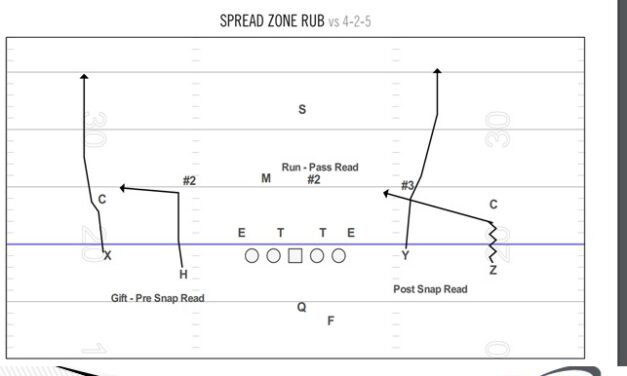
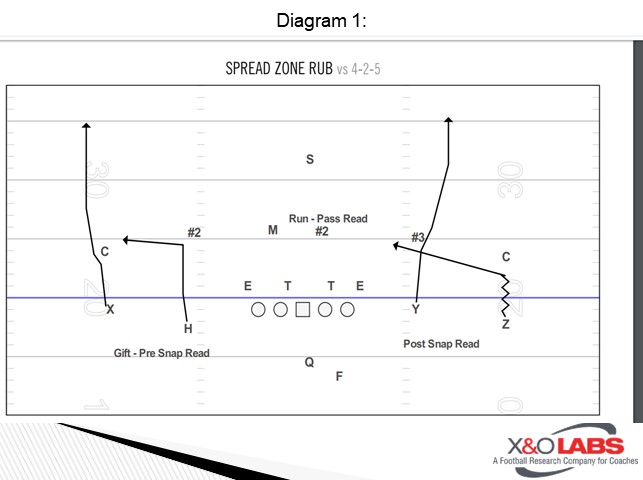
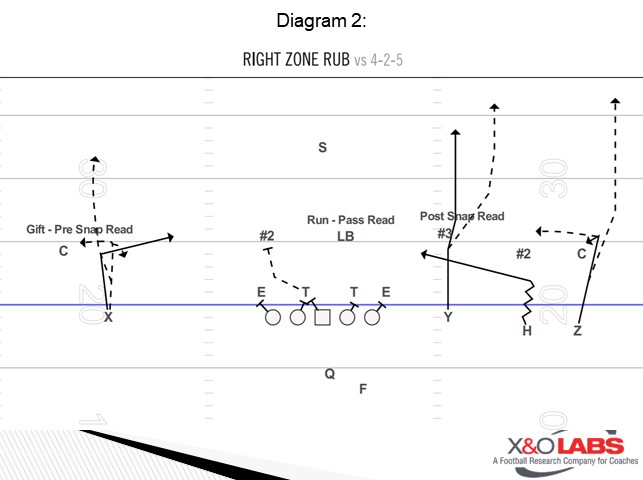
The “Rub” concept is a very inexpensive way to threaten a defense with the RPO and has answers for both zone and man coverage. Our preference is to run it out of 3×1, but we can run it from 2×2 as well. From 3×1 we place the single WR on a “Gift” and the “Rub” to the field. Out of 2×2, we place the “Rub” on one side with a quick game concept to the other.

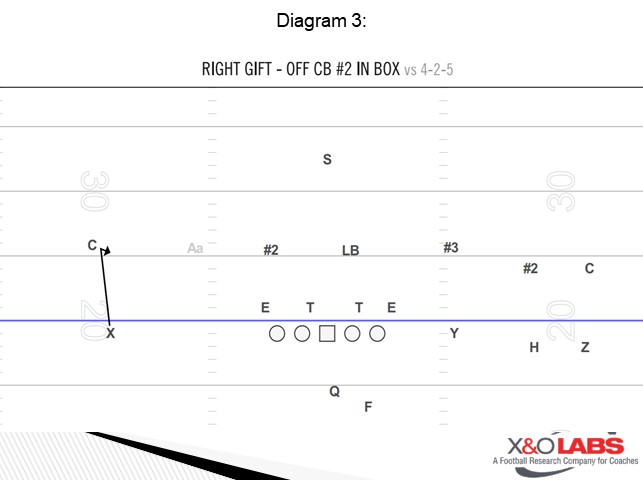
Diagram 3

Out of 3×1, we place the single WR on what many refer to as the “Gift” throw. He runs a 6yd Hitch by default but can convert to a Fade, Quick Out or Slant based on CB depth and LB leverage pre-snap. We do not post-snap adjust the “Gift” unless we are running the Fade and the CB press bails. In this case, we look for the back-shoulder throw.

To the 3-receiver side, we are running our “Rub” concept. The assignments are as follows:

#1 – Hitch Read: Push to 6 slam your foot and turn. If they press convert to a fade. If it is a tight man from an off position, roll corner or a buzz Alley player situation break inside on an “Under” route that does not cross the hash. 

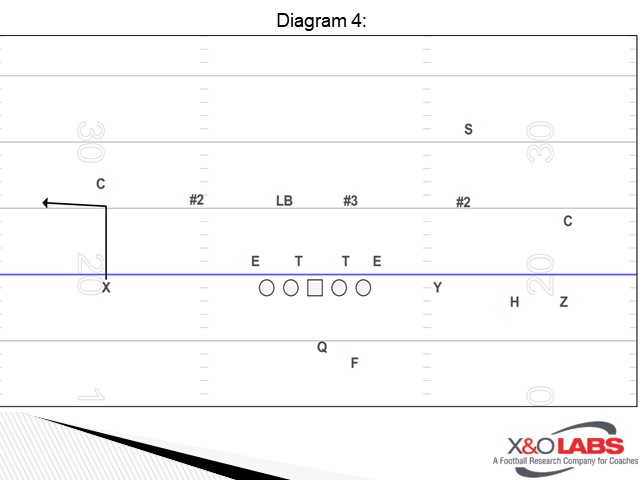
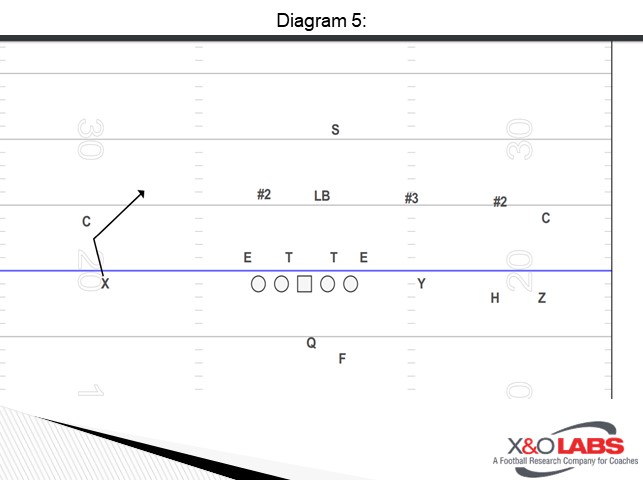
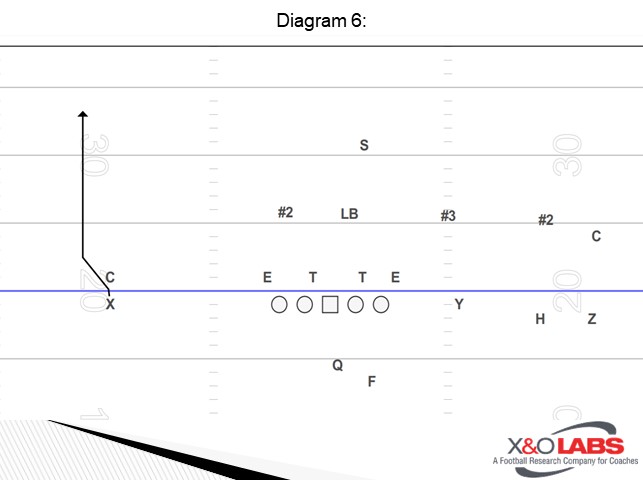
#2 – Rub: Delay-off the line. We teach our WRs to attack the leverage of the cover down defenders and use his reaction against him. We spend a lot of time in our passing game in general teaching WRs coverage, leverage, etc. He will use a delayed, “skippy” release to technique to set the defender up for the “Rub” and to turn his hips as well as freeze his feet. After we break hard inside on an angle off the butt of #3. We like to stay as steep as possible to keep us away from any inside LBs reacting to the throw.

#3 – Seam Fade: Our #3 will force the outside release on the cover down with speed. His job is to attack and run through the outside shoulder of his defender, clear his hips, then turn his head for the ball. It is very similar in technique to our route on our Go concept, which is a version of the old Run and Shoot concept.

Diagram 4

Diagram 5

Diagram 6

Our QB is trained to view this the same way every time we run a 3×1 RPO regardless of run concept or RPO attachment. I “borrowed” this from Coach Pat Murphy at Rhode Island. We tell our QB “Find 2, Find 3, Run the Ball”. What this means to him is to look at the single WR. Where is #2 from the boundary is, he in the box or is he out. If he is in, throw to the single, can hand signal adjust the route. If #2 is out of the box, we ask ourselves the following questions:

How far?

How deep?

Can he affect the route?

If he “kills” the single WR we move on to finding #3 to the 3 WR side and his relationship to the #2 man. After that we ask ourselves similar questions about #3 starting with is, he in or out of the box? If he is out of the box, we have a 5-man box that dictates hand the ball off. If he is in, he becomes the “give/ pull” key.

If #3 gives us a pull read, we and we pre-snap read #2 and 3 in man or 2 high zone we are going to take the “Rub”. If #3 gives us a pull read and pre-snap #2 is up with 1 high, we peek the man over the seam before throwing the “rub”. Sometimes we catch the defense in 1 high and the man over #3 cheats to jump the “rub” resulting in a big play to the seam.

Lastly, we always keep a close eye on how the defense is playing the #1 field side. If they are playing off, we will remind the QB in-game about the field side hitch. If they are pressing and we like the matchup, we take a shot. If it is man, we check to see if we can tag #1 on an Under route and have the QB read Rub to Under like our Levels drop back concept. However, this is a long throw so it depends on our QBs arm whether he can make that throw.

To study game film of this concept, click on the video below:

Read More

Defending Hot Reads and RPOs from a Cover 2 Structure

By Mike Harrison (Athletic Director/Head Football Coach)
and Roy Salas (Assistant Athletic Director/Secondary Coach)
Holy Cross High School (TX)


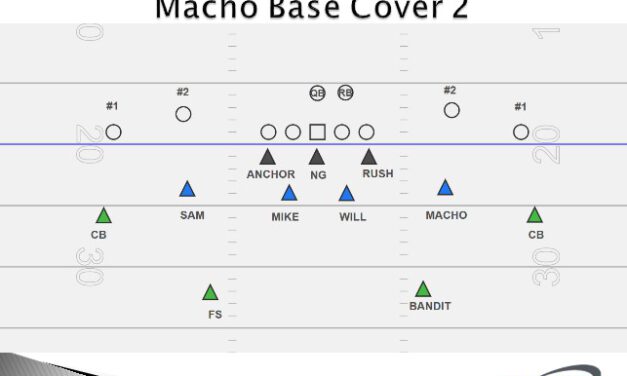
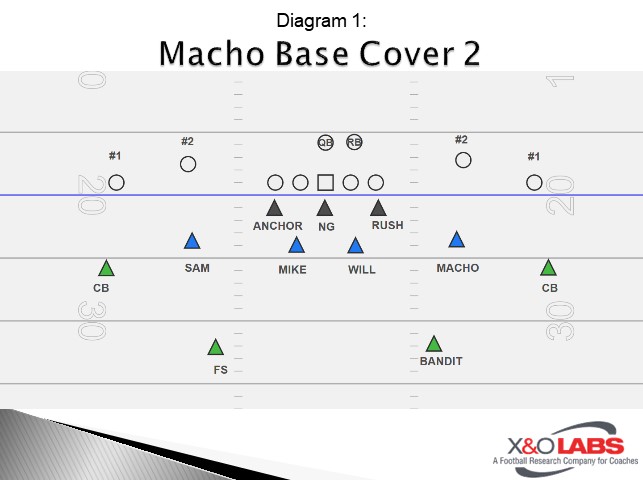
At Holy Cross, we believe in a gap control odd front with a cover 2 shell as our base defense.  This allows us to disguise our stunts and coverages and puts our athletes in, what we believe is, the most advantageous position to be successful.  From this base, we can be multiple in all aspects of defending our opponent.  Our base coverage is a cover 2 concept with a pattern read to defend both run and pass. Here is a diagram of the base alignment.

Diagram 1


The two outside backers we call Sam and Macho.  They are very important components of our scheme.  We will begin by teaching our outside linebackers our basic stance and the base squat technique.  This technique places them in a hook to curl responsibility vs the pass and outside-in leverage vs the run.  Our basic stance is two point with feet slightly tilted; with outside foot slightly ahead of an inside foot.  Our eyes are inside on the QB, with shoulders square to the receiver/LOS and keeping our nose over our toes.  They are responsible for QB on an option and have second contain responsibility on outside pocket passes (sprint out or bootleg).  We teach them the ABC’s of alignment and read progressions as outlined below.

Squat Technique: Used by outside linebackers when in hook/curl responsibility.

Depth: 5 yards from LOS, if there is a TE, HB or tight slot, they are 1 x 1

Alignment: LEVERAGE is defined as an ability alignment, but it begins as a nose to eye relationship and moves directionally.  this goes by seam leverage: If the receiver is inside the seam; outside leverage, If the receiver is outside the seam; inside leverage. 


ABC Alignment Rules

“A” alignment is against a tight end, H-back or tight slot.  Align 1 x 1 outside and read the helmet of the tight end or H-back. If the helmet goes outside-treat as a hook block.  Maintain leverage with the inside shoulder to outside shoulder of the tight end, always keeping the outside free. If the helmet is inside-squeeze the LOS and look inside for potential misdirection or QB read plays.

If the helmet goes vertical-open hips to the receiver and jam with the outside arm.  Then collision route and carry to a depth of 12-15 yards before turning over to the safety.


Trips alignment is over #3

“B” alignment is if the inside slot receiver is 8 yards or less to the end man on LOS.  Align nose to the inside eye of the slot receiver.

“C” alignment is if the inside slot receiver splits over 8 yards from end man on LOS then apply the APEX rule or also known as the ½ way rule. This states that my depth will correspond with my width (simply put if the receiver is 10 yards from the OT then my alignment would be 5 yards inside the receiver and a depth of 5 yards) Trips alignment is over #3; follow “B” or “C” alignment rules

Single receiver-based rule is SINK (align APEX to single receiver) and run responsibility is switched to pitch/contain


Safety Technique:

Our read technique is to key the QB level to the #2 receiver (#3 in trips); buzz feet at the snap

“QB to me”: We define this as level one action which means the QB is giving any down the line action to my side or level two means the QB is giving off the line action to my side. Here, we will check receiver for run/pass intent. If the receiver drives to you to block or tries to hook the defender will lock out his arms, keeping shoulders square to LOS (NEVER shoulders turned), keeping eyes inside for the ball, fighting across the face of any block; never going under the block.  Remember the OLB is responsible for QB on option.

If number two blocks down on an inside defender, he must replace while maintaining outside leverage; squeeze the hole outside-in.


Quail Technique:

If the receiver releases for pass route, he must collision the route.  If the QB breaks pocket on sprint out or bootleg; then he must release the route and become second contain on the QB.  The inside LB will now have to replace the OLB on the hook/curl responsibility.  Part of our basic defensive unit work is that when the QB moves outside the pocket then the zones will move with him.

We call this Quail technique: Check the BSG for run/pass intent.  Based on the backside guard the OLB will do the following:

BSG zone away: Play the cutback

BSG pull to: Outside edge player (DO NOT RUN UPFIELD—THIS WILL TAKE YOU OUT OF THE PLAY—BE PATIENT)

BSG pull away: Take a pursuit angle

BSG pass set locate the backside route and collision, DO NOT CHASE

Read More

The Complete Unbalanced Run/PAP Menu

By David Buchanan
Head Coach
Mercer County Senior High School (KY)
Twitter: @ChiefSmoke10


Unbalanced lines have been a big part of our offense for 27 years for several reasons. But, the most significant of the two:

1: Our rival at Paris HS (1992-1995) was Coach Roger Gruneisen’s Bourbon County team and they played Cover Zero in their base defense. An unbalanced line gave us an extra man at the point of attack while also putting the FS in man coverage away from strength, who was covering our TE. That gave us a net gain of at least one player and if they aligned improperly, two players.  In fact, our base goal line & short yardage set we still use in 2019 is an unbalanced power I that we created specifically for Bourbon County’s defense. 

2: Studying Homer Smith’s Manual’s on football, I became obsessed with numbers, the defense’s ability to get defenders across the midline, and the ability of a defense to “fit” on multiple sets…. sets that were unbalanced and unconventional. 

Our overwhelming tendency is that we will run to strength because defenses struggle to fit to it and get numbers across the midline. But we have developed a way to attack the weak side that has been successful when defenses are able to do both above. 

The unbalanced line also gives us a chance to maximize the use of our best players at the point of attack. On the 3-man surface, we can utilize two offensive tackles and our best guard to have a great run surface. A concept I stole from Coach Alvis Johnson at old Harrodsburg HS in the ’80s is to go unbalanced and put two studs (Shon Seibert: TE & Jim Pittman: OL) on the weakside/ 2-man surface side. Watch the defense slide to strength, then hammer them to the weak side with superior personnel.


Weakside Counter Trey, Isolation, and Sweep

Our favorite play to the unbalanced side is a basic, gap down, off-tackle play. The entire offensive line blocks the inside gap. The fullback kicks out the End Man on the LOS (EMOL). My coaches have teased me about our multiple sets and say all we do is find a million ways to run off-tackle. They are correct.


Counter Trey 

To the weak side, this concept is a good complement/counter to our off-tackle play. The play side OL (Guard & Tackle or Guard and Tight End) will block their inside gap to the linebacker. The center will block back for the pulling Guard. If the Center has a 0 technique, he will post the NG before he blocks back.  The BS Guard will pull and kick out the EMOL. The BS Tackle will pull and “hug the wall”.  He will block the first defender he sees, working inside out. Generally, it turns out to be the play side inside linebacker. Counter Trey to the two-man surface is an A gap play for us. We want to collapse the A gap and have the TB run it tight, so we do not block the outside linebacker. Most of these coaching points come from good friend and former opponent, Leon Hart when he coached at Ashland Paul Blazer HS. Leon was also the OC at Eastern KY University for Coach Roy Kidd during their heyday. 

The fullback will block the most dangerous defender backside that is past the defender being blocked by the center. Usually, it is a 4 technique or wider. The 3rd OL to the unbalanced side will rip and try to get to the Free Safety and block him, usually. But his assignment can vary based on a weekly game plan issue.

Diagram 1

Diagram 2


To study game film of this concept, click on the video below:

Editor’s Note: Coach Buchanan provided coaching points for each of the video clips below:

Clip 1:  In this clip from practice, we offset the TB to give the defense a different look. We prepped this week for the BS ILB to run through. When the center blocks back, if he runs into a stunt, he must pick up the stunt, or if the ILB plays tight to the LOS.

Clip 2: The left OT gets good movement, allowing the TB to run the ball tight and in the A gap. We don’t have to block the corner who is out of the play.

Clip 3: We have a huge tendency to run off-tackle in this unbalanced set on the goal line. Counter Trey to the weak side is a good complement.

Clip 4: We have a huge tendency to run off-tackle in this unbalanced set on the goal line. Counter Trey to the weak side is a good complement.

Read More

Inside Out Read Methodology for the Curl Concept

By Eric Treske
Head Coach
Wisconsin Lutheran College
Twitter: @LUCoachTreske


Coaches across the country are looking for ways to steal easy completions in their passing attack.  Whether it’s perimeter screens, quick game or RPO attachments, it’s clear more and more teams are looking to utilize high percentage passing concepts to help control the box and stay on schedule.  Our offense is no different as we use those strategies to help open big-play opportunities and keep the whole playbook available to us.  When execution is on point, this is a great strategy.  The question for a coordinator is what you do when a team has a personnel advantage in the box and can still use underneath defenders to take away easier throws.

The easiest answer is to attack vertically; however, this is often a low percentage strategy, especially on obvious passing downs.  This means we as coaches are forced to address how to attack the intermediate areas of the defense.  While we have used a wide variety of great concepts to attack the intermediate areas (drive, shallow cross, mesh variations) we have found using variations of the curl have been a higher percentage option to help us move the chains.  Much of this is due to the nature of the throw.  When the curl works back to the QB out of his break, he becomes more of a fixed target. This can lead to more difficult opportunities for yards after the catch, but we feel the value of completing the curl is that it keeps the offense on schedule and opens up more vertical throw opportunities. We want the defense to decide if they are willing to give up plays underneath the last level defense or if they want to take it away and be more susceptible to big plays.

There are a ton of different ways we’ve implemented the curl that I will share in this article, but I think it’s important to understand the principle behind the concepts: reading the various curl concepts inside out.  This is a significant shift from the way I learned the concept as a young player and coach as many offenses look to put an immediate stretch on the alley (curl or flat) player.  While we agree that we can put that defender in conflict, we have found that reading it inside out forces the zone to expand more.  This forces the alley player to declare his assignment and gives the curl time to get to depth and hunt for space.  This also changes how you approach the route that attacks the flat.  In the outside-in progression, the route attacking the flat can become your primary route as teams will coach the all to gain depth and rally to the flat.  In the inside out progression, the out route essentially becomes a check down throw.  This allows us to get the ball to the curl more often and when it does get to the flat, we usually have more room for yards after the catch.


Installing our base Curl Concept


We install our Curl Concept from a 3-man surface. This is our home base as it gives us the most flexibility to vary the concept.  As we progress, we work to variations from a 2-man surface.  Since we progress the curl concept begins inside out, we teach it the same way so for us the Curl begins with the number 3 WR. 


Shield Route:

The #3 WR runs what we call a shield route.  His job is to get to the inside shoulder of the #3 defender (often the Mike) as fast as possible.  While we don’t coach the depth because it’s based on the defense, it usually is 5-6 yards.  He sets the windows of the zone.  For fast-expanding teams, he will receive the football early and often.  For slow expanding zones, he will hold the #3 expansion and create bigger windows for the Curl.  The shield route is also our “Hot WR” as he can immediately replace and interior blitzes/ fire zones.


Speed Out:

The #2 WR primary route is our 4-step speed out.  His job is to attack the outside shoulder of the #2 defender (usually a SS) and break hard on a 90.  If it’s man coverage he is a great option (especially in short-yardage or weekly matchups).  If it’s zone he is opening the curl window.  Since he is the last route in the progression, the out route can run himself into the sideline.  If this is the case, we teach him to face up the QB and gradually gain depth upfield.


Curl Route:  

The #1 WR runs the curl route.  We coach the curl to get to 14 yards and hunt back into the curl window as fast as possible.  Attacking the window is critical so we work hard on being efficient at the breaking point and accelerating to the open space.  Coverage recognition helps our curl runner as well.  We want him to be able to see if the #1 defender (CB) is a deep zone player or hard flat player.  This impacts his stem and where he anticipates the window of the curl.  Against a deep zone player, we work to sell vertical and gain inside leverage.  Against a hard-flat player (Cov 2 or cloud looks) we attack the frame, sell inside and shave throw the outside shoulder for a smoother vertical release. 


QB Reads:

Our QB begins the concept by going through his pre-snap checklist.  All our concepts are built to attack a numbers advantage with a strong, weak and box answer to the defense.  To make this happen it’s crucial that our QB goes through our 3-step checklist before the snap of the ball. 

Read More

Varying Alignments and Techniques for the Hybrid OLB in Odd Fronts

By Nick Davis
Defensive Coordinator & Defensive Backs
Rose-Hulman Institute (IN)
Twitter: @Spread_Defense


In our system, we have a hybrid linebacker that must be able to play on the line of scrimmage, play as a traditional linebacker, and play man coverage, like a safety.  I think our ‘Bob’ linebacker is much like what offenses are doing with 11 personnel and utilizing the hybrid tight end.  We want to find a tough, physical player that has many different skills and find ways to use his advantages all over the field.  We play with 3-3-5 personnel as our base.  Our ‘Bob’ linebackers have been high school safeties, linebackers or even undersized defensive lineman.  We are a one-gap defense that plays mostly one-high man coverage.  At our core, we are a field/boundary defense, but our Bob and his skill set allow us to set our front wherever our best matchup is.  We want to put this hybrid player wherever we think we can get a mismatch in the run game or on pass downs.  The way we set our front has nothing to do with how our defensive backs will lineup.   

For us the last 4 years, our ‘Bob’ has been one of the best players on our team. I also think if you need to hide a linebacker you do not want in coverage or at the point of attack, this could work for you.  We are looking for a fast linebacker that can create havoc with his pass rush from the line of scrimmage and linebacker depth.  This could also be a big, physical kid that does do a great job in coverage.  I think the best thing about this position is you can have different types of players on your team fill this role with different skill sets and still have great success.  We have had different types of kids, but in my mind, you are looking for your best box player that you feel can do a bunch of things.  This guy will be our 4th rusher most of the time.  The other two linebackers are a little more defined. We will bring our other outside stack linebacker “Mike” at times to keep people honest. He should be a nice mix between the ‘Bob’ and ‘Will’.  Our ‘Will’ is the most physical guy of the crew and he will stack the nose guard in our odd fronts. 


Categorizing Fronts:

Like I stated in my earlier article about our fronts, we use a category system for our fronts, in which the first letter of the word and the type of word will tell you how and where to align. The three-down fronts are all different types of birds.  Our four-down fronts are all different types of fishes. Five-down fronts are all different types of mammals. Our six-down fronts are different types of fruits.  We created a system where you can get the ‘Bob’ where you want him on every play.  If there is a bad right tackle, you can put your ‘Bob’ on him all game.  If there is a great tight end, you can put your ‘Bob’ away from him.  So, in our front names, we incorporated how we want to set the front.  One of our odd fronts is called Buzzard.  Buzzard is a bird, so we align in our odd front and sets our field defensive end and ‘Mike’ to the boundary and our tackle and ‘Bob’ to the field.  In all our fronts we find ways to put the ‘Bob’ to or away from the field/boundary, right/left, or running back/tight end based on our game plan.


Streamlining your Teaching:

Once you’ve found the right guy to be your ‘Bob’ linebacker and you know where to line him up, how do you coach this guy?  If you have a large enough staff, this guy needs a coach just like an offense would have a tight end coach. If you are limited with coaches like we are, your linebacker coach works him primarily, but he spends time every day with your defensive line coach. We run a 3-step drill with all our linebackers in pre-practice every day that runs through all the blocks they will see from the line of scrimmage and at-depth that week. The player takes the first 3 steps we teach based on what block they will see. We do this with all the linebackers because when we play our 5 and 6 down fronts, the ‘Mike’ or ‘Will’ has to play on the line of scrimmage.  We want to make sure they see every block they can see.  We have them, partner, up, so they get a full five minutes to work this drill.  We will do run drills with our linebackers and defensive lineman so we can get all the reps of the on the line of scrimmage work they need for the week.  As the coordinator, I must do a great job of making sure we are getting our 3, 4, 5, and 6-down fronts called in practice.  I want to make sure we are getting a similar number of reps between our 3 and 4-down fronts in all the drills we do, in case changes are made during the game.    

Read More

Varied Screens Through Simple Offensive Line Rules

By Matthew T. LemMon
Head Football Coach
Tamalpais High School (CA)
Twitter: @tamhighfootball


The idea behind all our screen concepts is that the Offensive Line will run their screen tracks the same way on each screen type, except our middle screen.  The idea behind this is to limit the amount of teaching to our offensive line and limit the input they must process before running their tracks.  The concept tries to create a funnel with lead blockers to attack a potentially weak piece of the defense to give the receiver a clean lane to the endzone.

Diagram 1


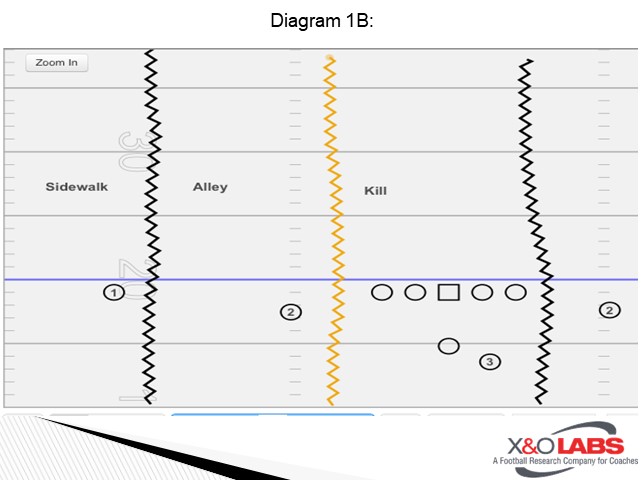
The simplest way to break down the process of our screen is by each position on the Offensive Line and how they process who they are to block and at what angle is most effective.  We will go through each position and then include how we teach and coach our middle screen concept.  We teach three tracks for the Offensive Lines, they are Sidewalk, Alley and Kill.  These three tracks will be explained throughout the article. 

Diagram 1B


Play side Offensive Tackles:

We teach our offensive tackles are coached to take two and a half kick steps (this can alter depending on the speed of the Offensive Tackles on your team, quicker guys may need to take three or more kick steps, while slower guys may need only to take one kick step – timing is everything) and throw their hands violently in an attempt to convince the defense they are indeed pass blocking. 

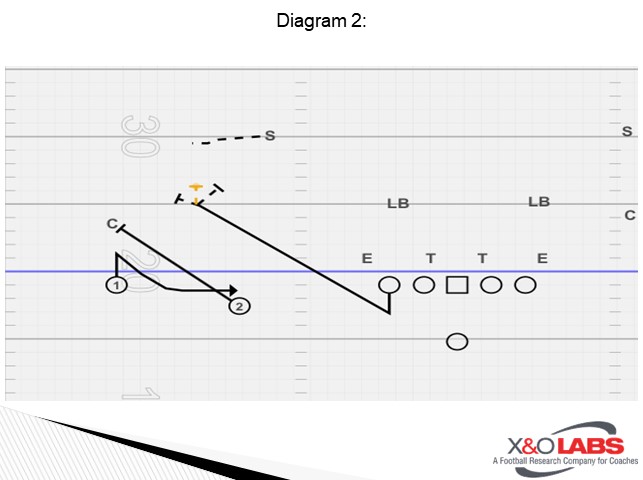
After these kick steps, they should look to attack what we call the “alley” – this is the area between the farthest defender and the hash.  Before the snap of the ball, the Offensive Tackle should identify the first defender in this area between the depths of 5 and 15 yards, so that we may know exactly who our aiming point is and how they might move to the play.  Usually, this individual is either the Overhang defender or the Safety to the side of the screen. 

Diagram 2


If we are dealing with a defender that is in-between the depths of 5 yards and 8 yards, our goal is to attack the upfield shoulder.  So, if we are running a screen to the right and the overhang is located at 7 yards depth, then we would attack his right shoulder looking almost to kick him out and ride him to the sideline. 

If we are dealing with a defender at a depth greater than 8 yards, our goal is to simply attack the middle of the defender, usually a safety, and force him to choose a direction and wall him off in that direction.  If he bananas greatly in one direction, simply basketball shuffle to help create the funnel.  


Play Side Offensive Guard:

The offensive guards will take one and a half kick steps and pump his arms as if he is pass blocking.  He needs to sell the pass block as most of the Linebackers in our league are reading the guards for their keys. 

After their kick steps, they should look to what we call the sidewalk, which is the farthest defender away from the offensive line and closest to the sideline.  Offensive Guards should identify three things before the snap: how many defensive players are within 5 yards of width to the outside receiver, how deep these defenders are, and if there is one or less defender, who is the next most immediate threat to the play.  We have to recognize how they might move on the play when the movement begins to happen.  This defender will likely be the safety to that side, the overhang defender, or the corner depending on what formation we are using.

Diagram 3


If we are dealing with a defender that is in-between the depths of 5 yards and 8 yards, our goal is to attack the upfield shoulder. So, if we are running a screen to the right and the overhang is located at 7 yards depth, then we would attack his right shoulder looking almost to kick him out and ride him to the sideline. 

If we are dealing with a defender at a depth greater than 8 yards, our goal is to simply attack the middle of the defender, usually a safety, and force him to choose a direction and wall him off in that direction.  If he bananas greatly in one direction, simply basketball shuffle to help create the funnel.  


Center:

The offensive center will take one and a half kick steps and pump his arms as if he is pass blocking.  He needs to sell the pass block.

Diagram 4


After these kick steps, they should look to attack what we call the “alley” – this is the area between the farthest defender and the hash.  Before the snap of the ball, the Offensive Center should identify the first defender in this area between the depths of 5 and 15 yards, so that we may know exactly who our aiming point is and how they might move to the play.  Usually, this individual is either the Overhang defender or the Safety to the side of the screen. 

Read More

The Bounce Post Technique to Defend QB Run, RPOs, and Modern Offenses

By Woody Blevins
Special Teams Coordinator/Cornerbacks Coach
University of Northern Colorado
Twitter: @CoachWoody2


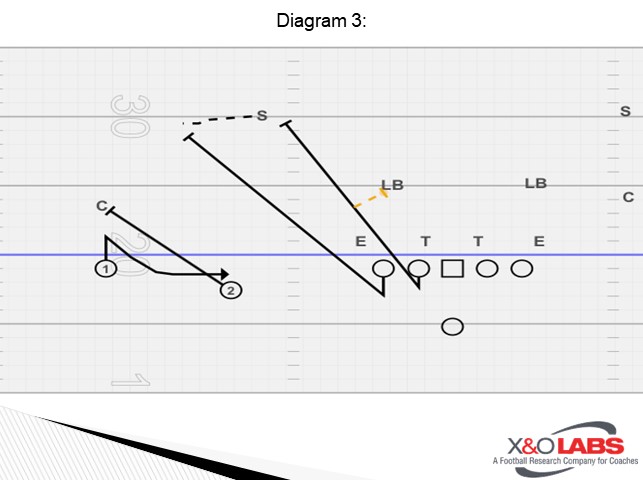
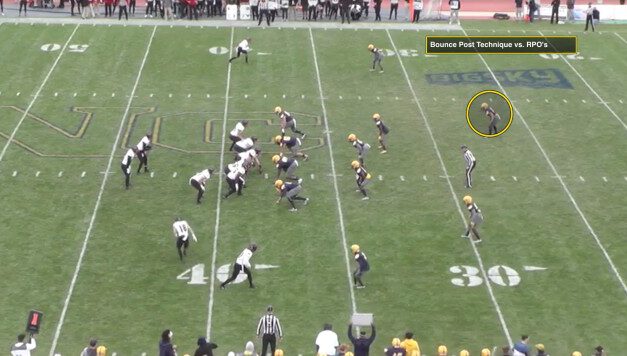
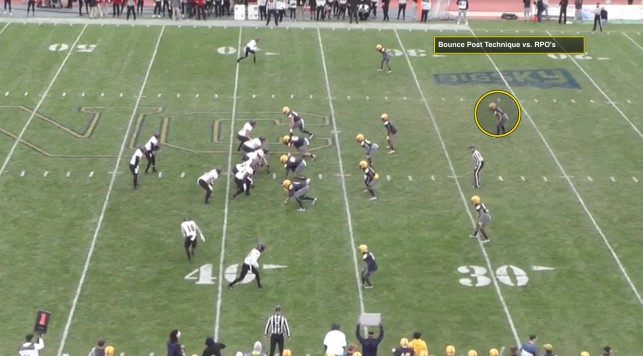
Offenses are more dynamic than ever. With the increasing popularity of the Quarterback (QB) Run Game and RPO’s most defenses have begun to favor 1-high coverage structures. As most of us know, 1-high coverages take defenders out of run/pass conflicts. While 1-high defenses are one of many solid answers to defend modern offenses, one of the most important parts of single high defense remains out of date: the post technique. In this report, I aim to uncover the major chink in every 1-high defense’s armor and teach you how to fix it by updating your post technique. A change in how you teach your post technique will help you effectively defend QB Run, RPO’s, and modern offenses. At the University of Northern Colorado (UNC) we call that post technique the Bounce Post.


THE PROBLEM: IT’S IN THE NUMBERS

Before we begin discussing the Bounce Post technique it is imperative that we understand some of the strengths and weaknesses of 1-high defenses, specifically as it pertains to the run game. Let’s begin with its strengths. Any coverage which closes the middle of the field (Middle Of The Field Closed: MOFC) has at least eight defenders in the run fit. I would be hard-pressed to find a defensive coach on the planet who does not agree that 1-high defense is excellent at stopping the run. As we see in the diagrams below, any 1-high coverage has the same, gap sound fit.

Diagram 1


In the next diagram you can see that even though the formations are spread, 1-high defenses are still GAP SOUND.

Diagram 2


Another fact that is noticeable from the previous diagrams is that while 1-high defenses are gap sound, they also take defenders out of run/pass conflicts. For example, Curl/Flat (C/F) defenders are always relating to their #2 threats. Hook/Curl (H/C) defenders are always relating to their #3 threats. Regardless of coverage (3, Match, 1Rat, Fire Zone, Man Free, etc.) we always have every receiving threat covered and out of run/pass conflicts. 

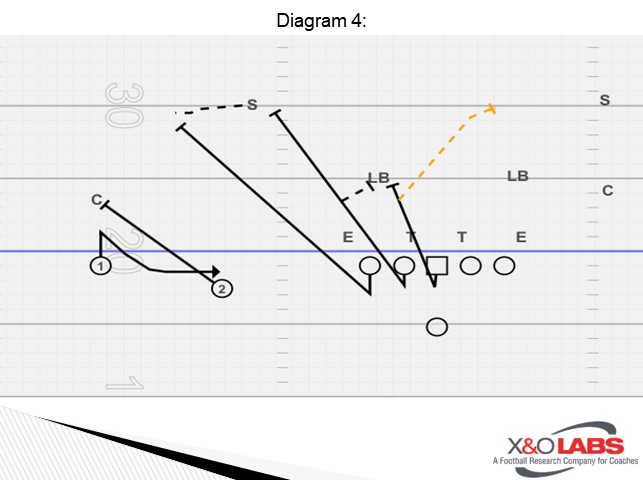
It is clear that the strength of a 1-high defense is stopping the run, but its biggest weakness is hidden. The glaring issue with the 1-high defense is clearly revealed when we take a look at it from a different perspective. As I – and the diagrams above – have made abundantly clear, a 1-high defense is gap sound; however, it is not hat sound. To demonstrate my point, let’s take a look at the numbers of the run fit:

Diagram 3


Yes, you read that correctly. The offense has one more player in the box than we have. Why is this important? Well, to illustrate this efficiently please take a peek at the next diagram:

Diagram 4


When you factor the QB into the run game, 1-high defenses are outmatched. While defenses that close the middle of the field may be gap sound, they are not HAT SOUND. Essentially, the defense is playing with 10 people in the QB run game and the offense is playing with 11. It is also important to note two additional flaws brought about by QB Run game…

In Read Zone, the offense is putting arguably their best athletes in space (their QB) against a Defensive End (DE) [arguably one of the defense’s lesser athletes in space]. While we use a squeeze scrape to put a LB on the QB, offenses have started to adjust to that technique in many ways. The most common way is to kick out their tackle on the DE. This places two defenders outside the tackle and no one in the now open B-gap. Offensive adjustments to squeeze scrape are starting to become very effective in making it obsolete as a fix-all answer for Read Zone. Regardless, below is a clip of us using a squeeze scrape technique in an effort to put a better defensive player (he went to an NFL Mini Camp) on their QB in Read Zone.

The clip below best illustrates this coaching point:

Read More

Combination Coverage in 5-man Pressures

By Grant Caserta
Defensive Coordinator/LBs Coach
Illinois Wesleyan University
Twitter: @gcaserta1


5-man pressures have become the go-to blitz of choice for us here at Illinois Wesleyan. Not only do they carry less risk than 6 or 7-man pressures, but they also offer the opportunity for us to be creative with our scheme, and flexible with our personnel. We can devise plays that attack weaknesses in protections and create positive matchups for us. We can be endlessly innovative with how we bring our 5 rushers. Using just a handful of techniques, we can give the offense the appearance of many different blitzes, while keeping things simple for our defensive players.


Two Read Coverage (Tex vs. 2×2)

I believe any pressure is only as good as its coverage. If there are wide open receivers running around, the ball will be out too quickly for the rush to get home. Although we have multiple different coverage options behind 5-man pressures, I will focus on just one, Tex. We will use Tex most often when blitzing one linebacker out of our 4-2 base defense. We also use it when blitzing two linebackers out of our 3-3 package. We like to use Tex for a few reasons:

  1. It can be used with any kind of 5-man pressure pattern involving a linebacker
  2. It uses coverage techniques that we already use in base coverages
  3. We can cover 4 verticals
  4. We can disguise our pressure well


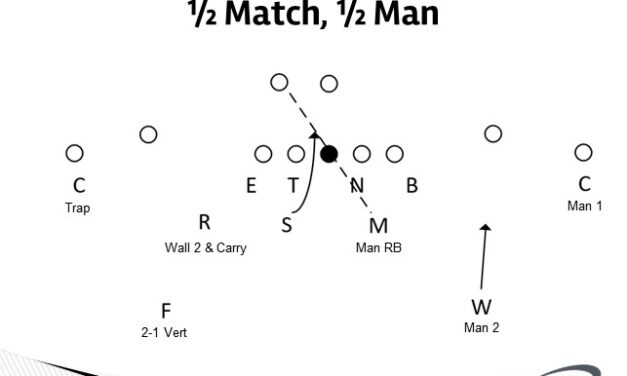
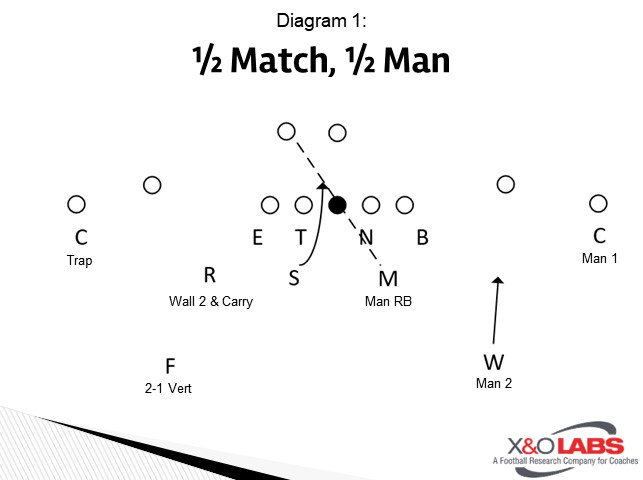
In simplest terms, Tex is a combination coverage. It is like 2-read/Palms (man match) to the field and man to the boundary. There are only 4 coverage techniques involved in Tex. In our lingo, they are:

  • 2-1 Vert
  • Trap
  • Wall 2 and Carry
  • Man


Diagram 1


2-1 Vert:

The deep safety will be the 2-1 Vert player. He is aligned 1×10 outside #2 (can be wider if there is a large split between #1 and #2). He is keying #2 to #1.

We teach all man match coverage players to look for 3 types of routes: vertical, in or out.

On a vertical route, the safety will man #2. He needs to understand there is no post help. If #2 breaks to the post, he must work to get to the top shoulder (downfield) of the WR and cut him off. If #2 breaks outside after his vertical release, the safety must maintain his outside leverage.

On an inside route (under 5 yards), the safety will rob #1. Our coaching point to the Safety when robbing #1 is to look to undercut inside breaking routes (dig, curl, slant). If #1 goes vertical, we want to take an angle to cut off the WR down the field.

On an outside route (under 5 yards), the safety will call “out, out” to the corner and man #1. The safety must take a top-down approach to #1. If his angle to #1 is too shallow, there will be no recovering on a fade/go ball.


Trap:

The corner will be the Trap player. He is aligned in outside leverage on #1, pressed up. He is also keying #2 to #1. The corner is playing #1 man to man, unless he sees #2 coming to the flat (or hears the safety call “out, out”. This is a technique that takes a lot of practice, especially if it’s being done from press alignment. Our coaching point to the corner is to keep his eyes on #1 on the initial release off the ball and steal a peek back to #2 while he is executing his press technique. As you can imagine, this takes some getting used to by the corners. However, even if the corner doesn’t see #2 coming out, he must trust his safety to make the “out” call to alert him to come off #1.


Wall 2 and Carry:

The overhang player will be the Wall 2 and Carry player. His alignment is apexed between #2 and the offensive tackle. He will key the OT for run/pass but can be late to the run. The Wall 2 and Carry player will read #2 if he gets a pass read. His responsibility will be based on the route of #2. 

On a vertical route, the overhang will be a “Wall 2” player. He is going to carry #2 to about 12 yards while looking for an inside breaking route from #1. If #1 is coming inside, he will leave #2 and cover #1. If #1 does not come inside and #2 continues vertical, he will settle around 12 yards and eye the QB.

On any inside route (any depth), the overhang will carry #2 across the field. He has him, man, to man on any type of in-breaking routes (drag, slant, dig, etc). On an outside route, the overhang will rob #1. We will use the same coaching point as I mentioned when describing the safety’s “rob” technique. The main difference is we will not expect the overhang to cut off a vertical route by #1.

Read More

Altering Sprint Draw Blocking vs. Multiple Fronts

By David Porras Jr.
Offensive Coordinator
Roma High School (TX)
Twitter: @deelow127


Teaching gap blocking schemes in your offense can help add new wrinkles to your offense.  Gap blocking allows our offensive line to understand exactly whom to block in any front.  If your offense runs sprint out passing plays, installing a sprint draw to your offense will help you keep defenses honest. Our sprint out passing plays are very important to our offense, so adding a sprint draw play was a must. We run our sprint draw typically when we have a long yardage situation and/or against teams that are not as aggressive with their blitz packages. Sprint draws are also another great way to get the ball to your running back showing full flow and countering back. In addition, sprint draws are another great play to attack bubbles in defensive fronts.


Reasons to install a sprint draw into your offense.

  1. Great way to attack defenses that rotate their coverage to your strength.
  2. Shows full flow in the backfield and countering back.
  3. Great against aggressive pass-rushing defensive ends.
  4. Protects your sprint out passing game
  5. Creates great angles in your blocking scheme.
  6. Simple scheme


Coaching Points vs 3 common fronts:

4-3 Defense: the main coaching point when we face a 4-3 front is the left tackle inviting the defensive end to go up the field which allows us to open up the gap even more.

3-3 Stack Defense: the main coaching point when we face a 3-3 front is getting our down blocks and not allowing any penetration by any down linemen.

50 Defense:  the main coaching point when we face a 50 is again the left tackle inviting the defensive end to up the field.

Read More

“Sugar” Huddle Directives and Communication Process

By Cameron Cox
Offensive Coordinator
Refugio High School (TX)
Twitter: @CoachCamCox


If you’re like me, when the dust settles at the end of a long football season, hardly any time passes before you begin searching for any small addition, or change, to improve your scheme. It may be something as simple as a new passing concept, or a small, new, series of plays. Often, the addition/change ends up fading away; for one reason or another, it wasn’t quite as good for your team as you thought it would be. However, other times the addition/change ends up being a home run. The process of designing and implementing the sugar huddle into your offensive scheme takes patience and commitment, but for us at Refugio High School, it was a grand slam.

Overview

The sugar huddle is a tight, well organized, huddle set up approximately 2-3 yards from the line of scrimmage. When the huddle is broke, offensive players sprint to the line and the ball is snapped as quickly as possible. You can imagine the advantages of the sugar huddle. Defenses face many struggles when trying to defend an offense that utilizes the sugar huddle regularly throughout a game. There is no time to make a strength call, hardly any time to communicate blitzes/stunts, and very little time to recognize tackle over sets, four-man surfaces, or even which receivers are on and off the line of scrimmage.

I do not know the origins of the sugar huddle, but the major program that I first noticed utilizing it consistently was Auburn University. Coach Gus Malzahn and his staff refer to their sugar huddle package as, “fire alarms.” Many of you are probably familiar with this concept, or package, but may be curious as to how to go about implementing it into your offense.

cox 031020

Planning and Installing the Sugar Huddle

The first thing you need to know about installing the sugar huddle is that you can utilize it out of any offensive scheme. I’ve witnessed Slot-T and Wing-T teams use it and I’ve seen spread offenses use it. At Refugio High School, we run a multiple offensive scheme. We base out of a power spread offense, but we also use under center, pro-style sets. Because of this, we will operate out of both the shotgun and from under center in our sugar huddle package. 

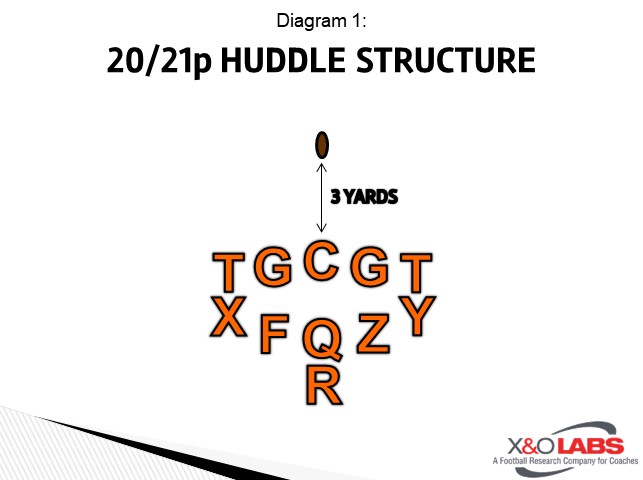
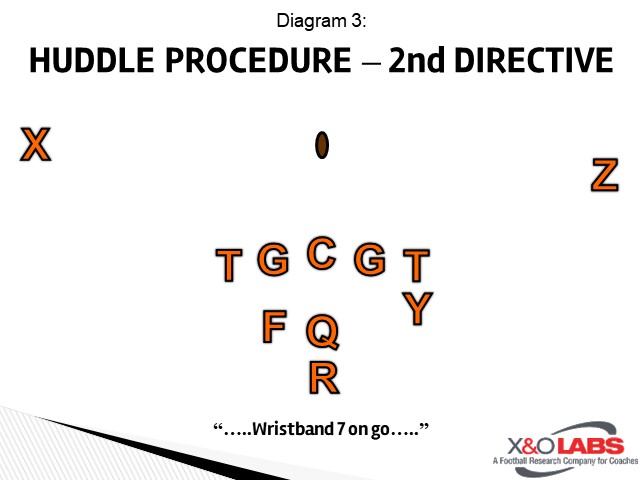
When you have decided to utilize the sugar huddle in your offensive scheme, you must select the huddle structure that best fits your offense or base personnel grouping. The huddle structure is where your players set up in the huddle. The key is to align your players in the huddle so that they can break out and get to the line of scrimmage, or their respective spots, as quickly and efficiently as possible. We choose to have our center set the huddle 2-3 yards from the ball, with his back towards the line of scrimmage. The right guard and right tackle will line up to the left of the center. The left guard and left tackle will line up to the right of the center. All offensive linemen have their backs to the line of scrimmage. From here, you need to strategically align your skill players in a way that will get them out of the huddle with as little traffic as possible. When we first installed the sugar huddle, we only utilized 20 and 21 personnel, under center sets. We also only aligned in a strong right formation. By starting simple, and keeping everything very consistent, it was easy for our players to get comfortable with the sugar huddle procedure and getting in and out of the huddle quickly and efficiently. We installed five plays from our base offense – jet sweep, power off the jet fake, play-action pass off the jet/power, toss sweep, and naked boot off the toss sweep. We practiced these 5 plays from the sugar huddle all spring long. Our base sugar huddle structure, from 20/21 personnel, is shown below.

Diagram 1

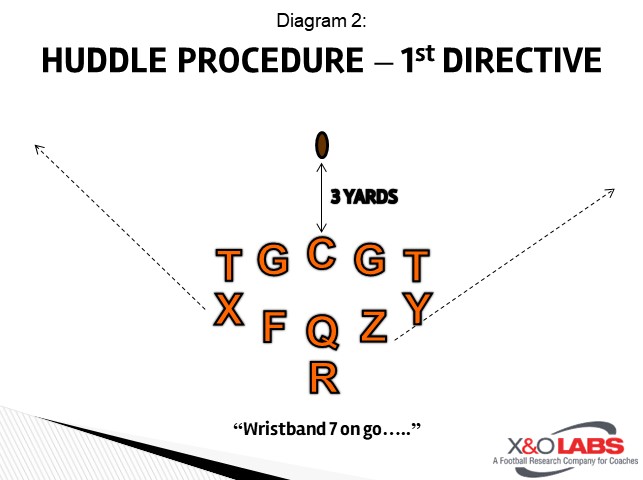
After you have decided on the huddle structure that best fits your offense or base personnel grouping, you need to decide your huddle procedure. The huddle procedure is how you will get your play to the quarterback, how the quarterback will verbalize the play call to the other 10 players, and how your players will break the huddle. This may seem like a very simple process, but it takes great planning and practice. We use wristbands in our offense, so we signal in the play to the QB from the sidelines. The quarterback will then approach the huddle, take a knee, and relay the play to the other players. The quarterback uses these directives:

Wristband 7 on go…….Wristband 7 on go……..Ready break!”

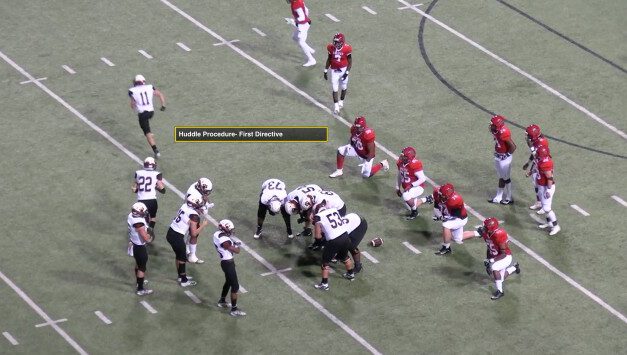
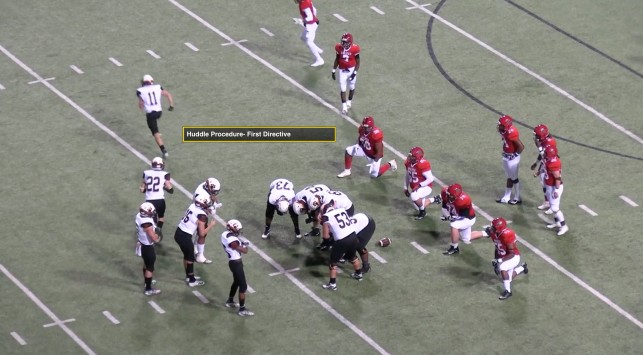
The way that the quarterback gives the directives in the sugar huddle is very important. Players break at different times during the quarterback’s directions. When the quarterback gives the first directive, “Wristband 7 on go”, all players will look at their wristband and find the play. Any player who is not attached to the formation (typically receivers that are not aligned tight to the formation) will break the huddle once they find the play on their wristband.

Diagram 2

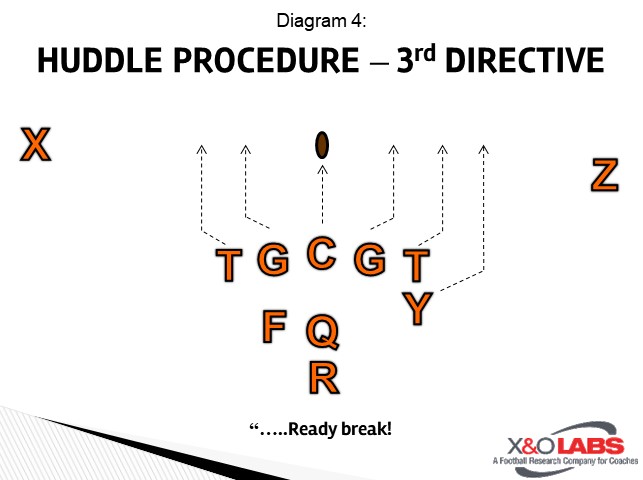
When the unattached players are nearly getting set at their spots, the quarterback will give the second directive, “Wristband 7 on go.” The quarterback will give a slight pause, and all remaining players will break the huddle on, “Ready break!

Diagram 3

Diagram 4

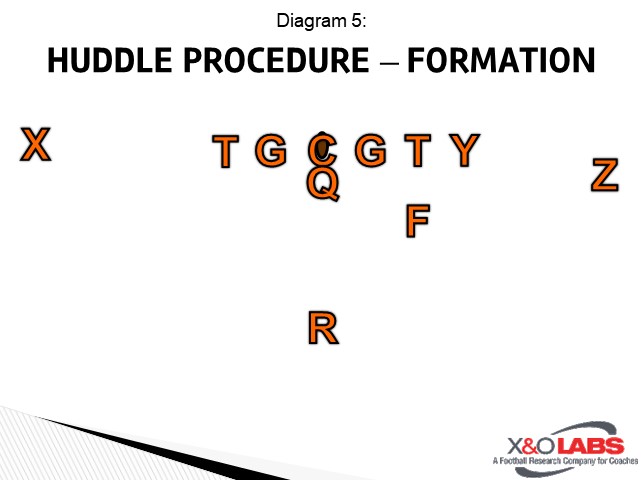
In our sugar huddle procedure, all offensive linemen will turn outside, away from the center, as they break the huddle and get set as quickly as possible. The remaining skill players, that are attached to the formation or aligned in the backfield, will get to their respective spots as quickly as possible. All players must get set as quickly as humanly possible once they get to their spots.

Diagram 5

Coaching Points:

When you are utilizing the sugar huddle scheme, the snap count can be whatever you want. Sometimes it is beneficial to go on two. The quick tempo of the sugar huddle will often have defenses very antsy and you may be able to draw an offsides penalty.

It is very important to make sure that your players are comfortable and relaxed. The more often you practice operating out of the sugar huddle, the better you will

Read More

Handling “A-gap” Pressure in the Gap Scheme Run Game

By Doug Taracuk
Offensive Line Coach
Capital University (OH)


The gap run scheme has constantly evolved from the Wing-T days and Robust T days of my early coaching years. It is hard to watch a game on Friday night, Saturday or Sunday and not see several gap scheme runs. The concept of building a wall inside, kicking someone out and leading a blocker through the hole lives today just like it does on the classic Vince Lombardi film explaining the “Packer Sweep”. One key difference offenses face today is the multitude of line stunts and second level blitzes designed to attack the running game.

At Capital, in the Ohio Athletic Conference, we face more pressures on run downs than we consistently see on passing downs. As we build a running package each week, we must make sure that it can account for the pressures we will see that week. We start by examining the common fronts used by our opponent. We like to know the alignments and favored techniques of the down linemen and the alignment and reads of the linebackers. We need to understand what is “normal” from this front. From there we will examine their pressure package used to stop the run game. Do they do this out of the normal front or do they align differently to get it done? We see both situations. Obviously, if we can see a key for a stunt or pressure via an alignment key, it helps us. In this report, I will walk you through some of our adjustments used to handle the various combinations of “A-gap” pressures used to stop our Gap Scheme Runs.


Defining Gap Rules

Our base rule on the play side is “Gap-Down-Backer”. Simple as it may seem, this rule has held true for my four decades of coaching. Gap is defined as a down defender aligned between my nose and the near shoulder of my inside partner on the play side. A player in the “gap” will be tough for my inside partner to assist with blocking. He would have to step outside while his responsibilities are inside. “Down”, for us, runs from the inside V of the neck on my inside partner to the tip of my partner’s near shoulder. Here, we could receive help on a combo block used to move a down lineman. “Backer” comes into play when there is no down man in my Gap or Down rules.

Using these guidelines, an offensive line could block most any look presented to it on the play side.

Here are “Gap” alignments.


The defenders are aligned somewhere between my nose and the near shoulder of my play side partner in Diagram 1. Diagram 2 are “Down” alignments. The lineman is aligned head-up or aligned on the outside half of my play side partner.

The Tackle has no one in his Gap or Down rule. To get to his “Backer” he will work a track through the rear of the Nose to pick off a loop move which would be difficult for his Guard to get. Refer to Diagram 3.  On the backside we will pull one or two of the lineman and we must control pinching movements which threaten our run from the inside-out. We are not set on who we pull for our gap plays. If it makes sense to pull the Center instead of the Backside Guard, we will. There are times when it makes sense to pull the Backside Tackle instead of the Guard or the Center. The key is for the three of them to know who should pull and why that pull takes preference. On Counter, we will pull the Center and the Tackle, the Guard and the Tackle, the Center and the TE/H-Back, the Guard and the TE/H-Back, the Center and the RB or the Guard and the RB. Once we determine the most dangerous pressures, we will select the pulling schemes.


Handling A Gap Threats in Base Fronts

Now, let’s look at some of the common fronts and I will explain how we handle the “A-gap” threats that we see. We will run our gap scheme runs to a Tight End or to an open side. From here on, I will focus on the schemes from the FST (front side Tackle) back. Let’s start with the common 4-2 front with the Tackle aligned on the outside shoulder of the Guard.

The Nose is aligned on the inside shoulder of the backside Guard. Both linebackers are in the box and in their normal alignments. The hardest block here would be the block of the FST. If the FSG (front side Guard) worked inside for the backside linebacker immediately, a pinch move into the “A-gap” would be difficult to stop by the FST. We would want to combo the block the tackle to the BSLB. Through film study, we want to know how the inside linebackers flow when they read down and pull action. If they are going to flow along on level two, we will have the FST use his hard angle footwork inside to knock the Tackle to the FSG. The FST will climb on he feels the FSG taking control of the block. The FSG will step vertically with his inside foot first and then step through the crotch of the defender with his second step. His eyes are in “A-gap” looking for a run through, but his hands are prepared to grasp the defender as the FST knocks him inside. Once the block on the defender begins, we want breast plate hand placement and our eyes on the outside V of the neck on the man. Again Refer to above Diagram 4.

The FST will lead step inside with the high knee aiming for the near armpit. The backside knee will aim for the near hip of the defender. We are coming with power moving him inside to the FSG.

If in our film study, we see that either of the inside backers will fill through “A-gap” on a regular basis through blitz or by running through an open window, we will alter the combo block. The FSG must be able to help on the down man but he must stop any penetration through his gap. His footwork does not change. He will lead with his inside foot and use a shortened step. He will still place his second step into the defender. To help the FST, we will use a shoulder and flipper to distort the defender’s momentum. Our eyes are still focused on the near linebacker to the backside linebacker. The FSG must be able to stay as long as possible and disengage when necessary to stop penetration inside. The FST will now use his slide base footwork. We will execute two quick lateral steps inside to gain position and they execute our angle drive block footwork. The third step would angle across and the fourth is the “through’ step into the man. The FST has to be able to react to a pinch move by the defender. The combo becomes a delayed version of the first one explained. The FSG’s rule is “Backer”. His primary gap is the “A-gap. He will help the FST until his assignment is threatened.

Read More

Gap Scheme Self-Scout: Troubleshooting the 7 Main Problem Areas

By Wendell Fevrine
Offensive Coordinator
New Utrecht High School (NY)
Twitter: @WFevrine


Gap scheme runs are great foundational concepts for any offense.  They force the defense to play assignment football, which displaces defenders in order to overcome the favorable angles for the offense.  This article will analyze how an offense running power and counter schemes can account for the most common defensive adjustments.  Opportunities for RPO’s and play action passes are prevalent, but this article will focus on strategies that keep the ball in the belly of your running back.  Handing the ball off for first downs and touchdowns has a visceral effect on an opponent’s pride that will pay dividends late in games.   Getting gutted in the run game is discouraging to a defense and often leads to undisciplined play, which in turn can lead to explosive plays for the offense.


On power, there is a front side combination block to the backside backer (2nd backer in the box).  Giving the down block options to stay on the DT or go to backer softens him at the point of attack on the DT.  Coach Sam Pittman of the University of Arkansas was the offensive line coach of Northern Illinois when QB Jordan Lynch assaulted the NCAA record books using gap schemes.  Coach Pittman teaches the combo block with only the post block reacting to the backside backer.   The down blocker stays on the DT no matter what, going down like an avalanche, to ensure movement on the DT.  The post block will take a tough step and lift the DT vertically while eyeing backside backer (Inside gap threat).   In essence only one person is looking at backside backer in the combination; the running back is responsible for hitting the point of attack with a head of steam and the confidence to make an explosive decision at the heels of the down block while reacting to flashes of color.

The Power play is a part of the gap scheme family.  Transversely, there is no gap scheme without a gap block (aka down block).  Not getting movement on the DT at the point of attack is the most problematic feature of the play.   All the other components of the play mean nothing without maximizing movement at the point of attack.   The more movement you have at the point of attack, the more room you have for error with the other components.  Movement at the point of attack on the DT is the foundation of the play, trying to fix anything else is futile without ensuring this component. 


Problem 1: Play Side Movement

Answer: RB Bang Cut

If the linemen being down blocked tries to play over the top of the down block or is trying to play 2 gaps, the down block will snap his hips into him while staying engaged like a man blocking scheme.  The running back needs to maintain eye discipline on the down block and press the A gap full speed.  As he approaches the A gap he will break to the tail of the down block (bang cut) and hit the hole “face first” to ensure body lean and low pad level.


To study film of this concept, click on the video below:
Read More