|
2017
|
3
|
7
>> X&O Labs Members: Login here to continue reading
Join X&O Labs to Continue Reading…
Plus, get 4 FREE books!
  When you join X&O Labs, you’ll get instant access to the full-length version of this report — including access to everything in The LAB and Film Room. That’s over 4,000 reports and videos. Plus, if you join with a Staff Membership, you’ll also receive 4 FREE books mailed directly to your home or office! When you join X&O Labs, you’ll get instant access to the full-length version of this report — including access to everything in The LAB and Film Room. That’s over 4,000 reports and videos. Plus, if you join with a Staff Membership, you’ll also receive 4 FREE books mailed directly to your home or office!

Read More
By Josh Franke
Head Coach
Toronto High School Toronto (OH)
Twitter: @Coach_Franke
Heavy passing offenses have slowly trickled down from the NFL to the collegiate level, and now they are becoming commonplace among high school teams. With the ever-growing popularity of things like 7on7s, the Elite 11, and private quarterback coaching, high school quarterbacks are better today than they ever have been. Having to defend these heavy passing offenses a few times a year put a huge burden on our defense. Although we traditionally run a 3-3 stack, we were still getting beat in coverage. If we played quarters, slants, hitches, and bubbles would hurt us. If we tried to stop those underneath routes with different coverage, we would get burnt deep on vertical routes. We used to play by the old adage “If they want to nickel and dime us down the field, that’s fine, no one has that patience”, well, those days are over because these offenses will do that. We had to develop something different that would allow us to play max coverage but also allow us to be solid in run support. I have to give credit to my defensive coordinator and defensive backs coach Steven Rebich and Matt Ludewig because together we sat down to develop our 31 and 32 defenses to counter the rising trend of the spread pass-heavy offense.
Alignment:
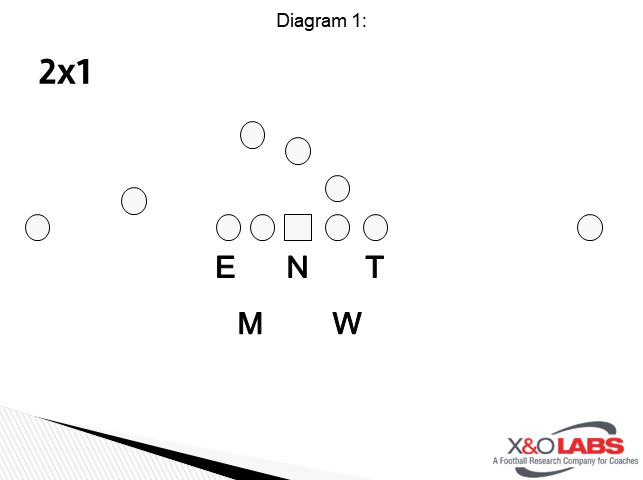
The 31 and 32 defenses were designed to be played against teams who love to pass the ball out of 3×1, 2×2, or any type of empty set. We wanted it to be a “defend everything” type of coverage but we also wanted to take away any type of jet sweep and stop the inside zone with a QB read off it (which is usually a complimentary run play for these offenses).
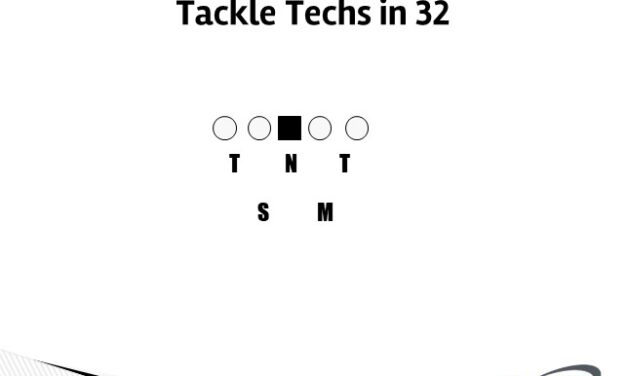
The term 31 and 32 are used to determine the number of box defenders we have. We are traditionally a 3-3 stack, therefore, when we go 31, we will have three down linemen and one linebacker, in 32 we have three down linemen and two linebackers. The trick and one of the most important pieces of this defense is that your tackles line up in a 4i position.
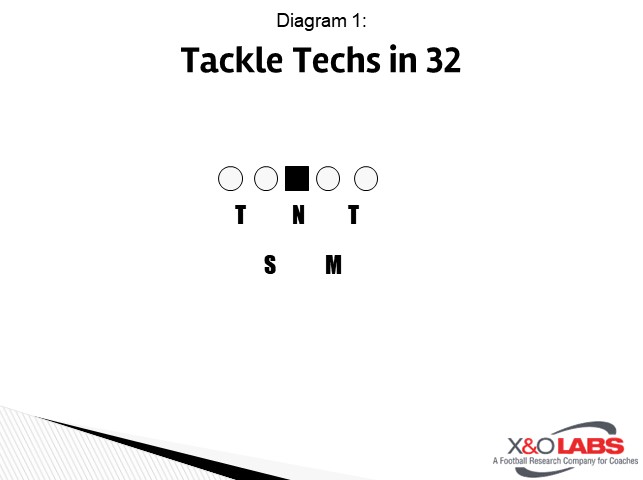
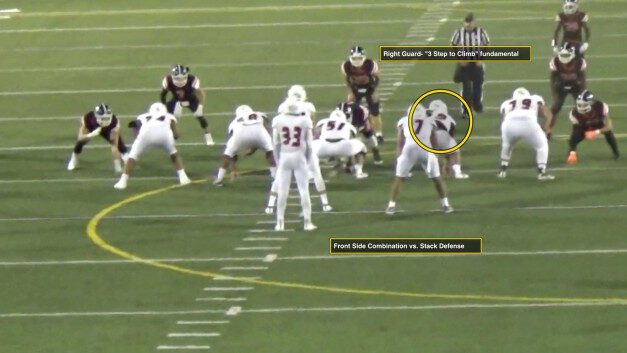
This is one of the most important coaching points in this defense. The tackles are responsible for the B gaps and must be prepared to take on double teams, especially against the pass. You can play the NT in a variety of different ways, you can slant him opposite of the back alignment, you can have him control double-A gaps by playing straight up, we also have incorporated a couple of different defensive line stunts we like to integrate, which works well because of the closer alignment of the tackles and nose tackle.
The interior linebacker/s will be responsible for the A gaps and are responsible for all inside runs and will act as the alley or fill players on any outside runs. Our interior linebackers tend to love this defense because they have no major responsibility and are freed up to play instinctively against what they are seeing and reading.
Coaching Points for Run Defenders
Force Players:
By far the most important position on the field because they’re the only two players who have both run and pass responsibility. In this defense, the secondary is a pass-first responsibility and the box defenders are a run-first responsibility.
Your force players must be able to force all outside runs, jet sweeps, and QB pulls on reads back inside to help. We tell all our force players that their first responsibility on a run is to make sure they don’t get the edge if they can make the tackle, great, but it’s not their primary responsibility.
We have our force players pivot their stance to face the backfield. This way their backs are already turned to the potential WR block. As I mentioned before, we’ve had several blocks in the back called because of this alignment. I cannot stress enough that they must attack the outside shoulder of the ball carrier so they don’t give up the outside alley.
4i Tackles:
Our tackles hate this formation and alignment because they always get double-teamed, almost every play, regardless of pass or run. They will often try to play head up or even sneak themselves outside, or they’ll say, “I’ll line up outside and rush into the B gap.”. Make sure that they’re lining up in that 4i technique and just work on splitting double teams by getting skinny through the hole with a solid rip move. We’ve learned that having speed guys on our line has been more effective than having strength guys on our line and it helps with this alignment and we still got a lot of penetration.
32 alignment vs 2×2:
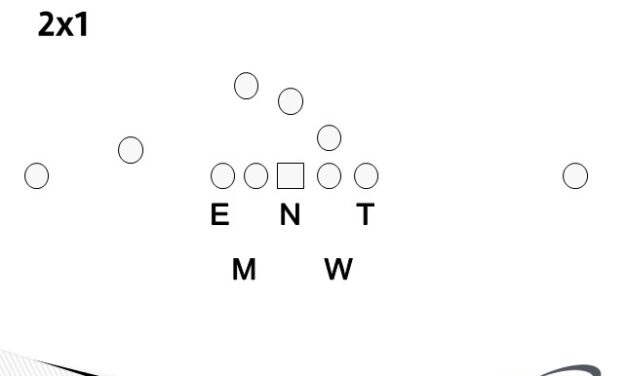
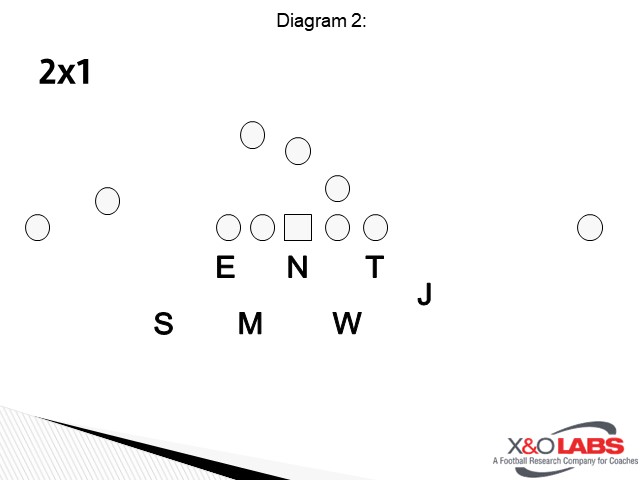
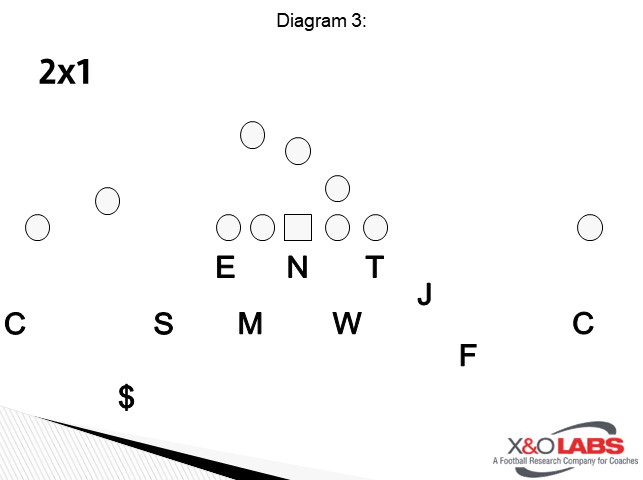
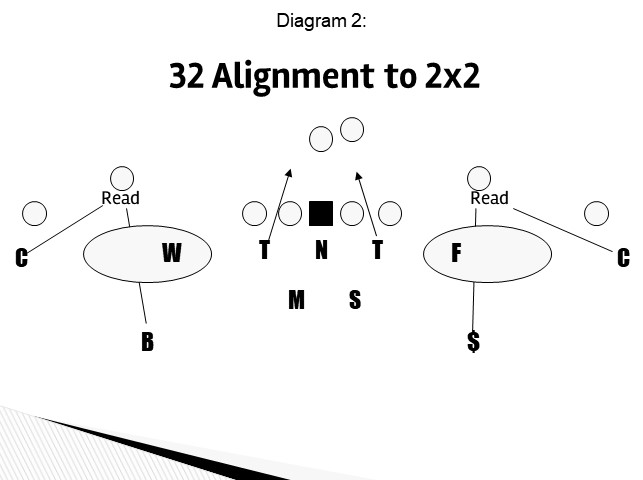
Against a 2×2 set, we would align in our 32 defenses. Our Mike and Sam linebackers will stay in the box, our boundary safety will drop to give us a two-high safety look, we will press our corners, and play a press quarters coverage. This allows us to defend against four verticals but also, by pressing our corners, we can defend any quick hitches, slants, or bubbles.
Another very important and key aspect of this defense is that we apex our will linebacker and field safety between the tackle and slot receivers. They have the most important responsibilities of this defense. They must serve as force players on any outside runs. By alignment, they can defend against any jet sweeps, bounced inside zone runs, or any pulls by the quarterback on a read play. Against the pass, they are responsible for taking away any inside slants or hitches by the #2 receiver, because we are playing press quarters, the corner would be responsible for any bubbles or out routes.
By aligning this way, we have now taken away all short game passes and the four vertical threats. With our will linebacker and field safety, we have taken away any outside run or quarterback pulls on read plays, and with our alignment by our box defenders, we’re safe against any inside run.
31 alignment vs 3×1:
Our front three alignments on the defensive line don’t change, tackles in 4is and nose in a zero tech. However, we will only play one linebacker, our Mike, and we will stack him over the nose. Now, the NT has to take one A gap and the Mike will be responsible for the other A gap. You can communicate this however you choose, whether they communicate it to each other or you always have your nose slant one way or the other. Regardless, you will still be gap sound inside the tackle box.
>> X&O Labs Members: Login here to continue reading
Join X&O Labs to Continue Reading…
Plus, get 4 FREE books!
When you join X&O Labs, you’ll get instant access to the full-length version of this report — including access to everything in The LAB and Film Room. That’s over 4,000 reports and videos. Plus, if you join with a Staff Membership, you’ll also receive 4 FREE books mailed directly to your home or office!
Read More
By Jake Novotny
Head Football Coach
Fountain-Fort Carson High School (CO)
Twitter: @Coach_JNovotny
Football teams are built in the off-season. As coaches, we know the importance of the seven months before the season in laying the foundation for our program’s culture. During this time, all programs are embarking on a similar process including strength and performance training, spring practices/skill development, summer programming, and leadership building. For most high schools, there is a premium placed on your players being together during this process throughout the year, for all four years, and at several schools, as they grow-up in local feeder programs. This philosophy allows several schools across the country to build rich history and traditions, align cultures, and refine skills and schemes for their players as they grow-up in the same football program over the course of many years.
At Fountain-Fort Carson High School (FFCHS), we believe in approaching our off-season no differently than anyone else. However, our school district is partnered with an active U.S. Army Base (Fort Carson is less than 10 miles from campus), resulting in the added challenge of a transient student population. With 60-70% of our student population identified as a “military child,” we must have a plan to “on-board” players that move into our school as well as develop players knowing that they may leave at any time because of their parents’ military orders for relocation. Though many coaches may see this as a difficult situation, we believe this to be a great opportunity for us to build lasting relationships with players from several different backgrounds. Most importantly, serving as a coach at FFCHS allows our coaching staff to give back to those who willingly fight for our freedoms daily by actively investing in their children. In the following paragraphs, I will outline our philosophies and plan to build a competitive team environment yearly while supporting a transient student population.
Culture Life Cycle:
The life cycle of our program starts over every year at FFCHS. This means that we believe that each team will have new leaders, cultures, and identities. Even though many coaches may believe this at the high school level, it is exacerbated when you have a significant portion of your program’s players coming from military households. As mentioned before, students will move in or out of school at any point in the calendar year. Therefore, as a coaching staff, we must have a clear plan for the development of our players and program yearly. The following guidelines outline our staff’s general philosophy when it comes to growing our program on a year-to-year basis taking into account our military student-athletes:
- They are all OUR players while at FFC no matter where they came from, or if there is potential, they may leave – coach them the same way, they deserve that.
- Instill our program culture (expectations, values, schemes, skills) into the players that are non-transient (usually those that are non-military or those that are military who have arranged to stay until graduation). These will be the “Carriers of the Culture” and will ensure that newcomers to the program are both “schooled-up” and welcomed.
- Build and grow a healthy feeder system through community engagement for both our military and non-military families.
- Create multiple access/entry points into the program throughout the year for student-athletes to seamlessly transition into our program (also important for our multiple sport athletes).
- Be “okay” with the fact that students will leave! If we have done everything in our power to build a young man athletically, academically, and socially in our program, we have created a lasting impact on his life that will make him a better person. That is WHY we coach.
This is the general philosophy that we focus our off-season programming around each year. With that, I will take you through the different phases of our off-season and highlight the focuses for each phase, as well as explain how each phase allows for seamless student-athlete entry and exit.
Post-Season Phase: (Last Game – January)
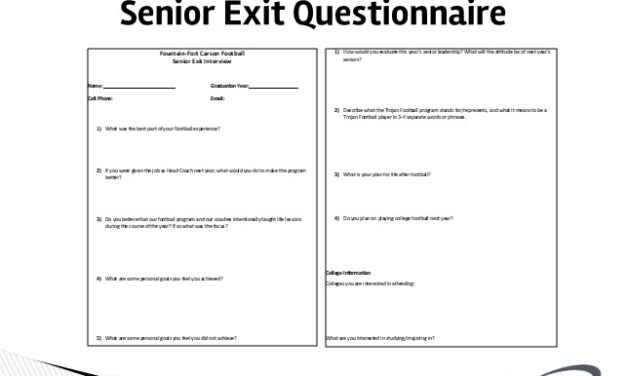
As soon as our season is over, we begin the post-season phase of our program. Just like many programs across the country, this phase centers on putting the season to rest and preparing for the upcoming year. This phase is a lot of administrative work for me as the head coach. During this time, I will compile final stats; do equipment inventory and set-up several meetings with our athletic director, coaches, and academic counselors. One of the most important things done during this phase is our senior exit interviews. I will meet with every senior that finished the football season within two weeks after the last game. This is a priority for me. In my opinion, there are several things gained from hearing the opinions of the players who will be leaving your program as they reflect on their time here. Again, as I have stated before, we have several players, including seniors, who move in at any time during the year. I do not care if they have been in our program for all four years or moved in the day school started, all of their opinions and perspectives are valuable and can help us grow our program to be a great experience for next year’s players. I believe that your out-going seniors will give you a valuable perspective on what is working and not working in your program because they can give honest reflection without the pressure of still being in the program. During these meetings, each player fills out a questionnaire (see diagram 1) and has a 10-15-minute meeting with me. I explain to them that I want their honest opinion on our program and their experience. These meetings are humbling, but I value them very much because it has helped us shape our program to be more player-focused every year.
>> X&O Labs Members: Login here to continue reading
Join X&O Labs to Continue Reading…
Plus, get 4 FREE books!
When you join X&O Labs, you’ll get instant access to the full-length version of this report — including access to everything in The LAB and Film Room. That’s over 4,000 reports and videos. Plus, if you join with a Staff Membership, you’ll also receive 4 FREE books mailed directly to your home or office!
Read More
By Tyler Hales
Head Coach
La Jolla Country Day School (CA)
Twitter: @Coach_Hales
Introduction:
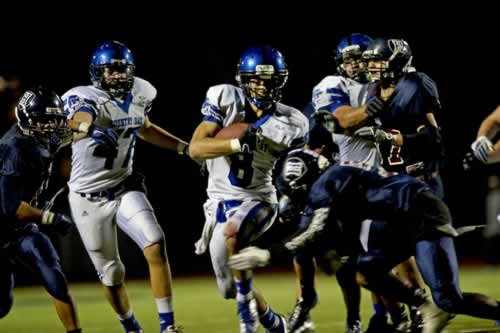
Over the past few years there has been a lot of talk about the no-punt philosophy thanks to the great success of Coach Kevin Kelly at Pulaski Academy (AR). Coach Kelley has done a tremendous job explaining the reasoning and benefits behind this uncommon strategy and his analysis was something that I researched extensively when I took over as head football coach in January 2014.
Our 4th down philosophy (“never punting”) not only fit our desire to play aggressively on 3th down, but it also best suited our personnel. Over the past two years, we have implemented this philosophy with great success. In 2014, La Jolla Country Day won the first 11-man CIF title in school history and in 2015 we lost in the CIF semi-finals to the eventual State finalist Coronado. Additionally, we averaged 4,476 total yards and 423 points per season since making that change. That is over 800 yards and 40 points more than the average over the previous 9 seasons.
There is no doubt in my mind that consistently going for it on 4th down has led to this offensive improvement. But the analytical part of me wanted to make sure that the numbers matched my gut feeling. This article will dive into our philosophy and the numbers that support the use of this approach at La Jolla Country Day.
It Starts with Assessing Personnel
A few other coaches and I had talked about the no-punt philosophy for a few years, so when I took over the program we immediately began to seriously discuss this approach for our varsity squad. While on paper this philosophy looked great, we wanted to really do research and a self assessment to make sure we were ready to take on this style of play. While we scoured the internet to read everything we could find about not punting, we also took an in depth look at our roster. We were coming off our worst season in over a decade (2013), finishing 5-6 and losing in the first round of the playoffs for the first time since we became 11-man in 2005. Our 2014 team would have some good senior leadership but was relatively inexperienced and very undersized. The question we asked ourselves was what do we need to differently to compete in our tough league and in playoffs?
In assessing our personnel, it was obvious that our strengths were going to be on the offensive side of the ball. We had a returning quarterback who had started every snap as a freshman and is one of the most highly recruited QBs in the nation. Surrounding him in our air raid offense was a group of good receivers and running backs. Conversely, our defense was going to be young and inexperienced. We surmised that we were likely going to be counting on our offense to lead the way in 2014. Add in the fact that our punting game in 2013 was unimpressive, averaging only 28.5 yd/punt and you can see why we were looking for a different approach.
After analyzing the research and our personnel, we decided that we were ready to be “all in” on the “never punting” philosophy. With our personnel and with the data in mind, we wanted to keep the ball in our playmakers’ hands and keep the ball rather than voluntarily punting. The prospect of having a 50% chance of converting the 4th down rather than give our opponent the ball 20-30 yards from our spot simply made sense to us.
Defining Our 4th Down Philosophy
Of course, we knew there would be challenges in implementing this philosophy. As Coach Kelly has discussed in detail, getting your people to buy in is huge and players typically aren’t the ones you need to worry about. One of the biggest challenges our coaching staff discussed was those “what if” situations.
For example, it’s late in the game, we are up by 2 points and backed up in our own zone facing a 4th and long. To address situations like this, we had a contingency plan of bringing back what we called the “field goal punt,” which is a little known rule in HS that you can line up your FG unit and simply kick the ball as if you were kicking a 90 yard FG. Because this is a scrimmage kick it ends up like a punt and the return team can return the ball from wherever it lands (which in our plan was out of bounds). Doing this allowed us to still be all in on going for it on 4th while also giving us flexibility in certain situations. We also had our QB practice quick kicks once a week as another options to utilize in certain scenarios. When we presented our plan to not punt to the team on day one of fall camp, I allowed players to process this philosophy and push me with questions. After about 15 minutes of this discussion, players were excited and ready to go.
Here is a look at our complete “Philosophy” that all of our staff is agreed upon going into the season:
Torrey Football: 4th Down Philosophy and Guideline
Philosophy:
We are an aggressive 4th Down team.
>> X&O Labs Members: Login here to continue reading
Join X&O Labs to Continue Reading…
Plus, get 4 FREE books!
When you join X&O Labs, you’ll get instant access to the full-length version of this report — including access to everything in The LAB and Film Room. That’s over 4,000 reports and videos. Plus, if you join with a Staff Membership, you’ll also receive 4 FREE books mailed directly to your home or office!
Read More
By Jeff Zerfas
Safeties Coach
Northside High School (GA)
Twitter: @zerfas_atc
With the use of 3-high safety defenses becoming more prevalent at the high school, collegiate and professional levels, many coaches have asked what kind of coverages they can run within this scheme. Our answer is to run a coverage that combined many facets of our other coverages into our 3-high covers. Combo coverage involves man and zone principles and is played with the Middle of the Field closed. Combo coverage is a coverage meant to be run on 1st or 2nd down that allows the maximum number of defenders playing the run and pass at the same time. The 3-3-5 is designed to be able to bring 3/4/5/6-man pressures and combo coverage lends itself to being able to be paired with any pressure package that you want to run. Combo coverage is unique that in its base call, all 5 secondary players align at 7 yards and it stresses the opposing QB to identify who is and is not in the box pre-snap.
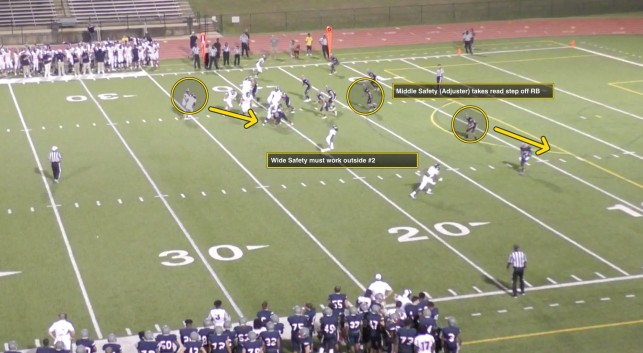
Base Structure/Alignment
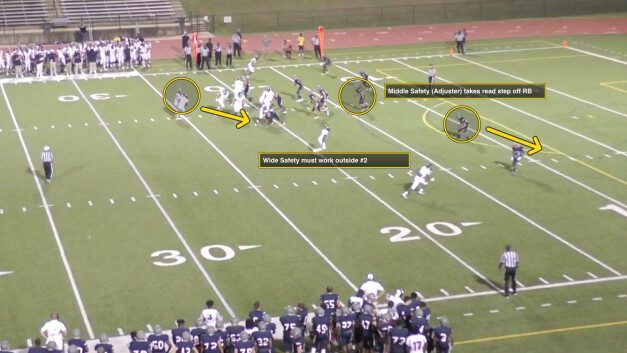
Our base defensive structure is a 3-3-5 with a base alignment of 3 Safeties stacked over 3 Linebackers stacked over 3 DL. Our base defense strength is called to the field and we flip our 2 LBs and Safeties on each play. Our position names are F= Field Backer, B= Boundary Backer, W= Wide Safety, S= Short Safety, M= Mike, A= Adjuster. The Field Backer and Wide Safety always align to the field and the Boundary Backer and Short Safety always align to the boundary.
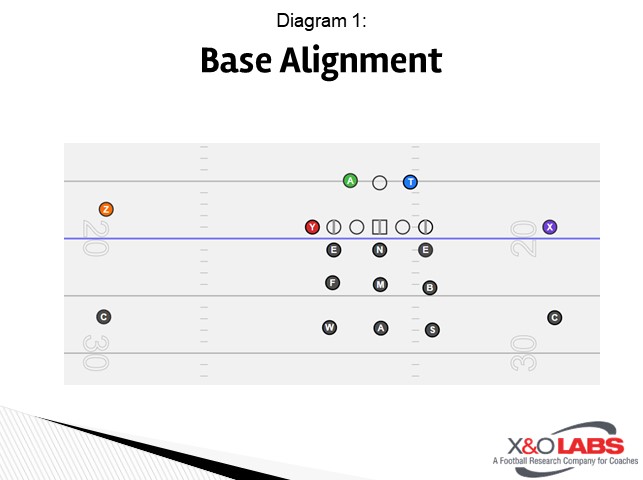
Alignment of Secondary Players:
Combo Coverage can be called and played 3 different ways but the only alignment/technique that changes is the corners. The base call of Combo aligns the Corners and Safeties at 7 yards. The corners are playing “Loose Man” on #1 Wide and Short Safeties are playing “Seam” Technique on 2/3, the Adjuster is “Run Support/MOF”, and the Linebackers are playing “Hug” Technique on #3.
Bump Combo:
The first adjustment that can be made is to call “Bump Combo” and this changes the alignment of the corners and brings them from 7 yards off the line of scrimmage to 5. It also changes how they play man coverage.
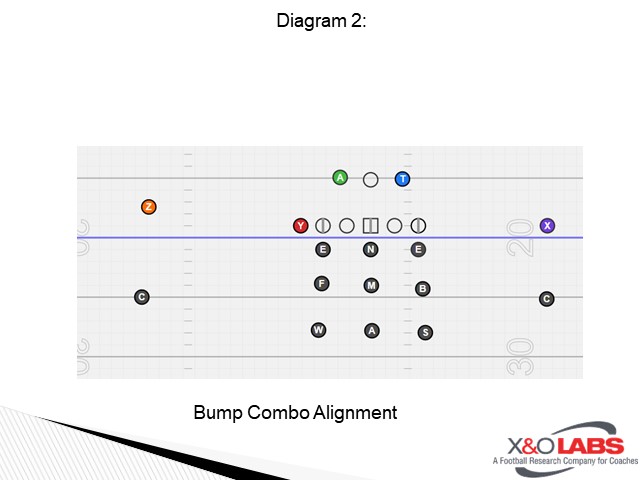
Press Combo:
The second adjustment we can make in Combo is “Press Combo”. This changes the alignment of the corners from 7 yards off LOS and brings them down to the LOS and they play in your face man to man coverage.
Techniques:
Corners: (Corners are 10 and 11 to the ball on run and have no responsibility to stop run)
Loose Man: Align 7 yards from LOS inside eye of #1 WR. On the snap of ball will take 3 backpedal read steps reading the release of the WR. If WR breaks at any point during 3 backpedal put foot in-ground and drive on break. If WR runs vertical, then collision inside the hip of WR and force them towards the sideline. The points of emphasis with the corners in loose man are to really work with them on getting good to backpedal steps that are not too short but are not too long. If the corner steps to close together on his backpedal, he will get to his third backpedal step before the WR has gotten to their route break. If the corner takes too long of a stride in his backpedal, he will be off-balance and will not be able to react quickly to quick game concepts.
Bump Man: Align 5 yards from LOS and head up on WR. On the snap of ball buzz feet and wait for the WR to come to you. Collision the WR at 5 yards and attempt to reroute him away from his intended route. In bump man, the corner is going to chop his feet on the snap and mirror the release of the WR. If the WR steps out the corner will side shuffle out, and if the WR steps in the corner will shuffle in, these do not have to be big shuffles the corner just needs to stay square and in front of the WR.
It is also important to work with the corner so that they do not try to put too much into their jams. Most high school corners think that they need to jam the WR hard to get a reroute and that is not what is needed in this instance. The corner forces the WR to reroute himself by simply not moving out of the way as the WR runs up the field.
Press Man: Align at LOS head up on WR. At the snap of the ball mirror release of WR and offhand jam him as he steps toward you. For the press man technique, the area that needs to be emphasized the most is that the corner does not try to be overly physical on the jam. Most corners will try to jam hard because that is what they think is important. We found that this puts the corner out of position for the rest of the route that the WR will run. We teach our corners in press man to “inch out”. This means that they will take small steps backward almost a back-ward shuffle and when the WR steps one direction the corner will then punch with the hand opposite of the step by the WR. This does not need to be a very hard punch, but it does need to be firm.
Safeties:
>> X&O Labs Members: Login here to continue reading
Join X&O Labs to Continue Reading…
Plus, get 4 FREE books!
When you join X&O Labs, you’ll get instant access to the full-length version of this report — including access to everything in The LAB and Film Room. That’s over 4,000 reports and videos. Plus, if you join with a Staff Membership, you’ll also receive 4 FREE books mailed directly to your home or office!
Read More
By Will Theobold
Offensive Line Coach/Offensive Coordinator
Park High School (MN)
Twitter: @CoachTheobold
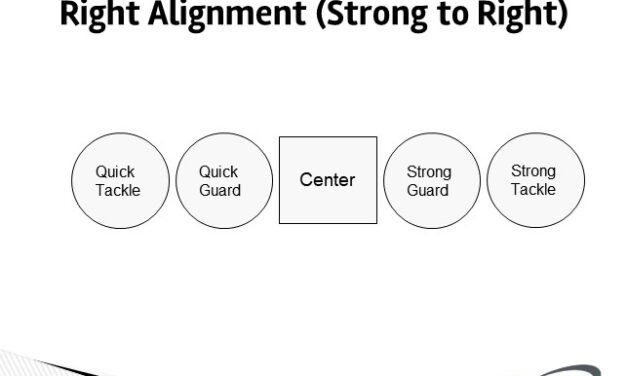
My first season at Park High School we as a staff decided to install a gap scheme offense with a strong and quick side to accentuate our personnel, reduce teaching and techniques to those players executing them the most frequently.
Why?
The question from my head coach prompted this whole process: How can we maximize our OL’s talent and practice reps at the same time? As an offensive staff, it was decided that since we were implementing new blocking rules, going from zone blocking to gap scheme blocking, that we could help our players gain “extra reps” and truly use their strengths to our team’s advantage. As a Gap run scheme team our players only need to know a handful of different types of blocks to master and thus have a narrowing of their overall focus.
The reasoning for Strong/Quick side is so we can put our players in the best situation to be successful along with giving them as many practice reps as possible at their specific job. We were inspired by the idea of an assembly line. You have one worker specializing in a certain part of the overall product. They keep getting reps and over time they can become an expert at their one job in the overall process. We feel like if we can limit our player’s input of their job and technique, they can more easily master it and then execute better than the defense. Also, there are some Air Raid coaches who, similarly, never have their receivers switch sides to increase reps and reduce teaching.
Personnel
For our team, we considered going with the conventional OL play with specializing with a side (i.e. RG, RT) but ultimately decided to go with a Strong/Quick Sides. Here are some traits and characteristics we look for in our offensive line.
- Strong Tackle: Great at Down blocks, great first step, big dude
- Strong Guard: Bigger of two guards, needs to have great feet, needs to be nasty
- Center: Needs to have size, cannot be pushed back, have consistent shotgun snaps
- Quick Guard: Smaller of two guards, needs to have great feet, needs to be persistent to reach those log blocks, great football IQ as he will have to adjust on the fly to the strong guard’s block, “The adjuster”
- Quick Tackle: Any size, needs to have great feet
>> X&O Labs Members: Login here to continue reading
Join X&O Labs to Continue Reading…
Plus, get 4 FREE books!
When you join X&O Labs, you’ll get instant access to the full-length version of this report — including access to everything in The LAB and Film Room. That’s over 4,000 reports and videos. Plus, if you join with a Staff Membership, you’ll also receive 4 FREE books mailed directly to your home or office!
Read More
By Matthew Bishop
QB Coach
South Johnston High School (NC)
At South Johnston, we were primarily a run-first, power-based offense. Originally the head coach’s offense called for a sniffer/H-back to handle the defensive end and a WR to handle the extra man in the box. Due to base personnel, teams were able to put 8 defenders in or around the box or send an extra edge rusher. These two things forced the offense to adapt. In doing so, we progressed to handle the extra man and pressure by adapting the pin and pull system to an option-based system.
Originally: What gave us a lot of trouble as an offense was the inability to handle an extra defender in or near the box.
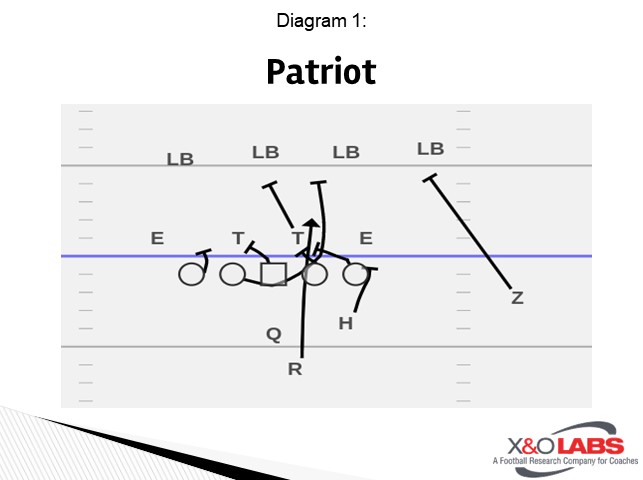
Slot receivers were never our best blockers, nor should they be in the offense. To think that they would be able to dig out an alley defender to help us pick up another run threat, run great pass patterns, and catch passes was not something we believed slot receivers could do. If they were great run blockers, they wouldn’t be receivers.
In order to help get us an extra offensive threat and not another run blocking liability, we used Kirk Ciarrocca’s ideas from his time at Western Michigan.
The cornerback is counted as 1.
The alley defender, who was the next 2nd level pass defender inside the corner was going to count as a 1 or a .5. If this alley defender was outside, stacked, or partially covered the slot receiver in any way, he would be a 1. If the alley defender was inside the slot, such as aligning as an apex defender, he would be counted as .5. This total would be added to the 1 from the cornerback. So, the Qb would have a count of 1,1.5 or 2, when talking about the defensive alignment to the first two detached threats.
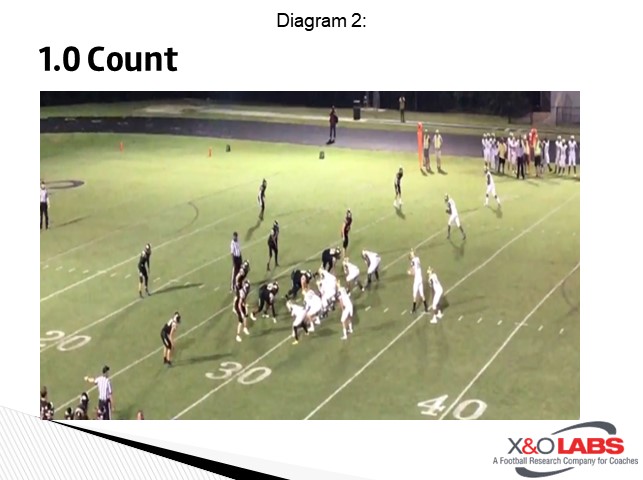
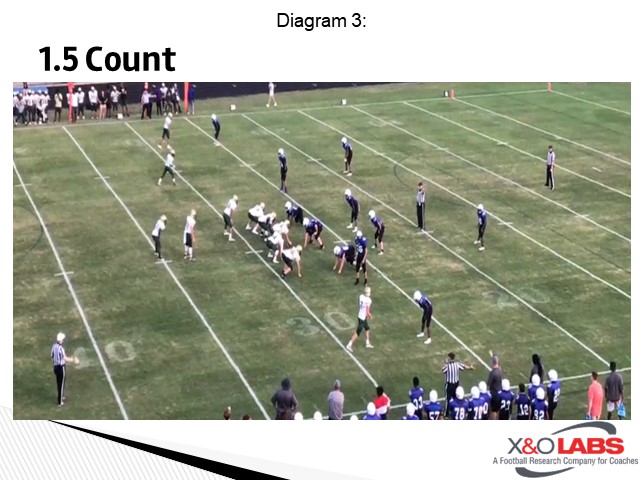
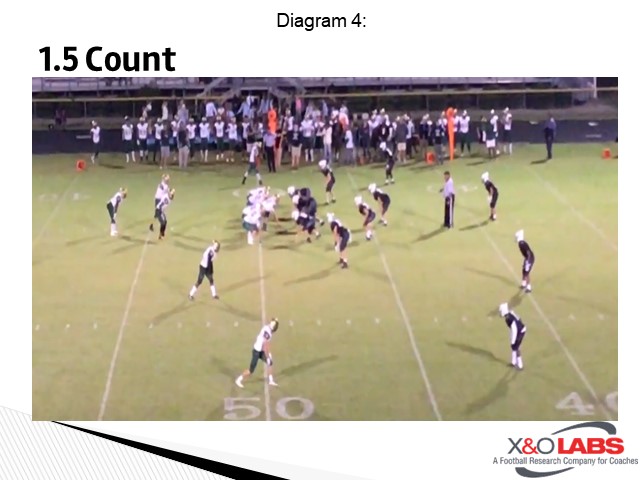
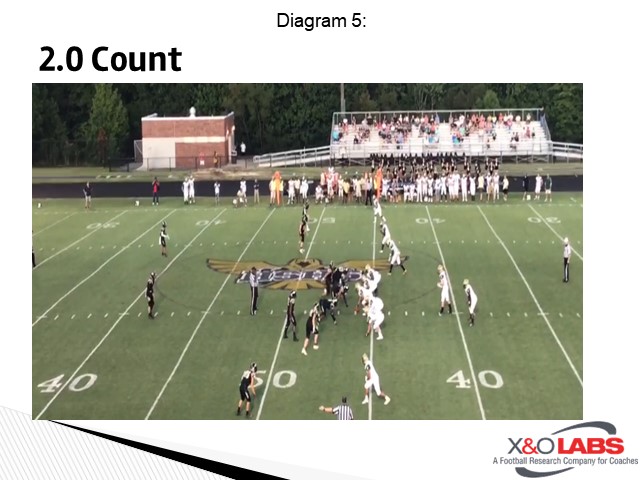
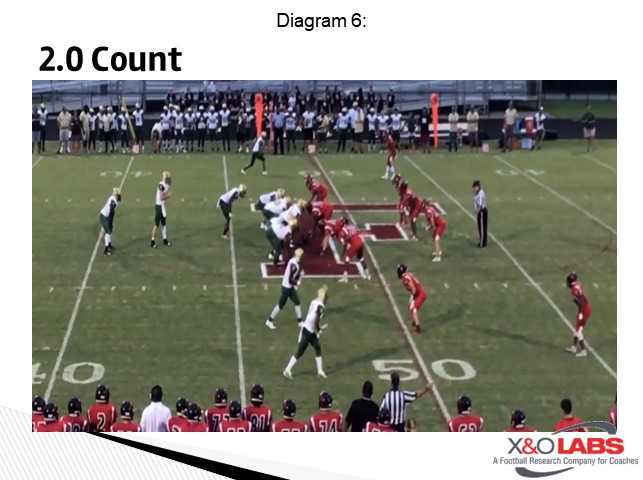
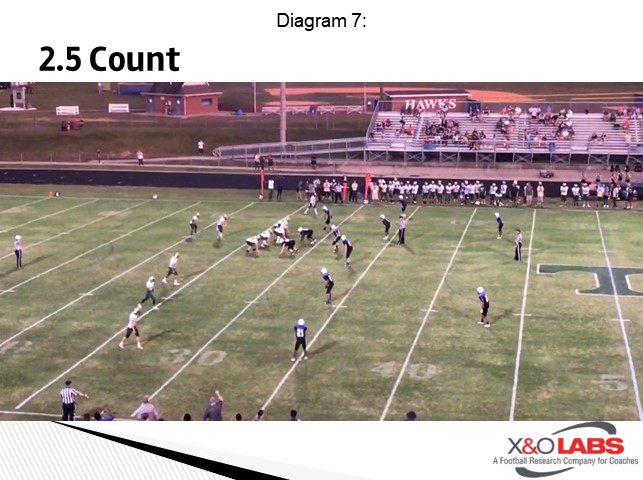
The quarterback had to count the defense’s alignment to decide as to what we were going to run. The most quarterback they had to count to was 2. If the defense’s alignment was 1.5, he would throw the blaze to the slot receiver. If the count was 2 or more, he would run the play call. We were comfortable if the QB threw the blaze every time. Our reasoning was that if we could get out slot receiver the ball against a defender, he had leverage on, chances were we were going to have an efficient play. No matter what formation we came out in, the split receiver would block the cornerback and the slot receiver would run the blaze.
In my opinion, it’s far easier to begin using this concept with a right-handed quarterback if the receivers are on his left, and vice versa for a left-handed quarterback. The reason for this is that by having a right-handed quarterback throw the blaze route to his left, he doesn’t have to change his feet or flip his hips around. I had the quarterbacks, all right-handed, simply step laterally and throw down the line when throwing the blaze to the left. By doing this, it allowed the running back clear their throwing lane and allowed a quick release out the QB’s hands.
If the QB was throwing to his dominant side, he would stagger his step with his dominant foot behind his non-dominant. This would allow him to roll his hips over as he stepped across to throw. Again, the purpose of this was to speed up his release and not have him take an exorbitant number of steps.
This was not a run-pass option. If the quarterback liked the count before the snap, he would throw it. If he did not like the count, he would not throw it. The goal is to reduce as much of the guesswork for the quarterback as possible, especially for a high school QB who doesn’t spend hours upon hours watching the film for tendencies and practicing.
Can you tell the quarterback to be aggressive or conservative on his alley defender count? Of course, you can. In fact, I think you need to. The less indecision you give your QB, the better. Also, adjusting the aggressiveness of the QB can give you a quick in-game adjustment if the alley player is giving you trouble.
Regardless of the aggressiveness of the week, our QB could not be wrong running the power read play and not throwing the ball.
Can you add a single side WR pre-snap option? Again, yes, you can. I am not in favor of it. I think it adds one more layer of thinking for a high school QB.
Running the Ball:
>> X&O Labs Members: Login here to continue reading
Join X&O Labs to Continue Reading…
Plus, get 4 FREE books!
When you join X&O Labs, you’ll get instant access to the full-length version of this report — including access to everything in The LAB and Film Room. That’s over 4,000 reports and videos. Plus, if you join with a Staff Membership, you’ll also receive 4 FREE books mailed directly to your home or office!
Read More
By Josh Barge
Assistant Coach
Red Mountain High School (AZ)
Twitter: @RMCoachBarge
The new craze in offensive football is to spread the defense out and chuck and duck the ball all over the field. Empty looks are a great formational edge, because it helps your coordinator and offensive players recognize defensive schemes much quicker. We are primarily an 11 Personnel program; our Empty package is 11 Personnel. Our Empty Package is a count-based package where three different schemes are being run at the same time, and our QB decides where we have a numbers advantage and that’s where the ball goes. Very seldom do we throw the ball past the line of scrimmage on this play, which leads to a very high conversion rate. We have been running this set for the last 7 years with a QB rating well over 150 and have yet to have a season with under 5 YPC.
Base Formation
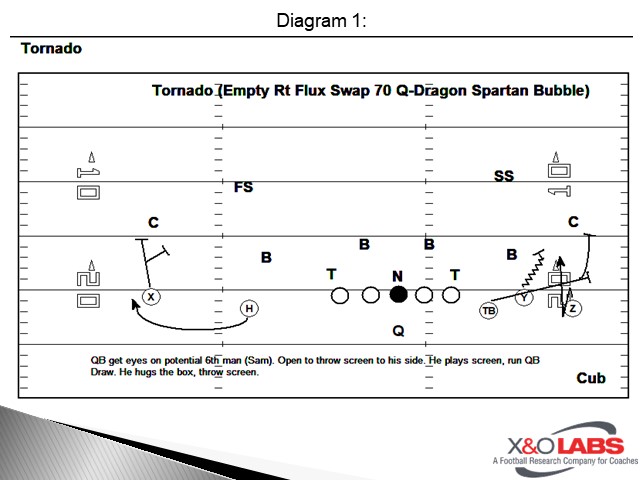
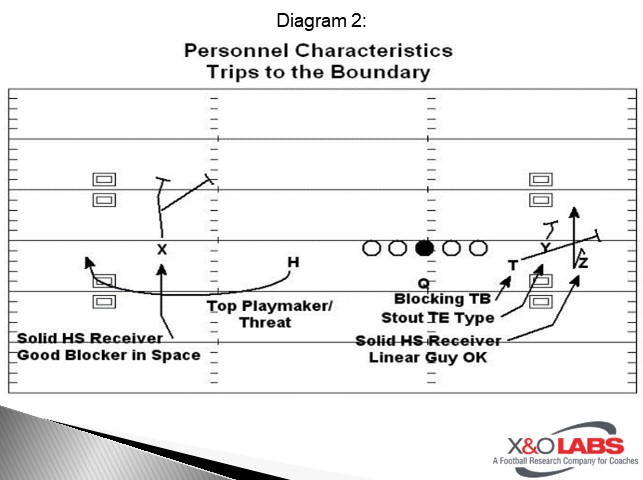
Our Primary set is a boundary trips look with our X and H receivers to the field with our regular 2×2 field alignments. Our Y (TE) sets the trips set to the boundary side with our Z and RB flanking each side in a 1×1 alignment. We tend to run our plays out of this package as a one-word quicks. We are not changing out of our base personnel to run then. We can get lined up and run a play super-fast as the ball is being spot. This allows us to get lined up and either our coordinators or the QB can decipher were the ball needs to go with plenty of time to adjust as needed.
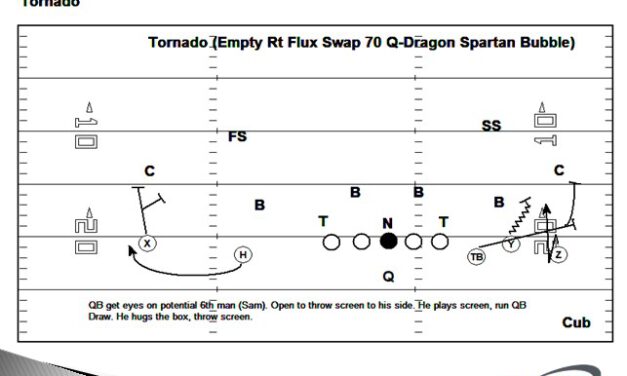
3-Man Spartan Screen
The boundary is running what we call our 3-man spartan screen. The Y (TE) has the key block we call our “ooze” block. It is essentially a down block in space, but it sets the crease for the Z receiver running our Spartan screen. He takes one step forward and then shuffles back one step and catches the ball. He needs to get up the field, make at least the first guy miss and get at least five yards. The running back has what we call the “kick or carry” block. He will take a flat angle with an aiming point of one yard in front of the receiver getting the ball. He has the corner. If he comes downhill quickly, kick him out. If he stays at depth, make the turn and carry block his declared angle.
Our field side is just running our 2-man bubble concept. The X is blocking first force. If everything is equal, we ask him to block the corner with slight outside leverage and stay square. But his initial track will always take him into the ally player. Find the guy that has the best chance of making the tackle and block him. Our H is always our speedster. He will cheat his alignment back a half a yard. Bucket step, cross over gaining depth and width. The quarterback, who is in the gun, will turn his shoulders on the first two steps. If he is under center, his shoulders must stay square to line of scrimmage. Catch the ball and get it to the edge. If the ball hits the ground, treat it as a live ball. Get on it!
Our line really has a week-to-week run set, teams that get upfield with their ends, we will block it as a draw. Teams that hang around and 2 gap everything, well block inside zone steps to the 3 tech. Teams with inside big men that wreck shop, we trap them to slow them down a bit. This can also be transformed into any scheme that fits your program the best.
Here is what the play looks like against some the of most common defensive schemes we see.
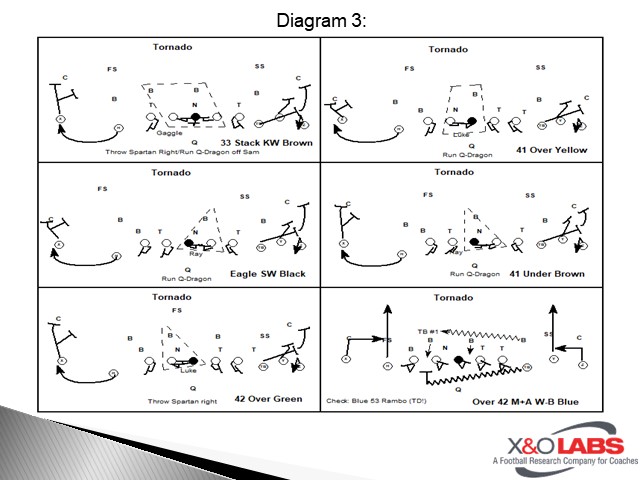
Coordinator/QB’s Rules
Because this is a pre- or post-snap SRO, the quarterback or the coordinator has the final say on which concept (screen or QB run) to use. Not surprisingly, it’s all about numbers. In any five-man box, the QB/coordinator can activate any of the runs in our menu that week, including zone, trap, draw or pin and pull. In any six-man box, the screen game should be activated because of the numbers advantage.
Essentials in Making Concept Efficient:
Surprisingly, you don’t need a dual threat QB to run this package, we have run it with pocket-passer and scrambling/wildcat style QBs and have had great success with both. Depending on your QB’s football IQ, these plays might need to be run as “Check-With-Me’s.” Have the eye in the sky (coach in the box) decipher the defensive look and signal in to the QB the best option. As he gets better at seeing it himself, start adding more responsibility on him. When teams start playing games with their alley defenders, the QB can make or break this play. Have them get their eyes on the alley defender and read his movements.
The biggest coaching point is regardless of which screen or run play gets utilized, it’s important that everyone still does their job. If the QB gets a run read, the wide receivers need to still run their screen full speed. The QB knows that there isn’t a guy blocking the second level perimeter players for his run. Teach your receivers to embrace blocking, their blocking ability makes this play work. “Return-the-favor” block for your buddy and everyone gets stats. This is a toughness play, we are going to out physical our opponent in this finesse set. Catch the ball and get to your landmarks as fast as possible and win your individual battle.
>> X&O Labs Members: Login here to continue reading
Join X&O Labs to Continue Reading…
Plus, get 4 FREE books!
When you join X&O Labs, you’ll get instant access to the full-length version of this report — including access to everything in The LAB and Film Room. That’s over 4,000 reports and videos. Plus, if you join with a Staff Membership, you’ll also receive 4 FREE books mailed directly to your home or office!
Read More
By Shawn Byrnes
Offensive Line Coach
Ottawa University (AZ)
Twitter: @fbcoachbyrnes
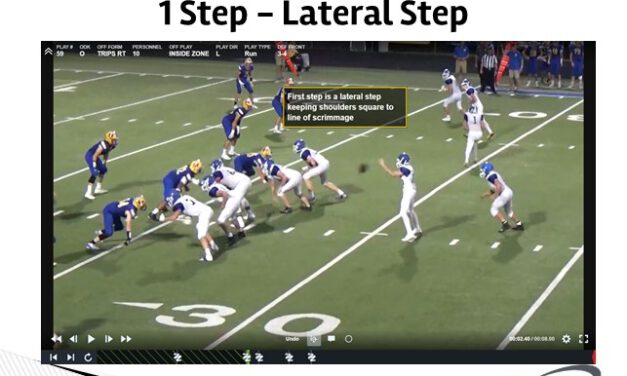
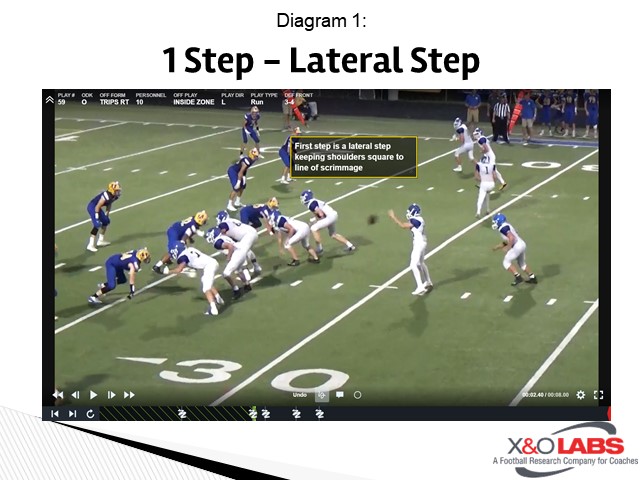
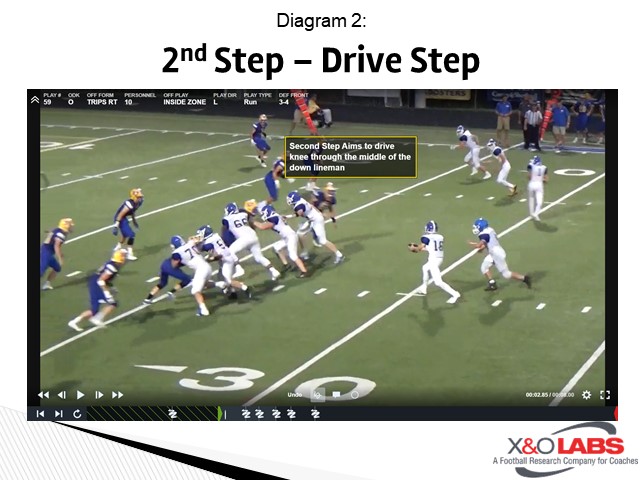
Wide Zone blocking can be employed in a variety of different ways. Here at Ottawa University – Arizona (OUAZ), we determine our lateral vs horizontal displacement of defenders depending on their alignments, structure of the defense, and where we would like to create the running lanes. We teach our Offensive Line, Fullbacks, and Tight Ends that we need to “Expand and Build.” We define that by expanding the front-side running lanes and building a backside wall to prevent the backside collapse. We believe these concepts can put your offensive line and running game in a great position to be successful.
The coaching points for the Offensive Line and Tight Ends are identical when it comes to our front-side zone blocking. We use multiple techniques when it comes to our blocking assignments and teach them across the board from Center to Tight End. In our front-side blocking system, the coaching points we emphasize are body landmarks of the defenders, footwork techniques to get you to those landmarks, and your helmet/body placement once you fit the defenders. We blend or combine a bunch of techniques from week-to-week.
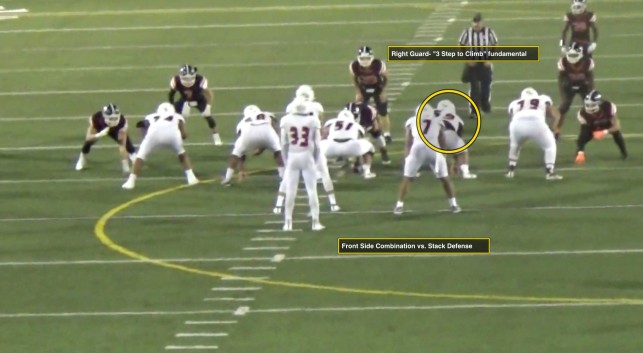
Body Landmarks of the Defenders
We use two landmarks when talking about attacking the body of a defender. We use our outside armpit landmark and our helmet landmark. We practice attacking these landmarks every day in pre-practice and individual in our combination pod work. We work different DL shades, linebacker alignment and style of play i.e. slanting/read defenders, scraping or downhill LB play, etc. These practice clips below show you how we practice and execute our landmarks for the covered/uncovered lineman.
Covered Lineman: Outside Armpit Landmark
Regardless if you are in a solo assignment or you are the covered linemen in a combination assignment, we teach our blockers to aim their helmets to the outside armpit of the defender.
To study game film of this concept, click on the video below:
>> X&O Labs Members: Login here to continue reading
Join X&O Labs to Continue Reading…
Plus, get 4 FREE books!
When you join X&O Labs, you’ll get instant access to the full-length version of this report — including access to everything in The LAB and Film Room. That’s over 4,000 reports and videos. Plus, if you join with a Staff Membership, you’ll also receive 4 FREE books mailed directly to your home or office!
Read More
|