|
Rover and Nickel
|
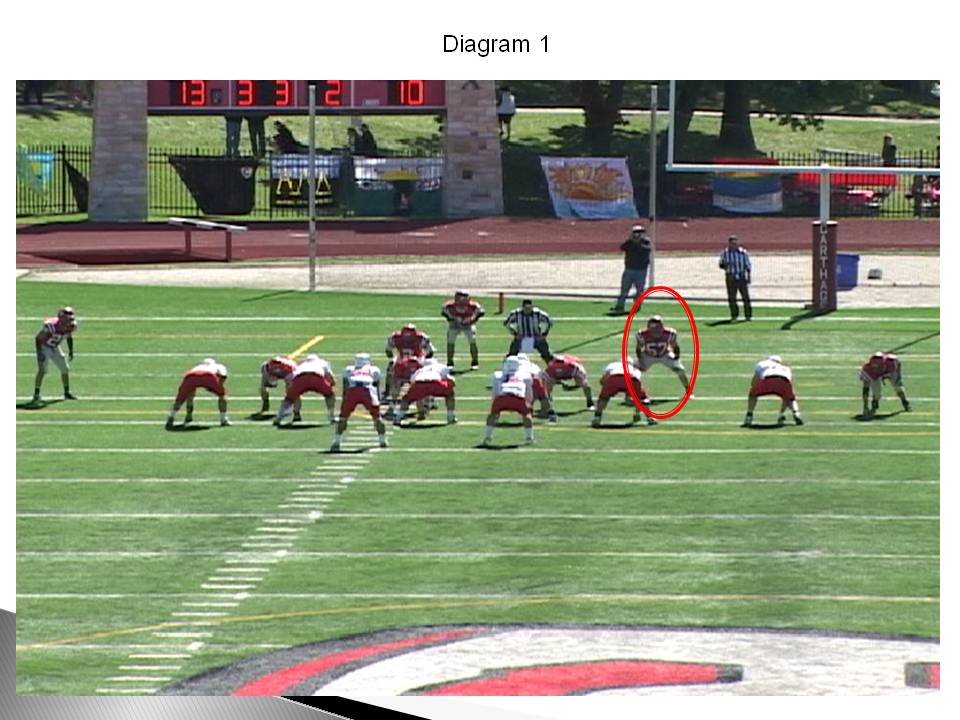
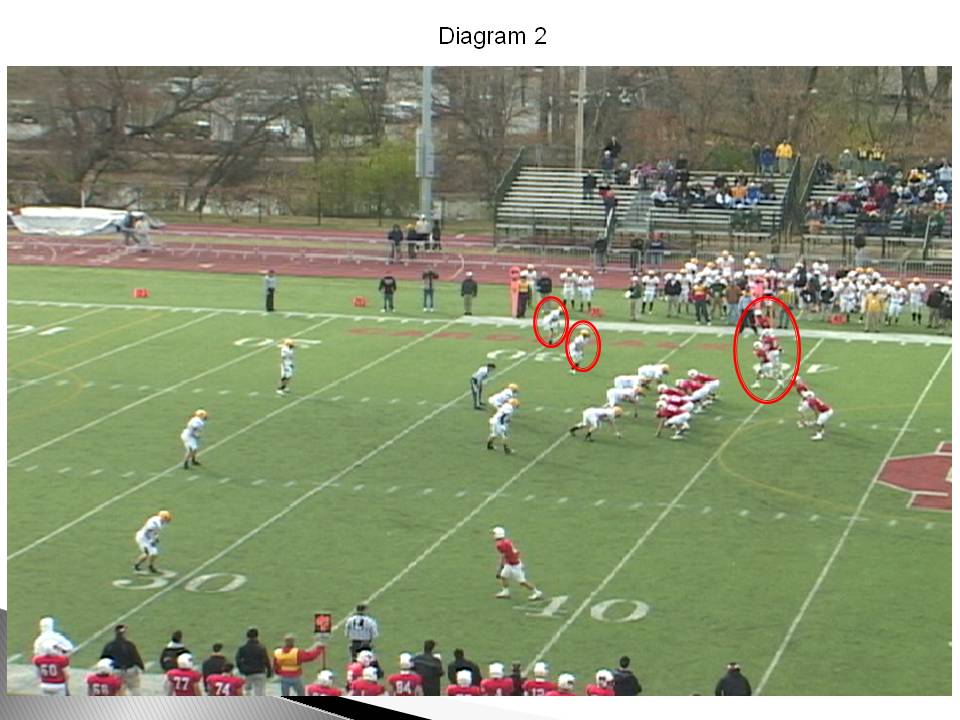
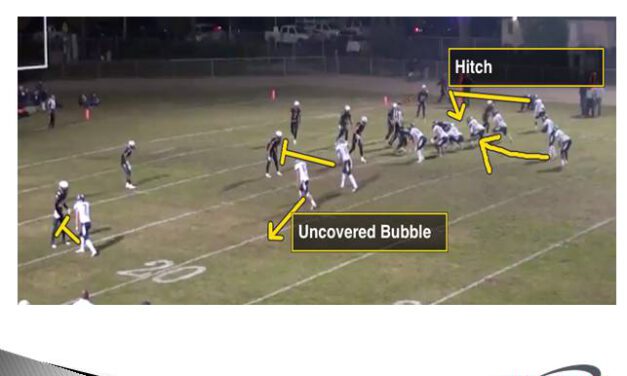
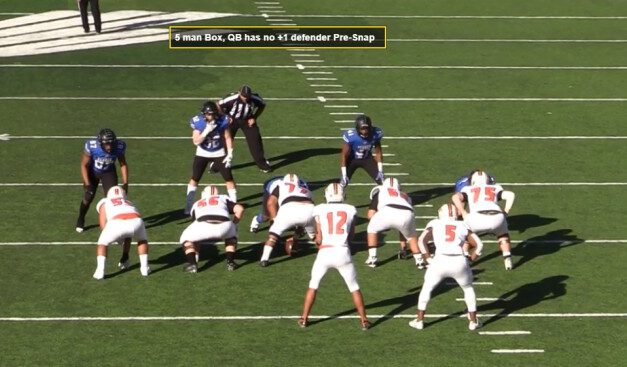
3X5 off EMLOS, if there is #2 rec. follow alignment rules – inside eye at 5 yards to start.
|
Run to: Contain – set edge and turn everything back inside. Outside arm and leg free.
>> X&O Labs Members: Login here to continue reading
Join X&O Labs to Continue Reading…
Plus, get 4 FREE books!
  When you join X&O Labs, you’ll get instant access to the full-length version of this report — including access to everything in The LAB and Film Room. That’s over 4,000 reports and videos. Plus, if you join with a Staff Membership, you’ll also receive 4 FREE books mailed directly to your home or office! When you join X&O Labs, you’ll get instant access to the full-length version of this report — including access to everything in The LAB and Film Room. That’s over 4,000 reports and videos. Plus, if you join with a Staff Membership, you’ll also receive 4 FREE books mailed directly to your home or office!

Read More
By Paul Hefty
Assistant Coach
State College High School (PA)
Instructor of Kinesiology, Penn State University
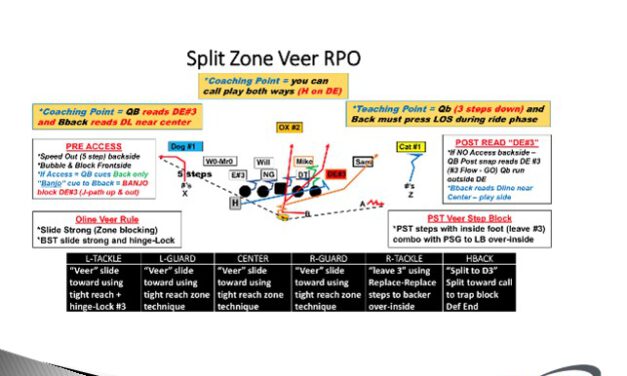
One of the challenges for all coaches is to take today’s new-exciting, but complex RPO concepts and find ways to simplify teaching, learning and processing for high school level players (and Coaches). The dilemma is to take a major D1 offense or complex system and make it simple enough to use at not only the high school varsity level – but, with the 9th grade program – while still reaping the benefits of explosive plays and being turnover free.
First, research a system that is sophisticated, but simple in design, “Evolved Simplicity” = use only 1 blocking scheme for OLine (Zone-Veer) – Run or Pass.
Second, design a system to be flexible in that it can adjust and fit to the strength’s (talents) of personnel from year to year, week to week and game to game.
Third, use a scaffolding or chunking teaching progression. Scaffolding or chunking of teaching is a process of introducing information in a way where each future concept builds upon or simply expands the previous concept.
Step 1 – Simple
- Teach using 2×2 alignments
- Learn details of a quality RPO system without making changes to the core, so as to not lose the integrity of system as it evolves
- OLine uses a minimum number of blocking schemes
Step 2 – Flexible
- Use simple personnel terminology while each position has a natural twin
- Split-Zone RPO attacks all fronts and coverages (1 scheme for multiple plays)
- Split-Zone RPO has ability to make QB a runner, thrower or dual threat (play to strengths)
Step 3 – Scaffolding
- OLine uses only Split-Zone (Veer) blocking rule for every type of play
- Pre and Post-snap defensive recognition process that is used with all no huddle plays. This TRI-O process is used with both the OC (coaches) and QB (players) = all on the same page
- Limited communication to simplify processing for players (think and play FAST)
3 STEPS – MAKING COMPLEX SIMPLE
Step 1. SIMPLE:
We start by installing and teaching everything from a balanced 2×2 H-back set. This helps with learning our offensive principle #1 = NUMBERS. Both the OC (from the sideline) and QB can easily see if the defense is balanced or overloaded by using a three step, defensive recognition process of pointing @ 1 or 2 high safeties plus hanging backers (Mr 0’s) and last, the mike backer.
The other key point is that you can adjust the H-backs alignment pre-snap (using similar formation calls that again, only the H-back adjusts to). This is done with an offensive concept (blocking scheme) in mind, which allows the H-back to have the best leverage for each play. Applying offensive principle #2 = BLOCKING ANGLES. Both the OC and the QB want to call plays to put the OLine and H-back in the best possible blocking scheme based on blocking angles.
To keep communication with the no huddle – high tempo offense simple, 95% of the time we have the Slot align to the field (formation directional call) and the H-back into the boundary. This achieves a maximum horizontal stretch of the defense while helping the OC and QB to identify defenders easily. Applying offensive principle #3 = SPEED IN SPACE or FIELD. The players can anticipate this tendency, helping to simplify and create consistency for everyone. When, and if, you want to be a heavy 3×1 team when the football is on the hashes, you simply move 1 player (H-back) to the field. All other players align the same as they would in a 2×2 set. By minimizing the number of players who have to change – you have limited new learning. The key to keeping your system simple is to have the ability to use the same rules for both 2×2 and 3×1 sets. Only the nature of the defense should change. The goal for changing alignments should be to manipulate the defense, not changing things up just to do something different (method to the madness). Remember, less variables for the players means less to process (Less is More concept = SIMPLE).
>> X&O Labs Members: Login here to continue reading
Join X&O Labs to Continue Reading…
Plus, get 4 FREE books!
When you join X&O Labs, you’ll get instant access to the full-length version of this report — including access to everything in The LAB and Film Room. That’s over 4,000 reports and videos. Plus, if you join with a Staff Membership, you’ll also receive 4 FREE books mailed directly to your home or office!
Read More
By Mike Kuchar
With Frank Giufre
Offensive Line Coach
University of Connecticut
The pin and pull concept have mainly been considered to be used as a change-up. It has been used to supplement the wide zone, tight zone and gap runs already in your arsenal. But that philosophy is changing. Before we present our research on the specifics of the block scenarios involved with the scheme, there are certain tangibles that need to be taken into consideration before implementing the pin and pull as a fixture in your offensive play menu.
Advantages of Tagging Pin and Pull Runs
- Uses high percentage down blocks to separate the defense. Not necessary to crush defenders, just to eliminate penetration.
- Opportunity to get two pullers in front of the ball carrier.
- Handles bigger defenders in the box
- Gets the ball out in the perimeter. As Coach Giuffre told us, “the offensive line likes screens but this gets them running to hit a defensive back. It becomes fun. You’re not trying to knock people off the ball.”
- Efficient red zone play because of the tight formation spacing.
Skill Set Requirement and Personnel Preference Needed for Efficiency
While with the Indianapolis Colts as an assistant offensive line coach, Coach Giufre used the concept mainly as a change-up for the Colts inside and outside run schemes. “It wasn’t part of our identity because we were such an outside zone heavy team,” he told us. “But if you have a running back that can navigate through space it can really put stress on a defense. You look at what Philadelphia Eagles have done (with LeGarrette Blount) and it’s been astonishing.” According to Coach Giufre, it may even make sense for high school coaches, to scrap the pure outside zone run and utilize inside zone and pin and pull because they may not have a back that can read the outside zone. “It may be easier to run the tight aiming points of inside zone with the pin and pull addition,” said Coach Giufre. “Cut the defense with down, down pull. You may get your outside zone off pin and pull without using the NFL or college model.”
With the prevalence of 4i techniques in Odd fronts, the pin and pull scheme can be reliant on down blocks at the point of attack while uncovered Guards can get out on the perimeter and make blocks in space. It seems to be extremely effective against teams playing heavy, inside techniques with a back that can navigate in the open field. “We like backs that can catch a toss then get his eyes up to his read,” he said. “It can also be an excellent run with jet sweep motion to act as an eye distraction to the defense.”
In most cases, Coach Giufre will utilize the pin and pull concept with both 12 & 11 Personnel groupings, but prefers it out of 3×1, 2×2, and 1×3 (Nub) formations.
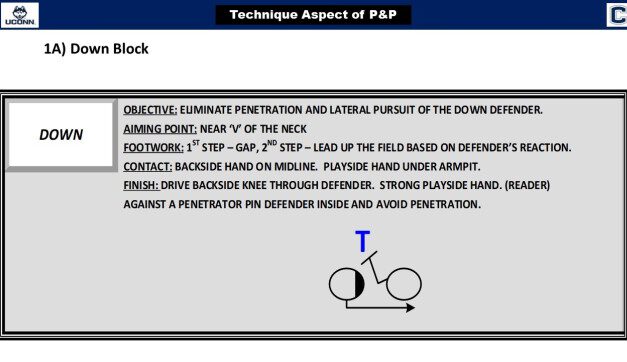
Down (Pin) Block Technique
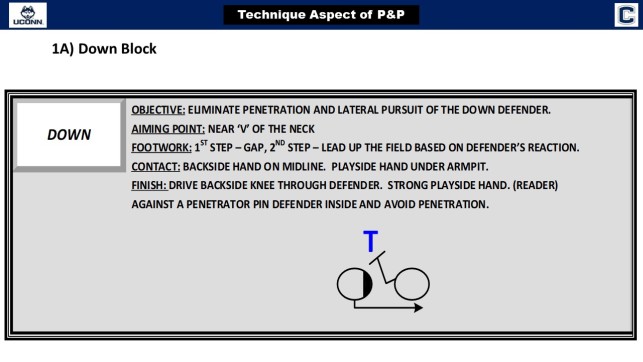
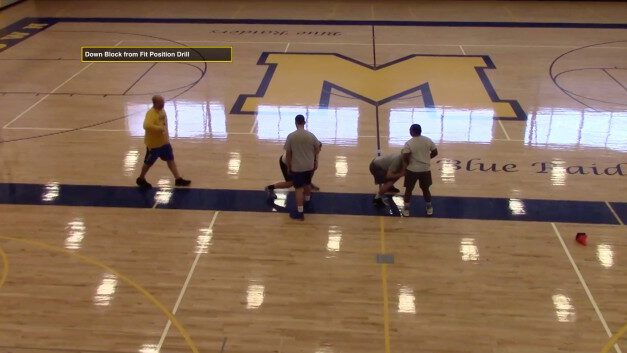
The concept of the down block is to negate penetration by working your hips around to block the defender. While some coaches teach a play side vertical step to account for any possible crossing of the face, Coach Giufre teaches a gap step with the first step. The second step is the lead step with the third step being the follow step. “On the gap step, we step with the foot closest to defender, while the lead step works slightly up the field,” said Coach Giufre. “In our position step, we set our eyes to the aiming point (which is the near V of the neck of the defender). Eyes should be in near V of neck. Like baseball, we try to keep our eyes on the ball. If we get eyes to aiming point and our body will follow.
Coach Giufre teaches a strong play side hand to flip leverage if the defender tries to get around him. “If we try to pin him and he runs outside, I step and take my inside hand and throw a shot put and accelerate him to sideline to open up the hole,” he said. “You need to know your personnel. If he is a penetrator, bring heavy hands and get your eyes on that near knee and bring your feet to displace him. These defenders can’t knock off a puller. If he’s a reader, be cautious on the first step and get second step on the ground to be prepared to flip hips.”
Pull Block Technique
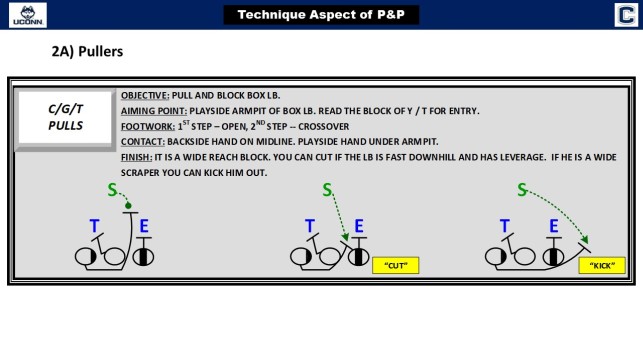
The footwork for pull blockers is taught as an open, crossover progression. Pull blockers will open their play side foot (Coach Giufre calls it a ‘wedge step’) and crossover with the backside foot. “It doesn’t matter if their shoulders are turned,” he said. “If they open up a little bit it helps them sift things out. The ball is out of the box anyway. It’s not like counter or power scheme.” As far as the strike point goes, Coach Giufre teaches a double under technique (made famous from John Strollo and Jim McNally lectures) on contact. “Rather than pushing a guy, you’re lifting him,” If you can get hands underneath and lift shoulder pads it chokes defensive linemen. They will naturally stand up to find air.” Once the target is identified (which is usually the first defender past the identification) there is no shimmy, or no entry point through the line. It’s a complete run. There are two types of blocks synonymous with these assignments:
Cut block- offensive lineman’s backside shoulder through defender’s legs.
>> X&O Labs Members: Login here to continue reading
Join X&O Labs to Continue Reading…
Plus, get 4 FREE books!
When you join X&O Labs, you’ll get instant access to the full-length version of this report — including access to everything in The LAB and Film Room. That’s over 4,000 reports and videos. Plus, if you join with a Staff Membership, you’ll also receive 4 FREE books mailed directly to your home or office!
Read More
By Brett Myers
Head Coach
Middletown Area High School (PA)
Twitter: @mtownfbinfo
Over the past three years at Middletown Area High School we have reached new heights as a program. We have won 3 Division titles, 3 District titles and made 3 straight appearances in the PA state finals. Our record is 53-6 over the past 4 years. There are many reasons for this success but one of the major pieces that have led to this success is our run game out of the spread and our top play over this period has been the BUCK SWEEP. The reason the buck sweep has been such a large part of our success is that it matches our core beliefs.
By adding the Buck Sweep to our spread offense, it has given us a chance to be physical against teams that we cannot move off the ball vertically. The buck sweep is the most fundamental play in football. It takes a total team effort to run this play. With that type of scheme and with proper technique you can have success with less talent. With, another benefit to the Buck sweep in our spread 2 back offense is that we can spread the field to give our players better blocking angles and get people in space. The more formations we can come up with the better. These formations will give us the angles we want and put different defensive players in conflict.
Coaching Points
We will start with our rules for the Buck Sweep
PS-TE-gap, down, backer – if flexed inside backer
PS-TAC- gap, down, backer
PS-G- pull kick out force player (open 5 o’clock crossover get inside out)
Cen- A gap to A gap-(most dangerous threat from play-side A gap to Backside A Gap)
BS-G- quick pull and wrap looking for backside lber
BS-TAC-Pull check & hinge
PS-HB – wing gap down backer/spread stalk unless in motion, chip end work to the the backer
FB- if QB under center carry out trap route if in H back reach 1st guy outside tac block
BS-HB- jump snap aiming for FB heel taking the handoff reading the flank, must make 90-degree cut, if TB spot run through QB hands reading flank looking to make a 90-degree cut.
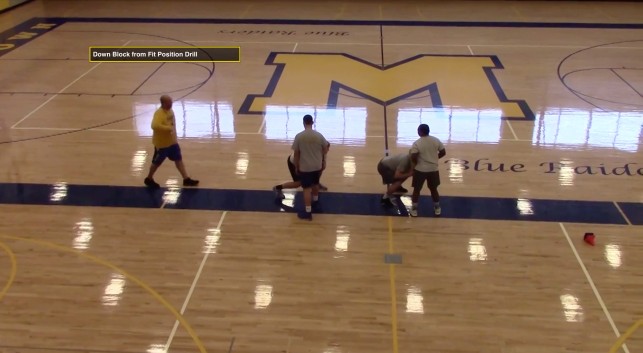
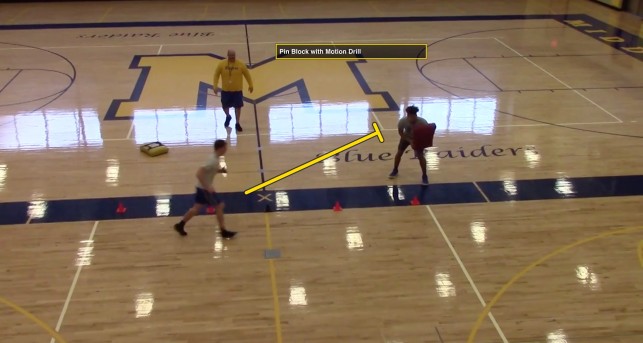
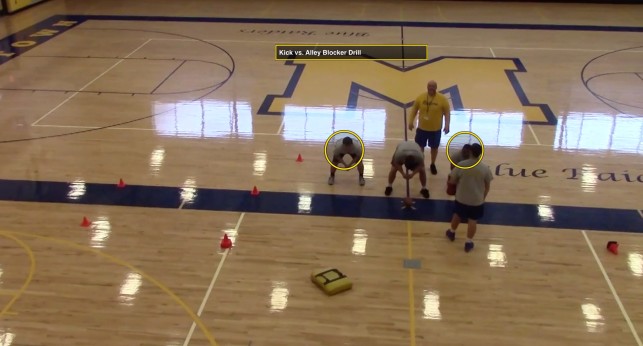
To study game film of this concept, click on the video below:
>> X&O Labs Members: Login here to continue reading
Join X&O Labs to Continue Reading…
Plus, get 4 FREE books!
When you join X&O Labs, you’ll get instant access to the full-length version of this report — including access to everything in The LAB and Film Room. That’s over 4,000 reports and videos. Plus, if you join with a Staff Membership, you’ll also receive 4 FREE books mailed directly to your home or office!
Read More
By Jeremy Plaa
Head Coach
Thomas Downey High School
Twitter: @JeremyPlaa
In our program, teaching the concept of HOW TO COMPETE is just as important as teaching technique and scheme. While some coaches may not believe that, the Competitive Games model has been great for us to celebrate success and use the lesson of losing to teach consequence and talk sportsmanship. And best of all, it’s fun and our kids love it.
Competitive Games have multiple benefits for our program:
- Each team has a captain and a co-captain, so it provides the opportunity to teach and build leadership
- Reinforces the idea that LEARNING TO COMPETE is everything in life
- Celebrates winning & uses losing as a motivator
- Serves to organize attendance in our program- each team’s captain takes roll
- Improves attendance in the summer- captains apply pressure to make sure all their team attends
- Serves to organize setup/cleanup of practice equipment (bags, water cart, cones, etc.)
- Reinforces the idea of family- helps freshmen to connect with older kids in the program
- Helps to prevent the hazing atmosphere that some programs have- where Seniors look down on younger classes
- Organizes jobs/duties in the off-season program- each team is responsible for something
- The FUN factor- don’t overlook this- we have FUN with our summer games
What is a Competitive Game? At the end of every off-season workout, we spend 15 minutes competing. Our entire program160 kids- is split into 8 families. Having 8 makes it easy to make every competitive game a bracket-style event. To get everyone involved, we come up with guidelines that will make sure all kids on each team compete at least once a day. For example, we keep Handball on Tuesdays a game of 5 on 5. To make sure everyone plays, we say that no athlete can sit out two games in a row. So, if they sit out round one, they must play in round two; or their team is automatically disqualified. Also, if a team is eliminated in round one; on the next day athletes who did not participate MUST be the first to be included.
Organization of Teams
How do we set this up? We start with coaches selecting potential captains. Anyone and everyone that we think is a potential captain is up for discussion. Our coaches settle on anywhere between 8-16 captains for the summer teams. This year we identified ten kids that have captain-potential. So, we picked our top 8 and allowed those 8 kids to select their co-captain. The remaining two kids that didn’t quite make captain in the coaches’ view, were some of the first “co-captain” picks. You can steer this as needed. Once we have a captain/co-captain for eight teams, we set a draft date following our first final exam date in May. Before the draft begins, captains select a team name with a “character trait” theme, and they also select what summer setup/cleanup jobs they want for the entire summer.
>> X&O Labs Members: Login here to continue reading
Join X&O Labs to Continue Reading…
Plus, get 4 FREE books!
When you join X&O Labs, you’ll get instant access to the full-length version of this report — including access to everything in The LAB and Film Room. That’s over 4,000 reports and videos. Plus, if you join with a Staff Membership, you’ll also receive 4 FREE books mailed directly to your home or office!
Read More
By Bruce Eien
QB Coach
Eugene High School (OR)
Twitter: @bruceeien
The spread offense is all the rage in football today. Modern defenses have come up with sophisticated ways to stop the spread offense. Many teams have combated these defenses with more traditional type formations and sets. Teams use double TE’s, TE/Wing and a fullback look to take advantage of these new modern defenses. What if you could combine both sets into a single offensive system allowing you to gain an advantage over anything the defense presents?
The Merge
The way we merge the Single Wing and Spread is to run the same series between formations. Optimally we would like to use the same personnel so we can shift between formations not allowing the defense to sub in bigger defenders. Most of the time the defense opts to play their pass defense and not a short yardage front. This gives us an advantage as we can get more people to the point of attack then they can defend. It also gives us options to see what system gives us a better advantage! We use the same rules and schemes in both formations systems to streamline learning time. Another advantage is multiple players can be the QB in the Single Wing giving you many game time options and optimizing practice time.
Formations
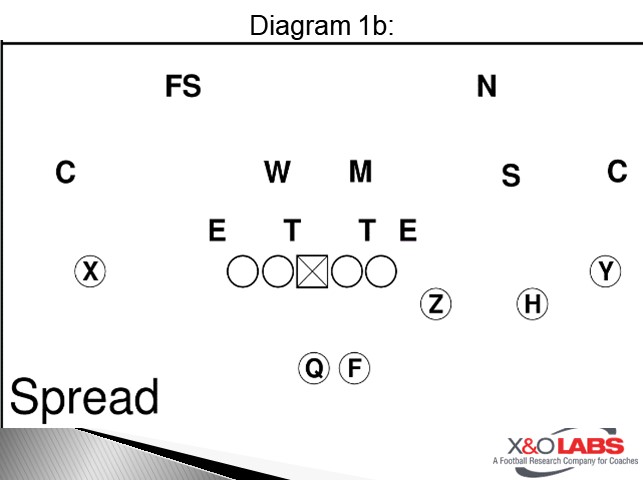
We use a four WR set with base formations of Spread, Trips and Empty.
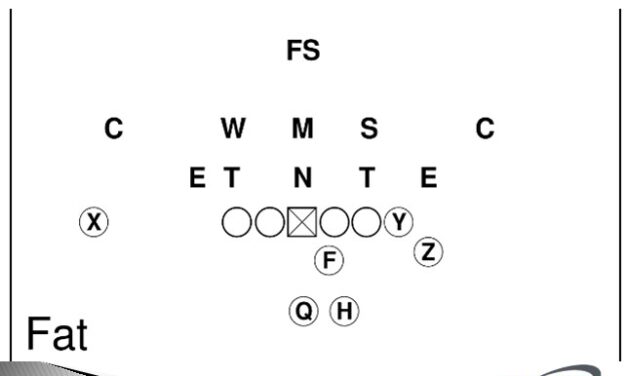
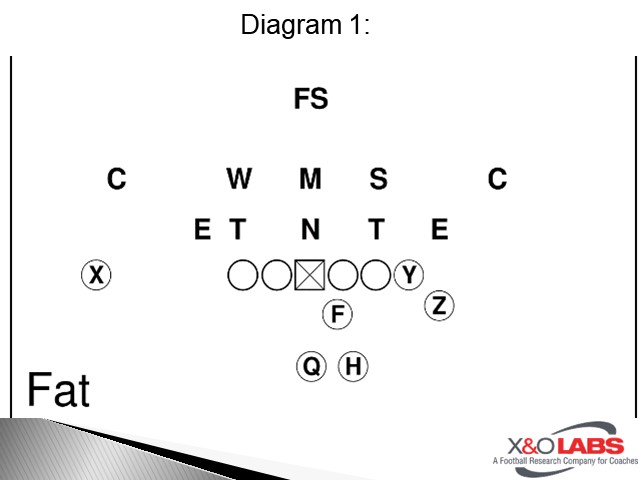
We use a Single Wing set with formations called Single and Double Fat
History
We have been an under center four WR offense since 1990 and went full-time shotgun in 2000. We had run the Power I as our goal line offense for many years. In 2001 we had a great running QB and we were figuring out ways to get him the ball. So, we brought in a true FB in the backfield and started running I back type plays to the QB. We then tried to figure a way to get the Power I into the offense and moved 2 FB next to each other. During this time a team in our league played a Single Wing Team and I noticed we could run our double FB offense from a balanced set. We introduced it in the 2001 season and called it Jumbo. One of our player’s mothers asked me when we were going to run those plays were, we bring in all the “fat guys” and hence the name was born.
Searching the Internet, I found the Single Wing Forum on Delphi and discovered Steve Calande was running something similar called the BEAST. The only difference was he was running 3 FB’s where I had 2 and a Wing. Later on, I found out we were both running versions of the Yale Formation from the early 1900s. It’s amazing how 2 different coaches from opposite ends of the country came up with a similar formation and plays, never knowing about each other’s work until they were finished?
Three play series
We use a three-play series of a QB Sweep, Roll Out Pass, and a Wing Counter.
In this series, we use the QB Sweep off the rollout pass. In the trips Formation, we use the rollout pass to set up the QB Sweep while in the Fat Formation we use the QB Sweep to set up the rollout pass. The Counter Play is used to take advantage of the defense overplaying the Sweep or Roll Out Pass. We have other plays in this series but are concentrating only on these three for this article.
Roll Out Pass Concept:
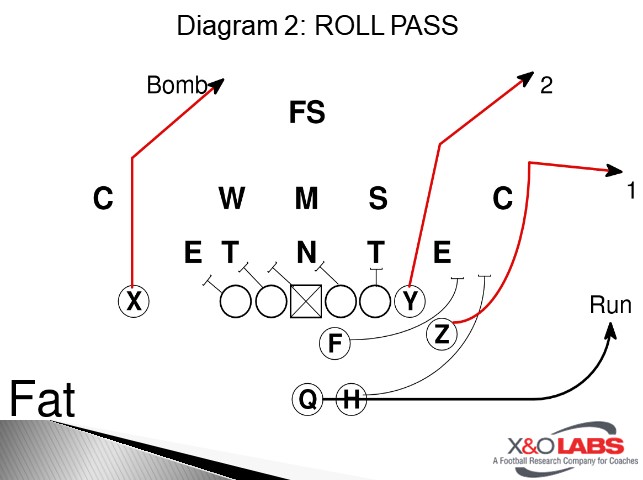
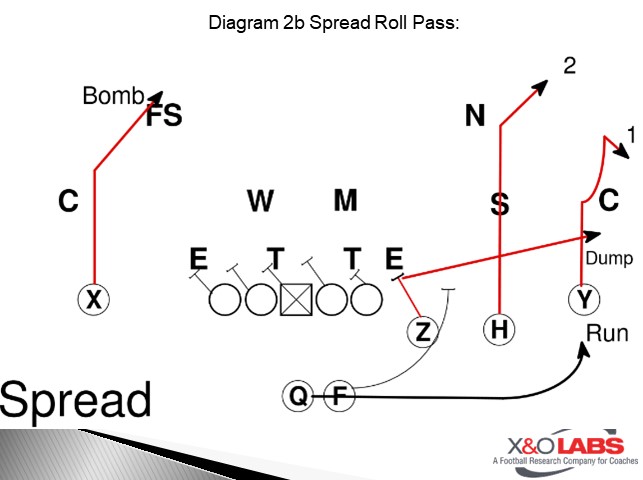
The Roll Out Pass is a moving pocket where the QB will break contain and read the CB on a Hi-Low Concept. We can also tag other concepts like Flood, Smash and Curl to this play. The Line is in turn back protection blocking to the gap opposite the play. For example, Roll Right, the linemen block left and vice versa. The RB sets the edge by running at the DE and takes over the block from the chipping #3 WR. In Fat, the TE will chip as the Wing is the primary WR.
WR routes are:
#1 15 Yard Fade Out (Fade at 7 comebacks to sideline at 15) in Fat the Wing runs a Wheel Out as he is tighter in the Formation.
#2 Deep Corner (corner at 15 getting deep)
#3 Chip on DE run 5-yard Flat route
QB breaks contain like Sweep and his first read is Fade-Out all the way. If the CB jumps the out the QB hits the deep corner route. If the QB is not open or he gets pressure he can dump to Flat Route or run the ball. If QB breaks contain and sees open grass for more than 10 yards run every time!
>> X&O Labs Members: Login here to continue reading
Join X&O Labs to Continue Reading…
Plus, get 4 FREE books!
When you join X&O Labs, you’ll get instant access to the full-length version of this report — including access to everything in The LAB and Film Room. That’s over 4,000 reports and videos. Plus, if you join with a Staff Membership, you’ll also receive 4 FREE books mailed directly to your home or office!
Read More
By Mike Kuchar with Todd Argesta
Defensive Coordinator
Montclair State University (NJ)
Twitter: @ToddAgresta
Montclair State University is a program rooted in successful tradition. One of the top Division III programs in the Northeast, the Red Hawks have been playing football for 87 years and head coach Rich Giancola has been coaching for 37 of them. He’s the active NCAA Division III leader in wins, compiling a 239-121-2 mark since taking over in 1983. Defensive coordinator Todd Agresta has been with Coach Giancola for 20 of those 36 years and it’s no coincidence that for 10 of those years the Red Hawks have been in the top three in the conference in every major defensive statistical category.
Like most successful program, they believe in what they do defensively and what they do is play with a middle of the field safety on over 85 percent of snaps. It’s a philosophy that Coach Agresta has developed and refined to defend the modern RPO offense. “I just believe in having a post defender,” he asserts. “I don’t feel comfortable with the teams we play playing with two safeties. You still need to stop the run. Our run fits are easier and it’s easier to teach.”
While the coverage can routinely change, one thing will not: there will be a safety in the middle of the field. And at the hierarchy of the Red Hawks defense sits its bread-and-butter coverage- Rip/Liz Match, or what Coach Agresta calls “Cover 9.” It’s the latest off shoot of man vs. zone, it looks like Cover 3 when it needs to and it looks like man coverage when it needs to look like man. It’s a coverage commonly associated with five-man pressure defenses and Montclair State runs it just as good as anyone.
Editor’s Note: Due to space issues, this report is designed exclusively around the coverage aspects of Rip/Liz match. X&O Labs already devoted an entire report on how to fit the run with this coverage with the University of St. Thomas (MN).
Personnel and Defensive Structure
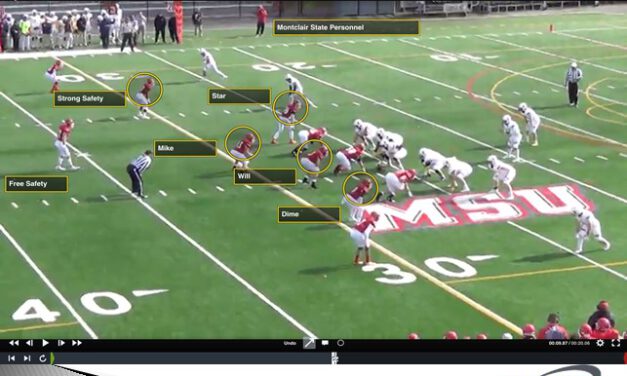
The genesis of the Red Hawks scheme is based on an Odd front with the following denominations:
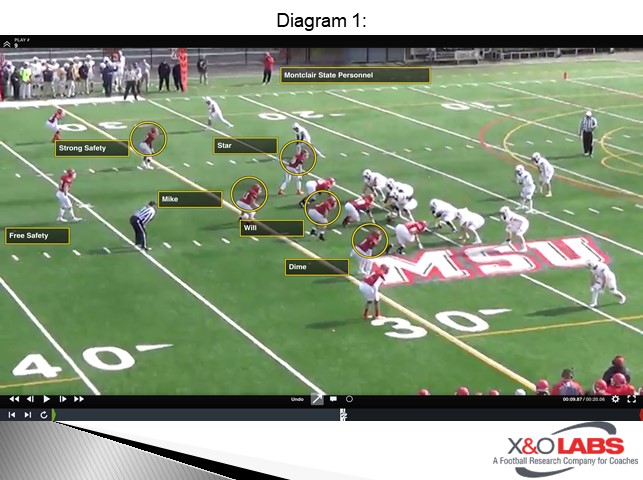
- Two-Gap Nose
- Base 4i Techniques at Defensive End (may be 5-techniques in Dime)
- Inside LBs: Mike and Will
- Outside LBs: Star (left) and Dime (right)
- Money: Strong Safety
- Jack: Free Safety
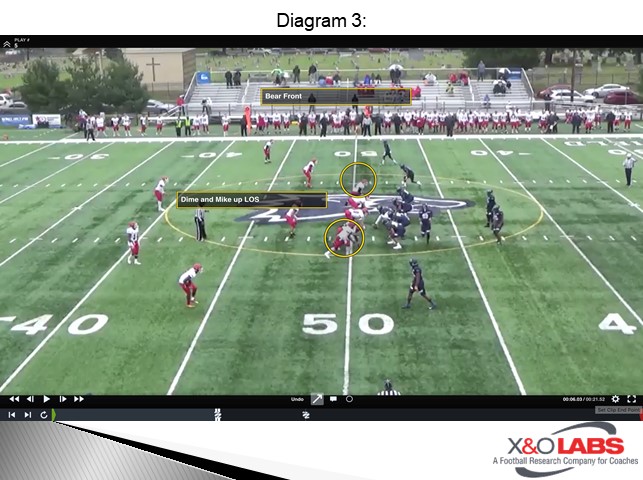
While Coach Agresta modeled his defensive scheme around the New England Patriots, he calls his outfit a “junk front,” which can align in various positions along the line of scrimmage. These fronts can transition into the following:
Odd Stack
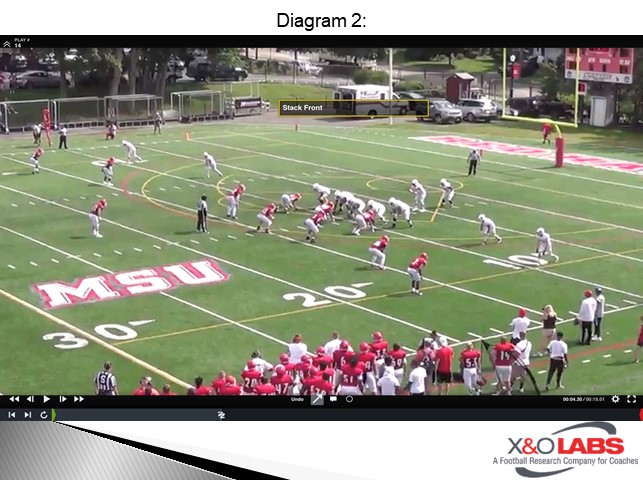
Bear Front
Base Coverage Principles
There is a myriad amount of pressure patterns that can be devised with this coverage, so we wanted to first spend time detailing the technique associated with each of the coverage defenders in Rip/Liz Match. The defenders in this coverage consist of the following:
- Two Outside Third Defenders
- One Deep Third Defender
- Two Seam 2 Droppers
- One 3 Hook Defender
According to most coaches, including Coach Agresta, the key to making the coverage efficient is a cross-training approach so that each back-end defender (LBs and DBs) understand how to play each of the above coverage concepts. It’s why the defensive staff at Montclair State spends the majority of spring practice (D-III is non-padded) working how defenders relate off each other. “Communication is the key to this coverage,” he told us. “Which is why we have buzz words for each scenario.”
While, we will provide the vocabulary behind the communication when we present the pass concepts that affect this scheme, we wanted to provide an overview of the responsibilities of these defenders.
Outside Third Defenders
In most situations, these will be the corners, the “Hawk” or left corner in the Red Hawks scheme and the right corner. In this system, the divider rules are the numbers. “If the wide receiver is outside the numbers, we’re 1×6 (one yard inside, six yards deep),” said Coach Agresta. “If the wide receiver is anywhere on the numbers, we will be head up the wide receiver at 6 yards. If he’s inside the numbers, we’ll be one yard outside and six yards deep.” Coach Agresta breaks down the post-snap read of the corner based upon the drop of the quarterback. “We will read the drop of the quarterback, mainly from shotgun alignments because that is what we see,” he told us. “If the QB catches and sets it’s a three step drop. In three step our eyes go to number one because we don’t get any shallow routes from that action. If the QB is taking three steps, it’s a five step drop for us. When I see five step, my eyes go to one and we pattern read off of that.”
>> X&O Labs Members: Login here to continue reading
Join X&O Labs to Continue Reading…
Plus, get 4 FREE books!
When you join X&O Labs, you’ll get instant access to the full-length version of this report — including access to everything in The LAB and Film Room. That’s over 4,000 reports and videos. Plus, if you join with a Staff Membership, you’ll also receive 4 FREE books mailed directly to your home or office!
Read More
By Adam Hovorka
X&O Labs Managing Editor
Twitter: @X&OLabs_Editor
Featuring Mark Melnitsky
Offensive Coordinator/Offensive Line Coach
Trinity College (CT)
Twitter: @coachmelnitsky
Football is an ever-evolving game, however, the one constant that has remained is the fact that you need to be able to run the ball to win games. At Trinity College, the Middle Zone is the staple of the run game. In 2018, Trinity ran it over 15x per game, for an average of 5.6 yards per carry and 9 touchdowns. One of the reasons they like the mid-zone so much is the flexibility it provides against different defensive fronts, schemes, and structures. Offensive coordinator, and offensive line coach, Mark Melnitsky says the reason they run it so much is that “We like it against, 4-3, 4-2-5, 3-man fronts, cover 2/4 structures, one high, man, for us it doesn’t matter the defense because we will be able to run mid-zone against any defensive look. It can also be run from under center or shotgun and offset or pistol when we do go shotgun. We can also tag our midzone to get many RPOs, play-action and bootleg pass to make the play that much harder to defend.”
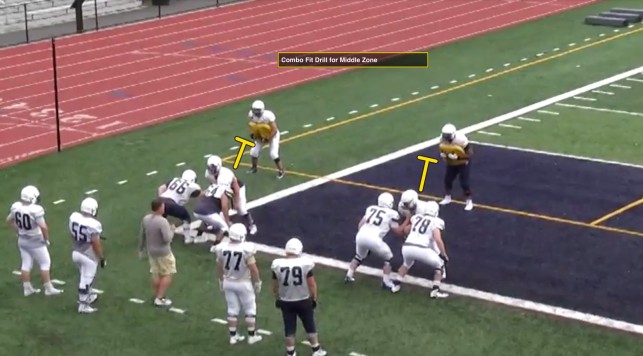
Why Run the Mid Zone?
- Provides flexibility vs. various fronts
- Can be run from Under and Gun alignments
- Multiple first and second level built in reads
- Versatile package of RPOs and PAPs
What is Mid Zone?
Football is a game where coaches often borrow ideas from one another and blend ideas into one concept. The Trinity Mid-Zone is one such Concept. Coach Melnitsky describes their midzone as a combination of the inside zone scheme and the outside zone, hence the midzone name. Coach explains his midzone by saying: “on the inside zone, the landmark is the inside foot of the play side guard and, when we used to run outside zone, the ball carrier’s landmark was 1 yard outside the TE or imaginary TE if run to a non-TE surface. The read on Inside Zone was the 1st play side interior DL to the 1st backside interior DL. The RB would sink the ball to his landmark and either drive it frontside downhill or hit the cutback in front of or behind the backside DL. In Mid-zone, we want the ball carrier to chase and press his play side landmark (outside heel of OT) and either bounce or crease the ball based upon how the tackle handles the DE. If the tackle reaches the DE, the ball carrier bounces the ball outside. If the tackle stretches the DE, the ball carrier must stick his outside foot in the ground and crease under the DE. We’ve essentially moved the landmark a player wider on MZ than IZ.”
Blocking the Mid-Zone
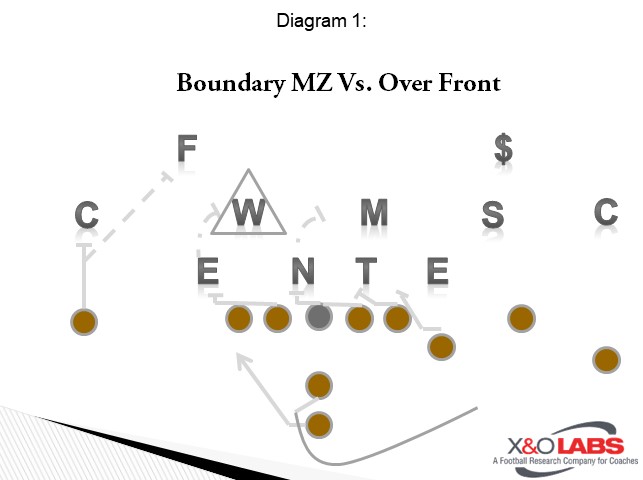
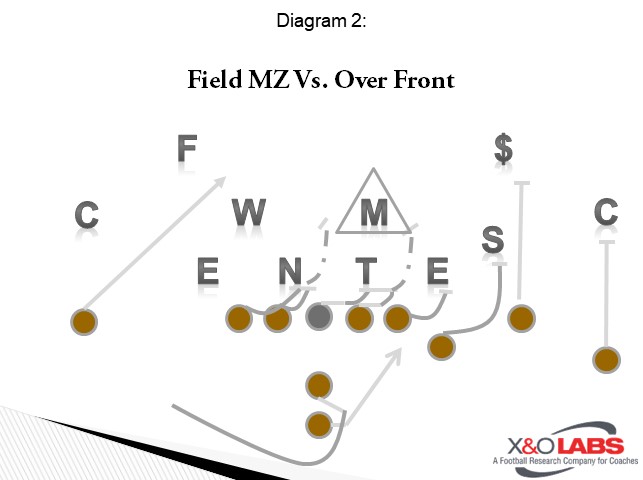
To truly understand any running play, it all starts with the offensive line and their identification of the front and the blocking techniques that they are going to use to block the myriad of fronts they will see. The first thing that the Trinity OL will do is identify the front as either odd or even according to their rules. Next, they determine who the Mike backer is and that will determine the combination blocks or man blocks being made on the MZ play. On any even front, the front-side tackle is by himself on the end man on the line of scrimmage. The play-side guard and center are working together for the Mike backer and first down lineman past the center. The backside guard and tackle are working for the first adjacent backer away from the Mike and the next interior down lineman.
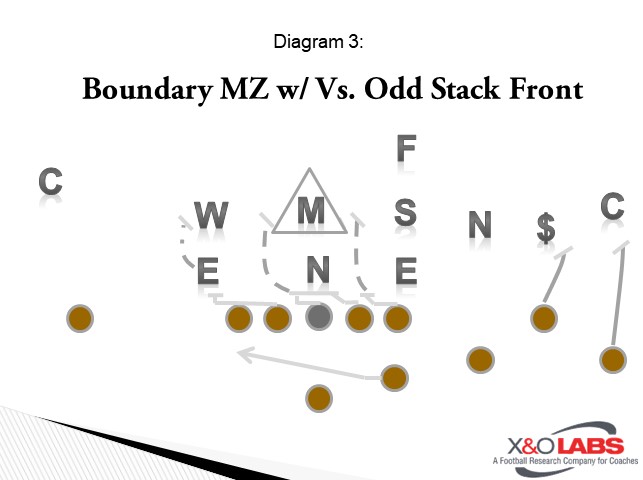
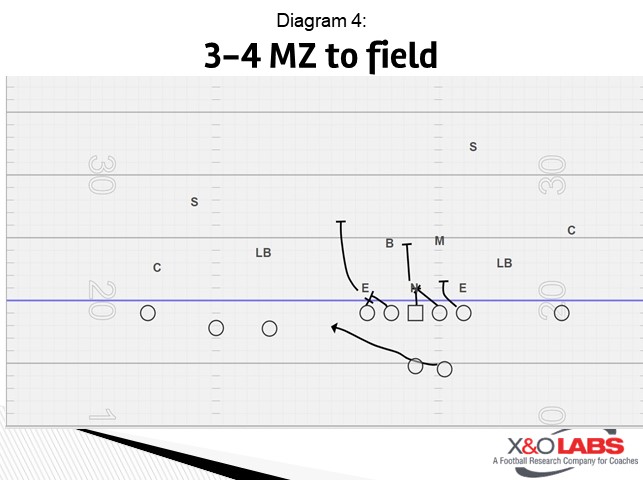
On odd fronts, the scheme is a little different, but Coach Melnitsky has simple rules to help his players know their assignments. For odd fronts, the blocking scheme is determined by if the play is being run into the boundary or the field. “We will run this from 3×1 with the solo side being into the boundary,” explained Melnitsky. “Into the boundary, if there is an overhang there, which most teams have, we will make the boundary inside backer or the playside backer the Mike. This pulls the front side guard into the scheme. The Backside Guard and center will work from the nose to that Mike and then the frontside tackle and frontside guard work from the playside down lineman to the overhang.
“If you run this to the field or the strength, we will make the backside backer the Mike. Here versus an odd front, the backside guard is working with the center to the Mike. We can do this because we have no overhang defender. He is being blocked by the TE or is responsible for a receiver in the trips and can be taken up by the route.”
The Playside tackle and guard have the first backer playside away from the Mike and the first DL. The Center and Backside Guard have the nose to the Mike and the backside tackle is ripping through the B gap and blocking whoever shows.
The diagrams below detail how Trinity runs its Middle Zone concept against various fronts:
>> X&O Labs Members: Login here to continue reading
Join X&O Labs to Continue Reading…
Plus, get 4 FREE books!
When you join X&O Labs, you’ll get instant access to the full-length version of this report — including access to everything in The LAB and Film Room. That’s over 4,000 reports and videos. Plus, if you join with a Staff Membership, you’ll also receive 4 FREE books mailed directly to your home or office!
Read More
|





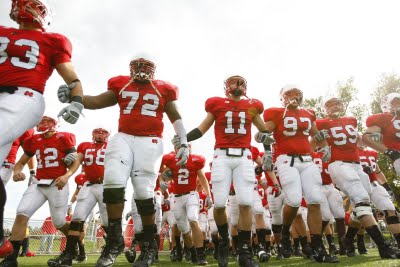
 Editors Note: Jeff Thorne is in his 11th season as North Central’s offensive coordinator and his third year as an assistant head coach. In 2011, the Cardinals established single-season school records for rushing offense (3,383), rushing touchdowns (40) and scoring (524), and led the College Conference of Illinois & Wisconsin in rushing offense (281.9 ypg), total offense (451.1 ypg) and scoring offense (43.7 ppg).? Jeff, the son of head coach John Thorne, played for his father and was a standout quarterback at Wheaton Central High School, earning All-State honors in 1989. He continued his playing career at Eastern Illinois University, where he was a four-year starter, earning All-Gateway Conference honors as well being named to the 1993 NCAA Division I-AA Preseason All-American Team. Jeff has also assisted at Wheaton Warrenville South with the quarterbacks and receivers.