Tracking and Applying a Takeaway Reward System for Post-Season

By Brian Mazzone
Head Coach
Stafford/Somers/East Windsor Co-op (CT)
Twitter: @staffordbulldog


We try to create an environment on the practice field that is turnover hungry. Through drills and mentality, we focus days of the week and segments of practice on forcing turnovers and getting our hands on the football of an opponent.


Creating the Hunger for Takeaways

Daily in team periods we focus on a “Loose Change” period. The Loose Change is something that I picked up from the University of Dayton years ago. We took the idea and put our own spin to it. We create this starting the first day of the season when we run team. The veterans know the routine, but the new players need to understand the process. The idea is that every time there is a ball on the ground someone needs to pick it up. It can be an incomplete pass, a fumble, a tipped pass, interception, anything.

The idea behind it is to create an environment where the kids are hungry for the football. This gets defensive players wanting the football at all times because there are rewards. It also gets your players to play beyond the whistle. There are always moments where players “believe” the play is over. In our minds the play is not over at the whistle, it’s over when we have the football.

Each week we have a coach who tallies the recoveries. He keeps track of every time someone picks up the football. At the end of the week we give out team awards that we post to our social media page. They are given a necklace with a giant half dollar on it and a cane with a dollar symbol on it. At the end of the year, we tally all the turnovers that the players have created. The winner of the loose change concept gets a gift card to a place of their choice for their victory.


Focus on turnovers

The same way that coaches harp on tackling technique and tackling drills, we harp on turnovers. When we have our weekly tackling circuits, we sprinkle in turnover stations. For example, we have two tackling stations and two turnover stations. We try to hit this two days a week. The one thing that we want the kids to understand is that we can’t just expect turnovers to happen. We need to believe that we are forcing the turnovers and that we can create them. If we just expect it to happen, we will be left without the football and having missed great opportunities to score.


Peanut Drill Application

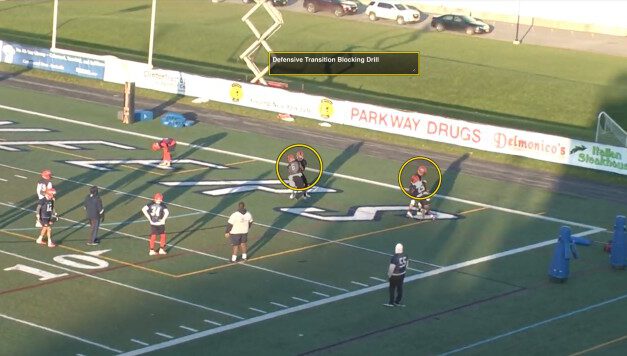
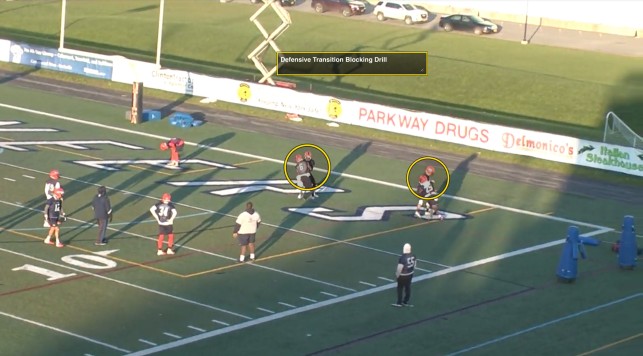
This is a drill taken from Charles “Peanut” Tillman. Tillman led the NFL in turnovers many times during his career. His idea was to poke the ball loose. We practice drill work where we have two players going to perform a tackle. The first player is going to pursue and secure the tackle. The second player comes in and “peanuts” the ball. The player focuses on getting an aggressive poke/punch on the football. The idea behind it is to be aggressive on the ball, not just to the ball. By being aggressive on the ball the ball carrier is most likely to lose focus and handle of the football.

By being aggressive on the ball the ball carrier is most likely to lose focus and handle of the football.

Read More

F.A.S.T. System To Develop Offensive Ownership

Jarrett M. Laws, M.Ed.
Head Football Coach
Salem High School (GA)
Twitter: @CoachLaws00


In 2016, when I was hired by the administration at Salem High School in Conyers, Georgia, my immediate goal was to revitalize the program by introducing an up tempo, no huddle form of offense that formerly ran the Wing-T. By year two, we were fortunate enough to reach the Georgia High School Association Class AAAA playoffs for the first time in 4 years. I firmly feel that what made our success unique from other versions of this form of offense has been our embracing the concept of giving ownership to the players, rather than depending upon the play calling of our coaching staff.

We base our teaching on the acronym “F.A.S.T.”, which stands for “FOURmation”, “Answer”, “Selection”, and ” Tempo”. We utilize “F.A.S.T.” as a double entendre of sorts, where, by conditioning, when one hears the word “fast” utilized when discussing offense, it becomes engrained in the psyche of the players to operate at a high rate of speed, while simultaneously reminding them of the order of their implementation of the selected offensive concept. Our play menu is quite reduced when compared to many other offenses, but our belief is that if we can implement what we have, from multiple formations, with built in answers to what the defense presents us, while being decisive in our selection, at a high paced tempo, we can never be wrong.

FOURMATION

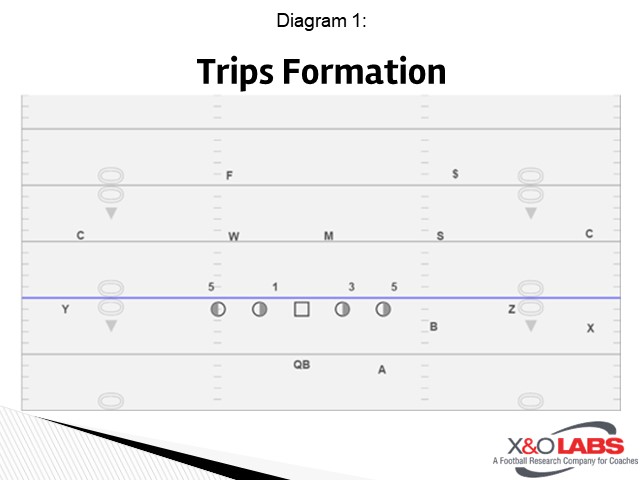
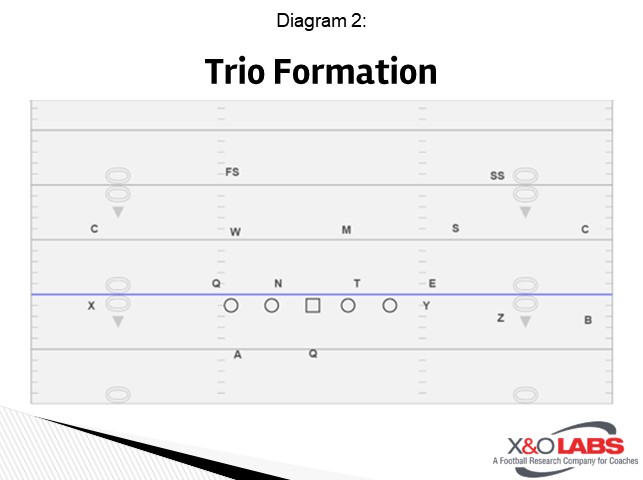
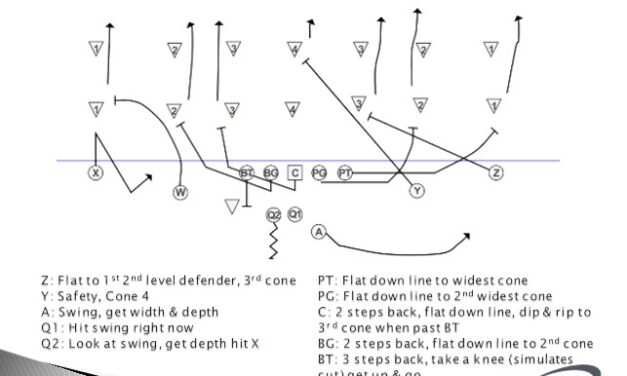
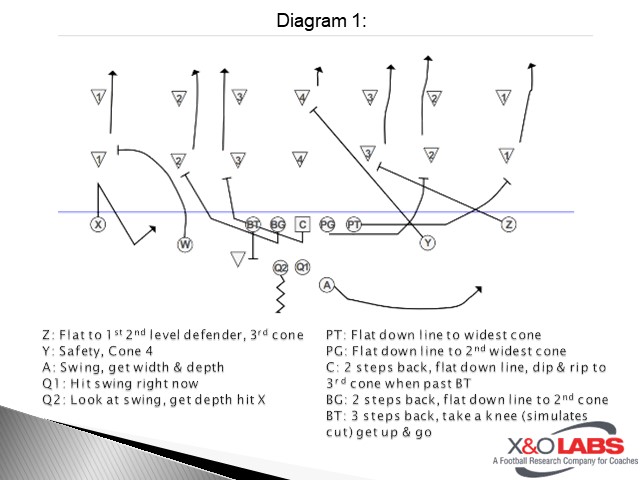
We have four major run concepts (Gap, Zone, Power, Draw) that we run up front, and four major drop back pass concepts (curl/flat, Hitch/Corner, Post/Dig, and Zone Flood) that we implement on the perimeter. When initiating our teaching processes with our kids, the very first thing we tell them is that we only have four runs and four passes that we will run from as many formations that we can create. No matter what the formation, we will always end up running a form of one of these four concepts. EVERYTHING surrounds the number “four”. We explain that being in 2 x 2, whether it be 10 or 11 personnel, will equal us out to four. The same goes for 3 x 1. A small play of words on the concept, but it grabs their attention to the special status of the number. Offensively, we major in 10 personnel 2×2, which will be referred to as “Deuce”, and 11 personnel, referred to as “Doubles”. For 3×1, we title 10 personnel “Trips” (Diagram 1), and 11 personnel “Trio” (Diagram 2). We have the ability to shift and motion to various other forms of 2×2 and 3×1, but for the purpose of this study, we will limit our presentations to our 3×1 formations.

Diagram 1

Diagram 2

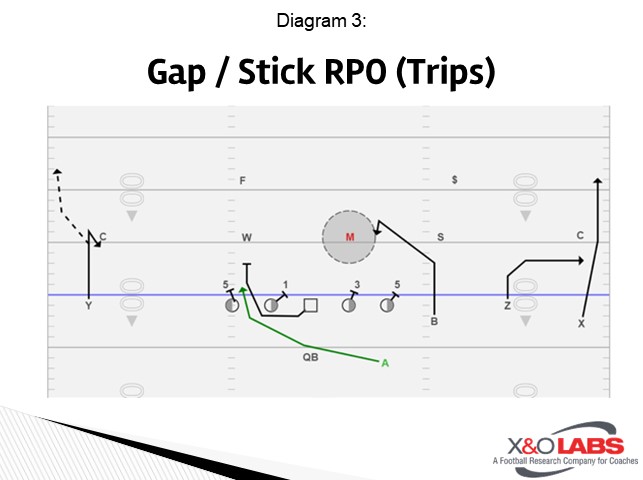
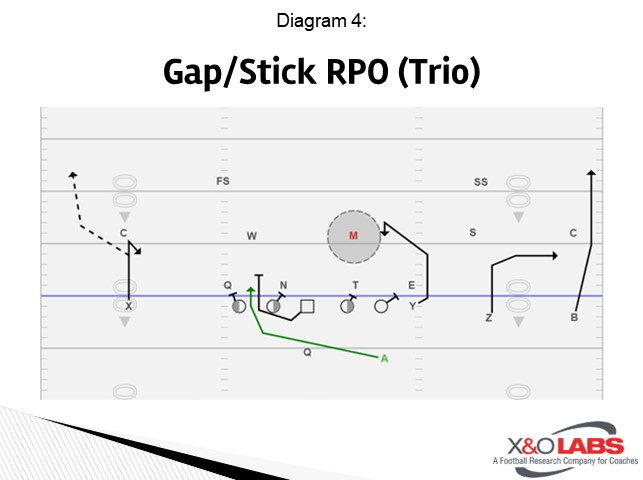
Nearly 70% of our run game is a form of “Gap”. In order to focus on the implementation of the ‘F.A.S.T.” Concept, rather than overview a whole offensive scheme, we will center this information share on it. Whether it becomes a Veer read, Midline read, or RPO is totally dependent upon the decision making of the players as it pertains to the defensive look that is presented to them, as well as the tempo that we have called. For example, if we are in a check at the line tempo, we normally will run a gap RPO. What separates our form of RPO is that the base call is preset according to the formation we are in. If we are in 3×1 10 or 11 personnel and we give a “gap” blocking call away from the multiple receiver side, we automatically tag the “Stick” concept as the pass option. When the play call is signaled, this is where the ownership comes into play as we move into the “Answer” phase of the call.

Diagram 3

Diagram 4

ANSWER

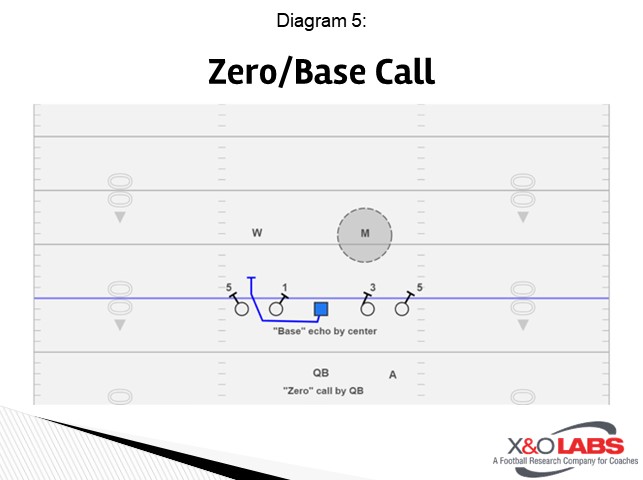
The quarterback alerts the front as to which gap the lead block will fold into. If he sees a pull side 3 technique, he makes a “Zero” call, which indicates that the center will pull into the first available opposite gap. The center looks to see if he has a clear “5” technique, or a tight 5/possible 4 technique. If the 5 is clearly determined, he echoes “Base, Base” to the other linemen. This call tells them to base the attached techniques, allowing the center to pull into the open opposite B gap. It is understood that the conflict player is the linebacker nearest to the pass option.

Diagram 5

To study game film of this concept, click on the video below:

Read More

In-Season Defensive Individual and Unit Goal Setting Objectives

By Jason Brown
Linebackers Coach
St. Charles Catholic High School (LA)


It is truly a pleasure to represent St. Charles Catholic High School and our entire staff as well as share our thoughts on defensive quality control. We don’t have all the answers. We are constantly looking for better ways to do things. Hopefully this article will stimulate thought and lead to better solutions to the more complicated problems that occur as the game of football evolves. When we think of quality control we should think of how we are measuring (statistically) our methodology– which is simply the way we are trying to implement our philosophy of defense.  Our philosophy of defense is to not let the offense move the ball effectively. How we are going to do that is our method. Then we must constantly evaluate if that method is helping us fulfill the philosophy that we have set.

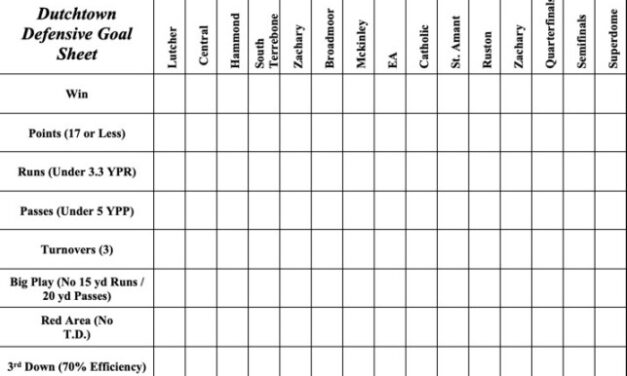
The first thing we came up with to test the method is to identify specific goals that tell us if we had a good game defensively. This goal board is updated weekly so that our players can see how well we are accomplishing our game goals. We need to be able to show them specifically why we are playing defense effectively. Simply saying we aren’t playing well is not good enough. We need to be very specific, with them and ourselves, about the things that we do well and what we need to do to get better. The goals we have on our board tell the players what we think it takes to play good defense.


Specific Goals:

Our first goal on defense is to win the game. That is the number one goal of the whole program and we sell that to our players every day. Some games the offense is going to have to bail the defense out in a scoring fest and other nights the defense is going to have to pick up the offense by putting up a shutout or scoring themselves. Let’s face it! Winning is a very fragile thing and should be appreciated no matter how it gets done.

Our next goal is to limit the opponent to 17 points or less. Years ago this number used to be 13 but with the potency of good offenses the tolerance level of this number had to increase. The next goal is to hold the offense to 3.3 yards per rushing attempt. We feel if we can keep it within our tolerance level we are playing good run defense. The next goal is to limit the opponent’s yards per pass to 5 yards. I know this sounds impossible but for this goal we actually minus true sacks (pass attempts not Q-Runs) off of the passing yards not the rushing yards, therefore creating an attainable goal.

The next goal is to force at least two turnovers a game. If we get this number our chances of winning go up tremendously. We do count wins on 4th down by our defense as turnovers because of the field position gain.

The next goal is no big plays. For runs, that is 15 yards or more and for passes it is 20 yards or more. This goal is getting harder and harder to accomplish will all the things offenses are doing but it is still a standard we hold our kids to on our goal board.

Another goal is no TDs when the ball gets in the Red Zone. We want to be real good in this area and make offenses settle for field goal attempts. We have found that even if good offenses are piling up yards if we can out execute them in the Red Zone it will pay huge dividends for us in winning the game.

The last goal we have is to be 70% efficient on 3rd down. Third down percentage is huge for us and we spend a huge amount of time giving our kids the tools to get off the field on 3rd down. We all know you can be real good on 1st and 2nd down but if you can’t get off the field on 3rd down it will be a long game. If the defense’s 3rd down percentage continues to be low during the year it could be a long year as well.

Read More

Emporia State’s In-Season Tackle Drill Catalog

By Nathan Linsey
Defensive Backs/Special Teams Coordinator
Emporia State University (KS)
Twitter: @CoachLinsey


Introduction

Here at Emporia State University since 2012, we have traditionally finished in the middle of the pack as far as our defensive numbers and statistics. If you look at the numbers over the years, the takeaways were there and the tackles weren’t. Following the 2014 season, when we finished 4-7, I went back through each play from that season and tried to figure out why we weren’t successful. After reviewing the film, the biggest concern was our inability to complete our tackles. Far too often, 3-4 yard check downs/runs were turning into 8-10 yard gains and 10 yard completions were turning into “explosive plays.”

That off-season going into spring ball we decided to focus on tackling in more detail to put our players in a better chance to be successful. Going into spring ball, we decided to break into five groups instead of three we typically did to focus and get into more attention to detail with how we were practicing our tackling. This also allowed us to have smaller groups at each station to allow for more reps. Each coach was responsible for teaching a phase of the “Hornet Tackle” and allow the players to carry out the drill. The five different drills involved with the Hornet tackle was our Leverage/Tempo Drill; Outside-In Hornet Tackle; Inside–Out Hornet Tackle; Roll Tackle; and, Profile Tackle.

Leverage/Tempo Drill

This drill really stressed the importance of your inside-out tempo of the ball carrier. We set up a cone every 5 yards for 20 yards and split up into 2 lines; one line being the ball carrier, the other being the tackler. The tackles starts about 2 yards behind the ball carrier about 10 – 15 yards away. On the whistle, the ball carrier will take off at a moderate pace (60-70%), slowing down and chopping their feet at each cone as if he were to cut back on the tackler. The tackler would pursue always keeping good inside out leverage with eyes on the ball carriers hip, “taking the air out of it.” Once the ball carrier would slow down at the cone, the tackler would square up his feet into the “near foot, near foot” technique to keep good leverage. The tackler should never overtake the ball carrier. Once the tackler reaches the ball carrier, he should tag off on the hip and the next group will continue.

To study film of this drill, click on the video below:

Read More

Double Duty for the Double Screen (Drill)

By Ray Butler
Head Football Coach
Boston Latin School
Twitter: @BLSFootball1635


Governing bodies have become more restrictive on practice time, amount of contact, types of drills and many other things.  Players and I don’t blame them, don’t like to run just for the sake of running during conditioning.  My staff and I, essentially, needed to come up with a way to accomplish conditioning needs and still get X & O football time out of all of our practice periods, no matter what time of year or type of practice. We think we accomplished this through running one of our favorite plays, the Double Screen.

We believe the Double Screen as a conditioner has allowed us to involve all positions to be involved in a meaningful way, work in play related skills and develop a “Big Play” potential play that everyone is confident running.

We also believe that this is one of our most adaptable plays as far as what formations we wish to run it out of and what defenses we like to run it against.

Repping the Double Screen Concept

When we begin on day 1 and go over our practice format for the day, we install our Double Screen out of a 2 x 2 set verse cones.  We do not set the cones up in a particular defense per se, but rather the areas we wish to see the players get to.

Diagram 1


Coaching Points:

  • We usually run this from the 25 yard line
  • Cones usually go about 5 yards and 10 yards from the LOS
  • After player passes the second cone, they run through the end zone
  • Players peel off to their side of the field so the next group can go right now
  • Q1 has the ball snapped to him and runs the cadence, Q2 has the ball in his hand


Read More

Shotgun Wing T Reverse Package

By Ken Vigdal
Offensive Coordinator
Brookings High School (SD)


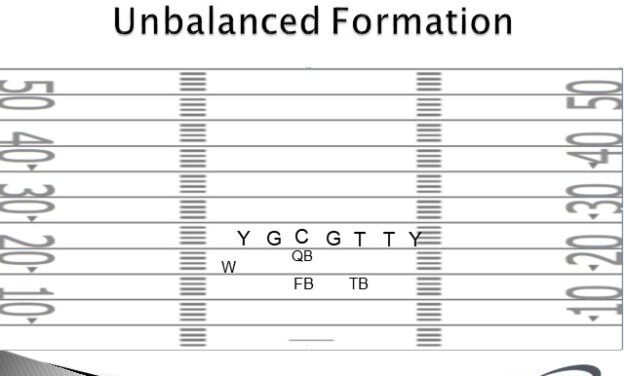
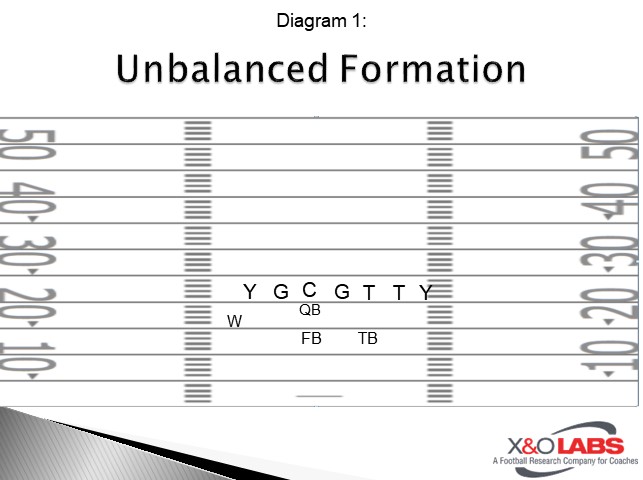
For a large part of my coaching career I have run a Wing T offense.  I started with the double tight formation, through time I implemented the gun, and now we are a spread wing offense.  The reason for the change to the gun was that defenses continued to put more and more defenders in the box.  We then went to the spread to help our running lanes open up.  As defenses have changed and adapted to the spread offense you see more 3-3 or 3-5 defenses.  One formation we have kept throughout our transitions is our unbalanced formation from under center.   We have kept this formation because it forces defenses to practice against a non-traditional spread set.  They have to use their practice time to defend this formation and all it brings with it.  Most, if not all of the teams in our conference run a spread offense. This gives us another opportunity to do something different that other defenses will not see every week.

Diagram 1


Alignment Adjustments

We keep our normal two foot splits for our offensive lineman.  The left tackle moves to a position between the right tackle and the right tight end.  The reason we move the left tackle to this position is that the right tackle and the right guard are used to working together.  We want to keep that consistency when we run other parts of our gap schemes.  The fullback heels are at 4 yards from the ball.  The tailback is slightly ahead of the fullback, usually heels at fullback toes and splits the inside leg of the right tackle.  The wing is in a 1×1 position off the left tight end. 

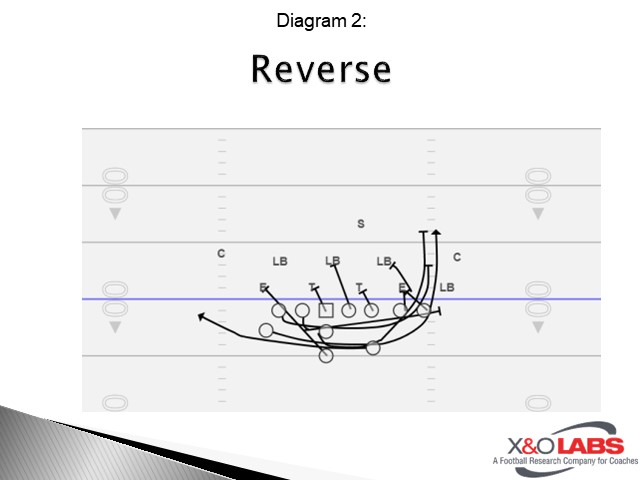
Diagram 2


Blocking rules

  • Play side Tight End gap down to double and on to backer
  • Left Tackle on for double to backer
  • Right Tackle double or gap down to backer
  • Right Guard on gap down to backer
  • Center on or cover for Left Guard
  • Left Guard gain depth on pull and kick out the first defender outside the double team
  • Weak TE pull and lead up the hole inside the kick out block, look inside first, if no one, look for corner or safety
  • Fullback depth of 4 yards, will have to be quick off the ball and cover for the pulling TE
  • Tailback depth of 4 yards, alignment inside leg of right tackle, will work across the formation. If player has great hands, receive it like a handoff and give to the wing, if not have him receive it with the shelf technique. We always find that back the can take it and give it like a hand off.
  • Wing 1×1 off the TE, takes an outside jab step for time to let the fullback get to his blocking assignment. He then gets 2 yards depth and takes the handoff from the tailback, cuts up inside the kick out block.  He will receive the ball on an inside handoff.
  • Quarterback reverse pivot out, to the midline, second step has to be stepping towards the TB. Gives the ball to the tailback and continues on inside the kick out block and lead block for the wing.


Read More

Implementing a Defensive Takeaway Mentality

By Joe Castellitto
Inside Linebackers Coach
Utica College (NY)
Twitter: @CoachJoeCast


To state the obvious, a defense’s main objective is to stop the opposing offense from scoring. Clearly, if this is done, your team has the best odds of winning a football game. But what can a defense truly do to increase the odds of winning a football game? Create turnovers and score on defense.

It almost sounds simple to just stop the offense on a third down or to create a takeaway. The Utica College defensive staff bases our defensive philosophy on third down wins and creating takeaways. Yet, this is easy to discuss amongst football coaches. Our staff has developed a system for turnovers based off of verbiage, drills and game stat percentages. 


The ”Takeaway Mentality”

Implementing a takeaway mentality or philosophy to an entire defense must start from Day One. At Utica College, the first night in preseason camp the defensive coordinator, Will Pluff, has his opening presentation. Each slide in his presentation is also implemented and reiterated in other defensive coach’s player manuals.


First is our defensive philosophy which clearly states who we are and how we will be successful.  A list is provided for the players to visualize.

We will be successful when:

  • We run to the football
  • Tackle with leverage
  • We create turnovers
  • Focus and communicate through the ups and downs of the game.


These points are reiterated by the staff throughout the season.

Next, as a staff, we felt that it is important to have universal verbiage that can be used by the entire defense and staff.  To make these short quotes known we use them regularly in practice and in games.

“Run to the football”

“Finish at the football”

“Numbers score”

“Beat the block”

“Get another play”

“Beat the momentum”

Yes, you will hear these quotes consistently from the coaching staff throughout the season. If you want your team to share the same mentality, you will hear these quotes from players communicating with each other. That is when your defense is on the same page and a takeaway culture has truly been implemented.

Read More

6 Onside Kick Progressions

By George Karafantis
Defensive Assistant
St. Anthony’s High School (NY)
Twitter: @greek42e


Every coach preaches about how specials are one third of the game and are vital to the success of your football program. However, not every program structures its special teams’ practices properly or utilizes special teams’ schemes as effectively as they do for either defense or offense. At St. Anthony’s H.S., special teams has been, and is, treated almost the same as offense and defense. Individual periods for all specials are used in practice and schemes will be added (or removed) based on opponents’ weaknesses (or strengths) in an effort to gain as much of a competitive advantage as possible. In this report, I will share some of the schemes related to our kickoff coverage and our “kickoff offense” that has helped us win games and a semifinal playoff game this past season.

Everyone has always referred to kickoff as a coverage team or a defensive play aimed at pinning the return team, and subsequent offensive team, deep in its own territory. But what do you do when you feel that your kickoff team can not only pin the offense deep, but force a turnover that can essentially change the path of a football game? We have instituted a kickoff “offense” that is essentially a series of onside kicks that are used based on game planning and identifying the oppositions weakness in their kickoff return game.

Would you ever have an offense consisting of only one or two plays? Of course not, so why have only one onside kick in your game plan. Some may argue there is not enough time in a practice to efficiently practice multiple special team plays. However, there is always time if you make it. We are fortunate to have a high number of players in our program and try to use everyone somewhere on the football field. For many players that is on specials.

Our kickoff onside team can sometimes be referred to as a kickoff offense since we are designing the play to give the ball to our offense. We start with the ball on kickoff, so we feel we have some control of where the ball goes and because of that we look for the least athletic player on the return team and study him. If he is on the front line, we have a few options in our onside kick game to take advantage of him. If that weakness is on the second level of the return team, we have a couple answers for that player as well. Through film study we determine if that player is more aware of his right side or left side and what he is better at in fielding a kicked ball. Is it hard for him to handle a ball on the ground or in the air? What about going to his left or to his right? Once those answers are determined we use one of several onside options.


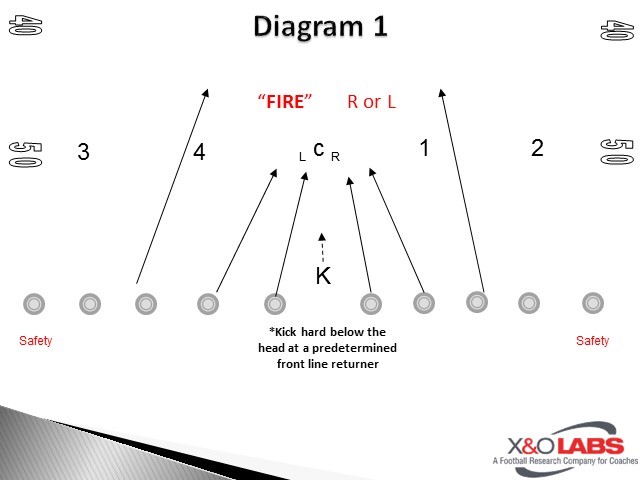
Fire R or L

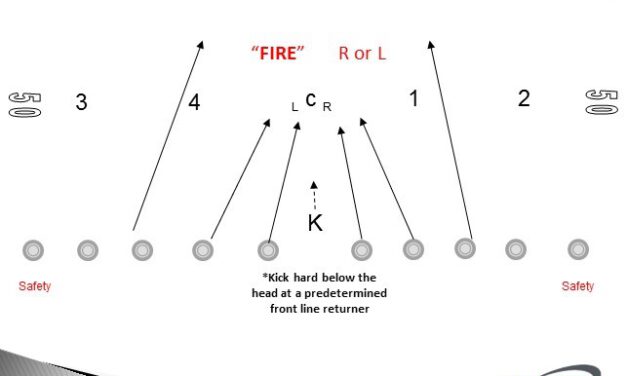
The first kickoff offensive play we will discuss is our “Fire” onside. Fire refers to the kicker kicking the ball on the ground with a lot of speed but not enough to where the ball jumps above the head of the frontline returner. Our fire call is usually done by telling the kicker first a number of a guy on the front line. The head coach, who calls the special team’s plays, will then give a direction. The direction will tell the kicker to fire the ball off of the predetermined returners right side or left side. The kick must not bounce too high and must, at a very minimum, hit the defender in the hopes that it ricochets back to our kickoff team. If the front line moves and the ball goes through to the second or third level, we are still in good shape since their stud returners most likely will not field it. Please refer to diagram 1, which shows a standard even kickoff team with 5 guys on either side of the kicker.

Diagram 1


‘Fire’ Coaching Point: The kickoff team’s inside guys should never go off sides and must have eyes inside to the ball at all times. It happens fast, so they must sprint to the spot and breakdown in a shortstop type position with knees bent and hands in between their feet ready for a bounce or ricochet.

Read More

Drilling the Twitch, Hands and Hips in Pass Rush

By Mike Giancola
Defensive Line Coach
Bridgewater College (VA)
Twitter: @CoachGiancola


For the most part, playing defensive line is a thankless job.  Masterful hand and footwork are not sexy.  Absorbing a double team to allow a teammate to make a tackle never shows up on a stat sheet.  The grueling, physical, violent nature of the position and what is asked of it usually goes unnoticed by a majority of people that watch the game.

However, the one thing defensive linemen are asked to do that everyone sees is getting to the QB in the pass rush.  This is where “the money is made” at the position, literally and figuratively.  Sacks can turn the tide of a series, and win games at the highest levels (think Von Miller in Super Bowl 50). 

The art of the pass rush is not something most players are able to just show up and do.  It needs to be approached in a methodical and precise way.  Here is a base overview of coaching the pass rush that yielded success for our defenses.


Initial Twitch Drills

The mentality of the defensive line is passing situations needs to be focused on the get-off at the snap of the ball.  This starts not only starts with quick recognition of the snap, but also an explosive first step.  The coaching points we use are to drive the knee to the chest and gain two yards in the first step with violent arm action to put stress on the offensive lineman.

Working quick twitch and explosion drills into individual periods every day can help with this.  Below are examples of a couple of those drills we do:


Long Bag Get off Drill

Read More

Strategic Use of OL Splitting to Gain Blocking Angles and Improve Double Teams

By Rich Duncan
Offensive Coordinator/Offensive Line Coach
Berry College
Twitter: @coachrichduncan


In starting our program at Berry College in 2013, we quickly found that developing our offensive line was going to be vital to our success.  In our first two seasons, we were not able to effectively run the ball.  While the schemes we had in place were time tested and traditional, we needed to find ways to help our guys upfront gain an advantage.  Simply stated, doing what I had been doing over the past 20+ years in coaching the offensive line was not going to be enough.  I had to find creative ways to help us improve quickly up front in order to become a successful football team.

We started this process by asking the question, “What would make it easier for our players?”  We started watching film of teams that were successful, trying to study ways to improve.  Through this process, we discovered that using strategic line splitting was something we needed to explore.  We were hopeful that our splitting plan was going to help our guys gain an advantage.

We began maneuvering our splitting in different ways that were not traditional uniformed spacing.  Instead, we adjusted our splitting in ways to give our linemen an advantage of increased blocking angles and technically efficient double teams as well as reducing gaps for penetration by the defense.  As this process evolved, we began to achieve our ultimate goal of finding success in the run game.

Now that we have been using our line splitting rules for three full seasons, we have found many benefits that were not necessarily intended but have aided us greatly.  These benefits include identifying and picking up twisting defenders, seeing line movements pre-snap because of alignments, as well as recognizing blitzes. Additionally, our running backs and QB’s are able to visually see blocking schematics and running lanes before the snap of the ball.

Procedurally, we are a no huddle offense and we practice at a high tempo pace.  Our goal in practice is to get a high volume of reps while coaching with buzz words.  Most of our corrections happen through meeting time and video sessions.  For visual learners, the more interactive we can be with video, the faster they will develop.  Show them how to do it correctly and also show them previous errors and why they are a problem.  What I have learned through coaching in this manner is that our players start to learn the “why” of our splitting, often through their correctible mistakes on film.

I must note that we do a fair amount of walk through coaching.  At Berry, walk through sessions are committed exclusively to assignments, which includes splitting for our OL.  For those that are primarily tactile learners, this is a great way to spend time “doing it” while allowing them a slowed down way work through the process of splitting.


Split Groupings

As a general coaching point, we have defined maximum, minimum and over splitting to our players: 

  • Maximum splitting is 2-3 feet from the offensive lineman inside you with emphasis on being as wide as you can to do your job.
  • Minimum splitting is “shoe to shoe” or about 6 inches from the lineman inside or adjacent to you. One of the flaws we have had to work through with minimum splitting is allowing enough space between us that we do not step under ourselves with our first step.  We tell them they must be able to use their footwork without stepping on one another. 
  • The final term we use is over splitting. It is for our tackles when the guard has split away from him and he is trying to maintain as much space as the defense will allow. Over spitting can range between three and five feet from the guard.


Split Sub Groupings

We have grouped our splitting into four categories. These are:

  1. Big
  2. Interior
  3. Gap
  4. Zone


We refer to these different splits as BIG Z.  This acronym is a way for our guys to memorize the splitting concepts we use.


Big Splits

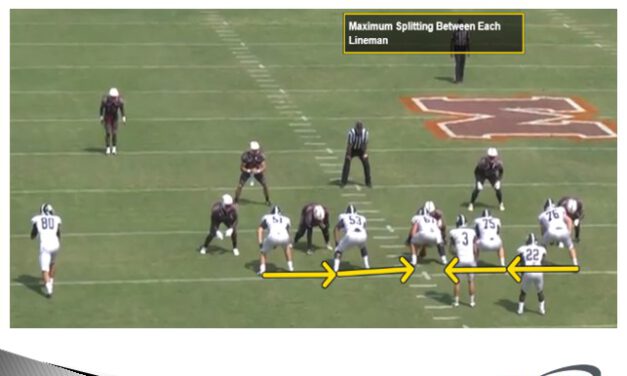
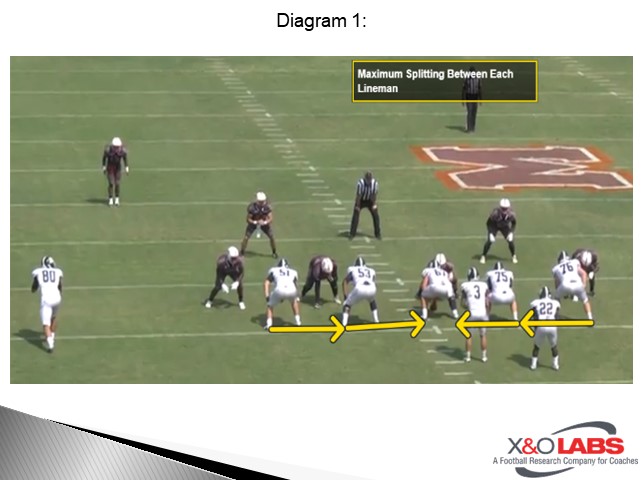
In Big splitting, we are trying to take maximum splitting between adjoining offensive linemen. Our goal is to spread the defenders as far as possible from one another increasing the size of the gap or fit they need to defend.  In this particular splitting, defensive alignments do not matter to us as we are only concerned with spreading the run box as wide as possible.

The splitting rules are simplistic.  We are looking to gain between a two to three foot split between the center and the guards as well as the guards and tackles.  Ideally we would like to take the splitting to three feet. Looking at this splitting as a practical application can be seen in

Diagram 1

Read More

Training the 6 F’s in LB Read Progressions

By Tim Yourison
Defensive Coordinator / Linebackers
Hamline University (MN)
Twitter: @CoachYourison


Here at Aurora University, we are always trying to get an extra hat to the ball on defense. Whether we are in our three or four down fronts, our linebacker play remains the same. We do not teach them to play one specific gap, but they need to understand where the open gaps, or as we call them windows, are and fit off the ball. This report will go through our linebackers’ fits and techniques and how we teach them.


Linebacker Techniques:

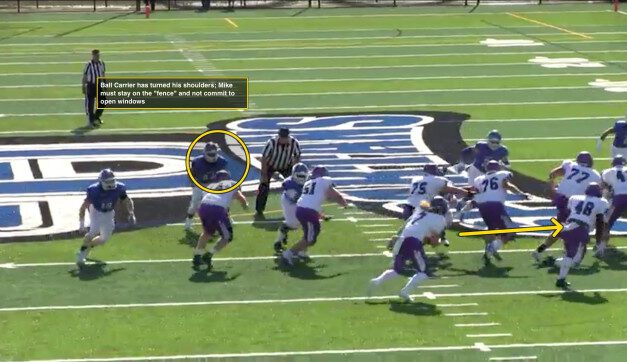
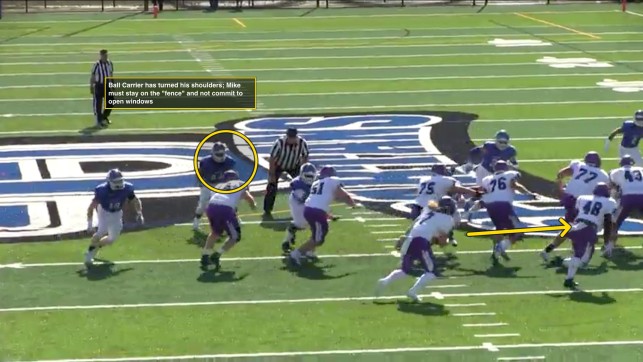
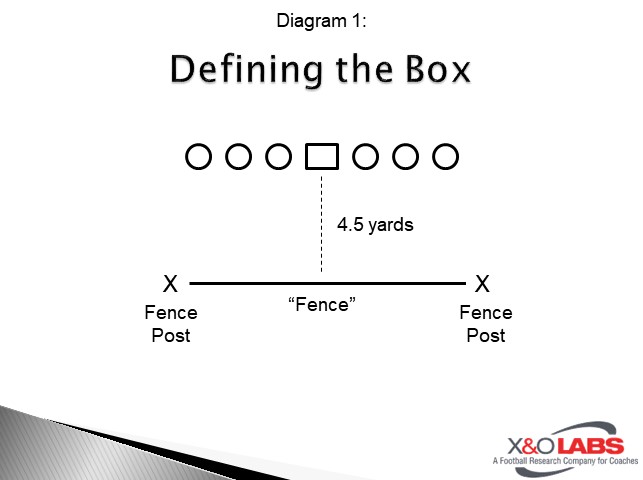
In order to play linebacker here at Aurora, our players must understand the game of chess. We want to move like a rook, not a bishop – we want them to stay square and attack downhill, not turning our shoulders and coming down at an angle. Our linebackers are taught to stay on the “fence” – toes four and a half yards from the line of scrimmage. Since we play both a four down and an odd front, our linebackers need to learn how to be a force player or a box player, regardless if their position is an inside or outside linebacker.

Linebackers at Aurora key offensive linemen to the running back or ball. The coaching point for them is to have their low beams on the lineman and their high beams on the running back. As soon as the ball is snapped the linebackers will take their read step. Read steps for them are a heel pop, then one six inch lateral step in the direction of their lineman, staying at linebacker level, or “on the fence”. After that initial movement, they find the running back or the ball. The reason we have them stay on the fence is three fold. First, it allows them to read and diagnose the play without over committing to one gap. Second, it allows them to stay out of the mess on the line of scrimmage. Third, if a linebacker buries themselves into the line, an offensive lineman is very comfortable engaging and blocking them. If an offensive lineman has to climb and try to block a more athletic player in space, we feel that is an advantage for us.


The “Three F’s”:

Our linebackers are taught three F’s for their run response techniques. If they are a force player the three responses are: Force, Fold and Fence.


Force – Outside action at you

  1. Make the play – Tackle the ball carrier.
  2. Force the ball back inside.
  3. Make the ball go backwards if it continues outside.


Fold – Inside run at you

  1. Maintain outside leverage on the end man on the line of scrimmage (EMLOS), beware of crack block, stay at fence level.
  2. Expect ball to bounce to you.
  3. Once ball is into the line of scrimmage (LOS) inside of you, fold inside.


Fence – Ball is away

  1. Patience to the fence post – linebacker depth over the tight end or where the tight end would be.
  2. While moving to fence post, move eyes to opposite tight end or the #2 wide receiver for boot indication.
  3. No boot indication slide the fence, staying square, looking for open window to shut.


The inside linebackers’ three responses are: Fill, Flow and Fit.


Fill – Back is to you

  1. Offensive line action is away from you
  2. Open window, fill it now
  3. Expect an offensive lineman to climb up to you


Flow – Back is to you

  1. Offensive line action is away from you
  2. No open windows, stay at fence level
  3. Stay on back hip of running back, wait for open window


Fit – Back to away from you or behind the quarterback

  1. Step with your offensive lineman key (action to you)
  2. Eyes to running back
    • If runningback is downhill now or cutting back, rock back and fill an open window, creating the vice with the other inside linebacker
    • If running back cuts the ball back all the way outside, slide the fence looking for an open window
    • If the running back stays on a path to your side, fill open window


Diagram 1


Once we have taught the three F’s in the classroom we can teach it on the field. Our linebackers practice together because all of the positions could end up being a box linebacker or the force player.


Linebacker Practice Progressions:

Our defensive practice plan is divided in half each day – the first half is a run focus, and the second half in a pass emphasis. We start each individual session with every day drills from stance and first steps to block defeat. We then do a group run fit session before inside run. The second half of individual is spent working pass drops, then coverage fits before 7 on 7. We finish practice with our scout sessions.

Read More

5 Components for Simulating Tempo in Practice

John Wagner
Run Game Coordinator/RBs Coach
Monsignor Bonner/Archbishop Prendie (PA)
Twitter: @JWags42

Introduction

With more and more coaches moving to the no huddle, it is important to be able to simulate game tempo during practice. In my first year running a no huddle, high tempo offense, I found it difficult to run the practices at a tempo that would help us come game time. We had revisit the way we ran our practices. This started from the daily schedule to the way that we coached our players. 

We completely revamped the practice schedule and shortened each period to keep a better flow and avoid lulls in practice. Our longest period is 15 minutes and are team periods. Our normal periods are typically 5 or 10 minutes in length. By doing this, we are constantly moving preventing our players from becoming stagnant. 

What we learned was that we did not start the practice at a fast pace. We did not transition well from stretches to the next period. The 1st thing that we did to correct this was start each practice with 4 stations of 1 minute a piece. This got our players moving immediately at the start of practice. 

The next thing that we did was add a team take-off period. This is a period where we line up and march down the field on air.  Again, this is just to get the guys moving and used to the tempo that we want to have in a game. 

Team Take-off

During team take-off, the 1st and 2nd team offenses move the ball down the field on air. Both offenses will start with the ball on the plus 40. Each huddle will have their own signal caller and will march down the field. Once the ball crosses the goal line, we flip the huddle and start with ball on the ball on our 5 and move out to the 40. This is great work for the 1s and 2s.

For us, it is a great opportunity for the JV guys to get reps in a high tempo period. This period will run 5 minutes and typically we will get off between 30-40 plays. During our 1st year doing team take-off, we really increased the tempo of our practices. The players started to realize that we needed to keep this tempo throughout the whole practice in order to be successful in the game. By going against air, you will get your team to move at a tempo that will be impossible to match on game day, thus slowing things down for your team in the heat of the moment. 

Read More

Quarterbacks: 12 Drills for Game Simulation

By Ryan O’Hara
Quarterbacks Coach
Mt San Antonio College


Introduction

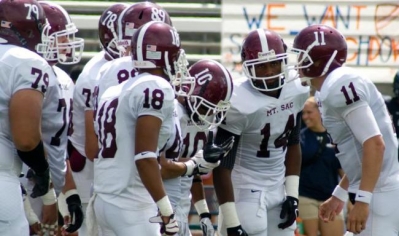
PTEX6849 srFor Quarterbacks, the offseason is when the work begins. In this clinic report, I will provide you with some new, simple, and effective ways to improve your QB play. The focus of these drills is to improve a QB’s balance, foot speed, feel, evasion, timing, rhythm, weight transfer, and confidence.

My goal as a coach is to try and recreate any possible movement a QB can do in a game and get him as many repetitions at them as possible. These drills are meant to do just that.

Note: It is recommended that you do at least half of these drills daily. Our pre-practice, individual warm-up is usually 15 minutes and we usually get 8-10 of these drills done a day.

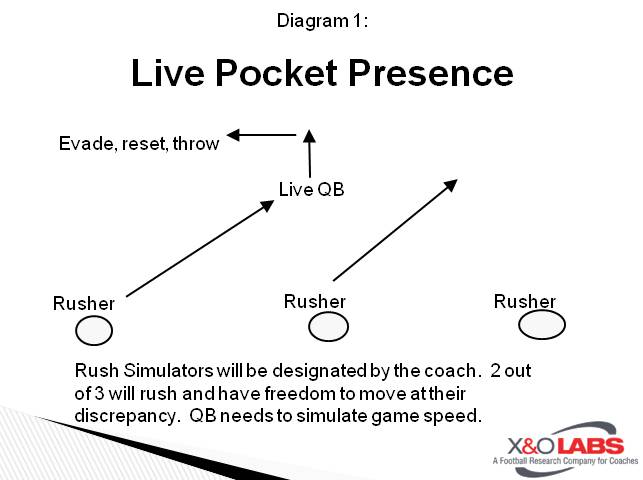
Drill #1: Live Pocket Presence

This drill starts with one QB under center or in shotgun. Two or three additional quarterbacks will be lined up on cones spaced 4 yards apart (see below). The QB will take a 5 step drop with a hitch from under center or a 3 step drop with a hitch from shotgun. When he sets at the top of his drop, two rushers will backpedal at him quickly, make him move, reset, and get the ball out as quickly as possible. A coach or receiver will stand 15 yards away. This works on movement within the pocket while staying poised to throw accurately, a skill that I believe is essential for good and consistent quarterback play.

Slide1

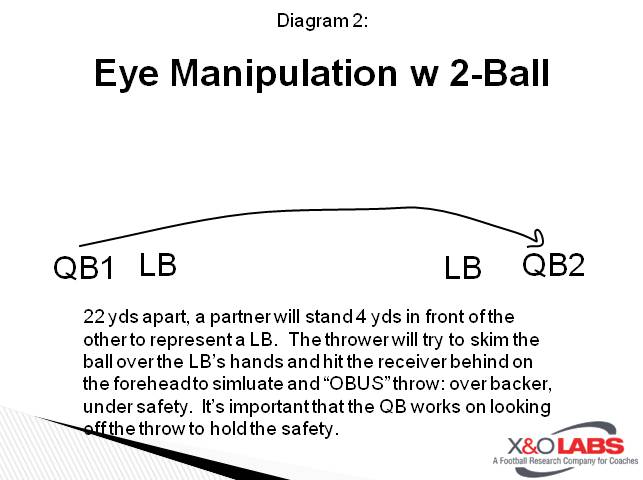
Drill #2: Eye Manipulation W 2-Ball

In this drill, four quarterbacks will stand 22 yards apart from each other, with two on each side. One QB will stand in front of another to simulate a linebacker. The opposite QB will take a 3 or a 5 step drop with a hitch and try to skim the ball over LB’s head. This throw will have a little height and a lot of speed. The ball needs to come out off the first hitch and the QB should work on looking off the safety. This drill simulates timing, rhythm, arc and manipulation of defenders.

Slide2

Drill #3: Quick Set-Up & Throw

Read More

Four Run/Pass Play Checks for PAT Attempts

By Eric Struck
Special Teams Coordinator/WR Coach/JV Head Coach
Washington High School (SD)
Twitter: @EricStruck

Introduction:

Touchdowns are obviously a great momentum boost for your team so why not take advantage of that momentum on the scoreboard by going for two if the defense is unprepared. Using the PAT as an extension of your offense can be fun for your kids and cause headaches for the opposing teams.

Philosophy

I have been the Special Teams Coordinator at Washington High (SD) the past two seasons. When I was given the job, I had three philosophical goals in mind:

  1. Do things that set us apart from the competition
  2. Make special teams fun and exciting for our players
  3. Use schemes that gave us an advantage on game nights

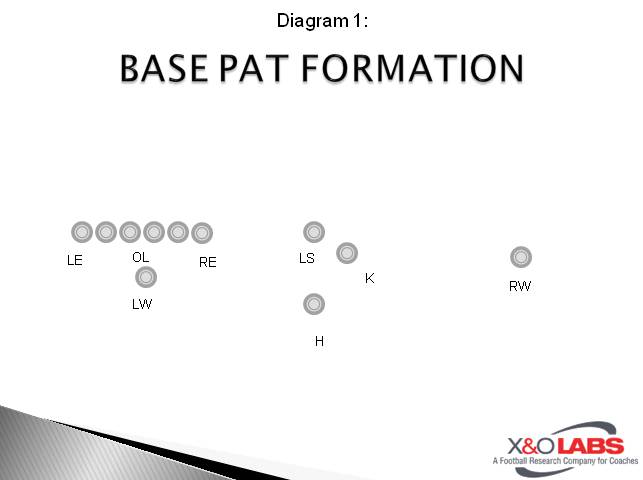
Using the PAT and creating different formations while using the same set of checks on a week in week out basis accomplishes all of those things for us. When we first install PAT, we start with a basic formation that we will tweak from week to week.

Slide1

We will install 4 basic checks that we will use determine what our course of action will be when we get lined up. Those checks will be consistent throughout the season and we may add or tweak things as we go along. For our checks, the Holder will look to the sideline at me and after I survey the defense I will give him a signal if we want to run a play to go for two points or if we will line up and kick it. I give a arm/hand signal that tells the Holder what we want to do then he will call it out to the rest of the PAT team. It is important that they get lined up quickly so that we have enough time to survey the defense as well as get lined up to kick if we need to.

Read More

Methods in Creating On-Edge Positional Meetings

By Andy Merfeld
Cornerbacks Coach
Benedictine College (KS)
Twitter: @Coach_Merfeld


As coaches, we have all heard the expression, “It’s not what the coaches know, it’s what the players know that really matters.” I think most of us believe in this statement, but how many of us truly practice it? How many of us emphasize player learning as a central tenet of our programs? As coaches, our success is directly linked to our ability to effectively communicate with our players. We must examine complex problems, come up with solutions within our existing scheme, and figure out how to impart the necessary information to our players. One of the reminders I keep on my desk is to “be the best teacher on campus.” Over the course of my career, I have spent a lot of time thinking about better ways to teach and communicate with players. In this report, I want to share some ideas for teaching and learning aids that I have used. I am indebted to several other coaches for most of these ideas and tried to give credit to the proper men where I could. Among those not otherwise mentioned, I am specifically grateful to John Steger at the University of Minnesota Duluth, Travis Walch (formerly of the University of St. Thomas), Dante Bartee at Cal-Berkeley, and Justin Wyatt at Upper Iowa University.

As an aside, I want to emphasize that I started out as a high school coach and have always worked at the small-college level where we are not blessed with an army of support staffers. With some organization and creativity, I think all the activities I will discuss today are doable at any level of football. Secondly, I would like to make a disclaimer that my background is primarily coaching the secondary and many of my examples relate to that area, but I believe most of these practices can be adapted to other positions and the offensive side of the ball as well.

In this report, there are a few different areas on which I’d like to focus. One area focuses on the general procedures I use in my position meetings. A second area where I will spend some time is on special activities in position meetings. Thirdly, I wanted to pass along some general guidelines that I have found help facilitate player learning and information retention.


Position Meetings: General Procedures

I am a firm believer in requiring players to sit in their position groups in meetings. In a smaller setting, this means I have the safeties grouped together and the corners grouped together. The primary reason for doing this is to allow the players to coach each other throughout the meeting. I always make it clear that quiet conversation is encouraged within groups (if it is on topic, of course). If I’m covering a coaching point for the corners and one of the young safeties has a question about something different, I will let one of the older safeties quietly help the younger one. If the point is especially important or I want the players to hear a different voice, I might ask the older player to explain the point to the entire group. I feel like this format allows us to cover as much ground as possible in a limited amount of time. It also gets the older players more invested in our scheme and in the development of younger players. Allowing the players to coach each other benefits both the player doing the teaching and the one(s) who are learning. As we know, the best way to learn a skill or concept is to have to TEACH it to someone else. I also try to be very clear about the players needing to be comfortable communicating with and coaching each other, since that is essentially what they have to do on the field all the time (the theme of players working with and coaching each other will be consistent throughout this report).

Sitting in position groups can also be used in larger settings where the entire offense or defense is meeting together, or in a special teams meeting where players can sit in small groups with their position coaches (the coach working with the right side of the punt team, as an example) and get extra coaching while the lead coach runs the meeting.

In the defensive systems in which I have coached, the safeties are responsible for nearly all the pre-snap communication among the defensive backs. In my meetings, I require the safeties to make each coverage check in the meeting just as they would if they were on the field. When we watch practice or game film, whoever is in on the play we are watching makes the check in the meeting. This serves several purposes. From a practical perspective, it keeps the players active and involved in the meeting. Secondly, it gives the players many more quality mental reps. They get the coverage call from me in the meeting (just as they would get it from the sideline in a game), go through their mental checklists, and must make a clear and confident coverage check. (Depending on the situation, you may not even need to watch the play! You could just have the safeties make their checks and move on to the next play.) The corners, who are typically not making checks, also get repetitions listening for the checks from the safeties. Thirdly, requiring the safeties to make their checks each play allows me, as a coach, to get an accurate feel for their comprehension. If the less-experienced players are comprehending everything well, I can feel confident that everyone is ready to progress to the next concept. If the more experienced players have questions or are overly confused, I’ll know I need to slow down or possibly even back up and review the material.

Another way that to encourage players to take ownership is by giving them the opportunity to contribute to the game plan. The QB coach and offensive coordinator at Upper Iowa, Ben Curran, likes his QBs to come to their Tuesday meeting with several game-plan ideas for the upcoming game. This ensures that the players are watching the film on their own and that they are putting some thought into what they are seeing.


Position Meetings: Special Activities

Pre-Snap Coverage Test

When I was coaching at Upper Iowa, we tried to place a high premium on pre-snap disguise in our secondary. One way we emphasized this is by administering a video test to the players. I believe our linebacker coach, Jason Hoskins, had the initial idea for this test. Usually, on an off day late in spring practice, I will pick out ten plays against a generic offensive formation (10 personnel 3×1, for example). Then, I will use a Hudl note to pause the video exactly one second before the ball is snapped. I will allow the players about ten seconds to look at the still picture, and they will have to write down what coverage they think we are in, as well as why they think we are in that. This forces the players to look at their own position, as well as the players around them, for clues about what coverage we are in. Clues could be based on a safety’s eyes, a corner’s stance, or a linebacker’s depth, among many other things.

Read More