
Creating a Stem System for DL to Disrupt Blocking Schemes

By Jordan Fast
Defensive Coordinator
Sioux Valley High School (SD)
Twitter: @RealJordanFast @CossackFootball


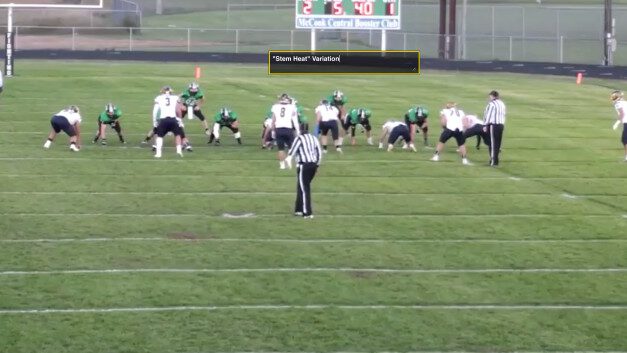
Pre-snap defense line stems create the appearance of complexity, thus creating confusion while giving defense lineman sound responsibilities. Organized stems place blockers in conflict, create negative plays, force offensive lines to have sound blocking rules and allow defensive lineman to make aggressive plays and keeps offensive line pads off linebackers. Every organized and competitive team has spent numerous days working through defensive fronts and blocking schemes. Stems, in both odd and even fronts, place blockers in conflict and creates a defense which is destructive rather than reactionary. Any offensive line can block “vanilla” defensive fronts. Incorporating and using stems among your defensive front will make your players faster and more explosive.

At Sioux Valley, we have a mixture of players who put their hand down on the defensive line. We believe in an aggressive style of defense, which often places eight players in the box.  The reoccurring non-negotiable theme among our defense line players is “no one gets off the ball harder than us.” At Sioux Valley, we place athletes on the line and stems are one way to allow our athletic lineman to make plays. Our Head Coach, Dan Hughes, has integrated a lifting program which has yielded success in order to have athletic lineman who can get off the ball. Sioux Valley defensive linemen are extremely strong in the hips, core, and explosive muscles. This tactic yields success in pre-snap movement among our defense. Our players can be even faster and more explosive if we place them in situations which allow them to showcase their weight room gains.

Eighty to ninety percent of our defensive line strategy is gap alignment. Stemming allows us to show a gap and fill that gap, or show a gap and cross-face into a gap with which we were previously aligned. Every stem has a counter action. Just because we stem over, this does not show which gap is each player’s responsibility. Along with deceptive defensive line gap alignments, stemming allows second level players more opportunities to mix in simple blitz schemes, which appear very complex in cohesion with stems, but are very simple. Mixing in stems will also keep second level players pad free from offense lines blocking linebackers.
 

Communication

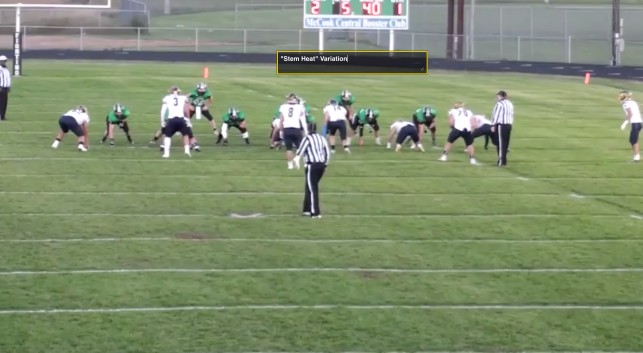
Sioux Valley is a communication-based team. With this pillar in our framework, stems force communication and the recognition of offense formations and alignment. Each stem is tagged with vocabulary, which dictates the action of each particular stem. Stemming action is dictated by the strong (Sam) and weak (Will) side offense alignment. Second level players establish which is the Sam and Will side. Defensive lineman should never have to think, only react. The defensive line needs second level communication to function as a unit. Every year, within the first two weeks, a defensive lineman will become upset for lack of communication from the second level because it is creating confusion on his stem. This leads to a healthy opportunity to reinforce communication, which leads to increased recognition of offenses and more complex reads. Stand up players will vocally state their position, such as “Sam left” or “Will right.” This commutation conveys on which side stems will take place based on the call sent in by the coach.  Here is the order of our communication to stem:

  1. Coach relays a number to the signal receiver using wristbands
  2. The receiver transmits the call to the rest of the defense
  3. Second level players establish Sam and Will sides which dictate the action of stem or another action is applicable.
    1. Based on weekly check calls, defensive captions, traditionally the player(s) who establishes Sam side can “kill” called actions.


Vocabulary

Our basic stem vocabulary using Sam and Will calls:

  • Down: towards the Sam side
  • Up: towards the Will side
  • Fluster: Back to the gap you started on


This is our basic vocabulary.  Upon mastery, you can begin to merge these.  For example, “Up Fluster.” Now players will stem to the weak side and return to the gap they started on. As an introductory to stems, we simple use Fluster, which in more complex thought would be “Down Fluster” 


Progression:

We start with simple stems during the summer and from day one. While we may stem as little 10% to 50% in game action, many of the reps that we drill on in practice and team time contain pre-snap movements. The more time defense lineman spends practicing stem actions the quicker and more confident lineman become. Practicing stems more than we use them also forces team communication and defensive line engagement during team time. Now defensive lineman has to cognitively engage in team play, rather than the monotonous activity of beating the gap or JV player across from them. Stemming also forces defensive lineman to know defensive techs/alignment.  In order to build vocabulary and practice stems, here are just a couple ways we use to build on stem progression:

  • Sled work
  • Football on a stick drill work
  • Team pursuit drills
  • Handbags or shields drill work
  • Individual time defensive line time before games


When do we Stem?

Read More

Using Pullers in the RPO Game

By Phil Hamilton
Offensive Coordinator
Saint Vincent College (PA)
Twitter: @coachphamilton


Adaptability is so important in today’s fast-moving society.  It is also vital on the football field.  Defenses have slowly but surely adapted to the “RPO” world we currently play in.  Having the ability to continually keep a defense on their toes is always at the forefront of our offensive game plan.  RPOs and Play-Action Passes are an integral part of our system.  Because of this, adapting and enhancing the run game, while incorporating passes off of it, has been imperative.  With the idea of keeping a defense aggressive, using pullers is effective. 

Essential Coaching Points:

The first essential coaching point of any RPO or Play Action Pass is ball-handling.  When we start this process in practice, our quarterbacks must understand the importance of making everything look exactly like run.  Defensive players, at their core, are just like dogs; if you show them a piece of meat, they will run to it.  The quarterback must treat every RPO or Play Action Pass as if we are handing the ball off.  When it comes to the RPOs, we stress the importance of riding the ball hip to hip.  This gives the quarterback ample time to make his read, for the defensive player to react, and for him to make an educated decision on what to do with the football.  When the quarterback gets a pull read, we want to stress being “violent” with the football. Rip the ball up into a perfect stance and let it rip!  If he hands the ball off, we stress the same things–carry out your fake!

The second essential coaching point is the demeanor of the offensive line.  Just as the QB does, the OL must treat RPOs and Play Action Passes just as we would any run play.  With the leeway that they receive to push up to three yards downfield, they have plenty of room to block for the run while keeping their boundaries in the back of their mind.  Coming off the ball with aggression is key. 

The third essential coaching point is the demeanor of the running back.  At the risk of sounding like a broken record, the running back must treat these types of plays like he is getting the ball.  In the RPO game, the running back has a very good chance to receive a hand-off, so whether he does or not, we want him to go through his read process; carry out the fake as if you have the football. If the RB attacks his aiming point and cuts off his blocks, he is always able to get reps at reading the run game, even if he does not have the football.  With all fakes, if we are able to take one defensive player out of the play, the job has been accomplished.

Pin and Pull Concept:

Pin & Pull is a great way to get our big guys blocking smaller guys.  It takes some athleticism for the OL, but it also gives our running backs a way to get into open space quickly.  Being able to incorporate run/pass options off of Pin & Pull has helped us tremendously.  There are several ways we can do it.  We always want to identify an aggressive defensive player.  Whatever level we are attacking, we want the defense to return to their core identity: aggression.  With their aggressive nature, we gain numbers in the passing game.  If they are coached to take a more passive approach, we will have favorable numbers in the run game.  Pullers tend to emphasize run and bring out that aggression, especially when multiple guys are pulling.

Reading a Linebacker:

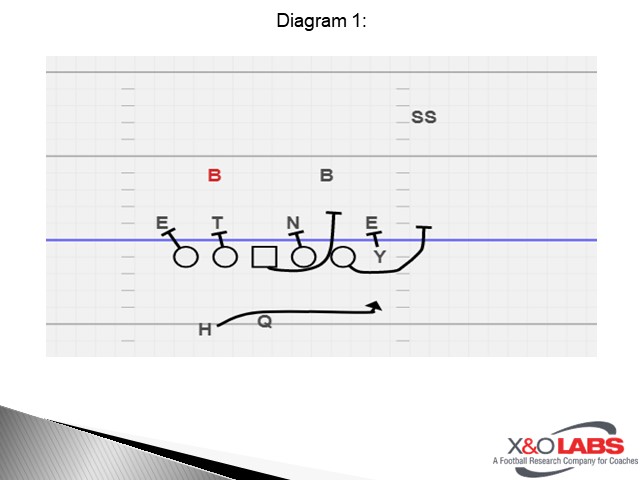
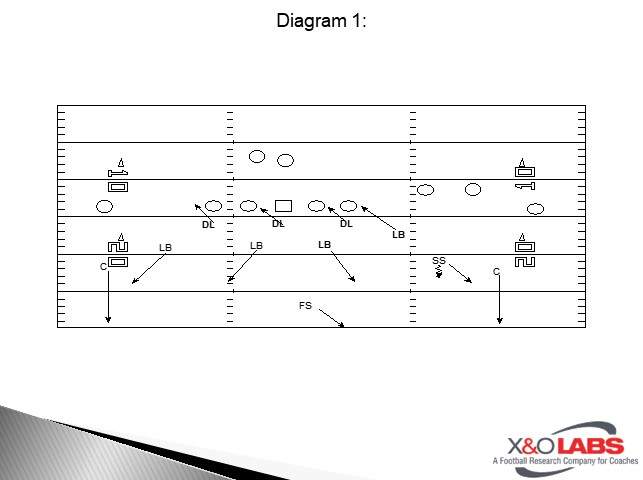
Diagram 1

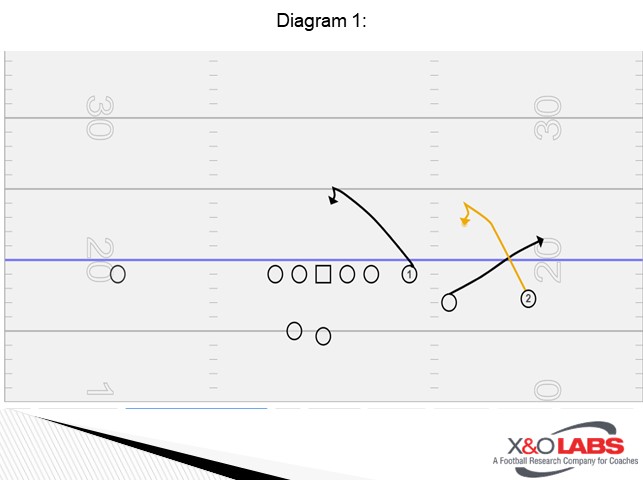
When we have identified the read linebacker, our next step in design is the pass concept.  When reading a linebacker, we always would like to have something quick behind it.  We love to keep our quarterback in a 1 to 2 read.  Give him two options.  Throw the first, until it is taken away.  Shift your hips and throw the second.  As a quarterback, we have to know that the OL is not pass-blocking! The read and throw must be quick. In both of these examples, you see the quick hitters we have in place behind the linebackers.  The aggression of the linebackers is accentuated by the pulling action.  In both cases, each linebacker is sucked in by the action, leaving great throwing lanes.

To study game film of these RPO concepts, click on the video below:

Editor’s Note: Coach Hamilton has provided clip by clip narration of this playlist below.

The first, double slants, is good against man or zone coverage.  Although we lose a man up front, the quarterback does a great job of maintaining his base and moving to his second option. The first window is open, but because he has to move, he throws the outside slant.

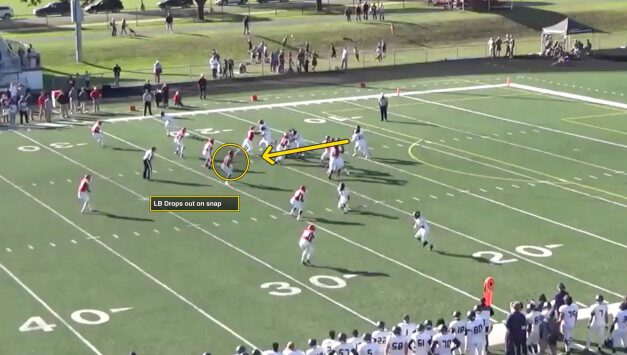
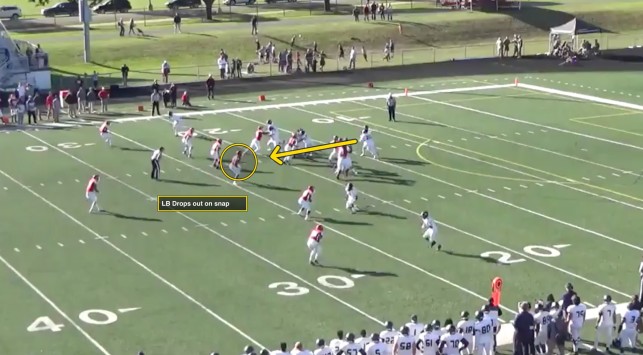
In the second clip, you see the backer in the box drop at the snap.  This is great for us.  Most linebackers trigger when they see pullers.  In this case, his aggression has been taken away.  By dropping out, we now have a hat on a hat. 

In the third clip, we receive heavy pressure off the edge. Blitz provides us two ways out; make the quick decision to throw or hand the ball off to and not take a hit. In any offense, limiting quarterback hits is essential. The quarterback does a great job of making the decision to hand the ball off.

The fourth example is a slant/bubble concept.  Again, this can be used against man or zone coverage.  Our receiver does a great job of attacking leverage and causing the defenders to collide in man coverage.  The route is great, but the quarterback performs perfectly here as well.  He gives great ball action, riding it hip to hip.  That action allows the defense to react.  Being inside the ten-yard line helps as well, attacking the aggressive nature of the defense in the red zone.

The fifth clip is gray.  The quarterback makes the decision to give the ball because of the linebacker whom we are reading “slow plays” it.  Being decisive is huge in this offense, and the quarterback does a good job with that here.

Read More

IZ Leverage Drills for 1st/2nd Level Blocking


By Mike Fossum
Offensive Line Coach
Wisconsin Lutheran College


Introduction

There are many challenges in coaching NCAA Division III football, but having consistently huge/physical offensive linemen is certainly one of them. At Wisconsin Lutheran College, we have been working for years to reduce our inside zone play to the simplest form possible to fit our personnel and our spread offense (wide splits and no tight ends). Our A gaps are typically 3 feet in width and our B gaps can get as wide as 4 feet at times. That width has forced defenses to quickly define themselves and puts our OL in advantageous leverage positions while also creating natural seams for our ball carriers. If our players understand what they see in front of them and know how to use their leverage, then we are able to effectively execute the zone/read play as a base part of our offense.

The drill sequence that I will demonstrate in this report will cover a few of the fundamentals we believe in for blocking the 1st and 2nd level within our zone scheme.

Body/Leverage Drills

I am a big believer in having players understand what a good “fit” position is as opposed to a bad “fit” position. One of the real keys to great OL play is being able to correct yourself when you are out of position. We have a series of body/leverage drills that help with this.

Bad Block Drill

Here we are training the body to recover and understand how a proper fit position feels. A blocker starts out in a good fit position, squatting in front of a defender with inside hands, head up and a solid base (knees under armpits, toes under knees). The defender slowly walks backward while holding the blocker’s elbows. The blocker keeps his feet stationary and allows his body to get way out in front of his feet. Just as he is nearly going to fall forward we have the blocker widen and fire his feet, lower his hips and raise his eyes to “recover” back into his starting fit position. This is very much a low speed drill and is really all about body awareness for the blocker. On the demo video you’ll see a good look at this drill, the only coaching point I’d emphasize more is bringing the head/eyes upward during the recovery action.

To study narrated film of this drill, click on the video below:

Read More

Bracketing the X in Trips Formations

By Ty Gower
Defensive Coordinator
Norman North High School (OK)
Twitter: @coachgower

Introduction:

At the 6A level in Oklahoma, it seems almost everyone has a big time FBS recruit playing the X. Due to this, it was imperative for us to find ways to combat our opponents who would get in 3×1 formations and isolate the X. At the same time, it was important not to live in the same coverage to the trips. For that reason, we found multiple ways to play trips. This kept the offense guessing by what coverage we were playing while keeping us sound to the X’s side.

The “Walk” Concept:

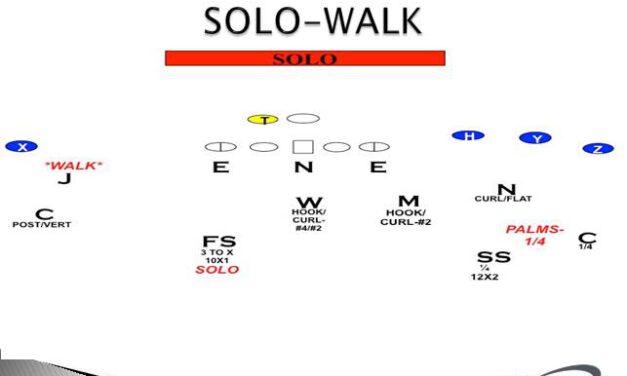
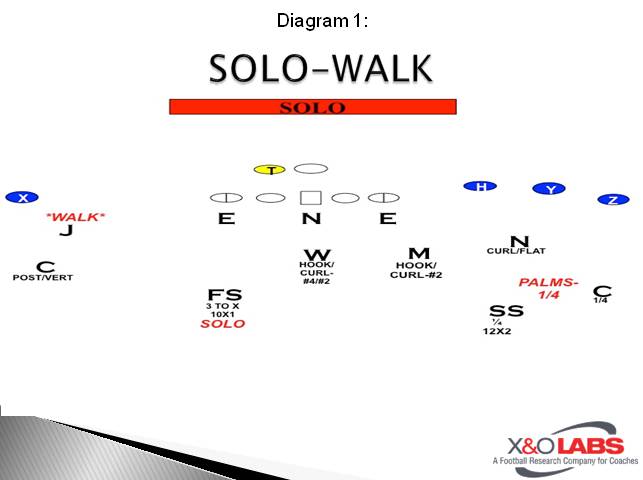
The “walk” call within our 3-4 has allowed us to play a variety of ¼ based coverages such as palms or a quarters to #1 and #2 receivers, and “solo” to the #3 receiver (Diagram 1). This makes it an easy change up to trips, but also giving us the ability to play 2 on 1 on the single receiver side (X). Although we might have taken away the X, it was still important that the offense didn’t get too comfortable seeing the same coverage to trips. For that reason,  we employ a mixture of palms, cover 4, cover 8, and off man to that side.

Slide1

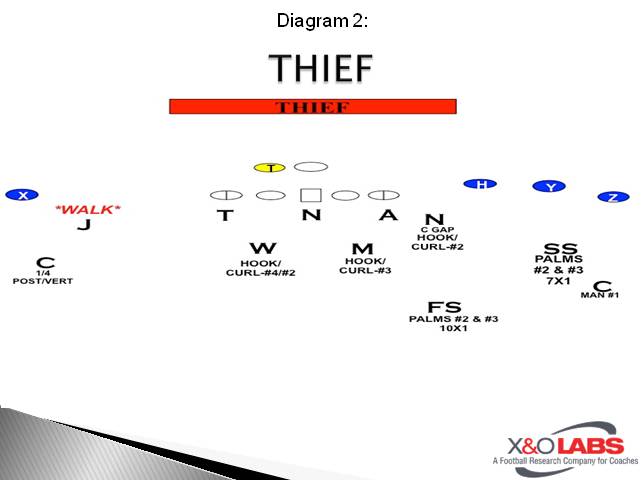
What also made our “walk” call effective was the ability to play various palms coverages on #2 and #3 receivers. One of which being our “Thief” coverage (Diagram 2). In this diagram, we are playing a palms coverage on #2 & #3 with the SS and FS, while still maintaining a true six man box with “20” Linebackers. This worked well because we were not teaching a new concept to anyone except the SS, who becomes like the “Palms CB.” Because of our flow fit concept of the inside linebackers, we were gaining a “flow gap” player in the WLB. That said, we found gap scheme concepts to the weak side could cause us issues at times because our force player was slow on same side power/dart weak. Now it was our turn to find answers for having a fast force player, but still keeping the ideology of our defense and “Defending the X.”

Slide2

Coaching Points:

To go back to our walk call, it was so easy to install due to we didn’t have to teach anything new out of our base structure to trips. It also fit how we were playing flow fit run fits with the inside linebackers. While the OLB was the C Gap-Force player, we were still able to pick up an extra C gap run player in the WLB. On our walk call, we taught the OLB like a “Cover 5” CB. He would have an inside technique on the X with his hands on and wall to the sideline. At the same time, he had to be very aware of where the RB was. If the RB was away from him, he had to trigger fast and was not allowed to get his hands on the X.

While the pre-snap disguise was there, it was not always effective due to “run action” by the QB/RB mesh. For this reason, sometimes we found that we were defeating the purpose of the “walk” call.  This forced us to find another a variation of keeping the “2 on 1” thought process on the X.

To study game cutups of the “Walk” coverage concept, click on the videos below:

Editor’s Note: Coach Gower has provided segmented clip narration for each cutup below:

In the clip below, here is our walk concept. This was the first game of the season in a new defense, so we were still working out some kinks. Notice how the OLB gets hands on and is physical with the X. Because the RB is set to him, he knows he can more physical on the X. Would like to see him wall to the sideline, but will take the physicalness. Also as we discussed earlier, notice the flow gap fit by the WLB that allows him to flow into the C gap.

Read More

Using Read Families to Train QB Progressions

By Jeff DiSandro
Offensive Coordinator & Quarterbacks Coach
Bishop Kenny High School (FL)
Twitter: @Coach_disandro


I am going to talk about some of the basics of our passing game.  I like to think that our approach with the passing game and pass installation is just one way of “doing simple better.”  As I work through our pass game structures, I will also include some specific comments on game planning pertaining to the concepts and ideas being discussed.  I am going to intentionally stay away from QB fundamentals discussion for the focus of the article.  I want to thank X&O Labs for being a tremendous coaching resource and I know I have learned a ton from other coaches over the past few years. 

To start, we are going to break our passing game down into four major types of read families.  Our major read categories are progression reads (P), defender keys (K), matchups (M) and combinations (P + 1).  All playbook plays and potential additions in the passing game will fit into one of these read families.  Each week our staff will spend time analyzing each these structures and how those read families will influence the defense we see (for our advantage).  We work hard and drill the QB on the differences between each family and thus how our plays are designed to attack the defense.  At times we may seem very multiple; especially in the passing game, but we are not.  Every play we have fits into a family of QB read types and once he (the QB) identifies the nature of the family and what we are trying to do he can have confidence and mental command with his processing week to week.  I am very picky and about the QB reads in the passing game.  As a coach, if I am not 100% certain on what we are trying to accomplish and how it fits into the above-mentioned families then how can I expect the players to be confident?  We do build and add as the season goes on but as coaches, we must be certain that how we present plays and our plan to the kids (and the QB) and it must neatly fit into the above schemas we are creating in the passing game.  We always talk about putting players in a position to succeed and this is one of the ways we do that regarding throwing the football. 

Progression reads (P)   

The first family we start training the QB with is our progressions reads.  These are pure progressions and the QB will learn to work through a primary, secondary and check down route (1-2-3).  With almost all these concepts, we are trying to build some type of 3 man passing triangle.  We group all our progressions as either weak triangles, strong triangles or middle triangles.  Grouping our progression reads this way helps me arrange my practice and film study teaching time and be efficient and organized with my teaching methods.  We like our passing triangles no matter the coverage or defensive structure.  These are calls that we like to think of as “coverage proof.”  This just means that we don’t look for a specific cover 3 or cover 2 looks to work a certain progression.  Through the game planning, the coaching staff will decide how we want to flood the field or what specific triangles we want to use.  Using formations and different motions, we are always trying to find ways to put our 3 on their 2 or our 3 on their 3 with some type of winning leverage.  Again, we can deploy a variety of progression reads and the QB can feel confident in being diverse so long as we communicate the family and get him to understand how this play influences the defense.

Diagram 1

QB progression is sit, curl, flat. This is a strong triangle. 

Game plan thoughts would be how do you want to flood the field (formations?).  No matter how many ways you choose to do it the family the basics don’t change for the QB.  What personnel groups and formations will utilize your best players and put them in primary or secondary spots in the route concept?  For example, will you see middle blitz in a certain area of the field, and can you work the middle sit to an explosive athlete in that situation?  That could require you to move an athlete around a little, but the basics and nature of the play don’t change at all.

One of the big things with the QB in the progression read family is for him to avoid locking into a wide receiver during the play.  We work hard on repping the QB and his eyes and we want to create good habits of field awareness in the progression passing game.  One of the drills I use for progression reading is shown below.  We do a lot with the drill.  Not only is this a good way for the QB to develop the ability to move through progressions and create some situational awareness but it is also a good way for me, as the coach, to teach the defensive coverage reactions and how the weeks opponent will match our concepts.  It is the QB’s job to evaluate those spots (or a phrase I use is do you want to buy this land) and throw the football into the open grass.  As mentioned above the QB cannot lock into a WR.  A lot of the interceptions that happen on progression reads can be traced back to locking onto a WR in the progression and losing that awareness – thus not feeling/seeing a defender that eventually can make a play on a throw.  All the QB footwork is tied into the progression, meaning he always has rhythm, hitch 1 or hitch 2 with the internal clock in his head.

Drill 1 – Progression Drill Ideas

3 cones will act as routes being run into the appropriate areas.  Our spacing concept has a sit over the center at six yards, a mini-curl that adjusts off the flat defender and an arrow / flat throw.  The colored mesh or cloth will form a box around the route to help the QB gain specific progression or triangle awareness.  We talk the QB through each route in the progression and review how the trigger players may or may not meet the colored mesh near the cone and route.  We will cover how the specific defense that week will react to our spacing progressions.  All of this is designed to get him to play with triangle awareness within his progression reads.  I also use this drill to review any special scenarios and play call situations we might encounter.

The drill is a good way to teach about defenders within the coverage scheme and how spots of the field get covered and routes become dead thus moving the QB to his next progression.  The drill has some flexibility because the coach can work specific parts of the progression, simulate different defender tendencies or have the QB just work eyes and throwing to open grass based on simulated awareness.  One way we would add to the first skill is to add a pressure or pocket movement component to the drill.  We will still work QB football and progressions all the same but add a 3-man DL rush and force the QB to fit in the pocket a variety of different ways while keeping his eyes down the field.

This is our spacing concept to the trips side.  The QB reads are Sit, Curl, Flat.  We would like the #1 WR to throttle into the open area or grass better in this situation.  We teach this curl as adjust off the flat area and he can sit in a first window or second window based off the flat defender response.  He should present numbers and hand target for the QB.  #2 (the flat route) must get width as his route really helps create the stron

Read More

3-3 Stack Adjustments to Handle Heavy/Unbalanced Formations

By Brock Harney
Defensive Coordinator
La Crosse Logan High School (WI)


Defensive packages benefit from having “canned” or “automatic” adjustments to different situations designed to put stress on a defense.  Every defense installs a coverage check or base adjustment to Trips formations in the passing game.  In order to be sound and prepared, defenses must also have a base adjustment to:

  1. Heavy Personnel (31, 32, 22, or other creative sets with 1 or no WRs)
  2. Unbalanced Sets (Any set that only has 2 players on the LOS on one side of the ball)
  3. An additional offensive lineman on the front (Extra OL- we refer to as “Fat”)


Failure to prepare for these situations will cause breakdowns in run defense in the same way that failing to account for Trips/Empty/Quads will cause breakdowns in pass defense.  Defenses usually know how to adjust to these groupings once presented with the formation, but the challenge lies in teaching players to recognize these situations and go to adjustments before the offense can use the formation to their advantage.

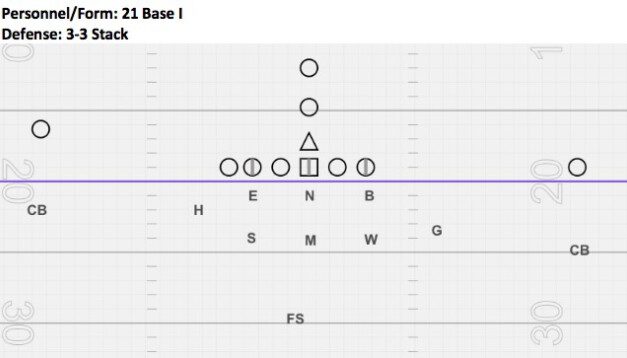
Our version of the 3-3 Stack is predicated on control of the interior 6 gaps, C gap to C Gap.  Depending on personnel, we may do this by playing a single gap control defense or by having specific players playing 2 gaps.  Regardless, our 6 players in the box must be able to shut down the interior 6 gaps in order to be sound vs the run.  Adjustments to heavy and unbalanced sets largely involve the players responsible for setting a hard edge and 2nd/3rd layer support behind the front.

Diagram 1


3-3 Adjustment Rules


Heavy (31, 32, 22, 23 Personnel)


CB/FS (Defensive Backs) Adjustments:

The defensive backs adjust to Heavy personnel groups with a “wide as the widest” rule.  The CB will align as wide as the widest eligible WR.  The down safeties (Hammer and Gun) will remain down to provide a hard edge in the run game.  This adjustment provides support balance in virtually every Heavy situation they encounter.  In situations where there are no WRs removed from the box (23 Personnel), the FS is able to tighten down to a Robber alignment and scrape to action while the CB’s provide a deep ½ vs the pass on each side.


H/G (Down Safeties) Adjustments:

The two down safeties will typically align 3×3 on the EMLOS but will adjust to 1×1 alignment vs Heavy Personnel.  In these situations, they become run first players that set an ultra-aggressive edge and lever plays back to the interior 6.  If the scouting report shows that the offense is likely to show a lot of Heavy personnel, this position may be subbed with an OLB or a really athletic DE that can handle themselves in space.  The down safety positions tend to be the most reliable players who are both sturdy and athletic.


S/M/W (Linebackers) Adjustments:

The primary goal with these players is to maintain stack alignment against these personnel groupings while really keying these players on what an offense is likely to do.  It is important to know if the offense is in Heavy to gain leverage on the edge or if they are in Heavy to create run gaps inside.  These players will fit based on the line call given to the front (Gaps or Slant) and take care of their interior 6 gaps.

Read More

The Navy Way: Combos, Scoops and Veers

By Mike Kuchar
Senior Research Manager
X&O Labs
Twitter: @MikekKuchar


Introduction

Regardless of what offensive system you run, you must admit you’re curious about the flexbone. How can this offense produce the top rushing numbers year in and year out despite an often disparity at talent? Sure, the basis of this offense is to run the football, but we’re talking about yards per carry here. Specifically, 5.7 yards per carry over the last four seasons as it pertains to the Naval Academy. In fact, of all the major rushing categories (yards per game, yards per carry, yards per season) the Midshipmen have only been out of the top five two times in each of those categories since 2013.

We were curious too. So, we took what are believed to be the three cornerstone blocks of the flexbone offense, the front side combination, backside scoop and veer release, and organized an exclusive first person tutorial with offensive line coach Ashley Ingram to learn how he taught these blocks. We spent a day with offensive line Coach Ingram this spring to research how he teaches these three blocks. As hard as it was to fight the urge to tour Annapolis in the spring time, we hunkered down in the backroom facilities at Navy to study how he’s able to get his offensive line to perform at such a high-level season in and season out.

You don’t need to run the flexbone offense to learn from this report. If you run outside zone, you scoop on the backside. If you run gap schemes, you combo on the front side. And if your offensive menu has any option element in it, you’ll need to teach the veer release to evade the read key. At its bare bones, this report is about how to teach offensive linemen to get off the ball and play with a physicality that is unmatched. Its what Navy does.

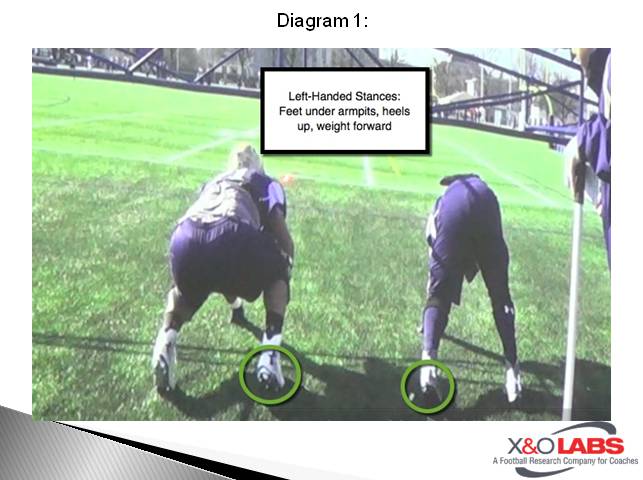
Teaching the Stance (Diagram 1)

Slide1

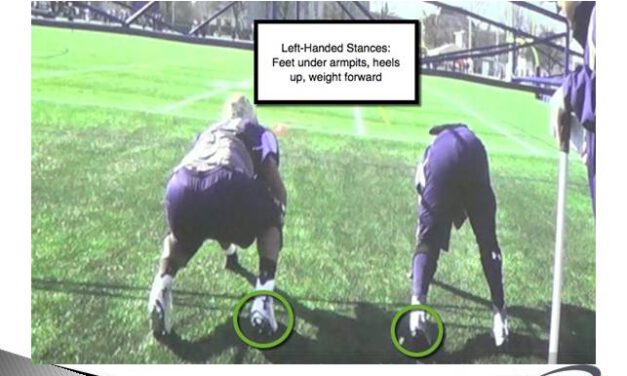
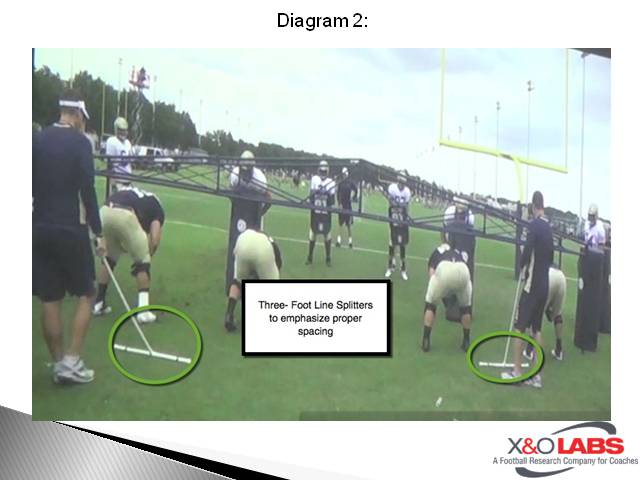
When you watch Navy’s, offensive line get off the ball, and boy do they get off the ball, you will notice the almost sprinter like stance used by the front five. Their feet are directly under their armpits with some air under their heels. The front hand is a good deal in front of them. Although Coach Ingram down played how important weight distribution is by just talking about having the weight forward, he did emphasize how important it was to have depth off the football. “We push it to legally breaking the belt line of the center,” he says. “We only cheat on the ball if the defensive line plays back on us. We put our hand on the toe of the center. Our helmet will break the belt line.” In order to teach a three-foot split across the front, he’ll start each of his individual drills with a line splitter that you can see in the diagram below (Diagram 2).

Slide1

In order to execute the backside scoop block more efficiently, he teaches both a left hand and right hand stance. “Our left side linemen play with their right hand down with a right foot stagger,” he said. “Our right-side linemen play with their left hand down with an inside foot stagger. The outside foot should be a little more cleated than the inside foot. Our inside hand is down on both sides which helps with scooping because that’s the hardest thing in our world.”

Coaching Points on the Stance:

  • Feet Under Armpits, narrow base
  • Weight in front of body
  • Toes and Knees up field
  • Teach both a left hand and right hand stance

Coach Ingram provides his tutorial on how he teaches stance in the video below:

Read More

Protecting Your Gap Runs Vs. Common Defensive Adjustments

By Mike Kuchar
Senior Research Manager
X&O Labs
Twitter: @MikekKuchar


Introduction

fordamOffensive coordinators don’t want to be taken out of their rhythm and how defenses do this is by eliminating what offenses run most efficiently. If gap run concepts are one of your most efficient run concepts, defenses will find various ways to combat these schemes. Below are what we found to be the most common problems defenses pose to gap scheme run concepts and more importantly how offenses are alleviating these issues.

Problem #1: Kicking Out the C/D Gap Defender at the Point of Attack

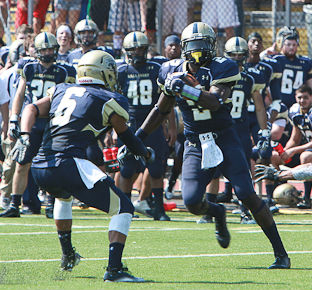
Whether you’re running your gap scheme to the open or closed side of a formation, it’s imperative to get a kick out block at the point of attack or the play stalls. And while some offensive coaches will preach a “log” block to account for aggressive, spill defensive ends, we’ve found that the majority of coaches will force the kick out regardless. How they are able to force the kick out block is presented in the following methods.

Solution 1: Varying Footwork of F, Justin Gumm, South Beloit High School (IL)

“The technique we use with our F when kicking out is critical to the success of the play. He steps with his outside foot first, so on his second step his hips will be open to the end. This ensures that he doesn’t get beat inside. If he were to step with his inside foot first, his next step will then leave him vulnerable to getting beat inside. He must gain ground towards the line of scrimmage with the first step to ensure he is not reaching and opening up the gate for the defensive end.”

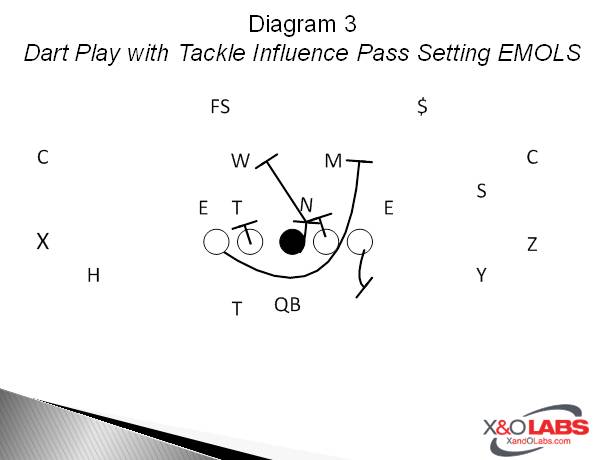
Solution 2: Dart Scheme Variation, Ryan Schleusner, Offensive Line Coach, Fairmont State University (WV)

“We would use this against teams that were consistently ‘trapping the trapper’ or defensive ends that were easier to block by pass setting than by pulling and kicking out. As you can see, all that we have done is eliminate the kick out block by pass setting the play side EMOLS. It should be noted that this play can only be effectively run to an A gap defender without having to change all of your base counter rules. It should also be noted that the tackle who is pass setting must ‘invite’ the EMOLS to beat him up field and pin him there or he must actively engage the EMOLS if he does not use a hard pass rush.”

To see video of this technique, click on the video below:

Read More

Cover 2 Press Corner Techniques

By Richan Gaskins
Defensive Backs Coach
Gallaudet University (DC)


Introduction

galludetOur secondary and linebackers are taught to play physically in pass defense. Physical play does not begin when the ball is in the hands of the receiver, it begins at the line of scrimmage. Our version of the Cover 2, our most successful coverage this season in terms of interceptions this season, has placed a premium on putting hands on receivers and tight ends. “Hands-on” has become a common phase in the secondary in our Cover 2 look, particularly with the cornerbacks. Our philosophy centers on the idea that a quarterback has approximately 2-3 seconds to make a decision in the pocket before reverting to either a “scramble drill”, sack, or hurried throw. By having our cornerbacks and outside linebackers re-routing receivers, it will disrupt the timing of the quarterback and receiver. Our ultimate goal is to cause turnovers by forcing the quarterback to make the most difficult throw or settling for the last read in his progression.
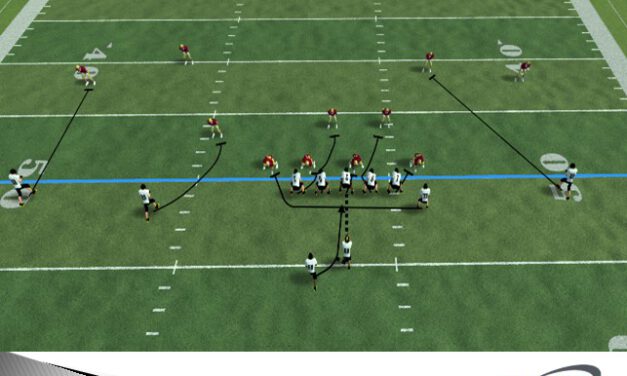
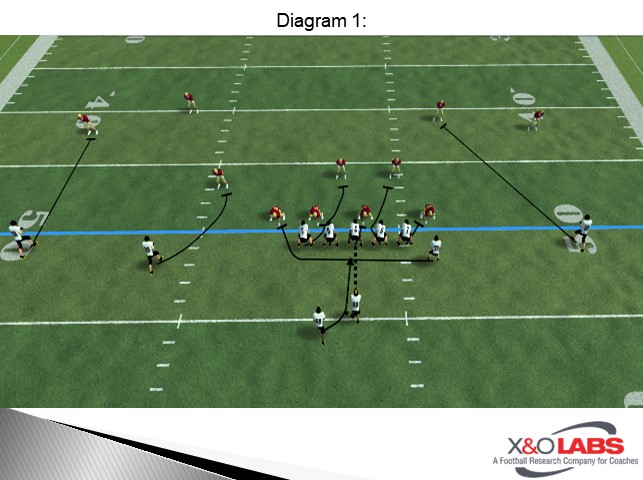
Placing a premium on physical play in the secondary will also cut branches off of the passing tree. What I mean by that is that receivers will often be forced to break off routes early, or resort to a limited number of routes. Physical play makes it difficult for many pass route combinations to fully develop before the rush gets to the quarterback, as we saw with many offenses who gave us a high percentage of 3-step routes. This plays into our defensive concept of stopping the big play.

Hard Corner Techniques

We have different alignments in our Cover 2, but our philosophy in every look remains the same. In our “Hard” Cover 2, our corners are lined up one to three yards from the line of scrimmage, giving him the least amount of room to work a release. We set up in an outside shade of the wide receiver, with the inside foot parallel to the groin of the receiver. Our feet are even and set underneath the hips, providing a solid base. The body is in a comfortable, hands are above waist level with the tips of the fingers facing forward. We coach the hands to be relaxed and ready to strike. Like any track coach will tell you, a loose, relaxed muscle travels faster than a tense one. The objective of our cornerbacks in Cover 2 is to force all threats inside towards our safeties and Sam and Will backers. While being physical may lure some corners into being overly aggressive, we coach our defensive backs to jam with their feet first. By keeping the initial outside leverage using short, quick steps to stay in front of the receiver, we can disrupt the timing of a pass route. We have two drills that we use to emphasis our footwork in Cover 2, the importance of forcing your opponent to the inside, and to not unnecessarily give up ground, respectively.

Read More

Four Fit Patterns in Defending Split Zone from Two-High Spacing

By Mike Giancola
Defensive Coordinator
Bridgewater College (VA)
Twitter: @CoachGiancola


Zone schemes have been a regular staple of offenses across the country for close to two decades now.  Athletes on the football field year in and year out continue to get faster and more athletic, allowing offenses to be more dynamic.  The fluidity of zone schemes let coordinators be more “simplistic” in concept while also taking advantage of potential mismatches in the run game, allowing for a play to hit in several different gaps based on the blocks up front and the reads by the tailback.  Just like any other base scheme, zone runs evolved over time.  With the heavier use of 20 personnel and Y-Off 11 personnel sets in today’s game, many offenses utilize the split-back inside zone play.

Diagram 1


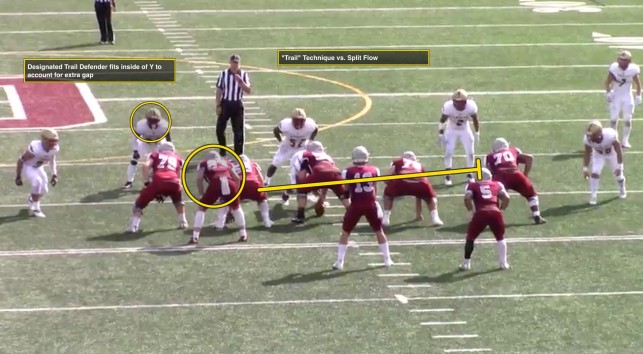
The difficulty in defending the split-back zone comes from the extra gap created on the backside of the play with the slicing sniffer.  The question defensive coordinators need to answer is: how do account for the extra gap?  Here we will discuss various ways to remain gap sound in defending the split-back zone.


Defending Split-Back Zone

Depending on our defensive call, we have four ways we will defend the split-back zone.  The idea behind each is to keep gap integrity while providing adequate numbers in the box to allow for one of our defenders to be unblocked to make the tackle:

  • Screw Down a Safety
  • Treat the Sniffer as a Pull
  • Trail the Sniffer
  • Rat the Sniffer


Situational Implementation

As a staff, much of the teaching we do in terms of our scheme is done conceptually.  We found (through copious amounts of trial and error) that teaching this way allows players to take ownership of the scheme, think less, and play faster.  As such, we will pair the different approaches to defending split back zone with our front calls.

As we install fronts and teach our run fits, each front has a base fit and corresponding rules.  Simple call tags (discussed below) can slightly adjust these rules to better defend certain offensive schemes.  A simple guide for when we use these concepts is:

  • Screw = Base Even Front Call
  • Sniffer Pull = Adjusted Even Front Call (keep 4 shell)
  • Trail = Base Odd Front Call, Adjusted Tight Front Call
  • Rat = Base Tight Front Call


Screwing Down a Safety

The easiest way to account for the extra gap created in a split-back zone is to screw down the weak safety.  A “Screw” call for us creates an 8-man box that protects the defense not only against the split-back scheme, and it also accounts for offenses whose QB is a running threat.  We will most often make a Screw call when we determine there is more than one back in the backfield.  Based on aligned of an off Y, especially if he is in the core (between the tackles), we will treat him as a back.  Matching numbers for numbers in the box is the simplest way to account for all gaps while also having an unblocked hat (possibly 2) to make the tackle.

Read More

Rub Route RPOs to Combat Man Coverage

By Steve Rapp
Offensive Coordinator/QB Coach
Dr. Henry A. Wise Jr High School (MD)
Twitter: @CoachRapp_O


At Wise High School attacking man, coverage has become a regular occurrence for us. We are a heavy Run/RPO team, which defenses answer as of late is to play a lot of Cover 1 and Cover 0 to get extra players into the box and take bender/stick throws away. This has led our offense to evolve to man-beater concepts with the sprint out and RPO attached. I will discuss 3 man-beaters, a sprint-out rub combination, an RPO man beater with Gap scheme, and one with the outside zone with an off/bail CB.


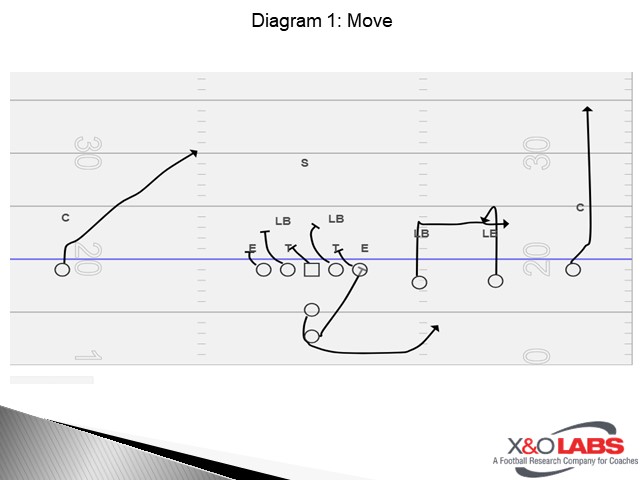
Move Concept

Our sprint out move combination is a go-to versus Blitz and Man coverage. It is a 3×1 combination (See Diagram #1). You can dress this up any way you like using bunch/loose trips/TE attached or detached Trips. The premise of this whole combination is #2 and #3 working together to get a rub. #1 strong is 50/50 Fade ball, #2 a 5-yard hitch and expanded inside (like a basketball pivot), #3 a 4 yard out staying straight after coming underneath the hitch. We add full sprint protection opposite of the call for a false triangle read for inside the box backers, which leaves our tailback 1v1 versus the play side DE.

Diagram 1


Major coaching point: This 5-yard hitch and 4 out must be worked every day, they are a team and must work together to get each other open. We work it vs press on 2/3 so they can work their releases but still get the timing down. 

To study game film of this concept, click on the video below:


Editor’s Note: Coach Rapp has provided coaching points for each clip below:


Clip 1: Pre-snap read is man and we are working the out to the hitch. Great job on the rub, easy throw and catch. 

Clip 2: We catch them in a full spin and an edge pressure works the out right to the blitzer! Perfect.

Read More

Long Stick Techniques to Optimize Zone Pressures

By Clay Iverson
Head Football Coach
Mukwonago High School (WI)
Twitter: @CoachIverson


Introduction

banner 4From the flex bone to four wide, double tight to empty, or up-tempo to shifts and trades; developing a pressure package that is both effective and sound week-to-week is becoming more and more difficult. All challenges aside, there is an answer. For us, it starts with solid zone coverage and the ability to bring 5 or even 6 man attacks that you can use week in and week out is one way to keep improving daily. This prevents the “defense of the week” approach that will inevitably be a recipe for disaster.
At Mukwonago High School (WI), we have hung our hat on multiple zone pressures. Pressures that are installed in mini-camps and pre-season that we feel comfortable with against any offense we see throughout the course of the season. 

Long Stick Technique:   

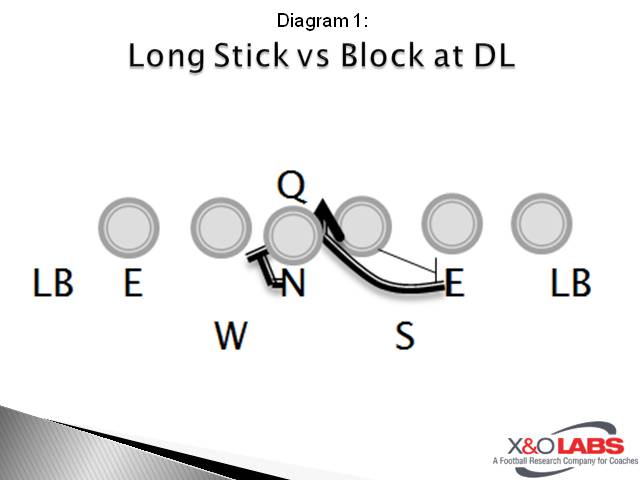
While we have a variety of zone pressures, from double inside backer, inside/outside backer, safety and corner zone pressures, it all starts with our ability to use one or more of our defensive linemen in a long stick technique. Like many of you, we define a long stick as a stunt where a defensive lineman must cross multiple gaps.  We practice this technique daily in multiple periods with our defensive linemen. Here are our long stick rules and coaching points:

Performance Alignment: Because the defensive linemen have to travel longer than a traditional slant, they may need to adjust their stance. These adjustments include backing off the ball, narrowing their stance, or moving to a head up to inside eye alignment. These changes vary based on the player as they all need to use their own abilities to get to where they need to be. We have found some of our quicker or longer leg players prefer to line up wider. This adjustment makes them travel further; however this gives them more of a chance to read their keys and adjust on the run.

Eyes: Once aligned, the long stick defensive lineman must have his eyes focused on the near hip of the adjacent offensive linemen.

First Step: On the snap, the defensive lineman will take a flat step rotating their foot, knee and hips so they are all facing the sideline. Next, he will throw his movement side arm backwards to get his lower body and hips rotated. This skill is very similar to the first step of a pulling offensive lineman. He must be sure to keep his eyes on his key, which is the adjacent lineman.

Second Step To: The second step is the most crucial step in the movement and it is all determined by what his key does. As the player takes his first step and gains ground down the line of scrimmage, he is reading the offensive lineman and the direction he is headed. If the key comes to block him, which could be a zone to him, out block at him, or slide protection to him, then the defensive lineman must continue to gain ground and possibly lose a little depth in order to get to the next gap. He cannot get cutoff.

Third Step: The third step must get on the ground quickly and redirect the defensive linemen up field in his gap. On his third step he must have his feet, hips, and shoulders facing and moving in the direction of the line of scrimmage (Diagram 1).

Slide1

Read More

Developing a Defensive Identification System

By Sam Gooding
Former Offensive Line Coach/Special Teams Coordinator
Dakota State University (SD)
Twitter: @CoachSamGooding

Introduction:

When analyzing the defenses that we saw in the 2015 season, we were astounded to see so many different looks. Teams tended to have similar strategies to stop our base plays, but the alignments that they operated from were wildly different. Not only that, but each basic front had so many subtle variations that the blocking schemes could look completely different against similar fronts with slight adjustments. This placed quite a bit of stress on our offense, specifically the offensive line. The emphasis of this article is not specific techniques or schemes, simply how we sought to solve this problem through defensive identification.

Front Description

The first step in alleviating the problem was developing a more detailed, yet intuitive way of analyzing fronts on film. An Over front with two LBs in the box is not the same (and is not blocked the same) as an Over front with two LB’s in the box, a DE reduced to a 5-tech to the TE side and a LB walked up into a 9-tech. The front ID system that we began to use was divided into the three most descriptive categories for us: the base “Front” (Under, Okie, etc.), the “Box” (# of players at LB depth in the box), and “Tags” (we had different descriptors for small adjustments, like LBs walked up at different points on the line, etc.). Together, this naming system allowed us to quickly analyze a defense with breakdown data and see how a defense liked to align before we even began to watch film in-depth. We also saw quite a few benefits with the offensive line being able to come to the sideline and accurately describe to us what they were seeing on the field.

Front ID Pre-Snap

On the field, pre-snap identification needed to be simplified much more in order to identify combo blocks and ensure that all players were accounted for in the box. Our up-tempo offense placed a premium on our players’ abilities to quickly ID a front, make their calls and play fast. To do this, we installed a “Point” system, similar to what many schools across the country use to establish a standardized method of identifying blocks that can be used in all run plays as well as pass protection. To illustrate the way we used this system, we will focus on our inside zone for the run game and our 6-man half-slide pass protection. We will also briefly look at how we apply it to other runs/protections.

As with most schemes, we borrowed quite a few ideas from multiple coaching staffs to establish the system that would work best for us, much of which came from the staff under offensive coordinator Bill Cubit at the University of Illinois. I would be amiss if I didn’t credit this staff for what they did so well.

Application to Inside Zone

With the multiple looks that we received from defenses, it was clear that the classic “covered/uncovered” principles could not always account for every player in the box against unconventional alignments in our inside zone. Simply running tracks would result in unblocked players against certain looks, especially when defenses tried to protect LBs by nesting them behind certain techniques of defensive linemen. Our application of the point system to our inside zone combined elements of zone and man schemes: the flexibility and capability to pick up movement of a zone scheme with the certainty that every defender was accounted for  in a man scheme.

The process at the line begins with the Center’s “Point” call. His call will identify a LB by number (ex. “Mike 52!”). This establishes the “0” in our numbering system. It is important to remember that the “Mike” is not necessarily the true Mike linebacker. For our inside zone play, the 0 is simply who the Center (or the Guard in his combo) is working toward. This varies depending on the play, but that is our rule for inside zone. The Center has some flexibility in his Point call and can adjust it as he sees fit. His only rules in zone are that against an even front (4 down linemen) he establishes a playside Mike point and against an odd front (3 down linemen) he makes a backside Mike point. There is an inherent amount of trust in giving this responsibility to one player, but our current Center just finished his third year as a starter and has quite a bit of awareness on the field. If needed, who establishes the Point could be adjusted, but we did not want to put more on the QB’s shoulders and the Center has the best vantage point on the OL.

Slide1

Once the point call has been made, the Center has declared who he is working toward (the “0”). He then makes his combo call, declaring who he is bringing with him to block the first down lineman playside in combination to the 0 or Mike. From there, the combo calls can be made outward from the Center. The combo playside of the Center will be responsible for the next adjacent down lineman and the “1.” The combo backside of the Center will be responsible for the first backside down lineman and the “-1.” We have a set of combo calls for each possible combination on the line, as well as “solo” calls for one-on-one blocks. We allow our players some freedom in deciding who combos and who can be left with a solo block, allowing us to adjust the combinations to ensure that we combo more dangerous defensive linemen. The numbering system ensures that we have everyone in the box accounted for, no matter the alignments. Typically, we will cut the backside DE loose and read him in our inside zone. If there is no “1” in the box (the 0 is the furthest playside LB in the box) then the next combo playside from the Center’s is working toward the run support player to that side, or a LB who leaks out over the top. We refer to this as an “MDM” combo, or “most dangerous man” combo.

Read More

UNC’s Evolution of the Air Raid: Why the System Being Implemented at Chapel Hill is Breaking the Mold

By Mike Kuchar
Co-Founder/Senior Research Manager
X&O Labs
Twitter: @MikeKKuchar


To most college football fans, the name Longo may not resonate with other Air Raid associations like Leach, Holgorsen or Riley. But the truth is he not only belongs in that same category but also may be carving out a niche for himself in today’s era of the Air Raid disciples. For those that don’t know the new offensive coordinator at the University of North Carolina, for nearly 30 years his version of the Air Raid has produced astronomical numbers at every level of football. He’s orchestrated a top-ten offense nationally from Division 3 William Patterson University (NJ) to Division 2 Slippery Rock University (PA) to FCS level Sam Houston State University (TX) where his Bearcats averaged 531 yards per game and 41 points per game producing two-time Walton Peyton Award winner in quarterback Jeremiah Briscoe.

And as recently as last season while as the offensive coordinator at Ole Miss, his unit finished in the top seven nationally in three separate categories- total offense (510 ypg) passing offense (346 ypg) and yards per play (7.1)

So, when someone with the digital Rolodex the size of Mack Brown came calling, many pundits were surprised he made Longo his selection. Even Brown himself admittedly thought outside of the box when making the hire. “I wanted to find someone who has done more with less and that was Phil,” Brown told us. “He’s taken lesser players and beaten better teams.” While the hire may have been unpredictable, the root of Brown’s selection process was not: he wanted a coordinator who had a complete grasp of the system that his counterpart at Texas Tech Mike Leach used against him for 15 years in the Big 12.

Brown couldn’t have gotten any closer to hiring a Leach protégé than Longo. He and Leach have a relationship dating back to Leach’s days as the offensive coordinator at Kentucky. Longo gloats when he talks about packing up his 4-Runner and making the nine-hour drive from north Jersey to Lexington. Fueled on Taco Bell and taking periodic stops at gas stations to shower was well worth the sacrifice to hear Leach talk about his offense at his coaching clinic, where Longo’s persistence in asking questions eventually picked up on Leach’s radar. “I outlasted everyone in the room,” he said. “It was a complete grind, but making that trip was the best decision I’ve ever made.” The two have remained close friends since, even while butting heads on the recruiting trail- Briscoe was a Leach decommit before ending up at Sam Houston.

But the linear lines that connect these two coaches systems veer off when it comes to one distinct difference in philosophy: the onus of responsibility in Longo’s Air Raid is alleviated from the quarterback and placed on the receivers.

The Foundation: Chasing Space

Read More

Eight Man Fits Patterns in 3-4 Spacing

By Phil Kleckler
Defensive Coordinator
Lindsey Wilson College (KY)
Twitter: @CoachKleckler


The game of football is constantly changing, and I think it’s important for coaches to always be committed to learning and growing. In today’s game, teams must defend a wide variety of offensive schemes, formations, and tempos. At Lindsey Wilson College, we are an aggressive, odd multiple fronts and coverage defense.

No matter how much the game is changing in terms of schematics, it still comes down to execution! As we look at offenses when we break down opponents, we usually find the most successful ones have very few plays and concepts that their players can fully execute and understand. They window dress their plays with formations and motions to make themselves look more versatile and different from their opponents. We take the same approach with our defense whether it’s our base fronts and coverages or within our blitz packages.  We make our scheme as simple as possible for our players to learn, so they can play fast and attack! We want our scheme to be annoying for an offense to prepare for by building in pre-snap movements and alignments. We work rigorously to prevent the offense from having a pre-snap advantage.

To put this idea into perspective, I will show you how we implement “Window Dressing” within our coverage packages.  Our number one goal each week is to stop the run and make the team we are playing one dimensional. In order to do this, all eleven of our defenders must be committed to stopping the run. We will use our secondary to gain a numbers advantage in the run game. The backend of our defense learns three coverages, but we play many variations within those coverages that make us appear different to our opponents. I will describe how we implement our cover three package in our defense while keeping the teaching the same.

To keep things simple within this article I’ll explain all our cover three coverages from our base 3-4 front.  We send in a menu of coverages with every call and it is up to our safeties to get us in the right coverage based on the formation we get.   Based on that call the players know how to fit the run game including pullers, kickouts.  Backers also know where to insert based on that call as well. 


Nickel LB as Extra Fitter

Diagram 1


We always begin on our install calendar by starting with our field cover three coverage using our field outside linebacker as the insert. The defensive line can be in the variety of shades we incorporate in our defense while our outside linebackers will “Yo-Yo” from the heels of the DL to the apex of the nearest WR.  At the snap of the ball, our DL will take a 45-degree slant step to the boundary of their nearest gap. Our field OLB will aim for the end man of the line of scrimmage. We also can/will change responsibilities with the field DE and OLB to create gap exchanges for the OL to have to block. All of the slanting defensive linemen are aiming for the near hip of the OL they are slanting to and don’t look to get vertical until they have canceled their assigned gap. Our secondary will roll to the field strength with our strong safety being our field Seam / Curl / Under / Flat (SCUF) defender. Our SS is our primary force player to the field and all our box defenders are trying to make the ball bounce to him. Our field outside linebacker insert paired with our field version of cover three is good against perimeter run teams that run power read, outside zone and split zone.

To study game film of this concept, click on the video below:


Editor’s note: Coach Klecker has provided a clip by clip analysis of this playlist below.


Read More