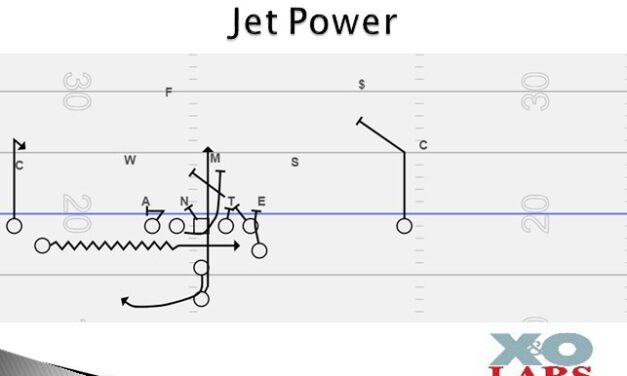

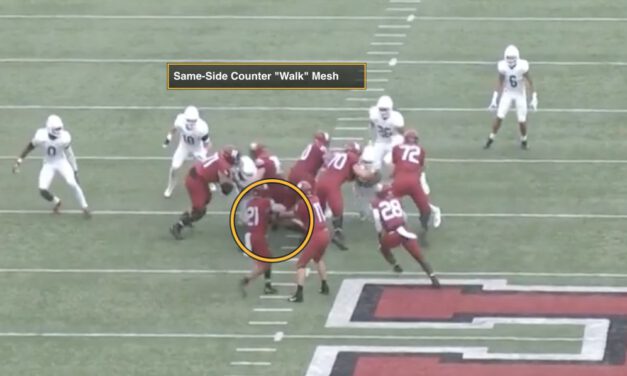
Harvard’s Build-Ins to Protect 12 Personnel G/Y Counter

By Mike Kuchar and Keegan Kennedy
Offensive Line Coach
Harvard University (MA)
Twitter: @CoachKKennedy


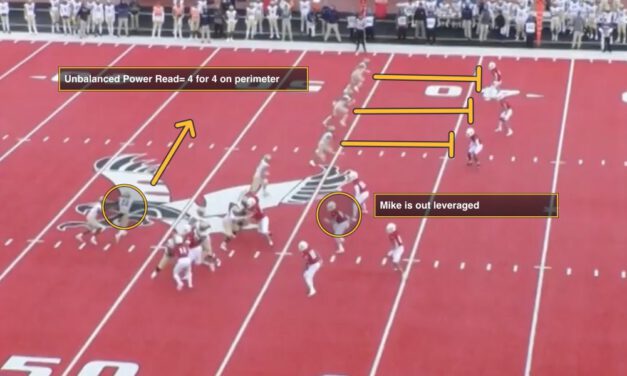
Like many offenses, Harvard relied on using more detached (Y-Off) roles for its tight on gap schemes. But during his off-season study this winter, offensive line coach Keegan Kennedy realized how much defenses were relying on keying that Y-off to rock back and fit split zone and counter schemes. So, he spent the majority of spring ball teaching the Y to pull from a grounded or attached position and found that defenses were rarely keyed in to him when he was on the line of scrimmage. “We find it to be a great advantage,” coach Kennedy told me. “ We wound up loving to pull the tight end from an on the ball alignment. Our tight ends are super athletic but they have to be good enough to run things in the box.”

And as defenses continue to spill the counter scheme, the offensive staff works tirelessly to protect its counter concept by pulling the Center, Guard, Tackle and Tight End depending on the front. This report focuses on the build-ins that Harvard has used depending on the defensive front presented. Most of these adjustments are built into the play call or a communicated adjustment at the line of scrimmage.


Mesh Variations:


Same Side Mesh:

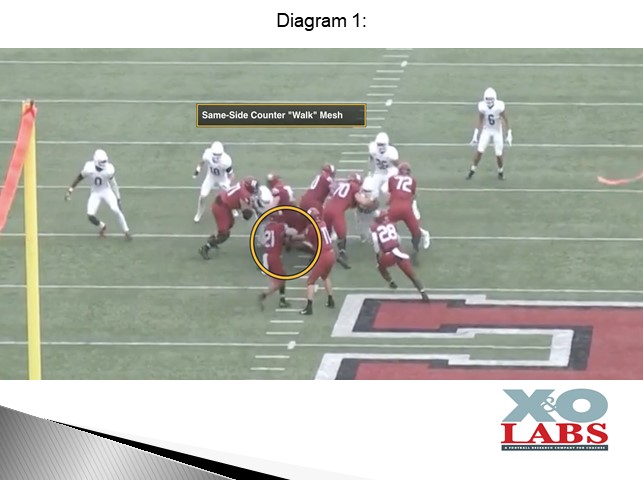
Before getting into the specifics of the tight end roles, Harvard will use many of these counter concepts with a same-side mesh with the running back. It’s helped get second level movement, allowing for angles on down blocks play side. Running back coach Saj Thakkar uses the term “walk it out” for the back and it’s the exact same mesh as inside zone for the first three steps.

The first step is a 45 degree open step with the foot near the quarterback. The second step is a cross over into the mesh followed by a plant on the third step. “Off the plant step, we redirect to our landmark which is the play side leg of the C gap,” said Coach Thakkar. “It’s really slow, but needs to be used to get in phase with second puller.”
 

Pistol Mesh:

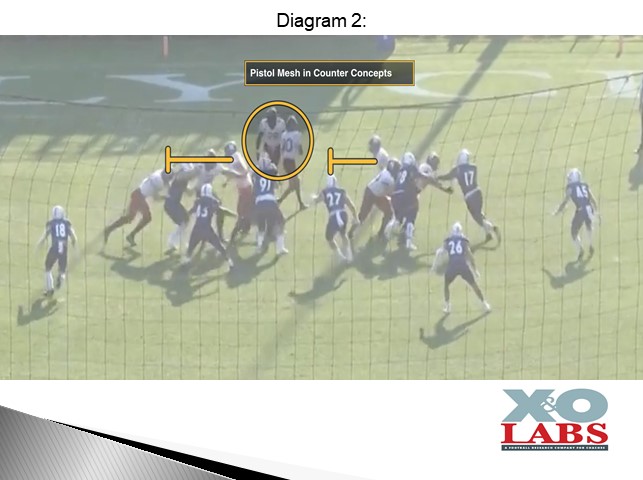
Harvard will also use a Pistol mesh with counter schemes. The idea is to get the back’s shoulders squared and get downhill at the A gap entry point. The QB will open at 6 o’clock and reverse out while the running back will shuffle play side then get vertical. Coach Kennedy did emphasize that in order for this mesh to work, the back has to have good enough vision to pick up the second puller. “It’s a good answer against teams that will box and not spill the first puller, so the back can get right up into the line of scrimmage,” he said.
 

Read More

Delaware’s Pressure Catalog from 3-High Spacing

By Mike Kuchar with Manny Rojas
Defensive Coordinator
University of Delaware
Twitter: @Coach_Rojas_UD


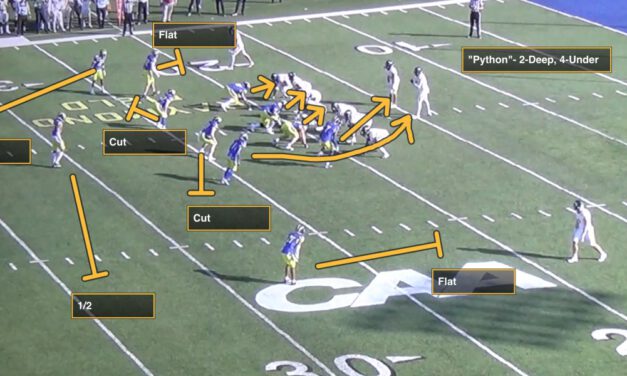
Two seasons ago, Delaware was purely a base defense. Rarely were they a pressure outfit, relying mainly on three-deep, five-under coverages from its 3-high shell. According to Coach Rojas, the system was originally molded after what defensive coordinator Jon Heacock has done at Iowa State, but shifted to more of the pressure aspects that FAU defensive coordinator Todd Orlando has established. In the CAA conference, Delaware sees more 11 personnel structures than anything else, so getting more speed on the field makes sense, prompting Coach Rojas to claim “he’ll never go back to playing four down defense again.”


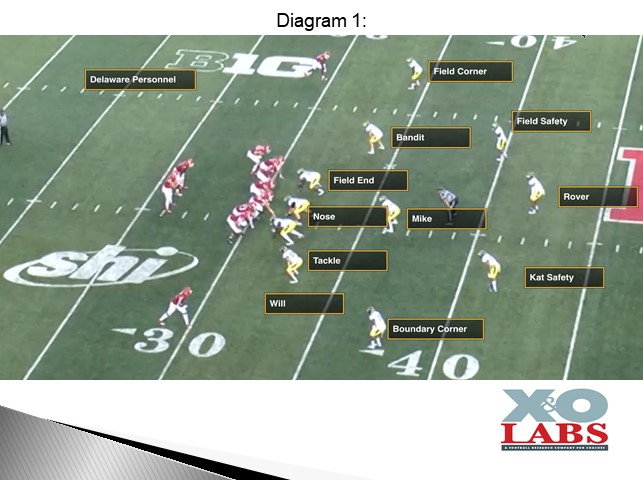
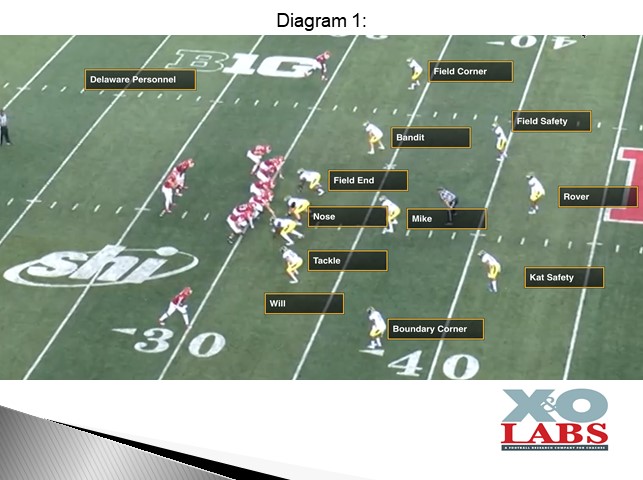
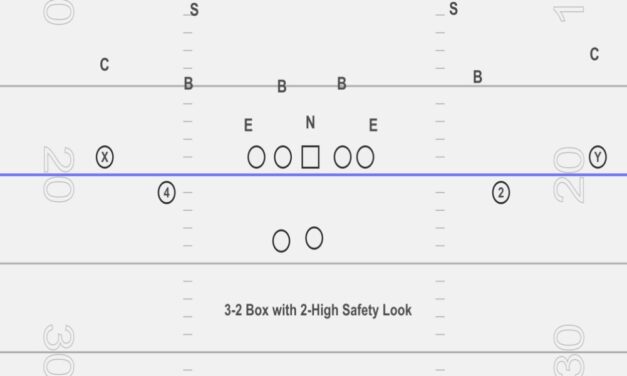
His base personnel operate like an Odd Stack consisting of the following:

  • Nose- No lag player, pure zero tech vertical player
  • End- mainly to the field or offensive strength
  • Tackle- mainly to the boundary
  • Mike- Middle linebacker
  • Will- Weak side linebacker
  • Bandit– Strong side linebacker
  • Rover– Middle safety (glorified linebacker in this system)
  • Field Safety– Best cover safety
  • Kat– Weak side safety
  • Field Corner– can play left and right based on tempo
  • Boundary Corner- can play left and right based on tempo


Coach Rojas does use sub personnel with those of these pressures, which consists of four safeties and two corners. One of the linebackers will come out. “We used to bring a corner in but now we are using a safety because our safeties can cover,” he said. “It makes it easier to call things and make calls on the run against tempo. We can call it as we need to.”
 

Base Pressure Ideology: Three Down vs. Four Down

It’s important to note that pressures in three-down structures have to be called entirely different than in four-down because of the way it’s structures. In four-down fronts, safeties are the insert defenders in pressure concepts whereas in three-down those players are linebackers. So, a good amount of time has to spend teaching those linebackers where to insert based on the pressure. This is why Coach Rojas will chose to run more field pressures than boundary pressures. “We just bank on teams running to the boundary and us rallying to the football,” he said.
In this report, we are going to profile the base zone and man pressures Coach Rojas utilizes in his system.

Read More

SDSU’s Segment Teaching of Lateral vs. Vertical Double Teams in Gap Schemes

By Mike Kuchar with Ryan Olson
Run Game Coordinator/Offensive Line Coach
South Dakota State University
Twitter: @CoachRyanOlson


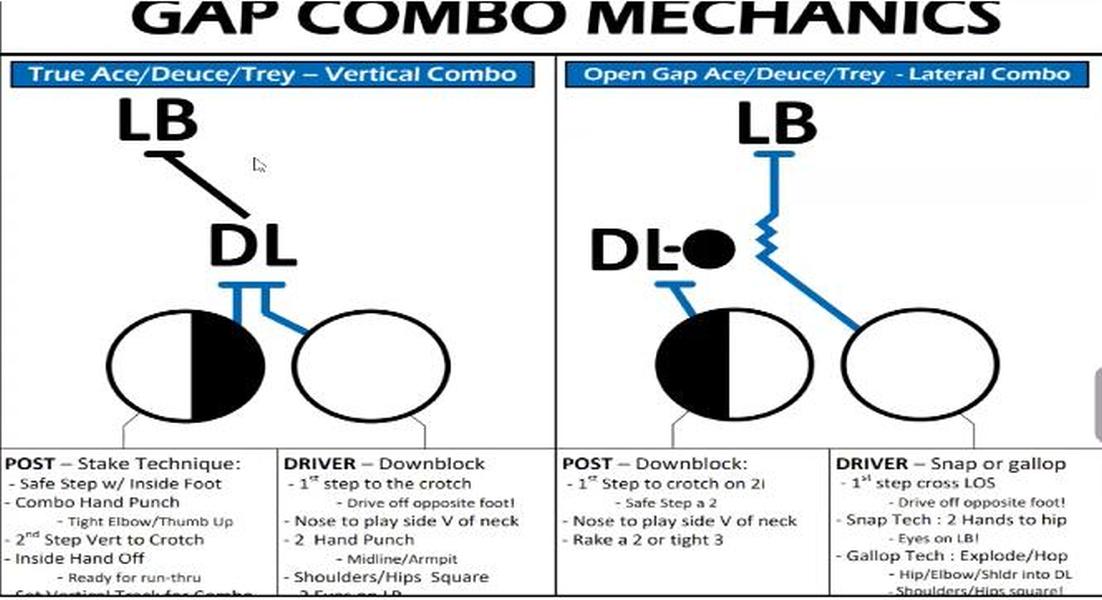
Anyone that watches Missouri Valley Conference football knows that South Dakota State University is built on running the power play. It’s been that way ever since head coach John Stiegelmeier took the program over in 1997. And even with the departure of former offensive line coach/run game coordinator Jason Eck, the Jackrabbits have found a way to gash defenses downhill on gap schemes. Part of the reason why that’s been the case is the meticulous detail in which the coaching staff goes about teaching offensive linemen the details of blocking the play. When gap schemes are the bedrock of your offense, then it makes sense to spend the necessary time needed to develop these skill sets.


Pistol Backside Mesh:

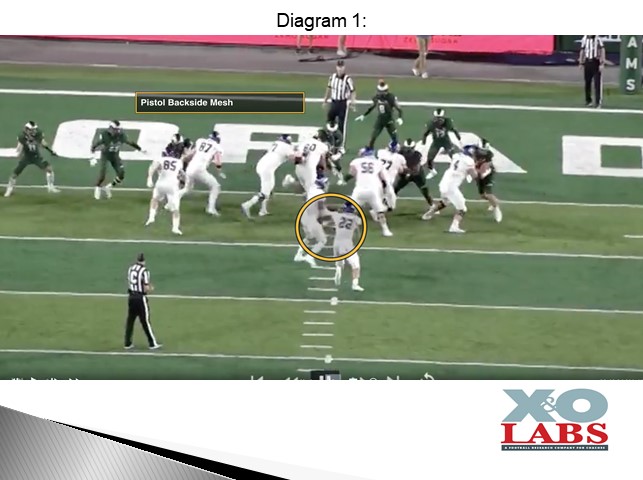
While the bulk of this report will be centered on the drill work Coach Olson uses to teach the concept, there are some alignment nuances that the Jackrabbits use to gain maximum efficiency on the concept. One of those variants is teaching a backside mesh from Pistol alignments. According to Coach Olson, the purpose is to provide a control mechanism any defenders able to run the play down from the backside.


The QB is taught to get off the midline and he’s responsible for clearing the way for the back. The running back is responsible for the mesh, while the quarterback’s eyes go to the backside C area. Wherever the QB sticks the ball it’s him to makes the adjustment. The quarterback is responsible for the D gap defender, so he is given the option of pulling the ball if there is smoke off the edge or the backside Tackle doesn’t do a good job on the hinge.

According to Coach Olson, the change in mesh has been really good in handling any backside issues. “When you have weak side linebacker’s walk up backside he’s usually accounted for in the count so you need a hat for him,” said Coach Olson. “In the past we would just pull it if he came off the edge. But the defense can have numbers if there is a safety over there. Or, you can put a tight end on the backside but you need to change the formation and be in different personnel groups. This is easiest and affects the least amount of people.”


RB Aiming Point:

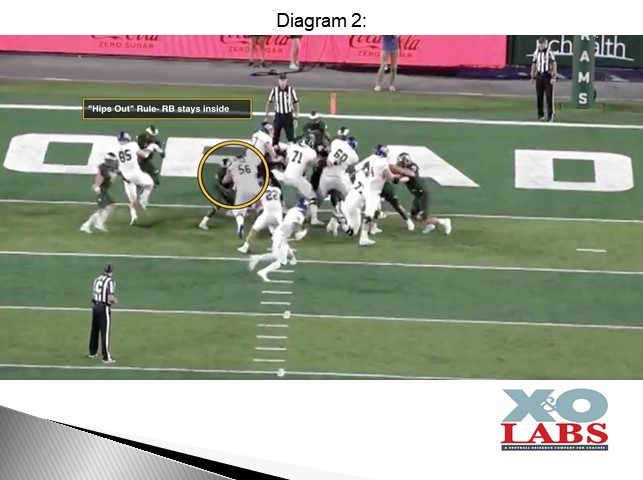
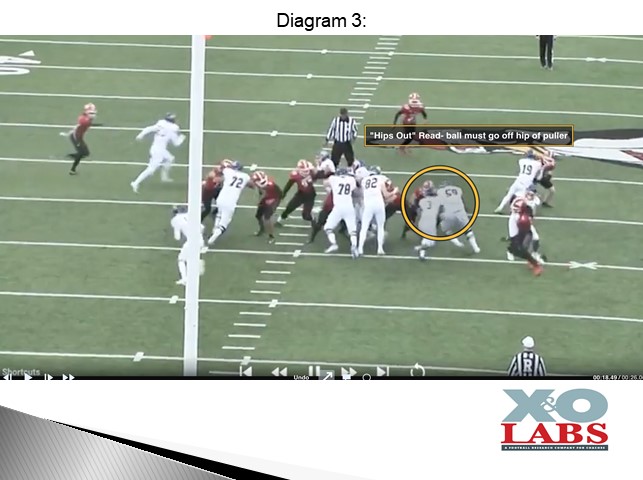
The ball carrier is taught to be 1×1 off the inside hip of the puller (backside guard). Coach Olson teaches a “hips in” or “hips out” progression reading the block of the puller.


“Hips Out”- Puller’s ass is in the hole ball should stay inside the puller.


“Hips In”- If the puller skates it or he has to log it the running back has to go tight off the ass of the puller.


So, while the power concept is taught as an A gap concept, the ball carrier will often bounce the ball based on the read of the block. “We’ve never seen the ball hit in the A gap, particularly against an Over front if we’re getting the right movement on the combination,” said Coach Olson. “There is too much static in there so it becomes more of a B gap out insert point. It may look like it’s in the A gap because we are getting vertical movement. We’ve never talked about feeling flow of the backer. So many defenses come over the top of down blocks. So, now we tell them to check the backside A gap. If that Nose pops over the Center, we may want to hit them against fast flow teams.”


Tight End Alignment:

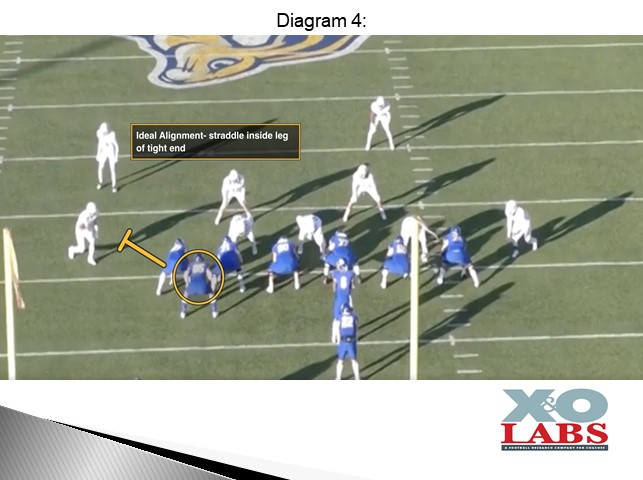
Since SDSU is more of a heavy personnel gap scheme team, a priority needs to be placed on the alignment of the kick out player, the tight end. According to Coach Olson, the best alignment is to straddle the inside leg of the grounded tight end.


“We don’t talk about taking a ‘J’ path,” he told me. “We talk about being vertical forever to the point of contact. If the 9-technique falls off the edge we can always relate to him super late. We want to be as vertical as possible with near foot, near shoulder contact.”

Read More

Montana State’s Power, Jet and Counter Read Catalog

By Mike Kuchar with Brian Armstrong
Run Game Coordinator/Offensive Line Coach
Montana State University
Twitter: @CoachArmy


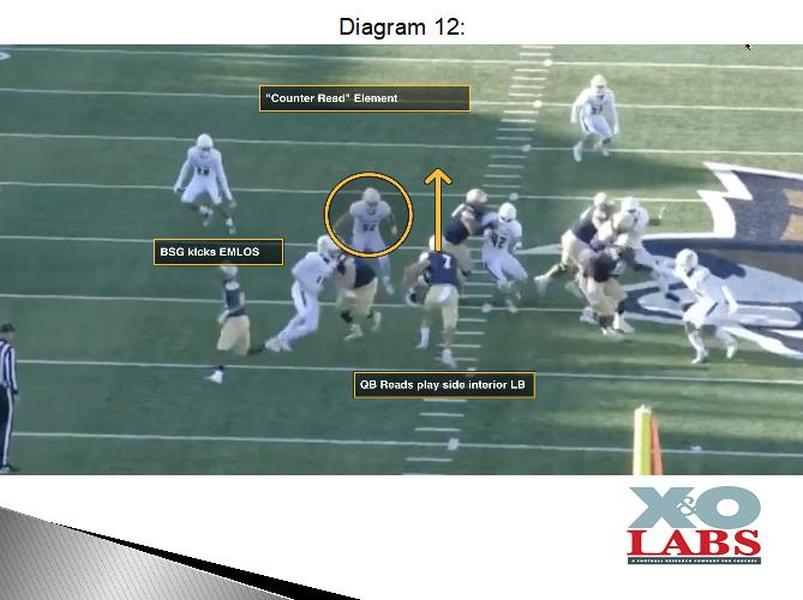
Montana State has continually been at the top of most FCS rankings, including playing in the title game in ’21 against North Dakota State. This consistency has been built off the run game, where the Bobcats have continually developed it’s gap read and counter read concepts to produce maximum efficiency. This season they averaged over 300 yards a game on the ground, including 6.58 yards per carry, many of those on these gap read concepts where its quarterback averaged 88 yards a game.

Coach Armstrong has developed the power and counter read concepts to where any player in the program (running back, receiver, etc.) and run them. He has even lined up wideouts that may have some quick twitch in the backfield to run the concept without using motion. It’s a true commitment to running the scheme, regardless of the personnel. And when you watch Bobcats film it’s apparent that Coach Armstrong has a willingness to run the scheme regardless of the defense or the formation.


Formationing the Play:

Although the Bobcats will use the power/counter read from any formation, Coach Armstrong believes the best way to build is in 3×1, because the numbers are equal. It forces the Mike linebacker to run down the horizontal element of the play. Most of the time, it’s a win for the offense. And when it’s not, Coach Armstrong has an answer, which we’ll get into later. Using 3×1 open as a base, Montana State will also run the scheme from the following formations:

Read More

Best Practices: Alternating 3-Safety Insertion Points in Drop 8 Coverage

By Mike Kuchar with Manny Rojas
Defensive Coordinator
University of Delaware
Twitter: @Coach_Rojas_UD


Over the last couple of seasons, the University of Delaware has prided itself on three-high safety defense. And in the majority of those snaps, defensive coordinator Manny Rojas will play Drop 8 coverage by varying several insertion points for those three safeties. In the CAA conference, Delaware sees more 11 personnel structures than anything else, so getting more speed on the field makes sense, prompting Coach Rojas to claim “he’ll never go back to playing four down defense again.”

His base personnel operate like an Odd Stack consisting of the following:

  • Nose- No lag player, pure zero tech vertical player
  • End- mainly to the field or offensive strength
  • Tackle- mainly to the boundary
  • Mike- Middle linebacker
  • Will- Weak side linebacker
  • Bandit– Strong side linebacker
  • Rover– Middle safety (glorified linebacker in this system)
  • Field Safety– Best cover safety
  • Kat– Weak side safety
  • Field Corner– can play left and right based on tempo
  • Boundary Corner- can play left and right based on tempo


Run Fit Responsibilities:

While this report is mainly focused on the responsibilities of zone cover defenders, Delaware does feel comfortable defending the run game in its three high structure. There are several base principles that Coach Rojas will employ to be efficient in the run game. They are as follows:

  • The Nose is a vertical player, not a lag defender.
  • Against any three-surface formation, Coach Rojas will drop the Bandit (field safety) or Kat (boundary safety) for immediate force presence. He believes firmly in setting the edges of the defense- something we will explore in a future clinic report from him.
  • The End and Tackle are mainly C gap defenders but that will change if the Kat or Bandit drops to their side. That would make them B gap defenders.
  • The two interior backers (Mike and Will) are triangle Guard read players and will fit off the Nose accordingly.


Varying Inserts:

It all starts with not having the Rover (middle safety in Delaware’s scheme) having to play the post every snap. That is way too predictable. Instead, Coach Rojas will alter his Drop 8 coverage package week to week depending on what he’s going to see. Most of them are called by him, but who runs the middle is based on formation and game plan. “Week to week we design it differently,” he said. “If we’re going to check something it will be more based on a player than a formation,” he said. “It makes it easier for our kids to focus on that one piece we’re focused on.” We’ll have more on that later.
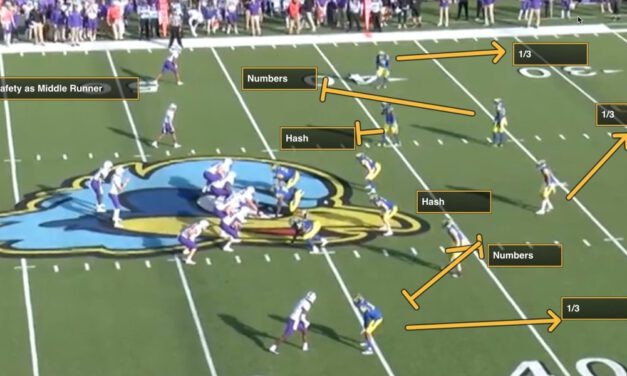
When you send any of those three safeties into the post, into the lane or into the flat, it gives the quarterback indecision on what is going to be a viable throw. And this is all predicated on what Coach Rojas calls “hash, numbers, middle, hash, numbers” teaching. Those are the five underneath zones in his Drop 8 coverage. He won’t use hard corners unless it’s third down. Essentially, he’ll use the following landmarks in Drop 8 coverage:

  • Hash– These are the traditional curl defenderns. They will begin 10-12 yards on or near the hash to start, but move with quarter backs eyes
  • Middle– This is the middle dropper and will work based off of the route. In 3×1 he will come to three. He will not run past him
  • Numbers– These are the traditional flat defenders, who will be force defenders in the run game.


The beauty of how he teaches it is that these defenders can be anybody in the back end. It will not always be the safety. Many times, it’s determined by how far a defender’s alignment is to the number three receiver. And if defenders are going to check something it will be based on a player rather than a formation, which makes it easier for players to focus on that one piece that they are looking for. “For example, if all three defenders are on the hash or wider, than it makes sense for the Field safety or the safety that is closest to him to be the insert,” said Coach Rojas. “He can take away the stick and the hitch faster than the Rover (middle safety) can. The Rover would never get to the hash fast enough. But if number three and number two are close, then I let the safeties make the judgement call because they see it in real time.”

If these adjustments are not communicated by players, they are built into the play call. So, if the call is “52 Odd Stack” and the Rover knows he’s the post player, it can be changed weekly by simply tagging “52 Odd Stack Safety,” thus alerting the safety to run the post while the Rover plays his spot. Or he may give it a different name like ‘Ranger’ so one safety knows he is going to the post. “It’s helpful to have variations of cover three because you may have one that you liked when you’re backed up or when you’re in the middle of the field,” he said. “You may like one in the high red zone because you’re changing who is spot dropping where.”
The focus of this report is how Coach Rojas and his defensive staff create multiple Drop 8 coverage pictures to defend opponents formation and personnel. These consist of the following:

  • 3-Deep, 5-Under Coverage
  • Quarters Coverage
  • Halves Coverage
  • Man Coverage

Read More

Vice Leverage Rules in Tampa Sims

By Mike Kuchar with Jack Cooper
Defensive Coordinator
University of Rhode Island
Twitter: @CoachJCooper


When the defensive staff at Rhode Island returned from its visit with Baylor last off-season a couple things were clear: Ron Roberts knows his football and the Tampa simulated pressures that Roberts used last season meshed perfectly with the Rams personnel and structure. It tied into their cover three and man free package with one added benefit: there is not real threat of those bender routes because of the presence of the middle safety.

So, defensive coordinator Jack Cooper took the info he amassed and started devising his version of these Tampa sims. He realized he didn’t have the personnel that Baylor had (they were more advanced at the outside linebacker position), so he simplified it by only using three core pressures: a boundary pressure with the Will linebacker and a middle pressure with the Mike linebacker. The rules were simple: The Sam (or field outside linebacker) will never be in the rush pattern. It either be the Will, the Bandit (boundary outside linebacker) or the Mike. And he implemented them out of his base four down package as well. Both cases were four man rushes with a pure three deep zone behind it.


Personnel:

Just for context, the Rams use the following skill personnel in its three-down (or sub) grouping:

  • Buck– boundary outside linebacker and hybrid defensive end. In four down fronts he is in the front.
  • Sam– He will align to field or passing strength. He’s known as the “big Nickel” in Coach Cooper’s operation.
  • Mike– strong side inside linebacker
  • Will– weak side inside linebacker
  • Nickel– third corner (this presents a problem with these pressures because this defender is not accustomed to playing a deep half technique). Coach Cooper admitted these concepts work better with safeties.
  • Strong Safety- This will be the middle safety
  • Free Safety- This will be the boundary safety
  • Field Corner
  • Boundary Corner


There are packages where the Sam will stay in the game and a defensive lineman will come off the field (2-4 spacing) and there are other times where he’ll use a 5-1 package by keeping both outside linebackers (Sam and Buck) in the game and take the Will out.


Disguise Element:

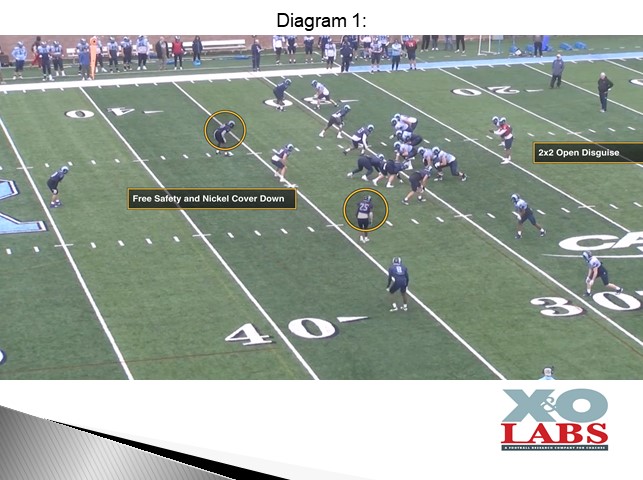
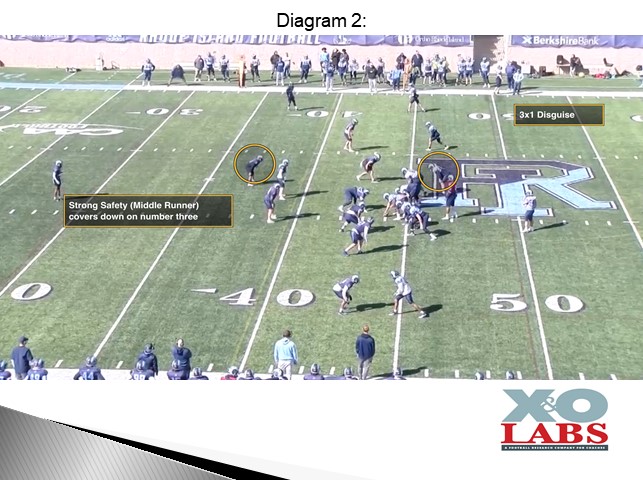
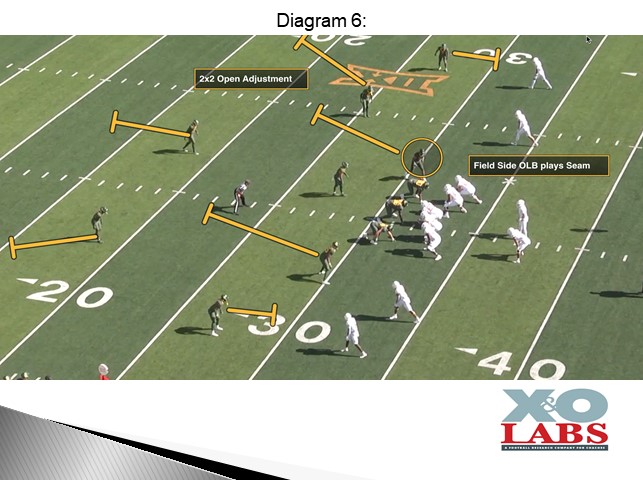
Regardless of the personnel, the prerequisite of running these sims is to keep an element of disguise. So, in order to do that he’ll cover down early to give the illusion of rip/Liz match or cover three. This is all predicated based on 2×2 open or 3×1 open.

In the image below against 2×2 open, both the Free safety and Nickel cover down over the number two receivers.


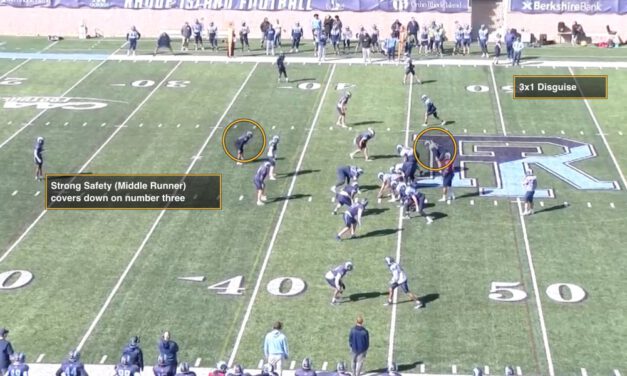
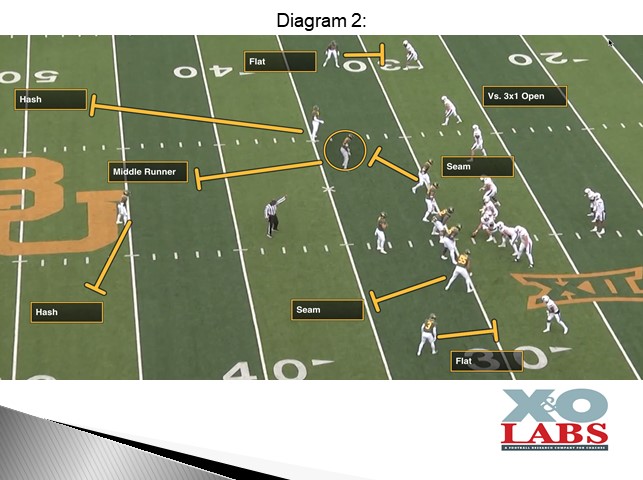
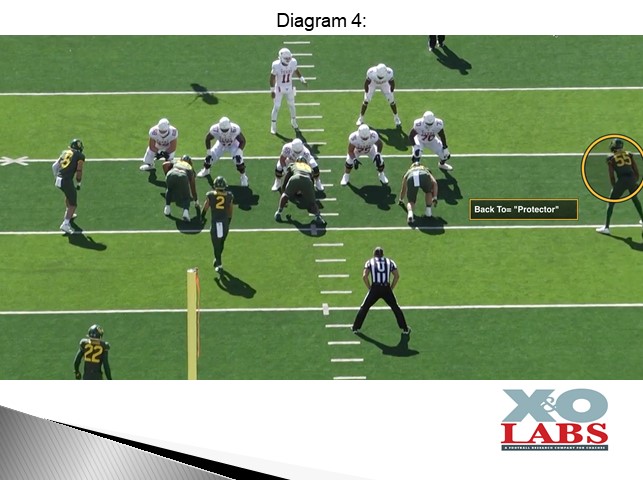
In the image below against 3×1 open, the Strong Safety (middle runner) covers down number three early to give the illusion of man free. He will start at eight yards off line of scrimmage.


All defenders will pedal out on cadence. It’s essentially Tampa coverage coming from a cover down disguise. According to Coach Cooper, all other defenses in the Rams system are “roof defenses” where they will hold the divider and then work off cadence. Against any running back motion or Empty, defenders will immediately get out of their shell and going to their responsibility. “We won’t let our disguise override our job,” he said.
 

Directional vs. Delivery Key:

Before getting into technique specifics with this coverage, it’s important to understand how he teaches the eyes of zone defenders. Essentially Tampa is the same principles as cover three, where defenders are taught to melt in the zone. Once they get their zone eyes set, Coach Cooper and his staff teach a “directional” vs. “delivery” key:

  • If the directional key is away from me, we shuffle.
  • If the directional key is to me, we sink with depth. That means there may be some high/low concept coming to me


Safety as Middle Runner:

The benefit of using these Tampa sim pressures from 3-High structure is that the middle runner plays from depth, which is contrary to having an interior backer (with a run gap responsibility) play from low to high. It takes the Mike out of run/pass conflict and according to Coach Cooper having the Nickel be the third safety makes it more symmetrical and cleaner teaching. It ties into the cover three creeper package because of the roof shell. “The disparity of the safety playing the middle run through vs. the linebacker doing it was like three to one,” coach Cooper told me. He did say he recommends that Nickel be a true safety (rather than a third corner) because he understands how to play a hash technique.

Read More

Teaching Insert, Wrap and Break Scenarios for BSG on Search Pull

By Mike Kuchar with Andrew Prevost
Offensive Line Coach
South Dakota University
Twitter: @CoachPrevost


Introduction:

Like many programs in the Missouri Valley Conference, South Dakota relies on the power concept to be the lifeblood of its’ offensive menu. But as a heavy, multiple tight end personnel outfit, the Coyotes run its power concept with a D-gap track. Offensive Line Coach Andrew Prevost thinks that the size and strength of first level defense in the MVC won’t let you crease the A gap on gap schemes. Instead, the pull will usually get pushed from C gap out into the perimeter.

So, rather than be hell-bent on inserting the ball into the A gap, Coach Prevost and the offensive staff at South Dakota teaches a wider, D-gap track in its power concept. This provides a contingency against squeeze and spill defenses, and gets the back (or quarterback) on the perimeter with the addition of an extra blocker. And because the entry point for the back becomes two gaps wider, the puller has to slow down his timing to stay in front of the back.

“The search pull slows him down so he can visualize and see the linebacker,” said Coach Prevost. It’s important to note that South Dakota is a one-back power outfit, there is no kickout element in this scheme.


RB Insertion Point: “Chase Backside Number of Puller”

While the ball carrier is expected to bounce the ball in the D-gap power concept, Coach Prevost made it clear that if he doesn’t start in the A gap, he’ll never get to the A gap. So, the A-gap will be his initial landmark, but he’ll look to track an A-D gap path based on the reaction of the defense. “We have him chase the A gap and as the A gap window closes they go to B to C.,” said Coach Prevost. In order to do this, the running back will track the outside leg of the play side Tackle. Coach Prevost says it’s a rarity for the backside Guard to insert into the B gap, so instead the back will just follow the path of the Guard. “We used to have him fit the puller but we switched it and now chase the backside number of the puller,” he said. “But what would happen was that puller would wrap really tight and the back would be too wide and they would always want to bounce it.”
Read More

Tampa Sims From 3-High Alignment

By Mike Kuchar with Ron Roberts
Defensive Coordinator/Inside Linebackers
Baylor University (TX)
Twitter: @CoachRonRoberts


Last time we worked with Ron Roberts he was telling us about his “Tampa” creeper package that he devised during the COVID lockdown in 2020. Before reading this report any further, it may make sense to reference the prior one below:


Middle Runner Personnel and Technique in Tampa Sims


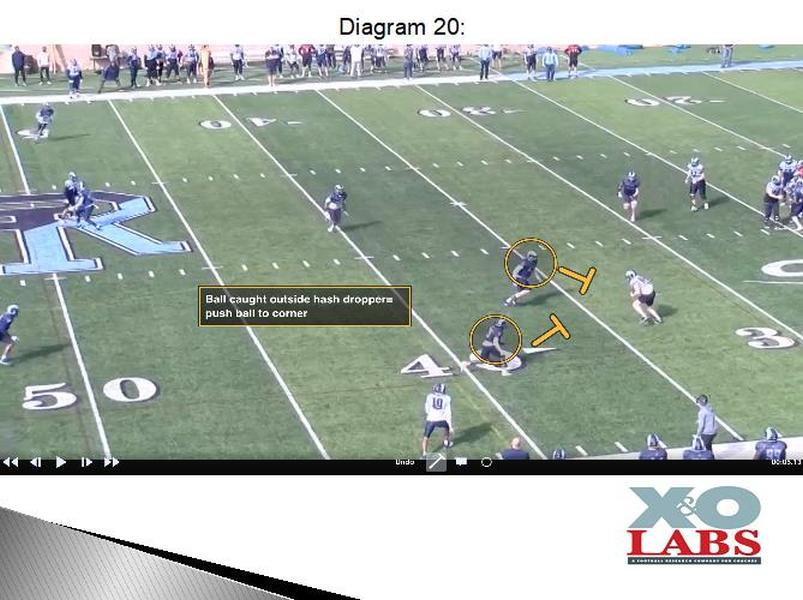
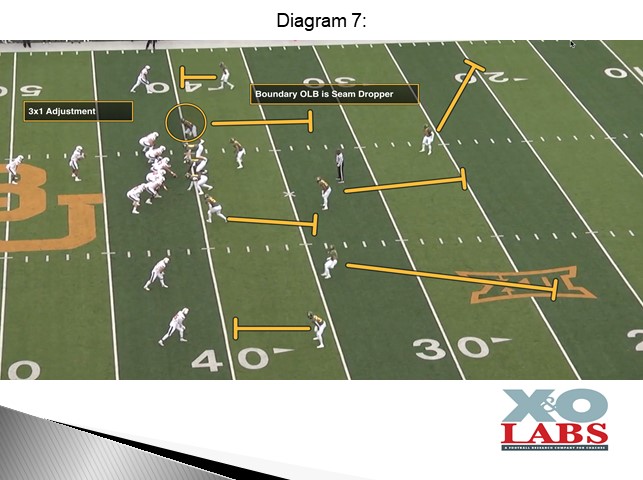
Quite simply it’s a four-man rush simulated pressure system with three high (Tampa) coverage behind it. While this coverage concept yielded some terrific efficiency- see Oklahoma State and Sugar Bowl against Ole Miss last season- he adjusted his three-high sims to alleviate a second level player from dropping into the middle of the field. As a result, he transitioned to using the same concept from his three-high sub personnel grouping. And if you’re utilizing a three-high structure it’s an easy build-in to your system. By moving to having an extra defensive back be the middle runner, it prevented a 5-technique outside linebacker from having to be a seam dropper. A second level linebacker is able to handle that responsibility because he’s not asked to run the middle of the field. “If you’re dropping those outside linebacker then you need to teach them multiple drops such as a field drop, hash drop and boundary hash drop,” said Coach Roberts. “We don’t want to do that anymore. We had to simplify it so that they just need to know that if they are dropping they are either dropping to the field side hash or the boundary side hash. They are not looking for anything else.”

The creepers from the three-high package is complemented with other two high structures or bracket coverage looks and is used primarily on third downs. “Our middle field open look is where we play our three-deep creepers,” he said. “It all starts there. We roll strong or weak. It doesn’t start in one high structure.”
There are several pressure packages tied to these creepers, but for the most part they are field and middle activations. Coach Roberts likes them best against open sets such as 2×2 and 3×1 open. “It’s good if you get more skill, open sets and your Mike can’t run with anything down the field,” said Coach Roberts. “It’s easier to play number three on an over route from depth with a defensive back. Best to work from top down alignment than vice versa.”


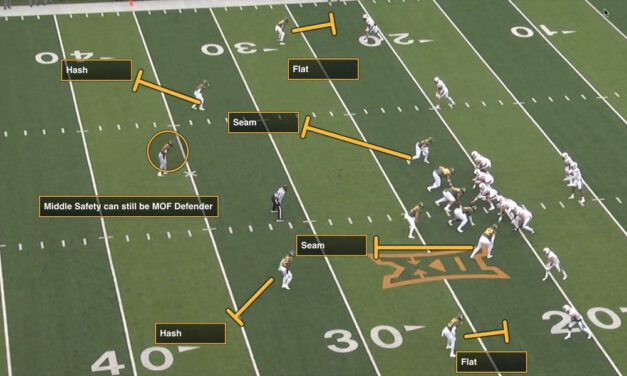
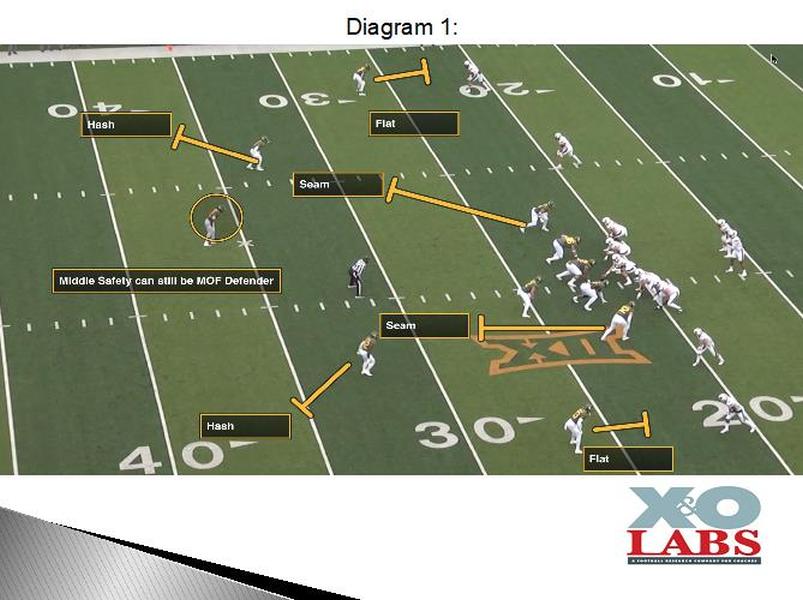
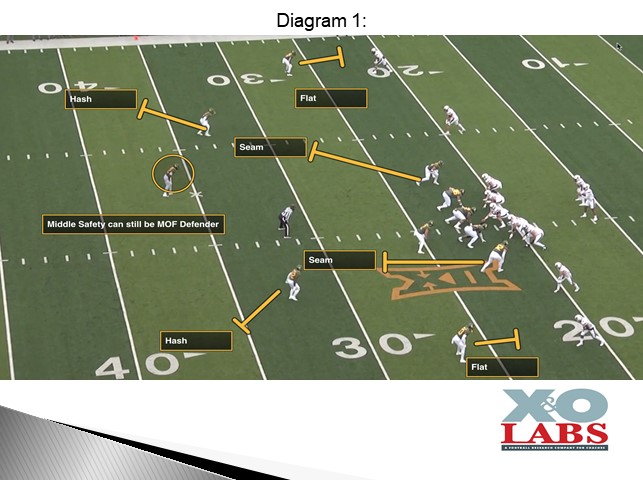
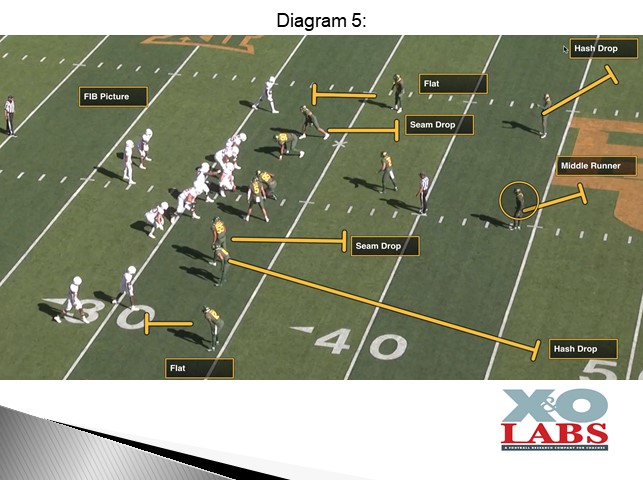
In its simplest form, there are four main pressure patterns in this package, although I’ll tell you Coach Roberts has been continually tweaking them to find alternative middle runners. Essentially, he classifies the coverage defenders as the following (more on the technique later in the report):

  • Cloud Defenders (2): responsible for flat
  • Seam Defenders (2): responsible for #2 in the seam
  • Middle Defender (1): post defender
  • Hash Defenders (2)


These packages are presented differently based on 2×2 open or 3×1 open formations, and they are taught differently based on each.


2×2 Open Sets:

According to Coach Roberts, In 2×2 open sets, it’s important to show post-safety help. Regardless of the pressure pattern, the middle safety is able to close out inside the hashes because he’s already in a position to do so.


3×1 Open Sets:

Against 3×1 open sets, the Middle runner can cover down on number three to show man coverage and still work his way back to the middle of the field. This is why you want the middle runner to be a safety. He can align 8 yards over number three and still play the middle. You can’t do that with a linebacker.


RPO Theory: “Aggressors vs. Protectors”

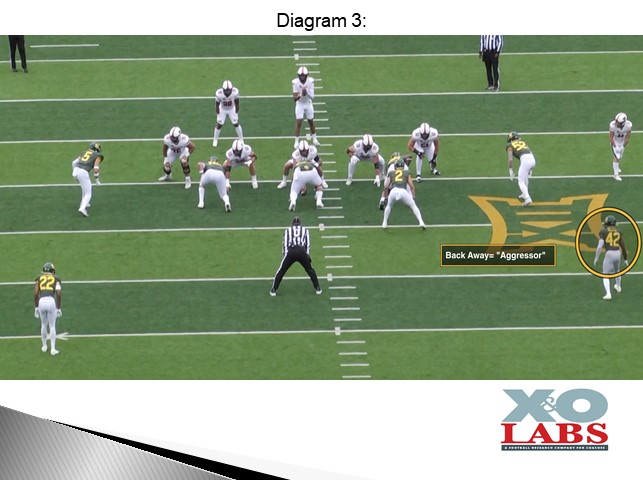
According to Coach Roberts, this not necessarily a good call against RPO offenses unless it’s 2×2 open sets where the middle safety can cheat to the side of the back. The way in which he’s able to get this taught is by terming the words “aggressor” and “protector” based on back location.

“Aggressor”: refers to any defender who is away from the back. This gives them freedom to trigger in the run action of the play.


“Protector”: refers to the defender to the side of the back, and consequently, the RPO. These defenders need to be a little more patient before triggering. Their job is to protect the RPO first.


Coverage Structure:

So, out of three-high structure, the Field safety (who is the middle safety in Coach Roberts system) is traditionally the middle runner. The Nickel is the field safety and the boundary safety is the Star. The only time the boundary safety (Star) is the middle runner is when there is formation into boundary structures.


“Our creepers are designed off 2×2 and 3×1 because I want to drop the 5-technique so he doesn’t have anybody to cover,” said Coach Roberts. “He’s dropping off air.”

“If it’s 2×2 I’d rather drop the field side 5-technique because he’s dropping off a ghost three or someone in the backfield so his job becomes easy.”


“If it’s 3×1 I prefer to drop the boundary 5-technique because he’s not dropping on anyone. He’s not good at it. That’s how you get away with dropping those guys out. The best way to do that is so that they are not covering anyone.”


Read More

Teaching Level Two Zone Reads in Gap Schemes

By Mike Kuchar with Glenn Caruso
Head Coach
University of St. Thomas (MN)


There’s an argument around football circles that there is no better teacher of gap schemes than University of St. Thomas (MN) head coach Glenn Caruso. And with the Tommies capping off a 10-1 season as the only non-scholarship team in the AFCA FCS top 25 rankings, that argument continues to gain merit year after year. Coach Caruso has been an advocate of gap scheme runs since his early days as an assistant in the Missouri Valley Conference and he’s continued his success running them ever since. He’s one of the more cerebral coaches at any level of football and he approaches gap schemes in the same fashion. “People think it’s a meathead play but it’s not,” he told me. “It’s a very intuitive play because of how many ways it can hit with two different inserts.”

The focus of this report is on how Coach Caruso and his offensive staff teach his gap schemes using zone principles. This mainly applies to how the back is taught in making the right read.

“There is so much lateral movement in football today that if you’re not adding zone principles to your isolation and gap schemes then you are putting you offensive line in a very mitigated situation,” he believes. “The RB has the width, depth and vision so he has time to make a decision. That is a zone principle.”

So, he calls it “power at level one, zone at level two.” “Everybody thinks that in gap schemes the more you block for leverage the less of a read it for the back, whereas in zone schemes there are level two reads at linebacker depth,” he said. “But at the end of the day our gap schemes are run like a gap scheme at level one, but the read that gets promoted to level two is more like a zone. We don’t look at the edge. It’s less about edge more about how LB’s are playing it.”
 

It Starts with the Backside LB:

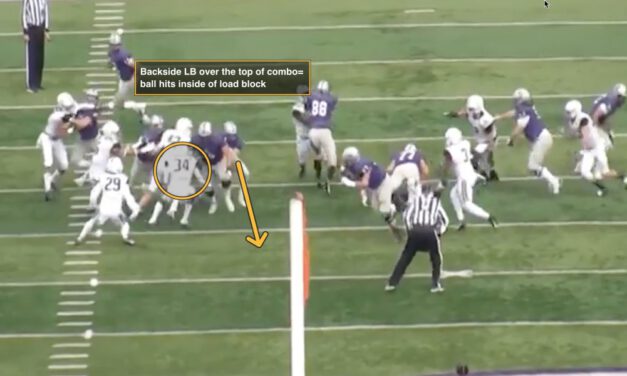
Coach Caruso believes in having the ball carrier read gap schemes from the backside first and that starts with how the backside linebacker is playing the combination block. In fact, he says the second most important defender is the weak side outside linebacker. “The running back’s read will change based on the width of the linebacker that they are combo-ing to,” he said. “The closer that linebacker gets, the read becomes a little more ‘zone-ish’ in nature. At some point the power play is going to have to cutback. That will be the 14 yarder on first down not the 6 yarder that breaks the game open.”
 

Kick vs. Load Player Decision Making Process:

Before accentuating the running back reads in gap schemes, it’s important to note that explain how Coach Caruso teaches gap schemes. Most gap schemes are taught with “kick” and “load” players. The first blocker is the kick out block and the second blocker is the load block, usually pulling from the backside. We all know that. But St. Thomas is a heavy personnel offense, where there are four different human beings who can play those roles differently. His Guards will often play fullback roles, which is why he doesn’t teach any skip pull techniques. “We turn and run and read it out to give our running back the longest amount of time to read the play,” he said.

Coach Caruso talks about the three most important decision makers in the play. The first decision maker is the kick player, who has to make one of two decisions: either he kicks his defender or he logs his defender. The second decision maker is the puller, who has to make one of two decisions off the kick player: either he inserts inside the kick block or wraps around it. Finally, the ball carrier is the last decision maker in the play. The ball carrier has to make two decisions off each of those two blockers decisions. That becomes 16 total factors.

Sounds cerebral enough… we told you. But stay with us. According to Coach Caruso, the efficiency of the play all comes down to making sure everyone reads the guy in front of them. “But you need to give the decision maker all the information,” he said. “And the only way you do that is to teach your ball carrier to get behind those guys. The ball carrier needs to be laterally behind the second to last decision maker. If the running back gets too wide and not behind it he can’t read it. People teach the running back to be in the hip pocket but that doesn’t allow anything but a bang bang decision when contact is made on a kickout block. So, you turning them into robots. Getting behind that decision maker is that important.”

The focus of this report is to show how Coach Caruso and his staff teach the running back to adjust to all the different reactions off the decisions above.

Read More

Kent State’s Universal Shuffle Pull Technique

By Mike Kuchar with Bill O’Boyle
Offensive Line Coach/Run Game Coordinator
Kent State University (OH)
Twitter: @OB_GoldenFlash


They are not called the “Flash” for no reason. Kent State’s entire offensive outfit relies on tempo to create confusion and discomfort in defenses. Because of this, offensive line coach Bill O’Boyle teaches his entire offensive line to pull (that includes Centers). And while there may only be two types of pulls in his system- slow pulls and check pulls- it’s the continual repetition of these two techniques that has vaulted Kent State into the top five every season in rushing yards per game.

In this clinic report, we profile the techniques behind both of these pulls including the drill work Coach O’Boyle uses on a daily bases with this unit. And while backside pulls are essentially in this offense, it’s important to understand that the play side of these concepts are referred to as “gapping units,” where players work in unison to horizontally eliminate any movement across the front. At Kent State, all gap concepts are treated as A-gap plays. “Nobody crosses our face in a gapping unit,” Coach O’Boyle told me. “Everything is considering an A gap entry point and we always chase it back.”

The ball carrier runs his track to the hip of the Center as he would in tight zone. He told me that running backs know exactly where the ball is going to hit, and very rarely will it bounce into the B gap. “If we it does go into the B gap it will be in a goal line situation where we have bigger personnel and more numbers on that side so it can hit wider,” he said.


The Down Block Fundamental:  “Violence on a 45”

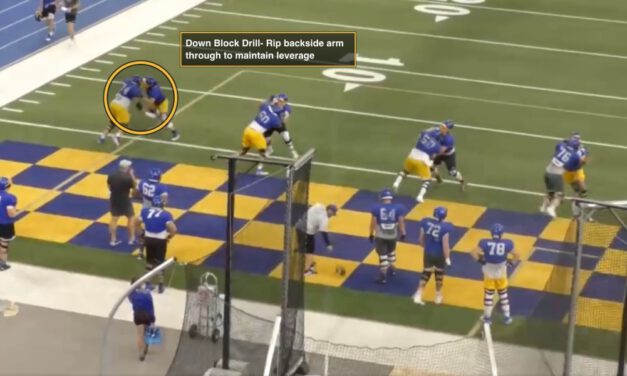
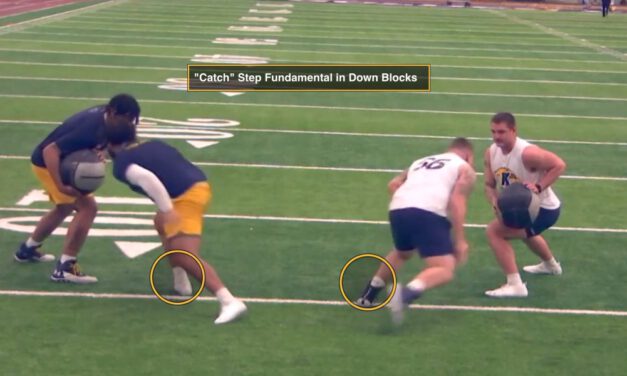
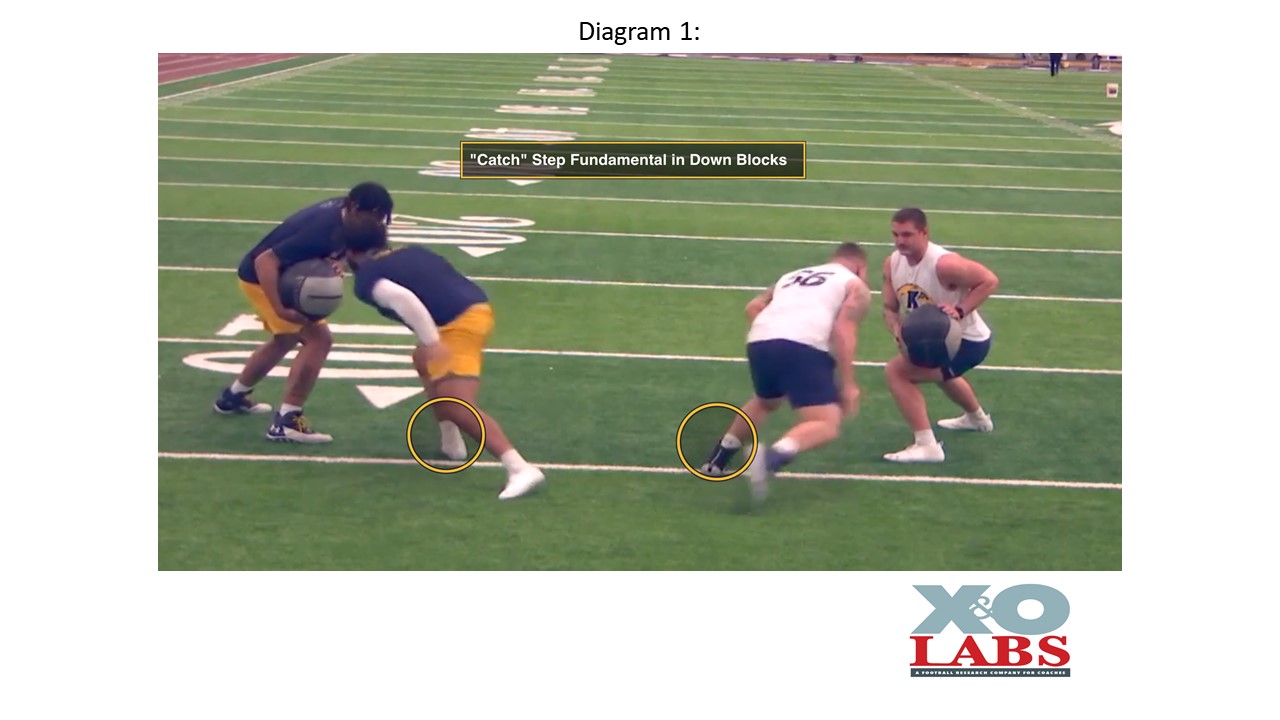
The gapping unit starts with the down block to protect the inside gap. But rather than teach a play side open step as some coaches do, Coach O’Boyle teaches what he calls an open foot movement with the inside foot to protect any potential movement across the line of scrimmage. Coach O’Boyle calls it “opening the knee.” “We want to swing the knee open, with the purpose of our momentum and strong base getting defenders upfield,” he said. “We have to be able to adjust off the drive block.”


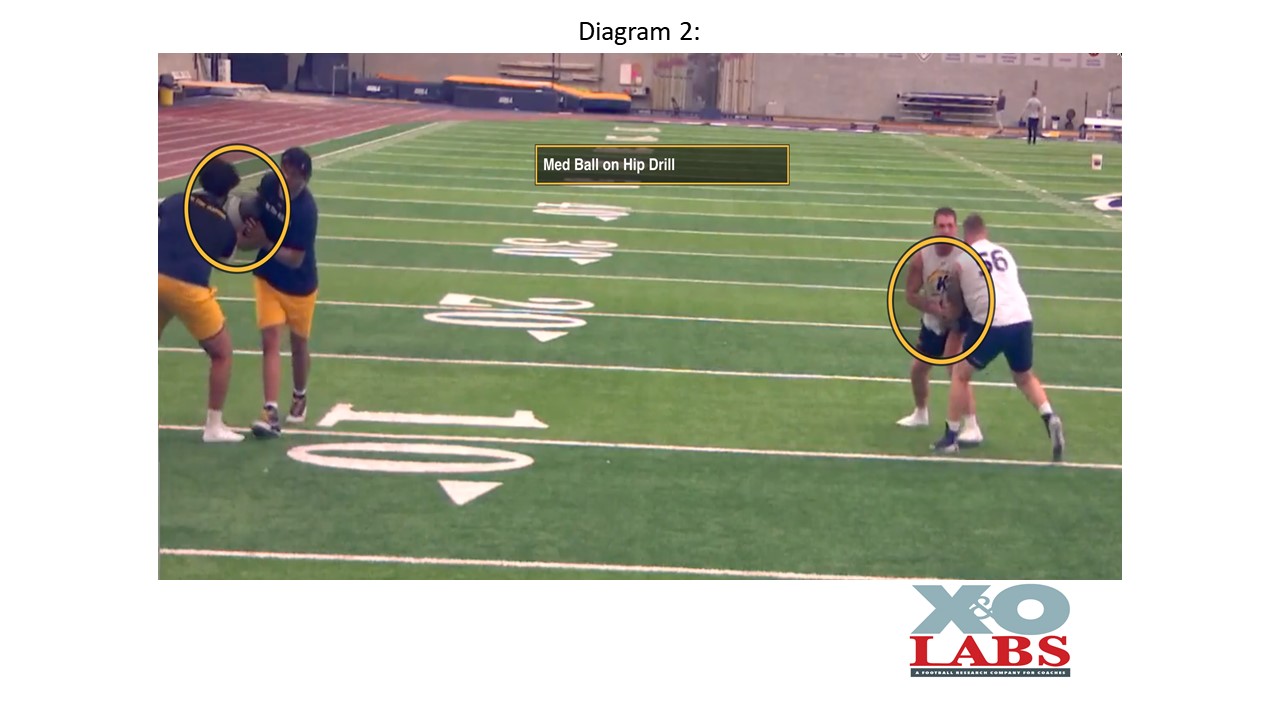
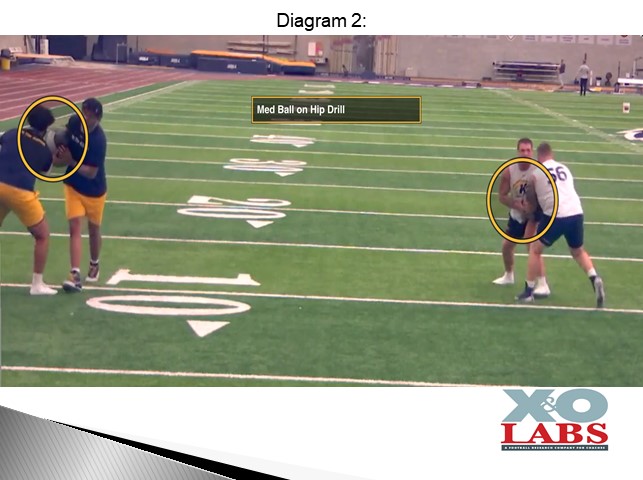
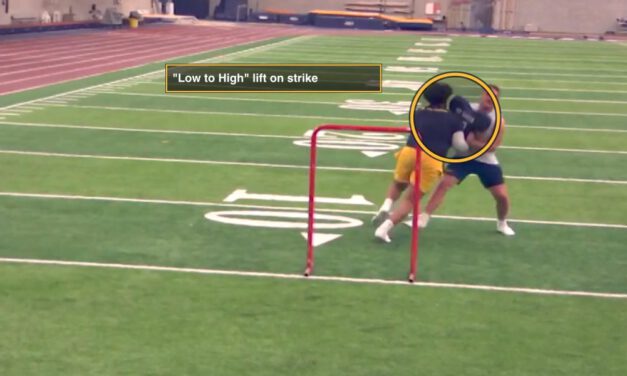
He used to teach a drive step but that step became too narrow, forcing the second step to crossover allowing a defender to backdoor the block. “If they step, then they lock the hip and wind up crossing over. By the time you make contact you give the defensive lineman a two way go. He can go upfield or underneath me. I wind up turning my shoulders and he can back door me.” And as far as strike point goes, Coach O’Boyle teaches a shoulder tip to chin landmark on defender, no hands. “We talk about not letting our face leave the jersey of the defender,” he said. “We want to knock the hips two gaps across our face.” In order to drill this, he’ll have a defender place a med ball on his hip so that lineman can use their backside hand as a “thumb lift” to  knock it vertically on a 45-degree angle. Coach O’Boyle calls this a launch, to simulate ripping a sink out of the wall.

Read More

Kent State’s Check Pull Progression in Gap Schemes

By Mike Kuchar with Bill O’Boyle
Offensive Line Coach/Run Game Coordinator
Kent State University (OH)
Twitter: @OB_GoldenFlash


They are not called the “Flash” for no reason. Kent State’s entire offensive outfit relies on tempo to create confusion and discomfort in defenses. Because of this, offensive line coach Bill O’Boyle teaches his entire offensive line to pull (that includes Centers). And while there may only be two types of pulls in his system- slow pulls and check pulls- it’s the continual repetition of these two techniques that has vaulted Kent State into the top five every season in rushing yards per game.

In this clinic report, we profile the techniques behind both of these pulls including the drill work Coach O’Boyle uses on a daily bases with this unit. And while backside pulls are essentially in this offense, it’s important to understand that the play side of these concepts are referred to as “gapping units,” where players work in unison to horizontally eliminate any movement across the front. At Kent State, all gap concepts are treated as A-gap plays. “Nobody crosses our face in a gapping unit,” Coach O’Boyle told me. “Everything is considering an A gap entry point and we always chase it back.”

The ball carrier runs his track to the hip of the Center as he would in tight zone. He told me that running backs know exactly where the ball is going to hit, and very rarely will it bounce into the B gap. “If we it does go into the B gap it will be in a goal line situation where we have bigger personnel and more numbers on that side so it can hit wider,” he said.


The Down Block Fundamental:  “Violence on a 45”

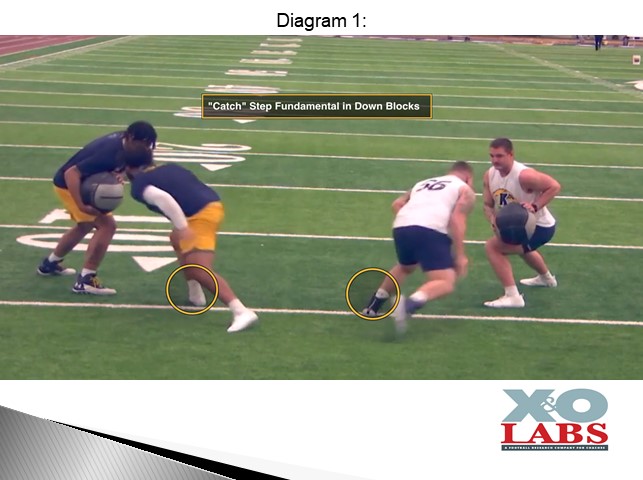
The gapping unit starts with the down block to protect the inside gap. But rather than teach a play side open step as some coaches do, Coach O’Boyle teaches what he calls an open foot movement with the inside foot to protect any potential movement across the line of scrimmage. Coach O’Boyle calls it “opening the knee.” “We want to swing the knee open, with the purpose of our momentum and strong base getting defenders upfield,” he said. “We have to be able to adjust off the drive block.”


He used to teach a drive step but that step became too narrow, forcing the second step to crossover allowing a defender to backdoor the block. “If they step, then they lock the hip and wind up crossing over. By the time you make contact you give the defensive lineman a two way go. He can go upfield or underneath me. I wind up turning my shoulders and he can back door me.” And as far as strike point goes, Coach O’Boyle teaches a shoulder tip to chin landmark on defender, no hands. “We talk about not letting our face leave the jersey of the defender,” he said. “We want to knock the hips two gaps across our face.” In order to drill this, he’ll have a defender place a med ball on his hip so that lineman can use their backside hand as a “thumb lift” to  knock it vertically on a 45-degree angle. Coach O’Boyle calls this a launch, to simulate ripping a sink out of the wall.

Read More

Pre-Snap RPOs from 2×2 and 3×1 Formations

By David Moskowitz
Head Coach
James O’Neill High School (NY)


It is a great honor to have the opportunity to contribute something that might be helpful to other coaches. So many coaches have been so giving and patient to me. That is what makes this such a great profession.

I am writing about our RPO off of Inside Zone. I got the head coaching job at James O’Neill High School two weeks before the season started in 2019. O’Neill is the school that serves the West Point community; working with these great kids is a blessing. I have been an I coach my entire career and installed that system when I started. We struggled to a 3-6 record, as the system was not an ideal fit for the players that I had. Midway through the 2019 season we put in some spread elements to combine with the I. I worked in elements of what I knew best, with the spread, that featured the quarterback as a runner. We moved the ball better in both the I and spread but I knew that I needed to change to what fit our players best. In the long offseason of 2019-2020 I studied the spread system: many thanks to Coach West of the Army Sprint football team and Coach Drinkall, the tight ends coach at West Point. We played a 6 game schedule in the spring of 2021 and a full schedule in the fall. We won 14 of those 16 games, winning 2 sectional titles and reaching the state regional finals in the fall.

The centerpiece of the offense is the Inside Zone with a pre-snap RPO. All of our runs between the tackles have pre-snap RPOs. We count the defense from outside in. If we have an advantage on the outside we automatically throw the ball. This will be done to the 3 receiver side, 2 receiver side or 1 receiver side. Any defender that is 8 yards or more off our receivers is not counted, he is not considered a threat. Our quick passing game and downfield passing game have been dynamic, allowing us to get some of those favorable looks. We are content to take the 4-5 yard gain that we are being given and believe that with our athletes on the outside several times per game we will break those off into big gains, or even touchdowns. Our tailbacks from the previous year were the 2 slot players in our spring season. One was 6’3 210 lbs. and the other was our best all-around football player. This fall we played with 2 of our fastest kids as the slot players. We distribute the ball to all of our positions; knowing that they will get touches has made our kids embrace blocking.

Read More

Corner Post (COP) Tag Concept in Quick Passing Game

By Michael Hartman
Head Coach
Arroyo Grande High School (CA)
Twitter: @AGFOOTBALL2


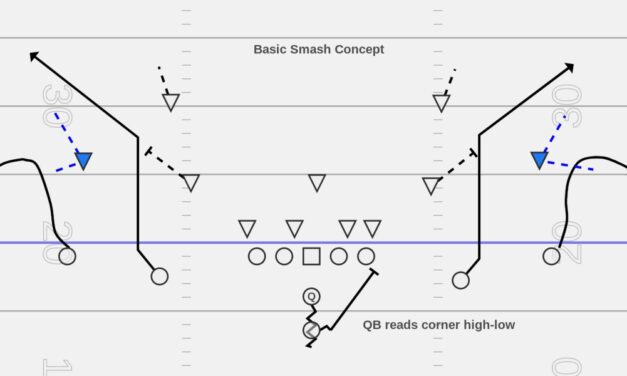
We are always looking for ways to attack the two high safety defensive structures that we see in our 2×2 and 3×1 formations. As defenses have gotten better at covering traditional high-low Smash concepts (Hitch-Corner, Out-Corner), we have needed to find adjustments that allow us to get to the middle of the field in our quick game. One successful answer we have found at Arroyo Grande High School is our Corner Post tag.


Coaching Points

Understanding Defensive Structure — We teach our players a very simple one high vs two high pre snap read. Versus two high defenses, our players know that the deep safety is responsible for #2 receivers going deep (in a Cover 2 or Quarters based scheme) with underneath help from a second level defender (a linebacker or rolled down safety). For our Corner Post route, our #2 receivers know that they need to sell that they are running a corner route.

Stem Release – Our receivers stem to gain leverage on the defender that they need to “beat” on any specific route. On a Corner route by the #2 receiver, we stem to gain outside leverage on both underneath curl droppers and deep safeties. This not only gains us width for Corner routes, but it also opens up the middle of the field for Corner Post.

Read More

20 Personnel RPO Build-Ins to Access Leverage

By Zen Bliss
Head Coach
Prestige Sports Academy (FL)


In my two seasons as an Offensive Coordinator at the Post Graduate level, our Zone Schemes have been a versatile weapon. We used a lot of 20 Personnel. We are going to discuss a simple RPO scheme out of 20 personnel (inside zone with play side and backside glance route). Our RPO structure stays the same every week, meaning we will have game planned route concepts attached to our run plays depending on the defense of our opponent. It’s a simple one word play call. We may have a glance/shoot concept attached to our inside zone on the play side and the backside WR runs a 5-step glance, a hitch/wheel play side and an 8 yard in route by the single side WR attached to any of our run game. The combinations are endless.


R.P.O DRILLS / PRACTICE

What we do is have our RPO practice periods in practice where the concepts are repped 1st on air in an offensive group period. We will take our two QB’s and split the wide receivers and tight ends into two groups and with each QB throwing to each group, then we run scout period where we get to see the different defenses of our opponents, and finally in a live team practice. Except for 5 drop back concepts the RPOs  is our base passing game.

The majority of our run game includes an option component, we are always in search of taking advantage of specific defensive players by putting them in Run/Pass conflict. Our mesh drill has been critical in helping us achieve success in the area of ball security and gaining an understanding of which defender is in conflict for each RPO concept. The mesh drill will involve only the QB’s and RB’s at the base level.

Later we add TE/H’s and receivers as schemes become more complex. We prefer a high number of repetitions in our practices. The drill will allow us to focus on the QB/RB mesh and each player’s reads. We will work the mesh drill for 5 to 7 minutes per practice depending on the following variables:

  1. BASE RUN READS – limiting it to our base runs only. Coaching Point– Spacing is KEY in this drill. We use cones to maintain alignment and landmarks

* Quarterbacks will rotate from Center to Quarterback to Defensive End to out. The Running Backs will rotate from Running Back to Linebacker to out. If we have a TE/H involved, he will rotate from TE/H to Safety or Outside Linebacker to out.

Quarterback
Center – snaps the ball and gives a read to the RB by emulating the movement of a DT.

Running Back
Running Back – execute the called offensive play.
Linebacker – give the RB a read forcing him to use an escape skill.

TE/H – execute the called offensive play. Outside Linebacker – plays defensive force and gives the TE/H a person to fit up on. Once the players master the drill, to maximize reps, we will run two drills at the same time facing one another. We will work every run play in this drill with the main focus on option plays.

Read More

Formation into the Boundary: Non-Traditional Packages that Stress the Defense

By David Weitz
Offensive Coordinator
Hamilton Southeastern High School (IN)
Twitter: @dweitz7


When taking over as an offensive coordinator for the first time one of the biggest problems isn’t finding what to do, it’s finding what not to do. In a world where we have access to so many different resources and tools for developing our knowledge, it’s easy to become overwhelmed. There are so many good schemes out there and all of them work.

When I first took over as an Offensive Coordinator four years ago that was definitely an issue for me. As a lifelong football nerd, I had studied and could talk about a variety of different schemes and offensive systems. I have coached in a Modified Wing T, Traditional Pro, and Up Tempo Spread under some of the greatest offensive minds in the state and arguably the country.

Through experimentation and a lot of bad ideas, I finally arrived at a way of thinking about offensive game planning that fit my brain. I have always been a fan of Flexbone’s systematic approach to attacking a defense. I loved the Up-Tempo Spread’s ability to thin the box out and adjust plays at the line. At the same time, I really enjoyed the misdirection of the Wing-T. We have worked to combine this into a way of thinking about attacking a defense that has been great for our players and coaches.


Why Series

One of the core components of our offense is that we want to make teenagers think. One of the best things I ever heard was from Jayson West who told me “I’m not trying to trick 40 year old’s, they’re smarter than me. I’m trying to trick teenagers.” That has become the foundation of our philosophy and how we approach game planning. The more variables and potential outcomes we can force players to think about before and while the ball is being snapped, the better we will be.

The other thing we really believe in is the idea that we want to have answers. If we are having success running a play a good defense is going to adjust and find a way to stop us. Well they only have 11 players so if they are going to adjust to stop one play, it’s going to open up another one. With a series we are able to exploit that adjustment.

The result is a very systematic way of thinking about play calling. If they are going to stop our Outside Run then that should open up another play. The series based play calling style, made famous in the Tubby Raymond Delaware Wing-T, gives the coordinator answers. Which is one of the things I always loved about the Flexbone and the If-Then style call sheets that Paul Johnson made famous.

The thing that was the big breakthrough for us wasn’t the series system, it was the application of the series system. I had only thought of the series system as a Wing-T or Flexbone type of system. When we looked at the series based system and applied it to our spread formations, we made a huge leap as a program.


Why Formation into the Boundary

When considering different formations and motions that are going to stress the defense it’s always nice to be a little non-traditional. When you are able to get outside of the conventional box you force the defense to play and plan for formations they don’t always see. This is why we love the concept of going formation into the boundary.

With our formation into the boundary series we are going to put the passing strength into the short side of the field. This leaves the defense with a difficult choice, do they put their defensive strength into the boundary and leave open space or do they let us gain an advantage and risk dealing with our quick game.

Read More