
Using Multiple Formations for the Rugby Punt

By Dan McKenna
Special Teams Coordinator
Anna Maria College (MA)
Twitter: @CoachMack36


Introduction:

Punt is the most important play in football. The number of players guaranteed to handle the ball and the exchange of possession and field position is what makes punt the most important play. The rugby punt is a great way to add simple variety to any punt formation. At AMC this past season, we had a lot of success working in the rugby technique with our existing scheme. We used the rugby through the combination of existing and new formations, making our punt scheme unique and multiple.

Before completely adopting this concept, we wanted to know exactly what we would be gaining and losing by going to the Rugby punt. Here is a list of pros and cons:

Pros

  • Block point changes
    • Rushers must alter their path to the block point.
    • The distance between the block point and the backside to A-gap rushers increases.
  • Reduces stress on protection
    • Frontline can take a more aggressive approach and attack rushers moving laterally/forward, instead of having to protect moving backward in their steps. (Bucket step VS. Kick slide)
  • Allows coverage to release/get downfield easier
    • Keeps attention on punter/in backfield.
    • The longer the punter can cradle the ball, the more the coverage can close to the returner.
  • Limits block and return schemes
    • Being able to punt from the pocket and rugby in any situation creates difficulty to match block and return schemes with each punt.
  • Creates problems for returner
    • Difficult to read and field a rugby kick because of the limited hang time and roll. This can create turnovers due to an unpredictable bounce of the ball.
    • Returner is often forced to let ball roll or fair catch.

Cons

  • Can increase ball security issues
    • The punter has a greater chance of mishandling the ball on a rugby punt because of the movement involved in his steps, not looking the ball in (catch and mold) and executing a clean drop while on the move.
  • Punter’s mechanics
    • Drop and point of contact need to be emphasized more in practice to stay consistent with the rugby movement. Punter mechanics can get sloppy when punter is focused on moving.
  • Protection
    • Can create seams and an open front-side edge rush if the protection’s steps are not executed correctly and in good relation with the punter’s rugby steps.

Personnel:

As with almost any aspect of football, it is critical to know your personnel! When considering adding the rugby technique, the focus should be solely on the punter. Some punters are strictly “pocket punters” that are most productive punting the traditional way. Fit the scheme to the punter to maximize his strengths.

Here are a few things we evaluate when determining if the rugby technique fits the punter:

Ball security – Does the punter consistently catch and mold the football to his body, especially as he takes his lateral steps. Ball security can be a bigger issue in a rugby punt if the punter is too focused on getting out of the pocket and reading the rush instead of looking the ball in and focusing on hand placement and drop.

Read More

Using Press Technique to Disrupt the Fade-Stop

By Trey Henderson
Safeties Coach
College of William and Mary 

Introduction 

wandmI would like to take this opportunity to thank Mike Kuchar, Research Manager for X&O Labs for allowing me to write this article on Press Coverage.  Most of what I know about the game of football has been given to me by someone.  I would like to thank them all, but there are just too many to mention.
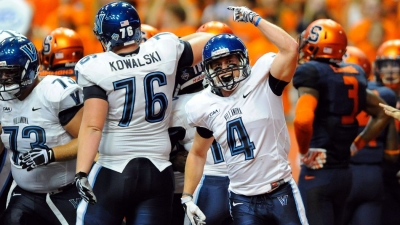
In 2010, William and Mary finished the year as the CAA Champions with the #2 Overall seed in the Division I playoffs.  Defensively, we were sixth in points allowed per game (16.6 ppg) and tenth in Pass Efficiency Defense (103.6)  in all of FCS.  We also allowed only six passing touchdowns.  The reason for our success is because of our ability to play Press Coverage no matter where we are on the field.  In this article, I will explain our basic press man to man technique and how to better defend the fade stop route.

The teaching progression we us in our Press Technique, at William and Mary, can be illustrated by the acronym (AKRE) :

Alignment, Key, Responsibility and Execution.  We use this acronym for every coverage we install, regardless of zone or man.  So let’s get to work.

Alignment – If we are lining up on a #1 WR that is on the LOS (Line of Scrimmage) then we align one yard off the ball with inside leverage on the WR. If the WR is off the LOS then we align as tight to the LOS without being off sides while still having inside leverage.  We define Inside leverage as having our outside foot splitting the WR in half.  Our stance is square with our feet slightly wider than shoulder width.  This give us a good base and allows us to not get run over if a WR decides to bull rush us.  Also, we are in a good knee bent position with our hand relaxed ready to strike.

Key – Our eyes are locked on the bottom of the WR numbers.

Responsibility – The WR Man to Man.

Execution – We want to be as physical as possible in our three-yard area surrounding us and the WR.  Our feet need to move before our hands, so that our punch is more violent.  Moving your feet provides a better balance for the punch.   If we dominate this area, then we should disrupt the timing of any route.  As the WR moves we move our feet,   I begin by telling our guys to slide back slightly(slide technique is defined below) when the WR moves to prevent them from lunging.  As we slide back grudgingly from the WR, we remain as square as possible.  We use an off handed punch technique on the WR.  This means if the WR releases to our right then we slide our feet to stay square and maintain our leverage and punch with our left hand.  Our aiming point is the breastplate of the WR with our thumb up.  This gives us the most power to punch the WR and impede his release.

Get X&O Labs’ Research Reports Sent Directly to Your Email Every Tuesday Morning.  Just Enter Your

Principles of Slide Technique:

  • Balance stance, no stagger.
  • Weight on balls of feet (similar to a boxer), no forward lean, no heels.
  • Six inch to one foot slide backwards depending on ability of receiver.  For most dynamic receivers, a longer slide is necessary.

Read More

Creating Your RPO Menu to Combat Common Defensive Adjustments

By Mike Kuchar
Senior Research Manager
X&O Labs
Twitter: @MikekKuchar


Introduction

Now that your RPO concepts have been installed and implemented, it’s time to fine tune your RPO package to attack the certain coverages and adjustments presented throughout the course of the season. We’re not referring to changing your base RPO concepts, just tailoring them to attack what defenses are doing to defend them. In this research report, we present the most efficient RPO’s concepts being used for the backside X receiver, how best to get a dominant tight end involved and what answers can be provided against man coverage.

RPOs vs. Defenses That Leverage the Stick Route

Since the stick/draw RPO may be the most popular of its kind, defenses are finding ways to get the Mike backer (or hook defender) to play with inside leverage on number three. Below are some options that help alleviate that issues.

Establishing a Pass/Pass Read: Drew Owens, Offensive Coordinator, Western Connecticut State University

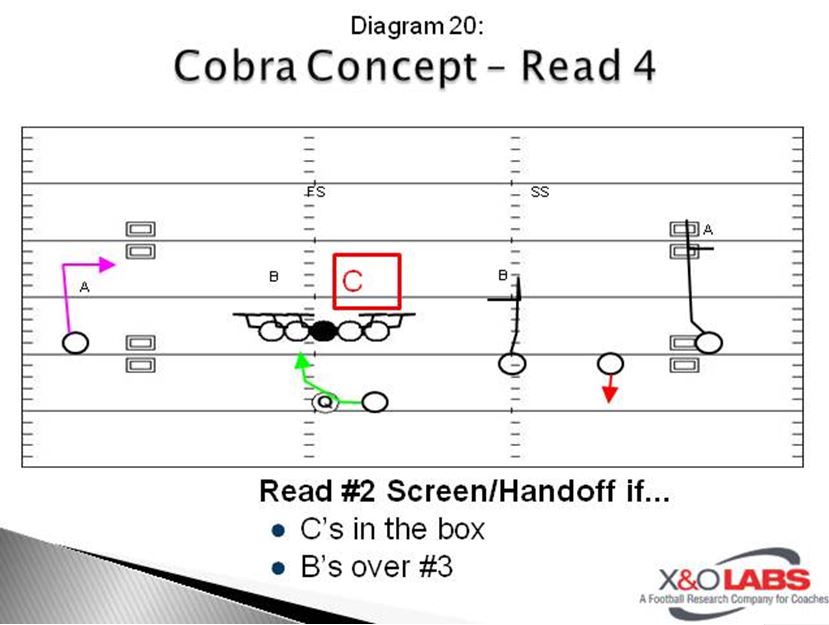
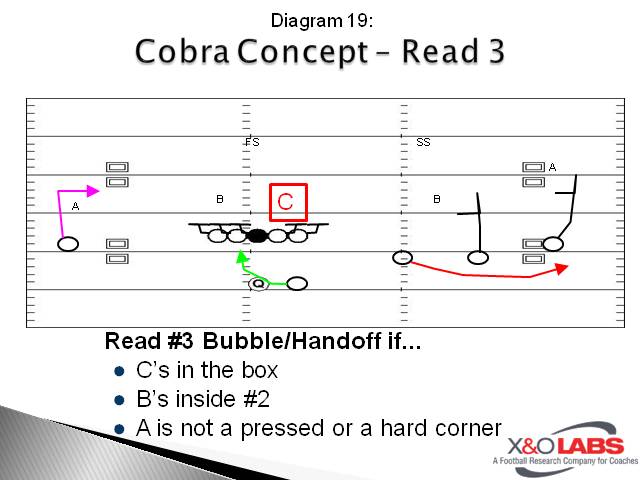
“For example, defenses will sometimes insert C and set B on the inside leverage on number three (Diagrams 19 and 20). We will just say, ‘Bravo’ and take the C read off and it becomes pass/pass read based off stick or bubble,” continued Owens. “We have no blockers for the defenders in the box. The QB will still will show ball, but eyes to right to B based on that defender.”

Slide19

diagram22

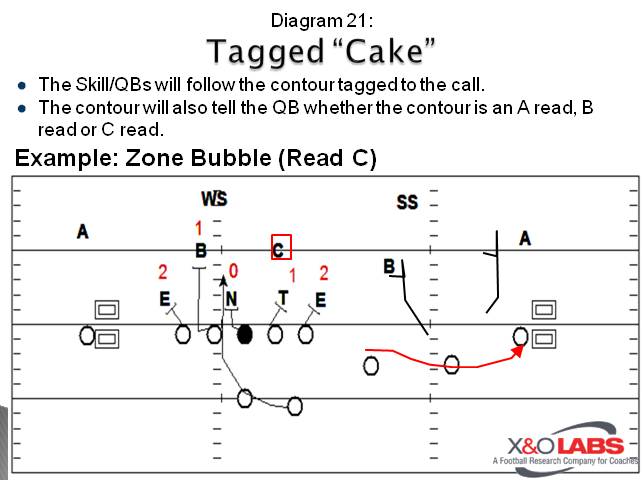
Owens will also use a “Cake” variation where the Stick read is off. It becomes a bubble by number three (Diagram 21), which is used on weeks when he’s having a hard time blocking that box defender.

Slide21

To see a video tutorial of Western Connecticut’s Cobra Concept, click on the video below:

Read More

Phase Two: 4-2-5 – Case 1: A Communication System to Support Multiple Front Structures

By Adam Hovorka
Managing Editor, X&O Labs
Twitter: @XOLabs_Editor


Over the last two decades, Stony Brook University (NY) has evolved itself from a Division II football institution to a non-scholarship FCS level program and now is among the top teams in the highly competitive scholarship level Colonial Athletic Association. Just this past season saw the Seawolves crack the top 25 nationally at the FCS level nine weeks in a row.

At the heart of this progression is a defense that under head coach Chuck Priore have not allowed opponents to score over 21 points per game in five of the last six seasons. The 2018 season saw the Seawolves produced the following numbers in the CAA:

  • Finished 1st in opponents 3rd down conversion (28.2%)
  • Finished 2nd in scoring defense (20.3 ppg.)
  • Finished 3rd in rushing defense (122 ypg.)
  • Finished 5th in total defense (315 ypg.)


System and Personnel:

The Seawolves are a 4-2-5 defense at heart and have been for years. But the influx of RPO offenses and the speed of the skill players in the CAA have forced them to transition into using both Odd and Even front structures. And they have done so by keeping the same personnel on the field. Much of that responsibility falls on the boundary defensive end- or what Stony Brook calls the Anchor. The following positions round out the personnel in Stony Brooks’ defense.

  • Nose
  • Tackle
  • Field End
  • Boundary End (Anchor)
  • Strong Inside LB (Mike)
  • Weak Inside LB (Will)
  • Field Down Safety (Rover)
  • Field High Safety (Free)
  • Boundary Safety (Whip)
  • Boundary Corner
  • Field Corner


The “Anchor” is the hybrid defensive end/outside linebacker type that has continued to be the pulse of the Seawolves unit and the position that we profile in this report. It’s a position that has continued to be extremely productive in this outfit, registering the following numbers this past fall:

  • Finished 4th in tackles
  • Finished 5th in TFL’s
  • Finished 3rd in Sacks


Anchor Job Description:

At Stony Brook University, the “Anchor” or boundary defensive end is one of the most important positions on the field. According to defensive line coach Rob Noel, he’s a player that started out at as a linebacker but either got too big or wasn’t quite explosive enough to make tackles in space. Or, he struggled to make the reads as consistently as a linebacker would. It’s a player that is usually at the 240-250 pound range at the FCS level, which is significantly smaller than the 290-pound field defensive end playing on the other side of the ball.

Ideally, Coach Noel wants this player to be around the range of 6’1, 250 lbs. “I’d like him to have as long arms as possible,” said Coach Noel. “Height is not as important as wingspan. The bigger you can get the better, but I am willing to sacrifice height at that position to get a very fluid athlete because we’re going to ask him to do a lot of different things on the football field.  I think for us that position must be an extremely high motor type of kid.”

Read More

Phase Two: 4-2-5 – Case 2: Responsibilities and Techniques for Anchor vs. Run

By Adam Hovorka
Managing Editor, X&O Labs
Twitter: @XOLabs_Editor


Like most defensive outfits, Stony Brook prides itself on stopping the run and everything they do so is based off the four-down front. So, when the Seawolves transition into either their Double Eagle or the 3-man fronts, it’s almost the exact same defense.  “We just tell the Anchor that either you are already aligned in the gap you are assigned, or you are moving back to the gap we want you in,” said Coach Noel. “if we have a blitz called in a four-down front, we can very easily run it from the 3- down front and Eagle package by using a different word that they already know. If the blitz is called something in 4 man package (say Bronco) then in 3-man fronts it might be called Orange.”

Regardless of the front, the Anchor will be asked to execute the following three techniques based on run to or run away from him. These are all techniques that we will cover in this case.  

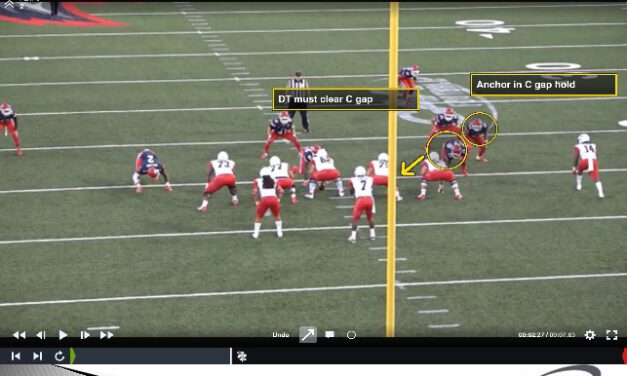
  1. Hold the gap Technique: In most times this defender will be asked to hold the C gap, but may be the B gap in certain pressures. Whatever the situation, he is responsible for his gap. He can either align in it or blitz to it. Here, the Anchor is in single gap control and must get upfield right away on the snap.
  2. Lag Technique: Lag means that if the offensive lineman tries to reach the Anchor, he will play to his butt side and play the inside gap. He will allow himself to get reached and not worry about holding the outside gap. These are used in zone schemes to prevent any wind backs. It allows for big plays in the A and B gap.  
  3. Fold Technique: Here the Anchor who is aligned as a stand-up C gap or even D Gap player will take the B gap or A gap. This is mainly used against gap teams when the Anchor gets pull schemes away from him. In these circumstances, he’s not responsible for CBR (counter, boot, reverse).


According to Coach Noel, the purpose of using multiple fit patterns is to alter blocking schemes at the line of scrimmage. These fit patterns are tied into two factors: coverage structure and block recognition. But regardless of the fit pattern called, it can be changed based on the offensive blocking scheme. For example, “lag” fitting doesn’t happen when it’s a gap scheme because most gap schemes will entail some sort of pull. Therefore, the lag fit becomes a “fold” fit. Even though these fits are executed at the first level, second level defenders are expected to know where they fit based on the blocking scheme. “In most cases, the linebackers will work to play behind on zone schemes and fit their gap on gap schemes,” he said. “If the Anchor is folding fitting the gap, the linebackers push a gap further away from the run action. It’s all based off the flow. We tell them they have this gap in base flow and this gap in pull.  No communication has to happen.”

According to Coach Noel, these are all built in calls and will change the fit of the other defenders. For example, “Pirates,” could mean four down front (Pittsburgh) with a lag fit. It’s a premise that the defensive staff at Stony Brook implemented recently to break tendencies for opponents. “At this level, if defenses know what your fit is it doesn’t matter how good for football players you have,” he said. “Some of the biggest plays we gave up this year was when the defense figured out what we were going to be in and dictated to us.  So, we decided to not check our fits anymore based on an offenses formation. There were teams that knew in certain formations they’re going to get Quarters coverage out of us and they were going to get the match-up they wanted and exploited us for some big plays.”  

In order to get it communicated, Coach Noel will use one-word calls that tells the defense the front, the coverage, and the fit. “For example, Bronco may tell them it’s a four-down front with a lag fit,” he said. “Where Texans could mean it’s a three-down front with a lag fit. Or maybe Steeler tells us it’s a lag fit from a quarter, quarter, half coverage structure. All NFL teams could be four down fronts with lag fits.”


Hold Gap Technique:

The first thing the Anchor is taught to do in the run game is to hold his gap. The hold gap technique is a single gap control technique where he is asked to either align in the gap he’s responsible for or blitz to it. He must be able to align in his gap and hold it in either 3 or 4-man fronts.  This includes blitzing or moving into his gap as well.  Therefore, this player has to be able to easily move in and out of the 3- and 4-man fronts because he’s making a lot of the same reads.  

“He’s going to fit a lot of the same gaps and in a two-point stance he’ll be a bit further from the line of scrimmage,” said Coach Noel. “So that’s what helps us be able to move in and out of this very easily. We are not asking the guy to suddenly do something in the 3-down package that he doesn’t already isn’t doing in the 4-man front. There’s not a single thing that is different.”  So, if the Anchor is responsible for C gap control he can do so at the line of scrimmage or back off the line of scrimmage to play it.

The reads in the hold gap technique may change based on opponent, according to Coach Noel. There are times when he must have “bigger vision” like a linebacker or he might key the guard and tackle to his side. “He’s got to look at both of those (Guard and Tackle) in a 3 or 4 down front,” said Coach Noel. “Since he needs to see the whole picture, he can’t just get what he needs to do from one guy.  We will drill that when we are not in pads. We will go on barrels, we will do walk-throughs, and will do this as a group. He will just get his block reads a little bit different. They’re just kind of walking through plays and we’re getting our block recognition.”  

Read More

Phase Two: 4-2-5 – Case 3: Responsibilities and Techniques for Anchor vs. Pass

By Adam Hovorka
Managing Editor, X&O Labs
Twitter: @XOLabs_Editor


From a coverage perspective, the Anchor will be asked to handle several responsibilities. In the majority of situations, he’ll be assigned to play the weak flats or match the number one receiver into the boundary. But he will also be asked to carry some sort of spot drop on a field area such as a hash dropper or middle of the field dropper. These techniques are often utilized in Stony Brook’s drop eight (five under, three deep) coverages and zone pressure (three under three deep) concepts. “We give him landmarks of where he’s going to drop depending on what the coverage is,” said Coach Noel. “And we will vary between teaching him zone eyes and man eyes.”

Coach Noel mentioned that he doesn’t spend a lot of time drilling coverage techniques. Many of the teachings are done off of the film. “In zone coverages, we emphasize our eyes either looking more at the quarterback or getting more depth. We will talk through routes a little bit at that time. It is just teaching them offensive football, that’s what we try to do more than anything with the coverage part of it.”

In this case, we segment our research based on the following:

  • Man-coverage responsibilities
  • Zone coverage responsibilities


Man-Coverage Responsibilities:

Stony Brook will ask the Anchor to play some man coverage but will only be asked to do so against a tight end or running back. “We will try to never have him matched man on a slot receiver,” Coach Noel said. “We do this if we think he can match up and run with the tight ends and or the back. We work to keep our eyes are on him and run with him wherever he goes. The important fact is if we have a matchup that we can live with athletically?” In instances when the Anchor has to play the number two receiver, he may make a switch assignments with the safety. The safety would handle the slot and the Anchor would play the back.


Blitz Engage on RB:

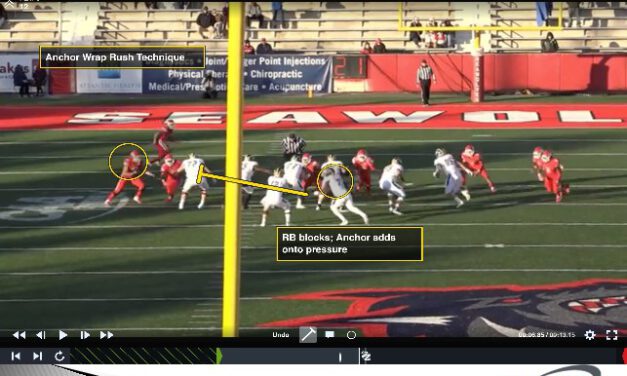
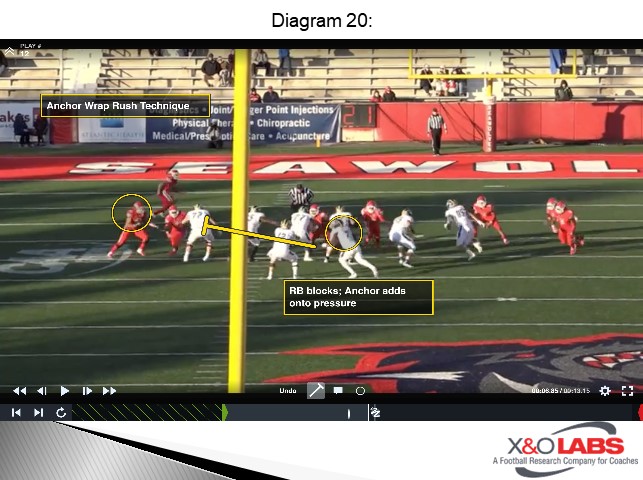
When the Anchor is responsible for the back in coverage, he will execute a wrap rush technique if the back blocks. “When the running back steps up to block, he’s no longer a threat so our blitzers will add onto the pressure.”  

The clip below is a good example of how the Anchor wraps into pressure. Here he’s responsible for the back man to man. The back stays in and blocks, so he adds onto the pressure and gets a stack.

Diagram 20


“We don’t waste a guy on him, he adds in once he sees the block is taking place,” said Coach Noel.

Read More

Phase Two: 4-2-5 – Case 4: Developing a Practice Plan and Drill Work for the Anchor

By Adam Hovorka
Managing Editor, X&O Labs
Twitter: @XOLabs_Editor


As detailed in the first three cases of this report, there are several techniques the Anchor has to master. The challenge is being able to teach and rep all of these techniques in a streamlined practice plan. At Stony Brook University, Coach Noel is the only defensive line coach. Which means he cannot solely work with the Anchors. His time is split between working with the entire front. And it is this collective mindset that Coach Noel uses when developing this player. “We think of this position as defensive lineman first and foremost,” he told us. “He will do all defensive drills with this group and build from there.  He does not have his own position coach; he is part of the defensive line unit.”


Delegating Practice Time:

Having said that, Coach Noel will get him extra reps at times when he builds them into his practice plan. It is usually during special teams segments where Coach Noel will steal time with the Anchors to work all of those run fit techniques (fold, lag and hold) detailed in case two. “There will also be times when we break up the tackles and ends,” said Coach Noel. “I will take the ends and Anchors and work with them and do some drills because they do a little bit different things in regard to pass rush, but I don’t think you need a different coach completely.”

“We do almost the exact same technique, execution, and everything across the board at all four spots.  We teach the same pass rush drills and the same block destruction drills.  We do the exact same footwork on get-offs and all the stuff that we already must do.  Now there are some specialized things that he must do. He’s the only guy that’s going to be in covers for us 95% of the time so I don’t take individual time to work pass drops.”

One of the more essential periods the Anchor will get is dividing his time between getting one on one pass-rush with the offensive line and working pass skelly with the back end. He will often be involved in the 7 on 7 for the first five minutes- where the coverages he usually involved in are scripted- than he rotates with the backup Anchor so he can work pass rush with the rest of the defensive line. “He’ll come down to do pass rush and the other guy will go get a few reps in pass skelly,” said Coach Noel. “Then we’ll send them down there for seven on seven and they’ll get reps pretty much every single day.  We also don’t try to over-coach that guy too much when it comes to that kind of stuff. We give them landmarks, and give them easy things to remember.”

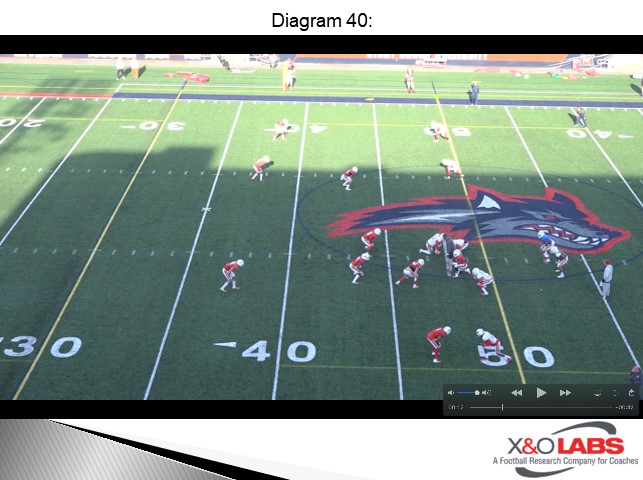
Diagram 40


There will be game specific concepts that Anchor will be taught based on the opponent and Coach Noel and linebacker coach Matt Hachmann work to carve out time to get that accomplished.  “We may do some circuit training with him (detailed below) to change things up,” said Coach Noel. “We may have something in that week from the 3-down front where the Mike and Anchor have the same responsibilities dependent on flow call, and Coach Hachmann will take the Anchor for the period. There will be other times when we are teaching all the other guys to pass rush technique.  We will occasionally want to know if we got a linebacker that we want to rush on third down sometimes so they will come with the defensive line and we’ll teach pass rush to him.   We really just teach speed and speed to power and then little intricacies off of that, some counter-moves, and the long arm.”


Seawolves Agility Circuit:

Because this Anchor gets cross trained in Stony Brook University’s system, it’s important that he continue to develop the agility needed to play both run and pass. On any given snap, he’ll be asked to play a zone in coverage, play a man technique in coverage, rush the passer or play a run fit. So, a good deal of time is spend working on the dexterity needed to change directions mechanically. One of the first drills Coach Noel will do with these Anchors is work on their lateral movement skills.


Lateral Shuffle Drill:

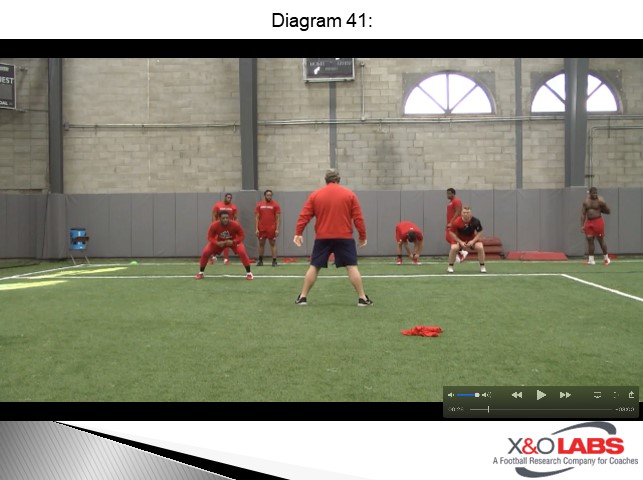
Diagram 41


This drill emphasizes the lateral movement needed to play this position. After the shuffles are executed, defenders will burst downhill to simulate getting home in the pass game or the approach on a ball carrier.

To study film of this drill, click on the video below:

Read More

Assigning Gap, Bonus or Conflict Responsibilities for Overhangs to Defend RPO’s

By Jason Thier
Defensive Coordinator & Linebackers Coach
Dickinson State University (ND)
Twitter: @Jasonthier


Due to the control that the offense has before the ball is snapped, the game of football is offensively driven. With the ability to determine the personnel, formation, shifts, motions and snap count they dictate the terms to the defense on every play. Due to this pre-snap control, defenses must be able to adjust to what the offense presents. In a Two-High safety scheme, it becomes the responsibility of the linebackers to be the adjusters. In the modern spread game, this means linebackers spend more time aligned in space as APEX players. Additionally, with the introduction of the run-pass-option (RPO), APEX players in a Two-High safety scheme are being put in conflicts on what to defend. The combination of these things has made the APEX player a difficult position to play and coach. This report aims to address how to get the most out of the APEX player with proper alignment, reads, and pre-snap indicators.

We will begin by identifying the three different types of defender the linebackers could be when facing an RPO style offense; gap, bonus, or conflict. It is important that each linebacker knows what type of defender they are before the ball is snapped. In most situations we are able to control the type of defender they will be by defensive play call, and pre-snap indicators.


Gap Defender Responsibility:

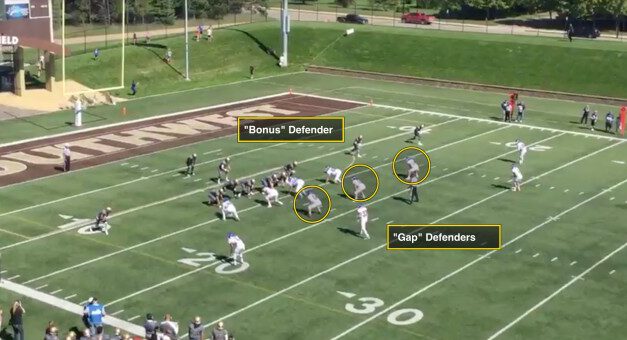
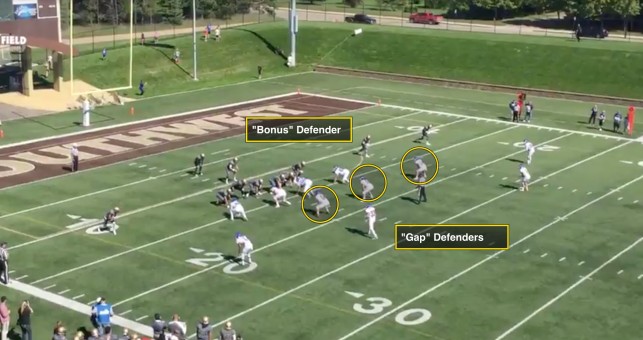
If a linebacker is aligned in the box he is referred to as a “gap defender”. As a gap defender, they can be aggressive against the run because they have no responsibility to the throw option of the RPO. We teach our gap defenders to play RPO’s as base run plays. Even though this report is about APEX defenders, it is important to understand what the linebackers in the box do to see the whole picture.


Bonus Defender Responsibility:  

If the linebacker is aligned in the APEX position he is either a “bonus defender” or a “conflict defender”. A bonus defender is an APEX player who doesn’t have a primary gap attached to the box, and can play the throw option in the RPO first. We teach our bonus defenders to guarantee the throw won’t happen before helping on the run.  The throw could be a screen or three step routes. After guaranteeing the throw, the bonus defender plays the run option from outside in. The beauty of the bonus defender is the ability to create help where it is most needed. For instance when facing a talented runner at QB, they can be used as a secondary QB player and take stress off the defensive end.


Conflict Defender Responsibility:

A conflict defender is an APEX player who has the duel responsibility of a primary gap attached to the box and has to hold off the throw element of the RPO. The conflict defender has the most difficult job verse an RPO offense. We teach our conflict defender to be “slow to go and fast once they know”. They will pop their feet in place while making the read, giving up no ground to either the run or the throw. By game plan we will determine which one of the options we want to give the offense and have the defender be more aggressive towards the option we want to take away. Our base rule is to guarantee the run first. It is our responsibility as defensive coaches to dictate who we want the conflict defender to be as often as possible.


Alignment and Stance

When it comes to the stance of the APEX player, we teach the same stance as a linebacker in the box with one small exception. Instead of the APEX player having their toes at the same level, we have them stagger their stance with the inside foot forward. The stagger should be no more than the outside foot’s toe on the inside foot’s heel. We feel this allows our APEX player to open their hips quicker in passing situations and still be able to play downhill against the run. With that being said, stance is all about comfort and efficient mobility. If a player is more comfortable in a squared up stance, we encourage him to use the one he feels the most confident in.

The alignment of the APEX player is determined by whether or not they are a conflict or bonus defender. If the APEX player is the conflict defender, they will align five yards off the ball, splitting the difference between the end man of the line of scrimmage (EMLOS) and the extended wide receiver. If the APEX player is the bonus defender, they still align five yards off the ball while cheating their alignment closer to the wide receiver.

Read More

Mixing Unbalanced Formations and Motions into Sugar Huddle Communications

By Danny Schaechter
Offensive Coordinator & QBs
Gonzaga College High School (Washington, D.C.)
Twitter: @CoachDShack


Whenever deciding to add something to the offense, I want to make sure it’s simple, effective, and cheap. Therefore, we decided to add a sugar huddle package to our offense. The sugar huddle is not new to football. Then again, neither is the fast-paced no-huddle offense. With defenses catching up to the speed of offenses, it’s our job as offensive coaches to keep them off-balance. This is why we began using the up-tempo sugar huddle. It allowed us to change the tempo while utilizing an unbalanced formation and motion paired with our base plays and a couple of tricks. Thus, we were able to go slow yet still be fast while keeping the defense on their toes, having to align and adjust quickly.


Mechanics

Furthermore, after research and tinkering, we decided it’s best to get the receivers positioned in their pre-snap alignments while the linemen and backs were in the sugar huddle. The combination of linemen getting set quickly in a two-point stance and already having all skilled players pre-aligned helped us make this an up-tempo sugar huddle. The coaches signal our sugar huddle tempo/motion (one signal) then the play (just like our no-huddle). The QB, TB, FB, and WRs get the play signal from the sideline. The QB, just like in our no-huddle, tells the O-Line the play. After making sure everyone is set on the perimeter, the QB breaks the huddle. The linemen get set quicker than Quick Draw McGraw. The QB is in charge for sending and timing the full speed jet motion, and we’re off to the races.


Communication

As mentioned earlier, we utilized an unbalanced formation and motion with our sugar huddle this year. One-word play calls are the rage, but we wanted this package to be more multiple, so we used one word to specify the formation, the motion, and that we were in our sugar huddle tempo. Below are examples of our two formations:

Diagram 1

Diagram 2


QB: Heels at 4 directly behind the center, in charge of timing the jet motion

TB: Toes at 7 directly behind the QB

Read More

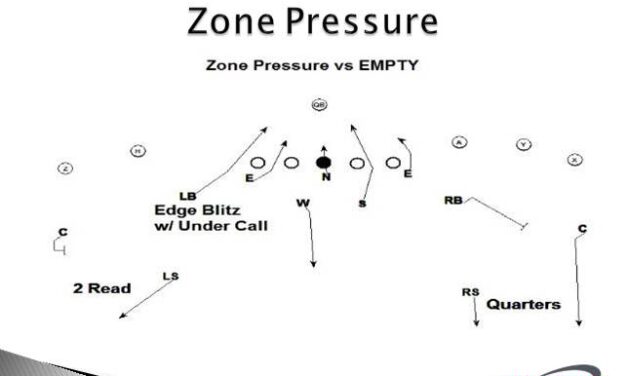
Mixing Coverage and Pressure to Defend Empty

By Laban DeLay, Head Coach
Billy Skinner, Safeties
Arlington Lamar High School (TX)
Twitter: @Coach_DeLay & @CoachSkinz

Introduction:

We are in a football era where defending offenses is becoming a more difficult challenge each year. Winning football games 3-0 or 7-6 are few and far between due to athletic ability and the creative minds of offensive coaches. At Lamar High School, we are diligent about not staying in one front or coverage very often and trying to create confusion for the quarterback and offensive coordinator. This clinic report will feature the Lamar Vikings defending empty sets by bringing a variety of pressures and mixing the coverages.

Scheming Empty Formations

Our number one priority as a defensive staff is to be sound against the run in every formation while taking away the opponent’s favorite pass concepts. To do this, we analyze our opponent’s run game from each formation along with their personnel groupings. When we encounter empty formations, we design a 4 to 5 call package tailored to take away their favorite plays and to neutralize their best offensive player. These calls are designed to not only take away their favorite plays, but also to add confusion to their quarterback by a mixture of coverages & fronts. Here are a few examples:

  • If we are playing a quarterback who is better in the pocket, we design a man pressure that will move him off of his spot and ultimately throw off his timing in accordance to routes.
  • If we are facing an athletic quarterback, who is more prone to scramble, we will design a zone pressure that will allow us to keep “Zone Eyes” on him, while we play games with the coverage in the back end.
  • Against a stud receiver, we can design coverage adjustments using our base package to play “STAR” coverage, to eliminate him out of that particular play or series.

We like to mix and match all of these concepts together when we customize our empty package for each opponent every week. During our practice week, we will rep all of our calls while giving our linebackers the freedom to make our empty call checks and our safeties will adjust the coverage to keep everything sound. This allows them to feel ownership in our defense and encourages them to study our game plan thoroughly. We, as coaches, also have the capability to “lock” in a specific coverage per the game situation rather than our allowing our linebackers and safeties to make the adjustments. Our “adjust” call allows the safeties to call a coverage that is best suited vs the formation the offense presents to us. Our safeties have to be great communicators with each other because many times we will make a split coverage call. For example, we might play Cover 2 to one side while playing Cover 4 or perhaps man coverage to the other side. Our safeties will communicate the coverage with one another first & then relay the coverage call to their side corner & outside linebacker. We feel that our “adjust” coverage allows us the flexibility to get into the most favorable coverage as we will detail later in this report. 

“Adjust” Coverage vs. Empty

We teach our basic coverage principles in a classroom setting we call “Football 101”. We begin with Cover 2 and illustrate this coverage vs multiple formations. We instruct alignment, strengths, weaknesses as well as proper execution of Cover 2. We proceed to teach each of our coverages in this manner to educate our players on the multitude of looks we can run in the defensive backfield. We want to build comfort level with our players in such that we can run any coverage vs any formation. Through our “Football 101” education we then discuss which coverages we prefer to certain formations and concepts which is a critical part for our safeties with the “Adjust” call. Now that our players have a solid foundation of our coverage schemes, it enables us to mix and match coverages against our opponents. For example, if a team is running empty and runs a vertical scheme to the three receiver side we may want to run our quarter’s concept there, and run our read Cover 2 concept to the two receiver side.

Quarter, Quarter, Half vs. Empty

When we run quarters to the trips side of empty it is imperative that the safety and corner read the route concepts. If the route combination does not threaten our zone then our eyes must move to the next most dangerous threat, thus we never “cover grass”. Corners will be responsible for the outside quarter, so their eyes will go from the #1 receiver (the furthest outside) to #2, and then to the #3. If there is a smash concept (#1 stop, #2 corner route) the corner will stay over the top of the corner route and allow the underneath coverage to be responsible for the stop. The safety is responsible for the inside quarter, so his read must go from the #3 receiver to #2 and then to #1. If he reads that #3 is vertical he pedals for depth and protects his hash. On the quarters side, the key to success is the underneath coverage.  The outside backer starts with his eyes in the backfield for his run/pass key. If pass, outside backer must take speed off the #2 receiver with a violent re-route. He is the curl/flat player and we believe that the quarterback’s front shoulder will direct his drop. If the shoulder is quick game or screen now and his hand comes off the ball, we must locate the “quick man” and trigger. If the quarterback’s shoulder and eyes lock vertical, he can carry his re-route deeper. Inside backer’s initial alignment against empty is to discourage the hot of #3 strong and #2 weak.  Their main responsibility is to handle the quarterback run scheme that the offense presents.  After reading pass, the inside backers will protect the hash allowing nothing to cross the face underneath them while taking away the hot routes.  The job of the inside backers is to force the quarterback to attempt the longest and/or widest throw to give time to the secondary players to react and make a play on the ball.  The #1 goal of the inside backers is to protect the hash so the safeties are not put in a matchup with more than 2 receivers in their zone.

Read More

The FSL Package: Boundary Concepts From 3×1 Formations

By Patrick Murphy,
Head Football Coach,
Saint Anselm College 
Twitter: @Spredm_N_Shredm

Introduction:

CaptureConventional offenses have often scoffed at the idea of running trips into the boundary, but at St. Anselm College we have found a way to turn this type of thinking into an advantage. We find that by putting trips to the boundary, we force the defense to make a choice; defend numbers or defend space. From there we can build plays to attack the different choices that they make.
Philosophy:

To give you an understanding of why our philosophy is what it is here at Saint Anselm College, you have to understand the history of the program since my staff and I arrived here in spring of 2008. When we arrived, we inherited the nation’s longest losing streak (38 straight D-II losses with the average loss by more than 30+ points). We had only 35 players on roster that first spring, the program was dead last in nearly every offensive statistic, and there was zero confidence in the team’s ability to move the ball, score points or be successful at anything.

Unlike the rest of our league, our program had yet to make the jump to scholarships, so we were operating as a non-scholarship program in a scholarship league with some of the toughest admissions standards in the area. We’ve since began to add scholarships to the program, but we are still far behind the rest of the league in scholarship numbers. It is because of these hurdles that we have developed into a no-huddle, multiple read, “smoke & mirrors” offense that relies more on not blocking defenders than it does on scheming to block the outstanding defenders we compete against. For us, we spend time as a coaching staff devising ways to not block these defenders so we “Improvise, Adapt, & Overcome”.
I think our offensive philosophy itself allows us to play at a very fast pace that dictates that the defense play “vanilla”. The FSL package further magnifies that tempo and can handle different fronts/coverages/pressures because it has “built in” answers to each. Along with the base package, we also build a surprise or two into it, just as we do with our base offensive attack, on a weekly basis. So the package is constantly growing and presenting different counters to defensive problems.

We have either lead the league or been in the top 2-3 teams in the conference in rushing, passing, total offense and scoring during our time here at St. Anselm. The last several years our FSL Package has helped tremendously to “even the playing field” against some of the more talented programs we face. Ultimately, it still comes down to “Numbers, Angles, & Grass” and how to engineer those three elements to our advantage.

FSL Basics:

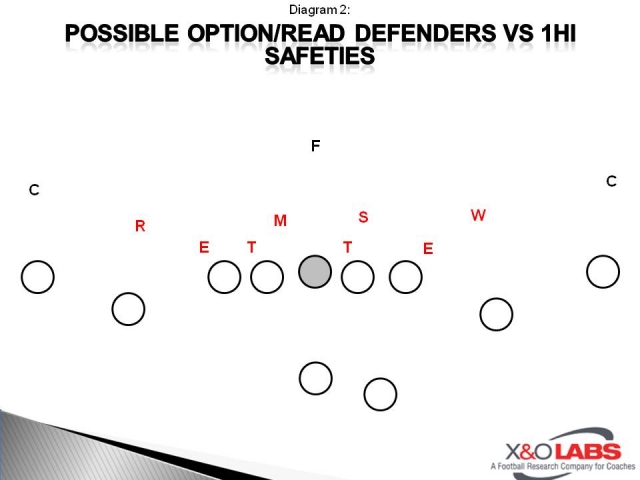
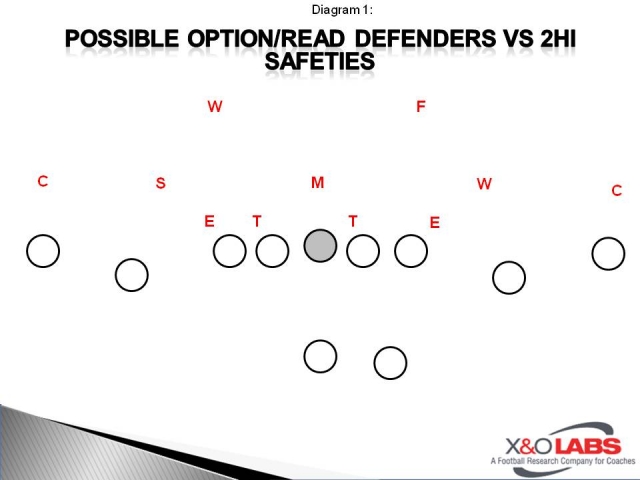
Depending on what our opponent is doing from a coverage/scheme standpoint, we are capable of reading all 11 defenders in a 2-high shell defense (Diagram 1). Against an 8-man front, we are capable of reading the entire front 8 in a 1-high shell defense (Diagram 2). Who we read will be determined by several factors, some of which are personnel, formation, the scheme employed against us, and where we can turn the numbers angles and grass to our advantage. Throughout the game plan process, we’re looking to take the path of least resistance. We do not spend a lot of time scheming to block the top defenders we face. Instead, we “erase” them by either formationing them or reading them. The FSL package allows us another way to disguise how we are erasing their best defenders.

Slide1Slide2

Read More

Flexbone Issue – Case 1: Keeping Concept Integrity by Varying Balanced, End Over and Trips Formation Structures

By Scott Dieterich
Offensive Coordinator / QB & FB’s Coach
Parkview Baptist School (LA)
Twitter: @deterball


I would like to open by thanking X&O Labs for the opportunity to share this report with you. As a coach, I greatly appreciate the value of the resources that football coaches from across the country share and the forum that X&O Labs provides for its readers is greatly appreciated and respected.

As a long-time flex bone offensive coach, there are a few things I need to begin this report with to help the reader understand the “why” and not just the “what” of this article. Just as there are many different varieties of the modern spread offense, the same can be said for today’s modern flex bone offenses. I believe it’s safe to say that most flex bone offenses are similarly deeply rooted in a few core plays (i.e. triple option & midline options etc.), but there are many subtle differences within different versions of the flex bone offense.  Some of these differences are not always easily noticeable and they can include elements such as the types of complementary plays used, the type & frequency of the passing game, and the use of formations and personnel.

The main concept that will be covered in this article will be using different formations and specializing personnel in the flex bone offense to be the most effective and efficient. I believe that most high school coaches learn many things from visiting and studying college teams every year. But not all things transfer down to the high school level equally. The main issues that most often must be considered for high school coaches are time and the ability of our players. We are a 1-platoon team, so we must share our players in each phase of the game (O-D-K), which greatly limits our time with them in each phase as well as limiting how much we can put on each of them mentally. This article is written with much thought given to these issues. Things obviously change for the better when a coach has more time and/or more ability with regards to his players. It will also be assumed that there is some working knowledge by the reader of the flex bone offense. This article will touch on some of the plays we use in this offense, but the plays will be covered more within the context of how they are used with different formations more so than in-depth detail of the plays themselves.


Flex Bone Formations

The discussion for formations in any offense can’t accurately be complete without considering the assignments & roles of specific players & positions within each formation, for each play, and vs. all defenses. All (11) positions on each play are vital, but within the flex bone offense, there are (2) positions that have “more on their plate” than any others; The QB & the Halfbacks. NOTE: I call our halfbacks “T & Y” or collectively “TY-Backs”; many flex offenses call this position “A-Backs”. The formation itself cannot necessarily take pressure off the QB, but we do try to take pressure off the Halfbacks by limiting where we align our halfbacks and what we ask them to do.

The Split-End or Wide Receiver is a position that isn’t very demanding mentally, but physically it is very demanding in its own way. Many flex teams have really expanded recently what they will ask this position to do by specifically using the SE to align and perform more like a TE. Again, I have seen this done effectively at the college level but I really haven’t seen it trickle down to the high school level very effectively and consistently. Again, a college team can recruit specifically what they are looking for to fill the needs of what they ask their positions to do where most high school teams must develop their players to best fit what they can within their natural abilities.


Formation “Integrity”

The “integrity” or effectiveness of a formation in the flex bone offense for us comes down to a (3) key concepts that we try to maintain with 99% of our sets:

  1. Always have an “attached” halfback. By having an attached halfback this gives us the most flexibility for the plays we run.
  2. Always have a “true” fullback aligned behind the QB. A true fullback threatens the defense immediately and it is the trigger for many of our plays. When a flex bone team doesn’t have a true fullback, this eliminates much of what a defense must defend.
  3. We want to be able to run the bulk of our offense out of all formations that we use, especially our options: By making the defense always align option sound to both sides of a formation greatly limit what they can do defensively and still be sound.


A Few Different or Unusual Alignments that you may notice within our Formations

I really don’t care for coaching something just because “that’s just the way it’s always been done” or because “that’s what everybody else does.” I don’t mind thinking outside of the box a little bit, especially when I feel like it gives our players the best chance for success. Below are a few alignment things that we do differently as compared to most flex teams.

  1. Our TY-Backs/Halfbacks align deeper than most flex teams – this tends to make most of their assignments easier such as improved motion paths & blocking fits.
  2. Our Fullback (aka B-Back) is aligned in a 2-point stance. Although it’s rare to see this from a flex team, I feel the advantages far outweigh the disadvantages.
  3. Our O-Line is aligned further up on the LOS than most flex teams that tend to get as deep as legally possible with their O-Line. We feel this alignment helps us our O-Line function better overall in most blocking situations.
  4. Our T.E. will align in a 2-point stance many times. We give the T.E. the choice to align in a 2 or 3 Point stance and many times they choose the 2-point stance because most of their assignments are executed easier from this alignment.


Read More

Flexbone Issue – Case 2: Troubleshooting Common Flex Bone Issues Against Odd Fronts

By Ken James, Nate James & Matt Donegan
Northwood High School (OH)


The 3-4 defense can have a variety of appearances; therefore, it is important to first identify where the defenders are lining up and how they are attacking your offense.  Running the triple option/midline, we are always trying to put ourselves in an advantageous position by using a variety of formations and motion to help us gain a numbers advantage.  Seeing how defenses align to simple formation adjustment can give the offense the upper-hand.  Regardless, it is important for the quarterback to identify the dive and pitch reads before the snap.  Equally important is for the play side halfback and wide receiver to identify the primary and secondary force defenders and to communicate so two people are not blocking one person.  Many teams have played a 3-4 against us because we run midline very effectively and they think having a NT will prevent that from happening.  Being able to execute a multitude of option attacks can help provide answers when teams try to take away the midline or inside veer.


Inside veer

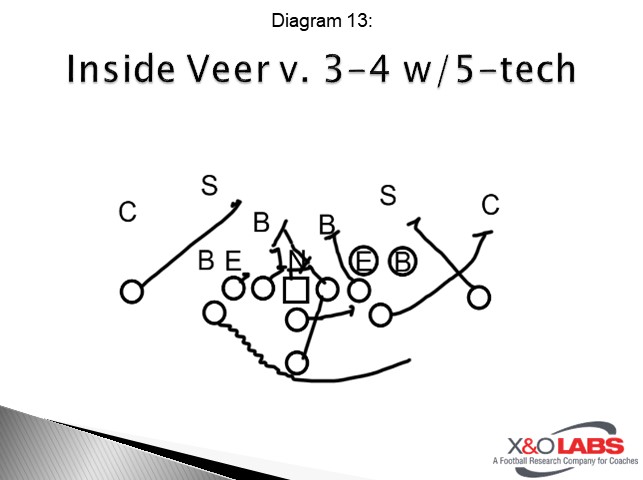
Diagram 13


In Diagram 13, there is an image that displays how we block a 3-4 defense and whom we are trying to option.  Our backside G and T are scoop blocking to protect against an angle from the NT, blitz from BSLB, or a pinching backside end.  The C and play side G are going to combo the NT up to the backside LB (if the LB is gone, work up to the safety).  The play side T will release inside, making sure to rip with his outside arm to negate the DE from getting his hands on him allowing him to get the play side LB.  I teach the quarterback to envision a clock at his feet, so he should have a first step at 4 o’clock (3 o’clock is obviously a lateral step) and to draw the ball back as quickly as possible to get the ball into the FB’s belly while keeping his chin on the front shoulder.  By doing this it forces the ball back and keeps the quarterback’s eyes are the predetermined dive read.  The quarterback must decide (whether to give or keep) by the time the ball reaches his front thigh then immediately get eyes up to the pitch read (practicing meshes and different mesh defenses every day is crucial to being successful).  The front side wide receiver is responsible for the secondary force and must take a good angle to attack the safety.  The play side running back is going to arc release and block the primary defender (it is beneficial to come up with some sort of simple hand gesture, so the two players can communicate and block the correct defender).

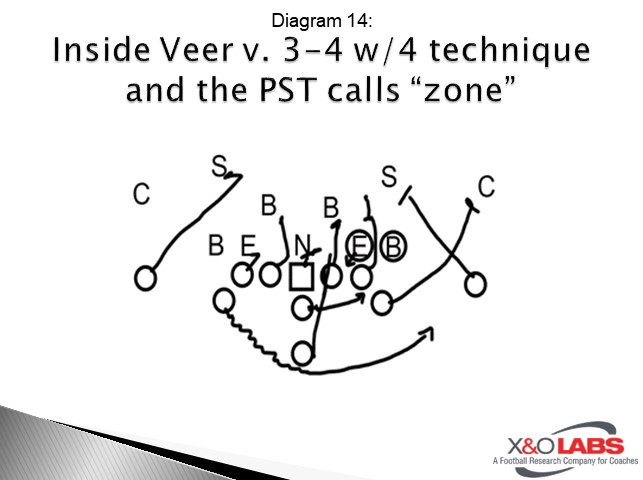
A common defense to this is to pinch the DE (or place him in a 4-technique) to prevent the play side Tackle from getting to the LB, leaving him unblocked and able to scrape over the top for tackles.  Therefore, we have our Tackles make a “zone” call (if they cannot release inside) to signify to the guard he is going to outside release to block the LB (if taken by the G he will climb to the safety).  The play side guard must take a play side zone step up to the LB and the C must also take a play side step to get his head in front of the Nose Tackle.

Diagram 14


To study game film of the Inside Veer concept, click on the video below:

Read More

Flexbone Issue – Case 3: Individual OL Drill Progressions for the Flex Bone Offense

By Pete Llaneza
Offensive Line Coach
Boonton High School (NJ)


Before the 2018 season our head coach, Bryan Gallagher decided to fully commit to the spread option offense developed by Paul Johnson.  In ten games this season we rushed for 3,960 yards.  We scored 44 rushing touchdowns.  We averaged 7.4 yards per carry.  These totals were a big improvement from our 2017 rushing stats.  Part of the reason for our success was due to the talent we had in the backfield. Another reason for our success can be tied to the scheme. There are many teams that run this style of offense and have talented backs but do not have the same type of success. The thing we had, that all teams who run this style of offense successfully have, are five tough guys up front who were willing to work at the details of blocking every day. 

Navy Head Coach Ken Niumatalolo said, “Culture beats strategy all day long. Our culture is the way we come off the fricking football.” I believe our success is based upon the culture of effort, toughness and attention to detail developed during our offensive line individual period. I remind our guys every week, the reason we rush for 400 yards on Friday night is because of the work we put in during our individual periods.  This article will discuss our offensive line individual run block drill progression and how we have developed the Boonton Bomber offensive line culture.


Stance

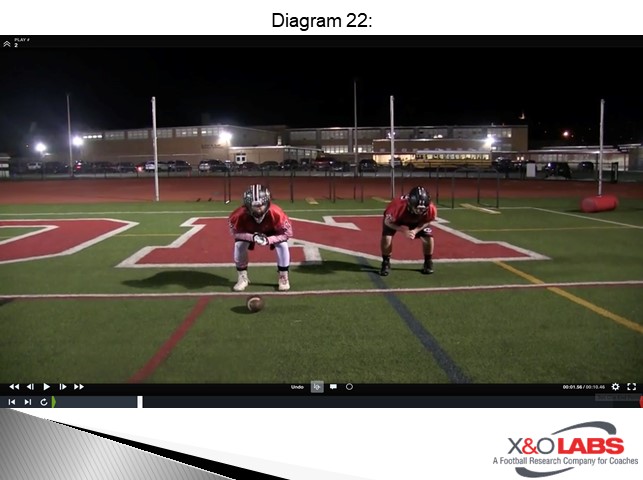
Diagram 22


I am not a coach who wants his guys in a “comfortable stance”.  The stance is the first part of executing a good block.  I want our players to start in a position that will give them the best chance to be successful in executing their assignment.  That stance is usually uncomfortable at first.  As the players become more flexible, the stance gets more comfortable.

In our version of the spread option offense our lineman will have more weight on their down hand than most offensive lineman.  However, we do need to pull, pass set and down block often.  We ask our guys to be in a more balanced stance than most spread option teams and we do not want a stagger. Pad level is a point of emphasis.  We want our guys as low as possible in their stance. The following is the progression we use to teach the stance.  We will do this before each practice at the start of the summer. After a few practices, we will eliminate this portion of practice.  However, we are constantly coaching the stance in other drills.

When we set up the stance progression we align our first team, second team, third team on yard lines.  The centers will align in a row.  The left guards in a row. The left tackles in a row.  The right guards and tackles will also align in rows on the other side of the center. Everyone will do this progression at the same time.  We ask the center to put his toes on the near tip of the yard line.  The guards will take a 3 foot split from the center. The tackles will take a 3 foot split from the guard. We have a split stick to help measure this.  Our split stick is a PVC T that is 3 foot long at the top.  We can lay it down to quickly assess the split of our offensive line. 

We also want our guards to take a vertical split so their helmet breaks the beltline of the center.  This vertical split has many benefits.  The main benefit is it allows our guards and tackles a better chance of reaching a defensive lineman on the backside of scoop blocks.  To get this vertical split we ask the guards and tackles to put their hand down on the yard line that the center has his toes on.


Stance Progression and Technique Fundamentals

  1. Step up to the line in a hip width power stance. Same width as when Olympic lifting. Pigeon toed in, with heals out.
  2. Squat down, shaking hands until forearms touch thighs.
  3. Stretch out down hand out. Right side OG/OT use left hand. Left side OG/OT uses right hand.  Center will stretch non-snapping hand out.  We want to promote forward movement.  Stretching the down hand out promotes that.
  4. Reach hand out until heals pop off the ground. Pinky should be in line with the big toe. All five fingers in the ground. Thumb of the offhand should be under the chin with fingers spread.
  5. Back should be flat and down hand should be out in front of the eyes. Hips should be slightly higher than head.

*** The center will reach out to grab the ball, putting thumb on the top lace.  Center’s arms should be extended.


To study film of this drill, click on the video below:

Read More

Flexbone Issue – Case 4: Weak Side Veer Concepts from Unbalanced Formations

By Nate Teichgraeber
Head Coach
Council Grove High School (KS)
Twitter: @CoachCGBraves


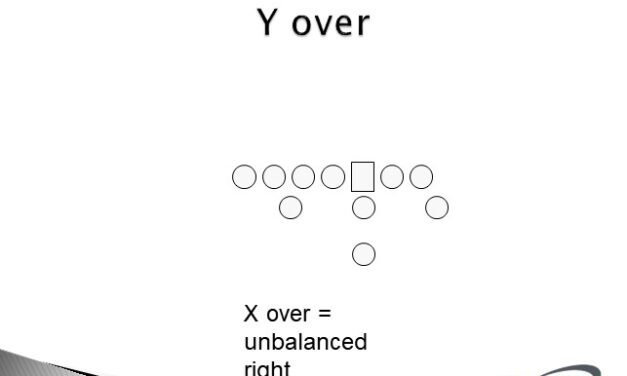
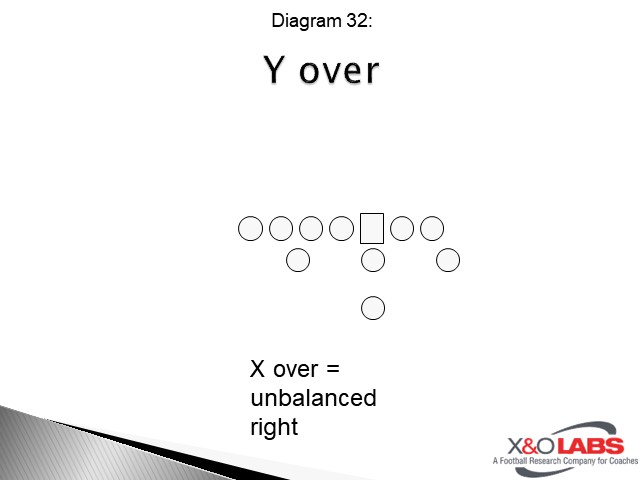
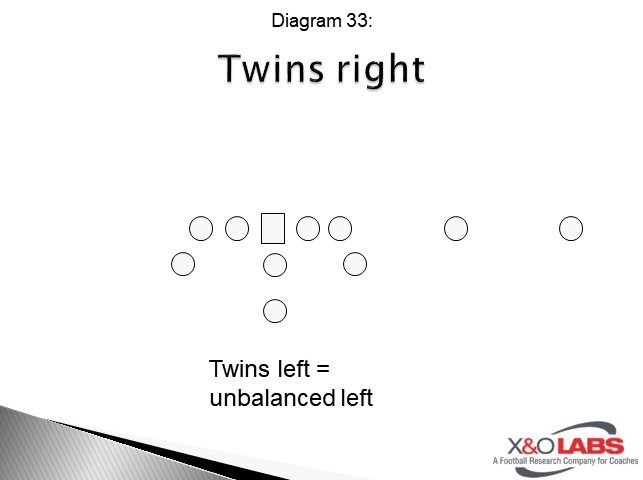
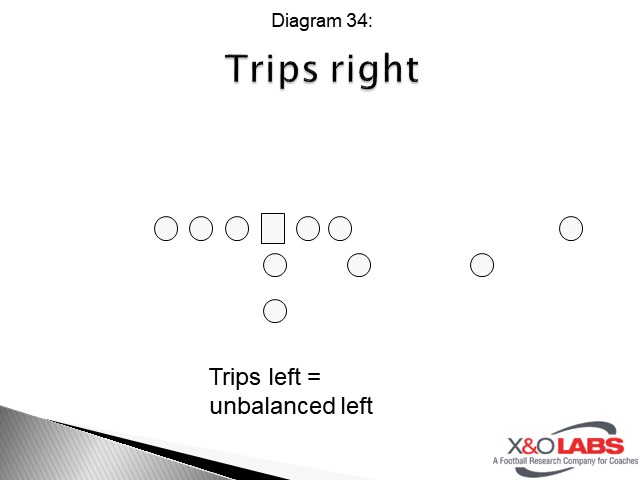
Unbalanced formations in our Flex Bone system presents problems for defenses and how they adjust. We run our core base plays out of unbalanced formations (inside veer, outside veer, midline, zone option, belly, rocket toss, and counter iso) without making changes to our blocking rules and schemes, and we want to run them to both the strong (heavy side) and weak side. Being primarily an option team, we feel unbalanced gives us an added advantage when teams have to adjust by still forcing teams to account for the dive/QB/pitch while still lining up sound to our unbalanced formations. Y over (Diagram 32) Twins (Diagram 33), and Trips (Diagram 34) are (3) three ways we run inside veer triple or double option to the weak side of an unbalanced formation. We are giving the defense a lot of looks to prepare for, and we aren’t changing what we do for our OL. We can modify our blocking schemes to any front with our blocking rules and scheme our wings to block either the force player, high safety, or corner, which gives us a numbers advantage to the weak side of an unbalanced formation.

Diagram 32

Diagram 33

Diagram 34


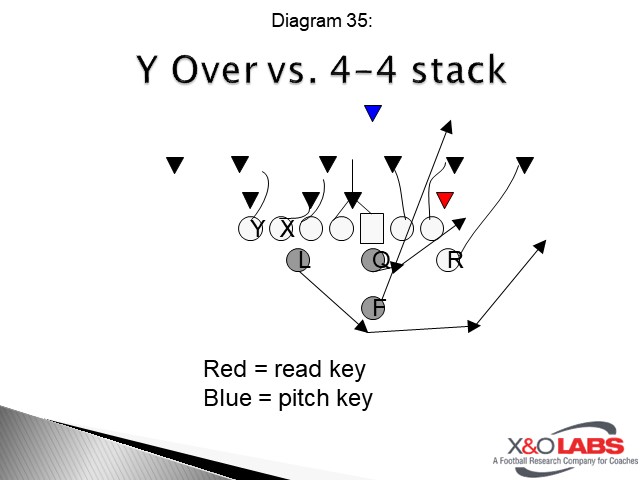
Y over unbalanced weak side inside veer vs 4-4

Diagram 35


  • QB – reading 1st man 4i or + play side.
    • pitch key is called-in from the sideline pre-snap to the QB and play side wing.
    • in this play, the high safety has been designated the pitch key.
  • F – regular inside veer path right
  • R (play side wing) – sideline call to block the corner
  • L (backside wing) inside veer pitch path
  • Y – backside inside veer rules
    • unbalanced TE scoop, climb, and hinges (SCH) inside and tracks to 2nd level
  • X – inside veer rules
    • TOE SS combo block with LT
  • LT – inside veer rules
    • TOE SS combo block with X
  • LG – inside veer rules
    • GOT SS combo block with C
  • C – inside veer rules
    • GOT SS combo block with LG
  • RG – inside veer rules – since uncovered and #1 is read key, track to 2nd level
  • RT – inside veer rules – since #1 is read key, best path release and track to 2nd level


In the clip below, the QB knows the wide 5 will have a hard time squeezing the dive, and our G & T will release w/good angles to LB. Good decision by the QB to give the ball. The play side wing is assigned to block the corner, with the pitch key the high safety. We don’t block very well weak side, or this would have been a bigger play.

Read More