|
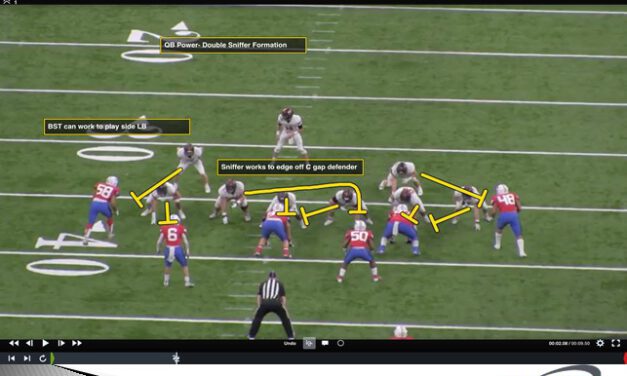
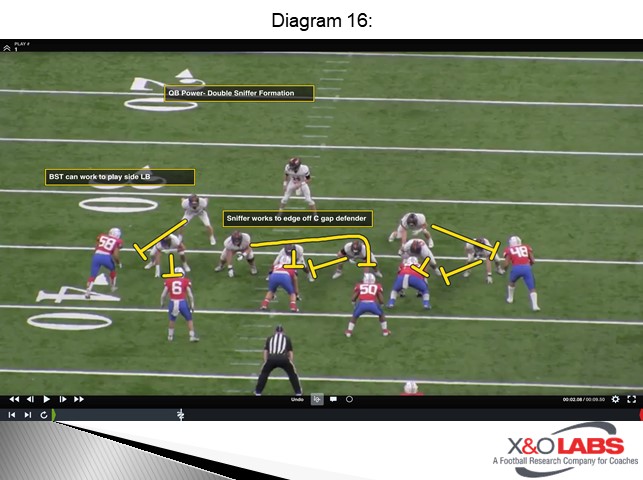
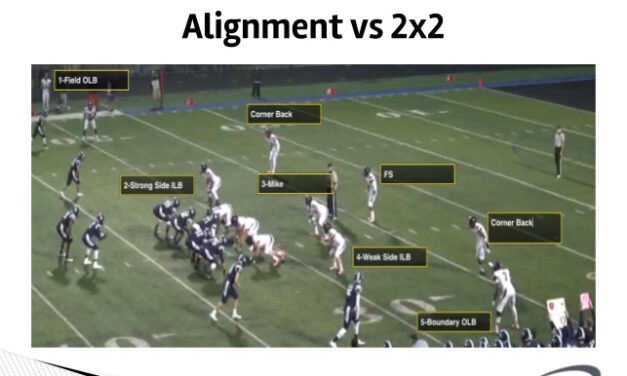
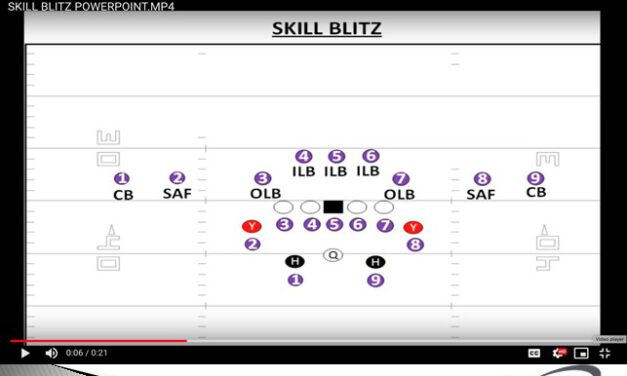
ILB
|
2/4: C Gaps
3: Gap Free
|
2/4: Collision #2 to Hook/Curl
3: QB Spy/ Replace Blitzer
>> X&O Labs Members: Login here to continue reading
Join X&O Labs to Continue Reading…
Plus, get 4 FREE books!
  When you join X&O Labs, you’ll get instant access to the full-length version of this report — including access to everything in The LAB and Film Room. That’s over 4,000 reports and videos. Plus, if you join with a Staff Membership, you’ll also receive 4 FREE books mailed directly to your home or office! When you join X&O Labs, you’ll get instant access to the full-length version of this report — including access to everything in The LAB and Film Room. That’s over 4,000 reports and videos. Plus, if you join with a Staff Membership, you’ll also receive 4 FREE books mailed directly to your home or office!

Read More
By Chip Sorber
Head Football Coach
Geneva High School (OH)
Twitter: @chippers5
Our base run game out of the shotgun consists of more than the following three plays, but we start with them. Each play is a complimentary play to the others. They look the same, have jet motion with them and attack multiple areas of the defense on each play. We can run all our shotgun plays from under center also. We have some subtle variations included in this report to either help break defensive keys, slow down the defensive flow, or provide better blocking angles for our offensive linemen. In 2018, we rushed for over 3,000 yards. We run the ball 85% to 90% of the time. Therefore, we are faced with 8 and 9 and sometimes 10-man boxes each week and we still find a way to run the rock.
Jet Sweep
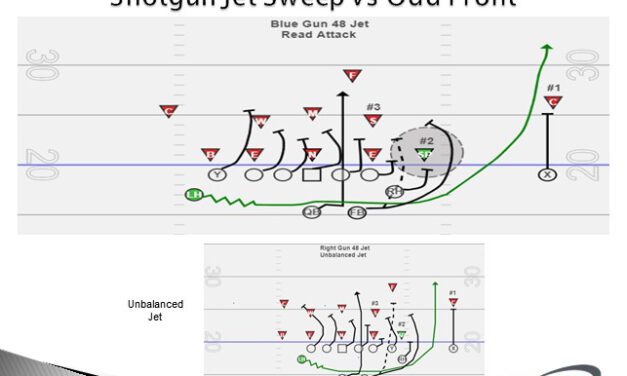
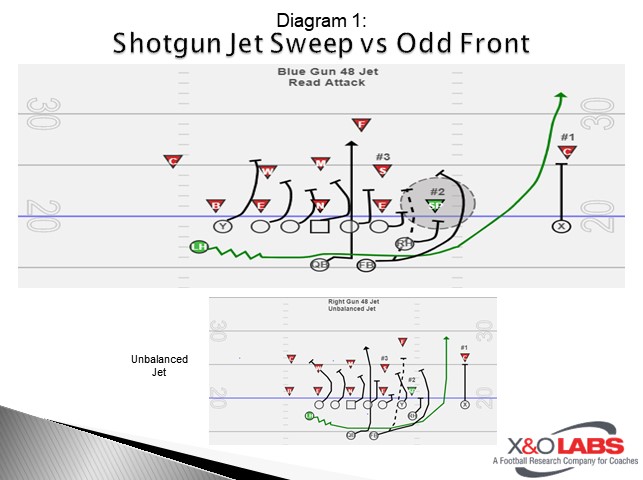
The jet sweep is the first play that we install every year. Nearly everything we do offensively is predicated on jet motion. The jet is our best perimeter play and running it out of the shotgun has allowed us to evolve our traditional Wing T into our Spread Gun Wing T. We ask our offensive linemen to make a realistic block by enabling him to drive his defender outside if that’s the way he wants to go. This is a read attack jet sweep reacting to the blocks as they occur.
Over time, we have observed defenses that react to our jet motion in a variety of ways. They will slant to the jet motion, blitz to the jet motion, roll the secondary to the jet motion or any combination thereof. Sometimes defenses overreact and sometimes they under-react but our goal is to keep them guessing and make them pay for whatever defense they deploy. The strength and success of our jet sweep is because it exists in a series of other plays that help each other succeed. The Jet series plays look very similar to one another while being quite different. When we add some variations to the blocking and backfield schemes our offense becomes a nightmare to prepare for.
Coaching Points
QB will snap the ball when the JET back is in the backside B gap. The QB will mesh with the jet back and carry out his QB Isolation fake. The ball carrier (Jet Back) will follow the block of his FB. The offensive line and play side wingback all take a 45-degree fire/reach step and try to gain outside leverage. If they cannot get outside leverage, then block your man outside as fast and hard as possible. The FB and Jet Back will read the blocks and cut up inside or stay wide and outside. We read attack the #2 defender. The fullback (gun back) is our lead blocker and he must make the correct read on the block our TE or OT make on the #2 defender for his route to block the #3 defender. We do not block anyone from the play side A gap back. The Center, BSG and BST simply cut off backside flow at the 2nd and 3rd level.
X: Stalk block the #1 defender or run off if tagged.
Y: Cut off backside flow at the second or third level.
RH: Block the #2 defender. Try to gain outside leverage but if you cannot then block him outside and we will cut up inside of your block.
LH: Fast jet motion receiving the handoff in the play side A gap. Get to the edge as fast as possible reading the block on the #2 defender and following your FB.
FB: If offset alignments you are the lead blocker on the jet sweep. FB will read our block on the #2 defender to determine if he leads the play inside or outside that block.
QB: Snap the ball when the jet back is in the backside B gap. Meshing with the jet back you will make the hand off in the play side, A gap then continues with a great QB Wham/Isolation fake.
PST: 45-degree Fire/Reach step attempting to win outside leverage. If you cannot get outside leverage drive your man outside and back off the LOS.
PSG: 45-degree Fire/Reach step attempting to win outside leverage. If you cannot get outside leverage drive your man outside and back off the LOS.
C: 45-degree Fire/Reach step attempting to win outside leverage. If you cannot get outside leverage drive your man outside and off the LOS.
BSG: Cut off backside flow at the second or third level cut off backside flow at the second or third level.
BST: Cut off backside flow at the second or third level.
To study game film of this concept, click on the video below:
Editor’s Note: Coach Sorber has provided a clip by clip narration of this concept below:
Clip1: Unbalanced jet into the boundary. We outnumber the defense on both flanks. Great reach block on the #2 defender. We have such good numbers our FB just has to clean up as he leads the play.
Clip 2: Unbalanced empty backfield jet. Defense keeps a 7 man box to defend internal QB run which means they cannot properly defend both flanks giving us huge number advantages.
>> X&O Labs Members: Login here to continue reading
Join X&O Labs to Continue Reading…
Plus, get 4 FREE books!
When you join X&O Labs, you’ll get instant access to the full-length version of this report — including access to everything in The LAB and Film Room. That’s over 4,000 reports and videos. Plus, if you join with a Staff Membership, you’ll also receive 4 FREE books mailed directly to your home or office!
Read More
By Shea Monroe
Offensive Coordinator
Ashville High School (AL)
Twitter: @Coach_Monroe3
We primarily work out of 32 personnel the whole game. In some instances, when we do use “receivers” they are just flexed tight ends. We use these flexed tight ends to create extra gaps and to crack the 2nd level.
The reason: In 2018, I recently took a new position at Ashville High School in Ashville, AL. We are grossly undersized and not very big. My head coach decided that we should adopt a “ground & pound” philosophy, where we could control the clock and keep our defense off the field.
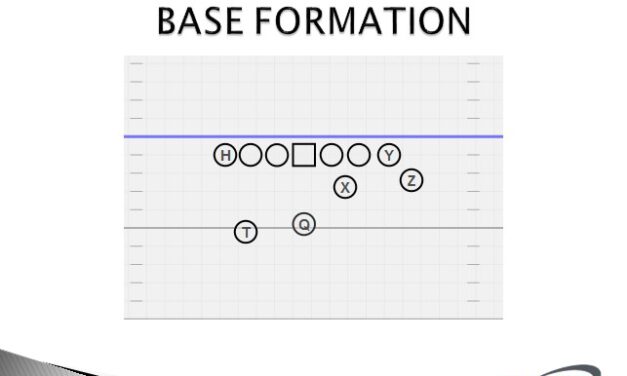
The style of offense we run was made popular of Coach Tim Murphy of Clayton Valley Charter School in California. Basically, the offense featured an exclusive two tight end set with the QB in the shotgun, the TB offset to his right or left, and a fullback and wingback off-set to the right or left. Below is an example:
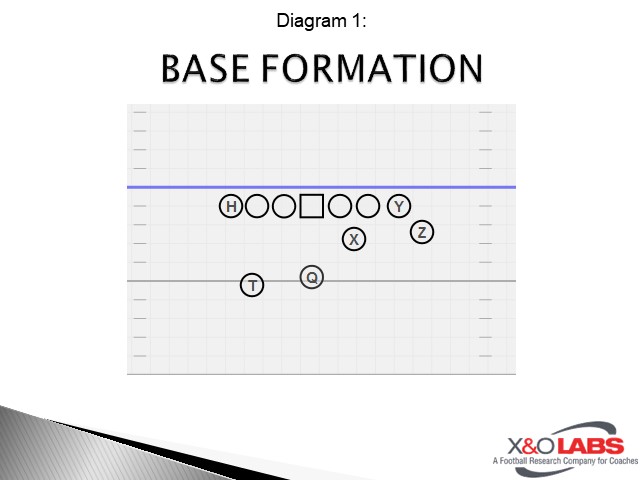
One of the best benefits of going two tight ends is the ability to go unbalanced. We run unbalanced 3 different ways:
- 2-4 (two linemen on one side of the center, and four on the other)
- Tackle Over (TE on the backside)
- End over (Crack alignment covering up a tackle)
As an offensive play caller, I know there are only a few options the defense can do to unbalanced formations:
- They do not do anything.
- They slide down a full man toward the most lineman/WR side
- They roll their secondary
- They walk a linebacker over
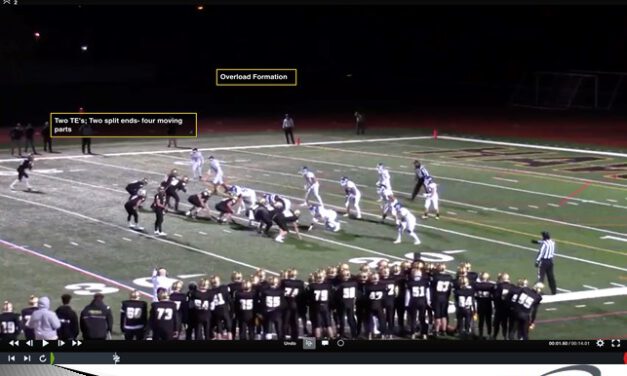
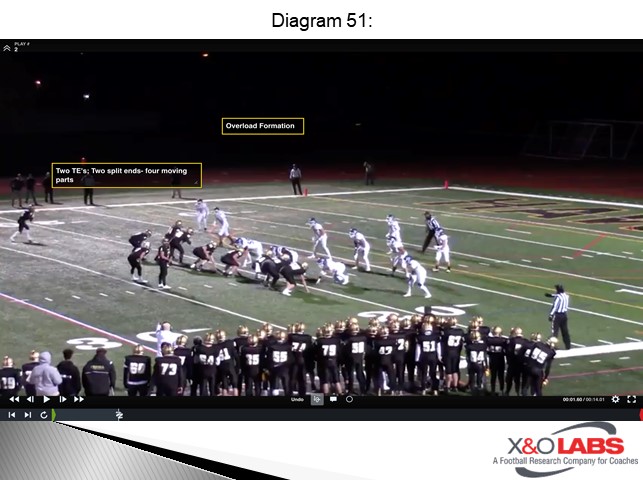
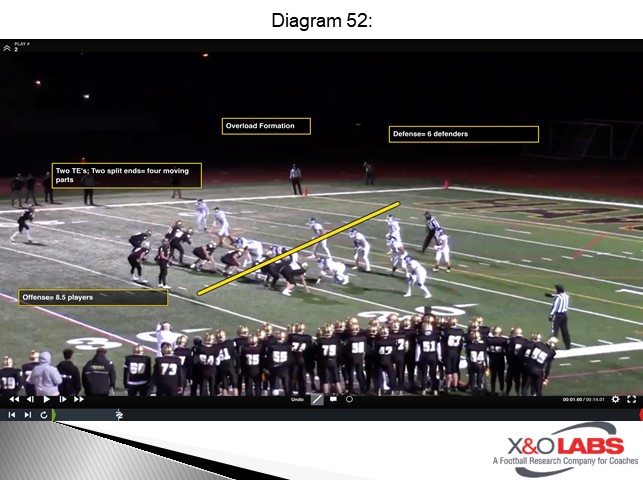
Below are some diagrams of our unbalanced sets:
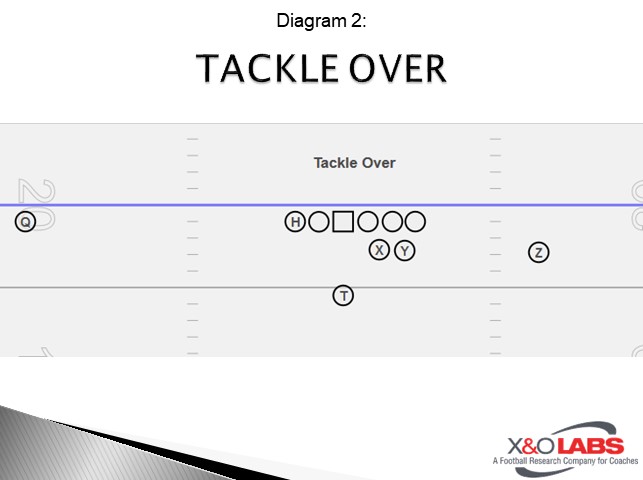
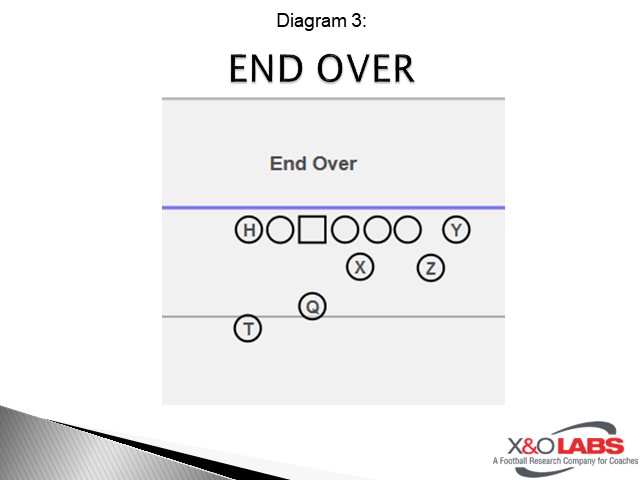
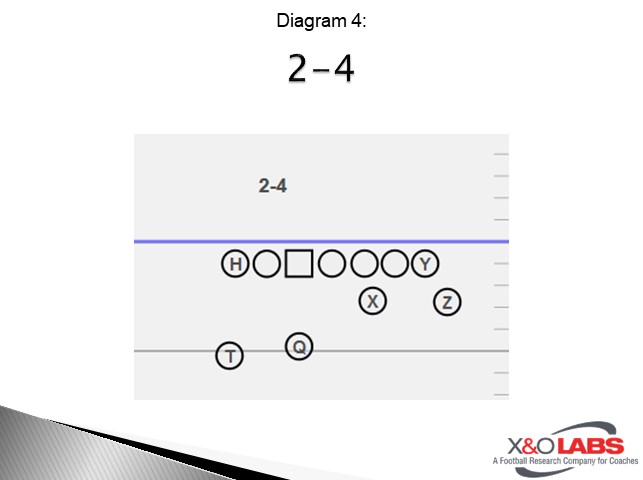
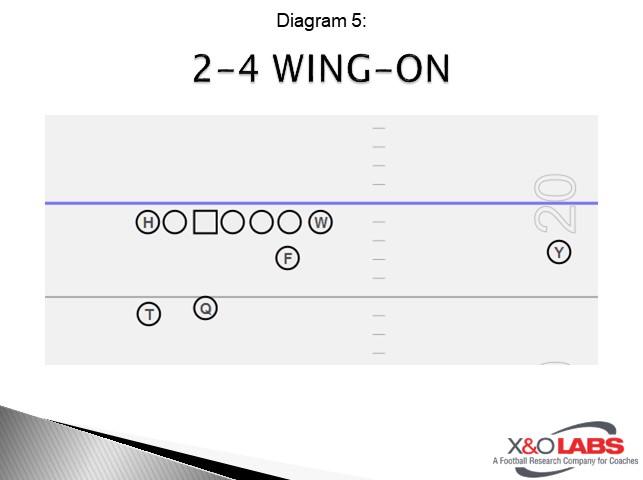
Coaching Points:
From these formations, we really like our QB run game. Running the QB is great because it allows you to be +1 running the football. For example, if the defense has 10 in the box, you will have 11 with the QB becoming a runner. When teaching the quarterback to run the ball in these condensed looks you must tell him a couple different things:
- Be patient (it’s a fistfight in a phone booth)
- Let your blockers get in front (point #1)
- Make 1 cut and get vertical (this is a marathon, not a sprint, at least for us)
>> X&O Labs Members: Login here to continue reading
Join X&O Labs to Continue Reading…
Plus, get 4 FREE books!
When you join X&O Labs, you’ll get instant access to the full-length version of this report — including access to everything in The LAB and Film Room. That’s over 4,000 reports and videos. Plus, if you join with a Staff Membership, you’ll also receive 4 FREE books mailed directly to your home or office!
Read More
By Mark Melnitsky
Offensive Line Coach
Trinity College (CT)
Introduction
The Middle Zone is an excellent complimentary play to the staple run play in our offense, Inside Zone. With a wider landmark, the Middle Zone play provides us with an effective way to potentially run the ball outside the tackles. It is a play we run from a wide range of personnel groups and formations. We are also equally comfortable running the play from under center or in the shotgun. This past season, the play was very productive for us as evidenced over our eight games where we ran the play 77 times and netted 512 yards for a 6.6 yards/play average. In addition to being an efficient play, Middle Zone provided our offense with the ability to generate a good number of explosive plays (plays that gain at least 20 yards) on the ground.
The genesis of the play in our offense took shape several years ago when we were primarily a one-back, three-receiver offense. From that personnel group, our two primary run plays were inside zone to the two-man surface and one-back power to the three-man side. Occasionally we ran an Outside Zone concept to the three-man surface. However, the Outside Zone scheme required one of our receivers make a crucial, point-of-attack block on the alley defender.
More often than not, that block was a mismatch for us, with a receiver being asked to hold up for several seconds against an outside linebacker. With the tight landmark of our inside zone play (outside leg of the guard), the only way we could consistently run the play at the three-man surface and control the end man on the line of scrimmage (E.M.O.L.S.) on the backside would be to motion a receiver over to cut him off or to have the QB read him. Having the receiver motion over to cut off the E.M.O.L.S. made us relatively predictable. Additionally, our quarterback was not very athletic, therefore we were not inclined to invest in a read scheme.
This being the case, we decided to merge concepts of two plays in our offense, Inside and Outside Zone, to create a new play – Middle Zone. In a nutshell, we widened the Inside Zone landmark for the running back to the outside leg of the tackle. We kept the blocking scheme for Middle Zone the same as our Inside Zone play. However, we employed the techniques of our Outside Zone for our offensive linemen and tight ends. We kept the read for our running back the same as it is on Inside Zone. We just bumped it one defender wider. For instance, in the case of an even front, instead of reading the front-side 3 Tech to the backside Nose, we had him read the DE to the 3 Tech. In doing so, we made the backside E.M.O.L.S. much less of a factor, eliminated the match-up issues for our receivers, and added a “new” play to our offense using concepts and techniques our players were familiar and comfortable with.
MIDDLE ZONE RULES
QB: If under center, step with play-side foot at 10/2 o’clock. Race ball to mesh point at depth of approximately 5 yards. After handoff, execute boot fake opposite the run play. From the shotgun, extend ball in front, secure exchange, and execute boot fake opposite the run play. From the shotgun, we can also ‘tag’ the play and have the QB read a backside defender to determine whether to hand the ball off or keep it.
RB: Lead step, crossover, and chase the outside leg of the tackle. Stretch the ball wide, aggressively chase the landmark, and “crease” or “bounce.” The read is the E.M.L.O.S. to the first front-side down lineman inside. If the first read is reached, bounce the ball outside. If the first read (E.M.L.O.S.) does a good job containing the play, look to crease the ball underneath the first read. You now must make a quick determination where your second read (down lineman) is and hit the underneath crease accordingly.
FB: If “Boss” (Back on Support), arc release for alley defender. If “Lead” read the PST’s block to determine best path to block playside ILB.
PST: Zone playside C gap. If covered, either combo scoop with PSG to playside ILB or reach defender solo. If uncovered, combo scoop with TE to alley defender.
PSG: Zone playside B gap. If covered, combo scoop with C to playside ILB or reach defender solo. If uncovered, combo scoop with PST. C: Zone playside A gap. If “Odd” front, combo scoop with BSG. If “Even” front, combo scoop with PSG to playside ILB or MLB (If ‘43’ front).
BSG: Zone cutoff backside A gap. If “Odd” front, combo with C. If “Even” front, backside combo with BST to backside ILB. Look to cut on the 2nd level.
>> X&O Labs Members: Login here to continue reading
Join X&O Labs to Continue Reading…
Plus, get 4 FREE books!
When you join X&O Labs, you’ll get instant access to the full-length version of this report — including access to everything in The LAB and Film Room. That’s over 4,000 reports and videos. Plus, if you join with a Staff Membership, you’ll also receive 4 FREE books mailed directly to your home or office!
Read More
By Rob “Tog” Paschall
Offensive Coordinator
Carrolton Creekview High School (TX)
The Veer and the Power are not often seen as complimentary. The Veer has its loyalist within the option football community while the Power is seen as the basis of “big boy football” that doesn’t rely on deception to trick the defense. Dig a little deeper and you will find that there are quite a few similarities between these two schemes. In fact, we have found that the similarities in technique and look to the defense actually make them the perfect compliments within our scheme.
Why Veer AND Power?
Our staff has all come from various styles of offense, with varied ways to attack a defense. When I came here and was made the offensive coordinator we started to have meetings to figure out where we wanted to take things. I had the basic system in place having been a coordinator in Texas High school football for years, but have always wanted the staff to have some buy in with the thinking that more input=more output. When I met with our head coach, Jay Cline, and the rest our offensive staff, my goal was to have a truly collaborative effort that we could put in to develop our offensive system. Here are the basic tenets of our offense that we landed on.
- We needed to be adaptable to the talent on hand. Our offense had to be modular to allow us to keep and teach a system over the years, yet adapt it to the wildly varying talent levels on the team or in specific position groups we see at the high school level from year to year.
- We were going to be physical. This is not dictated by the formation. It is more of an attitude and “what you will accept as a coach” thing. We wanted to run power.
- We were going to be balanced, or at least have a semblance of balance.
- We wanted to be able to do all of the above and keep things simple for the offensive line while being able to pyramid teach our system. In other words, we wanted to be able to make it look complicated for a defense, be easy, cheap, and effective for our kids, and allow us enough answers in our x and o’s toolbox to be able to attack whatever fronts or personnel issues we see.
We were going to be a vertical push zone team with our offensive line as that was my background and what I believe in as a sturdy system to allow any offensive line, regardless of talent to have some success. With this, we were going to have the ability to rotate our combos with a simple tag. When we rotate our combos to the backside linebacker we can insert someone, either an H back, wr, fullback, or an offensive tackle on that linebacker. We can also read that same guy in the gun.
With this basic vertical zone combo style in place. We can then adapt in a modular way from inside zone to read, insert, counter insert, filled read, dashed read, and veer where we read the unblocked de on the frontside of the combo rotation. We can add all sorts of window dressing on top of the zone to make it look more complicated than it really is. When we block veer, we treat it as a backside rotate zone, with the psot as the “insert” guy. We can run veer as a triple, but usually run it as a double option.
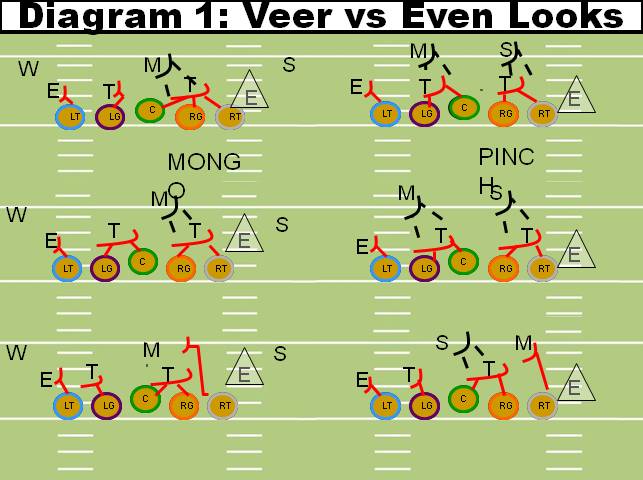 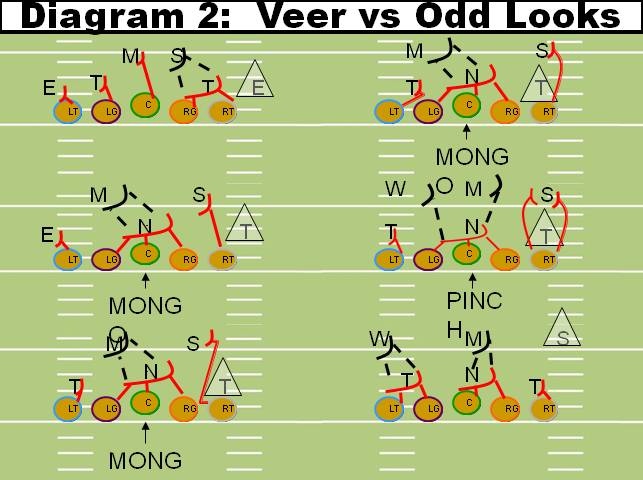
>> X&O Labs Members: Login here to continue reading
Join X&O Labs to Continue Reading…
Plus, get 4 FREE books!
When you join X&O Labs, you’ll get instant access to the full-length version of this report — including access to everything in The LAB and Film Room. That’s over 4,000 reports and videos. Plus, if you join with a Staff Membership, you’ll also receive 4 FREE books mailed directly to your home or office!
Read More
By Justin Roper with Mike Kuchar
Quarterbacks Coach
University of Northern Iowa
Twitter: @Justin_Roper
Editor’s Note: At the time of this interview, Coach Roper was in his third year as the offensive coordinator at Slippery Rock University (PA). After a 2018 season that has produced an 11-3 record and a trip to the Division 2 quarterfinals, Coach Roper has now been appointed as the quarterback’s coach at Northern Iowa University
Justin Roper had big shoes to fill when he first arrived at Slippery Rock University in 2016, the “Rock” was coming off a year where it averaged 45 points and over 600 yards per game under the direction of then offensive coordinator Phil Longo. Coach Longo, now the offensive coordinator at the University of North Carolina, set up an Air Raid system and when Coach Roper took over, he was the only new face on the staff. Coach Roper’s dad Brad coached at Georgia Tech in the 90’s and Justin had only been a position coach for two years at Valdosta State University before being named an offensive coordinator. This was a challenge in itself and Coach Roper put the onus on himself to learn the already established terminology rather than create his own.
“We were going from an Air Raid based offense to a spread based system,” he told us. “You organize your priorities in what is important. What we called things is not important. That doesn’t matter. What is important is how routes are run and what are we trying to accomplish. That stuff I can tweak to my liking while keeping the base structure the same. The teaching and the purpose of teaching is the same thing.”
MK: Describe the process you use when evaluating the incoming talent when taking over a program.
JR: “I watched the entire previous season straight through with no cutups without the other staff because what I wanted to find the pure identity of what that offense was. I researched what they did really well? What were the weaknesses? What that allows you to do is I can sense what they were really good or bad at rather than think what they were good or bad at. I noticed our wide receivers were the best blockers I’ve ever seen. That’s an unbelievable strength. Then when you talk to your staff about how they use their positions and the talent that is returning. Then your morph that into how you want to use them. You understand the positives and negatives of what you have. The next step is to talk to the staff about the positives and negatives of what they think they have and then you see what matches up.
I think it’s important to let your staff teach you what they did well the season before. I’ll first stress our identity, which is to play fast and execute. From there, I asked position coaches to teach me how they taught the run game. This does two things: one, it gives you the ability to assess their talent to convey information as coaches and two it lets you understand how things were communicated to the players and what needs to be kept the same or what you can adjust. It also provides ownership to the coaches. You might have the inclination to say ‘I want to do things this way and the success is warranted, but I can’t beat people over the head telling them what I want to do. Listen to what they did so they feel that they have been heard. But make it known that l has the overriding say on things.”
MK: After assessing the personnel, how do you go about fitting your scheme around that personnel? Is this a selection process of which concepts should be utilized with that personnel?
JR: “I was going from an Air Raid to a spread system. The basis of the system that I was taking over was one that valued quickness and making people miss in open space over anything else. All the running backs were smaller- 5’7 and the slots were 5-8 or 5-9 that were really good at making people miss in space. The Air Raid system was all set up to be receiver friendly. Not sure how many of them played QB. What I do in a spread system, everything is based on the QB read. Because that is the hardest thing. I base everything on spots on the field and we read defenders, not necessarily a progression. We read defender to defender. The receivers just get to a spot on time. We tell those receivers to get to the spot any way they can. It gives receivers more freedom and lets the quarterback understand what the defense is doing. We read defenders eyes, intent and body language.
>> X&O Labs Members: Login here to continue reading
Join X&O Labs to Continue Reading…
Plus, get 4 FREE books!
When you join X&O Labs, you’ll get instant access to the full-length version of this report — including access to everything in The LAB and Film Room. That’s over 4,000 reports and videos. Plus, if you join with a Staff Membership, you’ll also receive 4 FREE books mailed directly to your home or office!
Read More
By Micah Adams
Defensive Coordinator
Waukesha South High School
Twitter: @GridironAdams2
Introduction
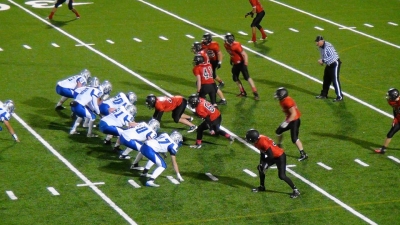 At Waukesha South, our team has seen a great deal of improvement in the past two years. Led by Head Coach Dave Rusch, our defense promotes an aggressive, attacking style of defense that causes turnovers and creates confusion in opponents. At Waukesha South, our team has seen a great deal of improvement in the past two years. Led by Head Coach Dave Rusch, our defense promotes an aggressive, attacking style of defense that causes turnovers and creates confusion in opponents.
The way we look at it, a confused player is a slow player. So the more we can make the offense think, the slower they operate and the more chances we will have to make big plays and create turnovers. One of the key elements of the disruption we cause on defense has been the implementation of a Psycho package.
Defining the Psycho Package
For us, the Psycho package is a scheme that utilizes a front that does not give players specific places to line up. Instead, the defensive front players are encouraged to continually move during the quarterback’s cadence in an effort to disguise their assignment on any given play. The idea of the Psycho packaged was derived from similar ideas used by Dom Capers of the Green Bay Packers and Nick Aliotti of the Oregon Ducks.
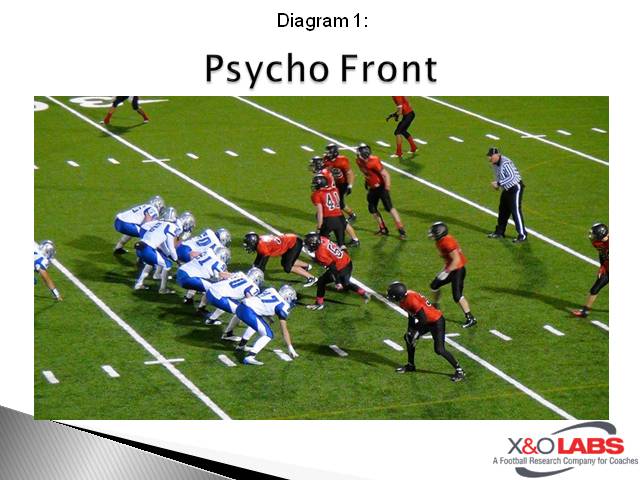
Using a front based on movement requires finding players that are mobile and aggressive. Larger, slower players would not be able to quickly change directions in order to be in the right position at the snap of the ball while moving during the cadence. By having the right type of players on the field that can make the athletic moves required, our kids are better able to truly disguise whether they are blitzing, dropping into coverage responsible for a gap in the run game or contain on any given play.
In many ways, the use of quicker players in this system plays into our strengths as a program. South is blessed with many exceptionally gifted athletes and lots of tough kids who are passionate about football. However, we struggle at times to find the requisite size on our lines to compete in the highly competitive Classic 8 Conference, which many call the best conference in the state of Wisconsin. The Psycho package is part of our answer to this lack of size.
The key to implementing an entirely different scheme was to keep players involved in situations that they most often experienced in their roles in our base 4-3 defense as well. For example, if our Whip linebacker often was dropping into the weak side flat, his Psycho position would ask him to do that at times as well. This made the install of the Psycho package “inexpensive” in terms of practice time as the kids were often already practicing the things that they would need to do in their Psycho role.
>> X&O Labs Members: Login here to continue reading
Join X&O Labs to Continue Reading…
Plus, get 4 FREE books!
When you join X&O Labs, you’ll get instant access to the full-length version of this report — including access to everything in The LAB and Film Room. That’s over 4,000 reports and videos. Plus, if you join with a Staff Membership, you’ll also receive 4 FREE books mailed directly to your home or office!
Read More
By Jeremy Plaa
Head Football Coach
Thomas Downey High School (CA)
Twitter: @JeremyPlaa
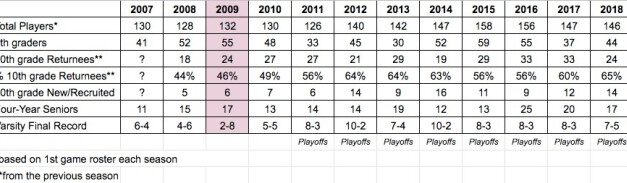
After taking over the program twelve years ago, it took me a couple of seasons before realizing we needed to fix the issue of retaining players. We had to reinforce the mentality with our lower-level coaches that we wanted them to enjoy their football experience and wanted to play again the following year. Every head coach knows this but having solid lower level coaches is really the foundation of any good program. The kids retained and the kids recruited slowly started to improve, but it was a process that took time. It is one of the main reasons I believe continuity is so valuable with a coaching staff- so that we can learn from mistakes made and finding more efficient ways to get things done. We learn better practices every year and attempt to improve every year.
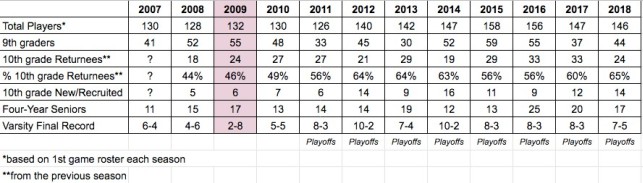
Our participation study showed two things: 1) improvement doesn’t happen overnight and 2) at some point your program will likely hit a participation plateau. The key to growing your program is you cannot rest when you hit that plateau. We work as hard as ever with looking for athletes at our school, and retaining them when we find them. While our numbers have stayed pretty constant the last few years, our program accrues playoff experience and the expectation of success with each winning season. Below, you will see the quantifiable increase in numbers in our program over the last twelve seasons.
As football is more popular than ever at the college and professional ranks, concussions have scared away not only parents of high school kids, but also kids at the youth level. Kids themselves even seem to be constantly reminded of the dangers of football. As coaches already know, all the benefits of football far outweigh the risks. As coaches, it is our job to not only promote our sport but to do our best to entice as many kids as possible into our school’s program. We are constantly looking for ways to increase our signups and retain the kids we have in our football program. This article will list all of the ways we have “got them out for football, and kept them in the program.”
Recruiting your hallways is not a once-a-year thing. It is an all-the-time thing. Recruiting your hallways could be between classes, in your class, or before and after school. Obviously, the more coaches you have on-campus, the easier your job. But even if you are not lucky to have that situation, you can still reach out to teachers on campus to help promote your program. Build bridges there and you will surely see the benefit.
Our staff is always on the lookout to identify students we should approach about playing football. We are a 9-12 high school and we spend most of our on-site recruiting effort on our freshman class. We feel like they will give us the biggest return for our effort, and have the chance to be in our program for three years. We feel like we can have as big of an impact on them as they will on the program. We are not against recruiting any grade level, but in terms of time management, we like to spend most of our time on each year’s freshman class.
We also get a monthly report from our attendance office of students who have transferred into and out of our school. Occasionally we will find a young man whom we can get tied into our program, and that, of course, would help him get acclimated to the school more quickly as well. If you don’t get this type of report, make friends with someone in the attendance office and ask if you can check in occasionally to get a report like this. With the data systems our schools have, it probably isn’t difficult to get this done.
Step 1: Recruiting the Physical Education Teachers:
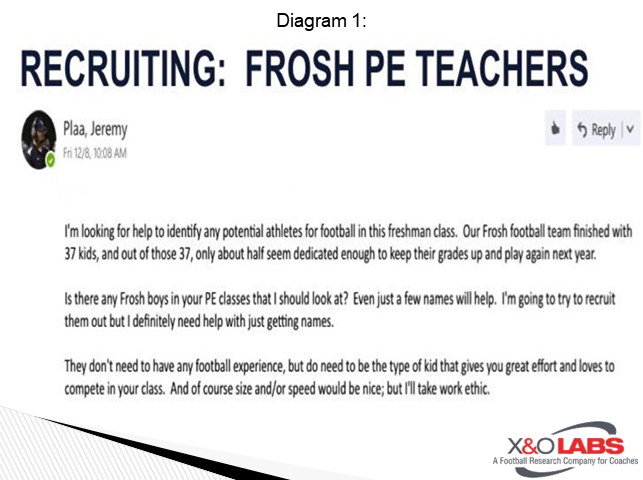
We will start our cycle for next season as soon as the off-season begins. The first stop for us is our PE teachers. In December of each year, we will send them an e-mail that will ask them to identify any or all kids that they think would be good for football. We ask for work ethic first, and talent is secondary. They will always identify at least a few kids that will make a difference in our program, but of course, make a bigger difference in their own lives for joining a team environment that football provides. December is a good time to ask the PE teachers because this has given them a few months to identify the kinesthetic kids that excel in class. I will usually follow up with in-person conversations with those teachers, and giving them a t-shirt as a thank you for helping our program out is always good practice.
Depending on how helpful your school’s PE teachers are, you can also use your school’s attendance/grading system to look for potential players. We have a data system that I can filter all of the male ninth-grade students, and I can look at their first quarter grades as well as a school picture of each student. The student’s picture could give you a small clue, but the bigger reveal is the student’s grades. In the past, I’ve looked for students that get good grades in PE, and struggle in their academic classes. These kids are surely kinesthetic learners and would probably enjoy afterschool sports. These students probably NEED afterschool sports. The extra guidance of a football coach could be just what that young man needs to improve as a student to be a part of the football program. They are easy recruiting targets and should be discussed with their PE teacher if the PE teacher didn’t already alert you about the student. Another reveal is a student that gets all good grades but doesn’t seem involved with many other programs at the school. Our school is typical of most, and offers music, drama, agriculture, and of course other sports; but sometimes you will find a student that does very well academically but has not otherwise tied into the school’s afterschool activities. Students that get good grades are going to be more reliable and will likely reflect well on your program’s reputation and emphasis on the academic part of the “student-athlete.”
>> X&O Labs Members: Login here to continue reading
Join X&O Labs to Continue Reading…
Plus, get 4 FREE books!
When you join X&O Labs, you’ll get instant access to the full-length version of this report — including access to everything in The LAB and Film Room. That’s over 4,000 reports and videos. Plus, if you join with a Staff Membership, you’ll also receive 4 FREE books mailed directly to your home or office!
Read More
 By Will Pluff By Will Pluff
Defensive Coordinator
Utica College
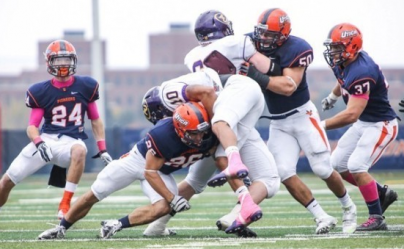
At Utica College we are a base 4-3 defense and run Cover 3. Our philosophy is to have a base defense that is strong from the inside out keeping terminology consistent to allow our players to play as fast as possible We align to the field or the formation strength if the ball is in the middle of the field. We do not use the traditional “Strong Safety” but instead align two linebackers primarily in the box and one out in space rotating our weak side safety down to get us to Cover 3. This is the first way we teach our players to get to an 8 man front.
BASE COVER 3 RUN FITS USING THE 4-3
Before I get to the run fits for the linebackers and secondary I think it is important to cover a few basics of how our defensive line plays in the 8 man front. Our defensive linemen are coached to read the offensive linemen for block recognition and strike their shade low to high as quickly as they can. They should be working to take two quick steps to create a new line of scrimmage. We ask that our defensive line makes plays that come to their gaps by using an escape move. We will also slant our defensive line, they will use a 45 degree slant step working penetration of their gap. Longsticking is a common term which we call “slicing,” this is a two gap movement. Our last defensive line adjustment has them hit their gaps getting to the heels of the offensive line.
When installing Cover 3 with the linebackers and secondary we stress their run fit and knowing how Cover 3 works against the run. We have words that tell the players what their run fit is and this run fit tells them their pass responsibility. When we say 8 man front we want our players to picture two “Force” players, two “Fast” players, two “Secondary Contain” players, and one “Alley” player. The outside players are working the ball back inside and the inside players are working the ball outside.
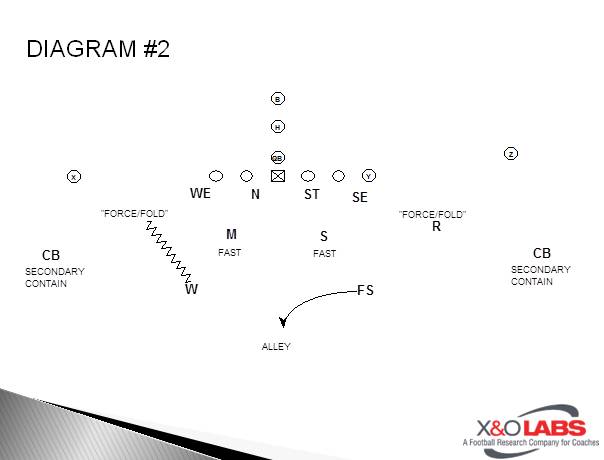
In our base defense we adjust our linebackers alignments to 3×1. This is common to do while running Cover 3 to help since the alley for the runner to hit inside of the force player can be displaced by the receiver’s splits.
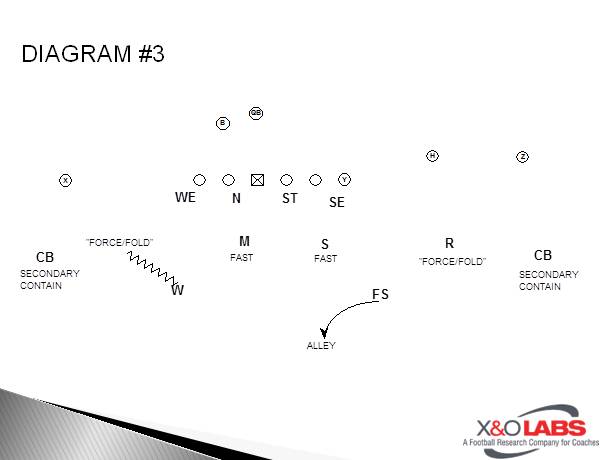
It is very important for the players not only to know their run fit but know what it means. The run fits stay the same but the players performing them can change as we start to roll to Cover 3 different ways. The run fits also stay the same when we are running our 3 Under 3 Deep. Since we keep the run fits consistent in the majority of what we do this gives our players less to think. We, as many other teams, want our defense to play as fast as possible and teaching run fits this way in the 8 man front has allowed us to do that. The following list of words and definitions is what we show the players at the very beginning of camp.
“FORCE/FOLD”
-RUN TO- Make the tackle or turn the ball inside
Fast Flow to: Attack the ball and make the tackle, attack any lead blocker with inside shoulder keeping outside arm and leg free (outside leverage) “Forcing “ the ball back inside.
Slow Flow to: Stack on DE keeping shoulders square having the ability to play from the outside in, waiting for the ball to commit to the line of scrimmage. Play the ball if it bounces outside or fold downhill into the formation if the ball hits inside.
>> X&O Labs Members: Login here to continue reading
Join X&O Labs to Continue Reading…
Plus, get 4 FREE books!
When you join X&O Labs, you’ll get instant access to the full-length version of this report — including access to everything in The LAB and Film Room. That’s over 4,000 reports and videos. Plus, if you join with a Staff Membership, you’ll also receive 4 FREE books mailed directly to your home or office!
Read More
By Mike Kuchar
Senior Research Manager
X&O Labs
Twitter: @MikekKuchar
In this case, we will expound upon the coverage responsibilities of defenders in these replace pressures. Remember, the base coverages will only be one of two concepts, Cover 3 or Cover 2, but the difference in these pressures is that it’s unknown, particularly to the opposing quarterback, which defenders are responsible for which zones because they can change from play-to-play.
According to Coach Toney, this the safest way to pressure the quarterback, because a defense can get seven defenders in coverage. And the beauty is those defenders will change from snap-to-snap. “When running a replace pressure, you are still playing traditional coverage,” he said. “We are playing either four under three deep zone (Cover 3) or five under two deep zone (Quarter, Quarter, Half). Being able to play traditional coverage while still being able to bring pressure maximizes your time coaching. Since you are running the same coverage you play on base downs, there is minimal new learning for your players, which allows them to rep and become proficient at the techniques, pattern reads and matches of the coverage. The other added benefit is that the presentation of the coverage looks drastically different to the opposing quarterback, because different defenders are dropping into the underneath zones and different rushers are coming. So, while it may be simple for us, it’s still difficult for the opposition.”
According to Coach Toney, utilizing replace pressures gives you the ability to call them in all down-and-distance situations. “For example, in third-and- medium situations, most offensive coordinators are trying to get the ball to the sticks,” he said. “So, defenses are mainly seeing quick-rhythm short routes in which three deep replace pressures wouldn’t be the answer. Yet if we want to run those pressures, we have other coverages to pair them with, so they can be used in those situations. Conversely in long yardage situations, we like using our two deep and three deep zone replace pressures to protect the seams and verticals, which forces the offense to check the ball down short and outside and we can rally to and tackle in front of the sticks. This versatility has allowed us to go into games running the same pressure patterns from four or more different versions of coverage as well as allows us to keep our game plan simple for the front and allow the secondary to adjust to the down-and-distance situations by coverage.”
Communication System for Pressures
Part of the challenge in devising pressure packages is making sure the language is aligned. One flaw in communication can produce big plays for the offense. This is why Coach Roberts and the defensive staff will marry each of these pressure concepts with words that denote the corresponding coverage. The four replace pressure concepts are classified below:
Editor’s Note: All of the following pressure concepts are detailed further in this report.
“Smoke” Pressures: These are boundary (short side) pressures. The coverage is a single safety coverage (cover three) with weak side rotation.
“Fire” Pressures: These are field pressures. The coverage is a single safety coverage (cover three) with strong side rotation.
“Weak” Pressures: These are middle pressures. The coverage is a single safety coverage with middle rotation. Strength is called to the field.
Two-High Pressures: These are middle of the field open pressures, where mostly an interior linebacker will add onto the pressure pattern. Coverages can vary between two-read or cloud principles.
Base Three Deep, Four Under Coverage Responsibilities
In order to teach the zone coverage unilaterally, defenders must know the base rules of each underneath and deep defender. Regardless of the zone they are responsible for, each coverage defender is asked to look at the QB with “zone eyes,” which is different than pure pattern match principles. It’s all centered around the intent of different defenders dropping into unknown locations to get tip balls or interceptions. Since the Cajuns teach a spot drop, not pattern match principle, all coverage defenders must abide by the golden rule: Anything the quarterback tells you as he’s dropping is bulls**t, once the backfoot hits the ground it’s a reality. And with four unidentified flying objects come directly in his face, the QB will usually need to shorten his drop. So, when the quarterback shortens his drop, so do drop defenders. They often don’t need drop that far before the ball is released, or the whistle is blown on a sack.
In any of the above three deep, four under coverages, the following zones must be accounted for:
- Outside Third (2 defenders)
- Deep Third (1 defender)
- Curl/Flat (2 defenders)
- Hook (2 defenders)
Outside Third Defenders: While outside third defenders will usually be the corner, or Weak safety in boundary pressures, they will play off 1×8 off the number one receiver or will press bail to look like man coverage. Their primary key is through the number two receiver to the QB. “He will start in a walkout technique,” said Coach Toney. “His is secondary key is the release of number two. If number two is in the seam, he will get depth on his divider, which is one yard on top of the numbers if he’s a field corner. If he’s the boundary corner the divider is apexing the numbers.” Once the ball is snapped, these defenders are asked to play with complete vision on the quarterback. “If number two is anything non-vertical (which means in our out) he will nail down and play loose man on number one,” said Coach Toney. This is essentially “MOD (man over the depth of LBs)” in Coach Nick Saban’s terms. “He will play loose man over the depth of linebackers on number one. Anything underneath he will zone the third and look for work coming back to him.”
>> X&O Labs Members: Login here to continue reading
Join X&O Labs to Continue Reading…
Plus, get 4 FREE books!
When you join X&O Labs, you’ll get instant access to the full-length version of this report — including access to everything in The LAB and Film Room. That’s over 4,000 reports and videos. Plus, if you join with a Staff Membership, you’ll also receive 4 FREE books mailed directly to your home or office!
Read More
By Mike Kuchar
Senior Research Manager
X&O Labs
Twitter: @MikekKuchar
As potentially elaborate as the simulated pressure scheme may be, its efficiency lies in drilling the fundamentals of both the cover defenders and rush defenders. Teaching simulated pressures require teaching defenders to perform skills that they are not accustomed to performing. In order to get this done, coaches must spend time working various defenders through each of these responsibilities. Louisiana State University defensive coordinator Dave Aranda, who is credited for bringing the scheme to the NCAA level, credits the Baltimore Ravens as the model in the NFL for being efficient in switching jobs through the season and modeled his three-day installation after that blueprint. “On day one linebackers will do linebacker things, defensive backs will do defensive back things and bigs will do the defensive line things,” Coach Aranda told us. “Then in day two, the linebackers will switch with the defensive backs and in day three the linebackers will switch with the bigs. This way, everyone’s role is switched. Simulated pressures give you that ability. The coverage will always be the coverage, it’s the specific defenders that are executing that coverage that will constantly change.”
While we may not be able to document all of the drill work that the Ravens work through on daily, we are able to provide practice film of how both Coach Aranda and University of Louisiana safeties coach Patrick Toney teach their players the rush and cover concepts infused in these pressures. We segmented our research into both rush and coverage drills.
Coverage Drills
Curl/Flat Drill Progression (University of Louisiana):
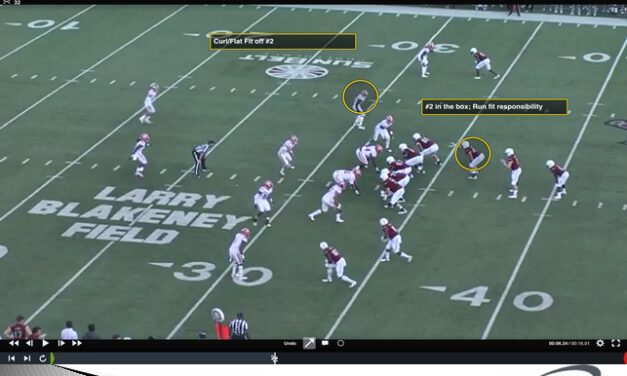
In three-deep simulated pressures, there will be two curl flat defenders who will be asked to reroute the number two receiver if he’s vertical or look to get underneath the number one receiver if there is no other vertical threat. And because these curl/flat defenders can either be interior linebackers, outside linebackers or safeties in this system, Coach Toney will rep all potential curl flat defenders through the following circuit.
Curl/Flat Drop on Air for Second Level Defenders:
This drill teaches the drop of the curl flat defender if he’s positioned as a second level defender such as a linebacker. If on the hash, his drop needs to be eight yards deep and on the top of the numbers. If he’s in the middle of the field his drop should be between the numbers and the hash. All eyes should be on the quarterback, who will simulate throwing an interception.
To study film of this drill, click on the video below:
>> X&O Labs Members: Login here to continue reading
Join X&O Labs to Continue Reading…
Plus, get 4 FREE books!
When you join X&O Labs, you’ll get instant access to the full-length version of this report — including access to everything in The LAB and Film Room. That’s over 4,000 reports and videos. Plus, if you join with a Staff Membership, you’ll also receive 4 FREE books mailed directly to your home or office!
Read More
|