Simulated Pressure System – Bonus Case: Installation Methods for the High School Level

Question and Answer with Kyle Cogan
Defensive Coordinator/Assistant Head Coach
Lexington High School (MO)
Twitter: @CoachCogan


While simulated pressures have been populating the NCAA domain for the last few years, we realize many high school programs will be implementing these concepts for the first time. As a result, we wanted perspective from a high school program with experience using these schemes, particularly a smaller program with lower numbers that needs to maximize time to get these established. Our source came from Lexington High School in Missouri, where defensive coordinator Kyle Cogan has been using them for the last couple of seasons. We conducted a Q and A with Coach Cogan below.


Question: What percentage of your pressure system is based on simulated pressure?

Kyle Cogan: Conceptually, it’s one third of our pressure system. I separate everything into three categories: 

  • Simulated pressures 
  • 5 man pressures
  • 6+ man blitzes. 


When we ran one of those three concepts we used simulated pressures about 30% of the time, 5 man pressures around 60%, and 6+ man blitzes roughly 10%.

Of total snaps on the season we used simulated pressures 7% of the time, 5 man pressures 24%, and 6+ man blitzes 2% of the time.

Depending on the offenses you see week in and week out the percentages could be completely different for another team. About half our schedule we are playing teams running split back veer, wing T, or single wing. Some of these teams will use 9 man protections or run trap on 3rd and long. We could go back-to-back weeks where we don’t run a single simulated pressure and then the following week use them 30% of the entire game. 


Question: What summer installation model do you use for this concept? Do you spend one day teaching pressure patterns and another day teaching coverage? Do you tie them both together?

Kyle Cogan: In the summer I teach the two main pressure patterns we will use for the season on the same day. One is attacking the A gap, the other is attacking the B gap. This is after we have all our base fronts installed. By the time we get to our simulated pressure install we have most of our base coverage concepts in which for us is cover 3, man free, and 2 man variations. From there it’s plug and play. Because we are only bringing four rushers I can pick and choose the coverage concept we want based on what coverage matches up well with what the offense likes to do. Or I can select what simulated pressure matches up well for the blocking protection the offense likes to use. 

Read More

Heavy Personnel C/D Gap RPO Concepts

By Brent Dearmon (with Adam Hovorka)
Head Football Coach
Bethel College (TN)
Twitter: @BrentDearmon


Editor’s Note: We would like to congratulate Coach Brent Dearmon on his recent (January 2019) appointment as Senior Offensive Consultant at the University of Kansas under Head Coach Les Miles.


At Bethel College in 2018, we called 320 RPOs out of 798 plays. 40% of our offense was RPOs. We scored 55 points per game this season and averaged 7.4 yards per play on called RPOs. Twenty of our 85 touchdowns this season came from RPOs. We also have found safer ways to call RPOs. Early on in this “RPO” journey, our QB took some late hits because of a short edge or a missing gap in the gap scheme. Because of this, we have started running more RPOs from 12/21 personnel groupings to protect the backside of our QB more. This also eliminates two-sided reads for QBs. If you are trying to simplify RPOs for your young QB, this system is a great way to get started. Give your QB one post-snap read and allow him to play faster and smarter. Plus, having two good tight ends makes it easy to get wide receivers to block because they know that we can live in 12 personnel.

Dearmon 012919 1


12/21 Personnel Advantage

The advent of odd structures have basically forced offenses into using heavier personnel. I like double tight sets against odd fronts for a variety of reasons. We have more gaps accounted for, and we keep the quarterback upright. In some of our schemes, you can often see the QB standing up with no one within five yards of him. Now what we’re starting to do is account for the D gap into the boundary with the tight end blocking rather than using a “gift” concept such as a fade or hitch route.  With our hand-down tight-end blocking, we often get our tailback one-on-one with the non-run fitting boundary safety. 

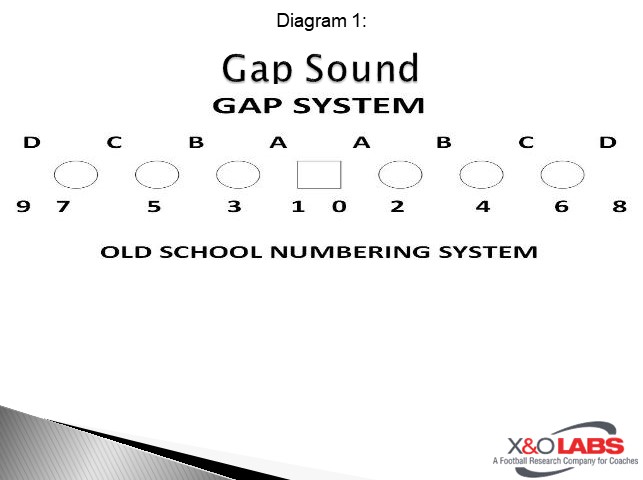
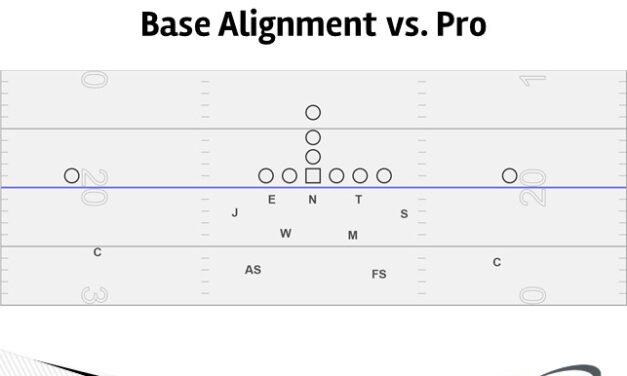
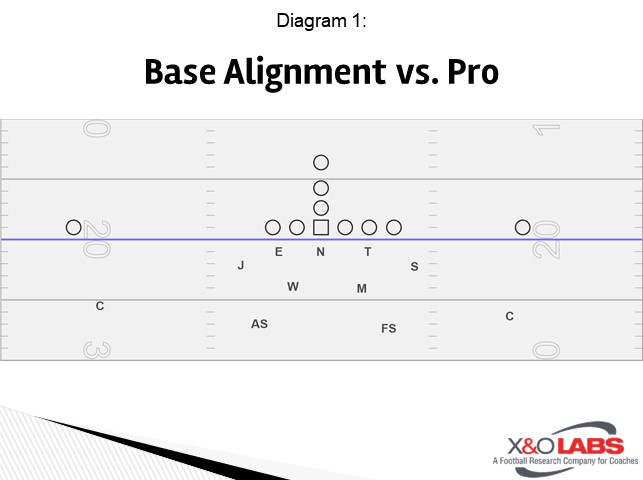
Before we get into plays, I want everyone to understand how we teach our QBs. The chart below discusses every RPO we install. Our QBs understand in which gaps they are protected, in which gaps they are reading, and in which gaps the protection is weak. Our QBs must understand when a gap is empty.

Diagram 1


So, now we are taking the same RPO catalog we used with 10 and 11 personnel and have adjusted it to fit with 12/21 personnel groupings. Below I detail the more common RPOs we are using with this grouping and why it’s effective with heavier personnel groupings.


Inside Zone with Bubble Contour

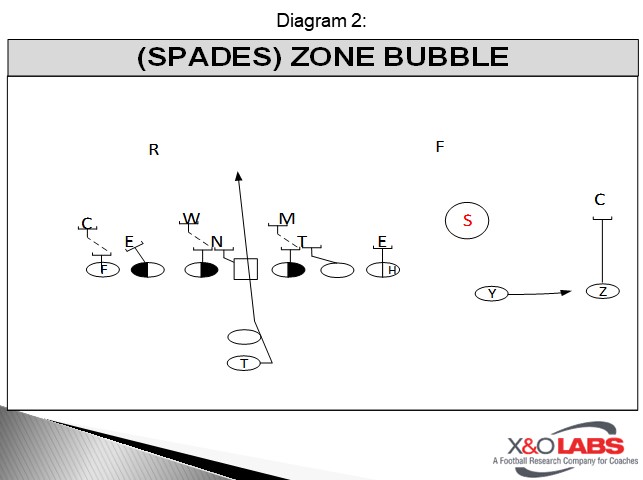
The first RPO we put in is the Inside Zone combination with field Bubble.

Diagram 2


In this concept the QB will learn the following:

  1. The offensive line and HBs will protect you from front side D gap to backside C gap.
  2. QB is responsible for the field D gap run fitter both pre and post-snap now. The QB will ride read the field D gap player. If the D gap player attaches hard to the run fit, he will pull and throw the field bubble. If D gap player blitzes and squeezes the back, abort the ride read and get depth to deal the bubble now.


The Advantage that 21/12 Personnel Grouping Gives

By using the double tight end formation, we have the D gap to the boundary to the C Gap to the field side accounted for. The QB knows we have everything blocked and he is responsible for D gap to the field. The QB is reading the Sam linebacker in the C gap who is just hopping around post-snap. It tells the QB to just run the ball. 

Diagram 3


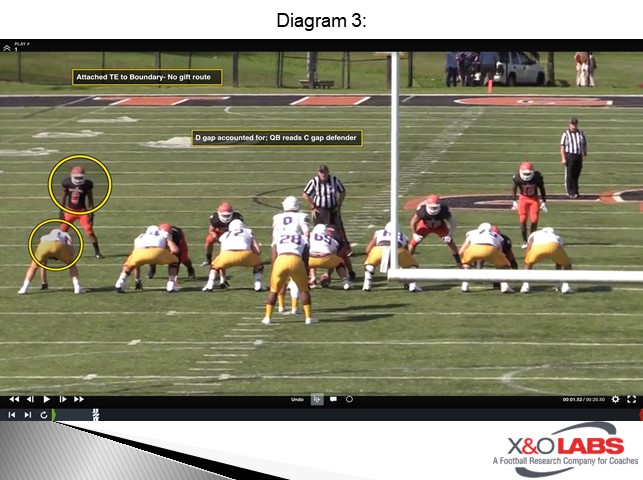
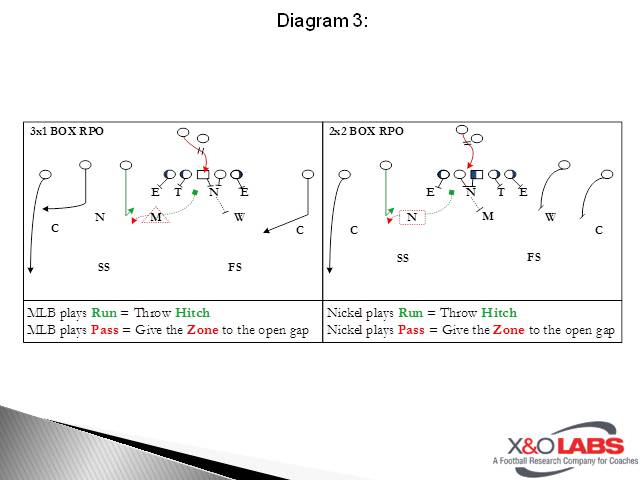
The same effect can be accomplished with using an H back from across the formation. The boundary tight end takes care of the D gap fitter, which is the Cover 2 corner and the offensive line handles the rest of gaps to the backside linebacker. The QB will read the Sam linebacker to the field. You can see that backer is expanding, so the QB gives the ball and fakes throw. 

Diagram 4


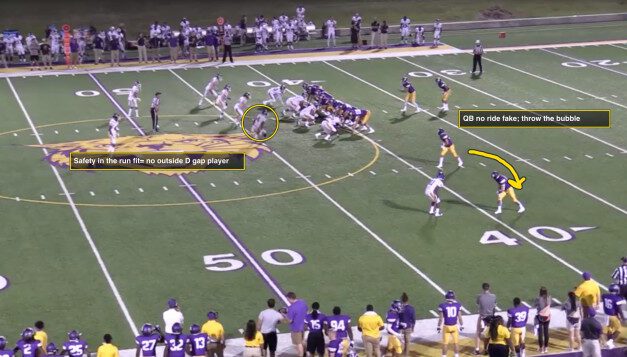
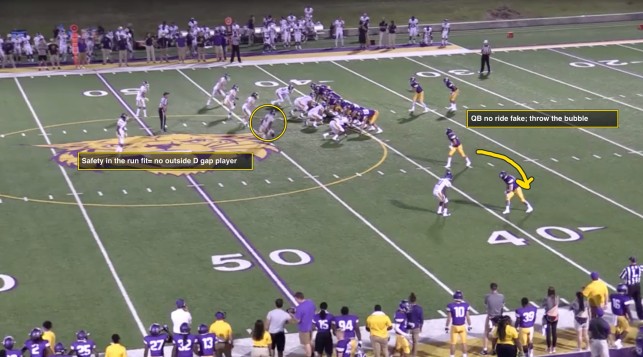
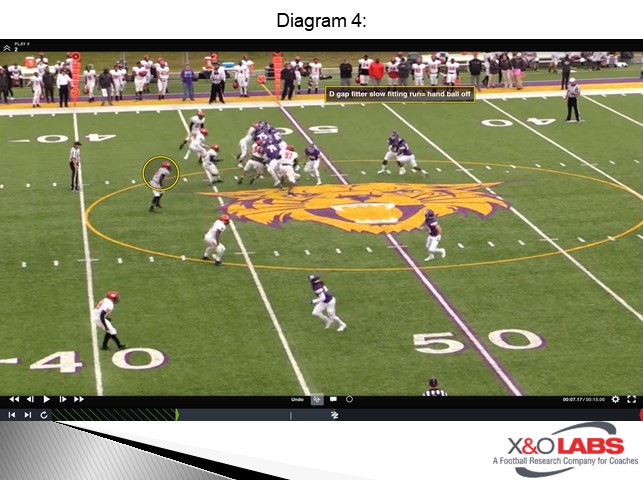
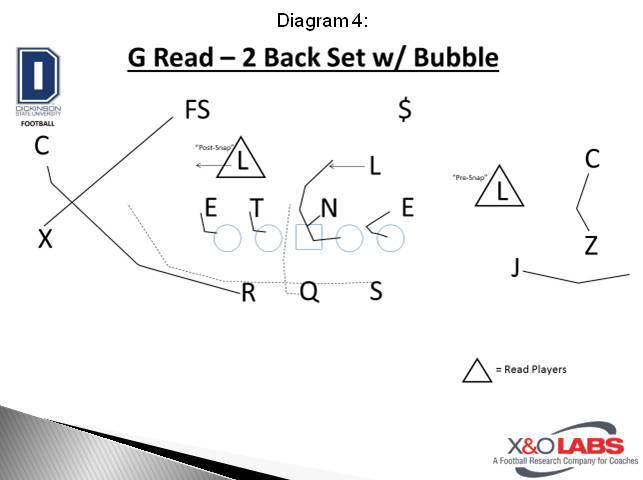
We can run the same play with the boundary tight end handling the D gap player. In this case, the safety is in the run fit. The defense has no field D gap player, so that tells the QB he doesn’t have to ride anything, and he can go ahead and throw the bubble now.  

Read More

Transitioning Between Multiple Even and Odd Fronts without Sacrificing Coverage

By Joey Ginn
Head Coach/Defensive Coordinator
Bethel High School (OK)


First off, I would like to begin by thanking Mike Kuchar and Adam Hovorka for what they do with X&O Labs to further the learning opportunities for coaches to develop. I would also like to take this time to mention/credit my staff, these guys have gone above and beyond in trying to change the shape of a program that isn’t exactly known for success on the gridiron. James Mangram (OC/OL), Lincoln Dearing (WR/DB/Special Teams Coordinator), Stony Burt (DL/RBs), Jason McPhail (OLBs). I spent this last year coaching our LBs, and QBs and calling the defense as a head coach. 

We are a small 3A program in Oklahoma and had just 37 players this year. We were very young the last 2 seasons, my first two years as head coach. My first year here coming from a 6A program where we had 100 + players in 10-12th grades and coming here where we had 42 players 9-12 in my 1st season and 37 players 9-12 this past year was an adjustment. At the 6A program, we had a split staff of 10 coaches, we practiced our varsity and JVs separately, we had a separate 9th grade staff and they held their own practices. Another advantage we had at the larger program was we had several one-way players, for instance, all but one of my linebackers at the 6A school practiced and played defense only. I was two deep at every position also. When faced with 37 kids 9-12 as opposed to 100 players in grades 10-12 and another 40 freshmen, there are some adaptations that had to be made. My first year we were an Odd Stack team with split field coverages in the back end, because that’s what I believed in. However, as the first season moved on, I made the decision we had to do what was best for our personnel and what I believed in better fit the kids I had in my program.


The Transition

Entering the off-season, we returned our Mike linebacker, and a to-be-sophomore who had played a little bit of inside linebacker for us as a Freshmen. We also returned our strong safety/linebacker hybrid who we called Bandit in our 3-3-5 Scheme. We had a to-be-freshmen kid who I felt like could play a linebacker for us, but I really wasn’t sure. We had a wrestler coming out who I felt like could be pretty good, but I had never seen him play football before. Therefore, we had to go to the drawing board to figure out what we needed to do to fit our personnel best. I knew two things were going to remain no matter what: split field coverages in the back end, and an attacking Odd Front. We looked at several things believing we were an inside linebacker short to allow us to play our Odd Stack. We felt like the to-be-Sophomore just wasn’t yet aggressive enough to be a Stack LB in our true 3-3-5 scheme. We had used him, however, as a DL as a 9th grader, so we knew he gave us the ability to be multiple in our looks by putting his hand down on occasion. With this we began putting together a plan. How could we maintain our structure and aggressiveness defensively with 3-3-5 personnel, maintain Split Field Coverages in the back end, yet not have that 3rd Stack linebacker? 

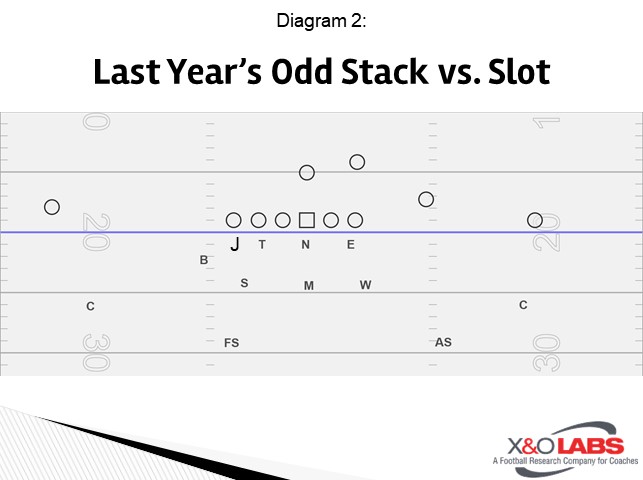
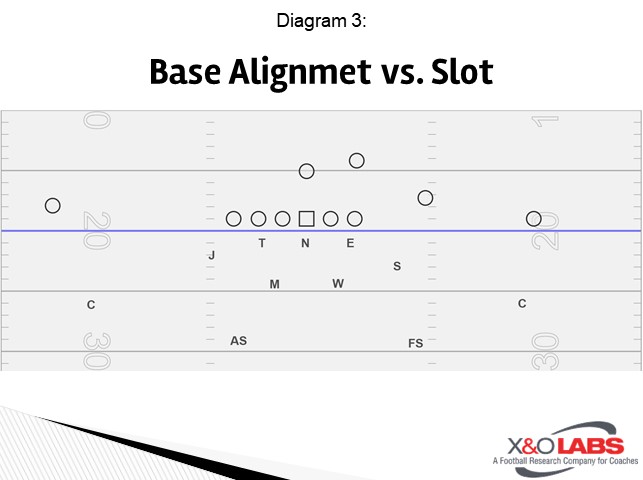
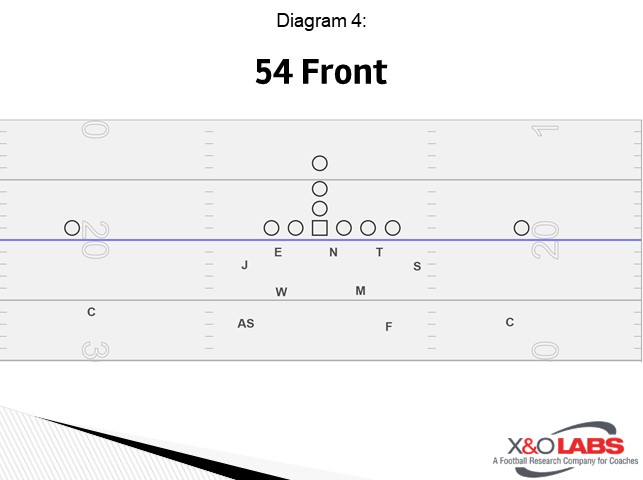
Upon research/study, we thought we found our answer. We looked high and low, and drew several different things along the way, but mostly what helped us the most was putting pen to paper comparing our 3-3 stuff side by side to 3-4 stuff, maintaining our Split field coverages.  What we would do was line up in a 3-4, we would use our Bandit as a Sam on the passing strength side, he would always travel with the free safety and play OLB to the passing strength.  Our Mike LB would simply be a 30 LB on the strong side, our Will would move to a 30 LB on the weak side and we would create a “Jack” LB position that would travel opposite the passing strength (Diagram 1). This we felt would make lining up even simpler as a defense as it balanced us up, and formations could no longer give us alignment issues such as double tight did in our 3-3-5. Our free safety could make the passing strength vs. what we call a slot set to the true passing strength rather than to the TE in our 3-3-5, this made us more-sound as we had more of a LB on the weak side of the passing strength to be able to tighten down to a 9-tech. vs. a TE and still had 3-on-2 to the two quick receiver side (Diagram 2 & 3). We would still call the front the same way we had the year before by calling the tackle (strong end) and end (weak end) using a double-digit call and telling the nose he played the high number side (Diagram 4).

Diagram 1

Diagram 2

Diagram 3

Diagram 4


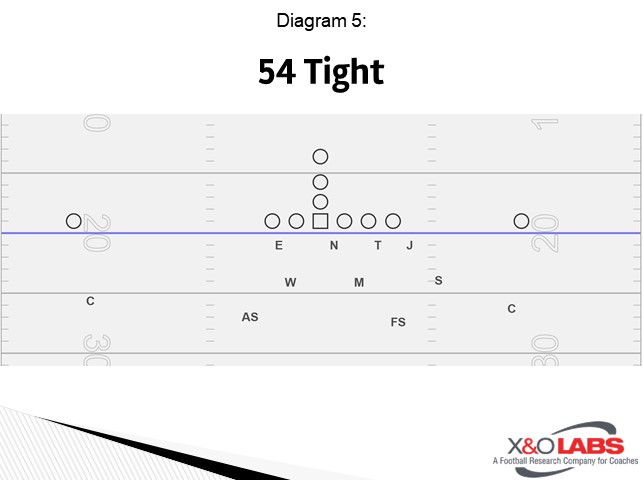
Another advantage with this transition we felt was the ability to install some Even front looks and even an Under look that I grew up in coaching defense with. This was very simple out of our 3-4 Front the way we had installed it. We made two calls that talked to only the Jack: “Tight” told him to travel with the strength of the front he had 2 simple rules. 1.) If the tackle is in a 4-tech., you’re in a 7-tech. with your hand in the ground. 2.) If the tackle is in a 5-tech. you’re now a stand up 9-tech. This gave us the ability to vary our look giving us a 4-2 look with the very same 3-4 personnel on the field. We changed nothing for the secondary here (Diagram 5 & 6). The other Even look we created was a “Walk” call. “Walk” told the Jack again he was on the Weak side lined up in a stand up 5-technique. The call we used to go with a “Walk” call front-wise was 53 Walk (Diagram 7), we told the free safety in Walk he had to call the passing strength to the front strength when we were in Walk vs. any 2×2 set this put us where we needed to be vs. a Slot set as mentioned earlier (Diagram 8). 

Diagram 5

Read More

The Double Wing Power: The Culprit Behind Two Program Resurgences

By Derek Katris
Head Football Coach
Elgin High School (OH)
Twitter: @CoachKatris


Editor’s Note: In this report, Coach Katris describes how the Double Wing offense helped him re-build two programs. As he tells it, he and his staff were able to generate on-field success, increase player participation numbers and win more games. At the end of this report, we asked Coach Katris to discuss in more detail the impact the Double Wing had on the overall health of these two football programs.


I accepted the head football coach position at Briggs High School (Columbus, OH) in April of 2009 with only two years of experience as an assistant coach. The school only had one winning season since 1996 and a great deal of player and coach turnover. I attempted to install a spread offense my first season. We couldn’t do much right and struggled to a 0-3 start. We couldn’t score, could only inconsistently move the ball, and lacked offensive explosion. We finished the last seven games running a vanilla under center dive, trap, and off tackle series to try to come up with some sort of offensive identity.  We finished 3-7 and averaged only 17.6 points per game. We had no offensive identity and lacked team toughness.

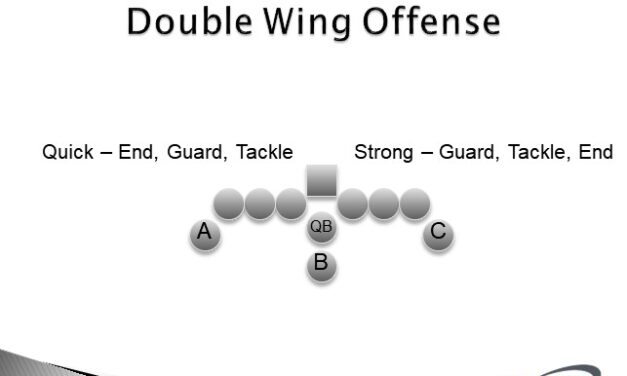
Along with the help of my offensive coordinator, my brother, Luke Katris, we found the double wing offense. It had everything we were searching for, however, most of all it gave us an identity. We introduced an offensive system built around the power play. We didn’t need to be bigger, faster, or stronger to be competitive with this system. We believed that with the core philosophy of running power, blocking hard, and running hard for 5 yards every play we had a chance. We finished 6-4 and beat our rival in game #10. The double wing and its power play had helped us turn the program around.
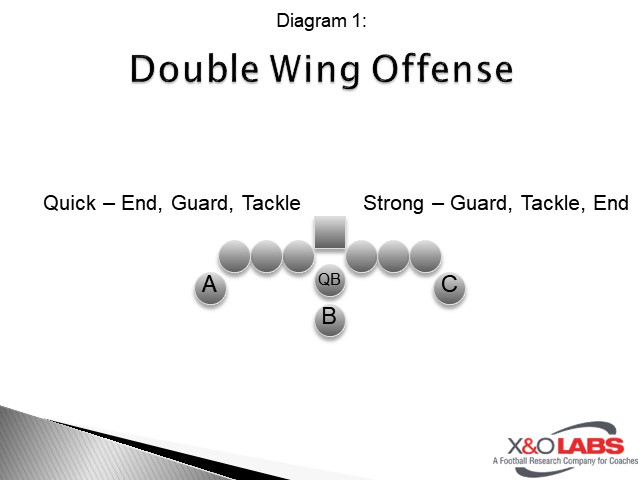
Diagram 1


It all started with a concrete philosophy, running base double wing power, and building everything up from there. The philosophy formed an identity that everyone could believe in – always do one thing better than the other team (run power). We improved drastically as an offense and averaged 26.3 points per game in 2010. The offense produced even more the next season (2011), averaging over 31.4 points per game.
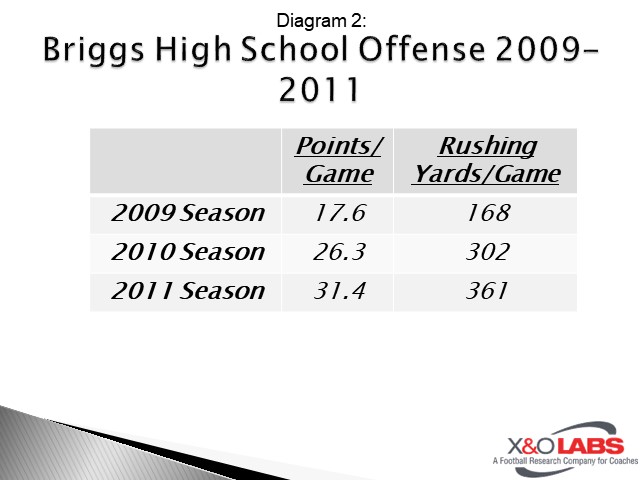
Diagram 2


After the 2011 season I moved on and spent three seasons as an assistant at two different schools, guiding each as the offensive coordinator in the double wing offense. In the spring of 2015 I was blessed enough to get the opportunity to be the head football coach at Elgin High School (Marion, OH). Elgin was a school with great football tradition; however, it had fallen upon tough times. Low participation in football, no winning season since 2005, and continual turnover at head coach had taken its toll on the program.

The first two seasons we struggled mightily going 3-7 and 0-10, suffering through some very tough losses. We averaged only 18.3 points per game in 2015 and 17.2 points per game in 2016. Year three was the turnaround we had all hoped would come once our younger players grew up. We started 3-0, rushed for over 1,700 yards in those three games alone and set multiple state of Ohio rushing records. Game #1 (553 team rushing yards, #27 state of Ohio team single game rushing history) and Game #3 (688 team rushing yards, #6 state of Ohio team single game rushing history) were now in the record books for most rushing yards by a team in a single game. While later on adding #19 in the state record book with 584 yards rushing in game #9. No other team in state history is on the list more than one time. The season culminated with the school’s first winning season since 2005. We averaged 46.6 points per game, 481 rushing yards per game, and converted 46/60 two-point conversions on the season. In addition, this past season we followed up last season’s success with a more diverse attack. In the process of attaining the first back-to-back winning seasons since 1999/2000 at Elgin High School, we averaged 401 rushing yards per game. We also implemented more of a passing attack adding in 56 passing yards per game. Our scoring average was 45.4 points per game and we converted 41/62 two-point conversions.
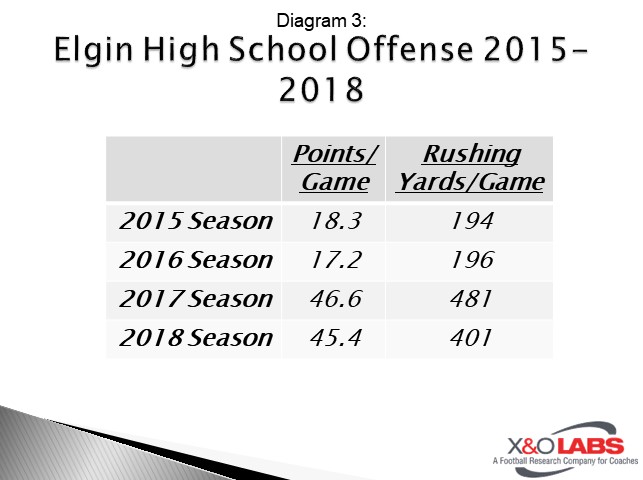
Diagram 3


What is it about the double wing that allowed for this type of turnaround ability? Everything we do draws from the offense, whether it is in the weight room, film room, or practice field. The offense has literally steered our program from the depths of being one of the worst teams in the state to one of the best rushing offenses last football season in the state of Ohio. The kids own it, love it, and identify with it. When we line up every first play, tough play, and needed play we run power. We pride ourselves on execution, aggression, strength, and breaking tackles.

Very simply the Double Wing has allowed us to do three things very well: develop an identity as a football team, play fast with confidence, and give our players an advantage because they know how to execute against every imaginable front that we could face with very simple adjustments. Our players know from day one our identity of the football program is power. They understand how we win and what it takes to be successful because of our identity. We discuss our identity regularly and hold everyone accountable to it. Our players have very simple alignments, assignments, and techniques that are drilled daily. Through the simplicity and daily repetition our players are very confident and do not experience situations they have not practiced extensively before. I believe this is a very important facet of high school football; the more confident team that plays faster is usually the more successful team. Finally, we develop an advantage because there are only so many combinations of fronts that can be played against our base double wing alignment. By the end of August camp our offensive line and tight ends have seen it all.

Read More

QB Gap Read Concepts

By Jace Schillinger
Offensive Coordinator
Dickinson State University (ND)
Twitter: @jaceschillinger

Introduction:

schillingerThe past couple of seasons, we have been trying to play “11 on 10” football. We had a quarterback that was a nice runner and could do a great job in the read game. This approach also helped our young offensive line that was not ready physically to handle some of the defensive players on our schedule. 
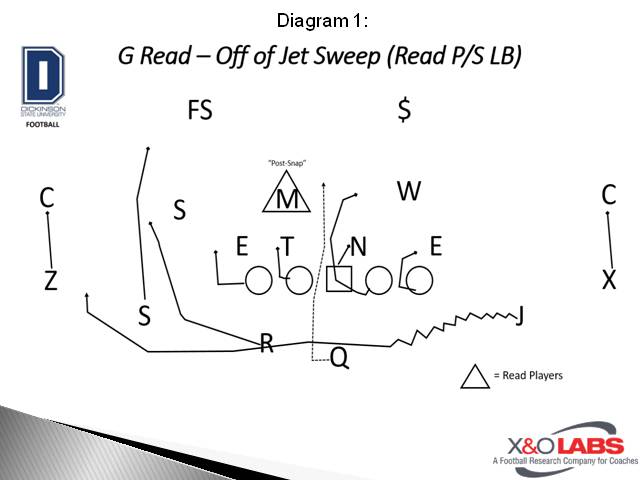
During this time, we ran a steady diet of zone read and power read concepts. It worked well for us, but our opponents soon began playing different games against us up front to muddy up the read for the QB. Against the zone read, the defense would crash the end on running back and loop linebacker for quarterback. Against the power read, we saw defenses collisioning the mesh point and looping the linebacker.

To counter these tactics, we needed something different to slow down both the end and linebacker while getting the ball on perimeter and giving the QB a lead blocker.  The result was our G Read concept . Since installing this play about halfway through the 2014 season, we have averaged almost 7.5 yards/play on G Read. 

Base G Concept:

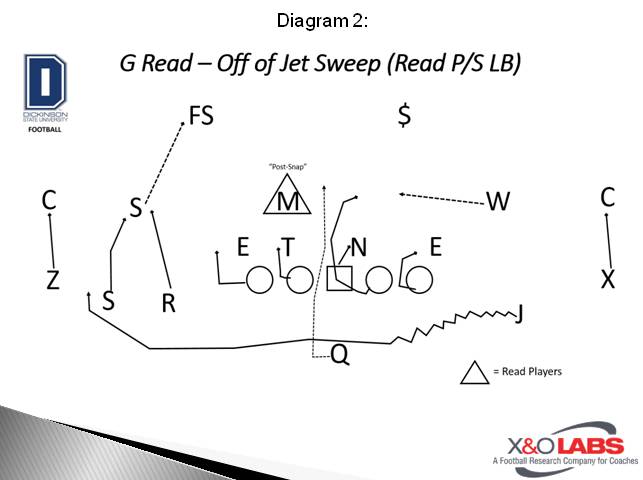
At its core, this concept is quite similar to everyone’s “G” play. The difference is that we pull for the backside LB and leave the front side LB. The quarterback is taught to read the LB head up of the center to the playside tackle. If the read key flows with the jet motion, our QB keep will keep the ball running the QB “G” scheme. If the linebacker doesn’t flow, the QB will give to jet motion back and we feel we can get the edge.

The QB read is rather simple for this play. We tell our QB that if he thinks the Jet can out run the Mike at exchange time to give it. If he doesn’t think we can out run him or we get flow, the QB will keep ball and get to A gap. Whenever they are in doubt, they are told to give ball to the jet player and save the QB from taking another hit.

Slide1Slide1

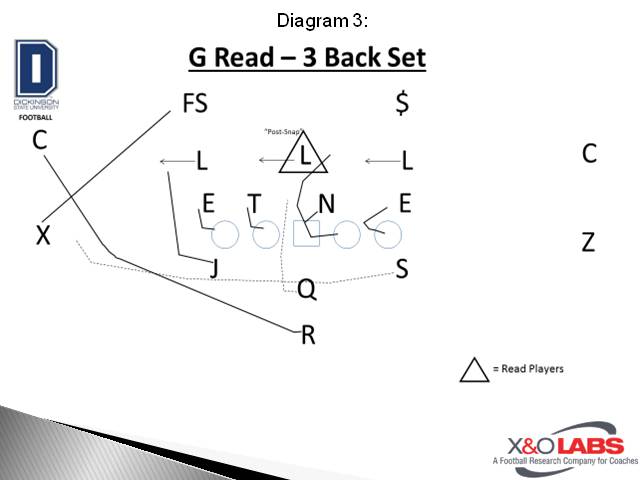
We can also run this play straight out of the backfield with no motion with our tailback. It is a little tougher read for the quarterback, because the linebacker is not flowing so hard with jet motion. In our league, we see a lot of 6-man boxes in 10 personnel formations.

Slide3Slide3

We run this play mostly from 2×2, 3×1, or empty sets. Most of the time we get 2-high safety looks with these formations. To the front side of the play, we are running outside zone. Our play side tackle is taught to bucket step and to try and reach the outside wing of the defensive end. To the backside, we can tag a bubble or quick screen.

Read More

Defending Formations into the Boundary (FIB) from Two-High Structures

By Cody Alexander
Secondary Coach
Midlothian High School (TX)
Twitter: @The_Coach_A


Though it may seem counter intuitive, utilizing reduced space can get a defense to over react to WRs into the boundary. As I wrote in my first book, Cautious Aggression: Defending Modern Football, offensive coordinators align formations into the boundary to get the defense to over rotate to the short side of the field, baiting the defense to leave the wide side without an overhang. Offensive coordinators also use FIB to take advantage of how a defense sets its strength, and finally, to isolate a single WR on a CB. Add the use of quick motions back to the field and the defense can look as though it is ill prepared for what seems like an easy transition. The goal of this report is to demonstrate how Quarters, and primarily a two-high scheme gives the defense the best chance at combating FIB formations.

Most Quarters schemes can function as a split-field defense. This means that each side of the secondary can react to the set, or number of WRs it is given, and can be manipulated by the coach to fit any need by the defense. By running a split-field look, the defense has a better chance of reacting to an offense that puts a formation into the boundary (FIB). The diagram below illustrates this flexibility.


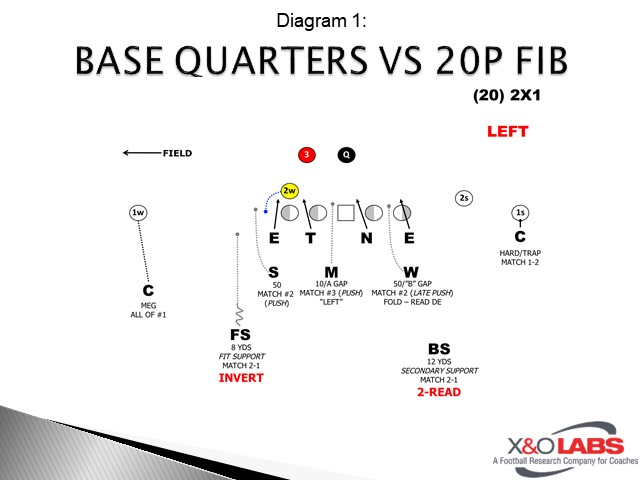
Defending 20 Personnel Y Off FIB:

To the two WR side, the secondary is in a 2-Read, or match Cover 2 concept. This allows the CB to be “hard” (aggressive) near the line to combat a vertical by #1, an RPO screen into the boundary, or as a plus-one if the ball comes back to the short side. This added value by the CB forces the offense to go back to the field, making them predictable. Playing 2-Read over the two WRs also allows the Will LB to work back into the box since he knows the CB will take any out cut by #2. In the diagram, the Will is labeled as “late push.” The coaching point for the Will is to step to his gap with his 6” steps (lead leg first) and read the mesh. If the RB comes his way, fold or fit off the DE, if the QB pops up to pass, the Will holds the curl, working through #2 to get to #1. If #2 goes out, the Will’s eyes dart to #1 to see if he is coming back inside, holding the curl and bracketing the WR with the safety.

Diagram 1


The field side is just as crucial to the boundary. In a Quarters scheme, especially to the single WR side. The advantage of staying two-high and running split-field scheme is that a defensive coach can manipulate either side to fit what is needed. In an obvious passing situation, the field safety (FS) would not invert down on the open side (shown above), instead opting to stay high and assist the field CB in the pass, primarily in what I refer to as the “post-hole” (the area near/on the hash where most Posts are thrown). The safety’s alignment to the field should be near or on the hash depending on tendency of the offense.

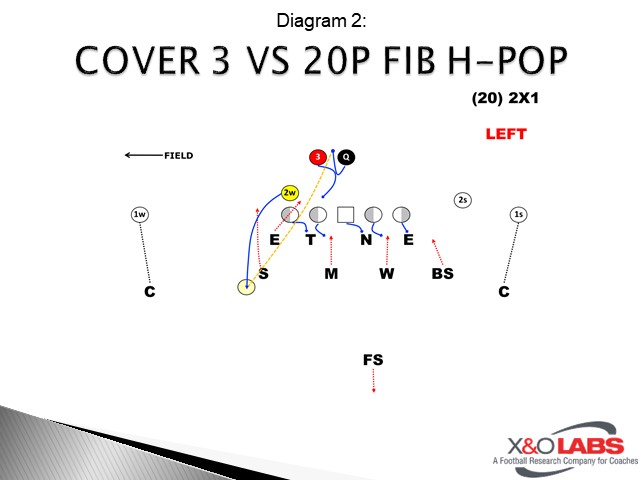
Many coaches will spin a safety down prior to the snap to gain leverage on the sniffer or H-back. By putting the safety to the boundary down prior to the snap, a defensive coach is opening the door for the offense to use play-action against his defense. Below is a diagram of a typical “H-Pop” spread offenses use to counter aggressive Cover 3 or single-high schemes. Staying in a two-high shell inhibits the ability of the offense to gain free access to the field and keeps them cornered into the boundary. The eyes of the safety to the open side should read through the sniffer to the QB to see the play develop. Versus a pass the safety either takes the vertical stem of the H-back or works to the “post-hole” with eyes back to #1.

Diagram 2


One of the most basic ways that an offense can attack a defense by using formation into the boundary is from a 20 personnel or Y-Off formation. In the clip, below, the offense puts both WRs into the boundary while setting both backs to the field. If the defense were to roll to the boundary, the defense would lose the field overhang. The play shown is the infamous Power Toss, made famous by Chad Morris at Clemson. The fits for the defense are simple, the DE to the play side will work to his first threat or QB because he has that in option responsibility. The Sam should fit outside the arcing sniffer to force a cutback but makes the mistake of going inside the arc. Not all is lost, because the inverting safety is there to correct him and make a tackle for a loss.

Read More

Leveraging Weight Room Achievements to Grow Participation

By Brian Odland
Head Football Coach
Saint Peter High School (MN)
Twitter: @coachodland


We are a mid-sized public high school. Our district offers two other fall sports, soccer and cross country running. We are also not immune to the concerns regarding player safety. Despite these challenges, we have seen our football numbers in grades 10-12 increase by over 55% over the past ten seasons.  I am privileged to be invited by X&O Labs to share what we are doing to have this success. 

We have a couple tenets that form the foundation of what we do:

  1. We must connect and make relationships with the players. This is key.  I truly believe building the relationships keeps kids out and makes it more rewarding for players and coaches.
  2. We are inclusive. We welcome anyone whether a first-time player or a kid returning to play.
  3. We mention these multiple times, “If you are here, you matter!”


What follows is a breakdown of what we do based on the time of the year:


SCHOOL YEAR OUTSIDE OF THE FOOTBALL SEASON

With the conclusion of the football season, we encourage all our players to participate in our off-season program. We offer lifting times in the mornings as well as after school to reach all our players, even those in winter seasons. Our emphasis to each athlete is to strive for individual improvements. We do not stress competition between the players (kids will do that on their own). Rather we focus on achieving personal records (PRs). This fosters success and helps them develop confidence.

We have found that spring has led to a drop in weight room attendance for a variety of reasons. This past season, we selected eight seniors and they held a draft of all football players in grades 9-11 to be placed on lifting teams. They selected team mascots and had to track down their draftees to inform them, and in some cases invite them, to join the team in the weight room. The competition was based on weight room attendance and completion of their daily lift sheets during the spring and into summer. The winning team was offered the choice of an ice cream treat or to sit out one conditioning period during the first week of practice. 

We observed a couple of reserved seniors really step up and take a leadership role with this activity and it forced the older kids to communicate and work with the younger ones.

Beyond the lifting, I email a letter in March to every returning player and possible new players in grades 7-11 grade specific letters regarding summer opportunities, camps and fall start dates. I have found this to be a time saver for myself as families try to schedule summer vacations, work schedules, etc.

Read More

Adapting Single Wing Principles to Ignite Your Run Game

By Dan Woolley 
Head Coach 
Scott High School (KY)

Introduction:

There is a lot of talk now of how people are using Single Wing principles to enliven their run game. Whether it is the overloaded formations, wildcat groupings, or misdirection backfields, these age-old systems keep finding their way back to all levels of football.

When I became the Head Coach of Scott High School (KY), their football program had accumulated 76 total wins over a 34 year span. It was apparent that if we were going to be successful we needed to do something unique, simple, and fundamentally sound. The Single Wing concept provided all of those attributes and more.

Since implementing our modified Single Wing offense, we have gone 18-14 and have rushed for an average of 6.94 yard/carry, rushed for 301.64 yards/ game. More importantly, we have outscored opponents by an average of 10 points a game over that time period. Here are a few of the reasons that the Single Wing has helped create such a large turn around.

Unique: We are the only one in our state (that I know of) that runs the offense. This means that opposing teams are unfamiliar with the offense and don’t have a ‘standard’ answer for playing us. Most teams will not run their base defense against us. Instead, they have players have to change positions and/or responsibilities, which causes them to play slower. Since opposing team’s only has 3 days to prepare, this can become a huge advantage.

Proven: The single wing has been around for over 100 years and has been run at all levels. Teams nationwide run this on the high school level and have recently won state titles running the Single Wing including nationally ranked Apopka High School in Florida.

Identity: Our kids have bought in to this system and its physicality. They enjoy this style of play, but more so, the success that has come since its implementation. In today’s world of 7 on 7’s and spread happy offenses, many players are not used to this physical brand of football and are not used to getting the ball run at them for four straight quarters. This can physically and mentally wear down a team.

Numbers: Many times spread coaches talk about counting numbers in the box to create an advantage. We think of our single wing the same way. In our base formation, we line up with 10 players in the box. If we have a numbers advantage in the box, we are content to run the ball. If we don’t have a numbers advantage in the box, then that means that there is no safety and we will try to throw the ball over their heads.

Unbalanced: With our unbalanced set, we look for the side where we have a numbers advantage to and attack that side of the formation. It is important to remember that we use a lot of pullers in our offense. This allows us to get another man or two to the point of attack even if we have a pre-snap disadvantage at the side of attack.

No QB, No Problem: Since we have started running this offense we have had traditional QBs at the varsity level, but we know from experience that this will not always be the case. When that prototype QB isn’t available, we can plug in a running back without changing schemes. In the true single wing, there is no true QB, but instead a running back who receives the direct snap from center. Having a true QB does help as throwing the ball loosens the defense up, but replacing the QB with another running back can end up getting you an extra blocker at the point of attack.

Simple: The simplicity of this offense and the power it provides in the run game allows teams to not change much when they are in short yardage or goal line situations. This offense is built to drive the ball out from under the shadow of the goal line and punch it in when we get close.

Blitz Killer: Because our standard splits are less than one foot, there are no natural gaps for defenses to exploit. For that reason, most teams do not blitz or stunt against us.

Base Formation/Advantages

Our base formation is an overbalanced line with a guard and two tackles to the strong side and a guard and TE on backside (Diagram 1). The offensive line is off the ball as much as is legally possible to aid in pulling and avoid cutting techniques by the defense. The wide receiver (R) aligns to the strong side along with a wing (B) who is lined up one yard by one yard off of the outside tackle. The QB is aligned directly behind the center with heels at 5 yards. The tailback’s (A) base alignment is 1 yard to the side of the QB and 2 feet behind the QB. The most unique position in this offense is our fullback (also known as a sniffer). He is lined up anywhere from the middle of the A gap to the middle of the B gap, depending on the play, and about 1 yard behind the linemen.

Read More

Creating 10 Play Package From NASCAR Tempo

By Brandon Clay
Offensive Coordinator/OL Coach
Haltom High School (TX)
Twitter: @brandonclay88


Haltom had finished 6-5 in the previous year before I became OC, they had made the play-offs for the first time since 2000, and the first winning season since 2009. Head Coach Jason Tucker wanted to invest in an up-tempo, no-huddle approach, I had a background in RPO and no-huddle.  That investment paid off, as at the time of this report, we are 12-0, finished District Champs, and are in the 3rd round of play-offs. 


Part 1: Establishing Base Plays

We decided in order to play fast we needed to simplify the blocking schemes, eliminate as many “rules” as possible, and package a RPO with each play. After experimenting with wrist bands, we found them to be too rigid, too slow. We felt our kids could not get lined up fast enough, getting caught up with wrist band, rather than lining up and getting the play. We settled on signals, and it really allowed us the freedom to check plays and get what we needed to the kids. 

We have an All-State QB who can run and pass, so we decided that our base plays would be:

  1. Zone Read with, the option of Stop, Flat or Spot attached as RPO
  2. Power with Bubble/Slant
  3. Power Read with Jab/Go
  4. Counter with Bubble Screen
  5. Inside Zone with a Slant


In order to go fast and reduce the amount of time spent with blocking rules, we decided that gap schemes would give us the best chance of being successful and would constitute a majority of our plays. 

For Power, Power Read the scheme is the same, we utilize the traditional, gap, down backer on the play side, with the backside guard pulling to seal, and “zip gate” from the backside tackle.

Diagram 1


Our Zone blocking scheme is quite simple, we will full zone on Zone Read, not blocking the E.M.O.L. For Inside Zone blocking, we utilize the same set of rules, but we leave the backside inside LB unblocked, and block the back-side end.

Diagram 2


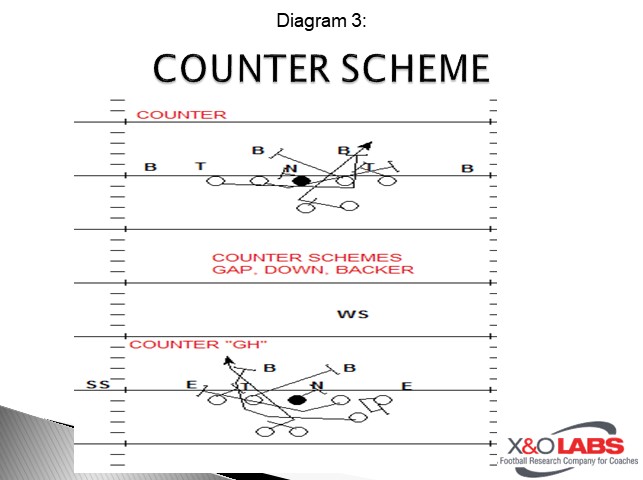
For Counter schemes, the play side is blocked exactly as Power and Power Read. The back-side guard will pull and kick the E.M.O.L. and the backside tackle will pull and seal the play side linebacker. For GH, we make a stay call, the H-Back will replace the tackles pull and seal. The tackle will “zip gate” as he does on Power and Power Read.

Diagram 3


Part 2: Setting the Tempo

The most trying part of establishing an up-tempo, H.U.N.H. offense is getting the pace in practice, not only for players but for coaches. The 3 main keys, in my opinion, are the following:

  1. Practice Scripting: In order to go fast, be efficient you have to script, script, and script!  We script Inside Run, Team, and our NASCAR period. For the first 3 weeks (including Spring Ball), we went as fast as possible in practice, our goal was to be faster in practice than in the games. We didn’t stop Team for the SPEC OPS (look team) to get lined up, it was more important that we get lined up and snap the ball. By scripting our plays, it reduced time, it made coaches signal faster and the kids had to keep pace.

  2. Coaches Must Invest: Regardless of how long you been a coach, if you make the investment to be Up-tempo H.U.N.H. you will be forced to change some of your practice habits. Stopping the Team session because a WR split isn’t perfect or the SPEC OPS team isn’t aligned perfectly is something you will have to live with, in order to establish a superior pace. You must supplant this with watching film, we film everything, 1 x 1, 7 x 7, Inside Run, Team. You also have to get your kids to watch film, THEY have to invest in themselves, and learn to critique their own performance. HUDL has a wealth of data, ease of use and its available on their phones, you must use that resource if possible.

  3. There Are No Half-Measures: Once you decide to play at this pace you will begin to see your kids WANT to go fast. In many games this year, I have had our kids tell me, “We need to go faster” and as a result when we “slow down” our performance dropped. We have different tempos, like most up-tempo teams, but we are at our peak when we are running over the Umpire to get the ball set and snapped before the defense gets a signal in. 


Read More

The Off-Season Tipping Point – Rise of a Champion


How one coaching staff, who grew tired of early playoff exits, made an off-season change that played a crucial role in an undefeated state championship…


By X&O Labs Research Team


How close is your school to becoming a championship program?
Are you one-step away… or three or four?

Either way, you’ll want to pay close attention to this report. It’s going to show you how you can either take the next step towards building a championship program or take the one-step you need to get your next championship…

This is a case study about one high school program that was close to reaching their goals; they were admittedly a few steps away after a disappointing season.

That was when they made a decision that had an enormous impact on their program and was one of several trigger points that led to an undefeated, championship season.

Let’s start at the beginning…

What makes a Championship program?

Great coaching, an accountability culture, driven athletes, and high school athlete’s mobile phones.

Wait, what?  

Yup, that’s what Terry Wilson, Assistant Football Coach and Strength Coach for Chippewa Valley High School (CVHS) in Michigan believes, and it’s hard to argue with him based upon his results.

Last off-season he was looking for a way to give his team an edge in the weight room and take the big step from 8-1 and a playoff loss to the next level. That’s when he came across X&O Labs’ review of MaxOne, the powerful all-in-one coaching platform (MaxOne is a sponsor of X&O Labs, but we’d still use their app even if they weren’t).

The CVHS “Big Reds” are now the Division 1 State Football champions and attribute some of their success to MaxOne. We wanted to find out why.

So, we sat down with Coach Wilson to learn some more. We were intrigued by the subtle, but substantial ways that MaxOne helped Chippewa Valley become undefeated state champs.


Awaken the Beast: The Culture of the Weight Room
Built on Competition and Accountability


“The way MaxOne helped us get to the state championship game, and ultimately win it, was by creating a culture of competition in the weight room, that we didn’t have before.” – Coach Wilson.


Champions love to compete, and great programs build a culture around competition in everything they do, not just on the field but off the field too.

Read More

Bracket Coverage: A 2-High Answer for RPOs and Gun Runs


By Woody Blevins, Safeties Coach, University of Northern Colorado,


While some coaches have made the full transition to defending post-snap RPOs with man coverage, the defensive staff at Northern Colorado has bought into using bracket coverage structures to defend 10 and 11 personnel RPOs. In this exclusive clinic report, UNC safeties coach Woody Blevins details how he teaches his inside and outside bracket rules vs. 2×2 and 3×1 formations, and how he trains the eyes of conflict defenders to recognize run vs. pass. This coverage has yielded less than a 50 percent completion percentage and produced five takeaways. Read the report.


By Woody Blevins
Safeties Coach
University of Northern Colorado
Twitter: @CoachWoody2


Introduction:

“If you know the enemy and know yourself you need not fear the result of a hundred battles. If you know yourself but not the enemy, for every victory gained you will also suffer a defeat. If you know neither the enemy nor yourself, you will succumb in every battle.”  – Sun Tzu

Offenses are changing. They are changing and innovating faster than ever before. Defenses, on the other hand, lag behind. The rise in popularity and effectiveness of RPOs is due, in part, to a lack of knowledge on the defensive side of the ball. Most defensive coaches answer to RPOs is to run a version of cover 1 or cover 3, especially since RPOs were originally built to take advantage of 2-High coverages. But, if you work in a pass heavy conference (i.e. the Big Sky) like I do; living in some form of single high coverage is a recipe for disaster.

The purpose of this article is to give defensive coaches a sound, simple, and productive way to defend RPOs with a 2-High coverage. At the University of Northern Colorado, we call it Bracket.

RPO Review

A basic understanding of RPOs is essential to understanding the practicality of Bracket coverage. The reason RPOs are so successful against 2-High coverages (4, 2, and 6) is because they require a defender to be in “conflict.” I categorize a player to be in “conflict” when he has two jobs to do. For example, in cover 4 the Outside Linebacker is required to fit the B-Gap against the run, but also be the 2-relater/wall player against the pass. 

Slide1

Types Of RPOs

Pre-Snap: There are many good ways to put yourself in an advantageous position against Pre-Snap RPOs (mainly by alignment), but I will not have enough time to touch on these RPOs.

Post-Snap: We see two main types of Post-Snap RPOs: Perimeter and Box. Bracket is built to defend both Perimeter and Box RPOs.

Perimeter RPOs: Perimeter RPOs are, essentially, a version of the Triple Option. The offense reads a first level defender for the inside zone (dive) and a second level defender for the throw (pitch).

Slide2

Box RPOs: Offenses read a defender who is responsible for a gap within the box. We also see 3rd Level RPOs in this family, but I won’t discuss them in an effort to keep this simple.

Slide2

Now that we are all on the same page we can begin to discuss how to defend RPOs.

Bracket: Strengths And Weaknesses

Bracket coverage was initially built to stop the Read Zone Bubble (Perimeter RPO) run by spread offenses. The more we used Bracket the more we began to understand it and tweak it. Eventually, it became a large part of both our Box RPO defense and base defense as well. The key strengths of Bracket are as follows:

The key weaknesses of Bracket are as follows:

  1. The CB’s are always in man coverage.
  2. The OLB’s could end up in a man coverage situation.
  3. Even though it is man coverage, no one adds on. So it will remain a four-man rush throughout the duration of the play.

Bracket: The Basics

Before I begin to explain Bracket coverage, I want to make it clear that all diagrams will be drawn up out of an even front with an A-Gap pinch by the interior tackles. The sole purpose of the even front and pinch is to simplify the explanation of how the coverage fits against the run. Bracket can be run out of nearly any front.

Read More

Unbalanced Line Surfaces to Boost Your Run Game

By Will Compton
Associate Head Coach
Conroe Oak Ridge High School (TX)
Twitter: @CoachWCompton


As coaches we are always looking for ways to boost our run game. Going into the past spring we felt that our offensive line was going to be a strength of our offense. We decided to take our best three lineman and put them on one side. We would use our H-Back/TE to serve as the tackle on the weak side. We wanted to keep our schemes as simple that could easily be translated back to our basic offense. The unbalanced sets allowed up to add a power aspect to our Offense and still hold the defense accountable for all the skill players on the field. We finished this year averaging 231 yards per game running the ball, with 31 rushing touchdowns. Our unbalanced sets accounted for 24% of our formations throughout the season. In these sets we were able to average 6.97 yards per play.


Benefits of Using an Unbalanced Line:

  • Put the defense in an alignment issue
  • Get your best lineman at the point of attack
  • Take the safeties out of the run game
  • Ability to utilize a three man surface without having a true Tight End


Offense is evolving each year. It seems that everyone today has some type of RPO regardless of the level of play. This in my opinion has led to more defenses going to a 3-man front. We see odd front defenses 80% of the year. This began to give us issues on our interior run game. This spring we began to look for an answer to this issue. As coaches we know that the thing that puts an odd front in a bind is a tight end in the Offense. However, we did not have a tight end. What we did have was five lineman and an H-Back that was willing to block. Our answer was to put our three best linemen on one side and use that as the point of attack.

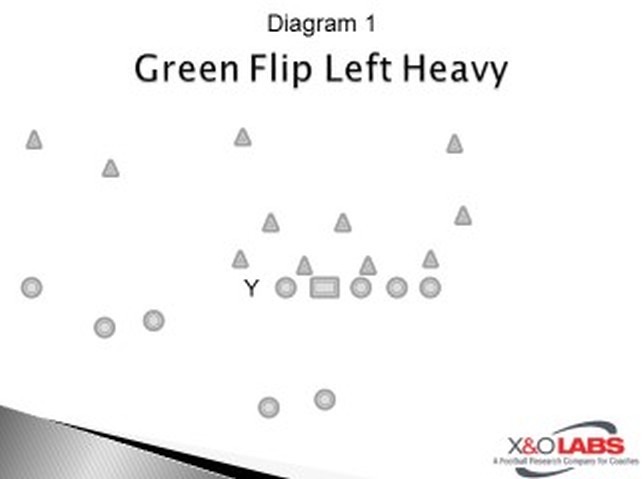
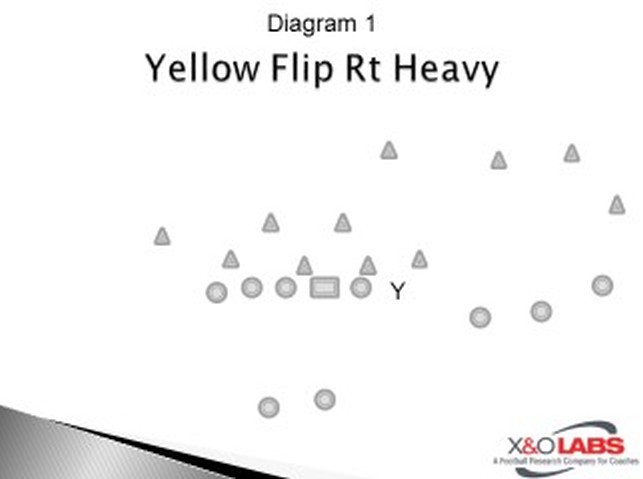
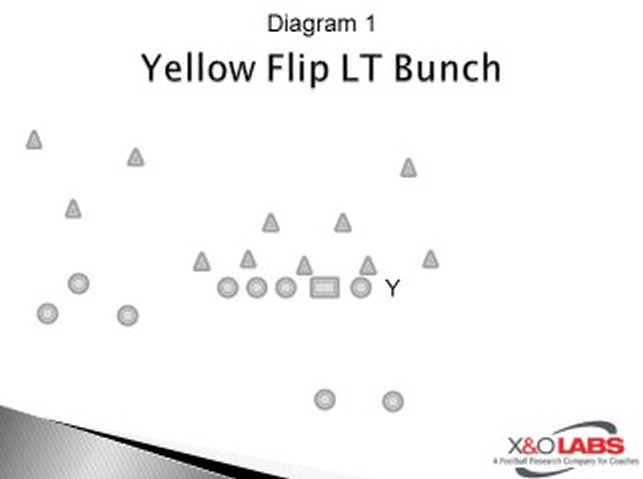
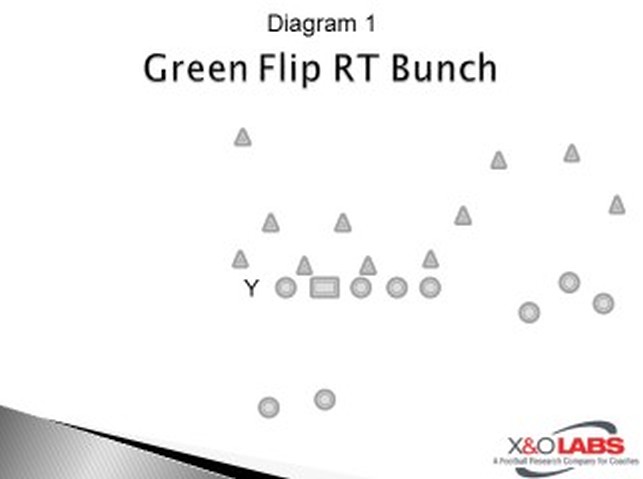
By using an H-Back on the 2-man side we were able to keep the safety away from the point of attack. When we set it up we decided that we would call the 3-Man surface to the right “Green” and 3-Man surface to the left “Yellow”. We would use our “Houston” personnel. “Houston” is our personnel package where we take out our slot receiver and bring in our H-Back/TE. If you have a true tight end this package becomes even better because you can get in and out of it without having to change personnel. This puts the Defense in a bind because now they must always find the tight end and make sure their safeties are in the right spot. If you are able to mix in your unbalanced sets along with some trips tight formations, you are able to keep the safeties constantly having to figure out how to line up the defense. What we saw this year is that many defenses would play our tackle over set different than our trips tight sets with their fronts. Now defenses are spending more time on aligning correctly giving the offense the advantage.


Formation Advantages in Unbalanced:

The way we set up our unbalanced set is that we use the words “Green and Yellow”. Green means that the 3-lineman surface side will go to the Right. Yellow means that they will go to the left. Early in the season we would break this out of a “muddle huddle” however as the season went along, we were able to just line up in it.


What we have seen this year is that most teams have one adjustment for how they will play the unbalanced set. In our opinion a defense must decide if they are going to play Nickel (Down Safety) to the 3 man surface side or to the multiple wide receiver side. This seemed to determine how the defense would play the front. If the defense played the Nickle (Down Safety) to the 3-lineman surface side, we would see some version of a 1-5-9 to that side and a 4i/3 weak. If the defense did not want to play the Nickle as a 9-technique vs the 3 lineman side it would look more like an even front with a 1&5 weak with a 3 and 6/7 strong making the defense look more like a 4-3. Once you know how the defense is going to play you up front you are able to move around your WR to create matchups.


Green Flip Heavy and Yell Flip Heavy:


Advantages:

This was a great formation for us in our unbalanced set. The advantage that you get on offense is that now you have your three best WR’s playing on the same side. This opens you up to the possibility of any 3 man passing concepts that you have in your playbook. It also makes the defense decide how they are going to play their corner. If the corner goes over to the three receiver side and the safety stays on the 3-lineman side you open yourself up to a matchup you might like by motioning the Running Back out of the backfield.


Yellow Flip LT Bunch/ Green Flip RT Bunch:

Read More

Evolvement of 20 Personnel “Key” RPO to Out-leverage Odd Defenses

By Ken Vigdal
Offensive Coordinator
Brookings High School (SD)
Twitter: @kevigdal


Thanks to the success of University of Arizona offensive coordinator Noel Mazzone and his Nzone system, the “key” screen has taken various shapes and forms the last few football seasons.

What used to be a post-snap RPO screen to the number two receiver has transitioned into getting a back out on the perimeter against a slower inside linebacker. Because of odd front structures, the presence of one or two backers walked up on the line of scrimmage eliminated zone option runs. Many of the teams that we play in our conference ran some type of odd front. When our 20 personnel aligned, you would see 1 or 2 backers walked up on the edges making it a 5 front.

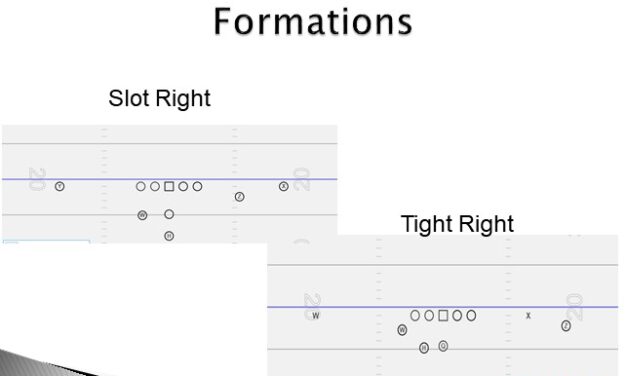
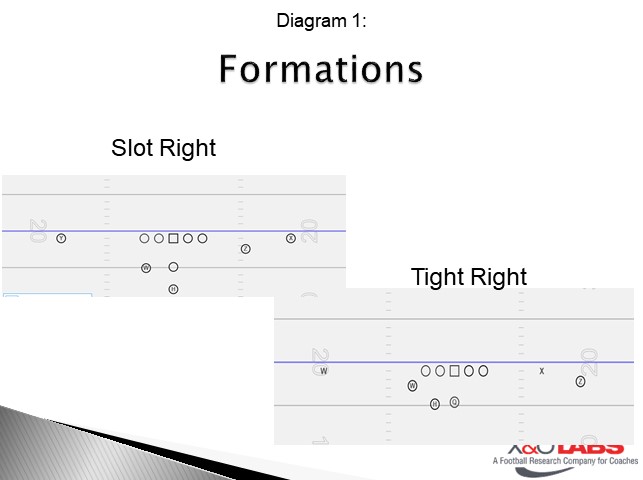
Zone option was effective at the start putting defenses in conflict. Then defenses started to slow play with their backside OLB taking the option part away from the play. Zone option still wasn’t the answer we were looking for. We started running motion with the H or W and noticed that OLB would only adjust one or two shuffle steps out.  That’s when we decided to start running zone and Key 3 to the back out of the backfield. We like to run Key 3 with either back out of our Slot formation, or the W out of the Tight formation. This allows us to even up with the defense or gain a +1 advantage.

Diagram 1


We were a traditional double tight Wing T team for many years. We made the transition to the Spread Offense 4 years ago. In our spread offense when we have 20 personnel in the game, either in the backfield or a wing position. Teams would put 8 or 9 defenders in the box, which made it difficult to run. To combat so many defenders in the box, we would run jet sweep to get to the edge, to limit the number of defenders we had to block. Defenses would buzz their safeties down into the box with the jet motion or linebackers would crash down hard to take the sweep away. We would run jet motion and run our zone, trap, and power, but running the ball was still a struggle. We had to come up with a solution to combat movement by the defense.


RPO Success

The RPO blocking rules are an extension of our jet sweep, receivers are blocking everyone to the inside with backs running hash, number, and sideline. This makes it simple for our receivers, blocking both the sweep and RPOs the same. We design our RPOs to get one of our best athletes with the ball, in space, and let them use their athletic ability to get up field.  The goal is a plus 5, when we throw Key 3, it should gain 5 yards for it to be considered a successful RPO. Although we are a no huddle team, we are a very ball controlled team. We are going to use the run game to gain 3 or 4 yards a carry or throw the RPO for 5. We put many drives together this season that were over 10 plays, leaving the other team’s offense on the sideline.


“Key 3” Responsibilities: 

  • The offensive line will run their inside zone footwork. Coaching point: when the backside tackle sees the key signal from the sideline, it is an automatic Lock for him. Which means he is going to lock onto the backside defensive end. We do this for two reasons. First the QB may decide to throw the free choice route to the backside, or if we run the Key 3 Go, the routes may take longer to develop. Second, if you don’t lock on to the backside DE he will disrupt the throw or sack your QB.
  • Y or backside receiver, if the QB likes the match on the backside, he will throw the free choice route. The backside receiver signals the route he is going to run. He signals every play so the defender doesn’t know when the ball will be thrown or when it is a dummy signal.  During game planning, we will choose the three routes that we will use for the week.  Our basic choice routes are speed out, fade, and slant.  The call route by receiver is dependent upon the depth and leverage of the defensive back.
  • Z and X receiver will block the same as jet sweep, positioning themselves to get the ball carrier to the outside. They will engage the defensive player working to the outside shoulder, pinning them inside. Coaching point: if the defensive player takes an outside stem, and the receiver cannot pin him in, he will turn and push the defender outside to the sideline. When the running back sees the receiver’s numbers perpendicular to the line of scrimmage, he will cut up the field and work his way back outside if he can.
  • W will go in motion, and when he gets a yard inside number two receiver, he will start to carioca. We have done it other ways, but this technique it keeps his shoulders square to the line of scrimmage, allowing him to read his blocks of the receivers.  If the W does not go in motion, he will use his inside zone footwork.
  • H will go in motion and use the exact same footwork as the W did for Key 3. If not, he will use his inside zone footwork.


Read More

Creating a Fake Punt Menu from Rugby Alignments

By Nick Smith and Clint Hodges
Defensive Coordinator/Offensive Line Coach
South Effingham High School (GA)
Twitter: @nhasmith
Twitter: @hawgswag


At South Effingham High School, we have become accustomed to finding a way to utilize the kids that we have because we aren’t always blessed with kids that fit a certain mold. Going into the season of 2012, we had graduated our punter, and we did not have another player who we thought could step in and punt effectively in the traditional shield punt mode. We needed an answer to our punting game.

After much research, we settled on a concept by Abe Mikell that we thought we could incorporate into something that could work for us. We took his basic formation and rules and went to work. His article gave insight on how to line up and cover in meticulous detail. What really caught our attention was how one could use the rugby punt in a way to gain another offensive down. Since fourth down is still an offensive down, we can use it to put the other team in bad field position or as an opportunity to fake a punt and gain a first down in order to keep your offense on the field.

We had a very athletic WR/DB with long legs and a lot of speed, so we decided to give him a try at being our punter. The first couple of weeks we tried it, we ran into quite a few questions and roadblocks. That said, we also saw how our kids embraced this new idea, and everyone loved it. We had many fakes we could run out of this formation, and the ability our punter had to tuck the ball and run if he had the edge was another huge added benefit. All in all, we had made our decision to sell out to the rugby punt, and it paid huge dividends for us. In this article, we will try to explain our basic ideas on our personnel, alignment, protection, coverage, punter’s rules and fakes.


Pros

  • Difficult for the defense to align to the formation
  • Opposing team has to spend extra time in practice lining up to punt team
  • No aiming point for blocks like there is with a traditional punt. Toe doesn’t meet the ball at the same spot each time.
  • Protection is simplified and executed by personnel used to blocking
  • You don’t have to have a real “punter” to have an effective punting game
  • Because of all of the FAKES in the arsenal, we think we gain an offensive down
  • Snapper only has to snap it 10 yards, more accurate snaps.
  • Coverage is much easier and marginalized because returners are reluctant to field a bounding ball
  • The punt portion of practice becomes fun instead of a dread at practice


Cons

  • Not quite as effective when ball is positioned on the right hash.
  • Perimeter pressure from the right takes getting used to. There will be struggles early in practice but you can work through them!
  • Pressure will intensify if you aren’t willing to fake on occasion.


Personnel

We originally used a mixture of offensive and defensive players. We handpicked players who fit this system the best, and it took quite a few reps in order to mix and match and make sure we had the proper players in the proper places to make rugby punting effective for us and put the defense in as much of a bind as we could. There are 6 linemen (we used our OL mostly, the left Tackle must be a threat to catch a pass), 2 wings (the one in motion needs to be a great open field tackler), an upback (must be able to handle a snap at times and block the “A” gap rusher). We have used our starting quarterback as the upback for the last couple of years. We rarely get a play side A gap rusher and just the fact that he is in the backfield seems to reduce the overall rush. We also use a split end (gunner type), and a punter (preferably an athletic player who can run).


Starting Alignment

The down linemen and wings will align in one-foot splits on the play side. The reasoning behind such tight splits is to condense the defensive formation as much as possible. By reducing the formation, you also make it difficult for the defense to overload one gap. On the backside, the Tackle can be a little wider (2-3 feet) in order to stretch the backside rusher a little wider away from the punter. Backside wide rushers should not be able to block the punt if the punter is working outside fast enough. Contrastingly, the backside guard must stay in a tight alignment because he has the largest gap to cover. The snapper is leaving the formation almost immediately in order to cover. The backside guard needs to be your best and quickest blocker up front. He has the hardest job of all of the down linemen by far.

The wings will align tight to the TEs. The backside wing will go in motion to the play side and end up in the position of a normal slot receiver and become a gunner in a normal punt situation. It is imperative that he aligns as close to the LOS as possible without actually being on the LOS. When he goes in motion, his hip almost needs to rub the down linemen. We will trap with the wing in motion and by him being close, we know we can’t get called for moving forward on the snap. The play side wing will block his zone like a normal lineman and get into coverage along with the down linemen.

Read More

Defending the Triple Option with the “Monster” Package

By Steve Coburn
Head Coach & Defensive Coordinator
Wasatch High School (UT)
Twitter: @stevecoburn76


Introduction:

coburnIn this clinic report, I’ll be describing our approach to installing and using our option package within our 4-3 defensive scheme. Our base defense is primarily out of an over front and quarters coverage structure. We may only see this offense once or twice during the course of a season, so for that reason, we need to be very specific with our players as we install this package.

From an X’s and O’s perspective, we will only use one front and one coverage. These offenses run the same plays repeatedly week in and week out while we may only get three days of practice to defend it. For that reason, we minimize our defensive package to get better at defending the option. We believe this gives us the best opportunity to get as many reps as we can in those three practices in preparation for the opponent.

We tell them, our players, that they have 1/11th responsibility and they need to be very disciplined in that responsibility for the package to function. If they do their 1/11th each play then we will be successful.

Monster 1 Scheme

Monster 1 is designed to be a balanced defense. It consists of two dive players, two quarterback players on each side of the ball and one pitch player in the middle. The two dive players are the 2i defenders and the 30 technique inside linebacker. We play the defensive tackles in 2i techniques to minimize the Midline option play. The two quarterback players are the overhang defender (low safety) and the 5-technique defensive end or the inside linebacker depending on the block of the offensive tackle who will either veer or base block. The high safety is tasked with playing the pop pass to pitch.

Read More