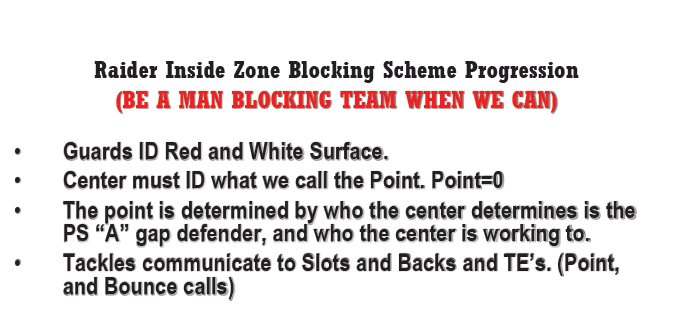
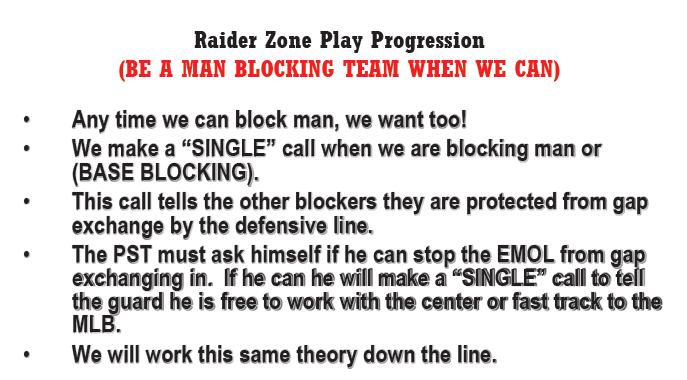
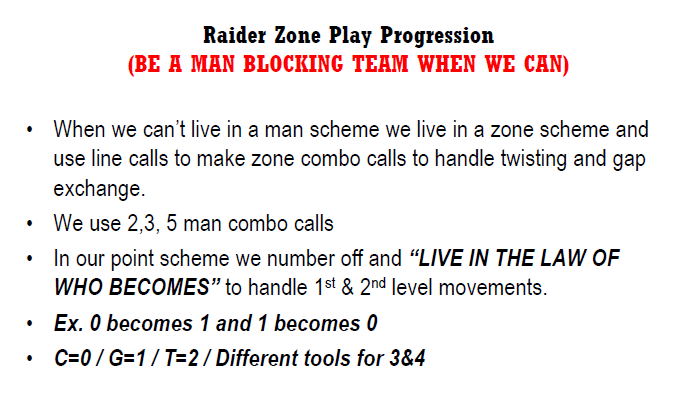
Marrying Inside and Outside Zone Schemes

By Chris Fisk

Offensive Line Coach

Southern Oregon University


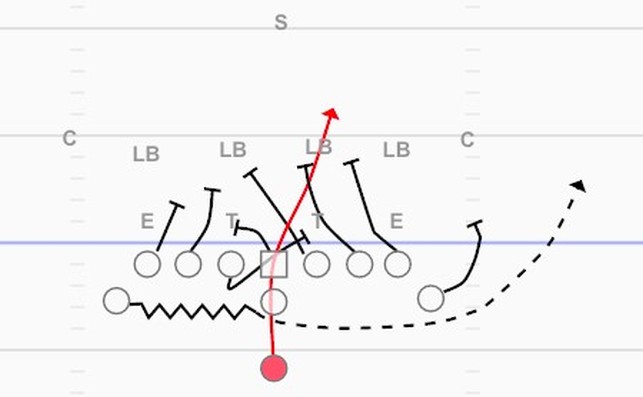
Editor’s Note:  Chris Fisk, the offensive line coach at the University of Southern Oregon, details how he uses a man count system (the same used at Oregon) to block his inside zone scheme.  

Read More

Engaging the Explosive Play Using the CAP Accelerator

By Dub Maddox

Offensive Coordinator at Jenks High School (OK)

and

Director of Product Development at the National Football Academy (NFA)
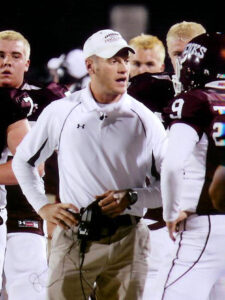
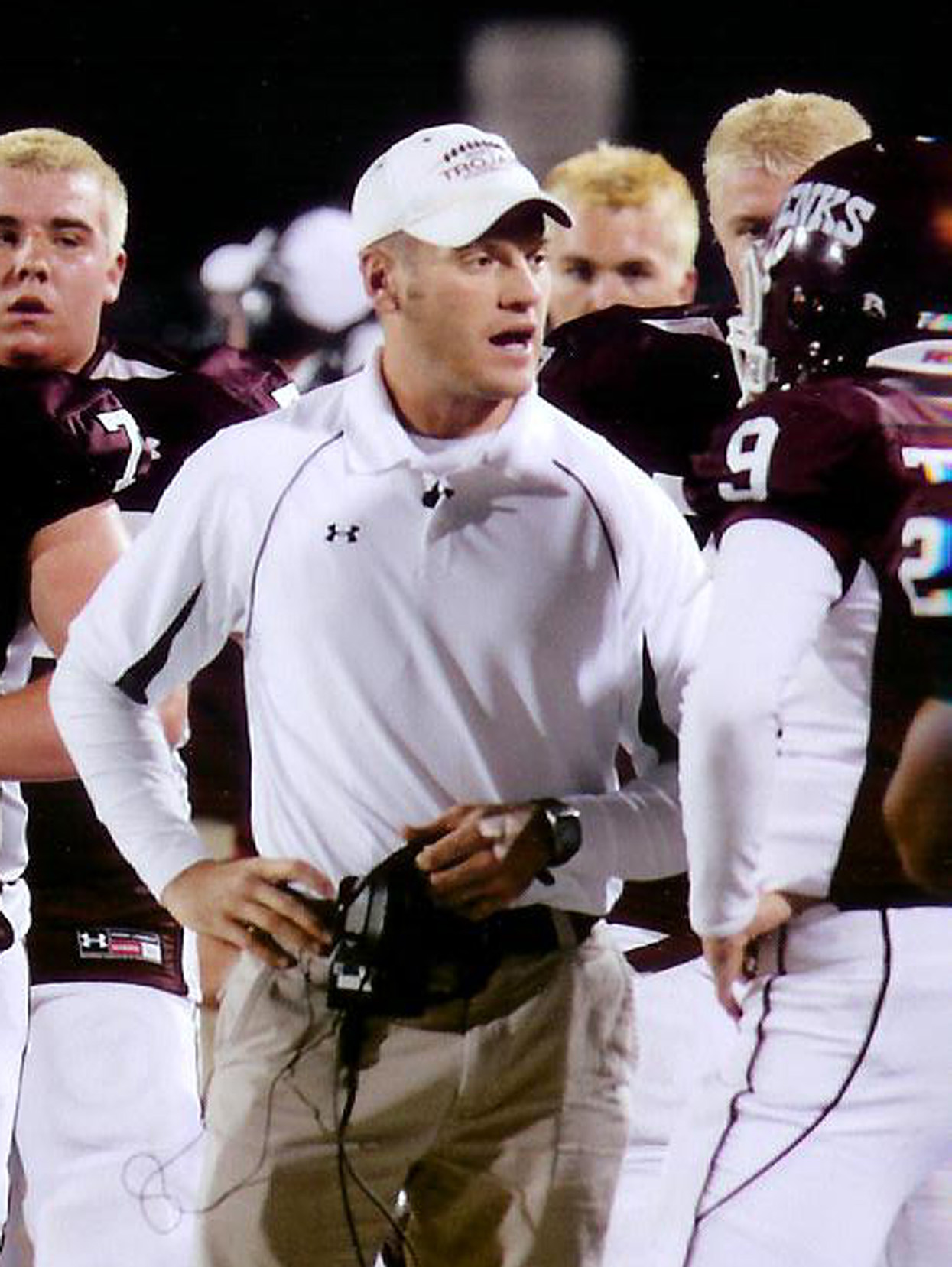
Coach Dub MaddoxEditor’s Note:  Dub Maddox is the offensive coordinator and quarterback coach for the 13 time 6-A State Champions Jenks Trojans in Oklahoma.  In the off season he is the Director of Camp operations for National Football Academies and travels across the country training athletes and coaches. Under Maddox’s guidance the Trojan offense has generated the All-time Oklahoma 6A scoring record of 53.4 points per game in 2010 as well as the All-time rushing record of 3884 total yards in 2011. Maddox has produced the school’s All-time leading passer (Sawyer Kollmorgen) with 6,716 yards (73TDs) 2008-2010, along with the school’s All-time career TD record holder (Mark Ginther) with 76 TD’s combined with a 70% career completion percentage-2006-2007.  In 2012, Maddox coordinated the Trojan offense to help win a State Championship that outscored opponents 458-73 in the first half alone. His QB (Kyle Alexander) set the All-Time best TD-Int ratio by throwing for 2034 yards with 27 TD’s and only 2 Int’s in 219 attempts. Dub Maddox is the co-creator and author of the R4 system and book From Headset to Helmet. 

An Explosive Play Defined

Maybe you’ve heard the coach’s dilemma:  “You have to run the ball to win, but you have to throw the ball to score.”


Can you find the key relationship in this statement? Every successful football team has nailed it: The best offenses are not one dimensional!  To run the football effectively you must keep defenders out of the run-box by threatening a pass; to pass effectively you must keep the box defenders and secondary players at bay by threatening a run.

This double threat demands a specific type of run and pass. In fact, according to Mike Eayrs, Head of  Research and Development for the NFL’s Green Bay Packers, over the last 30+ years in the NFL, the distance of 12 or more yards on runs and 16 or more yards for passes are the minimum distance needed to trigger a dramatic increase in scoring probability.  When these distances are achieved on a run or a pass they are labeled Explosive Plays. As you’ll see, most QB decision making structures on pass plays hinder explosive opportunities.

In that same timeframe, the NFL team with a positive turnover ratio and more explosive plays (You get more than you give up) win 91% of the time!   Lesson learned:  We need more explosive plays in our offense.

To rephrase the coaching dilemma, to increase probability of winning games I need more explosive plays than my opponent.  Yet to get explosive run plays (12+ yds) I need the threat of throwing explosive passes (16+ yds). But how do I throw explosive passes without committing the greatest indicator of wins and losses….turnovers?

Eliminating Archaic Trains of Thought

As the old saying goes: “Three things happen when you throw the ball and two of them are bad.”  The two negative results of passing- incompletions and interceptions- haunt the hearts of coaches.   This fear drives coaches in their pursuit of what pass concepts to use and how to teach their QBs to read them.


The most popular philosophies differ in coaching the modern passing game and explain why QBs miss explosive play opportunities.  Most coaching methods for reading pass concepts serve the coach not the QB.  Giving up control and trusting a QB to make the right read can be extremely difficult.

Holding onto the reigns for your QB

The clever but ineffective coach controls his fear by attaching reins to the QB to “simplify” his decision-making.  They might say pick a route-side combo based on number of safeties or use defender key quick-game and screens in order to provide high-percentage completion security but fizzle the explosive play. Logic is replaced with a “take a shot” mentality instead of the explosive pass play, often by “tagging” the deep route on a play or calling a “double” move route when they “feel the force” and hope it will be there.


Another common method of reading pass concepts is taught through progressions. A coach gives his QB a number of routes to scan through after the snap in a sequential 1, 2, 3 and up to 5 order. The QB has greater freedom to view more of the field, but it requires keen mental discipline and mature timing to look at the right place at the right time to make the right throw. That’s a lot to put on a young QB.  So to simplify it, coaches break up the read by removing the explosive, and lucrative, deep routes from the post-snap decision-making process so he can focus on a defender key stretch for an intermediate or flat throw, thus eliminating the explosive play!  Common coaching buzz-words such as “Alert” or “Peek Deep” are called pre-snap to remind the QB to evaluate the availability of the explosive route if coach hopes it will be there.

The problem is that the “reins” fail to teach the QB to read what happens post-snap as the play is developing.  The Post-snap decision-making process is the highest need of the QB….Even more so in today’s complex game.  The advancements of pass defensive coverages in today’s game are designed to short-circuit the QB’s pre-snap decision-making process.  Defensive post-snap pattern reading, post-snap rotation, and split field coverages create overwhelming mental chaos in a QB.  What you see pre-snap is no longer what you see post-snap.

A New QB Operating System- The R4 Approach

What if it was possible to engage an operating system that gives the QB and coach the ability to anticipate where the highest probability of completion is no matter what the coverage?  What if we had the tools to accelerate QB decision-making both pre- and post-snap by allowing him to read what is happening in real-time instead of what he thinks will happen?  What if the coach and the QB had a common language that increased explosive play opportunities by defining what “Open” really means and looks like?  What if they could control the Chaos?


These were the answers I was seeking when I started coaching QBs.  How do I teach them to decide when a WR is “Open” and what does “Open” mean?  When I visited clinics or Division 1 programs, I asked these “questions” and common coaching answers were sweeping statements such as “Throw to grass”, “Throw them open” or “If they can’t do it, we find somebody who can.” I thought to myself, How much grass is needed to be considered open, when does my QB throw it there, and what if I don’t have another guy?  Each time I came away frustrated.

Read More

Defending the Option with the 4-2-5


By Chris Kappelmeier

Defensive Coordinator

Sparta High School (NJ)


Editor’s Note:  Coach Kappelmeier rejoined Sparta HS’s coaching staff in 2011 serving as the Defensive Coordinator. He has a long history coaching high school football with past positions as an assistant coach at Pope John (1986?1992 and 2008?2010),  Sparta (1993?1994, 2005?2007 and 2011?present), and High Point (1995?2004).  He was the head football coach at High Point for 8 seasons (1995?2002), winning a conference championship in 2001 (the only one in school history).   He has a Bachelor’s Degree in Mechanical Engineering from the Catholic University of American and a Master’s Degree in Mechanical Aerospace Engineering from Princeton University.  He has been teaching Physics and Calculus at High Point Regional High School for 19 years. He and his wife, Raquel, have three children: John (12), Lauren (11), and Maddie (7).


Over the past few years, we have faced many different forms of the option.  Each option system has its nuances, but we have found that defending them can be very similar.  It all starts with know what NOT to do.  Here are a few of the lessons we have learned that will help you avoid common problems that people face when defending the option:

#1 – Do not play assignment football with your defensive front.  Nothing can slow them down more than telling them they can only tackle one particular player.  The key to effectively defending any offense is allowing your defensive players to play with confidence and to play fast.  The same holds true for defending the option.  Let your players execute the same techniques they have used all season and they will be the most effective.  Another reason to avoid assignment football for your front defenders is it typically takes more than just one defender to tackle the dive/veer back.  Since this is always the first choice for any option offensive coordinator, you cannot assign only a defensive tackle or end to stopping him.

#2 – Do not expect any player to defend both the pitch and the pass.  The play action pass is the most explosive play out of the option offense and any good option team will be very adept at throwing it in any situation.  Do not rely on the player assigned to the pitch to also cover the slot receiver or tight end down the field.  Use your free safety to defend the inside receiver.

#3 – Do not align your defensive linemen in the large gaps that are very likely when facing an option-oriented team.  When the offense aligns with large splits the temptation is to have your defensive linemen line up in a gap and penetrate.  Experience has found that while this may be successful sometimes, in the long run it can backfire and allow for a big play by the offense.  Maintain your shade alignment not allowing the covered linemen to ‘jump through’ to the next level allowing the linebackers to run to the football and make plays.  By maintaining their shade alignments, the defensive linemen are guaranteed to be single blocked since double teams and combo blocks are very difficult with big splits.  Maintaining shade alignment versus wide splits also makes stunting across the face of the offensive man more effective since there is no offensive lineman close enough to block the backside gap.

#4 – Do not invent a new defense to defend the option expecting your players to master all of the necessary techniques in one week of practice.  Once they figure out what you are trying to do they will have an answer for it. You best off playing fast out of your base defense.

4 Do’s in Defending the Option

In the end, experience has taught me that the best way to defend the option is to align in your base defense. For us, that means using out flexible 4-2-5 scheme to address the different double and triple option techniques that we face year after year.  Here is a quick look at our scheme / alignment followed by four “Do’s.”

Slide1Slide2Slide3

#1 – Ignore Line Splits

A favored technique of many option teams is to use very wide line splits.  The temptation to align in the gaps is great, but “It’s a trap”!  When you align in the gap and not on an offensive man, either lineman can now block you with a very good angle, or release to a linebacker or the FS.  This puts the burden of defending the fullback carry or the quarterback keep, on the defensive linemen which increases the chance that an athletic running back or quarterback can escape and make a big play.

A better way to combat the wide splits is to align heavy on the offensive linemen in a slight outside shade and using line stunts and slants.  During games versus option teams this past season our defensive linemen stunted or slanted on almost every play.  Since this is a big part of the 4-2-5 defense it was something they were comfortable doing.  They spend at least one 15-minute session each week during the season, not to mention the preseason time, defending inside running plays while stunting.  The linebackers are aware of the gap exchanges created by the stunts and slants and have no difficulty fitting the run in these situations. 

Read More

EWU Pattern Match Coverage System

By Cherokee Valeria
Cornerbacks Coach
Eastern Washington University
Twitter: @CoachCherokee


Introduction:

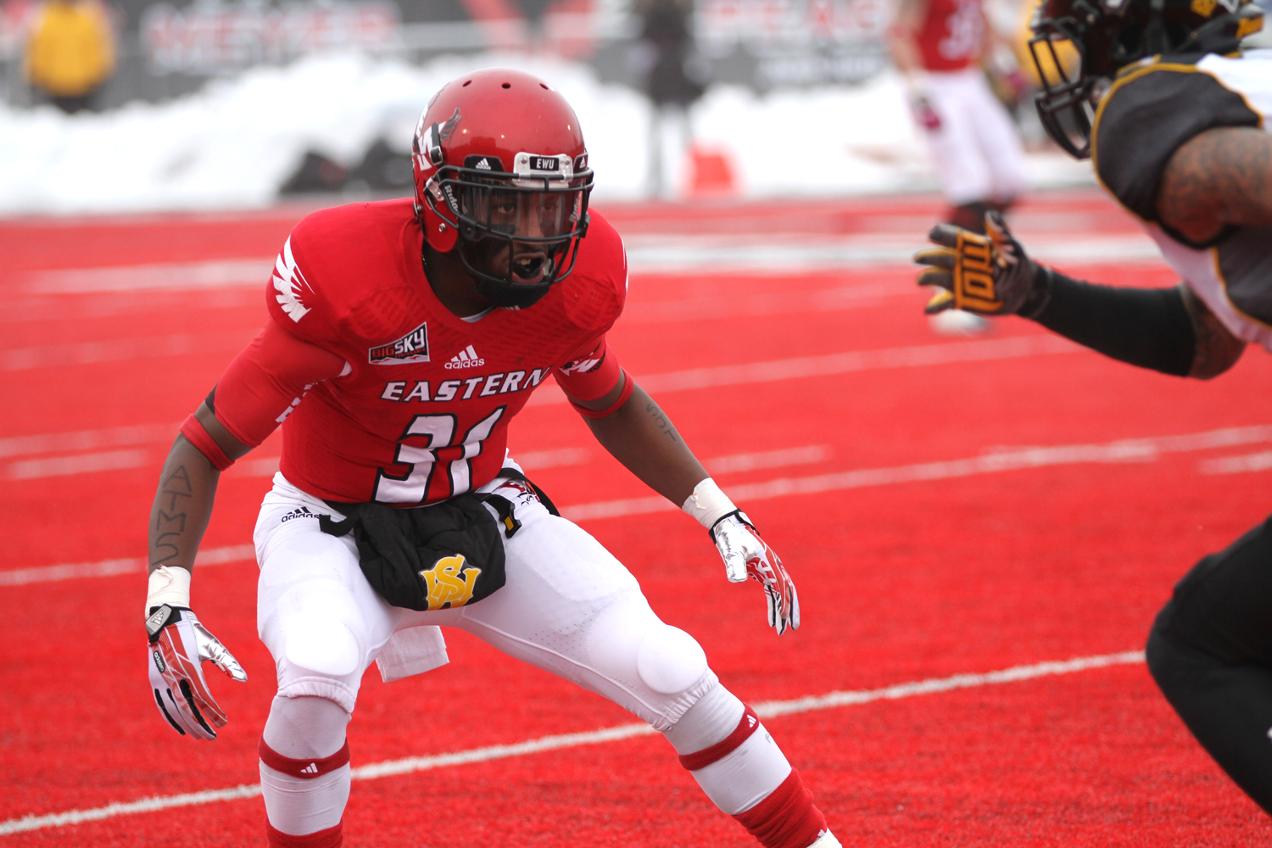
easternwashEastern Washington University prides itself on being a defensive football team, often finding itself in the thick of the FCS playoffs each season. The Eagles are primarily a quarters team that mixes in Cover 3 and Zone Pressures out of a 4-2-5 front. In this clinic report, I will share our Quarter-Man Technique that is used when we are playing Cover 4 and we want the cornerback in an off technique. 
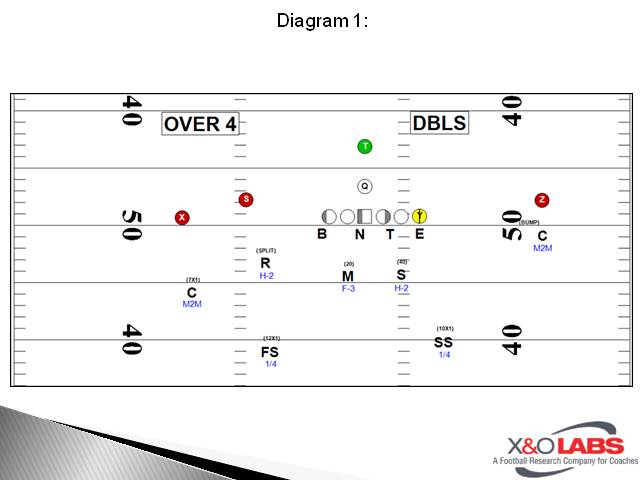
Theory of Cover 4:

When installing a new defensive call to our players, we will always break down the theory, strengths, and weaknesses of the coverage. This allows us the opportunity to explain why we will call a particular coverage at a particular time of a game.

XO Labs PPT Template1

For instance, we tell our players that Cover 4 is a pattern-read man concept that is accompanied by a four man rush. It is not your typical zone coverage, where defensive players are responsible for particular areas of the field. Instead, they are dropping and relating to route combinations that are ran by the offense.

We explain to the defense that there are three underneath match drop defenders, and four vertical attached players. At Eastern Washington, we primarily run this coverage out of our four man fronts and is used on normal down and distance situations.

Quarter-Man Technique

Strengths and Weaknesses of the Techniques:

Strengths

  • Direct vision on the quarterbacks release from center provides quicker Run/Pass key
  • Easily disguised within our other off techniques
  • Natural cushion allows corners to run with a vertical release by the receiver

Weakness:

  • Cornerback’s off-alignment opens up the threat for offenses to attack the quick game to the flats. (The flats are a weakness in Cover 4)
  • Alignment causes a later reaction to a Push-Crack by the wide receiver
  • Takes cornerback out of the pattern match equation, therefore the safety or linebacker has to run with any slot receiver to the flats

Alignment/Assignment: 

  • Cornerback alignment is “7×1” meaning seven yards off number one receiver, one yard inside.
  • Alignment will be based off of a split rule adjustment
    • Ball in the Middle of the Field = 2 yards on top of the numbers
    • Ball on the Hash = The boundary corner will be at the top of numbers and the field corner will be ½ way between the numbers and the hash
  • Against any type of run towards us we are responsible for secondary support
  • Against any type of run away from us we will carry out our insurance responsibilities (Cutback – Reverse – Pylon)
  • Against any pass we will be responsible for identifying the release of #1 and playing man coverage

When do we play our Quarter-Man Technique?:

Our techniques are based off the position of the first eligible receiver on our side of the core formation. In most situations this will be on a detached wide receiver or an attached tight end.

Our Quarter-Man technique will be executed when we are aligning to a detached wide receiver. We have a completely separate technique that we call our clamp technique that we will use on an attached tight end.

Leverage on a Wide Receiver (Inside or Outside):

Our leverage within our alignment is based upon the wide receivers horizontal relationship to the core formation. We call this our ‘Split Rule Adjustment.’

Read More

Ferris State Power Read/Jet Read Concepts

By Dan Rohn – QB’s Coach/Run Game Coordinator – Twitter: @coachrohn                      
Steve Annese – Slot Receivers Coach / Director of Football Research
Sam Parker – Offensive Line Coach – @CoachParker
Ferris State University (MI)

Introduction:

ferrisAt Ferris State University, we have experienced a great deal of success over the past 5 years including 2 GLIAC championships, 3 playoff berths, and an overall record of 48-11. This success can be attributed to a multitude of factors, and one of the many factors has been the success of our offensive run game through our spread option attack.
As part of our spread option offense at Ferris State, we employ 10 and 11 personnel sets to spread a defense from sideline to sideline in order to create room for our quarterback to make reads and get the ball to athletes in open spaces. This includes a heavy dose of the quarterback carrying the ball himself. This type of offense allows us to make the most of our blocking resources by reading a hat at the point of attack instead of having to block him.

In our time at Ferris State, there have been a number of concepts that have been incredibly good for us and our offensive output but there are a couple that stand above the rest. If implemented correctly, we believe these concepts can be the difference between making a run at a playoff spot and struggling to find the offensive efficiency that every team desires. In this article, I am going to break down a couple of plays that have become staples of our run game and, in turn, our success at Ferris State University.

Power Read

Slide1

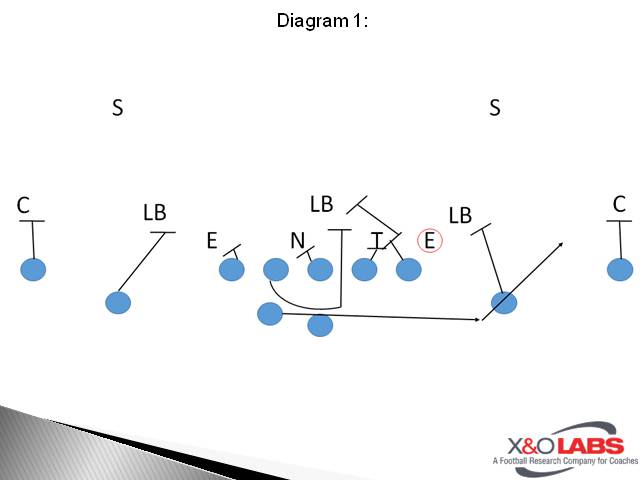
The Power Read concept employs a hybrid of a traditional power scheme and a read option scheme and uses the mixture of schemes to gain an advantage with a tailback perimeter run or a quarterback downhill run into open space.

On the read side of the play, the offensive tackle releases to the backside linebacker “chipping” the 3 technique (if there is one) on his way in a technique that we call a “bang release.” The play side guard blocks man on; this could mean blocking a B gap player or an A gap player and leveraging him whichever way he needs to in order to create movement. The center is blocking back for our pulling guard. The backside guard is pulling and horning for the play side linebacker. His job is to horn through the available gap created by the play side guard and is on to the linebacker similar to what he would do on traditional “power o”. The backside tackle is sealing the inside gap and if he feels on pressure inside he will then attack the backside end to make sure there is no back side pursuit.

The running back should line up with his heals on the quarterback’s toes and the middle of his body on the outside leg of the guard. On the snap of the ball he is running laterally across the quarterback’s face and forming a good pocket for meshing with the quarterback. Once the ball is in the mesh the running back with form a “soft seal” on the ball while waiting for the quarterback to make his read. Once he has the ball or the quarterback has chosen to pull the ball (either way) the running back will give a little bit of ground while running a hoop and getting to the perimeter as fast as possible.

On the perimeter the slot and outside receivers are attacking the man over them or the most dangerous man in terms of making the play on the perimeter tailback run. This is important as their job is to create space on the perimeter as that is where the focus of the defense will be.

The quarterback’s job, once the ball is snapped, is to stab the ball into the pocket of the running back and initiate a good mesh. As the running back crosses his face, his eyes should be locked on the defensive end to the play side. He will take about 2 and a half shuffle steps as he reads the defensive end’s movements and determines what to do with the ball. If the defensive end squeezes as he is released then the quarterback will give the ball to the running back. If the end runs to the running back to make the play on the perimeter, then the quarterback will pull the ball and keep it vertically behind his pulling guard. When in doubt, if the end cannot make the play on the running back, then the ball should be given to the running back and worked to the perimeter.

When power read is executed correctly, the defense has a huge burden to stop the perimeter run and still not give up the big play on a downhill run. It is an easy enough concept to execute that the burden is on the defense rather than the offense and that is where you want to be as an offense.

Teaching the Combo Block:

The objective of the block is for the guard and tackle to work on a 45 degree angle to the backside LB of our Power scheme. It is the guard’s job to stall the impact of the DT, and the tackle’s job is to create movement.

Read More

Mary Hardin-Baylor’s Championship Off-Season

By Mike Kuchar
Senior Research Manager
X&O Labs
Twitter: @MikekKuchar

Editor’s Note: The following research was conducted as part of XandOLabs.com research report on NCAA Player Development Study. Continue reading for more information on this study.  

Case 1: Developing the Off-Season Mentality

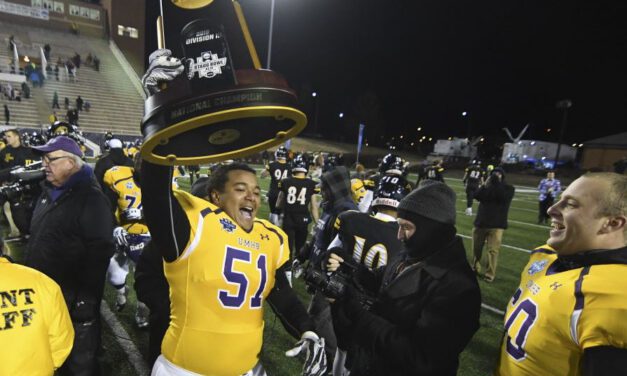
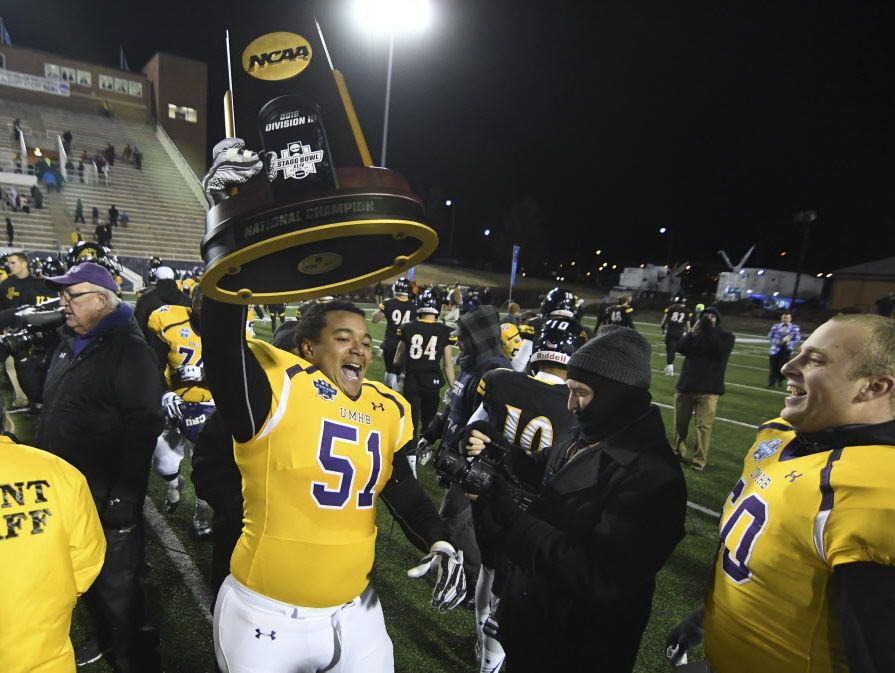
mhbchampsIn this case, we studied what these coaches were doing in the off-season to develop the mental capacity of their players. We all know that it’s the cohesiveness and resilience of a football program that is developed from January to spring ball. We wanted to find out how head coaches were developing players in this area as it pertains to the following components:
  • A character development program
  • A leadership council among players
  • The infusion of a sports psychology program

While we found that the leadership council seemed to be the clear favorite of choice in developing players during the off-season, we found that coaches were using different criteria to select leaders and various activities that encourage these groups to promote the program.

Peter Fredenburg, University of Mary Hardin-Baylor (TX): “We elect a unity council who then drafts members of the team to divide into teams. We use nine leaders for each team and they draft the rest of the players whom we call them coaches within their team. We ask them to be involved in campus activities. We will also have a Sports Information Director in each group whose job it is to enhance the ability of that team to grow by attending activities. These guys work with local high schools and elementary schools to read to local kids.  We keep up with them on a weekly basis by meeting with them each week. There is nothing more powerful than peer pressure in my opinion. Once they draft a team member, these leaders stay with them. The leader of the team meets with players regularly to develop team chemistry. We ask them to be involved with community service. They do in the off-season, what we do in the fall.”

Read More

Two High Run Fits vs. 20/11 Personnel Run/RPOs

By Adam Harvey
Defensive Backs Coach/Special Teams Co-Coordinator
Cibolo Steele High School (TX)
Twitter: @coach_harvey18


Editor’s Note: Some of the videos in this report contain audio.


The latest trend from offensive coordinators’ perspective is finding the hybrid Y/H that can line-up virtually any and everywhere to keep the defense guessing. The players who can line-up as an offset FB (H), Off Y, On Y, and slot have given defensive coaches headaches in matching personnel especially when there are no substitutions. Regardless of the front, having an overhang that can account for the flex player is important. Having defensive backs that can complement the overhang both in run and pass concepts may be the difference for success of the defense. In this report, I will discuss our reads versus the Y, off Y, and H from the DB position, particularly safety because we are primarily either spinning or keeping two on the roof based on the alignment of the flex player. For identification purposes, I will refer to this player as the flex throughout this report.


20 Personnel (Flex is aligned as RB/FB/H)

Teams that stay in a 20 personnel look will align the flex inside the tackle box. We have played this similar to a three-man surface keeping our backers inside and adjusting in the back end. We are a press 2 scheme by design and want to stay in our base if possible vs 2 back sets. If the flex is aligned as an H, whether on the strong or weak side of the formation, we will generally align to him. With the game plan in mind, many times it will depend on the talent level of the outside WR and the slot to the twin’s side. The skill of those players determines how much attention we can give the flex. In this report, we illustrate how we align vs split backfield, strong flex, and weak flex. As we get into the coaching points, please keep in mind, all of our variations are game planned and we will keep our alignment consistent but change responsibilities as the strength of offenses change from opponent to opponent. At the end of the day, the teams that can show similar alignment, yet run different concepts to confuse the opposition are those who will come out on top usually. 


OVER/UNDER FRONTS

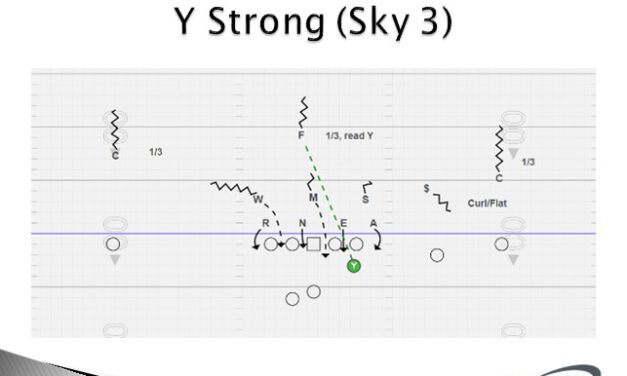
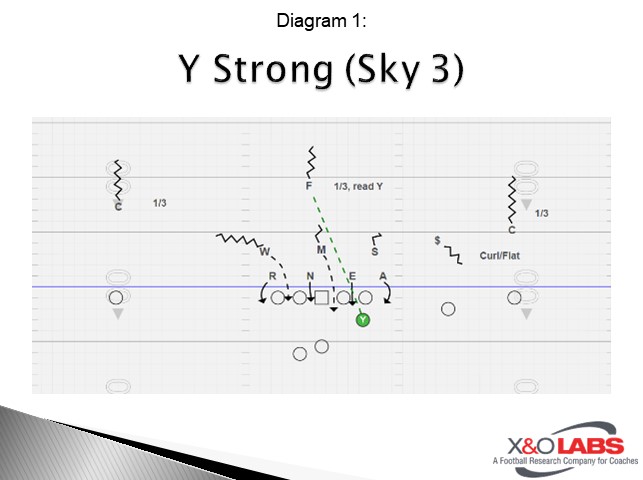
FLEX STRONG: With Power, GT, and Wham schemes reigning as the go-to with 20 personnel, we like to play either press 2 or quarters to this formation. However, we will also spin the safety to the flex side if we feel the offense will run power or a wide zone play. With our front seven often in an under front, we will spin the safety to get a closer force, fit inside with the Mike and Sam and put the backside safety on the roof. The coverage becomes Sky 3. If we remain in two-high, we are either playing quarters to get both safeties involved in the run fits (force) or two and have the corners play press and force. We have also played some man free to the look with the same idea of spinning the safety on the flex side to make it look like sky, but we remain in a cover one concept.

Diagram 1


Coaching Points: When staying in two high our initial read is the mesh point and the ball. Our secondary read is #1 to the solo side and #2 to the twins’ side. We react to the flex late, from the safety position. Our alignment should be anywhere between 8-12 yards depending on the down and distance as well as the ability of the player involved. I give our guys flexibility to change up depth as they see fit until they get caught up and then I will make the necessary adjustment. 

On the play below, notice the back who is aligned in a strong position of 20 personnel will shoot out to the flat on a sprint flood concept. The safety to the flex is going to scroll, but then cut his scroll and sprint to the sideline once he reads sprint out. Our coaching point is to gain enough depth to keep two routes within breaking distance. The corner’s job is to take deep third and keep a two-yard cushion on the deepest route. He does a good job being patient as the wheel route enters his third late in the play. The backside safety who has the middle of the field takes the post and leaves the wheel as the only throw the quarterback has. Nice coverage all around to a Flex look that could have been thrown underneath and gotten us to bite on his shoot route.

Read More

Midline Concepts from Short Pistol Alignments

By Scott Hansen
QB Coach/Passing Game Coordinator
Hinsdale South High School (IL)
Twitter: @CoachHansen05


As someone who was raised on the Split Back Veer (SBV) from under center, I am what you may call an “option purist.” I ran SBV as a quarterback for four years and coached it for another five. Combine that with the time that I’ve spent studying and coaching the Flexbone Triple, and you’ve got a coach who’s pretty set in his beliefs. With that said, I also understand that any coach worth his salt knows that he has to evolve as the game evolves.

When I was hired to my current position, I was expected to be open minded. Our offense combined the traditional Flexbone Triple with Spread concepts. As part of this scheme, we would put our quarterback was in the short pistol, 2 ½ yards from the center. The reason for this being that having the QB closer to the center than a traditional Pistol formation allows us to align our fullback so that his hand is on the ground at 5 yards depth. I was initially curious to see how the timing of the snap, the mesh, and the point of attack all worked in synchronicity.

While I was skeptical at first, it was easier to buy in after seeing the big picture. Here is a list of the ways that we feel we gain an advantage using the short pistol:

  • Aids the QB in gaining depth for reading all option plays
  • Protects the mesh from upfield penetration or a stalemate at the LOS
  • Causes read keys to take a definitive angle
  • Puts the QB at the proper depth for the quick passing game
  • Disguises the intent of slot motion (slots align even with the QB)


Diagram 1

Diagram 2


The Quarterback

For the quarterback, the teaching progression starts with catching the snap. In the short pistol, the snap resembles that of a shotgun snap with some minor differences. We teach our center a two-handed “flip” to get the ball back to the quarterback. He turns the laces to match the handedness of the QB and flips the ball back aiming for two end-over-end revolutions. The QB begins his footwork while catching the snap. His eyes go through the ball to the dive read.

I teach simple cues to help our QBs learn muscle memory as quickly as possible:

  1. “Flip the hips.” The backside foot clears the midline while the playside foot moves to 6 o’clock. Feet should move simultaneously, and the majority of body weight should be on the back foot. The most common mistake is for the QB to jump off the ground. Rather, his feet should be gliding to the proper position.
  2. “Reach and teach.” We subscribe to the “Ride and Decide” method in terms of the mesh. The QB will “reach” the ball back to his playside foot. Ideally, the ball is placed directly on the midline. Once reaching the ball, the QB will “teach” the dive read. Whatever the dive read does is wrong.
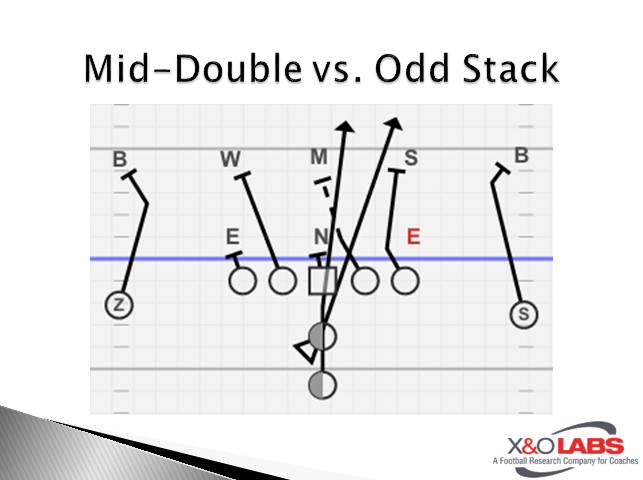
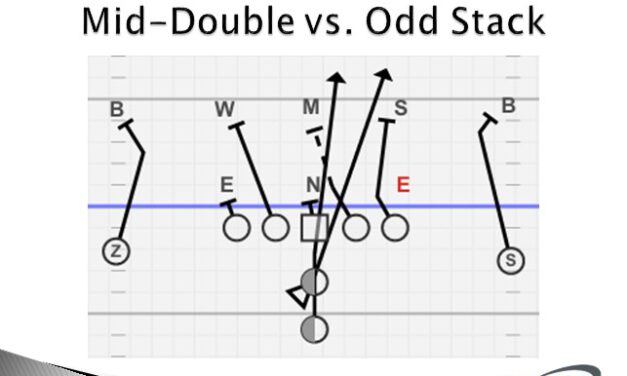
  3. “Give and take.” If the QB gives the ball, then he prepares to take contact from the dive read. We teach our QBs to absorb, not accept contact. He will give with the hit. This technique is the same whether we are running Mid-Double or Mid-Triple. If we can carry out the fake to the pitch phase, then it’s a bonus.
  4. “Pull and replace.” If the QB pulls the ball, then he replaces the dive read by pushing off of his playside foot into the LOS. In Mid-Double, there is no pitch read, so the QB is taught to get vertical now.
  5. “Pull. Pitch.” In Mid-Triple, if the QB pulls the ball, he is taught to step to the pitch and get it out there. Against a 4-man front, the EMLOS is rarely a pitch player. The same applies to a 3-4/5-2. Against a 3-3 Stack, however, the QB is drilled on reading the stack. Normally, the stack LB is taught to fit for QB, which means he’ll have to be special to run down our pitch back. Regardless of how you teach it, it is important that the QB understands that Mid-Triple is either a give or a pitch.


Read More

Defending the Wing T with Eight Man Fronts

By Kyle Cogan
Defensive Coordinator
Lexington High School (MO)

Introduction

At the smaller classifications in Missouri, we see a wide range of offenses that we have to defend week in and week out. This includes everything from Double Tight, Double Wing to all out 5 wide spread and everything in between. Due to the different schemes we see each week, we wanted a defense that could adapt to any offense we might see. For that reason, we are very multiple in the fronts, blitzes and coverages we run.

Through our 2015 season, we played a total of 6 different Wing T teams. The Wing T seems to be timeless. No matter where you are, you can all but guarantee you’ll see a good Wing T team during your season. In my experience, the Wing T forces you to go to an 8-man front. Our team philosophy is that if you cannot stop the run, you’re going to be in for a long night. We base out of a 4-2 scheme, but run a fair amount of 3-3 as well. Our approach for defending with each of these schemes will be covered in the rest of the article.

Preparation

The first thing we do when playing a Wing T team is chart their formations and tendencies. This will give you a good idea of what type of Wing T team they are. Since each Wing T coach is a little bit different, you must get inside their head and try to think how they think. When you have determined the formations, plays and personnel they play with, then you will understand the type of animal you are dealing with.

Although everyone has their own unique terminology, I will use Tubby Raymond’s verbiage because it is what I know best and the way I learned the Wing T. Most Wing T coaches will use some sort of the same verbiage but tweaked to their style.

The various types of Wing T schemes we see are:

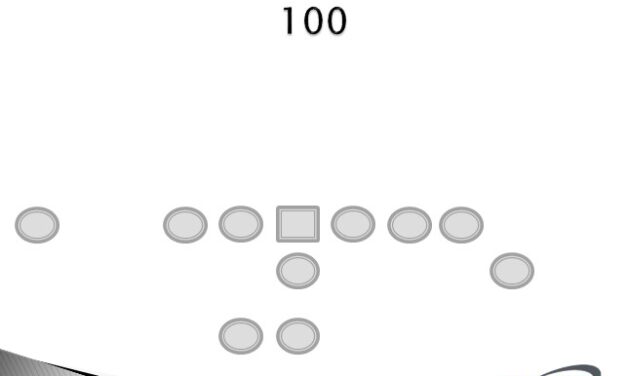
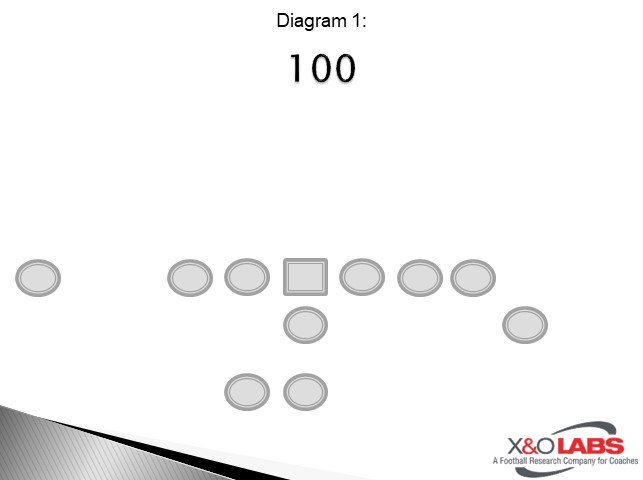
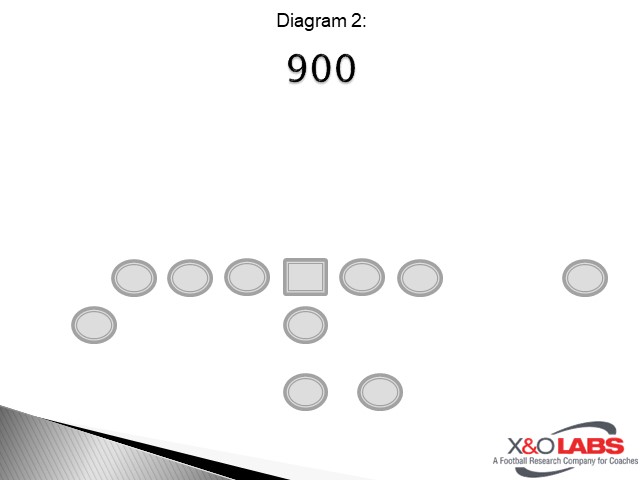
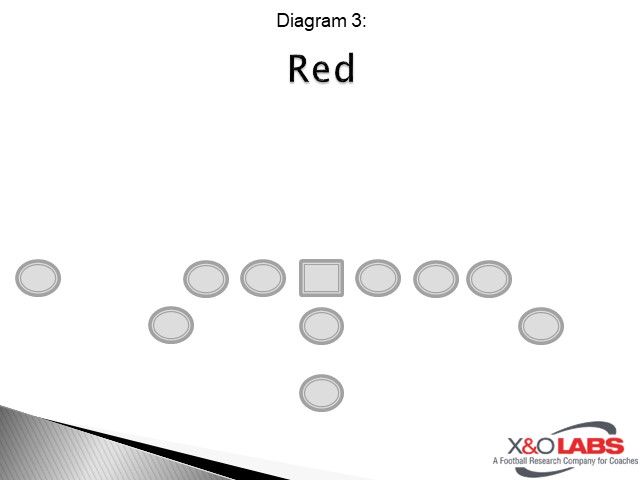
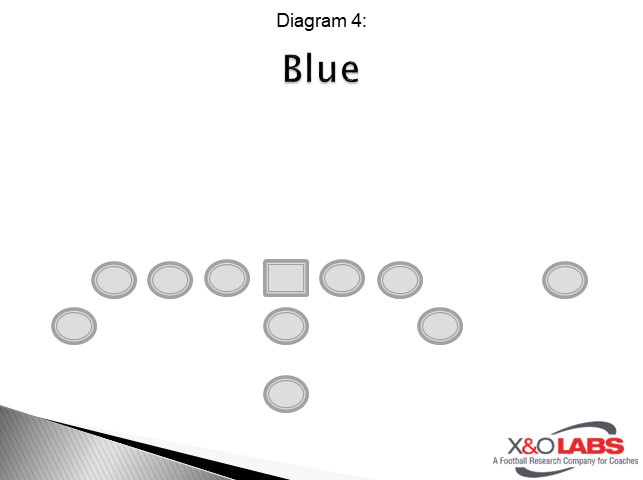
Traditional – In this version, the basic trap, buck sweep, and waggle are the staple concepts. You will see a lot of 2 back sets, primarily 100 and 900 with Red and Blue mixed in.

Slide1Slide1

Hybrid – This version has more formations and motions with a ton of jet/rocket/buck sweep to the open side. These teams usually have a faster FB and will false key plays with their guards. It is more common to see Red and Blue than 100 and 900.

Slide3Slide3

Option – We mainly see midline and veer.

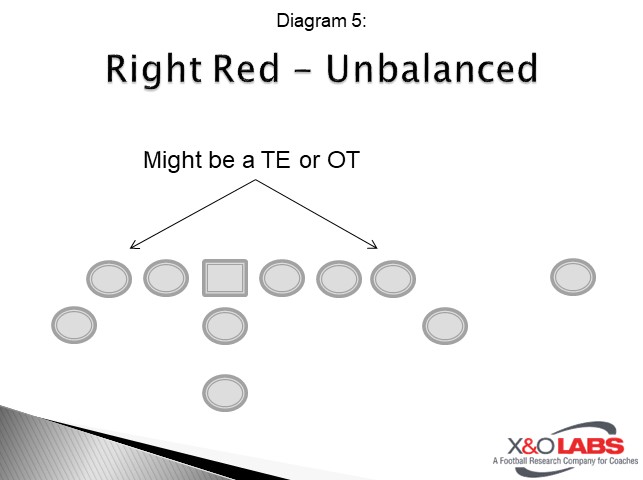
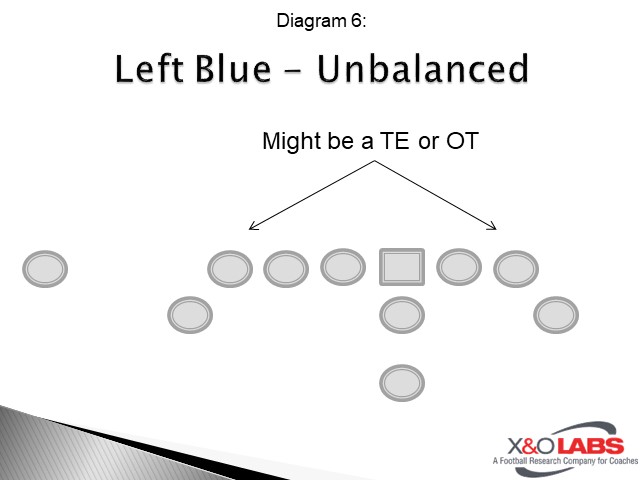
Unbalanced – This is more of a change-up for most teams than a base formation. We almost never see a true 4-man surface, but when we do we just slide everyone a man over. We do, however, see a fair amount of ‘X over.’ In my Wing T terminology, this is Right 100/Red and Left 900/Blue formations. Teams will line up differently as some will also go tackle over and others will just make the TE ineligible with the X receiver.

Slide5Slide5

Spread – This version uses the Wing T concepts and plays but primarily runs it from the gun and some pistol sets. If you have ever heard Bruce Cobleigh speak, this is his scheme.

After we have determined the type of scheme we are seeing, we go to the motions this team uses. The beauty of the Wing T is that when motion is incorporated you will always be outflanked. In my opinion, you have to get a 9th hat (FS) in the box to match the numbers (discussed later).

Everyone’s terminology might be different but to me the main types of motion in the Wing T are:

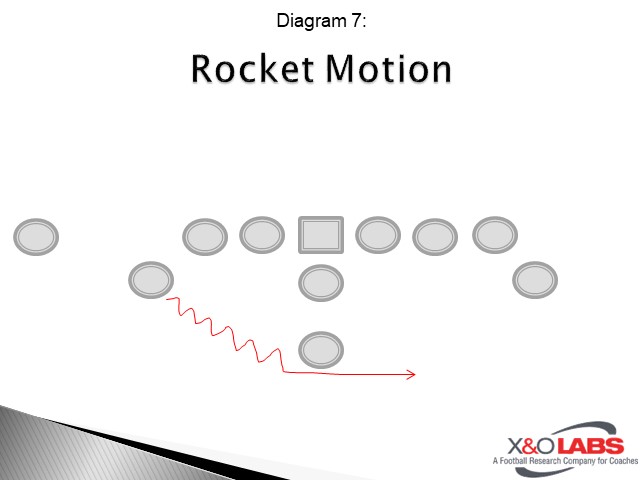
  1. Rocket – TB/WB motions flat behind the QB in gun/pistol or FB depth when they’re under center.

Slide7

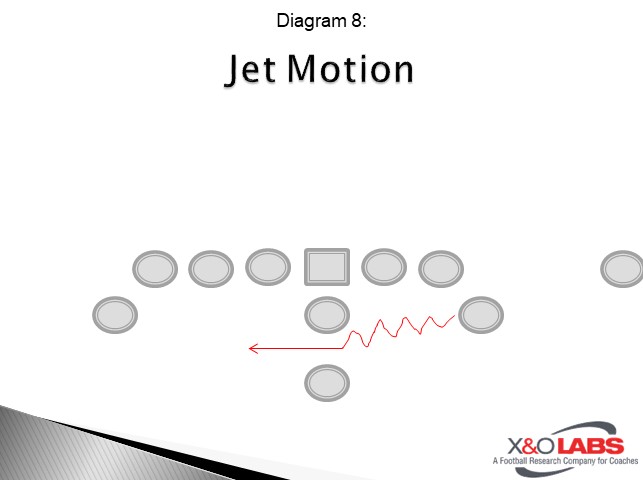
  1. Jet – TB/WB motions in front of QB in gun/pistol or behind QB when under center.

Slide7

Read More

UCONN’s Two-Man Surface Toss Concept

By Mike Kuchar
With Frank Giufre
Offensive Line Coach
University of Connecticut


Editor’s Note: This is the second report in a two-part series on UCONN’s Pin and Pull run concept. Part one focused on the three-man surface concept. Many of the block techniques associated with this report are further explained in .


For most offensive play callers, the 10 personnel four wide run game can be very limited. You have your base inside game such as inside zone or trap and your base outside run game like stretch or outside zone, but after that it gets limited. While many coaches prefer to run some toss game out of three-man surface bunch sets, the same can be done from the two-surface side without a tight end. The benefits are simple- it gets the ball on the perimeter in a hurry with bigger bodies lead blocking for the ball carrier. But in order to run the scheme with a great deal of efficiency, it’s important to educate the back on whom to read based on the defensive front presented. With many defensive structures relying on pressure tendencies in the fringe red zone area (where the play is mostly run), the offensive line must be able to protect any potential leakage that can stall the play.


Advantages of Tagging Pin and Pull Runs

  • Uses high percentage down blocks to separate the defense. Not necessary to crush defenders, just to eliminate penetration.
  • Opportunity to get two pullers in front of the ball carrier.
  • Handles bigger defenders in the box
  • Gets the ball out in the perimeter. As Coach Guifre told us, “the offensive line likes screens but this gets them running to hit a defensive back. It becomes fun. You’re not trying to knock people off the ball.”
  • Efficient red zone play because of the tight formation spacing.


Box Blocking Rules

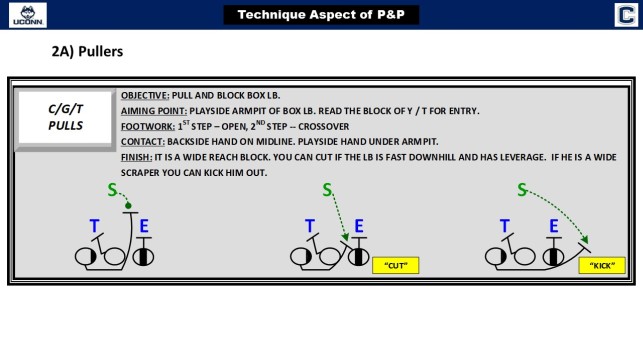
The bunch toss concept can be manipulated in several ways to attack different fronts- all of which are included in this report. In most cases, the first puller (usually the Tackle) will block the first defender past the identification.

But regardless of the tags, there are three primary blocks associated with blocking the box in this run game:

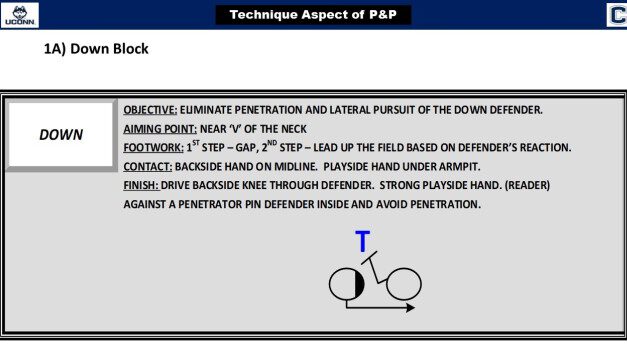
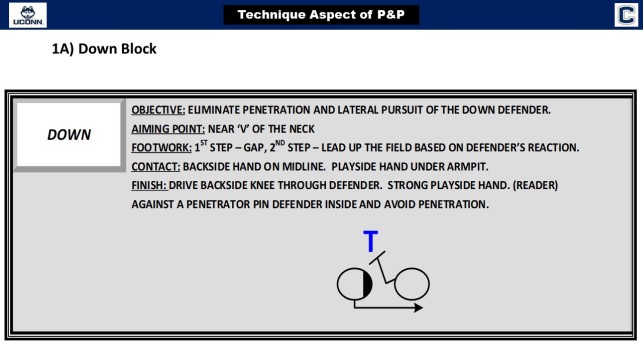
  • Down Block

Diagram 1

  • Pull Blocks

Diagram 2

Read More

Implementing Multiple Card Systems for Tempo Offenses

By Scott Girolmo
Head Football Coach
Lee High School (VA)
Twitter: @CoachSGirolmo


Seeing a play call go from abstract lettering on a play sheet to 11 players aligning in perfect spacing on the field, and executing the movements and schemes accurately is one of the most beautiful aspects of our sport. Being a play caller can make you feel like an artist. The canvas stretching before you may be green already, but your creativity and ingenuity can allow you to paint a masterpiece on any given play.

The methods in our sport are as diverse as the mediums used in an art studio. I have a tool that I believe can help all coaches simplify their artistic process. From the most complex systems, “U Zap to West Right Tight F Left Fake 99 Toss Crunch Naked Right,” and an NFL favorite “Shift to HB twin right open, swap 72 all-go, special HB shallow cross, wide open”. To the simplest, “Y-Over 121” or “Trips Left Late 93 H-Wheel.” We all want to be as efficient as was can at creating great football. If you are a west coast offensive coordinator looking to get your formations and shifts in quicker, or an Odd stack defensive coordinator hoping to speed up your front adjustments, I believe that a flip-card system can help you become more efficient. Even if you already have hand-signals, I believe flip cards cannot just complement any hand-signal system you may already have but enhance it as well. No matter how deep your staff is, this can help you top to bottom in any of the three facets of the game including special teams.


Designing Formation Cards

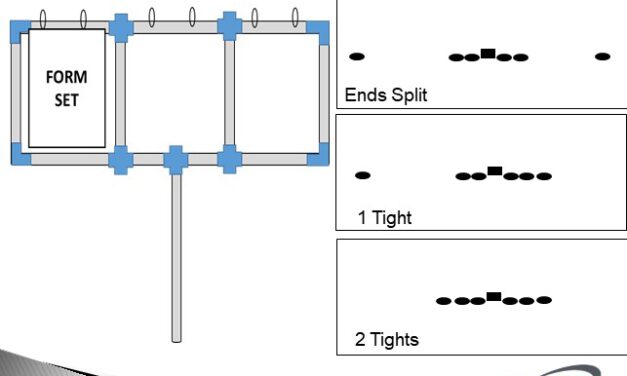
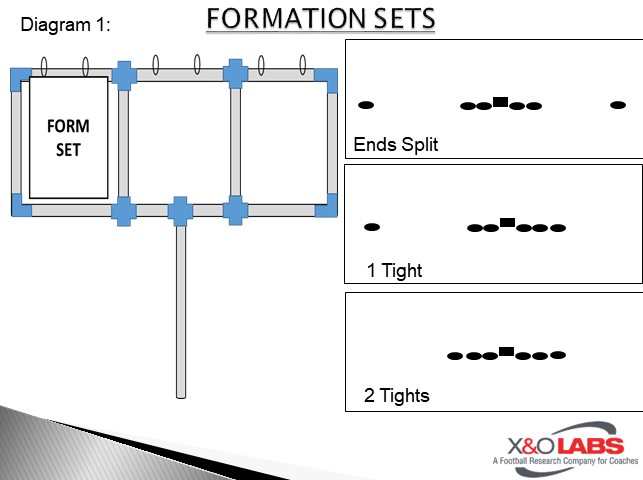
When I first started using this system the goal was to create a fast and easy method for calling formations so that I only had to hand-signal a play call. I wanted not only to be multiple, but also be quick so we could be up-tempo when we needed to be. When I stood and looked at our hand signals from the player’s standpoint, they were good, but they were limited by two hands. I knew that some would require a three signal movement, and every time one hand progressed to the third signal, I would lose the first for a moment. By creating a three panel frame, and hanging cards from it, I was able to leave the formation up on the cards through the whole play call, and it was stagnant – no waiting for the signal to start over to get set. This became particularly helpful when it came to our motions and shifts. It was painfully frustrating when looking at the signaler who was responsible for motions and formation when he would have a movement signal that wasn’t clear enough and then go straight to the formation. I needed a better way for my guys, a faster and easier way for them to see and understand the call. That is when I came up with the formation cards. I categorized all our formations by the “Set”, “Adjuster”, and “Backfield”, and broke the panels up to correspond with this. I wanted to compartmentalize the information for them, so that guys only had to remember small chunks, or “rules” about formation-creation. If they could learn the pieces, I could create any formation I wanted by mixing them up.

Formation “sets” can be described as the coordination of the 7 players who align on the line of scrimmage in the formation. In the first version of the cards, I used a three panel frame and basic formation sets to accommodate a multi-personnel offense. Three sets made up the skeleton for everything: both ends Split, One split and one Tight End and Double Tight End. The same can be true of any offense. For example, if you are a flex-bone team, you can fix your formation sets up to allow freedom for your B-Backs to align anywhere, and put your best backs where you need them.

Diagram 1

Read More

Using Robber Coverage Behind a 3-4 Front

By Nat Zunkel
Head Coach
Mercer County High School (IL)
Twitter: @CoachZunkel

Introduction:

IMG 3109Robber coverage is one way to develop a hybrid style defense to combat several of the no-huddle/multiple formation offenses that we play. After years of developing and tweaking this concept, we have found that this is the perfect high school defense for us. As a rule we use this concept about 60% of the time.

Rationale:

When we conceptualized this defense, we sat down and decided what was best for us:

1. We needed to think less on defense so we could play faster.
2. We had to decide what to do versus multiple formation teams.
3. We had to find a way to combat the no-huddle offenses.
4. We had to continue to find ways to out-athlete other teams.

After studying, we were able to determine the following responses to the points above:

1. Each player has one responsibility.
2. The outside backers will be able to play on the line of scrimmage.
3. Our rule system is simple and concise for no-huddle teams.
4. We use a base 3-man front so we can have an extra athlete on the field.

Here is a breakdown of what we are looking for with each position:

Defensive Line:

The defensive line must be completely gap aware, that is to say that from the nose to the ends each lineman must be able to “own their gap” on each play.

The Nose must be able to play a two-gap technique. We typically want a bigger body in this scheme, but we have had tremendous success with smaller wrestler types. His ultimate goal is to mess with the center’s snapping hand and disrupt the backfield.

The ends will play the B-gap against the run and the C-gap against the pass. For this reason, they must be athletic. Because of the way we play the front three, they are more active in the run game than they are in the passing game. That said, we look for a 20% QB hurry/hit /sack rate on passes.

Slide1Slide2Slide3

All defensive linemen are taught from day one on how to take up a double team. We use the terminology of “hipping” into the gap.

Linebackers:

Our inside linebackers are coached differently than the outside linebackers due to the differences in their techniques.

Inside linebackers (Mike and Will) typically align head-up over the guards who will also serve as their read on each play. In a run fit, Mike and Will have the A gap to the B Gap. Against the pass, they are responsible for the Hook Cross zones. In essence, the inside linebackers need to make every play between the tackles.
The outside linebackers (Sam and Dog) always read the end man on the line of scrimmage and will have several different alignments. The Sam should be the bigger more physically aggressive player of the two. Against a 2 x 2 set, the OLB splits the difference and sets the edge in a run fit. Against the pass, the OLBs are responsible for the Curl-Flat zone. When we get a TE formation, the OLB walks up and plays with his inside foot up splitting the difference. They must always be thinking contain and essentially make every play outside the tackle box.

Slide4Slide5Slide6

Against crossing routes, both the safeties and OLB eyes must go to the opposite field while yelling “IN” and thinking “collision.”

Against a wheel route, the OLB and Safety will yell “wheel.” This alerts the corner that they are going to switch to an inverted cover 2 and they will then chase.

Safeties:

The safeties in our defense must be very intelligent and athletic and they must always be thinking run first. The rover (strong safety) will make all of our calls so he must know the specific differences between Robber, Cover 3, and Cover 2 coverages.

The rover will align a bit tighter than a normal safety depending on the formation. We will set him between 7-9 yards if the #2 receiver is in the backfield or on the LOS. If we get 2×2 formation, he will align at normal safety 10-12 yards depth. He reads the end man on the LOS to the strength. Against the run, he is an alley player. Against the pass, he reads the #2 receiver. If #2 runs an out, flat, or bubble route, his eyes go to the #1 receiver to rob his route. The rover will play through #1 to the flat thinking “collision” #1. If #2 goes vertical, he will run with him and turn into man coverage.

The free safety will align at normal safety depth 10-12 y

Read More

Fordham University’s Double Pull Concept


By Mike Kuchar

Senior Research Manager

X&O Labs


Editor’s Note:  Mike Kuchar sat down with Joel Rodriquez to talk exclusively about the MAP concept, a double-pull concept in Fordham’s run game that has averaged 8.3 yards per carry.  Joel Rodriquez is the offensive line coach at Fordham.  He had previously served in the same capacity at Bryant College (RI).


Introduction

The crux of Fordham’s offense- one that has netted 522 yards per game this year- is a no huddle, high tempo, 10 and 11 personnel unit that takes advantage of misplace defenders by using the zone read game and play action concepts off of them.  In fact, my first interaction with what Fordham does was when I sat and listened to the Rams head coach Joe Moorhead talk at a clinic about the various pass concepts he uses of his zone read run game.  Though this may be a topic for another conversation, I couldn’t move my pen fast enough to write down all of his coaching points.    What I did catch was his admirable comments about his Offensive Line coach and run game coordinator Joel Rodriquez and the terrific job he does designing.  So I made it a point to go drop in on Coach Rodriquez to talk about how Fordham is so successful running the ball.

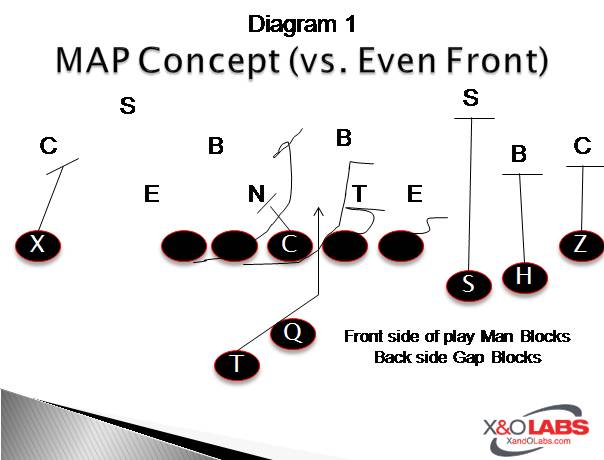
What he divulged to me is what he calls his MAP concept- a Man/Gap hybrid used to take advantage of defenses that play various games (exchanges, scrapes, etc.) to the read side of the zone read.  At its core the MAP scheme is a man concept to the front side of the play and a zone concept to the backside of the play.  The offense lineman to the play side have man assignments while the backside lineman are responsible for backside gaps, at least in theory. While it may seem like Power in structure, the front side man blocking assignments prevent any possible double teams while the backside Tackle is free to climb to the second level as a double puller.  (Diagram 1) “We didn’t want to Trey or Deuce block because we just don’t have the personnel,” said Rodriquez.  “It doesn’t take much to install it- it’s zone for the front side of the line and it’s a different read for the linebackers.”  The reason why it’s a different read is because the running back executes a “cross bow” assignment by lining up away from the call side.  His footwork will be different based on whether or not the Rams or giving it or reading it.

Slide1


Play Side Blocking Assignments:

Play Side Tackle:

For the play side Tackle, it is generally inside zone blocking.  He will block man on to outside, could be head up or outside.  Rodriquez’s coaching points for him are below:


  • PST should always have inside leverage by alignment, so drive DE & fight to keep inside leverage; widen the B-gap.

ü  Must stay square & under control so we can redirect and react to movement

ü  Don’t care which leverage he gives, by movement or alignment

ü  Strain to stretch whichever leverage the defender gives you


Play Side Guard:

The play side Guard has essentially the same assignment as the Tackle but a much bigger responsibility.  He has the man up to inside, whether it’s a 2i, 3-technique, etc.  But his biggest responsibility is to not let any player cross his face to the play side.  “If he (the defender) works a side, press him back inside and square him up. Cannot let a player cross his face.   Rodriquez’s coaching points for the play side Guard are below:


Read More

Incorporating Both Traditional and Shotgun Wing T/Double Wing Schemes

By Denny Diduch
Head Coach
Forreston High School (IL)


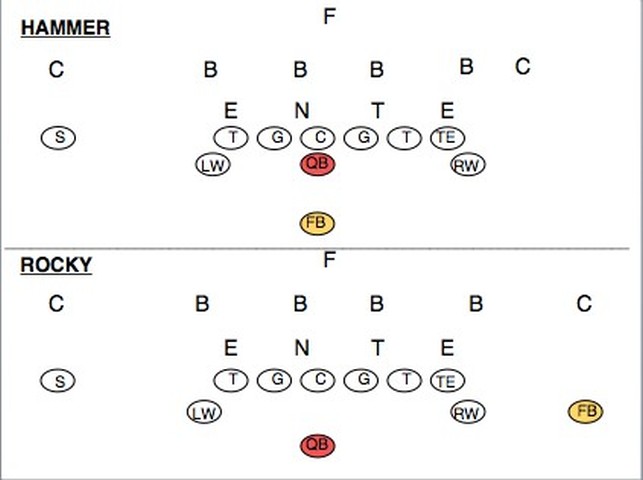
At Forreston, we have run the double wing offense for over 90 percent of our total snaps. When our program needed a switch-up, our kids’ mentality did not lend us to choosing a more traditional adjustment within wing T circles. Traditional wing T teams look to overload their lines with a tackle over or heavy backfields. We have seen other programs use these strategies effectively, but we believed those sets worked because of a hard-nosed, wrestler type team attitude. We play these types of teams in our conference, and when we tried to imitate that style it rarely worked, and at times felt like we were defeated before we even ran the play. Instead, we decided to replace our FB with a WR type player and put our QB in gun. We have been able to keep our blocking assignments simple, but still add a new dimension to our offense by making our QB become the FB and add an outside threat to our traditional Jet Sweep, Jet Trap, Off-tackle series.


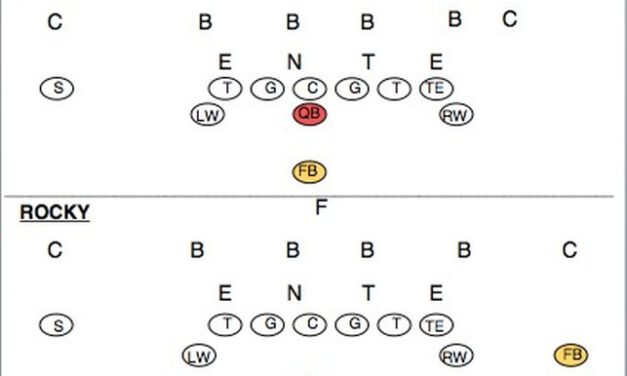
Top: Hammer (with Traditional FB); Bottom: Rocky (Shotgun with the QB now the FB)

Diduch 112718 1


Troubleshooting Common Issues with Wing T/Double Wing Systems:

When the opposing front 7 is stuffing our trap and off tackle plays, and the secondary can run with our jet sweep, we (like many Wing T teams) have struggled to execute a consistent answer with the passing game. We find that the pressure good defenses use to combat our run plays also creates havoc on our slow play action game. We needed an answer that met the following criteria:

  • Keep our blocking schemes and techniques the same and our total plays low.
  • We didn’t want to move our TE. We want to know where the defense will be.
  • Keep our OL/TE tied to each other in both gun and under center.
  • Be able to attack all levels of the defense.
  • Low risk. Get the ball out quick with little chance for negative plays.
  • We wanted to give the LB’s a different “look” without sacrificing the tough nosed line play we have worked to develop.


For the purposes of this report, I will not break down our base plays but simply show how the base plays can be run from both formations.


Combating Traditional “Myths”:

  • Traditional clinic talk says to do one or the other (shotgun, under center) or risk being bad at both
  • Negative plays
  • Fumbled snaps


We addressed the shotgun and under center concern by marrying our plays in both styles. We did not create two offenses. We just created two ways for the QB to initiate the play. To avoid a change in mentality, we practiced our gun segments and under center segments interchangeably throughout the season, week, and practice. One style was not our tough style and the other our finesse style. Instead, we coached, practiced, and executed the two styles as much as possible as “2 sides of the same coin”.

To avoid negative plays, we increased the amount of total snaps between center and QB
throughout practice by using a no-huddle system. We stressed getting the ball out early on a pass and having the QB run rather than force a tight window.


Trap From Hammer vs. Rocky Formations

Hammer

Read More

Off-Season Standardized Player Evaluation Model Design to Drive Improvement

By Kyle McKenna
Assistant Head Coach, O-Line and D-Line
Mercer Island High School (WA)
Twitter: @CoachMcKenna


One of the best clinics I have ever attended was given by Bill Belichick in regard to the development of personnel that you have on your team. The example he used was Julian Edelman, who had played college quarterback before he was drafted by the New England Patriots. In their initial evaluation of Edelman, they came to the conclusion that he possessed the potential to become a slot receiver. During the clinic, Coach Belichick showed video of Edelman running routes early on in his career and then followed with others that showed a gradual improvement over a period of two years. While Wes Welker was their starter, Edelman was developed to perform a similar role. When Welker departed and signed elsewhere, Edelman was well prepared and excelled at the role once he had the opportunity to start.

In the NFL, the evaluation of talent is a key ingredient to creating a successful team. This is especially true when there have to be tough decisions about who stays and who goes on a fifty-three-man roster. On the college level, deciding who will get scholarships and how a high school football player projects on the next level takes years of practice in evaluating talent. For high school coaches, there are different factors to be considered when projecting a player’s development over a 2 to 4-year period.

On the high school level, coaches do not have the luxury of signing a better player and getting rid of another. In addition, most high school coaches are looking at the bigger picture of character development and life skills. This creates an emphasis on constant improvement or a step-by-step improvement cycle that improves the individual player, his position group and the entire team. By looking at the entire development of the player from an improvement point of view rather than production, a high school coach can fully develop the middle and bottom of the roster and therefore create a stronger team. Most squads possess a dynamic player, but great teams surround that athlete with complementary role players that can bring a team from good to great.


Application

About eight years ago, I came up with a simple method of grading players in the off-season to drive improvement and give the coaches a standardized assessment model in which to guide how they coached individuals. Once this idea was introduced to the staff, the definitions and structure began to organically take shape as we discussed the levels of improvement. Also, it helped coaches to properly match up skill levels to reduce the risk of injury and build the confidence of our players. By determining a starting point, it gave coaches the opportunity to identify strengths and weaknesses and implement strategies towards improvement. This system used colors to indicate where a player was at in his development. The four colors we used were Red, Yellow, Green, and Purple.

The colors that we used represented the level we thought the player should be placed at the time of the discussion. Personnel conversations occurred in April, at the end of May, mid-July and late August. Those discussions consisted of our staff talking about players by position and indicating whether they met the initial designation of returning starter or projected starter. Once that was determined, we could then discuss the player’s specific color designation and a plan of action for individual improvement that could elevate their status. These meetings were an opportunity for coaches to “pound on the table” for a player that they thought could contribute in the fall. It also served as an opportunity to discuss potential position changes that could benefit the team and accelerate the player’s development.

Read More