
Establishing a Full-Field Zone Run Concept


By Gerald Hazzard – @CoachHazzlec

Offensive Coordinator

Lake Erie University



lake erieEditor’s Note:  Assistant Head Coach Gerald Hazzard joined the Storm coaching staff as the offensive coordinator in January 2007. Hazzard was the first assistant hired by Mark McNellie. LEU finished 2013 as the second ranked offense in Division 2 averaging 551 yards per game. Hazzard coaches the quarterbacks and has produced 18 all GLIAC performers in 4 years. A 1999 graduate of North Olmsted High School, he was a three-year varsity fullback and linebacker. The Cleveland native and his wife, Emily, married in June 2007. The couple resides in Painesville with their children Gerald IV and Lucy.


One of the first questions I always get asked is “What do you run in short yardage and goal line situations?”  I always answer quickly that we do what we do best, and that is run zone.    This past season we converted 35/46 short yardage situations when we called a zone play.  Note:  for us, a short yardage situation to us is 3rd and 4th down with 1-3 yards to go, or running a play from the 3 yard line in. 

No matter what offensive system you use, I am firm believer that in critical situations you should always call the plays that you execute the best.  The zone is “what we do best” because we make it that way.  We spend 20 minutes a day working our zone concept with our linemen so it has to be what we do best.  We believe so much in zone blocking schemes that it encompasses about 75% of our run game. In addition, we make sure that the zone play gives us a few options to get the 3 yards that we need to move the chains. 
Slide1


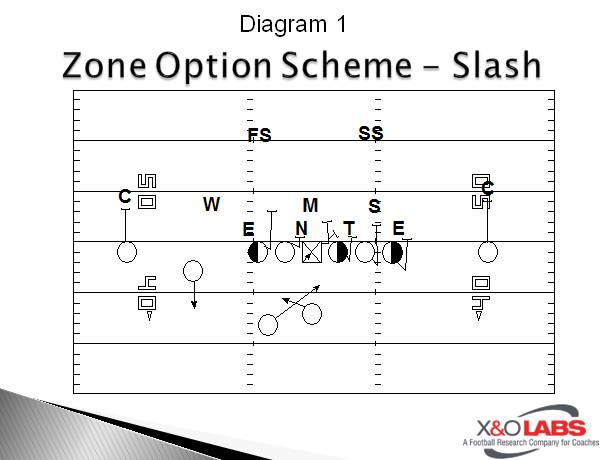
Here are a few of those concepts (some of which will be looked at later in the report):

  1. We are a read zone team, but we have the added dimension of incorporating a pitch guy anytime our QB pulls the football.  This can come from the slot or a second or third back.
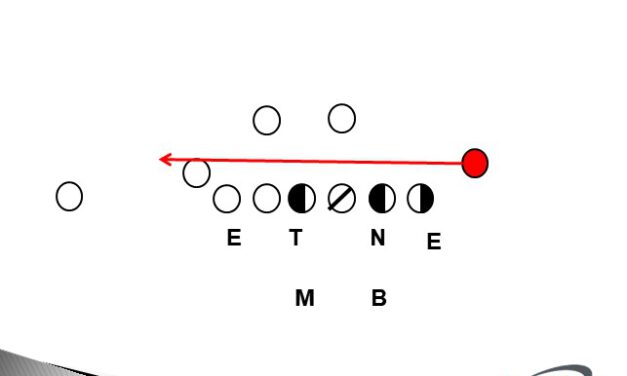
  2. We run a “full field zone” as opposed to the inside or outside zone.  This concept allows the RB to take the ball anywhere from outside the 9 technique to the playside or outside the 5 technique to the backside all based on his two reads at the snap of the ball.
  3. We teach our linemen that we don’t need to drive the defense vertically on short yardage plays, we just need to make creases.  If we make a crease the RB just needs to hit the hole and fall forward and chances are we will move the chains.
  4. We will add an additional running back to lead the play if needed.  These aren’t traditional fullbacks, they are tailbacks that understand how to run the play as if they had the ball allowing them to read the defense and lead the back to the right hole in our full field zone.

Starts Up Front

The key to the success of our zone option game is the offensive line.  When we recruit offensive lineman we are looking for kids who have great feet, can get to the second level quickly, and have a natural ability to stick like glue and finish their man.  Our zone blocking assignments are the same as any team out there.  Where we are drastically different is in our technique.  We take what we call a 4 o’clock step with our play side foot as soon as the ball is snapped.  This technique is used regardless of where defenders lined up.  Absolutely, defenders will not always stay where they line up.  Our 4 O’clock step will allow the defense to declare itself so our second step is always correct.  We are going to line up our offensive line as far off the ball as the officials will allow us.  It creates angles and we should be able to get our second step in the ground before contact is made.(Commonly referred to as a bucket step)  This allows the defense to declare where they are going.  Our second step which we call our crotch step is designed to split the crotch of our assignment.  When these first two steps are executed properly our offensive lineman should be on a perfect course to execute their assignment. 

Read More

Concept Blocking the Pin and Pull Scheme

By Jay DeCann

Head Coach/Offensive Coordinator

Little Falls High School (MN)


Editor’s Note:  Coach DeCann is entering his 3rd year as head coach/offensive coordinator at Little Falls High School. Coach DeCann is entering his 25th year of coaching high school and college football.  DeCann has been apart of 6 conference championships and two NAIA national playoff runs. 


CaptureWe have been an inside and outside zone team for a long time and had great success with the inside zone play, but really struggled with consistency with the outside zone play with the Rip/Reach/Overtake concept.  We just had a very difficult time with displacing and getting movement on the down defenders and creating an edge for the outside zone.  In 2003 I was very fortunate to spend some time with former University of Minnesota offensive line coach Gordy Shaw, who at the time was apart of one of the best running games in the country running inside zone and pin and pull stretch play.   The piece of this concept was it gave us a great C and D gap play for our tailback that was a perfect marriage with our inside zone run game.  The backfield action was very similar to what we were doing with our outside zone play so it was just a matter of teaching the new concept to our offensive line and tight ends. 
We really liked that there was not a laundry list of rules for the offensive line, but concepts for the offensive line and tight ends working in tandems.  The main premise of the play is to make linebackers become 2 gap defenders and it allowed our tailback to read the block of the tight end and was a 2 gap play for us by pounding it into C gap or bursting off the edge into D gap. 

We try and maintain our normal splits with our offensive linemen and tight ends on our pin and pull play.  As most coaches I talk to, we have linemen who like to cheat their splits and narrow up because of fear of betting beat inside, and so our splits will tend to be any where from 18” to 24” with the offensive line and tight ends 24” to 30”.  Our vertical alignment we like to be slightly off the ball and have our linemen and tight ends line up with their helmets aligned on the rib cage of the center.  We teach a balanced stance with not much of a stagger with our feet and coach our offensive line to have approximately 40% of their weight up on their down hand.

Offensive Tackle/Tight End Tandem

The tight end is the player who will make the call.  The tight end has 3 common looks that he needs to understand the concept of this tandem:

  1. OT and TE covered= Reach
  2. OT uncovered and Linebacker inside = Slug
  3. Swap: OT uncovered and linebacker outside= Swap

The 3 schemes this tandem needs to understand are reach, scoop and pin and pull. 

Reach Scheme:

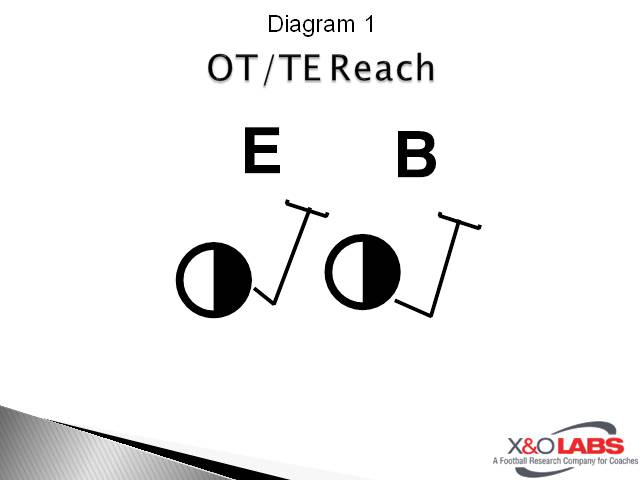
We teach our guys to step at a 45-degree angle play side and their aiming point is the outside armpit.  The 2nd step we coach them to step into the crotch of the defender, as the outside hand should be thrown into the far armpit area and the backside hand into the bottom of the shoulder pads.  Head should be fit into the rib cage of the down defender and we continue to run our feet trying to work the defender for width or vertical push.  You will see as we go on that we are OK with the down defenders either getting reached or displaced outside with the read of the tailback on the tight end block.

Slide1


Slug Scheme:

The Slug scheme is used when the offensive tackle is uncovered and the linebacker is inside the box.  We teach our covered player to take a “Slide Step” which is a lateral step.  The length of the step will depend up on the alignment of the down defender.  We tell the covered player his aiming point is the play side number, so we need to slide step to get our eyes on the play side number and fit our eyebrows on the play side number.  2nd step again is to the crotch of the defender and hands inside on the down defender.  Again, we can displace the down defender for width or work a vertical push to 2nd level.  The uncovered lineman will take a 45-degree step with the aiming point the backside number.  We want this player to assume he will be overtaking the block, but do not chase the number.  If the number disappears we stay on our track for 2nd level defender. 

Read More

4-2-5: Split Field Coverage

Zach Watkins
Co-Defensive Coordinator / Special Teams Coordinator / Safeties
Washburn University
Twitter: @Zach_Watkins and @WU_Football

Introduction

 SES2173Our base scheme here at Washburn University is the 4-2-5. We believe that by playing this as our base defense we’re provided with the flexibility to defend any type of offensive scheme we will face. Up-tempo no huddle, spread, pro-style, triple option, etc. are all schemes to be soundly defended by the 4-2-5. By having 5 DBs on the field, we are able to play a variety of coverages with our base personnel. Last spring, we wanted to research and install a coverage that combined several parts of our preferred coverages. “Auto” coverage was our perfect fit as it allows us to play a Cover 3 coverage while handling certain routes with man principles. In addition, we have found Auto coverage to work very well against any combination of 4 verticals. We can eliminate this spacing problem normally felt against 4 verticals by squeezing the verticals into our help. Auto is by no means our own original idea, but we have modified certain aspects of the check system to fit our personnel (as explained below).
Alignment

Slide1

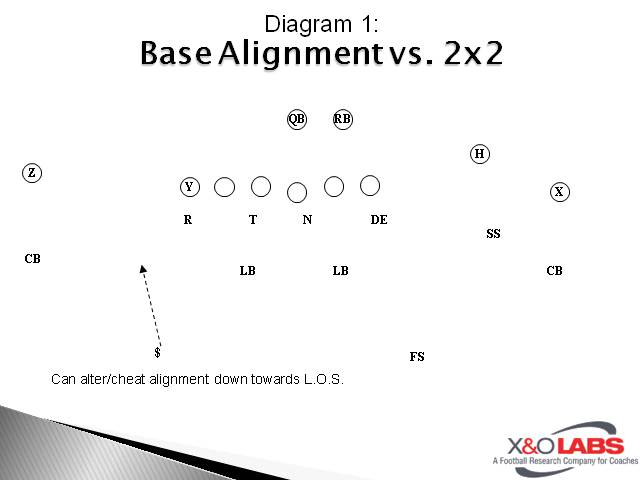
In our base alignment above, Auto is drawn against a base 2×2 set which is our favorite formation to play this against. With that said, we believe this is a sound coverage against any formation. In this case, the alignment rules are as follows:

  • LBs will align in 30s (outside shoulder of guard) at normal depth (toes at 5 yards).
  • Strong safety (SS) will align 1 yard outside #2 WR at 4 yards depth.
  • Our free safety (FS) and star (weak side passing strength, $) will align 12×2.
  • The $ will cheat his alignment down during cadence (sometimes aligning there initially).
  • Corners (C) will align 5-7 yards off if they are not pressed up. We change our corners’ alignments often to give various looks. Corners align 1 yard inside leverage.

Assignments vs. Any Non 3×1 Set

The concept of our Auto coverage is very simple. It is a combination coverage of man and Cover 3 and all positions will key their run read first. The LBs key the near guard through to the backfield, or what we call the essential “triangle”. The SS and $ will key the end man on the line of scrimmage or the uncovered offensive lineman if he playing the high safety. The FS will key the uncovered OG to the OT. Lastly, the CBs will key the #1 receiver.

Auto is best explained from the outside in. The way we teach it, corners and safeties (SS/$) have essentially the same rule; “anything up or out.” Anything “up or out” by the #2 receiver is to be played as outside leverage man to man for the safeties. Anything “up or out” by the #1 receiver is to be played as inside leverage man to man for the corners. We use the term “Man on Deep” (M.O.D.) as well as “up or out” for the CBs. “Up or out” is anything vertical past 6-7 yards. Our depth for this can change week to week based on opponent.

From the safeties perspective, a #2 receiver can be a WR, TE, or if 2 backs, a RB out of the backfield. Once he makes an “up or out” read on #2, that man is his man and he must stay with him in proper leverage. We are trying to squeeze all vertical routes by the #2 receiver into the FS by being physical on the receiver’s outside hip. The FS is essentially playing the middle 1/3 of a cover 3 look. Depth and middle of formation are his main thoughts as the play develops. We want the FS to be breaking downhill on any ball, similar to how he would play Cover 3 or Cover 1.

Read More

Off-Season Conditioning for the No-Huddle System

By Mike Kuchar

Senior Research Manager

X&O Labs

Twitter: @MikeKKuchar

1375570653Introduction:

Fact: 63.7 percent of coaches have made changes to their off-season program since going to the no-huddle system. Makes sense right? How can you expect your players to go at breakneck speeds on the field if you’re not teaching that pace in the weight room? According to our research, that teaching needs to occur now in the winter conditioning program.

Many of the no-huddle coaches we spoke with specifically credited their off-season development as the main catalyst for providing them the ability to use the tempo they needed in-season to be successful. Although this seemed like a natural progression, we felt that this was a component of football that may be neglected among tempo coaches. So we researched it. We wanted to know that these no huddle coaches were doing in the weight room this winter that helped to generate the endurance, speed and resilience needed to run the no huddle system.

So, the pocket of coaches we reached out to was small. We simply targeted those coaches that have worked with us before on our No Huddle Study special report (click here to read that study). Of these coaches, 40 percent (majority) of them have been utilizing the no huddle between 1-3 seasons. Which means they have drastically changed their weight program recently, the data below is new and cutting edge. Many coaches have cited these programs below as reasons why they’ve been able to compete and defeat larger programs.

And if you’re concerned about space issues in your weight room, chew on this:  81.9 percent of these programs share the weight room with other teams.Now keep in mind this is not strength and conditioning special report. There are no videos of players performing squats, lunges, etc.  You don’t need us to tell you what these exercises are. A quick search on youtube.com can find that. But we did provide you with something better: In addition to our research, we also provide you with the email addresses of the no huddle coaches featured in this research report, so you can contact them yourself to elaborate on the work they are doing right now to get their program better.


Biggest Change This Off-Season:

We began our research by asking one simple question: “What is the biggest change you’ve made this off-season in your weight program to accommodate no huddle tempo?” Our findings are below:

High Interval Training (H.I.T.) Reducing Rest Periods:

Coach Priebracha, Montgomery High School (NJ): “We spend our time focusing on reducing rest periods between sets and continual push to ‘sprint’ through the work out. The entire lifting should take no longer than 45 minutes. Go fast in your reps, speed up your rest, get next lift quickly.”

Coach Stichel, Archbishop Curley (MD): “We use a fast paced whistle driven program. We take 30 seconds to complete lift with 15 seconds to change weights and members for next set. It’s all done on whistle commands.”

Coach Hansen, Hinsdale HS (IL): “The conditioning aspect of the program has been researched, and we have implemented more high intensity interval training (H.I.I.T.). This gets our players used to the repetition of maximum effort for a short time followed by a short rest period. We feel that this type of training mirrors what will take place on a typical offensive drive.”

Coach Majeski, Highland Community College (KS): “The biggest thing we have done is cut down the rest between sets in the weight room. The reasoning is, yes, you can do more weight with a longer rest. The person who takes longer rest will have to lighten the load when the rest break is shortened. The person who takes shorter breaks will be able to use more weight when the rest periods are increased. We feel we will get a better overall conditioned player. A strong player that is tired loses strength rapidly. A strong player that is in condition will wear down his opponent.”

Anonymous: “We have utilized more metabolic conditioning work, especially focused on work to recovery ratios that mimic a long offensive series.”


Using Cross Fit Programs:

Cody Eyerman, William V. Fisher Catholic High School (OH), mr.ceyerman@gmail.com:

“We have incorporated CrossFit type workouts for our explosive training days. We try to use a wide variety of exercises with our workouts; we really believe that CrossFit is a good way to train your body to react to all types of situations. Some of the most common CrossFit moves we use are thrusters (front squat to push press), clean and jerks, box jumps, pull-ups, pistols (single leg squat), explosive step-ups, and explosive lunges. We also incorporate supersets with some regular exercises.  Such as bench press with clap push-ups after or squats with split squat jumps after. Other things we may do are add an agility ladder as one of our stations in circuits, med ball abs (middle of sit up position catching a med ball at all different points), and all different kinds of plate raises sometimes on commands as a team for a little extra fun.” 

Read More

Multiple Fronts in the 3-4

By Jason Thier

Defensive Coordinator

University of Montana Western

71889_609636990782_36105425_34725893_5182030_n

Editor’s Note:  At 24 years old, Jason Thier became the Defensive Coordinator at The University of Montana Western in 2011. Prior to coming to UMW, Thier spent two seasons at Augustana College in Sioux Falls, S.D. In 2010, he helped coach the team to a 10-1 regular season record and the NCIS South Division Championship. In his young career he has coached five all-conference players and one all-region player, at both the linebacker and safety position. Thier played at Truman State University where he was a three-year starter at linebacker, earning All-MIAA Defensive honors his senior year. 

There is no question that the game of football is in constant motion. It is a continual machine of change. Each year it seems like there is a new offensive scheme that is gaining momentum and earning the reputation of being unstoppable. It then spreads like a wild fire across the country, traveling with coaches from team to team, conquering the game one conference at a time. Because of this, defensives are forced to adapt and adjust to combat all the latest and greatest offensive trends. This process is cyclical: offensive minds come up with new ideas and defensive minds find ways to stop them. However, there is one thing about football that will never change: it is a game of numbers and match-ups. A team’s ability to gain the numbers advantage and create favorable match-ups has a direct correlation with their ability to achieve victory.

That is one of the main reasons why we have chosen to run a 3-4 defense here at Montana Western. It garners the ability to eliminate offensive mismatches and exploit match-ups of our own. It also gives us the ability to line up and adjust to all offensive schemes and formations. Being a base 3-4 team, we ran 46% of our plays last season out of reductions fronts (four fronts using a linebacker as the fourth linemen). It is the flexibility to move in and out of reduction fronts that gives the 3-4 defenses the adaptability to defend all offensive attacks. In order to be successful playing in reduction fronts we have to do a great job of teaching our linebackers to play on the line of scrimmage. This article is going to be two tiered; first I am going to focus on how we teach our linebackers to play on the line of scrimmage and secondly I am going to introduce you to the multitude of reduction fronts we use in an effort to eliminate mismatches.

Stance and Technique

When playing up on the line of scrimmage we want our linebackers to be physical and aggressive, attacking blockers and delivering contact. In order to do so, a linebacker’s stance when playing on the line of scrimmage must be low, powerful, and comfortable. Regardless of which stance you choose to use when playing a linebacker on the line of scrimmage, above

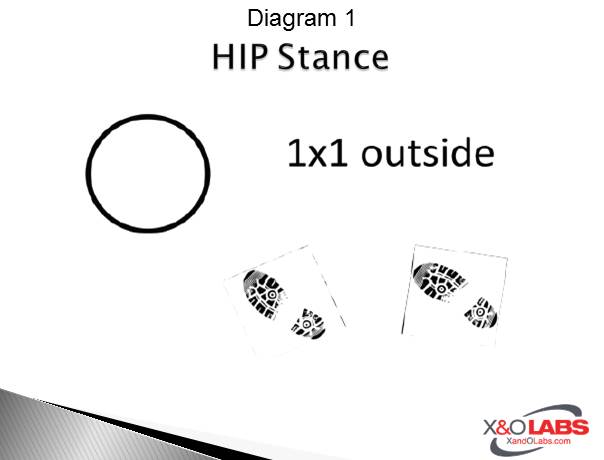
anything else it must incorporate those three things. If a player is not comfortable in his stance, his first movement will be to get comfortable, creating wasted movement. Our goal is to eliminate all wasted movements. If the player is not in a low and powerful position to engage a blocker he is at a disadvantage to give up ground immediately on the snap. Last season we started the year with our linebackers using what we call a HIP stance when they were playing on the line.

Fundamentals of the HIP Stance

  • Eyes are keying the near shoulder of the man you are shading. Read his tip to determine the block (To, Away, Back).
  • Inside foot is up, the back toe is to the heel of the front foot, and the feet are slightly inside of the shoulders.
  • The knees are bent, shoulders are back, and chest is big.
  • The hips are aligned with your aiming point (usually the outside tip of the man you are shading).
  • Hands are relaxed in front of your body ready to strike.
  • The first step is a six inch power step with the inside foot, into the crotch of the man you are shading. Be careful not to over stride. Violently fire your inside hand to the V of the neck and outside hand to the shoulder of the offensive player. Step and strike should happen at the same time.

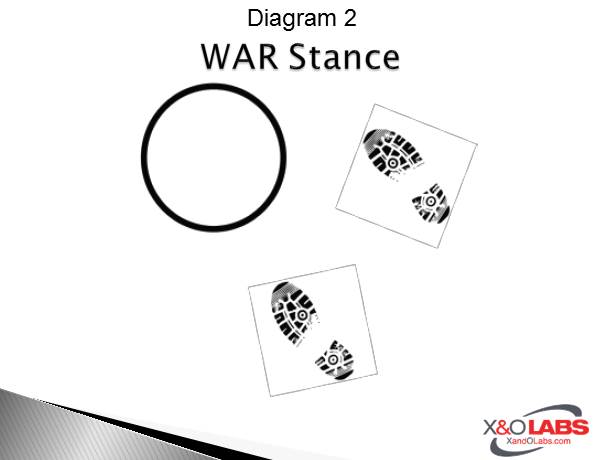
However, after our week four game we noticed that instead of stepping with the inside foot to engage blockers, our players were stepping backward with their outside foot to absorb contact. We also noticed that on the snap our guys were lowering their pads and repositioning their base. This indicated a lack of comfort and proper pad level. We then decided that we needed to make a change. We decided to put our players in a better position to be successful and to accomplish what was most important about playing on the line of scrimmage: being low, powerful, and comfortable. We then implemented what we refer to as the WAR stance.

Fundamentals of the WAR Stance

  • Eyes are keying the near shoulder of the man you are shading. Read his tip to determine the block (To, Away, Back).
  • Outside foot is up, the back toe is to the instep or heel of the front foot, and the feet are shoulder width apart.
  • The knees are bent, shoulders are back, and chest is big.
  • Body is angled inside at no more than forty-five degree angle, aligning your crotch with your aiming point (usually the outside tip of the man you are shading).
  • Hands are relaxed in front of your body ready to strike.
  • The first step is a twelve inch power step with the inside foot, into the crotch of the man you are shading. The inside foot should now be in front of or even with the outside foot. Be careful not to over stride. Violently fire your inside hand to the V of the neck and outside hand to the shoulder of the offensive player. Step and strike should happen at the same time.

The decision to make the change to the WAR paid great dividends. After changing our players from the HIP to the WAR stance we gave up 100 less yards per game in the last six games, in comparison to the first four games. We also gave up half a yard less per carry in the run game in the last six games. Finally we finished 3-3 in those last six games after going 1-3 in the first four games. Obviously there are multiple factors that go into making such improvements, but the change to the WAR stance was a big part of it. After the season was over I was able to identify why the WAR stance is superior to the HIP.

Read More

6 Non-Negotiables in Building a Program

By Dan Ellis
Head Coach
Great Valley High School (PA)
Twitter: @CoachDanEllis


Introduction

greatvalleyI have had the great fortune to be the head football coach at three separate high schools – Springfield (Delco), W.C. East, and Great Valley. In the first two cases, I took over a football program that had been down for an extended period of time. At Springfield, I took over in 2008. That program had not had a winning season since 1994. In three seasons, we changed a culture by taking the 2010 team to its first playoff run since 1994. I left to take the W.C. East job after that season, but the new head coach, Tom Kline and Chris Britton, were members of our staff and continued a run in the playoffs from 2011-2014. At W.C. East, in the four years previous to my arrival in 2011, W.C. East went 5-38. In 2013, we finished 6-5, the first winning season since 2006. At Great Valley, I was fortunate to take over a program with a history of more success and in our first season, we went 12-2 and won the District I Championship. Here is the blueprint that we implemented at three different schools that has worked successfully at each.

Step 1: Develop a Philosophy and Mission Statement

The number one thing that is needed in turning around a program is a clear, well thought out coaching philosophy or mission statement. Having a philosophy will establish the guidelines for your program. All things in the program should evolve from this one idea and should be constantly reinforced throughout the season and off-season. Our mission statement here at Great Valley is…

“To build young men of empathy, integrity, and moral courage who make the world around them a better place.”

All aspects of our program evolve from this idea. At any one point, whether it is in the weight room during the winter or a camp practice, we engage our players and talk with them about these ideas and the overall philosophy. It is not always done with the entire philosophy in mind, but different aspects of it are constantly talked about.

In order to achieve the overall vision of our team, we stress two key characteristics that will ensure that we achieve the overall goal. For our players, the two characteristics that we require of our players are Attitude and Effort. When we discuss these topics with our players, our emphasis is to discuss the importance of attacking anything with the best attitude you can and with your maximum effort. Both of these characteristics are things that any player at any age, from all talent levels is able to give. I was fortunate to play for George Welsh and Gary Tranquil (Offensive Coordinator) at the University of Virginia, and both would always say, “It takes 0% skill to give 100% effort.” There may not be a more appropriate statement when building a football team. These are non-negotiable and will not be ‘coached’. They are a requirement. Most importantly, we always bring attitude and effort back to our overall philosophy – in order to be successful with our mission statement, players must give attitude and effort, and it is not just in football, but also universally. To be a great student or a great musician or a great ________________, the prerequisite for success is having a great attitude and giving maximum effort at all times. Pick the person who is successful in any field – Steve Jobs, Bill Gates, Nick Saban, George Welsh, a players’ parents, etc. – they attacked their jobs relentlessly and with great effort. That is how Apple became Apple and Microsoft became Microsoft.

Having a great mission statement is not the only key aspect to being successful. That in fact is probably the easiest part. The hardest part, over time, is being uncompromising. X’s and O’s clearly play a crucial part, but keeping that vision untarnished and uncompromised is critically important. The discipline required to commit to our mission statement is not easy. Bringing the best attitude and effort every day is hard. It is my job as the head coach and my assistants’ job with their respective players to make sure that they are getting that attitude and effort each and every day. When players are not, we push them to be better. Clearly, every day is not always a good day and discuss that with the team. If it is a bad day, you must work to make it better the next day. However, there are situations where some players cannot make the trip.

From the first team meeting with the players and parents, we establish the vision for our program and discuss these non-negotiable ideals – Attitude and Effort. I am always brutally honest with the parents after discussing our mission statement. It is a hard ideal to live up to and I will work ceaselessly to help the players achieve their individual goals as well as our team goals. But, I demand attitude and effort and when it is not being consistently given at any point during the year, I will choose the success of the team over the individual. Unfortunately, from the moment I took each of my head coaching positions, I told the team and parents that the train had left the station… and unfortunately, not everyone can make the trip. Sometimes, some players are just unable to commit. It is crucial that when you are faced with the critical situation, when a player with immense talent reaches that point, the team must come first. It is not good enough to stand firm with underclassmen that is at best a role player. The test of real leadership comes when you are faced with the challenge of a great player who does not follow. Unfortunately, I have had to lose several players. My first year at W.C. East, two returning starters did not complete camp. My second year, our returning starter at tailback was lost. However, by being consistent through our first two years, we did not have any issues our third year.

Read More

NCAA Player Development Study

By Mike Kuchar
Senior Research Manager
X&O Labs
Twitter: @MikekKuchar

Introduction

“Coaching is about getting the most out of your players.” It is an axiom that I first heard uttered by Russ Grimm, the offensive line coach for the Tennessee Titans and original “hog” himself with the Washington Redskins. While it’s hard to argue the validity of that phrase, the difficulty in that task lies in what coaches call the “strain,” or the process in developing your players. There is a fine line that distinguishes mediocre and success in coaching and while much of it can be attributed to pure talent, how coaches extract that talent can often be a thing of beauty. It is that process of strain, that became the focal point of this study.

So, when we started research for this project, we reached out to many of the coaches in our network with one request: “Select one head football coach that gets the most from his players year in and year out.” While an abundance of names came pouring in, we went after those that kept reoccurring and while we didn’t get in touch with all of them, we were able to with 12 head football coaches, with all levels of collegiate ball represented, to ask them how they develop their players. Our research was segmented into four cases:

  • Off-season mental development
  • Off-season physical development
  • In-season mental development
  • In-season physical development

Most of our contributors have been head football coaches for over a decade. Our twelve contributors have amassed some staggering numbers collectively as head coaches, which include:

  • 734 wins
  • 711 win percentage throughout their tenure as a head coach
  • 47 division championships
  • 3 national championships (all within the last three seasons)

The list of contributors to this study is below:

Contributors (in Alphabetical Order)

Chris Ash, Head Football Coach, Rutgers University

Glenn Caruso, Head Football Coach, University of St. Thomas (MN)

Mark Farley, Head Football Coach, University of Northern Iowa

PJ Fleck, Head Football Coach, Western Michigan University

Peter Fredenburg, Head Football Coach, University of Mary Hardin-Baylor (TX)

Vince Kehres, Head Football Coach, Mount Union University (OH)

Chris Klieman, Head Football Coach, North Dakota State University

Ron Korfmacher, Head Football Coach, Taylor University (IN)

Matt Mitchell, Head Football Coach, Grand Valley State University (MI)

Tim Murphy, Head Football Coach, Harvard University

Bob Stitt, Head Football Coach, University of Montana

John Steigelmeier, Head Football Coach, South Dakota State University

Case 1: Developing the Off-Season Mentality

In this case, we studied what these coaches were doing in the off-season to develop the mental capacity of their players. We all know that it’s the cohesiveness and resilience of a football program that is developed from January to spring ball. We wanted to find out how head coaches were developing players in this area as it pertains to the following components:

  • A character development program
  • A leadership council among players
  • The infusion of a sports psychology program

While we found that the leadership council seemed to be the clear favorite of choice in developing players during the off-season, we found that coaches were using different criteria to select leaders and various activities that encourage these groups to promote the program.


Chris Ash, Rutgers University: “In the off-season, you want to accomplish some specific things. You want to get them bigger and stronger, you want to build their athletic ability, you want to build their toughness, you want to build leadership, you want to build their football skills and lastly you want to build their football IQ. You have to do that in 8 hours a week during the off-season. You can’t slack off on any of those things because rest equals rust. You can’t afford to let any of them be underdeveloped. WE built toughness at Ohio State through the artificial adversity we created in our off-season workout. You don’t rise to the level of the occasion; you rise to the level of our training. We use the phrase E+R = O which means events plus response equals outcome. We are an event-based program, we train our players to handle adversity. If you don’t train the players to deal with adversity, they will not be ready for it. We will create a special workout to push them to the limit mentally or physically or change a routine where we ask them to be here at 5 am to see how they respond. We are creating that for good events and bad events so they are ready to respond the right way. “


Glenn Caruso, University of St. Thomas (MN):“ We use a program where I will have players read several books during the course of the off-season, many of which do not have anything directly to do with football. I believe more in the psychological piece of it, using the off-season to teach not just how we feel but how we can best prepare ourselves to be at our best in stressful situations. It’s about learning who they are, how they relate to people and how people relate to them. It’s about learning ways to communicate and ways to mitigate anxiety and ways to teach their peer groups about the psychology of human nature. It’s a program that I made up. It’s a seven part mini-course that goes through the basic tenants of human psychology or human behavior.”

Read More

Multiple Variations in Getting Play Makers the Ball

By Adam Hovorka
Managing Editor, X&O Labs
Former Head Coach at Schreiber High School (NY)
Twitter: @XOLabs_Editor


You probably have that one player that is just better with the ball in his hands than the rest of the guys on the team.  When he has the ball good things happen and the more touches he can get the better your chances become.  If that special player is not your running back you have to be very creative in how you get him the ball.   We are a shotgun inside zone heavy team and our dynamic play maker (DP) just wasn’t the type of player that we could just hand him the ball in inside zone and be that effective.  We had to be very imaginative in how we got him the ball.  We moved him all over the field and used him in an assortment of ways.


Concepts for the “DP” in the Slot

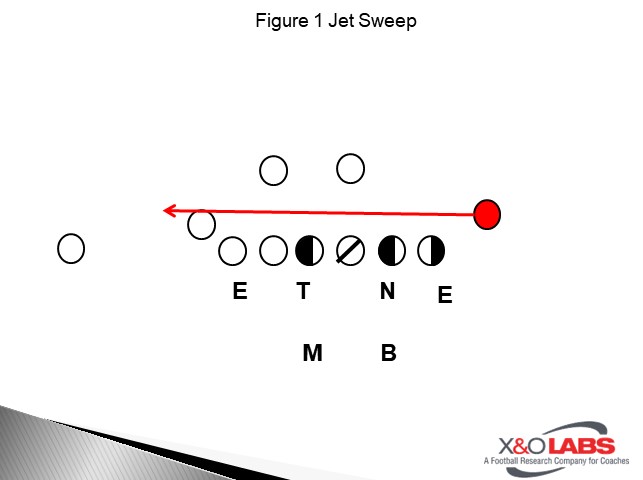
The first way we got our DP the ball was to align him in the slot and run some simple jet sweep.   We would run some empty or end over formations to get the number advantage on the perimeter. This is your typical jet sweep that almost every team runs. 

Diagram 1


This formation was the most successful for us running jet sweep and enabled us to get the ball on the edge to our DP with some good blocking angles.   The first clip we are in a TE/wing formation with a wide receiver split wide to the same side.  In the 2nd clip we are in an empty formation with two receivers on the line of scrimmage.   A key coaching point f or the DP to cut down his split and snap the ball on first sound.  We do this to slow down the defense from recognizing the play and less likely to react to the motion.  We also would tag the play with a word for the outside receiver to crack and have the back on the corner.

To study game film of these concepts, click on the video below:

Read More

Post-Season Self-Scout Protocols

By X&O Labs
Twitter: @XandOLabs

Introduction

graphAfter the conclusion of each season, many coaches start the progression of evaluating and assessing each concept to measure its proficiency. It’s a process intertwined in two folds: cutting ineffective concepts from their play menus and building on productive concepts for future seasons.

While conducting our research on this topic, we’ve heard the following phrase uttered many times, “We should’ve called that play more.” So, we studied how six coaches (five college and one high school) use their self-scout process to evaluate what worked this season and what didn’t. Their question and answer session is below.

Contributors

• Justin Iske (JI): Offensive Line Coach, Southwestern Oklahoma University
• Gerald Hazzard (GH): Offensive Coordinator, Lake Erie College (PA)
• Shaun Weaver (SW): Defensive Coordinator, Gettysburg College (PA)
• Matt Kerstetter (MK): Co-offensive coordinator, Westfield High School (TX)
• Jake Olsen (JO): Offensive coordinator, Loras College (IA)
• Vincent Digaetano (VD): Linebacker Coach, Nassau Community College (NY)


1. How long after the season do you start your self-scout procedures?

(JI): “We do a weekly self scout during the season by play efficiency, down and distance and personnel tendencies. We also do a weekly efficiency report to determine why runs/protections were inefficient based on technique errors, assignment errors, scheme issues, etc. After the season, when we have a little more time, we go back and do a little more in-depth evaluation.”

(GE): “We will start our self-scouting during the season. Every Wednesday, I will receive a report from our offensive GA on our play call tendencies. We track our run/pass tendency based on the following downs: first down, 2nd and 7+, 2nd and 4-6, 2nd and 1-3, 3rd and 7+, 3rd and 4-6, and 3rd and 1-3. We will also track our play calls by formation and our run/pass tendency by formation. After the season is over, I usually begin our end of the year ‘efficiency’ reports after the signing day in February.”

(SW): “I start after the AFCA convention on the official breakdowns, but I watch film throughout recruiting.”

(MK): “We will self-scout after the first three games of season, before going into district/conference Games, and then self-scout again around the game 6/7 mark. These are just to help get a feel for how our identity evolves as an offense over the course of the season, what are our best plays, followed by getting our tendencies. The big self-scout for me comes almost immediately, usually the day after the last regular season game. This is so we can start preparing for playoffs and really understand what tendencies we have developed over the course of the season. We start having a plan to have ‘tendency breakers’ built into the game plan. We always assume the opposition has almost all of our film; therefore they will have a game plan of how to try to slow us down based on our tendencies. We need to do our best to recognize that and prepare for it ourselves. The goal is to always have answers in the game plan moving forward. Usually our most recent three games are more heavily valued as a reflection of who we are. Upon completion of the season (it does depend on when it ends) we won’t usually do a whole season analysis until January. We clear our heads, take a step back, and then merge everything together and run reports and attempt to do an analysis of what we did well and what needs to be improved during the off-season.”

(JO): “It varies. Due to our off campus recruiting schedule we hit the road right away and do not get too in depth with the self-scout until around Christmas break. At that time, we’ll begin the initial data and research. Thus far I’ve taken a look at our run/pass ratio, RPO ratio, and cleaned up some date entry mistakes to streamline reports.”

(VD): “The self-scout has become an ongoing process throughout the season. The weekly data is kept in the video editing system, currently using HUDL, under the custom fields. Once the last game film is graded the post season procedure begins. Initially this was something that started at the end of the season, but as the procedure was completed it became more productive to complete week by week to utilize real time data to make decisions and adjustments.”

2. How long does the self-scout procedure last?

(JI): “We will do our end-of season self scout analysis after signing day in February. It will last about two weeks.”

(GH): “Our off season efficiency reports take a few days to do.”

(SW): “A full month.”

(MK): “These in-season self-scouts are fairly quick, only about an hour or so. HUDL really helps cut the time down needed to organize the material and run some reports.”

(JO): “It’s off and on from Christmas through March. We’ll try to get most of it done with new questions and angles before we approach other programs or start heading to other spring practices. Our spring ball doesn’t start until mid-April, so we have a window to make adjustments.”

(VD): “Self-scout procedure is a constant assessment used throughout the season and in the offseason. It helps to determine the drills that will be scheduled during individual period during the season. It also helps to determine what the off-season focus will be for both fundamentals and scheme. The self-scout also is used for the re-evaluation of the position manual.”

3. How do you delegate the self-scout process to your staff? Which responsibilities do you give them specifically?

Read More

4 Essentials in Developing Chemistry for the XP/FG Unit

By Sam Watts           
Kicking and Punting Coach
Owner of Sam Watts Kicking
Phoenix (AZ)
Twitter: @samwattskicking

Introduction:

As a consultant and kicking coach, I have found common mistakes coaches teach when developing field goal units. We will discuss in detail how a holder, snapper and a kicker can become better individually while on their way to becoming an efficient field goal unit.

Missed extra points in the NFL increased last year when they moved the distance of 20 yards to 33 yards, resulting in the most missed extra points since 1972. The operation time (snap to kick) in the NFL is between 1.20-1.25. College specialist’s times range from 1.25-1.35. High schoolers time can range between 1.35-1.45. Coaches at the highest levels record every kick, snap and hold of their field goal operation.

Unit Responsibilities

Let’s start with who has what responsibilities in our unit and why.

Snapper: The snapper is to address the ball in his stance, and the stance sets the alignment for his fellow linemen. In video clip #1, watch how the snapper waits for the kicker to move sideways before he grips the ball. This allows for him to not be over the ball for too long.

Read More

Steal Points by Using Tricks, Specials, and Formations

by Jay Wilkinson

Offensive Coordinator

Broken Arrow High School

If you are at all like me, after a few weeks of running the base plays of your offense, you have to be itching to add something that can create a big play and bring a little new life to your offense.  These concepts can give you a chance to steal points and create mismatches all over the field, but they also can derail your practices and distract your team from what you do well.  In order to keep avoid the potential negatives of special plays and formations, consider the following questions.

  • How much teaching / practice time will be needed?  Is it worth it?
  • Can it be used against multiple teams or is it only for a specific opponent?
  • Success Rate vs. Turnover Rate.
  • Are you willing to ACTUALLY call it in a game?
  • Does the play come off of something we already do?
  • When / in what situation are we going to call it?

More Than Gimmicks

Too often coaches make trick plays far too difficult.  The fact is, you can get the same impact without having to add a whole new concept into your offense.  There are a variety of ways that you can throw a curve ball and they don’t all require an entirely new play.  One such way is by using formations.  Here is why:
  • Defensive rules are based on formations.
  • One small change and the D could be thrown out of position or forced to play vanilla.
  • Formations are easier to install and allow you to still stick with your offensive philosophy.
Here are a few ways we use formations to stress opponents:


Read More

7 Def. Scouting Report Essentials

By Nick Hill 

Safeties Coach

Santa Rosa Junior College

Editor’s Note:  Coach Hill is entering his first year as safeties coach at Santa Rosa JC.  Prior to this assignment, he spent 2 seasons as the quality control coach at Cal Poly while also assisting as a linebacker coach.  Coach Hill started his coaching career coaching outside linebackers at Santa Rosa JC after graduating from Linfield College in 2008.


Introduction

srjcEach week defensive staffs across the country face the challenge of formulating a game plan that will slow down today’s high-powered offenses.  In order to do this, they must have an understanding of what they are up against including strengths, weaknesses, tendencies, and developing an overall feel for what the offense is trying to do.  The process of breaking down film accurately as well as creating scouting reports will help your staff achieve this and hopefully lead to a game plan that will allow them be successful on game day.  Listed in this article are some ideas on how a defensive staff can go about preparing for an offense on a week to week basis. 
 

1. Grouping Plays by Field Zones and Down and Distance

One task you want to take care of before you start to break down the opponent film is set up your program that groups together plays by field position and down and distance.  By putting these into the settings of your film breakdown program, it should automatically put the field position in for you based on what yard line you type in when you are doing the down and distance segment. Below is an example of how you may want to set up the field position on your program.

-1 to -5 YDL= Backed up

-6 to -19= Coming out

-20 to -50=Field Zone Minus

49 to 26= Field Zone plus

25-16 YDL=High Red Zone

15 to 5 YDL=Red Zone

4 YDL to 1 YDL= Goal line

The same thing goes for field position.  Listed below is an example of how you can set up your distances.

2nd & 11+=2nd & Extra-Long

2nd & 7-10 yds=2nd & Long

2nd & 4-6 yds=2nd & Medium

2nd & 1-3 yds =2nd & Short

***You can set up third down the same way

The first part of film entry is known as Down & Distance (D&D).  To do this aspect it is best to get an official play by play from the games that you are breaking down.  If you can’t find an official box score you may have to go off the scoreboard shot, or you may have to look at the down markers on the field and try and eyeball the distance.  When working on the D &D part of the film, one person will read the play by play, while the other person enters the data into the computer and ensures that the play by play matches up with the film.  If for whatever reason this doesn’t match up then you need to stop and figure out what the problem is.  I’ve found common problems include: missing clips from the film, clips that are out of order, end zone and sideline view not matched up, or the play by play will be off or missing a play.  Whatever the problem is, it is important that it is fixed right away so that it doesn’t throw the rest of the film off and ensures accuracy.  Other information that should be entered into the film during this time period include:

  • 1st play of series
  • Series number
  • Punts
  • Turnovers
  • Sacks
  • Scrambles
  • Penalties
  • Quarter.

General information summary

  • Use play by play and partner if possible to ensure accuracy
  • Information to be entered into film-quarter, 1st play of series, series number, when the series ends (punt, turnover on downs, turnover), down and distance, hash (from defensive point of view), run/pass, yds. gained/lost on play, incomplete/complete, enter penalties, QB scrambles,


2. Evaluating Formation and Personnel

The next information to be put in is the formation/personnel of the offensive team.  Before getting started with the data entry for this section you should print out a two deep depth chart as well as a roster to help with personnel identification.  One thing I found helpful when doing this was taking a small sticky note and putting it on the two deep with a column for QB’s, RB’s, WR and TE’s.  I would then write down the number of the players in the appropriate column as the game went on, making my own two deep that was easier to read.  When entering personnel data into the film it is important that you are not only accurate but that you are also consistent in what you are labeling the personnel groupings.  This requires a lot of attention to detail.  Throughout the season you may run into a team that uses a primary personnel group, but gives you formations that are of another personnel group.  An example of this would be a team that runs a lot of 12 personnel but has an athletic tight end that will at times line up in a detached position in the slot, giving them an 11P look.  Although the offense is presenting and 11P picture, the film should still be labeled as 12P, to distinguish from when the offense is truly in 11P.  Other scenarios to keep in mind that may come up during the season include teams that use two QB’s, or perhaps they bring in another quarterback for a wildcat type of package.  These should be labeled with something to distinguish them to allow them to be sorted out later when the film cutups are being made.  If a team runs wildcat but the regular QB stays in the game, then just label it what the personnel is, and add wildcat in the formation or backfield set box.  Others scenarios to watch out for include extra OL in the game, especially by the goal line or in short yardage situations.

Formation/ Personnel summary

  • Personnel
  • Formation name/ backfield (note for 20/21/22P groups make sure to label whether the two backs in the backfield are both tailbacks or

Read More

11 as 1 Team Defensive Pursuit

By Jason Sedlak
Defensive Coordinator
St. Thomas Academy (MN)

Introduction

11as1PursuitThere are very few completely original ideas in the game of football today, and the pursuit angles that we use at Saint Thomas Academy (STA) are a result of a clinic presentation made by Coach Chuck Martin who was at the time, the Grand Valley State University Head Coach.  Coach Martin presented the idea that running to a spot at some point down the field where you hope to intersect the ball carrier actuallyprovides more opportunity for big yardage on cutbacks because you are creating space for the ball carrier.  This type of angle suggests that you are trying to tackle the ball carrier by yourself and do not have any help on the field.  He called it a one on one pursuit angle.  He then went on to present the team tackling angles that they used at GVSU and that is the basis of the pursuit angles that we use at STA.
We play an aggressive pressure style defense at STA, and like all defenses, we put a premium on playing team defense and getting as many players to the football as possible on each play.  We emphasize speed and want our kids flying to the football without hesitation.  One of the foundations of our team defense concept is trust.  We don’t want 11 heroes running around the field all trying to make the big play.  We want 11 guys who are focused on doing their jobs and trust their teammates to do the same.  We feel that the way we pursue to the football emphasizes our team defense and trust concepts. 

Identifying Force

Every one of our defensive calls has a primary and secondary force player and it is absolutely necessary that all 11 defenders know and trust that the ball will be turned back to the inside where we have the most help.  It is just as important that our force players trust their teammates to pursue aggressively and on the correct angles in order to minimize the offenses effectiveness.  We feel that this allows our players to go full throttle to the football because they know, and over time and through repetition, trust that their teammates will turn the ball back to them.

Knowing that we have players assigned to force the ball back to the inside of the field, we teach our players to pursue to the inside or back hip of the ball carrier.  The only exceptions to this rule are for the primary force player on the backside of the play who looks for reverse and all misdirection plays coming back his way, and the backside corner who takes an angle towards the far pylon for the “touchdown saving tackle.”   The remaining non-force players are on inside out pursuit paths pressing the inside hip of the ball carrier.  We feel that this puts them in great position to make a tackle when the force player makes the ball carrier turn back to the inside.   Using this general concept, we are trying to restrict the amount of space available to the ball carrier and therefore taking away the big cutback play.

Drilling Pursuit

We conduct at least one, if not all, of the pursuit drills below in practice on a daily basis.  Some days we will work through four of the drills in an eight to ten minute pursuit circuit.  On other days we will mix these pursuit drills with tackling and take away drills in a skills circuit.  We emphasize getting to the football as fast as possible and on the correct path during every one of our practice periods.  It doesn’t matter if we are in our pursuit circuit, a unit drill, skelly, or team against scout cards, we are constantly telling our kids to get after the football and to take the correct angles.  Like any skill in football, repetition with constant feedback is the key.

1 on 1 Concept Drill

Slide1

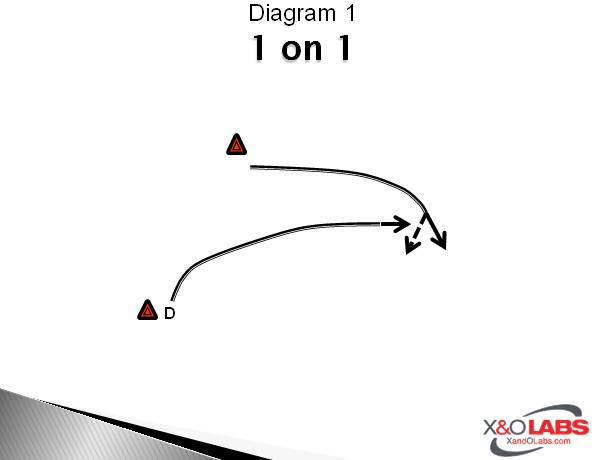
We use this drill in summer practice and the first day or so of two-a-days to introduce and solidify the back hip concept.  The ball carrier is to take an outside path and at some point in time try to cutback across the face of the defender.  The defender should pursue to the back hip and know that the ball carrier will cut back into his pursuit path.    We conduct this drill at ½ to ¾ speed to really solidify the concept and focus on the following coaching points:

  1. Initial steps should be directly at back hip and bend as the ball carrier turns upfield.
  2. Do not get out in front of the ball carrier and run to a point in space where he might go.
  3. Close the distance with the ball carrier as fast as possible.
  4. Shimmy/breakdown under control as the ball carrier cuts back.
  5. Never let the ball carrier cross your face.

Check out the film below for a closer look at this drill.

Read More

In-Season Ball Disruption and Takeaway Progression

By Dave Marean
Head Football Coach
Wayne Central High School (NY)


As a defensive coordinator, one of the things I like to do after every season is review each game film and try to see what made us successful and what hurt us each game. Defensively, the main things I like to focus on while watching film are: our alignment, assignment, tackling, team pursuit and ball disruption (turnovers). Recently, I started to look at our results from season-to-season to see if there were any continuous traits that were not allowing us to be successful defensively. Some years it could be as simple as we just did not have the “Jimmy’s” and the “Joes”, but more often than not it came down to ball disruption and getting turnovers or lack of.

Years ago (2010), I stepped down from being the Offensive Coordinator and I took over our defense, as I felt we were not accomplishing what we needed to do defensively. One of the biggest things I wanted to do was get our kids to understand on defense you can score. I wanted them to not look at our defense as “defending” our own end zone but attacking our opponents’. I wanted them to get the mindset that we are going to score on defense and if we cannot, we will at least get the ball back so our offense can.

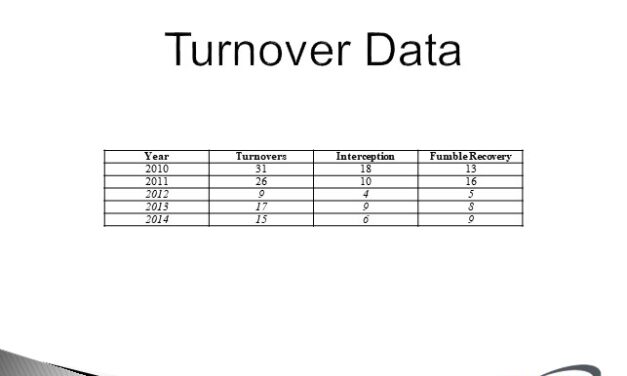
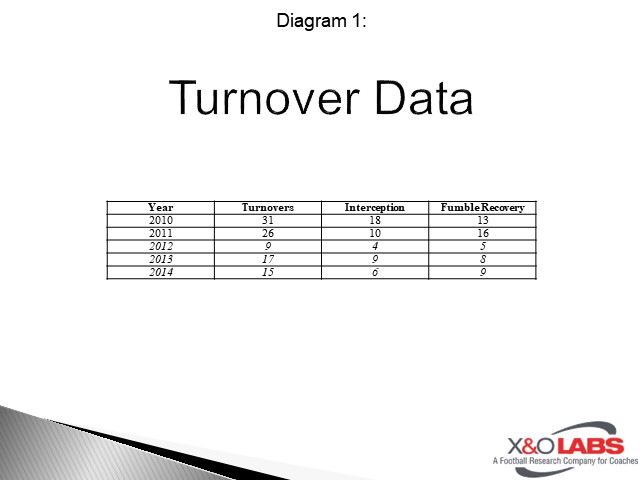
In 2010, we went 7-0 in the League and finished 8-1. The most regular season wins our program had ever had prior to 2010 season, was two (since starting varsity football in 1998). Now, we had some special players on that team, but we as a team also created 31 turnovers (18 int. and 13 fumble recoveries) in 9 games. In 2011, we went 6-1 in the league (6-2 overall) and we created 26 turnovers (10 int. and 16 fumble recoveries) in 8 games. In 2012, we went 3-4 in our league (4-5 overall) and created 9 turnovers (4 int. and 5 fumble recoveries) in 9 games. In 2013, we went 4-3 (6-4 overall) made it to the sectional finals and we created 17 turnovers (9 int. and 8 fumble recoveries) in 10 games. In 2014, we created 15 turnovers (6 int. and 9 fumble recoveries) with a record of 4-3 league and 4-4 overall. See diagram 1 to see a clearer picture of this data.

Diagram 1


After the 2012 season, I quickly realized that defensively we were not getting as many turnovers in recent years as we did in 2010 and 2011. Looking back at our practices that year, we also got away from our turnover stations in any part of our practices, which by the 2012 data you can see it affected us on Friday nights. So, when 2012 season finished, I realized we needed to continue to implement some type of turnover stations in our practice plans.

The big thing is that doing turnover stations by itself is not enough. You must incorporate some type of turnover work within your individual periods and group periods. This is something that you have to get your staff to “buy” in to as well. I will actually put on our practice plan: “Turnover stations last 5 minutes” of each individual and group period. I have a great staff and they want to take advantage of every minute they have during their individual or group period. So, I have to make sure I stress how important it is to have 5 minutes of turnovers mixed in, so we may add more time to the whole Indy and group period so they get covered what they need along with me making sure some type of turnover work is accomplished.

Most of our original turnover stations and philosophy on turnovers came from Rutgers University back at the NYS Coaches clinic we attended in 2009. Over the years we have added and subtracted some of them or simply “tweaked” how we run them to better fit our kids and our program. Most recently, though, we have added to our stations and our philosophy of turnovers based on a lot of what Syracuse University does. Their concept of ball disruption is something we have taken on and we try to drill this into our player’s habits of disrupting the ball. Our belief now is that if you are causing ball disruption on defense that in turn will create more turnovers. We talk to our players a lot about attacking or disrupting the ball more than anything else we do on defense. I think kids now days, need to attach words with drills that will help them understand what we are trying to accomplish. If you ask any of our kids what are key words that describe our defense, they will say ‘attack’ and ‘disrupt.’

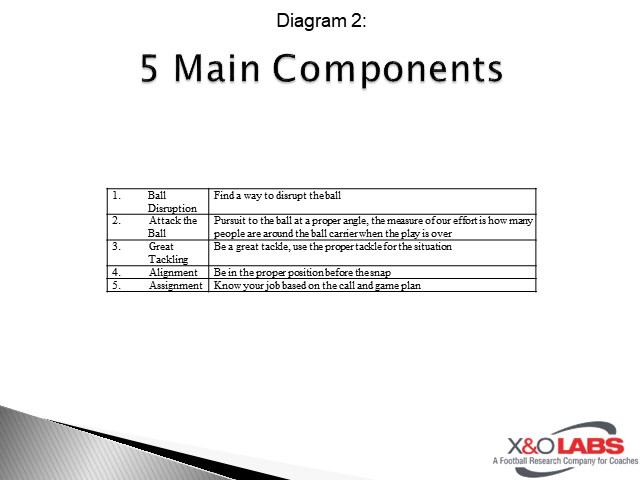
Our defensive fronts (based on our personnel) have changed a little over the years, but our philosophy has always stayed the same. We want our players to focus on five main components (see Diagram 2).

Diagram 2


In Diagram 3, you can see our turnovers compared to ball disruption. Since implementing this past season some of the ball disruption concepts to our defense, you can see we actually forced a lot more fumbles and interception opportunities then we have had in the past two seasons. Unfortunately, the ball didn’t always bounce our way. So, one thing we will be doing next year in practice is incorporating ball disruption drills within our pursuit drill. On film a lot of our missed opportunities to turn a ball disruption into a turnover, was the lack of effort in pursuing to the ball, especially on fumbles. The majority of fumble recoveries are not recovered by the person who caused the fumble so everyone must pursue to the ball, because the next person is the one who will get the ball. The same goes for interceptions, if someone breaks up the pass, the caught tipped ball usually is not the person who broke up the pass.

Read More

Treating Trick Plays as Equalizers

By Eric Walkingstick
Head Football Coach
Akron-Westfield High School (IA)


Every coach has a trick play or gadget, many are known for that special play that they like to run in that key or crucial game. What I find interesting is most teams don’t run them till they need them.  If these plays are so good why do we put them in our hip pocket, why do we just break them out 2-3 times a year? The fear is that we don’t want to use them up, we want to save them till a crucial juncture in a special game where we must have them to win.

My philosophy is the opposite. I want to use at least 3 new specials a week and by the time we get to the playoffs we have tons of special plays. We don’t run them all in a week just the 3 or so we plan on actually using. This approach forces our opponents to work on a concept that may take us 5 min to install but over the course of a season adds up to overwhelming numbers of plays that they must prepare to defend.

We coach our players to trust these plays while understanding that we don’t live and die by them.  We use them so often that if they don’t net a touchdown it is not a big deal. Instead, it is just part of our overall philosophy. Often these plays are designed to generate small gains.  In general, they are low risk high reward and the kids love them and they want to be part of it either by naming them or searching the internet to give me ideas. It creates a real degree of team ownership.


Creating Specials

We don’t call our special plays gadgets or tricks instead we just refer to them as special, so they are thought of more as just a common part of our offense not a prayer play. We will introduce these plays at the beginning, on 2 point plays, after halftime or certain down and distances situations during the game. Below are examples of some of the concepts that we have used over time, but we have others that we are rotating into the game plan as well from week to week.


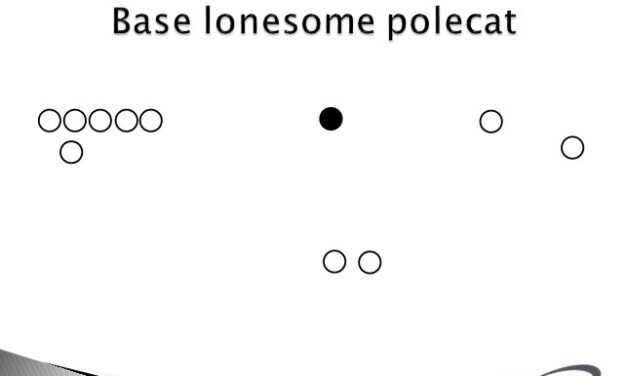
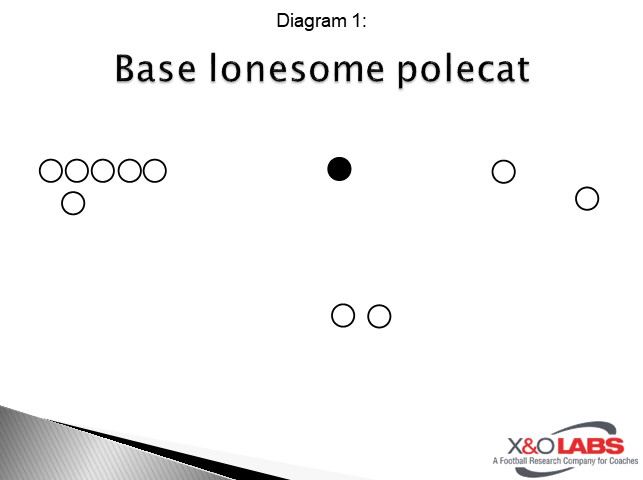
Lonesome Pole Cat

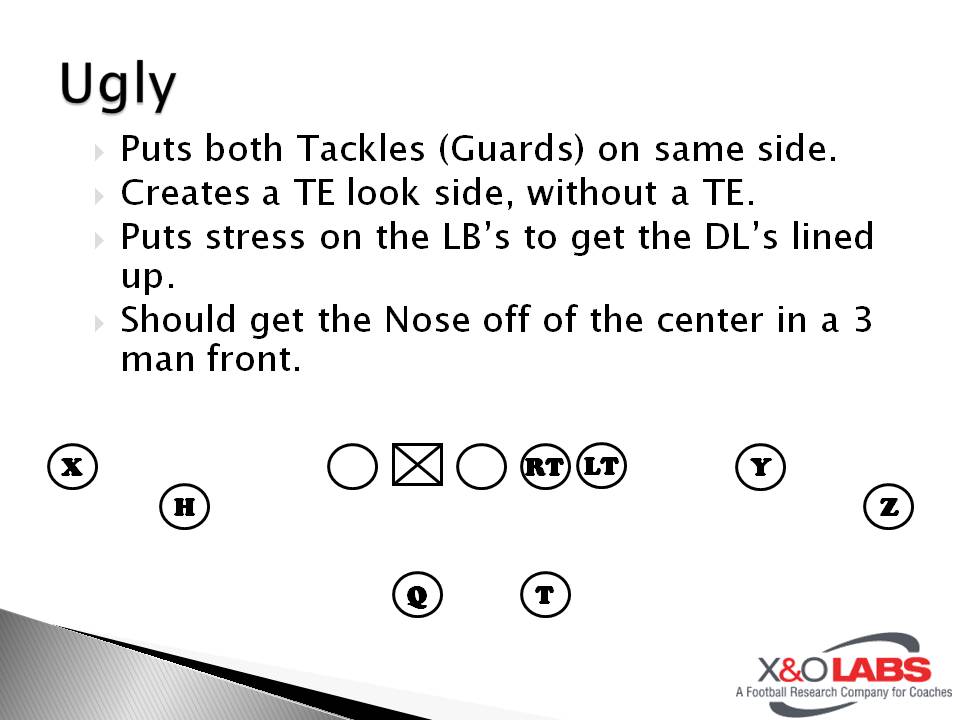
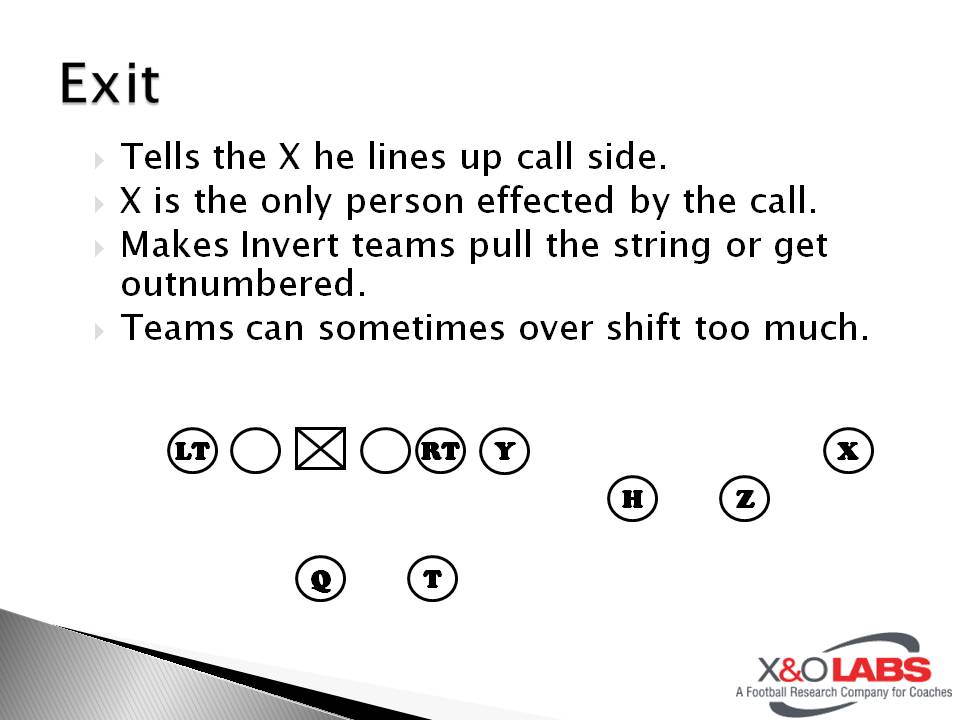
The first play we will look at is called the lonesome pole cat (Diagram #1). I was introduced to it as a defensive coordinator many years ago, and as a coach the things that we find the hardest to defend should be things we research and possibly incorporate. If you adhere to the philosophy motion creates emotion then this may have you seeking psychiatric help.  The concept is simple unbalanced set that can attack any defensive approach. We package it as a two play check. While we like to use this at any point in the game, for this report we are looking at ugly downs and distances like 3rd and long or even on 4th and long.

Diagram 1


To study game film of this concept, click on the video below:

Read More