
Avoiding Late Season Complacency in Practice

By Jeff Minter

Columnist

X&O Labs


Editors Note:  Since 1998 Coach Minter has served as a head coach, coordinated all three phases of the game, and worked with the defensive line, offensive line, linebackers, quarterbacks, and wide receivers. In the past few years, Coach Minter has become one of the most popular and respected coaching bloggers on the web and is excited to be a regular contributor for X&O Labs.

The best teams are almost always great closers.  They don’t just start fast, but they get better as the game progresses.  This same logic can be applied to seasons as well.  The teams that understand how to continue to get the most out of their players as the regular season comes to an end and the post season begins.  So, with that in mind, I have put together a list of do’s and don’ts that should be applicable for any team, anywhere.


Practice Planning “Do’s”

Do… Film Everything

With the increasing access to technology, and the growing popularity of the iPad, it has become exponentially easier to film practice sessions for later viewing and correcting. You can now easily use apps such as CoachMe and Coach’s Eye, along with any video app, to film practice for immediate feedback or diagram things on the go. Even if you’re still using cameras, DVD duplicators, allow you to quickly burn anything for multiple players or coaches to watch at home. By using technology to help you teach either before, after, or during practice you are more likely to be able to coach on the run…which happens to be the next key idea.

Do… Coach on the Run

Don’t take time to stop practice for each coaching moment. Especially if you are able to teach off the practice film, make sure you are coaching as practice is moving. Ever see a coach stop the whole offense to review something with one player? It kills the tempo of practice and can lead to players losing focus.

Do… Script Everything

Seems obvious, but it sounds like this doesn’t happen everywhere. Scripting accomplishes a few things. First of all, you can control what your team is practicing as you aren’t doing it on the fly. This gives you a better opportunity to spend quality time on reps your team really needs. Scripting also allows you to control the number of reps your team is getting. When you chunk a team time into 20 minutes you are likely to go the whole 20 or possibly over. However, when you follow the script you can avoid over repping your players by going longer than is necessary to accomplish your goal. Finally, scripting allows you to work in special situations or field position needs.

Do… Properly Label Scout Cards

How many times have you told your team where they will be and then run the play only to be told that the defense was in a different place?  Fix that problem by being more specific with the scout team and give them more information.  Tell the scout team they are “X”, “H”, or “32”. Whether you use numbers or letters is up to you, but it’s a lot easier for the kids to get where they need to be if they only have to look at one position.

Do… Use Your Terminology for Scout Teams

Whenever possible use your own words for plays, formations, and alignments so you can effectively communicate with your scout team. This is especially helpful with the scout defense and offensive lines. Your offensive line probably has a counter trey blocking scheme, so no matter what the backfield is doing, if that blocking scheme is being used make sure it is noted on the scout card.

Do… Use Two Huddles

If you have the players available use two huddles. Yes, your scout team won’t be as good when it divides into two groups, but more players are active, more players are getting reps, and your first team is able to get more looks and reps as well.


Read More

Developing a Defensive Game Plan


By Tom Hochhalter

Head Coach,

Calvin Christian High School (MI)

Researchers’ Note: Coach Tom Hochhalter is entering his first year as head coach at Calvin Christian High School in Grandville (MI).  Before taking on this challenge, Tom served as Defensive Coordinator at West Ottawa High School and at Holland Christian High School where his team won a State Championship in 2008.  Tom is known for his exhaustive preparation and understanding of the 3-5-3 defense.

The first year I was a varsity defensive coordinator my head coach told me that defensive game planning was simply matching up your best defensive calls to the offense’s best plays. I thought that was easy enough. As that first season progressed so did my skills of developing a defensive game plan each week. I thought his idea was straight forward, but I had to figure out when and where the offense was going to call their best plays. So I devised a method that I continue to use and tweak weekly.

The first step is to determine tendencies that the offense has. The ones I look for are:

  1. Down, Distance, and Field Zone location.
  2. Personnel grouping which is determined by the number of running backs and tight ends.
  3. Formations.

Of course getting all of this information can be quite a laborious task.  I have worked to minimize the time it takes to find this information by using film breakdown programs like Hudl.  These are great tools for breaking down scout film of an opponent and allow break down film in many different forms and create scouting reports for your staff and players.


Once all of the data is logged in Hudl, I use a variety of custom reports to help me construct a detailed “Hit Chart.”   This “Hit Chart”combines the two most common defensive gameplan concepts, down and distance breakdown and field position breakdown, creating a hybrid form that has proven to really find the tendencies that the offensive coaches lean on during the game.  Here is how it works…

First, I established the list of down and distance categories that I want to assess with the chart.  You can get as detailed as you want, but I have decided to use the following 18 categories.

  1. 1st and Possession
  2. 1st & 10
  3. 2nd & 1-3
  4. 2nd & 4-6
  5. 2nd & 7-10
  6. 2nd & 11+
  7. 3rd & 1-3
  8. 3rd & 4-6
  9. 3rd & 7-10
  10. 3rd & 11+
  11. 4th & 1-3
  12. 4th & 4-6
  13. 4th & 7-10
  14. 4th & 11+
  15. 1st & Goal
  16. 2nd & Goal
  17. 3rd & Goal
  18. 4th & Goal

Each of these categories will become it’s own chart that tracks the type and direction of the offensive plays from of that particular  down and distance in the different field zones.

Read More

Teaching Destruction to Edge Defenders

By Zach Watkins
Co-Defensive Coordinator/Special Teams Coordinator/Linebackers
Washburn University (KS)
Twitter: @Zach_Watkins

Introduction

The offenses that we face weekly in the ultra-competitive MIAA conference are great at attacking the edge. Whether that be running the ball outside, throwing bubbles, utilizing their screen game or RPOs, block destruction on the edge is extremely important. With up-tempo offenses hitting the edge quickly and getting the ball out in space, it often becomes a numbers game. If the offense feels they have a numbers advantage, they will try to exploit it. With that mindset, we feel that we have to win some 1 on 1 battles on the edge to successfully defend these plays. We also teach proper pursuit angles through drills and practice as well as tackle leverage on the ball carrier from the pursuit players. We ultimately feel that defeating blocks on the edge and out in space are what helps us effectively defend these plays.

Attacking the Ball

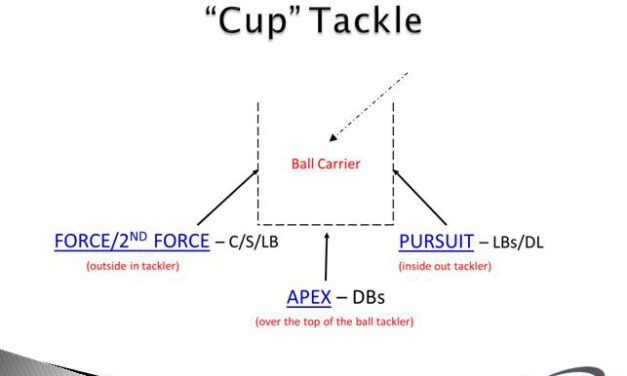
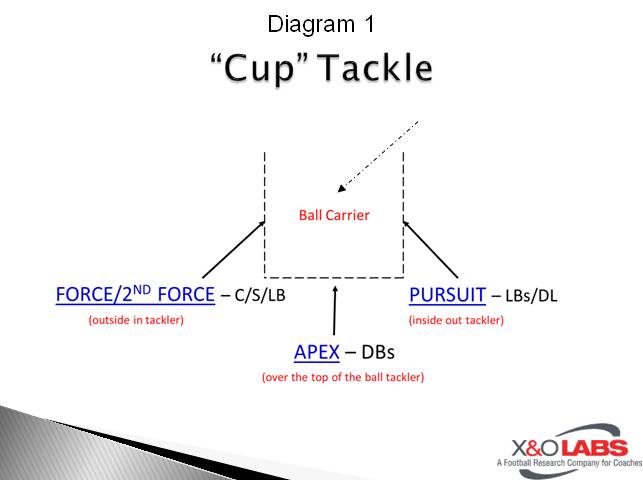
Before we teach block destruction techniques, we will teach how to properly run to the ball to put ourselves in the best position to make the tackle. As we teach proper pursuit angles with drills and in practice, our “cup” tackle begins to show its’ effectiveness.  In our daily tackle/turnover circuit, or in specific individual time, we will work on our “cup” tackle. I’ve heard people also call this inside-out tackle, vice tackle, etc. We teach our players that there will always be 3 types of players in a tackle:

  • The force tackler – Outside-in tackler who turns the ball back inside. The force tackler will usually be a CB, S, or LB who begins the play outside of the box.
  • The pursuit tackler – Inside-out tackler who does not let the ball cut back. The pursuit tackler will be someone running inside out to the ball, usually a LB or DL.
  • The apex tackler – Over the top of the ball tackler who must make the play if the ball gets to him (Diagram 1). The apex tackler will always be someone staying over the top of the ball, usually a DB (high safety or CB).

diagram1

By teaching the players to understand which type of player they are in any given tackle, they can understand where their help is and where they must position themselves to make the tackle. We will utilize a tacking/pursuit circuit to effectively teach the defenders which part of the cup tackle that they are assigned to fulfill.

Below is our “Cup” tackle pursuit drills.  We begin with just the pursuit tackler keeping a good inside out path.  We will progress into adding the force tackler.  Then we will progress by adding the apex tackler.  This way the players can understand in a logical progression which part of the cup tackle they are. (bottom right corner of the field)

Read More

Unbalanced FG/Extra Point

By Terry Kent
Offensive Coordinator & Offensive Line
Downers Grove South High School (IL)


One of the great joys of watching the college bowl season every year is to see what new and innovative ideas college coaches come up with during the time leading up to their games. The unbalanced extra point is one of these ideas. As a retired math teacher, I was intrigued by the angles and distances the formation creates and how difficult a block would be, assuming the snap, hold, and kick are on time. If the fastest 10 yd time in the NFL Combine is 1.4 seconds, then no one should be able to block our kick, if everyone does their job correctly.


Alignment

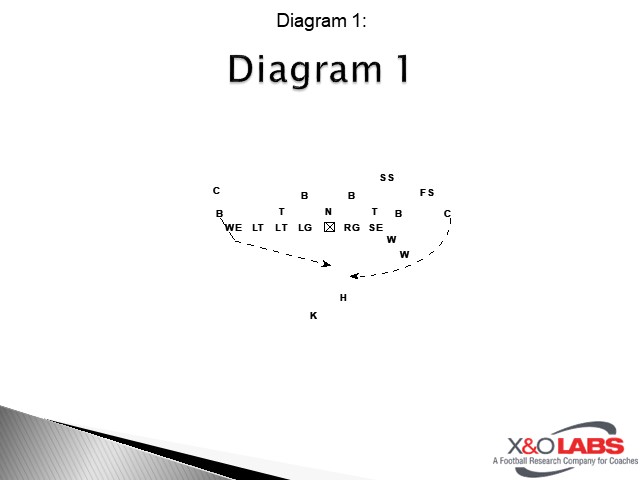
Diagram 1


Linemen Rules:

  • 3” splits in the A gap
  • 6” splits elsewhere on the line
  • Inside foot back, toe to heel stagger
  • Right side uses a left handed stance, left side a right handed stance.
  • We often flip our OL in PAT so they can use their normal stance.


Step with inside foot up and lateral. DO NOT MOVE Outside foot!! Keep outside heel on the ground.

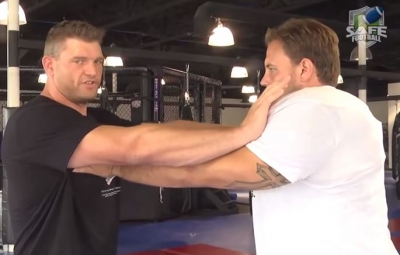
We punch up and out with their fists, so we have two hands in every inside gap. Arms should end up in bench press position. We teach them to hold their ground and absorb the rush.

DO NOT TURN YOUR SHOULDERS. If worse comes to worse, grab some cloth and fall backwards like a tree.

The wing steps inside like the linemen, but he punches straight out with his outside arm to push any outside rusher farther away. The SE steps & punches as the linemen.  We prefer the SE to be a defensive lineman with an eligible number. The snapper’s job is to deliver a tight spiral, hitting the holder in the hands. After he snaps the ball, he should get his head up, and try to help out the two guards in the A gap as best he can.

Read More

6 O-Line Techniques to Defend the Bull Rush

By Mike Kuchar
Senior Research Manger
X&O Labs
Twitter: @MikekKuchar


Introduction:

petersScott Peters spent seven years in the NFL with the Philadelphia Eagles and New York Giants before launching Fight Ready, a Mixed Martial Arts Academy in Scottsdale, Arizona where he trained the likes of Cain Velasquez and Brock Lesnar. He has since started the “Tip of the Spear” leverage program, which incorporates MMA leverage techniques to help offensive linemen in the use of run and pass blocking. Peters’ program has been implemented by over 400 football programs at every level. His methods have been touted by former NFL offensive line coaches Jim McNally and Bob Wylie every year at the C.O.O.L. clinic in Cincinnati. He begins our in-season trouble shooting series with a Q and A with X&O Labs Senior Research Manager Mike Kuchar on techniques that offensive linemen can use to protect themselves against the ever-popular and ever evolving bull rush.
MK: Why did you decide to start safe football? What motivates you to spread this information to football coaches?

SP: I love football and what it can offer to young athletes developmentally. Concussions and sub-concussive head trauma remains a serious threat to the game’s future, but more importantly, the welfare of the young men who play it. I had a lot of unnecessary concussions when I played due to poor or limited technical information available to me, and I feel strongly about raising the collective level of knowledge to bring confidence back to the game. Ultimately Safe Football exists to empower players to take safety into their own hands through the development of superior technical skill, and this can only be achieved through the leadership of coaches.

While the public waits for answers from doctors, helmet companies and football organizations, Safe Football has teamed up with the true leadership (football coaches) to influence necessary changes to protect the game and its players. We believe this is particularly important at the youth and high school levels, where the majority of football is played.

Through my experiences in MMA, I discovered certain movement patterns and postures that yielded exceptional strength of the body, which indirectly correlates to football. In 2011, I began developing football techniques based on those leverage principles, emphasizing the use of hands to transfer force by using the body as it was designed to move from a biomechanical standpoint.

In 2012 and 2013, I was hired by the University of Washington to teach their players my techniques (and drills), which were later credited by the coaching staff for their success on both sides of the ball. In 2013, running back Bishop Sankey set the single season rushing record in school history, and in the same year the athletic trainers confirmed zero reported concussions or neck stingers among their offensive and defense linemen; the first time this has happened in recorded history according to UW medical personnel.

Although “bigger, faster and stronger” is still the mainstream approach to player improvement in the off-season, more and more teams, coaches and organizations from youth to the NFL are recognizing the need for football specific skill development. Over 400 coaching staffs from youth and high school to the NFL have adopted the Safe Football curriculum, which provides them a detailed and comprehensive technical instruction plan along with over 200 drills designed to expedite skill development. With the constant advancements in technology, it seems we’ve lost sight of the importance of human interaction and hands on teaching. Safe Football is here to partner with coaches in every community where football is played to advance technical mastery to save the Game of football and to do it on our terms in a proactive manner, as opposed to accepting undesirable policy.

Mike Kuchar (MK): Why do you think the bull rush move continues to be a popular move among pass rushers at all levels of football?

Scott Peters (SP): Great question; there are a couple of reasons the bull rush is still a staple move for players at all levels. The first reason is its simplicity as a pass rush. I think youth, high school and many college players use the bull rush because they lack the technical know-how to win using finesse moves. In the case of less experienced defensive linemen, they know there are 3 potential routes to the quarterback: 1. Left 2. Right or 3. Down the middle. The bull rush is the most obvious pass rush for most beginners, and it is for this reason it is widely used at all levels. The second reason the bull rush remains a popular move is because it works. Take for example two inexperienced players of equal size, strength and athletic ability (one offensive and one defensive lineman), and line them up in a 1 on 1 pass rush drill. Who wins? Defenders have the advantage of momentum and vision into the backfield when it comes to 1 on 1 pass rush situations. Offensive linemen are asked to stop penetration from a charging defender while doing a glorified backpedal, and this takes a high degree of skill, which in turn takes knowledge and time to develop, also giving rise to the popularity of the bull rush.

The third reason the bull rush remains a popular move is understood by higher level defensive linemen, and that it is used to set up pass blockers for speed or finesse moves. I teach defensive linemen to develop explosive, shocking power with their hands before developing advanced finesse or disengagement techniques, because of the physically and psychologically disruptive threat it presents to offensive linemen. I think of the bull-rush like a fastball in baseball. It’s the first pitch a pitcher learns. If you have a good fastball, you can add a curve, slider, or change-up. When a pitcher comes with a high velocity fast ball, the batter has to get everything moving a little faster to initiate his swing and get the bat around. A hitter has to hold his water when he sees the change up or curve ball, which is difficult to do. This is paralleled with the pass rusher who shows a formidable power rush early in a game. The typical outcome from offensive linemen is loss of balance and posture to combat the power. Intuitively, pass blockers will lean on defenders when attempting to stop their bull rush, opening the door for other moves. This is the synergistic value of having a multidimensional repertoire of pass rush moves.

Read More

Creating Disruption with Your Even Front DEs with the Bend, Squeeze or Jet

By George Karafantis
Defense Coordinator
St. Anthony’s High School (NY)
X&O Labs Advisory Board
Twitter: @fb_captain42


When building your defense, and before implementing it, you must have a vision of what you want it to look like. I think most Defensive Coordinators would envision an attacking, relentless and physical defense. But how exactly you get there and where you begin to build this, matters to the success of your unit. I believe that winning defenses are built from the DL backwards. My philosophy, is and always will be, that in football the BEST LINEs WIN. In the following we will focus on the most important and disruptive parts of our defensive LINE, the DE’s. 

Our defense will be most successful by placing a large emphasis on playing speed and aggressive defensive ends, with length. The size or weight of the player is not the most essential part required for the construction, physicality and effort are most essential. This is especially true when choosing your ends.  I have always played these types of players and in the following article I will map out three specific techniques that will allow your defensive ends to be the disruptors that they should be.


Even Front Personnel

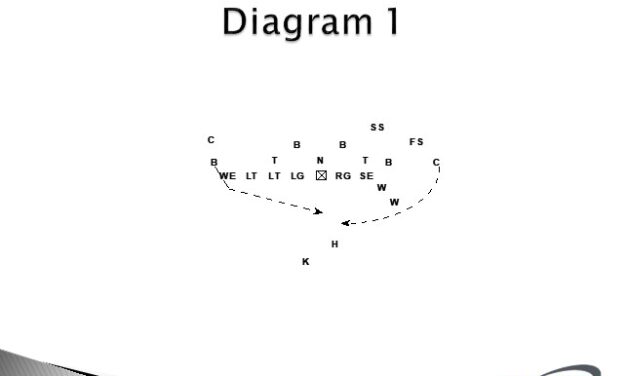
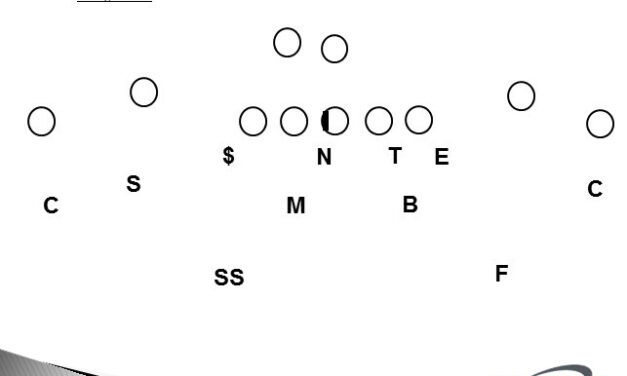
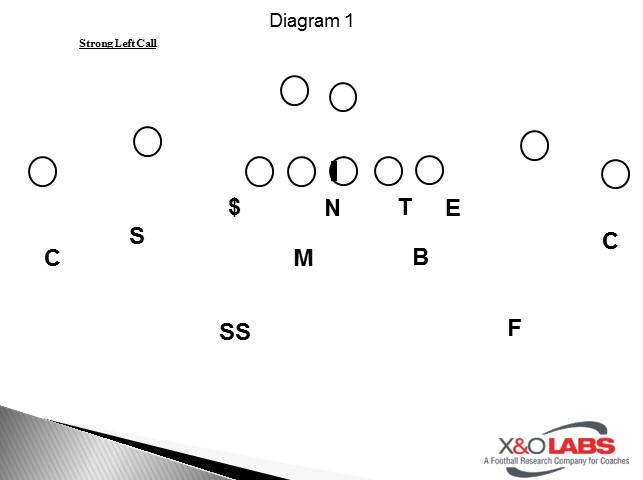
Before we get into the specifics of our defensive end technique it is important to point out that our even front consists of two DT’s and two DE’s. One side is identified as the strong side and they travel to the passing strength. These two are the Nose, who is either in a 2i or 0 shade, and a 5 tech $tud DE. The other side is referred to as the weak side End (5 tech) and 3 tech Tackle.

See Diagram 1

Diagram 1


Many of our calls are based on the hash including playing the three technique (weakside) to the boundary as well as playing the better safety to that side as well. In the Diagram 1 the boundary is to the right. That safety, our Free Safety, must be a dynamic athlete capable of playing a variety of spots.


Assessing Personnel of DE

Since at the high school level we cannot shop for our groceries, as Bill Parcells so eloquently stated, we have to find the correct players to play the correct positions. The positions we put them at are critical to the individual’s success as well as the team’s success. We prioritize the following traits when looking for our defensive ends:     

  1. DE’s that can move. Stud athletes – size is not required, physicality and explosiveness are. Basketball types (forwards/big guards) that can jump and are long limbed.
  2. Ability to change direction, capable of bending, dynamic flexibility and balance.
  3. Have tremendous takeoff, be a DISRUPTOR.
  4. Great hand fighter.
  5. Plays with great leverage.
  6. Be the alpha male (not a bad word, although most think so). Worker, tough, physical.
  7. Plays fast & relentless.
  8. A “captain” type of player


The proper explosion & physicality that is necessary for our DE’s to play with, begins with the stance. The proper stance that is to be utilized by our linemen will allow for an explosive takeoff and the ability to read as they give relentless effort. We teach a sprinters type stance. They MUST learn, practice AND BECOME COMFORTABLE USING BOTH A RIGHT HAND STANCE AND A LEFT HAND STANCE. We plan on a future entry that will focus on developing your DE’s through specific skills and drills in a progressive manner.

The stance technique is taught as follows:

  1. Feet are shoulder width apart
  2. The covered foot’s toe drops past the gap foot (Up foot).
  3. Pretend to sit in a chair, & fall forward with man hand down, gap foot up.
  4. On fingertips of the down hand, ALWAYS.
  5. Butt slightly higher than the head.
  6. Bull neck, eyes inside key ball for initial movement.
  7. Dangle the opposite hand, allowing the use of the hands as a weapon.
  8. Align nose on offensive player’s shoulder (Unless in a head up alignment or jet technique where he’ll be wider).


Read More

Limiting Frequency and Creating Tempo for In-Season Workouts

By David Hopper
Strength & Conditioning Coach
Washington High School (SD)
Twitter: @SFWStrength


Imagine working for something for nine straight months. You spend hours on end in a room that is like a freezer in the winter and a sauna during the summer. Instead of sleeping like most people you must wake up early to go to this room and pick up heavy things to earn this special something. Not only do you pick up heavy things in this room, but you must go outside and sprint like your life depends on it.  On top of doing all these things yourself you must constantly encourage your friends to do the same thing every day. Now imagine you finally have this special something in the palm of your hands and you decide to let it go!

I believe this is what exactly happens when athletes train to develop speed, strength and power before the start of the season, but do not continue training during the in-season. Why train for nine months if you will not continue it during the time that truly matters? Athletes shouldn’t peak during training camp, they should try to peak during the championship game!


Key Points for an In-Season Model

It’s important to continue to develop strength & power in the weight room as the athlete continues to improve game speed on the field.  We want to develop these things while limiting energy expenditure, muscle soreness & decreasing time spent in the weight room.


Less Frequency

We use two days instead three or four days per week. We also use less volume with 2-3 sets and about 30-45 mins in the weight room instead of 3-5 sets and 45-75 mins in the weight room.

During the off-season our top priority is the weight room, but the moment the pre-season starts the weight room is secondary and they must focus on the actual game. To minimize the mental and physical drain we limit the amount of lifts throughout the week. During the summer we spend four days training, but the moment summer training ends we switch to two days a week. Not only do we limit the lift frequency, but we decrease the overall volume of the actual lift. We do this by limiting exercise number and exercise sets/reps. In total we try to trim our normal 45-75 minute work outs down to around 30-45 minutes. This is important because athletes will be spending extra time on the practice field spending energy. I always tell our athlete that the body has a certain amount of money that it can spend on physical activities. During the winter we spend most of our money on increasing strength and we see our maxes go up because of that. During the fall they are spending large chunks of money on the football field increasing game speed/technique/etc. so we must limit our spending in the weight room to counter act that.

Read More

Stealing Points With 2-Point Play Organization

By Nate Stierhoff
Offensive Coordinator
Benjamin Logan High School (OH)
Twitter: @QBTheClinc14

Introduction:

What if I told you a small high school that missed 13 extra-point kicks in 2 years actually scored 97 points in their 95 PAT opportunities over that same time frame?

If you do the calculations, that is a 102% return on PAT opportunities based on conventional football math. Yes we are that team that goes for 2 a lot, and you should know our data shows we should be going for 2 much more often! 

In my two years as offensive coordinator at Benjamin Logan High School, we have taken a program that was scoring 13.2 ppg in 2013 (1-9) to scoring 43.1 ppg in 2015(6-4). I follow second year head coach Jeff Fay in creating a mindset in our players that we are trying to score as many points as possible every snap that we are on the field. A huge factor in creating this mentality in our program is our exotic, yet structured PAT muddle huddle concept. We have found this concept very cheap to install (10 minutes from install to scoring more points) and flexible to allow for endless tags and variations.  

PAT Muddle Huddle System

Slide1

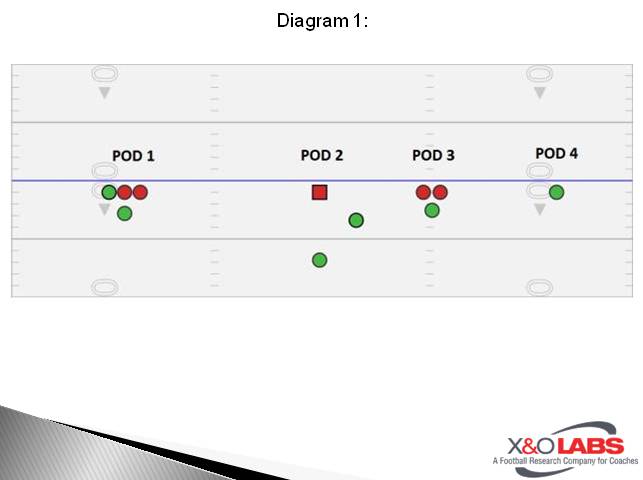
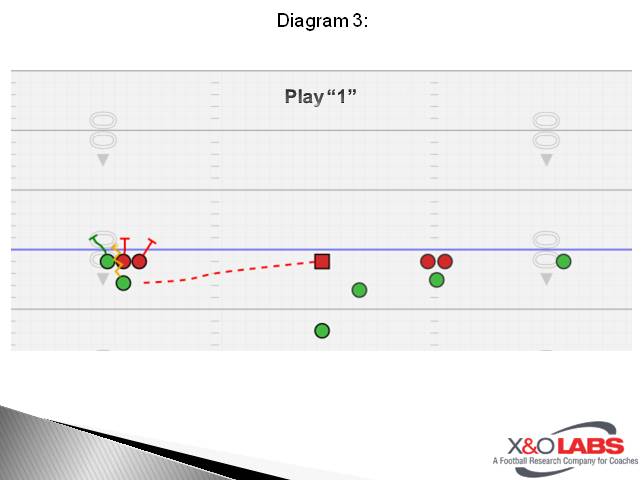
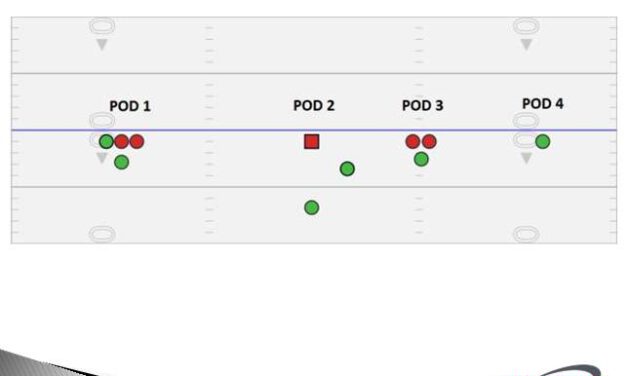
Diagram #1 shows the base formation our players know to line up in as soon as we score a touchdown. The green players are eligible to receive a forward pass, however on a 4th down or special teams play non-eligible numbered players are allowed to line up at any eligible positions as long as they do not receive a forward pass. During team periods every practice our offense drives the length of the practice field. Upon scoring on our scout team players immediately line up in this formation and the kicker is ready beside the coaches with his block. If we do not like the look we get our kicker is ready to sub in for any player and we shift to a traditional PAT formation. Our players understand from day 1 of camp that trying to get a quick 2 point conversion is the last offensive play we run before we celebrate and head off the field.

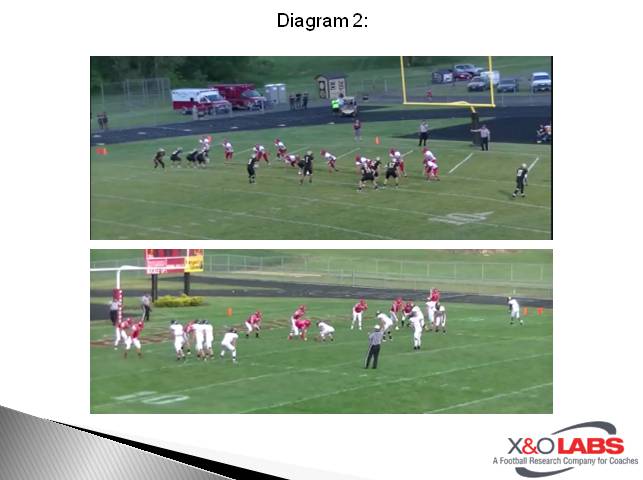
Diagram #2 shows just how confusing the formation can look to a team who just gave up a big score. 

Slide2

Pod 1

With the pods labeled 1,2,3,4 we are able to see how the team aligns to our formation, or look for a matchup to exploit and then signal in a number of where we want the ball to go. Once that concept is mastered, advanced tags can also be added to the number. We are a tempo offense so all of our players communicate to each other and our coaches through common hand signals.

When we decide we like our match up in Pod 1, we signal in a “1” and the center will wait for the ready whistle and upon grabbing the ball he will laterally flip it to his left. (Diagram #3) This is technically a backwards lateral to the eligible player standing behind pod 1 who will then push into the end zone. The 3 players in front will handle the numbers they get man to man or just wedge block the pod into the end zone. We have found we like the eligible players in pod 1 to be a Tight End type on the line and a RB behind the pod who can catch the ball and make 1 cut into the end zone.

Slide3

It is important that the center moves the ball LATERALLY FIRST, as soon as a ref declares that he brought the ball UP first the play will be blown dead and you will lose the try. When teaching right handed players the lateral we tell them their first movement is to lean to the left then push off their right foot falling towards the target after they throw. When they step with their left foot first instead of leaning the ball will naturally move the opposite direction making the ball movement slow enough for the ref to blow it dead.

Read More

8 Non-Contact Tackling Progressions

By Mike Kuchar
Senior Research Manager
X&O Labs
Twitter: @MikekKuchar


Introduction

mequitehsUsing circuit-tackling progressions provides for higher player involvement and less contact time. These drills not only teach the fundamentals of contact points but also stress the footwork necessary to get players into the position to make contact, which can be one of the more underrated coaching techniques associated with tackling. In this report, we segmented our research into the following categories:

  • Footwork Tackle Progressions: These drills emphasize the pre-contact footwork necessary to put defenders in position to make tackles.
  • Shield Tackle Progressions: These drills replace bodies with shields in an emphasis to teach the proper contact points without taking any one to the Ground.
  • Angle Tackle Progressions: These drills teach defenders the proper angles to make contact on ball carriers.

Footwork Tackle Drill Progressions

Form Tackle Progression: Ryan Porter, Mesquite High School (TX) 

Slide1

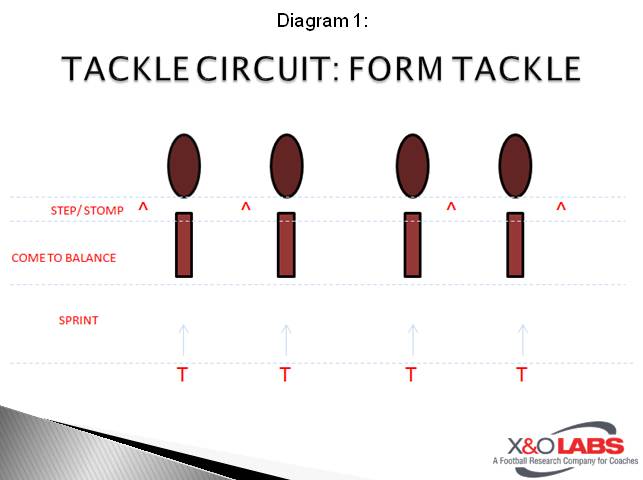
Coaching points:

  • On command tackler starts to sprint toward bag.
  • Upon reaching bag tackler begins to regrow base and sink hips (come to balance).
  • After coming to balance over bags tackler runs feet and grows “wings” (elbows high in back forcing hips to sink).
  • On command tackler will step with proper foot and get into a hitting position.
  • On “hit” tackler will throw elbows violently to sky as tight as possible to tackling dummy causing hips to explode through and launching body through the dummy.

To see film of this form tackle progression, click on the video below:

Read More

Attaining Numbers to Defend Power Read/Stretch Read

By Michael Bellacosa
Defensive Coordinator
St. John the Baptist Diocesan High School (NY)


I have always believed that best way to play defense at the high school level is to take the reactive nature of defense out of the equation and take an offensive play calling approach to this side of the ball.  Over the past six seasons, the SJB defense has implemented a multiple front attack stemming from a Base 4-3.  The objective is simple, to overwhelm the point of attack with movement and different angles.  This approach seems to have put our opponents on their heels and taken their best options away.  The Tackle box must belong to us.  By overloading the line, we must stop anything from breaking through the middle or its points for the other team.  By spilling everything to the sidelines, we are playing to our strengths, which is fast flow and pursuit to the ball.  We have not been blessed with tremendous size and stout players across our front.  Running sideways equals no gain.  The fastest way to the end zone is straight up the middle. 

Over the years there has been no play more challenging to defend then the stretch read out of the spread.  Whether it is an even 2-2 set, 3-1 or even the Jet Sweep to QB Read, this play requires discipline and assignment football while maintaining our aggressive identity. 

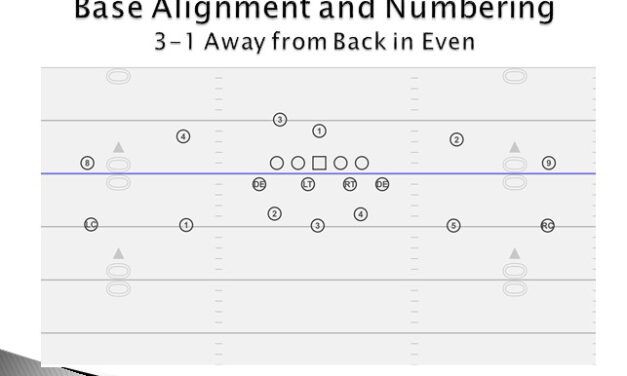
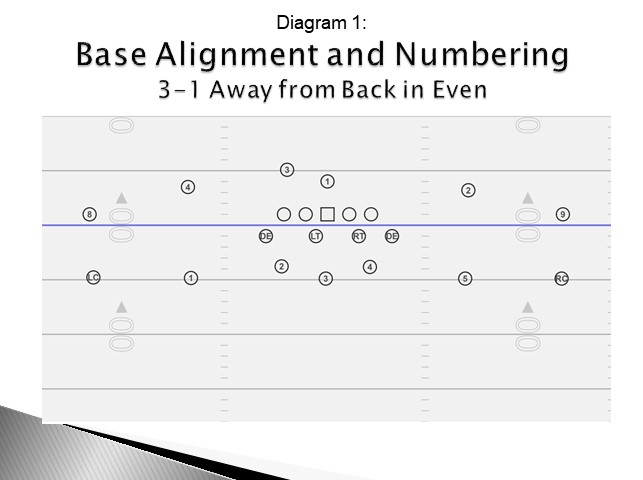
Diagram 1 shows our Base 4-3 defense numbering our safeties and linebackers 1-5 from left to right for our blitz purposes in other packages.  Our defensive line has specific landmarks to hit across the offensive line to help keep their pad level down and stop them from peaking in the backfield.  Our base coverage is combo 2-1 man coverage with linebackers picking up the back out of the backfield.  Combo coverage incorporates basic switch principles to defend any pick plays and combination routes. 


Coverage Terms:

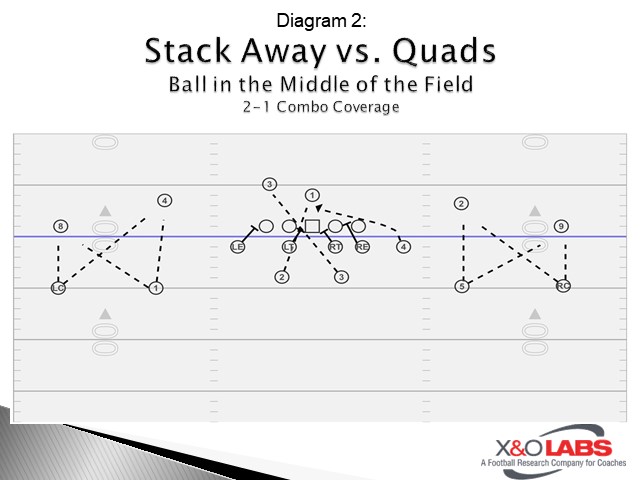
Combo Coverage Rules:  Read 2-1.  It is our primary defensive coverage.  Combo refers to a two-receiver side where corner and safety can switch combination routes, inside defender takes inside receiver, outside defender takes outside receiver.

  • Combo coverage will be used to stop middle crossing routes safety to safety (our shallow)
    • When the inside receiver breaks in, turn and run but get eyes on opposite number 2 receiver
    • If the opposite receiver crosses, break down and switch with a cross call
    • If he doesn’t stay locked on your man
    • Waggle or play-action pass as well
      • Corner or safety will pass off the drag route to the free squatting corner
        • Corner or safety will then cover the back out that just faked with QB.


Diagram 1


Every team has that a “go to, bread and butter play”.  In defending a team that runs Stretch Read,  “Stack Away” from the running back fits our overall philosophy the best.  In defending this play, the idea is to take away that QB run up the middle and force him to give the stretch making the RB run wide.  We put six defenders on the QB and pursue to the stretch.  This will overwhelm the point of attack and create hesitation and indecisiveness in the QB.

Diagram 2

Read More

Methods in Building Scout Team Autonomy During Game Week

By Eric Anderson
Inside Linebackers Coach
Bishop Chatard High School (IN)


As coaches, we all would like to maximize the quality of practice. If you can create an environment that has energy and efficiency, it will definitely transfer into good things on Friday night. We all attempt this. Some days it works, some days it doesn’t but we all strive for that perfect practice. I believe, as I’m sure many of you do too, that in order to even have a chance at creating this environment for your two deep depth chart (the guys that play), the competition they face must be formidable. Enter the Scout Team.

If you don’t have the opportunity to two platoon, then you definitely use a scout team.  Most teams use scout players in all phases of practice. If you want your offense, defense, and special teams to get the hands-on experience they need, then their competition must be able to effectively recreate their opponent. We want our players to be ready for anything on Friday night, so we must try to create that environment during the week. 


Buy in

When you want your players to buy in, the first step is to show them that you have bought in. So, if you are in charge of teaching the scout team, it is important that you are well versed in the scheme they need to know. Be able to answer questions about the scheme and provide them coaching direction as if you are the coordinator.  As a scout coach you should also bring a positive and competitive energy to the task.  Once they see you are excited about the opportunity to coach them, they will be eager to compete against the starters. Enthusiasm won’t solve everything, but it is a good place to start.

There are a few other things we do to try to create buy in. The most important being recognition. We have “Scout Players of the Week” every Thursday before we start our walk thru practice.  The Head Coach will announce these in front of the players. Some kids like the mention, but most of all it allows them to see that they are being evaluated. Every year a few guys that started on the scout team earn a chance to play on Friday Nights.  When players know they are getting a chance to “show what they got” you get a unique kind of energy.


Personnel

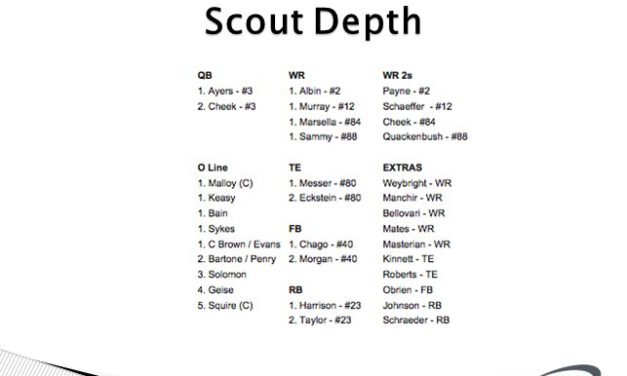
Scout Team starts with scout players. We want to face the best competition without putting our starting units at risk. Early in the season we as coaches collaborate to create what we call a “Scout Depth Chart.” I’ll use Scout Offense to explain this.

I first work with the D coordinator and D assistants to know who will be taking 1st and 2nd team reps that week of practice. Once we have that, we go to the Offensive Coaches with the leftover players to see who we can’t use for the sake of the team. The common players on this list include your kickers and O starters. Once you have your scout players you create a depth chart according to the opponent’s personnel.  We pay attention to skill, size, and position. The closer we can mimic our opponents, the better. We have a depth chart ready to go by Monday, but it is a rough draft. You will have to be ready to adjust because of injury, kids missing school, or even JV games, etc. We are fortunate to play a lot of our JV games on Saturdays, which allows a scout preparation period on Mondays. 

Read More

Daily LB Block Destruction Drill Progression

By Greg Patterson
Inside Linebackers Coach
Hueytown High School (AL)
Twitter: @gregpatterson51

Introduction

The most essential thing we as coaches can do to help our players on the field is to give them the tools/techniques they need to be successful. Two of the most fundamental tools a defensive player needs are the ability to get off the ball and destroy blocks. We tell our guys all the time that we understand that a player may get blocked but it is unacceptable to stay blocked. Block destruction is a fundamental key to winning on defense.

Basics

Our catch phrase for block destruction is “Shock/Lock/Shed”.

As with most every aspect of this game, leverage is a fundamental key to success. We begin our teaching progression by teaching proper leverage for the position. Although we teach all of our players to keep low pad level (low hips) and head up (see what you are striking), there are slight variations from what a DL does vs what a corner does to defeat a block. Usually, the variations are strike point and the type of block they are trying to defeat. It is easy to lose focus on our player’s stance (feet) during these drills so we relate as many things as possible to how we are tackling.

We teach a good base with feet shoulder width apart, attack with near leg and near shoulder, head up, and eyes on target. We feel that this carry over in teaching principles from tackling to block destruction and vice versa helps our players perfect their technique.

Teaching Progression/Coaching Points

Board Drills

We simply use a wood board (1x6x14) to teach eye discipline and hand placement. When we begin the teaching progression, we like to use these boards instead of a hand shield to begin the teaching progression because it forces our players to keep their elbows tight and their thumbs up. The boards are easy to grab which helps us to emphasize our need to grab cloth to properly shed the blocker.

To study film of this drill, click on the video below:

Read More

McMurry University’s 6 Essentials for OL Scouting Reports

By Adam Kirby
Offensive Line Coach
McMurry University (TX)
Twitter: @CoachKirby25

Introduction:

mcmurryfbI believe that the offensive line, more than any other position, is one that requires a strong work ethic, attention to detail and meticulous preparation. Perhaps this is why I heard so many of my peer offensive line coaches talking about the challenges of the weekly preparation that their linemen need.
I have always prided myself as a coach on these attributes and want my offensive line to be the hardest working and most disciplined group on the team. The players know that playing offensive line at McMurry University is a privilege and they take pride in that. My goal for my guys is to go into each game confident that they know what could happen in any given situation.

Obviously, if this is to be accomplished, the work ethic must be there in order to achieve the goal of winning on Saturday. That goes for coaches and players alike. Here is a look at what we expect our players to know going into every game:

  1. What are their favorite fronts?
  2. What are their favorite blitzes based on down/distance?

    1. What is the percentage they run a certain blitz?

  3. What are their favorite stunts based on down/distance?

    1. What is the percentage they run a certain stunt?

  4. What do we feel comfortable with in the run game?

Contents of Weekly Scouting Report

Scouting Reports have become such a big part of today’s game. Everyone has them and uses them; from the overall offensive plan, to quarterbacks, to the offensive linemen. With the explosion of Hudl software, Twitter, Facebook, and YouTube, information on your opponent is as easy to access as it’s ever been. But the struggle that I have heard from other line coaches is that they have trouble harnessing and delivering this information in a way that works for their players.

One key to addressing this issue is creating a line specific scouting report. While understanding the overall game plan for the offense and our goals that we’re looking to accomplish that week is necessary, having an offensive line that knows and accepts their role in how the offense will function is vital.

Our offensive line scouting report is broken into six sections:

  • Notes
  • Statistics
  • Starters (Linebackers/Defensive Line)
  • Roster (Linebackers/Defensive Line)
  • Stunts/Blitzes by Down/Distance
  • Blocking Adjustments

Contents of Notes Section

We also include miscellaneous information about the scheme that we will be facing that week. (ex. when the 3-technique is to the strength of the formation, watch Will blitz)

We also include tips and tricks that will work to our advantage as an offensive line (ex. #96 plays deeper when he is about to stunt).

Players have found this particularly helpful as we watch film during the week. Quite regularly, there have been comments where they are seeing what I’m telling them as a coach.

Contents of Statistics Section

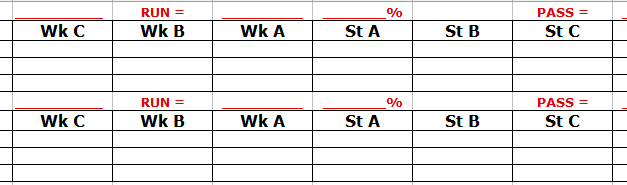
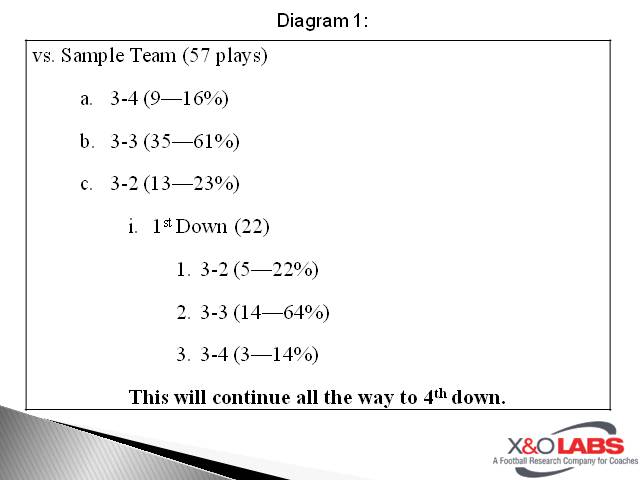
In this section, I will take every play of every game our opponent has played and break it down into percentages. I leave it divided game by game rather than combining the games so that the players can see how the opponent has differentiated from week to week.

I like to start with the total number of plays for that game, broken into how many times they were in a particular defensive family (4-2, 4-3, 3-4). From there, I will break it down into 1st, 2nd, and 3rd down. For each down, I divide the defensive family by the number of times they run it and what it equals out to percentage wise.

An example of this can be found below. This is an opponent that we played early in the 2014 season.

XO Labs PPT Template1

Contents of Opponents Starters Section

It is important to know everything you can about who your opponents are as individuals. I like to include a picture of every defensive line and linebacker starter that we’ll face that week. Include as much as you can in this section; height, weight, weaknesses, strengths, statistics, etc. Leave no stone unturned. For each starter, I will try and find 2-3 things that they do right and wrong to show to our guys.

Contents of Roster Section

I will include what I call a DL/LB roster in every scouting report we do. With the multiple formations that are being run in today’s game, it is not uncommon for a team to substitute a defensive lineman or linebacker and the level of play not drop that much. In my opinion, this is the most important section of the entire scouting report.

It’s tough to win on Saturday afternoons, especially in the American Southwest C

Read More

Streamlining Communication Methods to Defend Tempo

By Mike Harrison
Athletic Director/Head Football Coach
Holy Cross High School (TX)


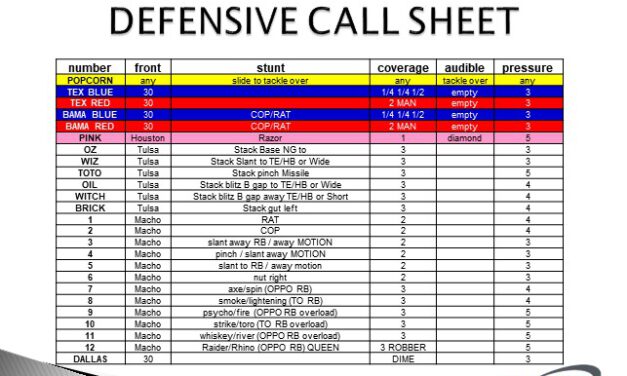
Facing an up-tempo, multiple formation offense has forced us to find ways to match the offensive pace while being able to bring pressure, check coverages and have sound formation adjustments. It has been our experience that athletes who are confident in what they are doing play instinctively rather than reactively. Instinctive athletes tend to play faster and therefore become “playmakers”. Our ability to communicate effectively is the center of our defensive system and is based on the following principals:

  1.  Ease of communication through the use of wrist bands
  2.  Front end preparation by coaches
  3.  Putting information in an easy and coherent format that players can use in games


Our success is a direct reflection of our players and staff “buy-in” to this system. Once implemented it takes a tremendous burden off the players and allows them to play with confidence. In fact, our players affectionately refer to our defensive wrist band communication system as the “idiot card” due to its

Using Movement to Gain Numeric Advantages

The goal of an up-tempo offensive scheme is to disrupt the defensive signals so that the defense is misaligned.  This creates a natural mismatch for the offensive team to expose. The most common response of any defense when struggling to get calls in is to run their base defense. The offense takes away your ability to attack, and they gain the ability to dictate the flow of the game. In our defensive scheme we rely a great deal on movement to be successful, and we use automatics to gain a numbers advantage against certain formations, aligning in base would hurt us.

We wanted to be able to maintain our aggressive defensive style against any tempo offense we face. It simply took too long to signal a call in from the sideline to communicate the defensive front, stunt and coverage. The other factor we considered is that we wanted to be able to check/audible our defensive call by offensive formation-we wanted the ability to align differently vs a 1 back or 2 back set.

Limiting Defensive Techniques

The emphasis is on mastering a few techniques and then using those techniques to communicate effectively with the team through individual positions. Limiting the amount of techniques an athlete will utilize in a game allows them to execute those techniques at a high level. The greatest failures defensively usually fall in one of about three areas: 1. Alignment, 2. Reads and 3. Gap Responsibility. Our focus is to reduce those mistakes by effective communication against the up–tempo teams. 

We focus on coaching techniques with only a few formational adjustments that are predetermined, such as our wing/nasty rule for our OLB’s. The techniques are limited by position which again, allows athletes to learn few things, but do them very well. Most importantly with this focus on technique, it allows more quality repetitions at practice. This means we will become more instinctive and less reactive.

Using Coaches Call Card

Read More

Ground Game Grind: Missouri Western’s 7 EDD for RBs

By Colin McQuillan
Running Backs
Missouri Western State University (MO)
Twitter: @CoachMcQuillan

Introduction

Our offense at Missouri Western is based around running the ball. The better we are at running the ball and controlling the LOS the better we will be in the passing game. This means we must be great at every concept and situation that we will encounter on game days. The best way to be prepared for these are to practice for them each day.

We start by emphasizing the following:

  • Preparation
  • Execution
  • Effort

These are the three most important points that we make every day of practice. We will push our student-athletes to the limits and prepare them for game days and being successful.

Our next area of emphasize is turnover margin. We must win the turnover battle, either by taking it away with our defense or taking care of the ball on offense. The combination of both is what is key at any level of football. In the MIAA, we can see the true correlation between turnover margin and win/lose column.  Here is the data from the last three years.

2014 MIAA Turnover Margin (Win/Loss)

  1. UCO +1.17 (8-4)
  2. UCM +1.0 (8-4)
  3. PSU +.85 (11-2)
  4. FHSU +.55 (7-4)
  5. MWSU +.36 (7-4)

2015 MIAA Turnover Margin (Win/Loss)

  1. NWMSU +1.27 (15-0)
  2. UCM +1.09 (8-3)
  3. ESU +.86 (11-3)
  4. FHSU +.75 (8-4)
  5. MWSU +.27 (6-5)

2016 MIAA Turnover Margin (Win/Loss)

  1. ESU +1.31 (11-2)
  2. FHSU +.83 (8-4)
  3. WU +.67 (7-5)
  4. NWMSU +.47 (15-0)

The ability to take care of the ball is key, but we also emphasis that our players be loose and enjoy the game. That said, we want to score every play!  Which is where I came up with our signature #Score6Squad to get across the point of scoring 6 every play. 

Footwork

Our footwork from the running back position will vary with play and scheme. That said, several tag words can be added to the end of the call to let the RB and QB know which backfield action is desired. This will allow us to “make the same plays look different and different plays look the same.”

On each play, our RB will be responsible for knowing the following items:

  1. Footwork
  2. Aiming Point
  3. Read

Note that the aiming point and read may often be the same for each play, whereas the footwork will be dependent on alignment. 

Read More