Situational Punting in the Rugby Scheme

By Garic B.D. Warner
Special Teams Coordinator
Marietta High School (OH)
Twitter: @mumford421


The main concept behind the rugby punt is giving your coverage players additional time to get downfield before the kick. Not every high school team is blessed with a punter with great hang time. The rugby punt allows you to get those precious seconds during the snap to kick interval. The punter must have a consistent launch point, as protection is vital for every punt.


Formation

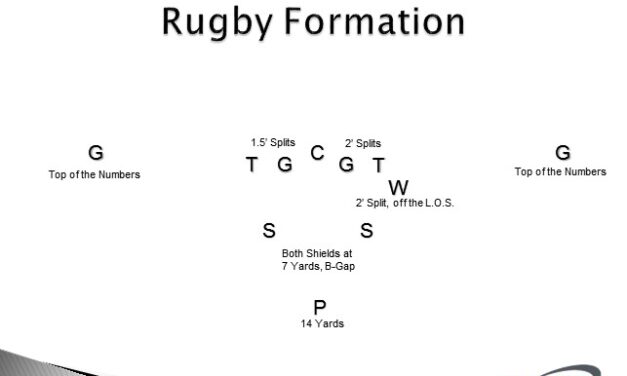
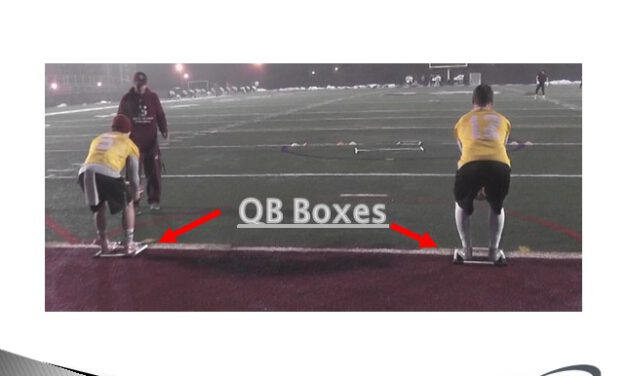
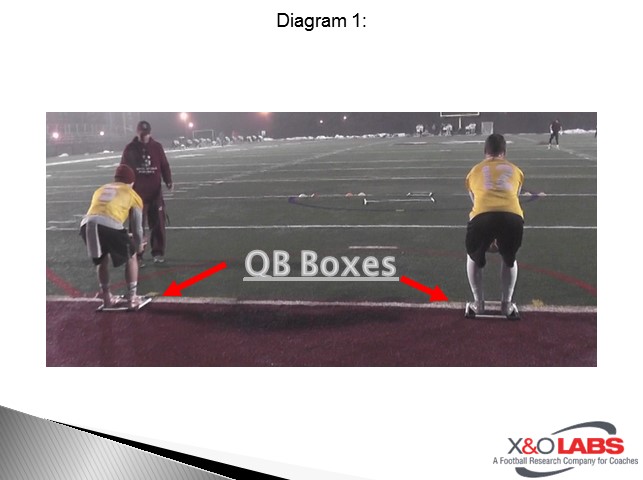
The rugby punt formation possibilities are endless. Here at Marietta High School, we believe in winning special teams play with better fundamentals and effort. The only formation variant we teach is the shield punt. We simply move our wing back to the shield and the gunners to tight end. While the coverage rules don’t change, the protection scheme is a bit different and more in line with traditional shield punt concepts. Below is our rugby and shield punt formations.

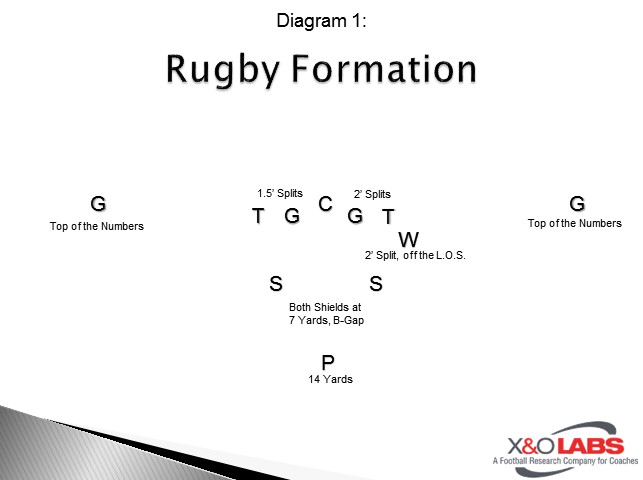
Diagram 1


Here’s a good look at our rugby punt formation. By this point in our season, our punter had improved his accuracy, so we moved our left gunner in closer to the formation.

Read More

6 Tips for Improving Defensive Practice Efficiency

Cody Fagan
Defensive Coordinator
Midlothian High School (TX)
Twitter: @Coach_Fagan30

Introduction

As most defensive coaches would tell you it’s hard to find time to build a game plan and stay focused on fundamentals during the grind of a football season. At Midlothian High School, we get 50 minutes per day on Monday and Tuesday, and 30 minutes on Wednesday to guarantee our defense is ready to stop our opponents’ normally fast paced offense. That’s just over 2 hours of on field practice time a week to practice fundamentals, implement a new game plan, and ensure the kids are confident they know what they will see from our opponent and are ready to stop them. I have been blessed to work for some great defensive coordinators and elite head coaches in my 10 years in this wonderful profession. Like many of you, I have “stolen” some great ideas along the way to help maximize defensive practice time.

Tip #1: Practice with a “Conditioning Pace”

In order to get the most out of our 2 hours and 10 minutes of on field defensive practice a week, we have trained our coaches and kids to practice like every second counts. I know this is not a new or revolutionary idea, but sometimes I think we have to remind ourselves and the kids that the game is won Monday – Thursday in the film room and on field preparation. Normally, the better prepared team comes out on top. We try to alternate segments of practice from “slower paced” (although nothing we do on the field is very slow) to “Full speed” (get as many reps as possible in that 5-15 minute segment). By doing this, we guarantee they are well rested during the times we have to slow down and teach. 

Tip #2: Circuits for Maximizing Reps

Like countless other defensive coaches we take advantage of a few circuits during our practices to make sure we never get to far away from the basics during our preparation. Vince Lombardi once said “some people try to find things in this game that don’t exist but football is only two things; blocking and tackling.” With that in mind, we make sure we are always practicing tackling and getting off blocks. Below is a description and diagram of our 2 most commonly used circuits during the season.  

Panther Tackle Circuit

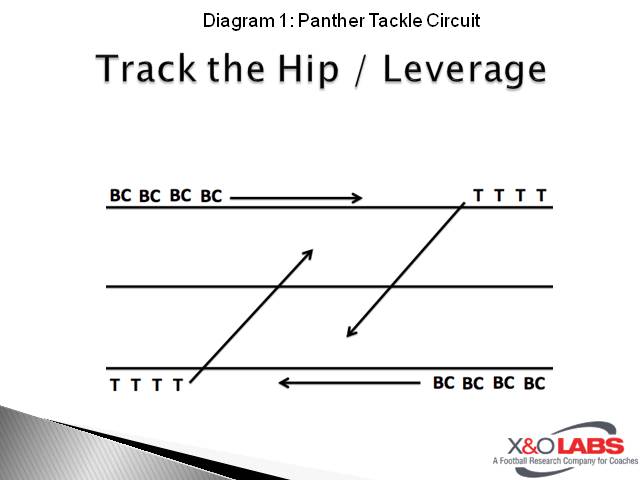
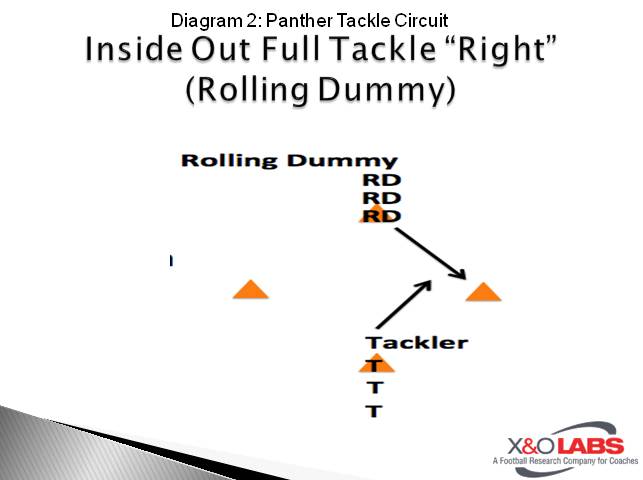
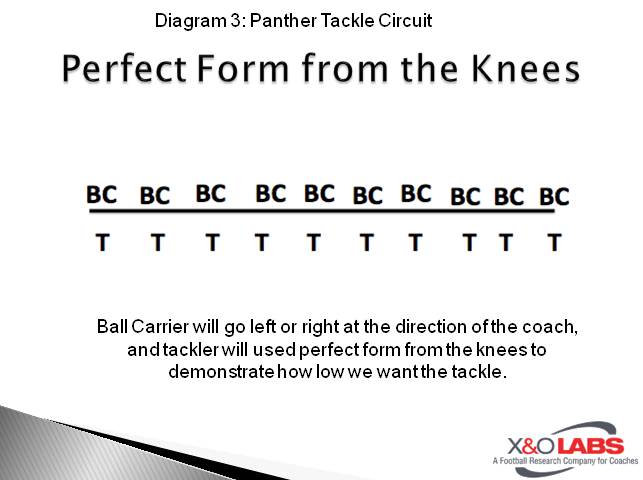
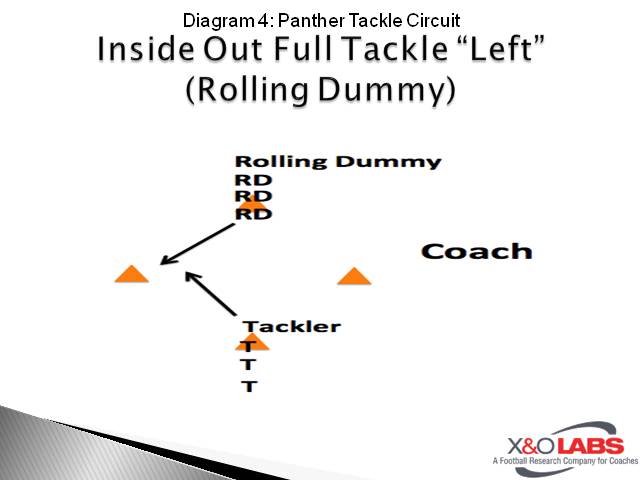
Our tackle circuit consists of five varsity defensive coaches stationed around the field each doing a different tackling drill. We will divide kids into five groups of 10 players and each group will spend 2 minutes at each station. Our circuit is as fast as possible with coaches coaching every rep. We will adjust our stations periodically to practice what we need based on recent success and failures in our tackling. For the most part these, are the five tackling drills we do day in and day out:

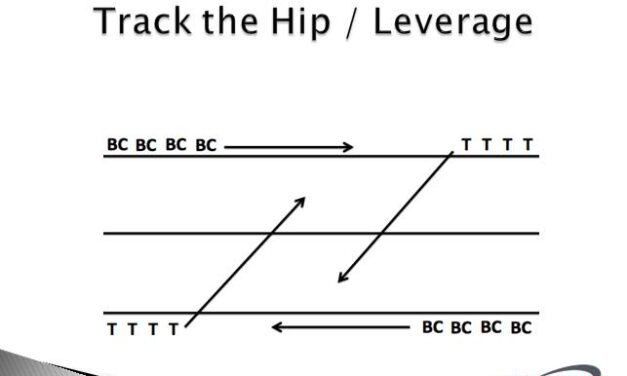
  1. Track the hip / leverage
  2. Inside out full tackle “right” (rolling dummy)
  3. Perfect form (from the knees)
  4. Inside out full tackle “left” (rolling dummy)
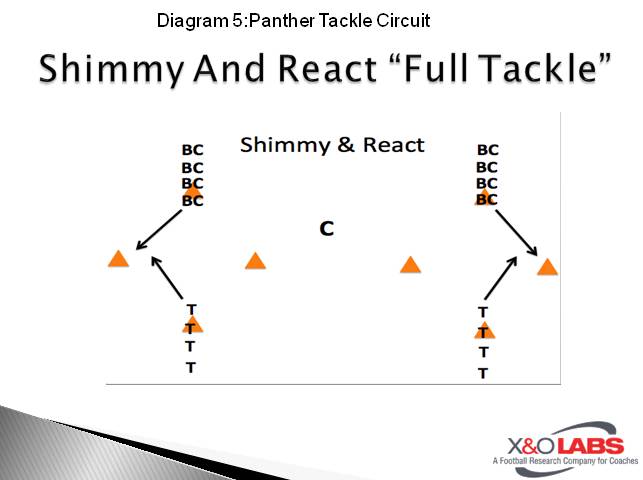
  5. Shimmy and react (full tackle)

Slide1Slide1Slide1Slide1Slide1

Panther Defensive Circuit

Our defensive circuit consists of 5 Varsity Defensive Coaches stationed around the field in the same locations as the tackle circuit each doing a different type of defensive drill. We will break kids into 5 groups of close to 10 players and each group will spend 2 minutes at each station. Our circuit is as fast as possible with coaches coaching every rep.  We will adjust our stations periodically to practice what we need based on recent success and failures in our defensive productivity.  But for the most part these are the 5 basic defensive drills we do day in and day out:

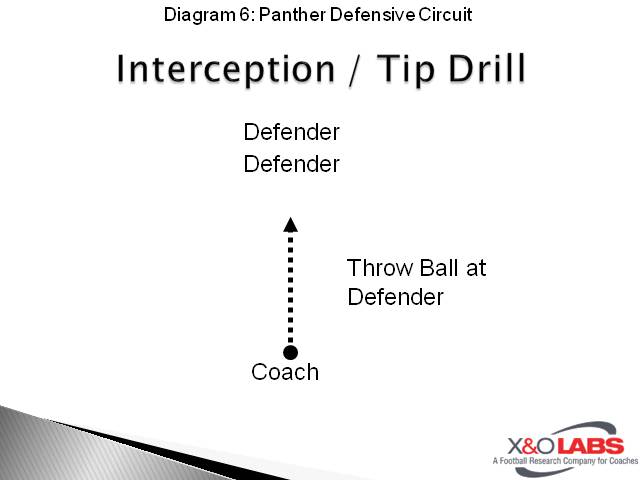
  1. Interception/ tip drill, ball on the perimeter for d-line
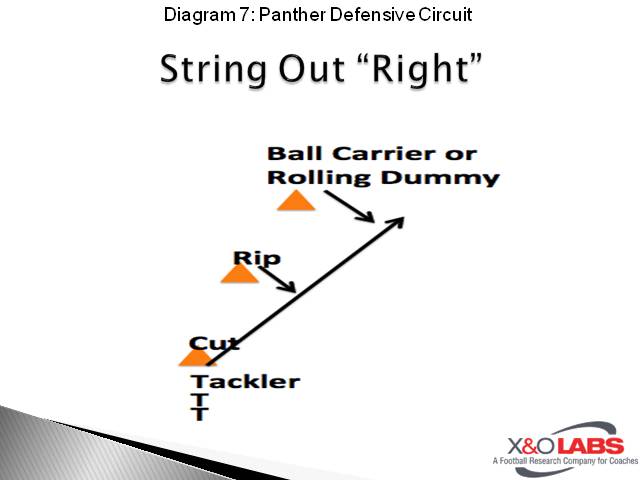
  2. String out: Cage and defeat a block, rip of a block, tackle rolling dummy (right)
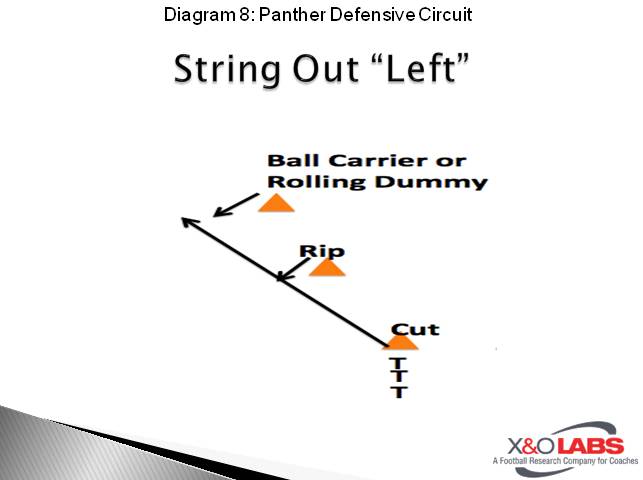
  3. String out: Cage and defeat a block, rip of a block, tackle rolling dummy (left)
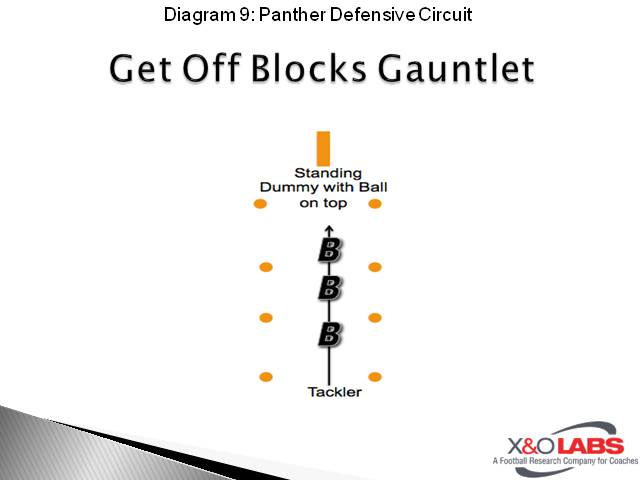
  4. Get off block gauntlet: 3 vs. 1 defeat 3 blocks and get to dummy then recover in a crowd
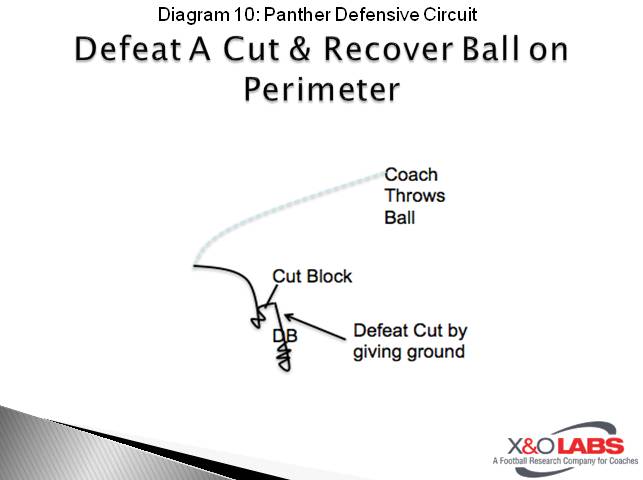
  5. Defeat a cut and recover ball on the perimeter

Slide6Slide6Slide6Slide6Slide6

Tip #3: Play Sheets

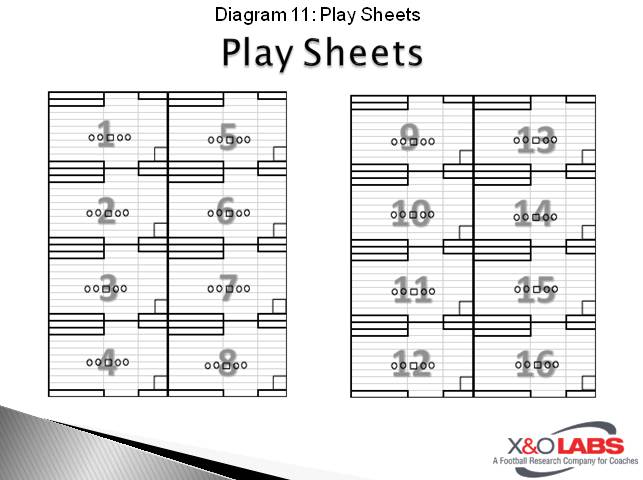
We got tired of slowing down the pace of practice to huddle up the scout team and show them the play, so we have bought in on using the play sheet format shown below (Diagram 11).

Slide11

We use these sheets for all group settings; inside, 7 on 7, and team segments. Each sheet is numbered in a different color to safeguard against kids having the wrong sheet during the wrong segment of practice. Each player will have a sheet and know what their position is. For example, the X receiver looks to see wher

Read More

8 Mesh Mechanics for Option: Gun/Pistol Alignments

By Mike Kuchar
Senior Research Manager
X&O Labs
Twitter: @MikekKuchar

The following excerpt is from X&O Labs special report on the Veer and Midline Option concepts. Get more on this special report, go here


Pistol Techniques and Fundamentals (Midline Option)

#1: Jump Step Technique

Rouse-BioRalph Isernia, Head Coach, Rensselaer Polytechnic Institute: “From the shotgun, the QB will ‘jump’ the snap and step with his back side foot opposite of the read. He will clear the midline by stepping up and over, away from the read. The step is 2 feet toward the LOS and 2 feet off the midline. Basically, his toes will be on the center’s back side foot. After the first ‘Clear’ step, he will come to balance with his back side foot. With his eyes on the read, he will get his shoulders back and extend the ball back to the FB. The FB will take a drop step with his BS foot for timing and run the midline course 100 mph. With inside arm up, he will soft fold over the ball and feel for ‘push-pressure’ from the QB give. His eyes are on his action key (the block in A gap) so he can read the block.”

#2: Drop Step Technique

Matt Sims Colby High School (KS): “To teach the mesh in the Midline scheme. We tell the Pistol back that he owns the line from him to the center. It is the QB’s job to get out of the way. If we are running Midline to the right side, the QB in the Pistol formation will take a 1-yard step toward the line of scrimmage with his left foot at 10 o’clock. This allows him to get out of the way of the Pistol back that owns the line. The QB will then get depth with the ball as he watches his read man. Most times the decision is made before the mesh happens. The QB needs to show the ball keep bent arms and make his read. As the Pistol back runs straight down hill toward the center.”

Joe Whipple, Schalmont High School (NY): “We run our Midline, Veer and Zone mesh everyday for 5 minutes. I paint a line from a cone where the center would be back 8 yards behind the QB and RB. The RB aligns in 2 different positions in all three plays. We first have them run all three through Pistol (RB aligned behind QB in gun) then align him to the side of the QB, as he would run Zone. He is able to run all three plays from both positions and they all look the same. The painted line gives the QB and RB aiming points to where they have to go. The QB is taught to get off the midline. Ideally his heels are in the back side A gap. The RB runs right up the line, which is the crotch of the center. So if he is aligned in Pistol its pretty much straight downhill. If he is aligned next to QB he gets to the line and works up field. The QB does not ride the RB to the LOS, I think it is tough and it makes the defender play both RB and QB. He rides him until he makes the decision to keep or give. We always tell him when in doubt, give.” 

#3: Two-Step Technique

Marcus Miller, Englewood High School (FL): “Our midline step rule is for the QB to take his play side foot and put the toe of his play side foot 3 inches perpendicular to his back side foot. His back side foot will naturally progress to towards the LOS, this makes his weight shift forward, but we want his backfoot in the ground as soon as possible because midline is a pull 85% of the time and he will drive off his back foot. After the ride, we push off the (play side) back foot and take two steps and then cut vertically. His mesh point is fast and gains ground to make the DT play it just like he does under center.”
Tim Kilgore, Mansfield Legacy High school (TX): “We run it out of the Pistol. The QB steps back with two quick steps and allows the RB to aim at the crack of center. QB extends ball with thumbs on top and spread fingers on bottom. Teaching their grip during QB school in February, I walk by the QB and try to slap the ball out of their hands. The running back runs his belly over the ball. QB rides from thigh pad to thigh pad and transfer his weight to front foot. This weight shift allows him to take his first step with his back foot without a false step. The QB will take 3 steps parallel to the line of scrimmage before cutting up field. He can cut up quickly if we are cutting up inside of a 5-technique. The RB follows the Zone direction of the center unless he sees daylight in the back side A gap.”

Read More

“40” Personnel Package for Red Zone Offense

By Chris Cutcliffe
Head Coach
Oxford High School (MS)
Twitter: @chriscutcliffe

With Noah Riley
X&O Labs Contributing Writer


Offensive red zone production is absolutely crucial in determining wins and losses, particularly in close games. We all know that as the field condenses, it becomes more and more difficult to move the football against a great defense; therefore, great preparation and practice in this area of the field is essential for setting up your team to have the best chance for success. At Oxford, we believe that in crunch time you have to be able to run the football in the red zone. We are typically 60-65% run in that area of the field. However, we spend a great deal of time preparing and practicing our red zone passing game. We are looking for high efficiency in our passing game and the ability to produce some big plays. In this article, I will break down some of our game planning thoughts in the red zone, how our offense practices for the red zone, and look at several examples from last season where this preparation and practice lead directly to touchdowns on Friday night.


Game Planning and Practicing the Red Zone Run Game

The first thing we try to do when creating our red zone plan is looking at what we think of as a defense’s red zone personality.  Some coaches stay conservative in the red zone, but many will dial up pressures and play a lot of man coverage.  The next thing we identify is at what point does the defense switch from a red zone defense to a goal line defense.  For many teams, this happens inside the 5-yard line.  For others, it is more determined by offensive personnel than it is by yard line.  Once we have these patterns identified, we are able to begin working on our red zone run game plan and our goal line run game plan.  We work this game plan into our practice schedule on Wednesday.  Our offensive players have coined the term “Red Zone Wednesday.”  We will work our goal line and short yardage run game plan during our inside drill on Wednesday and work our red zone run game plan during a red zone team period.


Personnel Variations

We use a lot of 10, 11 and 12 personnel groupings in our base offense and we’ll do the same in the red zone. Some weeks we will have special personnel groupings like some of our heavy stuff and empty stuff.  It’s one of those things that builds. Early on we may just carry our base personnel stuff and maybe one special, then late in the season, we may have 3-4 special personnel groupings. An example of this is our cannon-ball package (detailed below) which we started in week 6, and carried it the rest of the year. There are also some personnel groupings that we took into a certain week, and didn’t run them the rest of the year, we just liked it for that one game. No matter what formation/ personnel grouping we’re in, we try to keep the teaching all the same, especially for the offensive linemen.


Tempo Variations

When we’re in the red zone, we’ll use a little more check with my stuff, just because there’s less film to scout in the red zone compared to the open field. You’re not always sure what you’re going to get. Despite the fact that we are a no-huddle team, when we run our cannonball package we huddled just because it made it easier on our inexperienced wildcat quarterback. We also probably use a little more one-word calls because those prevent teams from subbing in goal-line personnel. Also, you naturally use more one-word calls because you usually are in the red zone because you made a big play, and one-word calls are used to catch teams off guard after a big play.


Protect Both Edges

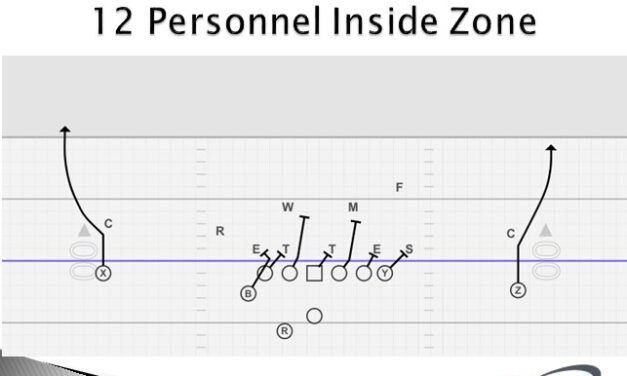
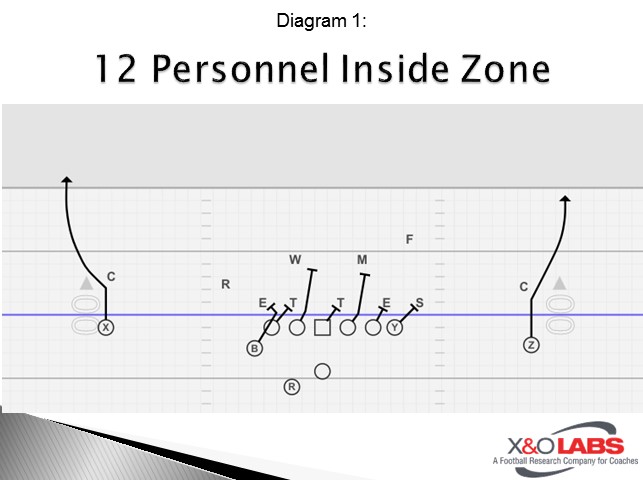
We believe it is absolutely critical in the red zone to avoid negative yardage plays, so that plays a significant role in our game planning.  For example, many teams love to bring edge pressure in the red zone.  You often see an edge rusher catch a running back off of the short side for a loss in these situations.  We love to utilize 12 personnel formations where we have both of our edges protected to run the football.  This is also a great time to tag an RPO to take advantage of a 1 on 1 matchup on the outside because with both edges protected, there should not be a free hitter on the QB.  The example below is inside zone with both edges protected.

Diagram 1


The clip below is an example of this concept:

Read More

Drilling the Guard to Near Back Read Progression for ILBs

By Spencer Leno
Inside Linebackers Coach
Massillon Washington High School (OH)
Twitter: @SpencerLeno


There are three main points of emphasis that are communicated to our inside linebackers at the beginning of the year. They include:

  • Know Alignment/Assignment
  • Read and React
  • Be Great Tacklers


While block destruction, tackling, footwork, and pass defense are all important aspects of playing ILB, our players really take pride in reading their keys and then reacting to the football. If we get good at reading our keys, we can always make up for a lack of talent or speed. Stopping the run is our first team defensive goal, so we really emphasize the importance of being disciplined with our eyes and reading keys. For us, we believe the easiest and most efficient way to read effectively is by reading “guard to near back.” Out of our three or four individual periods each day at practice, our ILBs will spend at least one period or more each day practicing our reads, whether it’s in the form of a drill or a walk through.

From an overall defensive perspective, we are a multi-front, 3-4 defense. We will start off in an under front with a stand up 5 technique in the boundary and then branch off from there. Most of the time, our two inside linebackers will align in 30 techniques (outside shade of the OG). We believe in being gap sound in the run game, but understand that gaps can move based upon whether an offense is running gap scheme or zone. Although we are a base under front defense, these reads, rules, and terminology can be applied to all ILBs in any defense in some form or another.

This article will focus on the progression of how to teach inside linebackers to read “guard to near back” effectively. When teaching players how to read their keys, it is important that we work part-to-whole, utilizing specific and simple terminology that all players can reiterate without hesitation. Our linebackers will hear the terminology being used constantly throughout drill work, film study, and chalk talk. The part-to-whole teaching and drill work progression includes the following:

  1. Walk Through of Drills and Reads
  2. Chalk Talk/Film
  3. Half-line Read Drill
  4. Flow Drill (Near Back Flow)
  5. Whole Line “Fast” Read Drill
  6. Inside Run
  7. Team Run


Guard to Near Back Key Principles

As opposed to reading primarily guard or primarily the running back, we read guard first to the near back second. Once we get our initial read from the guard, we eye our near back to read his shoulders to determine whether he’s running inside, off tackle, or outside. Their eyes should always be on the guard first because of the potential misdirection of the RB on run plays such as counter and QB counter. This is one reason why we do not just read the RB. It is worth noting that before we teach the primary reads, we review our read step and basic footwork. When the ball is snapped, we teach our ILBs to take a read step mirroring their primary key (guard) taking short six-inch steps until our key tells us to react and attack. When reading guard to near back, we initially focus on three primary reads to start off. They include:

  • Open Window
  • Closed Window
  • Pull Read


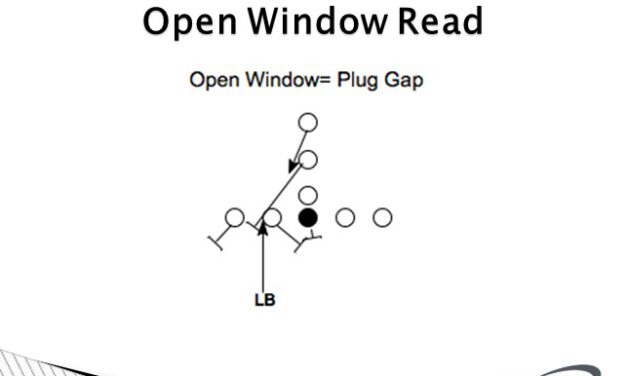
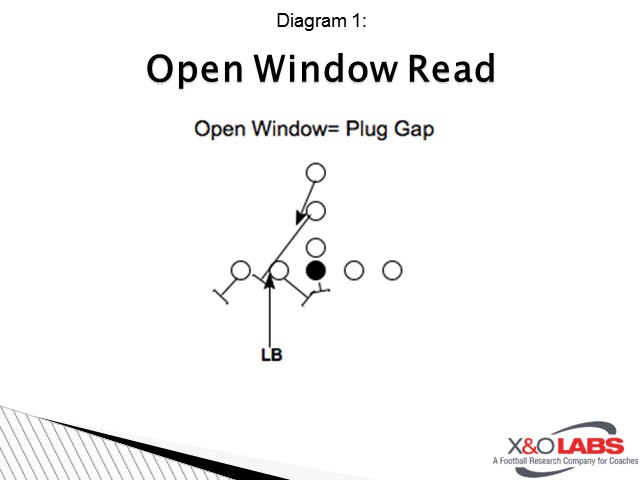
An open window read can be identified as a clear open read in our gap with full RB flow towards the gap. When we read this we will “plug” the gap, either making the play or taking on a fullback’s, H-back’s, or pulling guard’s block.

Diagram 1


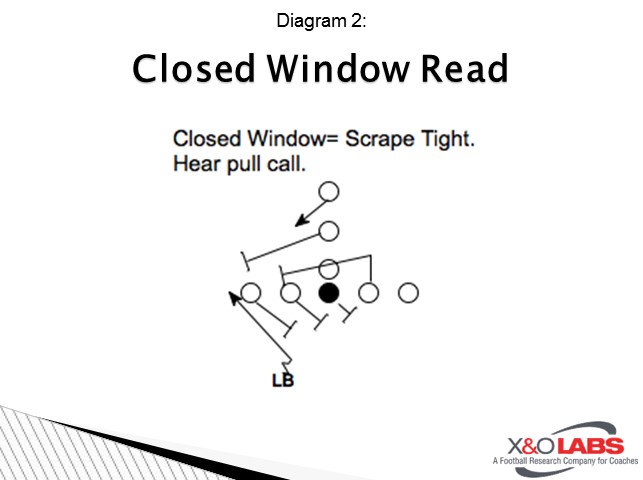
A closed window read can be defined as down blocks by the OG and OT. When we read this, our ILB may take his six-inch read steps mirroring the down blocks, but should redirect and scrape “cloudy to clear” tight to the wrong arm. The running backs shoulders will most likely be square to us still. Whether or not we are getting a “pull” call from the opposite ILB will help with this read as well.This read will occur when teams run gap scheme based plays.

Diagram 2


A pull read can be defined when the OG or OT pulls behind the center. When we get this read, we teach our guys to communicate “pull-pull” and then to “press play side A,” working “cloudy to clear.” We teach our guys that when pressing the play side A, if it’s “clear” we “press” it, if it’s “cloudy,” we work over top the down block from the play side. Since we read guard to near back, it is important to note that a pull by the OG trumps any directional flow of the RB (counter plays). The pull call tells the opposite ILB, who is getting a closed window read, to redirect to scrape. In the “Half-line Read Drill” clips below, you will see a rep where the ILB follows his guard as opposed to the misdirection of the near back.

Read More

7 Drills to Teach Proper Pursuit Angles

By Mike Kuchar
Senior Research Manager
X&O Labs
Twitter: @MikekKuchar


Introduction

1775-thumbAll great defensive coaches teach effort. But how to teach effort continually needs to be addressed. Maxims like “run to the ball,” or “get there quicker” are being quickly replaced with refined coaching points on how to take the correct angles in running to the ball carrier. These are several of the more efficient drills that we pulled from our drill film library that teach defenders the proper pursuit angles when closing in on a ball carrier.

1 on 1 Concept Drill

Jason Sedlak, Defensive Coordinator, St. Thomas Academy (MN)

Slide1

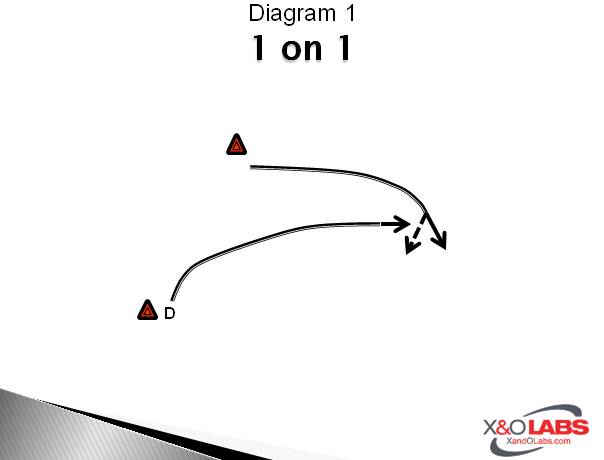
We use this drill in summer practice and the first day or so of two-a-days to introduce and solidify the back hip concept. The ball carrier is to take an outside path and at some point in time try to cutback across the face of the defender. The defender should pursue to the back hip and know that the ball carrier will cut back into his pursuit path. We conduct this drill at ½ to ¾ speed to really solidify the concept and focus on the following coaching points:

  • Initial steps should be directly at back hip and bend as the ball carrier turns upfield.
  • Do not get out in front of the ball carrier and run to a point in space where he might go.
  • Close the distance with the ball carrier as fast as possible.
  • Shimmy/breakdown under control as the ball carrier cuts back.
  • Never let the ball carrier cross your face.

To see video of this drill, click on the video below:

Read More

Game Planning the Red Zone

By Lazarus Morgan
Defensive Coordinator
Alfred University (NY)

With Adam Hovorka
X&O Labs Managing Editor


If you do not let the other team score, it is hard to lose the game. Sounds simple enough, right? Our defense wants to be the absolute best at not allowing points. Yards tell lies, so at Alfred University, we strive to be the best scoring defense in our conference every year.

In 2016, we had a great season: a 12-1 record, a run to the elite 8, and we finished number 1 in several defensive categories in the Empire 8 Conference. But, we were awful in the Red Zone. We gave up a TD approximately 70% of the time an offense would get into the red zone against us. Going into the 2017 season, I knew we had to get better in that area.

In 2017, we gave up a TD roughly 43% of the time an offense would get in the red zone; an improvement of nearly 30%. How did we do this? First, we changed the culture in the program regarding how we viewed the red zone. Then schematically, we simplified things so our athletes could play fast when the size of the field had become much smaller.

In changing the culture, the mentality of the defense now became that it did not matter what happened that allowed the offense to get to the Red Zone. We taught our players and trained them to block that out. Now it is all about holding the offense to a field goal attempt, or better yet, getting the ball back.

When an offense had a short field, in the past we would see some kids have that “here we go again mentality” that carried a very negative vibe and led to finger pointing. We changed that mentality, encouraging our players to be very excited because it was now an opportunity to show how great we are as a defense.  And they loved embracing that challenge.

This past season during a typical game preparation week, we practiced red zone defense three times a week. In this report, I will focus on how we play defense in the red zone from the 20 to 10 and the 10 to goal line, since for us those are two different defensive areas.

In the red zone, we do three things: we play a two-high coverage, a one-high coverage, and have a pressure package.


Two-High Coverage

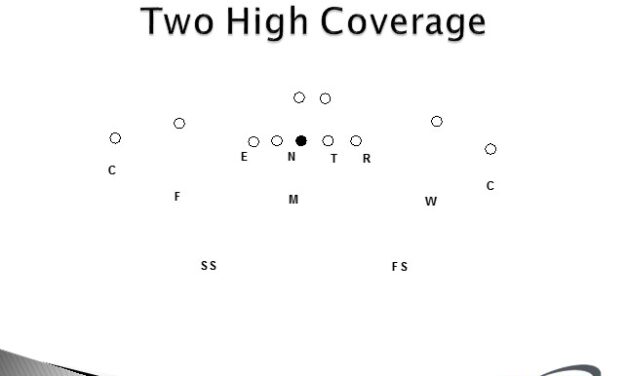
Everything we do for the most part as a defense in terms of coverage is from a two-high shell. Our two-high coverage is good for any type of 2×2 formation, or a pro or twins set. It allows us to commit nine players to the run game and gives us four defenders to play four verticals by the offense. Let’s start with the run first. Our coverages and our run fits are married together. In our defense, if you are the widest defender, you are a “force/fold” player, while all other players that are a part of the box are “fast” players. 
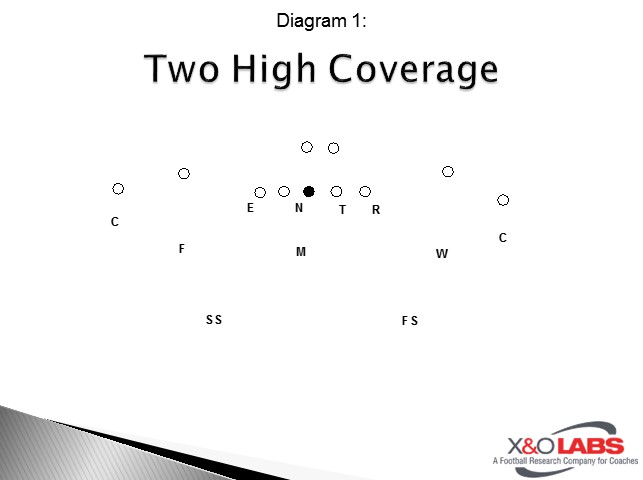
Diagram 1


In the diagram above, the force/fold players would be our Frank and our Will LBs. Their alignments will be predicated on the split of the WR in relation to the hash, the Frank LB will never get wider than the hash and the Will LB will never end up wider than the number 2 receiver if the ball is on hash. In our defense, “Force” simply means the ball coming to you, make the tackle. If you do not make the tackle, you must turn the ball back inside. We are a big leverage tackling team, so that tackle should be made with the players inside foot and inside shoulder forward. If the ball goes away, we want those players to take two shuffles with their shoulders square looking for the cutback. If the ball is not cutting back after they have taken their second shuffle, they pursue to the football.

Our fast players in the diagram are our Mike LB and our Safeties. Fast players in our defense take an inside out path to the football. We want those players to be on the inside hip of the ball carrier. The Mike can be aligned anywhere between a strong side 30 to a weak side 10 based on the tendencies of the team we are playing that week. The safeties align approximately 12 yards deep, 1-2 yards inside the number 2 receiver. If the number 2 receiver is a TE, then that safety will tighten to about 10 yards. Both safeties are keying the #2 receiver to their sides for a run pass/read. If they read pass, based on the defensive call, they could be covering the number 2 receiver man-to-man on any vertical climbing route or they could be playing a true quarters coverage. Our corners start in a press alignment. They will utilize a press-bail technique if we are playing true quarters coverage. When they press-bail, on the snap they will flip their hips open allowing them to read the QB as they drop straight back to their deep outside quarter. If they are pressing and playing man, they will not bail, as they have that number 1 receiver man-to-man, protecting the inside and forcing an outside release.

Read More

North Dakota University Competitive Tackling Scenarios

By Mike Kuchar
Senior Research Manager
X&O Labs
Twitter: @MikekKuchar


Introduction

The following research was conducted as part of X&O Labs special report on “Designing Tackling Systems” which can be accessed below:


Situational Tackling Scenarios:

One of the drill components that Coach Schmidt will use to teach tackling is what he calls “competitive tackling.” Done mainly in fall camp and in the spring, these types of drills pit best on best positionally to create competition. According to Coach Schmidt, it’s his best drill to teach leverage and it teaches them to make the different types of tackles. “One can be near shoulder, near leg while one can be a knife tackle,” he told us. “You can get a swipe tackle when one defender gets beat and the other one has to make a swipe tackle. This has been great for us because it’s competitive and you don’t get eleven on eleven where there is carnage everywhere. We post the wins and losses on the board in the meeting room so guys can see it. It’s a great way to evaluate who your best players in tackle.”

Read More

The 11 Most Effective Open Field Tackle Drills

By Mike Kuchar
Senior Research Manager
X&O Labs
Twitter: @MikekKuchar


Introduction

wiscWhile coaches have different perspectives on the correct techniques in open field tackling, we found one constant goal: do what you have to do to get the ball carrier on the ground. Usually, this comes in the form of closing space between the defender and the ball carrier, coming to balance before contact and understanding your leverage on the field as it pertains to other defenders and the sideline. We found the following common errors as it pertains to open field tackling:

  • Coming to balance to early on ball carrier: It seems that more coaches are using the term “come to balance” rather than the archaic “break down.” So many tackles are missed because defenders are not coming in with their eyes at ball level.
  • Losing leverage as a force defender: Whether it’s a squat corner, alley safety or apexed linebacker, these players are responsible for turning the ball into their help. In order to do this, they must be able to stay in a leveraged position to get the ball back to their help.
  • Overrunning the ball carrier when playing cutback: Another way in which defenders are missing tackles is by overrunning the ball carrier in the open field, providing him with cutback lanes that can gash the defense.

We presented the best way to fix these issues by producing what we felt were the eleven most effective open field tackling progressions complete with coaching points and video. We classified them into which of these problem areas they alleviate.

Editor’s Note: The following drills are cataloged in our drill film library. Insiders members can gain access to our entire drill and game film library, which contain more drills done by these programs.

Issue 1: Coming to Balance too Early on Ball Carrier

Regardless of whether you’re teaching the breakdown or shimmy before contact, a decision has to be made on when you start this technique. If you start this technique too early, you can give the ball carrier too much room to make a move and get by you. If you start this technique too early, the higher the chances are of not bringing your hips through contact, resulting in an arm tackle. These are the best drills we’ve found to reinforce this fundamental.

Read More

6 Drills to Teach Triple Option Mesh Mechanics

By Greg Webster
Offensive Coordinator
Springfield College (MA)
Twitter: @coachgregweb


At Springfield College, we utilize an under-center triple option offense. The foundation of our offense is the inside veer. To effectively run the inside veer, we must drill individual and team techniques numerous times. Through hundreds of repetitions, we look to build confidence in the execution of the offense so that when the play is called in a game, the players react rather than think. In order to build this confidence, we incorporate a drill progression that focuses on each individual aspect of the offense, with one drill building on the previous, working towards full team execution. The progression is as follows: quarterback footwork, mesh, ride/decide, pitches, and perimeter.


Drill 1: Quarterback Footwork

Diagram 1


The purpose of this drill is to work the quarterbacks’ footwork, hand placement, eye progression as well as cadence. Equipment needed for the drill: PVC pipe box and footballs (can also incorporate medicine balls as well as weighted footballs). Utilizing a two-foot-by-two-foot PVC pipe box we will have the quarterbacks start with their feet inside the box with the football in hand as if they are under center. One quarterback will start the cadence, with the rest following his lead, similar to a choir, in order to practice having each quarterback’s cadence sound identical. This is essential because all motions are predicated off the quarterback’s cadence. Once the quarterbacks simulate the snap they will execute a toe replace heel step so that the heel of their left foot (if running the play to the right) is in-line with the back-right corner of the PVC pipe box. The quarterbacks will freeze after their first two steps to ensure proper footwork, body position and eye placement. After the first two steps have been executed, the coach can add the entire phase of the mesh, so that it simulates the QB replacing the dive key’s heels and attacking the alley. Also, a visual key can be added to train the QB’s eyes by having a coach or player stand in the place of the dive key. On the snap, the coach or player will hold up a number with their fingers which will have to be read aloud by the QB. This helps to train the QBs eyes to be on the dive key every time. Important coaching points; pigeon toe the feet, mental weight on drive foot, hands beat the feet, pin the chin, eyes to the dive key, Z’s in the hips, knees and ankles.

To study drill film of this technique, click on the video below:

Read More

Building Player Accountability in Weekly Game Planning

By Rob Everett
Defensive Coordinator
Bridgewater College (VA)
Twitter: @NineintheBox


A consistent game planning process is the foundation of a successful practice week and leads to achievement on game day. Each part of the week, on and off the field, should be familiar for the players and coaches in order to reduce anxiety of the unknown, which allows all involved to focus on the opponent.

Using the free simulation GoArmy Edge technology, coaches are able to interact with each other and their teams in a controllable and accessible environment. Game plan installations and assessment of understanding is now taken to the players on their own time and in their own space. This allows instruction to occur at the frequency, pace, and setting each individual player needs.

In this report, we will outline how the GoArmy Edge football simulation program will streamline your coaches game plan process and enhance your teams understanding and accountability. We now have the ability to recreate the practice field in detail from the jerseys your team wears, to the view your players see. 


Part 1: Organization of Installations and Scouting Reports

Installation efficiency and clarity is required for the players to reach their full potential on the field. Most of the players do not see the backs of their teachers writing on a chalkboard in their classrooms, so the football classroom should emulate that experience. At Bridgewater College, we use the flipped coaching model of instruction to give the players the information they need in advance, in order to maximize the face to face time we get in meeting rooms and the practice field.

Using the GoArmy Edge technology, our scout reports and installations are sent out in advance containing the important tendency numbers of our opponent, as well as how we will align and move based on these numbers. What makes this vehicle unique to the traditional paper report and diagrams, is the players have the ability to interact with the plays, from the view from their own helmet. Defensively, we talk about fitting properly with the players in front, beside, and behind the players, and this tool allows them to see it first person. In addition, they are able to see it as many times as they need to. Think about how many times you have a player who has all the ability but could never grasp the game plan. Maybe they needed a different form or frequency of instruction. Using simulation and flipped coaching, these players have the tools to absorb the knowledge on their own time. 

The exact content of each installation varies on the opponent, but each contains at least:

  • Alignment of fronts based on formation (including backfield set and field zone)
  • Full fits of top plays (frequency and production)
  • Synthesized recap of important numbers and tendencies

Read More

9-Technique Play vs. Run Schemes

By Mike Kuchar

Senior Research Manager

X&O Labs


Researchers’ Note: You can access the raw data of this report – in the form of graphs – by clicking here to read: 9-Technique Statistical Analysis Report.


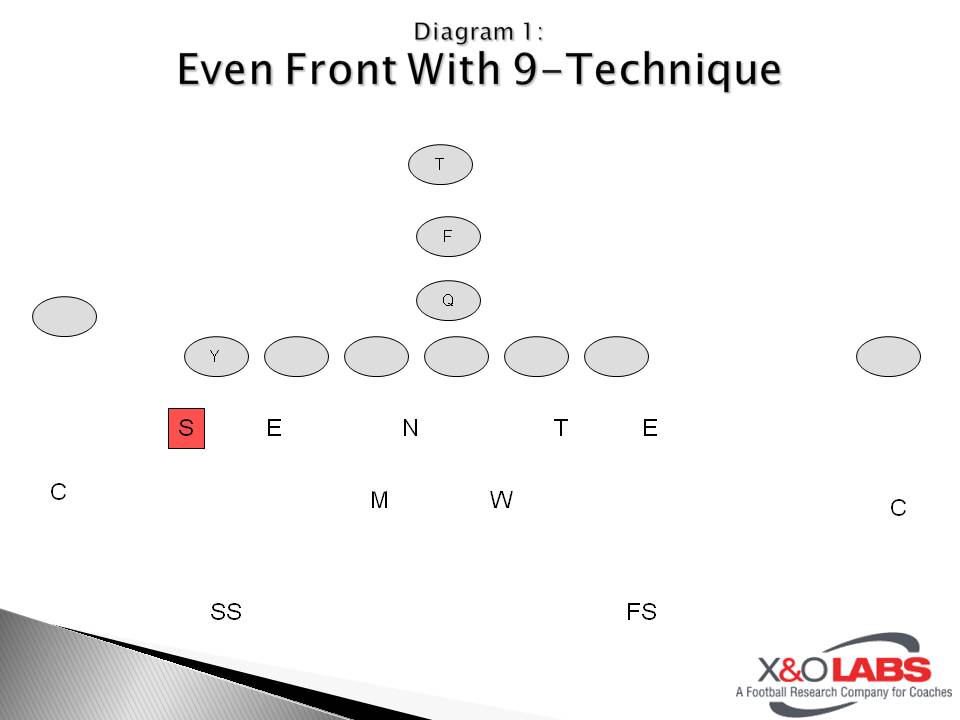
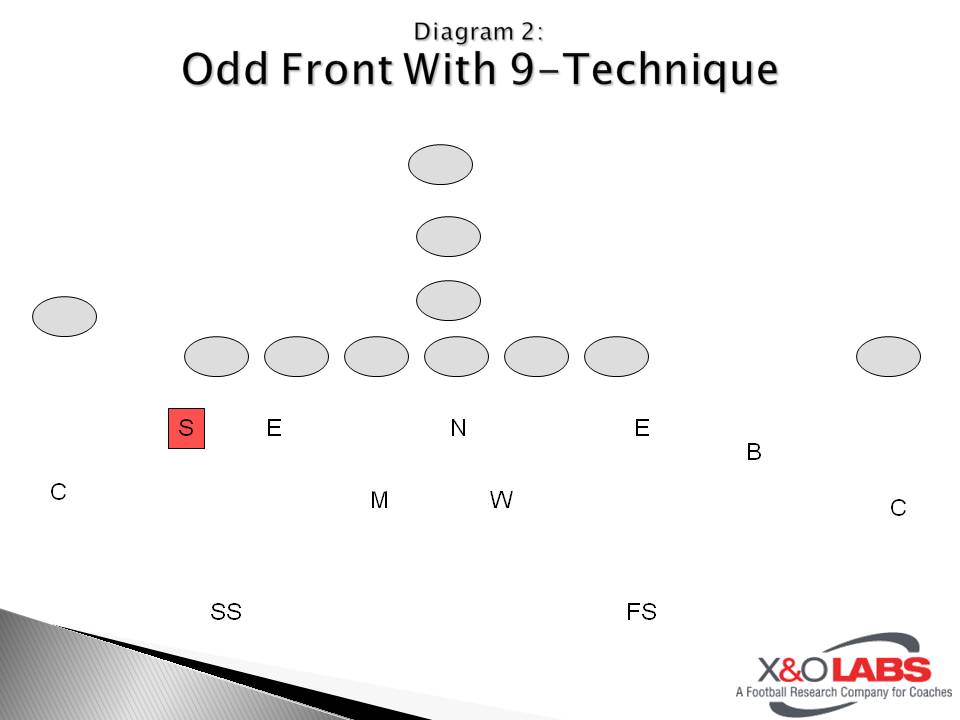
This report will focus on our research findings regarding the play of the 9-techinque defender.  What we’re calling a 9-technique defender is the player that lines up on the outside tip of the tight end or three-man surface.  While we realize this player can be a defensive lineman, we chose to detail the linebacker technique exclusively. This week our focus will be on how coaches train their 9-technique LB’s to play various blocking schemes.  These are the main defensive structure’s we will focus on for the report:

  • Even Front: Mainly an Under or Eagle defense with a walk-up outside linebacker playing the 9-techinque (Diagram 1)
  • Odd Front: a 3-4, 3-3, or 5-0 structure with an outside linebacker playing the 9-technique (Diagram 2)

It’s important to note that the 9-technique survey generated the most responses that we’ve ever had at X&O Labs with 2,457 high school and college coaches completing the survey. When we get responses like that, not only does it prove the validity of the responses, but also provides for a broader spectrum of coaches to share their knowledge.  We appreciate your feedback and hope that you’ll continue to be active participants of these surveys.

Before we get into the specifics of what we found, we thought we’d share some interesting statistics based on the survey.

  • 50.6 percent of coaches will use a 9-tehnique defender any time there is a three-man surface present, regardless of the front structure. Just goes to show how important it is to put immediate pressure on the tight end.  You don’t need X&O Labs to tell you that most run schemes are three-man surface oriented.  The presence of the 9-technique puts a first level player in the D gap for immediate force of the football.
  • 57.8 percent of coaches will use a traditional defensive lineman type IN THE EVEN FRONT to play the 9-technique, more so than an outside linebacker type. The teams that do use a linebacker to play the 9-technique will be more of an Eagle or Under front by nature thus making a five-man front.  It’s not as common to see a four down front with a 9-technique defender.  Teams that run a four-down structure will mainly utilize a 7-technique defender.  But, for now, we’ll focus on the 9-technique. 
  • 63.3 percent of coaches will use an outside linebacker type in THE ODD FRONT to play the 9-technique, more so than a defensive lineman type. We didn’t find this surprising, but what we did find interesting was the fact that these same coaches will spend more time training this defender to rush the pass than anything else.  It’s something we’ll detail in next week’s report.
  • 54.4 percent of 9-technique linebackers work with the DL in practice, while 45.6 percent work with the LB’s. This surprised us.  While we knew it wasn’t uncommon for these types of perimeter linebackers to get work with the defensive line, we certainly didn’t think it would be in the majority.  In fact, most coaches that utilize a 9-technique linebacker train him to use the same fundamentals that a defensive lineman would in the run game.   The only thing that separates their job description to that of a defensive lineman is the linebacker’s responsibility to cover receivers.  At least we thought, until we found that 67.1 percent of coaches will not even use that player in coverage schemes, he will rush the passer.  But again, a topic to be covered next week.

Case 1: Variations of Stance and Alignment

We’ve found that deciding between a two-point and a three-point stance is relative to whether your 9-technique is a defensive lineman in nature or a linebacker.  Today, we’ll focus on that player being a linebacker.

We’ve found that the stance of the 9-technique linebacker will vary based on the support structure of your defense.  If that 9-technique is the primary force player, he will use more of a tilted stance in order to maintain leverage on the perimeter.  Conversely, if that player is not a force player, his shoulders may be more square to the line of scrimmage.

Regardless of what responsibility the 9-technique defender, we’ve found that 58.1 percent of coaches teach the inside foot up in the stance.  This ensures a quicker read on the player’s visual key, who is mainly the tight end.  As it pertains to horizontal alignment, 46.4 percent of coaches will have their 9-technique split the crotch of the tight end, while 40.5 percent will play with their  inside foot further than outside foot of tight end in a wide alignment.  While it seems like coaches are split on this matter, Mike Eddy, the head coach at Gallia Academy High School (OH) doesn’t do either.  He has his outside linebacker line up in what he calls an “ability alignment.” 

“If the 9-tech is a better athlete we use a tight alignment of inside eye to outside eye,” says Eddy.  “If they are close to ability we align shoulder pad to shoulder pad.  If the TE is the better athlete, we align even wider at the tip of pad to tip of pad.  We align as wide as needed to defeat a possible reach block while still being able to squeeze a down block and keep the tight end off our inside defender.  Stance is slightly staggered with inside foot toe to instep.  This allows him to balance his step when he executes his read step on the offense’s initial movement.”

Read More

Backside B-Gap Block Fundamentals in Zone Runs

By Ben Luther
Offensive Line Coach
Tusculum University (TN)
Twitter: @Coach_Luther


First and foremost, I would like to thank Jerry Odom and Brian Ferguson for giving me the opportunity to coach the offensive line at Tusculum University and also to thank X&O Labs for allowing me to discuss how we at Tusculum University teach and execute combinations on the backside of our tight & mid-zone schemes. The combination, in particular, that we would like to discuss, is the backside “B-block” and drills to help reinforce the fundamentals to achieve the desired outcome. The “B-block” occurs when we run our zone scheme to the inside playing tackle (shade / 1 technique) on the front side, and there is an outside playing tackle (3-technique) on the backside guard, which is your traditional under front look. At Tusculum, we spend a lot of time in our individual periods on combo blocks and believe in emphasizing the details of individual skills in a part-part-whole teaching sequence to achieve a desired outcome on all of our combo blocks.


General Info & Key Points

Before hitting the field and introducing drills and fundamentals of the “B-Block,” there are a couple of key points that must be covered and understood in the meeting room.

  • Our general zone philosophy
    • In our zone schemes, the offensive line is responsible for moving the down lineman, and the running back is responsible for moving the linebackers.
  • What type zone scheme are we running? (tight vs mid zone)
    • The OL must understand the types and difference of each zone scheme that is being called. They must understand the goal and what the running back’s aiming point is for each type of zone.
      • Tight zone aiming point: RB = Play side leg of the center.
      • Mid zone aiming point: RB = Play side leg of the guard.
    • The importance of understanding these components will help the OL predict what type of Linebacker flow could occur, which will dictate how much time we can spend on the double team.
  • Linebacker Location
    • One of my mentors taught me, “Linebackers are like real estate. It’s all about location.” As an offensive lineman, knowing Linebacker location is crucial. The location of the Linebacker allows the offensive lineman to:
      • Determine defensive gap responsibility.
      • Set the correct angle of the play side hip and eyes, make appropriate calls based on if the linebacker is.
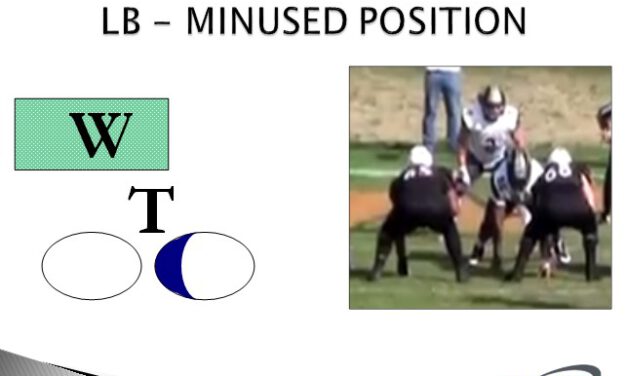
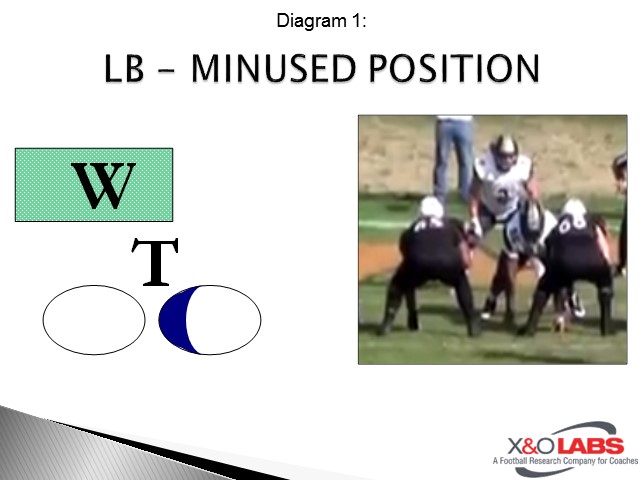
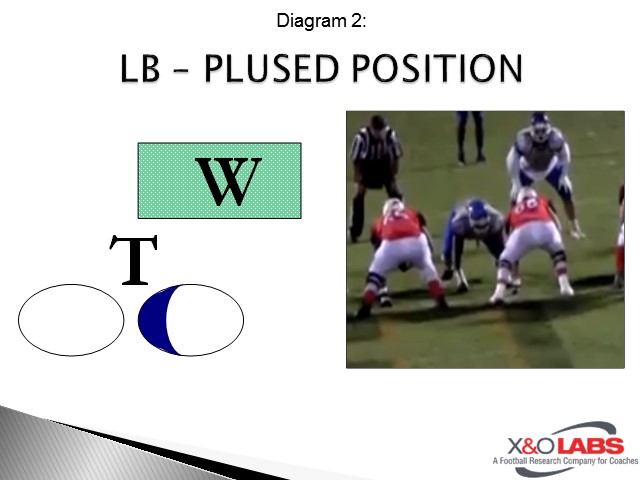
        • Plussed alignment- LB is lined up on the front side of the 3-technique)
          • Will make a “Quick” Call
        • Minused alignment- LB is lined up on the backside of the 3- technique)

Diagram 1
Diagram 2

  • The Components of the “B-block”
    • The Post player: In the “B-block,” the post player will be the backside guard. The post players job is to step with his play side foot & stand up the defensive lineman.
    • The drive player: In the “B-block,” the drive player will be the backside tackle. The drive player’s job is to deliver force and continue driving into the defensive lineman, helping create vertical movement.


The Rules of the “B-Block”

The General rules of the “B-block” are that we never leave a down lineman to chase a linebacker. As the offensive line, we are responsible for creating vertical movement at the point of attack and for securing the first level before we come off to a linebacker when he flows. We will not come off until he unstacks or threatens our front side gap.  Next, if the 3-technique slants across our face, we must collect and two-hand overtake with a strong play side hand, and the adjacent offensive lineman will foot fire up to the declared Linebacker. Lastly, when a linebacker flows and come off we must understand where we are trying to run the football.


The Components & Fundamentals of the “B-Block”

In the “B-block,” the backside guard, who is covered by the 3-technique, is responsible for lifting (posting) the down lineman.  Whereas the uncovered backside tackle is the drive player. He is responsible for delivering force into the down lineman and to continue driving into him to help create vertical movement. Both the post and drive player will use different techniques depending upon linebacker location.

Read More

Five Solutions to Run the Ball vs. Loaded Boxes

By Casey Miller
Offensive Coordinator
Herriman High School (UT)
Twitter: @cqmiller4


Introduction:

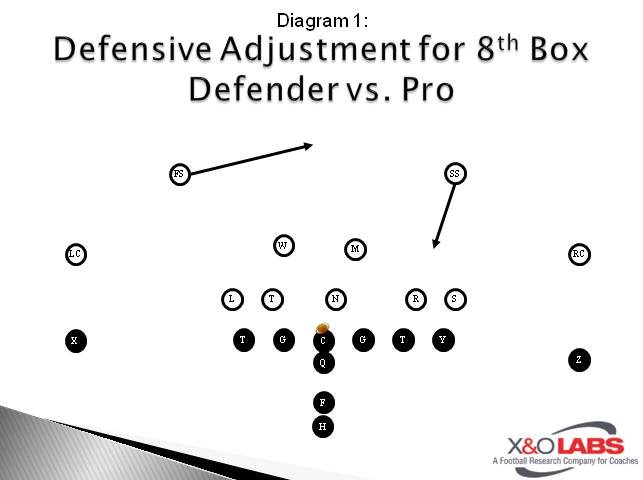
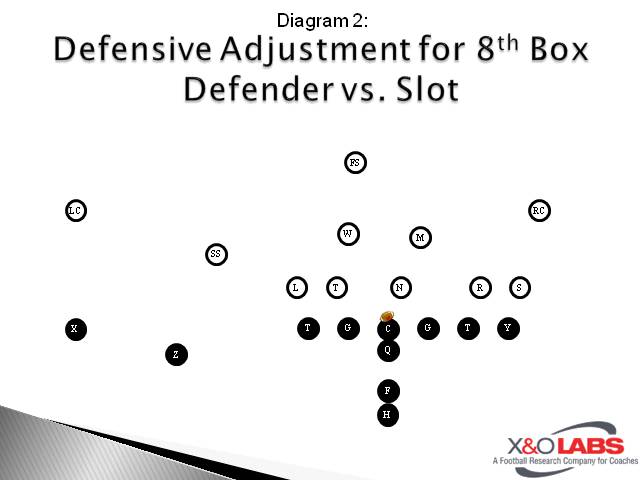
In any run-oriented offense, defenses will load the box with an 8th defender to help stop the run game. There are a few offensive strategies you can utilize to combat this defensive tactic and still be able to stick to your offensive philosophy of being a physical running team. There are five ways we try to do this, and we always build them into the gameplan at Herriman High School. Depending on what the defensive coordinator does to adjust to our base run game, we can move to any of them at any point in the game to counter-adjust.

Loaded Box Solution #1: Remove the 8th Defender from the Box

Most teams who face a run-heavy team will drop a safety down into the box to get an 8th defender in the box. For any stack-defenses (3-3-5, 3-5-3, 4-2-5, 4-4), it usually means the overhangs come up and play really tight, or they come all the way up on the line of scrimmage and come off the edge. For traditional 4-3 and 3-4 teams, this is usually dropping the “strong safety” down into the box on the multiple receiver side. By using formations with both WRs on the same side, most teams will put the strong safety on the side with both WRs, and he will have to leave the box to account for the slot receiver. In the box, this keeps the offense with the same run formation they always have, but it removes the 8th defender from the box because he has to widen out to the 2-WR side to continue to play zone coverage. You have now turned the 8 man box into a 7 man box, or at the very least, you are now running the ball at a corner that now has to be the primary run support on the TE side.

Slide1Slide2

To study game film on how Coach Miller removes the 8th defender from the box, click on the video below:

Editor’s Note: Coach Miller provides the following coaching points for each of the following clips below:

Vid #01 – Remove Defender

  • 1st Play = This is a 3-4 team that rolled their strong safety (#41) down into the box if the offense lined up in a pro formation. If the offense lines up in a slot formation, the SS moves to the weakside and must APEX out of the box leaving a 7-man box to defend the run. We wanted to run power to the TE side this week, so we were able to remove the extra box defender by lining up in a slot formation.
  • 2nd Play = This is against the same opponent as the previous play. We run Iso on this one, but it gives an example of how we give our running back a 2-way-go with our backside blocking. The weakside guard and tackle both block out and the double-team on the nose will stay on the nose if the backside LB goes over the top. If the RB sees the FB is going to get the outside shoulder of the Iso-LB, he stays to the playside and the backside LB can’t get to him because of the FB block. If the Iso-LB keeps his outside-arm-free, the RB will cut into the A-gap not occupied by the backside LB. If the LB gets to the playside, the RB will cut off the backside of the double team, but if the LB stays backside, the RB will just hit the playside A-gap and get to the 3rd level of the defense. On this particular play, the FB gets the outside shoulder so the back stays on the playside and picks up about 10 yards.
  • 3rd Play = This is a 4-3 team that would get their quarters safeties close to the LOS vs. a pro formation, but in a slot formation with the threat of 2 vertical routes to the same side, they would back the safety to that side off the ball. This gave us an opportunity to run the ball to the weakside away from their run defenders on the TE side.
  • 4th Play = This is the same opponent as the previous play. We caught their LBs filling inside very quickly so we removed the safety from the box and ran stretch back to the slot side.
  • 5th Play = This is our rival school that plays a 3-4 and has coverage-rules based on the offensive formation. Slot formation will again move their strong safety over to the slot side, which allows us to run back to the TE side without a force player to help the box-defenders until the FS. The corner and FS end up combining to bring down the RB, but it is 10 yards downfield. Just as the Iso play earlier, the back knows the FB will get the playside shoulder of the LB so he stays to the playside and hits the hole.
  • 6th Play = Same concept and same play as the clip before. We ran this play from this formation over 20 times in the 2nd half in this game. Turned a 3-point deficit at half into a large margin of victory by the end of the game
  • 7th Play = Same team, same concept, but this time the back sees the FB isn’t going to seal the Iso-LB, so he cuts back to the backside and slips thru the gap opened up backside.
  • 8th Play = Same team, same concept, but this time we ran it to the TE side because the defense had adjusted their defense to prevent us from running the weakside Iso play. Back knows the seal will happen, so he just stays playside and he has no force until he hits 3rd level
  • 9th Play = We get caught running this play to the side the defense has their extra defender to the playside, but the RB recognizes presnap that there is no backside LB, so he is going to cut backside the entire way. The force filling outside-in never has a chance to get there so we end up with a big gain.
  • 10th Play = In our 2nd round playoff game, we faced a 4-4 team that had 8 in the box

Read More

Attacking Protections Using Odd Front Pressures

By Wallie Kuchinski

Defensive Coordinator

University of St. Thomas (MN)


Editor’s Note:  St. Thomas University is coming straight off a 14-1 record and was a Division 3 national championship runner up and the Tommie defense was a big reason why Kuchinski’s defense yielded a mere 15 ppg this season and was ranked 15th in the country in scoring defense.  Kuchinski has developed a reputation for developing dominant defenses in his five years with the Tommies, which earned him the 2011 footballscoop.com award as the top Defensive Coordinator of the year. 

Please note:  The following report is written solely about attacking protections, therefore the coverage component of these pressures is not stressed.   It is centered only around the players involved in the blitz, not in coverage. For all intents in purposes, each of these pressures are covered with a three under, three deep principle. 

There are multiple successful units used in football  throughout the years. Whether we are talking about the Miami Hurricanes in the ‘80s using their dominant 4-3 cover 2 package or the old 4-6 fronts used by the Chicago Bears and Buddy Ryan in the ‘80s.  Dominant units have evolved over the past three decades just as fast as offenses have evolved. We are now seeing 3-3 Stack defenses put their stamp on history as well as the dominant 4-2-5 units TCU and others have been running for the past few years.  Meanwhile, 4-4 units have been having a high level of success in high school for years as well.

I’ve always thought if your scheme is sound and you get your players to buy in to your system, any form of defense can be successful. I am biased however and truly believe the 3-4 Okie defense is a superior scheme for a lot of reasons. At the University of St. Thomas we have implemented the 3-4 multiple pressure front for the past 4 seasons when our staff arrived in 2008. We have shared much success both in defending the run game and pressuring the passer the past few seasons. Statistically we have ranked at or near the top in the country in multiple statistical categories. Not limiting to scoring defense, rush defense, 3rd down percentage, 1st downs gained, sacks, tackles for loss, takeaways, pass defense efficiency, and red zone defense.

Let’s face it…we coach in a pass driven game these days and while our staff is committed to stopping the run with proficiency, affecting the passer is paramount in establishing a dominant unit. We have some impressive offensive minds at St. Thomas. If our head coach Glenn Caruso got on the white board and asked me how are you going to defend this pass concept vs. Cover 3 or how are you going to defend this pass concept vs. Cover 2 I’m not going to have some great answers. I played defensive end in high school and college. I am smart enough to know, however, that if you give the QB more than 3 seconds to throw the football consistently it doesn’t matter whether the kid plays high school, D3, D1 or in the NFL he’s probably going to complete that pass. Instead of dreaming up different ways to cover all these crazy route concepts our staff instead focuses on attacking different protections with our zone blitz concepts to get players coming free at the QB.

At the University of St. Thomas we have been employing multiple zone blitz concepts that attack protections out of our base 3 man front. While it’s difficult to find an offensive coordinator out there that is willing to take the flats for 5 yards all the way down the field, I would contest it’s equally difficult to find a good zone blitz defensive coordinator to pair his package down to a few pressures.  After our staff determines what we need to use to stop the run effectively and get our opponent in a one dimensional passing situation we need to determine what type of protections they are using. As a 3-4 there are a few different 3 step, 5 step, and play action protections we see on a regular basis. Our staff categorizes protections as Full Slide, Insert (half slide, half man), Man, 7 man protection, and Rollout. We do categorize rollout in 3 sub-categories such as: Sprintout, Boot (naked), and Waggle (usually an uncovered puller). For purposes of this article we will focus primarily on insert, man, and sprint out as those are the ones we see the most.  Nonetheless, in this article, I present 5 zone blitz concepts that attack various protections I feel everyone should take a look at.  But before we address the different types of pressures, it’s important that I define some “buzz words” we using in our pressure terminology.

Blitz Concept Buzz Words

Stab rusher-In a wide 5 tech a Stab Rusher is a vertical speed until he gets near even with the QB. He then transitions into Power (screws of his facemask under the chin of the OL) extends his arms to lockout and collapse the pocket, slipping inside or outside based on where the QB flushes.

Bull and Pull– Nose cheats his alignment to a slight shade (between crotch and foot of Center). The Nose takes a vertical step and bull rushes the Center and physically pulls him away from the pressure for a 2 count. His responsibility is not to let the Center get to the pressure side. After a 2 count (so he doesn’t get called for holding) the Nose finds his way to the facemask of the QB on his pass rush.

Read More