Training the Modern Day TE in 11/12 Personnel Offensive Systems – Case 4: Pass Game Responsibility – Protections and Routes

By Mike Kuchar 
Senior Research Manager 
X&O Labs 
Twitter: @MikekKuchar 


Introduction

There is no sense having a tight end on field if he can’t be a threat in the pass game. If that’s the case, you might as well bring in an extra offensive Tackle. It is Texas’ philosophy to have a tight end that cannot only pass protect but be a viable threat in the passing game. Because his offense is a downhill A/B gap system, much of Coach Tom Herman’s pass game is based on play-action concepts that complement these runs. Remember, this system produced three NFL caliber tight ends in James Casey (Rice), Collin Franklin (Iowa State) and Jeff Heuerman (Ohio State) all of which had the ability to not only pass protect but also catch footballs. And there is no better run/pass disguise to the defense than keeping this player on the field. It’s one of the goals of co- offensive coordinator Tim Beck who told us he’d like his tight ends to be on the field more than 80 percent of snaps this coming season, that includes third and long.

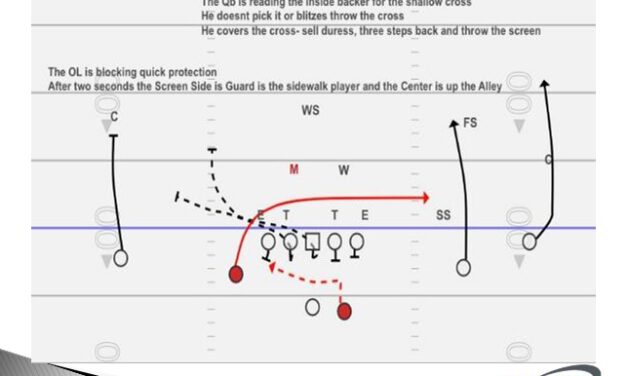
In this case, we are going to present our research on the main protections in Texas’ system and the tight end’s responsibility in those protections. We are also going to uncover the main routes in this system, particularly the ones that the tight end is expected to know.

Editor’s Note: Many of the nearly 200 football play diagrams in this report were drawn by FirstDown PlayBook, a digital football playbook website that has over 33,000 football plays all drawn by coaches with NFL backgrounds. For more information on this product, go here:  http://blog.firstdownplaybook.com/editing-tool

Just as footwork is put at a premium in the run game, it’s also stressed in the pass game. Although Coach Warehime doesn’t have the amount of time devoted to pass protection as the rest of the offensive line does, he focuses his teaching on some core drills in pass protection. There are the EDD pass protection drills he will work his tight ends through:

Demeanor Drill-This is more of a demeanor drill that emphasis leverage, and keeping feet under the body. It’s essential fundamentals in working against bigger offensive linemen.

To study drill film of this technique, click on the link below:

Read More

Training the Modern Day TE in 11/12 Personnel Offensive Systems – Bonus Case: 3-Day Installation and Practice Model for Game Week (NCAA and H.S. Source)

By Mike Kuchar 
Senior Research Manager 
X&O Labs 
Twitter: @MikekKuchar 


Introduction

It’s no secret that one of the biggest obstacles in developing the versatile tight end in an 11 or 12 personnel system is time. This player is entrusted with learning a great deal of information in a small time period. His time is torn between working with offensive linemen in the run game and pass protection only to be tossed over to the receivers for route progression work. It’s a daily carousel that must be honed in an organized fashion so that these players are prepared to accomplish everything that they are asked to.

At an FBS level program like Texas with ten paid assistant coaches on staff, one might not think this to be a problem. But according to Longhorns tight ends coach Derek Warehime it’s an issue he has to deal with daily. Because he’s only given 25 minutes during game week and can’t steal time from special team segments (tight ends are involved), he must be creative in how to add time to get done what he needs to. So, in this case we wanted to provide whatever coaches with a formulized plan on how to accomplish everything they need to, including drill work. We’ve even enlisted the help of a high school program that runs a similar system, Waverly High School (OH), and offensive line coach Jacob Knight who will spend a good deal of time working with this player during game weeks.

For a frame of reference, Waverly High School is a district with about 220 boys at the high school, 55 of who are football players aged 9-12. This past season their player was much more of a fullback than a tight end, so they spent a lot more time with him in the run game than pass game. According to Coach Knight, this season’s model is a converted wide receiver so he anticipates more of a 50/50 balance with run and pass to him. “Because of this you have to have a coach that is dedicated to this position and for us this guy is our tight ends coach/Special Teams coordinator Daniel Sand,” said Coach Knight. “For us knowing we have to balance this player we felt it was ultra important to have a coach dedicated solely to this position.” 

Our research is segmented into a three-day work schedule during game weeks. In most college design, Sunday is day one (players are off Monday), Tuesday and day two and Wednesday is day three. By the time Thursday rolls around it’s travel time for away games or more times spent in walk through. At the high school level, Tuesday is day one, Wednesday is day two and Thursday is day three.

Day 1 Schedule

UT Model

For Texas this is a general drill workday with 25 minutes of pure individual time. This time consists of hand placement, insert reads and basic rules. Coach Warehime will also mix in some pass protection drill work and whatever “game corrections” he needs to go over from the previous game.

Waverly High School Model

Monday is a big workday for Waverly. The tight end work is broken down into the following segments:

2 Minutes Stance Segment

On line of scrimmage off the line of scrimmage and split out as slot.  

6 Minutes Kick Out Progression

Tight end will start on a line, and the coach will give them a verbal cue to take their first drive (step). Tight end then works his first and second drive step with emphasis on getting on their proper kick out angle for power schemes.

10 Minutes Routes on Air

Tight Ends are working on running their routes appropriately as they fit into route concepts.

Read More

Streamlining Gap Scheme Teaching with the Spot Method

Matt Drinkall
Head Coach
Kansas Wesleyan University (KS)
Twitter: @DrinkallKWU


Introduction

Every offense is looking for effective and efficient ways to run the ball. A good gap system is a tremendous concept to carry because it facilities an offensive system in many ways. This report will detail the value and details of carrying a gap series, our base gap concepts, variations, and complimentary plays.

Why Gap Runs?

Our gap system is one of the most critical components to our offense. The reason I have chosen this package to detail in this article is because I believe any offense can incorporate this series and benefit from it. My favorite aspect of this play series is it is completely quantifiable. Each component of the play has easy measurements to determine correct vs incorrect. Our gap system facilitates an offense in a number of different ways:

  • Multiple personnel groups
  • Multiple formations
  • Easy to shift & motion to
  • Flexible to personnel
  • Fits most down & distance
  • Useful in any field zone
  • Excellent against movement
  • Easy to add variation to scheme
  • Outstanding for complimentary plays

Unique Teaching System

We have come up with a simple and all-encompassing way to teach our gap system to our players. I have coached in multiple systems and this is, far and away, the most effective and efficient means of communication and learning style. Our communication system totally simplifies assignments and removes the need for defensive recognition. Our system utilizes one-word assignments and teaches defensive alignment by theory. By coaching the system our way, we have built-in answers for any front we face. It has helped the most against 3-4 defenses that pressure and replace by dropping safeties into the box. It is an airtight, clean; concise manner of teaching that I am certain will be beneficial to your program.

Base Gap Terms

We have developed an outstanding teaching system that allows our gap system to operate seamlessly between plays, players, and defensive fronts. We have developed a unique terminology system that has made a gigantic impact on the effectiveness of our Gap plays. The most important aspect of our gap system is learning the terminology in our teaching, and then the play defines assignments. 

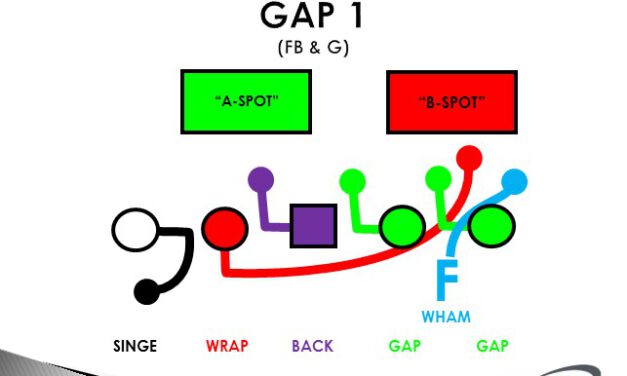
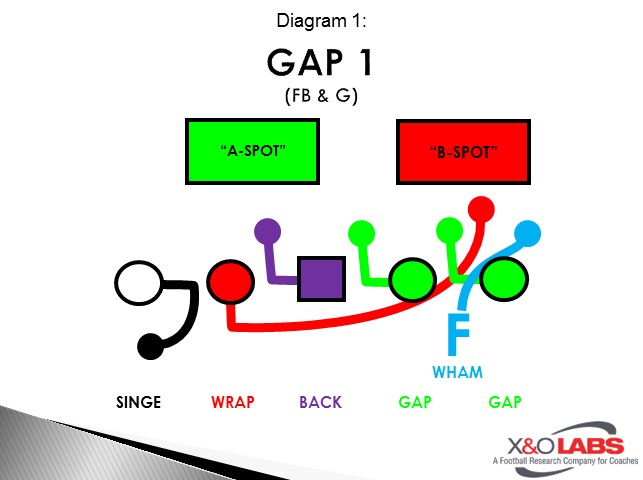
  • A-Spot: first level-two defender head-up, to back-side the center
  • B-Spot: first level-two defender play-side of the center
  • Wham: the block on the play-side C-gap defender
  • Wrap: back-side player working up B-Spot

The play side three offensive linemen always have the same assignments. Our play series determines which player is the Wham and which player is the Wrap.

Gap 1

Gap 1 is the first play of our three-play gap series. Gap 1 uses the FB as the Wham and the BSG as the Wrap. It is commonly referred to as the Power Play.

Slide1

Blocking assignments are as follows:

PST: Gap to A-Spot

PSG: Gap to A-Spot

C: Back

BSG: Wrap to B-Spot

BST: Singe

FB: Wham

Gap 2

Read More

Rip/Liz Match Coverage to Defend RPOs

By P.J. Gibbs
Defensive Coordinator/DB Coach
Gulf Coast High School (FL)
Twitter: @coachpjgibbs


Introduction

The RPO and the spread offense is constantly evolving. Defenses have to adapt and find different ways to attack the RPO and give the QB’s and their OC’s different looks and reads. As a defense, you need to adapt to your personnel and what type of pressures work best for you with your players. In this report, we will look at different coverages and pressures that have been effective for us at Gulf Coast in the past two seasons.

Match Coverage vs. RPO’s

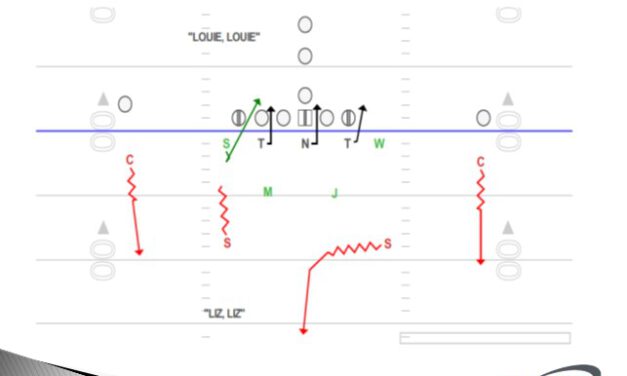
We employ multiple coverages against the RPO’s that are common here in southwest Florida but the first coverage, and the most efficient, that we teach is Match Coverage. We use Rip/Liz Match to defend RPO’s because it confuses the QB’s RPO Read. We must force the QB to hand the ball off and not have the option to pass. That is why we always start in a 2-high to give an illusion of open middle of the field and uncovered slot. It is imperative to drill your secondary into being disciplined and become great open-field tacklers in this defense scheme because the QB may throw the ball anyway. Your secondary needs to understand landmarks and angles to ensure the defense is played correctly.

Slide1

Pattern Match Cover 3 can turn into man coverage based upon the releases of the receivers. There are many benefits to matching routes post-snap after the pattern distribution. The first benefit is that it allows you to take the “air” out of the zones. The zones are no longer based upon areas on the field, but are now based upon the pattern distribution and the receivers releases and spacing on the field. No longer are defenders “spot” dropping and covering areas. They are playing tight coverage on the receiver in their zone. It forces the QB to be more accurate and precise with his throws.

Benefits of Playing Match Coverage vs. RPO’s

  • Allows defenders to contest balls through receivers’ hands
  • Gives answers to all different route patterns
  • Allows a defense to handle vertical routes with a single high safety coverage structure

This is a split safety coverage that is pattern matching what routes the offense runs at you in a game. Since we are a 4-2-5, we play with a Viper, who is our hybrid player, he can play the run as well as cover a slot or a tight end. If we see 10 personnel in match, we will send the Viper to the passing strength, which generally is our defensive left, due to a right-handed QB. If the QB you’re facing is a lefty, then send him to the defensive right. Our two linebackers will be in “30” techniques, with the Viper will be head up to inside leverage on the #2 receiver. The Corners will be 1×5 outside leverage, pre-snap, they will then slide to a head up technique on the snap. The Safeties will be at 10 yards on the Hash, pre-snap. Our two Safeties will make a “Rip” or “Liz” call depending where the Viper is against 10 personnel. If the Viper is to our defensive left, we will then make a “Rip” Call, meaning on the snap the right safety will come down to LB depth over the #2 Receiver.

Read More

Vertical-Dig Concept: Attacking M.F.O. Coverages

By Josiah Sears
Former Offensive Coordinator/Quarterback Coach
Wheaton College (IL)
Twitter: @CoachJSears

Introduction:

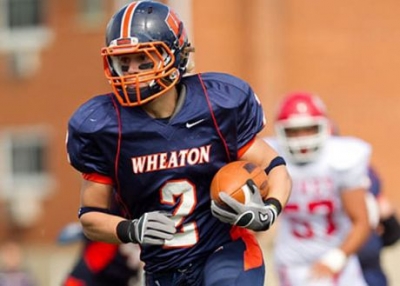
wheatonThe vertical dig concept has been a staple of our offense here at Wheaton for a few years. This is a concept we now generally use from a 3×1 formation, but can also fit in a 2×2 set. This article will discuss how we install the concept by talking about each individual route, the QBs pre-snap thought process and post-snap progression and some basic progressions and variations to the concept.

There are several reasons we use this drop back passing concept at Wheaton College. First and foremost, we feel there is a great opportunity to attack the middle of the field if a defense chooses to play open coverage versus our 3×1 formations. We also believe there is a great opportunity to stress the middle and outside linebacker to the 3 receiver side based on the responsibilities in most open coverages. Lastly, it creates a difficult scenario where a defense must commit to defending our single receiver side with two defenders or risk giving up an easy throw and catch to our best receiver.

Route Descriptions by Position

Slide1

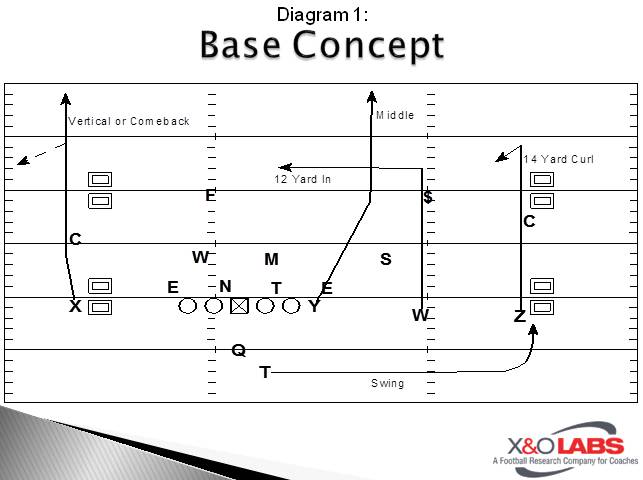
X – Vertical or Comeback Route.

This route is coached to be an outside release on the cornerback with the goal of beating him deep. The receiver must determine by a depth of 10 yards as to whether he is going to be able to beat the corner deep or not. If the receiver does not think he can win deep, he will plant on his inside foot at 14 yards and work back to the sideline with an aiming point of 12 yards. On his release, the receiver must be aware of the sideline and remain 5 yards or more away from it at all times. This allows him room to adjust to a wide ball from the QB if he runs vertical or room to work away from the corner if he runs a comeback. His sideline spacing is vital to ensuring he has room to catch the ball when thrown in his direction.

Y – Middle Route.

This route is designed to occupy the middle of the field versus open coverage defenses. The receiver is coached to attack the inside hip of the field safety ($) and run vertical to his inside. I believe teaching a receiver to simply run down the middle of the field can lead to involvement from the backside safety (F) and make the throwing window smaller for the QB. Whereas, teaching the receiver to attack the field safety ($) gives the QB the ability to lead the receiver away from the field safety with more space to complete the pass before the backside safety (F) can get involved.
W – 12 Yard In Route. This route is self-descriptive. The receiver is taught to push vertical to a depth of 12 yards and the put his outside foot in the ground there. He will then make a square cut to the inside and work into an open window. The 12 yard depth of the route is important in relation to the QB’s progression and timing.

Read More

Teaching Same Side Footwork For RBs in Gap Runs

By Mike Kuchar
Senior Research Manager
X&O Labs
Twitter: @MikekKuchar


Introduction

The location of the offset back in the run game can be a viable tell for defensive game planning. In many situations, defenses can access the location of the run by his depth off the line of scrimmage and his width from the quarterback.  This is why so many pressures are designed away from the back in the run game and to the back in the pass game to attack protections. So it’s important now for offenses to design their run game to attack the same side that the back starts on.

Mark Holcomb, the head coach at Oak Grove High School (NC) is in the minority of coaches who actually prefers to put the ball carrier on the same side of the Counter scheme. His base alignment is splitting the guard and 2-3 steps behind the quarterback. According to Coach Holcomb, Zone should look the same as Counter and Isolation because they are all downhill schemes.

“All these downhill plays should look the same. When we run Pin/Pull and Outside Zone, we will flatten him out even with the quarterback pre-snap. All we do is tell him to take a step across the quarterback’s face and get to the midline of the quarterback’s body. As he is doing that, he is looking at the backside linebacker. All he is doing is fitting in the back pocket of the pulling tackle and making him right. We tell him it’s just like Zone. We tell our running back do not move until the QB opens the ball. When the QB opens the ball, it’s just like Zone. It’s Zone and then you run to the backside.

For example, if you’re running Counter to the right, and you are aligned to the right, you are stepping left, right and then plating that left foot in the ground and pushing off of it to get back across. It’s not difficult to do. We have our freshman and JV players doing the same thing. It’s not that difficult to do in terms of footwork.”

The clip below best illustrates this coaching point:

Read More

Creating a Buck Read and Power Read Check System

By Clay Iverson
(Former) Head Football Coach
Mukwonago High School (WI)
Twitter: @CoachIverson


Introduction

Having been a proud owner of my wing-t decoder ring for many years (yes, we have run counter criss cross and pitched it to the quarterback down field) all of the gun, spread, check and read games were never really part of my offensive tool box. That was of course until I actually started looking at how some of the really good running football teams were starting to evolve.  We started to realize that shotgun was not a dirty word and maybe there was another R.P.O other than waggle (although in my opinion none better).  So as a program that wanted to run the ball and do what we know but also start to use some of the really sound spread formations and check concepts we knew had to adapt.  So we started with our best play the buck sweep and our fastest improving play power.  Pretty soon 2X2 and 3X1 were more than just terms used when building a house.

Why Read the Buck Sweep?

For as long as we have run the Wing T, buck sweep has been my favorite and most successful play within any of the Wing T series. It is an intricate play that takes a lot of time to develop. To try and run it out of the gun and read the backside frighten to me to say the least.  However, the more we watched teams in our state and around the country do it, the more intrigued we became. While we continue to run it under center, backing up and reading it out of the gun has become more of the norm.  There are some trade-offs of course, but below are some of the advantages we found once we committed to reading the tried and true buck sweep.

  1. Formations – by getting into some 3 and 4 receiver sets and spreading people out we could create a few more natural seams in a defense. Teams could no longer load up the box.  
  2. We could stay in two backs – our QB now is a runner – we are a two back running team with 3 or 4 receivers that must be accounted for. Before we knew were going to see a lot of defensive linemen and downhill backers. We now see more traditional defensive personnel.
  3. Make teams pay – Teams were starting to follow our guards with linemen and linebackers. We had answers in the past, but not many tendency breakers other than false pulls.   Reading this play solved that in a hurry and made teams play for keying guards.
  4. Rules didn’t change much – other than the center we could keep everything the same as our traditional buck sweep – a lot of times the center’s rule stayed the same as well.
  5. Series didn’t change – we could run read sweep, jet, trap, power, waggle, and counter out of the same gun formation.
  6. We started to improve our passing game – being out of the gun cleaned up some protection rules and gave our QB better vision.
  7. Kids loved it – we showed them clips of Auburn and Clemson and other big time programs running it and the kids bought in. Football has to be sold to kids sometimes.

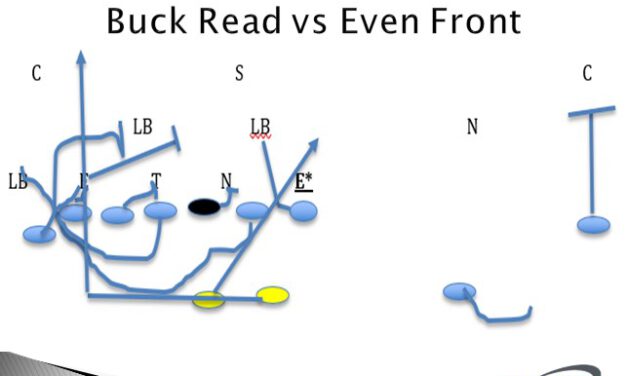
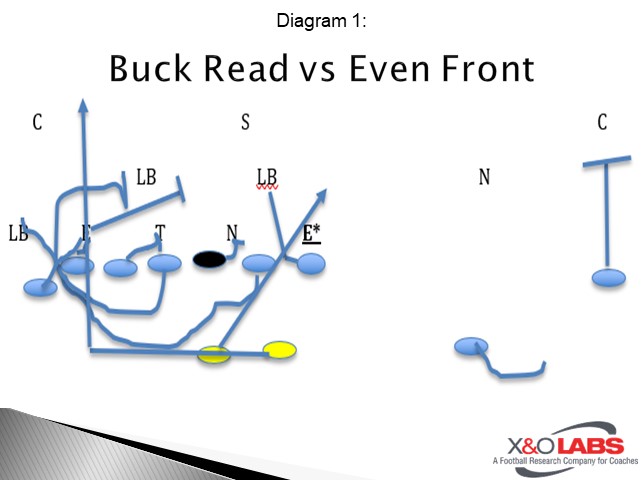
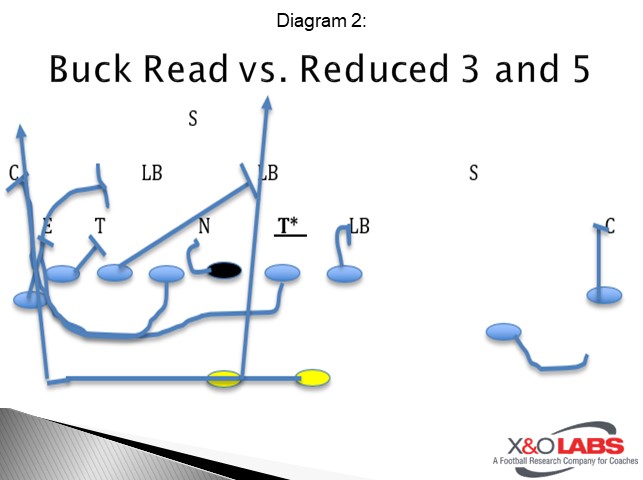
Slide1Slide1

Why Power Read?

Traditional Power was starting to become a very good complement to traditional buck sweep. If we were having a hard time gap blocking the EMLOS due to him coming up field, we could now base him or even false reach him. We can also create double teams and run the ball in the A or B gap. 

Now that we had made the commitment to use our QB as a runner and a reader, we felt we needed to be all in. To do this we wanted to be able to run our best plays in this fashion. This meant running power with the QB. The more we researched this, the more we saw people were running power with the QB and reading it with jet motion.  This intrigued us since jet was such a big part of our offense.  It allowed us to get to the perimeter fast, not have to win as many battles to be successful and the P/A and counter game fit with Wing T principles.  The motion alone gave people fits as we were using jet motion as window dressing for Wing T trap, belly and down in the run game. The advantages to stepping out from center and reading power were as follows (you could add many of the advantages of buck read as well).

  1. Formations – Once again we were able to spread people out and not have to block as many people.
  2. Conflict – Both power and jet are plays that challenge a defensive run fits – once you make them defend both you are putting at least one of their defenders in conflict.
  3. Didn’t need a dominating Tight End or Tackle – By reading the EMLOS we didn’t need to worry if we could handle him with a Tight End or Tackle.
  4. Slowed down pursuit – Again the play side linebackers could not run outside and the safeties couldn’t run the alley on jet right away or step up to play power
  5. Allowed for another second level blocker – with reading the EMLOS we could get a Tight End, Offensive Tackle or H back to the second level and outnumber defenses regardless of the read.

Slide3Slide3

Read More

The Flexibility of a Heavy GL/SY Defensive Package

By Kenny Ratledge
Defensive Coordinator
Gatlinburg-Pittman High School (TN)


Introduction

Before a team can design a goal line defensive package it must first decide where the red zone starts. What yard line is the point of demarcation? Some teams look at the -10 as that point. Others see the -5 or even the -3 as that point. Also, the offense’s personnel grouping must be a deciding factor. The use of 00, 10, 11, or 12 personnel limits the defense’s ability to get more size and defensive linemen into the game.

The package explored here is fashioned for a back and tight end heavy personnel groupings such as 22, 23, 30, 31, and 32 personnel combinations. The point of contention we are using is the -5 yard line. An added point here is that the Heavy package can be used against loaded offensive personnel groupings on other parts of the field. Its flexibility allows it to be more than a red zone defense. We base out of a 4-3 quarters coverage system. To get into the Heavy package we insert an extra defensive lineman and take out a defensive back. This gives us a 5-3-3 configuration. On the back end we can choose to play two corners and one safety or we can decide to play with three safeties considering our corners are more suited to play man coverage and, as a result, are not inherently good run defenders.

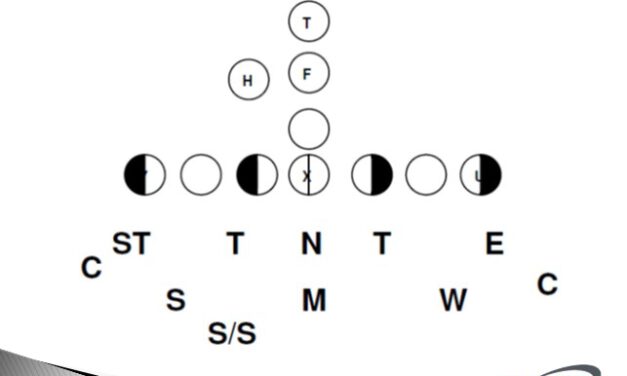
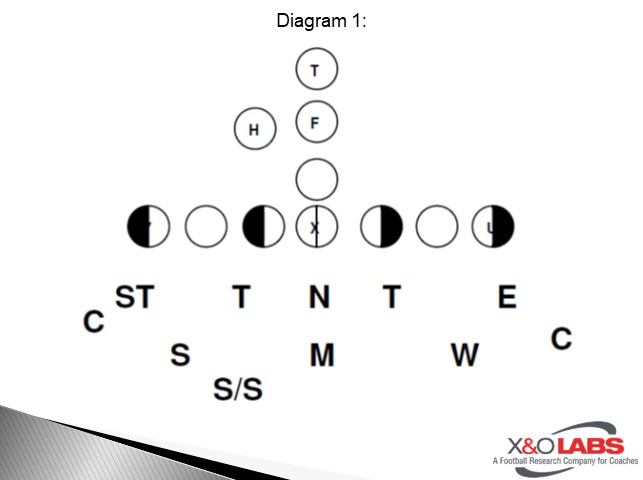
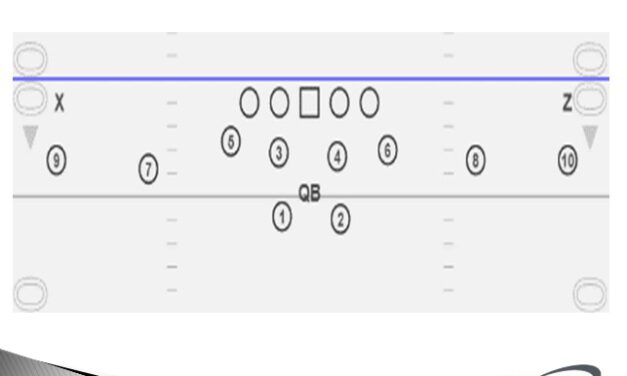
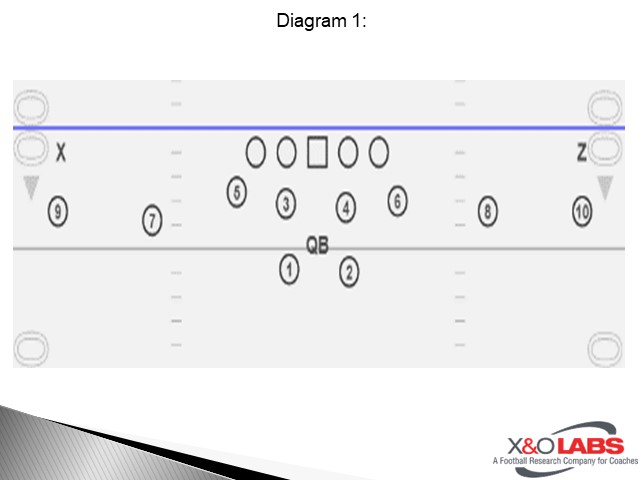
Diagram 1 shows Heavy personnel.

Slide1

Those positions include:

  • ST: Stud (defensive end to the call. 9 technique)
  • T: Tackles (right and left tackles who play 3 techniques)
  • N: Nose (0 technique)
  • E: End (defensive end to the weak side. 9 technique)
  • S: Sam (strong side outside linebacker. 50 alignment)
  • M: Mike (middle linebacker. Stack with the Nose. He may shade to the strong side in a 10 alignment)
  • W: Will (weak outside linebacker. 50 alignment)
  • C: Corners (right and left corners. Possible flip flop to get the best run defender of the two to the strength of the formation)
  • SS: Strong Safety

The base call in this package is Heavy Cover 0. This is shown in Diagram 1. With the base call the tackles align in 3 techniques and the ends line up in 9 techniques. We do have the capability to shade the Nose with a Strong or Weak Heavy call. The ends, as a changeup, line up in 7 techniques with a Heavy 7 call. With a Cover 0 call the corners take #1 to their side man to man and the Strong Safety is responsible for #2 to the strength. The outside linebackers, Sam and Will, take a back releasing to their side.

Read More

Training the QB in PSOs (Pass/Screen Option) Concepts

By Mike Kuchar 
Senior Research Manager 
X&O Labs 
Twitter: @MikekKuchar 


Editor’s Note: The information presented in this report is from our latest special report, 2018 RPO Evolution. The 3 new trends revealed in this report will bring a new wave of RPO production next fall. Continue reading this special report for more information.

One of the more current branches growing from the RPO tree is the implementation of screen concepts that are attached to the drop back pass game. It’s probably one of the newer trends in the RPO menu. According to our research, only 39 percent of coaches are attaching screens into their pass concept menu.

To be clear, a PSO (pass/pass option) couples a quick game to the concept side (such as stick, snag or shallow) with a delay screen to the running back on the backside. These take the place of any other backside options such as a free access throws to the X or a two-receiver mirrored concept progression. According to coaches, there many advantages to attaching backside screens into the pass game menu. Some of the more common benefits we found are below:

Read More

Two Deep Fire Zones That Affect Heavy Personnel Runs

By Steve Erxleben 
Head Coach/Defensive Coordinator 
Southern High School (MD) 
Twitter: @CoachErxleben 


Introduction 

At Southern High School, our defensive staff believes in zone pressure and the ability to bring any combination of inside linebackers, outside linebackers, and secondary players on any down and distance and at any position on the field. We split our blitzes into categories based on what combination of players (ILB/OLB, ILB/ILB, OLB/OLB, or ILB/Secondary player) is built into the pressure.  

Against most 2 back personnel groupings (20,21 and 22) on 1st down and 2nd and 4+, we use a combination of “edge” blitzes (ILB/OLB blitz from the same side) and “staggered’ blitzes (ILB and OLB from different sides) team. We will primarily focus in this article on the 3-man surface in 21 and 22 personnel first then examine the weak side counterpart.  

On heavy run downs, we like to put the “numbers” or the shade/1 technique to the 3-man surface and the reduction to the weak side or the 2-man surface. The reason we prefer this is we feel that putting the “numbers” to their numbers will create two hard edges, one in the C gap and one in the A gap. Our force player outside and two alley players to leverage the FB and TB in a full flow situation. Blitzing the 2-man surface offers the opportunity to trap or close down the cut back and keeps the run front side and hopefully altered to the sideline.  

The main issue with the two back run front side is that if every lineman base blocks to the side of the TE, there are 5 blockers front side and only 4 defenders if the front is sent away and the reduction is put to the TE. We primarily adjust to this with our coverage by adding the safety as a box run defender and allowing the backside ILB to be a true fast flow player. Adding the pressure, however, throws more at the blocking scheme and works in our favor as we work to funnel the ball and get at least one player unblocked.  

All of our “edge” or same side ILB/OLB blitzes are places on a map and begin with the letter “T” to designate what stunt/movement our call side defensive tackle is running and where our ILB and OLB call side are fitting. The side away from the blitz is playing base technique like they would be in a regular base defensive call. All of our “staggered” or opposite ILB/OLB blitzes start with the letter “N” due to the fact the nose guard is primarily involved in the pressure and not just playing a normal read technique. Having a good mix of both edge and staggered blitz on 1st down and any heavy run down and distances keeps our blitzing identity and allows us to play with different styles and abilities with regards to our personnel on the field. 

Base Structure 

To set the foundation, I wanted to talk briefly about our base defense. We look at our blitzes as concepts, so in our verbiage one term can cover the assignments of multiple players and our linebacker’s ability to fit off of the movement of our front is critical to executing each blitz call.  

Our base defense is the only defensive call we have where we are in a read situation. In that case, we are asking our front 7 defenders to key lineman and fit off of blocks to leverage their gap responsibilities. Our base defense is a slanting, 1 gap, odd front with match-up zone coverage principles on the back end. On virtually every snap, our interior defensive tackles are aligned head-up on the OT in a 4-point stance in a 4 technique. Our nose guard is also aligned head up and in a 4-point stance, aligned in a zero technique, head up on the center. We like the head-up alignment due to the fact it establishes some deception and allows us to disguise where pressure is coming from as well as where we are setting the front. The head-up alignment also plays into a lot of the bluffing and bailing we do with our second level players. We also do this with our secondary to creates deception to what coverage we are in. 

When we “set our front” we are telling our 3-interior linemen to take a 45-degree angle of attack. On the snap, our call side DT will move low and hard staying as square as he can from a 4 technique head up to a 4I technique, inside shade of the OT. Now a B gap player, the DT will collision the inside half of the OT getting his inside hand on the inside edge of the OT’s shoulder pad and his outside hand down the sternum of the OT. We give our interior players a pressure key and a read key. In this situation, our 4I DT is feeling the OT he is slanting away from but actually reading the block of the OG. If the OG blocks down and away from the DT or pulls inside, he will get his eyes inside, squeeze and stay square leveraging the B gap. If the guard blocks towards the slanting DT, he will get up the field to the heels of the OL and play the B gap aggressively. Our NG repeats the same movement from his O technique alignment, but his pressure key is the center and his read key is the backside guard as he becomes a 1 technique backside. Our backside DT away from the call is also performing the same technique accept his pressure key and read key are the same unless he is aligned to the TE. If he is to the open side, he is moving from a 4 to a 5 technique and his pressure and read key is the OT. If it is a two TE set or we are slanting to the TE in 21 personnel, the DT’s pressure key is the OT but he is reading the block of the TE. 

Read More

Variations of The Y-Over Route

By Darren Grob 
Offensive Coordinator 
Palmer Ridge High School (CO) 
Twitter: @Coach_Grob 

Introduction 

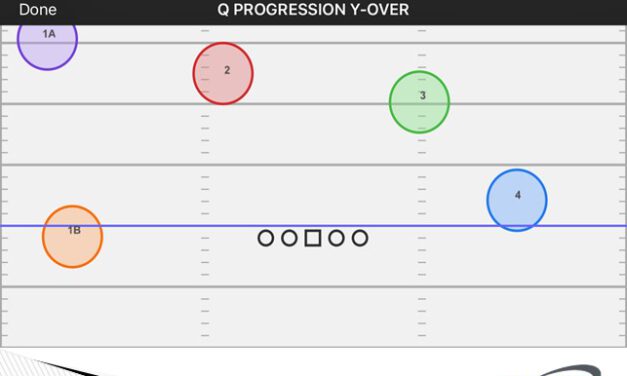
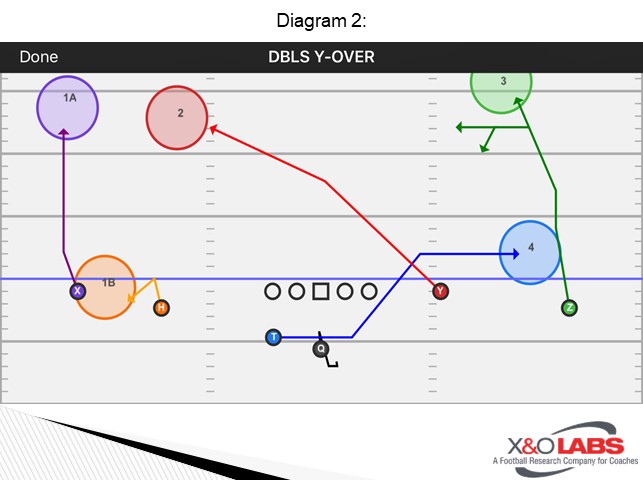
Our bubble Y-over (or Y-Cross) concept is a weak side flood much like the original Air Raid 95. This concept gives us both a horizontal and vertical stretch on the defense as well as built in constraints for our quick screen game. Bubble Y-over has been our most productive play for the last three years averaging just over 23 yards per completion.  

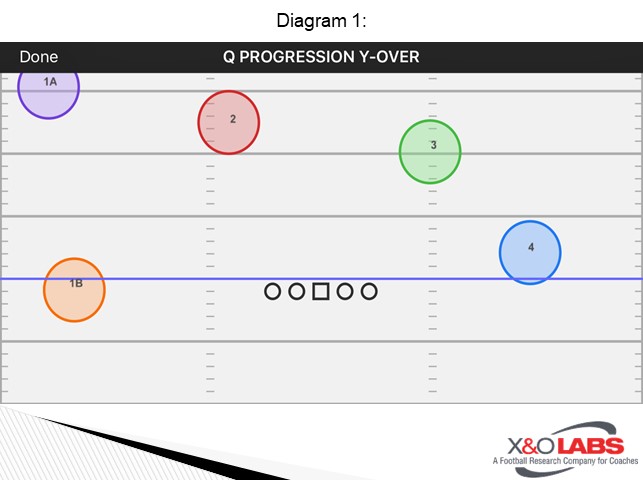
Our version of the bubble Y-over concept is a full field read and the first passing concept we teach to our young or inexperienced QBs because of the ease of the left to right (“windshield wiper”) progression. The read and footwork often come naturally as we run a lot of perimeter screens and rep quick feet in our Indy sessions daily. The ease of the progression helps our QBs develop their understanding of the system we use at Palmer Ridge. 

Slide1Slide1

Front Side #1: Go Route 

The front-side #1 receiver aligns at the top of the numbers and will run a go route stretching the defense vertically. We want the quickest possible release vs the defensive back in order to help the QB identify post snap coverage as fast as possible.  The go route most often comes open against cover 2 Cloud looks or teams that use trap or Read-2 coverage. Against middle of the field open coverage, we want the go route to pull the front-side FS in order to open up grass for the Y-Cross. We want our front side #1 to anticipate coverage and win by stacking his route once he beats the defender in front of him.  

Front Side #2 Receiver Bubble, Arrow, or Out  

The inside slot receiver has the flat route to the front side of the concept. We start this concept with a bubble screen but can game plan to use a 6 yard out if we feel that the secondary is keying the #2 receiver in some match quarters concepts or man under looks. The bubble screen does a good job of enticing both the flat defender and the FS to the front side and with movement creating a clear lane to throw the Y-crossing route behind it. At Palmer Ridge, we will also use some split back sets and have the #2 play side receiver push motion out of the backfield or use a Trey set and motion the #2 receiver across the field and run him on an arrow route to help identify coverage and pick-up easy yards against man coverage. We like to use the flat route from #2 as eye candy to entice the secondary.  

Read More

Using H Motion for Gap Scheme Runs

By Robert Burk 
Head Coach 
Tri-Village High School (OH) 
Twitter: @CoachBurkTV 

Introduction 

I am a first year head coach at a program that is in its third year of existence. When our staff began building our offense we knew that power and power read were going to be the foundation of what we did. By week four, we added counter to the mix and saw some great results. These three plays made up 26% of our offense and we averaged 5.5 yards on power, 5.5 yards on power read and 9.1 yards on counter (13 total touchdowns). In this article, I want to focus on how we used motion to set up these plays and execute them at such a high level.   

Communicating Motion 

When installing our offense, I wanted to limit the verbiage that players had to know. It was important to me to find a simple way to communicate motion that allowed us to move players wherever we wanted. Like all good coaches I stole an idea from Keith Grabowski’s book 101+ Pro Style Pistol Offense Plays. The idea is that you label 10 spots on the field and you can tag any player you want and tell them which spot to motion too.   

Slide1

We developed some simple rules for our receivers and our H. The receiver rules state that if you are motioned left to “9” or right to “10,” you know that you are either getting the ball or in the mesh on power read and may get the ball. If you are motioned left to “3” or right to “4,” it means that we are flash faking to you while running another play. Our H was more of a blocker and not someone we wanted to hand the ball to laterally. If the H was motioned to 3 or 4, he knows he is shuffling to that spot and running whatever run play was called. We can also signal two numbers, such as 4-3. In this case, the H will sprint to behind the right guard and then shuffle to behind the left. This allows us to start in any formation and move whatever player we want to where we need them without a lot of new terms or memorization. I simply hand signal the position that was to motion and the number.  We use locations on the body for a number system where pointing at the ground is 1 and tapping the top of your head is 10.   

Power Read 

Our motion system allowed us to use all 3 possible ball carriers as threats to run power read. We could get the outside receiver, slot receiver and tailback in the mesh for power read very easily.  The tailback had a simple rule. If I signal a motion such as “W-10,” he knows he is a lead blocker. If I did not signal a motion, he knows he is the ball carrier and should line up accordingly. In the first clip of the video below, we run return motion. We used this sparingly but as a change up for team who would roll to our motion.  

To study game film of this concept, click on the video below: 

Read More

Designing RPO’s from 12 and 13 Personnel Groupings

By Mike Kuchar 
Senior Research Manager 
X&O Labs 
Twitter: @MikekKuchar 


Editor’s Note: The information presented in this report is from our latest special report, 2018 RPO Evolution. The 3 new trends revealed in this report will bring a new wave of RPO production next fall. Continue reading this special report for more information.  

When the RPO craze hit the football industry back in 2014, many of the concepts being developed were designed from open, one back personnel groupings. Concepts were devised from 10, 11, 20 personnel from doubles and trips formations. This made sense at the time because many RPO advocates were spread coaches by nature. These formations and personnel groupings were already part of their offensive play menu. So, they were constructing ways to protect their top runs from these structures. 

But the paradigm has started to shift now into how to present these same run/pass conflicts to defenders using heavier personnel sets. Programs with able-bodied full backs and tight ends (that can both block and stretch the field vertically) are creating pass conflicts from their base runs to affect defenders. In this report, we present our research on how a small group of coaches are keeping heavier personnel groupings on the field not just to run the ball on third and short, but to create manipulations in the RPO game by affecting dual read defenders.? 

Editor’s Note: The personnel groupings included in this report include the following: 

12 Personnel: one back, two tight ends 

13 Personnel: one back, three tight ends 

21 Personnel: two backs, one tight end 

22 Personnel: two backs, two tight ends 

Read More

Implementing RB Isolations in the Pass Game

By Philip Vigil
Pass Game Coordinator/Recruiting Coordinator/Quarterbacks Coach
Fort Hays State University (KS)
Twitter: @PhilipVigil

Introduction

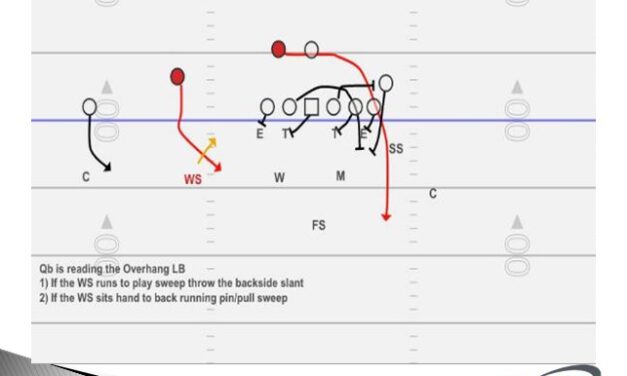
Any good offensive mind will tell you that finding mismatches on the football field will give you a clear advantage. Here at Fort Hays State University we have found success using this motto by getting our running backs matched up with either linebackers or safeties. There are several concepts that we use to get our running backs out of protection and into a route, but one of our best has been a Spacing concept that includes a running back Wheel Route. We have run this concept for the past 3 years and it has become a staple for our offense with answers for every coverage. We have been able to modify the concept by using different formations, motions, and protections to disguise what we are doing and to keep the defense guessing.

Slide1

Coordinator Coaching Points

  • We will only call this play on a hash. We have found that this concept is not as good when ran in the middle of the field. This also makes the landmarks for the route runners consistent throughout the game and therefore removes excess thinking.
  • We will use 5 and 6-man protection for this concept. We usually only use 6-man protection if we are facing a heavy blitzing team. By doing this we will allow the QB extra time to get the ball downfield to the RB.
  • Once you get good at this concept defenses will begin to key on your RB when your RB is aligned towards the boundary. We have found it helpful to move our RB right before the snap.

Coaching the Routes

  • Snag Route (#1 WR to concept side)
    • Align at the bottom of the numbers.
    • Press vertical for 2 steps then work inside at 45 degrees to find a window at 6 yards.
    • If you pass a defender on your way inside then sit down immediately and get your eyes to the quarterback.
    • If you see man coverage pre-snap run your route to sit directly in front of the defender who is covering the running back. This essentially becomes a “rub route” for us in man coverage.  We coach them not to make contact with the defender, but to merely get in the way.  If we get the defender in man coverage on the running back to work under our #1 wide receiver on the Snag route, then we should be able to outrun them creating a big play.
  • Wheel Route (RB to concept side)
    • As the running back is running his route he needs to be able to read the defense.
    • We simply teach that if there is an over the top defender to sit his route down and get his eyes to the quarterback.
    • If there is no over the top defender, then he needs to run the wheel route and expect the football.
    • Aiming point on the wheel route is the bottom of the numbers assuming the play is run from the hash. If the running back is able to get vertical by his landmark this should give the quarterback the room to complete the ball down the field on the outside shoulder much like vertical throws to outside wide receivers.
    • There are times in man coverage where the defender who is in man coverage on the running back works over the top of our #1 WR. In this instance the quarterback should throw a back-shoulder ball to protect the running back.
    • Coach your running back to get his eyes back to the quarterback as soon as he has made his read on whether to run the wheel or sit his route down. We drill this in practice during individual time. A coach will be the defender who can play Man Coverage or Zone Coverage and make the running back make a decision. It will take practice, but once the running back gets a feel for the concept it will be difficult for defenses to stop it.
    • I will also drill the QB to key the defender (a coach in practice) that is in man coverage on the running back. If he is taking a flat angle the ball should be thrown down the field, if the defender is taking a deep angle the ball will be a back shoulder throw to protect not only the running back but also the football.

Slide1

Read More

Efficient 3rd & Long Passing Concepts

By Eric Davis
Head Football Coach/Offensive Coordinator
Mankato East High School (MN)
Twitter: @davismn6


Introduction

It’s 3rd & 9. Do you have a plan? Do you know how many times you are likely to face this situation against a quality opponent? The answers to these questions and others like them dictate our approach to game and practice planning for a given week.

Here are some of our operating principles regarding 3rd & long:

Use our best player(s) or the threat of our best player(s): It is our belief that in high school football the “wrong” play with the “right” player is often better than the converse of that. Our most productive plays are usually more related to personnel than scheme. If there’s a throw our QB can’t make and we keep running a great scheme that puts him in a position to make that throw, whose fault is it when we don’t convert?

Evaluate our in-game risk tolerance: We must understand the overall game flow which can fluctuate from possession to possession and snap to snap. Consider questions like:

  • What is our current situation on defense and special teams?
  • Are we in four down territory?
  • How good is our punt team?

Due to some injuries to our punter and long-snapper last year, punting itself was a high-risk proposition and often dictated a more aggressive 3rd & Long approach.

Game planning begins with 3rd down: Many play callers prefer to start with their open field 1st & 2nd down calls as those are going to be the majority of their snaps. While I understand that approach, if 3rd down is as critical as we say it is, why not begin our game planning there and build the rest of our formations and calls around that? We usually choose at least one run, one screen, and a couple of the downfield passes described below. The run play does not need to be a draw.  While casual fans consider 3rd & long runs to be ultra-conservative “give up” plays, but you might be surprised how close your conversion rate is on runs versus passes when you study the data.

Run base plays and subtle variations of base plays:  Watching Alabama win the National Championship by running four verticals on 2nd & 26 in overtime against a strong defense is a reminder to all of us that you don’t need to stray from core plays in unfavorable down and distance situations.

Protections and Built-In Quarterback Draw

We can utilize 5, 6, or 7 man pass pro for the concepts detailed below, depending on our opponent’s personnel and scheme. We incorporate standard half-slide and full-slide protections that will not be a focus of this article. We have included QB draw as an “escape” in some of our 6-man protections and this is a component we are looking to expand in 2018.

In the context of those assumptions, here are some of our favorite 3rd & long passing concepts that we will call if we decide to throw the ball past the sticks in an effort to gain a 1st down.

Read More