
Defending Air Raid Offenses from Odd Stack Looks

By Jason Winstead
Defensive Coordinator
South Pointe High School (SC)
Twitter: @FootballSPH


Introduction

For most defensive units, the goal is to stop the run first. This makes since as there is nothing worse than having the ball crammed down your throat 4 yards at a time. Defenses tend to be built with this in mind. Stop the run, worry about the pass next.

At South Pointe High School, we do things a bit different. Our defenses are built on speed. We prefer speed more than size. If you can run, you have a chance to play. Our philosophy has developed because we were playing a number of Air Raid offenses year in and year out. This has led us to set up our defense to stop the pass first, while staying sound vs. the run with as few players in the box as possible. We will use multiple coverages to confuse the QB and to change our run fits against Air Raid teams.

Base Alignment

As stated earlier, we value speed. We are a gap assignment team. We are not big enough, or strong enough to utilize 2 gap techniques. We also want to take away as much thinking as we can. We tell our players to, “Know their gap responsibility and GO!”

At South Pointe, we make sure our best 11 are on the field. We do not believe in fitting our players into a scheme. Instead, we believe in fitting our scheme around our players. That means that we will do whatever we have to do to get our best 11 on the field. Against Air Raid offenses, it is vital that the 11 on the field can not only run, but also tackle in the open field. 

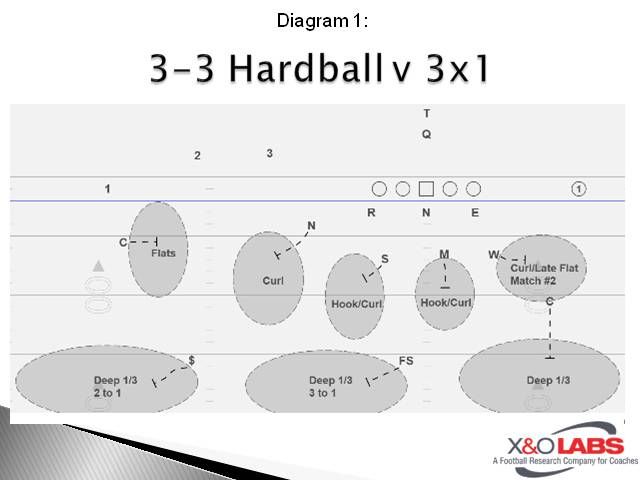
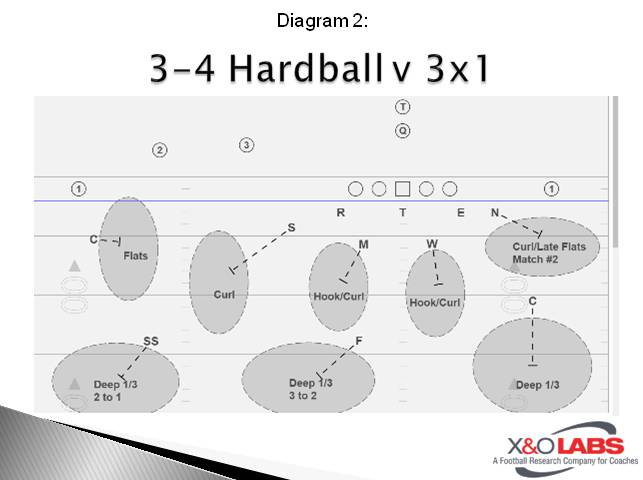
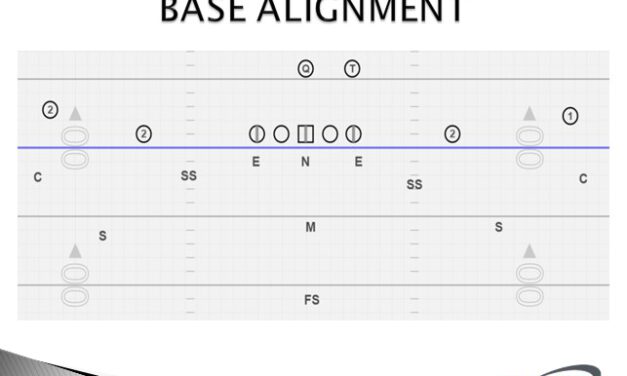
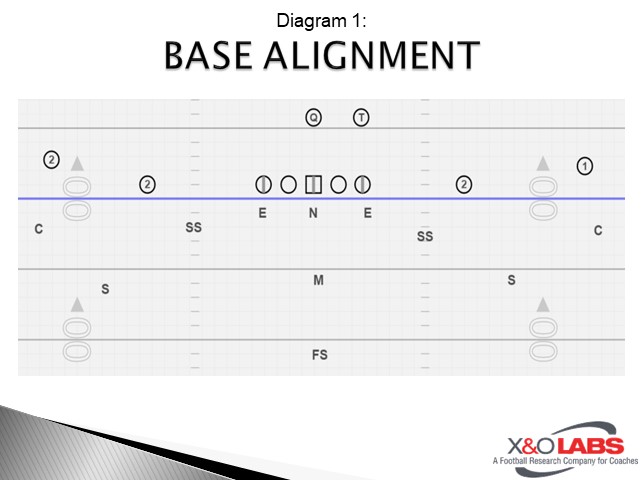
Our base alignment is a 3-3 cover 3 look with our SS splitting the difference between the end man on the line of scrimmage and the #2 WR. We will show what looks to be a 4 man box, hoping to encourage them to run the ball. Our DE will control B gap. Our NG will be given an A gap by the MLB. The Mike will take the other A gap. Our SS will read thru the tackle to the RB and will fill C gap against the run. What appears to be a 4 man box, quickly becomes a 6 man box against run.

Our goal is to make the offense bounce their running game to C gap. We feel that we have the speed on the field to run it down. We have no expectation of completely shutting down the run. We are playing the run/pass percentages. We will live with a few long runs in order to stop the chunk pass plays when possible. Adjustments will be made if the opposing OC makes a point to run the ball. 
Slide1

Base Coverage

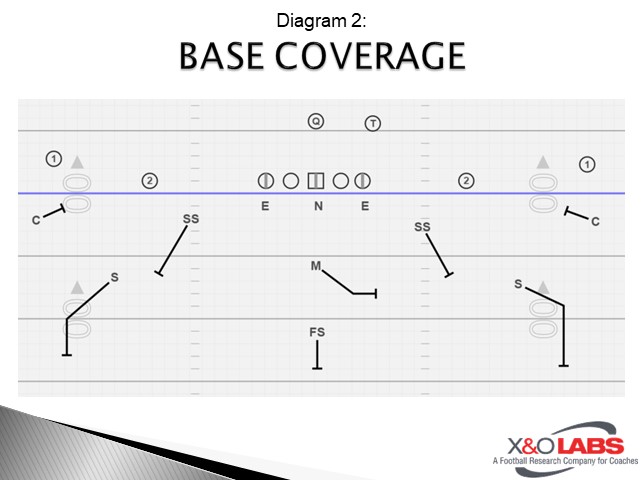
Our base coverage is Cover 3. We prefer to drop 8 in many instances. The nature of the Air Raid is to throw the ball quickly. We will pick and choose when to send pressure, but have found this to be a lot of show with minimal results. Most QB’s we face, including our own, will throw without the laces. Catch and throw. What ends up happening most of the time is that a throwing lane is opened and our blitzer(s) can’t get to the QB in time. We prefer to keep the extra droppers when possible.

That said, it is how we get to Cover 3 that has benefitted us. Our corners play a hard Cover 2. They will beat up the # 1 WR and funnel them inside. We are a zone Cover 3, Cover 2 team, so this is not something new we have to teach the week of the game. Our Corners will play #1 in a 1 x 1 alignment if the WR is on the LOS and at 3 x 3 if #1 is off the LOS. Our goal is to get our hands on them quickly and take away the screen game. If no screen happens, the corner sits in the flats.

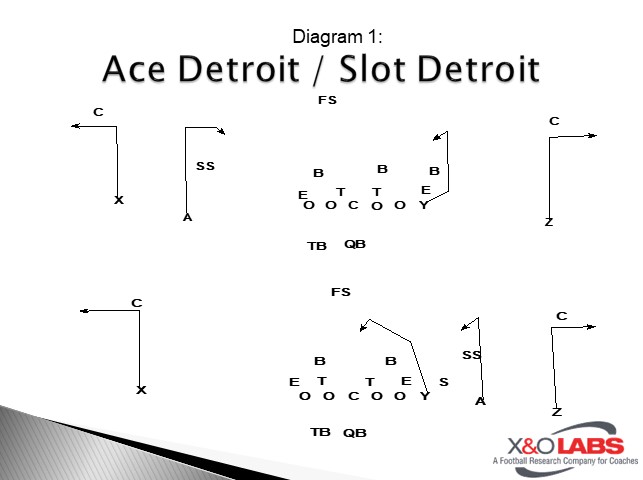
Everyone else is playing Cover 3. Our SS plays Curl, Mike plays hook to the strong side. Our FS stays in the middle of the field. Our 2 deep safeties (S) will align between the #1 and #2 WR and bail into deep their assigned. 
Slide1

Coaching Points:

Defensive Line 

  • Must control the running game. Our goal is to clog the middle and make all runs bounce.
  • The DE’s must attack B gap. They DO NOT have contain. If they beat their tackle and flush the QB, it is somebody else’s responsibility. In this case, the DE becomes a chaser. Against the Air Raid, we want the QB to have to scramble. We do not want him to be able to set his feet.
  • The DE will attack the inside shoulder of the offensive tackle. We do not want to necessarily “slant” into B gap. Our goal is to control B gap, not get washed out of it. If he gets a pull, he will jump into the hip pocket of the puller. If he gets doubled, he will fight the double team and drop if needed.
  • The nose can go 2 ways. We like to play our best DE at nose. If this is not an option, then we will play a “plugger” type player here. If we can draw a double team between the Center and Guard, we believe our DE can beat his Tackle into B gap.

Linebacker

  • Must NOT leave his A Gap. He is a major piece of stopping the run. With 7 DB’s on the field, he has to stay home.
  • We want him to be late to help with the pass. Read run first, if pass, turn and run, looking for crossers. To help with his reads, we have him align at 6 yards in his A Gap. We teach a flat footed read.
  • Against a QB scramble, the LB has contain on QB. He has to know that against a pass, he has the middle of the field. When he sees the QB take off, he has to go to the QB now! Note that this is what we teach against the Air Raid. If the QB is a runner, we are not in this defense.

Strong Safeties

  • Our SS use OLB techniques and reads. They read through the end man on the line of scrimmage to the RB. They have the QB in the running game.
  • The SSs will play underneath any puller to spill everything. In our
Read More

10 Things OCs Do That Make DCs Uncomfortable

By Adam Hovorka
Head Coach/Defensive Coordinator
Schreiber High School (NY)

Introduction

Do you want to know what will make a DC uncomfortable? This report will explain from a defensive perspective the things that any offense can do that will bother a defense and in turn can give the offensive some sort of advantage. Each of the ten ways to make defensive coordinators uncomfortable listed below have one thing in common; they create confusion and doubt.   

We surveyed ten defensive coaches, and these are some of the things that we found are keeping them up at night. 

10) Trick Plays

Reverses, double passes, throwbacks to the QB, and so on. Coaches keep on running these trick plays because they work. So why do they still work is the real question. First, they usually have really good players getting the ball in space. These trick plays should be tied into the offense’s base plays and protect those base plays. If you run a lot of stretch; a reverse off of that same look protects that play.  As defensive coaches, we always stress getting to the ball and pursuit. Tricks work against teams that pursue hard and stress getting to the ball. An added bonus is that the defense will see your trick play on film and pursue a little less diligently and spend time defending the trick play and a little less on your bread and better plays.

9) Play with A Tight End

Tight Ends create unique problems for the defense from an alignment and personnel perspective. The defense has to figure out if they want align certain personnel to the TE or just have players play a side regardless of TE location. Offenses can create great matchups by using the TE in the run game and pass game alike. TE’s create an extra gap in the run game while still having the threat of 4 or five receivers in a pass route. For teams that like to blitz, TE formations create a little bit longer edge and can give the offense one more pass protector while forcing defenses to still account for the TE as a receiver. Teams that run any form of split field coverage have to make a decision of where to put the extra player with the TE. If you do not have a TE simply put your 6th best lineman there or best bigger WR. 

8) Compressed and Stacked Sets

Defensive coaches like to have easy alignment rules for the players to follow. Compressed sets really bother those alignment rules. This creates some doubt in kids and makes kids play slower.  It also creates some nice blocking angles for wide receivers. Compressed sets tend to bring more defenders closer to the football and one missed tackle and there are no defenders near the sideline.  Stacked sets should force outside players to widen out or risks being out leveraged by the formation. This makes it easier to run the ball by removing a defender from the box simply by formation. Stacked and compressed sets also make it difficult for teams to play man coverage. If a team is living and dying with man coverage these are two musts for any offense. 

Read More

Frostburg State’s Down and Distance Pursuit Progression

By John Kelling
Defensive Coordinator / Linebacker Coach
Frostburg State University (MD)
Twitter: @JohnKelling37

Introduction:

Pursuit drills are not a revolutionary concept for most defensive coaches. In fact, most of us use them in some fashion every year. Our pursuit drills have become the foundation for all our teaching and the backbone for our defense. We are no different in the fact that our drills are not revolutionary, but it teaches our players during this drill everything they need to be successful in games. Our pursuit drill teaches our players pursuit angles, proper run fits including which shoulder and arm to keep free, proper form on our “Hawk tackling”, line movements on pass, appropriate blitz gaps, teaching proper practice tempo in our “Pin the Hip” periods, and finally learning 100% effort we expect on each play.

First Down Pursuit:

Goals:

Teach run fits from different fronts and coverages, proper form on Hawk tackling, proper pursuit angles, and 100% effort. We do not practice line movements or blitzes on this drill.

Set Up:

The drill is set up where you place five trash cans in a straight line to represent the opponent’s offensive line with the center in the middle of the field. There are cones on either side of both numbers and two “rabbits” that are 5 yards deep and 1 yard outside the last garbage can. These rabbits represent the running back and will run with the imaginary ball once tossed. The defense gets aligned based off the call you make as well as the formation you tell them they are seeing in front of them. There are 2 coaches aligned on the numbers 40 yards down the field, one coach behind the center, and the other coaches are 5 yards behind the rabbits. If you are fortunate enough to have extra coaches, you can place one to snap the ball while the other one tosses the ball.

Slide1Slide1

The Start:

Once everyone is set, the drill is ready to start. The coach behind the center will go through a cadence and toss an imaginary ball to one of the rabbits. The coach should communicate with rabbits before the cadence to ensure both rabbits don’t take off. Once the imaginary ball is tossed, the rabbits run directly to the numbers and once they get there they will continue to run to the other end zone in the numbers. The coach that tossed the imaginary ball should then go the opposite direction as if running a bootleg.

Each player is expected to touch the hip of the rabbit or tag off on the coach. When you tag off on either, each player is expected to be in an athletic position but not stationary. Their fingers should be down towards the ground and their palms are up and as they tag off and they should never impede the rabbit’s ability to run down the numbers. The repetition concludes when the last person has tagged off on the rabbit and the coach. The coaches who went 40 yards down field aligning with the numbers has an important task. The coach on the same side of the rabbit must watch to make sure every player touches the hip of the rabbit. The coach on the other hash is responsible to make sure each defensive player takes their own path and is in athletic position once they reach the rabbit.

We do not want our players to follow and take the same pursuit angle as a teammate. The coaches who start behind the rabbits are responsible for grabbing another player to replace the rabbit quickly for the next repetition. They are also ensuring we have the correct fits on the field. The defensive players are expected to understand their fit before the ball is snapped.

 We have 4 major categories the players fall into:

Read More

Variations of the PAP Glance Concept

By Matt Kelly
Pass Game Coordinator/Wide Receivers
Worcester Polytechnic Institute (MA)
Twitter: @CoachMKellyWPI

Introduction:

The glance concept is a staple in our passing attack at WPI. We use it out of our play action passing game and our drop back game. We believe that it gives us answers not matter what coverage we see while giving us a chance to get our single receiver isolated and give an easier throw for our QB. We use it with both 20 personnel 2×1 and 10 personnel 3×1 formations.

At WPI, we are a balanced offensive attack that attempts to establish the run first and build our passing attack off our primary run plays. The highest percentage of our passing game is made up of play-action, followed quickly by our quick game and drop back game.

A lot of teams are running this as an RPO and reading either the safety or LB to the side of the post depending on coverage. We choose not to do that as we don’t leave it up to chance, we want to put it more on us as coaches to dictate exactly what we are doing on each play. 

Base Concept

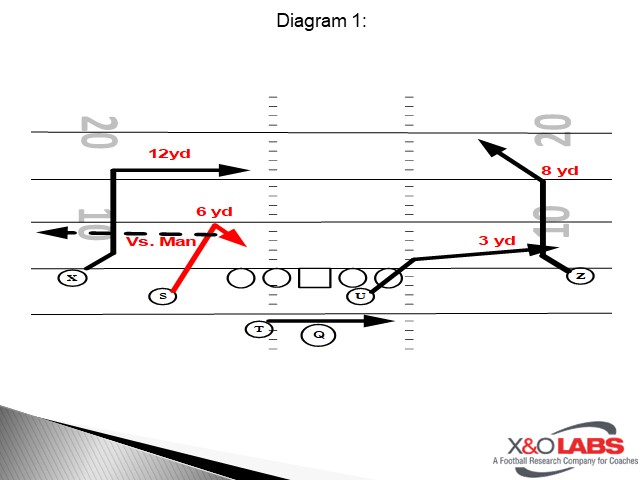
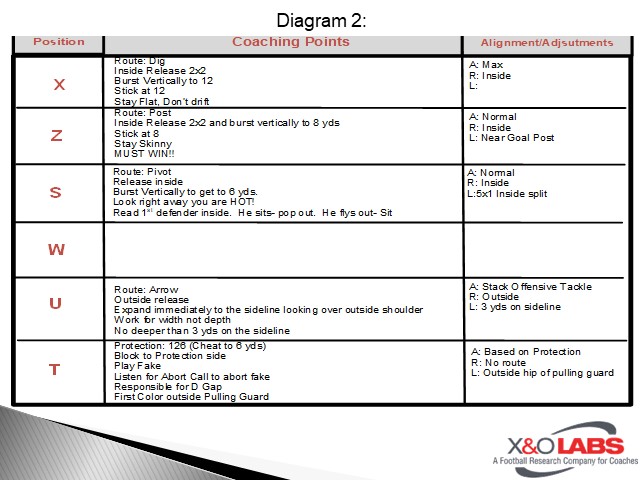
The glance concept for us is a Bang 8 (8 yard post) by the single receiver, with our sniffer back running an arrow (3 yards on the sideline width before depth) to the frontside. On the backside, we will run a pivot concept with #1 on a 12 yard dig, #2 on a pivot, 6 yards reading the 1st defender inside of him. 

Slide1Slide1

Rules

The rules we give for the QB are pretty simple. We really want to throw the post, that is our goal of the play and we want our QB to look there first. Against 1 high/Cover 4, it should be going to the Post anyways as the safety to that side would be either rolling away or coming down. This creates the void for our WR to win inside the CB. Against Cover 2, we used to teach him to work off the Hook/Curl defender and look Pivot to Dig. We no longer do this as we have struggled throwing digs to the field, especially to our left. We now teach him to look to throw the post and work from there.  We do have a “hot” built in for the QB. If he sees 2 rushers outside the tackle on the backside he will hit the pivot route. The WR running the pivot route will look right away if he sees any 2nd level defender blitz. The front side “hot” is technically the arrow route by our sniffer back. We don’t teach it as a hot as we feel we would be able to protect the front side with a pulling guard and TB. 

Protection

At WPI, we are mainly a gap scheme rushing attack, with our most called run plays being Power and Buck Sweep. Our main play action pass protection is based off the counter scheme (power in our verbiage) with the backside guard pulling and being responsible for the C gap player and our Tailback getting the fake coming across the QB and filling outside the puller to account of D gap. With this look, we show “power” to the defense and get the conflict defenders to trigger on the run and allow us to get over the top with the single post. 

WR Rules

The post route we run is breaking at 8 yards keeping a 45-degree angle aiming for the near goal post. We give a couple of rules for our WR running the glance route while also trying to give them freedom to be athletes. They are taught that they must win inside because we want this to work against any coverage scheme.

Read More

Helping OL Block in an RPO Heavy Offense

By Jared Smith
Offensive Line Coach
Sioux Falls Roosevelt High School (SD)
Twitter: @Mr_CoachSmith

Introduction

RPOs are far from new at this point. X&O Labs has done a great job of spreading the word about these concepts since day one. That said, I believe that offensive line play within RPO schemes has not had as much attention as it should. This report will focus on how to coach offensive linemen that can be effective in an RPO heavy offense.

Every defensive coach that has played against a team that effectively runs RPO concepts has complained about linemen being illegally downfield. From Nick Saban to your biggest rival, they are constantly reminding refs to watch for linemen down field on every RPO. That is until they have the ball and their OC starts running them too!

When we first started using RPO plays a few years ago, we did have linemen down field occasionally. Sometimes there was even a flag thrown. We knew that if we were going to get better and avoid these penalties, we needed to make some adjustments to blocking schemes and improve how I coached the linemen.  In addition, we added calls from our QB that have been very helpful in keeping that to a minimum. Now, it is very rare that we have a lineman illegally downfield on our RPOs which means that we are far less likely to have a big play brought back.

Throughout this report I will discuss how our program redesigned our RPO playbook to make things as easy as possible for our linemen. This will include choosing which run and pass schemes we use as well as how to pick a name and/or signal for each play. Each of these three steps started with the OL in mind.

Know the Rules

As a coach, it is your job to know the rules so you can teach your players correctly and to also use the rules to our advantage. Many of you witnessed the Baltimore Ravens hold every Cincinnati Bengal on punt coverage for 11 seconds to end their game last year. Whether that is unsportsmanlike conduct is a conversation for another day. What we do know is that the Ravens coaches know the rules and used that rule to their benefit at the appropriate time, just as they did in Super Bowl XLVII against the 49ers.

With that said, the NFHS rule book states the following;

“Rule: 2-28-2… The neutral zone may be expanded following the snap up to a maximum of 2 yards behind the defensive line of scrimmage, in the field of play, during any scrimmage down.“

By understanding that rule, we designed and stole RPO concepts that would help us succeed and we ditched any that made it tougher on our lineman. My linemen quickly adapted to the RPO plays because they’re all run schemes with which they are familiar.

Choosing the Run Scheme & Coaching Points

Our staff understands that the line is the most important piece to the success of every play. Most coaches believe if you can run the ball effectively it will open up all aspects of the passing game. With that said, we wanted each play to be as easy as possible for the lineman to execute so all of our RPOs start with a run concept that we already run proficiently.

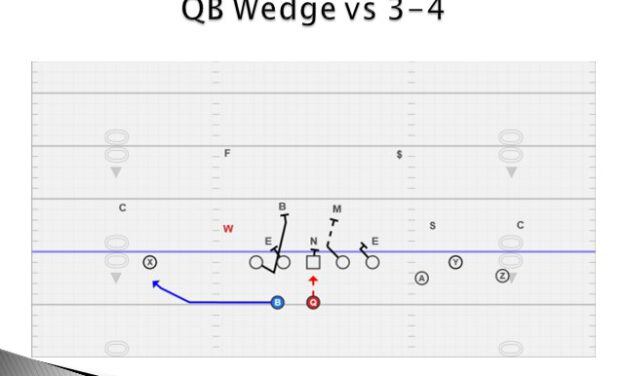
We teach several run schemes and we want to be able to incorporate as many of them as our linemen feel comfortable with into our RPO arsenal. The run concepts that we decided to use include plays with tackles pulling such as counter trey and dart and quicker hitting run concepts like wedge, inside zone, QB Iso and short counter. From film study, we will decide which RPOs to use each week based on what we believe our opponent will show us defensively. We will also decide where the blocking scheme needs to be tweaked because of what the defense does well or poorly.

Read More

Developing an Off-Season Corrective Action Plan to Prevent Missed Tackles

By Vince DiGaetano
Program Analyst for Football
Wagner College (NY)
Twitter: @CoachDig

Introduction

From a defensive perspective, there is only six different ways from a play to end; tackle, incomplete pass, out of bounds, penalty, takeaway or a score. On average each season you find that 70-75% of all plays defended end in a tackle. With that being said, is that same percentage of time reflected in your practice schedule?

The offseason is a great time to go back and see what you are doing well in the realm of tackling so that you can address the areas of need throughout the offseason and into the next. This report is meant to focus on fundamentals, planning and corrections in the area of tackling. I began looking at how our players tackle after 2012. At that time, I was at SUNY-Maritime and I set out to create a plan to improve on it in the offseason and preseason. The focus was on finding what specific corrections need to be made by position and player. Since then, we have built this into a program that has changed the way that we practice out tackling.

Classifying Tackles

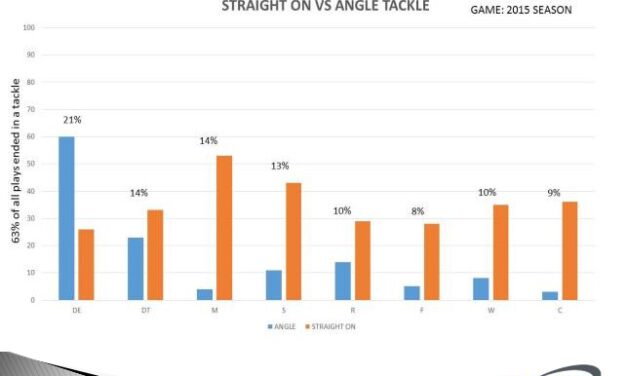
We assess missed tackles by failure to secure the ball carrier and stop the play. If the tackler is able to get the ball carrier down they are considered tackle. If the ball carrier gains additional yardage, it would still count as a tackle, but a correction also applies. We have also spent a lot of time calculating the yards after first contact. 

The percentages are all based on the amount of total times that they play would end in a tackle, missed tackles also, to apply the correction. Each of the plays are graded based on the fundamentals applied to the tackle. 

With this information in hand, we are able to spin it forward to working the proper drill work to correct these issues in winter workouts (weight room, etc.) or in spring. We are looking to work two specific concepts.

  1. Drills revolve around 3 main areas. Tracking/approach, Form or rugby/roll (below the waist)
  2. Corrections are based on 4 main areas. Approach (buzz), Hitting position (hit), force (shoot), secure tackle(rip)

This that information in hand, we the construct our drill time accordingly based on need and the progression. Once we master approach, we work on next phase. Interior guys will have more form. Perimeter more rugby roll. We change approach based on position group as well.

We try to steal time and apply these concepts to all seasons. In the weight room, we focus on squeezing from the lat muscles to secure tackles and preach the shooting of the hips in the explosive moments. Terminology remains consistent in the weight room and work outs. In the spring, we spend a little more time advancing progression. Take a little more time to do non-contact work. This gives us an opportunity to slow down and teach a little more. It also gives us an opportunity to get new coaches to staff involved and trained as early as possible. 

Read More

Hardball and Solo Coverage to Defend RPOs

By Jerrod Sparling
Head Football Coach
River Valley High School (OH)

Introduction:

Sparling XOLab

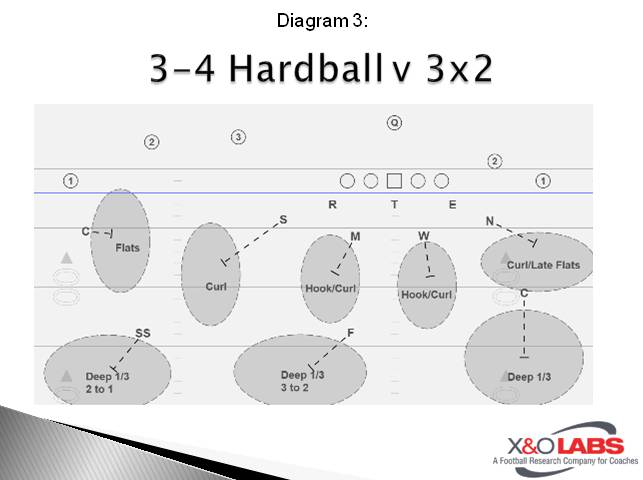
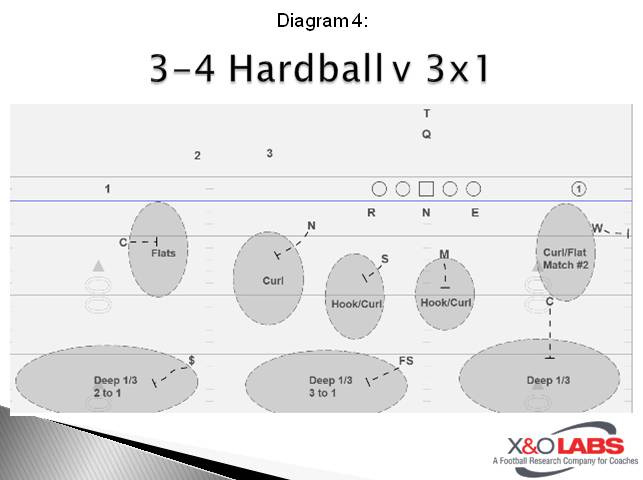
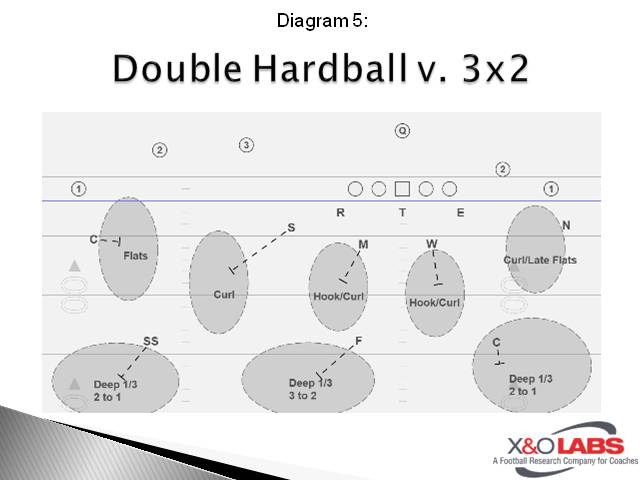
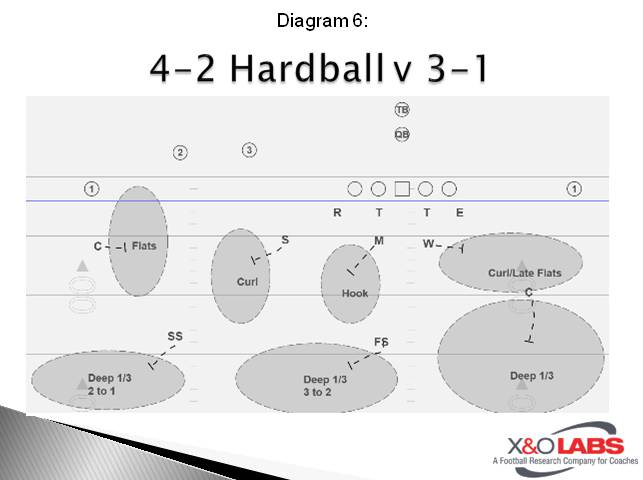
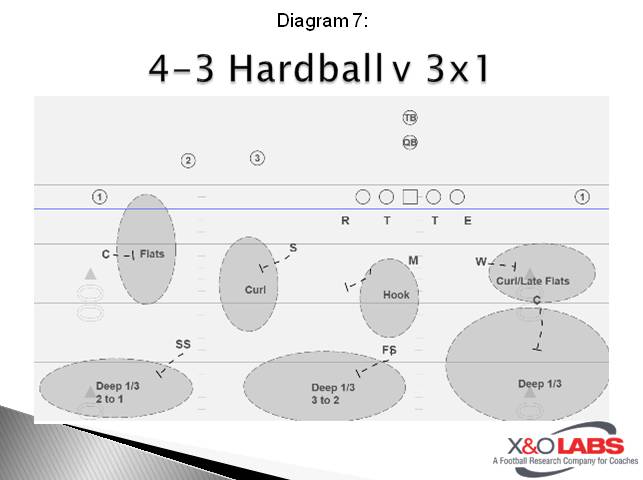
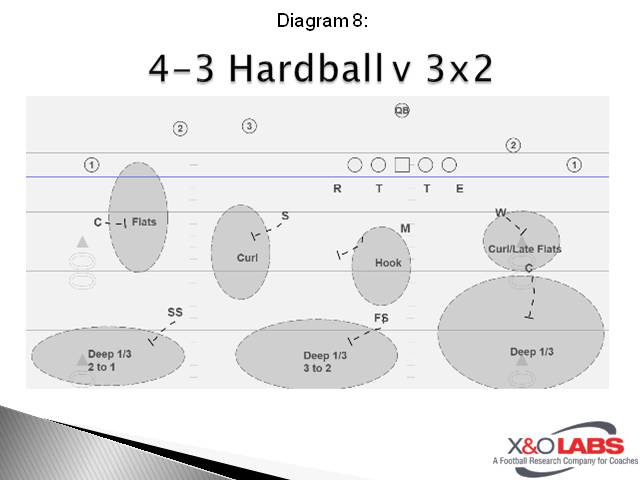
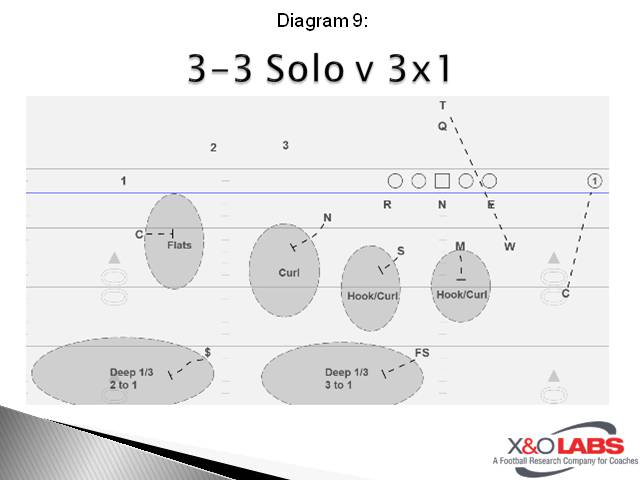
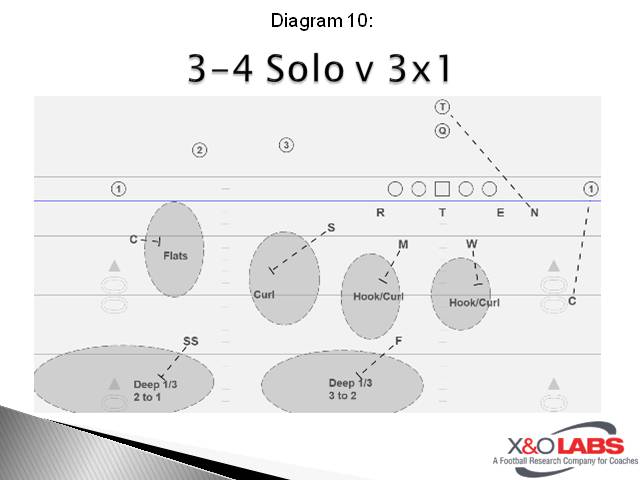
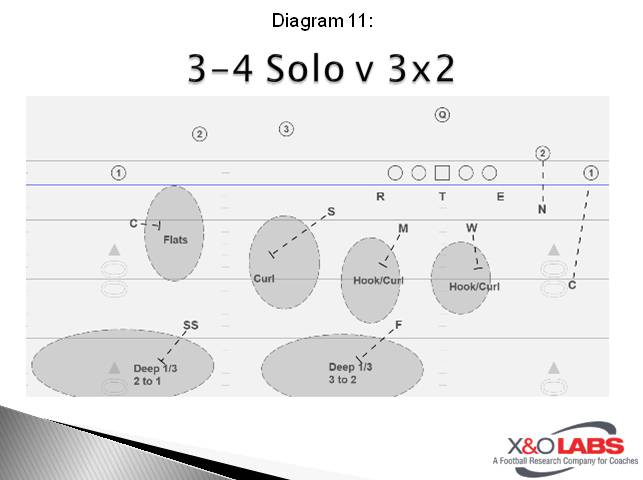
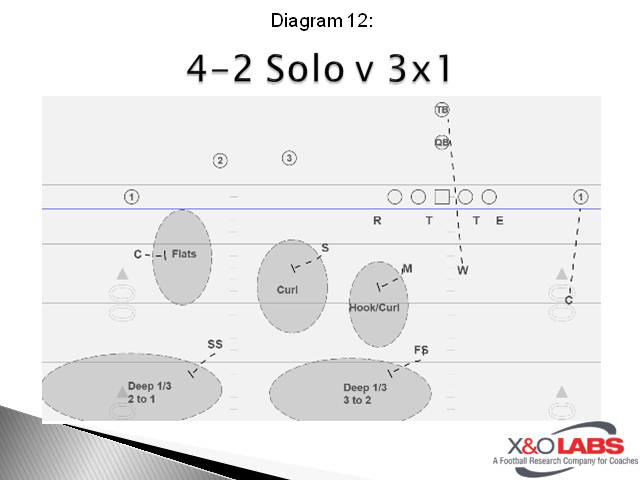
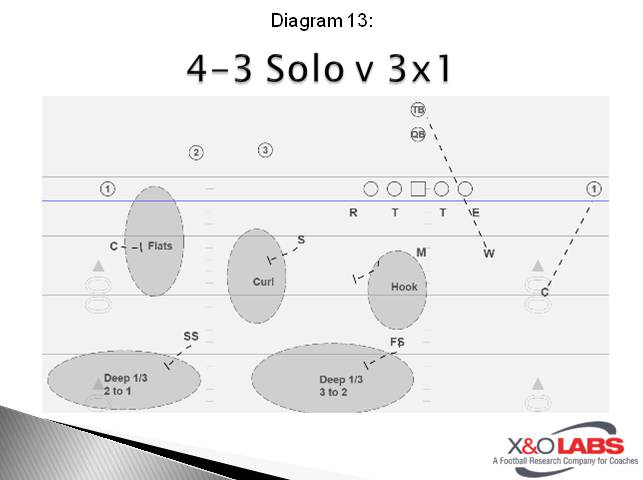
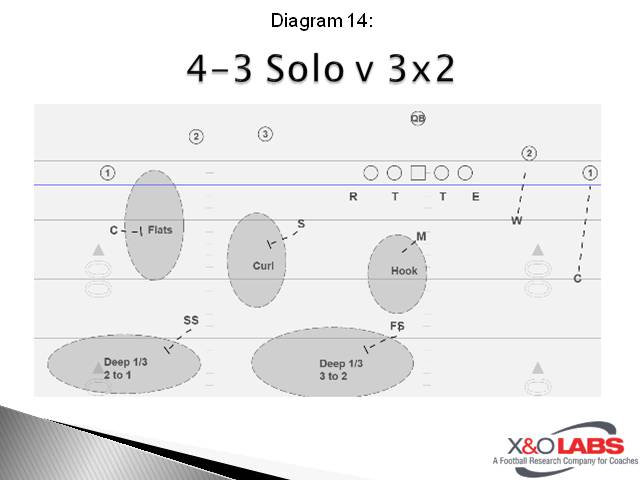
We have used 3 Cloud Coverage (“Hardball” to us) and variations of it against 3×1 and 3×2 formations since 2014. During that time, we have had great success in taking away RPOs (Bubbles, Smokes, Read Slants), as well as vertical based concepts, without having to thin out of box to do so. This coverage also decreases the amount of space 2nd level defenders can get horizontally stretched away from the box, which allows for more freedom in your run defense. Over the years, we were able to match 4-2, 4-3, 3-4, and 3-3 fronts with the coverage with relative ease.

Structure

Here is a look at the structure that we use in our Hardball Coverage. Note that when we are using this coverage, we use a standard 6- and 7-man box setups such as 3-3, 3-4, 4-2, and 4-3 variations to get proper gap alignment and responsibilities. For us, we usually have 6 in the box to 10 personnel and 7 in the box to 11 personnel, unless specific tendencies have us doing different.

Slide1Slide1Slide1Slide1Slide1Slide1Slide1Slide1Slide1Slide1Slide1Slide1Slide1Slide1

Trip-Side Flat Defender

Slide1

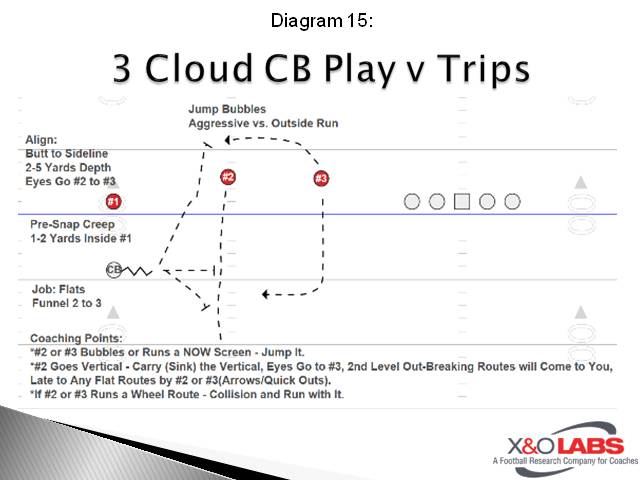
Depth & Alignment – 2 to 5 yards, with his butt to the sideline. Pre-snap he will stem to 2 yards inside the #1 receiver. If the formation is condensed or if the corner is worried about being able to get inside #1, we tell him to line up in between #1 and #2.

Responsibility – Funnel by looking #2 to #3. Playing curl to flat. 

If both go vertical, he must attempt to get hands on #2 and sink to your curl zone. He can be aggressive because he have over-the-top help. He will then be a late flat player on any outside flat route by #1. Rally to any catch in flat area.

If he gets a flat threat by #2 or #3 (Arrow or Out), he must continue to sink to curl zone and be a late flat player. He must also be aware of any flood concept so that a throw is not made over his head. At that point, he will rally to any catch in flat area. 

  • If #2 goes away – Get your eyes on #3 immediately.
  • If you get any bubble screen – Jump the bubble.
  • If #2 or #3 Runs a Wheel – Collision and Run with it.

Trip-Side Invert Defender (This is usually the SAM Linebacker)

Depth and Alignment – 4 to 6 yards, splitting the difference between #3 and the tackle. If he is in the box against 11 personnel, we like him to be on the outside shoulder of the tight end or H-back, depending on the front.

Responsibility – Funnel by looking #3 to #2. When in the box, funnel #2 while maintaining leverage on #3 and play the Curl zone.

Read More

Methodologies in Building Formation Packages

By Adam Hovorka
Head Coach/Defensive Coordinator
Schreiber High School (NY)
X&O Labs Contributing Writer

Introduction

Games are won on match-ups, match-ups are created by leverage and leverage is created by formations. How offensive coordinators design their formation packages can not only accentuate top personnel but also take advantage of opponents’ deficiencies, either by personnel or scheme. But our research has found that there is a fine line between what’s effective and what is too much in building formation packages. All offensive coordinators want to protect their top concepts, but risk battling the limits of long-winded verbiage (both by words and signals), player retention and correlating word associations.

We reached out to nine contributors (both at the high school and college levels) and researched how they build their formation packages to out-leverage defenses and isolate their top personnel.  The contributor list is below:

Contributor List (In Alphabetical Order)

  • Johnny Cox (JC): Offensive Coordinator, University of North Carolina Pembroke (NC)
  • Rich Holzer (RH): Head Football Coach, Mount St. Joseph High School (MD)
  • Kyle Ralph (KR): Head Football Coach, New Palestine High School (IN)
  • Kyle Schmidt (KS): Head Football Coach, Archbishop Spalding High School (PA)
  • Jeff Smith (JS): Offensive Coordinator, Warrenton High School (MO)
  • Mike Stanley (MS): Head Football Coach, Carey High School (NY)
  • Ryan Turnage (RT): Head Football Coach, Lee Davis High School (VA)
  • Scott Walden (SW): Head Football Coach, East Texas Baptist University
  • Kevin Wallace (KW): Offensive Coordinator, Glenn High School (NC)

We asked our contributing list the following nine questions:

  1. In your opinion, what is the most important component to formation design and creation?
  2. How many total formations to you have roughly in your offensive system?
  3. Is there a word or signal length you limit yourself to in calling formations? If so, what is that length?
  4. Explain the correlation between how many formations you have in your system to how many formations you will enter each game week with. How is this predicated on defensive personnel or structure.
  5. Explain how to designate formation groupings in your system. For example, how do you differentiate 12 personnel formations vs. 10 personnel formations? Are they the same calls, different calls?
  6. How do you package your formations either by word associations or signal associations to make them easier to group. For example, does every 2×2 formation start with “D”, every 3×1 formation start with “T,” etc.
  7. For single back offenses: explain the communication you use to change the back’s alignment.
  8. For H/Y off offenses: explain the communication you use to change the H’s alignment. 


In your opinion, what is the most important component to formation design and creation?

JC: “Design it how teams are playing you based on your personnel.  Take advantage of match-ups within your personnel groupings.  It is also to force teams to play our close splits of our wide receivers. We also number our spots where number one is closest to the sideline enabling us to move players around.”

RH: “The most important thing is how the defense adjusts to the formation- stack, bunch or pistol formations. The second thing is the match-ups. Can we go empty? Can we do different things and get match-ups with speed advantages?  We evaluate the defense against teams similar to us and how they align.”

Read More

Pre-Snap Hitch Controls in the Run Game

By Mike Kuchar
Senior Research Manager
X&O Labs
Twitter: @MikeKKuchar


Introduction:

The following research was conducted as part of X&O Labs special report on “Scaffolding a Pre-Snap RPO System,” which can be accessed in full below.

Hitch Concept Controls

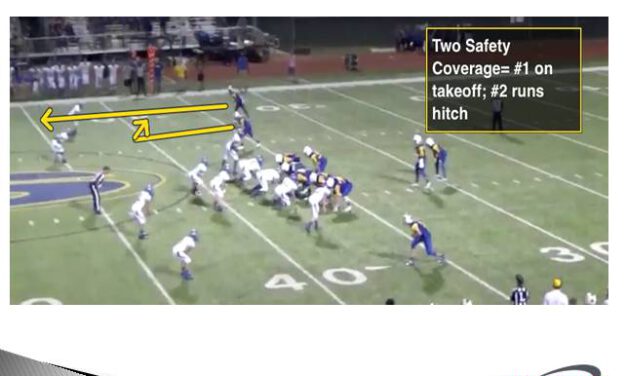
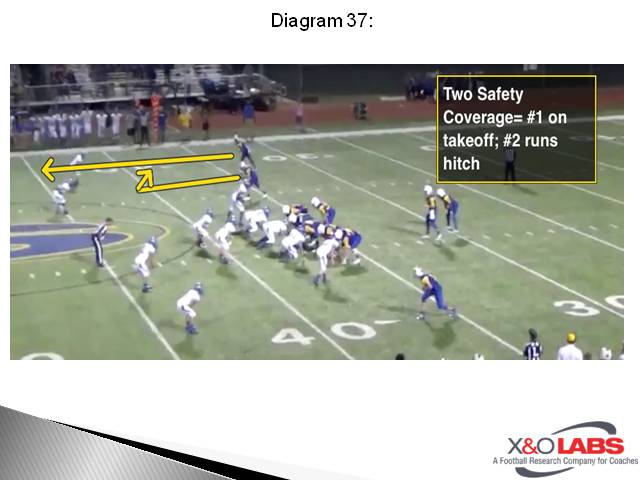
Against pure quarters coverage concepts, both receivers will hitch up. If the safety drops in hole the inside receiver stays vertical (Diagram 37).

Slide36

Read More

“Locked Route” Passing Concept

By Brian Grady
Head Football Coach
Fair Haven Union High School (VT)


Introduction

The Locked Route pass concept allows us to be able to run 6 base pass plays without receivers or tight ends having to learn to many concepts. The idea is we can run 1 play out of 3-4 different formations per game, which gives the defense a lot of looks, and gives us answers to different coverages. At the same time, our players only learn 1 route on that play, as they run the same route no matter where they are formational aligned. These base pass plays are very quick to install on the high school level. 

Out / Curl Concept

No matter the formation, our Z and X receivers will run a 10-yard out route and our A and Y receivers run 10 curl routes. We are trying to isolate our outside receivers to get 1 on 1 coverage with the corners.

Slide1Slide1

Coaching Points:

  • All 4 receivers need to sell they’re going vertical.
  • QB must use the pre-snap read to decide which side we’re throwing to in 2 x 2 formations. He will take the best match up by scouting report or the receiver that is getting the biggest cushion.
  • In 3 x 1 formations, the QB will decide if he likes the 1 on 1 match up. If so, he will take take it. If he doesn’t like that matchup, the post-snap read will be to attach the curl to the out. If the defender on inside receiver stays inside, throw the out route.
  • This a play we run in all situations.

Out / Curl Variation

When cornerbacks start to jump the out route because we throw it so much we tag “GO” call to it. This creates the chance for explosive plays with the Z and X running out and up routes. If teams play cover 2 and press outside receivers, we will automatically convert to 4 verticals.

Curl / Slide Concept

This is a play we run a lot because it is an answer to all coverages and can be run in a variety of down and distance situations. The routes are as follows:

  • X has a 13 to 10-yard curl
  • Z has a slide route (1 step then angle to sideline to get to a depth of 7 yards)
  • A has Curl or Post depending on formation.

Slide3Slide3

Coaching Points:

  • The QB must take the following pre-snap read in 3×1 formations.

    • First, is the middle of the field open? If so, he should look at taking the shot in the middle of the field.
    • Next, he must decide if he likes the 1 on 1 match up on single receiver side. If he does, he should look that way.

  • The QB’s post-snap read from 2×2 of 3×1 formations should be as follows:

    • First, read the flat defender. If he is not jumping the slide route, take 1 step and throw now. If he does jump the slide route, continue on the 3 stop drop.
    • Is the curl route open? If so, throw the curl. If the CB is jumping the curl, the QB should hitch up.
    • Lastly, he should look for the wheel route. The Z receiver is taught that as he looks back at the QB and he is continuing to take a 3 step drop, then he should turn his route into a wheel when he is six yards from sideline.

  • The biggest coaching point for our QB’s is to stay with the read progression as it happens, don’t predetermine what is going to happen. He must take the first open receiver in the progression.

Out / Vertical Concept

This is a shot play for us that has worked very well against cover 3 by throwing the verticals. It has also been effective on 3rd down and long by throwing the out routes. Before we call this play, we normally know by film study or as the game goes on how our opponent is defending 3 x 1 formations. The routes are as follows:

  • Z always runs a seem route
  • X and Y always run Out Routes
  • A always runs a post route.

Slide5Slide5

Coaching Points:

  • The QB’s pre-snap read is to see if the middle of the field is open. If it is, he should look their first post snap.
  • If the middle of the field is closed (C3) the QB reads flat defender to see if he staying over the top of the inside vertical. If he is, throw the out route. In the second diagram, we formational switch the alignment of the receivers to add a little confusion to the defenders, but as in all locked route plays the routes don’t change.

Read More

Using Man Pressures to Defend Quick RPOs

By Rob Busmente
Head Coach
Sterling High School (CO)
Twitter: @TigerFootball2, @norlito27


Introduction

Throughout the years we have always been a primary fire zone team with our pressure game. While this is still the basis of our blitz package, we needed to find ways to combat the quick throw and RPO game that many teams have begun to utilize to gain the advantage over the defense. The problem we were running into was that offenses were able to take advantage of the windows in our zone drops whether we would bring pressures or just line up and play. In addition, we would get stuck in the “we have always done it this way” rut and possibly became predictable to our opponents who know we always play zone in our base looks and behind pressures.   

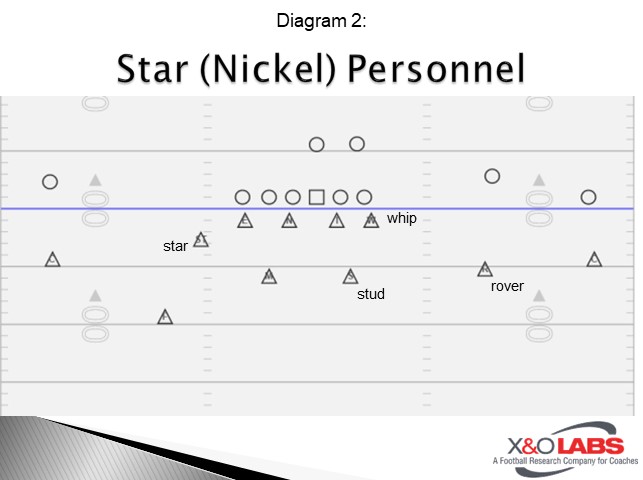
In football, the word “pressure” is one often associated with blitzing and in most cases, it is true. That said, we began looking for ways to pressure the offense with a combination of what we would call “sight pressure” and our normal blitz game. We work hard with our kids on the concept of presentation. Our goal is to present the offense with a base zone look and use late movement to help deter the quick throw or RPO adjustment when we would bring a blitz. This is why we decided to incorporate some of the man coverage principles to combine with our zone coverages to keep the offense in limbo while maintaining the integrity of our run fits. While certainly not perfect, we feel these adjustments have been a great benefit to us defensively. This report will present ways that we have adjusted using our base personnel and our nickel (star) personnel.

Base Defensive Scheme

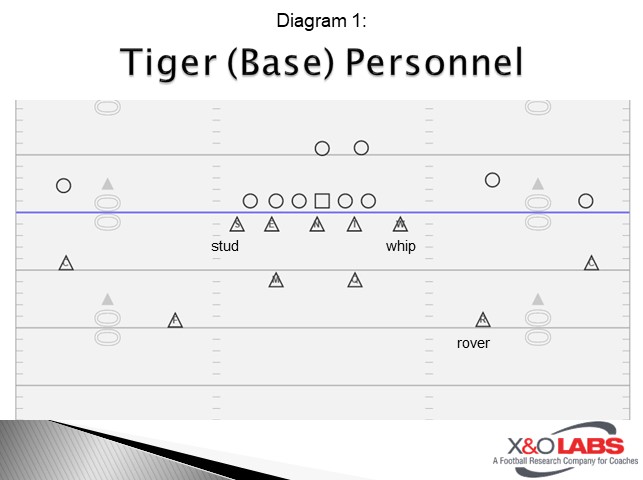
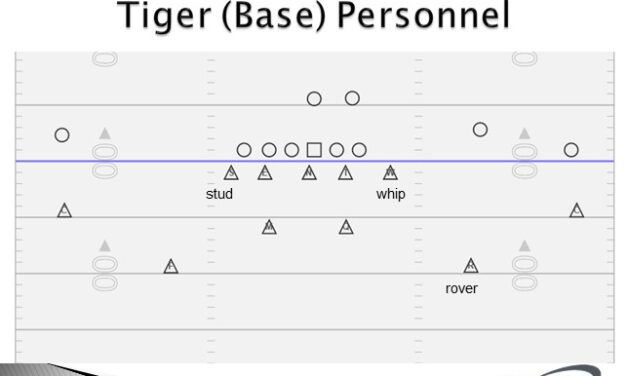
Our base defensive scheme is a hybrid 3-4/4-2-5. The following diagrams will show our base and nickel personnel aligned versus a 2 x 2 formation.

Slide1

Coaching Points Diagram #1:

  • Stud: For us, this player is a hybrid LB/DB type. He would travel with the Nose, End, Mike, and Free Safety versus formations. He is more of a LB that is physical enough to set the edge against a TE or tackle but athletic enough to cover a slot receiver.
  • Whip: This is a hybrid LB/DL type. He would travel with the Tackle, Quick, and Rover versus formations. He is athletic enough to drop into zone coverage (we try to avoid him playing too much man) but physical enough to play with his hand in the dirt.
  • Rover: This is our hybrid DB/LB type. He would align to the weak side of the formation. He is more of a safety with the ability to cover a slot receiver but is physical enough to play in the box like a LB.
  • Star: This is an extra DB we would bring into the game in a Nickel type situation.

Note: Our Rover and Stud would be similar to the Star/Money types respectively in that system.

If we don’t like the match up with our Stud and the Slot receiver we would bring in our Star (nickel) to replace an inside LB. What this does for us is gets a better match up with the slot receiver while keeping our athletic Stud player in the game to match up with the RB in man situations.

Slide1

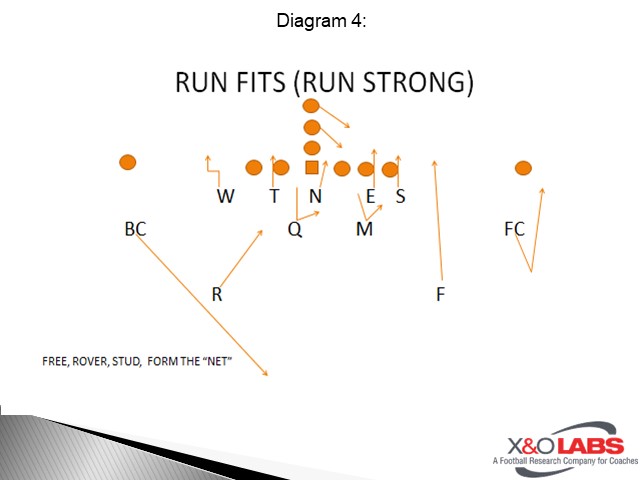
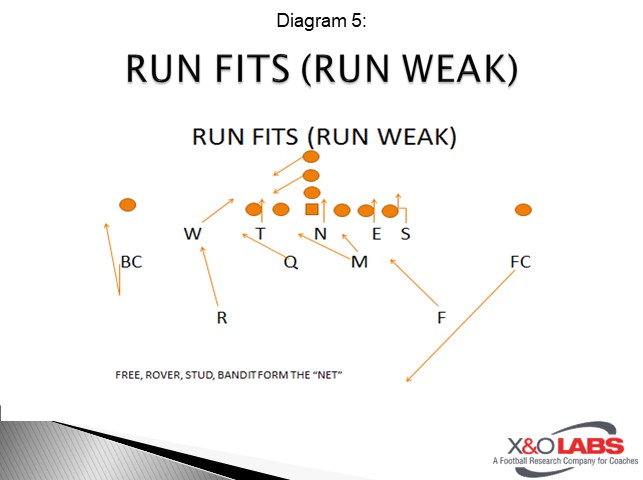
Run Fits          

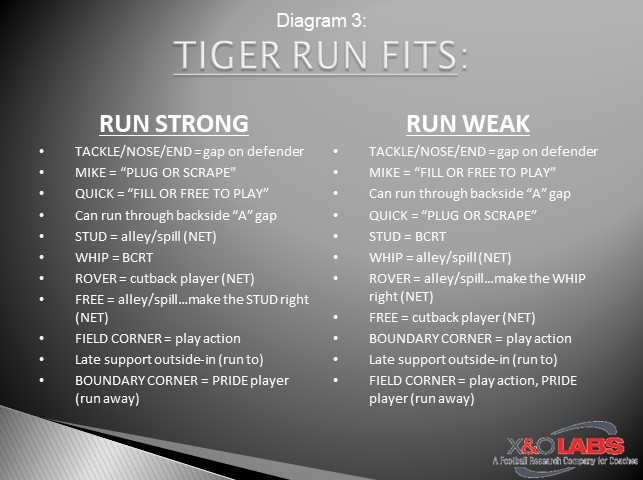
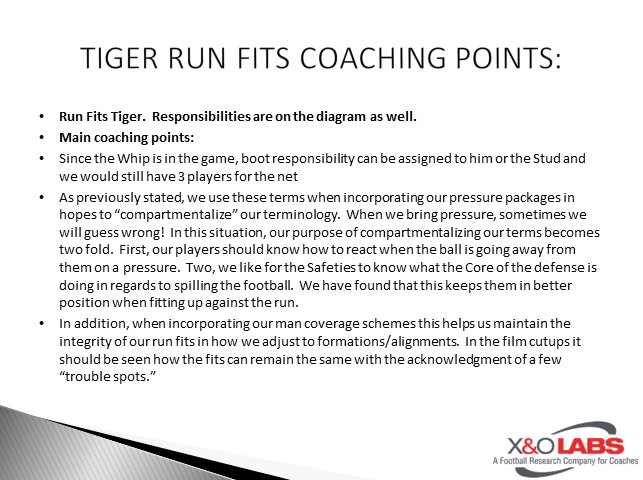
The next diagrams will explain our run fit terminology. We feel this is an important aspect of installing our pressure packages so our players know that their fit doesn’t change with the call. In every way possible, we like to live by the mantra “alignment doesn’t change assignment.” While the offense can create a few “trouble areas” by formation against some of our man/zone schemes, we nonetheless feel we have remained as consistent as possible. 

Slide3

Slide4Slide4Slide4

“Sight” Pressure Schemes (Tiger/Star Personnel)   

As previously stated, we try to present the offense with our base quarters looks as long as we can before moving into our man schemes. We tell our players to move as late as possible and if it happens post snap then so be it. The intention is to “pressure” the offense by changing looks and affecting the quarterback. There are also times where we decide to “show” the offense right away what our intentions are just to create potential smoke and mirrors. In the film cutups, you will see us aligned in the look right away but understand the intent is to always present a zone quarters look.

Read More

Pattern Match Coverages to Defend 2×2 and 3×1

By Alex Place
Defensive Coordinator
Dublin Scioto (OH)
Twitter: @dmsmrplace

Introduction:

placeThis past offseason, we transitioned from a 4-2-5 to a 4-3 in order to be multiple with our coverages and blitzes while disguising the coverages to the offense by lining up the same every snap. The previous year, we struggled as a team to have an identity. We seemed to be designing our defense each week to match what offenses were trying to do to us instead of having an identity that our kids knew and trusted. We see a bunch of 2×2 and 3×1 formations each week, so we decided to convert from a 1 high safety Cover 3 team to a 2 high safety Cover 4 / Pattern Match Cover 2 team.

Converting our defense to a 2 high safety team allows us to have an identity at all times. We no longer have to rotate our coverages to match up to what the offense gives us. Our kids know where to line up on every play and this defense allows to kids to react and fly to the ball. I will go through the alignment and assignments of the defensive backs and linebackers for each formation we see on a regular basis with the focus being on our “Cloud” pattern match coverage.

Alignment:

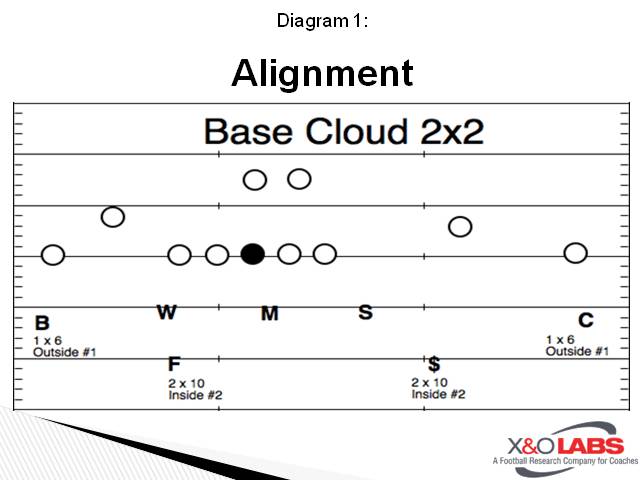
Anytime we have two detached receivers to one side of the formation, our corners and safeties lineup the same no matter what coverage we are in (Sky or Cloud). Our corners base alignment is 1×6 outside leverage of the #1 receiver. We turn our corners inside at a 45-degree angle. They will slow tempo out with a shuffle as they read their primary key, which is the quarterback. Our safeties alignment is 2×10 inside of the #2 receiver. Our safeties will slow backpedal, as they read their primary key, which is the quarterback (Diagram #1). Our outside linebackers are told to split the ball and #2. Their job is to be a curl player in the pass game unless otherwise noted in the report.

Slide1

Quick Game:

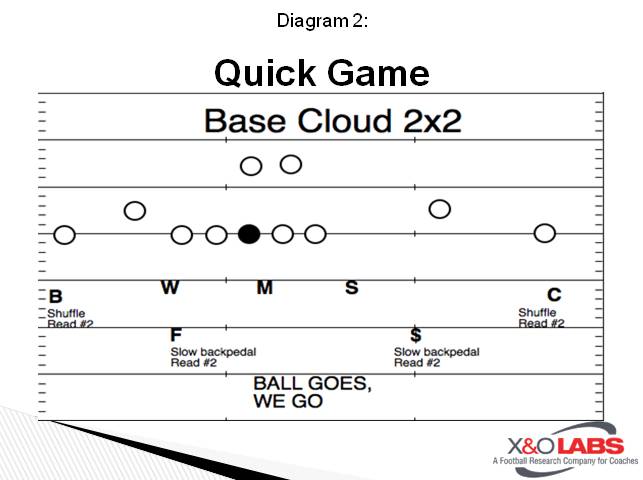
Both the safeties and corners primary key is the QB. We read the QB to clear the run game and the quick passing game before progressing to matching routes. When they get a quick game read (bubble, quick throw), our defensive backs know to react and play aggressively (Diagram #2). Our coaching point on quick game is “if the ball goes we go,” meaning we will jump a quick throw. Otherwise, “if the ball doesn’t go, we don’t go,” meaning we will continue to sink with the deeper route. Once we have cleared the quick game, we get into our pattern read progression. Switching our “Cloud” coverage to a pattern read, virtually eliminates the Bubble and Quick throws by having our Corners as outside leverage players and our Sam and Will as inside leverage players. This is something that we teach during our individual time in practice. It is also great training for the defensive backs’ eyes to quickly read the QB.

Slide2

Pattern Reading

The first day we install “Cloud,” we need to demonstrate to our defensive backs the progression of the QB, to #2, #1. Once we clear the run game and quick throw, we start our progression reading #2 to #1. Once the QB shows pass, we need to find the #2 WR.

Read More

Protecting Two-Back Runs with Flood and Naked PAPs

By Ryan Turnage
Head Football Coach
Lee-Davis High School (VA)
Twitter: @ldpride

Introduction:

Our offense at Lee-Davis High School begins with our running game. Our main staples in the run game include power, inside zone and outside zone. We have been very effective in our ability to run the football in recent years. Much of the success of our ability to run the ball is largely due to our play action passing game. Our goal with our play-action passing game is to put run defenders in as much conflict as possible. We want to slow defenders down as much as possible. Our most effective play action passes are off of our power play and inside zone play. Our philosophy is to be able to run these concepts from multiple formations.  We spend a great deal of time in the off-season and during practice teaching the fundamentals of these concepts. 

Flood Play Action

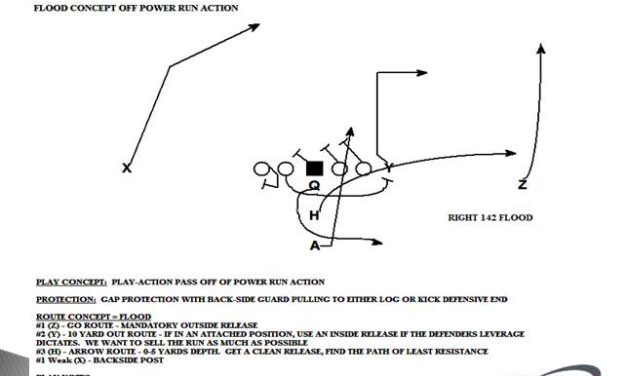
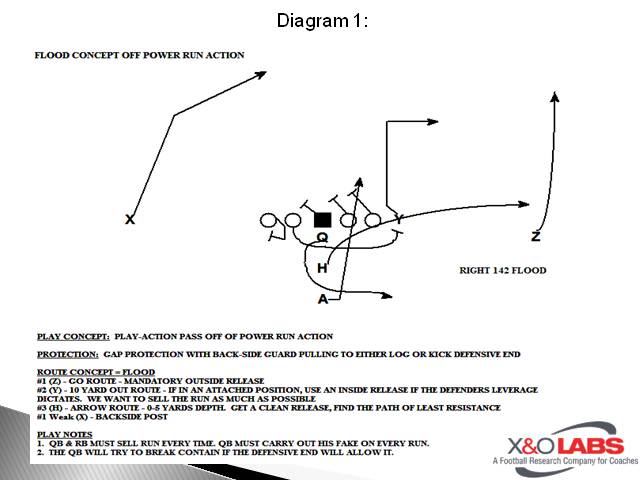
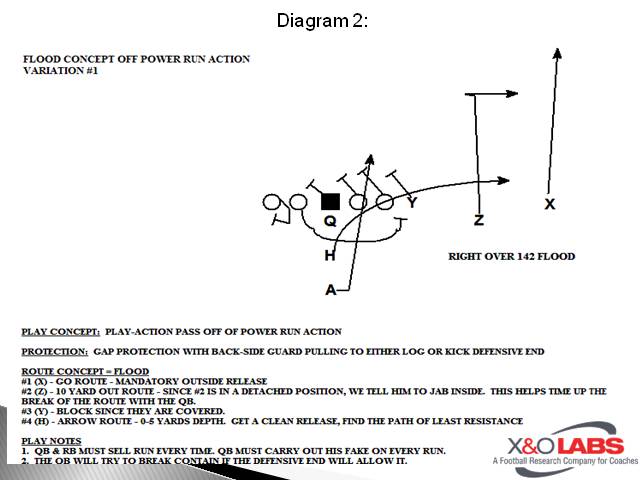
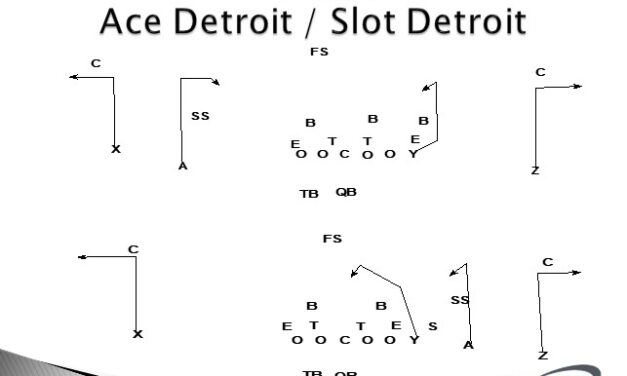
The play-action pass that we use frequently comes off of our power run play which is our 100 series.  We have the ability to use multiple pass concepts with this play-action pass but the concept we use the most is Flood.  This is a basic flood concept.  In our offense, we teach the flood concept the following way (Diagram #1). 
Slide1

This allows us to use the flood concept in any type of pass action we choose. (play action, sprint out, or drop back).  We can also add tags to the concept if we want a specific player to run a certain route.  Our play action pass off power is called by stating the Formation, Protection, Run-Action, Pass Concept in that order (ex: Right 142 Flood or 143 Flood). 

Slide1

In this play, our QB will attempt to break contain and throw on the run.  The only situation in which he would not try to break contain is if the DE to the play-side is up the field not allowing him outside.  In this case, he would pull-up and deliver the ball accordingly.  The progression for the QB is deep, middle, short.  We are looking for big gains in the play-action game but we tell the QB not to pass up player who has green grass in front of him.  We do not try to attack a particular coverage with this concept rather than attacking defenders that are assigned to playing the run and pass in their responsibilities.  The player that typically is most effected is the flat defender.  

It is important to note that sometimes QB’s will fall in love with the short throw and not look down the field. We will drill the progression of the play during practice.  Our focus in doing this are the fundamentals of the play. We want to make sure the QB is getting proper depth off his fakes and his ball handling mechanics are sound. We also stress proper route depth and releases by the receivers.  In the drill we will also add the pull of the backside guard and vary his block to force the QB to make his adjustment to his launching point.   

The protection for this pass concept is a gap protection in which we do pull the backside guard. We have protected the play both ways in that we pull the backside guard and sometimes we do not.  This is typically a game plan decision. The pulling of the backside guard makes the play look more like the run thus having more influence on the defense. The protection is as follows, the offensive line will step down aggressively and block the first defender inside that shows. Offensive lineman will step aggressively with their inside foot and block the first defender that shows on their path.

  • Play Side Tackle will step hard to the B gap defender, versus an even front this is most likely a 3 technique or 4i versus an odd front.
  • Play Side Guard will look to protect A gap. If A gap is uncovered he will help on the B gap defender with his eyes on the 2nd level.
  • Center will protect the back-side A gap, in most cases the back-side guard is pulling. If the back-side guard is not pulling they will protect the back-side A gap together.  We want to make the action to look as much like to run play as possible.
  • Backside Guard will pull. His rule is to log or kick based on how the DE is reacting to the play.  We drill this with our guards regularly. Our thought is if the DE is up the field regularly then chances are the run play is very effective.
  • Back Side Tackle will execute a gap hinge technique.

We like to call this play versus hard crashing DE’s, hard filling safeties, and OLB’s that are getting too involved in stopping the run.  We are not as concerned with the coverage the defense is playing when we call this play.  Our main goal is the affect the defenders that are making the tackle on the run action.    

Read More

Trap and Cloud Coverages to Defend Trips

By Erik Speakman
Defensive Coordinator
Opelika High School (AL)
Twitter: @erik_speakman


Introduction

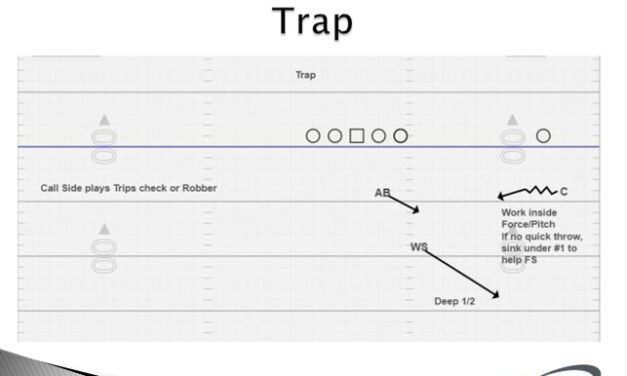
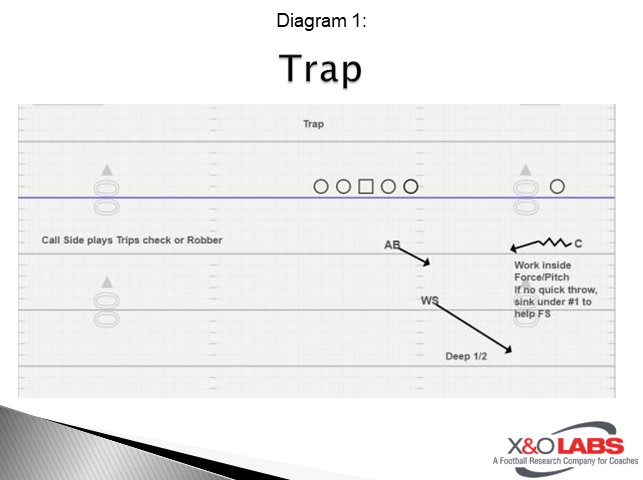
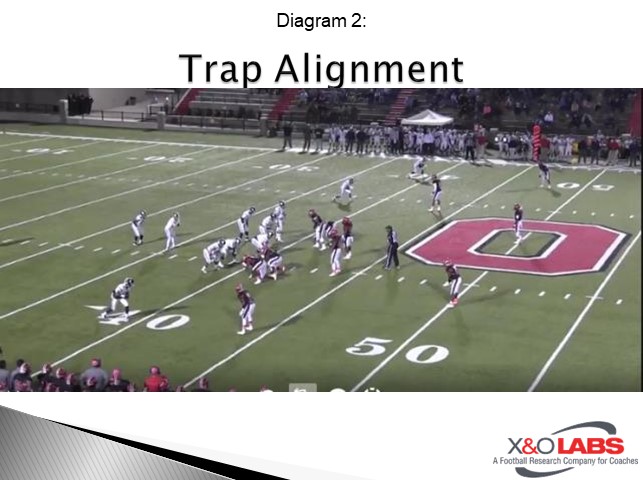
In this report I am going to discuss two coverage concepts that we use against trips sets. In short, we like to use a “trap” coverage away from trips and “cloud” coverage to the trips side.  We are starting to see more perimeter run game to our away side, which really puts stress on our away backer and our weak safety. By running trap to that side, we can get quick run support from our corner (usually the boundary corner). Cloud is a check we use if we are facing an offense that incorporates RPOs and runs to the trips side. We are constantly trying to find a way to get an unblocked defender to the ball and we feel both of these coverages help achieve this goal.
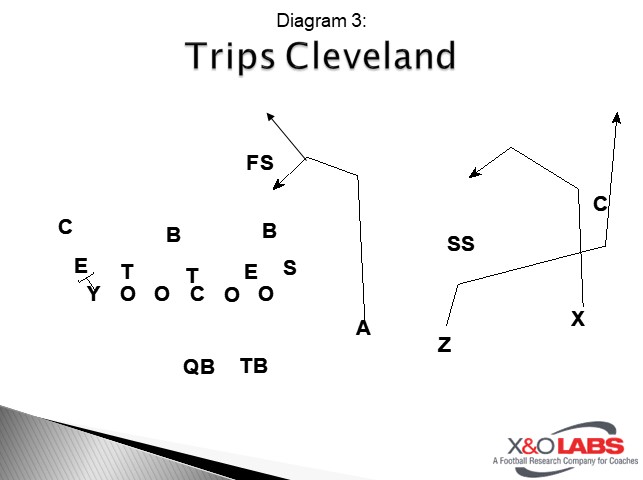
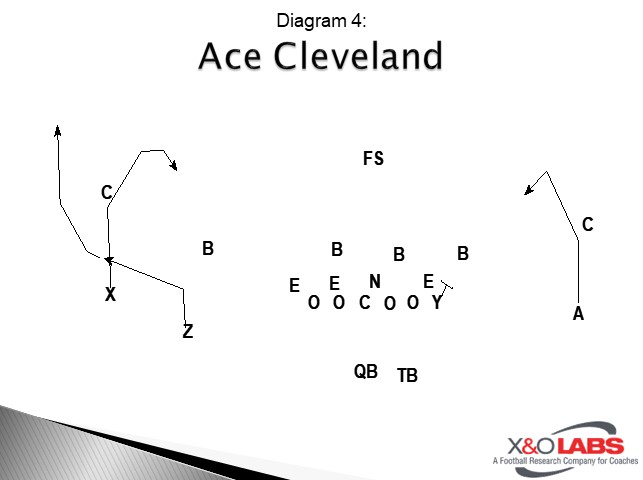
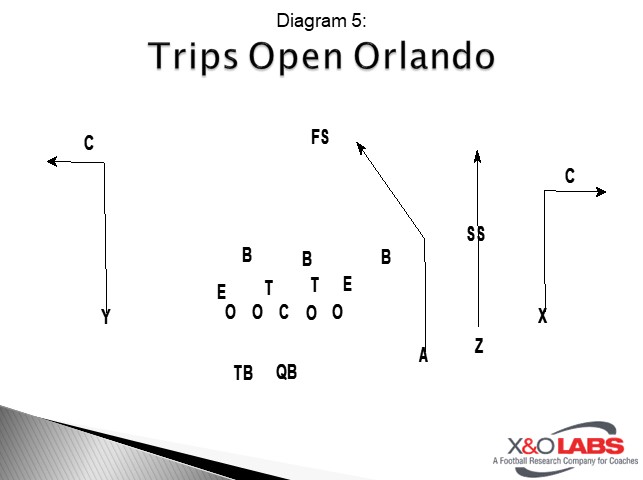
We are a split field coverage team, so we are always trying to give the opposing QB/OC different looks to our away side. Our away side is side with our weak safety, away backer and one of the corners and our call side involves our strong safety, free safety and the other corner. The WS and AB are always tied together and are usually aligned to the boundary unless the formation takes them to the field. The FS and SS are together and line up based on the passing strength. 
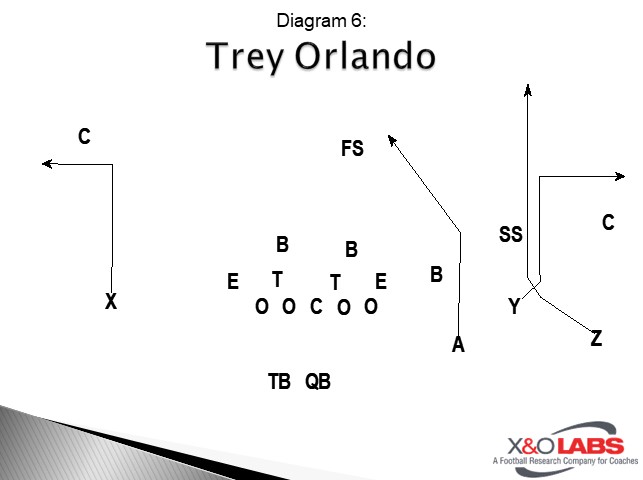
Trap has become our way of running a version of an old school Cover 2. It also helps us with our “cowboy”(corner blitz) because they end up looking very similar. Trap also gives us an opposite coverage to our “sky” coverage with the WS rolling down. We teach the WS and Corner that trap and sky are essentially the same coverage with the two players exchanging responsibilities.

Cloud is a trips check that helps us when we are facing an offense that has a perimeter run game to the field/trips side and uses bubbles or stand screens off of a zone/power look (RPO). Cloud is going to involve the FS, SS and field corner unless the offense aligns trips to the boundary. If trips is aligned to the boundary, the BC will now have to play cloud.

The way these two coverages are tied together is the techniques and rules for our corners. We play with a boundary and a field corner, but we also cross train each corner so that they can play either side in case of injury or if they can’t get lined up in time. Corners for us must know how to play to the away side and the call side.

Coaching Points for Trap Coverage

Slide1Slide1

Defensive rules for each position boil down to alignment, assignment and run to ball. We give each position the following three categories for what can happen on a play:  run to you, run away from you, and pass.

Corner – Alignment will start with our base alignment of 1 x 5 outside. When the ball is snapped, he should be inside the #1 receiver far enough that he can’t be blocked by #1. The corner will now read the QB for run/pass.

Read More

Mid-Season Wrinkles for Tempo Inside Zone RPOs

By James C. Gower
Offensive Line Coach
Tomball Memorial High School (TX)
Twitter: @Coach_Gower

Introduction

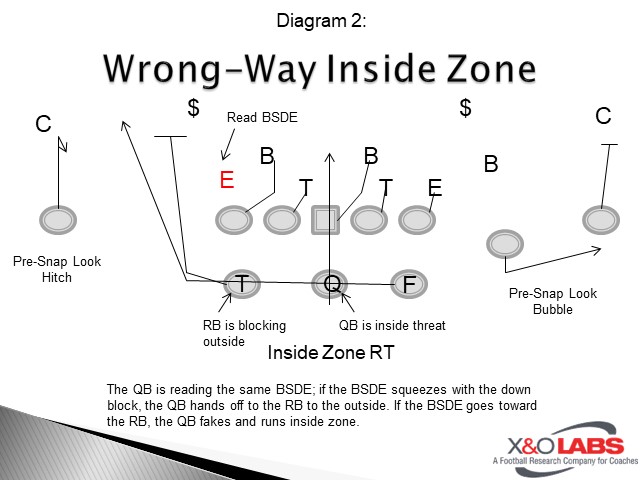
Zone read is no longer the new thing. Over the past 10 years, defenses have done a good job of catching up with the play and forcing offenses to look elsewhere to steal yards. While I still feel the zone read is a play that can consistently get your offense a consistent four yards per play, I think that offensive coaches need to add more wrinkles to slow the defenses recognition of the play. The “Wrong Way Inside Zone” has been our main wrinkle and this article will go over multiple ways you can incorporate it into your scheme.

Wrong Way (Inverted) Inside Zone

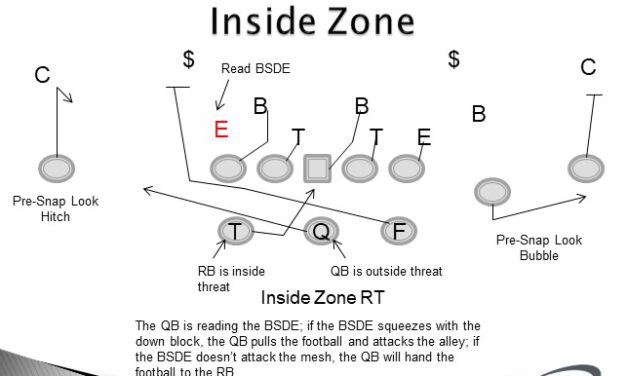
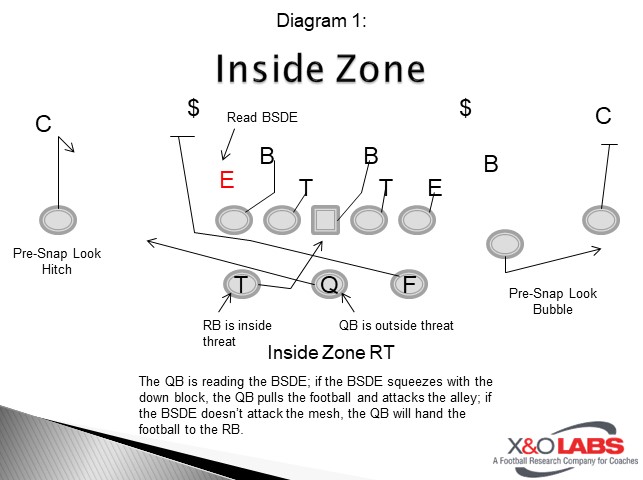
The Wrong Way Inside Zone is simply inside zone blocking with the RB and QB exchanging responsibilities. In the normal inside zone, the RB is the inside running threat and the QB is the outside running threat. Conversely, in wrong way inside zone, the RB is now the outside running threat, and the QB is the downhill, inside running threat.

Slide1Slide1

As you can see in the diagrams, we use a “numbering system” to block our inside zone. The rules are as follows:

Blocking vs Even Front

Play Side Tackle– Base block the play side #2 down lineman. He will double with the TE to alley defender if he has a TE or Slot with him.

Play Side Guard and Center – “CAGE” double team (center and guard) the play side #1 down lineman to the play side linebacker.

Backside Guard and Backside Tackle – “TUG” double team (backside tackle and guard) the backside #1 down lineman to the backside linebacker.

Blocking vs Odd Front

Play Side Tackle and Play Side Guard – “TAG” double team (play side tackle and guard) the play side #2 down lineman to the play side linebacker.

Center and Back Side Guard – “COG” (center and backside guard) the nose (#1 either play side, head up, or back side) to the back side linebacker.

Read More