
Defending 3rd Down with Efficiency

By Jordan Langs
Defensive Coordinator
Wheaton College (IL)
Twitter: @Coach_Langs

Introduction

Getting off the field on third down is critical to winning football games. Here at Wheaton, we have had very good success on third down over the past few years. Last year, we finished 6th in the country in that category while also finishing 5th in scoring defense and red zone defense. We attribute this success to our approach on third downs. Here is a look at the keys to getting off the field.

Don’t Forget 1st and 2nd Down

For our defense, the emphasis on 1st and 2nd down has become about executing our fundamental schemes, fronts, and coverages. We believe that early downs are when offenses have the most flexibility and variety. It is when we feel like we have the least amount of control of the scenario because the offense’s options are all at their disposal. Because of this, we end up at our most fundamental and conservative on 1st and 2nd downs. If we start getting into a guessing game and try to match their variety, we think that puts us at a disadvantage.

So in these early downs, we focus on what we can control, which is our discipline, technique and effort. From an install and teaching standpoint, we are a 4-man front and want to be very gap sound in the run game. In the pass, we are most comfortable in match quarters type of schemes with a ton of focus and teaching placed on being great pattern-read pass droppers. So this is what we want to focus on in those early downs. If we decide to deviate from that and exert a little more risk with pressure or line games, our kids must have a cerebral understanding of where and how we are increasing that risk.

The factors that go into the decision to take some risk, obviously depends on things like field position, opponent and game plan. The players understanding weakness and objectives of certain calls are important on every down, but especially important on 1st and 2nd. By them understanding what we are trying to accomplish in each front and coverage, it enables them to have a grasp on how best to get the offense in 3rd and medium to long situations. 

Get In the Driver’s Seat

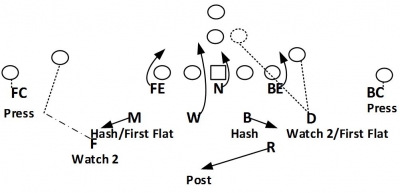
Getting in the driver’s seat as a defense in this age of football is not an easy task, as outlined above. We see 3rd and medium to long as one of the lone times that we get a chance to drive the bus and dictate some things to the offense. If and when we get in these scenarios, we do not want show up without a plan.

A large part of that plan is trying to make both the Quarterback and the Offensive Coordinator unsure of what they are looking at. As we all know, the up-tempo style of a lot of offenses allows them the opportunity to change plays multiple times before the ball is snapped; with a lot of the changes being dictated from what the Offensive Coordinator sees from the press box. We know that we are not just trying to keep the QB guessing but also his play caller.

One approach to try and handle those late play changes is to go ahead and try to change your own defensive call in order to counteract what the offense is trying to do. We will do that occasionally, but it is not how we prefer to counter the play change. Largely, we would prefer to counter 3rd down (for the sake of this topic) offenses by having multiple options and facets that allow us to feel like we can stay in the call we want and execute it regardless of the offense.

Read More

GMC’s 3-Deep Coverage Structures to Defend Perimeter RPO Concepts

By Mike Kuchar
Senior Research Manager
X&O Labs
Twitter: @MikekKuchar


Introduction

The following research was conducted as part of XandOLabs.com special report on “Defending RPO and Triple Option Concepts.”

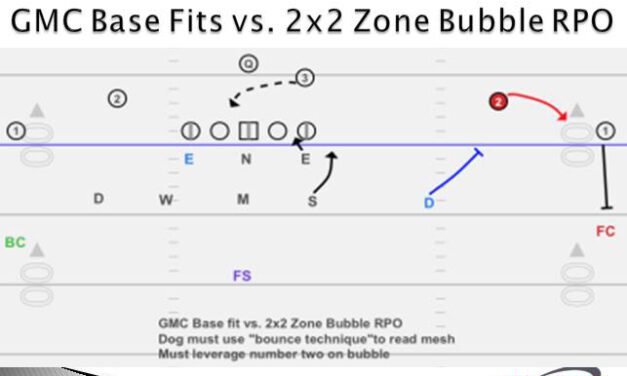
Much of what Coach Manchester does is out of a three-deep shell. “We want those outside linebackers to bounce, bounce and get a run/pass key on the end man on the line of scrimmage,” said Coach Manchester. “He won’t shuffle inside because teams will throw the bubble right away and it’s a pitch and catch. When we play three deep zone the Dog will be over number two five yards from the line of scrimmage and six yards from the receiver. They will bounce, bounce to get their run/pass key and then if it’s pass their eyes go straight to number two to reroute him. We read pass routes.”

Read More

Multiple One-Word Play Calls for Tempo Offense

By Heath Feldman
Wide Receiver Coach
Springboro High School (OH)

Introduction

One of the biggest negatives to running a tempo offense is the potential for running or throwing into a bad look. The concept of being able to call multiple plays while using a single code word allows for protection against this. We have incorporated 3 of our base runs with a base quick game pass and included an RPO / Relief into one-word calls that include the formation, play direction, and snap count.

In our system, the one-word calls are communicated to the players through signals and large posters. Each run concept is paired with a specific formation and the one word call also determines whether the formation strength is to the right or left as well as determines which direction the play is to be run. For example, all our one-word calls may consist of NFL cities for plays run left and NFL nicknames for plays run right. With the one word, we always let the linemen know which direction the run play is to be run and we then rely on the skilled players to know which side to set the formation. For our 3×1 Inside Zone we may call it Cleveland or Browns. If the call comes in Cleveland the “L” tells the line we are running inside zone left and the receivers know that the corresponding formation to this play is Trips Right. The call is then echoed by the players to insure they line up as quickly as possible and are ready to execute the play at the ready-for-play whistle. It is then the QB’s responsibility to run and execute the correct phase of the one word play that is called.

In regard to usage, one of the best things we found out about the one-word calls is that they are effective in most situations. There were times when we felt our team needed a little boost of energy so we came right off the sidelines using them to start drives. We also used them frequently after a big chunk play when we felt we had the defense on their heels. Most often, however, we used them when we wanted to play as fast as possible at a time when we felt the defense was tired or vulnerable.

The other aspect of these calls that we really liked was we could call the same play multiple downs in a row and not worry about the defense hearing the same call. In addition, playing at break neck speed forced defenses into base calls and limited what they could do in regards to their blitz packages and coverages.

3×1 Inside Zone

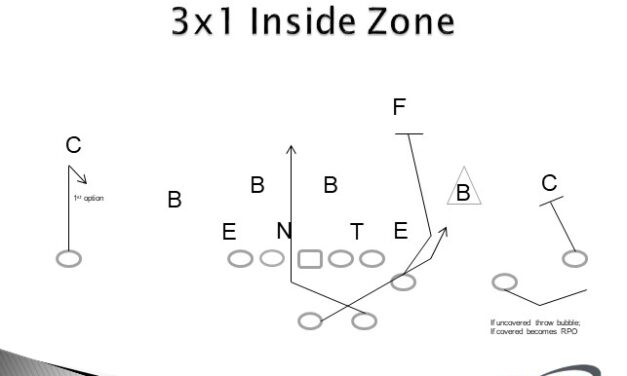
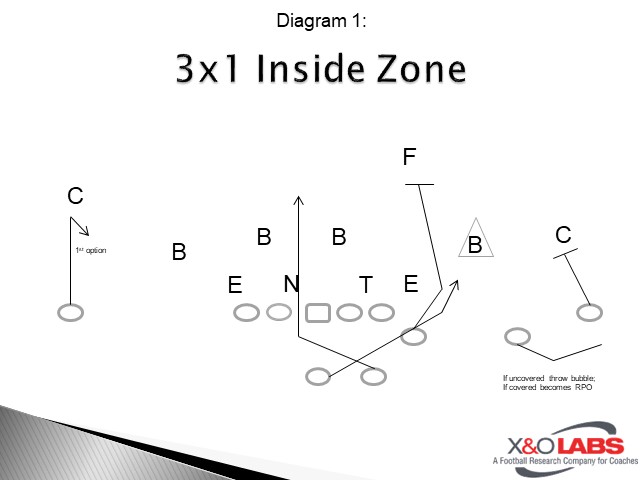
Our base run is inside zone, which we like to run weak out of a 3×1 set with a tight wing. We have married our inside zone weak with a quick hitch to the single receiver. Any time the quarterback has a free line of sight to the hitch we want him to take it. If he does not like the hitch look he quickly checks our #2 receiver for an uncovered bubble look. If #2 is covered he executes our inside zone read. The RPO happens if the QB pulls the ball on zone read. He will then attack and read the flat defender thinking run until the defender commits to him at which time he will throw the ball to our #2 who has slow played his bubble technique.

Slide1

Coaching Points

OL: Run inside zone weak

RB: Run inside zone weak. The QB will alert if he is going to throw free release hitch to know to stay out of his way.

Single Receiver (X): Run hitch route

Outside Receiver (Z): Stalk block

Inside Receiver (W): If uncovered run full speed bubble; if covered crawl to bubble (make sure to always stay behind QB in “pitch relation”)

Read More

2-Back Snag Vs. Two-High/One-High Coverage Structures

By Mike Kuchar
Senior Research Manager
X&O Labs
Twitter: @MikeKKuchar

Introduction

The following research was conducted as part of XandOLabs.com special report on “Spread Passing Study: Snap Concept.”

Run-Action Variations

Snag off Two-Back Isolation and Power

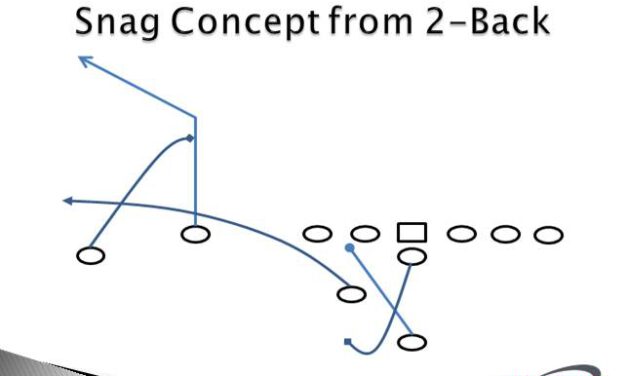
When the yardage shrinks inside the red zone, so does the probability of man coverage, which is why man coaches are employing some form of run-action to their snag concept in the red zone. Kyle Lowman at Bandys High School (NC) chooses to package his Snag concept out of two-back formations with various run actions including isolation and power. He will tighten his receiver splits and slide the fullback into the flat as the arrow component to the concept.

Lowman details this two-back Snag play-actions below against various coverages:

We wanted to combine the efficiency and potential of the snag concept with what we were best at – the I-formation and offset I-formation running game, namely the Isolation and Power plays. It also allowed us to make more use of the fullback in the flats, combined with a Smash concept in one play. Our bread n’ butter play has always been the Isolation, so we played on the needs of the defense to stop that to create open opportunities for receiving targets.

Coaching Points by Route:

  • Snag Route
    • Align no more than 6 to 8 yards outside Corner route.
    • If aligned on the LOS, squat for one count to let Corner route clear.
    • Run at 7 yd deep mark into the path of the Corner route.
    • If you pass a defender, sit down in window just inside him.
    • If next LB is buzzing hard and low, step around him to inside. If he is coming above you, pivot and work back out.
  • Corner Route
    • Hard and fast vertical release through OLB’s outside shoulder.
    • If he buzzes out hard, cut under him and get back on path upfield.
    • At 8 to 10 yards deep, stick inside foot, & accelerate away.
    • Take deep angle to sideline, looking over outside shoulder.
  • Flat Route
    • #1 goal is to WIN WIDE! Gain width fast, looking over low shoulder after clearing the traffic.
    • Be ready for quick throw if there is pressure or QB sees you with running room.

Coaching the Receivers

Read More

Affecting Run-Pass Options from the Odd Stack

By Nick West
Linebacker Coach
Parkview Baptist (LA)
Twitter: @nickawest1


Introduction:

The innovation of RPOs has become a nightmare for defenses over the past few years. This is due to the gap discipline needed for zone runs and high percentage routes that are basically glorified runs on the perimeter. It is really a true spread option that makes defenses cover so much of the field. Which leads to the fundamental question that DC’s are being forced to ask:

What coverage to play behind the front and how to fit and read the run?

Both split safeties and single safety looks have strengths and weaknesses in what the shell structure defends. The core 5 or 6 in the box of the defense has to have discipline and gap integrity to stop these zone run schemes. Think about the 6 Gaps in 10 personnel and 7 gaps in 20 personnel plus the extra hat that the running QB has to be taken into account. In my opinion, 2 back offenses can require 3 deep zone for the 8th hat closer to the line of scrimmage (LOS). The key is figuring out whom the read keys are and if the numbers in the core or perimeter defense will affect play calling.

The 3-3-5 can manipulate into a variety of fronts by either slanting, blitzing or alignment to confuse offenses and traditional blocking schemes while still maintaining the simplicity of 4-2-5 reads. The defense can be more calculated than a 4 man front by choosing where the 4th rusher comes from to affect a heavy tendency or down and distance. In addition, it is advantageous to have 5 defensive backs to defend RPO concepts.

In high school football, the majority of the game is played on the hashes which can give space advantages to the defense. In addition, we figure that high school QB’s are average to below average at throwing the forward pass. This limited space into the boundary makes throwing a boundary speed out much easier than throwing to the #1 receiver into the field which could end up being a 40 yard throw. Try and catch a tendency to see if this theory holds true. RB alignment can be a great run/pass tell and allow a defense to set great fronts or get into great coverages. Also another alignment tendency can come from an H-back alignments and wide out splits in relation to formation and MOF.  Talking to offensive guys from flex-bone to air raid, a common theme is highlighting the playmakers on their offense. So defend the comfort zones and what the offense wants to prioritize.

Component 1: Defensive Line Play for Hybrid Players

Defensive line play is going to be a huge key in stopping runs by either playing technique (LOS Control) or moving/slanting. Slanting a 0 technique nose away from the RB for heavy inside zone run teams can dictate what gap the ball is pressed. The nose can work up field after slanting into the play side A gap and having a back side A gap player which would be our Mike backer in base stack. So when the back presses and cuts back, a hat is in the back side ‘A’ gap ready to make a tackle.

Slide1

A tilt technique from the defensive end gives a better first step to squeeze on down blocks or zone away. Taking a 5 technique that’s square pre snap and angling him 45 degrees can allow a wide hip technique from the outside backers to make them hybrid core/perimeter defenders. This allows them to align with some width to get closer to slot while still be able to fit in the box. If you tilt a 5 technique, assume that he is a ‘B’ gap player because any base or reach at him is difficult because he is not square to the line of scrimmage (LOS) and first step is down LOS which makes it almost impossible to stay in c gap. Teaching three to four blocks to the defensive line can simplify the reaction and thought process a player needs to comprehend both mentally and physically. Not just about the initial read but the post snap read progression.

In the video link below, the End in boundary gets a reach block and fits in “B” gap and outside backer in boundary is  in Hip alignment. Also note that the 5 tech to the field is doing a great job of squeezing the block and spilling the football.      

Read More

WR Eye Discipline and Catch Mechanics Drill Work

By Adam Griggs
Wide Receivers Coach
Massachusetts Institute of Technology (MIT)
Twitter: @TheCoachGriggs


Introduction

There are countless clinics, diagrams, texts, and even videos out there on everything from releases, footwork, stemming a route, ball security, agility and explosive running with the ball. But often we forget that YAC (yards after catch) can not occur without the catch. Here is a basic progression of drills that can been used by wide receivers at all levels to gain a constant focus of “eye discipline” and proper catching mechanics.

Body Clock Drill

As our offensive coordinator, Keith Levan (former University of New Hampshire wide receiver) says that the key to developing as a wide receiver is to catch as many “bad balls” as possible. This drill is key to creating muscle memory of proper catch mechanics in 8 positions around the body as well as full extension above the head and just slightly “over the top.” We call this drill “Body Clock.” This is an excellent partner warm-up during pre-practice or during the offseason (in particular on a leg day).

Players start no more than 5-7 yards away or a distance that they can each accurately hit the spots “around the clock.” They throw the ball to the following locations in order:

  1. Eyes
  2. Left Shoulder
  3. Left Ribs
  4. Left hip
  5. Knees
  6. Right Hip
  7. Right Ribs
  8. Right Shoulder
  9. Eyes

They will throw the ball farther away from the body for additional challenge. Both players are working together, beginning from a loose position, and can have a slow relaxed foot fire, hands relaxed in the center of the body until the ball is thrown. When the ball is thrown, make sure the hands are loose and open, not clenched and snapping at the ball.

Coaching Points

We stress that the backside hand is quickly and efficiently crossing the body to the catch position. We also make sure the receiver is dropping his hips and eyes to the catch position. We will “freeze” the ball in place as we catch it, with eyes to the tip of the ball. Have players judge themselves by asking, “Am I catching the front end of the ball? Middle? Or back end of the ball?”  

Freeze and Catch and Lock Drills

Turning your head up the field early, or peeking for contact can lead to incompletions. But these only occur when a player does not see the ball into the fingertips of his hand and/or fails to follow the ball into a secure position. This process is called “Catch and Lock” and must become automatic for any great receiver.

Read More

In-Phase & Out of-Phase Technique Progressions for DBs

By Eliot Fields
Assistant Defensive Coordinator & Safeties Coach
Carroll University (WI)
Twitter: @CoachFields_CU

Introduction

We define being in-phase as the defender being in good position on a receiver. This means our defender is in a slight trail technique in which they are close enough to get their hand to the receiver’s hip while still maintaining a slight bend in the elbow. When we are in-phase, we are in good position to play the ball if thrown in our direction. We will utilize our wedge progression to teach our in-phase technique.

On the other hand, we will define being out-of-phase as the defender not being in position to make a play on the ball. This means the defender will need to play the receiver’s hands instead. When we are out-of-phase, we will utilize our disadvantage progression.

While some of the drills you will see here may be familiar, I firmly believe that the progressions we use to teach the techniques help our players fully understand the technique, as well as the “why” behind how we do things. Teaching a technique is one thing, but without teaching the student-athlete the “why,” we are not truly helping that individual become a better player. By utilizing these progressions, we are able to introduce the different aspects of our in-phase and out-of-phase techniques, identify when each will be used and ultimately tie everything back together.

Wedge Progression

As I stated above, when teaching our wedge progression we are saying that our defender is in-phase with the receiver and can make a play on the ball. We begin by teaching the wedge, as it is our best-case scenario. When we are teaching technique, we always want to teach the proper technique before moving on to contingencies.

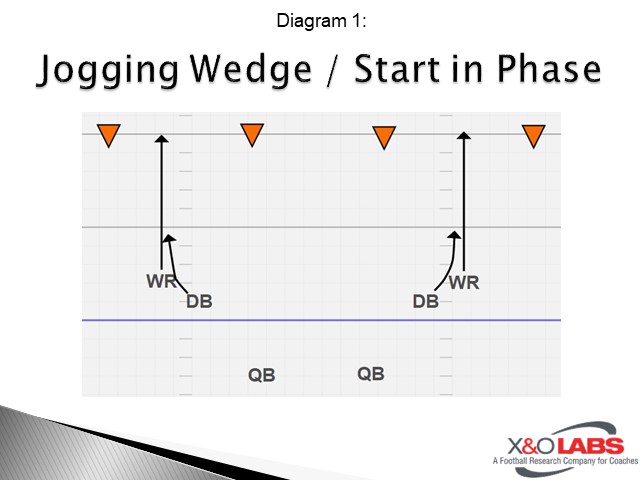
The primary focus of our wedge progression is getting into, or maintaining, proper body position on a vertical route by the receiver. This progression is broken into 4 phases:

  1. Jogging Wedge (w/o ball)
  2. Start In-Phase
  3. Mirror Breaks
  4. Full Wedge

Jogging Wedge

We start our progression by teaching the correct body position and posture. We want this drill to simulate perfect positioning against a receiver downfield. For this drill, we will slow down the tempo of the receiver and the defender, and eliminate the ball. The defender will start in-phase with the receiver, meaning that he has:

  1. Inside positioning on the receiver
  2. A slight trail technique (between ¼ and ½ man) on the receiver
  3. A slight bend in the elbow with the bottom 6 inches of his Ulna (DB’s outside arm) making contact with the inside hip of the receiver

On the whistle, both players will jog at 60-75% speed, with the defender looking to maintain this position on the receiver through the rep. The focus of this drill is 100% on body positioning and posture. The defender should be playing within their frame and under control throughout the entire rep.

Slide1

To study film of this drill, click on the video below:

Read More

Devising Sufficient Mid-Season Tackling Time (What’s too much, what’s not enough)

By Mike Kuchar
Senior Research Manager
X&O Labs
Twitter: @MikekKuchar


Introduction

The following research was conducted as part of XandOLabs.com special report on “Designing Tackling Systems.”

Practice Time in Tackling 

Once these issues are identified a decision has to be made on how much time needs to be devoted in-season in correcting these issues. Coaches are asked to balance the necessary time constraints made at every level of football with the priority that proper tackling warrants. We asked our contributors the following question:

What is your training method in teaching tackling? Do you do more of Circuit training? Grid training? Done on position groupings only? How much is done in-season?”


Contributor Key (in Alphabetical Order):

Joey Didier (JD): Defensive Coordinator, University of St. Francis (IN)

Vincent DiGaetano (VD): Defensive Analyst, Wagner University (NY)

Matt Entz (ME): Defensive Coordinator, North Dakota State University

Chris Kappas (CK): Defensive Coordinator, Mount Union University (OH)

Jamie Marshall (JM): Defensive Line Coach, Lindenwood University (MO)

Matt McLagan (MM): Defensive Coordinator, Northern State University (SD)

Jay Niemann (JN): Defensive Coordinator, Rutgers University

Mike Siravo (MS): Defensive Coordinator, Temple University

Eric Schmidt (ES): Defensive Coordinator, North Dakota University


Editor’s Note: All of the drill work mentioned below will be detailed with drill video in the later cases of this report.

JD: “We train our tackling in every practice through circuit training. One of our three coaches is the ‘expert’ on our staff in regards to one of our three tackling phases: track the near hip, shoulders roll through thighs, run or roll. That coach leads a drill in a ten-minute circuit daily either in full or no pads. We keep our players in their position groups as they rotate through the tackle circuit. In season, we spend about thirty minutes a week on defense with a ten-minute circuit on Tuesday, Wednesday and Thursday. We also spend 10-15 minutes a week on special teams tackling.”

VD: “We have a combination of training methods between circuit and position. We have developed within our circuit more position specific drills based on angles and frequency of types of tackles our position players are making. We also work on them playing off of blocks. In season, less time is spent on the circuit training and more time is spent working on tackling in individual drills. Realistically, a 5-10 minute segment is used each practice day with a tackling focus.”

ME: “We do a lot of circuit stuff early in spring and in camp. We make up a circuit that is a carry over for all groups, but then as we progress into fall camp we will do more position specific. It’s hard to mimic defensive line tackling. There are a lot of one-arm tackles going on up front. A defensive lineman only does those things with half his body. What we do three weeks before the national championship game, we will go back and treat it like fall camp. We go back to day one stuff where we are going circuit stuff again. If we are not going to have a circuit, we will try to find a way to get a tackling finisher in INDI for your first five minutes. For circuits, we will do a five-minute circuit in-season for five minutes total because we use 24 periods and exactly two hours full pads. We are always in a thud mode when we practice. We are getting ample tackling examples in practice. Emphasis is not taking him to the ground. Tackle high, keep eyes up and let go once we feel the thud. We let backs and receivers finish.”

CK: “It’s all circuits, but in some of the stuff we will do individual instruction. We don’t say we’ll work ten minutes of tackling, but each coach will find a way to work it in his drills at least once a week. We will do a circuit or drill every single day.” 

JM: “We will use one or two days during the season at five minutes per day. They are position specific and where we are going to be in space making tackles. If they are a 22 personnel team, then we need to work more in the phone booth or will be spread out in space. It’s specific to game planning that week.”

MM: “Our tackling teaching is primarily done in circuit training and defensive group drills. The process starts with multiple days of circuit progression and leads to defensive group drills. At that point, we will recycle the drills for repetition or evolution. Position groups will also integrate position specific tackling within their individual time. We will not reach this point until we feel we have a sufficient foundation to our tackling system. Our tackling system progression will take us through five practices (progression: static drills, on-feet drills, on-feet tracking drills, finish drills, full defensive group drill). At this point, we will recycle drills for repetition or evolution. Position groups will integrate position specific tackling within their individual time. After our initial progression, we will practice a tackling area of need/choice in approximately two-thirds of a week’s practice.”

JN: “Our individual drills are centered on the problems we’ve had in the previous day’s practice sessions. Defensive linemen may not need the same work as defensive backs do such as open field progressions. It’s a combination of circuit and individual tackling. We would like ten minutes of the circuit in fall camp and then five minutes of the

Read More

Practice Methodologies in Defending RPO/Triple Option

By Mike Kuchar
Senior Research Manager
X&O Labs
Twitter: @MikekKuchar

Editor’s Note: The following research was conducted as part of XandOLabs.com special report on “Defending RPO and Triple Option Concepts.”

Introduction:

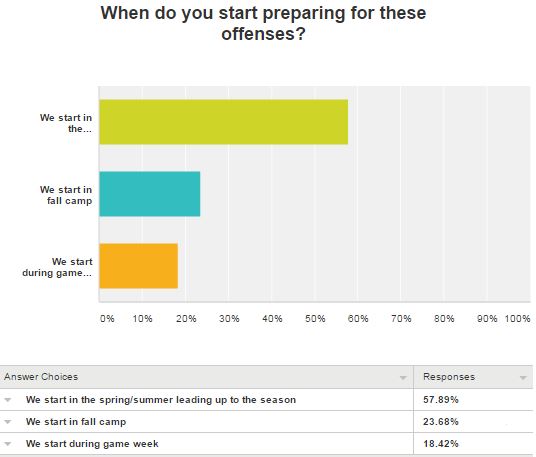
It’s impossible to defend these schemes during the course of a game week, which is why most coaches don’t. We’ve found that the majority of coaches, 57 percent choose to start preparing for triple option offenses in the spring or summer leading up to the season (See Graph Below). So, we reached out to those coaches who have won at least half their games against these schemes to tell us exactly how they prep for these offenses.

chart9

Practice Planning Flexbone Option:

Shawn Quinn, the defensive coordinators at Western Carolina University, adopted the following practice philosophies when defending triple option concepts:

  • Teach half/part/whole
  • Start half line than progress to full line.
  • Start with defensive line and back seven split up.
  • Start in the spring devoting time to defending the option every day.
  • Do a technique circuit which includes arc, load and cut work.
  • During the season, set aside time every day to practice basic option fits. We use ten minutes every Monday practice.
  • Work option fits during bye weeks.
  • Do as many drills without a ball to have defenders go to their responsibilities.
  • Rep every call verses one play. For example, use dive option weak vs. every defensive call you have.
  • Rep every play vs. one defensive call.
  • Use a perimeter blocking drill with cut blocking.

Half-Line Methodologies:

Jay Brophy, Buchtel High School (OH): “Set up half line group work on assignment football. Two half lines set up going left and right, rotating defense so they get looks going both ways on option.”

Jared Ocker, Sioux City East High School (IA): “We do half line fits all week against the various phases of the options. We use scout team cards and do not use a football. We will work on getting hands on and blocking down step down. This is also the time where we will script in our line stunts and blitzes.”

Jim Dawson, Trinity University (TX): “Split drills…a-b gap reads and games, c-d gap reads and play all before coming together in a team option drill or script.”

Team Defense Methodologies:

Gary Phillips, Conestoga High School (PA): “We practice a whole defense drill that works all phases of the option (dive/keep/pitch). We work on this for 10 minutes every practice in preparation.”

James Cook, Smithfield High School (RI): “Pursuit drills. Making sure our defense is running through the dive to QB then to the pitch.”

Read More

9 or Hitch Option (Bruise) Concept

By Jerald Pierucci
Head Football Coach/Offensive Coordinator
Shafter High School (CA)

Introduction

The hitch/9, 9/hitch and Hitch/Hitch concepts are staples for nearly all passing offenses.  We have recently combined these two concepts into one play call giving your offense the capability to hit the homerun ball and take the five-yard hitch without a check at the lines or coaches checks from the sideline. This is a concept that can be installed in one practice period, and ran at any time on the field. 

Necessity for Flexibility

Being a tempo/no huddle team. The ability to be flexible in play design (not complicated) is critical for us to play fast and have success on offense. With defenses becoming more flexible in coverages, we found ourselves relying more on “check with me” calls. While we are not against using “check with me’s,” the slow down allows defenses to change coverage while you are trying to change your offensive call.

A concept we use a lot is the Hitch/9, 9/hitch and all hitches. Each one is good against certain coverages, but can be taken away against others. As a play caller, I found myself calling an all hitches and a defense would align in 4 across all sitting at 5 yards, or other times calling 9/hitch and the defense aligned in Coverage 3.  Over time, I felt that it was more about getting lucky on having the right call at the right time.  

For that reason, we started using check with me and sideline checks to get into the right play. This was successful at first and we were able adjust to what the defense was aligned too. We continued this until we came against a team that stemmed alignment every time we checked.   

This last set back, made us really look at the play and decide to make it a pre-snap option that would put the decision the hands of the defense. We let their alignment dictate the route that will be ran. This is ultimately what allows this play to be successful. No matter what alignment or coverage the defense is in, we had an answer.

Necessity for Simplicity

When I started toying with the idea of putting a hitch/9 option route concept together, I started looking at the post snap option routes that were out there. After messing around with it at practice, it was obvious to me that at the high school level the post snap option was not a good option for our program. It was too complicated, and the time commitment to it was too great and the payout was too small.   

Read More

Differentiating Cut Block Technique Off Play Concept

By Ryan Schleusner
Offensive Line Coach
Fairmont State


Introduction

The cut block can be a highly effective weapon in almost any offense when used properly. A well timed and executed cut block can level the playing field at a position where you are usually athletically outmatched by the guy across the ball from you. The effects of these blocks include:

  1. It immediately takes the defender you are tasked with blocking out of the equation on the play.
  2. It can put a great deal of doubt in a defender’s head about how hard and fast he wants to play when he knows there is a good chance he will wind up on the turf if he goes full speed.

We teach cut blocks throughout our offensive structure. They can be used in any of the following concepts (each of which I will detail later in the report).

  1. Quick game pass protection
  2. Backside of outside zone
  3. In space on screens
  4. Reverses
  5. Draws
  6. Trick plays
  7. Backside punch/hinge on gap plays
  8. Down blocks in any pin/pull type of schemes

Cutting in Quick Game Pass Protection

The main goal of a cut block in quick game pass protection is to get a defender’s hands down so that the pass does not get tipped and intercepted. Even if the block fails to get the defender all the way to the ground, a properly time cut and where the player accelerates his body into the defender should succeed in forcing him to put his hands down. Thus, his hands will be unavailable to swat down a quick pass. The biggest coaching point in cutting while in quick game pass protection is to make sure you get into your pass set quickly (high hat). This will tip the defender off that it is a pass play and get him to fire off the ball quickly. 

As with anything in pass protection, it is important to set to a landmark. When pass setting to set up a cut block, it is important to be aggressive while maintaining a half-man relationship. We teach them to aim for the inside number of the defender and to get there quickly. The lineman must avoid being too far away from the defender when the timing is right.  

As a base quick game rule, we talk about getting at two or three kicks before throwing a cut block (depending on the speed of the kick and athleticism). As the defender comes towards them, it is important to wait until he is an arm’s reach away then he should drop his shoulder and drive off his far foot. He is aiming to get across his body on the cut. As he drops his shoulder and accelerates his body, we talk about throwing an uppercut aimed at the inside groin of the far leg. This will help accelerate your body and provide enough torque to finish the block cleanly.

It is important for the players to remember to communicate when they are cut blocking. The players next to them need to know of these intentions so that you can work together do not get called for an illegal chop block.

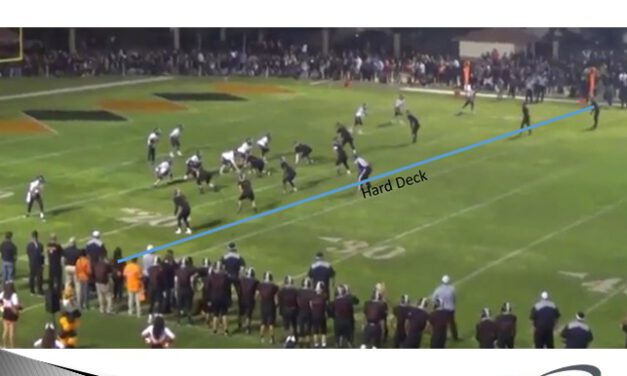
Film Notes: In this first clip, you will see the left guard take a good set, accelerate his body efficiently and finish the cut block by taking the defender to the ground. Both the right tackle and right guard in this clip have near misses for separate reasons. The right tackle attempts the cut too early which results in him missing his aiming point and make contact more towards the shin area than the groin. Because he executes the block quickly and with a good amount of force, he still makes a good impact on the defender.  The right guard’s block is unsuccessful because he does not accelerate his body fast enough and does not finish with an uppercut. This makes the contact weak and results in the defender not reaching the ground. The left tackle opted for a quick set, which can be a good option if you don’t feel confident the defender will be coming off the ball hard enough to get a good cut.

Read More

Splatter, Leverage and Rip Thru Block Destruction Drills for LBs

By Freddie Aughtry-Lindsay
Defensive Run Game Coordinator / Linebackers Coach / Pro Liaison
Campbell University (NC)
Twitter: @31_CoachFAL

Introduction

Here at Campbell University, our linebacker unit uses a number of block destruction techniques as tools to give us the best chance of being productive and effective at our position. At the linebacker position, you must be able to meet and defeat blocks with great technique and effort. The job of defensive players is to get to the ball carrier as quickly as possible while also being physical at the point of attack. The four block destruction techniques that are taught and discussed daily on our team / within the linebacker core are as follows:

  1. Spill & Leverage
  2. Splatter
  3. Rip-Thru.

Throughout this clinic report, these four block destruction techniques will be discussed in detail.

That said, no matter what technique is being used the most important components of block destruction are to always have active eyes, feet and hands. When using any of the techniques listed above, we want to always attack half a man when approaching a blocker. Ultimately, this allows us the best opportunity to get off a block and pursue the ball carrier. Attacking half a man also allows us to keep our off hand free, which increases our ability to make a play. We never want to be head up on the blocker because this blocks our vision and gives the blocker the ability to engage. Lastly, it is imperative that we know where our support is at all times within the defense so we can fit on the correct side of the blocker.

Techniques #1 & #2: Spill / Leverage Technique

The first techniques taught at Campbell University are the “spill” and “leverage” techniques. These techniques are used when taking on a blocker and we want to send the ball either towards the sideline (spill), or towards the middle of the field (leverage). The first thing we want to do is see the blocker and approach him with bent knees, attacking only half a man. The defender’s feet must be shoulder width apart with our foot nearest to the blocker slightly in front of the other. We do this because we want to attack the blocker with the same arm and same leg (ex: right arm/right leg). This gives us the most power to effectively destruct the blocker. The player must now shrink his elbow into his rib cage and ball his hand to make a fist. In doing this, we are using our fist, forearm, core, and shoulder to create a “shield” to alleviate impact from the shoulder. This ultimately protects our shoulders from injury.

Read More

Rule/Route Conversions for RPO Concepts

By Brent Eckley
Head Football Coach
Jackson High School (MO)
Twitter: @jacksonfbnation

Introduction:

At Jackson High School, we’ve sound some success in using RPOs to help us read different defensive players, as opposed to the more traditional concept of reading the backside defensive end on run plays.  We also make use of these types of plays, but we’ve found some ‘easier’ yards with changing up who we are reading play to play.

The two RPOs that will be covered in this clinic report are our most successful over the past two seasons.  The first is an RPO off of our outside zone or stretch play with the QB reading the backside inside linebacker. The quarterback has the option of giving the ball the running back or passing the ball to one of our backside receivers. The second RPO is based off of our quarterback outside zone or stretch play. The quarterback is now reading the front side force player. He will either run the ball or throw to one of our front side receivers. For the sake of this report, we will show the run plays and the corresponding RPOs out of 3×1 sets out of 10 personnel.

RB Stretch RPO

This concept is based in our outside zone concept. Our offensive line will take a minimum of two foot width alignment and we try to align deep, at the center’s hip.

Our rules for blocking the stretch play is based on covered or uncovered rules much like many teams that run outside zone. Covered linemen are taught to drop step and reach. We coach to run the feet and try not to close our hips too soon on the reach. If we close too soon, the uncovered lineman won’t be able to push us off to get to the linebacker. We teach our uncovered linemen to three step climb. His eyes are on the nearest defensive lineman to the play side. The uncovered lineman will drop step, crossover and run, trying to overtake the reach block of the covered lineman. If he can’t get there in 3 steps, he will then climb for the linebacker. If he can get there, he will push off the covered lineman to the linebacker and overtake the reach block, trying to close his hips as soon as possible to maintain the reach block.

Slide1

To make this play an RPO, we have matched up our most versatile quick pass concept with our stretch play. The following slides will list coaching points for this pass concept for our receivers and quarterback.

Slide2Slide3Slide4

Read More

11 Personnel Jet Sweep Concepts from Compressed and FIB Structures

By Bill Turner
Offensive Coordinator / QB coach
Buckeye High School (OH)
Twitter: @BillTurner6684

Introduction

Our version of the popular jet sweep concept is slightly different than most because we do ours from tight or compressed formations. We like running it to the field, but have had great success to the boundary as well. It has become important for us to have the ability to run it both ways based on how the defense is playing us. We will run it no huddle at a fast pace and also have the ability to check it to the best direction at the line of scrimmage. The jet also sets up our favorite run concept, the counter trey or QB counter trey.

Our goal of the jet sweep is to stretch the field horizontally by getting the ball to our best athletes moving as fast as possible trying to get it outside. We want to seal the edge with our last down lineman and our receivers. Our fullback will take on the outside force defender while working to hook him to the inside. If the FB is forced to kick him out, our ball carrier will adjust and take the ball into the alley. Later, we will cover several different ways to block this play depending on the defense’s alignment as well as using unbalanced formations to keep defense off balance.

Base Look

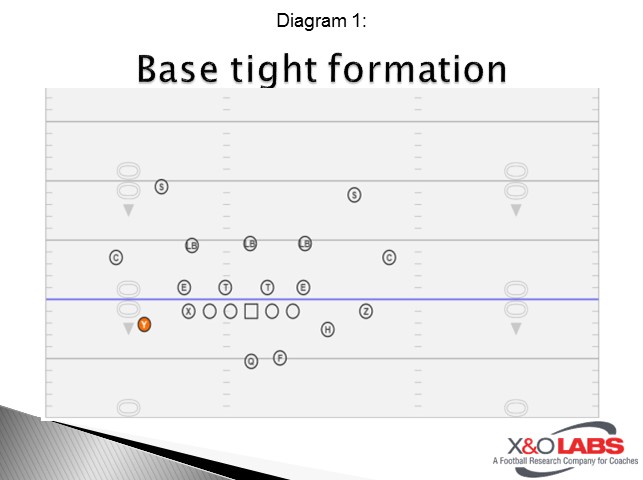
Our base formation for the jet is out of 11 personnel. We label our positions a little differently than most schools. F is fullback who is our best blocking back. X is our tight end. Y is our flanker also is our best jet runner. H is our adjuster and is our second-best jet runner. Z is physical blocker and deep threat.

Slide1

Base Blocking Rules for The Jet

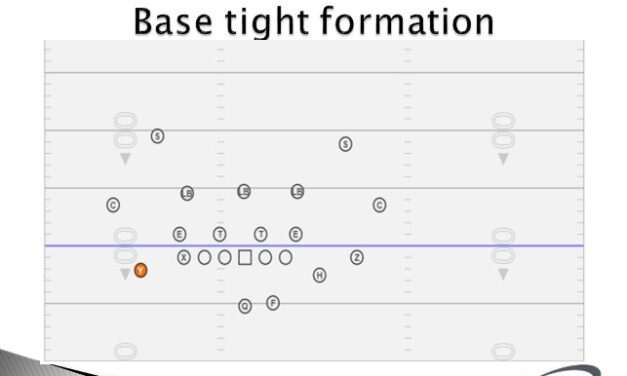
In the diagram below, we are in our base tight formation against an even defense. We are running the ball to the field away from the tight end. Our linemen are taking quick steps to the play side (known as gang steps is our terminology). We are stepping to the outside gap to hook that defender. Those to the left of the center are gang stepping as well but are looking to get downfield. If our tackle fails to hook the last lineman, he must continue to stay on him and run him up field or to the sideline.

Our H is coming down to the first man inside of him, which is often a linebacker. The Z will look for the most dangerous defender inside of him. If the Z is not threatened inside, he will go up field to the near safety. The H and Z will communicate with each other and may switch up their assignment based on the defenses alignment. Occasionally, we will have the Z take on the force man if he feels he can hook him or drive him to the sideline.

The F will take on the outside force man (usually a corner) aiming at his outside shoulder. If the corner stays wide, it turns into a kick out block.

The QB will bring the jet runner in motion with a hand signal. He is responsible for setting the ball in the jet runner’s belly and then carries out his Q counter trey fake.

Read More

Mixing Zone and Man Concepts to Defend 2×2 RPOs

Joe Ginn
Defensive Front Coordinator/LBs
Choctaw High School (OK)
Twitter:
@CoachGinn


Introduction:

Well, offensive coaches have done it. They’ve found a new way to bring back the Triple option and incorporated wishbone concepts of the veer into the Spread Offense with Zone Read/Bubble Schemes. I want to talk today about a very simple scheme that I believe we can all apply regardless of defensive scheme to attempt to defend it. The example I’m showing and accompanying video will show an Odd Stack, and a Base 4-3 Scheme. The key to incorporating this scheme is having the 2 safeties in the game and matchups you believe in. 

Scheme

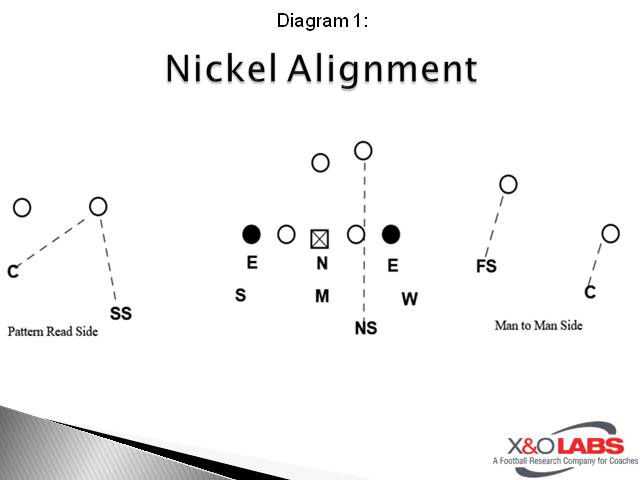
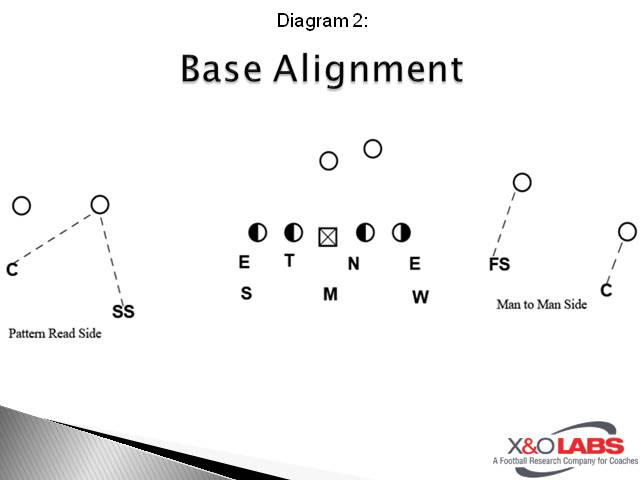
The concept we tried to use to limit this particular offense was playing man to man to the side we knew the Bubble/RPO was going to take place. We kept our normal Cover 2 Pattern Read Concepts in place on the other side. This particular team always offset their back, so we knew which side the bubble would be to, because we knew the QB would read the End to the side of the back and that slot receiver would be the one running the bubble. I’m going to focus this talk on their 2×2 set because it got a little bit more complicated to trips, and that’s a different topic here. We wanted #1 to be able to keep our LBs in the box and present to the Offense as much as possible a 6 or 7 man box to be able to stop the run, their run was much more scary than their pass (plus they were a spread to run team).

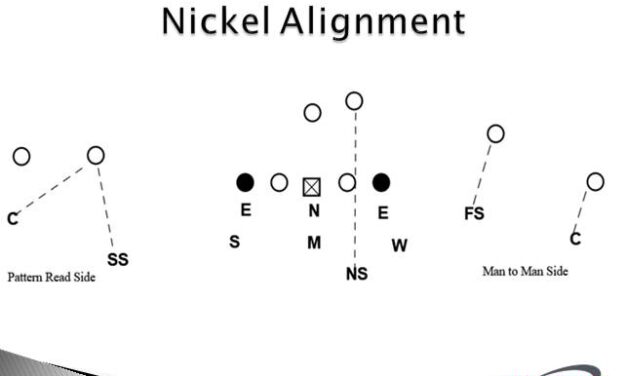
Our Scheme was to play Man to Man on the side of the back with our Safety and Corner because we knew this was the side the bubble or a slant would come from. While on the other side, we simply maintained our normal Pattern Read of #2 rules. Our Corner would squat on any out breaking route by #2 therefore, we could keep our LB on that side closer to the box because all he had to do was get to the curl area to defend any curl/slant, or be able to help collision the vertical of #2, but again we wanted his primary focus to be defending the run game.  You’ll see this concept diagrammed in Diagram 1 & 2, Diagram 1 is our 3-3-5 Nickel Concept, Diagram 2 is our Base 4-3.

Slide1Slide2

Defending the Run

As far as our concepts vs. the run we wanted them to be fairly simple.  We always play “Big” gaps vs. the Zone.  What I mean is the LB’s are assigned a gap based on alignment or movement of the D-Line so they are to fit their “Big” gap vs. Zone Concepts by the offense.  In the Nickel we wanted to force the QB’s hand a bit, so we slanted the front away from the back. We simply called “Away” with our playcall to alert the D-Line we were slanting away from the back. We played head up 4’s with our DE’s and the Nose played a head up 0. Our Linebackers were responsible for fitting big gaps vs. Zone, this put Sam in B gap strong, Mike was responsible for the Weakside A-gap, to take away the cutback if the Back read the Nose, and Will was our Gap exchange guy for the Cutback or a QB Pull.  e was told to fit tight to the Hip of the DE’s starting alignment of a 4 and tackle the 1st threat to show.  e also tried to steal the Nickel Safety in the run game by lining him up at about 8 yards depth and put him over the back.  e was responsible for the back.  e told him you’re the guy the Offense can’t block so if it’s run go tackle the running back. I’m not sure how many tackles he had, but this is the part I’d work to fix if I used this scheme again.  Honestly I don’t know if we had an aggressive enough kid playing here. 

Read More