
Slide-Step Off Man Technique Teaching & Drill Work

By Steven Dudley
Defensive Backs Coach/Special Team Coordinator
Fort Hays State University (KS)
Twitter: @CoachDudleyFHSU

Introduction:

Throughout my coaching and playing career, I had always taught the traditional back pedal off man technique. I was confident in my ability to teach it, it was always what I had used, and I knew it worked if executed correctly. A few years ago, I could not help but notice the rise in popularity in higher levels of college football of the slide-step technique and my players were noticing as well. With our defensive philosophy moving to more of a quarters scheme and my players wanting to use the technique, I decided to start researching the technique to make the switch.

Once we made the change, I ran into an issue. There is not a lot out there on teaching this technique. I spent a lot of time going to different FBS camps that I knew used the technique and poured over a lot of All-22 film. From there, I was able to piece together enough information to create my own ideas on how I thought it was best to teach it and after some trial and error in my first spring of implementing it, I’m very confident in the final product of the way I teach this technique. The change made a big difference in the play in our cornerbacks and the results reflected this. We rose to the second best pass defense in our conference, our CB’s interceptions rose from 5 to 9, both of our starters were all-conference, and one was first team all-region. The technique is now a staple in our system and will continue to be as long as we are a quarters based defense.

Overview

Before I get into the specific details of the technique, I want to cover a few philosophical points of why I teach things the way I do. In my mind, good DB technique is all about being in the proper position to transition into your next movement. Back pedal technique has little to do with how fast a kid can go backwards. If that’s all we were concerned with, we’d just teach them to do a backwards run. It’s all about pedaling with tempo while trying to main the technical integrity to be able to have the best break/turn possible. The same applies to the slide-step technique. The benefit of playing a slide-step technique is that it’s easier to break on anything in front of you because of the position the body is in. I always want to maintain the position to be able to break properly at all times. We also man turn all outside vertical releases, so I want to maintain a position where we can make a clean man turn to the outside.

Stance & Alignment

I always teach stance with the guys standing on a field line. This helps make sure they’re cocked in at the right angle and their feet are placed correctly. They want to have their outside foot forward and their inside foot back. They should be facing in to the ball. Now, I teach to have them slightly angled in to the ball. I always refer to it as having your belt buckle pointed to the ball. The best way that I’ve found to do this is to use the field line where their front toes should just be on the outside of the line and their back heel should be just inside of the line.

Their toes should be pointed in to the ball just as their body is. Some coaches will teach to have the front foot pointed to the line of scrimmage, but I prefer that it be pointed to the ball because it makes it easier to adjust to the stem of the WR once we start sliding. Their feet should be slightly wider than shoulder width apart. The width of their feet should be the same as if they were going to shuffle laterally. Their eyes and their chest should be turned in to their man. This upper body position helps them keep their hips slightly cocked in. Maintaining this position is so important because if the hips get opened up, it becomes very difficult to man turn. The arms should be relaxed, although some of my guys like to have a little flexion in their arms. That’s not something is get too concerned about.

I always teach my guys to play 5-7 yards off and to play with inside leverage. The guys that are very good with this technique I let get up to 5 or 6 yards, but I always start the young guys at 7 yards. For leverage, their outside shoulder should be matching the inside shoulder of the WR. 

Stance Coaching Points:

  • Facing into the ball
  • Belt buckle to the ball
  • Feet slightly wider than shoulder width apart
  • Toes pointed to ball
  • Comfortable bend at the hips, chest over toes
  • Eyes and chest turned into the WR
  • Relaxed upper body

Frequent Issues to Look For:

  • Too open or too closed

Footwork

On the snap, they should push off the front foot. The push off should start at where the front pinky toe is. Once they push off, they should be up on the balls of their feet so they’re light on their feet and are quicker to react to stems. The slide technique is not a true slide. It’s a push-step-step cadence. They push off the front foot, step with the back foot, then step with the front foot to get in position to push again. They should never be dragging their feet on the turf.

Read More

Building Blocks of LB Block Destruction

By Jason Thier
Defensive Coordinator
University of Mary (ND)
Twitter: @jasonthier

Introduction

When it comes to defensive football, there are base fundamentals that hold constant regardless of the era the game is being played in, the level at which it is being played, or the scheme that is being implemented. When we talk to our defensive players about these fundamentals, we are referring to the things that we get to control on defense. These are the components that the offense cannot dictate. 

It all starts with the pre-snap fundamentals, like alignment and stance, that place the defense in a position to be successful before the ball is put into play. Once the ball is snapped, it is about being relentless in three basic fundamental groups:

  1. Getting Off the Ball: The fundamentals of a great first step and keys.
  2. Getting to the Ball, The fundamentals of pursuit and block destruction.
  3. Getting After the Ball: The art of tackling and taking the ball away from the offense.

Whether a player is on the line of scrimmage or playing in the secondary, these pre- and post-snap fundamentals must be present on every play in order for the defensive unit to have success. For this clinic report, I will focus on the post-snap defensive fundamental that often gets over looked, block destruction. I plan to outline how we teach our linebackers here at the University of Mary to attack and beat blocks and when we want them to “get dirty” vs “stay clean.”

Block Destruction

Next to tackling, block destruction is the most important fundamental skill every linebacker must master. With the exception of when a linebacker is being read on an option play or RPO, a linebacker is assigned to be blocked by an offensive player on every run play. With the primary responsibility of linebackers being to stop the run, block destruction is a skill that must be practiced every day until it becomes an unconscious reaction by your linebackers. For the purpose of teaching, I break down block destruction into these simple parts; mentality, base, hit, and escape.

Block Destruction Mentality

It all starts with the mentality. They have to want to do it and they must build the mentality over time. Here are the coaching points we use to develop the mentality that we expect.

  • “He comes, I come”: The linebackers must work to attack the blocker the same way they would attack a ball carrier.
  • “Be a hammer, not a nail”: Linebackers must be the ones delivering the blow, not receiving it. We want to be able to see the body of the blocker jolted or rocked back upon contact. Block destruction takes a certain level of physicality in order to be successful.
  • “Can’t go one for one with part time blockers”: If a running back or wide receiver is assigned to block a linebacker, it must take more than one of them to get it done. It is not ok to be occupied or blocked by part time blockers.
  • “Holding doesn’t exist”: If a linebacker is being held it is because he is allowing himself to be held. It is our job to make it so obvious that the ref has to throw the flag.

Building the Base

The most important part to a linebacker beating a block is having the proper base on contact. Without a proper base when making contact the linebacker is likely to get over powered on the hit or not be able to escape. Nothing else matters if the base is not correct. Here is the proper base on contact coaching points:

  • Feet should be shoulder width apart in a slight stagger no more than heel to toe relationship. The majority of your weight should be on the ball of the front foot.
  • The near foot toward the blocker is in front with the toe pointed at the crouch. Your hips will follow the direction the front foot is pointing. If your toe is pointed to the outside of the blocker all your power on the hit will not transfer to the blockers body.
  • The far foot away from the blocker should be back in the stagger. Your toe again should be pointed at the crouch of the blocker for the transfer of power on the hit.
  • The linebacker needs to be in a low compact position ready to explode. There should be enough bend in the knees and waste to have the crown of the linebacker’s helmet just under the chin of the blocker. The chest should be over his toes, with his shoulders back.

Going hand and hand with building a good base is being able to get to that base off a full speed approach. A linebacker must be under control when attacking a blocker in order to finish with the proper base on contact. Attacking a block on a full speed approach is where most of the common base issues will occur. Here are a few of the most common base issues that we see:

Read More

SHSU’s Quick Game Tags off its Run Concepts

By Mike Kuchar
Senior Research Manager
X&O Labs
Twitter: @MikekKuchar


Introduction:

The following research was conducted in part of XandOLabs.com special report on “Sam Houston State’s Air Raid Evolution.”


Slant/Bubble Tag

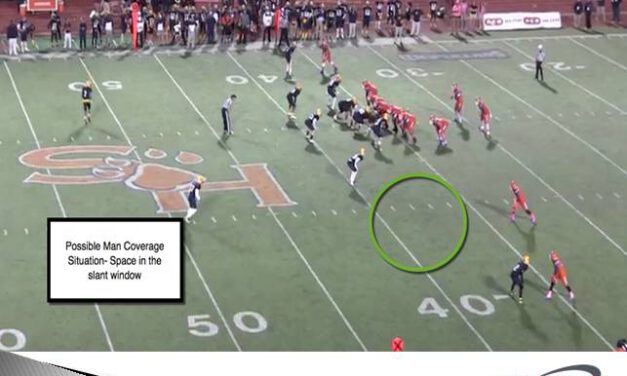
This tag is designed to attack man coverage teams where corners will run hard to defend the slant route. Number one runs a slant and number two runs a bubble route.

Where Space is Best Accessed:

Read More

10 Feet and Hands Drills for OL in Pass Pro

Anthony Vitale
Offensive Line Coach/Recruiting Coordinator
Southwest Baptist University (MO)
Twitter: @vitale_64

Introduction

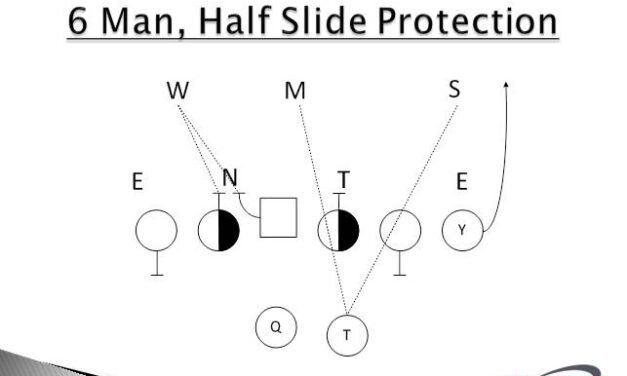
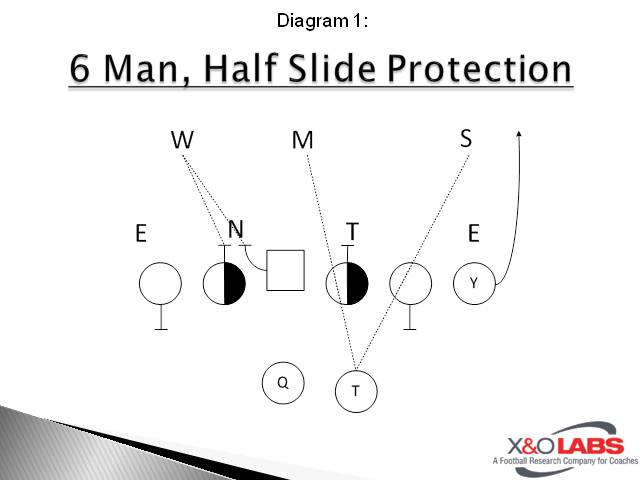
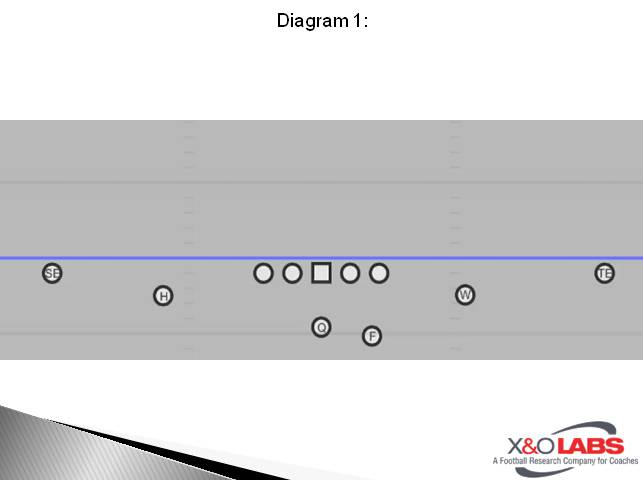
SBU utilizes a variety of protections within our passing system. One protection that the offense uses often is a 6 man, half slide, drop back protection. This concept, founded primarily in the principles of the 2/3 Jet protection concepts, is a basic scheme that allows for simple blocking rules (see Diagram 1). The protection relies heavily upon fundamentals, technique, and execution by both the Offensive Line and the Running Backs. Our staff feels that in order for the passing game to be successful while utilizing this protection, the Offensive Line must be physical and fundamentally sound in their execution. We are able to achieve this aggressive posture and technical execution through a heavy reliance upon a series of protection drills that cover not only the fundamentals of the position, but also the situations that Offensive Line must be aware of and prepared to handle.

XO Labs PPT Template1

Hips & Hands

We utilize a version of the Hips & Hands drill almost every day. We use this series of movements to emphasize both the movement of the hips as well as the pass protection strike and body position. The only movement we will get the hip all the way through is the first phase (6 PT start). In this phase, we are coaching the Offensive Line to explode through the bag and drive his belt buckle to the turf. While there is a slight hip roll that accompanies the pass protection strike in the second and third phase, the emphasis is more on a violent hand strike while keeping tight hands and elbows. 

To study film of this drill click on the video below:

Read More

Using Exercise Balls to Teach Core Tackling Fundamentals

By Joey Mariani
Defensive Coordinator
University of Redlands (CA)
Twitter: @UR_CoachMariani

Introduction

In teaching tackling, we emphasize what we call the “Three Rules of a Bulldog Tackle.” First, you must be able to see what you are hitting. This point of emphasis prevents our players from hitting with the crown of their helmets. Second, we tell them to lower your target. We coach that your eyes should be on the ball. This helps prevent the helmet to helmet contact that we are all aware of and teaches safer tackling. Lowering the target also gets our defenders closer to the ball and therefore, leads to more turnovers. Third, we teach them to finish through the ball carrier with a low to high wrapping up motion with your arms.

At the University of Redlands, we use alternative methods to teach basic fundamentals, keep players engaged, keeps players safe and maximize learning in a limited time frame. The following drills are used by us in the spring (because we aren’t in pads), or at the end of week when we still want to practice tackling fundamentals without the violence so close to game time.

The drill that we use for our safeties is designed to teach them to come to balance out of a full speed run in multiple directions and situations while using an exercise ball to finish the drill.  We have found that the exercise ball forces players to sink their hips, to run through the ball carrier, to wrap up and it is a very non-violent way to practice tackling. The ball is also a very inexpensive piece of equipment. Conversely, the other tackling devises out there are expensive and just don’t have the ability to be utilized in a fast / effective manner. The use of the exercise ball can be utilized to finish any drill that a coach has that will have the player finish with a tackle. For example, our players will learn to cut-to-tackle, block destruction to tackle, bag drill to tackle, get-off with a slant to tack, etc. I think that the possibilities are endless with the use of the exercise ball in multiple defensive positions.

Read More

Arkansas Tech University’s 9 RPOs from 20 Personnel

By Brent Dearmon
Offensive Coordinator
Arkansas Tech University

Introduction:

At Arkansas Tech University, we are a run first offense that mixes in complimentary RPOs to replace quick game. We base out of 20 personnel formation, so we see 6 guys in the box every snap. Most of our RPOs are designed to control the 7th and 8th hats in the run fit.

With every RPO we run, we have to figure out the following questions:

  1. Who is the extra run fitter to the side of the field we want to read? Which secondary player is designed to get his hat in the run fit to the field and to the boundary? Since we are a run first offense, our RPOs are based upon getting an extra hat out of the run fit each week.
  2. Are we protected? We rarely like to let DE’s run free in our protection unless the QB has a run option. If the RPO is designed to stay in the pocket, then we will read Safeties or Linebackers.
  3. What do we do verses blitz or man coverage? Do we have built in hots to serve as answers verses blitz to get us out of bad plays?

Below we will outline 10 different ways that we use scheme our RPOs as guided by these fundamental questions.

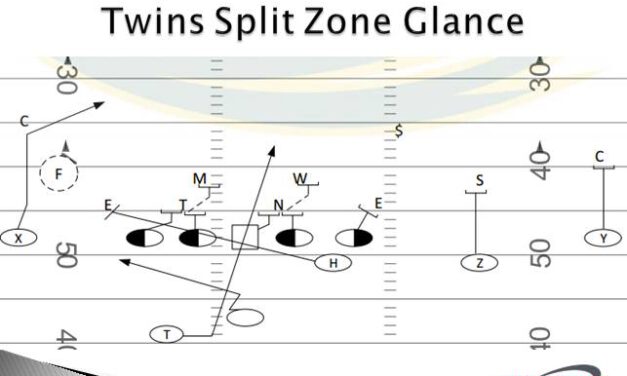
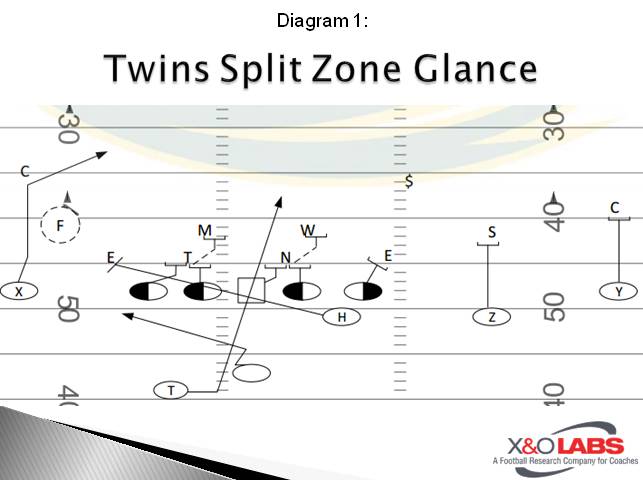
Concept #1: Split Zone with Glance Post (20 personnel)

This is a boundary ‘run fitter’ read attached to split zone. We see a lot of invert coverage into the boundary so this run concept is designed to read the boundary safety. So we had to ask ourselves the three questions from above.

  1. Who is the extra run fitter? With this concept it would be the boundary safety. If he fits the fun, we will pull and throw the glance post.
  2. Are we protected? Yes we are protected because we are running zone to the field with our HB blocking the backside edge on the split zone.
  3. What is our blitz answer? Because it is an inside zone scheme and we are blocking the backside edge, no pressure can hurt this run scheme so no blitz answer is needed.

Slide1

To study game film on this concept, click on the video below:

Read More

Deuce Coverage to Defend RPO Concepts

By Mike Kuchar
Senior Research Manager
X&O Labs
Twitter: @MikekKuchar


Introduction

The following research was conducted as part of XandOLabs.com special report “Defending RPO and Triple Option.”

Quarters/Split Field Coverage Families:

Source 1: Henderson State University (AR)

Co-Defensive Coordinator Jeff McInerney

Methodology:

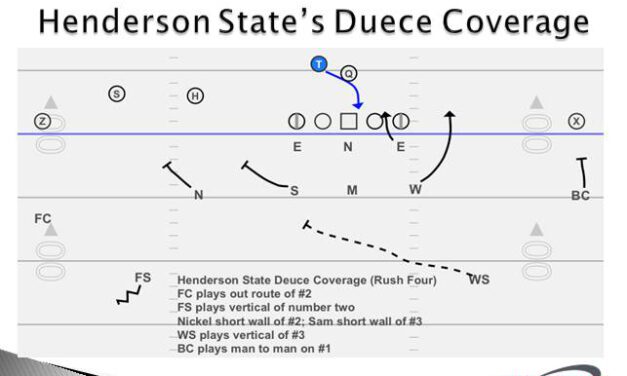
Henderson State University finished third in the country among Division II schools with 29 interceptions and did so by teaching their secondary to read the eyes of the quarterback even in zone concepts. They play their corners in the off position at eight yards and read the quarterback to determine run or pass. According to co-defensive coordinator Jeff McInerney, it’s a concept he learned from TCU’s head Coach Gary Patterson that has made a world of difference in them breaking to the ball. “Yeah, it can be scary,” he told us. “But if you do it right, you will confuse him and more importantly bait him into making a poor throw.” Henderson State is a 3-4 outfit that will rush an additional fourth defender at times. They play split field, matchup zone coverage structures, but will choose to play with at least two deep safeties to limit the vertical gains. “We will rally and tackle,” said Coach McInerney.

Read More

How Coaches Are Addressing the 4 Most Common Errors in Tackling

By Mike Kuchar
Senior Research Manager
X&O Labs
Twitter: @MikekKuchar

Last month, X&O Labs researched the most common issues in missed tackles (scroll down to more this special report). Because let’s face it: regardless of what level you coach or what offense you’re defending, we all face the same issues in missed tackles. What we found is that many coaches are devising a tackling system, not a series of drills, tailor made to address each of their tackling needs. Our research dictated the following four most common issues in missed tackles:

  • Improper body placement in open field tackling situations
  • Losing one-on-one leverage (or tracking) points on the ball carrier
  • Losing multiple defender leverage points on the ball carrier, or what is commonly referred to as “keeping the cup”
  • Lunge tackling or leaving feet in strike phase

These issues are best illustrated in the video below, submitted to us by Temple University:

Read More

Defending Option and Gap Schemes with the Bear Front

By Kai Smalley
Head Coach/Defensive Coordinator
Snohomish High School (WA)
Twitter: @fbcoachsmalley


Introduction

I have been fortunate enough to play for and work under some great defensive coaches which has helped me develop my defensive philosophy. The first coaching job I received out of college was as a defensive line coach under a coordinator that based out of the 46 Bear. I spent two seasons learning the adjustments and nuances of the defense. Two seasons later, I was hired as a defensive coordinator and I have been using it since. Though it has never been a base defense for my teams, the bear has remained a mainstay adjustment in my defensive playbook. It is always in our spring and summer installations so that we can use it and rep it any time and not have to spend valuable practice time during the season to teach a “new” front.

Adaptability

The architect of the 46 Bear defense, Buddy Ryan, developed it to create an 8-9 man front and outnumber the offense, especially on the strong side of the formation. Originally the Bear was used in 4-3 personnel, since becoming a defensive coordinator I have based out of both even (4-3) and odd (3-4 and 3-3) fronts. Each front allowed me to get to the Bear front. As offenses have evolved the Bear defense has had less of place in most schemes, but we still see plenty of 21 personnel and other run heavy sets that the Bear is designed to stop.

At Snohomish, we base out of a 3-3 stack. Throughout the season, we will see several different offensive schemes, the 3-3 has allowed us to be flexible enough to adjust to the offenses we see. We have found that the 3-3 has been the easiest to shift to the Bear. This is mainly because the personnel and positions allow us to make the correct adjustments without having to teach to many different / new techniques.

Base Alignments for the 3-3 and the Bear

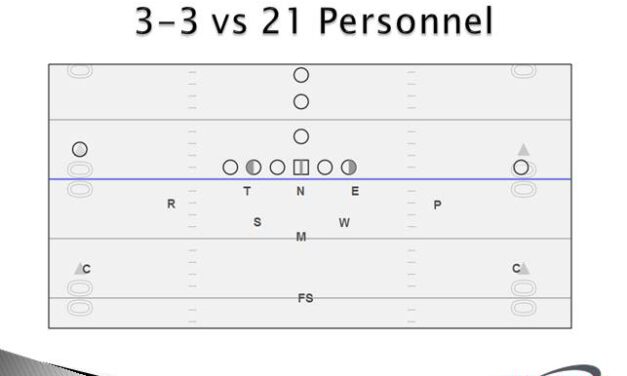
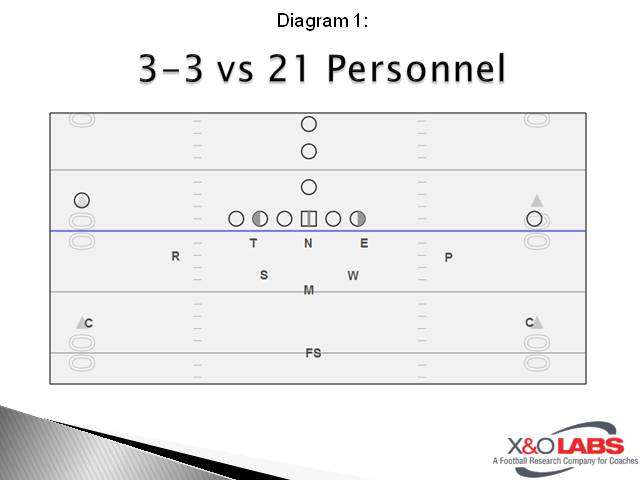
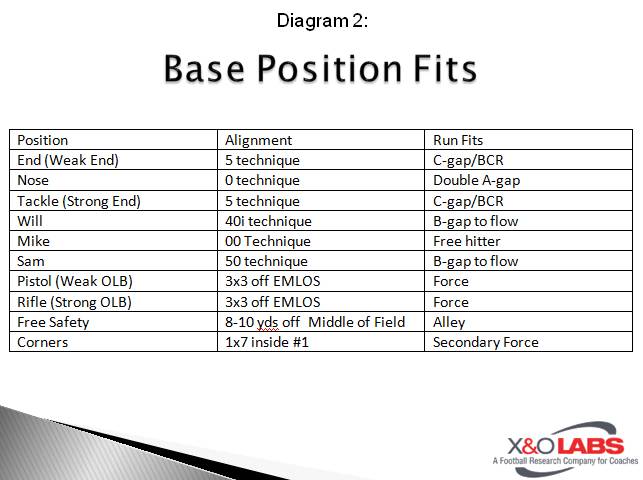
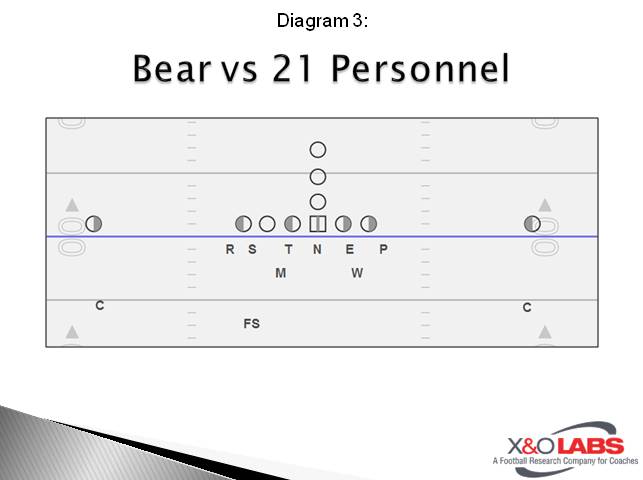
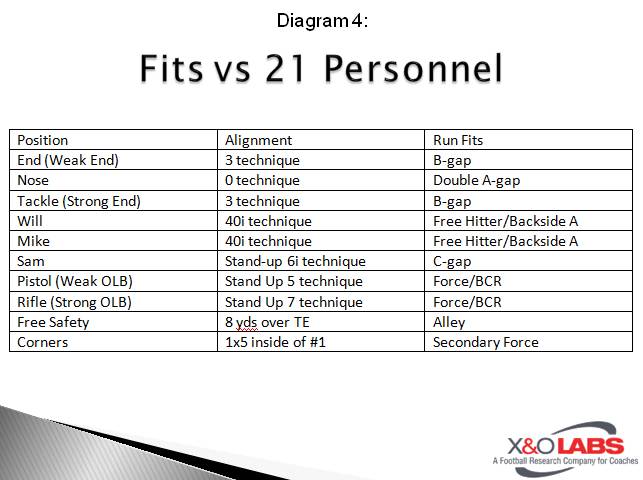
The charts and diagrams below list how we align in both our base 3-3 front as well as our Bear front. The whole purpose of using the 46 Bear is to get 8 or even 9 players in the box to stop the run, so I have listed the base alignment and run fits below.

Slide1Slide1Slide1Slide1

The alignments and assignments are similar for each position which keeps new teaching to a minimum. This allows us to be able to teach the basics of alignment and assignment without having to treat it like a different defense altogether. 

  • The Tackle and End both practice playing 3 technique players in our 4-man fronts, so their jobs are easy to teach.
  • The Nose is always a two-gap player so his job remains the same in both fronts.
  • The outside linebackers remain force players, just walked up outside of the offensive tackle to the weak side and the tight end to the strong side. We teach and work on force technique everyday with our outside linebackers in the 3-3, so this is a simple transition.
  • The Mike and Will remain inside linebackers. The Mike and Will play a back out to their side. The Mike takes #3 to the strong side and the Will takes #2 to the weak side.
  • The Sam, who is usually our bigger, more physical inside linebacker is used as our fourth man when we reduce to a 4-man front. He plays the same way in Bear and is a C-gap player. 
  • When we are in the Bear front, we play primarily running cover 0. The Corners are responsible for coverage first.
  • The Free is also primarily a pass player, but we will play him closer to the line of scrimmage than normal because we are jamming the tight end on the line with 2 players. This allows him to insert in the run game quicker.
  • Our Corners know they have no help and must play tight man coverage.

Keys, Reads and Rules

Defensive Line:

The Nose will play off the block of the center. His job is to never get reached, meaning he will play off the block of the center and work his body into the appropriate A-gap. The backside A-gap can be covered by the backside inside linebacker. He will also be getting double teamed so he must be able to either split the double team or eat up the blocks.

The Tackle and End will play in a heavy 3-technique and key the guards block. They have two rules playing this position:

Read More

Flare and Now RPO

By Mike Kuchar
Senior Research Manager
X&O Labs
Twitter: @MikekKuchar


Introduction:

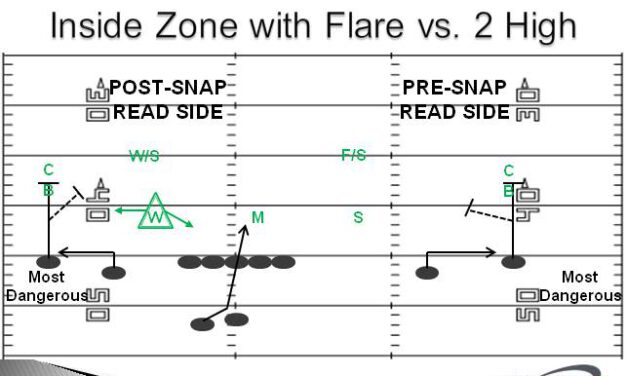
Hendrix College pairs its Inside Zone run concept with both a flare and now screen.  The read is predicated off the apex player in run/pass conflict based off his reaction on the Zone scheme. On the flare concept, the inside receiver is catching the screen (like bubble), while on the now concept, the outside receiver is catching the screen.  The offensive line blocks the five most dangerous defenders and the read is off of the perimeter force defender.  Here is a breakdown of each of those concepts:

FLARE:

    • When “Flare” is called, the INSIDE receiver is catching the pass.
    • Outside receiver “oozes” off the LOS towards the CB and blocks the most dangerous threat.

NOW:

    • When “Now” is called, the OUTSIDE receiver is catching the pass.
    • Inside receiver “oozes” off the LOS towards the CB and blocks the most dangerous threat.
    • Note:  If neither is called, receivers decide at the LOS who is getting the ball. Receivers assume we are running “Flare”. If CB is 5 yards or less, or if the wide-out gives a “Now” call, run “Now.” This takes practice!

Jordan Neal, the Offensive Coordinator at Hendrix College, spends a great deal of time educating the quarterback to make the correct read on this run/pass concept.  He emphasizes how much practice it takes to develop the correct read. Neal talks about the quarterback making a pre-snap “snap-shot” of what the defense presents before the ball gets snapped. His protocol for making the correct pre-snap read is below:

  • QB must take a “snap-shot” of the front to determine what the DL/LB configuration is. Is it a 4-2 box? Is it a 4-1 box? Is it a 4-3 box with straight man behind it? Is it some sort of odd front?
  • The next thing after identifying the box configuration is to see what we call the next “puzzle-piece,” which is the secondary configuration.

“We teach our quarterbacks to understand that if it is a 4-2 box, then he must immediately find the alley or force player to the side where his post snap-read is,” said Neal. “That guy (most of the time we are referring to the weak-safety, or the safety on the boundary side of the football field) can either be in a cover-two or cover-four alignment, or he can be walked up closer over the #2 receiver in an invert relationship with the CB which signifies cover-one or cover-three. If that weak-safety is deep, then the quarterback knows the outside linebacker on that side is his read key. If that safety is walked down over #2 and he is taking away the numbers and leverage advantage to that side, then the quarterback reads the defensive end on that side. At this point, the play just becomes old-fashioned Zone Read where the QB either hands it off to the running back or pulls it and runs the edge on a QB keeper. Everything works in conjunction because the tackle takes a snap-shot of the box and decides to block either the DE or the LB based on the box alignment and the QB is going through his progression as well. Receivers and the rest of the OL don’t have to do anything different at all from situation to situation.

Read More

Teaching Leverage and Strike Points to WRs for Perimeter Blocking

By Kenneth Tinsley
Wide Receivers Coach
Morrisville State College (NY)
Twitter: @CoachT_82

Introduction

Perimeter blocking at the wide receiver is very critical to the run game. Making a block at the 2nd and 3rd level of a defense can turn a small gain by the ball carrier into an explosive play, even a touchdown. Great blocking not only comes from effort and desire, but also from sound technique, fundamentals and understanding leverage.

It is also important to note that blocking as an outside receiver can be different than blocking as a slot receiver. Today we are going to go discuss some drills and fundamentals on how to put the wide receiver in the best position to make a block and how do adapt it to the position that they play.

Here are the points of emphasis that we focus on when teaching our receivers to block:

  1. Understand the run scheme – Knowing the direction of the run and who the ball carrier is will help the receiver to know which angle they need to take to their blocking responsibility and use proper technique that corresponds with the run scheme.
  2. Active hands and feet – If a receiver is constantly active with their hands and feet, then they can react quicker to the defender. Once the receiver is not actively moving, the defender can work around them and make a play on the ball carrier.
  3. Force the defender to have to go through your body to get to the ball carrier – As a receiver, we never want the defender to have free access to the ball carrier. If the receiver can put themselves into position to force the defender to come through their body, then the ball carrier will have a high success rate of gaining yards and creating explosive plays.
  4. Never leave your block to find another defender – Too often, I have seen receivers leave the guy that they are blocking to go for a knockout shot on a defender who is well behind the play. This has often result either in penalties or the first defender that was block ends up making the play. Once the receiver is engaged on his blocking assignment, he must maintain that block for as long as possible.
  5. Play full speed in between the whistles – With good technique and effort, the receiver will be very successful in blocking. He must never take a play off. As a coach, you have to get your players to buy into blocking. You never know when you can create opportunity for someone else to score. One thing I tell my receivers is “As a receiver you have to be able to score with or without the ball in your hands.”

Blocking Process

When we teach the blocking process, we break it down into four distinct categories. Each of these pieces can be drilled individually and grouped together to build the receiver’s blocking skill set. The categories are as follows:

Pre-Snap Identification

  • Once the play is called and the receiver aligned, the receiver should quickly identify their target and follow their rules and responsibilities to be successful in their block.

Approach

  • Come off the ball hard at full speed and come to balance.
  • Breakdown about 2-3 yards from the defender then work to close the distance between you and the defender. A slot receiver would need to get their responsibility quicker because they are closer to the run so their reaction time will be faster than an outside receiver.
  • Keep and athletic base. Feet about shoulder-width apart, knees bent, chest up, and biceps against the rib cage with the elbows pointing back. When the elbows are pointing back this will force the hands up. Hands open, thumbs pointing to the sky.
  • Keep the feet and hands active.

Attacking and Maintaining Leverage

  • The receiver should attack the leverage of the defender and to maintain that leverage. The receiver needs to put themselves in position that will force the defender to come through their body.
  • For example, if the receiver is on the right side and the run play is an inside zone play to the right, then the receiver’s attack point is the midline to the play side number of defender which would be the inside number.
  • Some coaches want to the receiver to be directly square in front of the defender which is fine. What I teach my receivers is to protect the run scheme. So if the run play is inside, the receiver is going to have an inside attack point. If the run scheme is to the outside, then the receiver will have an outside attack point.

Strike and Engage

  • When a receiver is engage with a defender, the receiver is either “in-phase” or “out-of-phase.”
  • “In-phase” is when a receiver is squared with the defender while engaged in the block.
  • “Out-of-phase” is when a receiver is engaged with a defender in the block and the defender pulls away.
  • Once the receiver is in position, the receiver must react first. The smaller the gap between the receiver and defender the faster the receiver must react. The receiver doesn’t know exactly where the ball carrier is so the receiver but be aggressive to the point of attack and strike first.
  • Once engaged keep arms strong and not fully extended. The receiver will have more control if their arms are strong. Get the receivers to think their doing a bicep curl once engaged with a defender.
  • Eyes up,

Read More

Offensive and Defensive Pre-Season Installation Models

By Mike Kuchar
Senior Research Manager
X&O Labs
Twitter: @MikeKKuchar


Introduction

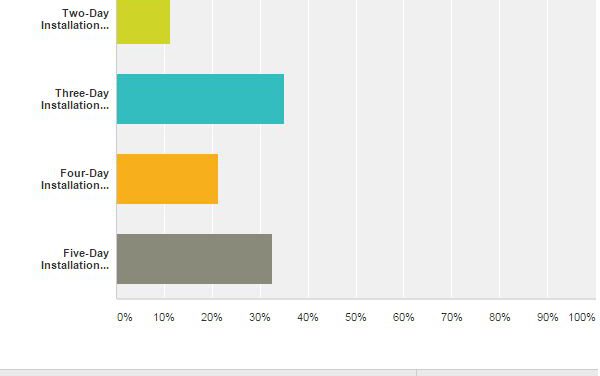
With the pre-season rapidly approaching, high school coaches are now designing their installation schedules for summer camp. Finding a way to delegate an entire offensive menu into segments can be a challenging operation, which is why we wanted to research which methods coaches were using to most efficiently plan their pre-season accordingly. 

Editor’s Note: This report is designed for high school coaches exclusively. Please keep in mind that each state has its own regulations regarding pre-season practice time. This will in turn, affect the overall time duration of the installation process. We’ve included corresponding coaches emails if there are further questioning.


Offensive Installation Protocols

We wanted to research which factors were most vital in devising an offensive installation plan. So, we asked contributors what their methodology is in selecting which concepts they begin their install with. Do they base it on last season’s proficiencies? The adaptability of the skill set of their returning players? A mix of both? Their responses are below:

Mark Holcomb, Oak Grove High School (NC) mholcomb@davidson.k12.nc.us: “We will first assess the players we have coming back for the next season. We will then run reports from HUDL based on the most often used plays and success rate. We will then marry the two together based on personnel and proficiency.”

Brian Spicer, Saint Joseph Central Catholic bspicer@bishop-hoffman.net: “We are a perimeter first team. We tell our kids that we want to get the defense running to the sideline so we always start off with our perimeter plays during installation. This sets up our attack philosophy right out of the gate.”

Glenn Duff, Spalding High School allenduff@bellsouth.net: “The methodology starts with the type of QBs we have for the upcoming season. Next we’ll evaluate the OL (big slow / big agile / small quick, etc) to determine run game. Finally, we look at our receivers to determine if we’re a vertical or horizontal pass team.”

Matt Kuempel, Oelwein Huskies mkuempel@oelwein.k12.ia.us: “We base our installation process based on what our bread and butter play is going to be. From there we install the complements and constraints to that play. We do all of that from our base formation, but from there, we will change formations and install the same play with any additional compliments or constraints that this formation allows. This process is determined by our players’ abilities and who we want to get the football to.”

Rod Stallbaumer, Basehor-Linwood HS (KS) rstallbaumer@usd458.org: “We are a system offense so we install based on series and type of play. Try to show how they fit off each other. Day one we install our fast flow plays (jet, Iso). Day two we install our mis-direction (FB & QB Counter), Day three we install our option game (IZ triple, speed option) A lot of our pass install is done in the summer with 7 on 7 but we install PAP pass with our fast flow, quick game with our mis-direction and screen game with our option (a lot of our screens are RPO’s off IZ).”

Nathan Ferency, Shepherd High School coachferency@gmail.com: “Our methodology mainly focuses on our personnel of returning players and the abilities of incoming juniors. We will predetermine what we feel will be our strengths and build our offense based on what is best for our personnel.”

Run Installation Methodologies

We’ve found that when installing the run game, most coaches will group run concepts by families such as gap runs, zone runs and man runs. While the priority of each may differ between contributors- the majority of our coaches will base their install off the zone concept- most coaches will choose to select one of these run families per day of install to rep. We asked our contributors what important correlation they use when installing their run concepts. Their responses are below:

Read More

Understanding Levels to Defend Stacks/Bunches in Man Coverage

By Mike Kuchar
Senior Research Manager
X&O Labs
Twitter: @MikeKKuchar


Introduction

The following research was conducted as part of X&O Labs special report on “Man Coverage vs. RPOs,” which can be accessed in our exclusive membership website, Insiders.

Defending Compressed Formations:

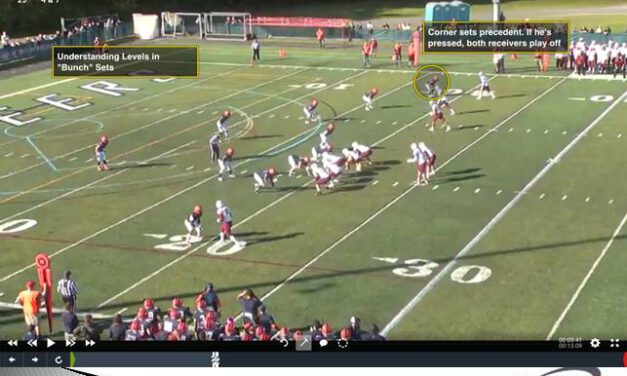
Quite simply, if you’re going to play man coverage you’ll need to learn how to handle compressed formations. Bunches and stacks are pre-requisites for offensive coordinators now when they prepare against man coverages and adding the RPO element to these structures can further perpetuate a defensive coordinator’s anxiety. So we felt it was necessary to research man adjustments on how coaches were playing these formations. We’re talking pure man adjustments here, not “bunch” or “area” checks, which are synonymous with zone coverage.

Read More

Multiple Variations on Red Zone Power Pass


By Cameron Keller, Assistant Head Coach / Offensive Coordinator, Winona State University (MN)


Over the past season, Winona State ran some form of this concept 22 times inside the 30 yard line. Of those 22 snaps, they completed 17 of those passes with 4 TDs and 0 INTs. At nearly 78% completion, this concept was their most successful concept within our whole passing attack. Read about it here…


By Cameron Keller
Assistant Head Coach / Offensive Coordinator
Winona State University (MN)
Twitter: @WSUQBCoach

Introduction:

winona1In today’s game, everybody runs some version of play-action pass to match their desired run game.  For us, being an Inside/Outside Zone & Power team, the ability to effectively run our Power Pass has been instrumental in our offensive success.  Especially in the red-zone, the Power Pass concept for us is one that we have leaned on a lot for great success throwing the football inside the 30 yard line.  Where I think we have done a really nice job over the past 6 years is being able to take whatever it is we are running that week in terms of formations, and fitting our power pass concept to those same looks to better eliminate any tendencies we might show in our formational play calling from week to week.  We run Power 3 different ways:  2 Back, 1 Back, and QB power.  The trick for us is to be able to install the base concept for our Power Pass in such a way that no matter what the formation we run it out of, our guys always know what the base concept looks like and can adjust accordingly from there.
Base Power Pass

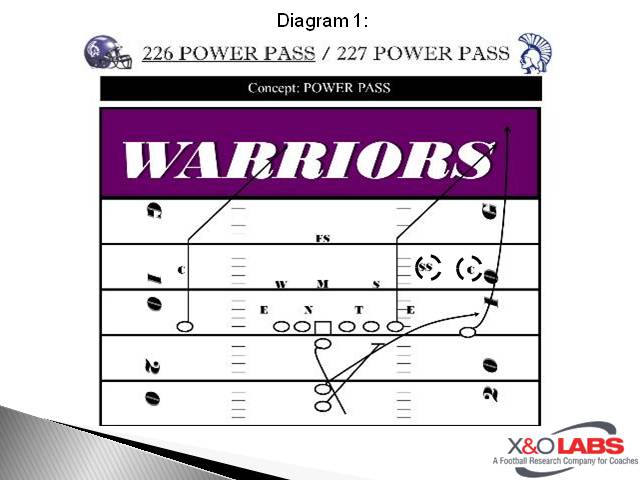
Like most teams running power pass, our base concept is based off of a “Flood” Concept:  achieving 3 distinct levels outside of the numbers.  We do this with a number of route combinations, but our base concept involves a vertical, corner route, and a flat route (Insert Diagram #1).  This base concept teaches our QBs how to read High to Low and also have the automatic hot route built in.

Slide1

In the red-zone, specifically, we don’t run this exact route very much due to spacing issues with the vertical but I like to show this base install for teaching purposes so people can see what we are trying to accomplish from the beginning with the teaching of our QB’s read progression.  Specifically for our QBs, they read the CB first to determine if we can take a shot with the vertical.  If the CB bails and stays over the top, their eyes travel to the alley player the read the Corner/Flat route combination.  Where a lot of young QBs make their mistake, in my opinion, involves the initial read on the CB.  I teach all of my QBs if the CB is looking at you and trying to play both the vertical and corner route, take the shot.  If he turns his back and runs, find the alley player.  If the alley player sinks, throw the flat route to the FB.  If the alley player jumps the Flat route, throw the Corner route.  We have 2 main teaching points with all of our Corner Routes:

  1. Always run the route skinny, aiming at the front pylon until we get inside the 30…at that point the aiming point changes to the back pylon.  This give the QB leeway to flatten out the route if the safety sits over the top.  This is the main reason I say to throw the corner route if the alley player jumps the flat route.
  2. If we get a safety that has outside leverage on our corner route, we will convert the corner to a skinny post.  This adjustment will be shown in one of the video clips.

The one thing I want to point out with this read involves how a lot of people talk about the FB route in the flat in terms of “You can’t go broke taking a profit”.  I’m not sure this has ever been talked about in my QB room because last I checked, you can throw a TD on 3rd and 3 even if the FB is always open!  For us, the defense always dictates where we throw the ball regardless of the down and distance.

Protections

One of the questions I get asked the most when it comes to our Power Pass revolves around our different use of protections based on the type of play action we are running.  With three different types of Power Pass comes 3 different types of protection as well.   Our base protection gets installed out of our 2 back Power Pass and is taught based on the Turn back protection concept.  With this protection, we will pull the back side guard to emulate Power and he is ultimately responsible for the first defender to show in the C Gap.  With our FB being out in the route, we keep the IB in to be responsible for the second defender to show in the C gap or outside.  Where I think we do a really nice job is at our play side tackle.  We teach our QBs to make sure and alert our offensive line anytime we see a threat of pressure to the call side.  With this alert, our play side tackle, who’s main responsibility is the B gap, will be slower to turn back to the B gap, anticipating the 5 technique to cross his face.  We call this a “Hump” technique.  I’ve seen teams turn the tackle to quickly and a good defensive end will play off of the tackle’s outside hip leaving the protection a hat short.  Our play side Guard and Center will block back as well leaving the backside tackle to funnel hinge and take the most dangerous threat: either the defensive end or the WILL LB if he blitzes.  If we choose to run this away from the TE, keeping him in for protection, we water fall the back side with the Tackle and TE.

Read More

Three Tags in the Four Vertical Concept

By Eric Struck
Wide Receivers Coach/Passing Game Coordinator/Special Teams Coordinator
Washington High School (SD)
Twitter: @EricStruck

Introduction:

One of our favorite pass plays, and one that is popular with a lot of coaches, is the four-vertical concept. We want to run this play as much as possible but be able to give the defense different looks as well as take advantage of what the defense will give us. We feel that by adding a simple tag system allows us to be very diverse and multiple within our passing game but keep things very simple for our players.

Set Up

Slide1

In our basic 2×2 formation (diagram 1) each one of our receivers has a rule as well as a specific landmark they need to follow. We tell our outside receivers that they own the numbers and we tell our inside receivers that they own the hash.

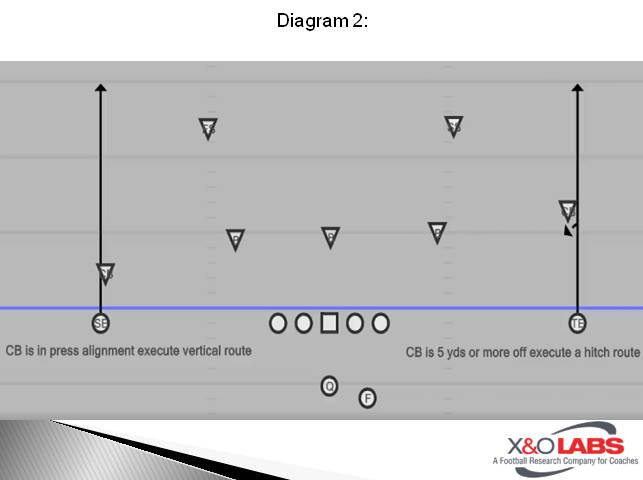
Along with sticking to their landmarks, our receivers are also executing a read as they run their route. Our outside receivers are reading the depth of the corners both pre-and post snap. They have what we call, the “Hitch Read.” As a general rule, if the CB is deeper than 5yds then they will execute a hitch route at roughly 5-7 yards. We tell them on their 5th step they should know if they are continuing vertical or hitching it up (diagram 2).

Slide1

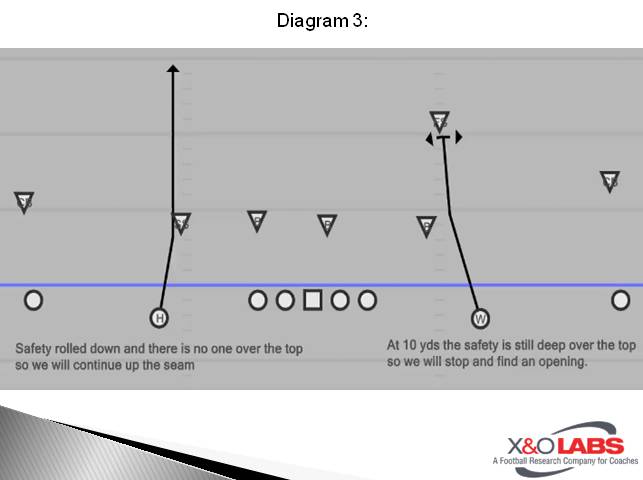
Our inside receivers have what we call the “Seam Read.” They will get a pre-snap read if the safety is over the top as well as a post snap read. Once the inside receivers reach 10 yds. and the safety is still over the stop then they will hitch up and work 3 yds. to either side of the hash and settle in a window (diagram 3).

Slide3

If there is no safety over the top, then they will continue to run the seam. We spend a lot of time working on this play and we feel we can execute it no matter the situation.

QB Read Progression

He will start by assessing the safeties. How many deep safeties are there? Our quarterback coach uses the terminology of “Open or Closed Roof.” An “Open Roof” would be 2 deep safeties and a “Closed Roof” would be a 1 high safety look. If it is an “Open Roof” our QB will read from the outside receivers to the inside receivers. If it is a “Closed Roof” then our QB will read from the inside receivers to the outside receivers.

With an “Open Roof” read the QB will read the depth of the Corner. If the hitch is there we will take it every time. If the Corner alignment does not allow for the Hitch then the QB will read the near safety. If safety stays on or close to the hash then the QB has a one on one match up the outside. If the safety widens then the seam route should open once we clear the alley defender.

Switch Tag

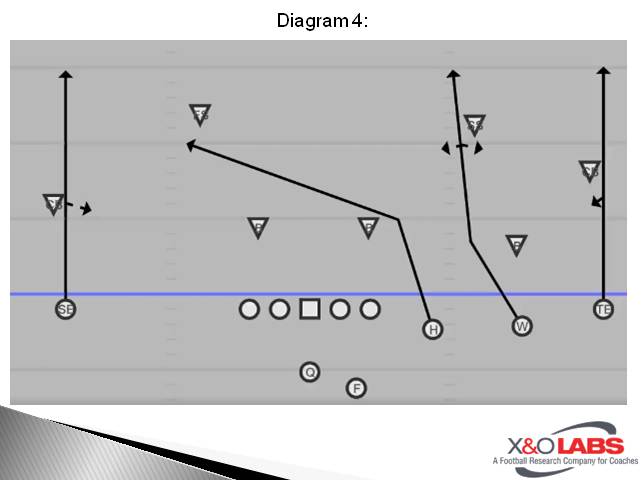
Our favorite tag for our Four Verticals concept is our “Switch” Tag. In our basic 2×2 formation, both sides would execute the switch tag (diagram 4).

Slide3

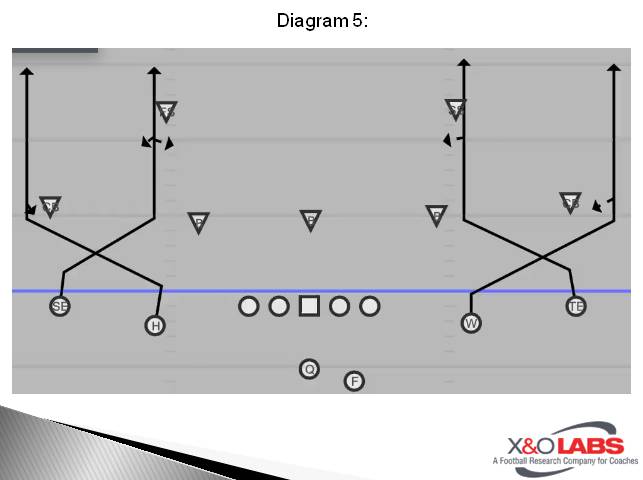
This tag applies to not only the release we want to execute but the reads on the route as well. Our outside receiver will push vertically 2-3 steps then work their way inside up the hash so that can execute the “Seam Read.” Our inside receiver will push vertically 1-2 steps then work behind the outside receiver and get to the numbers and execute the “Hitch Read (diagram 5).”

Slide5

The great thing about the “Switch” tag is that the read stays exactly the same as our basic four vertical concept. If we are in a 3×1 alignment then the “Switch” tag applies to the 1st two receivers from the sideline. The inner most receiver will work to get vertically to the opposite hash and he no longer has a read. He is getting vertical no matter what the defense does.

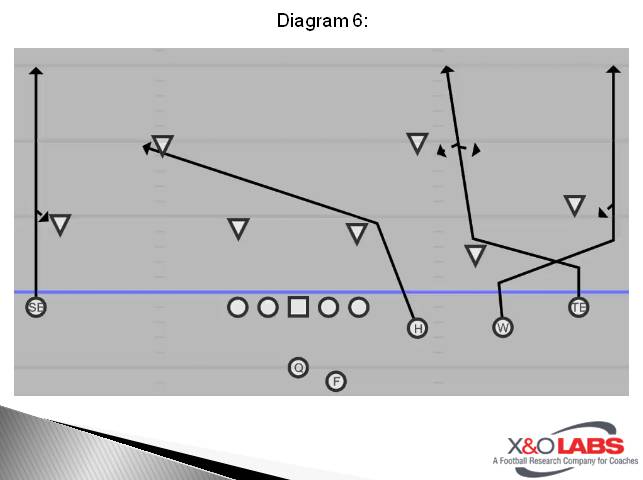
We really enjoy the switch especially when we face a Cover 2 type defense or a defense who aligns their CB’s in press or a tight alignment. This allows for our receivers to get a fairly clean release off the line of scrimmage. With the switch release against a press corner we feel the “Switch” release gives us an opportunity to out leverage the corner with the slot receiver. The CB must carry the outside receiver and when he does this it gives our slot the opportunity to get outside and hopefully be able to gain a step or two advantage on the CB (diagram 6).

Slide5

The “Switch” tag is also very effective when using motion. Faking the “Jet Sweep” action to the boundary and using the motion man to run the outside vertical route is a great way to out leverage the CB (diagram 7). This also takes advantage of a rotating secondary. If you are a team that uses a crack scheme or some type of switch blocking scheme on the perimeter, then the motion paired with the “Switch” tag can be especially effective against an aggressive alley player.

Read More