
WIN Slant/Fin Lock RPO

By Cole Kristynik
Offensive Coordinator
Cypress Springs High School (TX)
Twitter: @ColeKristynik

Introduction:

A trendy offensive phrase is to “play in space.” To many, that could mean bubble, smoke or swing screens. At Cypress Springs, we use all three of these at times when the defense gives us luxury looks to do so. Our sense of space or the holes we want to puncture tends to be further down the field. We are members of the RPO group and they have been a big part of what we do for a while now.  We use the 3×1 Stick/Gift Concept, Glance Routes, Screens, among others.

That said, the WIN Slant/Fin route combination has taken us to another level in the past few years. A big component of this is our constant evolvement of this route combination. One of the first additions we made was to not just attach it to a run but to also use it off a hard Half Slide play action. This allows the Win Slant route to find more depth, space and pierce a hole in the defense in more areas. This is what frustrates defenses, along with our ability to get the ball out of our hand with lightning speed and a confidence that our WR’s will find the space.

There is no doubt that some defenses know what we are trying to do, but they do not always account for the multiplicity and options of the routes. At times they try to overplay and rotate coverage where they think the routes are designed to hit. The truth is we do not always know where the vacated space will be pre-snap. In some instances, we have not executed upfront picking up a blitz or our undersized OL may be overwhelmed and allow penetration with defenders on a path to our QB, but the mesh freezes enough for a quick pull and deal of the ball. The RPO version is our best way to run option.

Rules and Coaching Points

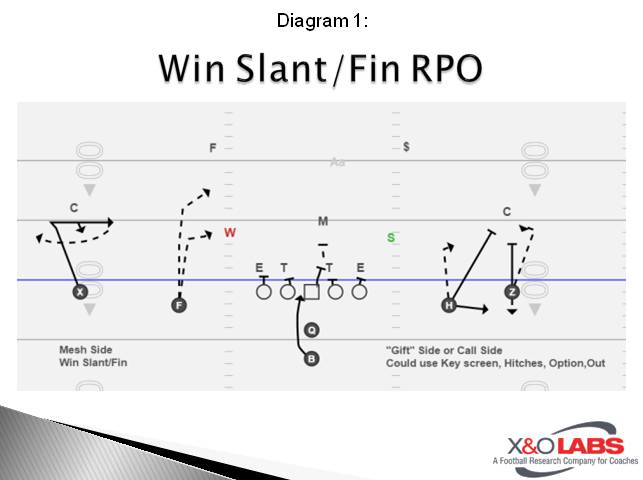
When we RPO this concept we use Locked Zone (Diagram 1) about 70% of the time. We have also have used Split Zone, Double Fold, 2 Back Iso and G/H Power. We prefer the latter with our Single WR tags and 3rd level reads, another piece of the RPO and Play Action route Family. 

Offensive Line Notes:

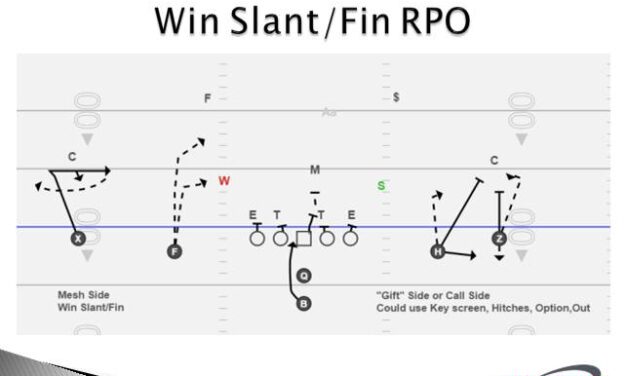
This article is more about the multiplicity of the route concept and pairing it with a leverage beating  Gift side as a RPO or using Play action. However, in Diagram 1 we will see the highest percentage RPO scheme. Some call it Tight Zone, we use the term Locked Zone.

RPO version with Locked Zone in 2×2.
Slide1

WR Notes:

Called Side: Gift

The gift side has been key screens, option hitch routes, and other quick leverage beaters. Note that when we do bubble it is a small step controlled crawfish to get corners to trigger outside of #1 while our slot pushes for the space vertically. We use multiple splits, stack, adjustments, or whatever helps us gain leverage for the Gift or to hold that half of the field.

This is the same concept in place whether it’s the play action or RPO scheme, it keeps it simple and allows us cheap yardage on proper down and distance even on play-action call.

If on Mesh Side: Win Slant/Fin.
Read More

Tao of Kickoff: 4 Drills to Improve Your Coverage

By Coach William Lund
Special Teams Coordinator and Linebackers Coach
Saginaw Valley State University
Twitter: @lundsanity51

Introduction:

I arrived at Saginaw Valley State in the spring of 2016 with the goal of making our Special Teams unit one of the best in the country. A big part of reaching that goal was to turn around the kickoff coverage unit. Thanks to great players and the drills used in this report, we improved our kickoff rankings 80 spots during the 2016 season for NCAA Division 2 football programs. The key was developing an efficient way of balancing the skills and techniques needed, while still maintaining the ability to run the opponent’s schemes for the upcoming week within a tight time frame.

These drills are done pre-practice in a five-minute time frame. It is a teach tempo, but we try to work around ¾ speed. We utilize these drills as a prep for the day’s practice where the Kickoff team will be the focus.

Each of these drills can also be applied and used to develop your team’s Kickoff Return unit by merely changing the emphasis to blocking. The “Flyzone Drill” and “Cardinal Drill” can be used as competitive drills between units to create a more intense work atmosphere.

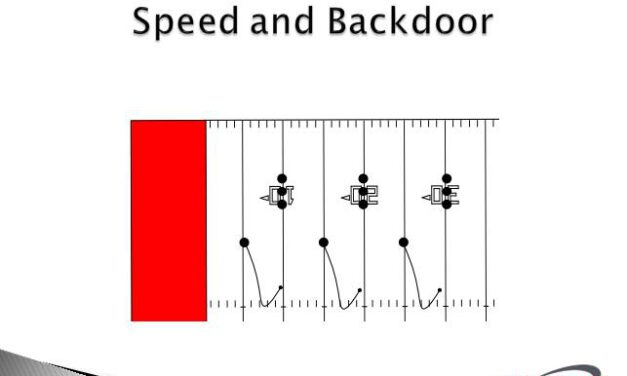
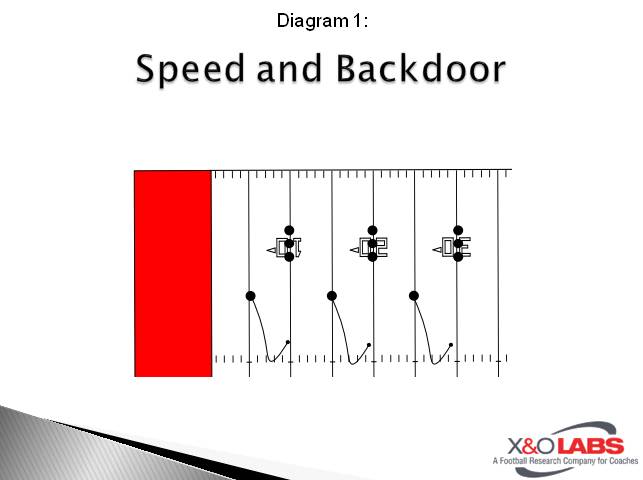
Speed and Backdoor

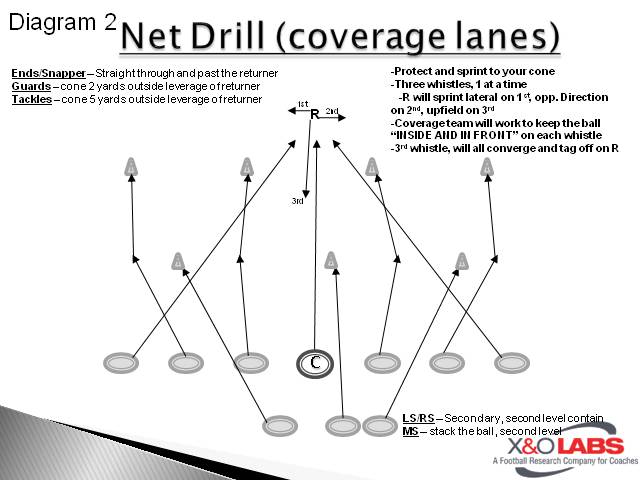
Slide1

This drill is our pre-practice drill we work on to develop using a “dip and rip” when beating a block with speed or working a back door move with a stick and move a al “Allen Iverson crossover.” We will settle on the hash with a near foot near shoulder approach or work on tackling using donuts.

Film Notes: These first 4 clips of drills are variations of skills needed to defeat blocks in space. The first one is defeating a block with speed. Starting on the sideline, we want to dip and rip through the blocker, and on approach to the hash we work a near foot- near shoulder shuffle, simulating our preparation for the tackle. We added a tackling donut to provide a functional vehicle to tackle, and execute our near foot – near shoulder tackling technique.

To study film of this drill, click on the video below:

Read More

5 E.D.D.s for Shield Punt Coverage

Zach Watkins
Co-Defensive Coordinator/Special Teams Coordinator/Linebackers
Washburn University (KS)
Twitter: @Zach_Watkins

Introduction

watkinsOur coaching staff here at Washburn University believes that special teams can win or lose you two games in a season. This belief held true for us in the 2016 season. It might be a missed extra point, kickoff return TD, or the kickoff team pinning the opponent deep in their own territory, but each unit has a responsibility to the team to win their play and help win the game. As I always tell our special teams units, “field position is the purpose of special teams.” No unit has a greater task of flipping field position in our favor than the punt team. 
The PRIDE Unit

We call our punt unit “Pride.” We use this term to stress to our team how important this unit is. Our staff calls it “the most important play in football.” “Pride” is also a part of our special teams’ mantra that we say before each meeting. 

We are a shield punt team.  We use the shield for three basic reasons:

  1. Ease of teaching/understanding the scheme
  2. The ability to plug guys in from week to week because of injury/playing time, etc.
  3. Most importantly, provides the most effective coverage.

Base Coverage

We will utilize different formations/shifts/motions, directional kicks, rugby style roll out, and other wrinkles from week to week, but our base coverage and drills will stay the same. All of our coverage drills for special teams fit in well with what we want to teach on defense. By doing this, we can keep terminology the same across all areas of coverage, tackling, and leverage, which has translated well for our players.

Slide1

In Diagram 1, our base coverage is shown. We have tweaked scheme from year to year to fit our personnel, but this has been our most consistently effective coverage. Ends (E) are our speed guys (WRs/DBs) whose only job in coverage is to get to the returner as fast as possible. Their job, along with the Snapper (S), is to take a shot and make the returner go east and west. The E’s are taught to aim for the returner’s near shoulder, while the S is taught to go right down the returner’s middle. Everybody besides the E’s and S have one base principle in coverage which we apply across all coverage teams and to our defense; “KEEP THE BALL INSIDE AND IN FRONT!” If the ball is inside of you and in front you, we will make the tackle. 

We teach the Guards (G) and Tackles (T) to have specific leverage rules. G’s have 15×2 rule and T’s have 15×5 rule. This means that when they are 15 yards and closer to the returner, they must be leveraged 2 and 5 yards respectively to their side of the returner. The Left Shield (LS), Middle Shield (MS), and Right Shield (RS) are second level contain players. As with any coverage team, we want to create levels to ensure we can still make the play if a front line player loses their leverage. The LS and RS will keep the ball inside and in front of them, while inserting between the G and T to their side. The MS will stack directly over the ball as he covers downfield.  The Punter (P) will always be our true safety and will stack the returner.

Coverage Drills

Read More

Developing a Dominant Pass Rusher

An Interview with Craig Kuligowski, Defensive Line Coach, University of Missouri


By Mike Kuchar
Senior Research Manager
X&O Labs
Twitter: @MikekKuchar


mizzuIntroduction:

It’s no secret that former University of Missouri defensive line coach Craig Kuligowski knows how to produce NFL ready talent. When edge rusher Charles Harris went 22nd overall in April to the Dolphins, it marked the fifth defensive lineman since 2009 that he has mentored to go off the board in the first round. It’s the most of any program since that time. Now as the defensive line coach at the University of Miami, Coach “Kool” shares the methodology and drill work he uses to get his players ready to play at the highest level of football.

Mike Kuchar (MK): What makes a great pass rusher?
Craig Kuligowski (CK): Many of them have that unblockable mentality. You have to believe that they (offensive lineman) can’t block you. They may come in with it (that attitude), but it gets washed away really quickly. It needs to get built up. There is no defensive lineman I’ve ever met that doesn’t want to sack the quarterback.

MK: Why are your players such effective pass rushers?
CK: We take the mentality that if we don’t know if it’s run or pass we are going to play the pass. We are going to stop the run on the way to the passer. We are going to penetrate. We attack and react instead of using block reaction then find the ball. You can’t rush the quarterback playing the run first. What we do drill wise, better show up on the football field.

MK: What is the pre-snap and post-snap visual landmark you use on your pass rush?
CK: The first thing they key is the ball with their periphery. The second thing they key is the screws of the helmet. High hat= pass. Block down = close the trap.

MK: How do you teach hand placement on your pass rush?
CK: Well, hands and feet have to go together. Every drill involves the hands. When we run circles, we use hands. We do the sled. We overemphasize the hands.

MK: What is the process you use to decipher which pass rush moves work for each kid?
CK: Every kid is not good with every move. We do one on one pass rush every day. I watch them to see what works better and what doesn’t work. The real challenge is getting them to do what they do well and try to make them better. Instead of doing what they want to do or do every move. When you do too much, you lose. They have a tendency to try and overwhelm and opponent.

MK: Is there a set number of moves you teach? What is too much? What is too little?
CK: I teach them everything and they find the ones they use most effectively. It’s really a sales job to get them to do it. It depends on each player. I see what he does. We teach power rush, club rip, club swim, chop rip and speed rush and we teach a swim. Off all that stuff we can combination into one thousand moves. We might do club and rip and hit the tricep. Now some kids are using shake club rip or some are better and stabbing the outside hand and then progressing to club rip. Or I can go club rip and the offensive line pushes my hip and now I spin back to the quarterback. We have all those combinations just for that guy.

MK: Do you cross train your perimeter pass rushers with your interior pass rushers?
CK: Yes, but some moves are more accessible on the outside.

MK: What are some problem areas that arise in the pass rush?
CK: Does a kid come off the ball or does he stand straight up? Does he expose his chest? Is he not getting off the ball fast enough? Those are the main issues I try to address.

MK: What’s the mentality of your get-off? How do you coach that?
CK: You never want to go off on cadence as much as possible. You need to move on the ball. When the ball is snapped, where are you on the line of scrimmage? Have you gone past? Are you still in a stance? If you don’t do that well, you can’t be successful. When we’re not successful, we don’t penetrate.

Read More

Gap Scheme RPO Organization and Implementation

By Brian White
Offensive Coordinator
Rose-Hulman Institute of Technology (IN)
Twitter: @CoachWhite_RHIT

Introduction

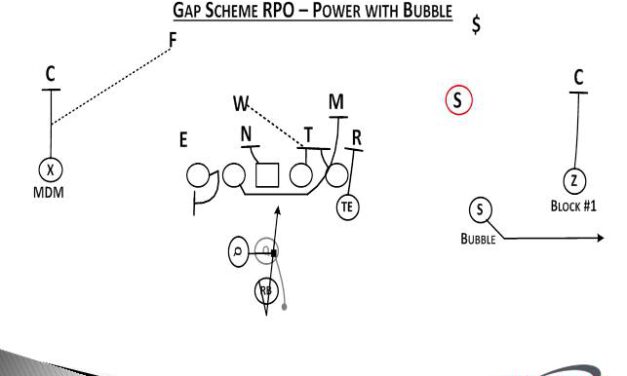
At Rose-Hulman, we have had success running RPO concepts attached to our Inside and Outside Zone runs. During the 2016 season, our personnel dictated that we needed to rely more on our Gap schemes. We still wanted to put opposing defenses in a run-pass conflict with an RPO based offense so needed to find a way to read a defender on our Gap schemes. We researched other successful programs and found that an effective way to tie in a RPO with a Gap scheme is to read a second level defender, namely the overhang LB to the side of the run.

Gap Scheme Runs

The two gap scheme runs we tied into our RPOs are Power and Counter. We like these two runs because most of the teaching is the same for the QB, OL, TE and RB.

Power Rules

Quarterback = Align with toes at 4.5 yards. Secure the snap. Clear the midline by taking a lateral step with your backside foot and a hinge step with your front side foot to get to 90 to get to 90 degrees. If a called run, hand the ball to the RB and carry out naked fake opposite the run. If RPO, read the play side OLB for run or pass as you mesh with the RB. Carry out throw fake if you hand the ball to the RB.

Running Back = Align with toes at 6.5 yards. Take a drop step with the backside foot, secure the handoff, blink the back side LB for cutback then read the A-B-C gaps. Be aware that the QB may pull and throw if RPO. In that case, carry out run fake.

Tight End = Block the play side C gap defender. He will usually align off of the ball with his inside foot just inside of the play side OT.

Play Side Tackle = Block the play side B gap defender. Has a possible double team with play side guard.

Play Side Guard = Block the play side A gap defender. Has a possible double team with play side tackle.

Center = Block the back side A gap defender. Has a possible double team with play side guard.

Back Side Guard = Skip pull for the play side LB.

Read More

OLB Play in the Cover 2 Robber Defense

By Shawn LaMothe
Defensive Backs/Running Backs Coach
Grosse Ile High School (MI)
Twitter: @CoachLaMothe


Introduction

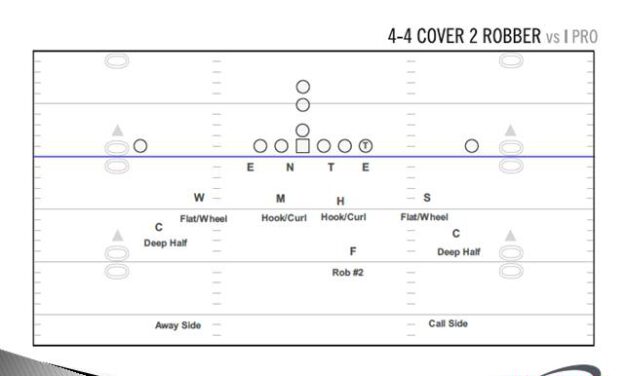
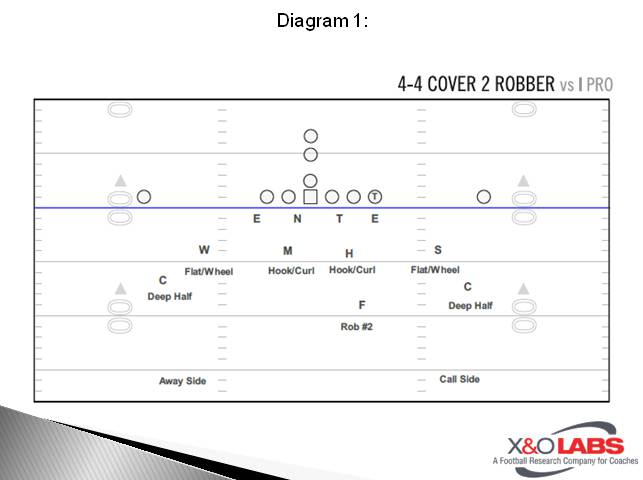
In our base 4-4 Cover 2 Robber system, our goal is for our outside linebackers (OLBs) to be run stoppers first. In our league, we compete against three, very tough, double-tight, full house backfield offenses, which run 90% of the time. Overall, 70% or more of the plays we will see from our remaining opponents are run plays, as well.

Defensive Structure

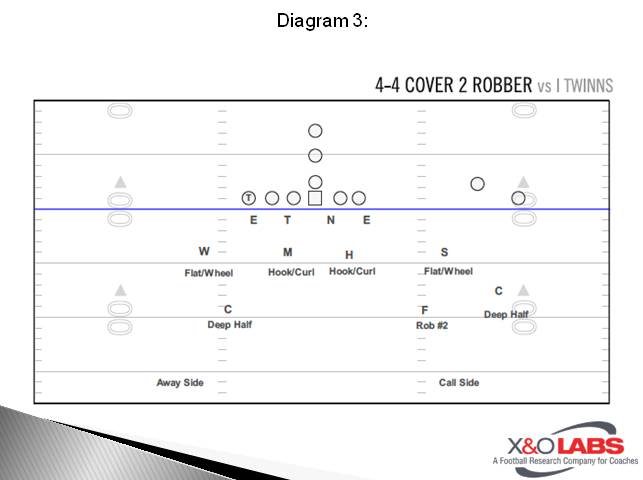
So we are all on the same page, when I speak about the 4-4 Cover 2 Robber system, we have two OLBs, two corners, and one free safety.

Slide1

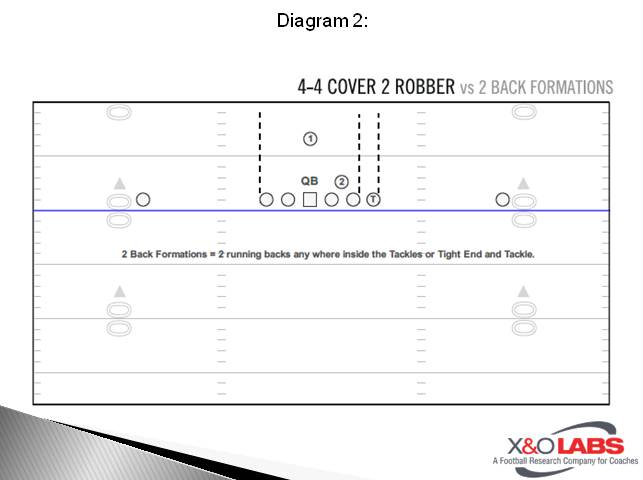
In our system, we have a “Call Side” OLB and an “Away Side” OLB. Before each play, the free safety communicates a directional call telling the OLBs which side to line up on and what side the free safety will be on.

Against any two back formations, this is our go to concept. It is important to note that we define two back formations as any formation in which there are two players lined up between the tackles (not including the QB).

Slide1

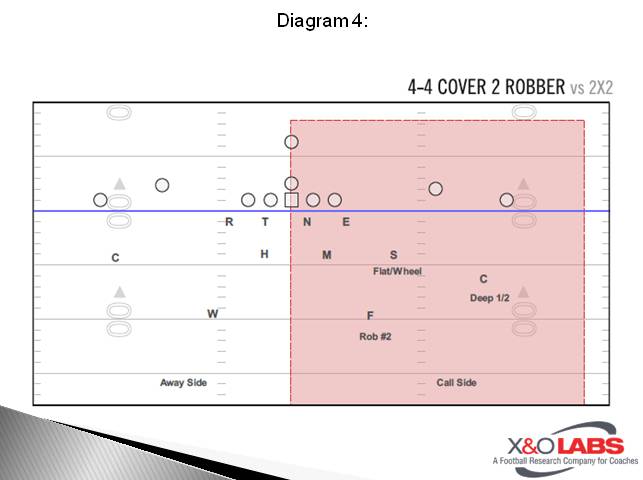
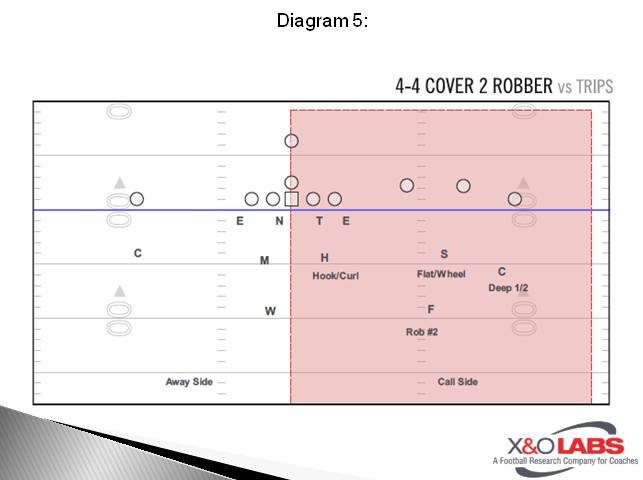
When we see one back spread formations, the first coverage adjustments we will make is to keep the responsibilities the same for the Call Side players with some changes to the Away Side. We do have additional coverages vs 2×2 and 3×1 formations; however, our first check keeps the Call Side the same.

The OLBs’ responsibilities are:

  • Force players vs the run
  • Flat players vs the pass 

Alignment

  • Against only Tight End:
    • Align four yards deep and four yards outside the Tight End.

Slide3

  • Against Two Split Receivers:
    • Split the difference between the Offensive Tackle and the #2 Receiver and five yards deep.
    • If #2’s split closes and he aligns closer to the tackle, we tell our kids always align in position to maintain outside leverage. Once the player feels like that is threatened, he can move head up to outside #2.
    • If the scouting report shows heavy pass from this formation, we will move the OLB out, closer to the #2 receiver to five yards deep and two yards inside #2.

Slide3

  • Against Three Receivers:
    • Split the difference between the #2 and #3 receivers and five yards deep. It does not matter if #3 is a tight end or in a wing position.
    • If it is a bunch formation, the OLB will align head up with receiver on the line of scrimmage. If the bunch is close to the tackle, the OLB will maintain outside leverage.
    • If the scouting report shows heavy Bubble/Now screens from this formation, we will move the OLB out, closer to the #2 receiver to five yards deep and two yards inside #2.

Slide5

Keys

Read More

Eight Tips for Maximizing Your Program’s Summer

By Product Specialist Team
MaxOne.com

X&O Labs Note: We recently met with the guys at MaxOne to talk best practices for summer. MaxOne is also a sponsor of X&O Labs. These guys are doing some cutting-edge stuff. We looked at the research they have been doing with coaches and realized the results could help our readers. So, we asked them if we could publish it. We really believe in what MaxOne is doing and think it is the future of how coaches will run their programs.

Take a look below at the findings – and take a minute to download the 42 things that the best coaches do in the summer.

max11

Summer is coming. What do those words mean to you? The season most often associated with vacation, time off, and relaxation has a very different significance to those who run football programs. As the temperature rises, so does the urgency to get better for the season ahead.

There is no one single recipe for driving improvement within your program; there are a million different ways to attack it, and it happens one day at a time. If you’re looking for new ideas here are eight of them broken down into three categories:

  1. Strength and Conditioning
  2. Program Building
  3. Communication

If you put just one or two of these to work in the coming months you will set your program up for even more success in the season to come.

Report continues below…

Are You Doing These 42 Things?

There are 42 things that successful coaches are doing within their program every summer. Download this FREE checklist. Go here.

Strength and Conditioning

1. Think Creatively About Strength

There are countless strength building tools and resources available to coaches. Outside-the-box options such as CrossFit, Kettlebells, and even yoga can provide outstanding options for customizing your summer workout program.  Bringing fresh ideas and new challenges to your strength program will not only boost the excitement of your athletes, but also keep them engaged and working hard.

John Allen Snyder, Head Football Coach at Indiana Area High School described his diverse and creative approach this way:

max12“Our program is spearheaded by our OL coach… our district Strength and Conditioning Coordinator…and myself the head coach. We feel the three of us together bring a varied approach to Strength and Conditioning…[One] Powerlifting, [another] HIIT/CrossFit and Flexibility, and myself the football aspect. This allows us to throw everything on a wall and see what sticks. It allows us to create varied programming based on three fundamentally different strength approaches, but we always make sure that there is on-field application for everything we do.
It doesn’t have to be a new fad workout, either. Something as simple as unique warm-ups that are introduced in a different space, or a finisher exercise that generates energy and competition in the weight room can help to increase engagement in your program.  

Read More

Teaching the Dead-Snap in 5-Steps

By Mike Kuchar
Senior Research Manager
X&O Labs
Twitter: @MikekKuchar

Featuring:

Adam Cushing
Offensive Line Coach
Northwestern University
Twitter: @CoachCushing

Introduction

nwIt was directly after the 2015 season when Northwestern offensive line coach Adam Cushing felt he needed a change. That season seven snaps negatively affected the outcome of the offensive play, including one that turned into a pick six. So he did what most good coaches do, scoured the earth to find better information on how to make the shotgun snap more efficient. So after consulting with offensive line coaches at all levels he decided to invest fully in the dead-snap shotgun technique, which compromises speed for accuracy by eliminating the wrist flick of the center.
Read More

Implementing a Pre-Season O-Line Drill Catalog

By Justin Iske
Offensive Line Coach / Co-Offensive Coordinator
Southwest Oklahoma State University
Twitter: @justiniske

Introduction:

Working with your players during the off-season is critical to having success during the season. Regulations on time, equipment and number of players you are allowed to work with have forced coaches at all levels to be more creative when it comes to getting work done while staying within the rules and keeping your players healthy throughout the off-season.

One tool that is underused during the off-season is watching film. With programs like Hudl, it is easy to make teach tapes of individual plays or techniques to help your players continue to get better. It is also a good idea to film your off-season drills to review with your players.

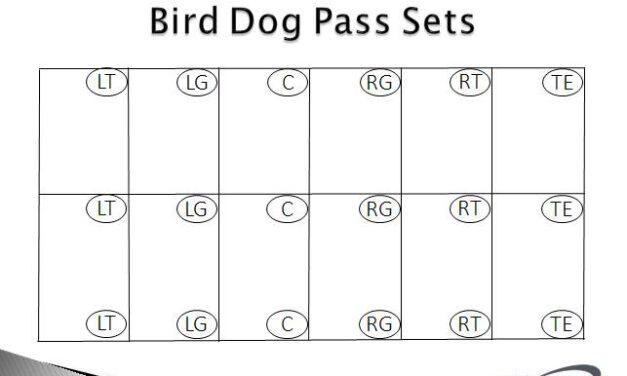
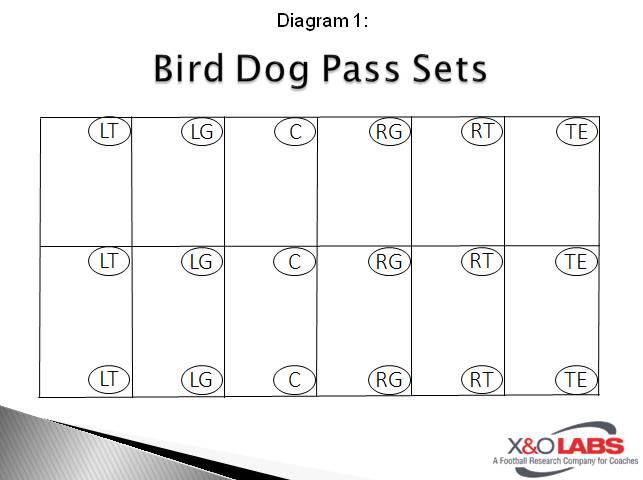
Bird Dog Pass Sets

This is a great way to work all of your offensive linemen (and tight ends) at one time to maximize reps. If you have a grass area that you can form a grid with 5×5 squares that is great. If not, you can use yard lines and towels to get the same results. If you can’t do a grid and don’t have access to lines, simply use the towels as landmarks.

  • Line up all of your OL’s and TE’s on a grid (or you can use yard lines and towels) by position.
  • Call out a play and snap count.
  • Drill can be done for one step, two steps, or through a whistle.

Slide1


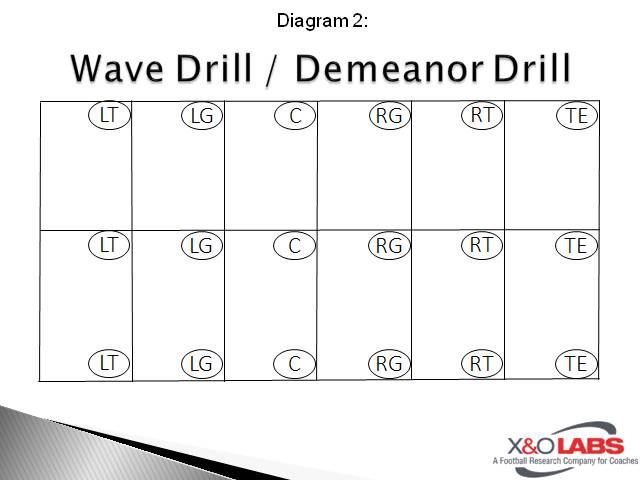
Wave Drill

Another drill that can be done with everyone at one time. This drill is a great warm-up drill and it allows the players to feel proper body position for both pass protection and run blocking. It can also be used as a conditioning drill to develop core strength and overall stamina.

  • Line up all of your OL’s and TE’s on a grid (or you can use yard lines and towels) by position.
  • Point in a direction and then call out snap count. Change direction every 2 to three steps or as desired.
  • Drill can be used as a warm-up and/or as a conditioning drill.
  • Side to side = pass pro demeanor.
  • Forward or backward = duck walk / run.

Slide1

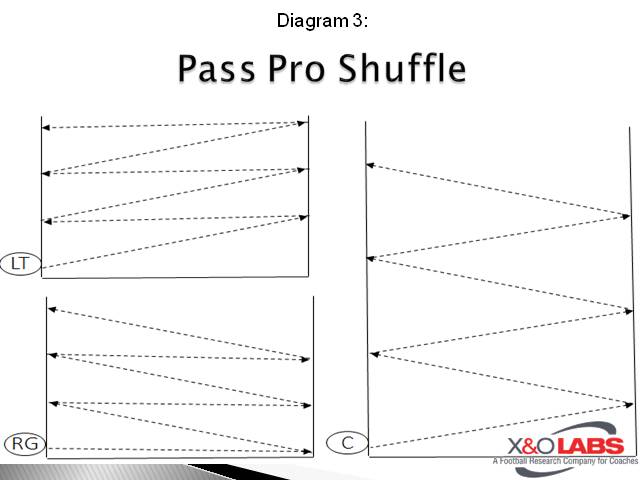
Pass Pro Shuffle

This drill incorporates a kick or post set and change of direction. It can also be used as a conditioner. The key coaching points in this drill are carrying the hands correctly, proper weight distribution and keeping the feet as close to the ground as possible as you slide.

  • Divide OL’s into three groups (right-side, left-side and centers).
  • Align 1st player at the sideline of the field on a yard line. Have them kick or post (based on position) five yards and back as many times as desired.
  • Once all three groups have gone, start over with all going the opposite way first.
  • In the diagrams on the right, the left side would kick to the left first, then post back to the right. Right side OL’s would post to the left first, then kick back to the right. Center’s would kick in both directions.

Slide3

Pass Sets (Kick – Post)

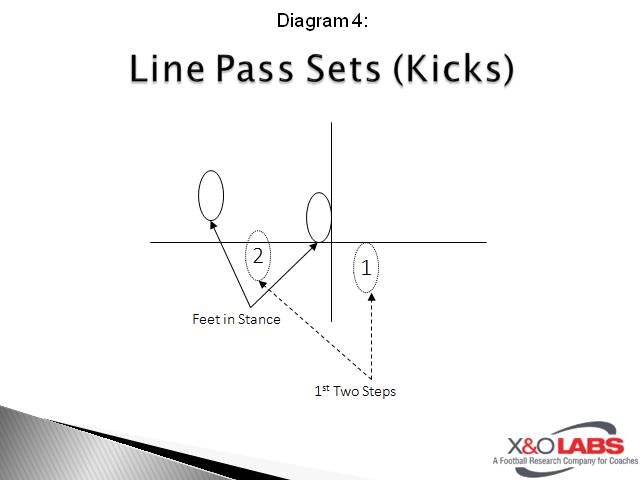
Drill can be done with everyone going at once on air or can partner them up to give players a defender/landmark. Align defender head-up, inside, outside, on the body or off the body to force them to adjust their footwork accordingly. Use the drill as a progression by having the players take one step, then two. Can progress to timing up the punch and then redirecting and/or reacting to a pass rush move.

Kicks:

  • OL starts in two or three-point stance with outside foot in the corner of two perpendicular lines (or rolled up towels).
  • On command, he will take his first step over the line for width and depth.
  • Drill can be done for one step, two steps, or through a whistle.
  • Drill can be done on air or versus a defender.

Slide3

Read More

Slide Footwork in Press/Catch Technique to Alleviate False Feet

By Mike Kuchar
Senior Research Manager
X&O Labs
Twitter: @MikeKKuchar


Addressing False Feet

Most coaches will argue that in press coverage, the feet must move before the hands. But where they move is just as important as how they move. Too many times, a corner will put himself out of position by stepping back or stepping away from the receiver. So, to combat this issue Coach Sewell at Bowie State University will use agile bags for his corners to work on their feet before making contact in press technique.

Coach Sewell calls this the No Retreat Press Drill, which works on press technique without retreating. “We’re focusing solely on sliding in the direction where your leverage advantage is without giving ground,” said Coach Sewell, who will use this from press alignment and catch alignment at 5 yards.

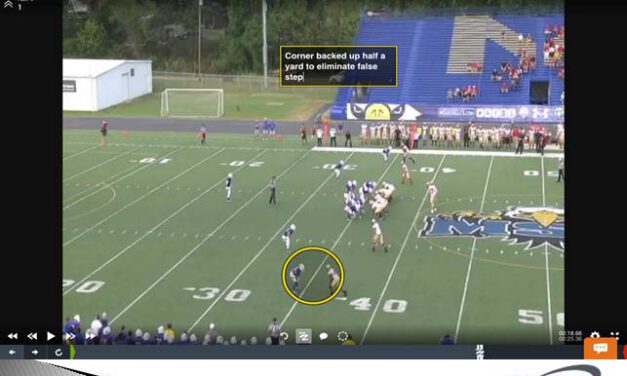
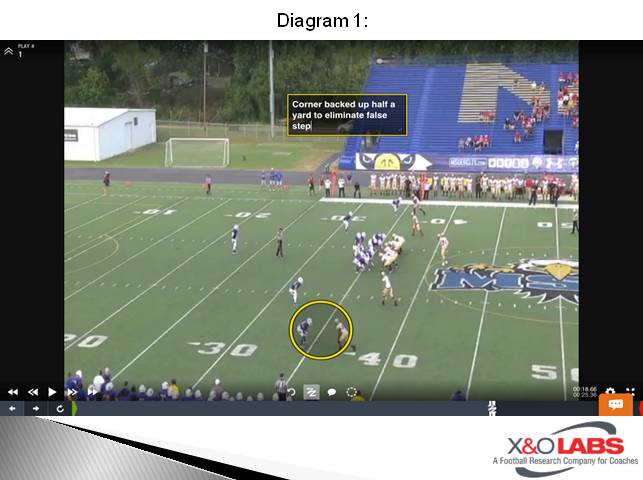
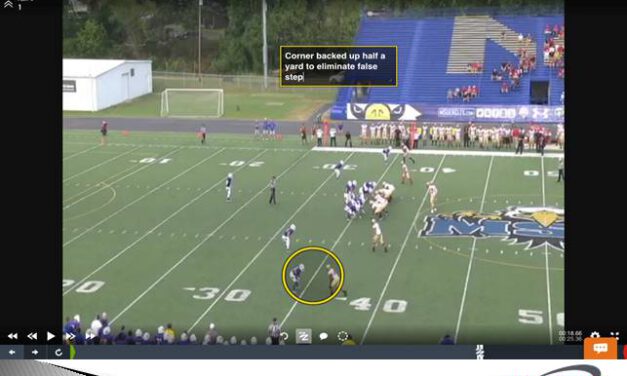
Conversely, some corners will develop the bad habit of a forward jab step in playing press technique. According to Coach Moore, if it can’t be fixed with extra study and individual work, he will back the player up a half of a yard and let them play using the false step, like a golfer playing for his/her slice. For example, in the clip below, the corner at the bottom is playing further off than the defender up top because he would always take the false step (Diagram 1). “So instead of playing at the normal depth, we backed him up a half a yard or so he can still take the false step,” said Coach Moore. “We had trouble getting it out of him.”

Slide1

At Southern Arkansas University, former defensive coordinator Josh Lawson, taught a slide technique to play press coverage. But to alleviate players using their hands before their feet, he would make his corners wrap their hands behind their backs. “We would have a receiver holding a dummy and we would cover the receiver without using hands so they had to use their hips and body all the way through the receiver,” Coach Lawson told us. “We don’t backpedal. We don’t think it helps us. So, we over exaggerated how many times we had to slide. So, if I felt like we needed two good slides in our press coverage before we can get our hands on them and open up with them, we would have exaggerated that to four slides. We would slide laterally four times and then punch a bag to open our hips. We over exaggerated their feet a lot.

Addressing Dead Feet

Aside from taking false steps, some corners have issues with stopping their feet in press coverage as well. How Mac Alexander, the defensive backs coach at Colorado Mesa University alleviates this issue is by using what he calls his “motor technique.” He will start his drill work every day for 10 minutes working his motor drill then progress to one-on-one’s. In his motor back technique; the emphasis is keeping the feet shoulder width apart with weight on the balls of their feet. The hands are up ready to punch and in athletic stance with flat back. When wide receiver releases the defensive back moves his feet back quickly gaining six inches with each step, while staying square.

Like many coaches, Coach Alexander will film his individual time of all the man technique. “We show them that ‘yes, you can do this,’ but you just have to focus on what you are doing,” he told us. “Because many times what gets a defensive back in trouble is that when they come press, they don’t have a plan on what they are going to do. So, getting them to think and focus every time they press will really benefit them.”

Once the motor technique is understood from a stagnant position, Coach Alexander now implements the fundamental to simulate when a receiver moves back and forth. It comes in the shape of his Zig Zag Drill.  “As the wide receiver goes back and forth, the defensive back is working his motor literally staying square and inside of the wide receiver,” said Coach Alexander. “The hips do not open and there is no punch.”

Addressing The Eyes and Hands in Catch Technique

As opposed to on the ball corners which use a press technique in man coverage, off the ball safeties or outside linebackers use what is called a “catch” technique with the visual of “catching” receivers and not giving ground, as they get into their routes. So, we asked each contributor to talk about how he is training the eyes and hands of defenders when in catch technique on a number two receiver.

Zack Moore, defensive coordinator, Morehead State University (KY): “At safety, most footwork issues center around two things: giving ground before utilizing ‘catch’ technique and giving up leverage due to breakdowns in their footwork.  We combat these issues by teaching our safeties to play on a cliff, understanding they cannot give vertical ground prior to making contact with the receiver. We also teach them to understanding how teams may attack our coverage helps the player understand not only what routes they’ll see, but why. Therefore, understanding why they must keep leverage. The technique correction is usually their failure to stay square and mirror lateral movement by the receiver. Correction may be as simple as re-teaching or may call for intervention by means of an alternative drill or approach.

If a player is in man coverage, we do not teach them to read the QB. They can be taught, dependent on the opponent, what routes to expect from various splits, field positions, different players and situations. Also, knowledge of what the weaknesses of the coverage may be and how offenses tend to attack the coverage should give them a good idea of how they’ll be challenged. For example, if we are outside leverage on a slot receiver, we know that slants and inside fades will be on the menu for whatever offense we are playing that particular week. RPO always adds to the challenge of defending, but this is also a big reason why we choose to utilize cover 1.  The back set is often a good indicator of whether you will be on the passing side of RPO. As mentioned above, this, as well as other pre-snap indicators, can help the player anticipate or be prepared for certain routes.    

Read More

Alabama, Michigan OL Coaches Headline C.O.O.L. Clinic in May

wylieThe Annual Offensive Line Clinic will be held on May 19 & 20, 2017 at the Millennium Hotel in Cincinnati, Ohio. It’s two days of non-stop football with presentations from some prominent offensive line minds in college and professional football including speakers from Michigan, Alabama as well as the Redskins, Cowboys and Steelers. X&O Labs will be represented and we would love to see you there.  While you can register for the clinic at the C.O.O.L. clinic website, Insiders members can access a report from Cleveland Browns offensive line coach and clinic director Bob Wylie on his Twin and Duo run concepts by clicking here.

Read More

Punt Coverage Drills – Washburn University

Read More

Man Coverage v. RPOs: Case 1 – Teaching Press Man and Off Man Techniques

By Mike Kuchar
Senior Research Manager
X&O Labs
Twitter: @MikeKKuchar


Introduction:

Playing man coverage is a mindset. We must not underestimate that. There is a common myth among coaches that believe you must have the “dudes” to play man coverage. You need that 4.45 shutdown corner that can eliminate at least a third of the football field. Or you need that 6ft. 3in. safety with the length and ability to both close quickly in the short game and cover enough ground in the vertical game to prevent deep throws. 

Well, we’re here to tell you that is not true, at least according to our contributors of this study. Regardless of your personnel, you can play man coverage and you can do so effectively without putting your players at a significant disadvantage. One of benefits of man coverage is the possibility of creating personnel match-ups and getting players who may be deficient in coverage the help they need if they know how to protect leverage. While man coverage can be the simplest coverage to teach structurally, the challenge lies in teaching your player the fundamentals and techniques necessary to defend routes.

In this case, we present our research on the daily drill work our contributors are using to teach both press and off technique to their back end. But before we do so, we wanted to start with how these coaches get their defensive backs to understand how important it is to play with confidence.

Developing the Man Coverage Mindset:

Let’s face it: getting players to play man coverage starts with the belief that they can. In doing this, defense can shift the paradigm to where they are dictating which routes they want the offense to run and which part of the field they want them to be run. And while much of this is tied to pre-snap and post-snap leverage, which we will detail in this case, we will start with how coaches are teaching their defenders to understand how the following five components tie into success in playing man coverage: 

  1. Competition
  2. Playing with confidence
  3. Knowing your Opponent
  4. Knowing the Situation
  5. Maintaining Focus

We asked our contributors how they use these components to prepare their defensive backs for success in playing man coverage. Consider their responses below: 

Mac Alexander, defensive backs coach, Colorado Mesa University: “As a defensive back coach I believe it is my job to instill confidence into my players. Part of being a defensive back is all about having belief in yourself. As a coach, I understand that they are going to get beat, but the way they respond is what I am really looking at. If a big play happens, I never want their body language to change, because if they do drop their heads or slump their shoulders, then I guarantee an offense is coming right back at them. I want them to believe in themselves and the techniques we are using.

“The first way I instill this confidence is by coaching them hard, but always being positive with them. The second way is by the way we do our individual drills. Each day we have a 10-minute segment dedicated to man-to-man technique. These drills are always the same and they pertain directly to what we are going to see from a wide receiver. Now these drills are not easy and they are made to make the DBs get tired, so now they must focus even more on their technique and what they are doing. This is my way of getting them to have confidence. As a group, we have the hardest individual periods on the team and that is something that we take pride in and will develop confidence through these drills. They work this stuff every day and come to a point where it feels very comfortable to them giving them confidence in themselves. Then when they see the drill work carry over to teamwork, they really start to work even harder during these individual drills.”

Will Pluff, defensive coordinator, Utica College (NY): “If you do your first three tasks right you will always have the opportunity to win the play. No matter whether you are ‘in phase’ or ‘out of phase’ you always have a chance to compete to win the play. But players need to be drilled what to do when the ball goes in the air. This cannot be an intricate thought process, it happens fast. We also spend a lot of time in wide receiver study of not only what routes you will see but also how the receivers get in and out of their breaks. Do they give the route away in their release? As far as down and distance goes, we must know what routes would an offense use and how does our alignment impact the wide receiver’s route such as an offense coaching choice routes based off our pre-snap alignment.”

Zack Moore, defensive coordinator, Morehead State University (KY): “Any form of man coverage requires confidence, thick skin and a short memory. The opponent is going to catch a ball, we’re going to get a pass interference call; they will make plays. If it happens, we don’t lose our minds, we correct the performance and put them right back in the same situation. Our expectation is that they learn from their mistake, correct it, and make the play when the opportunity arises. Confidence comes from feeling comfortable in what you are doing. We habituate our players to different looks as much as possible. In studying our opponents over the past couple of seasons, and by competing against our own offense, our guys will be exposed to all the stacks, bunches and motions we can imagine during meetings, film study, walk-through’s and practice. We believe that when they have been put in these situations, we’ll reduce the emotional response (panic) during competition, therefore increasing their ability to produce.”

Read More

Man Coverage v. RPOs: Case 2 – Formation Adjustments and Defending Compressed Formations

By Mike Kuchar
Senior Research Manager
X&O Labs
Twitter: @MikeKKuchar


Introduction:

The advantage of utilizing a 4-2-5 front structure is that it keeps both six in the box and is malleable against basically any offensive formation. When it’s coupled with man free coverage it provides for advantageous personnel matchups all over the field. While split field coverages are tied to 4-2-5 fronts, we’re finding that many 4-2-5 defensive coordinators are mixing in a good amount of cover one structures to account for every possible receiver on the field while keeping six in the box to defend the run game. The best part is there is no conflict defender sitting in an apexed alignment forced to make a decision on run or pass. Quite simply, there are separations of run defenders and pass defenders pre-snap.

We will detail how our contributors are coaching these interior and exterior defenders to play both the run and pass in case three. But in this case, we will focus more on how the 4-2-5 front structure adapts to each of the more popular one-back formations and how coaches are able to create personnel matchups on the perimeter.

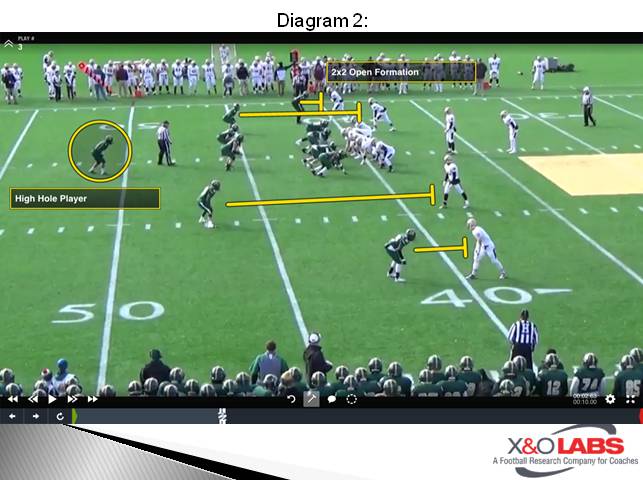
10 Personnel 2×2 Formations: (Diagram 2)

Slide2

Against 2×2 formations, the six-box will not change. The adjustment comes on the perimeter, where each receiver is covered down by the two corners and a strong safety and weak safety. The free safety is traditionally the high hole defender.

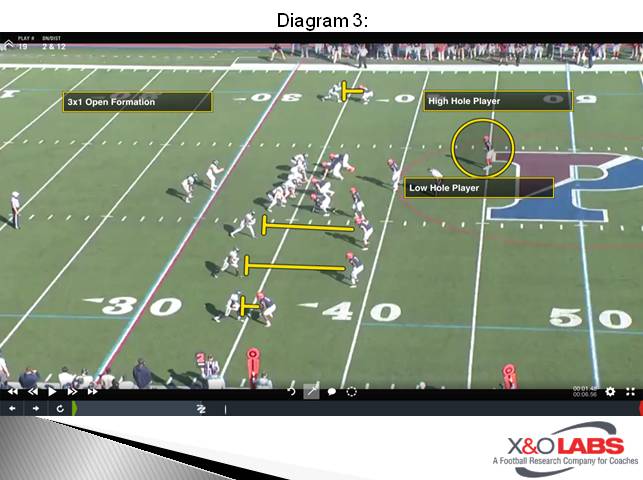
10 Personnel 3×1 Formations: (Diagram 3)

Slide2

Again, the box doesn’t change with trips formations. One interior linebacker will typically play the back and the other will play the quarterback. We will address how this will vary in case three. In the back end, the weak safety will traditionally be the high hole player, while the strong safety, free safety and corners scramble to align on the other receivers.

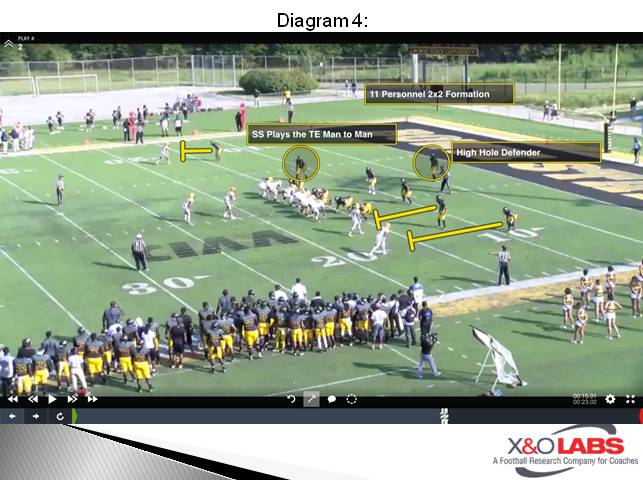
11 Personnel 2×2 Formations: (Diagram 4)

Slide4

The advantage of a closed tight end is that the defender responsible for him in coverage is able to play both the run and pass based off the tight end’s movement. As Will Pluff, the defensive coordinator at Utica College told us, “he has the best key in football. It’s hard for him to lie.” In these situations, the corners and safeties decide who will be the high hole player.

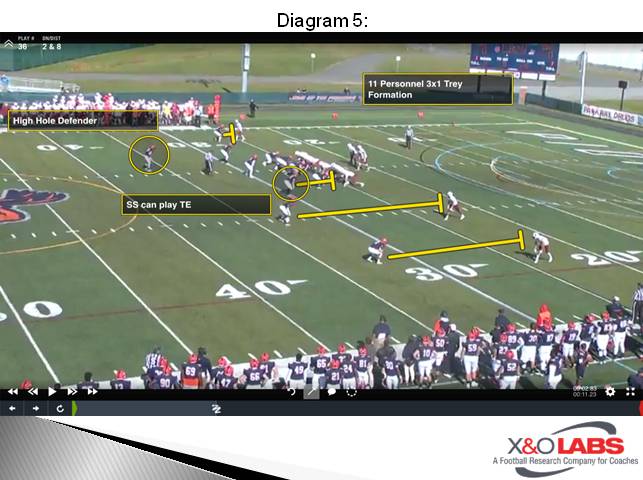
11 Personnel Trey Formations: (Diagram 5)

Slide4

In Trey formations, the strong safety will typically align to the tight end and play him man-to-man just as he did in 2×2 closed formations. However, if the offense aligns in a formation to boundary situation, a matchup advantage could be employed by “banjoing” the number two receiver and tight end. This is something Coach Sewell will use. When the number two receiver goes in, the safety drives down right now. He normally expands to play tight end but tight end blocks so he gets underneath number one. Here, the Mike is able to open up and be the low hole player when back goes away. It becomes a bracket on the number two receiver.

The clip below best illustrates this coaching point:

Read More

Man Coverage v. RPOs: Case 3 – Concept Teaching Man Free Coverage to Defend RPOs

By Mike Kuchar
Senior Research Manager
X&O Labs
Twitter: @MikeKKuchar


Introduction:

Now we segway into how using the fundamentals and techniques in the earlier cases transitions into defending RPO (run/pass option) concepts. In this case, we present our research on the run responsibilities of each defender. Remember there is one clear definitive in the reasoning why coaches are preferring to use man free coverage structures to defend RPO schemes: there is no conflict defender. The entire premise of the RPO system is to manipulate a defender in zone coverage who may have a dual responsibility by playing both run and pass. That is certainly not the case in man free coverage. Defenders are given either a run or pass responsibility pre-snap and it is their singleness of purpose to carry out that assignment.

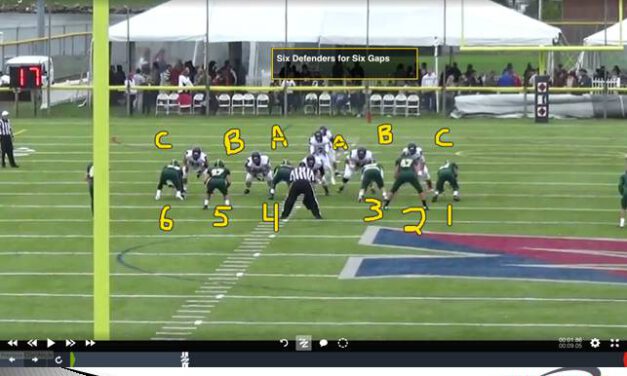
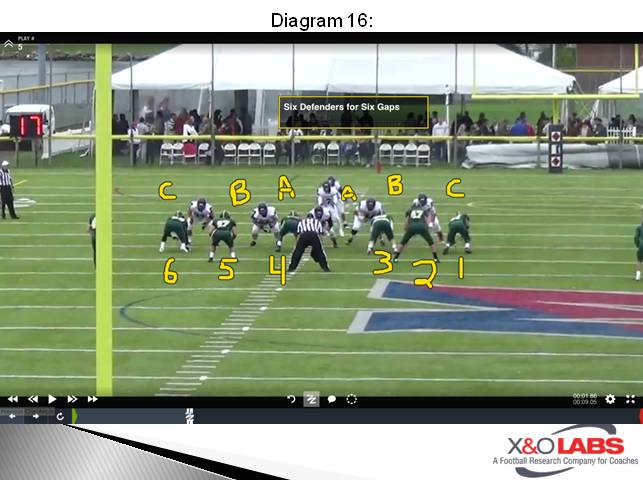
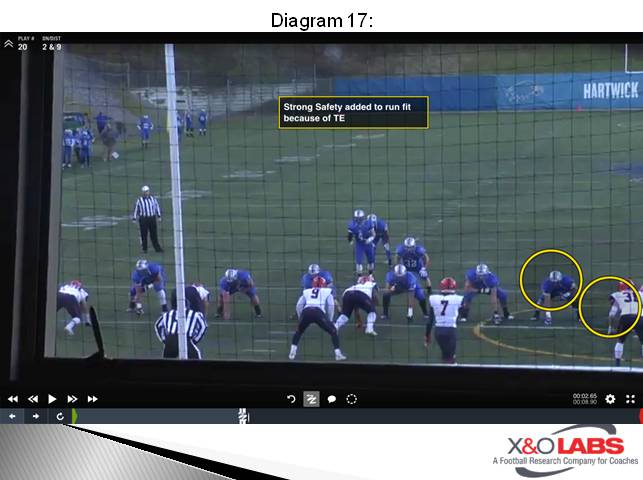
Now, the down side of man free coverage structure is there is no traditional numbers advantage in the run game. In 4-2-5 defenses, it is six-for-six in the box against open formation offenses (Diagram 16). It’s a single gap control situation, “a get a hat in a gap and go mentality” with a defender asked to make a tackle on the player he’s responsible for. Now, later on in this case, we will detail how some coaches are getting a numbers advantage by cheating the extra, low hole or high hole defenders, to get another hat in the run game. When offenses add an extra hat, thus adding an extra gap in the run game, another defender must be accountable. This defender is usually the strong safety against three man surfaces (Diagram 17).

Slide16

Slide17

Now, the benefit of having a closed tight end is that it may be a clean read for the strong safety to trigger on a run or pass. “The tight end is the best key in football because it’s very hard for him to lie,” said Will Pluff, the defensive coordinator at Utica College (NY). In order to make it a cleaner read for him, Coach Pluff will align his defensive end in a C gap so the tight end must have to make contact on that defender either way. And as we expounded upon in case two, the H/Y off key is often just as true in determining run or pass reads. The defender responsible for that player will simply add on to the run fit whichever way he moves pre or post-snap.  But either way it doesn’t change the box count. “We have to study the formation,” said Coach Pluff. “It’s really about what they are doing with the tight end off the ball. If they take the tight end and put him off the ball and involve him in the RPO, well then they have five blockers up front. They could block you with the quarterback as well. You have to make sure you need to have six in the box for the run and you get that in the 4-2-5 look. Our two inside linebacker will fit to the box. Schematically, we need to make sure we have eyes on number one, number two and number three in the pass game. If we have eyes on those guys and not involving the inside linebackers, I think we have a shot.”

Training Box Defenders to the Run Element of RPOs:

So now once the ball is snapped, the formation detail is off the table and defenders must execute their run or pass responsibility. Here we focused on how our contributors were training their box defenders to fit the run game. We wanted to study what they were teaching them to read pre-snap and how they were teaching them to react post snap.

Basically we found four areas of study in training the box defenders to play the run element of RPOs. They fit into the following areas:

  • Gap Based System
  • High to Low Read System
  • Low to High Read System
  • QB Read System

Gap Based Systems

Grant Caserta at Husson University teaches his box defenders a gap based system with the understanding that this may change based on any pullers. Against the zone read run game, the crux of our entire defense is having all interior run gaps accounted for. As Coach Caserta asserts, “If we leave open gaps inside from tackle to tackle, there is no way we will stop the run consistently. Fitting gaps properly on the interior is crucial. We feel like the strength of our defense is stopping interior runs, so that is where we prefer the ball to go on option plays.” As a general rule, anybody who is blocked has the dive. The unblocked defender will play the quarterback, which would apply against other types of RPOs as well, such as when defensive tackles or linebackers are read. The purpose is to get the ball handed off on any kind of zone read, RPO or any other kind of option. “All inside run defenders need to fill their gap based on the run scheme. We stress to these players that they need to stay in their gap and take care of the running back,” said Coach Caserta. “They must trust that the perimeter players will do their job and take care of their respective responsibilities. For these inside run defenders, it does not matter if there is a ‘read’ element to the play or not they should fit the run the same way regardless.”

The clip below best illustrates this coaching point:

Read More