
Adjusting C3 to “Match” Spread Sets

By Brandon Staley – @CoachStaley_JMU

Defensive Coordinator

James Madison University



jmupracticeEditor’s Note:  Brandon Staley is in his first year as the defensive coordinator and linebackers coach for the James Madison football program. Staley spent the last season as the defensive coordinator at John Carroll University, where he helped lead the Blue Streaks to a 9-2 overall record, 8-1 in Ohio Athletic Conference (OAC) play and a berth in the Division III national playoffs for the first time since 2002. His defense averaged giving up just 9.1 points and 228.4 yards per game, while forcing 27 turnovers, earning him OAC Co-Assistant Coach of the Year. Senior cornerback Randy Greenwood was named a Second Team All-America selection, while five defensive players earned All-OAC honors. His defense ranked third nationally in third-down defense, second in red-zone defense, third in pass efficiency defense and 16th in defensive yards per rush.


Introduction

Quick clinic question: What is the tragic flaw of Cover Three defense?  You guessed it, four verticals. But what if we told you that you could still play your cover three coverage concepts but negate those verts by matching up to those horizontal-stretching routes?  The answer may lie in what Brandon Staley, the defensive coordinator at James Madison University, calls “Match” coverage.   It’s a coverage that Staley used nearly 70 percent of the time on first downs last year while at John Carroll College, and the results were outstanding.  The Blue Streaks finished second in the country in total defense, posting four shutouts.

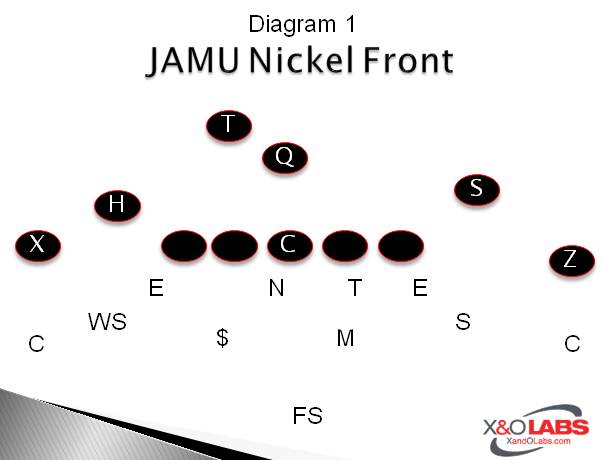
Editor’s Note: Since all of these coverages are three deep, four under by nature we will describe each coverage based on the responsibilities of those coverage defenders.  The symbols in the diagrams are the following:

S= Star (Nickel Corner)

$= Money (Linebacker to the Trips or Strong side)

M= Mack (Linebacker to the weak side)

DS= Drop Safety (Staley plays with left and right Safeties)

FS= Deep Safety

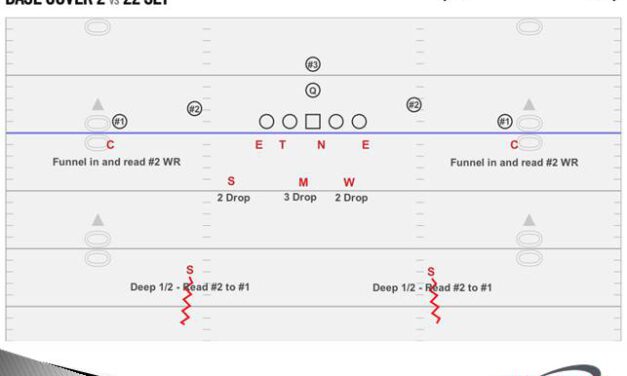
Out of a nickel 4-3 look (Diagram 1), Staley’s flat players will be a drop Safety and the Star, which is a Nickel Corner.   In Staley’s system, both Safeties are interchangeable- he plays with a right and left Safety.  Either one could be a box dropper.  “That is why we teach three-deep conceptually because your flat players can be different people depending on the personnel grouping and the rotation of the safeties,” he told us.  Staley teaches three base coverages on first down, all of which are predicated off offensive structure:

  • “Match” to slot and 2×2 formations
  • “Skate” to Pro, 3×1 and bunch formations
  • “Flood” to empty formations. 

Slide1

Staley details each coverage below, but the efficiency in teaching lies in the player’s ability to recognize formation structure and make the right check.   “All they have to do is identify the formation and that’s how you know what you will play,” Staley told us.    “We tell the players that this coverage plays like man when it has to and it plays like zone when it has to.  We are going to take away the “intent” of the formation and the routes. When routes go vertical, then we are going to carry them and it will look like Cover 1. When routes are shallow or when formations are tight, then we are going to play zone off of the QB and see the ball thrown.”

Illusion of Cover Three

According to Staley, the primary benefit of playing these coverages, as opposed to pure cover three, are bountiful.   “It gives the illusion of Cover one but  we have zone eyes on the QB.  Our Corners do a lot of press bail technique so you get a lot of fades and you’re on top of the route.  You’re able to play a lot of things top down.  Receivers don’t get a lot of yards after the catch and you have more overlap players.  Cover defenders don’t get drained out from playing man to man.  Man to man is dicey with stacks and bunches.  You still get the illusion of bump and run- to the boundary because it is bump and run.” 

Match Coverage Structure

Most offenses want to utilize the four vertical concept out of 2×2 sets, which is why Match is the adjustment against all 2×2 balanced offensive sets.   “We know that most offenses want to go with four verticals out of 2 x 2 formations so “match” takes away that intent,” Staley told us.  “It allows the middle of the field safety to stay in the middle because the seams don’t get stretched like when you spot drop as you would in Cover Three. Seam verticals have to be funneled to the middle of the field Safety.  We don’t want those seams working away from the middle of the field safety. We want to condense those seams.  We want those seams coming to our safety. We want to funnel those seams with the flat players.”
Read More

Quick Game Tags to Zone and Gap Run Schemes

By Jacob Knight
Offensive Line
Waverly High School (OH)
Twitter: @CoachKnight55

Introduction:

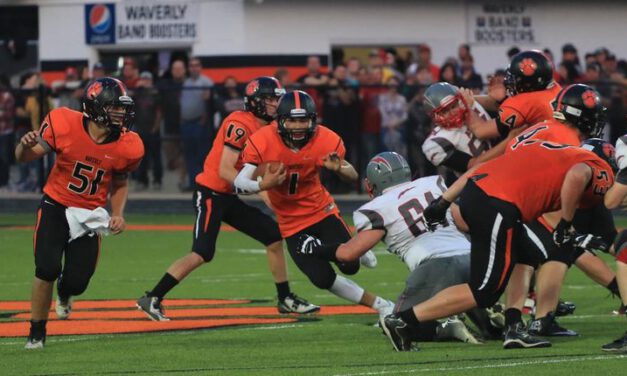
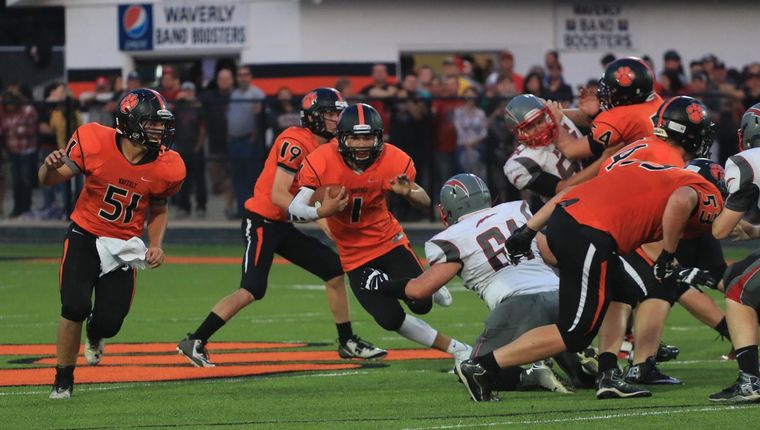
knightAt Waverly High School, we are big believers in getting our best athletes the football in space. Our other belief is we do not want to run the football into bad looks. These are concepts most teams adhere to, but our issue going into this past season was that we had a different kind of QB.
He is a hard worker with a great deal of arm talent, but he isn’t a great runner by nature. It isn’t that he was slow, but it was obvious that his legs were not what we were going to live on. To address this, we sat down and tried to construct ways to give our guy answers in the run game where he didn’t have to pull the football, and run. So through this, and research we decided the best way was to tag quick game to run plays.

Base Runs:

We run the following base runs; Inside Zone, Power, Counter, Stretch, and Pin& Pull. We are a team that operates exclusively out of the pistol. Because of this, we will not have tags on Stretch, and Pin & Pull (though we do allow our quarterback to take matchups to the backside 1v1 if he has them). We will tag quick game on Inside Zone, Power, and our Read counter play.

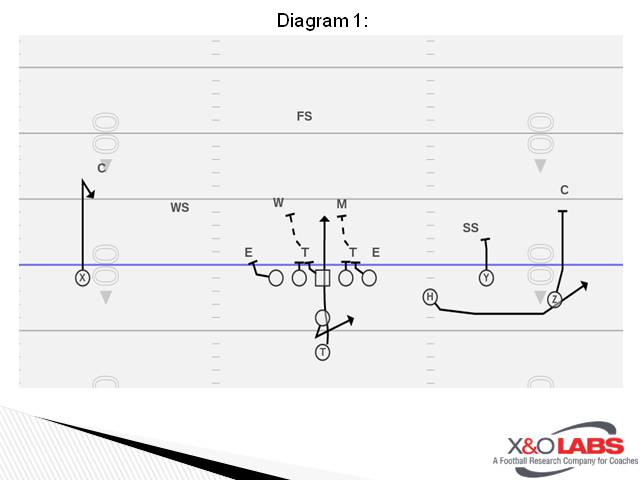
On every inside run concept our offense runs, our receivers have specific rules. If it is a 3 receiver side, our H (#3) knows that he is running a bubble, the single side knows they are running an option (hitch, slant, fade). Our receivers are going to block for the bubble, or run a route on every single inside run play we call (Diagram 1).

Slide1


To study game film of the bubble concept, click on the video below:

Read More

Quarterback Outside Zone/Bubble RPO

By Chad Stadem
Head Coach/Offensive Coordinator
Washington High School (SD)
Twitter: @Mr_Stadem

Introduction:

There are many ways to have the quarterback run the football. Power, inverted veer, zone read, and midline read are among the most effective in today’s game. Another way to run the quarterback is with your zone game. We like to use outside zone with our quarterback to add another option for our run game without needing more practice time to perfect it.

QB Zone Basics:

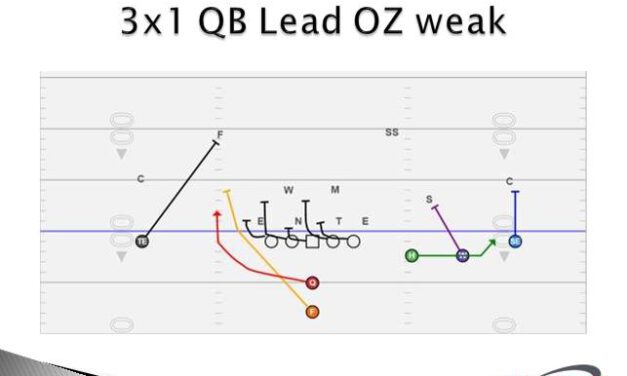
We are an up-tempo, inside/outside zone team at Sioux Falls Washington. We have been fortunate the past few years to have good linemen and running backs to perform this type of run scheme. We have also had some good running quarterbacks as well. We believe in having multiple formations and keep our scheme simple enough to be able to run our schemes effectively. One play we like to run at teams is the quarterback outside zone. We will also add a simple RPO to these runs to make the defense defend more than just the run scheme. We feel that a running quarterback puts additional stress on the defense, and in some formations, we can gain an additional blocker by using our running back as a lead blocker. 

We teach our quarterbacks to run the outside zone just as our running backs would. During our mesh period, our QBs run the OZ play just like our running backs would, along with the same gap reads. With a tight end or H back, we read the C gap. With no tight end, we read the offensive tackle’s block. We like having our running back as a lead blocker because he already knows how to read the blocking. We find this to be an efficient way to add an additional blocker to the scheme.  We run the running back lead from the pistol and the gun.

Read More

Cover 3 Conversions From a Cover 2 Shell

By Nick Bamber
Defensive Backs Coach and Special Teams Coordinator
Chesterton High School  (Chesterton, IN)
Twitter: @nbambernbamber

Introduction:

Being able to effectively switch and disguise coverages at the high school level can be lethal to opposing quarterbacks. We are a primary cover 2 team, but we will occasionally roll into various cover 3 and man looks to defend different attacks on the field. The good thing about these coverages is that they are very easy to teach and are simple on your players, especially your linebackers. The different coverages primarily involve changes in the defensive back action, allowing your rules for the linebackers to stay relatively the same.

From past experiences, I have found that complicated coverages with lots of changes for linebackers lead to more blown coverages and gaps in your defense. For that reason, we wanted to make things consistent throughout our coverages for our linebackers. I truly think this clinic report can be implemented at any level, especially if you already run cover 2. Already running cover 2 allows you to apply all your current cover 2 rules while giving you some additional variations.

Another positive of these coverage schemes is that rolling to cover 3 out of a cover 2 shell covers the weakness of a cover 2 defense. The middle of the field is the biggest void of a cover 2 secondary.  Every offensive coach will look to attack your middle when they see your cover 2 shell on film. This thought process can work to your advantage when you are using these alternate coverages. Rolling to a cover 3 out of a cover 2 look will put one of your safeties right in the middle of the field, the exact zone the offense is looking to attack. Picking and choosing the right times to roll and disguise can not only prevent a big play, but can hopefully get you an easy interception.

Base Cover 2

Our base cover 2 is the shell that we will show on nearly every play. The few exceptions being on goal line plays or our man-to-man coverage with no safety help. These schemes are applicable to both a 3-4 and a 4-3 set (all the play cards are drawn in a 4-3 scheme). Since this article is about coverage concepts, I will not go into much detail about our technique for each position.

Corners

Corners will line up with an outside shade on the outside receiver. The corner’s inside eye should be even with the receiver’s outside eye. Based on the speed or athletic ability of the receiver, the corner can widen his alignment a little if needed. Our number one concern for the corner is to funnel the receiver inside, so there is some flexibility given to our corner so he can accomplish our primary goal. In terms of depth, we range from a press look to 5 yards deep, depending on the team/ receiver.

Our corners, like most teams, read the #2 receiver (always count outside in for receiver numbers) and react to him. If he goes vertical or breaks inside towards the ball, the corner will stay on the #1 receiver. If #2 receiver goes vertical, the corner has to be ready play the deep ball on #1 receiver. If the #2 receiver comes out, the corner will push the #1 receiver towards the safety help and pick up the #2 receiver.  

Safeties

Safeties will line up 12 yards off the line of scrimmage. They have a 6-yard width window to line up within. They start on the hash and have 3 yards either way for their width alignment. For example, if the #1 receiver is really wide towards the sideline, they can widen up to 3 yards off the hash.

Our safety reads are rather conventional. The safety reads the #2 receiver. If he goes vertical, safety picks him up. If the #2 receiver makes any type of non-vertical break (slant, out, curl, comeback, etc.) the safety drives to the #1 receiver and picks up the route.

Outside Linebackers

The strong outside linebacker will be 5 yards deep and removed from the box, splitting the differences between the end man on the line of scrimmage and the #2 receiver. Obviously different formations will bring different alignments, such as a tight end set or empty, but to make things simple we will assume it is a balanced 2×2 set with one back. The weak linebacker will be in the box, but still keying the #2 receiver from his gap position. If you run a 3-4, the weak linebacker will also be removed like the strong linebacker.

Outside linebackers are “2 Drop” players. They will drop under the #2 receiver. We try to stay away from the generic “hook/curl” drop because you can end up guarding grass. We seek out receivers to drop under. As the play begins and the receivers start to cross, we have to adjust our drops and find the new #2 receiver. We teach our players that if the #2 receiver goes in, look in for the new #2. If the #2 receiver goes out, look out to #1 for the new #2 receiver. If no #2 threat, help under the #1 receiver.

Inside Linebacker(s)

The inside backer is a “3 Drop” player. If you run a 3-4 scheme, you will now have an extra player in coverage since there is only one #3 receiver. You can either blitz him, blitz an outside LB and have the extra inside LB cover the 2 drop, have him spy the QB, or you can just have an extra space player in coverage. Their rules are similar to that of the OLB’s in that if #3 receiver goes out, they must look out for the new #3 receiver. If he goes in, look in for the new #3 receiver. If the #3 receiver goes vertical, inside backer has to take him man to cover the void in the cover 2 defense.

Read More

Two-Back Iso Variations from Spread Personnel Groupings

By Andy Martinez
Assistant Head Football Coach/Run Game Coordinator
Archbishop Stepinac High School (NY)
Twitter: @CoachAndyMar

Introduction:

Every year, we look for ways to protect our base run game. This can be through the RPO game, screen game or play action game. Another way is to have complementary runs that look very similar to your base run game that is currently in your offense. This limits the teaching time that must occur when you are implementing a different run scheme. This year, the Iso play was a very effective complementary run scheme that protected our basic runs while being very flexible in the way that it could be applied.

Blocking Scheme

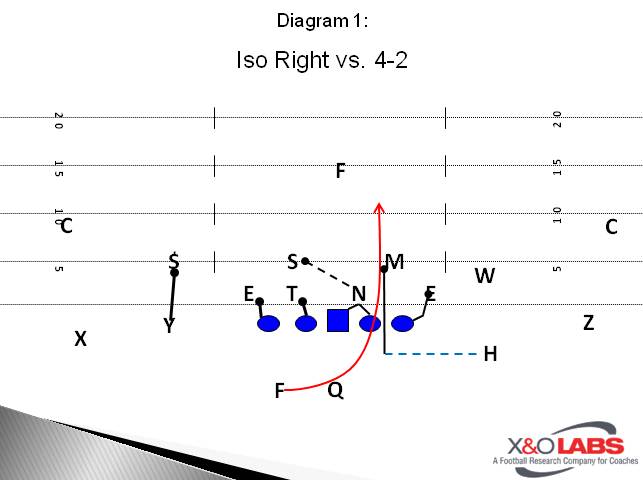
Our main focus, when looking at the Iso play, is to get a body on a body. Against a 4-down front, we will work to get a double team on the nose. It is important to note that our line splits are between three to four feet wide. We are looking to create natural running lanes for the running back.

Slide1

When running Iso to the 1-technique, the play side tackle (PST) is trying to get the defensive lineman to get up the field and outside. The tackles aiming point is the inside number of the DL. You can also have the tackle pass set on the DE to get them flying up field (that comes from watching film and getting a read on the defense). 

We are going to have a double team on the nose to the back side linebacker between the play side guard (PSG) and the center (C). They are trying to vertically displace the nose with their eyes on the LB. If he flows over the top, the PSG should come off. If the back side linebacker plays downhill, the center should come off.

The back side guard and tackle are trying to get the 3-technique and defensive end up the field and outside. They have the same aiming point as the PST (inside number of the DL).

Slide1

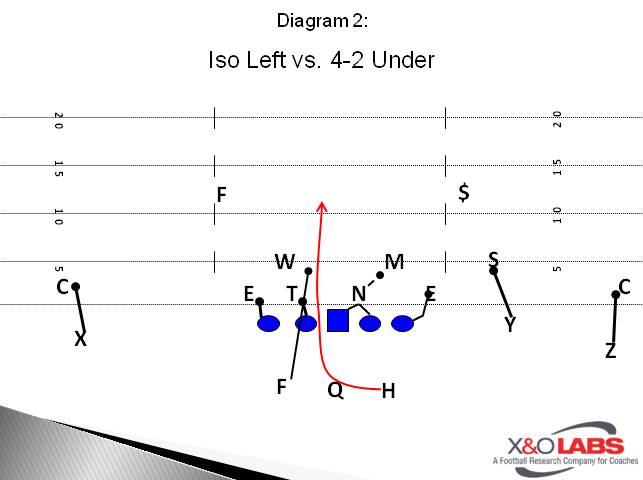
The only difference running to a 3-tech is that instead of the double team from the PSG and C, the double team is from the BSG and C. The rest of the base are base blocking the defensive ends and the DT. They are trying to attack the inside number of the DL forcing him to come up the field outside.

Read More

Combining Two Play Sequences in One Word Call

By Brian White
Offensive Line Coach
Rose Hulman Institute of Technology
Twitter: @CoachWhite_RHIT


Introduction

To play as fast as possible, our offense here at Rose Hulman will run these plays from our one word play call menu. Meaning that one word (or signal) will tell all eleven offensive players their assignment. In an evolution of our one word play calls, we have developed a package where one word will tell the offense two plays to run in sequence.  These “Two Play Combos” usually involve running outside zone followed by a play Action compliment.  The article will detail our outside zone and its compliments as well as describing how we run these plays with tempo.

One Word Play Calls

Outside Zone with Bubble     

We can notify all eleven players on our offense to run the outside zone concept by using one word. Once this word is delivered, the players will align in their appropriate positions and execute the scheme. Separate words are used to indicate open side or tight end side outside zone. Here are our rules:

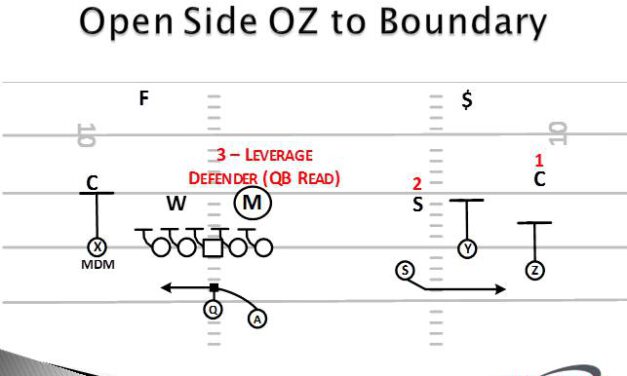
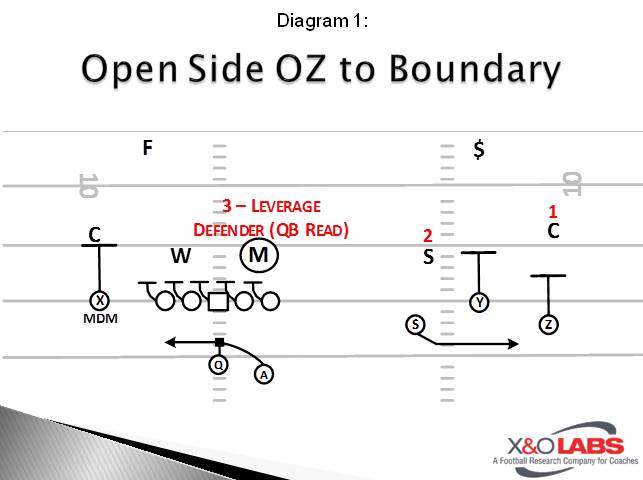
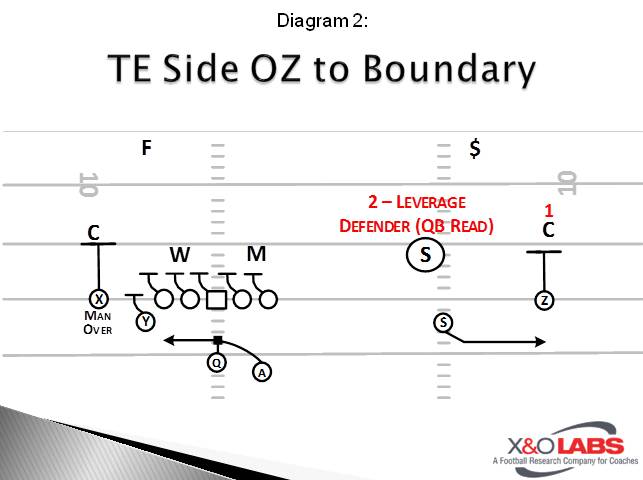
Offensive Line:  Execute outside zone to the boundary

Running Back:  Execute outside zone to the boundary

Boundary Outside WR:  Block man over

Field Outside WR:  Block for the bubble screen

Field Inside WR:  Run bubble screen

Tight End / H-Back:

–          If the open side outside zone is called, align to the field and block for the bubble screen

–          If the TE side outside zone is called, align to the boundary and block the D gap defender

Quarterback:  Read “Leverage Defender” for throw to Bubble or give to RB.

The leverage defender is the first defender under 10 yards, from outside to inside, that we cannot account for with the Bubble blocking scheme. For example, on a bubble to our #3 receiver, we cannot account for the third defender. If he is in a position to tackle the bubble, we will run outside zone.

Slide1Slide2

Outside Zone with Smoke      

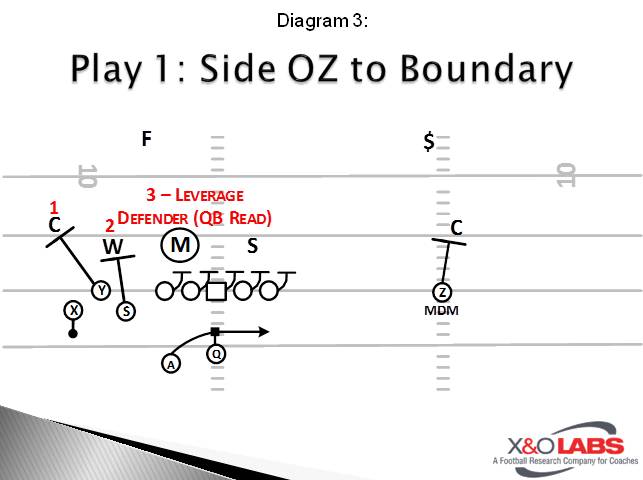
We can also flip the concept and run outside zone to the field with the screen occurring to the boundary. In this case, we will run a smoke screen with the outside receiver to the boundary and run open side outsidez to the field. Here are our rules for this variation:

Offensive Line:  Execute outside zone to the field

Running Back:  Execute outside zone to the field

Boundary Outside WR:  Align 2 yards outside the numbers and run a 1 step smoke screen

Tight End / H-Back:  Align to the boundary on the outside edge on the numbers. Block the CB.

Boundary Inside WR:  Align on the inside edge of the numbers and block the first defender inside the CB.

Field Outside WR:  Block the “Most Dangerous Man” (MDM)

Quarterback:  Read “Leverage Defender” for throw to bubble or give to RB.

Slide3

Read More

Four RPO Answers to Beat Man Coverage

By Jeff Smith
Offensive Coordinator
Warrenton High School (MO)
Twitter: @C0ACHSM1TH

Introduction:

smithThe popularity of RPOs have exploded in the past couple of years and there are very few offenses that don’t use some aspect of them. With that being said, defensive coordinators have been scheming at a consistent rate to stop the advantage the offense gains. In doing research, I have found that the only sound answer they have, without guessing, is to play Man Coverage.  This kills most RPOs that are out there because it triggers an automatic give to the running back or forces you to win the 1-on-1 between the wide receiver and defensive back. Another huge problem that this creates is that defenses then can have a +1 advantage in the box. My goal was to find simple answers to flip the advantage back to the offense and take advantage of the matchups that man coverage creates.
The 4 Answers

As I said before, man coverage forces RPO teams to go a different route. I wanted to keep things simple for my kids, so I wanted to create RPOs that would work against man and zone.  In looking for these answers I found that there are 4 things that mess with man coverage that you can use as part of your RPO.

  1. Pre-Snap Motion: This can be in the form of a jet motion or sending the running back to the flat.
  2. Hit the Edges: With the defense having a possible +1 advantage in the box, you have to go outside. The extra linebacker on the backside then is not going to be a threat at the point of attack.
  3. Be Creative with Your Running Back: In most cases when a team locks up with you, there will be a linebacker manned up on your running back if he starts in the box.  This is a great matchup in regards to skill in the open field. Find ways to exploit this matchup.
  4. QB Runs: If your QB is the ball carrier, then you have a chance to even out the +1 advantage the defense creates or even make it a +1 for the offense.

Blocking Scheme

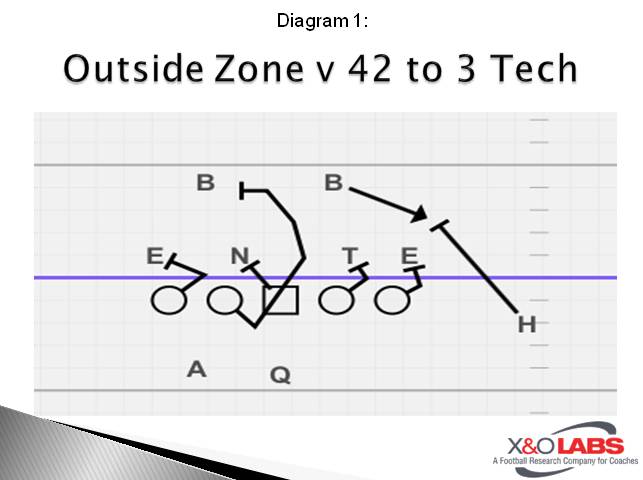
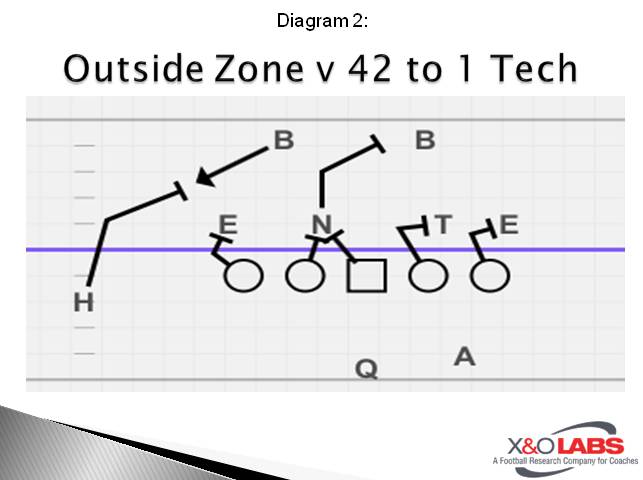
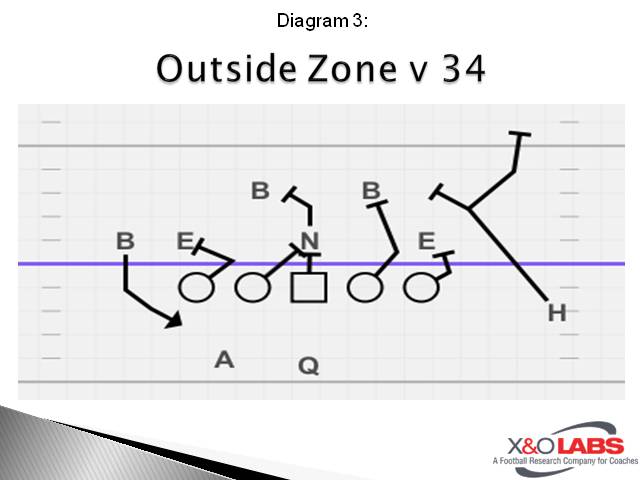
One of the four Answers to defeating man coverage in an RPO offense is to hit the edges. I have found the best way to do this is with an outside zone blocking scheme. We treat it differently against an even front than we do against an odd front. When facing an even front, we cut off the backside as opposed to leaving the backside unblocked. We do this because we want to create cutback lanes. 

The play side blocks are key with this scheme. On the play side, we always gain ground laterally and try to reach and seal the play side defender. If we can’t seal him then we run him to the sideline. If we are uncovered play side, we work a combo/fold to the next level and try to seal that level off. 

Head and hands are key for the play side blocks. Our goal is to get our head to the play side shoulder of the defender and get a quick hook. We teach zone holds to lock onto the chest plate and push/pull to help us get our head where it needs to be.  We want to lock out with our play side arm and pull with our weak side arm to naturally turn the defender.  We then want to run our feet to get our head where it needs to be and turn our hips to get the seal.  If we can’t get our man sealed, this is usually because he is running outside and his hips are turned that way.  If this is the case, we then push/pull the opposite way that we had originally.  This pulls his hips the opposite way that he is running and normally results in a huge wash or a pancake.  A wash is just as good as a hook in this scheme.

Slide1Slide1

As you can see from the diagrams above, the play side linebacker is unblocked by lineman against an even front. This linebacker will do one of two things with the flows and backfield actions he is seeing with this RPO package:

  1. Fast flow read and attack C Gap- In most cases he will read fast flow and attack C Gap. If he does this we will crack him with our #3 receiver/wing or will RPO him.
  2. Shoot B Gap now- If he shoots B Gap we will change our route tags and RPO him.

If we see an odd front team we will use a more traditional outside zone scheme and leave the backside outside linebacker free off the edge.

Slide3

Outside Zone

Now that we have the blocking scheme in place, we will attach that scheme to multiple RPO’s. The first of these RPO concepts is our Outside Zone play and our Sweep play. This is a play to counter one of our bread and butter plays, Power Read. We primarily are in a Trio set or a King set, and run Power Read as shown below.

Read More

A Comprehensive Guide to Defending the Flexbone Option

By Brock Harney
Defensive Coordinator
La Crosse Logan High School (WI)

Introduction:

harneyDefending the Flexbone Option offense is a frequent topic of discussion among high school coaches.  Well coached Flexbone offenses can be very difficult to stop on a regular basis. Having success against this offense requires some adjustments in game planning, play calling and defensive practice organization. At La Crosse Logan High School, we encounter very high-quality Flexbone offenses in conference play and in our region during the playoffs. I would like to share a few of our adjustments to scouting, building our scheme and our practice that have helped us win some games against this type of offense.
Scouting Flexbone Offenses

The most important aspect of preparing for a specific Flexbone opponent is to get a good idea of “who they are”.  Many option teams have a piece of their game that their offense is built around.  Typically, in crunch time, when an offense needs a first down, they will rely on this piece of their offense. To create stops on these downs, a defense must be able to recognize what is coming and take it away. 

We identify these pieces by the track of the Fullback: Inside Veer (ISV) where the FB tracks at the OG’s inside shoulder, Outside Veer (OSV) where the FB tracks at the OT’s inside shoulder or wider, or Midline where the FB tracks directly down the middle. If the offense’s home base is not one of these plays, then the offense may not be a true option attack and may just be using the Flexbone formation to run a different base offense. In that case, we treat them more like a standard offense.

Here is my mental checklist as I begin scouting a Flexbone option team.  These questions give me a pretty clear picture of the type of offense we are about to defend:

Question 1: Is the distribution relatively even between the QB and FB?  If not, is the reason related to the defense they are seeing or a particular player they are trying to get the ball to?

We look at distribution of the ball as the first component of game planning against this offense.  The distribution helps determine how frequently I will call the player used as the read key onto a specific part of the option.  If they have a homerun hitter at one of these spots, we want to encourage the ball to be in someone else’s hands.

Question 2: How often is the QB reading the mesh?  (This can usually be determined by watching the quarterback’s point of vision on film).  Does the QB give on clear “keep” reads? 

If so, there is at least a piece of the offense that is called from the sideline.  I will tag “called dive”, “called keep”, “called pitch” in Hudl, this can provide a picture of how often a read is truly happening.

Question 3: How often do the wings receive the ball on a true pitch?  Do the WRs block differently on some pitches compared to typical dive progressions? 

An uncharacteristic crack block can indicate a called pitch- these are important to note when tagging on Hudl as patterns can emerge quickly.  Sometimes an option team will run a called pitch in place of the rocket toss.  If the defense has a way to attack the pitch man aggressively in these situations, this is a big turnover opportunity.

Question 4: What types of counter do they run?  Wing Counter with/without pull, Air Force Counter, both?  If they run both- do, they prefer one type vs odd or even fronts?

This information is important for linebackers when working cutback and backside rules.  We always walkthrough counters on Mondays, along with any tells that may tip off they are coming along with where player’s eyes should be trained.

To study game film of this concept, click on the video below:

Read More

OLB “Bite” and “Blood” Technique vs. Three Man Surface Runs

By Mike Kuchar
Senior Research Manager
X&O Labs
Twitter: @MikeKKuchar


Editor’s Note: The following research was conducted as part of XandOLabs.com special report on “Defending the Run with the Odd Front,” which can be accessed in full below.


Bite Technique, Tim Baechler, Canton High School (MI):

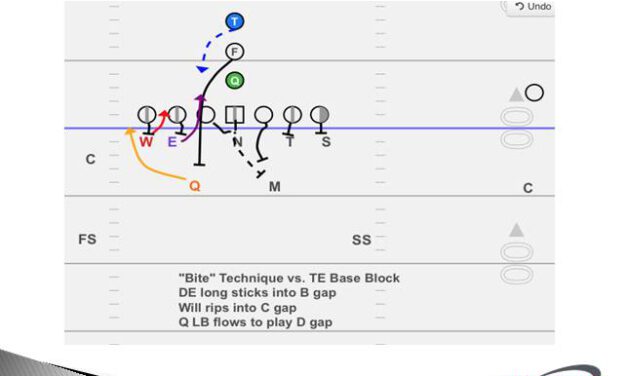
Coach Baechler will teach what he calls a “Bite Technique” to his outside linebacker against three-man surfaces, particularly if he is slanting to the field and the tight end is to the boundary or against two tight end sets. The purpose is to bounce the ball outside to the middle linebacker and primary support player. The Sam or Will linebacker is going to move to a head up situation. If the tight end bases him and he gets run action to him, the Sam will rip inside and be the C gap player while the Quick linebacker scrapes to be a D gap player (Diagram 34). The Will jams and closes to try to bounce and spill everything outside to the Quick who becomes the D gap player. If the tight end reaches the Sam, the Sam becomes the D gap player (Diagram 35).

Read More

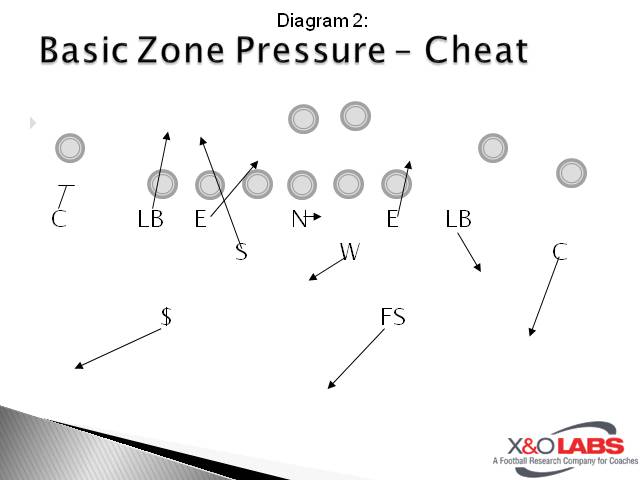
Mix These 5 Coverages Behind Zone Pressures to Defend the Run and Pass

By Clay Iverson
Head Football Coach
Mukwonago High School (WI)
Twitter: @CoachIverson

Introduction:

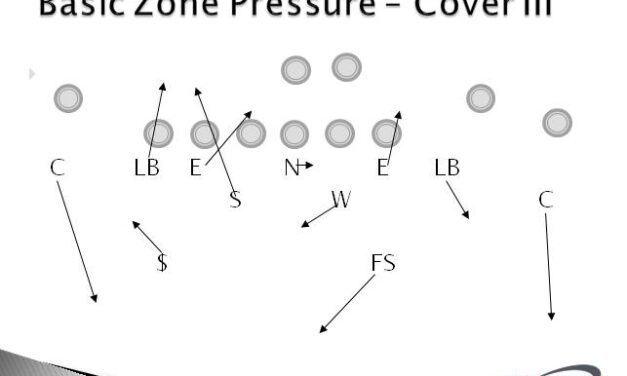
As we have developed our zone pressures, we have started to add different coverage concepts on the backend. We used to use Cover 3 exclusively and we did it the same way. This was a very effective way to cover down on your pressures and we will discuss. We found that as opposition coaches found ways to attack our one coverage, and quarterbacks were able to execute, we had to add a few more concepts; both to defend the run and pass from the back end of zone pressure. The concepts we will get into here are the base Cover III, Cover III Cheat, Cover II, Gator Coverage and Split Coverages.   

Why Zone Pressures

We live in a “why” society (which isn’t bad). Your players and assistant coaches want to know the why.  This forces the coordinator to make sure that he has good reasoning for what he is doing. We use to be a man blitz team or a zone pressure team that voided zones.  We believed that high school teams would be unable to pick up the pressures and even if they could, they would not be able to find the voided areas in their run and pass game.  We were right, for a long time, then we became less right as offensives started to evolve.  Finally, we knew we had to make a change because our “why” became “because we have always done it that way” – a very dangerous answer.

Varying Coverages within Zone Pressure

As we searched for a better way to call, execute and cover in our pressure packages we met with multiple college and high school staffs. Coach Steger, the incredibly well respect defensive coordinator at UM-Duluth, really has guided us through the process of making zone pressures a main stay in our defense. I have written before on the different pressures you can bring, and really they are as endless as your imagination, so instead of the pressures let’s look at the variations in coverage you can use in a very basic pressure. 

Cover III

Slide1

Coaching Points:

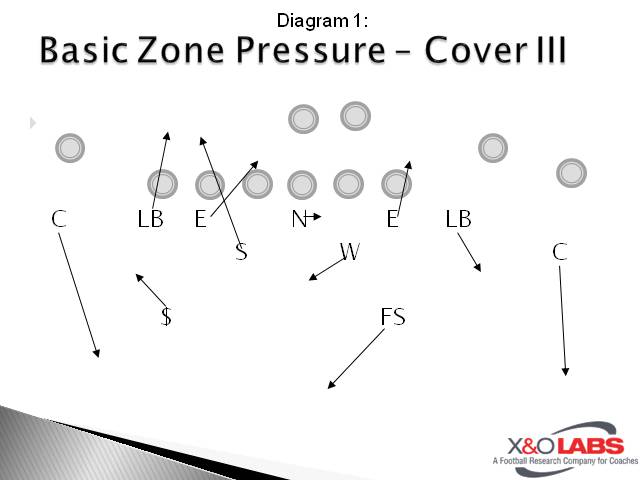
Very important to keep safeties on the hash until snap of the ball or they will tip the pressure. This might sound like coach speak but it has hurt us. Your back end kids will have plenty of time to get there. Here are some coaching points for the roll down safety ($ in Diagram 1).

  1. He should get no deeper than 7 yards of LOS when dropping into the flat. We use cones to teach this.
  2. Once the ball is snapped, the players don’t take their eyes off QB. They must remember they are in zone coverage and play the ball.
  3. Any receiver that tries to get down the seam must be rerouted. He should use his body position to force them outside to the Cover 3 corner.
  4. Keep the FS free and protect him.
  5. Make sure he keeps his shoulders square to LOS.  He can rally to flat, but if he turns his shoulders with a vertical route he is lost in run support and we have lost our flat player.

It is important that the safety that is rolling to the middle doesn’t over rotate and give up hips. He can be slow to go because he won’t be threatened until a deep route shows up.  The FS is needed in the run game on his side so if he bails to the middle to early, not only has he tipped your hand, but your run fits and spacing are a mess. 

Your corners have to understand they are cover 3 corners and if they have any #2 vertical threat they have to honor it and we will be light in the flat. We will teach our corner away from the pressure to be a little more aggressive as a lot of times the ball comes out fast his way.

Cheat Coverage

Slide1

One of the important parts of any defense is knowing it’s weaknesses. If we are zone pressuring out of Cover 3, we understand the flats are weak in both quick game and in the jet and rocket series.  We can bring the same pressure but by cheating the corner we can be solidify the flat.

Read More

Attack Multiple Coverages Using Dig-Pivot Concept and Simplify Your QB’s Read

By Kyle Buresh
Quarterbacks & Wide Receivers Coach
Dakota Wesleyan University (SD)
Twitter: @KyleBuresh2

Introduction:

bureshThe Dig-Pivot Concept is a simple read for the quarterback and allows an offense to attack the defense in multiple coverages. The dig-pivot concept is an efficient concept that requires great timing from our quarterback and wide receivers. The quarterback reads the wall 2 defender, usually an outside linebacker, and makes him wrong based on the drop he takes in coverage.  The dig route is also very difficult for a cornerback to cover and run with if the receiver makes a great break.  Another great aspect with this concept is that the dig route stays on the move and the quarterback can throw the ball into the first window right out of the receiver’s break or the second window after he clears a dropping linebacker or safety.  The pivot route forces a wall 2 defender, usually an outside linebacker, to hold his ground or work to the receiver because the route is attacking the defender before breaking out toward the sideline which creates great timing to throw the ball into a great window.  The concept is simplified based on the quarterback’s pre and post snap reads.
In this report, we will discuss this concept against an open (2 High Safety) defense. We will discuss the following aspects of this concept:

  • Install of the routes
  • The concept out of a 2×2 formation with the Quarterback’s pre and post-snap reads
  • The concept out of a 3×1 formation with the Quarterback’s pre and post-snap reads
  • Quarterback progression

Routes

Dig: The outside or #1 receiver runs the dig route working to flatten out at 12 yards.  The receiver pushes vertical to ten yards before planting on his outside foot to make a speed cut which allows him to climb to 12 yards depth and then stay lateral aiming at the opposite sideline.  The receiver uses his inside arm to hammer back, helping him to maintain balance and accelerate out of his break.  It is imperative that the receiver violently sinks his hips to help create force from the ground to accelerate out of the break.

Pivot: The slot or #2 receiver runs the pivot route at 5 yards.  The pivot route attacks the outside shoulder of the closest underneath defender, which is usually an outside linebacker.  Attacking the linebacker’s outside shoulder forces him to freeze or work to the receiver, which helps with the timing of the route.  When the receiver gets close to the linebacker’s outside shoulder he sinks his hips and plants off his outside foot and whips out of the route toward the sideline at 5 yards.

MOF Clear: The MOF clear route is run by the #3 receiver. The #3 receiver is taught to run up the middle of the field.  The quarterback can blink (pre-snap read) the MOF clear route against a Cover 0 (Man Coverage) look or if the two high safeties are aligned outside of the hashes or working off the hashes to the outside on the snap.  Those are the few times this route is thrown as it is primarily a clear route to get safeties away from robbing the dig route.

Spot: The spot route is run by our running back in a 2×2 concept where he sits at 5 yards over top of where the ball was snapped from.  The running back is in check protection where he sees if linebackers are blitzing and if they aren’t, he runs the route.  This route is simple as the running back escapes the backfield and turns around at 5 yards over the ball as a check down for the quarterback.

Flat: The flat route is run by our running back in a 3×1 concept to the single receiver side or boundary.  The running back is in check protection where he sees if the inside or outside linebacker to our man protection side are blitzing and if they aren’t, he runs the route. The running back escapes into the flat aiming at 3 yards on the sideline.  The running back throttles his route down once he reaches the numbers on the field.

Read More

West Conn’s Post Season Self-Scout Protocols


By Drew Owens
Offensive Coordinator
Western Connecticut State University
Twitter: @ballcoachDRO

Introduction:

With Clemson narrowly defeating Alabama in the NCAA National Championship, the 2016 college football season is officially over. I am sure your season had some highs and lows, along with some good and some bad, but with your season complete…now what? 

Like most college football programs, our focus here at Western Connecticut is on recruiting our next class, but I will also set time aside to work on our self scout. While recruiting, every program begins to explore ideas for their next year, but most of these thoughts, both X’s and O’s and philosophy are created before fully analyzing the just completed season. We have a process here at WCSU that will allow the coach/coordinator not only a better snapshot of their season but will also help a coach better understand how a football game flows. We do not want to have any innovation before fully analyzing our season.

Create Your Cutups

Create your cutups, using HUDL, DV or XO’s create files with your plays. At WCSU we break them down in the following categories and subcategories.

  • Run Game

    • Inside Zone

      • All Inside Zone

        • IZ (No Option)
        • IZ (1st Level 2 Options)
        • IZ (1st Level Triple Options)
        • IZ (2nd Level Options or RPO’s)

    • Outside Zone

      • All Outside Zone

        • OZ (No Option)
        • OZ (1st Level 2 Options)
        • OZ (1st Level Triple Options)
        • OZ (2nd Level Options or RPO’s)

    • Power

      • All Power Runs

        • 1 Back Power
        • 2 Back Power
        • Power RPO’s
        • Power (Inverted Option)

    • Counter

      • All Counter Runs

        • G/Y Counter
        • G/Y Counter RPO’s
        • G/T Counter (No Option)
        • G/T Counter Read (2&3 Options such as zone read- QB pull or Zone read with pull pitch/throw options.

    • Aux

      • Dart
      • Draw
      • Speed Option

    • All RPO’s
    • Aaa Options
    • All Inverted Reads

  • Pass Game

    • Drop Back

      • All your Drop Back Concepts

    • Quick Game              

      • All your Quick Game Concepts

    • Sprint

      • All your Sprint Concepts

    • Naked/Boot

      • All your Boot/Naked Concepts

    • Pocket Play Action

Read More

Air Raid: Shake/Out/Scissor Concept

By David Robinson
Offensive Coordinator
Skyview High School (ID)
Twitter: @coachrobi

Introduction:

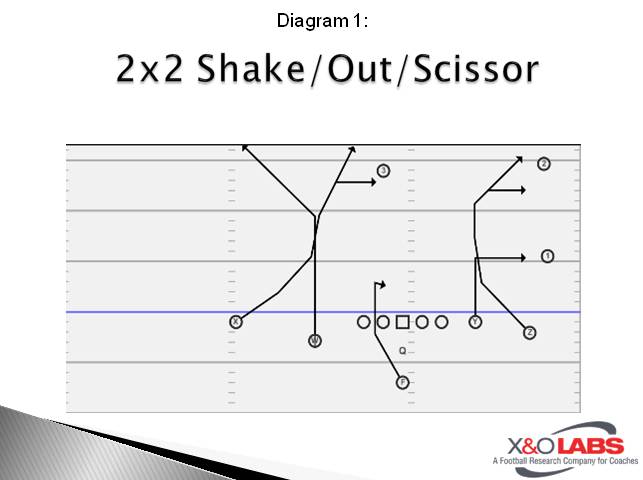
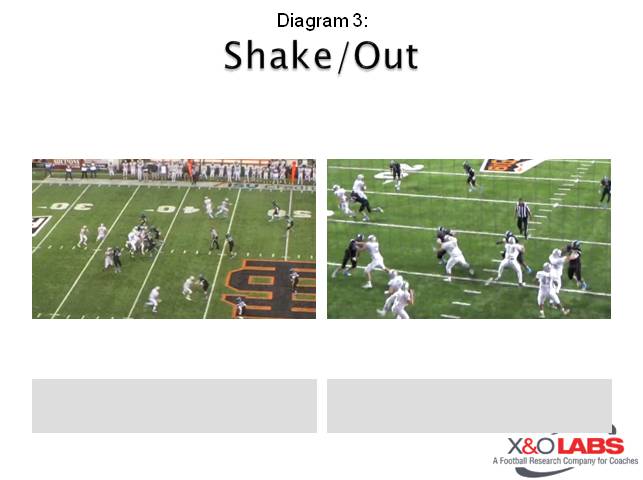
Shake/Out/Scissor has been a breakthrough concept for us this year. After years of struggling to find a reliable vertical concept (we’ve run different variations of 3 and 4 verticals with marginal success), we feel like we have found a vertical concept with staying power. It was our most called concept in 2016 including run plays (66 calls, 61% completion percentage (38/62), 652 yards, 5 TD, 0 INT). The concept is rooted in the air raid 3 verticals concept, a traditional two high beater, but has become very multiple and reliable for us.

Slide1

Protection

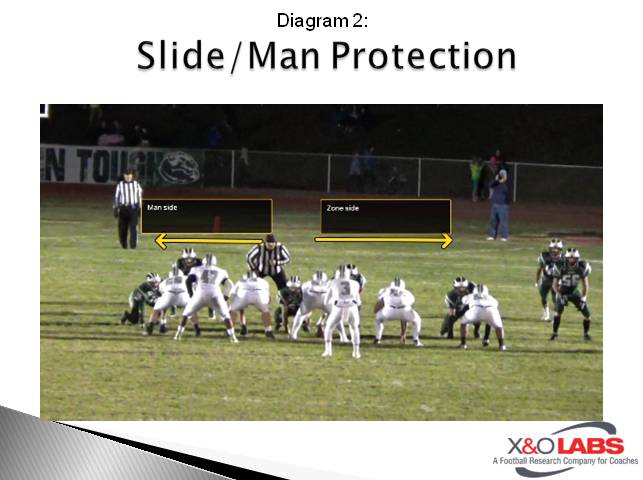
We are a half slide/man protection on this play with the running back taking the most dangerous man on the man side.

Slide1

Receiver Assignments

We are a concept based passing team. We move our receivers around to get optimal matchups for our best players. Receivers must know the concept from call side to backside; for example, the call side receivers run shake/out, while the backside knows to run scissors.

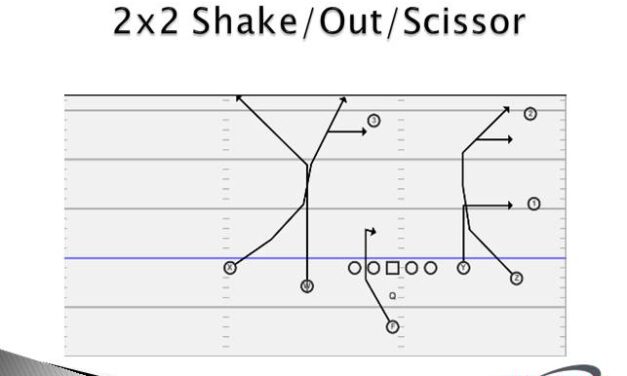
2×2 call side (Shake/Out):

Slide3

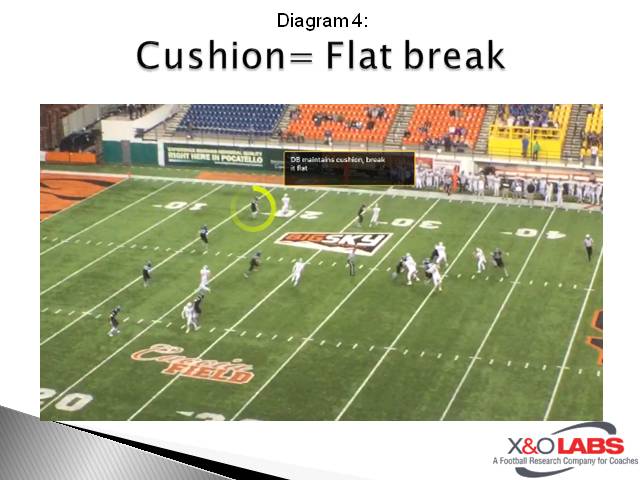
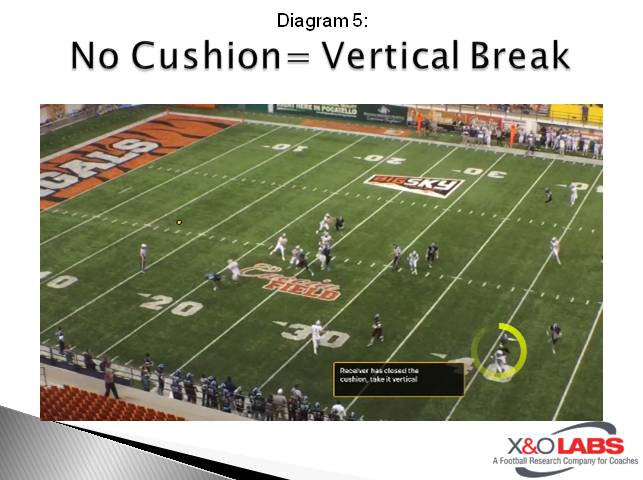
Shake: The number 1 receiver from the sideline will align approximately six yards from the tackle and run an inside release shake route, by pushing vertical to a depth of eight yards attacking the leverage of the deep defender (corner or safety). We teach our players early on in the spring to attack the defenders leverage, which is particularly important on the shake route. By attacking the defenders leverage we leave the quarterback room for the throw. The shake turns into a post/corner vs any sort of locked corner. We want the depth of the second break to be at 12 yards. On the break the receiver will push his angle vertical if he has closed cushion or flatten out the route if the defender maintains cushion.

Slide3Slide3

Out: The number 2 receiver from the sideline will align splitting the difference between the outside receiver and tackle. We have the out runner walk off the line on his release to allow the shake to get out first. The out runner and shake should be stacked (running the same stem) after the initial release, with the shake runner ahead of the out. The out runner will break flat at about 6 yards.

2×2 backside (scissor)

Slide6

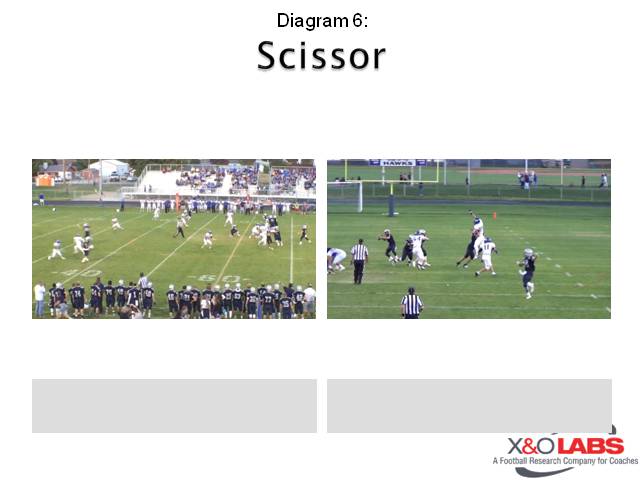
Scissor runners should be aligned in an approximately 3-yard relationship to each other.  The split of the number 1 receiver will be wider to the field than the boundary. Number 1 receiver will align about 9 yards from the tackle to the field and 6 yards from the tackle in the boundary. Number 2 receiver will align about 3 yards from the number 1 receiver.

Read More

Deciphering Level Reads in Offset Formations

By Mike Kuchar
Senior Research Manager
X&O Labs
Twitter: @MikeKKuchar

Editor’s Note: The following research was conducted as part of XandOLabs.com special report on Virginia Tech’s Bear Defense, which can be accessed in full below.


Introduction:

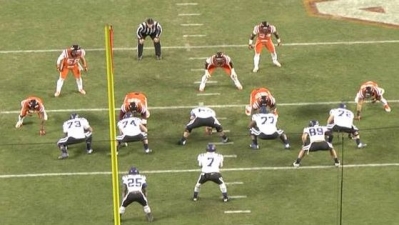
Let’s get one inalienable truth straight: the entire Bear package is designed to stop the run. We know that shouldn’t come as a surprise, but remember the roots of the Bear system is centered around two main objective: get plus one in the run game and eliminate combination blocks at the point of attack. If teams are running the ball on Bear, there is a technical problem, not a structural one. In fact, when Virginia Tech used the Bear package they surrendered 2.9 yards per carry. That is nearly one yard less than what the Hokies gave up per run play using any other defensive structure.

Level Reads on Single Back:

Foster and his defensive staff place a premium on the horizontal and vertical level of the offset back in one-back offenses. In fact, the Mike will call out the level of the back on every snap because it affects how the defensive line, Mike linebacker and secondary defend the run game. Foster was hell-bent on this being a big key to decipher which run or pass concepts can be used. He told us that a lot of what he does with his front is based on the anticipation of the play concept he is getting with the offset in that position. He did tell us that the level could be disguised if the team has a dynamic center and the ball gets back quickly, but in most occasions this is not the case and the back cannot lie in order to get to the mesh point. Since the Bear package puts a nose on a zero technique on that center, it’s much harder to both snap the ball and block efficiently. In any case, we detail each of these levels below.

Read More

Small Programs Research Report

By Mike Kuchar
Senior Research Manager
X&O Labs
Twitter: @MikekKuchar
With Special Reporting from Adam Hovorka and Benjamin Fusco


Introduction

IthacaSeniorsWhen I first got into coaching nearly two decades ago, I heard the current Don Bosco Prep (NJ) head coach Greg Toal say, “If you want to learn how to coach and how hard it can be, coach at a small school.” Coach Toal was, of course referring to his early coaching days at smaller classifications, and I had no clue what he was talking about. Having mentored at schools with enrollments of at least 500 boys, I wasn’t used to those “small school problems” that many coaches across the country were having. That was, until this past season went I spent the fall at a small public school in Union County, New Jersey. It was there where I had to learn about several challenges: stimulating competition among a smaller talent pool, fighting complacency with the “star” players and working through a functional depth chart with diminishing numbers in season just to name just a few. And I was just an assistant coach. This became the impetus that drove me to conduct this research project. I wanted to find out how some of the most successful small school high school coaches were running their programs despite being confronted daily with these issues.

After conducting my research, I’ve found that it seems success at coaching in the small school level is directly proportioned to how well you manage issues such as handling limited numbers, smaller coaching staffs all while sharing athletes and facilities. It was the goal of this study to uncover the solutions that some of the top small school coaches in the country were using to combat these issues.

The structure of our research was to find the problems that these small school coaches were having and how they were addressing these issues. We provided each contributing coach with a series of potential issues and they were asked to pick one and address specifically how they were solving it. They are separated into the following four domains:

  • Off-Season Program Development
  • Working with Limited Numbers and Less Talent
  • Delegating Responsibilities to a Smaller Assistant Coaching Staff
  • Implementing a Scheme to Maximize your Talent Base

Once we put together the four domains we wanted to address, we needed to establish criteria for potential contributors. The criteria was as follows:

  • A minimum of 40 or less varsity players on average per year.
  • A winning percentage of at least .750 percent (career record).
  • A minimum amount of FBS/FCS full scholarship players coached during tenure.

After developing those criteria, we engaged in the pursuit of finding our contributors.

Now it’s important to note our contributors came directly from our reader base, they were not picked directly by the XandOLabs.com staff. Although a hard deadline prevented us from connecting with all of them, we tried to be equitable in representing several states across the country. Our contributors are listed below 

Contributor List (in alphabetical order):

  • Tony Becerra, Pleasantville High School (NY): 82-40 in 12 years, 0 FBS/FCS scholarship players during tenure.
  • Tom Crawford, Bishop Diego High School (CA): 62-13 last 6 years, 4 FBS/FCS scholarship players during tenure.
  • Kurt Forrest, Mechanicsburg High School (OH): 43-8 last 4 years, average 35 varsity players yearly, 0 FBS/FCS scholarship players during tenure.
  • Jeff Giger, Strasburg High School (CO)-: 65-49 in 11 years, 0 FBS/FCS scholarship players during tenure.
  • Greg Grant, Heppner High School (OR): 283-65 in 35 years, average 34 total varsity players yearly, 0 FBS/FCS scholarship players during tenure.
  • Terry Hessbrook, Ithaca High School (MI): 139-19 in 13 years, average 32 total varsity players years, 5 FBS/FCS scholarship players during tenure.
  • James Hubert, Maplesville High School (AL): 160-38 in 16 years, average 40 varsity players yearly, 4 FBS/FCS scholarship players during tenure.
  • Tommy Lewis, Victory Christian School (FL): 40-8 in 4 years, average 38 varsity players yearly, 3 FBS/FCS scholarship players during tenure.
  • Mark Lippe, Adair High School (OK): 86-15 in 8 years, average 35 varsity players yearly, 1 FBS/FCS scholarship player during tenure.
  • Judd Naegar, Valle Catholic High School (MO): 148- 29 in 13 years, average 30 varsity players yearly, 0 FBS/FCS scholarship players during tenure.
  • Ed Sadloch, (formerly) Cedar Grove High School (NJ): 203-65 in 27 years, average 35 varsity players yearly, 9 FBS/FCS scholarship players during tenure.
  • Lynn Shackelford, Cashion High School (OK): 117-26 in 11 years, average 36 total varsity players yearly, 1 FBS/FCS scholarship player during tenure.
  • Kevin Swift, (former) Gold Beach High School (OR): 127-67 in 17 years, average 35 varsity players yearly, 1 FBS/FCS scholarship player during tenure.

    Read More