
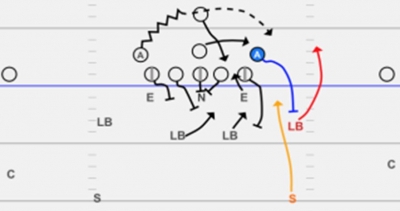
Defending RPO and Triple Option – Case 1: Odd Front Structures to Defend Flexbone Option

By Mike Kuchar
Senior Research Manager
X&O Labs
Twitter: @MikekKuchar


Introduction:

It’s not an aberration that when the Naval Academy and Army compete against each other in December, they are utilizing odd front structures.

In fact, 27 percent of coaches choose to utilize and odd front when defending flexbone triple option concepts. And while we will present various sources viewpoints on using the odd front, it’s important to note that many odd front coaches continually change their assignments when defending triple option concepts. Part of the complexity of defending triple option is having the discipline to play your assignments properly. We all know that. The successful option offenses will continually monitor how you are defending them and adjust accordingly. So while as a defensive coordinator, you may be confident in delegating these assignments to your players it may all come to naught by the second series of the game.

In this study, we sought out defensive coordinators that were successful in defending the option. In fact, many of them see it in practice every day from their own team. These offenses aren’t going away anytime soon and you’ll need to know how to defend them in order to have some deal of success. Every offense has some element of option football and in this case we will study pure triple option concepts from the flexbone and how odd front defenses are defending them.

First, we found that 88 percent of coaches have some experience in defending flexbone option offenses. By flexbone, we are referring to the Navy system, two slots (or A backs) a B back (FB) and two wide receivers. While these formations can change, the personnel usually does not. We also found that when defending these schemes, 64 percent of coaches use a phase base system (dive, pitch keep) while 19 percent use a gap based system (A gap responsible, B gap responsible, etc.).

Below, we selected a couple contributors to our study to explain the base way they defend option from their odd fronts.

Base Defensive Assignments:

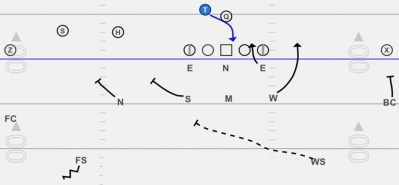
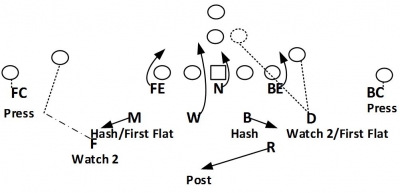
We studied how each type of odd front prepares to defend the triple option. We classified odd front structures based on 3-4 or 3-3 fronts. While we will go into further depth on how specifically, option football is defended, below is a general synopsis of how odd front coaches are playing assignment football. These responses were generated from our reader survey.

3-3-5 Base:

John Martin, Mt. Anthony Union High School (VT): “We run a 3-3 flex defense which gives us a pure gap alignment. From there, we are able to gap exchange easily on the snap, while still being gap sound. This ensures that we are ready for option football once the ball is snapped.”

Eric Firestone, Hazel Green High School (AL): “We run a 3-3-5 System. Our defensive ends are in 5-techniques. They and the middle linebacker are responsible for dive. Our stack linebackers will play quarterback to pitch. Our free safety will play pitch. Everyone else is secondary in the phases.”

3-4 Base:

Bill Debernarde, Calvary Chapel High School (CA): “It really depends on the athletes on the offense, and the athleticism of our personnel. In general, our responsibilities are as follows: nose and inside linebackers have dive; defensive ends have quarterback; outside linebackers have pitch; safeties have ball (RB to QB to pitch); and the corners have pitch.”

Mike Gutelius, Lindsey Wilson College (KY): “We use a 3-4 base with outside linebackers walked up with 4i techniques from the defensive ends. We move the front post-snap one direction or the other and roll the coverage based off of option action.”

Mark Lyons, Central Valley High School (PA): “In our 3-4 structure, we use the nose guard and 5-techniques play the dive. The inside linebackers play dive to quarterback, while the outside linebackers slow play for the quarterback. The safeties will play alley quarterback to pitch.”

George Balian, Burlington High School (MA): “We use a 3-4 defense vs. the flexbone option. The inside linebackers has the dive; the outside linebackers have the quarterback while the safeties play pitch. The corners are locked man to man in coverage.”

Mark Brown, Carroll High School (IN): “The defensive line handles the dive back whether it is the running back or quarterback. The outside linebacker is the QB player or outside runner. The inside linebackers play quarterback to pitch. The safeties play pitch.”

Odd Front Systems to Defend Triple Option:

While those might be the base ways to defend triple option concepts in the odd front system, we wanted to single in on some specific programs to research how they were defending pure option football. We selected six programs from all levels who had a winning percentage of .750 or higher in defending option football. We presented a synopsis of how each of these systems defend option football. While much of our contributions come in the form of defending flexbone option, we’ve found that coaches are using these same principles to defend spread option concepts as well. We broke down each of these systems on the following:

Read More

Defending RPO and Triple Option – Case 2: Even Front Structures to Defend Flexbone Triple Option

By Mike Kuchar
Senior Research Manager
X&O Labs
Twitter: @MikekKuchar


Introduction:

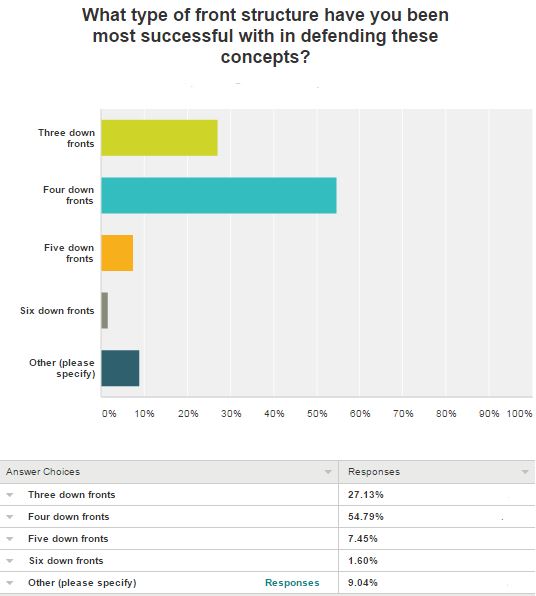
We found the majority of coaches, 44 percent, choose to use four down fronts to defend the flexbone option (See Chart Below). The reasoning is molded around the ability to cover up offensive linemen to prevent them from getting to the second level. We’ve also found that many defensive coaches are choosing to use a single gap control system (rather than those two-gap principles tied to odd front teams) to defend option. They are in the opinion that your assignments are clearer when you have one gap to control.

graph12

Even Front Systems to Defend Triple Option:

While those might be the base ways to defend triple option concepts in the even front system, we wanted to single in on some specific programs to research how they were defending pure option football. We selected six programs from all levels who had a winning percentage of .750 or higher in defending option football. We presented a synopsis of how each of these systems defend option football. While much of our contributions come in the form of defending flexbone option, we’ve found that coaches are using these same principles to defend spread option concepts as well. We broke down each of these systems on the following:

• Base Structure and Methodology
• First Level Play
• Second Level Play
• Third Level Play
• Changeups to defend option
• Pressure Packages

4-2-5 Base Structures:

Source 1: Northwest High School (OH)
Defensive Coordinator Robert Burke

Base Defense:
Northwest High School is a press quarters coverage team that will challenge receivers in the quick game. “Our main front is an under front, but we also use an odd at times.,” said Coach Burke. “Our philosophy is to spill everything to the sideline and let our athletes run it down. We are a squeeze and wrong arm team, which becomes important to how we defend these offenses. Our base coverage is quarters with a cover 3 check. Our coverage calls are dictated by the looks the offense gives us. We split the field in half and adapt to each so that no matter what the offense throws at us so we are not outflanked.”

Play of First Level:
The defensive end is taught to get hands on all down blocks. “This frees our inside linebackers up to make plays,” said Coach Burke. “Our end man on the line of scrimmage must also tackle the dive against the option. This dictates how we run fit the safeties and linebackers. Our DEs (and at times OLBs) must use this technique for us to be effective. Against these offenses and in our under front we play our Mike linebacker at 6 ½ to 7 yards over the ball. By squeezing down blocks we allow him to be an inside out player and flow downhill untouched.”

Play of Second Level:
Coach Burke will align his Mike linebacker at 6.5-7 yards over the ball. “By squeezing down blocks we allow him to be an inside out player and flow downhill untouched,” he said. “It is also important to point out that our coverage calls dictate our force and fill calls as well. When we split the field in half there must be a force, fill and pass only player on each side of the ball. When we discuss these calls note that against options teams the force player is pitch player and the fill player is the quarterback player.” Coach Burke explains these concepts below.

Nail:
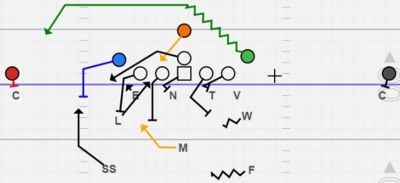
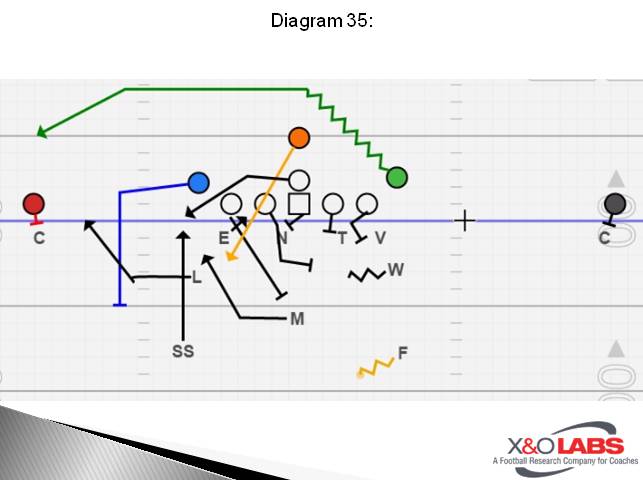
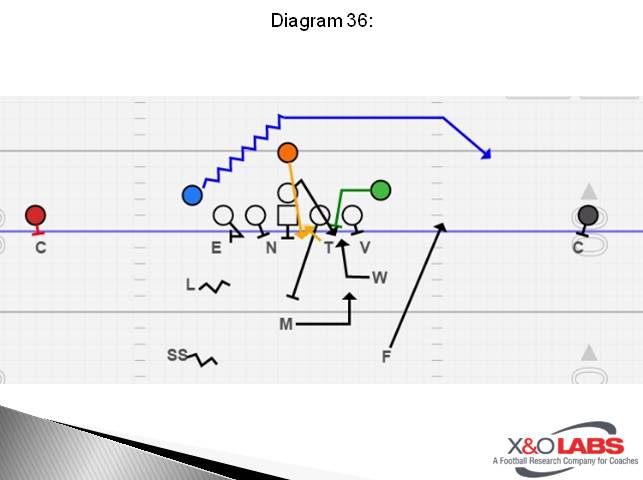
“Nail is a read between the outside backer and the quarters safety,” said Burke. “The outside linebacker plays at 3.5-4 yards off the wing on his inside shoulder. The safety aligns at 8 yards on his outside shoulder. Nail is a simple read. If the wing arcs or base blocks then the outside linebacker is the force player. He press sheds the wing and doesn’t let the ball outside him. Again, he is the pitch player vs. the option. The safety becomes the fill player vs. an arc. (Diagram 35). If the wing wraps inside for plays such as midline or belly, the outside linebacker wraps with him and becomes the fill player. The safety then becomes a force player vs. an insert block (Diagram 36). The corner has all of the number one receiver and we press. The safety has all of number two if he crosses five yards. If number two goes under five yards then the safety can double number one. The outside linebacker has the flat and runs with all wheels.”

Slide35Slide36

Read More

Defending RPO and Triple Option – Case 3: Zone Based Coverage Structures to Defend RPOs

By Mike Kuchar
Senior Research Manager
X&O Labs
Twitter: @MikekKuchar


Introduction:

By now, the RPO (run/pass option) game has arrived at a ball field near you. According to our research 80 percent of defensive coordinators have experience defending RPO concepts. While these concepts are proliferating, we wanted to research how defensive coordinators were using a holistic approach in defending them. Were they treating them as triple option elements? Where they using a certain coverage or front to contain them? Since many of these offensive concepts are still being developed, we were not surprised with how many coaches were still grasping for answers. It may be perhaps the number one course of study this off-season for defensive coordinators. In fact, many coaches we researched either didn’t have the confidence to put their names to the report or plainly chose not to for fear of being exposed. Naturally, we did our due diligence to find those that believed in what they are doing and had the credibility to put their name to it.

We decided to segment our research in this case to certain coverages that coaches are using to defend RPO concepts. We also detail which types of RPO concepts or constraints (stick draw, zone bubble, zone pop, etc.) that these coverages are efficient in defending. This case will focus on zone-based configurations, whether it be split field variations or whole field variations. Our research shows that the majority of coaches, 32 percent, will use split field coverage principles to defend the RPO game.

We selected six sources that have had a win percentage of .750 or higher in defending these offenses to explain how they were successful. Their system analysis is below.

Quarters/Split Field Coverage Families:

Source 1: Henderson State University (AR)
Co-Defensive Coordinator Jeff McInerney

Methodology:
Henderson State University finished third in the country among Division II schools with 29 interceptions and did so by teaching their secondary to read the eyes of the quarterback even in zone concepts. They play their corners in the off position at eight yards and read the quarterback to determine run or pass. According to co-defensive coordinator Jeff McInerney, it’s a concept he learned from TCU’s head Coach Gary Patterson that has made a world of difference in them breaking to the ball. “Yeah, it can be scary,” he told us. “But if you do it right, you will confuse him and more importantly bait him into making a poor throw.” Henderson State is a 3-4 outfit that will rush an additional fourth defender at times. They play split field, matchup zone coverage structures, but will choose to play with at least two deep safeties to limit the vertical gains. “We will rally and tackle,” said Coach McInerney.

QB Down Elbow Trigger Point:
When Henderson State preps against RPO offenses, they will use the quarterback’s down (or play side) elbow to determine whether it’s give of pull. “We teach our defensive backs to have a visual aiming point of the quarterbacks midsection to down elbow,” co-defensive coordinator Matt Gordon told us. “If he is a right handed quarterback, we are staring at his belly to his left elbow. If that left elbow stays high and up, we will stay with our flat footwork progression. Quarterbacks are not going to pick their arms up after they handoff the ball. They will go through the mesh and the progression, but they are lazy. When the ball is out, the elbow stays high. When the elbow pops back up, we find our pass responsibilities.” While this is apropos for offset situations, Coach Gordon tells us the pistol is harder to read, but the triple option component is not there. “In Pistol for us it’s ‘is his back to me or is his back away?’ Is the quarterback pushing to me or is his back being turned at me?”

We talk a lot about angles of departure. By the receivers third or fourth step, we have a good feel of what he is running. We should know by the third step what he is running.

Deuce Coverage:

Constraints Defended: 3×1 Stick Draw Concepts, 3×1 vertical concepts

Deuce coverage is a four down front coverage where the additional rusher will come from the second level. It’s similar to a read two coverage in quarters where the trips side corner will play the out routes of number two while the free safety will play the vertical of number two behind him. The Nickel is the short wall player of number two while the Sam is the short wall player of number three. The safety plays number two only if he’s past linebacker depth. In 3×1 sets, the Nickel is inside number two and the apexed Sam linebacker will play the short game of number three and does so by reading the quarterback for his run/pass demeanor before breaking on the ball. He will be the quarterback player on zone read option. The coaching point is not to get beat inside and rally to the flat.

“The Sam must see the mesh of the quarterback,” said Coach McInerney. “Once the ball is thrown, he has to get here in a hurry.” It’s basically a matchup cover two. To the backside, the weak safety will start at 12 yards and come down to 8 to be on top of number three. He will poach or play anything past five yards on the backside number three. The corner plays man-to-man backside. “You have to match up on number three and number two without playing true man free. We widen our backers vs. trips but we don’t pull them. The Mike has to get under number three if it’s trips. We matchup with the Nickel on number two and the strong safety will carry number three to the backside safety. (Diagram 62).”

Read More

Defending RPO and Triple Option – Bonus Case: Practice Planning for the Triple Option

By Mike Kuchar
Senior Research Manager
X&O Labs
Twitter: @MikekKuchar

Introduction:

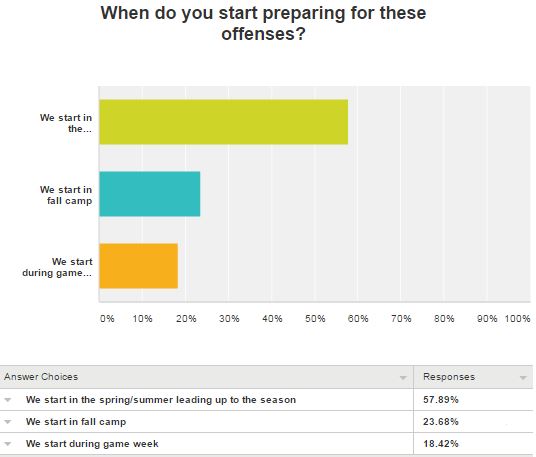
It’s impossible to defend these schemes during the course of a game week, which is why most coaches don’t. We’ve found that the majority of coaches, 57 percent choose to start preparing for triple option offenses in the spring or summer leading up to the season (See Graph Below). So, we reached out to those coaches who have won at least half their games against these schemes to tell us exactly how they prep for these offenses.

chart9

Practice Planning Flexbone Option:

Shawn Quinn, the defensive coordinators at Western Carolina University, adopted the following practice philosophies when defending triple option concepts:

  • Teach half/part/whole
  • Start half line than progress to full line.
  • Start with defensive line and back seven split up.
  • Start in the spring devoting time to defending the option every day.
  • Do a technique circuit which includes arc, load and cut work.
  • During the season, set aside time every day to practice basic option fits. We use ten minutes every Monday practice.
  • Work option fits during bye weeks.
  • Do as many drills without a ball to have defenders go to their responsibilities.
  • Rep every call verses one play. For example, use dive option weak vs. every defensive call you have.
  • Rep every play vs. one defensive call.
  • Use a perimeter blocking drill with cut blocking.

Half-Line Methodologies:

Jay Brophy, Buchtel High School (OH): “Set up half line group work on assignment football. Two half lines set up going left and right, rotating defense so they get looks going both ways on option.”

Jared Ocker, Sioux City East High School (IA): “We do half line fits all week against the various phases of the options. We use scout team cards and do not use a football. We will work on getting hands on and blocking down step down. This is also the time where we will script in our line stunts and blitzes.”

Jim Dawson, Trinity University (TX): “Split drills…a-b gap reads and games, c-d gap reads and play all before coming together in a team option drill or script.”

Team Defense Methodologies:

Gary Phillips, Conestoga High School (PA): “We practice a whole defense drill that works all phases of the option (dive/keep/pitch). We work on this for 10 minutes every practice in preparation.”

James Cook, Smithfield High School (RI): “Pursuit drills. Making sure our defense is running through the dive to QB then to the pitch.”

No-Ball Methodologies:

Michael McKay, Indian Trail High School (WI): “We have the LBs and perimeter guys practice responsibilities without a ball. Using bags as OL.”

Andy Guyon, Xavier High School (CT): “We always practice without the ball and on the last day all of the phases have the ball so we can work on takeaways.”

Read More

Packaging Gap Schemes with Pre-Snap and Post-Snap Options

By Lee Weber, CSCS
Head Football Coach
Wamego High School (KS)
Twitter: @coachlaw71


Introduction:

In my recent change in coaching positions, I decide that I needed to reinvent my offensive philosophy. I evaluated the talent that we would inherit at my new school as well as the type of athletes that projected to be in my program in the next ten years. From the research we completed, especially here at XandOLabs.com, we devised a simpler no huddle offensive structure based on spread concepts married gap run schemes with trickeration and window dressing ran at a high rate of speed.

This approach allowed us to cater to the sheer number of talented skill players that we would have to put on the field. It also kept the same physicality, but updated my philosophy of outnumbering the defense at the point of attack and making every defender accountable to be run at a more modern tempo and spread formations.

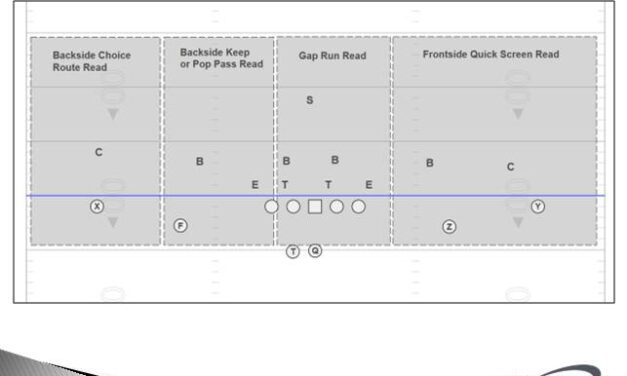
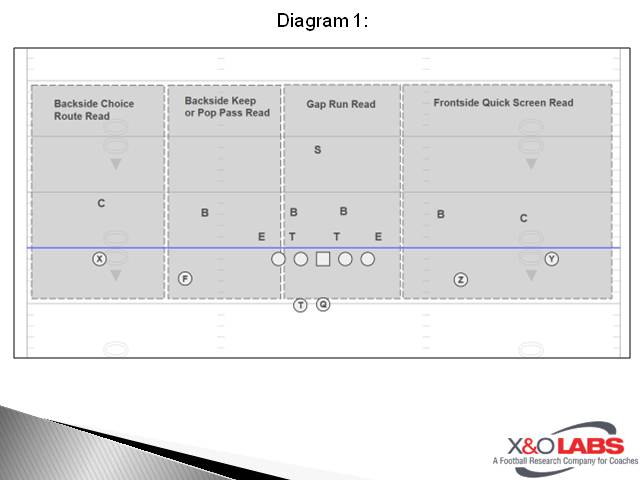
One of the base plays in our offensive arsenal is what we call “River/Lake.” This concept incorporates an inside gap run with pre-snap quick game/screens and a post-snap run-pass-option. To best illustrate this concept, I think it is best to see it through our quarterback’s perspective.

In short, we are compartmentalizing four areas of your defense so we can identify weaknesses in scheme, leverage, space, or alignment and then attacking that with one of five choices:

  1. Front side quick screen
  2. Backside choice route
  3. Tailback gap run
  4. Quarterback read keep
  5. Pop pass

It is the quintessential packaged play. We break down your defense in four zones to read and then exploit the advantage that you afford us. It truly makes the defense defend every inch of the field.

Slide1

Formation

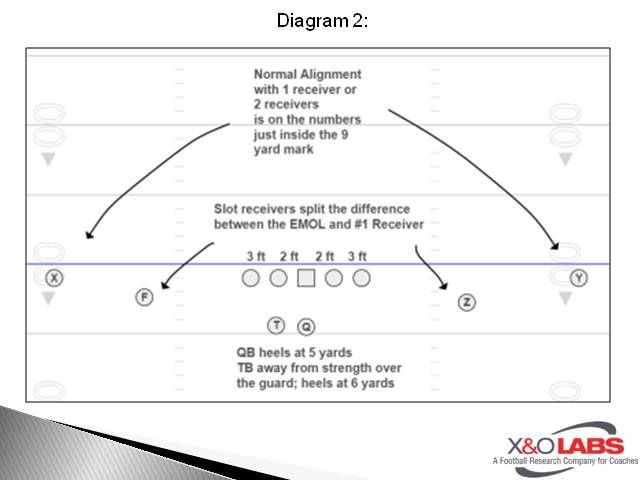
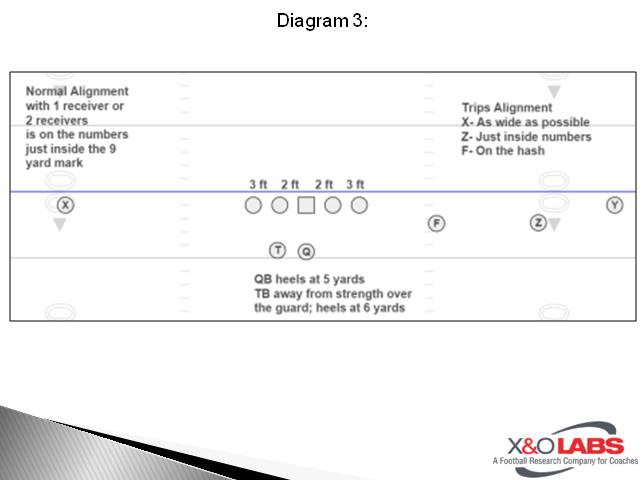
We can run a variety of formations, but typically run only 2 x 2 and 3 x 1 sets with the alignment rules as follows:

Slide2Slide3

SCAN

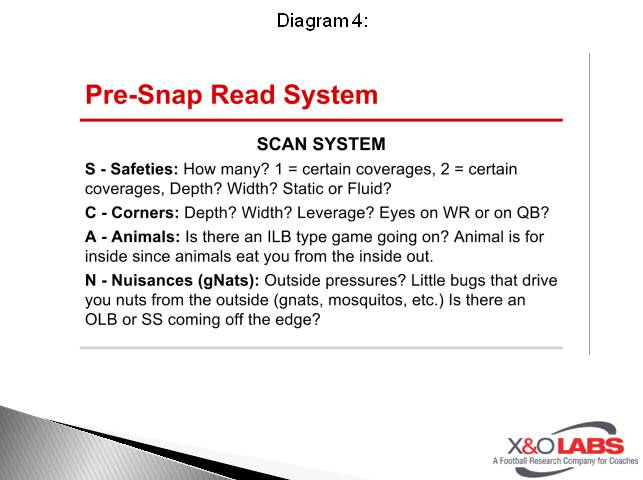
In understanding our quarterback’s progressions and reads on this play, it is important to understand our SCAN pre-snap system for our quarterback to evaluate the threats and structure of the defense.

Slide3

Using this pre-snap read, our quarterback can quickly determine whether or not he will throw the ball in our first two pre-snap concepts. These concepts are embedded into almost every run play that we run. Our receivers are running a quick screen frontside and an option route backside every single run play unless we have made an exception in game planning that week. The only time we do not run a quick screen on the frontside is on designed alley runs where we want both or all three of our receivers to stalk block.

The key thing to understand with this play design is: OUR QUARTERBACK IS NEVER WRONG. We preach that over and over to our quarterbacks. We want them to make quick and decisive decisions. If they are making the incorrect reads, then we need to teach them better, but we know that as soon as we start criticizing them for being “wrong” then they will be hesitant to make that choice again. Hesitation turns our offense into a very pedestrian scheme.

Slide4

Concept 1: Frontside Bubble Screen

Read More

RPOs From Stacks and Compressed Formations

By Mike Kuchar
Senior Research Manager
X&O Labs
Twitter: @MikekKuchar


Introduction:

The following research was conducted in part of XandOLabs.com special report on “Designing RPO Systems.” Continue reading for more information on this study.

Editor’s Note: Former Nassau Community College head coach Joe Osovet will use stack and stack extend formations in his RPO concepts to manipulate both man and zone coverages. He details these formations below:

Stack and Stack Extend: Joe Osovet

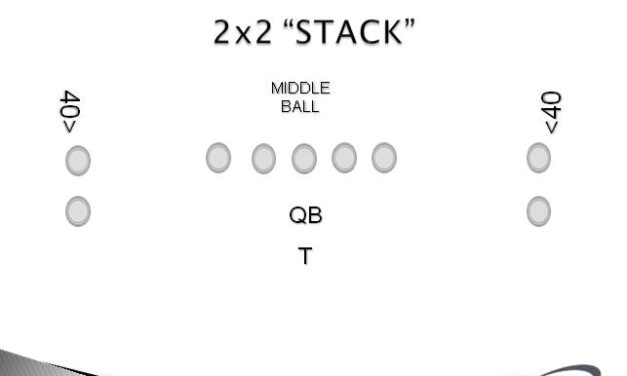
Our “Stack” and “Stack Extend” concept is something we benefited greatly from in our spread no huddle offense in 2015. The alignment and built-in manipulations (RPOs) packaged with our read game allow us to severely stress safeties and overhang players both pre and post snap.

Additional Attributes:

  • Gives offensive linemen and quarterbacks a nice clear picture of the box.
  • Creates more explosive plays in run game, as a result of outside hash-aligned safeties.
  • Limits stem disguises by defense.

Alignment:

Read More

Drill Compilation: Teaching “Top of Drop” Mechanics for QBs

By Sam Nichols
Managing Editor
X&O Labs
@SNicholsXOLabs

Editor’s Note: The following research was conducted as part of XandOLabs.com research report on “Drills to Improve QB Pocket Presence,” which can be accessed in full by clicking here.


Introduction

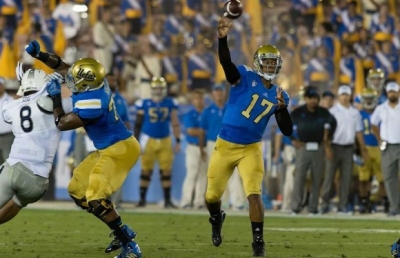
uclaqbWhen we first began conducting research on Quarterback development, we cast our net wide.  We wanted to explore every component of the position:  exchanges, drops, read progressions, throwing mechanics, etc.  What we quickly found is that it be difficult to write volumes on this topic, much less a 10,000-word research report like XandOLabs.com is accustomed to doing.  So we decided to subscribe to the “addition by subtraction” methodology by simply honing in our research on what a QB does at the top of his drop.  How he gets there is one thing- now what does he do when chaos ensues, and whatever well organized scheme or plan flies by the waste side.  Many coaches have told us that the easier part of a QB’s footwork progression is the drop, the most difficult is teaching him to move with the ball post-snap. 
In many ways, the drop is the simplest part of the pass play from a fundamental standpoint.  The answers are straight forward.  While coaches may teach different drops, what a Quarterback does at the top of his drop is essential.  The variables that exist are all determined by the play call and the situation.  But that all changes the second the Quarterback plants his dominant foot and works toward the line of scrimmage to throw the football.  At that moment all of the variables that defenses bring come into play.  It is that moment where a QB’s ability to execute his footwork under pressure will determine his long-term success at the position.  In this case, we will look at how coaches are teaching proper footwork through their route progressions from the last step of their drop to the end of a scramble. 

One of the more prominent drills that Ziegler does to teach the power position is what he calls the “Manning Drill” which can is explained in his words below:

The emphasis is to keep our QBs in their power position.  Knees bent, elbows relaxed, eyes down field as they work the bags.  First time through is typically done without a throw.  After going once or twice each way I incorporate a throw.

As the QB navigates the bags in his power position I will then randomly clap at which time the QB will make a throw to a WR 10 yards down the field working within the framework of the bags.  The emphasis here is still eyes downfield, relaxed elbows and bent knees…incorporating the throw I talk to the QBs about less being more.  I want them keeping their feet active but close to the ground at all times, never on their toes, never feet close together.  By staying in the power position they can set their feet and make a throw will no time lost and with power and accuracy. 

To stufy film of this drill, click on the video below:

Read More

Defending Flexbone Option from 4-2-5 Structures

By Mike Kuchar
Senior Research Manager
X&O Labs
Twitter: @MikekKuchar


Introduction:

The following research was conducted as part of XandOLabs.com special report on “Even Front Structures to Defend Flexbone Option,” which can be accessed in full by clicking here


Source 1: Northwest High School (OH)
Defensive Coordinator Robert Burke

Base Defense:
Northwest High School is a press quarters coverage team that will challenge receivers in the quick game. “Our main front is an under front, but we also use an odd at times.,” said Coach Burke. “Our philosophy is to spill everything to the sideline and let our athletes run it down. We are a squeeze and wrong arm team, which becomes important to how we defend these offenses. Our base coverage is quarters with a cover 3 check. Our coverage calls are dictated by the looks the offense gives us. We split the field in half and adapt to each so that no matter what the offense throws at us so we are not outflanked.”

Play of First Level:
The defensive end is taught to get hands on all down blocks. “This frees our inside linebackers up to make plays,” said Coach Burke. “Our end man on the line of scrimmage must also tackle the dive against the option. This dictates how we run fit the safeties and linebackers. Our DEs (and at times OLBs) must use this technique for us to be effective. Against these offenses and in our under front we play our Mike linebacker at 6 ½ to 7 yards over the ball. By squeezing down blocks we allow him to be an inside out player and flow downhill untouched.”

Play of Second Level:
Coach Burke will align his Mike linebacker at 6.5-7 yards over the ball. “By squeezing down blocks we allow him to be an inside out player and flow downhill untouched,” he said. “It is also important to point out that our coverage calls dictate our force and fill calls as well. When we split the field in half there must be a force, fill and pass only player on each side of the ball. When we discuss these calls note that against options teams the force player is pitch player and the fill player is the quarterback player.” Coach Burke explains these concepts below.

Read More

20 Personnel Arrow RPO

By Donnie Mays
Head Coach
South Charleston High School (WV)
Twitter: @CoachDMays


Introduction:

The Arrow RPO is a simple concept that we came up with after studying the Indianapolis Colts Levels Concept. We simply combined the Power Run Play from the shotgun with the Levels concept and applied some rules for our high school players to understand and simplify things. We initially wanted this RPO as a Tempo play, but found that it can be ran again and again with different players touching the ball with success. Our study also shows that we can run this RPO against various fronts and coverages with similar successes.

In all, we ran Arrow 20 times this past season. Here are the results:

  • 9 Runs 96 yards [10.6 Avg] 1 TD – 1 Fumble
  • 10 Passes (7/10) 70% 245 yards and 6 TDs.

The entire package combined averaged 17 yards per play and 7 TDs defining it as explosive for us. In other words, we should have run it much more.

Running RPOs

We first dabbled with RPO’s in 2006. Like mostly everyone, our process took us on the horizontal attack (Fast Screens) with Zone Runs. In 2008 when I became the Offensive Coordinator, we decided to expand our system. We loved getting the box to 6 and running quarterback isolation while tagging a horizontal fast screen to the edge. What we came to realize is that more teams were defending the screens as part of their daily routine, and therefore getting better and forcing the quarterback to run the ball. We also noticed that the Free Safety was becoming a huge run support player to tackle our quarterback.

Our answer was simple, send our slot wide receiver on a vertical while running quarterback isolation. We called it “Dump” because we wanted to treat it like the old tight-end dump pass. Eventually, it grew into a tremendous play for us. We made some simple rules for the quarterback for reads and timing so lineman wouldn’t be called down field. People started complaining to the officials saying, we were cheating and should be penalized more often, but we realized our lineman weren’t getting down the field that far at all. At this point, we were ALL-IN with RPO’s and haven’t looked back since.

After our quarterback graduated, we knew we had to start planning to fit the new quarterback’s abilities. We learned quickly that he was not a great runner but was very good at reading defenders. This is when we decided to tag our down field passing game with parts of our run game. One of the concepts we use (which is the study here) is our Arrow concept. The Arrow RPO is one of our two third level RPO’s. We currently run nine RPO’s from four base runs. We attack the field both horizontally and vertically in the RPO game. Our views and goals for Arrow is quite simple.

  • To Outnumber the Box for Run Game
  • Force Defense to Play 1v1 In Secondary
  • Eliminate the FS as part of Run Support

Slide1Slide2

We also have a simplistic way of teaching this RPO to our Quarterback:

Teaching the Quarterback

The quarterback is taught that this is a play that can be called multiple times consecutively instead of a play that we run at a high tempo. The quarterback is then given a simple system of indicators to determine the path of the play.

  1. Locate the Free Safety: (The QB has an invisible axis grid to find the FS and this will help determine where he goes with the ball.  The Axis runs from the Offensive Center Vertically to the End Zone and approximately 10-12 yards deep for the horizontal running sideline to sideline. This is what we refer to the quadrant locator.)

Quadrant Locator

Slide3

  1. Doubt: When in doubt, RUN THE BALL! This is the safest play from any look you get. Look for coach to give a “Stay” Signal which indicates the Run Portion of the play no matter what. Or look for a “Shot” Signal which indicates to take the Deep Pass no matter what by choosing the best match up.
  2. Box: Counting the Box helps give the QB a predetermined plan. Ours is simple: (5 Man Box=Run, 6 Man Box=Run or Pass, 7 Man Box=Pass, 8 Man Box=Pass) 

Slide4Slide5

Read More

Blocking Backside B Gap Defenders in Gap Schemes

By Mike Kuchar
Senior Research Manager
X&O Labs
Twitter: @MikekKuchar


Introduction

The following research was conducted as part of X&O Labs’ special report on “Spread Gap Schemes.” Continue reading for more information on this study.


Backside B Gap Player:

There were several concerns about blocking a backside B gap first level defender in gap schemes and with good reason. A backside 3-techique or 4i-techique for that matter, can be a tremendous nuisance for gap concepts particularly if that defender can get penetration. There are two common answers in blocking a backside 3-techinque defender, either block back with the center or pick and hinge with the tackle. While we found these two were the most common adjustments, there were a few other answers that coaches provided to handle that player. These answers mainly come in the form of reading, and not blocking him.

Read More

Coordinating Behind “Big” Offenses

By Mike Kuchar
Senior Research Manager
X&O Labs
Twitter: @MikekKuchar


Introduction

Defending up-tempo offenses can be difficult enough and because many systems have now transitioned into no-huddle operations, defensive coordinators are getting plenty of practice in defending them. After all, they see it in practice every day. But we wanted to research what lasting effect these up-tempo systems are having on their own corresponding defenses. While most coaches will argue a defensive system must match the offense’s system, we were curious to find how these coordinators were now gauging their units. How they assess them? What is considered productive? How are they evaluating themselves as coordinators? Below is the list of contributors to our study and some notes about the offenses they are coordinating behind.


Contributors (In Alphabetical Order)

Phillip Bennett (PB), Baylor University, Defensive Coordinator: Baylor’s offense finished 1st in the FBS with 48.1 points per game and 86 total touchdowns.

Ray DeFrisco (RD), Illinois College, Defensive Coordinator: Illinois College’s offense finished 10th at the Division 3 level, averaging 506 yards per game.

Josh Edwards (JE), Loras College, Defensive Coordinator: Loras College’s offense finished 9th at the Division 3 level, averaging 507 yards per game.

Jeffery Girsch (JG), Angelo State University, Defensive Coordinator: Angelo State’s offense finished 1st at the Division 2 level with 560.4 yards per game.

Nick Holt (NH), Western Kentucky University, Defensive Coordinator: The Hilltoppers offense finished 3rd in the FBS with 44.3 points per game and scored 82 touchdowns.

Mike Stoops (MS), University of Oklahoma, Defensive Coordinator: Oklahoma’s offense finished 4th in the FBS with 43.5 points per game, scoring 73 touchdowns.

Once we rounded up our contributors, we asked them the following questions:

  1. What is the biggest challenge you’ve encountered in playing behind these offenses? Please be specific.
  2. Have you changed your philosophy on how many sub packages to carry or put a quota on how many players you need to play each game? If so, how?
  3. What is something you’ve done in practice during the week to help your unit prepare for the rigors of playing behind these offenses?
  4. In our opinion, what is the most important defensive stat for your unit each week (points per play, red zone efficiency, etc.)? What is the least important? Explain why.
  5. What protocol do you use to judge your unit after each contest?
  6. How do you help change the mindset of an offensive minded team?

Their responses are below:


What is the biggest challenge you’ve encountered in playing behind these offenses? Please be specific.

PB: “The number one thing is you’re going to play a ton more possessions than you’ve ever played before. We have played more possessions on defense than any team in the country the last five years. We play around 16-18 possessions each game.” 

RD: “The biggest challenge I have encountered in playing behind up-tempo offenses is the shortness of adjustments between series.  That being said the coaches on the headsets have to be in sync to distribute any and all adjustments.”

JE: “Making adjustments on the sidelines. I don’t see many 6-8 minute drives anymore, so my coaching staff and I have had to adjust how we see things and communicate with each other and with the kids on Saturday. Each of my coaches has a certain thing they are responsible to watch for, either from the opponent or from our kids. This helps make sure that things are not being missed and that we can coach up our kids.” 

JG: “The biggest challenge is the number of plays that you have to be prepared to play each week.  In our case, our offense would score at a very fast rate.  This is obviously a good problem, but will test your conditioning and depth as a defensive unit.”

NH: “One of the big factors is that our possessions on offense are not very long so consequently we end up playing a lot of snaps. They score so quickly but many times there is no ball control and no conscience of clock management. Sometimes the negative is you’re playing a lot of snaps on defense and the offenses that you go up against are trying to be high powered also because they want to keep pace with our offense. Secondly, on defense you have to be conscience that your offense is high scoring so we need to not give up the big play. These offenses have to work hard. I’ve gone full scale. I used to be a very aggressive defensive play caller but when you’re scoring a lot of points on offense just hold back the pressure and play sound defense to eliminate the big play.”

Read More

NFL Veteran/Fox Analyst Chris Spielman’s Perspective on Rugby Style Tackling

By Mike Kuchar
Senior Research Manager
X&O Labs
Twitter: @MikekKuchar

Introduction

Having amassed over 1,181 tackles during his 10-year NFL career, Chris Spielman knows a little something about bringing ball carriers to the ground. Now as an NFL analyst for Fox sports, the former All-Pro middle linebacker sees first hand why elite athletes miss tackles. And while he has his own opinion on how he would teach tackling, he reflected on how tackling has evolved from the more conventional methods to emerge with a newer rugby style emphasis. Spielman is as “old school” as it gets (he played part of his career through chronic neck pain), which is why we wanted his perspective on the newer methods of rugby style tackling, all of which were detailed in our study of “Developing a Tackling System.” So we pinpointed what we felt can be six contentious talking points of our study and asked his opinion on them.

On why coaches need to adapt their teaching methods to meet newer rule changes in the game…

“If you don’t adapt you won’t play. Chuck Cecil (safety for the Arizona Cardinals known for physical play) couldn’t play right now. Kurt Schulz (former safety for the Detroit Lions and Buffalo Bills) couldn’t play because they would lead with their heads. They would be fined out of the league or if they were in college they would be called for targeting.”

Read More

Addressing the Problem Areas in Wide Zone Runs

By Mike Kuchar
Senior Research Manager
X&O Labs
Twitter: @MikekKuchar


Issue 1: Blocking a Wide First Level Defender

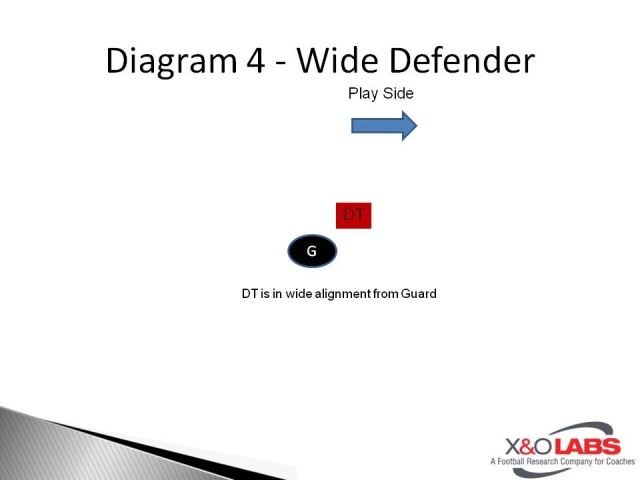
Any wide first level defender has the potential to alter wide zone blocking schemes, particularly if he is at the point of attack. Sometimes it becomes necessary to alter your footwork based on the leverage of the down defender. In order to block those wide leveraged defenders, consider the following techniques.

Solution 1: Drop & Pop Technique, John Donatelli, Towson University

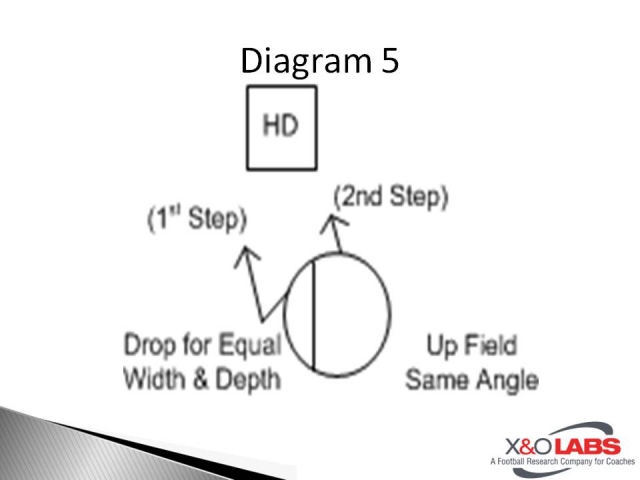
When defenders are in a wider alignment, Donatelli will use what he calls drop and pop footwork in his middle zone concept. In this technique the play side foot drops, steps behind the L.O.S. for equal width and depth to achieve “Big toe/Little Toe” Landmark. The second step is on the same angle but again on an up field-attacking angle. We utilize this footwork for attacking a hard defender off of our body’s or when piercing the backside second level.

To see how Coach Donatelli teaches the Drop and Pop Footwork, click on the video below:

Read More

Masking “No Huddle” Concepts With a Sugar Huddle

By Tommy Shoemaker
Head Football Coach
Central Arkansas Christian School (AR)
Twitter: @TShoe43

Introduction

Like many coaches, I am always interested in an innovation or wrinkle that could give my team an edge in preparing for our opponents. As a Hurry-Up No-Huddle (HUNH) offense, that wrinkle for us has ironically been a huddle – the sugar huddle. This concept and many of our sugar huddle plays were “borrowed” from Gus Malzahn and his offenses at Tulsa and Auburn. In this clinic report, I will explain the advantages of the sugar huddle, its implementation, and a few plays that we use out of the sugar huddle look.

Sugar Huddle Advantages

While the core foundation of our offensive philosophy is using a hurry-up no-huddle, we also believe that mixing in a sugar huddle can provide us with some unique advantages. Many of the advantages that we gained from an up tempo attack are evident as well when using a sugar huddle.  The two main advantages are preparation and panic. Using a sugar huddle adds additional prep time for our opponent and is not easily simulated. Adding to the difficulty of preparing for a sugar huddle is the fact that we typically change our sugar huddle plays weekly. It is tough to prepare for something you have never seen. Another advantage is the tendency for teams to panic trying to get lined up. Many times the defense will still be adjusting when the ball is snapped. This sense of panic can often cause the defense to lose its aggressiveness.    

Sugar Huddle Mechanics

The mechanics of the sugar huddle are simple, yet require practice to achieve the timing of the plays. One of the most critical parts of using a sugar huddle is aligning quickly and getting set before using motion or snapping the ball. The center will set the huddle 1 yard from the football. Both of the OGs and OTs will align in a “U” so that they can quickly turn and get set. If we are using a TE, he will huddle and lineup similar to the lineman. Any player who is split will huddle next to OL, since they will be released early.  The Backs and QB will huddle at the back of the huddle. The QB, or whoever is receiving the snap, will call the play and say “release.” This command will send the split receivers out of the huddle to line up. The QB will pause to give the receivers time to get to their positions and then say “Down.”  On this command the remaining will players will quickly line up and get set. Once everyone is set, the QB can begin the cadence. This may involve bringing a player in motion first. Our cadence is simply “Set, Hut.” 

Practicing the Sugar Huddle

Like any part of your offense, it is important to be intentional about how you organize, install and practice the sugar huddle component. When installing a sugar huddle, we give each play a name, such as “Diamond” or “Pistol.”  This one word name indicates the personnel grouping, formation, motion and play. This allows us to be very specific, yet simple when utilizing these plays.

On a typical game week we use Monday as a walk thru for our game plan. We will install any new plays and review the sugar huddle plays to be used that week. We typically go into a game with 4-6 sugar huddle plays. On Tuesday, we will run through all sugar huddle plays for that week at the end of our normal offensive script. We practice them at the end without tempo so that we can emphasize the execution and the details of the plays. Wednesday is the day when the plays are dispersed throughout the script. The emphasis is on changing personnel groups efficiently and scripting the plays based on field position or down and distance situations. Similar to many teams, Thursday is a run thru of our game plan. All of the sugar plays are worked into the script based on where we intend to call them on the field. 

Designing & Implementing Sugar Huddle Plays

When trying to determine what plays to use in our sugar huddle package, we put the plays into 3 categories:  shots, short yardage and momentum plays. The shots are intended to be passes that attack down the field. Shots are typically called in very specific situations such as after a turnover on the opponent’s side of the field, 2nd and short, or when backed up inside the 5-yard line. The short yardage calls are obviously for 3rd or 4th down and 1-3 yards and on the goal line. The momentum plays are intended to spark our offense. In a HUNH offense, getting a possession off to a fast start can get the momentum rolling for a series.

Read More

Fragmented Punt Formations to Maximize Field Width

By Ron Cook
Head Coach
Red Springs High School (NC)
Twitter: @3Ddefense

Introduction

Our approach to punting is to put as much pressure as possible on the opposing coaching staff in 4th down situations. We want to force their defense to be diligent, sound, and disciplined in spending practice time on special teams or risk giving up a 1st down at a crucial moment in the game. We force opposing coaches to decide if possibly getting yards on a punt return is worth the risk of possibly giving up a 1st down.

Special Teams Philosophy

As a player, I liked to be aggressive in everything I did and as a coach that mindset has not changed for me. Having spent time as a player at Virginia Tech (1997-2000), I learned a great deal of how to be aggressive and technically sound on special teams thanks to Coach Beamer. At Red Springs, we are just as serious and focused on our special teams helping us win games as we are on offense and defense. The kicking game is the part of the game where you can completely change the momentum of a game and steal wins.

For us, all of our “Special” units have unique names to emphasize their importance and to instill pride in our players who have the privilege of being a part of each unit. Our punt unit is named Spider. This unit is a “special” offense that can attack the opposition in eight or more ways instead of just conceding to the defense on 4th down.

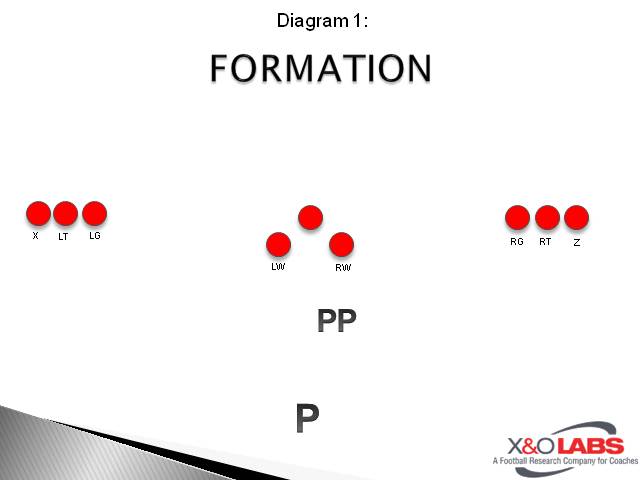
Slide1

The Spider formation utilizes the width of the field and forces our opponents to cover gaps and be sound in their alignment. This, in turn, forces teams to dedicate practice time to being in good positions to cover all of our fakes. In doing so, they must decide if they want to take a chance with having a returner deep or trying to block the kick if we do punt.

Punting Philosophy

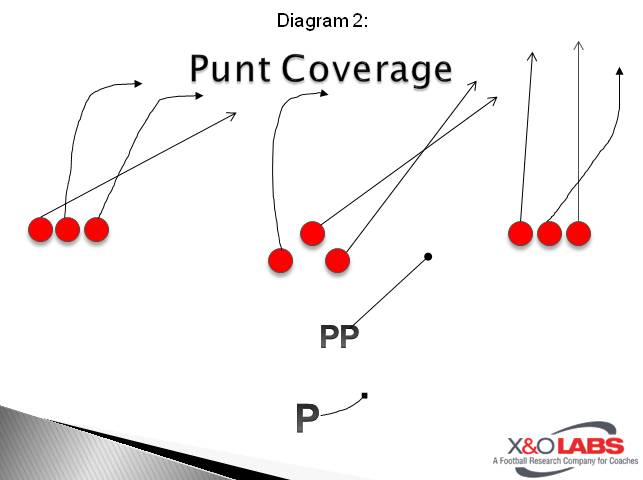
If and when we punt, we always directional kick towards the right sideline of the side of the punter’s kicking leg. The punter taking two quick steps to get the ball off as fast as possible (Diagram 2). The punter is told to keep the ball between the numbers and the sideline and away from the hash. We’re ok with the ball going out of bounds on a good kick. Our punters practice kicking the ball with a high line drive by focusing on making contact right at or below the knee. We are not concerned with hang time as traditional punt teams are, because our opponents are so focused on making sure we do not convert on a possible fake that they do not have a return set up. We focus on getting that line drive to hit the ground rolling and that’s where we steal yards in field position.

Slide2

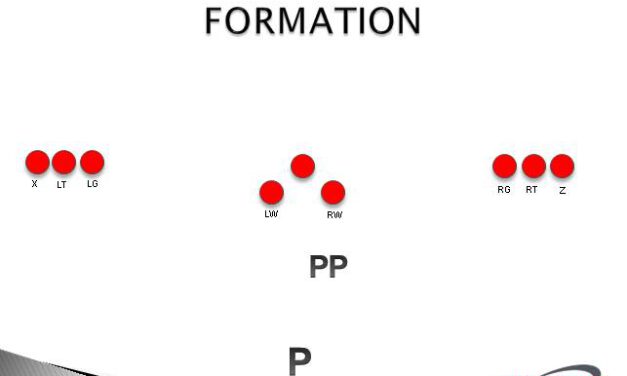
Personnel & Alignment

Read More