Adjustable Bracket Coverage Variations

By Mike Kuchar with James McCleary
Defensive Coordinator
Notre Dame High School (LA)


For the last couple of seasons, it’s been a foregone conclusion that the Notre Dame High School (LA) defensive unit will align in some sort of bracket coverage against any 2×2 open or 2×1 open formations. It’s been a mainstay in defensive coordinator James McCleary’s game plan that over 80% of the time he will defend those formations by playing some sort of bracket. The reason is simple: it helps in getting to a 9-man fit in run support as quickly as possible based on their run/pass read. For Coach McCleary, it’s a safer bet than man coverage provided you can train the eyes of the apex and high safety defenders. It’s a skill set that can only be mastered if you major in the scheme as Coach McCleary does. “Our safeties have become quasi-linebacker type defenders, so it allowed us to become very aggressive in the run game.”


Philosophy of Coverage:

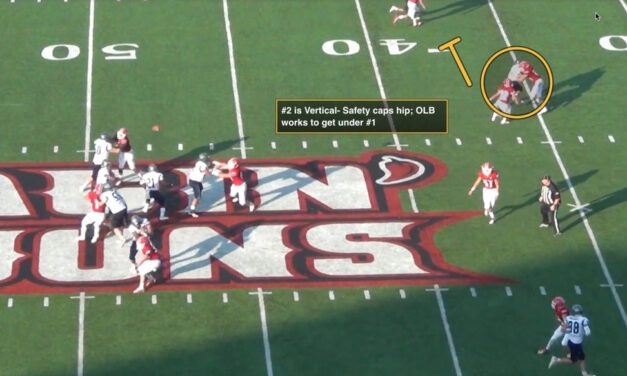
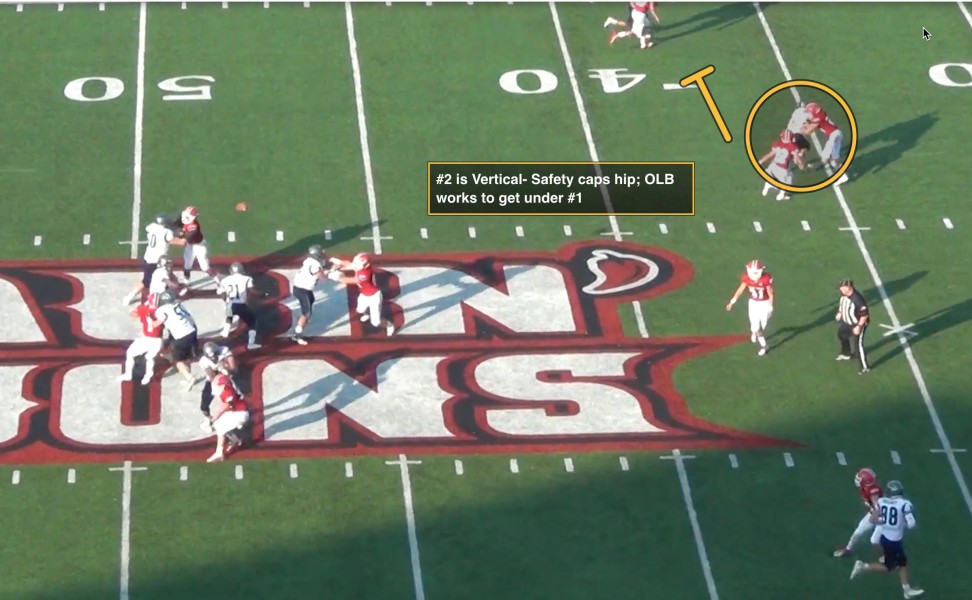
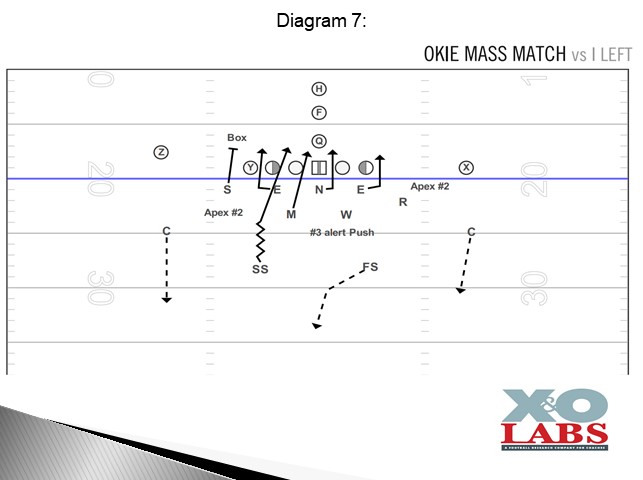
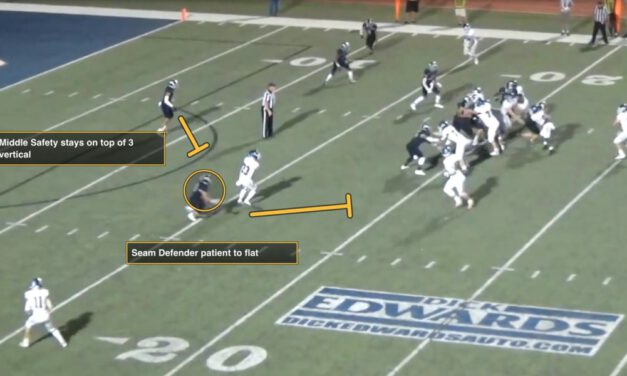
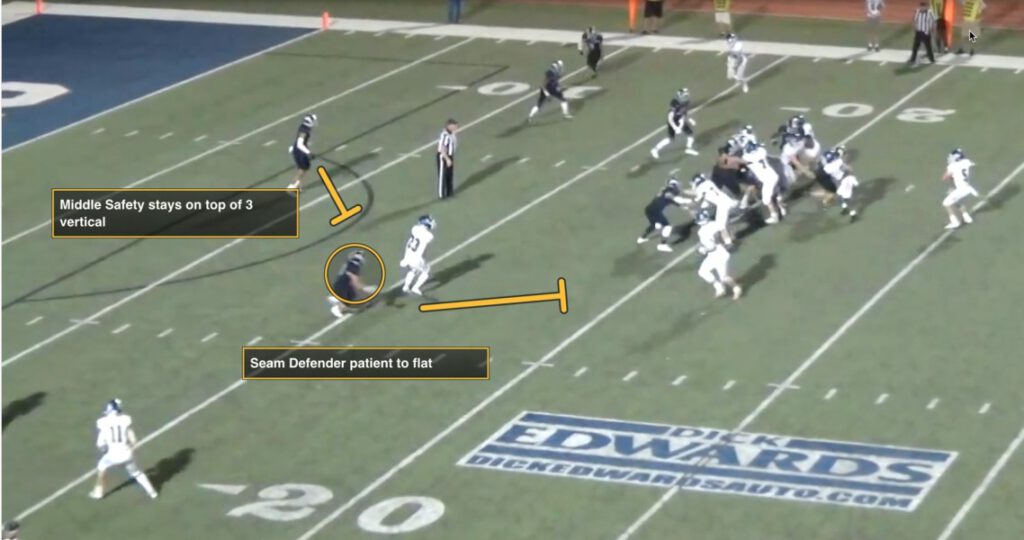
It’s important to note that in Coach McCleary’s system these bracket coverages are usually built-in as split field concepts. He’ll usually merge them with some form of cover two based on the split of the receivers. In typical 2×2 open alignments- we will get into adjustments later in the report- the corner will play all of number one while the safeties and outside linebackers (Will and Hank in Coach McCleary’s scheme) will play off the stem of number two. To start, the safety will play number two vertical while the outside linebackers will work to wall- Coach McCleary calls this angling to the butt cheek- number two.

“It’s not a true double team,” he said. “It’s more of an inside/outside hole technique like a triangle two or box and one situation in basketball. It’s safer than a man-to-man technique. We used to play a banjo technique after five yards but at the high school players have a hard time understanding depth.” It’s important to note that this coverage is purely an adjustment to 2×2 open and 2×1 open formations. He’ll use a different check for 3×1 formations.


Corner Leverage and Divider Rules:

In base bracket coverage, the corners are responsible for the number one receiver but receiver spacing will dictate whether or not the safety and outside linebacker are bracketing number two. If the corner is playing all of number one he’ll use the numbers as split rules to determine his alignment. If the receiver is inside the numbers, he’ll align outside. If the receiver is outside the numbers, he’ll align inside. “We can play off technique, deep technique, or catch technique based on down and distance,” he said. Quite simply if the corner is playing bracket he’ll align inside number one. If he’s playing a form of cover two, he’ll play outside. In either case, he’ll always have inside and underneath help.

Read More

Quick Game/Dash: The Most Efficient Pass Concept You’ve Never Heard Of

By Eric Davis
Head Coach/Offensive Coordinator
Mankato East High School (MN)
Twitter: @davismn6


Why the Quick Game Dash?

The purpose of offense is to score points and efficiently move the ball. Over the years, teams have used the Quick Game as a low-risk way to achieve these objectives. Moving the QB launch point is also a proven offensive tactic that has stood the test of time. In our version of the Pistol Option Offense, the Quick Game Dash is a primary weapon we use to attack defenses.

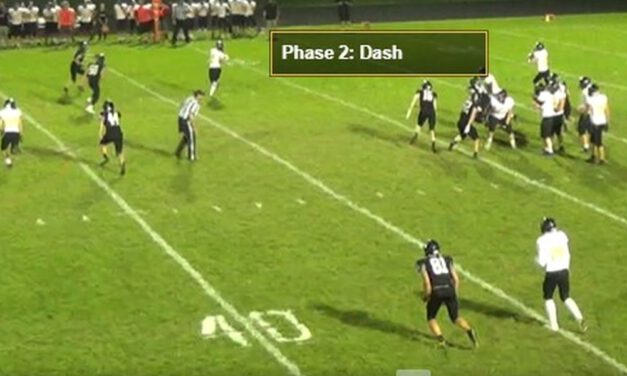
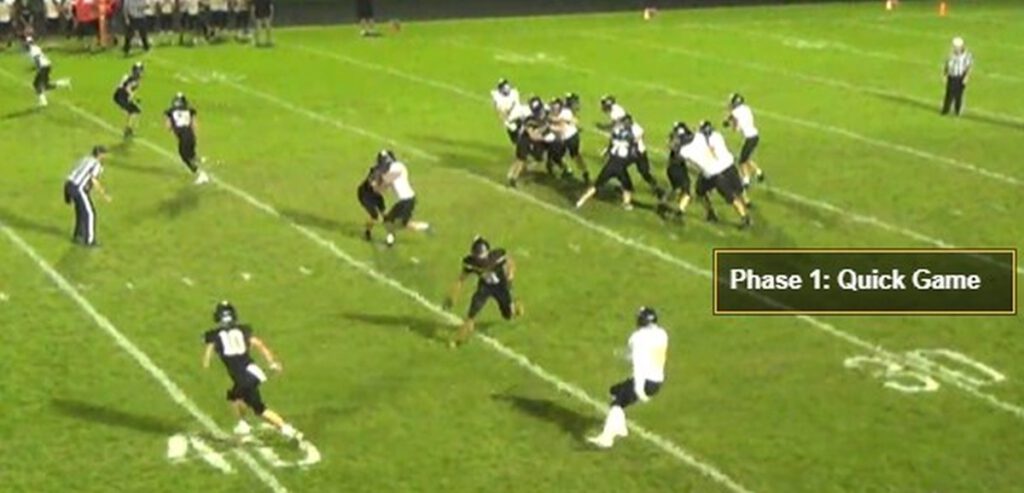
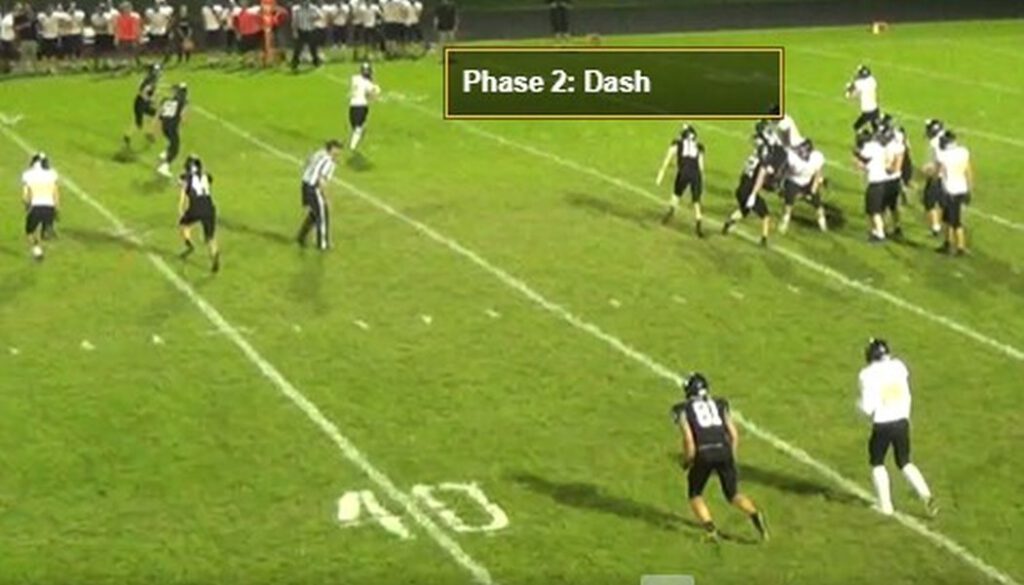
The Quick Game Dash involves running a Quick Game concept to one side of the field as the QB’s 1st look. If he doesn’t like what he sees, he will escape (Dash) to the other side of the field where there will be some sort of traditional Boot/Naked combination.


For many years we ran a traditional Quick Game with mirrored routes. One of our issues was that our QBs often threw to the “wrong” side. Whether they had a preference of throwing to their right or left, throwing to a particular receiver, or throwing to the side that was open in practice that week, we often left games believing we left yards on the table.

Packaged routes are great and used at the highest levels of football. Many of them require a level of understanding of coverages and route concepts by the QB that is difficult to attain until their 2nd or 3rd year in our system. The Quick Game Dash puts the mental pressure on the play-caller and lets the QB play fast.

The Quick Game Dash is part of our offense for the following reasons:

Natural Extension of our System: We believe in running a system as opposed to a collection of plays. Our starting point is the Triple Option. We need to execute the Triple well enough to force the defense to involve their secondary in run support. Next comes our Play-Action Pass game, which is mostly a vertical attack designed to exploit that secondary support. The Quick Game Dash provides balance and forces teams to honor our formations. Our experience has been that the threat of the Option keeps pass coverages relatively simple, and the threat of a competent Passing Game makes exotic option-specific defenses difficult to execute.

Multiple Attack Points in One Play: The Triple Option and the Quick Game Dash both adapt to the defense after the snap. Coach Tony DeMeo calls this “strategic flexibility”. We began studying some of Coach DeMeo’s work in the early 2000s, especially concerning how the passing game can complement option football. We continue to use several of his concepts and coaching points, such as his “UNLESS” rules, some of which will be detailed later.

Program Friendly: Our QBs get the same coaching points from 6th Grade through 12th Grade. They will hear things like, “Catch, load, and throw the Hitch UNLESS it is covered; then Dash away” for up to 7 years. The Quick Game is not dependent on an offensive line that can overpower the opposition, which means it can be a staple of our offense every year. We are not a two-platoon football program, so we need schemes that are easy to implement and practice.


Some of the position labels in the following diagrams may be confusing.  We don’t use traditional X and Z designations.  Instead, we have Field (F) and Boundary (B) WRs.  Our slots (H and Y) can be running backs, wide receivers, or tight ends, depending on what we are trying to do. Our starting point is the traditional Flexbone double slot alignment.

Advantages include:

  1. No Sacks: between Full Slide Protection and our QBs getting the ball out on time (2.4 seconds or less), we rarely, if ever take a Sack on this play.
  2. QB doesn’t throw to the “wrong” side of a mirrored or packaged Quick Game/
  3. No need for conversions; if we call the Hitch and they come out with a Press CB, we simply Boot away from it. It’s also great against teams that both Press and Press Bail. If the CB bails, throw the Quick Game.
  4. By looking at the Quick Game side 1st, we actually get to the Edge much cleaner than when we used to Sprint Out. We also limit/eliminate scraping second contain LBs, since the ones that are disciplined enough to do that are also disciplined enough to get to their drops when they see the initial 1 to 1.5 seconds of the play.
  5. Pairs nicely with our Triple Option / RPO offense. Our QB is used to Yes/No decisions both pre- and post-snap. It also allows him to be a Point Guard of sorts once he gets to the Edge.

Read More

“A Flop” Build-Ins to the Boot and Naked Game

By Mike Kuchar with Caleb Haynes
Wide Receivers Coach
Stony Brook University (NY)
Twitter: @Biggame_24


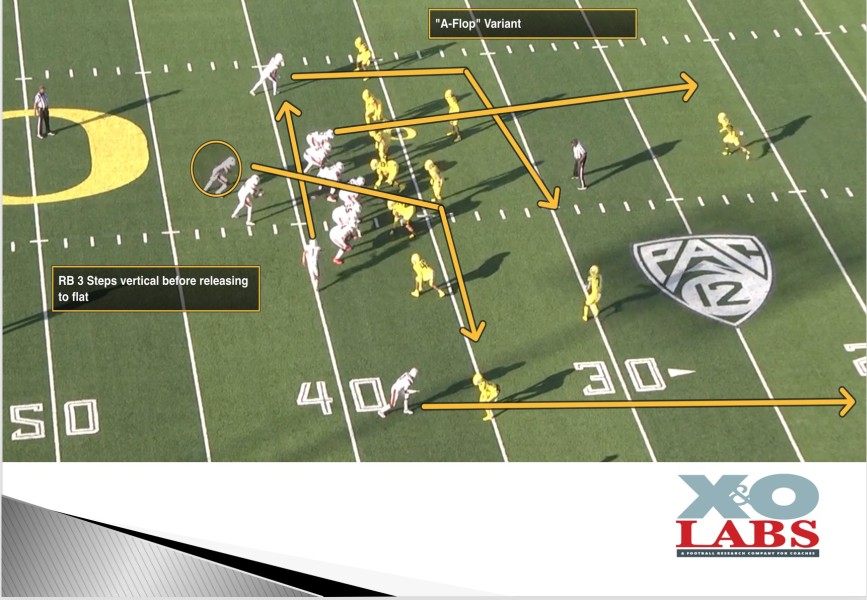
With a tall, athletic quarterback and a recent Division 1 transfer at slot, building upon their boot game was a no-brainer last off-season at Stony Brook University (NY). A perennial CAA power, the Seawolves relied on its boot game for at least 4-5 reps per game for a 70% efficiency rating. Like most productive boot concepts, this one was effective both in the air- with a 72% completion percentage and on the ground where eight scrambles averaged 5.12 yards per carry. But it’s how head coach Chuck Priore and offensive coordinator Chris Bache build in some of what they call “A Flop” tags to the boundary that made the concept productive.


Base Structure:

At Stony Brook, the boot game is part of the control pass menu which includes RPOs and Play-Action passes. But a lack of efficiency in the RPO game forced the offensive staff to rely on more of these boot principles this past season. While there are play-side and backside rules in the concepts, it’s the various tags that the offensive staff devised that helped in its productivity. In all, the staff will build in 3-4 boot variants to the field and 1-2 variants to the boundary. Clearly, this is all built off how defenses are playing formations and personnel.


QB Footwork:

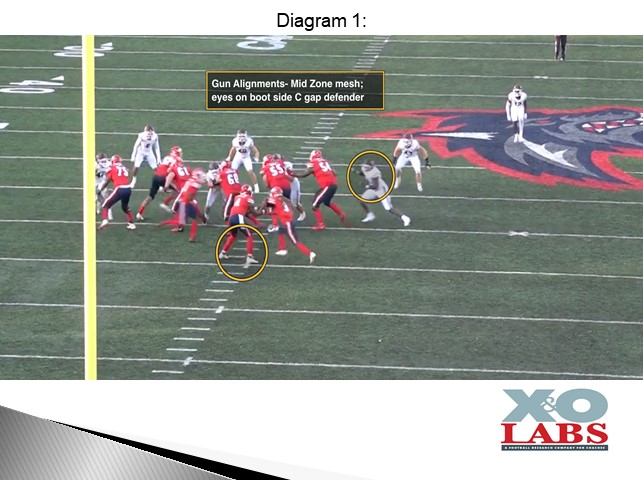
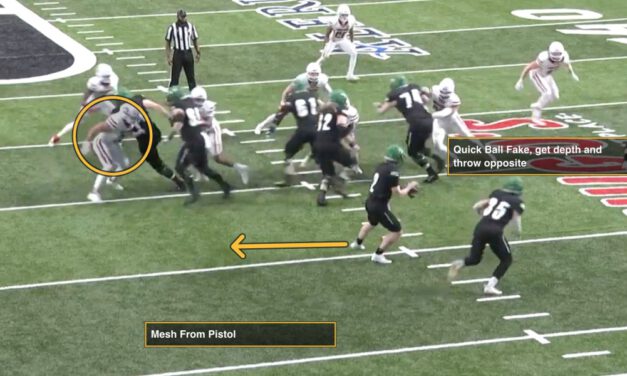
Stony Brook will utilize these boot concepts from Under, Pistol, and sidecar alignments. Clearly, in under alignments, the play fake is a bit more effective because the quarterback can stretch the ball. In Pistol alignments, he’s asked to generate a quick flash fake before working his depth opposite. In gun alignments, the mesh is the same as mid-zone footwork. The quarterback opens at a 45-degree angle, sells the mesh fake, disengages, and then gets his eyes right on the unblocked, C gap defender.


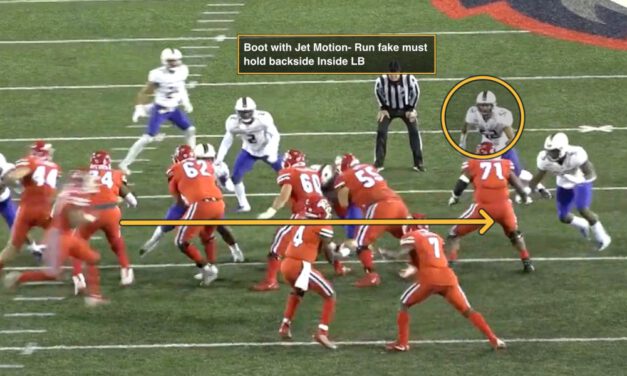
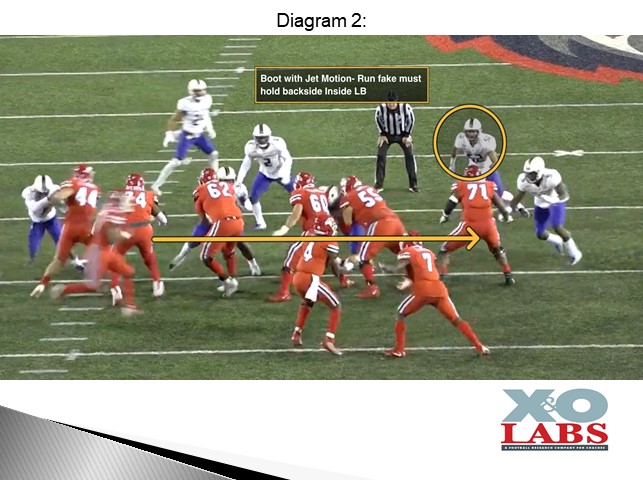
The offensive line is executing off its base mid-zone rules intending to get second-level defenders to move horizontally. According to wide receiver coach Caleb Haynes, Stony Brook puts a premium on that play fake because so much of its boot game is built off jet motion. “We have to sell it as a run play,” Coach Haynes said. “Many teams don’t run a ton of boot with jet motion because inside linebackers can work over the top with that motion.”


Backside Tags:

Before delving into the boot side route concepts, it’s important to note how Stony Brook formats the backside of the concept- or where the run action occurs. Below are the following tags for backside receivers:

“Base”/Default- Closest wide receiver to the ball runs a drag route. The next wide receiver runs a bleed post route.

“E Tag”- Closest wide receiver to the ball runs a clear/bleed route. The next wide receiver runs a drag route.

“S Tag”- Closest wide receiver to the ball runs a crosser route. The next wide receiver runs the drag.

“Cruise Tag”- Closest wide receiver to the ball runs a gut route. The next wide receiver runs the drag. The final wide receiver runs the clear bleed route.


Front Side Concepts:


Single Receiver Tags:

Ground zero for Stony Brook’s naked game lies in the single receiver menu, both to the field and to the boundary. While the comeback is the most efficient route in the Seawolves naked menu, they have transitioned into other concepts such as the ones below:

Reduction Smash– number one wide receiver on out route, number two receiver on a flag route.

Pivot– number one receiver runs whip route, number two receiver runs flag route.

Screw– number one receiver on mandatory outside release, number two receiver on whip route.

Twist– Post/Wheel variant


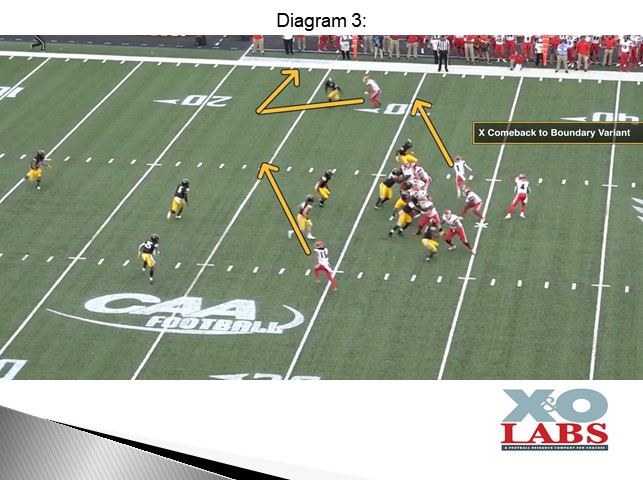
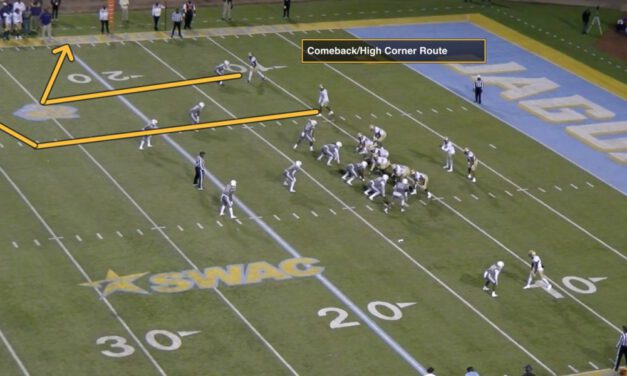
The one-on-one coverage beater against quarters structures seems to be the comeback by number one. But to get the correct spacing needed an emphasis is placed on the X stemming inside against the corner.


The quarterback executes a high/low read from the comeback down to the flat. “We talk about if the comeback is hairy, let’s dump it in the flat right now,” said Coach Haynes. “For us, it needs to be a 10 out of 10 completion throw to take the comeback.”

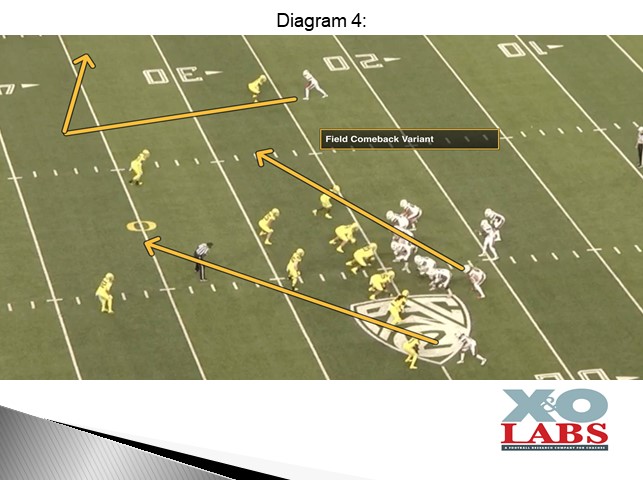
The field comeback is also a staple in the Seawolves naked package menu, providing the quarterback can throw it. It’s a 14-16 yard comeback but the X needs to work on splitting the hash and sideline to get the necessary leverage to run it.


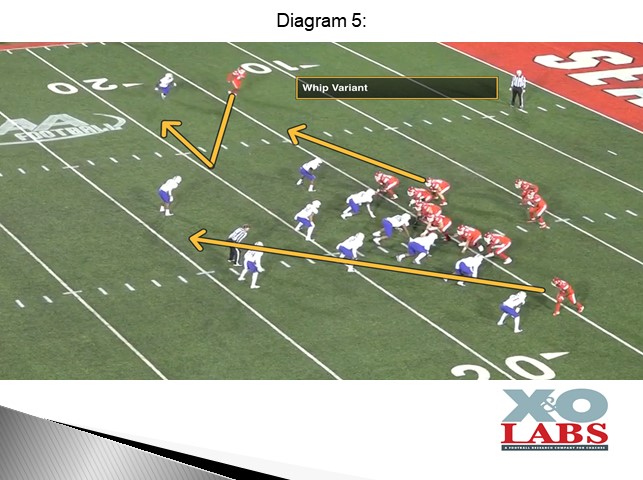
Most recently, they’ve gone to using more whip variants for the single receiver to the field. It was extremely effective to generate one on one’s against field pressure tendencies. The X is asked to sell a hard inside release for five yards and then pivot back out off the overhang.


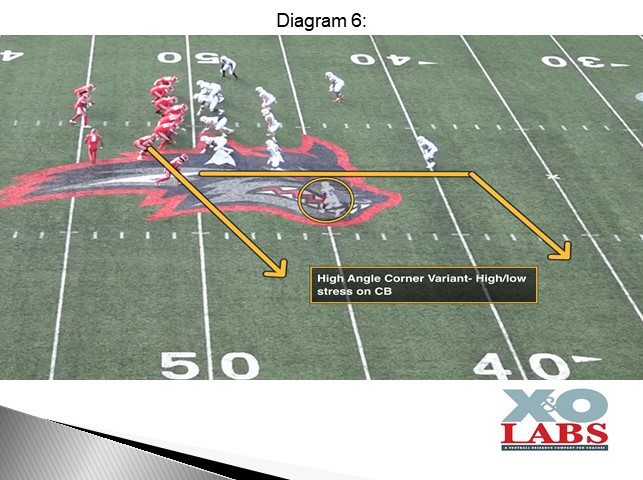
Finally, the high angle corner route can be another option in the Naked concept. Here the receiver cuts his split down to run the corner route. He gets to where he would be on a mandatory release, but now he’s a live option. The quarterback still executes a high low read from the corner route to the flat element to the drag. If neither is open, he needs to run.

Read More

Cross Training Multi-Positional Linebackers

By Jason Thier
Defensive Coordinator
Dickinson State University (ND)
Twitter: @JasonThier


As I like to jokingly say, “It is an offensive world, defenses are just living in it”. In order to exist in the current offensive world, defenses have to adapt what they were doing both structurally and personnel wise. As a player back in the mid 2000’s, I played in a tradition 3-4 style defense where the positional players were cookie cutters of one another and only the Outside Linebackers created reduction fronts. Both Outside Linebackers were the same body types and had the same skill sets. Both Inside Linebackers were the same body types and had the same skill set. In the mid 2000’s, the game wasn’t played in the open field like it is today and defenses were able to get away with this type of personnel and still have success. However, the game today is played in space, with up tempo, and pass options on every run play. Your defensive structure and personnel must be designed to handle today’s offensive schemes.

Here at Dickinson State University we adapted our defensive structure to a 3-4 / 4-2-5 hybrid defense to combat the modern-day offense. We went to this hybrid structure four years ago and have seen solid results since. As a defense over the past four season, 44 games, we have averaged giving up 16.6 points per game, which is the best in our conference spanning that time. We average 307 total yards a game, 115 rushing yards and 192 passing yards. We also have averaged 29 takeaways per season, along with a 3rd down defense yielding 31.2% success; leading our conference in both categories.


We refer to ourselves as a hybrid for two main reasons. First, our linebackers are no longer cookie cutters of one another, they are multi-positional players. Our field OLB, Rover, is more of a strong safety type player that gives use great flexibility in our coverage variations. Most of the players on our team who play this position currently, were safeties in high school. Our boundary OLB, Zeke, is more of a rush end who spends his time equally playing on the line of scrimmage and off the ball. This player becomes a fourth rusher for us more than any other linebacker. Our field ILB, Mike, has to be able to play in space and in the box. He is usually one of the best athletes on the team who is still very physical. Finally, our boundary ILB, Will, is the old school tackle to tackle linebacker who primarily lives in the box and is usually our biggest linebacker. The second reason we call ourselves a hybrid defense is because when creating our different fronts, we have the ability to construct them with any of our linebackers, not just an OLB like a traditional 3-4.  Even though we base out of 3-4 personnel we spend equally as much time in even spaced front structures as we do in odd spacing. This flexibility allows us to best match up with the offenses personnel on the field and put our players in position to utilize their greatest skills.

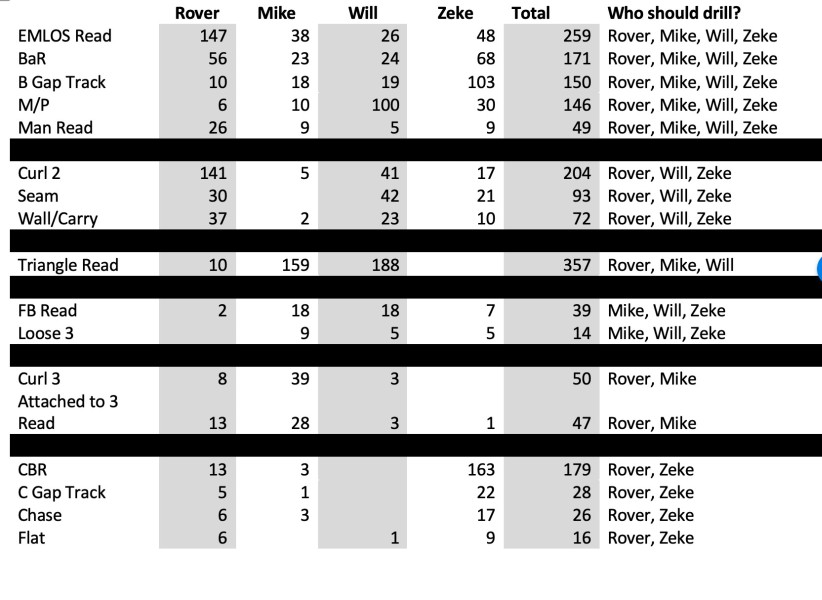
Having multi-positional linebackers and cross training them all together has opened up our playbook from both a front and coverage stand point. It allows us to be very multiple and complex to an offense, while being simple for our players. It allows our players to do what they do best instead of being asked to perform skills they struggle with. This article will focus on why we cross train all four linebackers, how we determine which skills need to be cross trained, some of the biggest challenges in cross training and detail how we create our fronts using the different linebackers.

First, let me explain why we cross train. What we noticed through self-scout was that throughout the season at some point all of our linebacker positions had played outside the box, inside the box, on the line of scrimmage, rushed the passer, and dropped into coverage. This could have been because of defensive design or the way the offense aligned to attack us. Due to the way we personnel each position, some do each skill more than others, but none the less each position ends up performing all of the skills. Yet we were not training all of the linebackers at a high enough level to be successful at all of the techniques. Which revealed a weakness in our scheme. If an opposing offense is able to make a player who is not comfortable playing in the box, be in the box, they are dictating terms. This is where the idea of cross training started. We wanted to make all of our players comfortable in every situation, whether it is something they do often or only every now and again.

Cross training means that all linebacker positions will learn the same skills and techniques. Everyone will learn how to play on the line of scrimmage as stand up linebacker and know our different rush techniques. Everyone will know how to read the triangle when aligned off the ball in the box and how to read the end man on the line of scrimmage when aligned outside the box. All of the positions will be able to execute all underneath coverage drops as well. Everyone will learn how to beat a block in space and at the point of attack.  This allows for more scheme versatility, maximizes our ability to use sub packages, prepares all of the linebackers to align anywhere within our defense, and makes it easier for one person to coach all four positions.

As a small college program, we are limited with the amount of coaches we have at our disposal. Cross training allows one coach to work with the whole group more often and limits the amount of player lead drill work when the group has to be split up. Cross training also yields to smoother position transitions with in our roster. As a player grows and develops he may be better suited to play a different position. By cross training the entire group, a move from Rover to Mike doesn’t feel like starting at square one for the player. This allows us to make roster changes with confidence and keep our best players on the field.

Read More

North Dakota University’s Gap Scheme/Tunnel Screen Merger

By Mike Kuchar with Danny Freund and Joe Pawlak
Offensive Coordinator/QBs and Offensive Line Coach
University of North Dakota
Twitter: @dfreund7 @PawlakJoe


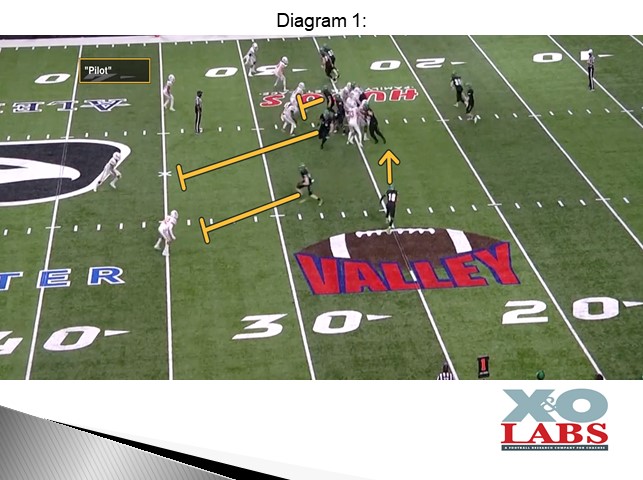
As a valued member of the Missouri Valley Conference, the University of North Dakota is built on running the football. But they also have a 6-1, 180-pound slot receiver with an uncanny ability to find and exploit space in the screen game. It’s led him to produce over 75 catches in two seasons for the Fighting Hawks. So, it made sense to merge their most efficient run concept (Power) with their most efficient screen concept (Tunnel). It’s simply termed “24/25 Pilot.” The number system denotes the run game while the concept name is Tunnel. The merger has produced over ten yards per play the last two seasons and has become a favorite in offensive coordinator Danny Freund’s menu. “It’s such a safe play,” reiterates. “Even if you get tackled on the line of scrimmage it’s second and ten. We don’t worry about lost yardage.”

The concept is called “Pilot” and can be thrown to the outside receiver or the slot. In triple width formations, it is typically thrown to the slot while in double width formations, it’s thrown to number one. The entire offensive line (except for the call side Guard) will release to block the second and third levels.


Best Practices: When to Call

Because of the run action, these calls are traditionally non-consequential down calls (first or second down) but Coach Freund will sprinkle them in on third and long scenarios particularly if he finds a potential voided or tight alley player to the screen side of 2×2 formations or a numbers advantage on the perimeter in 3×1 formations.


“Creating Stretch Away from The Screen”

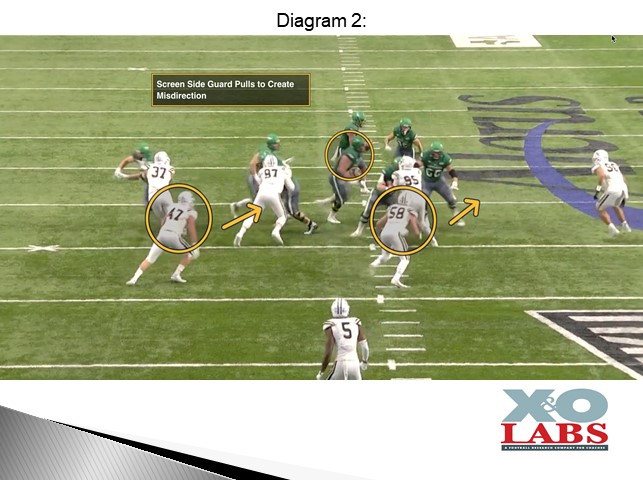
Tunnel screens are built off creating space in the middle of the field. And space stems from misdirection So, it becomes essential to create forms of misdirection that generate horizontal flow from defenders. In this concept that misdirection is generated in two ways: the false pull of the screen side Guard and the outside zone path of the running back. The screen side guard is simply taught to block his normal power rules. But instead of skip pulling, he will open pull opposite the screen to get second-level defenders moving.


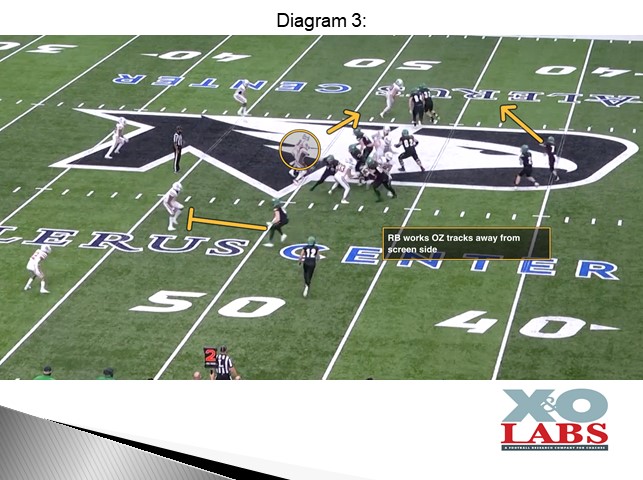
The ball carrier will create the second form of misdirection by working an outside zone path away from the screen side. He will automatically line up to the screen side when “Pilot” is tagged. As explained below in this report, there may or may not be a ball fake by the quarterback.


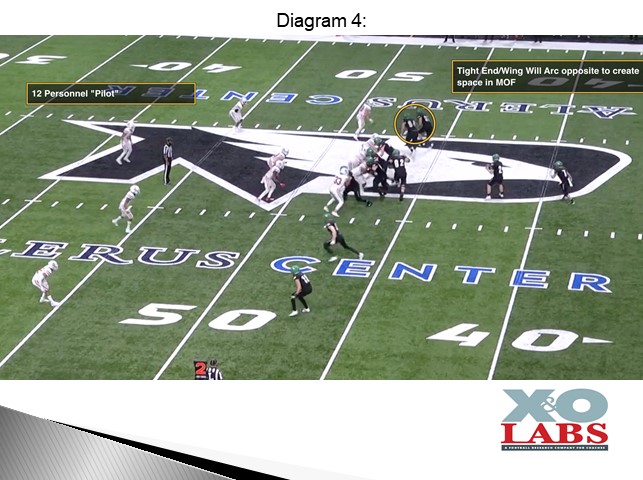
In 12 personnel Pilot, Coach Freund will have both tight ends arc opposite the screen side as a means to provide misdirection and create more space, for the tunnel concept.


Intended Receiver Technique: “Step on Three Ants”

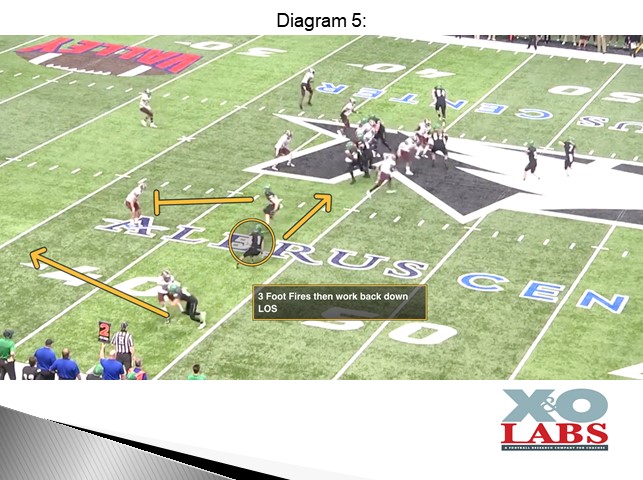
In “Pilot,” the intended receiver’s job is to find his way inside the screen side Tackle’s kick-out block and then work his way back out. As Coach Freund will tell you it’s a “feel” thing which is why many of the Fighting Hawk’s Pilot throws went to one particular receiver. Post-snap, the receiver is taught to generate three foot-fires (Coach Freund talks about stepping on three ants) then come flat down the line of scrimmage. At that point, the ball should be in the air.


Screen Side Receiver: “Screen Protector”

North Dakota will run Pilot to both double width and triple width formations. Essentially, whoever is not the Tunnel receiver will be asked to block the most dangerous defender on the screen side. He is known as the screen starter. If his block is ineffective, so is the concept. His technique is to kick that defender out so that the receiver can come underneath.

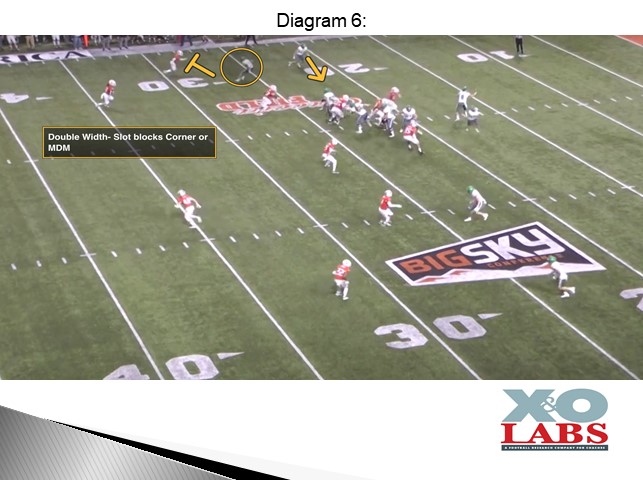
In double-width formations, number one is typically catching the screen, so the slot will handle the corner or most dangerous.


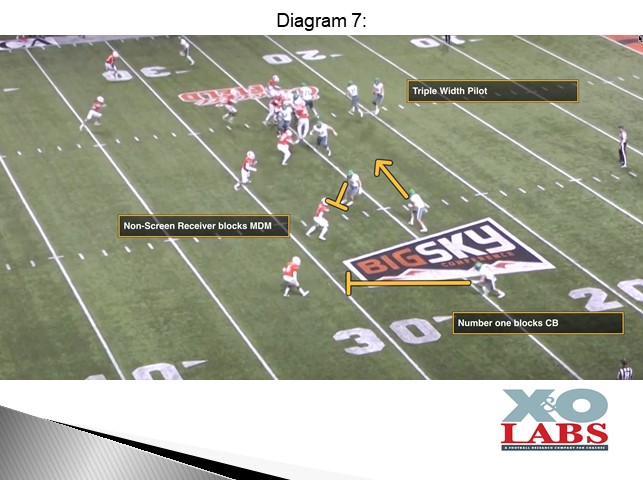
In triple width formations, either the number two or number three receiver is the target based on the tag. So, number one will traditionally block the corner with the non-screen receiver blocking most dangerous.


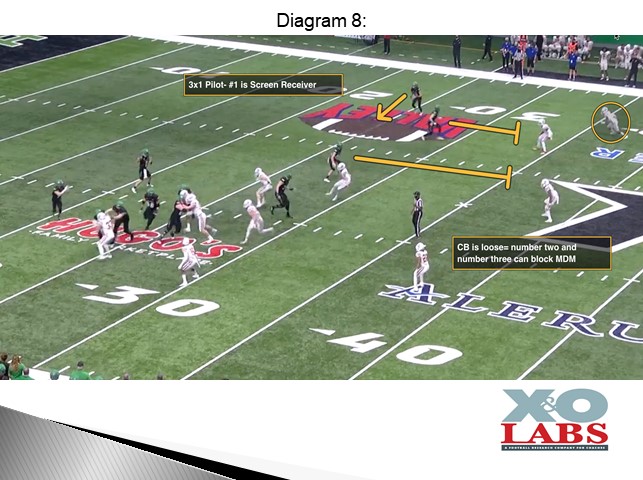
There are instances where the number one receiver to the trips side will be the screen receiver. In these circumstances, number two and number three will block the most dangerous. According to Coach Freund, this may not need to be the corner, particularly if he’s loose. The ball is not going out to the perimeter anyway.

Read More

Adjustable 3×1 Pressure Checks in the Fire Zone System

By Mike Kuchar with Brandon Noble
Defensive Coordinator
Downingtown East High School (PA)


One of the benefits of operating in an odd outfit is the ability to check pressures based on formation and backfield location. At Downingtown East High School (PA), 3-deep, 3-under fire zones make up nearly 70% of calls for defensive coordinator Brandon Noble. Coach Noble formats his defense into “left” and “right” or field and boundary alignments. As a 3-4 structure, he operates from the following personnel:

  • Field End
  • Nose
  • Boundary End
  • Sam- aligns to field or defensive left
  • Mike- aligns to field or defensive left
  • Will- aligns to boundary or defensive right
  • Ram- aligns to boundary or defensive right
  • Strong Safety- aligns to field or defensive left
  • Field Safety- aligns to boundary or defensive right
  • Left Corner
  • Right Corner


Coach Noble, a former NFL defensive lineman, believes in continually putting pressure on a high quarterback and an often inexperienced offensive line, forcing them to make decisions in real-time. “More often than not the defense will win,” he told me. “All we are trying to do is get a one-on-one battle.” In this report, Coach Noble details his fire zone package and how he had to evolve it into pressure checks to be adjustable in handling the various formations that can stress a field defense.

In this report, we will explain Coach Noble’s middle, field, and boundary pressure patterns and how each is adjusted to handle overloaded formations to the field.


Interior Pressure Pattern:

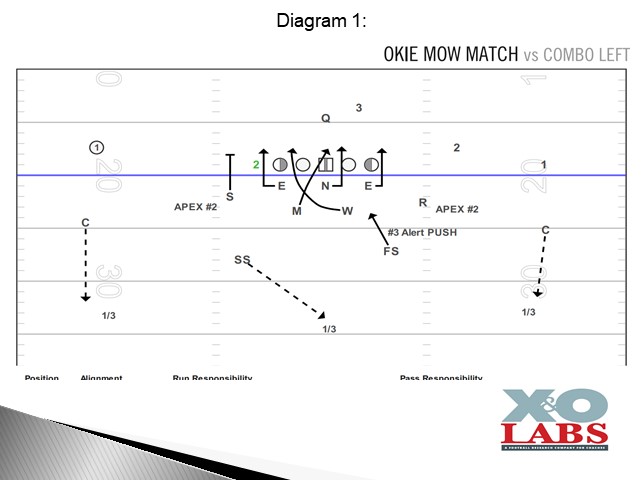
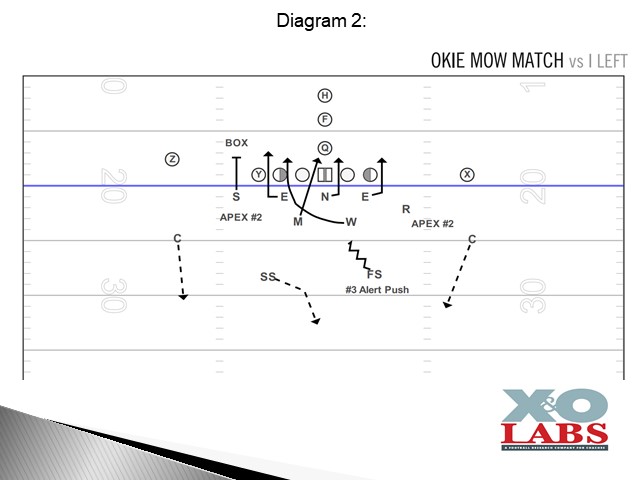
The interior pressure patterns in the Downingtown East system are designed to attack three-man surfaces in the run game. Coach Noble will term it “Mow” or “Wham” alerting his two inside backers to activate the pressure.


The Mike and Will are the penetrators here who will work off the A and B gaps respectively. The Nose will work into the A gap opposite the pressure. In “Wham,” the Will is the A gap penetrator while in “Mow” the Mike has that role. The A gap penetrator works the hip of the Center as an aiming point and the B gap defender works the outside hip of the Guard as the aiming point. The boundary safety (FS) is the inserter to relate to number three. The Ram and Sam are the two relators or hook seam defenders.

Raw cutups of the interior pressure can be found below:


Boundary Pressure Pattern:

The boundary pressure pattern in Coach Noble’s system is termed “Raw/Wolf,” where the Will and Ram are activated into the pressure.  “Raw” tells the Ram he is the outside edge pressure defender while in “Wolf” that assignment is given to the Will linebacker.


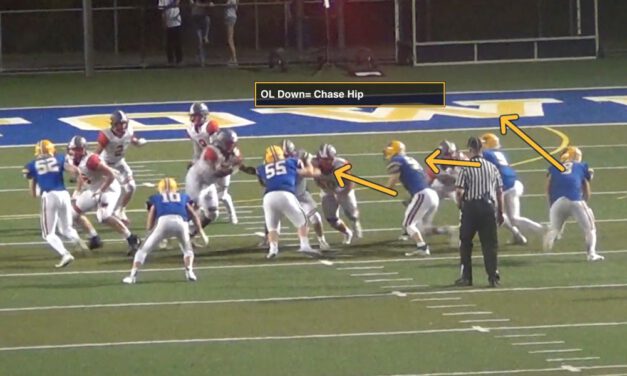
The Free Safety inserts to be the hook/seam defender with the Sam to the field. The Strong Safety handles the thirds with both cornerbacks. In any of these pressures, Coach Noble teaches a “jugs” or “knife” technique. With any run action away from them they read the next adjacent offensive lineman. If lineman come at them, they work underneath it. If the lineman is away from them, they chase the hip.


Raw cutups of the boundary pressure can be found below:


Field Pressure Pattern:

Field pressures are termed “Mass,” with the Mike and Strong Safety activating. The Nose works in the A gap away from the pressure, the Mike works off the B gap while the Strong Safety is the B gap rusher. The Will now becomes the low-hole defender and the Free Safety and corners round out the thirds coverage.


Often it’s the safety that becomes unaccounted for in the pressure. “I’m a firm believer in bringing the safeties, particularly if they are linebackers,” he said. “At the high school level, nobody accounts for them in protections.”


Raw cutups of the field pressure can be found below:


Read More

Bucket Teaching Drives and Shallows

By Mike Kuchar with Hayden Hawk
Offensive Coordinator/Quarterbacks
Henderson State University (AR)
Twitter: @H_Hawk


Most coaches understand that the passing game is built off progressions. Quarterbacks have first looks, progress to second looks then maybe a third look, and the ball is either thrown or he’s off and running. But many coaches make the mistake of producing separate progressions for each concept which can become confusing for the quarterback, ultimately delaying his release and putting him on the ground quickly. At Henderson State University (AR), under the direction of offensive coordinator Hayden Hawk, the offensive staff has formatted the entire pass game into six distinct “buckets” which aid in speeding up the quarterback’s progression and timing:

  • Vertical Buckets
  • Y Cross Buckets
  • Shallow Buckets
  • Mesh Buckets
  • Curl Buckets
  • High/Low Buckets (smash)


“The defense can do whatever it wants, but essentially it’s 1, 2, 3 for the quarterback,” he told me. “The details on these read progression is addressed below but the benefit of this teaching progressions provides for simple tweaks, or tags, each week in-season to manipulate defensive scheme or personnel.”

In this report, we will focus purely on how Coach Hawk and the staff at Henderson State format its Drive and shallow concepts into talking points for the quarterback to help speed up his progression and efficiency.


Tag Build-Ins:

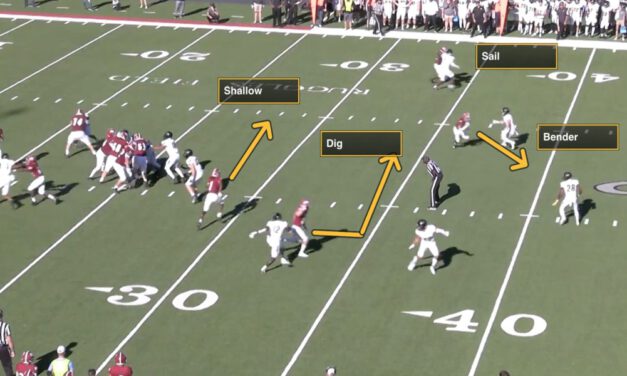
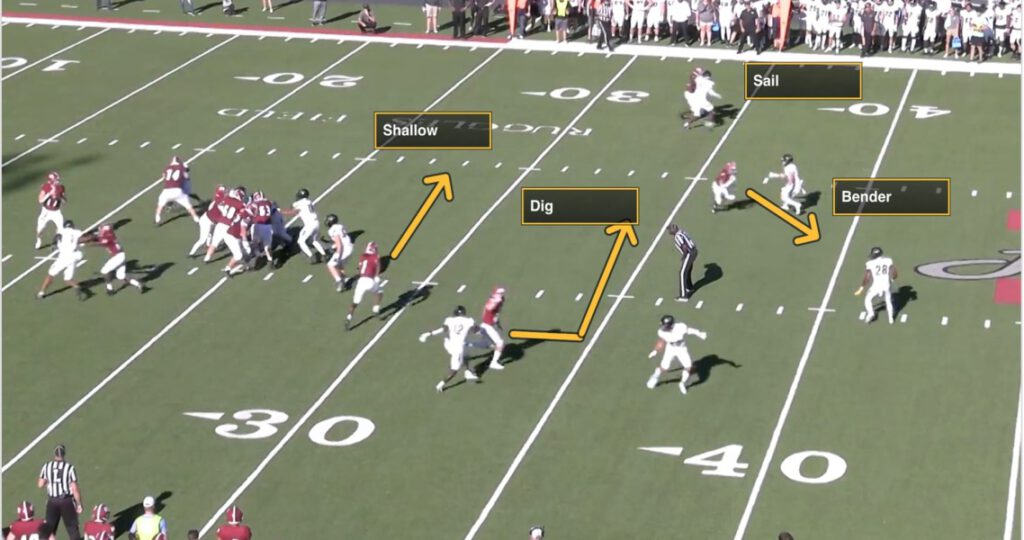
Henderson State formats its concepts by using concept name. In the shallow and drive series, the first word is the actual concept while the second word is the tag. For example, “Drive, Sail” would be one concept while “Mesh, Return” could be another. In total, there are six different concepts (these include tags) in the shallow/mesh family which are included further in the report. When these concepts are mixed with a variety of personnel groupings and formations it becomes difficult for defenses to prepare for. “We don’t repeat a play for three games,” said Coach Hawk. “So, when a defense breaks us down, it will look a lot but we run the same concepts.”

How Coach Hawk and his staff build in his tags is by devising a worksheet template each game week. This template is later generated into a call sheet. That worksheet contains the following:

  • 8-10 pure Drop back passes
  • 5 quick game concepts
  • 10-12 runs


The drop-back menu will consist of two vertical routes, two climb routes, three shallow routes, and two high-low concept routes. The staff just decides on how many of each concept they want, based on what they are seeing. The frontside of the concept will attack whatever coverage the defense is presenting that week and is the quarterback’s first progression. “If it’s a Cover 2 defense, we will try fit in a bender underneath the safety,” he said. “If it’s a quarters defense, we think about getting them on an out and up on the Nickel. Things like that. That limits us so we don’t endlessly come up with plays and allows us to focus on specific concepts when watching the opponent. We package our concepts with what the quarterback feels good about throwing where your first and second read should be our top two receivers. Throughout the week it’s building it to match that together.”


Locked Open Routes:

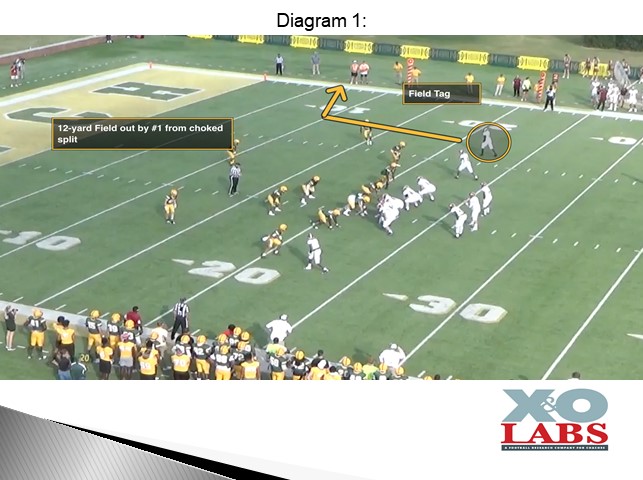
An example of these tag packages comes in the form of what Coach Hawk calls his “locked open” progression. These are front-side tags that never change. And one of the most efficient locked open routes last season has been the field out by the number one receiver, who happened to be a two-time All-American for the Reddies. Rather than number two running the out (or sail) as most offenses do, number one would run a 10-yard out (six steps) from a choke split (+2 from the hash) alignment to the field. This is contrary to a number two receiver running the route, which would be a 12-yard cut.

Read More

Open Seam Rules for 2-Relaters in Hot Pressures

By Mike Kuchar with Adam O’Neill
Defensive Coordinator
Manhattan High School (KS)


At Manhattan High School (KS) hot pressures only make up about 10 percent of snaps, but that doesn’t negate the efficiency of the concept. For defensive coordinator Adam O’Neill these pressures are a mainstay in “possession and ten” downs or heavy run tendency downs. The intent is to hit home runs in early downs by making tackles for loss. It’s an added benefit against 11 personnel Y off structures or heavy inside zone teams and the pressure concepts mesh well with the fire zones and man pressure concepts in the Manhattan High School defensive system. Coach O’Neill is hesitant of playing pure man coverage against open sets or quarterback run game, so his hot package is a good alternative against these schemes.

These hot pressures are used mainly as “shot pressures” to hit a home run on first down. Coach O’Neill relies on his prep work to call this on the right down, distance and field position. For downs with heavy pass tendencies, the coverage can easily be checked to man free. “I like cover one on pass downs but with the quarterback run I like zone coverage better,” he said. “Cover 1 and cover zero scare me in QB run game. Now at least we get zone eyes with a six-man rush.” Coach O’Neill terms these pressures similar to his fire zone pressures with one main distinction. Five-man pressures are termed by superheroes (such as Batman and Spiderman) while six-man pressures are termed by superhero groups (such as Suicide Squad and X-Men). The extra grouping is taught to accentuate an “extra defender” in the rush. “It just makes sense with players that way,” he said. “They just need to know the bucket to understand the coverage.”


Deep Third (Corner) Technique:

One of the carryovers in this scheme that is similar to fire zones is the corner technique. They are taught to plant and drive with their butt to the sideline. As Coach O’Neill says, the corner is going to take away the quick game with alignment but will bail out with zone eyes on the quarterback. Corners should expect fade but break on any stop routes in front of them. “If the route turns out to be a fade, we just keep running with it and look to intercept the ball,” he said. “By then the quarterback should be hit in the mouth. But if the ball is thrown underneath that’s on me. If they complete balls and it doesn’t turn into extra we are doing our jobs.”


Deep Safety Technique:

With only two pressure patterns in this scheme, the deep safety will often be the third level player away from trips in 3×1 or to the boundary or the Field safety in the field pressure pattern below. Coach O’Neill uses the same carryover as fire zone technique for that safety. So, rather than being a flat-foot reader, he will be more of a slow pedal player on the snap, getting his eyes on the QB/RB mesh. “It’s mainly for comfort purposes,” he told me. It’s a lot easier to start from depth and drop than vice versa. He is taught to insert late in the run game and be “slow to post” in the passing game. “We can be late on the run game because we are sending six. The pressure will be there. Don’t want to fly out of there.” In either case, he will be responsible for number three vertical trips and should never open to the boundary in those formations.

Read More

Ferris State 10 Personnel Run/RPO Package

By Mike Kuchar with Sam Parker
Run Game Coordinator/Offensive Line Coach
Ferris State University (MI)
Twitter: @CoachParker


Over 60 percent of the Ferris State offensive system is derived from 10 personnel groupings. This means that it operates from either 2×2 open sets or 3×1 open sets much of the time. And when you add the presence of the quarterback run game it becomes impossible for a defense to match hats in the box without playing some form of man coverage. That’s where the Rip/Liz motion commonly used in Ferris State’s system truly separates a defense. While Ferris State does see a good deal of pure cover zero, it often results in a significant chunk of plays due to the athleticism it has on the perimeter.

So, while the offensive staff, under the direction of offensive coordinator Steve Annese, spends a great deal of time analyzing how defenses will align to these two formations, they have made a conscious choice to run their quarterback early and often. Now, granted the staff can recruit to that player and they do with a great deal of success. But like most offensive staffs, the goal is to design a quarterback run/RPO system that lightens boxes, takes cultivates easy throws, and alleviates direct hits on the most important player on the field.


Ferris State Offensive Personnel:


Offensive Line Personnel:

The Ferris State offensive line is among the biggest in the country at the Division 2 level, averaging over 300 pounds upfront. What is unique about this unit is that positions are interchangeable, including the Center. Offensive line coach/run game coordinator Sam Parker will continually prep up to ten linemen during a season. Much of that success is accredited to his simple, and universal teaching methodology. He doesn’t teach a point system in any of his run concepts. Instead, Bulldog offensive linemen are taught to “spot” block both on zone and gap runs. He says it helps in alleviating the confusion that may be caused when the continual motion it the Ferris State system takes the defender in and out of the run box. More on that later.

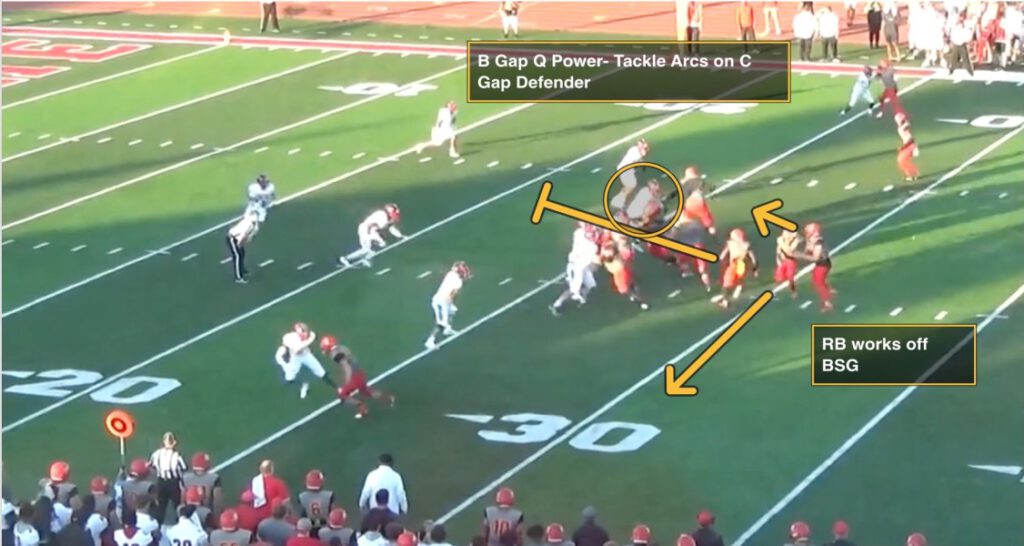
The success of the Bulldog run game perpetuated the advancement of these RPO attachments this past season. It helped in getting the ball on the perimeter to the speedier skill set of receivers. As Coach Parker told me, “defenses do us a favor sometimes by loading the box.” Because of this, a premium is placed on blocking scenarios, particularly in the front side of gap schemes. The six-box runs that populate the Bulldogs package consist of play-side man blocking at the point of attack. The success rate of those plays relies on these bigger, athletic tackles to handle the C gap defender. “Tackles cannot allow defensive ends to beat us across our face,” said Coach Parker. “If you have C gap players swiping in across your face it’s not negotiable. You can’t run gap schemes for us here.

How Coach Parker trains those individual man blocks are through his board progression drill below. It consists of the following progression:

  • Base Drive Footwork on Boards
  • Base Drive Footwork on Boards (Fit up Position)
  • Base Drive Footwork on Boards (From Stance)
  • Fit-Up Drill
  • Skip Pull Fit Up Drill on Boards


Skill Player Personnel:

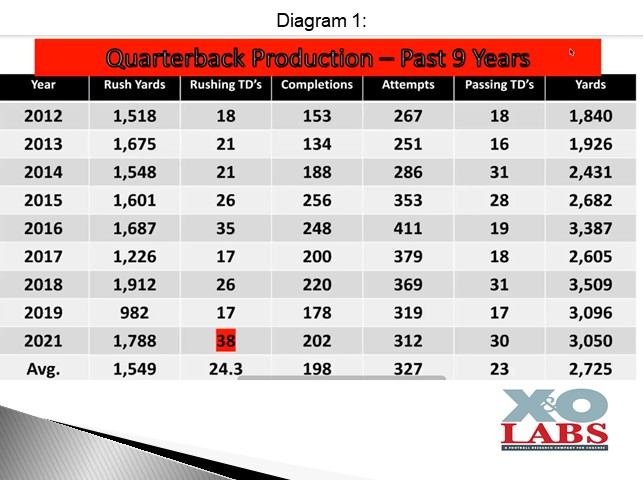
In this offense, it all starts with the quarterback. A multi-talented threat that drives this entire system, the quarterback has been the continual lynchpin in head coach Tony Annese’s system. There has only been one season over the last decade when the quarterback has not both rushed and passed for over 1,000 yards. This past season the Bulldog signal-caller had 38 rushing touchdowns, the most in Coach Annese’s tenure. He also had 52 more carriers than anyone else in the program.


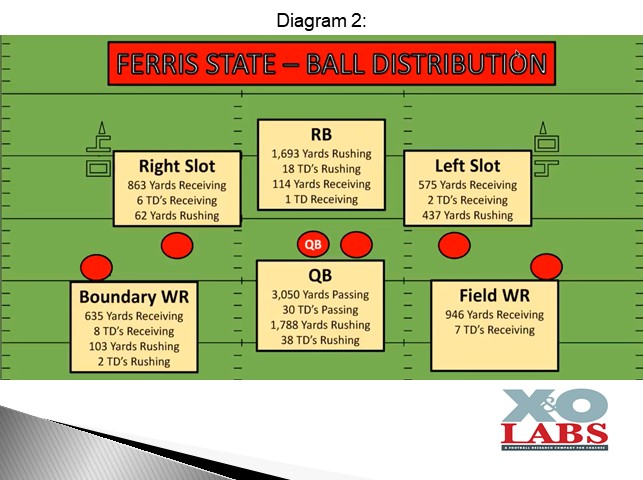
At the running back spot, Ferris State strives to recruit one within the 200-210 pound range, one that is durable enough to get over 100 carriers a season. “We don’t need a speed dude,” Coach Parker told me. “We usually have a balanced back.” That balance doesn’t consist of running and receiving. Instead, it’s about running and blocking which the back is required to do in all of the Bulldogs quarterback run schemes.

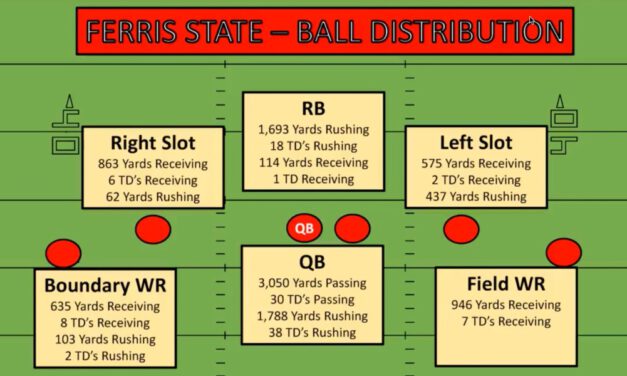
Ferris State doesn’t rotate its receivers. Instead, it plays with a right slot, left slot, boundary receiver, and field receiver. Altogether, they accumulated over 3,000 yards receiving and over 600 yards rushing.


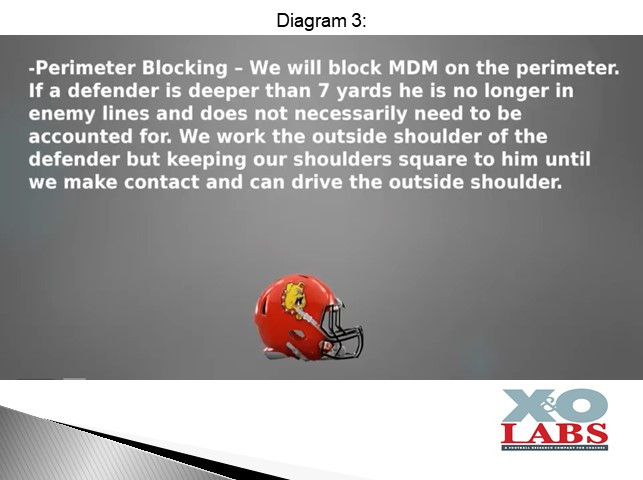
It’s a diverse grouping that uses deception in many ways often asked to be both ball carriers and decoys on jet motions as well as block on the perimeter. One of the many things that impressed me when studying this offense is the willingness of those receivers to stick their “face in the fan” so to speak and block the edge. It’s completely contradictory to the current personality of receivers in some spread systems today. In fact, their blocking rules are simple and translate into much of the run game in the entire system. Those blocking rules are below:


Half-Line Drill Progression:

Before moving forward, if you’re going to major in quarterback runs, you’d better spend some time teaching the offensive line and running backs whom to block. This is why Coach Parker and running backs coach John Smith will spend ten minutes every day working through a half-line progression together. With two groups going at the same time, it’s a low-impact drill where both the line and backs are taught to block all the various fronts Ferris State encounters each week. “We’ll get up to 50 plays during this period,” he told me. “Sometimes it’s easy for running backs to be physical, but in this system, they have to know who to block. This is the drill we use to teach them how to do so.”


Terminology:

Ferris State is a tempo outfit so it becomes necessary to group plays into packages. Although it does use one-word calls, much of the verbiage is broken down into the following signal progression:

  1. Personnel
  2. Formation
  3. Motion
  4. Play-Action
  5. OL Call
  6. Skill Call
  7. Tag


Motion, like jet motion, is a simple component. Ferris State uses two words (“Rip”or “Liz”) to denote right or left which tells which receiver is running it. The play-action component is used to classify whether that receiver is running a jet read concept where he can be a viable ball carrier or if he’s simply jetting across the formation to be a bubble screen element in horizontal screen concepts. There is tags built-in where he will be asked to motion across and block the box like he would in pure quarterback power schemes.

Like most offenses, run concepts are separated by families in the Bulldogs system such as tight runs, gaps, and sweeps. Taking “sweeps” as an example- because so much of the Bulldog’s offense is based on perimeter concepts like bubbles and jet sweeps- the offensive line is taught on these schemes to secure the defender over them. If there is no one over them, they are told to block the defender two gaps over. The intention is understood they will never actually get there, but the mentality capture the box two gaps over at the second level. Of course, this is the starting point, but because of the continual motion used on 35% of snaps, there has to be a good deal of verbiage to let players know who the ball carrier is. This is done by a series of tags: “Q” or QB, “T” for running back, etc.


Call Side vs. Run Side:

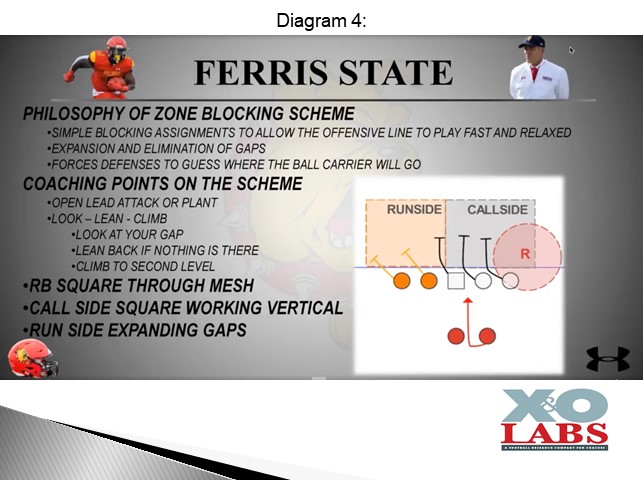
In every one of Ferris State’s run concepts, there is a divide between the call side and run side of the formation. The run side is the front side of the play where the run action is going whereas the call side is the read side of the concept. Because of this, the run side of the play is taught a different technique than the call side of the play. Take the tight zone concept in the diagram below. The run side of the concept will work to expand gaps for the back by taking wider footwork while the call side of the concept is more vertical to help the quarterback declare his C gap read.


According to Coach Parker, this helps during the install process so that running backs understand their assignments. In the quarterback run game when the running back is asked to be an additional blocker, the offensive line is responsible for the run side of the play while the running back is responsible for the call side of the play. In any read elements where the running back is part of the option, the offensive line has to know where the run side is vs. the call side.

“We build it that way because we will read the backside of G/T counter, but read the front side of power in our power read scheme,” said Coach Parker. “The back and the offensive line has to know which side is the call side and which is the run side.”

Read More

Two Deep Auto Sims from Mug Looks

By Mike Kuchar with Dionicio Monarrez
Defensive Coordinator
Southwestern College (CA)


Southwestern College (CA) prides itself on getting off the field on third down. But to so, defensive coordinator Dioncio Monarrez mixes in his base quarters coverage look with a multitude of simulated pressures from mug looks. One of his top pressures this season was an “Auto” call vs. 10 personnel teams. He used it in long-yardage situations when it was clear offenses were throwing the football. It was all based on the protection slide.


Pressure Pattern:

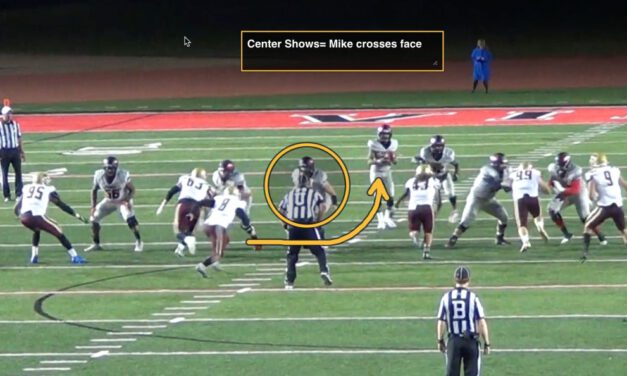
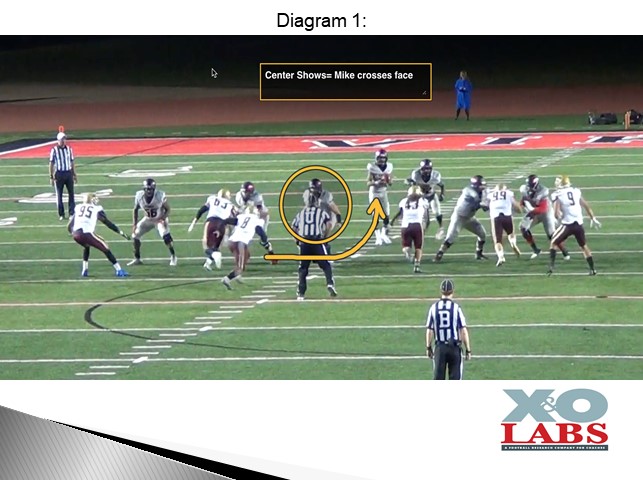
The pressure pattern creates a two on one vs. the running back in protection. The pressure is checked to the running back in protection or to the quarterbacks throwing hand if the ball is in the middle of the field to get a two on one with the back. The Mike LB creeps to the heels of Tackle pre-snap and is aiming at the earhole of the Center. If the Center shows, he will cross his face.

If the Center doesn’t show, then hit the gap and go. The Mike must hit the correct gap. He has to get on the other side of the RB. We want two on each side.


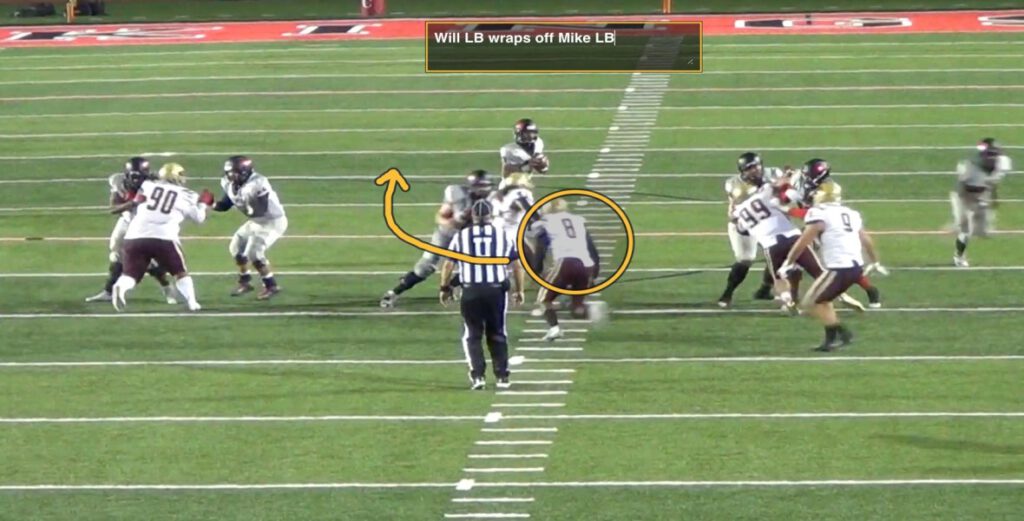
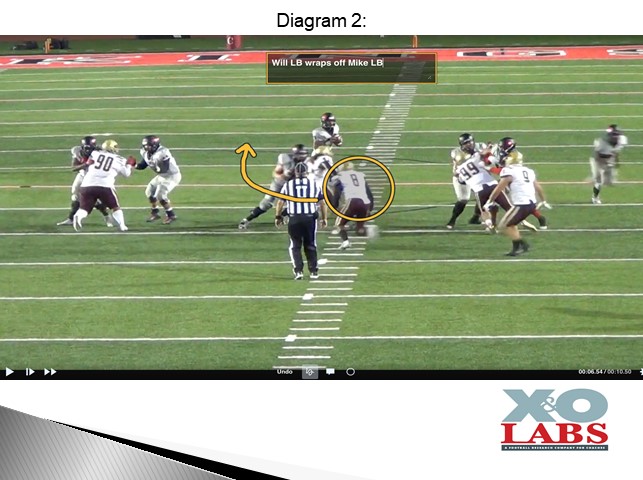
The Will linebacker will also stack the offensive Tackle. He is going to the Center but must go the other way of the Center. He can’t go backside. He has to stay on his side because he might be the contain LB to that side if the QB breaks the pocket. If he gets stuck, he needs to locate the QB. Coach Monarrez talks about a landmark of getting five yards upfield on the QB. If the Center works to the Mike on the wrap, the Will must come directly off of the Mike.

Read More

Teaching Robber Coverage through Three Universal Principles

By Mike Kuchar with Mike Giancola
Defensive Coordinator
Bridgewater College (VA)
Twitter: @CoachGiancola


The entire premise of playing man match coverages like Robber is to physically contest routes. Coach Giancola calls it “route ownership,” and it’s the driver of what the Eagles do from a split field perspective. All coverages are routed in the Robber family and are separated into two main principles: match defenders and coverage defenders.

  • Match defenders are owners of routes underneath. They relate to receivers first, not to areas of the field.
  • Cover defenders are defenders over the top. They relate to areas first, then to receivers.


These concepts are communicated universally by teaching three base coverage concepts, which can be universally applied to all back-end defenders. Not only does the technique translate, but as detailed later in the report, the pressure catalog is even more streamlined. Split field robber coverage eliminates the necessity for third-level safeties to insert into the location of the pressure. As Coach Giancola tells us, you can defend 2×2 and 3×1 open sets without rolling safeties. “Offenses would continually pick on backside X,” he said. “This gives you the opportunity to play 2 over 1 and keep the language and the scheme of the coverage the same. We want to be aggressive in coverage. How often are quarterbacks going to fit the ball into really tight windows consistently?”

Like most base Robber outfits, Bridgewater operates from 4-2-5 spacing. Its system is modeled directly after those established down the road in Blacksburg and include the following personnel:

  • Field End
  • Boundary End
  • Nose
  • 3-Technique
  • Strong Side LB (Mike)
  • Weak Side LB (Backer)
  • Whip
  • Rover
  • Free Safety
  • Boundary Corner
  • Field Corner


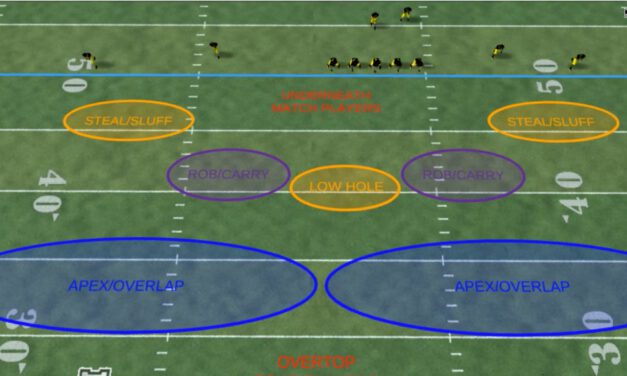
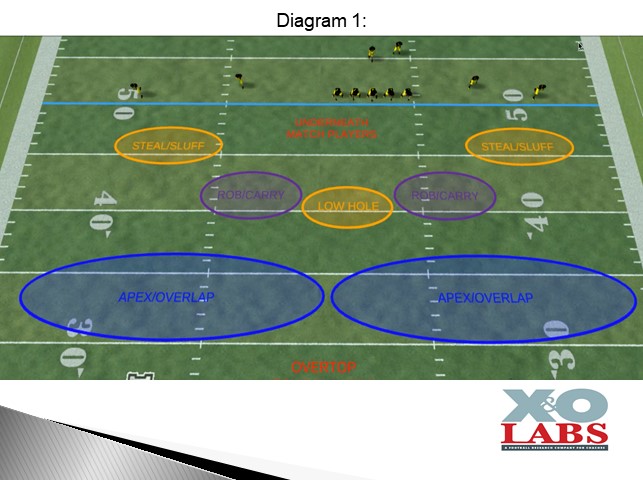
The entire coverage system is built around these three main concepts:

  • Steal/Sluff Players
  • Rob/Carry Players
  • Apex/Overlap Players


Each of these coverages is defined, developed, and consists of a non-negotiable to drive home the learning process. The first word in each of these concepts (steal, rob, apex) is a player’s primary responsibility in the coverage while the second word in each of these concepts is their secondary responsibility when routes develop.  Essentially you are either owning routes or helping on routes. While the coverages may change, these principles do not. Because of this consistency, players can cross-train through position groups. Once the coverage concepts are taught, Coach Giancola and his defensive staff cycle through various drill work to make sure all coverage defenders understand these techniques.


Steal/Sluff Concept:


Definition: These would traditionally be known as “flat” defenders. Steal/sluff defenders are underneath match defenders who are taught to “steal” any immediate routes to the flat and “sluff” (or sink) which means to trail underneath if no one threatens the flat. They are also force defenders in the run game.

Coverage Responsibility: Steal/Sluff defenders are taught to steal inside of the number one receiver. They will run with any wheel routes.

Technique: They will align head up or inside the number one receiver. These players are taught what Coach Giancola calls “steal steps” to get them to play more aggressively. Steal steps are read steps that prevent the Steal/Sluff players from moving backward.  They are different based on the initial leverage on the number one receiver.  If you are declared inside, you can pop your feet. If you’re head up the first two steps need to slide you inside the number one receiver. The main coaching point is to not back up on the snap.


He will read the quarterback mesh to a quick game and steal through the three-step. If number one is vertical, they are taught to “sluff” off by trailing underneath number one as routes continue vertically. Against any 3×1 sets, the steal/sluff defender steals outside the number one receiver, not number two.

The Non-Negotiable: Steal/sluff defenders cannot let number one across their face, especially against two vertical routes.


Rob/Carry Concept:

Definition: These would be traditionally known as hook/curl defenders. They are pure trail defenders who are man defenders. If these defenders are overhangs, they may be tied to a run fit, which may be an interior gap if the 3-technique is not to their side.

Coverage Responsibility: Rob/Carry defenders will look to own number two through the zone. They will look to rob and funnel from inside out, not outside in. They will run with any number two vertical.

Technique: If number two runs vertically he has to trail underneath him as far as he goes to force the quarterback to put air under the ball. If number two eliminates (is in), he will look to rob the next closes receiver in the direction of his key went out or in. If number two sits down, he is responsible for stealing him on the inside shoulder.

Non-Negotiable: Rob/Carry defenders have to run vs. number two vertical and play two across their face if he drives inside.


Apex/Overlap Concept:  

Definition: These are the deep half defenders. They are secondary run support defenders and will only drive up on run if receivers get hands on the underneath match players.

Coverage Responsibility: Apex/Overlap defenders have to defend the entire half of the field. Coach Giancola calls it a “ceiling” on the hash, where they don’t run with number two vertical (that is the Rob/Carry defender’s responsibility). The apex/overlap defender is taught to midpoint two verticals but overlap number two vertical to better help the rob/carry defender.

Technique: These defenders must be able to read the quarterback’s eyes post-snap.  They are taught to midpoint number one and two by weaving to stay in between those receivers. They will work to lean on verticals by reading the post-snap demeanor of the QB.

Non-Negotiable: Apex/Overlap defenders cannot get across the face of number one vertical. That’s easier to throw than to number two. The Rob carry defender can trail number two.


Low Hole Defender:

In Robber coverage concepts, the low hole defenders are taught to be a match defender and relate to number three. He owns any crossers or drags immediately but will work to a ceiling of 10-15 yards deep if there is no immediate crossing route.

Read More

Half Boot; Half Quick Game: The Quick Boot Concept

By Mike Kuchar with Elliott Wratten
Offensive Coordinator/Offensive Line Coach
Alcorn State University
Twitter: @CoachWratten


Alcorn State offensive coordinator Elliott Wratten would like to tell you that he took the concept from listening to a couple of Big 10 coaches’ clinic a high school staffer during a recruiting trip last spring. But in reality, this concoction was brewing for quite some time in his mind. The synthesis commenced when his starting quarterback entering the 2021 season was a shade under six feet. Clearly, he was going to have trouble delivering balls in the pocket. But he could evade pressure and extend plays. In previous years, Coach Wratten leaned on the sprint pass game to get smaller QBs on the perimeter. But the sprint out game had some significant deficiencies: the field gets cut in half, all of the action points to one direction giving the defense has a better opportunity at recognizing and reacting. Plus, secondary contain would be a problem with a smaller quarterback. “I didn’t want to worry about having the Mike linebacker pull up and knock our guy out,” he told me.

The boot game became another option. But, those concepts still emphasize only half the field and if the over route is not there immediately it can become a dead play. So, Coach Wratten needed to find a way to mesh full-field reads with a varying launch point. And it was after studying some Penn State and Arkansas film that he bought in full sail to what he calls his “Quick Boot” concept, which combines quick game elements to the boundary with a half roll element to the field. Alcorn State already built a free access package to the boundary and his quarterback was efficient in throwing on the run, so the merger was not only sensible but also inexpensive. It was so inexpensive that Coach Wratten installed it two weeks before pre-season camp. It became an easy drive starter and completion play for the quarterback. This season the Braves ran it 33 times and completed on more than 70% of balls. It quickly became the quarterback’s favorite concept and a reprieve after an incompletion. “Now we can get receivers able to work downfield routes and we can pull up later than in sprint out schemes. “You don’t have to pull up right away and make a quicker decision.”


Structure of Concept:

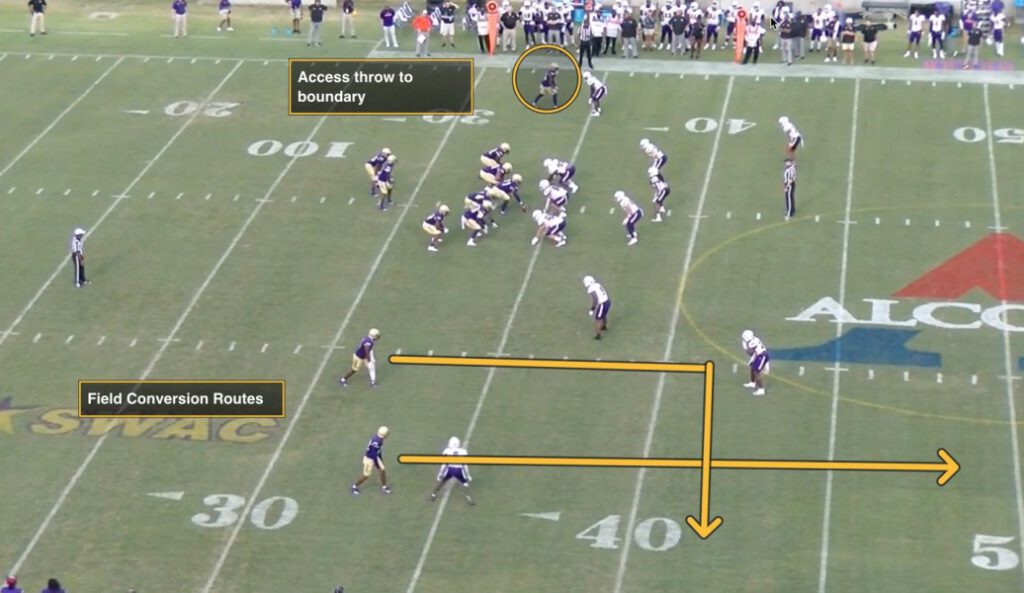
The structure of the concept is split between a boundary access route and field-side conversions. The offensive line is in a six-man protection scheme with the tight end, while the running back is in a check-release scenario as a late outlet for the quarterback.


Free Access Element:

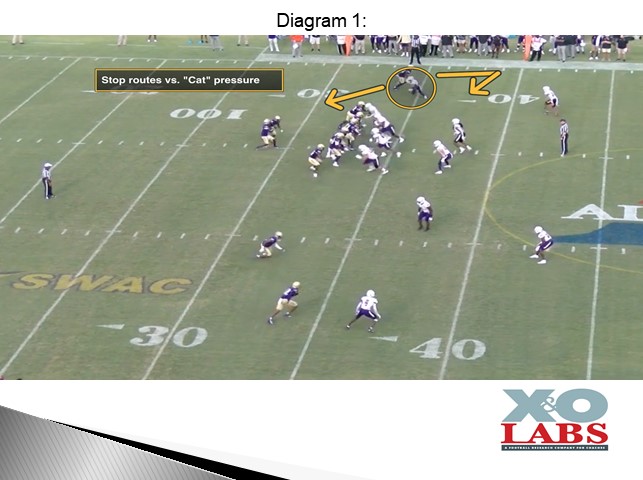
Like most programs, the free access element is built-in based on the depth and leverage of the boundary corner. Free Access throws are a major part of the Braves’ offensive system. And in the RPO world, many times the receivers, not the quarterback or Coach Wratten, communicates the intentional route at the line of scrimmage by reading coverage. This isn’t the case in these concepts according to Coach Wratten. These boundary routes are built into the play call. Earlier in the season, stops were used to take advantage of leverage. It was a solid answer vs. “cat” pressure from the boundary. “We would continually take a favorable one-on-one matchup with a receiver and that safety on those pressures,” he said. “But in doing so, that receiver needed to expand to the tics to widen the safety.”


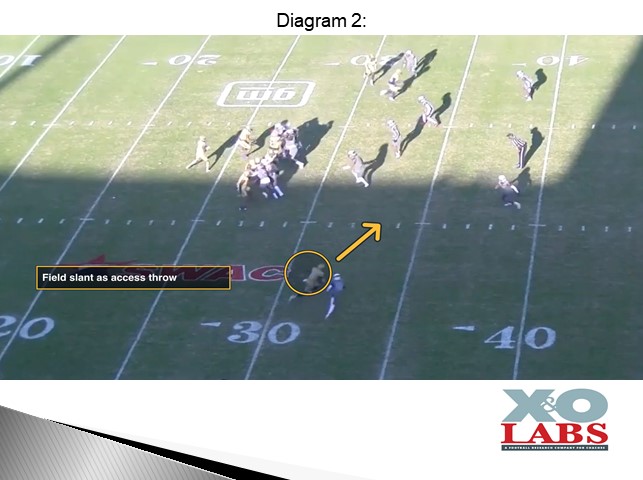
But as the year progressed, those access throws were now transitioned into field side throws like slants to take advantage of leverage and space. They were designed against press coverage to hit a moving target on the run.


QB Footwork:

All of these concepts are utilized from gun alignments. The quarterback will execute a drop step with one, two footwork to check the free access throw. If the access throw is there, he bangs it. If it is not there by the second step, he bows back, loses ground, and boots away from the line of scrimmage to work the field side routes.

Read More

SELU’s 3rd Level Horizontal RPO’s

By Mike Kuchar with Greg Stevens
Offensive Coordinator
Southeastern Louisiana University
Twitter: @CoachGregStevensSLU


For whatever reason, SELU wasn’t as proficient in running the ball this season. Longtime offensive coordinator Greg Stevens will be the first to admit it. Normally a ground and pound outfit, SELU was blessed with a gifted thrower at quarterback and plenty of speed on the perimeter to compliment him. So, like most good coaches, Coach Stevens played to his strength by building in an inexpensive, third-level RPO that got the ball out of the quarterback’s hands quickly into one of those lightning-fast receivers in space.

He did that by complementing a tight zone run with a third-level RPO to stress the play side high safety. It resembles boot action with an immediate flat route that can come directly across the formation. “We used to run nakeds by bringing that receiver across the formation, so we figured why wouldn’t we just do that with an RPO,” he told me. It became a concept the Lions ran 35 times this season and produced a 91% completion percentage with 8.7 yards per completion. But more importantly, it became a solid base-down play, setting up the offense in manageable third downs. And it was a productive tempo play out of all personnel groupings.  “It became a really good play for us because it was a good way to get our athletes the ball in space and an easy completion for the quarterback.”


The SELU Difference:

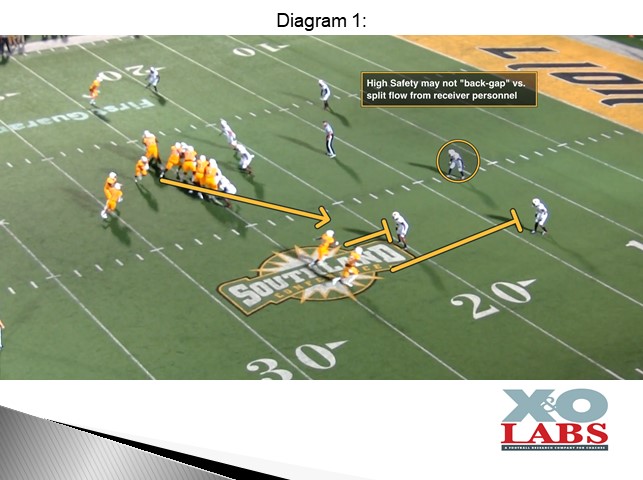
While most of these flat control concepts are utilized with fullbacks, tight ends, and H-backs controlling the flat, Coach Stevens decided to incorporate a receiver as the primary target. The reason: most defensive front structures will choose to “back-gap” or rock its safeties when a tight end comes across the formation because they have to respect the extra gap. They may not do it vs. a true receiver.


“That is where we’ve had the most success with the concept,” he told me. “Most teams will not rock safeties with a receiver or a skill guy. I haven’t seen anybody do it. Running him across post-snap is difficult to match whether a defense is in man or zone coverage because no one is accounting for him. And if you know they are a man team, you can bring it to the one receiver side on the backside. It produces a good amount of space for him to work in.”


Communication:

Since all of the RPOs in the SELU system are termed after rap stars, this concept is called “Tu-Pac.” It’s a built-in tag with the tight zone run game. How the concept is termed is simple. As a base call such as “24 Tu Pac,” the farthest inside receiver knows he is the player running into the flat.  If they are bringing a receiver from the backside (across the formation) it becomes necessary to ID the receiver who is running the route. Consider the following scenarios:


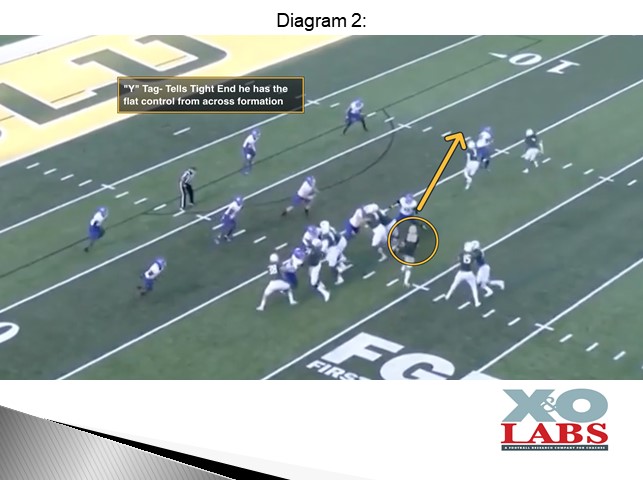
“24 Z Tupac”- Tells the Z receiver he is running into the flat from across the formation.

“24 Y Tupac”- Tells the Y he is running into the flat from across the formation.


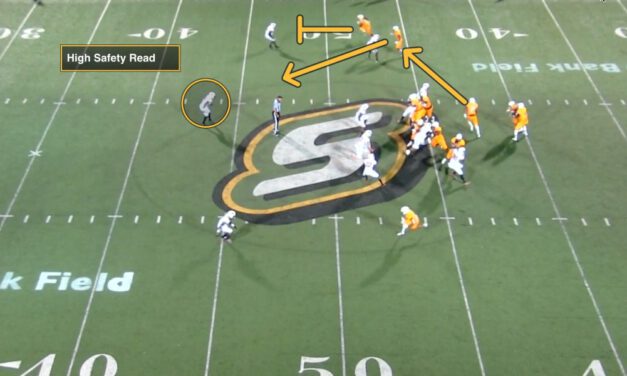
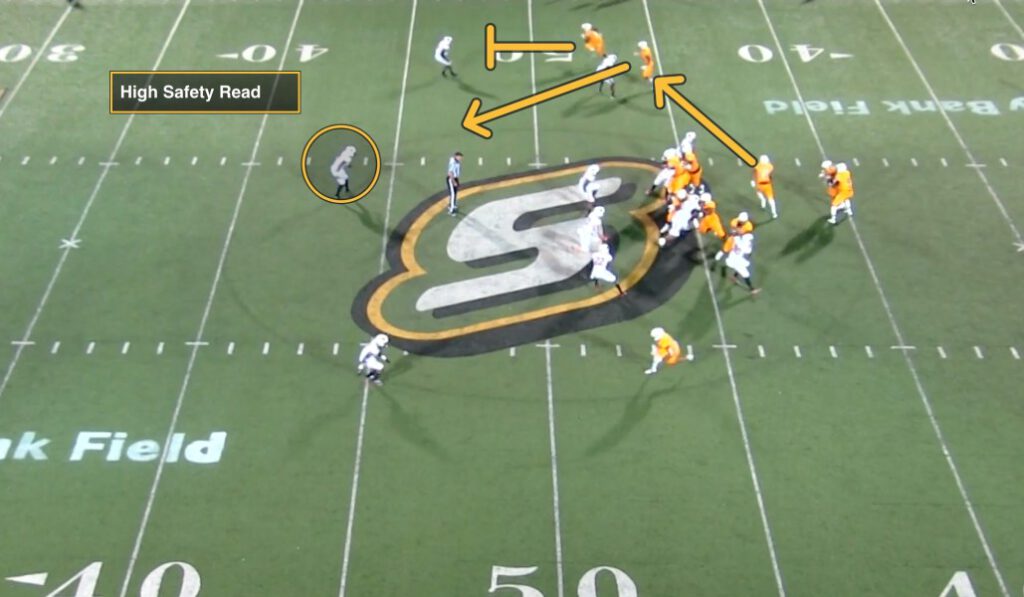
The rest of this report focuses on how the quarterback is taught to read the high safety and how the concept translates vs. potential problem coverage like man and trap coverage structures.

Read More

3-High Safety “AFC” Protocols From Odd Spacing

By Cory Quinn
Head Football Coach
Lake County High School (TN)
Twitter: @CoachQLakeCo


In Single-A football, what walks through the door is what we get. For the last two seasons, we have played with 28 players on the football team. In 2020 we were a base 3-4 defense because it suited our personnel. Due to graduation and typical 1A cycles, we were left with one true LB on the roster and a host of DB bodies. During the spring and summer, we experimented with different players in our base 3-4 look. The players we tried there were either too young or not the correct body type to play Inside Linebacker in a run-heavy league. I knew we needed to make a change and adapt to the players on our roster. I went back to the drawing board and created a defense that maximized the bodies we DO have. What resulted was an “Under front” and 3 High Safety structures that produced 2 shutouts and held opponents in our classification to an average of 14 ppg.

As an offensive-minded coach during my career, I formulated ways to create space. Now, tasked with designing a defense, I aimed to do the opposite: constrict space. In our league, as in most High School football leagues, stopping the run is objective number one. I had to find a way to populate the box but do so without traditional personnel. With the concept of suffocating space in mind, I designed the defense around the tactical idea of creating a triangle at leverage points around the box and perimeter to simulate an automatic three Man Trap. From there, I taught the players their assignments within the parameters of the triangles. Once we understood the leverage points of the triangle and our rules within the structure of the defense, we were fast to the football. Practice time could then be devoted to the three most important pieces of defensive football: technique, diagnosing plays, and forcing turnovers.


Body:

To keep this new defense simple, I installed base rules by position. These rules were steadfast and allowed us to get lined up and play fast. We defined the offensive strength based on the number of WRs (10P 2×2 balanced we called the strength to the field or RB tendency). The positional assignments are as follows:

Bandit– Align to the weak side in a wide 9 technique on the imaginary TE. IF there is a TE, play head up. Hands-on the tight end. Your responsibility is holding the outside most gap. NOTHING gets outside of you. Fight a reach block and post outside. The Bandit is coming off the edge every time to give us an Under-reduction post-snap.

Read EMLOS for the following reads:

  • If the tackle is down, surf. Take on kick-out block with inside shoulder, outside arm remains free.
  • If the tackle is down and there is no kick-out block surf zone read, play to RB after the ball is given.
  • If there is a High Hat from the EMLOS Pass Rush outside in.


DT: 4i. Post-B gap. Engage through the neck of the tackle.

  • If you get a down block, you MAY redirect, shed, and get over the top.
  • If you get a reach, “Stretch the Stretch” working to get flat down the line of scrimmage.


Nose: 0 Tech. Work to strong A gap. Fight double team and occupy space.

Anchor: LB position. Calls out the strength. Four yards directly behind the Nose. Reading guard away from the strength for a run, pass, pull. Pass responsibility: If the back is out weak, he is mine. If the RB is out strong, Mirror QB. Run responsibility: play underneath blocks. Work to mirror the RB.

DE: 4i. Post B Gap. Engage through the neck of the tackle. If you get a down block, you MAY redirect and get over the top. If you get a reach, “Stretch the Stretch” working to get flat down the line of scrimmage.

Delta: This is our Alley/Nickel player. Read EMLOS.

  • If you get a pass read, drop to help. Stop Slant, Stick. Rally to the Flat.
  • If the RB is out to your side, he is yours.
  • If the QB rolls to your side, BOMB the RB on the outside shoulder to turn the QB back in to help.
  • If you get a run read, play the gap the same way as the Bandit. Splatter the puller from depth, keeping the outside arm free. Inside Zone, you are the QB player! Nothing gets outside of you!


$ Safety: This is our best player. Alignment changes based on offensive formation and personnel. Pictures will illustrate this concept.

Rover: Align to the passing strength. If there are two receivers, play 2 read with CB. If three receivers check to our Tri concept (2 Read on Outside 2, F locks 3).

Free: Align away from the passing strength. If two receivers play 2 read with CB. If there are three receivers push to the Trips side. Base check to Trips is “Tri.” You have #3 Man to Man. Rover and CB play 2 read on 1 and 2.

CBs: Coverage based on receivers.

  • If we get 2 Speed, it is 2 Read.
  • If we get Trips, we check Tri. Align in press. Bail to 6 yards, back and tilt once QB starts his cadence.

Read More

Surfaces vs. Controls: How UT Martin builds its Wide Zone Concept

By Mike Kuchar with Matt Jones
Run Game Coordinator/Offensive Line/Tight Ends
University of Tennessee Martin
@CoachMattJones


Having followed Coach Jones on Twitter for over five years, I’ve been privy to seeing the nuggets on offensive line play he distributes daily. So, when I got the opportunity to work with him on this report I was more than thrilled. I had already known of the success UT Martin was having in the run game this season. I studied all their film and was enamored with the success it was having, particularly in their wide zone concept.

During my research, what I found is that there are three main pillars in Coach Jones’s teaching methodology of building the wide zone.

They consist of the following:

  • Differentiating Surfaces vs. Controls
  • Segmenting Open vs. Closed Side Runs
  • Incorporating Pods to teach these pillars


I’ve talked with numerous coaches who build their zone play in similar fashions, but it’s the clarity in Coach Jones’s teaching that made sense to me. His reliance on differentiating surface in his wide zone run game is predicated on the fact that 86% of his explosives in the wide zone runs hit in the front side A or B gap, which as we reported previously is where these plays hit for success. “Our wide zone play doesn’t get to the backside B gap,” he told me. “If we don’t get a gap pried open play side the play is dead. If it winds back, it gives defenses time to chase the ball down.”
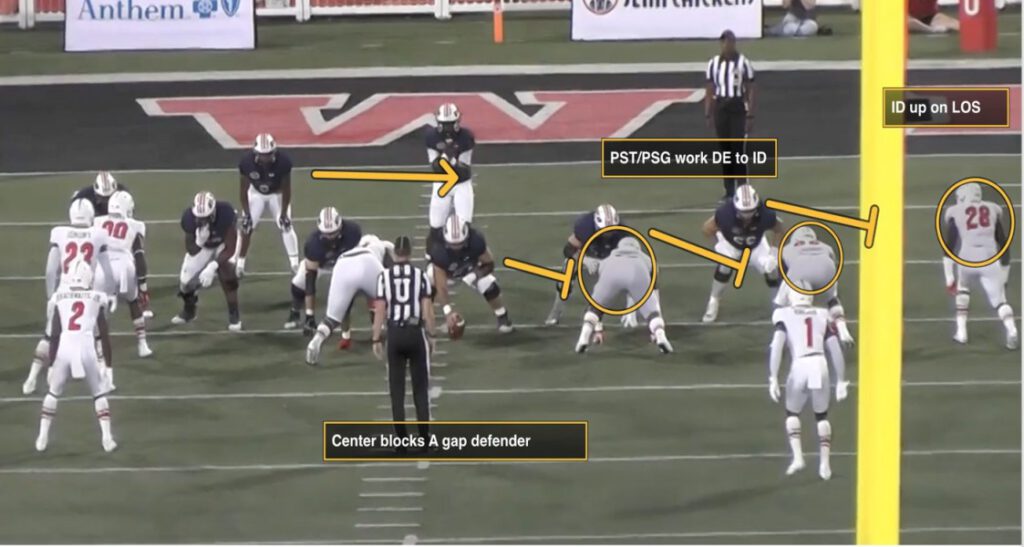
 

Differentiating Surfaces vs. Controls:

It’s important to note that from day one of install the QB (and offensive line) are taught to understand defensive numbers based on the play side surface. The goal is to never run a good play into a bad look. To do this, the QB is continually given the freedom to check the play into “the right math,” as Coach Jones put it. The “math” is in direct correlation to the surface structure. As he admits there is nothing more frustrating than having play-side offensive linemen dominate their responsibility yet the extra hat is the one that made the play. “That’s a coaching problem, not a kid problem,” he said.


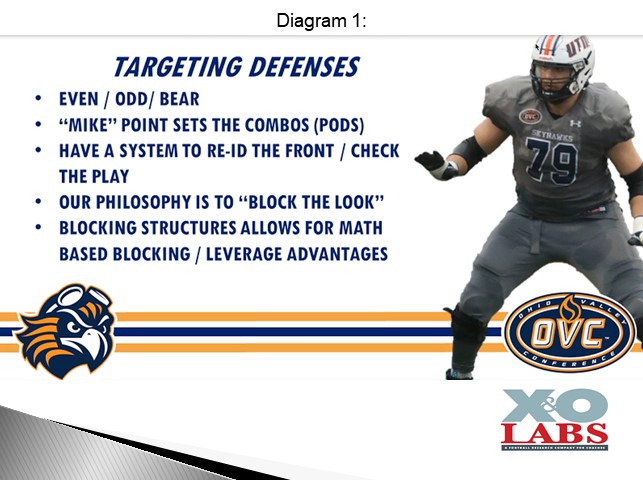
Targeting Defenses: “Stretch and Strain”

Separating the defense is essential to generating explosives in the wide zone and to separate the defense, you need to stretch the play side and cutoff the backside. This comes with what Coach Jones calls “stretch and strain,” where there is lateral displacement to stretch the front side with equal hats to block or “strain” the backside.
 

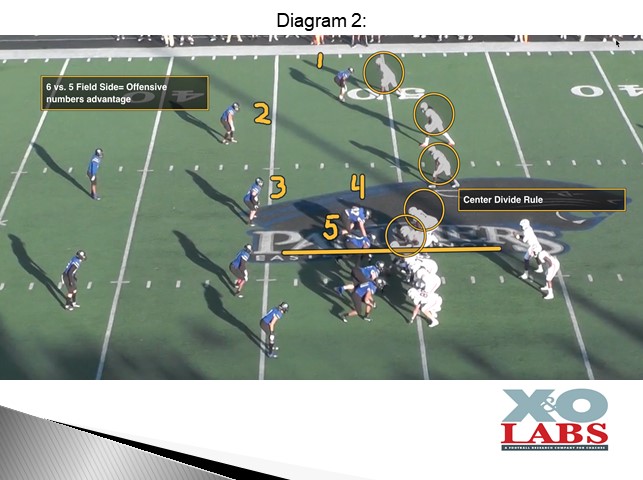
How that is taught is by players understanding numbers advantages based on both the play side and backside of the concept. Coach Jones uses the scenario of cutting the formation in half at the Center’s spot. If the numbers dictate a mathematical advantage, run the play in that direction. By blocking all defenders to the side of the field where the ball is going, you give yourself the greatest chance of explosive runs. If the numbers dictate a disadvantage, well, that is where the controls come into play.
 

Most outside zone teaching starts at the Center and many coaches may not run the scheme if the Center can’t handle the play side A gap. Coach Jones is no different in that regard. The Center is always considered a factor on the front side of the scheme. Even the ball carrier in UT’s system is taught to tempo the play side block of the Center.
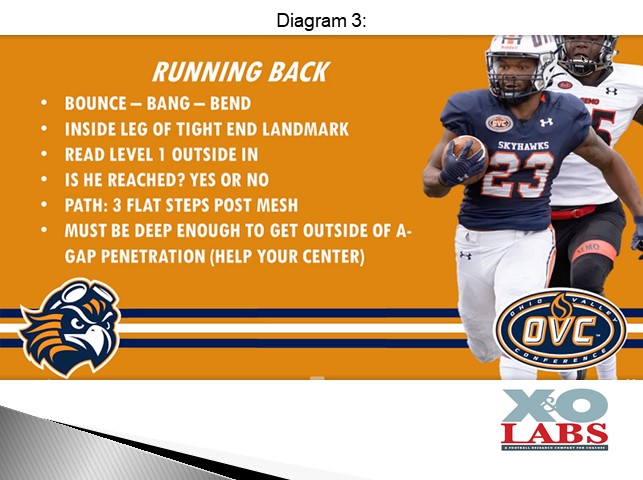
 

The Center is responsible for making the identification declaration and understanding the possibility to block the box. That comes with teaching him to communicate traditional play side point identifications. More on that as our report continues.  Targeting means being able to block the box without having to push out declarations to perimeter defenders. If this is done correctly, all you need to do is win one gap to the play side and the play pops. This idea of targeting is taught through the understanding of two factors: front-side surface and backside controls. We’ll start with the backside first.


Explanations of Controls:

Controls are simply how you’re handling the backside of the play. The full flow nature of the wide zone concept lends itself to defenders being able to chase the ball down from the backside. So, how do you keep defenders from doing that? It comes from having the quarterback responsible for a defender in every run. They have a read built-in and that read can vary from the backside A gap, B gap, and C gap. Every time the ball is snapped in the run game, the QB is reading someone. While Coach Jones admits on 90% of the time he’s handing the ball off it’s vital that at least one defender gets read to keep the math right. “We have to have answers if they have more than we can block,” said Coach Jones.

These answers come in the form of the following controls:


Nakeds- Used from Pistol alignments
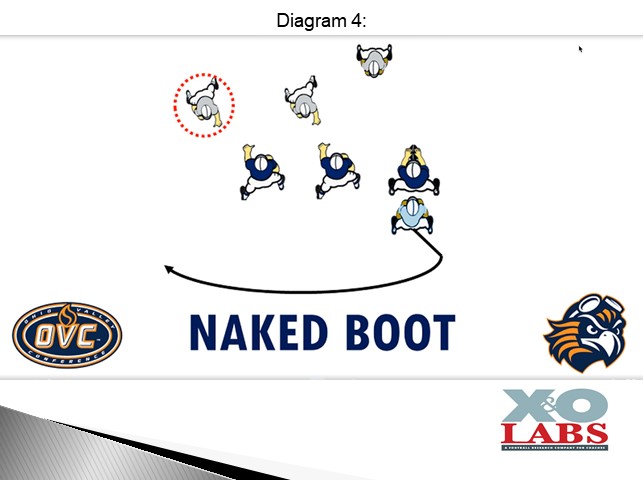
 

D-Gap Reads- Used with a three-surface backside
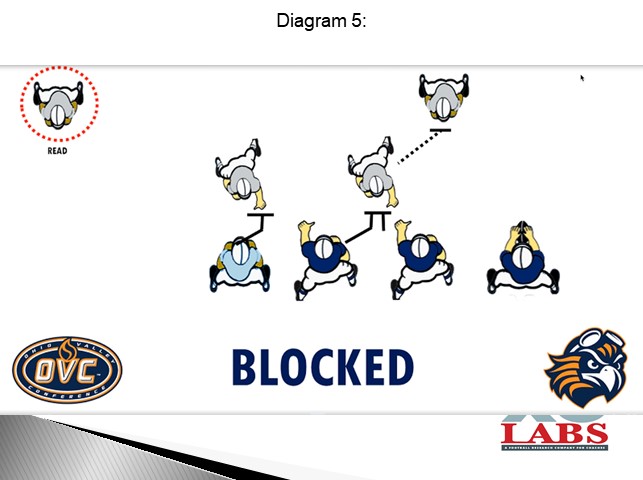
 

C-Gap Reads- Used with a two-surface backside or arcing the tight end to handle number four backside
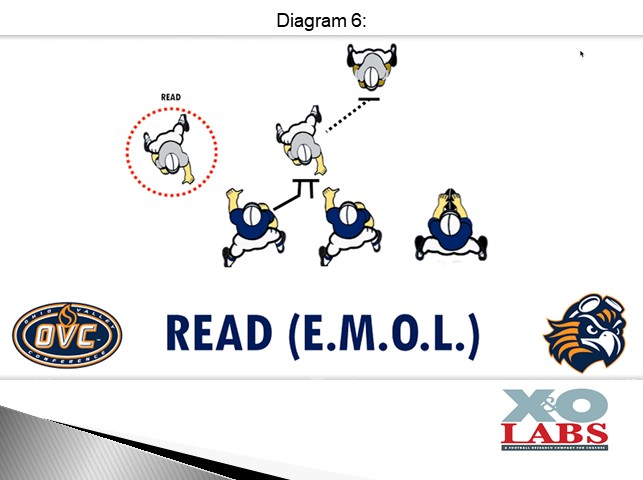
 

B-Gap Reads- Used with two surface backside, where first level or second level defenders can be read.
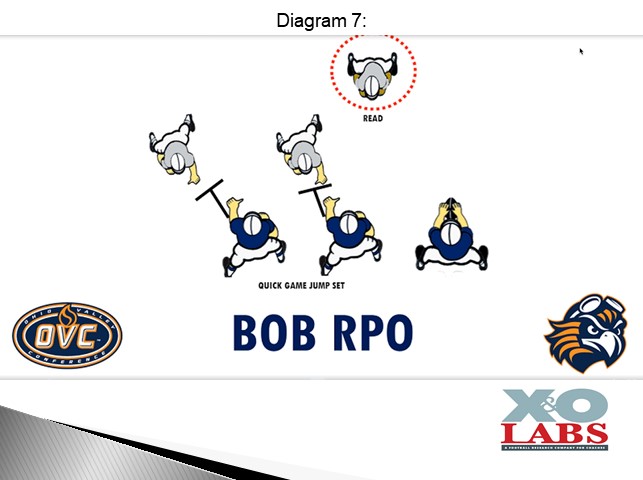
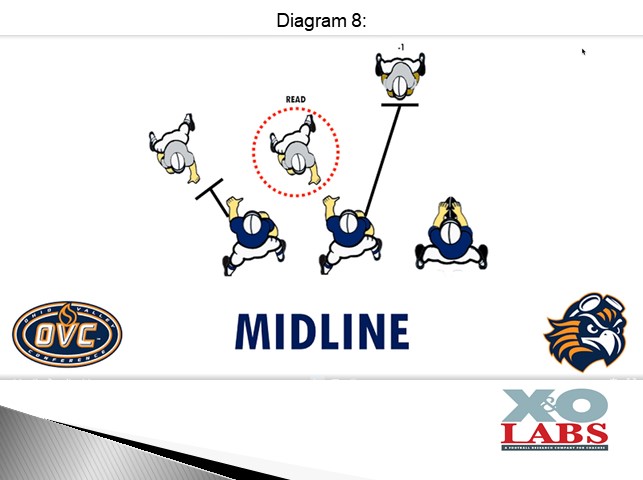
 

All of these backside controls are built-in by play call communication, which is explained later in the report.


Explanations of Front Side Surfaces:

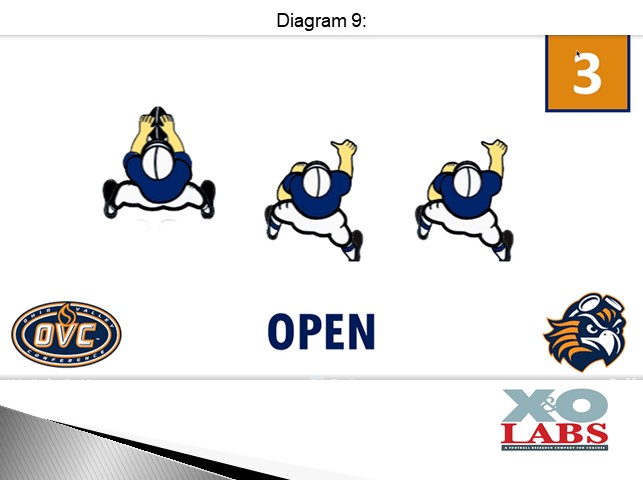
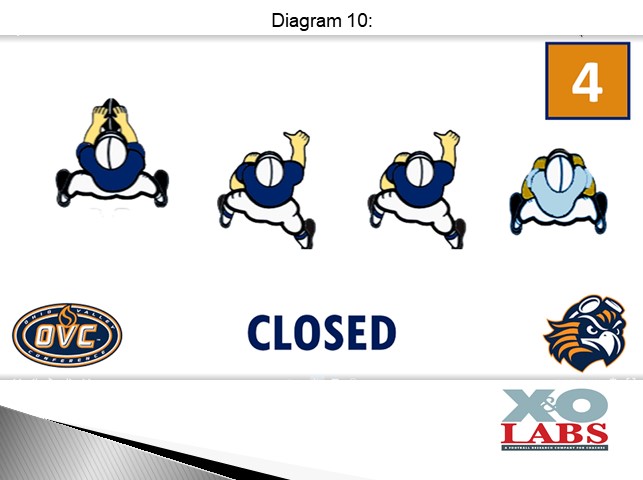
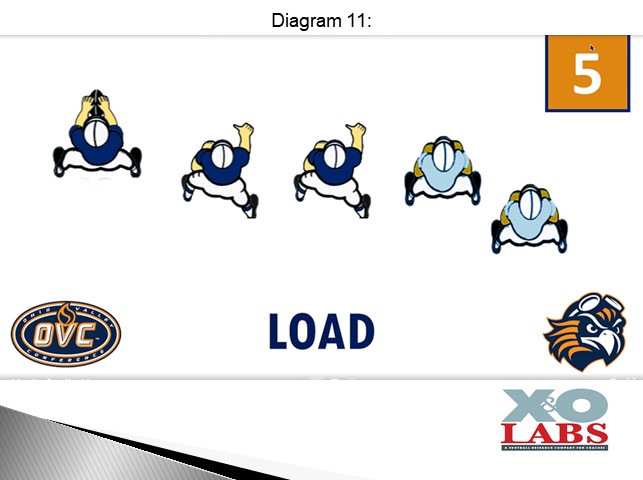
Surface teaching is also communicated by pre-snap verbiage. UT Martin will segment its wide zone call system into three surfaces: open surfaces closed surfaces and loaded surfaces:


Open Side Surface- Two-man surface structure, where Center, Guard, and Tackle are allocated to blocking the front side. Here the offensive line can handle three defenders, but not four.
 

Closed Side Surface- Three-man surface structure where Center, Guard, Tackle, and Tight End are allocated to blocking the front side. Here the offensive line can handle four defenders, but not five.
 

Loaded Side Surface- Four-man surface structure where Center, Guard, Tackle, Tight End, and Y are allocated to blocking the front side. Here the offensive line can handle five defenders, but not six.
 

Segmenting Open, Closed, and Loaded Surface Runs:

On day one of the wide zone install, Coach Jones and his staff provide specific communication to denote what surface the ball is being run to. The surfaces and controls are automatically built into the play call. Consider the following communication:


“O-Words:”- Any word with an “O” signifies outside zone to the open, or two-surface side. Consider the following:

“Oscar”- Open side outside zone from Pistol alignments (auto boot for backside control)

“Ollie”- Open side outside zone from Offset alignments (two-surface backside, auto backside C gap read)

“Otto”- Open side outside zone from Offset alignments (three-surface backside, auto backside D gap read)

“Owen”- Open side outside zone from Offset alignments (two-surface backside, auto second level B gap read, which could be a run-run read or RPO)

“Omar”- Open side outside zone (two surface backside) with divide action (cutoff C gap backside)

“Oren”- Open side outside zone (three surface backside) with divide action (cutoff D gap backside)


“C-Words:”- Any word with a “C” signifies outside zone to the closed, or three-surface side. Consider the following:

“Charlie”- Closed side outside zone from Pistol alignments (auto boot for backside control)

“Chris”- Closed side outside zone from Offset alignments (two surface backside, auto backside C gap control)

“Craig”- Closed side outside zone from Offset alignments (three surface backside, auto backside D gap control)

“Carl”- Closed side outside zone (two surface backside) with divide action (cutoff C gap backside)

“Cam”- Closed side outside zone (three surface backside) with divide action (cutoff D gap backside)


“E-Words:”- Any word with an “E” signifies that the count needs to be pushed out or go “extra” a defender. This may be needed against back gap defenses or combined with any jet motion away from the play. Consider the following examples:


“Ollie Ernie”- Open side outside zone from offset alignment, where the entire box count needs to work one past the point to account for “extra” defender.
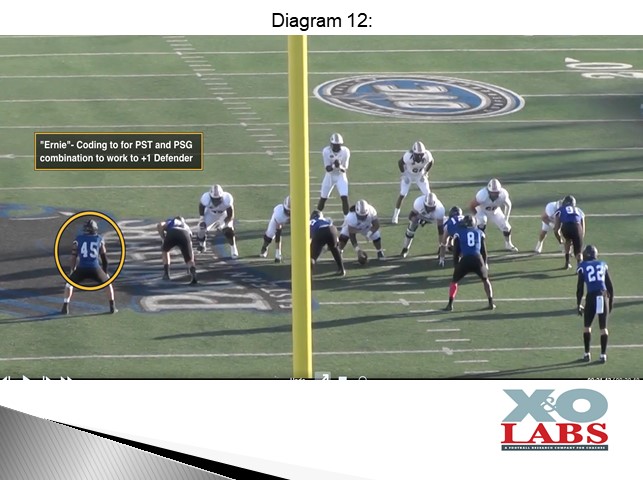
 

“Chris Ernie”- Closed side outside zone from offset alignment, where the entire box count needs to work one past the point to account for “extra” defender.
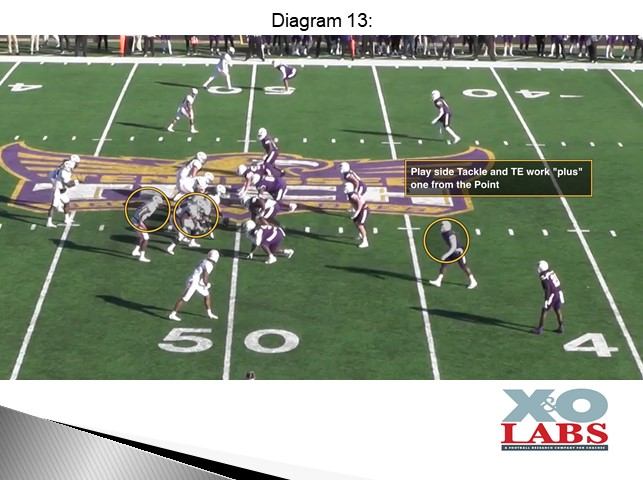
 

“The picture changes post-snap immediately,” he said. “There is nothing worse than jetting away from the open side with a fourth element and you don’t have a blocker there.”


For any “midline” reads where there is an “A or B” gap backside read, consider the following:

“Mable”- Closed side outside zone (two surface backside) with A or B gap backside read (first down defender past the Center)

“Martha”- Open side outside zone (two surface backside) with A or B gap backside read (first down defender past the Center)


According to Coach Jones, having linemen be able to distinguish the surface cuts down on learning time. And once they know the surface, all they need to remember is the control. “We spend more time learning the line calls than the play names,” he told me. “You would know the entire run game with 87 plays in just a little package.”

This teaching methodology is conducive to pre-snap motion as well. Oftentimes, Coach Jones will change the picture by moving the tight end to get a numbers advantage but the offensive line is not aware of it. All they know is whether it’s an open, closed, or loaded side run based on the call. The tight end either handles plus one to the point if he is on the play side or needs to be aware of the type of control above if he’s on the backside.

Read More