Tunnel Screen Off Run Actions

By Brett Dudley
Assistant Head Coach/Offensive Coordinator
Antioch High School (CA)
Twitter: @Coachbdud

Introduction

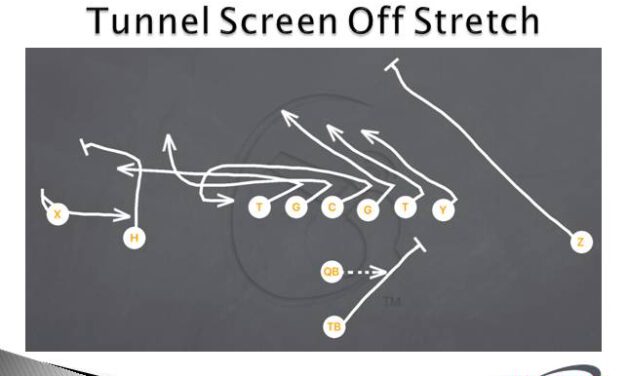
In our offense, the tunnel screen is a WR screen that we throw opposite of a run fake. We primarily ran this off of our stretch action (to get the most flow from the defense), but also experimented it off of power, to use the pulling guard to influence LBs. We would fully fake one direction and throw the screen back to the other side.

As a general rule for the offensive line, we will block the run called for the first 3 steps then work to release flat down the line of scrimmage. Their rules are as follows:

  • The first lineman to release looks out to kick out the first person out of the box.
  • The 2nd OL to release works to lead up through the alley.
  • The 3rd OL to release looks back in for anyone chasing the screen down from inside (often called a “rat killer”).

This general eye progression of “out-up-in” progression is used in all of our screen game, so the line has a set of rules (Out, Up, In) they can follow as they release down the line of scrimmage (LOS) in any of our screens.

Coaching the Receivers

The receiver getting the football will work 3 steps vertically trying to sell a vertical route. The goal is to get the corner backpedaling. If the corner is pressed up on him, the receiver must be physical and push off to create separation. Since the pass is caught behind the line of scrimmage, there is no pass interference, so he must get the corner off of him by any means necessary. Once the 3rd step is planted, he will pivot and retrace his route stem, working back through where he lined up, and retracing back to the QB just inside of the LOS. Once he catches the ball, we try to get them to turn up inside of the tackle or “first man out’s” block, usually this is where the “tunnel” begins to be formed.

Read More

Why Choate Prep (CT) Teaches Its H to Skip Pull on One-Back Counter

By Mike Kuchar
Senior Research Manager
X&O Labs
Twitter: @MikekKuchar

Introduction

The following research was conducted as part of X&O Labs’ study on “Spread Gap Schemes,” which can be accessed in full on the Insiders website.

LJ Spinnato, the head coach at Choate Rosemary Hall, the number one prep program in Connecticut, spends his spring visiting with Coach Malzahn at Auburn. He also uses the Slant formation to run is Counter scheme. The rules for the scheme are below:

PST (play side tackle): B Gap or backside inside linebacker; sift if odd front.

PSG (play side guard): Block A Gap or backside inside linebacker.

C: Away A gap to 3-technique; sift if odd.

BSG (back side guard): Trap pull technique to C gap player, pick up play side foot and put it down toes pointed downhill through play side guard and tackle. Adjust downfield to up field shoulder of kick player. Get ready to log and spill player as physical up field as possible.

BST (back side tackle): Gap Hinge. If odd, sift punch, hinge to outside linebacker after stunning 4-technique before center overtakes him. Same concept on 3-technique away.

H Back: Always run from sniffer position otherwise true Counter Trey. Skip pull just like a pulling guard on our Power play. Keeps his shoulders up field and it times up the best for us. Lead up on play side inside linebacker.

Skip Pull Fundamental:

Once that sniffer is in position to execute his block on the Counter, and he knows who to block, he must be taught the specifics on how to block that second level defender. We’ve found that most coaches are teaching a typical square pull technique where the H turns his shoulder perpendicular to the line of scrimmage to hug the double team.

LJ Spinnato, the coach at Choate Rosemary Hall (CT), was teaching the same technique, but found that often times his H was overrunning the C gap and not squaring up on the play side linebacker. So, week one of this season Coach Spinnato decided that he would teach that sniffer to use a skip pull technique just like the backside guard. He found the timing worked better and it gave the ball carrier a two-way go in the C gap.

To study game film on how Choate Rosemary Hall (CT) runs its Counter concept, click on the video below:

Read More

Designing RPO Systems: Case 1 – RPO Run Design/Pre and Post-Snap Protocols

By Mike Kuchar
Senior Research Manager
X&O Labs
Twitter: @MikekKuchar

Introduction

case1leadpicQuick question to all those RPO coaches: Are you designing these run/pass options in order to run the ball more effectively or just to throw it around the lot?

The answer seems obvious, right: to outnumber the defense in order to run the football.

Well, we thought so too until we started conducting our research on this study. The philosophy that began as a way to control a plus-one defender by tagging a pass element to your run game, may have shifted to the priority of getting your best receiver the ball in space though the air. Of course, there is nothing wrong with that philosophy. In fact, many of the coaches we spoke with are successful perhaps because they’ve figured out alone just how to do that.

We did provide over a dozen contributors to this study from all levels of football, including several who used a post-snap read on over 75 percent of their offensive snaps this season.  While a contingent of these coaches use their RPO concept to take advantage of defenders who are tied into the run game, there are others like Fordham University head coach Andrew Breiner who thinks the opposite. As Coach Breiner told us, “People are thinking how can I call a run and throw the football. That’s not our intention. Our intention is to call the run to run the ball, but now allow defenses to add the extra defender in the box.”

In this case, we wanted to provide coaches with the necessary means to design these RPO concepts. In doing so, we are going to take the following philosophy in mind, we will report on how coaches are constructing these schemes by placing defenders in conflict in order to run the ball more effectively.

Many of our sources were among the top rushing programs in the country this past season, Albion College (MI) rushed for 283 yards per game and Arkansas Tech University rushed for 269 just to name a few. We dug into how these coaches, and others, we using the RPO system to put defenders in pre-snap conflict and manipulate their assignment post-snap. The run games they were using to do so were based on three components:

  • Front Structure
  • Box Count
  • Field and Boundary Fitters

The bottom line is to find out who a defenses extra run fitter is and manipulate that defender using various means.

Designing Runs off Front Structure

Some runs work particularly well against different fronts. We all know this as coaches. But there are some coaches who put a premium on which run concept they are calling based off the front that they are seeing. We’ve found that in general terms, coordinators who plan against even front structures are more susceptible to call gap scheme run concepts, particularly against play side 3-techniques in order to get movement at the point of attack. These are also the same coaches who will choose to run zone concepts at the bubble (or shade/5-technique) side so their front side guard can climb to the next level. Alternatively, coaches that are designing their RPOs against predominantly even front teams have chosen to use some double pull concepts, mainly in the form of buck sweep and other pin and pull variations, because of the probability of getting two linemen out at the point of attack.

Eric Davis at Mankato East High School (MN) told us his power and counter gap schemes were less efficient vs. 3-4 teams, partially due to our inability to block the outside linebacker when our kick out player blocked the 4-techhnique or 5-technique.  “We also had some struggles getting to the backside linebacker with our backside guard on inside zone vs. 3-4 teams.  So we’re hoping that an expansion of our RPO package will fix that problem. We did run our buck sweep very effectively against those teams as well as power out of tackle over. While inside zone was not great against the 3-4, it was extremely effective against the 3-3 Stack, probably due to the fact the gaps the defenders were responsible for were more clearly defined immediately post-snap.”

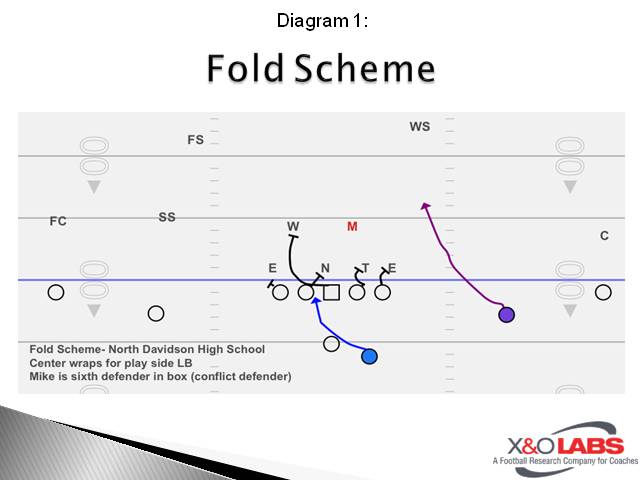
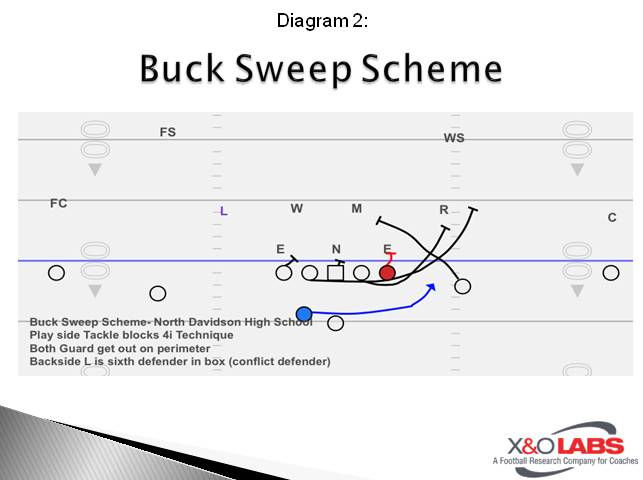
Mark Holcomb at North Davidson High School (NC) will break the run concepts from his RPO package into attacking front structure as well. Against four man fronts, Coach Holcomb will use his fold scheme, where he will block down on the nose and wrap the center or the uncovered lineman for the play side linebacker (Diagram 1). It’s a way for him to block the sixth man in the box. Against three-down looks, the gap blocking structure of the buck sweep helps even against 4i-techniques because he will use his tackle on that player in order to have two puller with the guards (Diagram 2).

Slide1Slide2 

Joe Osovet, the former head coach at Nassau Community College (NY), will check the portions of his RPOs to the shade techniques in four-down fronts. Although his run portions are not married to his RPOs at all, he told us he will run the best run concept that we will think is best against the front we are going to face. Then he tags his RPO concepts to what we think the back end of coverage is going to look like. “If we had our druthers, we want to gap things,” said Coach Osovet. “We want to run our inside zone to the low shade, our G/T counter to the high and our dart scheme is predicated on where the bubble is or the second level linebacker alignment is.”

Read More

Designing RPO Systems: Case 2 – RPO Formation Design to Manipulate Conflict Defenders

By Mike Kuchar
Senior Research Manager
X&O Labs
Twitter: @MikekKuchar

Introduction

case2leadpicOnce the pre-snap thought process has been ingrained in your quarterback, now it becomes necessary to start designing your RPOs based off the personnel groupings and formations you already have in your system. As an underlining rule, we’ve found that most coaches take the run concepts they use with the most success and protect them formationally by using structures where they can get a hat on a hat. Then, once the extra hat falls in defensively, the run/pass option is added. 

This case will focus entirely on how to identify who that extra defender (or conflict player) is based off the formation you present offensively. The RPO game is all about protecting your top runs. So we wanted to dig deeper and help coaches figure out how they can protect their runs based on the defensive structure they are seeing each week. Our sources divulge how they are able to do that using various formations. Since the majority of coaches we spoke are pure tempo coaches, the main personnel groupings we research are 20, 10 and 11 personnel groupings.

Lee Sadler at Marshall High School (AR) gives definition to the conflict defender

as someone who is responsible for playing both the run and the pass. “If we have one or two receivers to a side, the second defender from the outside-in is the conflict player,” said Coach Sadler. “We don’t count safeties or players over seven yards deep. If we have a three-receiver side, then the third player from the outside-in is the conflict player.” Following those rules, every time the quarterback gets lined up he will do the following:

  1. Look at the box for possible pressure.
  2. Look to the conflict defender on the left.
  3. Look to the conflict defender on the right.
  4. Look back to the box one more time and start the cadence.

The quarterback learns that on interior runs, he will have RPO options on both sides. On perimeter runs, he will only be concerned with the conflict defender on the backside.”

For Dustin Beurer, the offensive coordinator at Albion College (MI) any time he can block five for five up front (or four for four) he we will throw more vertical passing game with the quick game or pop on the backside. Any time he can leave the backside defensive end on a six-man box, he will run his quick game stuff (all of which are detailed later in this report). He classifies his box count priorities below:

  • 4-1 box read: Run the ball or vertical pass
  • 4-2 box read: pick on backside linebacker
  • 3-4 box read: nickel or outside safety

Editor’s Note: All of the concepts that are referenced in this case will be detailed, complete with video, in case three.

10 Personnel Designs

2×2 Open Formations

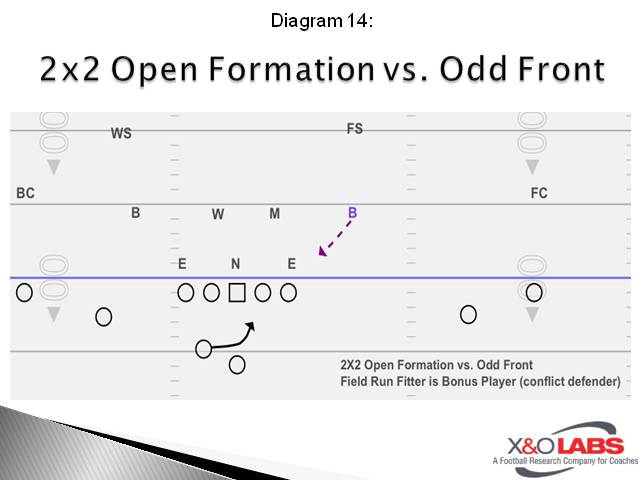
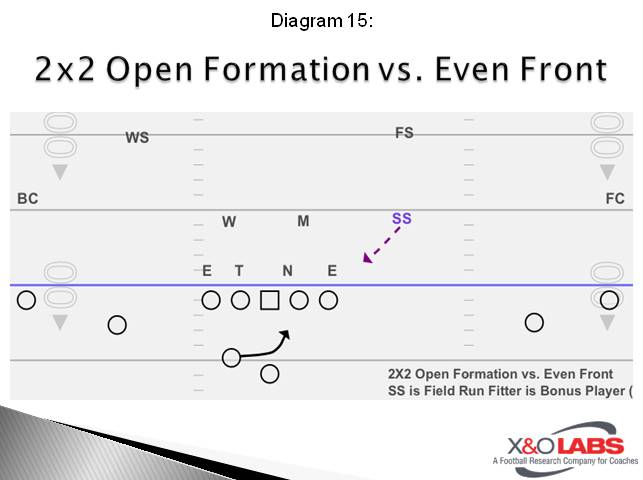
When designing RPOs from 10 personnel groupings, a clarification needs to be made the difference between 2×2 open or 3×1 open formations. Most defenses will align in two-high safety structures against these formations, so the extra run fitter can come from the following locations:

Field Second Level Run Fitter: Odd structure (Diagram 14) and Even structure (Diagram 15)

 Slide14Slide15

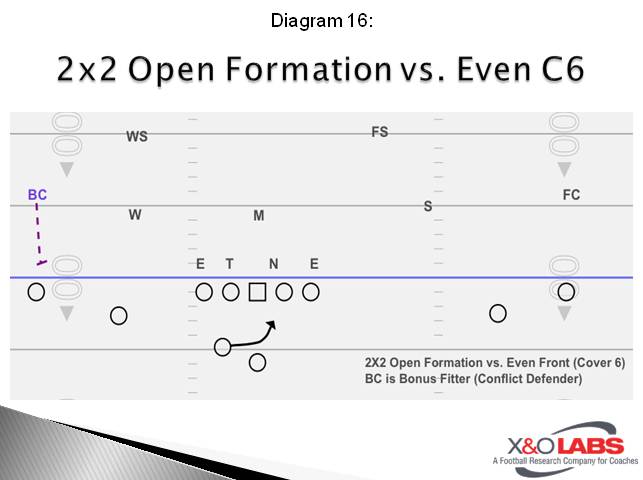
Boundary Second Level Run Fitter such as a Corner (Some 4-3 structures) (Diagram 16)

Slide16 

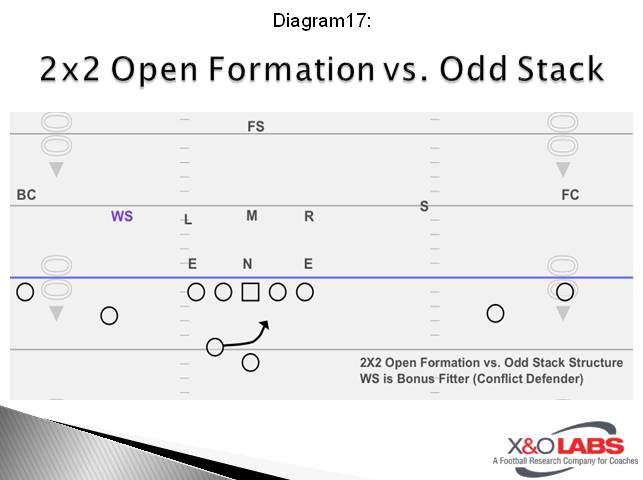
Boundary Second Level Run Fitter such as a Linebacker (Odd Stack structures) (Diagram 17)

Slide17

Read More

Designing RPO Systems: Case 3 – RPO Route Designation to Manipulate Coverage Structure

By Mike Kuchar
Senior Research Manager
X&O Labs
Twitter: @MikekKuchar


Introduction

case3leadpicIn this case, we detail which pass concepts coaches are using to stress conflict defenders. But before we start reporting on which run concepts are married with the pass game, there is one important denomination we came across in our research: Interior runs such as zone, power and counter are tied more to horizontal pass concepts while exterior runs such as pin and pull and outside zone are tied more to vertical pass concepts.

The reasoning is simple: The interior runs tighten second and third level defenders (opening up the perimeter alleys), while the perimeter runs widen them (opening up seams in the defense).

These are all new submissions with most coming in the form of post-snap third level reads. In the prior case, we presented research on how to target conflict defenders based off formation. In this case, we will present which concepts are used to attack these defenders. We categorized them into specific support patterns.

Third Level Manipulations

Safety Manipulations

Please Note: The RPOs detailed below can be used with various run actions, so the illustrations do not include the specifics on run blocking.


Manipulating Backside Safety in Run Support

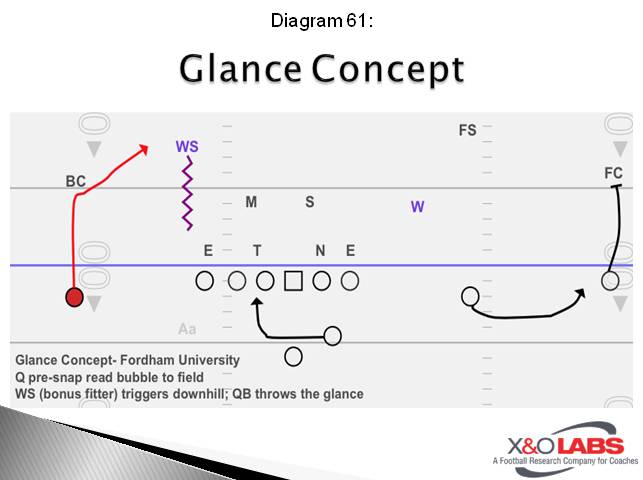
Glance RPO: Fordham University (NY) (Diagram 61)

Slide61

Read: Away from run action

Run Action: Inside Zone, outside zone, power or dart

Conflict Defender: Boundary safety in quarters coverage

Description: Glance is a concept generally to the X receiver out of 11 personnel groupings who will take a five-step route on a post angle. The quarterback will first check to see if he has leverage to the field to throw the bubble. If there is no threat of a perimeter blitz from the overhang, the quarterback will read the boundary safety for the glance route. “If the boundary safety rotates to the post, or makes any type of definitive movement to the line of scrimmage, we will throw the glance,” said head coach and offensive coordinator Andrew Breiner. The key is to allow the boundary safety post-snap to come screaming downhill when he sees run action.

To study game cutups of the Glance concept, click on the video below:

Read More

Designing RPO Systems: Case 4 – RPO Route Designation to Combat Man Coverage

By Mike Kuchar
Senior Research Manager
Special Reporting by Adam Hovorka and James Woods
X&O Labs
Twitter: @MikekKuchar


Introduction

case4leadpicThe talk around the clinic circuit this off-season was that man coverage provides a viable answer in defending these RPO schemes. We have the research to back it up. We found that 46 percent of defensive coordinators either use pure man coverage or a version of split field coverage (which essentially turns to man post snap) to defend run/pass option concepts. So this case serves as the pure counterpoint to the topic, how offensive coaches are attacking man coverage in their RPO game.

We’ve segmented our research into the following perspectives of opinion:

  • Coaches who rely on quick game methodologies
  • Coaches who use stacked and compressed formations.
  • Coaches who rely more on the run game component of RPOs

Quick Game Methodologies

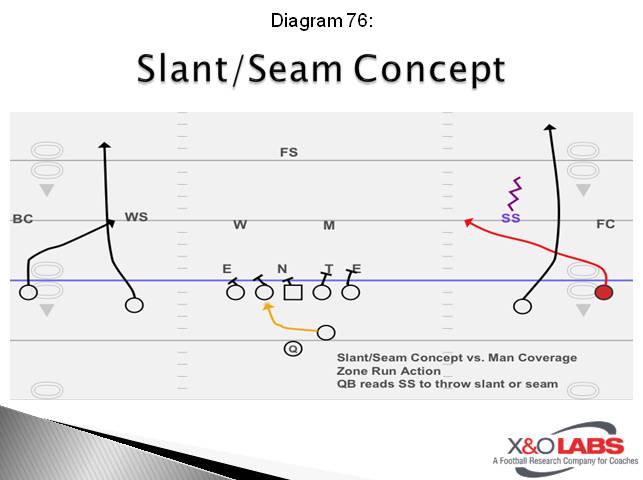
Lynn Shackelford at Cashion High School (OK) started to see an abundance of man coverage later on in the season due to the success rate of his RPO game. When he was presented with man coverage, he relied on quick game routes such as slants, arrows, posts, outs, seams and fades. He would use a built-in man beater to attack the side of man coverage. “For example, if we called a man side and a zone side, the quarterback would pre-snap to see coverage and what side he is working,” said Coach Shackelford. “If he likes the man leverage, he catches and throws the man side. If he doesn’t, he hands the zone run play.” Coach Shackelford will often have a slant/seam built into the man side as a man beater, which is paired with his zone run game. The quarterback is double reading here post snap from the inside linebacker to the strong safety. “If backer run fits, he reads the strong safety. If strong safety is peddling, he is throwing the slant.”

Zone Slant RPO: Cashion High School (OK) (Diagram 76)

Slide76

To study game cutups on this concept, click on the video below:

Read More

Designing RPO Systems: Bonus Case – Installation Methodologies and the Next Wave of RPO’s

By Mike Kuchar
Senior Research Manager
Special Reporting by Adam Hovorka and James Woods
X&O Labs
Twitter: @MikekKuchar


Introduction

The difficultly in implementing RPO concepts seems to be the selection process. Once coaches understand how to design them, creativity can take over resulting in an endless amount of concepts. Case three in this report had over two dozen alone. So the following question arises: How much does one need in an offensive system? We were curious to see if there was a specific number tagged to installation. We found that number ranged from 5 to 15 total pass tags off various run actions.  While we realize that is a broad base to work with, we did research how coaches were devising their installation both in the spring and fall to get to the end goal giving their offense the confidence to be able to run these efficiently. We segmented our research into the following methodologies:

  • Whole/Part/Whole
  • Three Day Installations
  • Segmented Teaching

Whole/Part/Whole Methodologies

One of the most thorough responses on the whole/part/whole teaching methodology came from Jake Olsen, the offensive coordinator at Loras College (IA).

He describes his process in details below:

“When installing these concepts, or any RPO for that matter, we use whole-part-whole installation. In the meeting room, we introduce the play with all components as a whole. It’s imperative our coaches outline the reasons why we are pairing particular runs with specific quick screens or passes. Based upon what we expect to see from our opponent, we devise the specific run(s) that we believe will work against the opponent’s front and pair up exterior schemes that can get our athletes the ball quickly in space.

Once we have put the RPO play together, we begin to discuss with the quarterback the objective. We’ll diagram up the base defensive look against the play and then begin to go over the ways the run portion could be stopped. We will then discuss how the ‘conflict defender’ relates to the third level and its coverage, thus providing our quarterback base knowledge about the run portion of the RPO. Finally, we will converse which match-ups in relation to our formation, will give us the best chance to have success.

Once we are on the practice field, we will work specific parts of the RPO during early individual periods. For example, we work two different five minute run mesh portions each day. One takes place before our team stretch to work particularly on the motion mesh or ‘jet’ mesh on our outside runs. Our centers, quarterbacks, slot receivers, and running backs are involved during this period.

The second five-minute period is a traditional run mesh between the RB and the quarterback. We work all the variations and mesh angles of our game plan at this time. In both five-minute periods we train the quarterbacks eyes by placing a coach in the area of where we believe the ‘conflict defender’ would be and flash numbers using our fingers during the mesh. This is similar to what we’ll do with quick game reads or other pass concept reads where we’re forcing the QB to focus on a defender. As he becomes comfortable with the mesh, we’ll begin to move the coach ‘conflict’ defender around on the snap, which simulates a bit more of a real look.

Regarding the exterior pass parts of the RPO, we use several individual or group periods to work out timing and routes. We split our receivers and quarterbacks into two different sides and work different quick game/quick screen concepts. Once again, we’ll place a coach as the ‘conflict defender’ requiring the quarterback to train his eyes toward the second level on the snap or mesh.

The final portion of teaching the RPO is putting it back together as a whole. There are several ways we believe this can be done. Our favorite is to bring all the offensive components back together, excluding the offensive line. We line up the entire formation and place one coach on the field as a defender. He will represent the ‘read’ defender for our quarterback to play against. As the season progresses, and our Quarterbacks become more comfortable, we add defensive backs into the equation. We have corners present press technique/soft technique on the outside receivers or safeties roll from 2-High down to 1-High in conjunction with the ‘conflict defender’. We’ll play this 6-on-1/6-on-3 drill for a number of reps with all our game plan RPOs. We feel this has been a great drill to gain the necessary reps we need to become smooth without creating long, drawn out team periods in order to get all the scenarios.

We’ve found the best way to get the quarterback to play fast and confident is to break the RPO down into is basic parts. We rep them individually on air, put them back together, and approach is much like a 3-on-1 fast break in basketball. Our quarterback is the point guard with the ball and he is looking to distribute quickly. In most of our drill work with our quarterback throughout practice, we place some sort of body in the area where his eyes should be and flash numbers or move creating a subconscious trigger which relates to what he should do on game day.”

Jesse Montalto, the head coach at Ellsworth Community College believes in teaching the entire concept together, but admits the biggest challenge is getting the quarterback to know who he is responsible for. So he teaches this in the most simplistic way possible: Equating it to numbers. “If it’s a five man box, the line has the four down and Mike or the three down and the two inside backer, which means the quarterback has number six,” Coach Montalto told us. “In a six man box, the quarterback knows he is responsible for the defensive end and be ready to triple off him. It’s installed in everything we do from the beginning; whatever the run game is in the RPO is in. If zone is day one, then all the run pass options with it are in with it. If power or counter is in, any RPOs off these run action are automatically in. We do it all the time.

Read More

Pre-Season Drill Series for Offensive Linemen

By Brian White
Offensive Coordinator
Rose-Hulman Institute of Technology
Twitter: @CoachWhite_RHIT

Introduction:

In conjunction with our Strength & Conditioning staff, our program has developed a series of drills our offensive linemen will perform during the off-season and during our spring practice. Our offense is an up-tempo offense that prides itself on our pace. We want to ensure that we practice such a manner that will prepare our offensive line to operate at a fast pace while improving their skills.

Additionally, we sought to develop a series of off-season drills that would not only simulate the accountability each offensive linemen have to each other on gameday, but improve the comradery of the unit as well.  This report will detail the core of the program we put together.

Tires/Ladders

The Tire and Ladder Drills are two drills preformed simultaneously to maximize efficiency and develop accountability in the unit. Our offensive line is split into two groups, one performing the Ladder Drills and one performing the Tire Drills. The amount of reps performed by the Tire Drill group is dependent on how quickly the Ladder Drill group finishes their set.

Ladder Drills are a great way to develop foot quickness, which is an important skill for offensive linemen.  Additionally, we wanted to extend the benefit of the Ladder Drills from the feet to the hands. offensive linemen need to have quick hands to be effective blockers and strong shoulders to maintain their health and strength throughout the season. Many offensive linemen suffer injuries to the labrum and/or AC joint. Performing the Ladder Drills with hands is designed to help prevent these injuries. The Ladder Group will perform their specific footwork pattern on their way down the ladder and then repeat the pattern on their hands on the way back.

Tire Punch & 1 in

The first set of drills is Tire Punches and 1 in on the Ladder. On the Tire Punches, we stress the offensive linemen to maintain a great pass pro demeanor.  We look for the whole foot on the ground with the weight on the insteps. The feet should be active throughout the entire drill, meaning that the offensive lineman will pound his insteps into the ground while never raising the feet too high. The ankles, knees and hips should be bent to produce proper power angles. We pay particular attention to how the lineman carries his torso and his hands. The spine should be sucked in and the chest should be puffed out. The elbows should be touching the ribs and the thumbs placed together. 

The Tire Punch is especially effective in developing punch timing. The offensive linemen are paired up on opposite sides of the tire and punch the tire one at a time. This creates movement from the tire that forces the offensive line to strike at the appropriate time. The punch should be delivered when the tire enters the “Strike Zone.” This is the area where the punch can deliver an appropriate amount of force to stop the defender’s charge and create separation. We define this area as the “Watch Area,” or the point where the defender is in the area where the offensive lineman’s wristwatch would be if his arms were extended out in front of his body.

The Ladder Group will face straight ahead and place 1 foot in each grid on the ladder on the way down.  On the way back, they will place 1 hand in each grid. We stress hand quickness and a firm punch into the ground. Just as we want to hear the feet of the offensive line pounding the ground, we want to hear the same from the hands. Once the Ladder Group has finished their set, then the Tire group will be able to move on to their next exercise.

Tire Flip & 2 In

In the next set of drills, the Tire group will again be paired up and flip the tire back and forth. We stress great hip flexibility in this drill. To pick up the tire, the offensive lineman must push his hips backwards to sink down and grip underneath the tire. The force to lift the tire should come from the feet pushing against the ground and driving the hips up. Tire Flips are an effective method to overtrain our run blocking technique. On a run block, we want to lift the defender out of the ground and climb underneath the defender to get our hips onto his hips. We illustrate this point the first time we teach the drill by first asking each offensive linemen to push, pull then lift the tire. Then we ask them to lift the tire with their hands far apart followed by lifting with their hands close together. We use these two teaching exercises to demonstrate why we want each offensive lineman to block with tight hands and lift the defender.

On the Ladder, the next exercise is 2 in each grid. The setup is similar to the 1-in drill, but now 2 feet will be placed in each grid on the way down and two hands on the way back. Emphasis is placed on the speed of the double tap in each grid.

Tire Front Squat & 1 In Carioca / 2 In Shuffle

On the third and fourth sets of Tire exercises, the Ladder group will perform two consecutive series of drills. The Tire Group will Front Squat the tire. Based on the weight of the tires used, adjustments to the number of men working on each tire may need to be made. The weight of our tires requires three men to work on each tire. The Front Squat is particular effective in developing communication and accountability. All three offensive linemen on the tire must be coordinated in the timing, depth and tempo of their squat on movement up and down. Usually, one leader will step forward on each tire to set the pace of the drill.

Read More

Zeeland East Counter Variations and GT Read Play

By Derek Pennington
Head Coach
Zeeland East High School (MI)

Introduction:

Our Counter and Counter Trey (GT) variations represent two of our core gap scheme run concepts at Zeeland East High School. We utilize these two blocking schemes out of a variety of formations and backfield action. In some instances, we attach an RPO to the play to protect the box from second level defenders squeezing the play. Additionally, our GT read concept allows us to block one less defender in the box and also provides significant challenges to second level defenders that have been taught to read pulling lineman. This concept also slows defensive linemen that have been taught to chase pulling linemen down the line of scrimmage. These two schemes have been very successful for us as part of our spread run game and have continued to evolve over the last 8 seasons.

Quarterback GT Concept

Slide1

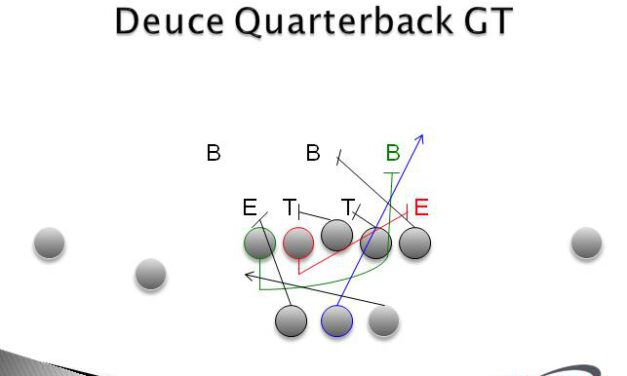
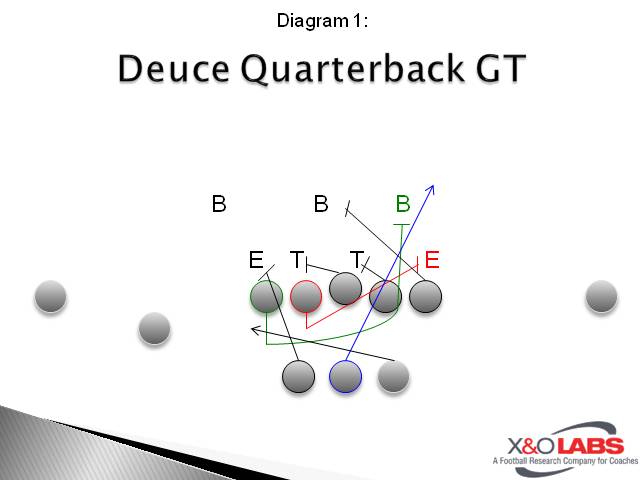
Our Quarterback GT play began as a pre-determined play with no read. Our backfield simply faked our stretch play to provide misdirection and the quarterback ran the ball on an A Gap track behind the pullers.

We have always felt two backs in the backfield allow us to run the ball more effectively and 20 personnel gives us a real advantage with this concept. We have evolved into more h-back sets because this allows us to add a hat wherever we want him to fit in the blocking scheme. We can cross flow him post snap or leave him on the side he aligns giving us more misdirection and, at times, pushing the QB to third in the order of  threats in the backfield.

Deuce GT Read

Slide2

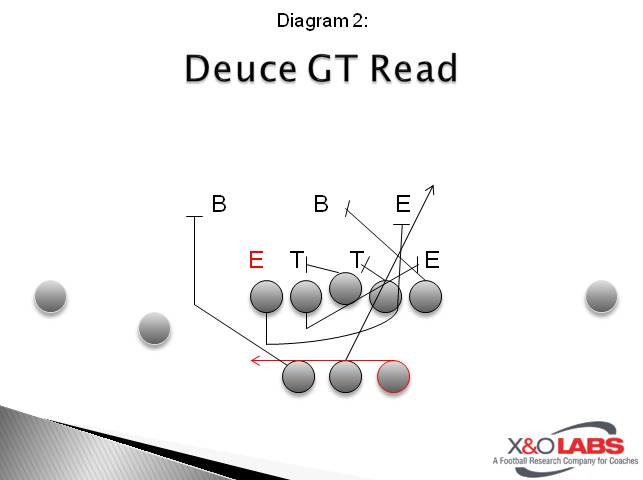
Over the past couple seasons, the quarterback GT play evolved into a read play in our offense. This helped combat defensive linemen chasing the pullers and second level defenders keying the pulling lineman. The quarterback reads the backside DE and either hands off the ball to the sweeping running back or carries the ball behind the pulling lineman into the A Gap. We tell the quarterback that he is to give the ball to the back unless the End gets up the field and can tackle the ball carrier. With that rule, any time a defense end squeezes or sits or does the surf technique would result in a give read. This is a quick read and the QB only gets one shuffle to either give or keep. He has limited time as he must stay behind the pulling lineman if he decides to keep the ball. The play has resulted in some big gains over the past couple seasons as it is especially tough on defensive ends that are taught to chase pullers and second level players reading pulling lineman.

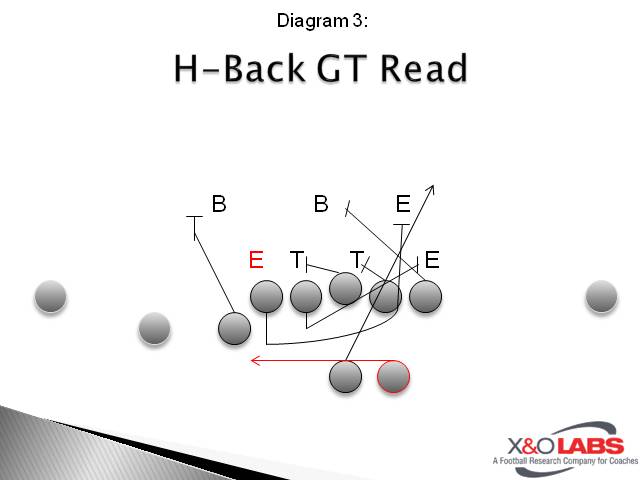
H- Back GT Read

Slide3

This is essentially the same premise as the concept above, but in this formation we use the H Back to arc block the second level for the sweep while still reading the defensive end. People often ask if we will ever have him slice away from the play side. While I am sure that could work, on this play we always have the H arc block for the second level defender to the sweep side of the play. Our change up has been to invert the play and the running back runs the trey and the quarterback runs the sweep. These plays represent our most effective ways we have utilized our GT blocking scheme 

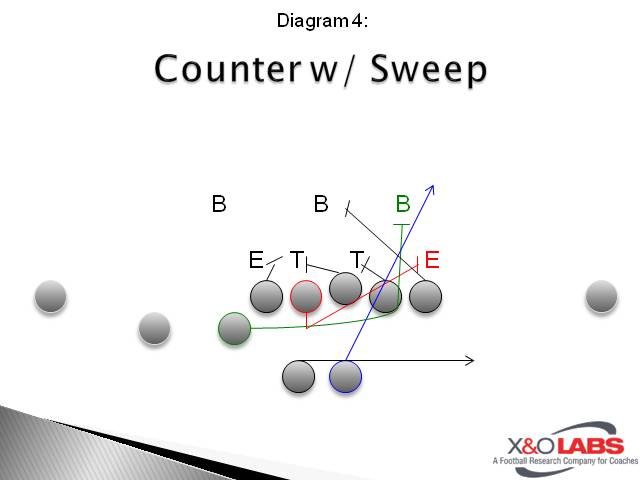
Counter w/ Sweep

Slide4

Our most effective way to utilize our counter scheme in 2015 was using the running back as a sweeper fake to put the Defensive End in conflict. On this play, the defensive end has a sweeping back approaching and a guard kicking him out for the counter scheme. The play looks very similar to our power read concept, but instead of reading the defensive end we are kicking him out. We averaged over 8 yards a carry with this concept in 2015. 

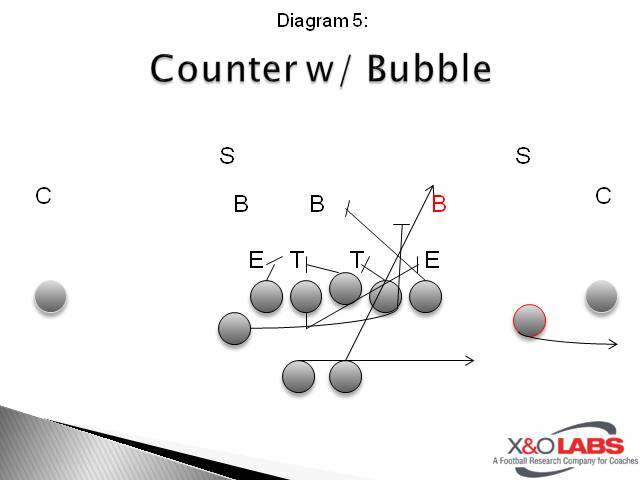
Counter w/ Bubble

Slide5

We will also use the bubble to protect the gap we are running in from heavy boxes and squeezing second level defenders. Week to week the quarterback is given a defender to key and read pre-snap. Since there is no run read on the counter scheme, the QB is able to focus on the bubble read even post snap if defenders squeeze the box.

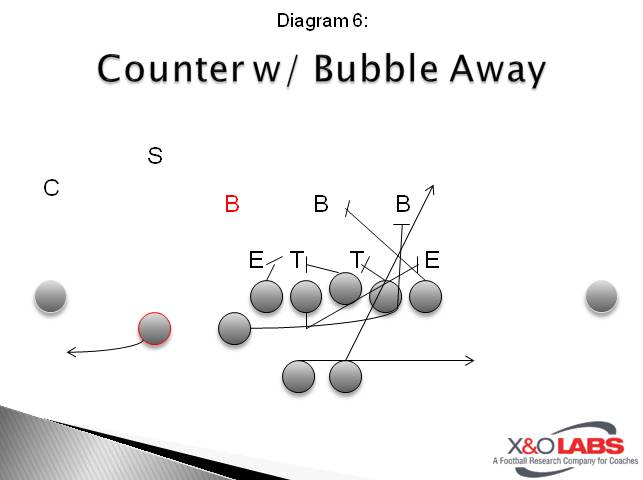
Where we align to run the bubble depends on where we feel we will get a grey area defender that week. This is determined with film analysis. Sometimes it is to the side of the bubble as shown here, but we can also run it away (below).

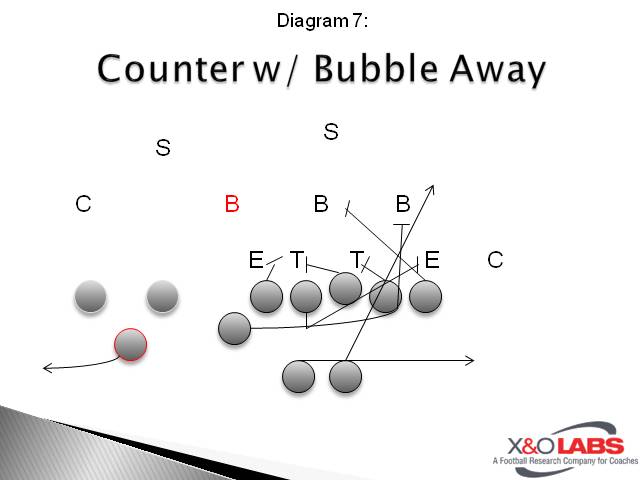
Counter w / Bubble Away

Slide61

Slide7

Another manipulation of the defense that we have liked is to overload the wide side of the field with 3 receivers and throw bubble away from the counter scheme . The quarterback counts hats and determines pre snap whether to give the ball on the counter or throw the bubble to the grass. 

To study game film of these concepts, click on the link below:

Read More

Cal University (PA) 4-2-5 LB Flow Reads

By Mike Kuchar
Senior Research Manager
X&O Labs
Twitter: @MikekKuchar

Introduction:

calpa

The following research was conducted in part of X&O Labs’ special report on “LB Play in the 4-2-5 Defense.” Continue reading for more information on this special report.


Linebacker Post-Snap Protocol:

Coach Lopez talks to his linebackers more about fit concepts, rather than fitting gaps in his system. Each fit concept is tied to a specific technique. He did make it a point to decipher whether or not that linebacker is playing with a shade or a 3-technique in front of him. “If you’re playing with a shade Nose in front of you you have to be more aware of the probablity of cutback as opposed to having the 3-technique. So we tell that backer if the B gap is exposed, he needs to slow down. If the B gap is not exposed, he can go faster.” Coach Lopez uses the following terminology in fitting the one back run game:

Scrape: Used against outside (fast) flow when the play side linebacker has a 3-technique in front of him. “We try to play over the top and get fast to the ball,” said Coach Lopez. “Help is inside you whether it’s the Will or the Safety. It’s used in Outside Zone schemes (Diagram 61).

Read More

Empty Triple Option Package

By Cory Kitchen
Offensive Coordinator/Quarterbacks Coach
Fort Wayne Bishop Dwenger High School (IN)
Twitter: @ckitchen11

Introduction:

The Triple Option has been a staple at Bishop Dwenger High School for more than a decade. We have found that running Inside Zone-Triple Option from an Empty formation is a way to modernize an old-school scheme. This clinic report will discuss how we run this concept, as well as introduce a complimentary “QB Wham” run and an explosive “Stretch” play action pass, all from the same Empty Triple Option look.

Inside Zone – Triple Option

We try to make things as simple as possible for our players so they can react and play fast without having to think about their assignment. We believe “if you think, you stink.” Our Inside Zone scheme fits that premise as we use a simple “Count System” with our offensive line. Pre-snap, the Center will identify the A gap defender on the play side as “0”, and our other linemen will count off from there. 

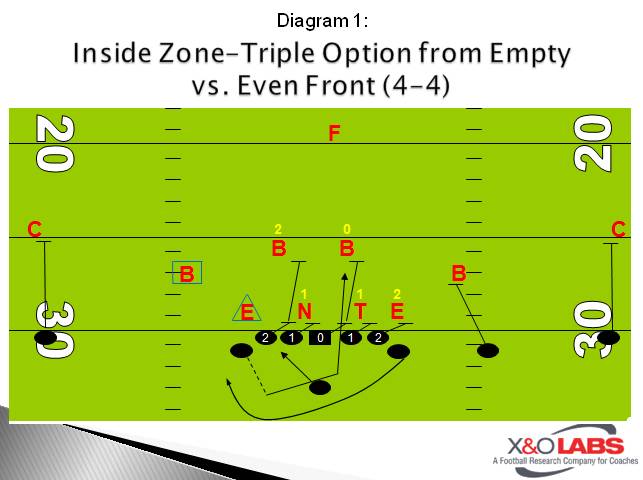
In Diagram #1, you will see our offense against an Even Front. In this scenario, the Center will identify the play side ILB as the “0”, since he is the play side A gap defender. The Center is responsible for the “0”.  The right guard is responsible for the play side B gap defender, or the “1”, which in this case is the 3 technique.  Finally, the right tackle is responsible for the play side C gap defender, or the “2”, which in this case is the play side DE. On the weak side, the LG is responsible for the weak side A gap defender, or the weak side “1”, which in this case is the 1 technique. The left tackle is responsible for the weak side B gap defender, which is the weak side ILB.  The weak side DE is our unblocked handoff key, and the weak side OLB is our unblocked pitch key for our Triple Option.

Slide1

As you can see from the diagram, once our offensive linemen get comfortable with their blocking assignments in the count system, we allow them freedom to communicate with their fellow linemen. They can decide to combo-block up front, in case the defenders swap gap responsibilities.  If the zone blocking schemes are new to you, we would recommend teaching the “count system” as a man scheme first, then working your way up to combination blocks as your linemen get comfortable with it.

We ask our dive back to begin his orbit motion, then come across the QB’s face upon the snap of the ball. If given the ball, he will continue pressing horizontally until he finds daylight, then will stick his back foot in the ground and get vertical. The play side A gap is his hopeful aiming point, but he will cut anywhere he can find daylight. The QB will catch the ball, step off the mid-line and stare down the handoff key, in this case the weak side DE. We teach him to “give” unless he believes the hand-off key can make the tackle on our dive back. If the QB pulls it, he is instructed to replace the feet of the handoff key and attack the inside shoulder of the pitch key. If the pitch key turns his shoulders toward the QB, he will “come to balance”, step to his pitch man, and deliver the pitch. We teach a “heart to heart” pitch technique. The ideal pitch relationship should be 5 yards between the QB and the pitch man, and 1 yard behind the QB.

Diagram 2 (below) shows the Inside Zone-Triple Option play against an Odd front. Again, using the “count system”, the Center identifies the 0 technique Nose Guard as the A gap defender. The right Guard is responsible for the B gap defender, or the play side “1”, which in this case is the play side ILB. The Right Tackle is responsible for the play side B gap defender, or the “2”, which is the 4 technique DE. On the weak side, the Left Guard is responsible for the weak side A gap defender, or the weak side “1”, which is the weak side ILB.  Since the weak side 4 technique DE is the handoff key and the weak side OLB is the pitch key, there is not a “2” for our Left Tackle to block versus this Odd front. In this case, we tell our Left Tackle to release inside to the weak side ILB and perform a “Veer Block” to seal off the backside for the QB or a RB cut back.

Read More

Using Tampa Coverage to Defend Vertical RPOs

By Mike Kuchar
Senior Research Manager
X&O Labs
Twitter: @MikekKuchar


Editor’s Note: The following research was conducted as part of XandOLabs.com special report on “Defending RPO and Triple Option,” continue reading for more on this exclusive study.


Source:
Mike Giancola
Defensive Line Coach 
Westfield High School (VA) 


Run First/Pass First Methodology:
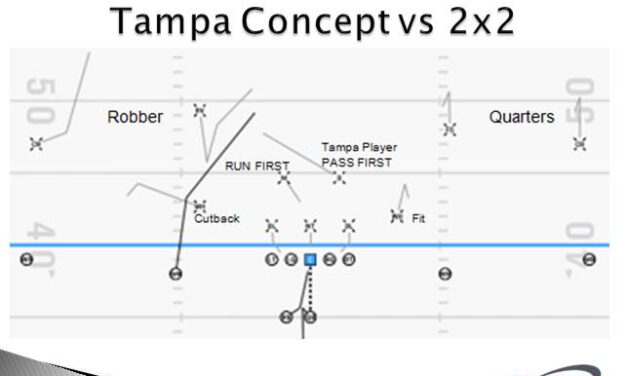
According to Coach Giancola, where it all got challenging in defending RPO concepts is with teams that started recognizing players that were responsible for the run and the pass. “We had to struggle with the number of adequate guys in the box and an adequate number of guys in the secondary playing pass,” said Coach Giancola. “So teams started running RPOs like fade out and not only picking on an overhang, but seeing what our second level flat defenders were doing. We’ve also seen teams letting the window open up more off the read player and taking a shot on us 15 yards down the field.”

Read More

University of Missouri DL Drills

Insider Exclusive: The Process for Training Mizzou’s NFL Ready Defensive Lineman

It’s no secret that former University of Missouri defensive line coach Craig Kuligowski knows how to produce NFL ready talent. When edge rusher Charles Harris went 22nd overall in April to the Dolphins, it marked the fifth defensive lineman since 2009 that he has mentored to go off the board in the first round. It’s the most of any program since that time. Now as the defensive line coach at the University of Miami, Coach “Kool” shares the methodology and drill work he uses to get his players ready to play at the highest level of football.

Read More

Finding Ways to Create Separation in Route Running

By Buddy Blevins
Wide Receiver Coach & Recruiting Coordinator
Oklahoma Panhandle State University
Twitter: @coachb_blevins5


Introduction:

panhandleGetting open or creating separation at the wide receiver position, in one form or another, is often relegated to three simple factors; size, strength, or speed (indeed, those do help). Unfortunately, all of us in the coaching world realize, you are not always fortunate enough to have guys that were born with, or have been able to create, those traits. Today we are going to discuss how coaches who may not have the personnel they desire can still have a chance to win with whoever, whenever by using my systematic approach.
Creating Separation:

The main situation I am going to address is an off man type of scenario. This will consist of off man, or any zone scenario when at the top of your route you have a defender nearby that is attached to you.

We teach that creating separation is a simple two part process:

  1. Recognizing the leverage of the DB by the top of your route (right before your break)
  2. Utilizing 1 of two methods to create separation
    1. Using a deceptive move
    2. Using an angle adjustment

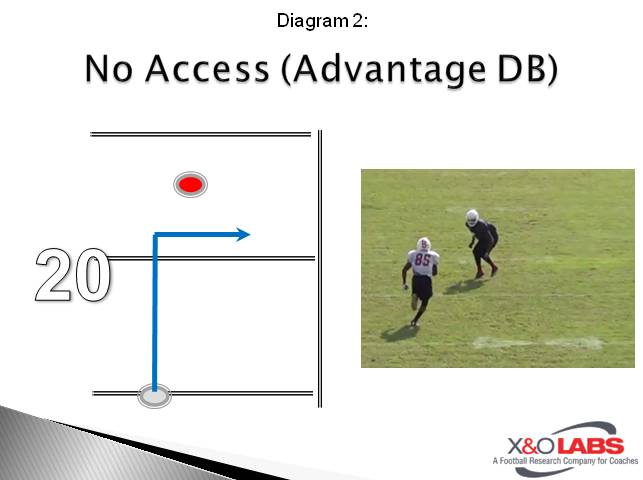
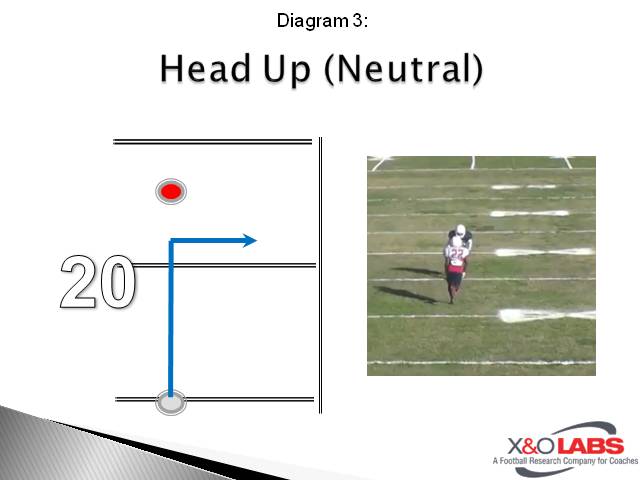
Understanding and recognizing leverage is extremely simple. Football is a fluid and constantly evolving game, we understand that. However, we decided to simplify things and categorize any DB’s position to fit into three basic scenarios.

Consider these relative to an “out breaking route”

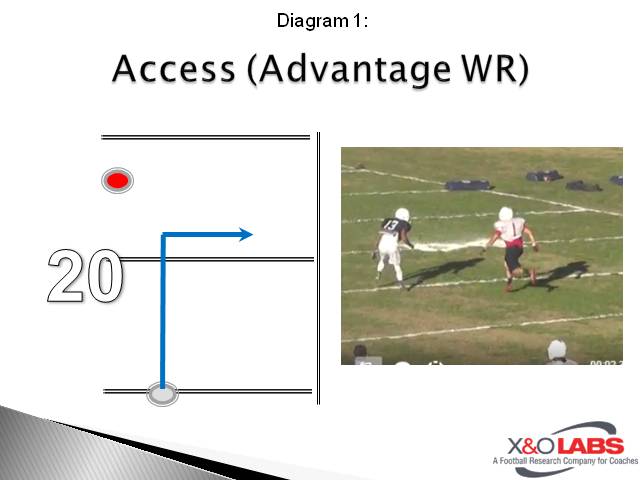
  1. Access (Diagram 1)
  2. No Access (Diagram 2)
  3. Head up (Diagram 3)

Slide1Slide2Slide3

The receiver assesses the DB’s leverage while in the vertical portion of the route. To us, this vertical portion of the route is known as the “stem” (just like the stem of a plant- it is the straight part). By the time the receiver reaches the last step or two if his stem, the DB’s leverage should be final and the receiver will know what he is going to do.

Each of the three leverages is attacked a different way. Here are two types of breaks/routes we will use to illustrate this point:

1)Angled Break: Burst Route (10-12 yd out/corner route from the outside) (Diagram 4)

Read More

Block Destruction to Defend the Screen Game

By Zach Turner
Defensive Backs Coach
Kenton High School (OH)
Twitter: @Zach_Turner1

Introduction

The screen game has become a huge part of the spread offense attack. Screens put our players in a situation where they must defeat a block on the perimeter and tackle an athlete in space. That is a challenge for most defenders and in turn, for all defensive coordinators.

Here at Kenton High School, we do not change our scheme based on what screens a team runs. We just align our defense to make sure we are never outflanked based on the offensive formation. In addition, we have incorporated a series of drills that teach our defensive backs and outside linebackers proper technique and screen fits to shut down our opponents’ screen game. We teach that screen fits are just like run fits in any defense. This allows our players to understand their leverage and how to pursue the football. Our defense has been in the top 3 in pass defense three of the last four years and a lot of that has to do with our ability to defend the screen game.

Teaching Block Destruction

When teaching block destruction we focus on using our hands properly and being the aggressor. We believe you cannot defeat blocks unless you are the aggressor, the more physical player. Much like offensive and defensive line coaches talk about the “low man wins,” we say the player whose hands strike first wins the battle. Whether it be an offensive player blocking or a defensive player destructing the block. We also never use the terminology of “beat the block” that is not good enough. You can beat a block by running around it or dodging it. We say “destruct the block” because this implies destroying the block through aggression and technique.

“The Difference”

First, I have to say we did not create it this. This idea came from Ohio State and they called it “the difference.” It blended so well with our core values of destructing blocks that we had to use it. The difference is split into two separate drills. The first drill is what we call “The Difference” the second drill is called “Strike and destruct”.

The difference is a competitive drill for us. Sometimes we use this drill as an offensive vs defensive drill and sometimes we will pair up our defensive players. No matter how we incorporate it, we want to have our defensive players be extremely physical and win the battle.

We start this drill by having player’s toes on the line and facing one another. We then have our players get into an athletic position and on the whistle both players compete to get their hands inside and lock out their hands. The player whose hands our inside and have locked their arms out is the winner. We will do this several times during the drill. On average, the drill lasts five to ten minutes and is a great practice starter because it sets a completive tone for the practice.

When working this drill, we always have these coaching points for our players:

1: Eyes on Target

2: Hairline to chin

3: Wrist Close Together

4: Elbows tight to rib cage

5: Violent Strike and Extend

We start out with the difference at least three times a week in pre-season and once during season. After introducing that drill and working it for a few weeks, we will move on to strike and destruct with our defense only.

Our strike and destruct drill is set up the same way as our difference drill but we take it one step further. Instead of just striking their opponents and extending their hands, the players will now strike, extend and destruct the block. While destructing the block they will replace the offensive player to the side of their screen fits. For example if they are an outside in player they will destruct the screen to their outside arm. Once the screen is destructed we tell our players to replace the offensive player. This allows no angle for the offensive player to come back and block our players unless it is in the back.

Additional Block Destruction

Along with the difference, we teach additional block destruction in our individual time. We believe you cannot just rely on one way to destruct blocks. It is also important to remember that not all high school players are strong enough to strike and snag defenders in order to destruct blocks. Therefore, in our indy time we teach and work a number of different techniques. Each position is different and I will discuss how we break down block destruction with our defensive backs and outside linebackers.

Defensive Backs

When teaching defensive backs proper block destruction, we focus on a few feature moves to go along with the difference and the strike and destruct. We always work a progression with our screen fits.

Read More