
Twin and Duo Run Concepts

By Bob Wylie

NFL Alumni Offensive Line Coach

Winnipeg Blue Bombers (CFL)

Editor’s Note:  Long time NFL coaching veteran and Winnipeg Blue Bomber (CFL) offensive line coach Bob Wylie details two of the more prominent two-back run concepts that have been a successful complement to gap run schemes in his tenure.  The video at the end of this article is from the COOL Clinic and contains Coach Wylie’s complete clinic talk on this concept.  This years COOL Clinic will be held this year on May 20-21 in Cincinnati, OH.  We hope to see you there!

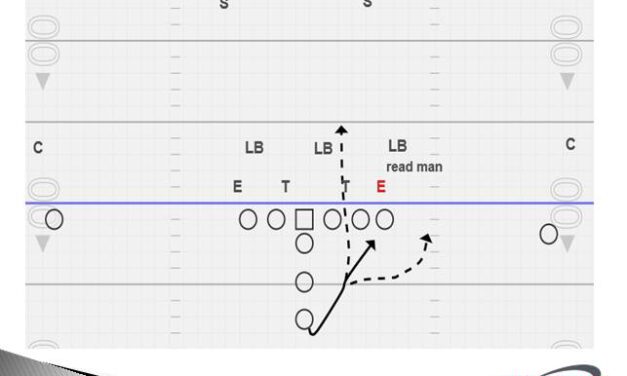
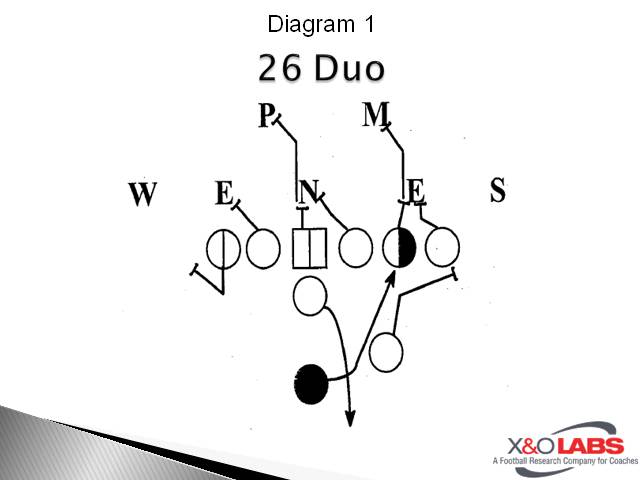
wylieWhen I was with the Chicago Bears we ran a play that we called 26 Duo. We wanted to figure out how we could get the backside linebacker blocked. This was not a new play. We still wanted to maintain some type of consistency with the back, and how he should read the blocking. The Duo stands for two double teams. Jim McNally came up with the term. We wanted to get two double team blocks where we could. (Diagram #1) Sometimes, if you had a third tight end, you could get three double teams.
Slide1

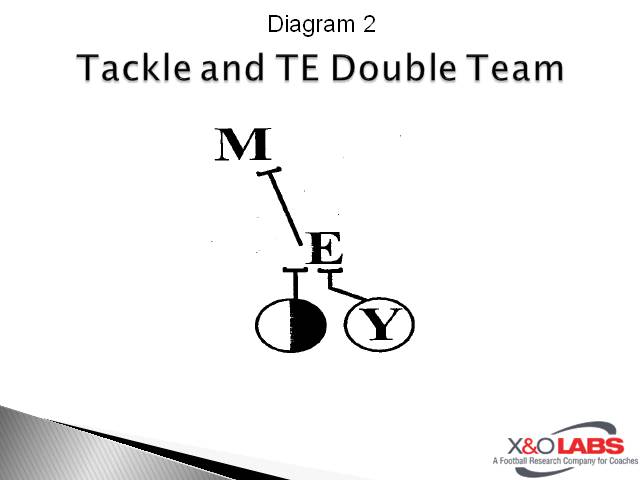
I want to draw the play up against the 3-4 look on defense. We are going to double team, or team block the 5-technique to the front side linebacker. (Diagram #2) The inside post man is going to take a short jab step, and his second step is coming up the field. The tight end is galloping into the line of scrimmage. We are getting hip-to¬hip with the tackle. We are going to double team block on the 5-technique straight back.
Slide2

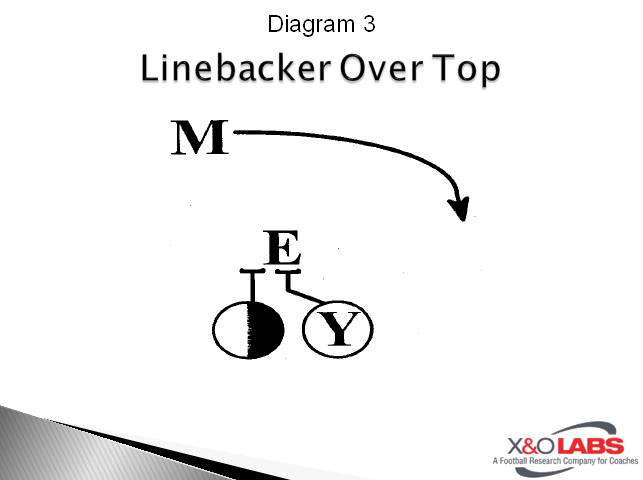
If the linebacker runs over the top we are not getting off the block. We are staying on the double team block. (Diagram #3) If the linebacker attacks the line of scrimmage and tries to penetrate the tackle-tight end area, the tight end may come off the double team block. So, if he runs over the top we let the linebacker go.
Slide3

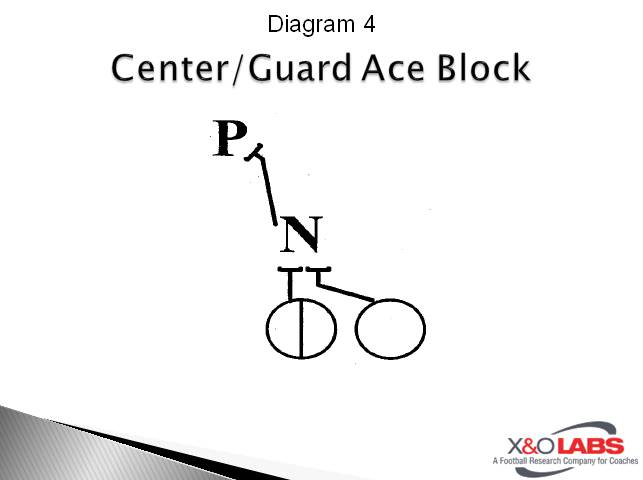
The ace block between the center and the guard is a double team block on the nose guard to the backside linebacker. (Diagram #4) It is the same steps that everyone else teaches on this play. It is a short control step, with the second step down the middleof the defender. The center may take a little more of the nose man. The guard comes down on the nose man and stays square, and drops the inside arm and knocks the nose guard back. He is looking to see what is happening with the Plug or backside linebacker.
Slide4

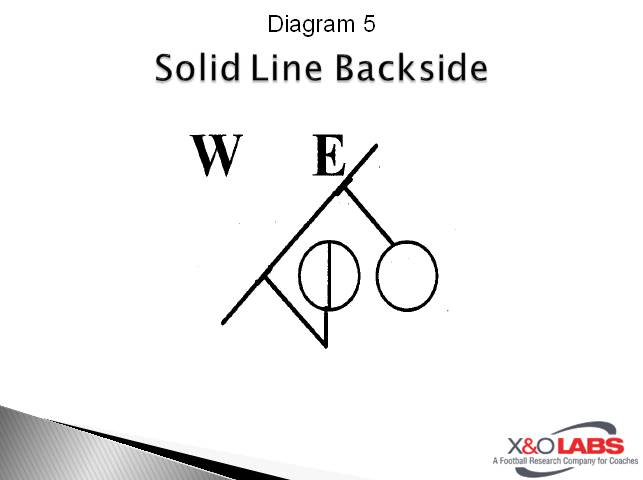
We use a read out technique on the backside. The left tackle posts the defensive end with his eyes on the Will linebacker. Here is where the play changes. (Diagram #5) The left guard picks his outside foot up and puts it back down. He takes the inside foot and he actually crosses over on his step toward the defensive end. The guard and tackle form a wall that looks like a solid line on that side.
Slide5

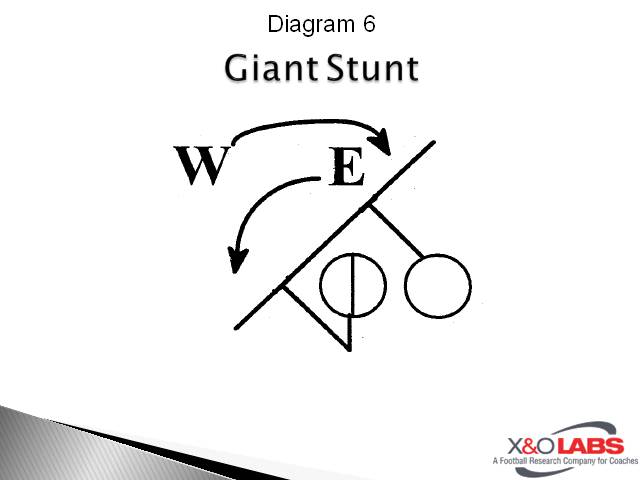
If the defense runs the Giant stunt, they would get picked. On the Giant stunt the end goes outside and the Will linebacker comes inside. (Diagram #6) This allows the guard to climb and pick up the Will linebacker. If the Will is coming off the edge then the end is more than likely coming inside and the guard can still block him. So, if the defense wanted to run the Giant Stunt, we could handle the stunt with the way we blocked on the play.
Slide6

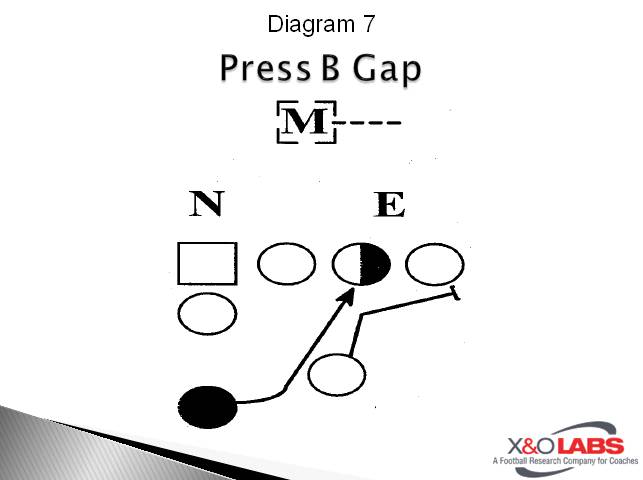
Here is the key to the play. We did not read the down blocks. We read the linebacker. (Diagram #7) We are reading the Mike backer here. If the Mike goes over the top, or stays where he is, we told the back he could cut the play back inside just like the zone play. We stressed for him to press the B-gap.
Slide7

The Fullback bocks the play the same as the power play without the pulling guard. He runs a drop step, crossover, and plant step.
Read More

3 Variations of the Counter Play

By Justin Iske
Offensive Line Coach
Southwest Oklahoma State University
Twitter: @justiniske


Introduction:

Counter is a simple play that has been around for decades. However, there are multiple different ways to run it to make it fit into any offense. While we will not go into a game with more than one or two different ways to run counter, over the course of a season we will use most of, if not all, of the concepts discussed in this clinic report.

There are several reasons we like the Counter concept:

  1. Puts misdirection into your running game. With offenses running predominately one back (and often times four receivers) as their base personnel, zone concepts have become more and more popular. While we like to run Inside and outside zone as much as anyone, we feel like we need to have something in our running game that allows us to end up opposite the direction of flow a play starts with. It is also important to note that the counter can be run to the same side as the back’s alignment in the traditional shotgun.
  2. Gap Concept that you can piggyback on teaching of the One-Back Power. Power is a staple of our offense as we called some variation of Power over 200 times last season. Every run in our offense falls into one of three categories (zone, gap or man). We teach these as concepts before we get into particular plays. Counter is a gap concept just like power. So if our guys understand the power play, they are ¾’s of the way to understanding the counter play.
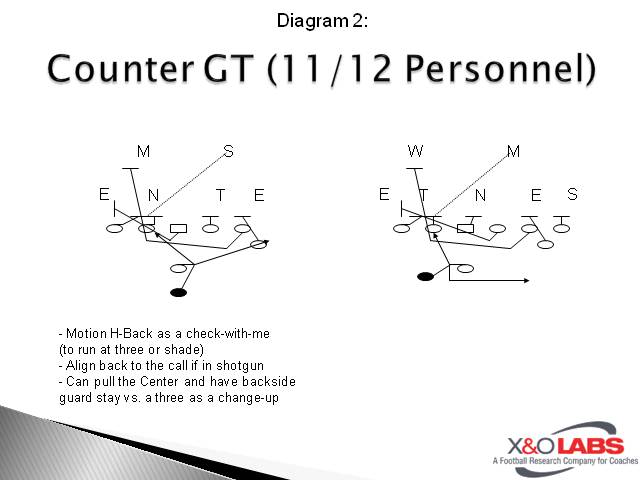
  3. Gives us another Weakside Run. We are a team that bases out of 11 Personnel and will run a fair amount of 12 Personnel as well. When you run Power 200 times a season, you need something to the weakside besides just zone and/or stretch weak. Counter gives us a great change-up that looks like zone strong initially, but ends up hitting to the weakside.

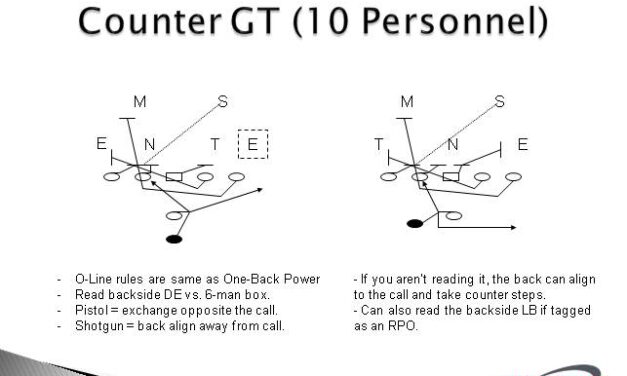
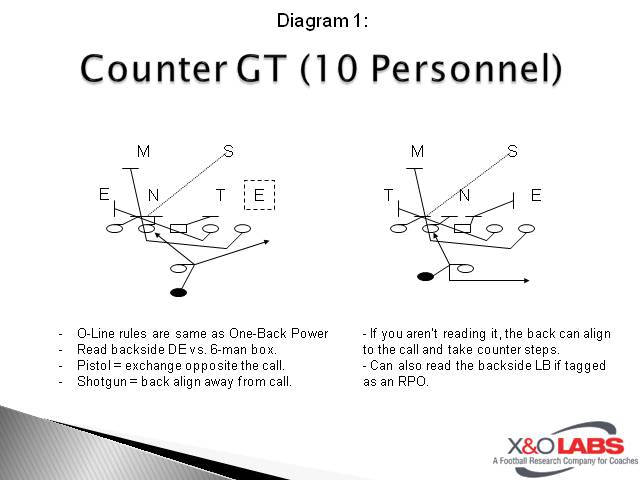
COUNTER G-T

The simplest way to run the Counter play is by pulling the back side guard and tackle. This variation can be run out of 10, 11 or 12 Personnel. If your QB is an athlete, this is a great concept to read the back side defensive end to handle a six-man box. If your QB is not a dual threat, then running any of your existing RPO concepts is an option as well. This is a play that can be run from the Pistol or traditional shotgun.

Slide1Slide2

Assignments for this play are very simple (and very similar to the One Back Power:

Front Side Tackle: B Gap to Second Level (look to double team at the first level

Front Side Guard: A Gap to Second Level (look to double team at the first level

Center: X to Y Gap (Fill for Pulling Guard) / May pull the Center against a back side three technique

Back Side Guard: Open Pull* and kickout the EMOL frontside

Read More

Defending Pressure with Slide Pass Pro

By Mike Slattery
Offensive Coordinator
Huntley High School (IL)

Introduction:

huntleyWe base our pass game at Huntley High School on our pass protection.  We will run quick game, rollout, and play action.  If we cannot protect a route we probably will not put it in game plan for the week.  What do we mean by protect the route?  If we are putting 3, 4 or even 5 receivers out we have to have a very good idea of what we think our opponent is going to do against each particular look.  This is where our weekend game planning session pays off.  We put up each set against the looks we’ve seen on film and decide what we think will best attack the defense.  We start and finish with protection, most of which is based on 6 man protection schemes. We will protect the 6 most dangerous gaps with our offensive line and running back.
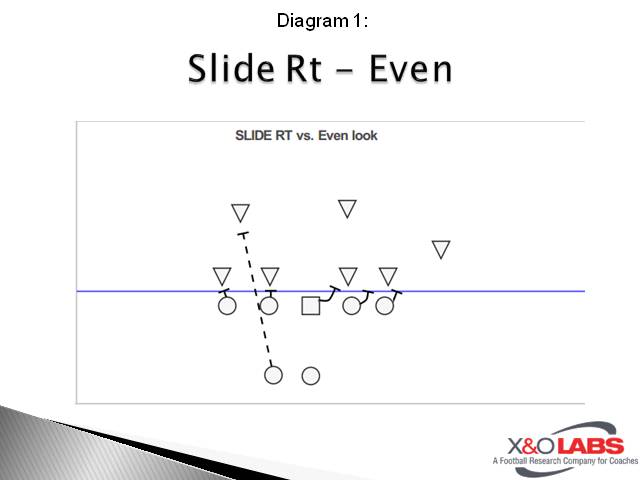
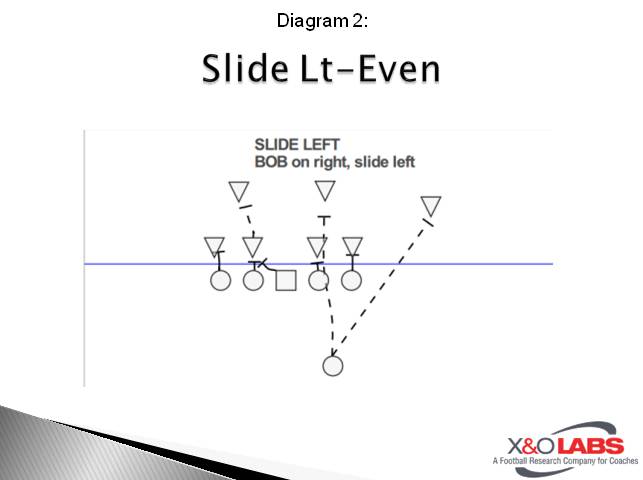
Base Rules

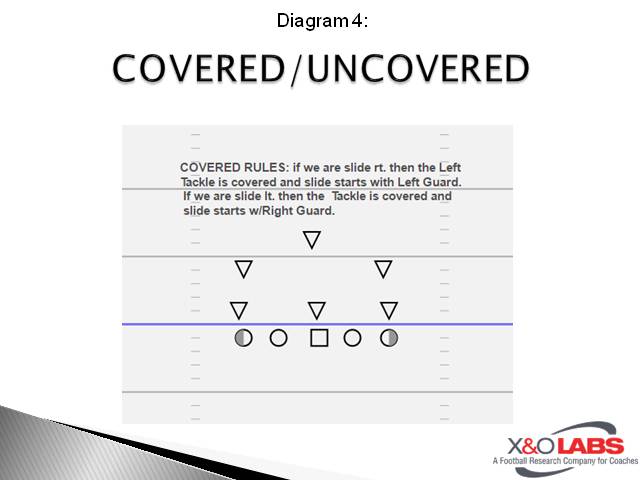
We try to keep our rules very simple for our drop back/quick game which allows for more time to work on technique and recognition.  The protection we will discuss, and one I would bet many others use is our slide protection.  The rules are as follow:  back side (BS) is “Big on Big.” The slide starts with first uncovered lineman away from call.  This means that if the call is to the right then any covered lineman on the left side will block Big on Big and we will start the slide with the first uncovered lineman back to the right.

Slide1Slide2

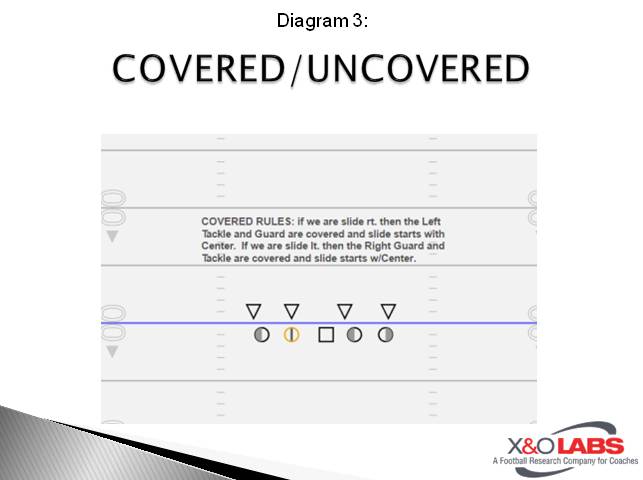
Defining Covered

How do we define covered vs. uncovered?  For us, if the defensive lineman is in an inside, over, or outside shade we consider our lineman to be covered.  Against a standard even front, this would typically mean that our left tackle and left guard (covered) would be B.O.B. and the slide would start with the center. It is important to note that we will have our TB blocking inside to outside linebacker opposite the call side. Against the typical odd front, our left tackle would be covered and the slide would start with the left guard.

Slide3Slide4

Slide

For us, slide means the line is blocking the gap to the call.  This typically allows us to block 3 to the call (even) and 4 (odd). What we teach our lineman is that if they are covered but still supposed to slide, they step to the slide but stay put if there is no threat to the slide side. For example, the Center against an odd front nose with noone threatening the slide gap, there is no reason to just jump out there. Instead, we coach him to step and wait for the guard to come and help (if no immediate threat). The actual uncovered lineman will make the call so all know where it is starting. For us, it may be as simple as the lineman calling out his own jersey number.

Read More

Va Tech’s “Pad Back” Technique to Defend Zone Read

By Mike Kuchar
Senior Research Manager
X&O Labs
Twitter: @MikekKuchar

Editor’s Note: The following research was conducted as part of XandOLabs.com special report on “Virginia Tech’s Bear Package,” which can be accessed in full by clicking here.

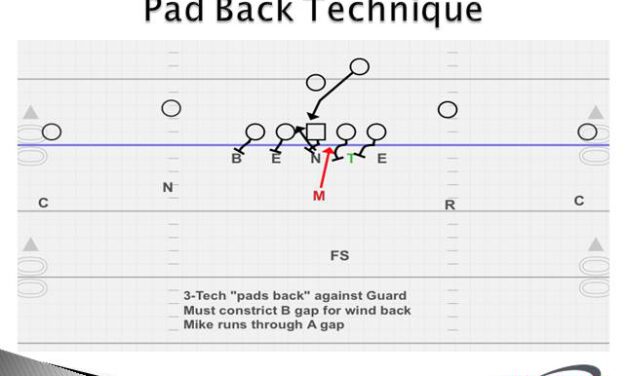
3-Technique Play (Pad Back Technique):

When studying this package, it’s inherently clear how the presence of two 3-techniques can ultimately disrupt blocking schemes and create chaos on in the backfield. Often times watching tape we were amazed with how unblockable these players were. They were getting penetration in their gap play side and not getting cutoff back side. The reasoning is simple: many times these 3-techinques are reduced defensive ends who are working on offensive guards who don’t have the size or strength to handle them.

Read More

RPOs: Case One – System Development

By Mike Kuchar

Senior Research Manager

X&O Labs

Twitter: @MikekKuchar


Introduction:

A bit of clarification is needed before we provide our research. We feel it necessary to provide an explanation of exactly what a run/pass options is. Like many other concepts in football, this has different meanings to different coaches. Some of these terms include run/pass combinations, dual read play calls and run/pass marriages.

This entire special report will be centered around run concepts that involve a pass element where the quarterback must make a post-snap read of a defender and decide whether he is handing the ball off or throwing the football.  Which means that a quarterback is reading a certain defender post-snap (known as a read key) to decide whether the ball is thrown or handed off.

These are not to be confused with run/run options (such as read option concepts) or pass/pass options (such as quick game concepts mixed in with screens).

This special report, The Run/Pass Option Concept Study, could perhaps be the impetus behind some ideas that may drive your offense to become more dynamic. The fact is, we all have run concepts in our offense and we have pass concepts in our offense. A short time ago, a group of smart football coaches decided to package their best runs with their best passes, thus taking the guesswork out of their hands and into their quarterbacks.

Now, that isn’t always a popular choice. We’ve interviewed a good deal of coaches like Charleston South High School (SC) head coach Donnie Mays who said, “If I want to run it, I’ll run it. I don’t want my quarterback making that decision.”

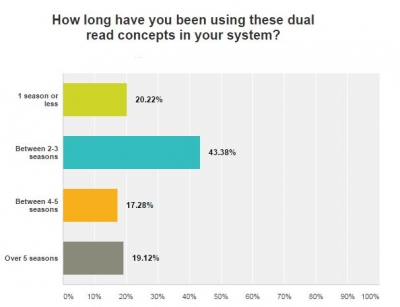
It’s important to note that Coach Mays has contributed to this report, because he does believe in the RPO system. But those coaches who have bought in completely to using run/pass options are a relative new crop. We’ve found that the majority of coaches, 43.3 percent, have been using run/pass options between the last 2-3 seasons.  

chart2

Benefits of the RPO System:

If taught correctly, a run/pass option necessitates you never getting into a bad play.  At its core, if the quarterback makes the right decision (based off his movement key) it’s a positive play. But we all know our quarterbacks don’t always make the right decision, which is why we dedicated a heavy portion of this research to how coaches are training their signal callers to make the right read. There is a lot of teach time that goes into establishing these run/pass option concepts and many of our contributing coaches detail what they do to progress the system further in this report. We selected several contributing coaches and asked them what they felt the benefits of using the RPO system provided.  Here’s what they told us:

Steve Rampy, Offensive Coordinator, Pittsburg State University (RPOs consist of 25 percent of his offense): “Not every run has a pass complement, but many of our runs have an ability to (have a pass off of them). We have some concepts where if we have a run called and we see an extra defender in the box, we will check the play. We have other concepts where if we see the same scenario, we’ll read him post-snap. You don’t want to get in a bad situation if that player comes into the box early, now you’re stuck. The quarterback makes the communication with the receiver to get it worked out. “

Brian Flinn, Wide Receiver Coach, Villanova University (RPOs consist of 30 percent of his offense): “We just try to get apexed players in a bind, either they play run or they play pass. Every run game is based off a smoke, bubble or free access throw for us. There is no three-step drop unless there is a two-minute drill. If you want to move defenders, have receivers run block.  We zone block and run two-yard hitches. It’s pass for the receiver and run for the offensive line. It’s the QB that has to think and make decisions. You eliminate a lot of things in your offense by doing this. You eliminate three-step protection and most of your play action menu.”

Drew Owens, Offensive Coordinator, Western Connecticut State University (RPOs consist of 50 percent of his offense): “We are a no-huddle team that wants to keep a premium on play call. We never want to read a guy that is influencing the run, and if he plays run, have to throw and read another guy. We put guys that are aiding in the run and forcing them to play the pass. He’s our run control guy. The quarterback has the built-in option to throw the ball allowing him to take less hits. It puts an extreme amount of pressure on a defense to prepare for the option and pass in a single play. There are two plays in one. Regardless of what the defense is in, you have the right play called taking out the need to audible. It also accounts for the sixth defender in the box in a 10 personnel formation (seventh defender if TE attached) and it forces teams to play one-high in normal situations.”

Read More

RPOs: Case Two – Manipulating Box Defenders

By Mike Kuchar

Senior Research Manager

X&O Labs

Twitter: @MikekKuchar


Introduction:

villanovaWhen conducting our research on RPOs, we noticed two common threads among offensive coaches who were proficient with the system: either these run/pass combinations attack box defenders or they attack perimeter defenders. These are primarily second level players such as linebackers or drop safeties (posing as linebackers). By definition; a box defender is a defender that is in the framework of a tackle box. 
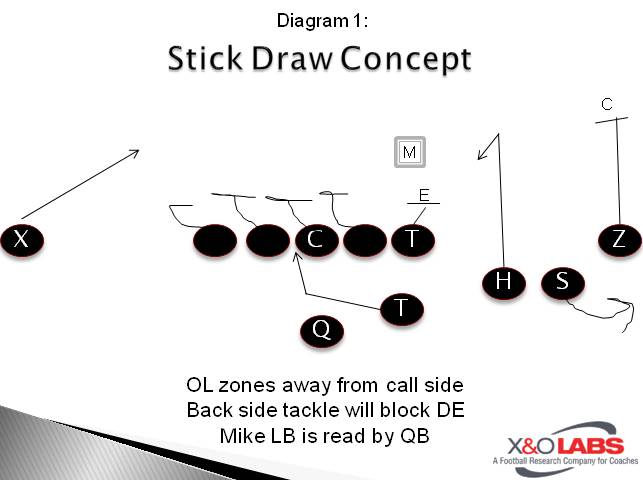
Now, each coach has his own definition of a tackle box, many of which are explained in this report. But, for all intents and purposes, this case will be based solely upon RPO concepts that are used to manipulate those interior linebackers that may have a dual run/pass responsibility in zone coverage. We’ll start with the most popular of these concepts, the Stick/Draw. 


The Stick/Draw Concept:

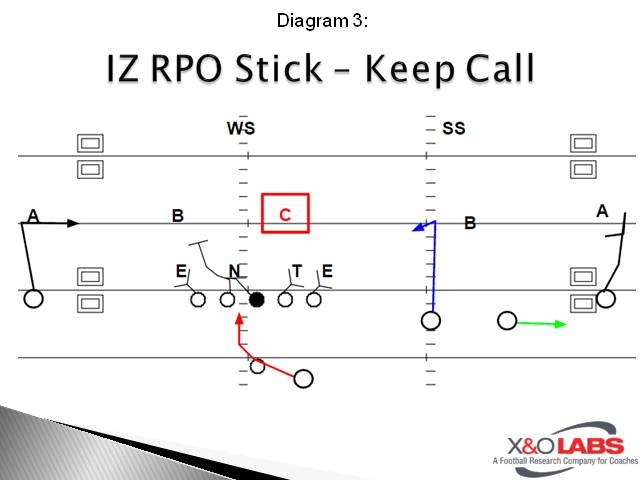
The main premise of the Stick/Draw is a Draw run concept mixed with a Stick pass concept (simple enough). Typically speaking, the post-snap decision is made by the quarterback off the play side inside linebacker who will either commit to tackling the ball carrier (on the draw) or work to play the stick route in the passing concept.  

The Stick Draw is by far the most common RPO used by coaches and apparently the most efficient as well.  In fact, 53.9 percent of coaches said they averaged between five and seven yards per play on this concept. Since this entire case is centered on the Stick/Draw concept, we will begin with perhaps the most important element of the play, the pre-snap identification process. For research purposes, the most common Stick Draw route progression is as follows:

Base Stick/Draw Concept Receiver Progression: 

  • Z Receiver: Blocks the MDM (most dangerous man) on the edge, just as he would in a bubble screen concept.
  • S Receiver: Bubble screen path. 
  • H Receiver: Runs a stick route. If the ball is on the hash, he gets on the outside edge of the hash. It’s a vertical, no stem, inside hitch.
  • X Receiver: Tagged route based on coverage and leverage.

Slide1

To watch a video tutorial of Villanova University’s base Stick Draw Concept, click on the video below:

Read More

RPOs: Case Three – Manipulating Perimeter Defenders

By Mike Kuchar

Senior Research Manager

X&O Labs

Twitter: @MikekKuchar


Introduction:

Case three of our special report will focus on run/pass concepts that put perimeter defenders in a bind, forcing them to defend both run and pass actions. In most cases, perimeter defenders consist of outside linebackers or drop safeties in zone coverage that have both run and pass responsibilities post-snap. It is these defenders that can be manipulated by showing a fast run action (such as Power, Speed Sweep or Outside Zone) then pulling the ball to throw in the area in which he vacated. Since many of the coaches we spoke with prefer to use the Power Read action as the run complement to these perimeter RPOs, we decided to start there. 

Power and Power Read (Inverted Veer) RPO Concepts:

For the last four years (or at least since Cam Newton left Auburn) the Power Read concept has been all the noise among Spread offensive coaches. Since much has been written and reported on this concept, defenses have learned to tighten up their schemes to defend it. As a result, these offensive coaches started getting on the whiteboard to design some lethal play-action concepts off the Power Read action, some of which are the RPOs detailed below. Now instead of the play side defensive end being the read in the run game, the apexed linebacker becomes the movement key. We asked the same set of questions (as we did in case one) to those coaches who are using the Power and Power Read RPO. 

Question: Which kinds of pass route progressions do you utilize in the Power Read RPO concept?

Brett Dietz, Offensive Coordinator, DePauw University: “We are going to run a double post to the number two receiver side with a wheel route with the blocking back coming out of the backfield.”  

Dan Ellis, Great Valley High School (PA): “We choose simple routes that are easy to complete for our quarterback. These consist of hitches, fast screens, bubbles, slots and double slants. The routes must be short so that all throws must be out before the pulling guard can reach the second level. The goal is four yards. But putting horizontal pressure on the defense creates opportunities for short throws to turn into long gains.”

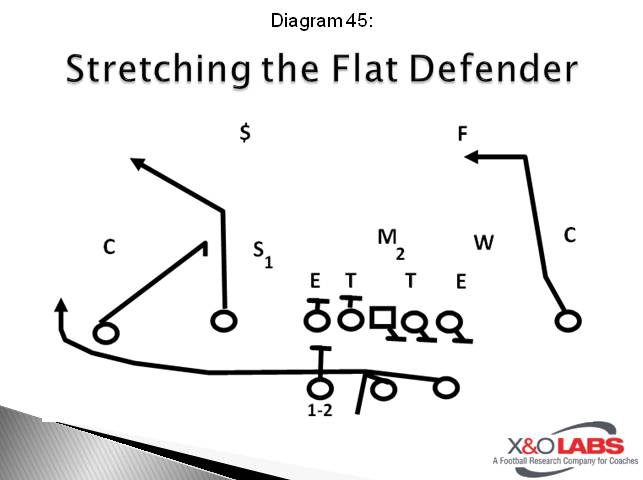
Austin Heaps, Lehi High School (UT):We utilize route concepts that the back we are faking to will hold the flat defender. In the following example, the back is our flat throw, high/lowing the corner in cover-two with the corner route over top. The snag holds the hook defender and then stretches the flat defender against cover-three or Quarters coverage, while the outside receiver sits on the outside linebacker’s outside hip. The corner route clears the deep coverage.”

Slide45

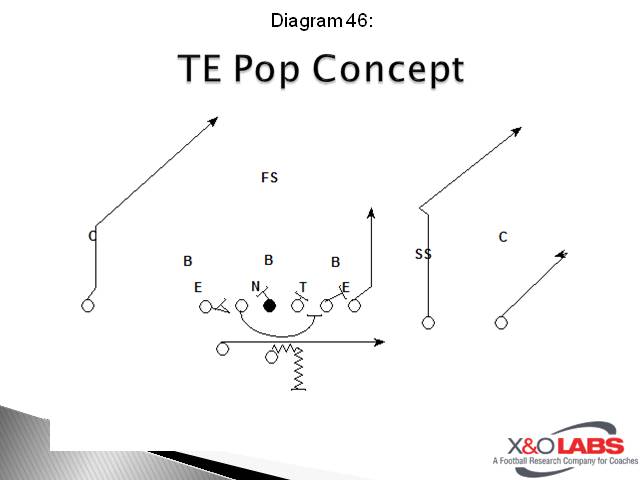
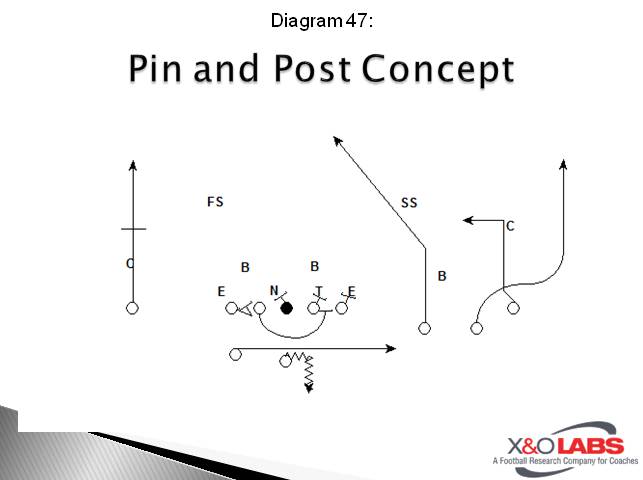
Greg Lauri, Offensive Coordinator, Nassau Community College (NY):“We have two route combinations that we utilize in this series, the first is a ‘pop’ concept with the tight end or number in conjunction with an outside smash concept. The second route combination we use is a deep pin-and-post combination with an outside choice route.”

Slide46Slide47

Question/Request: For those that use pass progressions off this concepts, explain the coaching points you use to teach your offensive linemen not to advance downfield.

Editor’s Note: At the college level, offensive linemen are allowed to advance up to three yards downfield before being called for an illegal man downfield if a forward pass is thrown.

Greg Lauri, Offensive Coordinator, Nassau Community College (NY): As in all of our play-action pass concepts, the most important thing for the offensive line to understand is that it must ‘sound’ like a run play. This means that they need to be aggressive in their initial block and drive the defensive lineman for at least their first two to three steps. We emphasize that they are not to block the linebacker they are responsible for, unless he attacks the LOS. This helps to prevent our guys from going downfield.”

Kyle McKenna, Brooklyn Tech High School (NY): “Our Power Read play-action pass is a perimeter read. If the read fast flows, we throw quick slant to the slot receiver in the vacated area. If the read stays, we run Power to the right side. Our QB takes one crows hop to read the Will, while our offensive line blocks Power with a Y kicking out.”

Read More

Wide Zone Scheme: Addressing Problem Areas

By Phil Vogt
Running Backs Coach
Palm Bay High School (FL)

Introduction:

Here at Palm Bay High School, we are a “wide zone” team that targets the edge of the defense. Unlike the outside zone, which tries to capture the edge, we try to “stretch” the edge with our wide zone scheme. If the defense lets us outside, we will take it, but the primary purpose is to stretch the edge defenders and force them into assignment conflicts. 

I will not get into basic blocking schematics, but rather will focus on the areas that will generally give you problems when running this play as well as how we adjust to defensive fronts. For those of you that want more details on the blocking on the wide zone, there is a massive amount of information right here on xandolabs.com about the blocking schemes and techniques. I also recommend researching anything you can find on Alex Gibbs when trying to introduce this as your primary running scheme. 

Why The Wide Zone

As I mentioned above, we are predominately a wide zone team. We have some other elements to our offense, but our focus is on implementing the wide zone. It is our go to play. Here is the rationale for this focus:

  1. There are more yards on the edge than inside the tackles
  2. The scheme is universal for all linemen, you are covered or uncovered
  3. We can force the defenders into assignment binds
    1. Notice is the clip below that the defender is taught not to get reached so he keeps outside leverage and we cut up behind him. On this same clip, you can see how the linebackers flow with the play and allow for the cut up lane.
    2. There is a conflict for the backside linebackers as well. They are taught to play the “cutback” but this is not a cut back play, ball is not going back there, it is a “cut up” play!

Read More

Pattern Read Coverage Out of the 3-4 Defense

By Mark Yates
Defensive Coordinator/Secondary
Mustang High School (OK)
Twitter: @thegoldball

Introduction:

mustangFive years ago, we transitioned from a 4-3 to a 3-4 in order to be multiple and defend the up-tempo spread offensive attacks that we’re seeing every week. For the longest time, we taught multiple coverages to our players, but increasingly we felt that calling certain coverages to formations was a guessing game and allowed offenses to somewhat “have the pen last”. As spread offenses became more prevalent, we felt the need to teach a concept coverage that would allow us to fit the pattern as opposed to having potential holes in a called coverage. That is when we moved to a pattern reading system.
When we made the transition to pattern read, our production went up and our points per game allowed went down tremendously. We now fit the route combination and make high school quarterbacks make the decision as opposed to us jumping routes and making that decision for them. So many times when we would call coverage in the past our defensive backs would play more programmed. With pattern read, our DBs learn route combinations and improve their eyes. The better our eyes have become, the more our production in the secondary has improved. This clinic report will cover how we teach our defensive backs how to pattern read at Mustang High School.

Alignment:

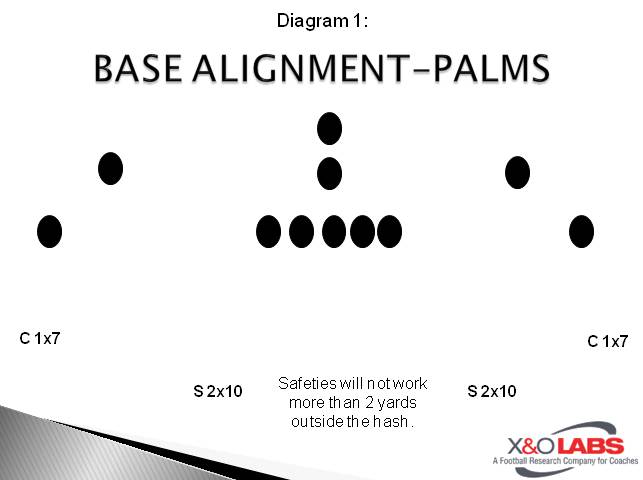
Anytime we have two detached receivers to one side of the formation, we call “palms”, which is our pattern read coverage. Our corners base alignment is 1×7 outside leverage of the #1 receiver. We turn our corners inside at a 45-degree angle. They will slow tempo out with a shuffle as they read their primary key, which is the quarterback. Our safeties alignment is 2×10 inside of the #2 receiver. Our safeties will bounce, as they read they read their primary key, which is the quarterback (Diagram #1).

Slide1

Quick Game:

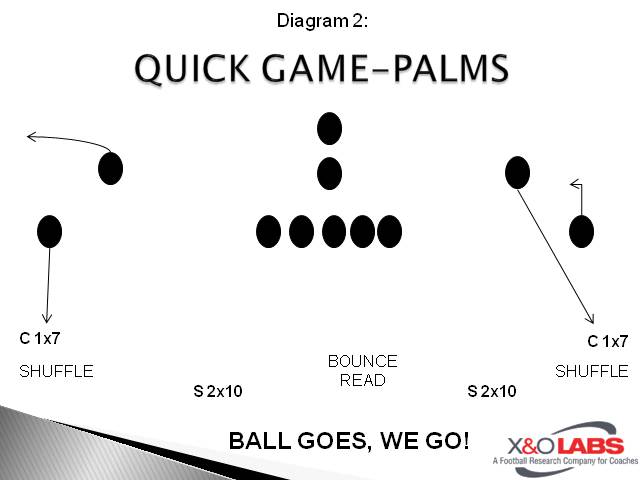
Both the safety’s and corner’s primary key is the QB. We read the QB to clear the run game and the quick game before progressing from there. When he gets a quick game read (bubble, quick throw), our defensive backs know to react and play aggressively (Diagram #2). Our coaching point on quick game is “if the ball goes we go,” meaning we will quickly attack a quick throw. Conversely, “if the ball doesn’t go, we don’t go,” meaning we will be ready for a Bubble and Go or any pump fake and throw. Once we have cleared the quick game, we get into our pattern read progression. Since switching to “Palms,” we have virtually eliminated the Bubble and Quick throws. This is something that we will teach during our individual time in practice on a daily basis so that it is second nature. It is also great training for getting the defensive backs’ eyes right as they must quickly read the QB.

Slide2

Pattern Read: #2 Inside Release

The first day we install “Palms,” we demonstrate to our defensive backs the progression of Ball-2-1. Once we clear the run game and quick throw, we start our progression reading #2-#1. Once the QB shows pass, the #2 receiver can release one of three ways.

If the #2 receiver gives us an inside release, the safety now knows he is a “robber” and his eyes go from the #2 receiver to the #1 receiver. As the corner reads the #2 receiver and sees the inside release, he now knows he is man on the #1 receiver. The corner knows he will have low wall support from the safety on any inside release in the order of Post, Dig, and the Curl (Diagram #3). The safety looks to “rob” the Post, Dig, and Curl. If the stem of #1 is vertical, our safety will now check backside looking for drags/digs.

Read More

Defending the 3 Phases of RPOs from an Odd Stack

By Ryan Desrochers
Defensive Coordinator/Linebackers Coach
Sunrise Mountain High School (AZ)
Twitter: @CoachRDes

Introduction:

IMG 0037Everyone is scrambling to try and defend increasingly prevalent run pass option schemes. Some coaches feel that playing man coverage eliminates the pass option, but that leaves a good portion of your defense with their backs turned on the play. Other coaches play RPO’s as if they are a triple option play. While this approach assigns one defender to the RB, QB, and receiver, many offenses are looking to create one on one matchups with their athletes in space to exploit these exact situations. As a defense, we do not have a special scheme or call that we use to defend RPO’s, but rather choose what we want to eliminate and rally to the other options.

Overview of Defense

At Sunrise Mountain, we run a 3-3 Stack Defense. As a base, we usually will stunt the line and send one backer. However, against RPO teams, we will often stunt our line without sending a backer. This allows our linebackers to play football fast and use our speed to our advantage. We are a gap responsible defense, meaning that we let our linebackers be fast to the ball because we will have another backer or safety flowing behind them to assist on cutback. As a base rule for our defense, our A and B gap players are responsible for dive while our C gap players are responsible for QB and our dog safeties are responsible for pitchman. As we get into the season and gameplan for our opponents, we will adjust and tweak these assignments to help take away the best players on the other team.

Stopping a Dominant Running QB

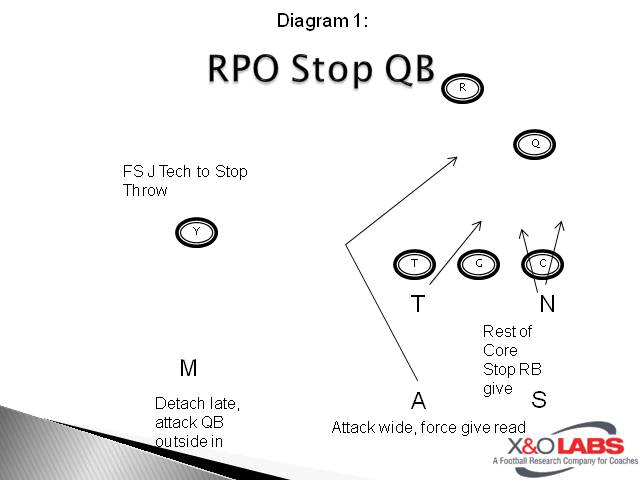
Mobile quarterbacks can be very difficult to stop regardless of the scheme and RPOs tend to give them even more space to work. As a result, we double team the QB run and trust our other 6 defenders in the box to stop the running back and snap throw. We do this by giving a give read with our C gap defender and slow play the running back at the second level. By rule our C gap defender is a QB player on any option play.

We determine the type of option and run by how the RB lines up. If he is even with the QB, the C gap player opposite the RB will play the QB expecting a power read. If the running back is behind the QB, the C gap player to the RB side plays QB on the read option. Our C gap player will not take the air of the OT and instead play the inside shoulder of the QB. Our dog safety will slide in and attack the outside shoulder of the QB when he disengages from the mesh point and attacks. Our angles on the play cause the QB to bubble back, eliminating the throw due to lineman down field. There are times when he does complete the throw on the hitch and we live with 5 yards and a tackle. By our safety running the J technique into the box.

Slide1

Coaching Points

  • C Gap player (A) inside shoulder of QB
  • B Gap Player (End) shock separate and look for RB
  • M – late outside shoulder on QB detach
  • Safety – J Technique to snap throw

When a QB is the team’s playmaker, we are going to do what we need to do to keep the ball out of his hands. Usually, they will get impatient and make a bad read and take tackles for losses.

Read More

Moving The Launch Point In The Passing Game

By Justin Iske
Offensive Line Coach
Southwest Oklahoma State University
Twitter: @justiniske

Introduction:

Capture123Keeping your quarterback upright is the most important aspect of a good passing game. The ability to pick up twists, dogs and blitzes through both protection and hot routes is vital to getting this done. Another option that can greatly enhance eliminating sacks is to move the launch point of the quarterback with sprint outs and bootlegs.
There are several reasons to get the QB out of the pocket. Here is the rationale we use here at Southwestern Oklahoma State University:

  1. OL vs. DL Match-Ups: No matter how well coached your offensive line is, there are occasionally going to be match-up issues up front. There is always that one three technique or edge rusher that your guys just can’t handle one-on-one. While chipping with the back, keeping backs and/or tight ends in the protection, or sliding towards an elite d-lineman are options to help your guys out, making the quarterback a moving target is a great option as well.
  2. Take Advantage of A/B Gap Pressure: If your quarterback is always directly behind the center it makes it easy for a defensive coordinator to bring heat up the middle consistently. This is especially true if you are a team that likes to release your running back and/or run Empty to get five receivers into the route a majority of the time.
  3. Roll Away from Edge Pressure: This is particularly true if you run Empty formations. Simple math tells us that if you are running five-man protections and the defense brings six, your QB must throw Hot off the sixth rusher. The obvious solution is to get rid of the ball quickly. This often looks great on the white board, but defensive coordinators watch film, too. Using film study to teach your QB or offensive line to recognize secondary alignment and rotation pre-snap, you can get your QB to the edge opposite of edge pressure and make him a threat to run or throw with a clear passing lane.
  4. Push the Ball Downfield instead of Hot Routes: As mentioned earlier, hot routes are a common answer to being outnumbered in protection. But if the defense knows they are forcing you to throw the ball quickly, they can break aggressively on three-step routes. Even worse, they can bait you into what you think are open throws by zone blitzing and dropping defensive linemen or sugared up linebackers. Getting your quarterback out of the pocket allows time for routes to develop downfield.
  5. Force the Defense to Defend the Quarterback: If you are blessed with a quarterback that is a threat with his legs, you must take advantage of it. If a defense plays a lot of man zero or man free coverage, defenders often have their back to the football or are focused on their man responsibility. This gives your QB a chance to get easy yardage with his legs. Further, just the threat of a running QB will force defenses to use a defender to spy the QB or stay in more zone concepts to let their defenders face the football.
  6. Give a Short QB throwing Lanes: If your quarterback can’t see downfield well inside the pocket, it is pretty difficult to ask him to read coverages and find open receivers. Batted balls can also be an issue with a vertically challenged QB. Sprint outs and bootlegs get the ball to the edge so that the QB has clear vision and throwing lanes.
  7. Running Plays and Screens to Compliment Sprint Out Action. Sprint draws and counters can open up explosive plays versus teams that over-compensate to sprint action. These are simple concepts with limited added teaching for the offensive line. Throwback screens to a back side tight end (and even tackle) can create big plays also. These are especially effective in the red zone and/or goal line area.

There are also some disadvantages to moving the pocket that you should keep in mind. If your quarterback has trouble throwing on the move it can take a lot of practice time to get this corrected. A right handed QB rolling to his left and vice versa can be an issue as well. If you become predictable in terms of which way you are going to sprint/boot, it defeats the purpose of moving the launch point. The other obvious disadvantage to moving the pocket is it cuts the field in half in terms of threatening the defense.

Read More

7 Versions of Four Verts From the Pistol

By Mike Kuchar
Senior Research Manager
X&O Labs
Twitter: @MikekKuchar

Editor’s Note: The following research was conducted as part of XandOLabs.com special report on “The Pistol Offense,” which can be accessed in full by clicking here. 

Perhaps we found the most success in play-action man protection concepts off the Veer and Midline option run-action. James Vint at Cornado High School (TX) wrote an entire piece below about his play-action pass concept off his Midline scheme from the Pistol formation.

“Our play action game is designed to attack areas the defense is vacating to play the run. With all of our play action concepts, we want the pass to look like the run. On midline, our offensive line will use an aggressive gap set protection. They will attack the near jersey number of the down defender. If you are covered, you will block the defender covering you. If you are uncovered, you will work inside to outside. We keep our protection very, very simple.

Our tackles will typically be blocking the 5 techniques. Versus an odd front, our guards will be uncovered, and they will work inside to out. We always want to block the most dangerous man first, and the inside linebacker is a more dangerous player than the outside linebacker. Versus an even front, our guard to the side of the 3 technique will have him man. Our guard to the shade will work be our dual read or inside to outside player. The center is going to base block the nose. If there is no nose, the center will work inside to outside.

I call it a gap-punch protection because we are going to step and protect our inside gap first.  It’s based on B.O.B. concepts.  The only difference between our gap protection and our Big on Big protection is the first step.  In our gap protection, our first step is to protect inside because we’re not worried about and edge guy- our back and QB handle that.  In B.O.B. our footwork is going to be predicated on the alignment of the defender.  If the defender is head up to outside shoulder, we will power step inside and kick.  If the defender is on our tip, now we are kicking. If the defender is a man removed, we are kick, kick and we read from there.   This protection is a gap-punch, Big on Big combination.  

The backfield action must look exactly like midline to the defense. Our pistol back will run down the brown spot on the center’s backside and sell the dive fake. He is responsible for “swallowing” the mesh point. He then is responsible for any A gap run through. We would essentially like for him to get tackled. The quarterback will push off the midpoint and flash the football. We teach the quarterback to bend his knees on the fake, and shuffle one step. As the back gets to the mesh point, the QB will pull the ball back in and bend his knees as he shuffles one step. The ball is not ever going to be in the belly of the dive back. We put a premium on ball security. We let the action sell the fake. After his shuffle step, the quarterback will then take a 3-step drop. He should end up at 6.5 to 7 yards on his drop.

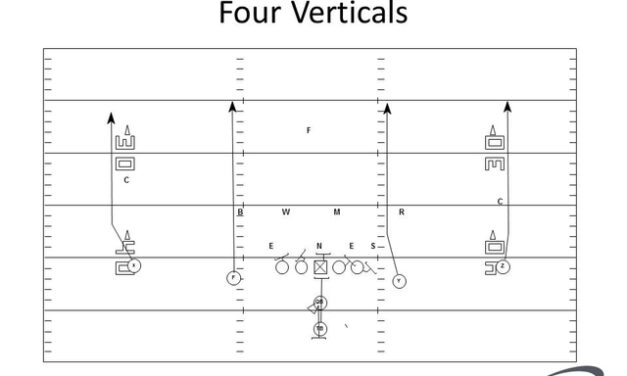
Our play action off the midline is built off our four verticals concept. Because the four vertical concept is versatile, it gives us the opportunity to be versatile with our play action game. Any of our 4 vertical tags can be run off our midline play action.

Read More

Training the Offensive Line in the RPO Game

By Drew Owens
Offensive Coordinator / Offensive Line Coach
Western Connecticut State University
Twitter: @ballcoachDRO

Introduction:

As you can tell from the vast number of reports that X&O Labs has released this winter, RPOs are the hot topic in offensive football. These Run/Pass Option plays are designed to read a certain defender on the field and either run or pass based upon the reaction of that defender.  When reading RPO reports, I have noticed that much of the focus has been concentrated on the QB read process or the contours (WR routes / Screens) attached to the play call. While all of these things are important, I think that it is easy to overlook what I consider to be the most important part of an effective RPO; the offensive line.

RPO Philosophy

Here at Western Connecticut, we have a firm RPO philosophy. We will not attach a run to a RPO unless the timing of the RB’s steps, the OL double teams and the QB mesh can allow the QB to make a true option decision to either throw or hand off based upon the read key. With our RB steps and tempo, we are able to attached IZ, OZ, Power, Counter and Dart to any RPO. Conversely, we do not attach RPOs to any inside quick trap or downhill veer runs because of the quick tempo and faster RB steps. We believe that the reads are too fast or the RB’s steps are too fast, therefore not allowing our QB to make a decision based on the read defender. The additional benefits of our RB base zone and gap steps force a read defender to make a decision during the mesh decision window. Through study, we have found that if our runs are too quick, the read player can flat foot and play both the run and the throw. 

We also have a firm philosophy that our offensive linemen will never know when we are executing a “read” option play or a “run/pass” option play. I never want my OL to come off the ball slower or hesitant for worry that they will be downfield. To make this work and “slow down” our linemen, we stress first level authority. All of our double teams are graded holistically but the prime stress is on the movement of the first level defender. Our uncovered lineman should always have a body presence on the backside defender when they are doubling. We also stress a “duck demeanor” to all of our offensive linemen. This demeanor naturally slows down our uncovered lineman when “duck walking” to the second level.

Run Game Rules

To be successful in the run game, our linemen must be able to play fast and not think. This is another reason that we don’t want the line to know that the play is an RPO. It is just one more thing for them to think about. It is important to note that we still identify who the “read key” is our offensive linemen. While we might not actually be reading that defender, the linemen know to never block or touch the read key. We teach this defender to be invisible to our linemen and to our count system. For example, the backside defensive end is the read key in inside zone and the front side defensive end is the read key in power. Our offensive line also understands if we block all first level defenders then the read must be at the second or third level.  Our running back also understands who these read keys are.

Slide1Slide2

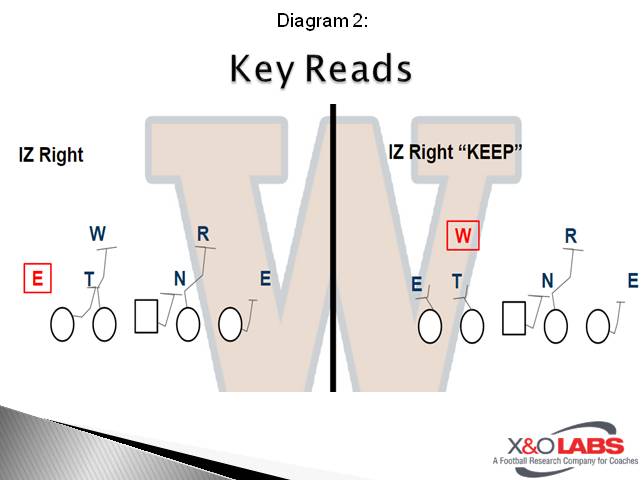
There is a delicate balance with our linemen run game count system and RPO read system. It is critical for these two systems to be in sync. To make sure our QB and linemen are reading the same defender, we will tag our called run play. For instance, the base variation when we call inside zone, the read is automatically by default the backside end. If we want to change the read to a second level defender, we will tag our zone play with a word to tell the linemen to block all 1st level defenders. If we tag our zone play with the word “keep”, our back side tackle and guard understand we must account for all back side defenders on the line of scrimmage (Diagram 3). When our linemen “keep” block, this is always an inside number drive and they are never allowed to have a defender cross their face. We also treat this “keep” side the same as we do for our man side of pass pro. We drill daily on the tagged side to work out twists and reductions.

Slide3

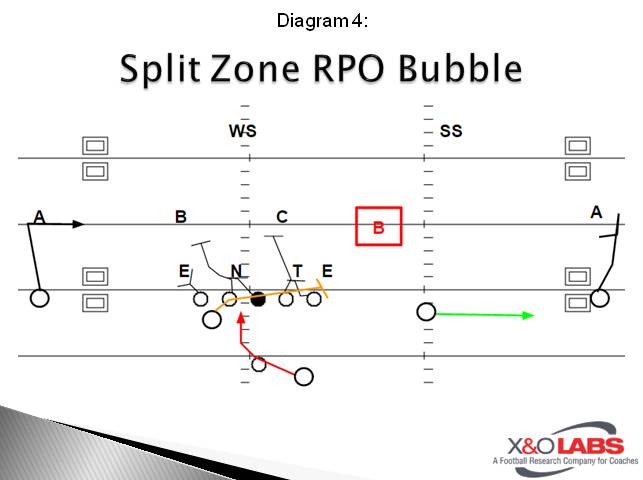
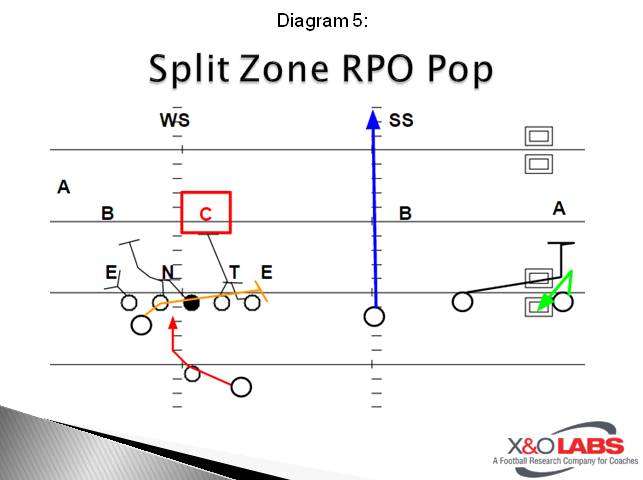
The next way we can account for all first level defenders and read second or third level defenders is by adding a FB or TE into the blocking. When the FB or TE handle the back side end or back side LB, we can now read defenders inside or outside of the box at the second/third levels (Diagram 4). Gap runs do not change anything in the system for the offensive line either (Diagram 5). Our gap runs will never change to account for a new “read” defender. By stressing first level authority, our front side linemen never climb too fast in gap schemes (Power, Counter & Dart).

Slide4Slide5

To study game film on these RPO concepts, click on the link below:

Read More

How 15 RPO Coaches Address Man Coverage

By Mike Kuchar
Senior Research Manager
X&O Labs
Twitter: @MikekKuchar

Introduction

The following is an excerpt from X&O Labs’ bestselling special report, The RPO Study. Continue reading for details on the #1 resource for run/pass option.

Answers to Man Coverage:

In the subsequent cases we devote a great of time on several run/pass option concept that can be integrated into your program immediately. We explain the concept, detail the route progressions, describe the quarterback post-snap read methodology and explain how formations can manipulate the reads. But before we do that, we wanted to address what can be the kryptonite of RPOs, man free coverage. Because chances are, if you are going to implement these RPO concepts in your offense, you will see some form of man coverage for two simple reasons:

  1. There are no apexed (run/pass) defenders; instead there are cover down defenders. There are players who are playing the perimeter and players who are box defenders. No in-betweens that can be influenced by a post-snap read.
  2. There are no eyes on the quarterback, for him to manipulate. Responsibilities are already pre-determined pre-snap. 

 So, what answers do RPO coaches have when seeing some form of man-free coverage? We went right to the source and asked them the question.

Question: What is your answer to man free coverage and cover down alignments?  Will you still use all phases of the Dual Read or will you most likely have a built-in answer?

Reader Responses:

Lee Sadler, Marshall High School (AR): “If we are seeing man free or any type of man coverage (which is usually the first answer teams will try to use to combat our RPO), we will start to use motion and shifts to try and move the eyes of the defender. In the past, we have also had success with switching our pop receiver. For example, out of a 3×1 set, using the #2 receiver as the pop runner instead of the #3 receiver. Small changes like that, or using motion and shifts, causes issues with the defense.”

Read More

Chris Ash Brings Meyer’s “On Edge” Teaching Methodology to Rutgers

By Mike Kuchar
Senior Research Manager
X&O Labs
Twitter: @MikekKuchar

Introduction

ashrutgersAs Rutgers football begins spring practice this week, new head football coach Chris Ash inherits a program that has finished in fourth place or lower in the East division of the Big Ten conference- including one bowl win in the last four seasons- all amidst numerous off the field issues. So in his effort to change the culture at Rutgers, Ash-who has spent the last two seasons as Urban Meyer’s defensive coordinator at Ohio State-has already implemented some of the on the “on edge” coaching methodology that Meyer has used with his programs since his days at the University of Florida. Mike Kuchar, the co-founder of XandOLabs.com, spent time with Coach Ash this winter talking about his plan to change the culture in Piscataway.

On Edge Teaching is a philosophy that forces players to respond in uncomfortable situations (both on the field and off). It teaches them how to handle adversity in extreme circumstances.

MK: What have you done so for this off-season to change the culture of the program?

CA: “The first thing I want to do is develop the culture that I want in this program. A lot of it is modeled after what we did at Ohio State, but there are things that I’d like to do differently that I’ve been exposed to at other places also. I first define to my players what culture means. Many coaches throw that term around a lot including me. But you have to step back and think about what the definition is of culture in that program. To us, culture is ‘the only acceptable way to behave and to perform.’ We talk about the three components of that culture as being the following:

  1. Relentless strain- everything you do in academics or athletics you must strain to be the best that you can be.
  2. Competitive excellence- putting yourself in position that when your number is called to make a play that you’re ready to make that play. To get to competitive excellence, you must have competitive spirit that means you want to compete in everything you do, from the weight room, the meeting room, the classroom, the off-season drills and in the practice field. If you don’t compete in those areas, you will not compete on a Saturday.
  3. Brotherhood of trust- this is where team chemistry is developed. Doing it at the unit (position) level. Our ultimate goal here is to have ten units strong and we want each unit on our team to have a tight chemistry and the relationships must be completely strong.

Players need to be continually communicated, educated and motivated to make it happen. That is the process we are in right now.”

MK: In what ways are these three components of culture continually reinforced during the offseason?

CA: “In the off-season, you want to accomplish some specific things. You want to get them bigger and stronger, you want to build their athletic ability, you want to build their toughness, you want to build leadership, you want to build their football skills and lastly you want to build their football IQ.  You have to do that in 8 hours a week during the off-season. You can’t slack off on any of those things because rest equals rust. You can’t afford to let any of them be underdeveloped. We build toughness at Ohio State through the artificial adversity we created in our off-season workout. You don’t rise to the level of the occasion; you rise to the level of our training. We use the phrase E+R = O which means events plus response equals outcome. We are an event-based program- we train our players to handle adversity. If you don’t train the players to deal with adversity, they will not be ready for it. We will create a special workout to push them to the limit mentally or physically or change a routine where we ask them to be here at 5 am to see how they respond. We are creating that for good events and bad events so they are ready to respond the right way. “

Read More