
4-2-5 LB Play: Case 4 – California University’s (PA) Fit Concept Methodology

By Mike Kuchar
Senior Research Manager
X&O Labs
Twitter: @MikekKuchar

The California University Methodology:

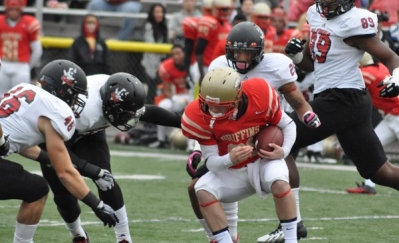
calpaWhile defensive coordinator and linebackers coach Mike Lopez teaches his players about gap integrity, he puts more of a premium on teaching them fit concepts. The Vulcans specialize in eight man front football out of its 4-2-5 structure, which means each second level player will have to know the following fit responsibilities- plug, cutback, force and fold. Because he will vary the placement of the 3-technique post-snap by using several different fronts, every linebacker and safety in his system are taught these fit concepts and the techniques used to associate with each. In case four, Coach Lopez details those fit concepts as well as the three different fronts he will use to set his first level B-gap player against one-back offenses.

Source: Mike Lopez, defensive coordinator/linebackers coach

Accolades:

  • 5th nationally in rushing defense at the Division 2 level, surrendering 2.67 yards per rush.

Introduction:

California University and its defensive staff (Dave Cole, Thomas Rebholz, Jr., Jessie Byrd) considers itself to be a multiple personnel, multiple front operation. Since much of what it sees is 10, 11 and 20 personnel, it spends most of its time in Nickel and Dime defense. For the most part, the Vulcans are a four under, three deep, middle of the field closed defense, which relies on boundary rotation where the free safety (who aligns to the boundary) is the extra run fitter.

As far as personnel, California University plays with a field inside linebacker (Mike) and a boundary inside linebacker (Will) as well as with a Nickel or Sam, a strong safety and a free safety. They use travel parties- the Mike, Strong Safety and Nickel (or Sam) travel together while the Will and Free Safety travel together. Up front, the Rush and Tackle travel together while the Nose and End travel together. The strength could be called to the field if on the hash or the passing strength if in the middle of the field (Diagram 57).

Editor’s Note: In all of the diagrams below, the Nickel should be aligned head up on the number two receiver while the Strong Safety will apex the tackle and slot receiver against two-wide sets, and apex the number two and number three recevier against three-wide sets. The Free Safety will align outside the end man on the line of scrimmage.
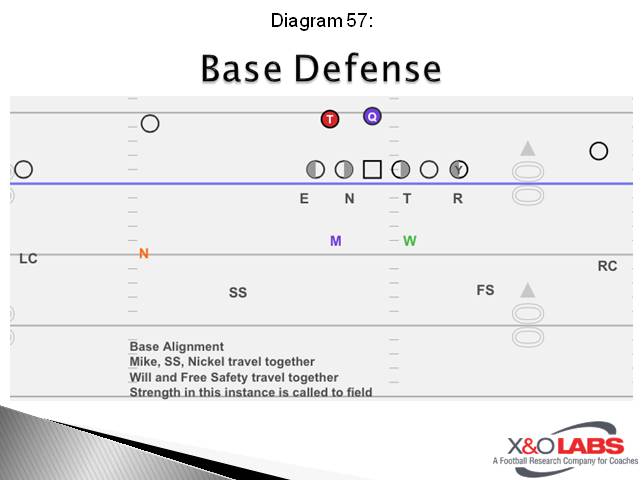
diagram57

Coach Lopez streamlines his teaching into reinforcing concepts as well as gap responsibilities. Against the one-back run game, he teaches only two flows: fast and direct. Either the run is coming toward you or away from you. Within those two flows, the following run fit terms are enforced:

Force Player- Player resonsible for forcing the ball back inside.

Plug Player- Player responsible for taking his gap right now.

Cutback Player- Player reponsible for tracking the hip of the ball carrier to play any cutback.

Fold Player- Player who is an extra (bonus) player in run away. He will execute a shuffle, shuffle technique and fold in late on the ball carrier. 

The Mike, Will, free safety, nickel and strong safety learn all of these fit concepts, which are described below.

Linebacker Pre-Snap Protocol:

Coach Lopez teaches three different types of alignments for his two linebackers: gap, rob and pull. Gap is used in 2×1 sets where the linebacker to the two receiver side is in a 40 alignment- the inside shade of the offensive tackle- while the backer to the single width side is in a 20 alignment or inside shade of the offensive guard he is aligned on (Diagram 58). Rob is used in 2×2 sets where the Mike and Will both align in 30 techniques (Diagram 59). Pull is used in 3×1 sets where the field backer will play in a 50 alignment (outside shade of the tackle and the Will aligns in a 10 technique (stacking a shade) (Diagram 60). As far as a pre-snap key, Coach Lopez talks to his players more about the triangle to vision points. Against one-back formations, Coach Lopez, the triangle is the peripheral vision of the guard, tackle and tailback. He will have the back as a secondary key and specifies on reading the hips of the back to decipher whether it’s a tight Zone scheme like Mid Zone (which is considering direct flow) or a wide Zone scheme such as Outside Zone (which is considered fast flow). It’s more of a concept-based system than teaching a gap methodology.

Read More

Translating Read Concepts to Your QB

By Brian Casey
Quarterbacks Coach
Montini Catholic High School (IL)
Twitter: @CoachBCasey13


Introduction:

montiniThe dual threat quarterback is becoming more and more commonplace in today’s game. Whether it is Cam Newton or Russell Wilson in the NFL, or the countless quarterbacks in the college and high school game, the position is moving to individuals who can be explosive with both their arm and legs. From a coaching perspective, the idea of having a quarterback that can break a simple run 80-yards for a touchdown is at times just as much of a ‘bailout’ for an offense as an Run/Pass Option is for a bad play-call. 
In 2010, my first year as a head coach at Aurora Central Catholic (IL), I coached a young man who would be considered a pocket passer. He performed very well for us that season, and led us to the most wins the school had in 10 seasons. However, as that season progressed, we began experimenting with some “Wildcat” options with a young man who could both throw and run. The offense evolved some as the season went on. In 2011, we set a school record for rushing yards, and continued to be explosive in the passing game. From that point, it has been very difficult to even think about not having a dual threat player at the quarterback position.

This season, my first season at Montini Catholic (Lombard, IL), we had a young man that played the position as efficiently and explosively as any high school player I have ever seen. He rushed for just under 1,300 yards, threw for 1,700 yards, scoring 32 total touchdowns, while only turning the ball over twice in 14 games. Those numbers become even more impressive considering, he spent his junior season as a receiver. The attention to detail and focus in practice, especially in the running game helped prepare him for what would become the school’s first ever undefeated season.

QB Read-Run Game – Installation Progression

When deciding to go with the read-run game, it is important that the installation is done at a slow pace to allow the quarterback to understand what he is looking at, and how to execute the read at a very controlled pace. When introducing each run concept, we will do it in five phases:

1. Classroom – White Board/Film
2. Individual Breakdown
3. Small Group
4. Controlled Team
5. Team

Classroom – White Board/Film

Our progression will begin well before we ever step on the field. Each season, we will begin with all the quarterbacks in a classroom, to install our read-run game on a white board, one play at a time. We will get into the specifics of identifying the ‘read’ player, and the rules for giving or keeping the football. After talking thru the concept on the board, we will watch film on the specific play, allowing them to see the plays in action.

Individual Breakdown

Once we have installed the concept in the meeting room, we will move onto the field, working on the fundamentals during our breakdown periods. During this time, our extra quarterbacks will serve as the running backs, while I will play the read player. To start, I will be very obvious in giving the read (hard down the L.O.S., far up field, etc.), as we continue to progress, I will begin to speed up my movement, and try to deceive the quarterback.

Small Group

Once both the quarterbacks and running backs have worked their individual drills and have installed the specific read concept in breakdown periods, we will both come together and work the backfield action at full-speed. Again, just like I did in breakdown, I will serve as the read player. Again, I will start the drill moving slower and being obvious with the movement, and gradually begin to pick-up speed, forcing the quarterback to make a quicker read while executing the handoff or pull, without putting the ball on the ground. Once both position groups are ready to go, we will spend a lot of time in this phase, as we view it as a controlled period where we can get a lot of quality reps, working on the mesh technique while making a read at various speeds.

Controlled Team

Read More

SUNY Maritime 3 Three Deep, 2 Under Pressure Package

By Saj Thakkar
Defensive Backs Coach/Special Teams Coordinator
SUNY Maritime College (NY)
Twitter: @coach_saj


Introduction:

maritimeHere at SUNY Maritime we play an aggressive 3-4 slant/angle defense with a 2 high look from the secondary. We play a variety of different coverages but our favorite to pair with our 6 man pressures is over 3 over 2 “Hot” coverage. We like to bring our 6 man pressures against 10 personnel sets in order to force the quarterback to get rid of the ball quickly.
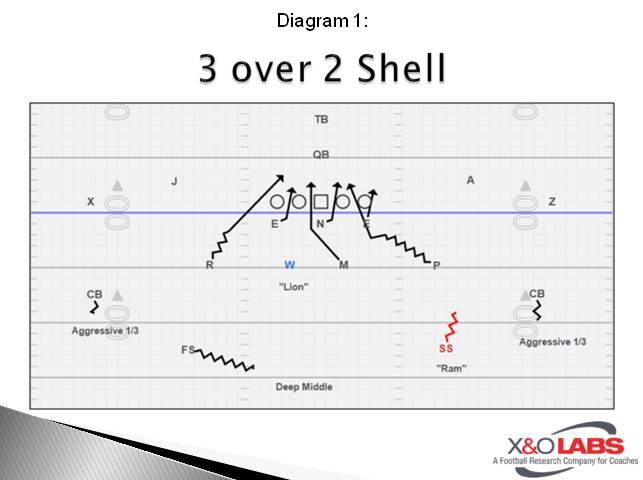
Our hot coverage allows us to play aggressive with our blitz game and gives 5 coverage men who can aggressively jump routes based off the quarterback’s keys. 3 over 2 also allow us to bring 6 without the fear of losing a matchup in 0 coverage and getting hit with a big play. The coverage involves two “hot seam” players, usually one LB and one drop safety, with the corners playing what we call an aggressive 1/3 technique, and a deep middle safety.

Here are the keys that we teach regarding the QB Drop:

• Drop
• Eyes
• Front Shoulder (Direction/Trajectory)
• Off Hand (Break Key)

Hot Seams (Ram/Lion)

Slide1

As with any successful coverage, we must communicate effectively to be successful. When we call our 6 man pressure, it is our coverage linebacker’s job to make the initial hot seam call. He will call either ram or lion depending on which seam he is responsible for. The safety opposite him will follow the call with the opposite call alerting the defense that we will have two hot seam players.

Ram/Lion Technique

We tell our drop safety to stay disguised as long as possible. Although this is an aggressive coverage, the worst thing that can happen is for him to get caught too low and are out of position to play the seam. We do not want him under 5 yards. Against a 2 receiver set, we aim to drop to the inside shoulder of the #2 receiver in order to be able to drive on the quick slant or under route.

Read More

Split End Power RPO

By Tom Grippa
Offensive Coordinator/QB Coach
Mount St. Joe University


Introduction:

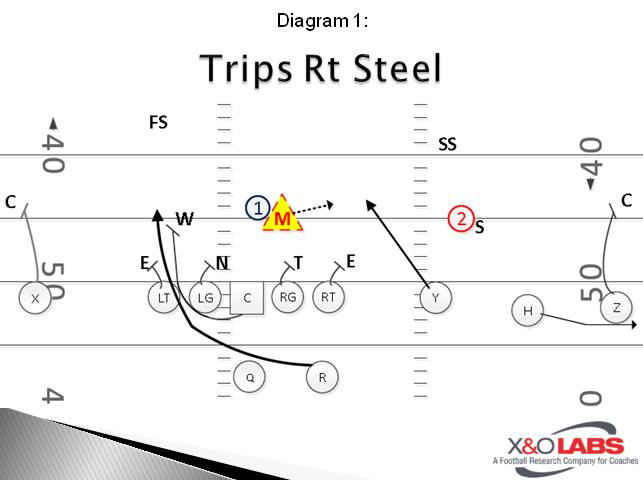
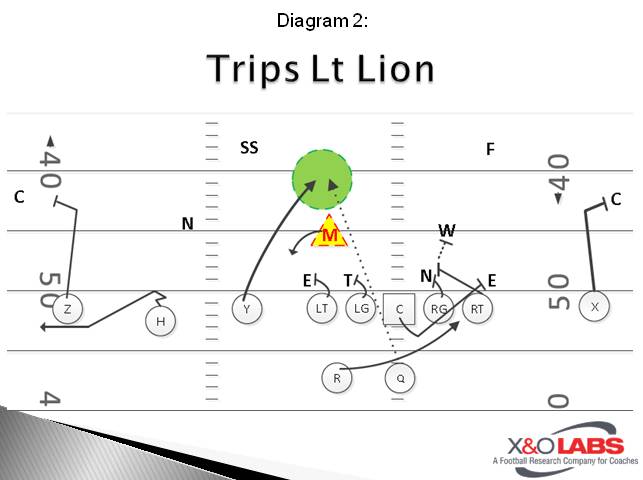
msjOne of our favorite concepts here at Mount St Joseph is the “split end power” that we run away from trips in 3×1 formations. We are attempting to control the box by adding a pass option component to our split end run play. Like any other version of option football, we are working to outnumber the defense by adding this run pass option concepts (RPO). Offensive coordinators are always looking for easy completions and using the split end power will give you easy completions on 1st and 2nd down run situations.
Blocking:

For the offensive line, the concept is simple. They will “block four down to the WLB.” Against an over front (Diagram 1), the backside guard and tackle block the 3 and 5 technique. The playside guard blocks down on the DT/NG and the center skip pulls and blocks the WLB. The center needs to read the play side tackle’s block on the DE. If the DE stays as a 5 technique, the Tackle will widen him to open up the hole and the Center wraps in the B gap and blocks the LB.

Slide1

If the DE stunts into the B gap the LB will be crashing off the edge and as the center sees this, he will execute a kick out block on the LB. If the playside tackle sees the DE slide into a 4I and the LB creeping outside, he can make a kick call to alert the Center to kick out the end man on the line of scrimmage (EMOLS).

Slide2

Against an under front, the same concept applies, but the backside guard becomes the puller. IN this case, the backside tackle blocks the 5 technique, the center blocks back on the NG, the play side guard blocks the 3 technique and the play side tackle blocks the 5 technique. The backside guard will then skip pull and blocks the WLB. This will be a tight wrap into the A gap unless the defensive line stunts, in which case the guard would wrap into the B gap or execute a kick out block.

Read More

Four Vertical Landmarks, Reads and Progressions

By Mike Kuchar

Senior Research Manager

X&O Labs


Editor’s Note:  Part 1 of X&O Labs research report on the four vertical pass concept will focus primarily on the research we found regarding receivers landmarks and route technique as well as the QB’s read progression based on coverage.  Since over 60 percent of coaches surveyed run the concept out of 2×2 formations, this week will focus primarily on that set.  


From Mouse Davis to Hal Mumme to Mike Leach, the four vertical pass concept has redefined offensive football and continued to leave its footprint on the landscape of every level.  Each coach that experiments with it, leaves their own distinct tweak on it, and in turn a football benchmark is developed.   X&O Labs first delved into the topic in an exclusive interview with Atlanta Falcons’ offensive coordinator Dirk Koetter that opened up the floodgates to an in-depth research project that culminates with what you see below.

The four vertical pass concept is a football discipline that gets researched every off-season (for various reasons which we will detail below) and for that reason, we wanted to provide what we felt were various ways to implement and more importantly devise the concept in ways that can fit your personnel. We’ve found that perhaps what started as a “run straight down the seams for the end zone” concept has morphed into a “take what the coverage gives you” opportunity to make plays in space.

So, right in time for 7-on-7 season, we present the first of a two-part series on the four vertical pass game.  What you see below will focus more on researched based information on what we’ve found were the most efficient ways to be successful running the scheme, while next week will detail some tweaks and changeups to the original concepts that coaches have used.


Case 1: Outside Vertical Landmarks and Adjustments

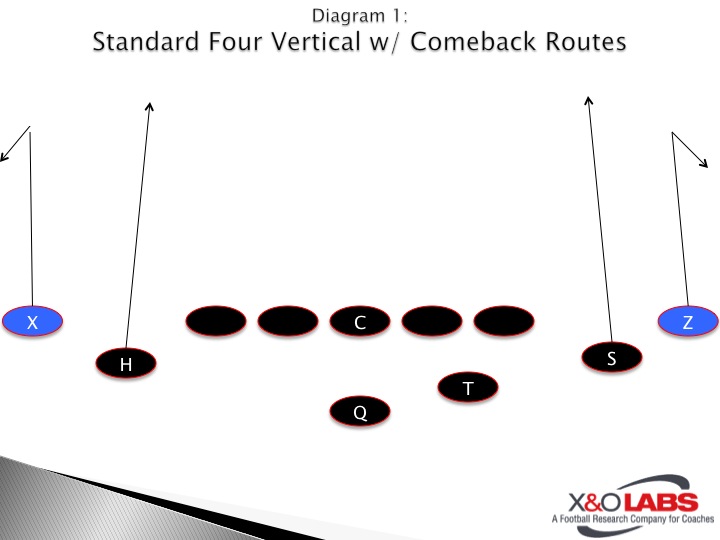
Considering all things equal, with the ball inside the hashes, 59.8 percent of coaches teach the bottom of the numbers as a post-snap landmark for their outside receivers.  In the four vertical concept, it’s the outside receiver’s (or number one as their commonly referred) job to stretch the cornerback and adjust this route off of them. While giving coaches the option of whether they teach a comeback, stop or speed out route on the outside – 67.8 percent teach comeback routes (Diagram 1) in their four vertical package.  Of these 67.8 percent of coaches that teach the comeback, 36.3 percent teach a 15-yard break point while 32.6 teach a 12-yard break point when making their decision to adjust to the corner.  We’ve found that this all depends on where the receiver can get leverage on the corner, thus making it easier throw for the quarterback. 

It seems that the drop out comeback could be an efficient “take what they give you” throw, particularly to the boundary where there is less room to work with.  Most coaches we spoke with wouldn’t dare throw the field side comeback (unless the QB had the arm strength to do so) but the productivity of the comeback could prove for an easy pitch and catch – so much so that Dublin Scioto High School (OH) offensive coordinator Doug Taracuk tagged his comeback route the “Winner Route.”  He uses it as a pre-determined throw to the best matchup he has on the outside regardless of coverage.

But what Taracuk does, that we thought was interesting, is have the QB react to the coverage and not the receiver.  Of course, this thought process is contrary to the entire principle of the four vertical passing game that relies on receivers making post-snap reads on defenders in space.  Taracuk will tell his QB’s to throw the ball deep if coverage allows it (and the receiver has gained space on the corner) but if he hasn’t, he will instruct his QB to throw at the back of the head of the WR, similar to a Mike Leach concept, which forces the receiver to adjust and react to the throw.   The receiver will look for the ball at 17-18 yards deep and react to the throw.  “The receiver will break inside or outside based on the defensive back’s leverage,” said Taracuk.  “It eliminated the QB misreading the intention of the receiver.  We used to get overthrown balls when the receiver broke and underthrown balls when he kept going vertical.  The back shoulder throw is now easy to see because the receiver reacts to the thrown ball.  Our only concern with the route is making sure the receiver is running a track which allows us to catch the thrown ball at his head.”

Below is some video of Taracuk’s “Winner Concept” in action:

Read More

How 3rd Level Defenders Impact RPO Reads

By Jake Olsen
Offensive Coordinator/Quarterbacks
Loras College (IA)
Twitter: @footballcoacho

Introduction:

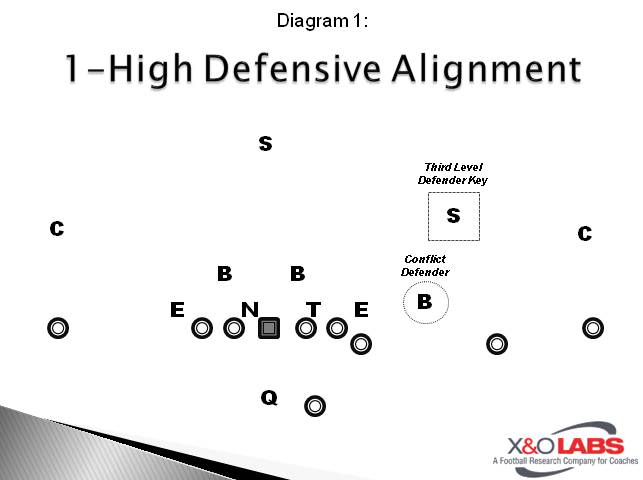
blogfinalsized 00001With increased popularity of RPO plays on offense, thus too have been the improved defensive techniques from the second level to try and stop them. Here at Loras College our staff has found ways to give our offense the best chance to succeed using the third level (or safety level) as the focal ‘read’. Our RPO’s generally use the second level, or linebackers, as the ‘conflict’ defender. That said, defenses have responded by having their ‘read’ defenders faking or bluffing their intent. An example might be a ‘conflict’ defender showing inside the box alignment and bailing out into a pass lane then subsequently aligning wide and shooting an interior gap on the snap. Stationary ‘read’ keys are much easier to define for a quarterback than those always moving around. We use third level defender alignment, depth, and eyes to help our quarterbacks determine where to go with the football. In this report we will outline a few of the play examples exclusively using 20 personnel (1 RB, 1 Hybrid, & 3 WR’s) in which we read third level defenders. These examples were successful for us this past season.
Pre-Snap/Post-Snap

As soon as the QB can determine the location of the safeties, he will identify if they are: 2-High, 1-High, or 0-High. Our general rule we teach him is the following: 2-High Safeties – lean toward run, 0-High Safeties – lean toward pass, 1-High Safety – Your call. We expect him to make an educated decision. In any case, where we put the decision on the quarterback and it could be ‘gray’ we want to give him baseline knowledge of where to begin.
In most 2-High Safety looks, we can identify one ‘conflict’ defender at the second level to ‘read’, but in cases where this defender is moving around, we use the third level to help clean up the picture.

Slide1

Though we had a ton of success throwing the ball this past season, and statistically it appears we’re a ‘pass happy’ offense, our goal is to run the ball first if the box is in our favor. If a defense completely outnumbers us in the box, our quarterback’s job is to highlight the matchup in the pass game. However, his complete understanding of how defenses fit together can allow him to still run the ball even when it may appear we are outnumbered. Most of our RPO’s have multiple pass options for the Quarterback to choose from.

We introduced the RPO system two years ago with primarily one run and one pass option to give our quarterbacks beginner level understanding. Since then, we have evolved into providing him with two, sometimes three pass options in addition to the run. This has allowed us to feel confident knowing there should always be a winnable match-up based on personnel or leverage. Based on percentages, we typically have a 67% chance of throwing the ball and 33% running the ball on any given RPO. As mentioned before, there are even RPO’s that give us a 75% chance to throw the ball and 25% to run.
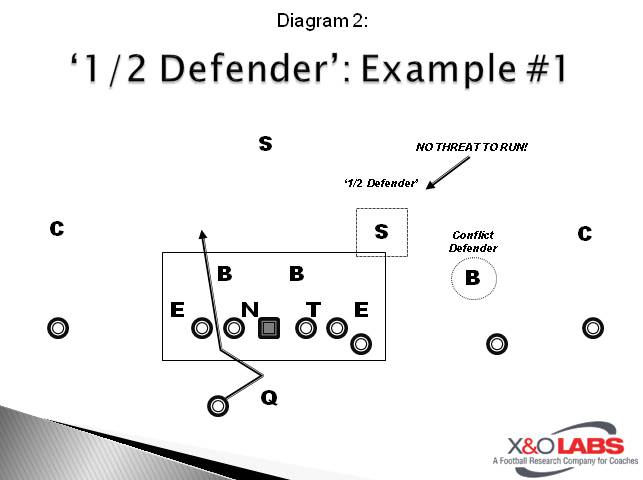
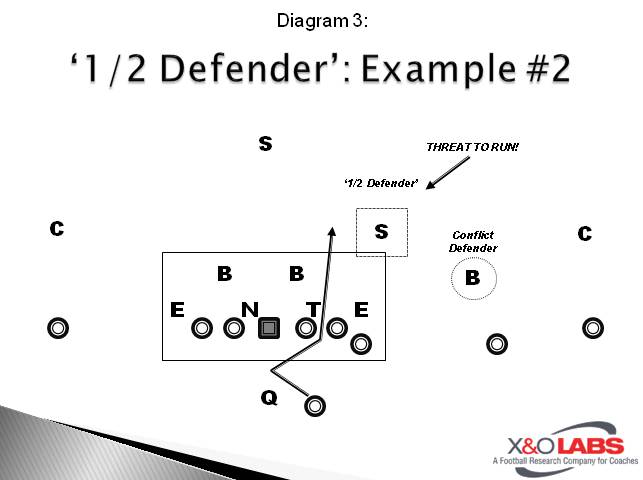
Even with the high pass probabilities, we start with the box first analysis and look to run the ball. At the snap, the decision is completely up to the Quarterback. He must have an understanding how the run play is being blocked. If we are completely outnumbered with blockers vs defenders, his decision to pass is simple. However, if we have what we call a ‘1/2 Defender’ creeping near the box, our quarterback could still hand it off. A ‘1/2 defender’ is a defensive player that we are not accounting for in the blocking scheme beginning to enter the run box (Diagrams 2 and 3). At times, he could double as the ‘conflict’ defender that we base the RPO off, but this is not always the case. Some ‘1/2 defenders’ may not have an immediate threat to our run.

Slide2Slide3

Play Example #1

The RPO used is our Power Gap scheme along with a quick game passing concept. Using the teaching we mentioned above, a 1-High Safety shell, places the decision on our quarterback. He uses his understanding and preparation to determine whether we can still run the ball or throw to matchup based route. The pre-snap defensive alignment shows the backside safety playing underneath the single side WR to take away the quick route and play wide run support. The box count is still 6 on 6 even though the Safeties are not in a 2-High look. Our quarterback knows the run play is still good because the direction of the run is away from the roll down backside Safety. He knows the free safety is playing the pass over the top of the two receiver side, thus handing the ball off is the best option for us in this play, assuming the ‘conflict’ defender does not fall back into the box on the snap of the ball.

Read More

Cultivating a Winning Culture

By Mike Kuchar
Senior Research Manager
X&O Labs
Twitter: @MikekKuchar

Introduction

mccWinning culture is built now. It’s cultivated in weight rooms across the county and emphasized in classrooms where coaches teach character development and the essentials of leadership. Successful coaches understand football is a yearlong endeavor. There is no off-season, just a perpetual process in which student-athletes learn the culture of being successful. Which is why the best coaches are hard at work now instilling what will be the “culture” of their program for years to come.

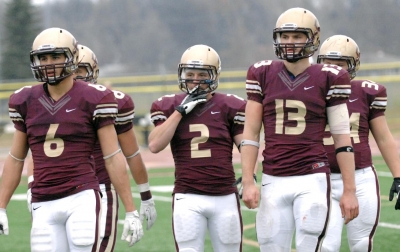

XandOLabs.com researched what winning coaches are doing now, in the off-season, to build successful teams. Our eleven contributors are head high school coaches in eleven separate states throughout the country and boast a winning percentage of .777, winning more than three-quarters of their games throughout their head coaching tenures. Their bio’s are below:

Contributors

• John Black (JB) Head football coach, Neodesha High School (KS)- 39-22 record the last six seasons, six district championships.
• Brian Blackmon (BB) Head football coach, Opelika High School (AL)- 64-26 record the last eight seasons.
• Kellan Cobbs (KC) Head football coach, Granite Hills High School (CA)- Went from 1-9 in first season to 9-3 in 2014 and 9-2 in 2015 finishing with a league championship.
• Kirk Fridrich (KF) Head football coach, Union High School (OK)- 97-13 record in eight years and four state championships.
• Josh Henninger (JH) Head football coach, Red Jacket High School (NY)- 36-5 record last four seasons. Two sectional titles and four league titles.
• Patrick Kane (PK) Head football coach, Hermitage High School (VA)- 148-26 record the last 15 seasons, 11 district championships.
• Clay Iverson (CI) Head football coach, Mukwonago High School (WI)- 81-23 record as a head coach, four conference titles.
• Corey Parker (CP) Head football coach, River Rouge High School (MI)- 56-20 record, five metro conference titles.
• Paul Patterson (PP) Head football coach, Norwalk High School (IA)- 12-2 record last season.
• Mark Raetz (MRa) Head football coach, Northview High School (IN)- 25-7 record at school, three Western Indiana Conference championships.
• Mike Rowe (MRo) Head football coach, Ricori High School (MN)- 48-22 record last four seasons, three sectional titles.

These eleven coaches were asked eight questions on how they have built successful programs. These questions were generated from our readers- on topics that spanned from off-season conditioning to fundraising. These specific questions pertained to:

• How they keep two and three-sport athletes motivated during the off-season.
• What activities they use to develop mental toughness in student-athletes.
• How they teach character education among their players.
• Which fundraisers they use to produce lucrative results.
• How they have built and developed accountability in the classroom among student-athletes.
• What characteristics they look for in hiring new coaches.
• Their philosophy in working with parents and administration.
• What they have done to develop the feeder systems (Pop Warner programs) in their towns to promote football.

The complete transcribed interview is below:

MK: How have you been able to keep you players motivated during the off-season? What things have you done during the winter, spring and summer months to keep multi-sport athletes interested in football?

JB: “We ask our players to get involved in wrestling or basketball. If they are not doing those things then we have after school speed and strength training. Most of our kids are already in a weights class so that is part of their offseason training but we want more. We try to treat them right when they are in there and make it a fun competitive place to be so they want to be there. We also reward them with shirts and other things. We still have problems getting 100% participation. Some of our kids get a job during offseason and they help support their family. We concentrate on getting the ones that are just playing around after school.”

Read More

Developing Off-Season and In-Season Communications

ByX&O Labs Staff
Twitter: @XandOLabs

Introduction:

“As the leader, part of the job is to be visible and willing to communicate with everyone”

– Bill Walsh

No matter how you measure success, a key to finding more of it is better communication. Think about the best coaches you’ve had or know. One thing they all have in common is their ability to engage and communicate. Great coaches communicate in a way that builds relationships, inspires hard work and exudes the mission of their team.

It’s no coincidence that winning often follows.

Yet a lot of really good coaches struggle with communication. There are so many ways to interact with kids, staff and even parents, and we, as coaches, don’t always know the best way to go about it.

Like all good habits, tackling proactive communication requires effort and determination—and maybe a little help in finding the right tools. We set out to find the best aid for helping football coaches to communicate and engage those within their programs.

Here’s What We Found:

A few months ago, a reader of XandOLabs.com shared the name Programax with us. Programax is a coaching app with a wide range of functionality, and promotes its ability to help coaches lead a better program.

It’s a bold claim, so we did our due diligence. As it turns out, Programax is packed with robust features that help coaches to engage, motivate, track and plan across their entire program. In short, we found it can help make your job easier.

We were so impressed, in fact, we decided to share with you a few of the things we really love about Programax.

As a side note, we reached out to the folks at Programax and asked them to provide video clips to show how the app works.

Check it out below, and follow up with Programax at www.Programax.org/football for a more in-depth view of the product.

1. Messaging

We were in search of a tool that helps football coaches with communication. We found Programax to be one of the best options out there in this arena, and really loved the app’s ability to take the legwork out of engaging stakeholders within a program. The app’s messaging functionality allows you to connect with any combination of your program’s coaches, athletes and even parents in seconds via text or email.

For those coaches who use spreadsheets for logging team contact information, take notice: the Programax app stores and organizes it all for you, making it simple to not only communicate with your program, but to access the information you need at any time. We also liked that you can set up custom groups containing those you message most (think captains, assistant coaches, etc.), saving even more time as you send information across your program.
Read More

Defending RPOs Using Assignment Football

By Kyle Bakken
Defensive Coordinator
Concordia College (MN)
Twitter: @KCBakk31


Introduction:

ccWhen we prepare to defend (triple) option, we want to be gap and assignment sound. The majority of the time, we are preparing for zone read offenses that do not incorporate a pitch player. Our approach with the RPO is to take the zone read concept and apply the pitch player responsibility to the #2 or #3 WR.

Each week we face RPOs, we break down the opposing offense and design our calls /stunts and coverages against the give, pull and pitch (pass). In this clinic report, I will describe how we have defended a 2×2 set while playing a cover 2 and cover 3 concept to specifically defend common RPO concepts.

Note: For the purposes of this report, the term “pitch it” will also include the pass as it pertains to run pass option plays.

Defining the Give, Keep, and Pitch Threats/Responsibilities

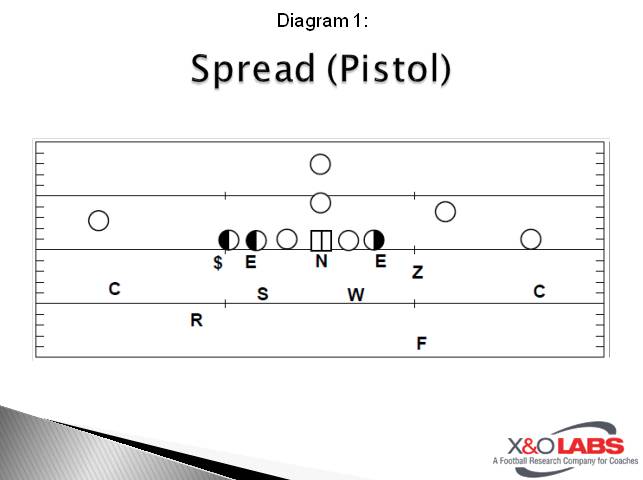
When we are preparing for an RPO opponent, the first thing we look at is the formation and backfield set. In this example (Diagram #1), we see an 11 personnel set with both pistol and offset backfields.

Slide1

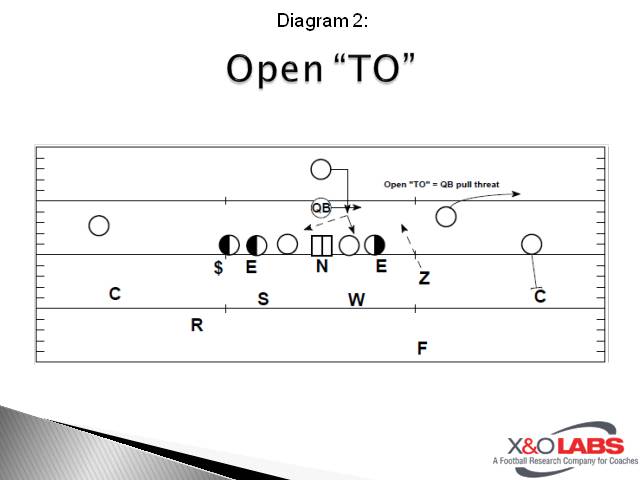
We treat a pistol backfield as a balanced backfield with an option threat in either direction as the QB has the option to open either way. From there, we identify the bubble/pass threat side in the formation which will lock in the defenders keys based upon which way the QB opens. Against the pistol, the keys must be post snap and will be based upon which way the QB opens. We give our LB’s a QB “to” or QB “away” triggers out of a pistol set to help define for them responsibilities both to and away from the run threat. When the QB opens to a particular side, there will now be QB threat with a pull and pitch option to that side and the players will respond accordingly (Diagram #2).

Slide2

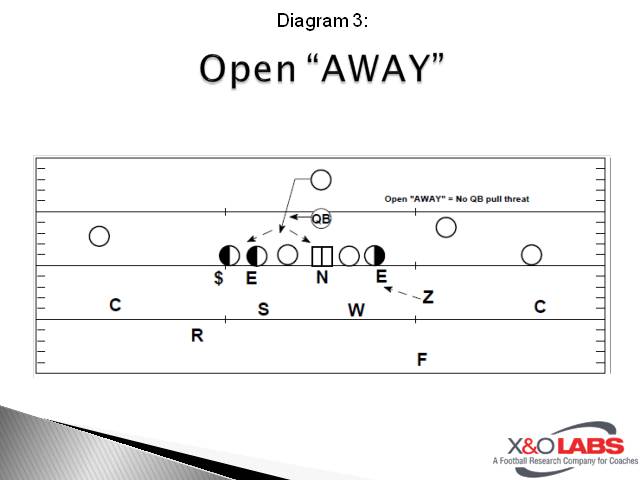
When the QB opens away, the players know that they do not have a QB pull threat. (Diagram #3).

Slide3

To study game film of this concept, click on the video video below:

Read More

Structuring QB’s Pre-Snap Options

By James C. Gower
Offensive Coordinator & QBs Coach
James Madison High School (Houston, TX)
Twitter: @gower_james


Introduction:

madisonMy offensive philosophy, as well as the topic of this clinic report, is calling the next play as quickly as possible, while giving your QB as many options as possible. We all hate calling a play that we think will work only to see that the defense has changed, making the play you called a bad play. To get out of the bad play, you either have had to teach your QB all kinds of audibles, or you call a time out. I want my players, and our QBs especially, to just play the game. Therefore, I do not teach them to do any kind of audibles. Instead, I teach our QBs, “the offense is like going to a restaurant; they give you a menu, and you order what looks good.” 
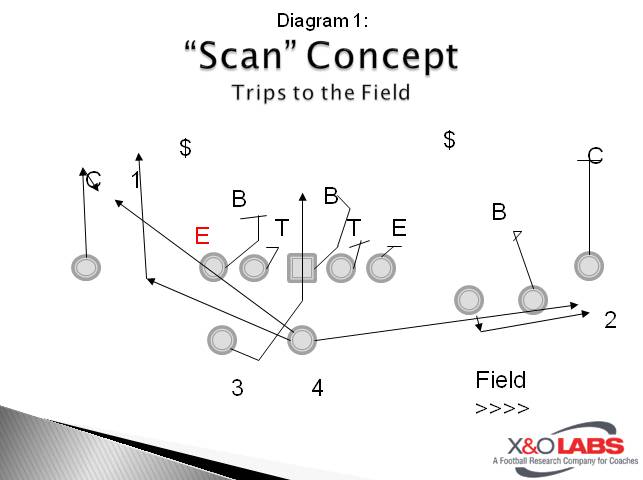
Scan (Pre-Snap)

90% of our run game is the inside or outside zone. In addition, we like to match our quick game passes and screen game to our inside zone to give the QB pre-snap options. By simply adding a tag onto our run game call, we give our offense multiple opportunities to take what the defense gives us. With a simple “Scan” call, our QB/WRs have pre-snap options.

Our WR rules on “Scan” are as follows:

  • Multiple Receiver Side – The inside receiver runs the bubble and the outside receiver(s) block most dangerous man. It should be noted that we do not count an attached TE whether he is on/off the line of scrimmage. The TE is involved in the run game called.
  • Single Receiver Side – He will run a six yard Hitch. Again, we do not count an attached TE as he is involved in the run game called.

Slide1

I teach the QB the following pre-snap progression:

  1. Hitch
  2. Bubble
  3. Inside Zone (reading the end man on the line of scrimmage)

Therefore, on our inside zone to the right call with a “Scan” tag, four different people can get the football.

Read More

Eight 4-2-5 Pressures to Defend Wing T Run Schemes

By Mike Kuchar
Senior Research Manager
X&O Labs
Twitter: @MikeKKuchar

Introduction

The following research was conducted as part of X&O Labs’ special report on “Defending Unconventional Offenses.” Insiders members can access the full-length special report, login here.

Movements to Defend Wing T Run Concepts:

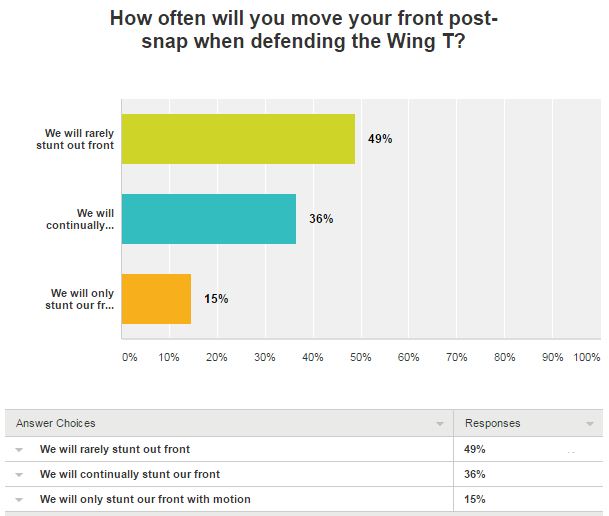
There seems to be conflicting opinions on whether or not to move the defensive front post-snap when defending the Wing T. According to our research, 49 percent of coaches choose not to move their front post-snap when defending the Wing T run game. While 35 percent will continually move their front and 16 percent will only stunt with motion.

graph11

Movements in Four Down Fronts:

Sparta High School, a perennial public school powerhouse in New Jersey has had success defending Wing T run game from its 4-2-5 front by mixing in several post-snap run movements by its first level defenders. On almost every play, Defensive Coordinator Christopher Kappelmeier will make sure one or more of his defensive linemen will be stunting into the adjacent gap or across the face of the offensive man and he’ll teach the proper stunt technique early in the preseason and practiced regularly. Many of them are gap exchanges which include second level linebackers as well.

“The linebackers need to know which gaps the defensive linemen are stunting into at all times because they will need to fit those gaps that are opened by stunting linemen should the flow head in that direction,” said Kappelmeier. “By moving our defensive linemen and linebackers on most plays, we make it very difficult for offensive linemen to execute their blocking schemes, particularly man or gap blocking schemes like the Wing-T.

“At Sparta when we practice our gap exchanges we do it during the inside run period. It is vital that the stunting linemen and linebackers be able to read and react while moving. Defensive linemen learn by repetition to read the offensive linemen toward whom they are stunting. Linebackers learn by repetition how to fit open gaps and not get caught between stunting defensive linemen. We have found that the movement of the defensive front, even if it doesn’t seem to be fundamentally sound on paper, very often creates situations in which defenders are totally unblocked and in position to make big plays. Pre-snap we try to look the same every play. The only player who may need to change his alignment is the nose. If he is stunting into the B gap, he aligns in a 2i-technique. This does not telegraph his intention to stunt because that is his alignment in the tight G front which is used often.”

Read More

Spread Gap Schemes Study – Case 1: Blocking Concepts

By Mike Kuchar
Senior Research Manager
X&O Labs
Twitter: @MikekKuchar


Introduction

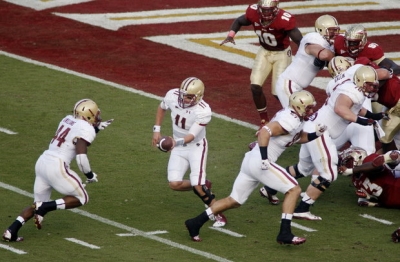
bcfbIt may have been last spring when sitting at an exclusive “high school coaches” only clinic with Boston College head coach Steve Addazio when I was enlightened into the origins of utilizing gap schemes from open sets.

Coach Addazio, who won two national championships as Urban Meyer’s offensive line coach at the University of Florida, recalled a conversation he once had with Coach Meyer before the first championship season in 2006. “I remember thinking that we didn’t have the size up front to go toe-to-toe with some of the defensive units we faced in the SEC that season,” Addazio recalled. “We couldn’t just hang our hat on the Inside Zone play. So, I called Urban and told him we’ll need to do something different. We knew we had an abundance of speed on the perimeter and at our skill positions, so we didn’t want to commit to a whole sale change of bigger personnel groupings. But, we had to create angles and generate misdirection up front.”

The answer lied in using down/kick principles up front, but at the same time keeping speed on the field. So, Coach Addazio and Coach Meyer went to work in keeping 10 and 11 personnel groupings to run concepts like Power and Counter.

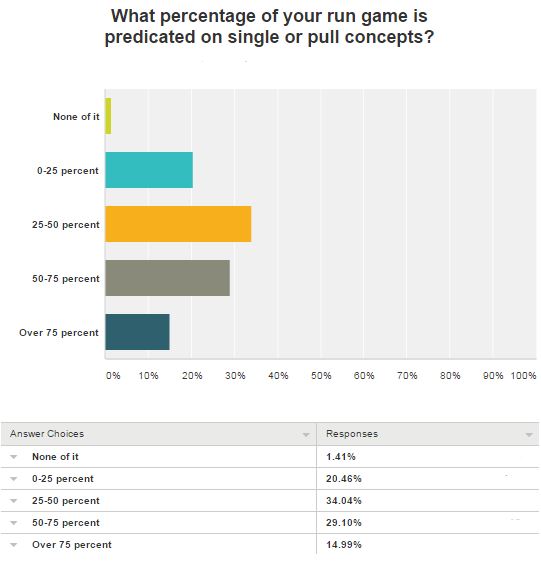
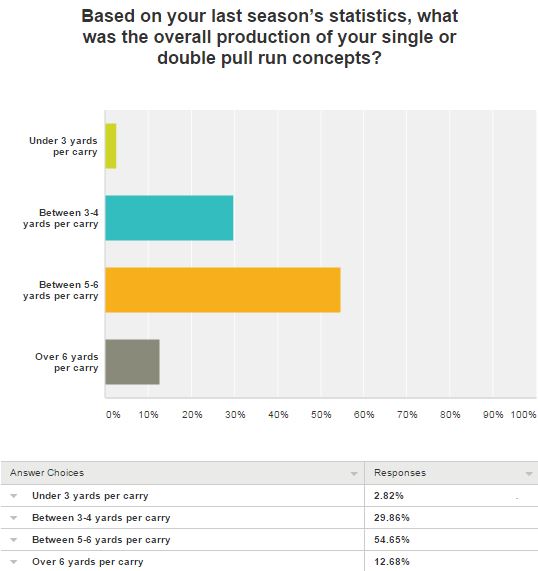
The results spoke for themselves. Two rings later, Urban Meyer and Steve Addazio’s Gators created another viable options for spread offenses to effectively run the ball. Fast forward nearly a decade later and FBS programs such as Auburn University, University of Mississippi, University of Houston (to name a few) and Coach Meyer’s new staff at The Ohio State University have used these Gap concepts from single digit personnel groupings to establish a dynamic run game. The fact is, Gap run schemes from Spread personnel groupings account for over 50 percent of the run game implemented in Spread coaches’ menus (Graph 1 Below). Of these coaches, 54 percent averaged between 5-6 yards per carry on their single and double pull Gap concepts (Graph 2 Below).

graph1

graph49

This study is centered around the three main Gap schemes offensive coaches are using from Spread personnel groupings, which we classify as the following groupings:

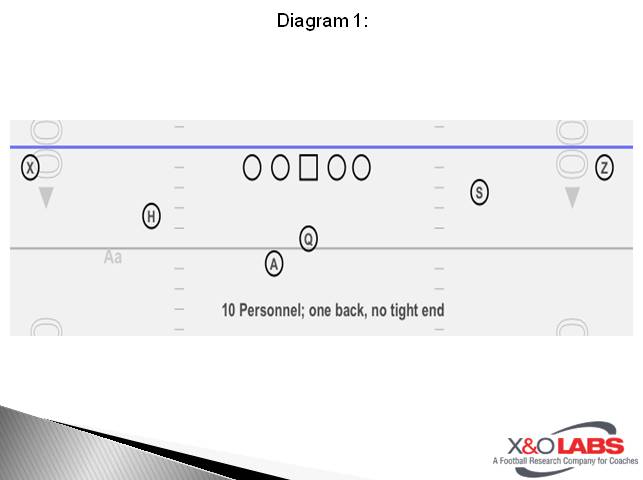
  • 10 personnel (one back, no tight end) (Diagram 1)
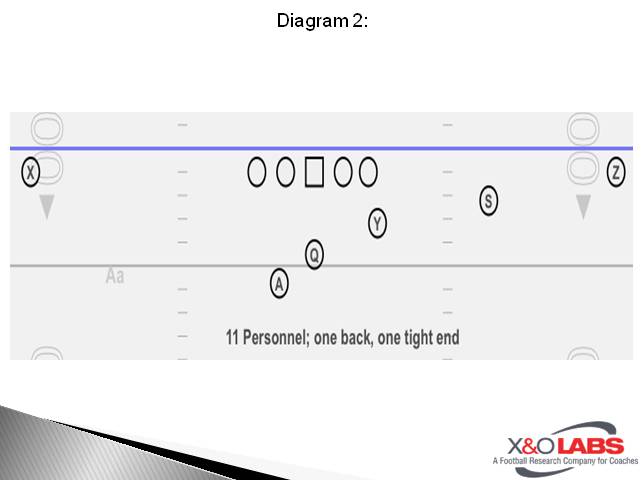
  • 11 personnel (one back, one tight end) (Diagram 2)
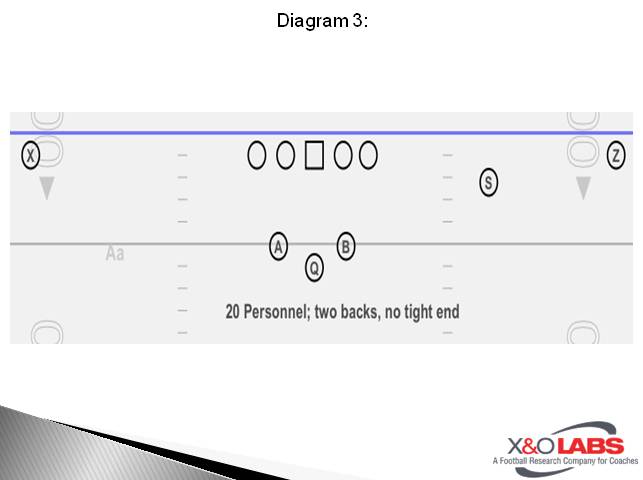
  • 20 personnel (two backs, no tight end) (Diagram 3)
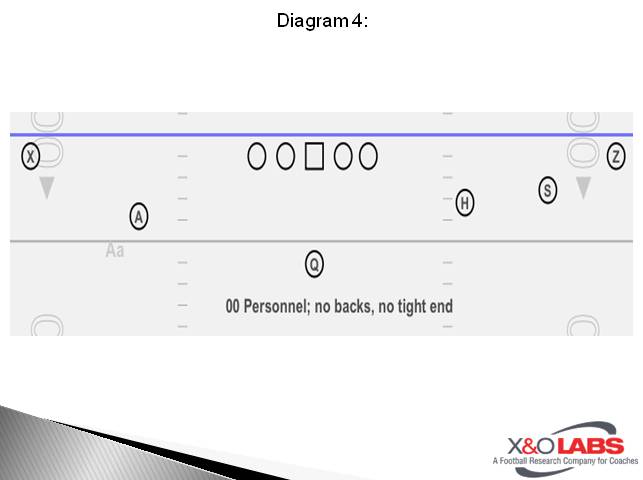
  • 00 personnel (no backs, no tight ends) (Diagram 4)

Slide1Slide2Slide3Slide4

These run concepts consist of:

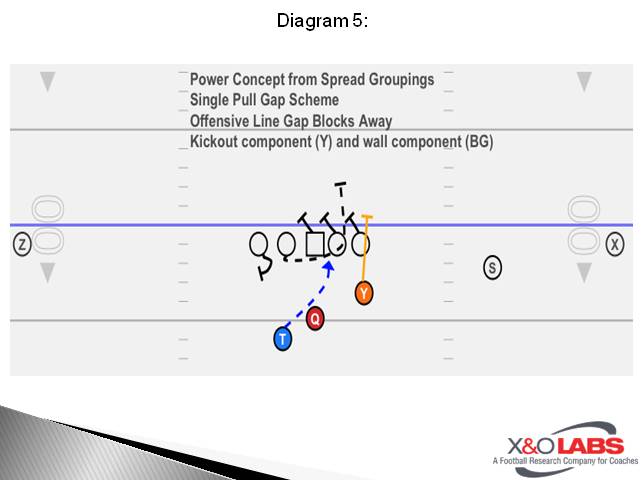
  • The one-back Power concept (Diagram 5)
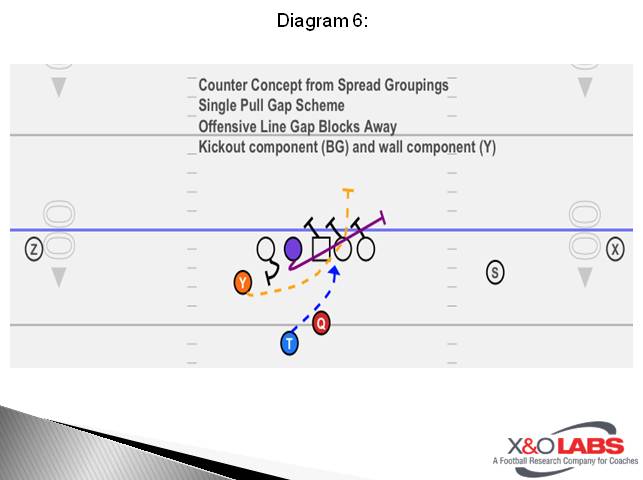
  • The one-back Counter concept (Diagram 6)
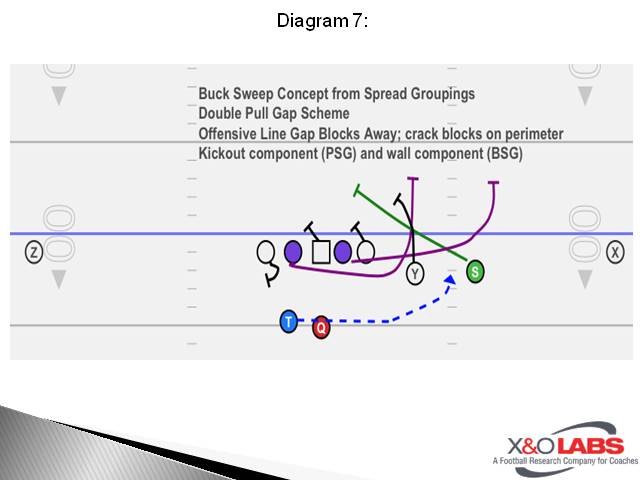
  • The Buck Sweep concept (Diagram 7)

Slide5Slide6Slide7

While each of the following cases in this study deal specifically with these particular run concepts, we wanted to compartmentalize our research in this case by singling in on the types of blocks that these Gap concepts utilize and how successful coaches are teaching these types of blocks to their players. Some of the coaches we spoke with use all of the three run concepts above, while others use one or two of them. Whatever gap concept is utilized, the following types of blocks must be utilized:

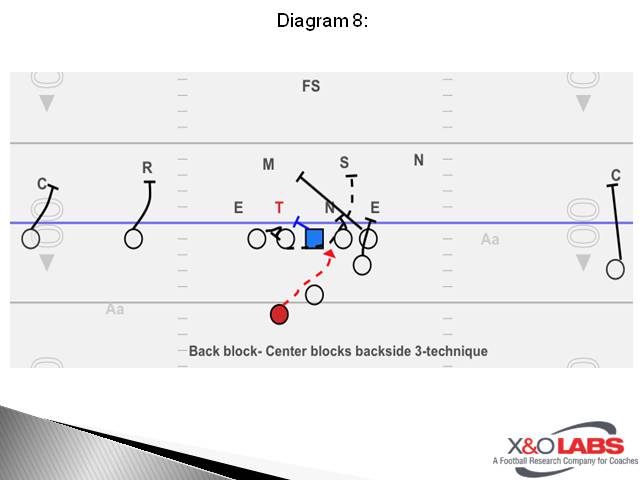
  • A single down block or back block such as Center would execute on a back side 3-technique (Diagram 8).
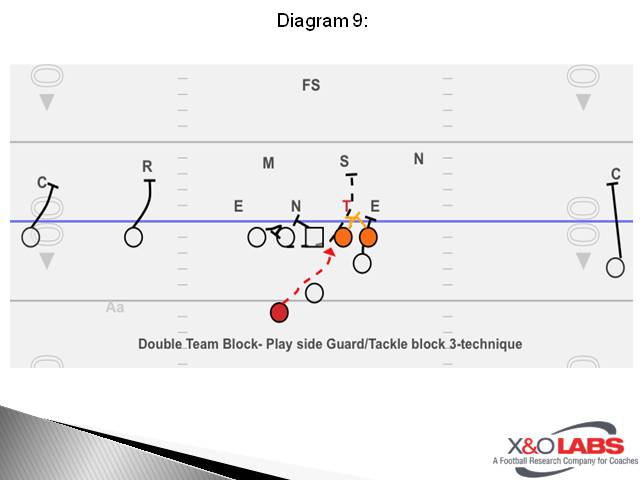
  • A double team block at the point of attack such as guard and tackle on a play side 3-technique (Diagram 9).

Slide8Slide9

Read More

Spread Gap Schemes Study – Case 2: The Single Pull Power/Power Read Concept

By Mike Kuchar
Senior Research Manager
X&O Labs
Twitter: @MikekKuchar


Introduction:

noufbThe single pull Power concept was the most utilized run concept out of Spread personnel groupings, with 89 percent of coaches using this scheme. What’s more is that over half of the coaches that responded to our survey have averaged between 5-6 yards per play on this concept alone. While the power scheme may be one of the eldest run concepts in football, how these spread coaches are formationing the scheme to reach maximum efficiency continues to be of interest. The Power concept is the truest in the form of a gap scheme because it produces the “down, down, kick” component that these gap concepts employ.

General Blocking Assignments:

Before presenting our research on what we found to be the most advantageous formations to run the one-back power concept, as well as the mesh points and reads that encompassed with the scheme, we felt it necessary to present the general blocking rules of the scheme from each of the programs that we researched.

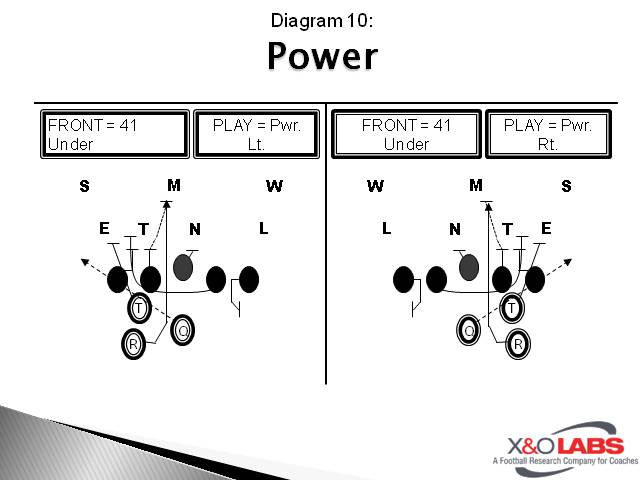
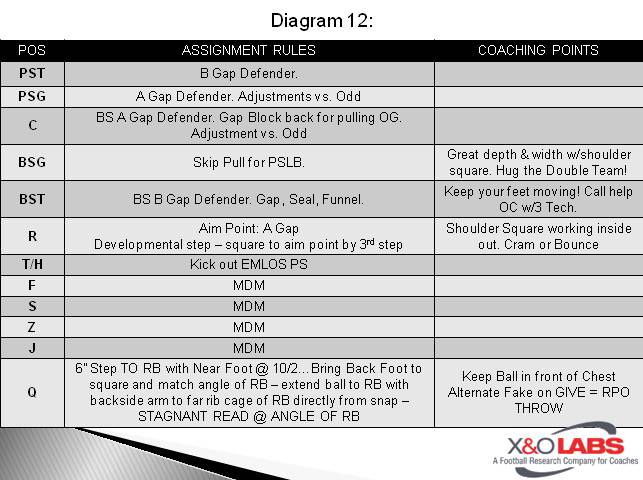
Ohio Northern University (Diagrams 10 and 11)

Slide10Slide11


PST (play side tackle): B Gap responsibility/Double 2-3 technique/Gap climb v. 2I-1-0 technique… stay square.

PSG (play side guard): A Gap responsibility/Double 2-2I-3 technique with PST/Block down on 1 technique/Double 0 with OC.

OC: Back side A Gap responsibility/Block back on 1-2-3 technique/Double 0 with PSG.

BSG (back side guard): Lead Pull/1st Defender outside widest down block.

BST (back side tackle): Back side B Gap/Gap hinge.

PSTE (play side tight end): If PST Covered (4-5 technique) C Gap responsibility/Double team with PST. PST uncovered (7-8 technique) D gap responsibility. Block first defender outside Level 1 or Level 2.

PST uncovered (9) C gap responsibility…Gap step – climb square…Block 1st gap threat…anticipate run thru.

H: Kick first defender outside widest down block.

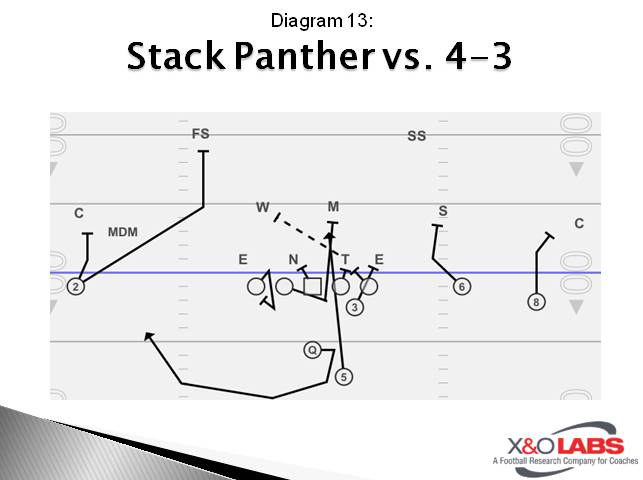
Shiloh Christian High School (AR) (Diagrams 12-13)

Slide12Slide13

X: Split: Top of the numbers (as tight as 6 yards from tackle). Dig out backside flat defender.

H: Alignment: Rip/Lip; Kick out the C gap defender using 3 step kick footwork aiming at inside number.

Y: Split: -2 (as tight as 6 yds. from tackle); Dig out play side flat defender.

Z: Split: 2 above the numbers; stalk cornerback.

PST: Down B gap to 2nd LB in the box (Deuce Back).

PSG: Down A gap to 2nd LB in the box (Deuce Back).

C: Down 1st defensive lineman backside.

BSG: Skip pull (shoulders parallel) and wrap for first LB in the box.

BST: Zone fill B gap (pick and hinge).

Choate Rosemary Hall (CT)

PSY (play side Y or H back): Block play side C gap player.

PST: B gap or backside ILB, sift if odd.

PSG: Block A gap or backside ILB.

Read More

Spread Gap Schemes Study – Case 3: The Double Pull Counter/Counter Read Concept

By Mike Kuchar
Senior Research Manager
X&O Labs
Twitter: @MikekKuchar


Introduction:

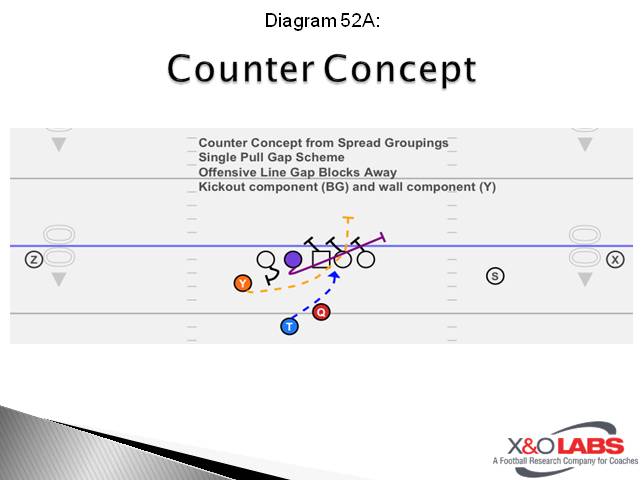
Chances are if you’re an offensive coach that utilizes the Power concept, you also have the Counter concept on your menu. It makes sense, particularly if you are using sniffer formations. While some offensive coaches feel that the Counter concept is the stepbrother of the Outside Zone scheme, formationally it marries up with the Power scheme because of the positioning of the sniffer, or B back, in one back offenses. In the Power scheme, that player is responsible for kicking out the C gap defender to the play side whereas in Counter schemes, this same player is assigned as the lead puller to the backside (Diagram 52A). We found that nearly 67 percent of coaches use the single pull counter concept in Spread personnel groupings. In this case, we will research the blocking assignments of the concept, the most preferable formations to run the scheme, how coaches are tying the sniffer into the formation as well as mesh points, ball carrier aiming points and the read concepts coaches are marrying into the counter scheme.

Slide52A

General Blocking Assignments:

For the most part, the Counter concept is similar to the Power concept because it’s a “down, down, kick” gap scheme that leaves the C gap player to be kicked out (mainly by the back side guard) and the play side inside linebacker to be walled (mainly by the Y/H). While we’ve found that there are some coaches like Lance Parker, the offensive coordinator at Bryant High School (AR), who prefers to pull the backside tackle based on defensive personnel or front, most coaches will stick to using the backside guard as the kick out block. We detail the coaching points that coaches are giving that player later on in this case.

“Leave Two” Blocking Scheme:

We’ve spoken with several coaches who use the “leave two” principle in blocking the Counter scheme. This means that the offensive line will leave the last man on the line of scrimmage and the next defender inside to be kicked and walled respectively. According to Nassau Community College (NY) quarterback coach Greg Lauri, this helps the offensive lineman for identification purposes. “The last man on the LOS will either be kicked out by the fullback or the TE, or we can read him as part of our RPO package” said Coach Lauri. “The first play side linebacker is for the pull player.”

Sprint Blocking Rules:

One of the more interesting ways we’ve researched how to block the Counter concept is what Coach Parker is doing at Bryant High School (AR). Rather than blocking the Counter as a gap scheme, Coach Parker prefers to use sprint out blocking rules along his front. The illustrations below are how Coach Parker looks at a Counter play to the left (Diagrams 53-54). The line down blocks and works up to the number two linebacker in the box while someone always pulls to kick the end man on the line of scrimmage. To the front side, his rules are common and he follows the “gap, down, backer” moniker. But to the backside of the scheme, Coach Parker has his players block it like sprint protection instead of gap hinging. It meshes with sprint out protection which he uses a good deal of in his offenses. It maintains continuity up front. “When we gap hinge, I feel like if you try to cut the gap off, you give them the short edge where if they want to pin their ears back and chase you down on a slow developing play the can,” said Coach Parker. “The Mike can get to you and ruin the play. We force them to ‘run the hump’ more than anything else. Not everyone is going to get there.”

Slide53Slide54

At Bryant, Coach Parker uses both a guard and tackle kicking the end man on the line of scrimmage. “Our guard kicking version netted more on our runs to our running backs,” said Coach Parker. “But I think the tackle kicking version works out better for our protection rules and for our Q draw scheme. There are advantages and disadvantages to different varieties of Counters. Your choice will largely be on what you’re trying to accomplish, defenses you face, and your personnel. Maybe our opponent that week reads guards and you could pull a linebacker off a route. Maybe the safeties read tackles and will bite down on the run. Depending on what we were trying to accomplish against our opponent, we used both versions. We called regular counter runs 8 to 10 times a game averaging about 8 yards a carry. We have to protect the effectiveness of that play.”

His line rules for Counter are gap, down, backer. The backside tackle pulls to kick the end man on the line of scrimmage. “Our line works to number two at linebacker level,” said Coach Parker. “Depending on whose gap is uncovered determines who works up. The key to us getting on the right guys is identifying where number two is. We also tell the lineman working up to number two, ‘if you have an angle for number one, you may get him but do not chase him out.’ This scenario comes up with 3-4/4-2-5 teams that play their backers tight over the guards. When in doubt, our linemen know they will always be right blocking number two.”

Read More

Spread Gap Schemes Study – Case 4: Double Pull Buck Sweep Concept

By Mike Kuchar
Senior Research Manager
X&O Labs
Twitter: @MikekKuchar


Introduction:

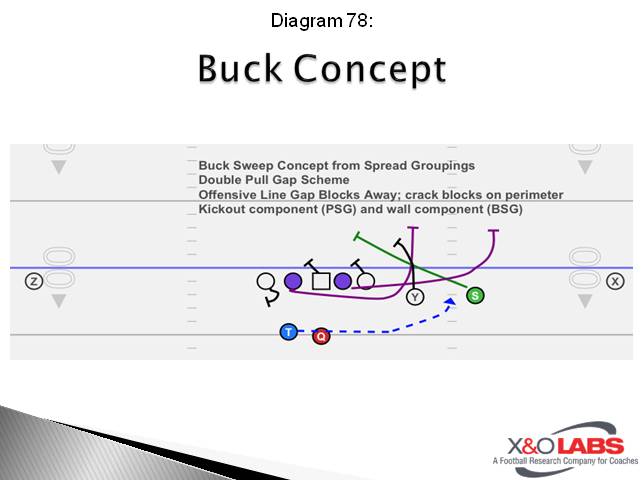
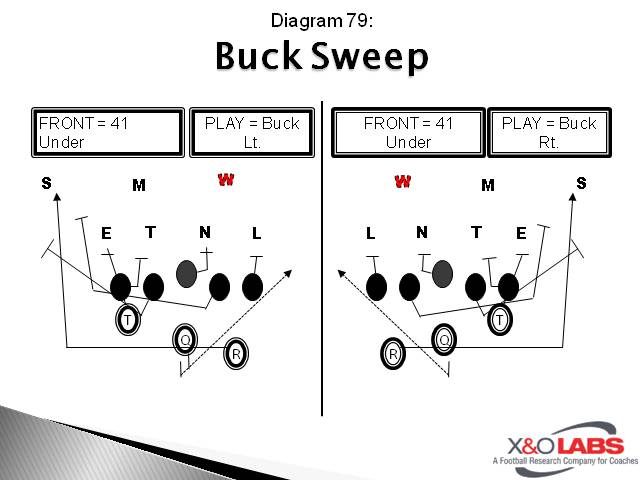
afbOne of the more popular Double Pull run concepts that has started to gain traction among Spread coaches is the ageless Buck Sweep, first originated in the days of Tubby Raymond and University of Delaware units. What once was purely a two to three back run concept has found itself into the menus of many Spread-based systems including Auburn University head coach Gus Malzahn who has been using the run since his days at Shiloh Christian High School in Arkansas. At it’s core the Buck Sweep toes the line between a gap and man run concept that combines crack and down blocking at the point of attack with the pulling of both guards (Diagram 78). Now after conducting extensive research on this concept, which we present below, we did find that some coaches are shifting from the traditional means of crack blocking into more pull/kick elements.

Slide78

According to our research, we found that 41 percent of Spread coaches run the Buck Sweep as part of their run game. We did notice that this concept continues to gain popularity considering the success of programs such as Auburn University, Clemson University and the University of Mississippi, which use this scheme frequently as part of their offensive arsenal.

In this case, we present our research on the varying blocking assignments of the scheme, how coaches are formationing the concept to attain optimal results, the preferable QB/RB alignments and mesh points, the technique behind the crack and pull blocks as well as the Read concepts that coaches are using off the base run.

General Blocking Rules:

As mentioned previously, we found a discrepancy between coaches that decide to use crack blocks at the point of attack in their Spread sets and coaches that don’t. There are, of course, Coach Raymond disciples such a George Najjar the former head coach at Sayreville High School (NJ) who choose to formation the scheme to outflank the defense which may alleviate the necessity of a kick. There are others like Mike Schmitz, the offensive coordinator at Ohio Northern University, who feel that the block of the H on the crack “ignites the scheme.” Below are the general blocking assignments on the Spread Buck Sweep concept from various contributors.

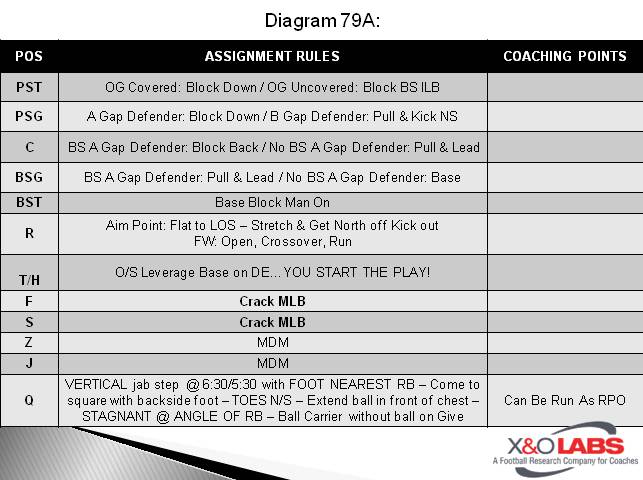
Ohio Northern University: (Diagram 79 and 79A)

Slide79Slide79A

PST (play side tackle): PSG (play side guard) covered: Block down/PSG uncovered…B gap and climb.

PSG: Block down on A gap defender/No A gap defender…pull and kick apex defender.

OC: Backside A gap defender: Block Back/0 technique: Block Base/Uncovered: pull and lead through alley.

BSG (back side guard): Backside A gap defender or 0 technique: Pull and lead through alley/No backside A gap defender: Base.

BST (back side tackle): Base or cut backside 3-technique.

H (or tight end) Block – outside leverage base block.

Shiloh Christian High School (AR):

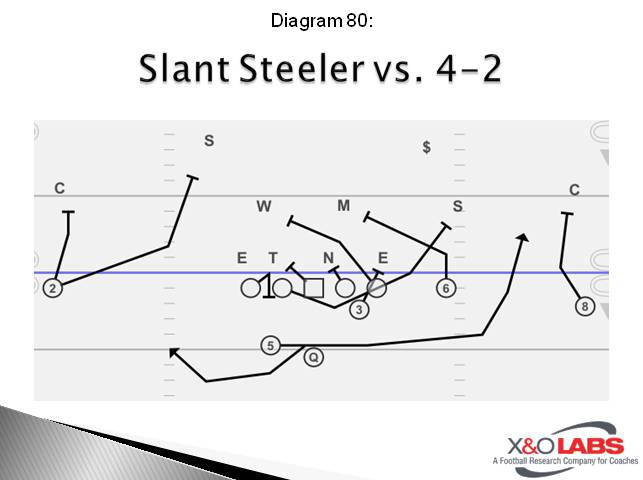
Jeff Conaway, the head coach at Shiloh Christian High School (AR), studied under Coach Malzahn and he feels that Buck Sweep is another “downhill attitude” play in his system, particularly if the defense is attempting to crowd the box. Below is how Coach Conaway blocks the concept from his Stack formation. He calls the concept “Steeler.”

Slide80Slide81

QB: Flash-mesh, hand ball, naked away.

X: Split: Top of the numbers (as tight as 6 yds. from tackle) dig out backside flat defender.

H: Alignment: Rip/Lip; Attack the midline of the C Gap defender, working to seal. Must not give up any penetration or allow C gap defender to stretch it horizontally.

Read More