


4-2-5 LB Play: Case 4 – California University’s (PA) Fit Concept Methodology
By Mike Kuchar
Senior Research Manager
X&O Labs
Twitter: @MikekKuchar
The California University Methodology:
 While defensive coordinator and linebackers coach Mike Lopez teaches his players about gap integrity, he puts more of a premium on teaching them fit concepts. The Vulcans specialize in eight man front football out of its 4-2-5 structure, which means each second level player will have to know the following fit responsibilities- plug, cutback, force and fold. Because he will vary the placement of the 3-technique post-snap by using several different fronts, every linebacker and safety in his system are taught these fit concepts and the techniques used to associate with each. In case four, Coach Lopez details those fit concepts as well as the three different fronts he will use to set his first level B-gap player against one-back offenses.
Source: Mike Lopez, defensive coordinator/linebackers coach
Accolades:
- 5th nationally in rushing defense at the Division 2 level, surrendering 2.67 yards per rush.
Introduction:
California University and its defensive staff (Dave Cole, Thomas Rebholz, Jr., Jessie Byrd) considers itself to be a multiple personnel, multiple front operation. Since much of what it sees is 10, 11 and 20 personnel, it spends most of its time in Nickel and Dime defense. For the most part, the Vulcans are a four under, three deep, middle of the field closed defense, which relies on boundary rotation where the free safety (who aligns to the boundary) is the extra run fitter.
As far as personnel, California University plays with a field inside linebacker (Mike) and a boundary inside linebacker (Will) as well as with a Nickel or Sam, a strong safety and a free safety. They use travel parties- the Mike, Strong Safety and Nickel (or Sam) travel together while the Will and Free Safety travel together. Up front, the Rush and Tackle travel together while the Nose and End travel together. The strength could be called to the field if on the hash or the passing strength if in the middle of the field (Diagram 57).
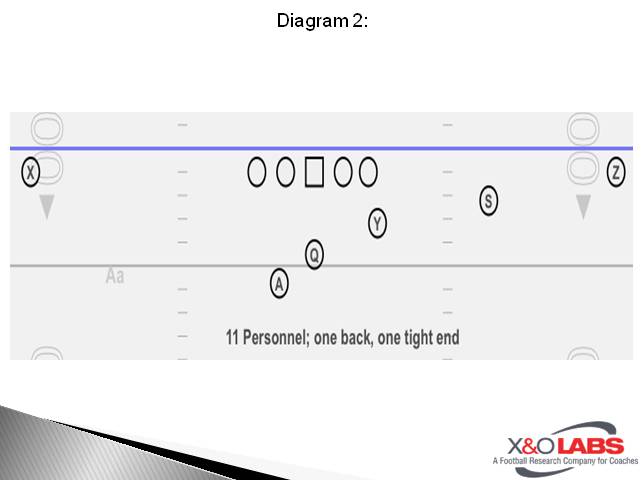
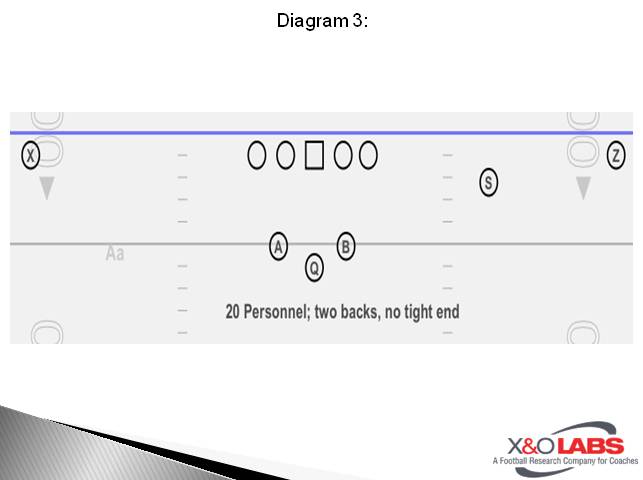
Editor’s Note: In all of the diagrams below, the Nickel should be aligned head up on the number two receiver while the Strong Safety will apex the tackle and slot receiver against two-wide sets, and apex the number two and number three recevier against three-wide sets. The Free Safety will align outside the end man on the line of scrimmage.
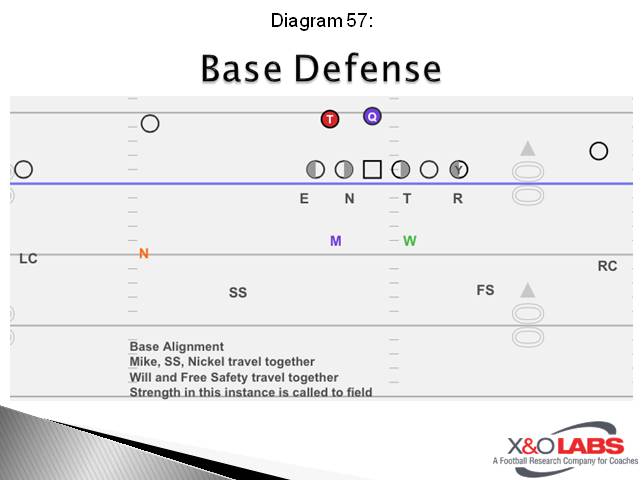
Coach Lopez streamlines his teaching into reinforcing concepts as well as gap responsibilities. Against the one-back run game, he teaches only two flows: fast and direct. Either the run is coming toward you or away from you. Within those two flows, the following run fit terms are enforced:
Force Player- Player resonsible for forcing the ball back inside.
Plug Player- Player responsible for taking his gap right now.
Cutback Player- Player reponsible for tracking the hip of the ball carrier to play any cutback.
Fold Player- Player who is an extra (bonus) player in run away. He will execute a shuffle, shuffle technique and fold in late on the ball carrier.
The Mike, Will, free safety, nickel and strong safety learn all of these fit concepts, which are described below.
Linebacker Pre-Snap Protocol:
Coach Lopez teaches three different types of alignments for his two linebackers: gap, rob and pull. Gap is used in 2×1 sets where the linebacker to the two receiver side is in a 40 alignment- the inside shade of the offensive tackle- while the backer to the single width side is in a 20 alignment or inside shade of the offensive guard he is aligned on (Diagram 58). Rob is used in 2×2 sets where the Mike and Will both align in 30 techniques (Diagram 59). Pull is used in 3×1 sets where the field backer will play in a 50 alignment (outside shade of the tackle and the Will aligns in a 10 technique (stacking a shade) (Diagram 60). As far as a pre-snap key, Coach Lopez talks to his players more about the triangle to vision points. Against one-back formations, Coach Lopez, the triangle is the peripheral vision of the guard, tackle and tailback. He will have the back as a secondary key and specifies on reading the hips of the back to decipher whether it’s a tight Zone scheme like Mid Zone (which is considering direct flow) or a wide Zone scheme such as Outside Zone (which is considered fast flow). It’s more of a concept-based system than teaching a gap methodology.


 The dual threat quarterback is becoming more and more commonplace in today’s game. Whether it is Cam Newton or Russell Wilson in the NFL, or the countless quarterbacks in the college and high school game, the position is moving to individuals who can be explosive with both their arm and legs. From a coaching perspective, the idea of having a quarterback that can break a simple run 80-yards for a touchdown is at times just as much of a ‘bailout’ for an offense as an Run/Pass Option is for a bad play-call.
 Here at SUNY Maritime we play an aggressive 3-4 slant/angle defense with a 2 high look from the secondary. We play a variety of different coverages but our favorite to pair with our 6 man pressures is over 3 over 2 “Hot” coverage. We like to bring our 6 man pressures against 10 personnel sets in order to force the quarterback to get rid of the ball quickly.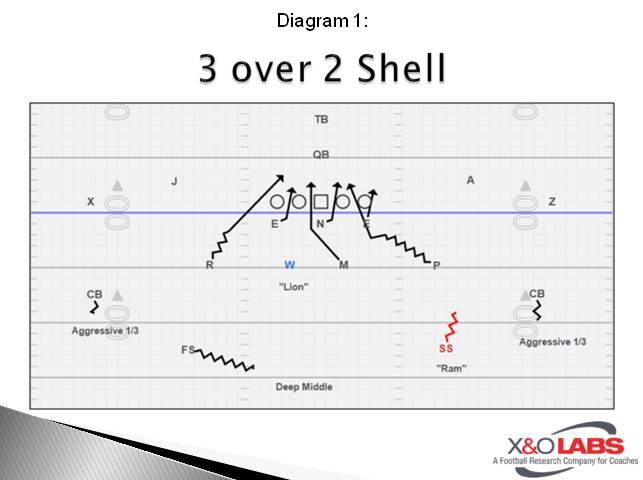
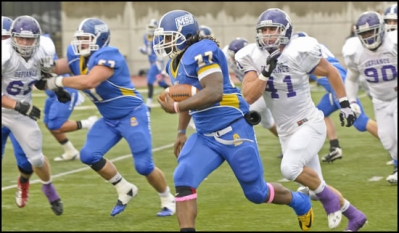
 One of our favorite concepts here at Mount St Joseph is the “split end power” that we run away from trips in 3×1 formations. We are attempting to control the box by adding a pass option component to our split end run play. Like any other version of option football, we are working to outnumber the defense by adding this run pass option concepts (RPO). Offensive coordinators are always looking for easy completions and using the split end power will give you easy completions on 1st and 2nd down run situations.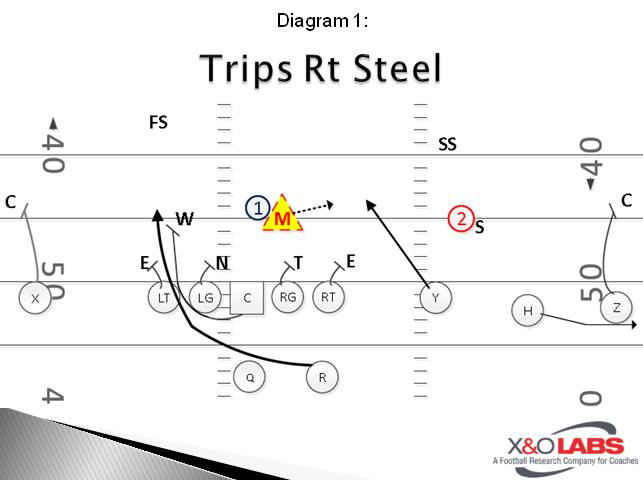
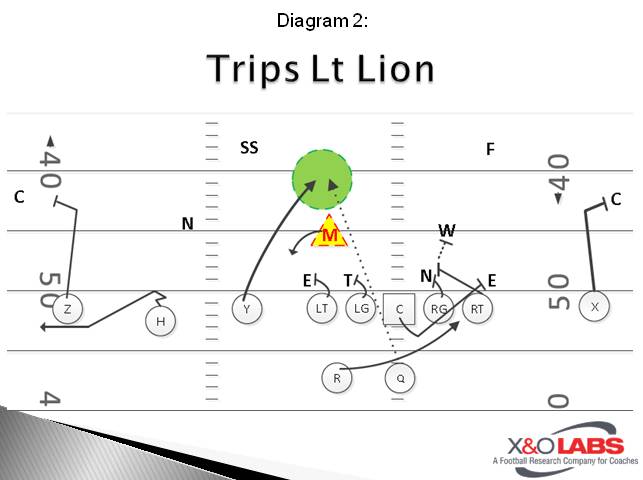
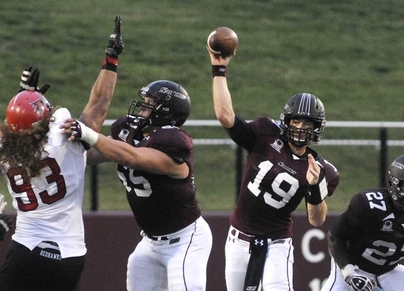
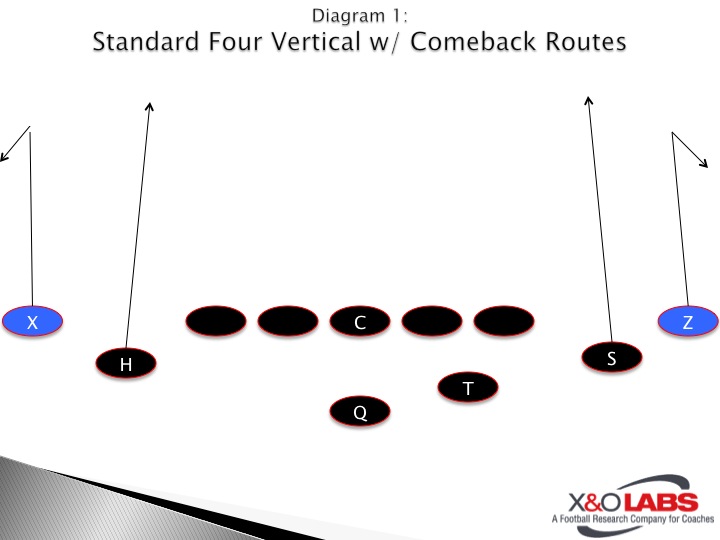
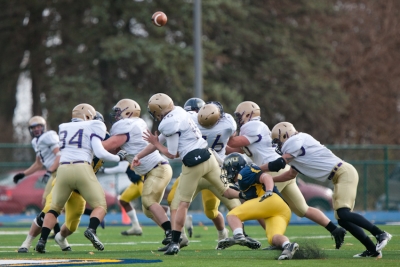
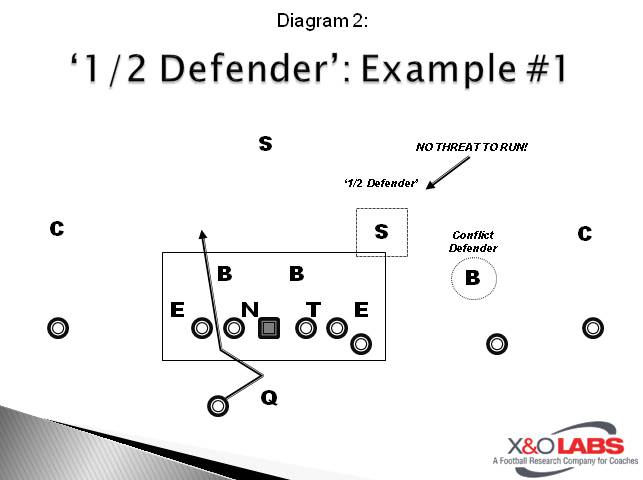
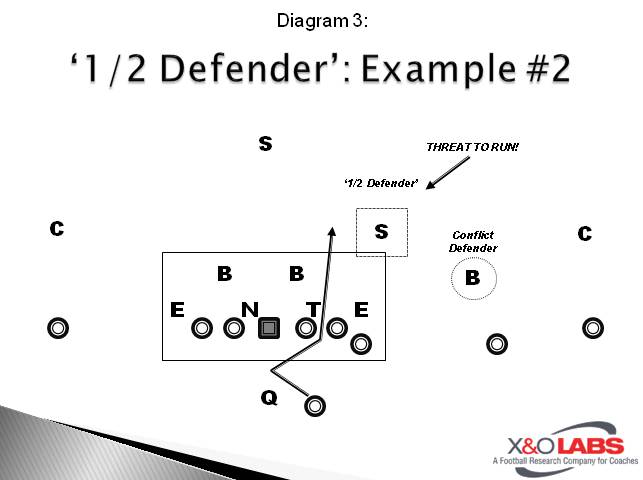
 With increased popularity of RPO plays on offense, thus too have been the improved defensive techniques from the second level to try and stop them. Here at Loras College our staff has found ways to give our offense the best chance to succeed using the third level (or safety level) as the focal ‘read’. Our RPO’s generally use the second level, or linebackers, as the ‘conflict’ defender. That said, defenses have responded by having their ‘read’ defenders faking or bluffing their intent. An example might be a ‘conflict’ defender showing inside the box alignment and bailing out into a pass lane then subsequently aligning wide and shooting an interior gap on the snap. Stationary ‘read’ keys are much easier to define for a quarterback than those always moving around. We use third level defender alignment, depth, and eyes to help our quarterbacks determine where to go with the football. In this report we will outline a few of the play examples exclusively using 20 personnel (1 RB, 1 Hybrid, & 3 WR’s) in which we read third level defenders. These examples were successful for us this past season.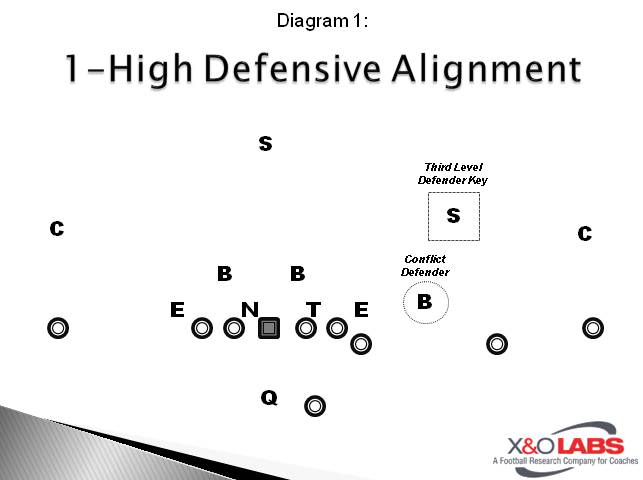
 Winning culture is built now. It’s cultivated in weight rooms across the county and emphasized in classrooms where coaches teach character development and the essentials of leadership. Successful coaches understand football is a yearlong endeavor. There is no off-season, just a perpetual process in which student-athletes learn the culture of being successful. Which is why the best coaches are hard at work now instilling what will be the “culture” of their program for years to come.