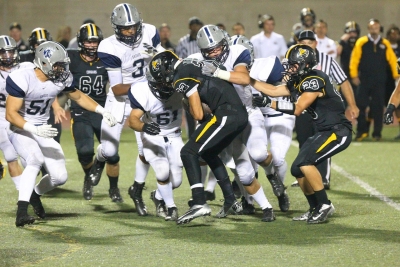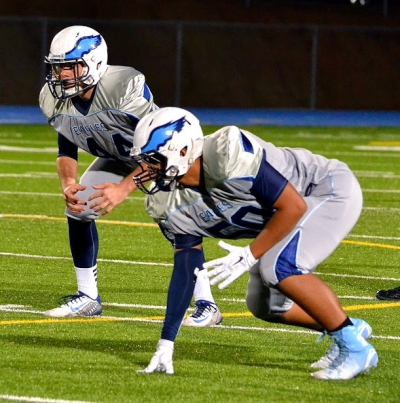

Odd Front vs. the Run – Case 3: Closed Side Defensive End Techniques vs. 3 Man Surface Runs

By Mike Kuchar
Senior Research Manager
X&O Labs
Twitter: @MikekKuchar


Introduction

The presence of a closed tight end may raise some concern for odd front coaches and for good reason: it creates an extra gap along the front. So in order to account for that space, we found that 45 percent of coaches will use a 5-techinque alignment with that player. This was only four percentage points lower than the 4-techinque alignment, which was the most common answer. Only 5 percent of coaches chose to stay in that 4i technique alignment that is synonymous with the closed or boundary side defensive end.
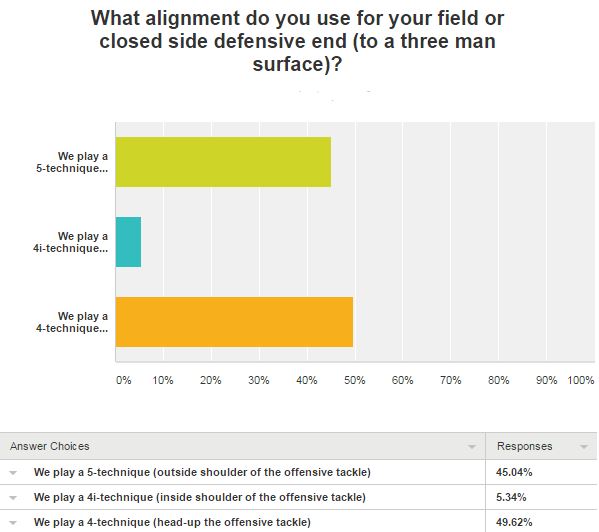
graph12

Characteristics of the Closed Side (three-man surface) Defensive End

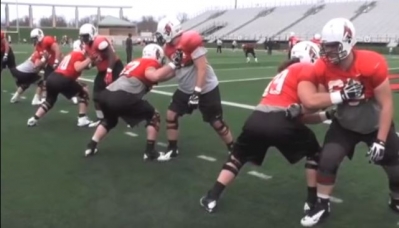
We surveyed coaches to find out the differences in technique between the boundary and open side defensive end. Many of our responses stressed the need for this player to be explosive with his hands and “rangy” enough to cover ground to the field side. We found that many coaches will also target this defender to be one of the better pass rushers among the front because he will mainly be matched up with the tackle. While this report is purely focused on defending the run game, we did want to highlight which characteristics coaches were looking for to fit their personnel in defending the run.

Below are some of the qualities that odd front coaches look for in developing their field side defensive end:

Coach Sturgis, Clinton Central High School (IN): “Our defensive end to the tight end side is typically a little of a better of an athlete than his counterpart to the open side.”

Coach Busmente, Sterling High School (CO): “He’s more of a plugger type for us and less athletic than our 4i technique. He’s most likely bigger.”

Coach McClain, West Laurens High School (GA): “We prefer a bigger plugger here if possible. He’s more like an athletic 3-technique in the even front. This guy will bump down into a 3-technique on occasion and we want a run stopper here.”

Coach Sarchet, St. John Paul the Great Catholic High School (VA): “He’s probably a bit bigger than the open side tackle. We don’t look for kids to get up the field as we do as maintaining gap control, taking on trappers, and squeezing our feet.”

Coach Calloway, Madison Middle School (NC): “He’s our best defensive lineman against double teams and getting off blocks.”

Coach Godwin, Gulf Breeze High School (FL): “This player has to be a little leaner and longer than the other two defensive linemen. He needs to have more speed because there is more ground to cover in defending the run game.”

Coach Desrochers, Sunrise Mountain High School (AZ): “We are looking for the lineman who is long enough and tough enough to play against a tight end, yet has enough wiggle to get a good rush on.”

Coach Baechler, Canton High School (MI): “We normally will have him be our Loop or C gap tackle. We would like him to be a bit bigger, but again speed and strength are more important than size.”

Technique of the Field Side (3-Man Surface) Defensive End

Once that player has been identified, we researched exactly how odd front coaches were training that boundary side defensive, based on the blocks he was seeing.

Some of our survey responses are below:

Coach Busmente, Sterling High School (CO): “He must drive into the tackle and help squeeze the B gap. He cannot get his shoulders turned out by the offensive tackle to create a seam there. Try to keep the outside arm ‘free’ as much as possible.”

Coach Bell, Missouri Western State University (MO): “We have two distinct stances that we teach our kids. We have our ‘BASE’ stance and our ‘JET’ stance. In our Base stance, our kids’ feet are wider than their shoulders with about 40% of their body weight on their down hand. We have flat backs with our off hand up and ready to strike the offensive line gap shoulder in front of us. We align with down hand to man, so our kids have to be comfortable with either hand down. On the snap of the football, our kids are coached to shoot their off hand, or what we call their GAP hand to gain control of the OL gap shoulder. Our kids shoot their down hand to the V of the neck. Their first step is a very quick 6″ step and their eyes are trained to go from the ball to the offensive line screws in which they are aligned on. If they are aligned in a 4i or 2i, their eyes go to the offensive line to inside of them for a quicker read on against zone schemes. If the kids are head up on our nose, then they can put whatever hand down they are most comfortable with and they shoot both their hands to breast plate of the offensive line and are looking to get vertical push after the first initial 6″ step.”

Read More

Odd Front vs. the Run – Case 4: Reduction Alignments to Problematic Offensive Formations

By Mike Kuchar
Senior Research Manager
X&O Labs
Twitter: @MikekKuchar


Introduction

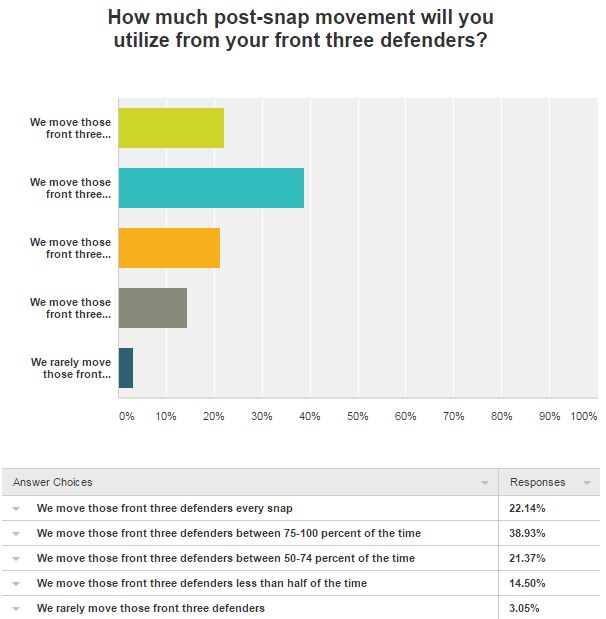
We’ve found that most odd front coaches do not typically stay in the odd front, they will stem and shift with a good deal of consistency into even front structures. Our research indicates that the majority of odd front coaches, 38 percent, will move their front three defenders on at least three quarters of snaps. We’ve also found that 61 percent of coaches will move those defenders both pre and post snap.

graph15

Most of these movements come in the form of “reductions,” which essentially means where the first level B gap defender (or 3-technique) will be placed either pre or post snap. We found that the three most common reduction placements will be formed in the following ways:

  • Boundary reductions: the first level B gap defender will be placed into the boundary.
  • Field reductions: the first level B gap defender will be placed into the field.
  • Formation reductions: the first level B gap defender will be placed in accordance with the offensive formation. These can depend on where the back lines up in 10 or 11 personnel formations or can be dependent on which side of the line of scrimmage the tight end aligns.

Boundary Reductions

The majority of odd front coaches will reduce to the boundary more so than the field. The reasoning is to get a 3-technique to boundary while slanting to the tight end or three man surface side. We found that the majority of coaches, 27 percent, use a quarter, quarter half coverage structure in boundary reductions.

Some specific reduction concepts are detailed below:

Under Front Reduction, Trinity College (CT):

At Trinity College, defensive coordinator Lewis Acquarulo uses the following strength calls:

1. Call strength to the passing strength.
2. If ball is on the hash, strength is called it to the field regardless of formation.
3. If ball is in the middle of the field, it goes to the two quick receiver side.
4. If it’s balanced, strength goes to the quarterbacks throwing arm or the offset back in one-back.

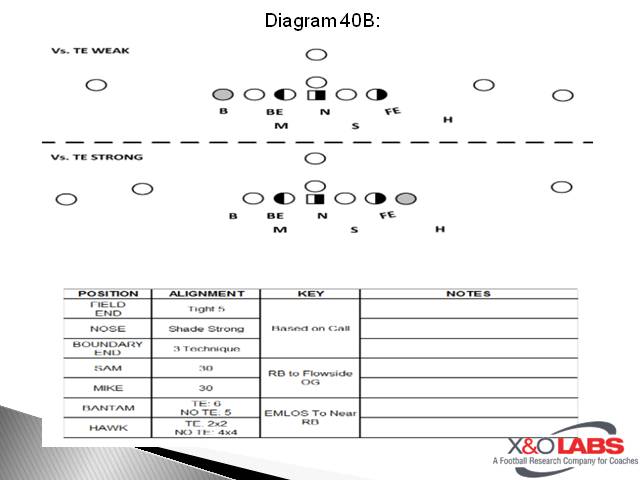
The Under front is a pre-snap movement that moves the stout, boundary end, to a 3-technique. The nose is in a shade, while the field defensive end is the 5-technique (Diagram 40B). The coverage is a two-high pre-snap look, but eventually will roll to some form of cover 6 or quarter, quarter half coverage. Off of this front, Coach Acquarulo will use several post-snap movements based off of call. Several examples are below:

40b

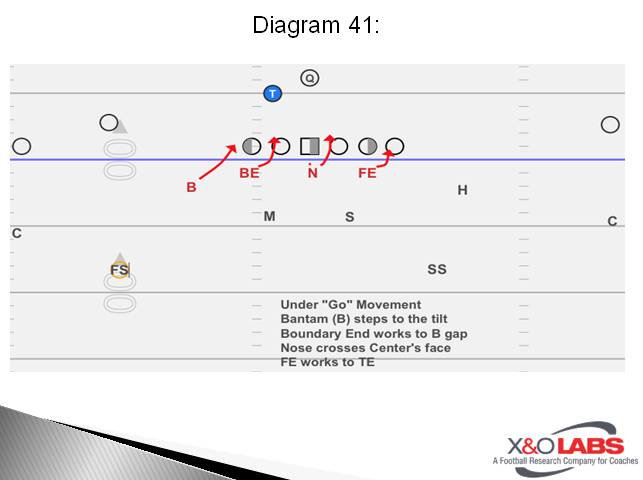
Under Go: This is a two-gap movement to the tight end side. The boundary defensive end contains through B gap and the nose works across center while reading the guard. “If the guard blocks back, he crosses face. If not, he works into A gap,” said Coach Acquarulo. “The Bantam will be the dropper in passing situations, but if it’s run, we tell him to step to the tilt and make the tackle block him. As soon as color crosses his face, he chases (Diagram 41).

Slide41

To see cutups of the Under front reduction, click on the video below:

Read More

OL Footwork in Outside Zone

By Brian White
Offensive Line Coach
Rose Hulman Institute of Technology
Twitter: @CoachWhite_RHIT


Introduction

rhitAt Rose-Hulman, our offense is predicated on running simple play concepts and executing them as fast as we possibly can. As with most Spread offenses, we also want to make the defense defend the entire width of the field at all times. This is one of the reasons why Outside Zone has become a staple of our offense. We can run this concept in one direction with a Run Adjustment, such as a Bubble or Smoke screen, in the opposite direction. While I will detail our “one word play packages” in another report, I wanted to give as much detail as possible in how we block the outside zone, one of our most productive play concepts.
Outside Zone

Our Outside Zone is a true zone concept. The offensive line will be responsible for their play side gap. We feel that a true zone concept, as opposed to a Pin & Pull concept, is the most effective manner to handle the variety of fronts, stunts and pressures we encounter each week. We keep the blocking assignments simple for the offensive line, which allows us spend more time developing their technique. The offensive line will reach the defender in their play side gap. The first offensive lineman without a first-level defender in his play side gap will block the play side LB, as the next offensive lineman without a play side defender in his gap will block the backside LB.

Slide1

The ball carrier is reading the block of the end man on the line of scrimmage (EMOL) as he runs towards the “Read Spot,” which is the roughly spot on the field two yards outside of the EMOL. We talk to our running backs about where the Read Spot is based on the direction of the play. When running Outside Zone to the boundary, the Read Spot is about halfway between the hash and the inside edge of the numbers (what we call the “Logo”). When running the play to the field, the Read Spot is in the middle of the field. Obviously, adjustments must be made if you are playing with high school hashes. He will run at 85% speed (this is a made up number, we use 85% to indicate that the ball carrier should not run full speed while not jogging either). This allows the ball carrier to put the offensive line on their blocks, as a ball carrier that runs too fast will overrun the blocking scheme. Great emphasis must be placed on the ball carrier making his decision on the Read Spot. A cut made before the Read Spot will give the defensive pursuit time to react to the cut and tackle the ball carrier.

Once the ball carrier has arrived at the Read Spot, the EMOL will have either captured the edge or not. If the edge is captured, the ball carrier will accelerate and attack the edge at full speed. If the edge is not captured, the ball carrier will put his play side foot into the ground and “up-cut” at full speed. Emphasizing the up-cut is critical, as a ball carrier that cuts back is likely to run into and unblocked defender pursuing the play.

Play side Reach Technique

A covered Offensive Lineman on the play side will execute a reach block. We call his first step a “Bracer” step. This step gains width and depth aiming outside of the defender’s play side foot. The second step will aim down the middle of the defender. Our striking surface is a “single under (palm facing up) one hand punch with the backside arm aiming at the defender’s sternum. The play side arm should remain free throughout the entire block. Once contact is made, the blocker must work to get his pads square to the line of scrimmage. If the blocker cannot reach the defender, he will then torque the defender outside by flexing his inside oblique and taking the defender past the Read Spot.

Read More

3 Adjustments to TE/Wing Surfaces vs. the Wing T

By Mike Kuchar
Senior Research Manager
X&O Labs
Twitter: @MikekKuchar


Introduction

The following research was conducted in part of XandOLabs.com special report on “Defending Unconventional Offenses.”

Aligning to the Tight End/Wing Surface:

Regardless of the offensive scheme, the tight end/wing surface can present a structural problem in a defense because not only does it provide for an extra gap (much like four-surface), but the wing off the ball can provide for an extra gap on either side of the line of scrimmage as well as a possible threat in the pass game. These formations are prevalent in Wing T, Single Wing and Double Wing offenses and a plan must be in place to defend it. It is these surfaces that Wing T teams prefer to run the buck sweep concept.

7-Technique Shade

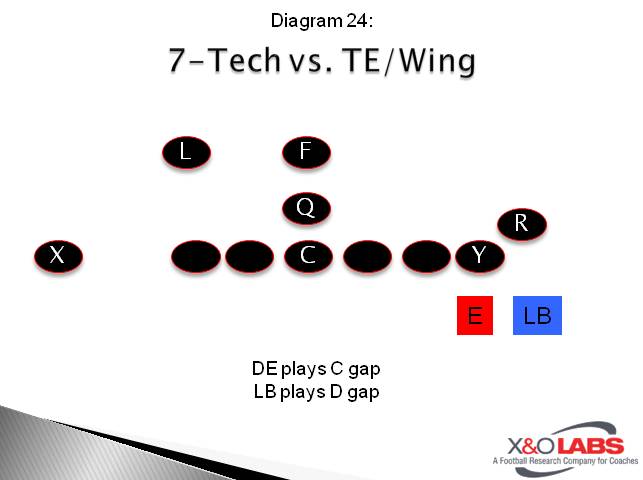
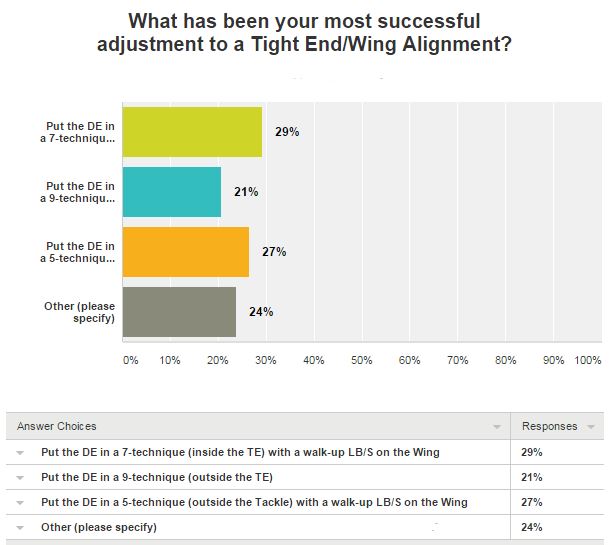
According to our research, 29 percent of coaches will align to a tight end/wing with a 7-technique with a walkup linebacker/safety as the D gap player (Slide 24). In this instance, the defensive end will play the C-gap while the outside linebacker will play the D gap. Since that defensive end may be the most pivotal defender against these offenses, because he is responsible for he C (off-tackle) gap, we wanted to present our findings for each possible scenario.

Slide24

graph10

Read More

Matching 3×1 Personnel with Four Coverage Adjustments

By Jason Bornn

Head Coach

Saugus High School (CA)

Twitter: @JasonBornn1


Introduction:

shsvsventuraWhether it is 10, 11, or 12-personnel, the Trips formation can present some unique challenges to any defensive scheme and, depending on your comfort level of what you do, may require multiple answers.
Here are a few of the questions we focus on at Saugus High School:

1. What do they do out of Trips?

2.  Are they run or pass heavy from Trips or are they balanced?

3. Do they run bubble, bubble go, flood, and/or three verticals from Trips?

4. Do they have a player that they like to isolate on the single side?

Once the answers to these questions are identified, we are able to focus in on the appropriate coverage for what the opposition likes to do out of their Trips sets.

Base Defense:

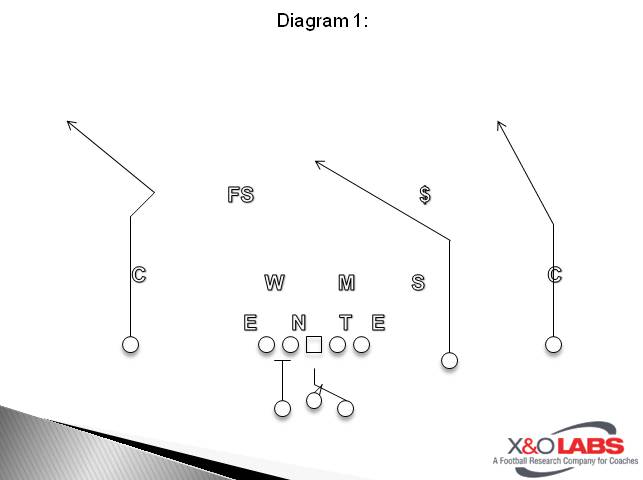
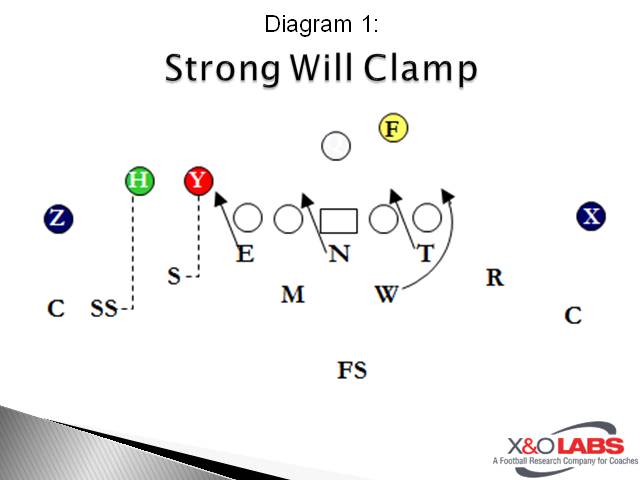
We are a 3-4 base defense but the coverages we run versus Trips can be applied out of any defensive structure. For teams who like to use the bubble, bubble go, and flood concepts to the trips side, we like to run what we call Clamp coverage, which is a hybrid Cover 3 (Diagram 1).

Slide1

Clamp Coverage:

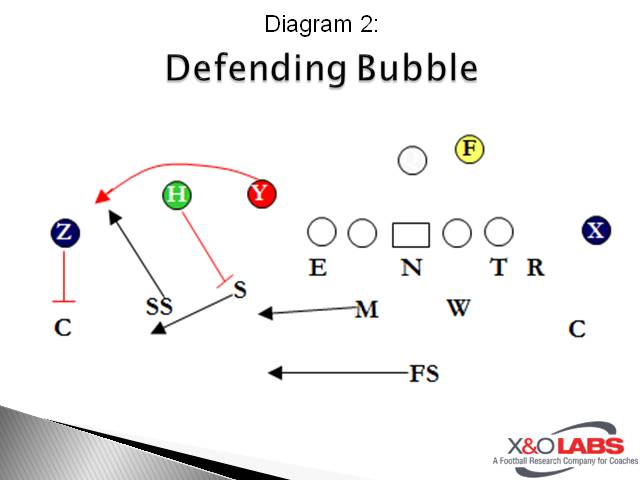
Clamp coverage is our top coverage to shut down a common staple for trips teams: the bubble screen. At the same time, it is solid against double outs by #2 and #3 receivers and common flood concepts. We also find this coverage lends itself to great run support against trips side run schemes.

Here Are Our Rules for Clamp Coverage:

Trips Side CB: Defend deep routes of #1 (Fade-Post-Corner); will continue to sink if #1 hitches up and #2 goes vertical, squeezing the route of #2.

Strong Safety:  He aligns seven yards deep and one yard outside of #2 receiver with his tail to sideline. He will begin a slow shuffle slide sink with eyes looking through the #3 receiver to the QB. He will then react to one of the following scenarios:

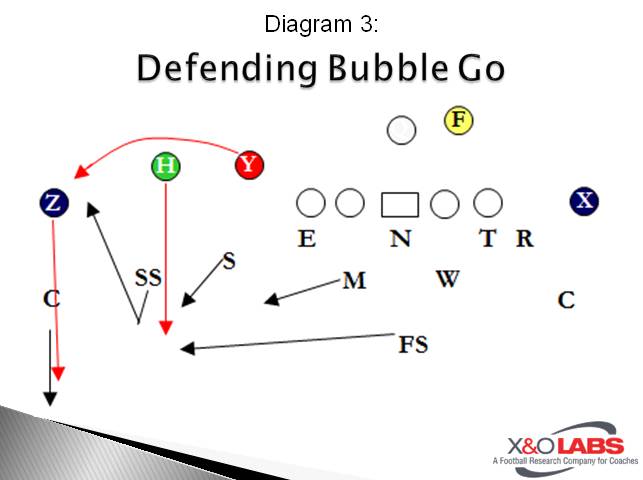
If the #3 receiver bubbles and the QB shows the palm off the football for the bubble, the SS will drive on the bubble (Diagram 2). If he does not get the bubble read from #3 and the QB, he will continue to sink until ball is throw to the bubble (Diagram 3).

Slide2Slide3

Read More

6 Keys to Scientific Quarterbacking

By Trenton Kirklin
Offensive Coordinator
Borger High School (TX)
Twitter: @Trenton_Kirklin

Introduction:

kirklinWhy is mixing science with quarterbacks so advantageous? You cannot argue with the scientific facts regarding the body and its functional ability. When we truly understand how the body works as a whole, we can then begin to figure out how to make our body perform to that optimal level as often and as possible. Playing the quarterback position may seem as simple as throwing a ball to a target, yet the complexity and kinematic sequencing that goes along with it is far from simple.
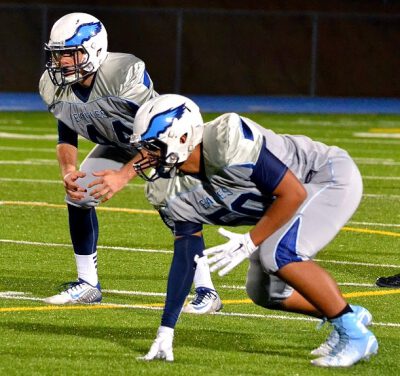
Over the past few years, I have been privileged enough to study under the great Tom House and Adam Dedeaux out of California. What sets them apart from other experts in the field is their ability to improve not only the physical aspect of quarterbacks, but the mental and emotional aspects as well. This characteristic is what attracts athletes like Nolan Ryan, Drew Brees, Tom Brady, and many others to their facility.

After studying under House and Dedeaux, I began to understand the kinematic sequencing that comes out of quarterbacking and the incredible science with which they back it. Our goal is to not to give the quarterback a set of tools to use only for the upcoming season, but rather to empower him with a set of tools that will last him a lifetime throughout each level of football.

Key #1: Work from the Ground Up

When working with a quarterback, the first message we stress is the role balance and posture play in a quarterback’s overall delivery. Once a quarterback fully comprehends that principle, we can move on to the next phase. The term “kinematic sequence” is thrown around often, typically when discussing rotational sports. Put into layman’s term, it is the body’s (hips, shoulders, arms) ability to create torque, which generates speed using its rotational force to eventually come to an end result – i.e., the throw. The entire sequence (kinetic chain) begins from the ground up and travels out from feet to fingertips.

The energy the body creates from the ground up is what House calls, “ground force production.” In order to get the most efficient ground force production, we must create a solid athletic base. Our base is like the foundation of a building in that it must be solid or everything else will crumble. Balance and posture will make or break a quarterback. If a quarterback has great balance and posture from start to finish, he is then ready to move on to the next phase in the kinetic sequence.

It is important to understand that in order for the kinetic chain to be effective, the timing must be perfect. Hips, shoulders and arms must fire at different times to create the right amount of torque, which, in turn, creates the perfect velocity for a throw. Timing, sequencing and mechanics are what House constantly advocates to his clients. Numerous coaches want to try and change a quarterback’s throwing motion for various reasons, but at the end of the day, we as coaches must realize and respect the fact that every athlete is unique. That being said, we can achieve the end result all coaches want (accuracy, velocity, etc.) by evaluating each quarterback’s timing, sequencing and mechanics.

Key #2: Importance of Light Feet

With the kinetic chain beginning at the ground level, it is vital to understand how to efficiently begin the chain of events. The notion of a “light strike” is what House and Dedeaux emphasize. When we say to step lightly, we are referring to the quarterback’s front foot. Light feet are fast feet, whereas heavy feet are slow. The throwing motion as a whole can be fast or slow, largely depending on the initial foot strike. It is a physical impossibility to have a quick foot strike and an elongated throwing motion. It is critical to understand that we do not transfer the weight from our back leg to front when we strike for reasons regarding repositioning. We must strike lightly and quickly while keeping our weight distribution within our base.

The other benefit to having a quick foot strike is the ability to recover when the initial read is not there. For example, envision a quarterback taking a three step drop with a read from left to right. He decides to take his first read to the left and strikes, but he hesitates and decides to move to the next read in his progression. If his foot strike is light, he has the ability to recover quickly, maintain weight distribution, and progress in the reads without trouble. Conversely, if the quarterback’s foot is heavy he must transfer his weight back to the load leg and then reposition, which can put him in a detrimental situation. Clear comprehension regarding the “why” of the foot strike can make or break a quarterback’s ability to further develop.

Read More

4-2-5: Protecting the Run Box

By Vincent San Filippo
Defensive Coordinator
Granite Hills High School (CA)

Introduction:

X and O Defensive PicStopping the run. It has been and continues to be the most important job of any defense. That said, the task is getting harder to coach to this philosophy when teams are willing to pass the ball 80% of the time. And with that the days of having seven or eight players in the box are all but over.
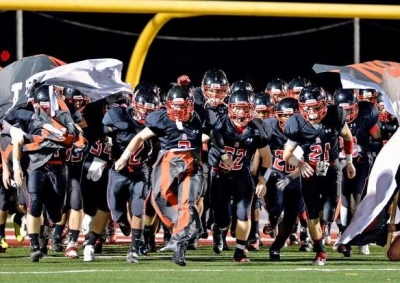

Our 4-2-5 defense uses the fifth defensive back as a rover leaving our box only with six players. We had some great success in a league where the Oregon style of offense is prevalent with even more of an emphasis on the passing game. We had a bunch of smaller quicker linemen and some decent athletes on the edge and this concept allowed them to do what they do best.

Importance of Movement

Movement pertains to our fronts and blitzes. We have come up with many fronts and stunts over the past two years and use them all to stop the run. We believe the more fronts we show in one game the more confusion we will create for the offensive line up front. We call defense like it is offense, in that we call a play for the offense to stop, not the other way around. Blitzing is the second key to stopping the run with six. We like to send five and six man pressures at run plays from all different angles. We often lane exchange and loop backers with to create confusion on the offensive line and to create penetration.

Importance of Patience

I have had the opportunity to be an assistant coach under two great defensive coordinators in my time coaching, Gene Andrews and Dave Waastad. I learned so much from both of these coaches, but the one thing I took away from both of them is how to be patient as a play caller.

I know stopping the run with six in the box appears to leave some giant holes in our defense and flies in the face of everything we have all been taught as defensive coaches, but we have found success within this scheme all comes down to is patience. As I am patient as a play caller, we will find a combination of a front and blitz that will stop the other teams run. It takes a lot of preparation throughout the week and some outside the box thinking, but it works. If our kids are playing fast and loose we will make up for any one big run with a bunch of swarms, TFLs, and takeaways.

Player Roles

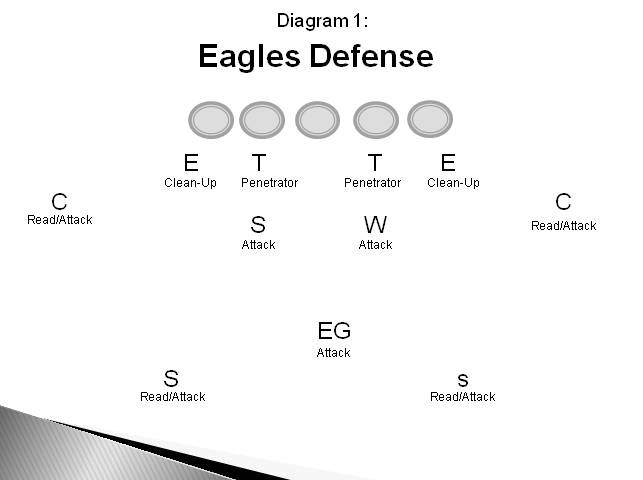
We feel each kid should not only know their specific job in a call or play but his specific role for our defense. Here is how we break down and describe these players and their roles:

Slide1

Penetrate Players: These are our defensive tackles. Aside from an occasional anomaly, our defensive tackles average 5’7 and 180 pounds. They are undersized, strong, and quick, but not fast enough to play linebacker. The Penetrator position gives them a chance to be successful. Their only job is to get up field and cause havoc in the backfield. We want them to make plays not suck up blocks. Teams are forced to double our smaller tackles because our tackles make plays. The double teams allow our Backers the ability to play freely without lineman in their face also making it possible to play with six in the box.

An obvious weakness of this approach is the susceptibility to the trap block. Fortunately, teams that we have faced do not run trap as much as they used to so the fear of getting trapped is not there as much. That said, we work trap every single day to make sure they are prepared for that situation.

Cleanup Players: Our defensive ends are our cleanup players. This is unquestionably the hardest position in our front six. Perhaps the hardest part is that patience is critical for our ends. We tell each end not to get greedy and be patient because the ball carrier will end up coming to you. The tackles penetrate so well that our ends just have to sit and plays will fall right in their lap.

Read More

Three “Shot” Play-Action Pass Off Run Action

Kyle Schmitt
Head Coach
Archbishop Spalding High School (MD)
Twitter: @kschmittASHS

Introduction

CaptureOur offensive philosophy at Archbishop Spalding High School is to be a no huddle, multiple, downhill running team. The core of the offense focuses on the zone, power and counter run game from the pistol. That focus is complimented by quarterback runs, packaged plays and the focus of this article, play action shot passes.
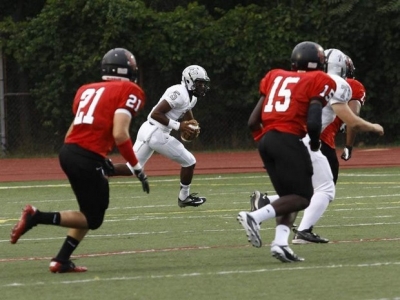
We define a shot play as a play-action pass that mirrors a top run, motion or formation. Our offense carries between 6 to 8 shot plays into each game. We are planning to attempt at least two shot plays per quarter, but this changes by situation.

Setting Up Shot Plays

Our core shot plays are in the game plan each week through different variations of formation and motion. We install these plays in pre-season camp with the plan to use them throughout the season. Here are a few of the game situations where we plan to use these shot plays in order to catch the defense in a vulnerable situation.

  1. 2nd Down Short/3rd Short (4 Down territory)
  2. Following a turnover or momentum changing situation
  3. When operating out of a Mini/Sugar Huddle
  4. Changing up the pace with a “One Word Follow” concept

Mini/Sugar Huddle

As a no huddle team, we can create deception by huddling 2-3 yards off of the football in a sugar huddle. Each game, we have a package of sugar huddle plays used to hide backfield set and unbalanced formations. We will break the WR’s first to let them set up then quickly break the offensive line and backfield players with the goal of snapping the football within 3 seconds if no motion is involved. The sugar huddle is a version of a “Tactical Tempo” to disrupt the defense from getting a feel for the flow of our offense.

Read More

Zombie Concepts Off Zone Runs

By Brian Rochon
Offensive Coordinator
Plymouth High School

Introduction:

jamarlOur offense, while somewhat dictated by personnel strengths from year to year, is firmly rooted in the outside and inside zone schemes. Variations of the outside and inside zone encompass probably 80% of our run schemes. This allows us to minimize the amount of thinking by our offensive line and helps us play at a fast tempo. The use of simple adjustments presents the illusion of complexity to the defense and meshes well with simple variations in who we’re reading, secondary manipulations and other tags. We are constantly saying, “We have two run plays!” While we certainly have more than two run calls, at our core we going to make our living on the outside and inside zone.
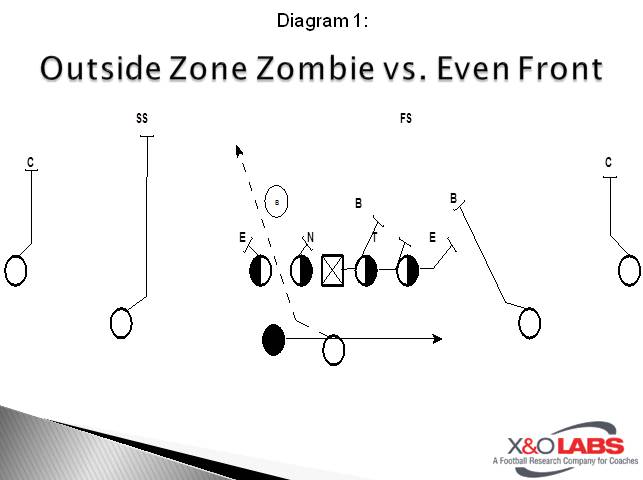
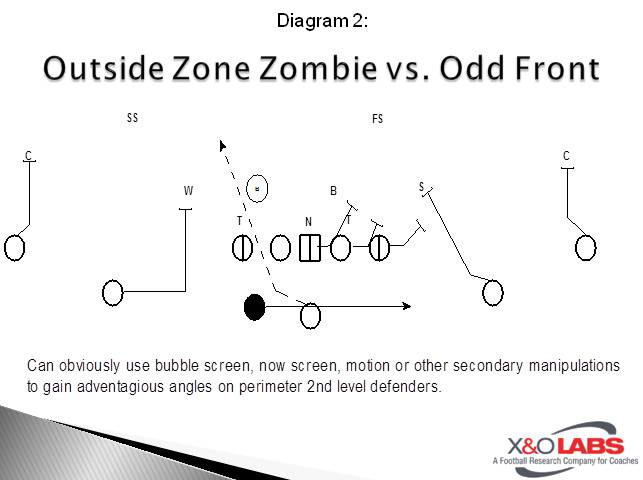
One thing that makes us unique is our ability to vary which front 7 defender we are reading all within our basic OZ and IZ schemes. The “zombie” concept, which will be the focus of this particle, is a variation that we picked up from current Indiana State Head Coach Mike Sanford while he was the OC at Louisville. As Coach Sanford explained to me, the zombie concept involves a zone scheme on the frontside of the play and a man scheme on the backside of the play. Hence the term “zombie” (Zone Onside…Man Backside = ZOMBie.)

The main thrust of the zombie concept is that it allows us to read an inside linebacker. This puts a 2nd level defender in conflict rather than the backside defensive end on our traditional zone read scheme, the front side defensive end on our flow scheme, or the backside tackle on our midline scheme. We can run the zombie concept off of our outside zone read action or our inside zone read action, depending on the game plan that week as well as the strengths of the opponent’s linebackers.

Zombie Outside Zone

When we have the correct personnel to do so, we absolutely love the stretch play at Plymouth. It allows us to get our best athletes the ball on the edge, which has the potential to be explosive at any level of football. Once we have established the outside read play, teams will often tell their inside linebackers to sprint laterally as soon as they see stretch action from our offensive line. This is where the zombie concept becomes so dangerous.

More often than not, that back side linebacker will sprint himself out of his gap integrity as he tries to get over the top. As he flies into the play side B/C gap to help with stretch, the QB will end up running right behind his shoulder pads.

Slide1Slide2

The rules and adjustments for outside zone zombie are as follows:

Play Side Tackle, Play Side Guard, & Center – 1st step is a flat sprint step looking to gain a man and a half. Stay low and work the back side hand to far side number of the defender followed by the play side hand working over the top of the defender. If he is unable to execute the reach, execute the proper tandem concept as a last resort.

Back Side Guard – Against a zero technique nose guard, he will combo with center driving to the play side. Against a 1 or 3 technique, he will step at the crotch of the on defender and drive. It is critical that he create movement as the quarterback’s running lane depends on this block.

Back Side Tackle – Against a 4 technique, we will have him use his outside base technique. Against a 5 technique, he can outside base or vertical set. It is critical that he does not let the defender cross his face.

Read More

Individual and Unit Pass Rush Teaching Progressions

By Joe Coniglio
Defensive Line Coach
University of Rhode Island


Introduction

rhodeislandAt the University of Rhode Island we want to develop our defensive line as a unit based off cohesion and trust. In passing situations, we will disrupt QB rhythm with a pre-snap plan (straight rush or game). Our unit will be master communicators, giving us the best opportunity to rush the passer as a group. We will be active, violent pass rushers who play with effort and a relentless motor. Our objectives are to have a winning get off, work a pass rush every snap, and counter (at QB level) to keep him in the pocket. We believe if we do these three things, it will equal success.
Our Edge

The underlying principle of Rhode Island defensive line play is ‘stimulus response’ (get off). This is the speed of our reaction when our visual target moves. This principle is used on every snap. Our goal is to have the best “get off” in the country. In passing situations we teach our players to rush on ‘their terms’, which simply means to make the offensive lineman make a decision before he is prepared to. With this, we must stress the offensive lineman with speed and make him reactive to us. Every week we will identify what moves first on an offensive lineman, or a cue from an offensive player and focus on it the entire week. That is what we consider our ‘weekly target’. There will be certain instances when we will key the football such as in silent counts or when the offensive lineman is slow out of his stance. Once our target moves or the ball is snapped, we will race and attack half-a-man taking a course to the QB. A great ‘stimulus response’ gives us the opportunity to rush on our terms. This forces the offensive lineman to give us his hands. In turn, we will work a violent move that highlights our strengths as a pass rusher. We take our numbers (his aiming point) away and flip our hips working them towards the QB. There are two ways to flip our hips, skate our feet or step our back foot in front of our lead foot helping us to direct our body. We will then accelerate to our aiming point on the QB.

Individual Pass Rushing Technique

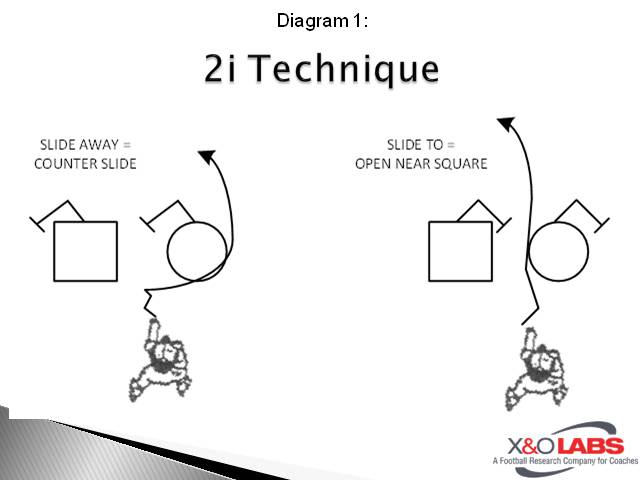
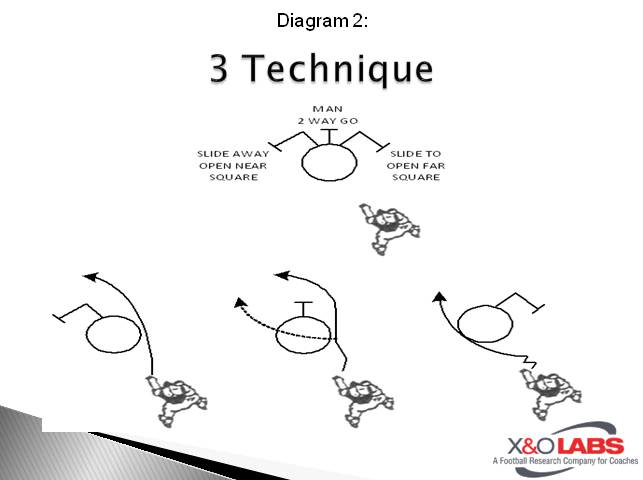
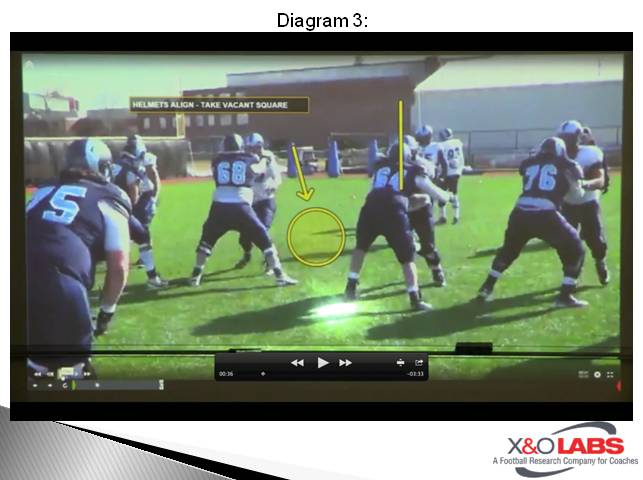
Pass rush lanes are crucial to our development as an affective pass-rushing group. Once we understand the how to create an even pass rush we must focus on our development as individuals. Teaching our inside players and outside players to rush the passer are completely different teaching progressions. Our base belief is that defensive tackles (inside) are set on a horizontal plane and our defensive ends (outside) are set on a vertical plane in passing situations. With this, nothing changes in terms of their stimulus response and their active, violent get off. Instead, we understand that the defensive tackles must defeat a quick/horizontal sets rather than soft/vertical sets. We teach the ‘open square principle’ to enhance our defensive tackles block defeat skills against these sets. The way we instruct this principle is once our helmet aligns with an offensive lineman, we must take the vacant square.

Slide1Slide2Slide3

Their aiming point with their hands will be the elbow nearest the open square they are attacking while working half-a-man. The basic pass rush move for our interior defensive linemen is the club rip or swipe. We do not teach the swim as a finish due to the ability it gives the offensive lineman to give us a violent strike inside the breastplate and knock us off course. A swipe is a violent punch above the near shoulder pad, leaving a very small strike zone for an offensive lineman to recover. This principle has helped our players develop a symmetry with their hands and eyes giving them an opportunity to anticipate a quick set and have tools to defeat it.

Read More

Red Zone Snag Off Orbit and Jet Motion

By Mike Kuchar
Senior Research Manager
X&O Labs
Twitter: @MikekKuchar


Introduction

The following research was conducted as part of XandOLabs.com special report on “Spread Passing Study: Snag Concept.”

Snag Off the Jet Sweep

Jim Ahern at Lansing Catholic High School (MI) will utilize the snag off his number one run action, the jet sweep which is usually from unbalanced sets. “We are an unbalanced set, with a flanker/tight end, and a twin set opposite that,” said Ahern. “The quarterback’s pre-snap read is the corner to see if he feels that the flag route might be open, and to check any possible blitz look. Post snap if he felt the flag route might be open, he peaks to see if it is there. If it is, he throws there. If it isn’t there, he will read the flat defender for the snag route or flat route. The reason that we have had success with the route is that it takes advantage of how defenses try to stop our jet play.”

Read More

Applying “Circular Force” Fundamentals in Pass Protection

By Mike Kuchar
Senior Research Manager
X&O Labs
Twitter: @MikekKuchar


Introduction

The following research was conducted in part of X&O Labs special report on “Man Pass Protection Drills.”

ballstateConcept of Circular Force: Ball State University
According to John Strollo, the offensive line coach at Ball State University, force can be produced in three ways: push (straighten limbs to expel), pull (flex limbs together) and torque (twist trunk to throw). So, Coach Strollo made a commitment last season to focus on the torque movement and play with one hand foremost in pass protection. As he told us, “every sport is played with one foot foremost and one hand foremost including football. Most are, except for offensive linemen and weightlifting.” Coach Strollo found that linemen seldom move anyone with their punch. They can more effectively move him with their trunk, their legs and their hips. In order to do this, Coach Strollo teaches his players to use two hands to precisely apply force to a defender. One hand is foremost and anchors to the opponent while the other hand is held back. The coaching points of the circular force drill are below (Diagram 16).

Read More

Can Your No Huddle Run Faster?

By Chuck Markiewicz

Head Coach

Arundel High School (MD)


Here at Arundel, we believe very strongly in General George S. Patton’s famed saying that “an imperfect plan implemented immediately and violently will always succeed better than a perfect plan.”  No part of our program better exemplifies that concept than the no huddle principles that we use to run our offense.  This article will cover in detail the way that we practice and employ different tempos and the communication system that we use to make it all happen.  As the quote above implies, these plans are by no means “perfect” as they are always a work in process.  The entire system has been derived over time from a wide variety of sources.  The key is that we worked to find out what worked best for us.

Our No Huddle Evolution

Our no huddle experiment all started with our team goals.  When I was a defensive coordinator in the 80’s, I was paranoid about all of the options that were open to the offense when we sat in one defensive look.  Later, when I became an Offensive Coordinator, I decided to put what I had learned on the other side of the ball to use and limit the looks that a defense was able to give us.  That is where the no huddle came in.  We combined the no huddle concepts with our Run and Shoot offense (from John Yaccino, Penn Trafford HS (PA).  From there our OC, Dave Doy, spearheaded the development of the system that we currently employ here at Arundel HS. We have found that a major key is to keep an open mind to ideas that fit our philosophy of coaching and playing the game.

The Importance of Possessions

Over the years our off season evaluation told us that we averaged a touchdown for every 3 possessions averaging 36 points per game. This was roughly our average until 2005 when we made a conscious decision to find some ways add 3 more possessions per game to try and up our average to 42 points per game. The project became trying to add things that would enable us to find those 3 more possessions.

We didn’t try to do this all in one year.  Our goal was to try to add something every year, test out our theory to see if it held up and add more the next year. We feel like our ideas have some merit because since we started to implement the changes in 2005 we have averaged over 42 points per game. We are still actively engaged in trying to find are still ways to add more possessions.

Here are some of the things that we have used to create additional possession:

  1. Added new tempo (Fastball) (2006)-Snap the ball as soon as it was ready for play. Our goal has become to snap the ball 100 times per game. Our highest total to date was in the 2005 State Championship game.
  2. Stressed Turnovers on Defense (2007)- A turnover circuit was implemented and practiced daily as a part of our pre game routine. Our ability to create and recover fumbles improved dramatically once we implemented this routine.
  3. We became a Punt Block Team exclusively (2008)-Stopped trying to return punts and became exclusively a punt block team. What we found was, other teams became so obsessed with protecting their punter that we were able to increase the yardage gained on punt return with an increased number of returns for a TD.
  4. Increase our 4th Down Conversion Rate (2009)-We made a conscious to decision to go for it on 4th down. Our OC knows prior to the drive whether he has 4 downs to use. We no longer make a snap decision to use all four downs. Our OC knows that he has four downs at the beginning of the drive. We feel that it takes some pressure off of his playcalling and drops the average per play from 3.3 yards per play to 2.2.
  5. Onside kick as a weapon  (2012) – We have devised a system that enables us to kick the ball to certain parts of the field and on side kick without taking an inordinate amount of practice time to accomplish our goals. It is still a work in progress. We have had a lot of fun coming up with a system that looks the same and attacks many different areas of the field. The onside kick has become a HUGE part of our special team s repertoire. Our offensive goals are as follows:

Creating Offensive Goals that Fit Our System

In addition to the possessions goal in place for the team, we created a set of goals and priorities for the offense that were aligned with the team philosophy.  Here is what our offense is trying to do:

Read More

Research: Defining and Utilizing Tendencies

By Mike Kuchar

Senior Research Manager

X&O Labs


tendenciesIntroduction

What makes a tendency?  It was a common query among coaches that contributed to our special report on offensive and defensive game planning this pre-season.  We wanted to find out.  So, we surveyed those coaches who won at least half of their games over the last three seasons to find out their metrics on what should be noted and what should be ignored in game planning.  And now that the season is gearing towards the playoffs, their advice on what to spend time on (and what not to) could be vital for your success.

In order to do this, we send a five-question survey on how they define and utilize opponent’s tendencies on offense, defense and special teams.  Some of the reputable programs that contributed include:

Please Note: All current records were accurate as of 10/20/14


Xavier High School (CT), currently 6-0

Ben Davis High School (IN), currently 7-2

Winnetonka High School (MO), currently 7-2

Nassau Community College (NY), currently 6-0

West Florida High School (FL), currently 6-1

Xaverian Brothers High School (MA), currently 6-0

Westfield High School (VA), currently 6-1

Choctaw High School (OK), currently 6-1

Union County High School (GA), currently 7-1


Question #1:   

What is your definition of a tendency (this could be offensive or defensive)?


Analysis:

Without going the Webster’s route, we wanted to find out from coaches how they defined a tendency.   We all hear that term being thrown around a lot, but we were curious to see what coaches spend their time on preparing their players and what is ignored.  Their responses are below. 


Responses:

“For us, a tendency such as down and distance must be over 65 percent. We look at the formation and play we take the number play out of each.”- Andy Guyon, defensive coordinator, Xavier High School (CT).

“Tendency is anything that gives something away to the opposition based on what you are inclined to do (have shown to do in regularity).”- Ian Gardner, Quarterbacks Coach, Desert Eagle High School

“A clear pattern or tip-off based on specific formation, personnel, down/distance, etc.”- Zach Cunningham, Defensive Coordinator, Winnetonka High School

“An inclination to do something by personnel or formation that creates a recognizable and usable predictor.”- Tony Bowman, Defensive Line Coach, Kentucky Christian College

“Technically, a tendency would be anything that occurs more than 50% of the time.  However, to be useful, it should occur at least 75% of the time.”- Mark Bates,  Head Coach, Village Christian High School

“For us, the term means 3 things: statistical tendencies, the tactical tendencies of the play-caller and also the human tendencies of the kids we’ll be facing.  All good teams have certain tendencies, but a tendency is noteworthy only if it provides a specific weakness you can take advantage of.  For example, if you know your opponent plays an 8 man box but you also know you can’t win matchups on their corners, the information doesn’t help much.”- Joe Metzka, former Offensive Coordinator, O’Fallon High School

“My definition of a tendency is something that’s easily remembered by me, our coaches and our players that is a dead give away to the play our opponents are running at that given moment. I mean really think about it.  You can make nearly anything a tendency. It’s all about making the information work for you and your kids. I’ve had teams that could remember everything from alignment of the running back dictates the play, to knowing if it’s 2nd and 4-6 and their on our 35 on the right hash their running this play. The team I currently have can’t remember crap. I mean they barely remember their assignments, so throwing a bunch of extra information on top of them doesn’t help. Matter of fact it hurts us. The less info I give them the better we play.”- John Johnson, Defensive Coordinator, East Lawrence High School.

Read More

Southern Oregon’s 20 Personnel Double Post Concept

By Matt Adkins
Passing Game Coordinator/Wide Receivers Coach
Southern Oregon University


Introduction:

sou1At SOU we want to take as many vertical shots in a game as possible. To do this we want to give the defense different stimulus, by not just running four verticals over and over and incorporating play action with our vertical passing. We run the double post concept at least twice a game, and usually more with different tags based on what the defense has given us in the game. In this report, I will be discussing the way that we run our double post concept out of our 20 or 11 personnel packages off of play action.

Why Play Action Double Post?

There are two reasons for why to play action the double post.

  1. Trigger the Mike: Make the Mike eat grass vertically to help widen the Sam/Mike window.
  2. Create easier access for the slot: If you can create any hesitation from the Sam (alley) you create free access for your slot making the safety decide faster.

Double Post Concept

Slide1

Release Rules and Depths

Single Side Receiver

Versus Off Coverage (as defined by off five yards): 7 steps vertical and three steps to the post. Break to the sidelines based on grass. We do not give our kids hard rules on whether to go over or under the corner, we expect him to be decisive and fast and see the same grass as our quarterback.
Versus Hard Coverage (as defined by under five yards): Solid take off. No release rules for inside or outside release, beat him with speed.

Logic – If the single side receiver is getting a “hard” corner, it is either man and we just want to get vertical against it to get the ball out quickly. Or it is a two-deep look, and we want to pull the safety off the hash for our double post side.

Slot Receiver

Slot – MOR (mandatory outside release) to the alley. Break to grass staying flat. We do no give hard rules in terms of landmarks. He must understand that he has two primary jobs:

Read More