Odd Stack Pressures to Defend 21 Personnel

By Mike Kuchar
Senior Research Manager
X&O Labs
Twitter: @MikekKuchar


Editor’s Note: The following research was conducted as part of X&O Labs’ special report on “Developing a Pressure Check System” which can be accessed in full by clicking here.

xavier1Andy Guyon, the defensive coordinator at prep powerhouse Xavier High School (CT), operates out of a 3-3 front structure and will package his Thunder and Lightning pressure package based off offensive tendencies. In his Thunder pressure package, he will slant to the strength of the offensive formation and blitz off the weak side of the formation. It’s a man coverage concept where the corners will play number one, the free safety plays number two strong, the strong safety will play number two weak or number three strong while the remaining linebackers will combo the backs.

Read More

Varying OL Techniques in the Power O

By Ryan Schleusner

Offensive Line Coach

Miami High School (OK)


neoAuthor’s Bio:  Ryan Schleusner has spent the past year as the Offensive Line Coach at Northeastern Oklahoma A&M Junior College.  I am currently the Offensive Line Coach and Run Game Coordinator for Miami (OK) High School.  I would first like to take the opportunity to thank Dan Ellis and X and O labs for the report on the Midline Play adapted off of Outside Zone blocking.  We implemented the play this past year, adjusting it to our inside zone framework and had great success with it.


We ran an up tempo shotgun spread offense this past year with elements of the pistol at times.  Our main run plays were Power Read, Counter Read and QB Counter Read.  These schemes were utilized to take advantage of our Offensive Line’s athleticism and to get the ball in our playmaker’s hands in space.  Using these scheme’s we were able to rush for over 225 yards per game and win the Southwest Junior College Football Conference Championship.  The main play’s that I will be talking about in this article are the Power Read, Counter Read and play action off of them both. 

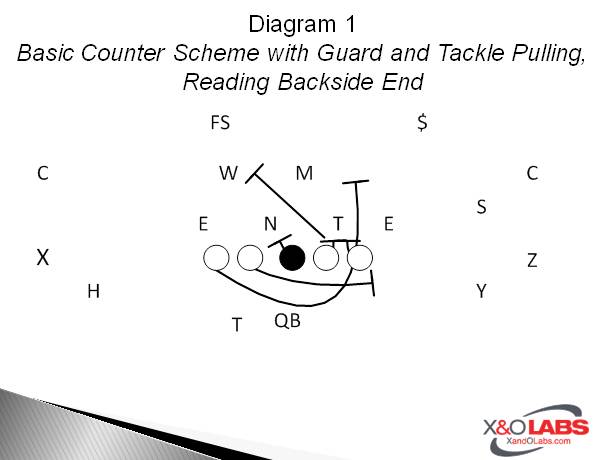
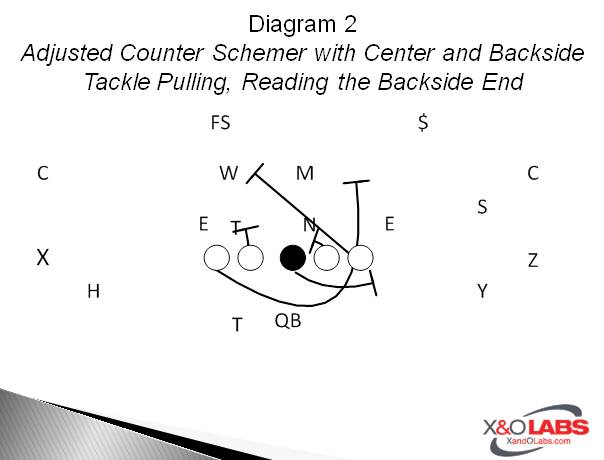
Our base counter scheme from 10 personnel was installed as a basic gap scheme.  Everyone on the play side was responsible for their backside gap and looking to combo down linemen.  On the backside of the play either the guard or the center, depending on which has an immediate threat in their gap, would pull to kick out the playside end man on the line of scrimmage.  A lot of teams teach this block as either a kick or a log, depending on what the defense gives you.  I do not believe in teaching this way and demand that the puller kick out the EMOLS.  The reason the pull is to be passed between the guard and the center is to prevent penetration on the backside of the play  `1  The second puller is the backside tackle, who must read the block of the guard to determine if he is to insert himself under the kick out block or “bounce” the pull outside.  Although I do not give the guards the option of not kicking out the EMOLS, the tackle must still read this and be able to adapt to the EMOLS not getting properly kicked out.

Slide1Slide2

We did this for two reasons, the first one being that our center liked to pull and was good at it, so why not find ways to let him do it.  Secondly, leaving the backside guard to block out on the 3 technique allows the tackle to pull cleanly and not worry about getting knocked off of his pulling track by penetrating defensive lineman backside.  We would also occasionally motion a slot receiver into the backfield for a pitch option, as you will see in the clips.

Read More

Play Calling the Middle Zone Concept

By Mike Kuchar
Senior Research Manager
X&O Labs
Twitter: @MikekKuchar


Introduction

fordhamWhile the middle zone continues its advancements among the football ranks, we found it imperative to research what were the most efficient fronts to run it against and how offensive line coaches were teaching their players to run it. We focused our research on alleviating some of the more common problems when utilizing the middle zone scheme, including blocking a play side 3-technique, blocking a play side shade and how to correctly teach the combination blocks at the point of attack.

Packaging the Play

John Donatelli, the offensive line coach at Towson University, talks to his offensive linemen about a pre-snap thought process that surrounds each of the schemes he runs. “In order to execute what I call a proper ‘pre-snap cerebral process,’ linemen must walk themselves through a few simple questions before the snap of the ball,” Coach Donatelli told us. “We have found that this approach has a variety of benefits. Understanding the play concept completely allows linemen to truly get an understanding before the snap of the ball as to how the defense will react to and fit the play. We are able to push our players far past their particular assignment and deepen their knowledge. We have found that this approach speaks to the individual player’s knowledge of the play and gives them a process to understand how their role in the scheme is impacted by those around them.”

This is the progression that our players here at Towson work through each play and the benefits of each individual question in Coach Donatelli’s words.

What is the play’s point of attack?

“We teach our players that this process starts with understanding “attack point” of the play. This forces the player to take his assignment to be more than just a line on a page. Instead, he is forced to determine how he can execute his assignment to enhance our team’s ability at the point of attack.”

 towson3

What is the alignment of the defenders?

“Analyzing the alignment of the defenders pre-snap is crucial to success. For us, that means taking account for more than just the defender lined up over him. We teach our players that they also must process how the two hard defenders to his right and left are aligned.”

Examples are below:

  • OT Alignment Keys: Includes the DE and DT or NT
  • OG Alignment Keys: Includes the NT and DT or DE
  • C Alignment Keys: Include the DT and NG

“In each case, the linemen will assess the width of each defender in regards to how tight or lose in alignment they are. The linemen must be trained to then turn their attention to the alignment of the LB over him. When assessing the linebacker, the lineman must be sure to account for both the width and depth of LB’s position.

Assessing these three points will provide the lineman with a base understanding of what could possibly be occurring on the other side of the ball. In order to further his knowledge of the defense, the player must take his assessment to the next level and process more than just those three points, two hard defenders and one linebacker.

Once they get a handle on understanding those three points, we teach our players to assess their entire half of the defense. This would mean reading the pre-snap alignment of all the hard defenders (including opposite NG for the guards), linebackers and safeties on their side of the ball. Each individual lineman’s ability to process the alignment of these defenders will unlock the defense’s intentions (most of the time), giving your linemen the advantage.”

What can the defenders do from that alignment?

“After processing the alignment of the defenders, linemen will have a very good understanding of what the movement or pressure the defense is about to employ on any given play. At this point, the alignment information will converge with what each lineman has learned through the week of preparation and film study. In most cases, our players will have a very good idea what tactic the defense is about to employ based on the details of the alignments against our particular formation. This information helps the player make decisions about what tools to use (next step). The best part of this process is that over time we see our linemen being able to apply this knowledge of defensive structures on the fly. In some cases, they not need much specific film study to understand by pre-snap alignment what the defense is about to do. When your lineman get to that point, your offense is going to be able to able to adjust to almost anything in game situations.”

Read More

New Research: Red Zone Preparation and Efficiency

By Mike Kuchar
Senior Research Manager
X&O Labs
Twitter: @MikekKuchar


Introduction:

Fact: 81 percent of offensive coordinators have a separate plan for the red zone. What’s more is 69 percent of these coaches will even vary their offensive system once they get inside the +20 yard line. In a game of situations, there is no question that efficiency in the red zone will mean the difference in wins and losses. During the course of our research on red zone efficiency, we took the responses of only those coaches who score touchdowns 75 percent or more this season in the red zone and present how they design their red zone attack, which personnel groupings and formations they use and which run/pass concept have given them the most success.

Red Zone Preparation

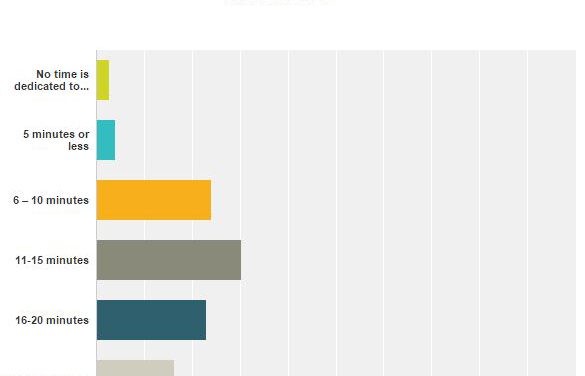
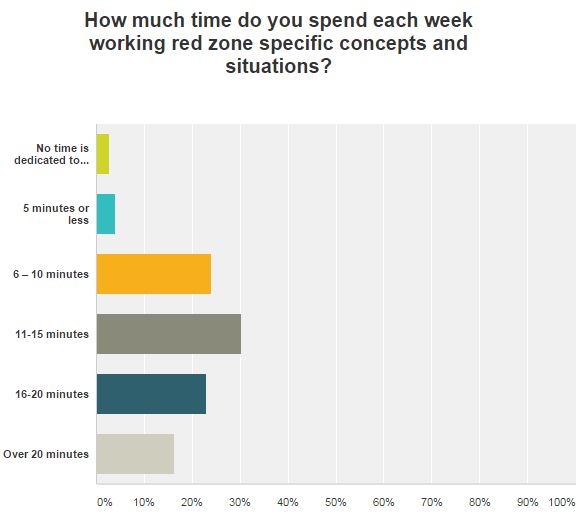
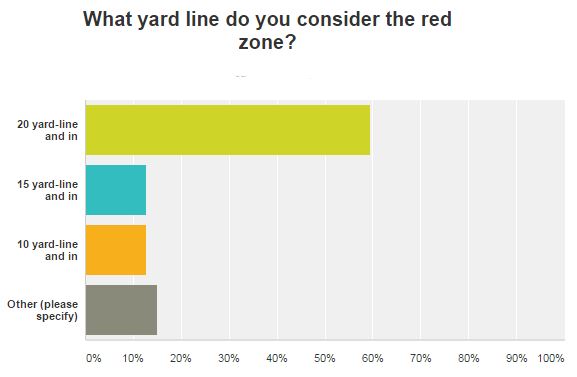
Football is a game of situations and perhaps no other situation is repped more than red zone offense. The majority of coaches are spending 11-15 minutes per week on practicing red zone offense (see below). While different coaches see the red zone as different landmarks on the field, we found that 59 percent of coaches consider the +20 yard line to the end zone to be the red zone (see below). So in an effort to make things more universal, we will use this landmark. In most situations, it is in that area of the field where offenses will start to alter their approach. Ask most defensive coordinators and they will tell you the “red zone” begins when an offense changes its play packages. We found this characteristic to be evident among offensive coaches. In fact, 69 percent of coaches say they will vary their offensive philosophy at least slightly upon entering the red zone. We wanted to research how more successful coaches are altering their game plan to be efficient in this area. So, we surveyed only those coaches who score touchdowns on at least 75 percent of red zone situations to see what they were doing differently. We found that because the field shrinks in that area, offenses are being uber aggressive in their play calling by mixing their base runs with complementary play action passing. Below are some of their responses.
graph8

graph3

Phil Holmes, Oakmont High School: “You’re working with a condensed field. So, we have a special package of plays that differ in both personnel and scheme from our base offense. For instance, we’re largely a no-huddle, shotgun spread team (10 and 11 personnel), but we will go with heavy personnel groups (23 and 31 personnel) as we enter the Black Zone (inside 10 yds.). This enables us to bring in bigger bodies to help us in our power run game but, it also allows us to isolate our best receiver in a one-on-one match-up in the pass game.”

Will Lobendahn, Radford High School (HI): “It’s less field for the defense to cover. They are able to fill the box and for that main reason is why we bring either two true tight ends or other linemen to give the defense extra gaps to defend which gives us the opportunity to expose a weak point in the defense and attack that with double teams and or bringing extra blockers to a side.”

Travis Carswell, Miles College: “My approach is two fold: one we want to disguise our base run plays with play-action passing game. Secondly, we teach our guys that this is ‘5th down-territory’ so play calling gets very aggressive in this area.”

Bill DeFillippo, Livonia Churchill High School (MI): “We will utilize more runs to attack added pressure and blitz schemes. We do use a specific package of red zone routes in different areas of the red zone by field position. This has helped us tremendously with the vertical length of the field shrinking.”

Jim Glover, Jackson North Side High School: “The vertical depth of the field has changed significantly and we are expecting more blitz and zero coverage. We will use more motion and crossing patterns to take advantage of man coverage. We will also go to more compressed sets to increase the horizontal aspect of the field.”

James Stubkjaer, Sioux Falls Roosevelt High School (SD): “Most defenses play cover 0 in the red zone. That being said, we really like aspects of our offense that is formation driven, and what that gives us based on how defenses are playing us. For example, we like to go shotgun, one back, and run speed option in our run game. We also like to go in empty formations which allows us to run ‘pick’ routes, or our QB can use his ability to make plays.”

Joe Osovet, Nassau Community College (NY): “My red zone is not to have any TFL’s or sacks. We already have three points. We will run the ball down hill and throw our quick game. Once we hit the green zone (+14 to GL) everything is in play as far as play calling goes. I will take some chances and be creative with unbalanced or exotic formations. Let me clarify one important point. Your red zone & green zone changes every year and is predicated on where your kicker is ‘money’ from. This year our kicker was automatic from about 42 yards so our red zone was from the +30 in.”

Paul Bernstorf, St. Paul’s School (MN): “In the Red Zone we expect more blitz and pressure defenses so our pass patterns involve more rubs down in the red zone. We expect the defense to be more aggressive so often our QB will pull the ball more on Zone Read down here because the defense is pinching in on the RB.”

Read More

Robber Coverage Adjustments to Defend 2×2 Open Sets

By Mike Kuchar
Senior Research Manager
X&O Labs
Twitter: @MikekKuchar


The following research was conducted is part of X&O Labs’ special report on the 4-2-5 defense, which can be accessed in its entirety by clicking here.


rp primary Mule Defense LWUResearchers’ Note: Before reading any further a simple clarification must be made. When referring to the 4-2-5 defense, we are referring to the PERSONNEL on the field, NOT the structure. The 4-2-5 defense consists of four defensive linemen, two linebackers, two cornerbacks and three safeties. Below, you will see some examples of two-safety defenses, one-safety defenses and no-safety defenses, which we’ve found could be employed by using 4-2-5 personnel.

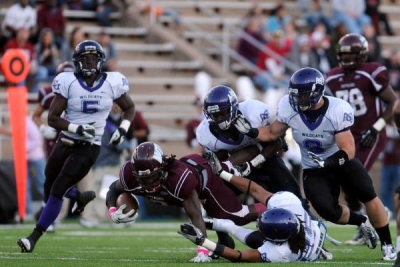
Like most defensive structures, there are a myriad amount of coverages that a coordinator can play behind it, but we’ve found that to be successful coaches must subscribe to the “less in more” theory – get good at a doing a few things right (or playing only a few coverages). Typically speaking, those that consistently use the 4-2-5 structure implement the following coverages on a weekly basis. Because these coverages independently can be the subject of its own special report, we’ve decided just to give a brief overview and description of each before going into more depth later in the report.

Double Slot:

This formation was given the most attention when we started conducting our research, and with good reason. This formation is one of the most frequently used in football, particularly with spread teams that utilize four wide receiver sets. We’ve found that without question, this is the most problematic offensive structures for a 4-2-5 defense to defend simply because the offensive set is balanced, but the defensive structure is not. Simply put, a double slot offense has two viable “speed receivers,” which means it’s difficult to get that 3 over 2 matchup that is possible against 11 personnel tight end formation. So when X&O Labs posed the question of how most 4-2-5 coaches defend this set, many were concerned about two specific details:

  • How to handle that backside number two receiver away from the strong side of the defense.
  • How to handle the comeback or out breaking routes of any number one receiver against true Robber coverage when the corner is responsible for the deep half technique.

We’ve found that with the ball in the middle of the field, this problem only intensifies. With the ball on the hash, it seems like Robber could be the answer because that back side corner doesn’t have a long way to go to play the cheat halves technique, and the field comeback throw is a long distance to go. However, with the ball in the middle of the field, it’s “game on” for the offense. They can attack in equal space to either side of the formation. The question was whether coaches will play a split field coverage principle to double slot formations or will they use some sort of balanced two-deep structure like Cover 2 or Cover 4. Remarkably, most coaches were split on this topic, some preferred to stay in their Robber coverage, while some opted for more safer coverages. It seems to truly depend on how talented that number two receiver is away from the strength of the formation.

Some systems will run Robber scheme to 2×2 but rely on communication from the Strong Safety and Weak Safety because in effect, they control their halves of the field, the Strong safety will handle the read side, which will mainly be the field side (or most dominant receiver side) if in the middle of the field. The away side will be to the boundary.

Read Side (Robber Side):

The read side of coverage is simply Robber coverage but the difference is that the corner plays any number two receiver to the flat, not the strong safety in most robber schemes (Diagram 19). Our research found 45 percent of coaches will teach their corner to play any out route by number two, while 38.3 percent teach the strong safety to control it. It’s a detail that must be communicated by the strong safety, and as one can imagine, must be rehearsed frequently in order to be perfected.

For example, if the number two receiver runs an out route, the strong safety’s eyes go from number two to the number one receiver. He is playing curl to post on the number one receiver (Diagram 20). Some systems tell their cover players to read hips. So if the hips sink, that means the receiver is breaking his pattern off and is going to stop. If that happens, the safety jumps the pattern. If the hips don’t sink, the safety knows that there is a post route coming. He picks a junction point to intercept the post route and takes it.

Read More

“Palms” and “Cathy” Coverage Adjustments to Open Sets

By Mike Kuchar
Senior Research Manager
X&O Labs
Twitter: @MikekKuchar

Editor’s Note: The following research was conducted as part of X&O Labs’ special report on Quarters Coverage, which can be accessed by clicking here.

Two-Read Coverage Rules:

In this type of coverage, the Corner’s rules are simple:

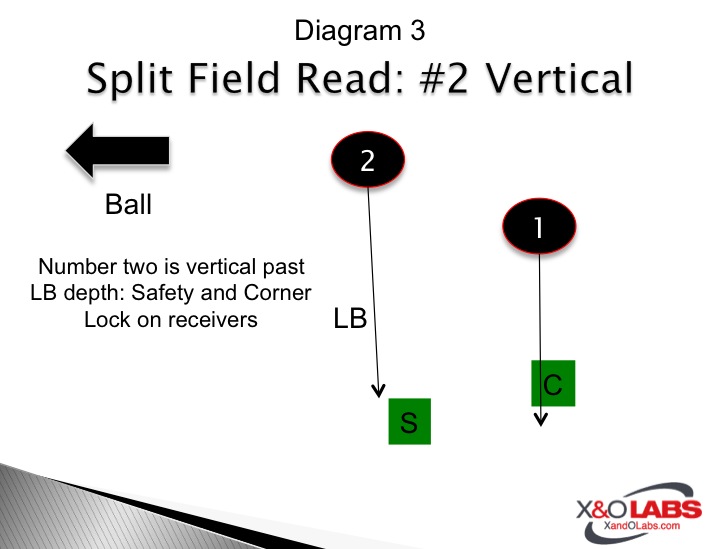
  • If number two is vertical (past linebacker depth) stay on number one (Diagram 3).


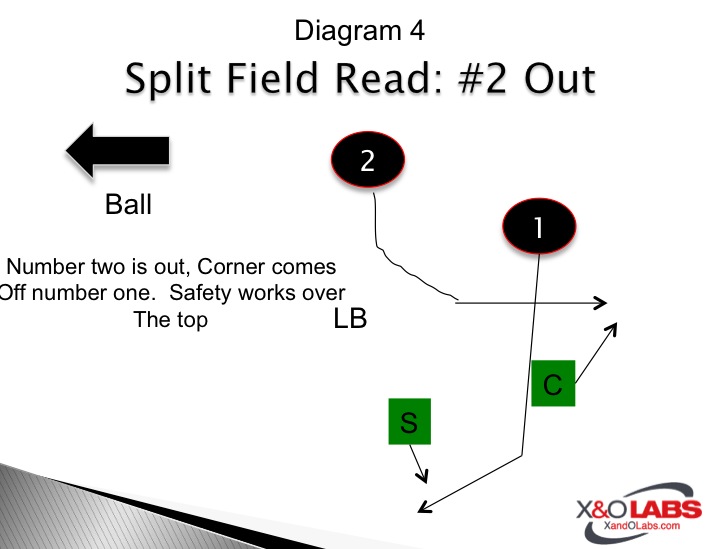
  • If number two is out, get off number one and play number-two (which is essentially becomes the new number one) (Diagram 4).
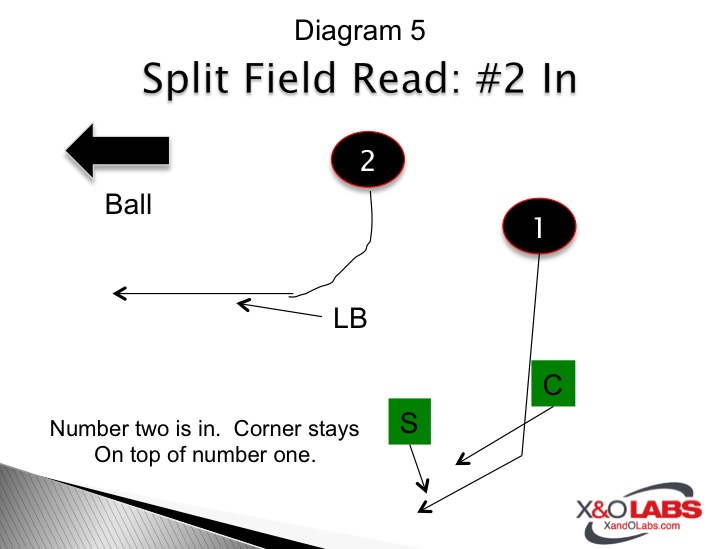
  • If number two is in, stay on top of number one (Diagram 5).

Alert Call

Since it is the defensive backs making these adjustments on field, anytime the offense comes out with a detached number two receiver and could be a vertical threat, Shap Boyd, the defensive coordinator at Muskingum College, uses an “Alert Call” made by his Safeties.  His rules are below:

Alert Call Rules:

CB Rules:

  • Squeeze #1 until #2 crosses your vertical
  • Do not chase, zone your quarter
  • If both WR disappears, then you can squeeze if #2 is running to the post or seam.
  • Watch the QB thru 3 steps before snapping eyes back to #1.
  • Flip your hips and skate

Safety Rules:

  • 12-15 yards off ball, on top of #2
  • If #2 is vertical- lock on #2
  • If #2 is out- get eyes to #1
  • If #2 drags- eyes go to QB and find work
  • “Don’t got until you know.  Find out what #1 is doing.”
  • Will LB must wall #2, look to #1 and expand for #3 pickup

The benefit of the Alert call is keeping the outside linebackers close to the core in run-downs.   Since both outside linebackers don’t have flat responsibilities, it allows them to stay what Boyd calls “the hip position” on the defensive end to their side.  Boyd uses it more on run downs or what he calls “tweener” downs when he’s not given a tendency on a run or pass.

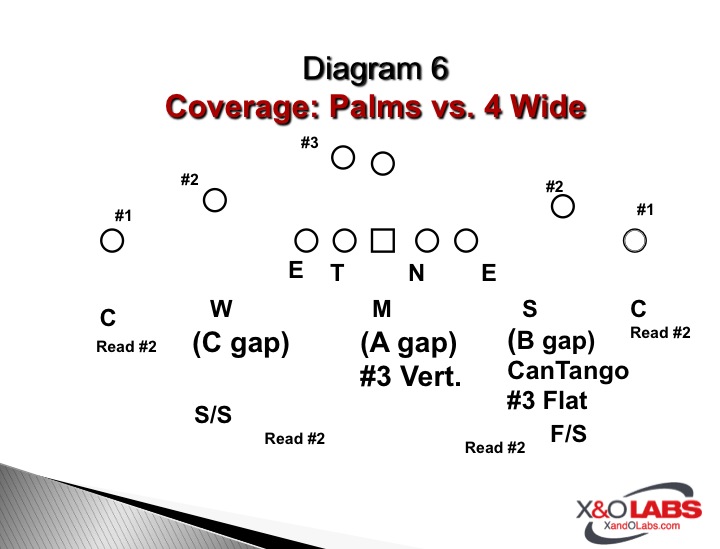
Joey Wiles, the head coach at St. Johns High School (FL) uses the same coverage, but he calls it “Palms.” A scheme he took from the University of Oklahoma under Bob Stoops.  Although Wiles says he will play Palms vs. any formation, it’s particularly useful against 2×2 sets because it keeps the Will and Sam linebackers in his 4-3 scheme involved in the run game.

Palms Coverage (Diagram 6)

Joey Wiles, the head coach at St. Augustine High School, a powerhouse prep program in the Orlando (FL) area has been an advocate of running what he calls “Palms” coverage, a concept he got from Bob Stoops back in his Kansas State days.  According to Wiles, he’ll run Palms to any offensive structure.  “In one season we’ll see three ‘I’ formation teams, two Wing T teams, one triple option team and three or four spread teams,” said Wiles.  “We will run this against anything.”

The Palms coverage premise is based off the read of the number-two receiver.  Wiles says that they are “palmsing” number-two.  While we must admit we have no idea where the verbiage comes from (if you know where it comes from, post in the comments section below), the concept is extremely effective and the rules are simple:

Palms Coverage Rules:

  • If number two is vertical, the corner plays number one.
  • If number two runs a flat route, the corner comes off on number two and the free safety plays number one.

The Sam linebacker or Nickel will apex (split the difference) between number two and the offensive tackle (Diagram 7).  “Depending on how good number two is, sometimes we begin to creep him in a little bit.  On pass route, the Sam must take a straight backpedal for three steps and settles there.  We do not want him opening up and letting the number two receiver underneath.  The only thing that takes him off is number three to the flat (Diagram 8).”

Read More

Michigan State’s Tags to Man Block Its Outside Zone Scheme

 By Mike Kuchar

Senior Research Manager

X&O Labs

Twitter: @MikekKuchar


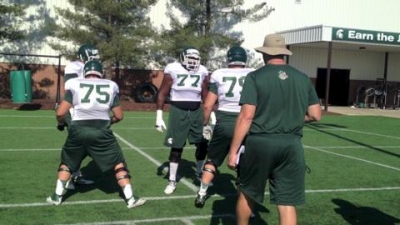
statenAccording to Michigan State’s offensive line coach Mark Staten, the beauty of tagging the stretch concept is it negates penetration by turning a zone blocking concept into a man-blocking scheme. The Spartans are averaging 246 yards per game on the ground in 2014 and its Pin and Pull concept is a big reason why. Staten sat down with us to tell us about three tags he will use to get down blocks and angles at the point of attack. 
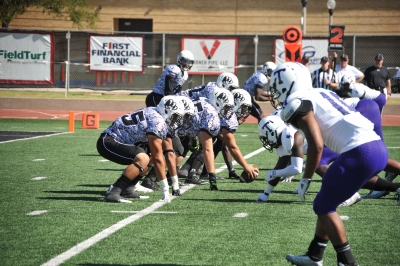
Editor’s Note: The following clinic report is transcribed from a first-person interview by XandOLabs.com with Michigan State offensive line coach Mark Staten. 

Introduction:

Simply put, Michigan State majors in the outside zone scheme, but minors in the pin and pull scheme. The Spartans offensive line coach Mark Staten contributed to X&O Labs’ study on the stretch or outside zone scheme (which can be found by clicking here) and he frequents offensive line clinics around the country lecturing on the nuances of the scheme. After all, the Spartans averaged over five yards per play on the outside zone in 2013. But what Staten doesn’t talk much about, until now, is what he does to counter defenses who start to flow with the rhythm of the outside zone concept and the answer lies in splitting the defense with a pin and pull concept. 


Scheme Work Relative to Pin and Pull:

Much of what Coach Staten teaches on the pin and pull concept is tied into the outside zone, so it’s imperative to start there. Michigan State classifies its zone concept into the following four derivatives: two-back zone, one-back zone, tight side zone and split side zone. The base rules for his offensive line in the zone play can be found below:

  1. Wide zone blocking scheme
  2. OL 18” splits – normal alignment
  3. Back Read EMOLOS
  4. Zone reach or tight reach
    1. Covered with help – Zone Reach
    2. Covered without help – Tight Reach
  5. Footwork
    1. Lateral Lead to Position
    2. Through the crotch of the defender
    3. Up the Field
  6. Uncovered is the short puller
  7. Backside is thin – chop / Sift DE to 2nd level
  8. Run off the ball when zone blocking. Great take off; use help to be aggressive
  9. Alert for line call adjustments (ie Zorro calls / Blocking call)

But as defenses start to flow, Staten will find ways to split them. “We do it for a few reasons,” Staten told us. “It stops the flow of the defense and it allows the TE (or PST in Stretch Weak) to attempt normal stretch reach and not tight reach as it would in the stretch play.” Staten will use the following tags in his Pin and Pull concept: Tag, Cage, Tex and Badger. These adjustments are described in more detail below:

Read More

4 Change Ups in Perimeter Blocking the Option

By Paul Murphy
Head Coach
Waubonsie Valley High School (IL)


Introduction

DPH 5179-1Defending the option, on its most basic level, is all about identifying who has the dive, who has the QB, and who has the pitch back. Conversely, option offenses want to identify who has each of these assignments in order to create their game plan. There are a few ways the defense can try to defend the option, so it is important that the offense has an answer for each wrinkle the defense presents. Here are a few of the most common concepts that defenses have used against our triple option attack:

  • The CB is assigned to take the pitch, the OLB takes the QB and the DE and ILB have the dive.
  • The two-high safety runs the alley and takes the pitch, the OLB takes the QB, and the DE and ILB take the dive.
  • The DE takes the Dive, the inside linebacker scrapes over the top to take the QB, and the OLB handles the pitch responsibility. The safety is then a bonus player. Most 4 – 4 teams use their free safety to run the alley to the QB or pitch.

In order to combat these varying schemes, we use a few different tags for our perimeter blocking. Each of these concepts reveals how we want them to block our option concept. When teams overload to our two-receiver side to stop the option, we will teach our QB how to change the play the opposite way.

The tags for our perimeter blocking can be used with our other option plays as well. We came up with these tags so we could try to account for the players the defense was assigning to take the QB or Pitch back in the option game. Before we break down those tags, I want to briefly review our rules for our base triple option. They are as follows:

Blocking Responsibilities:

X – The receiver to the single receiver side will run a post route and sell the pass play and work to lull the back side corner to sleep. If done correctly, later we will be able to throw the back side post for a TD.

LT – Zone block to the left. He is working by himself so he cannot let the defender cross his face.

LG – Against an even front, he will combo with the center on a one or two-technique or solo block a three-technique. Against an odd front, he must listen for line call and the block either “Zulu” (zone block left) or “Wizard” (wedge block on NG).

Center – Against an even front, he will combo with the left guard on a one or two-technique or zone step left against a three-technique and climb to second level. Against an odd front, he must make line call, and block a Zulu or Wizard concept.

RG – Against an even front, he will combo with the right tackle on the three-technique or zone block solo left against a one or two-technique. Against an odd front, he will listen for the line call and execute a Zulu or Wizard block.

RT – Against a even front, combo with the right guard on three-technique or zone block solo to the left against a one or two-technique and climb to the second level. Against an odd front, he will listen for the line call and execute a Zulu or Wizard block.

Y – The Y must listen for the specific blocking tag call in the huddle. The tag will tell him who to block. Here are his assignments:

ARC means he is assigned block the deep safety to the inside

Read More

Defending Zone Read and Power Read Concepts

By Mike Kuchar
Senior Research Manager
X&O Labs
Twitter: @MikekKuchar


Introduction:

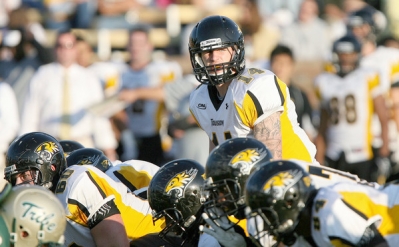
marshall1If an offense is centered on 10 or 11 personnel groupings, chances are the spread option game is a vital component of its play menu. That play menu will most likely consist of the power read and zone read game. Regardless of what formation offenses will dress these schemes up in, defenses need to have a plan to defend them. The research below serves as “change-ups” in defending spread option concepts. Implementing them into your base plan can yield negative plays and perhaps even turnovers.
Issue: Defending the Zone Read Game

The zone read game has been a staple among spread offenses for years and it’s not going away any time soon. As offenses are finding various components – pre-snap movement, formation changes and blocking variations – to dress up these concepts, these items shouldn’t be of priority in defending them. The following techniques and stunts can provide for indecision at the quarterback spot, which can lead to negative plays and more importantly, turnovers.

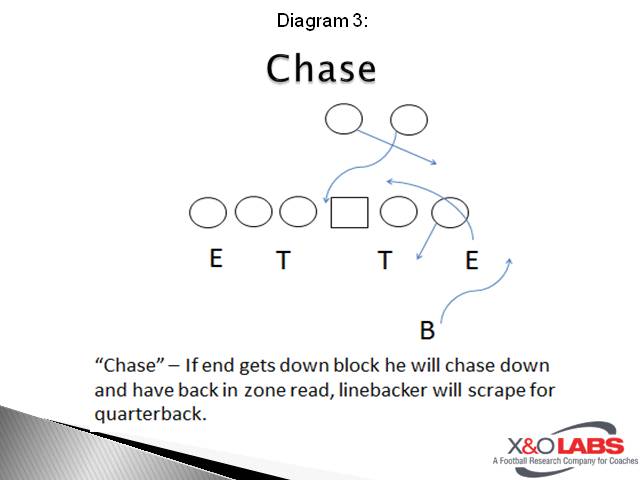
Solution 1: “Chase” Stunt, TJ Gillen-Hall, Kilgore High School (TX)

With “first threat” as our base technique, we can add our adjustments from there. The first of these is called “chase” (Diagram 3). This is a basic scrape exchange between the end and play side linebacker. Through our weekly tendency break down, we decide which side we will do this to, the back or quarterback. This is based on if they are primarily a zone or power read team. Normally, this would be more of a zone read change up, so we usually have the end on the side of the back executing it. If he gets a down block, he will chase the down. In doing so, we have now given him the back. Our play side linebacker will then exchange with the end and he has the quarterback. If the 7 technique ends up with this stunt, he will no longer be reading the tight end. If he gets a down out of the tackle, he will chase the down and have the back. Against power read teams, this exchange would be executed by the end away from the back and it should give the QB a quick give read.

Solution 2: “Hit” Stunt, TJ Gillen-Hall, Kilgore High School (TX)

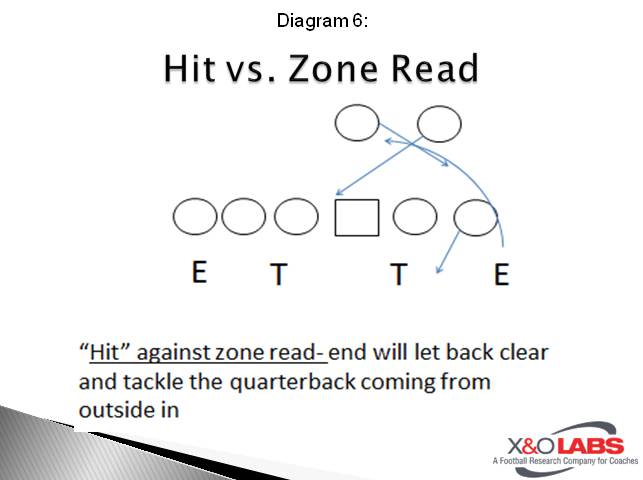
The final defensive line call we can make against read teams is called “hit”. This tells our end he is going to hit the quarterback no matter what. As mentioned before, we determine the end that will be running this based on tendency of the opponent. We could run it to the back, away from the back, to the strong or weak side end, or we’ve even had both sides run it if called. This is a read stunt so it only happens if the end gets a down block. They should know it doesn’t matter if it’s zone read, power read or any other variation, if he gets a down block he will head to the quarterback. Like chase, if the 7-technique is the end running it (the stunt) he would be in a tackle read instead of a tight end read pre-snap. We give the end an aiming point to stay at least half a man outside the quarterback, so it can be run outside in. In a perfect world, it will look like the end is up field like our rocket stunt; the quarterback will make the wrong read, and we will hit him for a big loss. Even if it doesn’t work out perfectly, we want the end to tackle the quarterback. We tell our kids the more we hit the quarterback in the read game, the more likely he’ll make a mistake and start guessing on his reads (Diagram 6).


Issue 2: Defending the Power Read Game

Since many defensive coaches group the zone read and power read concept together, we decided to present our research on these two concepts together. The “inverted veer” as some coaches refer to it, forces defenses to both out-leverage the ball carrier on the speed sweep, yet be sound enough in the box to handle the quarterback run. The following movements and techniques allow defenses to accomplish both these feats.

Read More

Mid Zone Scheme: 4 Techniques in Backside Blocking

By Mike Kuchar
Senior Research Manager
X&O Labs
Twitter: @MikekKuchar


Editor’s Note: The following research was conducted as part of XandOLabs.com special report on Middle and Outside Zone concepts, which can be accessed in full by clicking here.


Introduction:

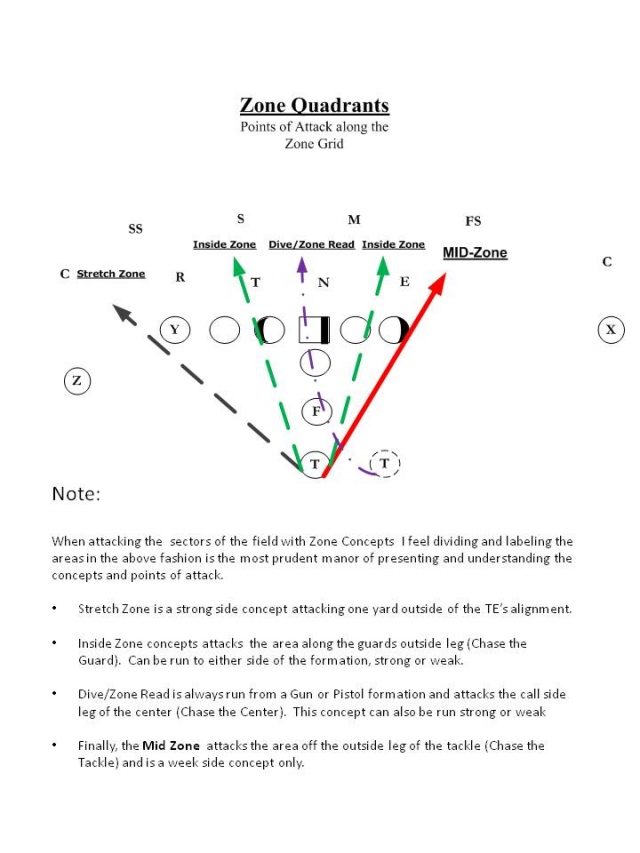
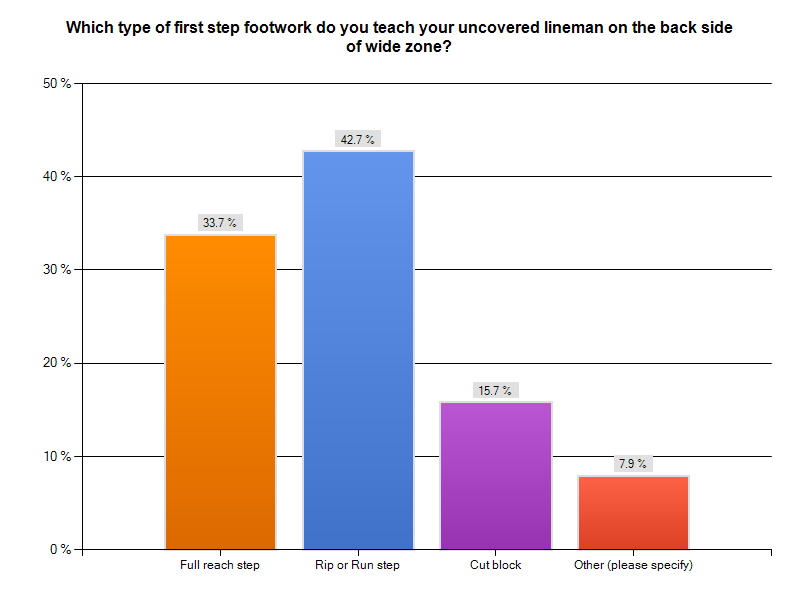
The backside of the stretch or middle zone concept is different than the inside zone concept, mainly because the scheme is not intended to cut behind the front side A gap like it is in inside zone. Therefore, it may be possible to “cutoff” the backside by getting defenders on the ground.  When we asked coaches what they preferred to do on the backside of wide zone concepts, 42.7 percent said they teach a rip to run technique, where 33.7 percent teach a full reach or scoop scheme backside.  Only 15.7 percent choose to cut block on the backside.  

chart23

We felt this could be due mainly to a large population of high school coaches who simply don’t spend enough time on the cut block technique because it is illegal in some states to do so.  Regardless of the technique on the back side, the visual aiming point was constant- 40.9 percent use the far number of next adjacent first level defender play side as a visual target. 

Rip to Run Technique

Jason Eck, the offensive line coach at the University of Minnesota State Mankato talks about a “fast track” technique on the backside of his wide zone concept.  “It’s deep open step and run and we’re looking to cut the defender in our play side gap,” said Eck.  “We never cut before 3rd step.  When climbing to the second level we run to green grass—where they are going to be—not where they are. The point is to get shoulders perpendicular to goal line at contact–Rip backside arm through play side leg. Get off the ground before the defender does.”

Read More

Zone Read “Choice” RPO


By Luke Mertens
Head Coach
Lakes Community High School (IL)
Twitter: @LakesFootball1

mertensIntroduction:

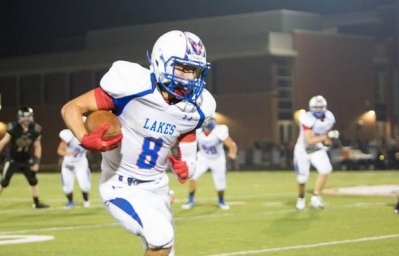
How many times have you seen an open window on the perimeter close instantly due to less-than-desired receiver blocking, despite dedicating an enormous amount of practice time on this exact skill? After cycling through a few receiver coaches and yelling at more than a few players, I have come to the realization that what receivers are asked to do in spread offenses is one of the toughest tasks in football. The solution was to take advantage of those reads by implementing RPOs into our offense. This allows us to now take advantage of perimeter defenders that are so well coached at reading run/pass cues.

Zone Read Choice

Every offense needs a “hat-hanger” and there’s no question that Inside Zone is ours. Over 80% of our run game called on Friday nights is Inside Zone. Like most spread teams, one of the looks we really like with Inside Zone is the Zone Read; however, we incorporate a pitch option for our QB more than most Zone Read teams.

After self-scouting, we came to realize that our Triple Option was predictable, which, combined with the difficulty of WR perimeter blocking, was not yielding the desired results. That said, we were also frustrated with the lack of productivity when we called Bubble. Since both of these concepts were central to our overall game plan, we knew we needed to make a change. The result was combining those two schemes into an RPO concept. We found that this change would both minimize our predictability and allow us to put those well-coached perimeter defenders in a bind.

Our Choice package tells our back side, perimeter players to execute Bubble while all box players and WRs to the play side to execute Inside Zone. It is then the QB’s job to put us in the best play based on both what he is seeing before and during the play.

The first thing he looks at is the pre-snap alignment of the defense. If he sees cushion and/or outside leverage by our WRs to the backside of the Inside Zone play call, then he knows he has the green light to throw the Bubble. Even if he makes this decision, he still must mesh with the RB to force the defense to honor the possibility of run. If the QB has any doubt on whether or not to throw the Bubble, we instruct him to give the ball. We feel that giving the ball to the RB is never a wrong decision and is a much safer alternative to possibly guessing wrong on Bubble.

Choice RPO Key Coaching Points:

  • QB pre-snap read – look for numbers and leverage on the back side to throw Bubble.
  • Even with a “green light” the QB does not have to take the Bubble.
  • Inside Zone is NEVER the wrong choice.
  • QB is to ALWAYS mesh with the RB.

If the defense disguises well and spins post snap into a look that is not conducive to running Bubble, then the QB should give the ball to the RB. This is another reason why we always have the QB/RB mesh regardless of the pre-snap read. Below is an example of a “green light” for the QB out of a 3×1 set:

Read More

2 Quarters Coverage Adjustments vs. 12 Personnel

By Mike Kuchar
Senior Research Manager
X&O Labs
Twitter: @MikekKuchar


Editor’s Note: The following research was conducted in part of X&O Labs special report on Quarters coverage which can be accessed in full by clicking here.


Introduction

One of the knocks against using Quarters coverage structures is the vulnerability it may have in defending closed sets where deep safeties must be tied into the run game. While that fundamental can developed with constant coaching, we’ve found that using “Tight” and “Flats” coverage adjustments in quarters coverage can help alleviate what can potentially be problem areas in 12 personnel teams.

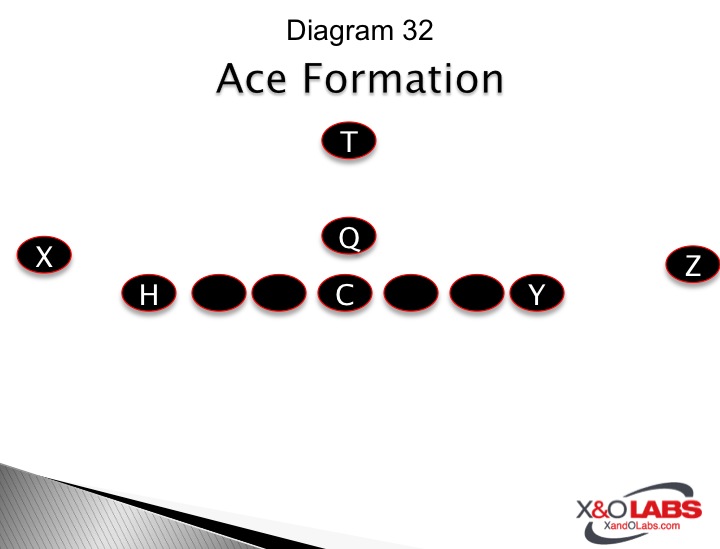
Ace Formation (Diagram 32)

The Ace Formation is a balanced set where there are two-wide receiver threats to each side of the formation. In traditional Quarters rules, it may be sensible to play a “Read” call to both sides of the formation in order to get those safeties activated in the run game. This makes sense. With eight potential gaps in the run game, those safeties are forced to become run players first – you’d be a gap short in the run game in a 4-3 front (only seven box defenders). But if you’re lining up against anybody with the ability of New England Patriots and their two tight ends (ok, maybe with a quarter of the ability of Gronkowski), then you’ll need to make sure those safeties can handle number two vertical stretching the field.

Read More

Pressures to Attack Full-Slide Protection

By Mike Kuchar
Senior Research Manager
X&O Labs
Twitter: @MikeKKuchar

Editor’s Note: The following research is part of X&O Labs’ special report on Developing a Pressure Check System, which can be found by clicking here.


Introduction

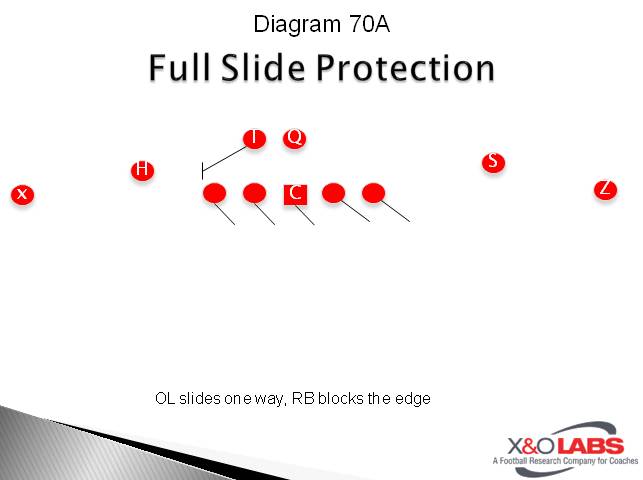
Full-Slide Protection (Diagram 70A): Full slide protection simply means the offensive line will slide all in one direction and put its back away from the slide. Here, the offensive line could slide in many directions, to the field, to the boundary, to the QB’s backside, etc. It’s important to get a tendency on where they are sliding most often based which could be based on down and distance and personnel.

Slide70a

Without question, full slide protection is the most simple to dissect and perhaps just as simple to attack. The key is to understand where they are setting their slide. Slides can be set to the back, away from the back, to the field or to the boundary. Once that tendency is determined, it becomes more sensible to attack away from the slide protection. We were surprised to hear that many defensive coaches are still seeing the majority of offenses employ full slide protection on a weekly basis. “We see so much slide protection in our league, everyone is doing it.” Butler Community College defensive coordinator Tim Schaffner told us. “We blitz the back to also work on the zone read.”

Read More

Addressing Pressures in P.A.P. Protections

By Brian White
Offensive Coordinator
Rose-Hulman Institute of Technology
Twitter: @CoachWhite_RHIT


Introduction:

RHPAThe main goal of our offense is to be a great Inside Zone team. In order to be an effective running team, we must have a well-developed package of compliments to our run game. These include our Bubble Screens, Four Vertical package and our Play Action package, which is the focus of this article. Our Play Action package is simple to execute for all eleven players on offense, while adding a layer of complexity for the defense to defend. We have found our Play Action schemes to be effective against the run stopping defenses we see, such as Quarters, Cover 3 and Cover 1.
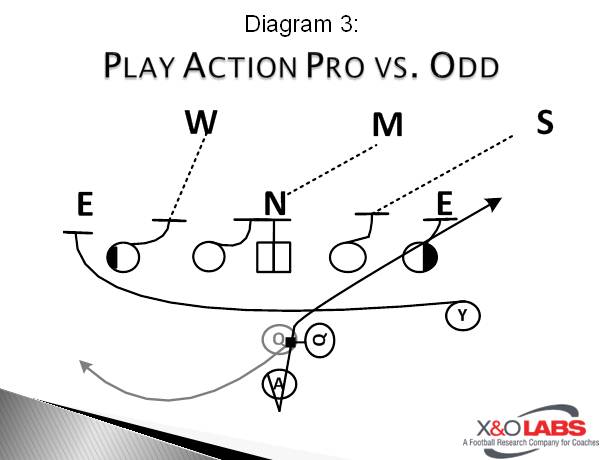
Protection:

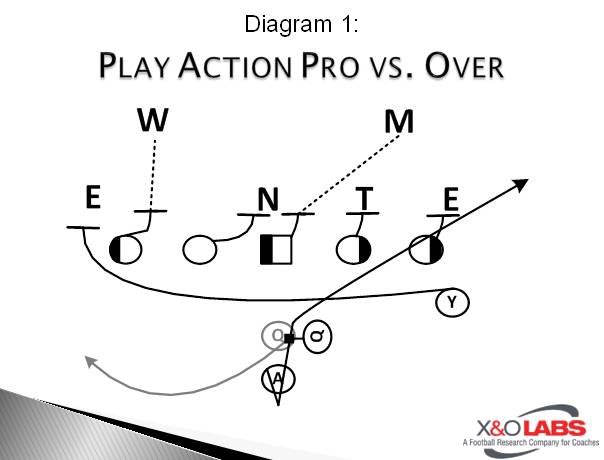
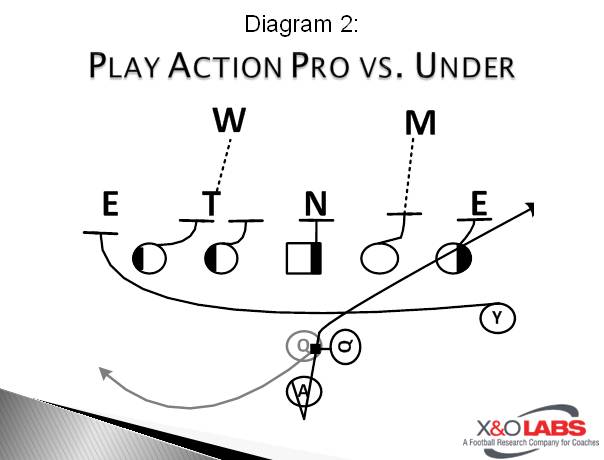
All pass concepts start with great pass protection. Having the offensive line understand the launch point of the quarterback and the backfield action behind them is critical to the success of the protection. The offensive line does not need to know every detail about the pass concept and action. They only need to know enough to make them understand where and when the ball should be thrown. In the case of our Play Action concepts, the quarterback and running back will execute a hardball fake of our Inside Zone. The quarterback will then work to a depth of 9 yards deep behind the original alignment of the back side tackle (meaning the tackle away from the zone fake). The quarterback will either break contain or pull-up based on the block of the back side defensive end. We will detail this mechanic a little bit later in the article. Based on this information the offensive line must understand that our Play Action concepts involve a hard action fake and the quarterback is working away from the zone.

Slide1Slide2Slide3

The protection will start with the center identifying the Mike linebacker. The center will use the same Mike declaration as if we were running Inside Zone. This means the Mike will be the first Linebacker from head-up on the Center to the play side. The offensive line will block Inside Zone with covered/uncovered principles. The first uncovered offensive lineman is responsible to work in combination to the point. The adjustment we make when running Play Action protection is that all offensive linemen will block a play side number landmark, which is slightly different than on our Inside Zone. Knowing that the quarterback’s launch point is away from the call, the offensive line can be confident to keep their defensive lineman on the run to the call side. These are the rules we teach our Offensive line:

PST: Block the play side C gap defender with play side number landmark. Alert to block an edge rusher.

Footwork: Dependent on width of 5-technique. Use Bracer (drop, bucket, etc.) footwork against a tight shade technique and over up on the second step. Shuffle first to cover up a wide shade.

PSG: Block the play side B gap defender. Combo to the Point if uncovered.

Footwork: Covered footwork is the same as the PST. Use Jab-Vertical footwork against a 2i technique to strike his play side number using a Flipper or Single Under technique. Use Bracer footwork against a Shade technique and provide presence to the nose with back side arm.

C: Identify the Mike as the first LB head-up and to the play side. Block the play side A gap defender. Combo to the Mike if uncovered.

Footwork: Use a Bracer step against a play side shade technique or head-up nose. His second step must get to the crotch of his defender. Gallop in leading with the play side knee against a 2i technique. Use Bracer footwork and provide presence for the back side guard against a back side shade or 2i technique.

BSG: Block the back side A gap defender.

Footwork: Use Bracer footwork against a 2i technique. He must get his second step to the crotch of the defender. Utilize a Shuffle-Bracer step against a shade nose.

Read More

Defending Empty Routes: Mixing Halves and Quarters Coverage

By Pete DeWeese
Defensive Coordinator/LBs
Milton High School (GA)
Twitter: @petedeweese


Introduction

CaptureThe game has changed, and as a result, defensive coordinators at every level have been forced to reexamine the way they structure their defenses. Spread offenses have changed the landscape of college football. While many of the RPO schemes that offenses are starting to use seem cutting edge, the reality is that offensive coaches are going back to time-tested schemes and simply adapting how they apply them. Good offenses know there are four surefire ways to put stress on a defense:

  1. Have better athletes on the field.
  2. Create extra gaps for the defense to defend.
  3. Maximize the number of vertical threats in the passing game.
  4. Take players out of their comfort zone and attack them.

Perhaps no formation puts these four stressors on the field at the same time as well as Empty formations. These formations allow the premier playmaker on an offense to create mismatches that put him in space to make plays. Empty also maximizes the threat of vertical routes, and in doing so, can force box defenders out of their natural habitat. Though Empty formations do not explicitly create extra gaps around the tackle box, they can open up gaps if a defense responds by removing a typical box player, thus effectively creating the same issue for a defense.    

Defending Empty Formations

We run a 4-3 defense as our base with a nickel package that is rooted in a 3-4 structure as a change-up. Our defense is a one-gap scheme that relies heavily on our technique and on our recognition of formations, tendencies, and schemes while blitzing infrequently. We worked hard to make sure that we could find a solution to Empty that didn’t force us to stray too far from our the core concepts of our defense. What we found was that it is much more difficult to do than it is to say.

During the 2014 season, 11 of the 13 teams that we faced ran some form of Empty formation. Our staff has been looking for the best “answer” for empty formation for four seasons. During that time, I have met with a handful of well-respected, college-level defensive coordinators and surveyed many other coaches to find the best solution. In the end, he most common answer that I received was some version of “I don’t have one.”

One former ACC & BIG 10 defensive coordinator told us that his graduate assistants had completed an in-depth summer study on Empty for two consecutive off-seasons. As part of their research, they broke down every snap of Empty that they could get their hands on. They looked at both sides of the ball and tried to analyze both the offensive tendencies and the defensive schemes used to combat them. In the end, the research suggested that Empty is a different creature and must be handled as such. With that research as our guide, we have adopted a similar philosophy at Milton.

This may seem drastic, but the absence of a back and the possibility of 3×2 and 4×1 alignments really is a game changer. Take a Trips formation for example, a 3X1 set is a 3X1 set and most defensive structures allow for easy adjustments regardless of offensive alignment. Many teams will incorporate the same front, coverage, and pressure packages to a 3X1 set with an attached TE just as they would if that TE flexes out. In my opinion, Empty does not allow itself to be so cleanly adjusted to.

Since it is different, we start with a different set of questions. Here is a list of questions that we address when we are preparing for an Empty package we start by addressing the following questions:

  • Is the QB a run first threat?
  • Do they use a 5, 6, or 7 man surface along the LOS?
  • Are they primarily a 3X2 or 4X1 version of Empty?
  • Do they use motion in their Empty package?
  • Where do they want to go with the football?
  • How do they stretch the field within their Empty Package?

Once we are armed with the answer to these questions, we are ready to create a solution for our defense that can work against the Empty formations that we are going to see that week. In the following section of this report, I will address some ways of defending multiple Empty concepts and schemes.

Defending 3X2 Empty

The most traditional 10P Empty formation typically aligns receivers in a 3X2 distribution. 

Read More