Drills to Block First Level Twists in Pass Pro

By Mike Kuchar
Senior Research Manager
X&O Labs
Twitter: @MikekKuchar


Editor’s Note: The following research was part of X&O Labs special report on Man Pass Protection Drills. The full-length version of this special report is in our Insiders membership website. You can join the Insiders by clicking here.


Introduction:

wmuWhile many of the techniques in the special report can be applied when blocking stagnant or stationary targets, the greater issue in pass protection is coaching players on how to defend movement, particularly at the first level.

This report is devoted to the techniques and drill work associated with defending E/T and T/E games, zone pressures and man pressures in pass protection. We researched not only how offensive line coaches are teaching their players to identify pressure, but more importantly, how to block it when it does come. Before we delve into the techniques these coaches use and the drill work that corresponds with it, a brief background on who our contributors are:

The Contributors (in alphabetical order):

  • Chennis Berry (CB), Offensive Line Coach, Southern University (8 sacks allowed in 2014, 4th in FCS).
  • Brian Callahan (BC), Offensive Line Coach, Western Michigan University,
  • Vin Giacalone (VG), Offensive Line Coach, Valparaiso University (5 sacks allowed in 2014, 1st in FCS).
  • Herb Hand (HH), Offensive Line Coach, Penn State University.
  • Art Kehoe (AK), Offensive Line Coach, the University of Miami (allowed 1.6 sacks per game in 2014).
  • Brandon Jones (BJ), former Offensive Line Coach at East Carolina University (371 passing yards per game in 2014, 3rd in FBS), currently at Cal Berkeley.
  • Jonathan Leibel (JL), Offensive Line Coach, Central Connecticut State University (11 sacks allowed in 2014, 10th in FCS).
  • Cameron Norcross (CN), Offensive Line Coach, Fresno State University.
  • Ryan Stancheck (RS), Offensive Line Coach, Alcorn State University (7 sacks allowed in 2014, 3rd in FCS).
  • John Strollo (JS), Offensive Line Coach, Ball State University (13 sacks allowed in 2014, 12th in FBS).

Single Man Twist Drill: Southern University

Read More

The Shovel/Bubble Triple Option RPO

By James Stubkjaer

Offensive Line Coach

SF Roosevelt High School (SD)

Introduction

Like many RPO concepts, this play started out as a simple Power Shovel play. But when our head coach decided to married the bubble play the power shovel it really began to take off for us. This is one of a few RPO plays that we employ, where we will put defensive players in conflict and take what the defense gives us based on a combination of pre-snap/post-snap reads. This, of course, requires our quarterback to process information and make decisions on the fly, but gives him multiple options for this one play.       

Linemen Alignment

As part of our spread concept, we put an emphasis on spreading out the box players as well. Our offensive linemen are in a two-point stance with wide splits that could range anywhere from 2’ to 4’ depending on the play. I know that some people believe that having linemen in two-point stance hurts the physicality in the run game, but that would be contrary to my experience. In the five years that we have used this technique, we have averaged over 31 points per game, over 200 rushing yards game rushing, and a minimum of 5.4 yards per carry.

We also want our level off of the ball to be as far back as legally possible. The levels off the ball are the key for the linemen in this offense because it allows them time to use their technique and make their blocks. The rule in South Dakota is that the facemask of the offensive lineman must break the plane of the centers hip. Once our center is set in his stance, the guard will adjust his splits accordingly, and we like to have our guards place the toe of their inside foot, so that it would touch an imaginary line drawn parallel to the heels of the center. Our tackles, then line up their inside foot, so that it would be parallel to the toe of the inside foot of the guard. If you view our formations from the side, you will see the center out and the guards/tackles will be in a straight line, as far back off of the center as we can get.                 

As a general rule, we are a gap-man blocking team but we often couple those concepts with inside zone rules on the back side. We lean heavily on the skip pull technique for our pullers but we also use open pull techniques at times.

Power Shovel / Bubble Concept:

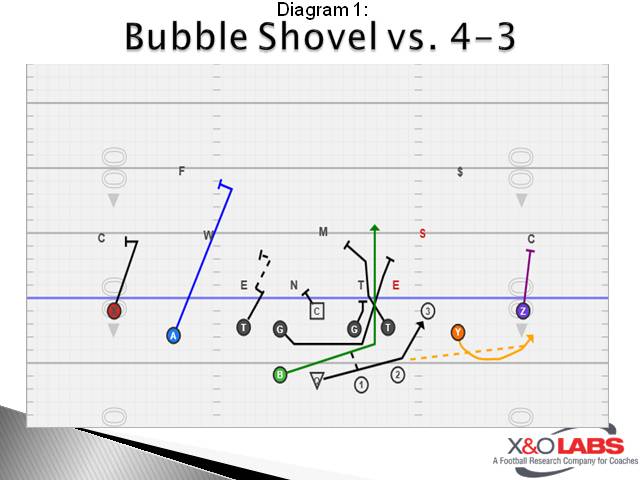
Here in South Dakota, we predominantly see 4-3 and 3-4 fronts and the occasional 30-stack defense. We have found that this concept can work against any of these looks with a few formation changes. Here is a look at this concept against each of these common fronts:

Power Shovel Combo v. 4-3

Slide1

Play Side Tackle: Double the 3-technique to the Mike. Note: We will squash his split down to about 2′ for the double.

Play Side Guard: Double the 3-technique to Mike with the tackle and keep eyes on the 2nd level for an A gap blitzer.

Center: Pin or base block 1-technique. Note: We also can pull our C, depending on back side ability and location of the back side nose guard.

BG: Skip pull, staying tight to the double team, and climbing to the Sam backer. It is critical that he does not pass up work on the way to the backer so if he encounters any resistance he will stay on that man.

Read More

Lock/Master Lock Concept to Negate Gap Exchanges

By Mike Kuchar
Senior Research Manager
X&O Labs
Twitter: @MikekKuchar


Editor’s Note: The following research was conducted in part of a larger special report on the Pistol option game, which can be accessed by clicking here.

Gap Exchange/Reading Second Level Players

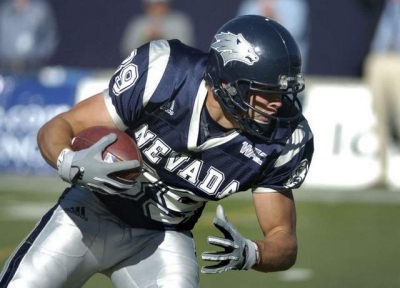
bildeOne of the more common defensive adjustments to zone read teams is known as a gap exchange, the most common being a first level and second level defender. According to Cameron Norcross, the former offensive line coach at the University of Nevada, these were the most common counters defenses would have against zone read concepts. Many defenses would tighten the alignment of their defensive ends to allow them to squeeze down blocks while second level linebackers can scrape over the top to play the QB (Diagram 16). Norcross recounts a time that Nevada encountered this exact problem when playing Boston College in a bowl game a couple years back. “We could never get our tackle down to block the play side inside linebacker,” said Norcross. “So we told the tackle to block him so our slip guy could block the play side inside linebacker (Diagram 17). The alley player would be free. So we ran our arc scheme to the tight end side so we didn’t need to run the ball at the tackle. We basically man schemed the back side (read side) of the play. Our tackle was responsible for him so we can take our tight end/wing back on the alley player.

Read More

Tight End Flat Combinations to Complement Zone/Bubble

By Curt Fitzpatrick
Head Football Coach
Morrisville State College
Twitter: @_CoachFitz


Introduction:

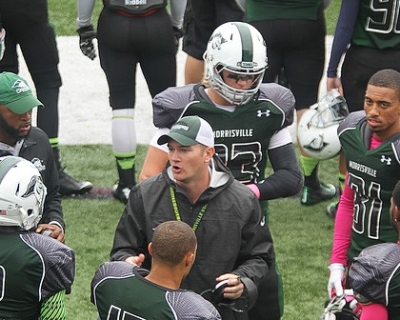
Fitz SidelineLike many up-tempo offenses, a large percentage of our run game at Morrisville State is based around running the Inside Zone play successfully. In spread formations, we either utilize a bubble screen on the back side to create a triple option look to the defense or give the QB a “now” throw if the bubble has the defense outflanked based on pre-snap alignment or pressure. This is a staple of our offense because it allows us to attack the entire field from sideline to sideline with one play call. We want to give our QB options, and try to have answers for multiple looks that a defense could give us on any given snap. 

Last season, inside zone made up 42% of our total run calls and we averaged 6.3 yards per play over those 196 plays. Below was our ball distribution on the play:

  1. Give to RB – 68% (5.4 yds/carry)
  2. QB Keep – 14% (8.9 yds/carry)
  3. “Pitch” Phase – 14% (8.7 yds/play)
  4. Front Side Alley Control – 4% (4.8 yds/play)

Because we run this play as a triple option, the “pitch” phase is whatever the third option is for the QB.  In many cases this is a bubble screen, but at times we will use a tight end flat route to the back side. This is a nice complement when a bubble screen is not available due to the lack of a slot receiver. This allowed us to utilize the same teaching that we spent so much time on when installing the zone bubble concept with a slot wide receiver and made it easier to install for our players as we try to use as many “this is just like that” install scenarios as possible. Furthermore, because of the way that teams line up to surfaces with a tight end, it gave us some opportunities for our quarterback to get some safe, high percentage completions. 

The key to making this concept work is that we were causing defenders to be in conflict in alignments that they may have not been exposed to previously. For example, a Sam LB might be more familiar with defending a zone bubble look when he’s apexed between the #2 receiver and the end man on the line of scrimmage (EMLOS) as opposed to inside the box against a tight end surface. After all, a goal of any up-tempo offense is to make defenders hesitant and question their eye discipline. This scheme fits that goal perfectly. 

Read More

Press Box Research Report

By Mike Kuchar

Senior Research Manager

X&O Labs


pressbox

Introduction

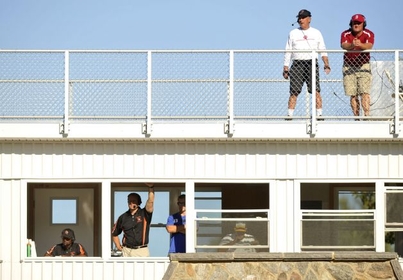
Now that we’re all approaching mid-season form, we felt imperative to address perhaps what might be the most under-coached aspect of on field coaching decisions- press box communications.  We’ve all been in situations when our spotter in the booth is caught “watching the game,” and not what he’s supposed to be clued in on.  Training your spotters is a difficult task, one that can only be mastered with the combination of disciplined eye training and plenty of experience. 

XandOLabs.com sent its survey on press box communications to 3,900 coaches- only offensive coordinators, defensive coordinators and head coaches at all levels that reported back on the methodology they use in the press box.  We heard back from coaches who had worked with their spotters for over twenty years and some who were in the process of training a beginner up there.  We’re more than happy to report on our findings below.

Case 1- Personnel in Press Box

Before we begin with the most common protocol used in the booth, we wanted to present some findings that we found interesting on the personnel in the booth.  We wanted to start with the head coaching position and find out how many coaches are tied into game day communications.   It seemed like the visual of the stoic head coach, ala Tom Laundry, pacing the sidelines without a head set is lost in football lore.  Truth is, we found that 83.6 percent of head coaches wear a head set on game day.   This wasn’t so shocking.  But there are some- like the University of Michigan’s head coach Brady Hoke, that choose not to do so.  It was this sixteen percent that we felt we needed to explore.  We reached out to the small minority to find out what those head coaches are doing when not on a headset and here is what we found:

“I go between the coordinators when suggesting things or asking questions, but only when I deem it a necessity.”- David Bice, Sardis High School (AL)

“An assistant with a headset stands near me and passes information to and from the press box.”- Joe Fabrizio, head coach, St. Petersburg High School (FL)

We found that those head coaches that opt not for the headsets are naturally not coordinators.  They spend the majority of the game delegating responsibilities- such as personnel, calling offenses and defenses- to their assistants.  Some of these coaches choose also not to be on the phones in order to eliminate clutter, which can be a constant distraction during the course of the game.  We found that the majority of coaches, 58.6 percent, use more than five headsets on game days.  This is more than double the amount that use up to five (see survey results below)Considering the majority of our survey responders where high school and mid-major college coaches, we found this number to be particularly high.  The protocol these coaches use during the game will be discussed in further cases, but the fact that there can be that many “mouths” going during the course of the game is staggering.  Managing that communication can be a chore.  What we found even more interesting is that even though many programs are using more than five headsets, 37.5 percent of these coaches have only two total coaches in the press box.  Now the issue becomes how to delegate responsibility to those two coaches, which we will explore now in futher detail. 
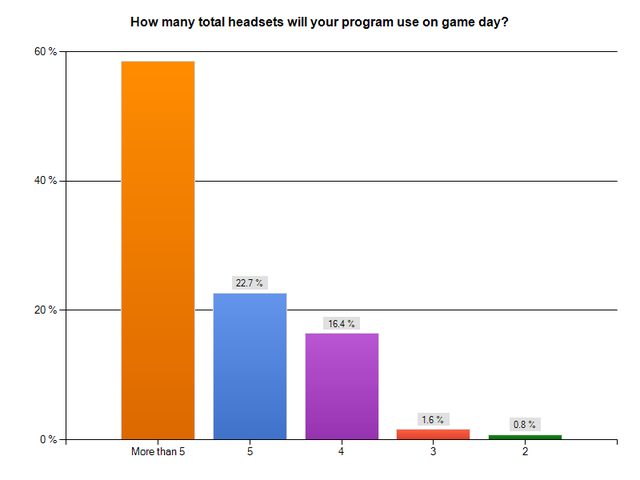
chart4 

Case 2- Offensive Responsibilities and Communication Protocol

The first question we wanted to explore regarding the offensive side of the ball was how many offensive coordinators are in the booth as opposed to being on the field.  We found that 63 percent of offensive coordinators choose to be on the field, which is significantly lower than defensive coordinators on the field.  We know that most coordinators choose to see the “big picture”- fronts, coverage’s, movements, etc. which is particularly why many major college programs have its offensive coordinators in the booth.  But as far as high school and small college coaches are concerned, the majority chooses to be on the field and trust their spotters up top to do their jobs.   Despite having a possibility of five coaches on headsets, 48 percent of these coaches only allow up to two other coaches talking on the headsets at the same time. 

Multiple Spotter Protocols

Having two spotters in the booth can provide some benefits to the offensive coordinator.  While we all know elements like down and distance, field position and coverage can be important, 37.3 percent of coaches feel that the defensive front is the most valuable information offensive coordinators receive from their spotters in the booth (see survey results below).    One of those coaches is Doug Taracuk, the offensive coordinator at Dublin Scioto High School (OH) who relies more on the visual he gets on the defensive front, more specifically, the defensive ends.   “The defensive ends are important to us due to our use of misdirection plays such as nakeds, counters, and reverses,” Taracuk told us.  “The play of the end often dictates what types of pass protection we use, which screens we use, and which reads or options we use. We want to know his angle of attack, his feet, how often he comes under pass sets, how disciplined is he on plays away, and does he wrong arm kick out blocks.  In our area, the big difference between great teams and average teams is often dictated by the play of the field or formation defensive end. With the variety of offenses in our area, we may not see how an end will play against our style on our scout tapes.”
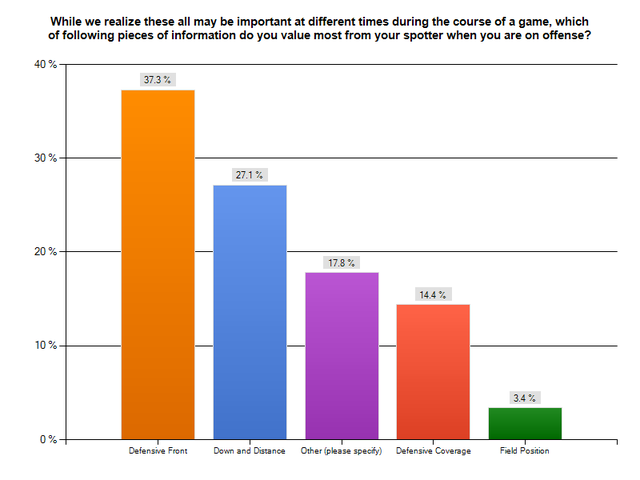
chart9

Taracuk detailed and example of this below:

“On Tape one, our opponent played a Navy style option team. Our second tape showed our opponent playing against a four or five wide attack.  In game one, they played a two tight end double wing offense.  We had a decent clue of the scheme, but it was hard to evaluate positions.  Going into the game, we thought we could kick the ends out with our tight end.  We were wrong. We switched to our counter plays where we either kicked him out with a pulling guard or high walled him with out tackle.”   While one of his spotters is checking the defensive ends, Taracuk watches the front at the point of attack on runs and the under coverage on passes. The second spotter watches the secondary fills on runs and the deep coverage on passes.  Recently in Ohio, high school programs are allowing coaches to use technology up in the press box and as a result, Taracuk uses what he calls his “doodle chart,” which we made available to our Insider members (click here to download this form)“We shoot pictures or video each play with an I-Pad.  At the end of each series, we tally the fronts, coverage’s and stunts and draw in the fills or drops. From tha

Read More

Using Quick Game Tags to Attack Voided Alleys

By Scott Girolmo 

Offensive Coordinator and Assistant Head Coach

Liberty High School (VA)

Twitter: @CoachSGirolmo

Introduction:

Liberty Handley Walters HUGGINS-320x246T.U.G. stands for “Throw to the Uncovered Guy,” and is a way for us to attack a perimeter weakness displayed in the defense as a result of poor alignments or over adjustment to stop our run game.
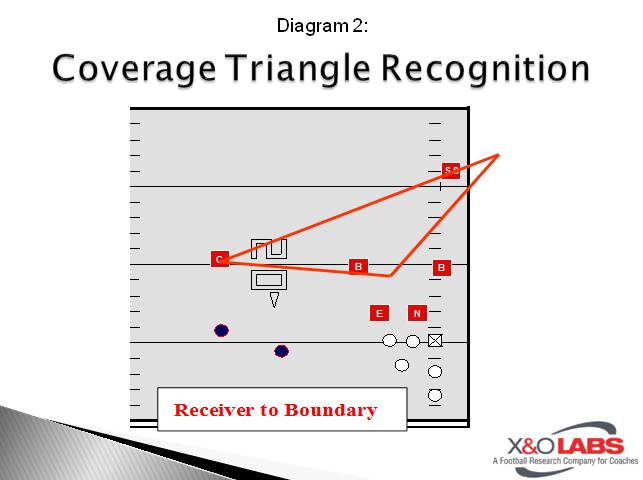
“T.U.G.” is used in our offense to any twin or trips receiver set that is back side of a perimeter run play, or that is to either side of any interior run play. “T.U.G.” has provided our offense with two quick pass options and successful plays with minimal risk. The first is a classic bubble route by the #2 receiver with a lead block by #1. The second is the opposite, a quick step back by #1 and a lead block by the #2 receiver. Our “Lookie” concept involves tagging quick pass routes on our run game to take advantage of match ups in man coverage or loose zone defensive alignment.

Identification of the “Coverage Triangle”

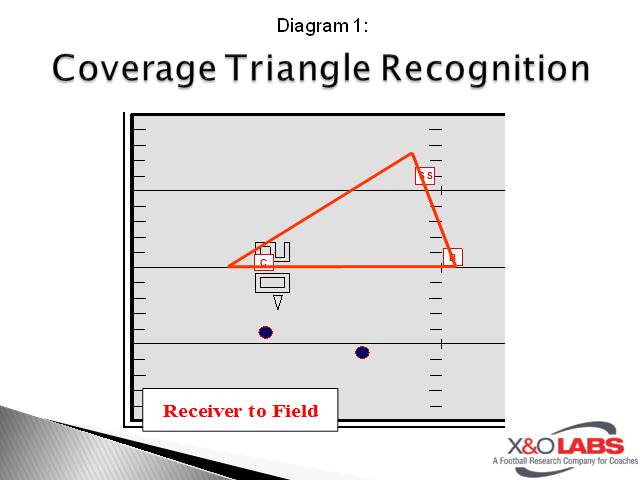
When we teach our receivers about coverage during spring install, the first topic we focus on is reading the “coverage triangle” to their side of the field. The coverage triangle refers to the spatial relationship between the deep safety player, corner and alley or primary force player on your side of the field (Diagrams 1 and 2).

We use this teaching method in all of our pass route concepts, and more often in our “T.U.G.” concept. For our conversion routes, it indicates to our receivers what adjustments to make pre-snap, and for our “T.U.G.” concept it will help them decide where the ball is going.

In the “T.U.G.” “concept specifically, we designate our outside receiver as the “shot-caller,” to dictate which of the screens we will be running and communicate that verbally to our slot. We only currently tag “Lookie” to a solo receiver, so it is up to the lone “X” to decipher the defense and relay his thoughts to the QB. The first step in reading his coverage triangle is to identify the deep safety to his side, and determine if he is a 1 high, 2 high, or no deep safety based on his relationship to the hash mark. Next, we determine if the technique of the corner is man or zone (inside or outside leverage) by assessing whether he is rolled up tight or backed off soft-aligned. Finally, locate the invert or alley player to your side who is most likely the primary force defender.

Slide1Slide2

Coverage Triangle Indicators:

The alignment of the triangle to your side will be the best indicator of overall coverage the majority of snaps. The situations that we practice against are condensed to provide the least amount of thinking possible for our players. Here are the concepts we expect our players to identify and understand:

Cover 2: If the safety is 10 or more yards deep and two yards outside the hash, we consider him to be a deep half player. The corner is tight and the alley player is splitting the slot’s alignment (Diagram 3).

Read More

Get Game Stats and Play-Charting in Real-Time and on the Sidelines

By Mike Kuchar
Senior Research Manager
X&O Labs
Twitter: @MikekKuchar


Introduction

LegUP Report Image

If you’re like 99% of us, you’re tracking game day stats and charting plays with pen and paper. This process hasn’t changed much since football coaches began collecting and analyzing data decades ago. The problem with this method is its time consuming, cumbersome and doesn’t always produce the most accurate data – which can cause major problems when you’re making critical decisions based on “kinda-sorta” accurate information.

This is why I’m excited to bring you this report. We’ve been testing a new technology that will completely change the way you look at play charting and stat tracking forever.

I’m talking about LegUP (www.LegUPAnalytics.com), the new iPad application that replaces the old pen and paper system of charting statistics and plays. LegUP tracks the play, the situation, the players involved and how they contributed to the outcome, and where and how the play ended.

At first glance, we thought LegUP was just a better mouse trap over the pen and paper method, but we were wrong… really wrong.

After testing the application for the last two weeks, we’re confident that LegUP is ushering in a new era of performance analytics. As coaches, we feel that LegUP has changed the process of play charting and stat tracking in two innovative ways…

  1. Real-Time Analysis: What we like best is that the stat tracking and play charting data is available in real-time. That means coaches on your staff will have access to the information on the sideline during games using LegUP’s iPad app (no internet required) – so you’ll no longer have to meet with your staff at halftime to “sync” up on stats. With LegUP, your coaching staff will have access to your opponent’s tendencies and trends during games, as well as your own tendencies and trends.
  2. Post-Game Reporting: As soon as the game is over, LegUP uploads the data to your team’s account (which is accessible from any computer with internet access). Using your LegUP account, you’ll run through a quick procedure to ensure all data from the game is accurate and ready for advanced reporting. Once this post-game work flow is complete, you can send play charting and stat reports to the coaches on your staff. You can also send injury reports to the athletic trainer as well as coaches. And best of all, you can easily upload data directly to HUDL. Keep in mind, this can all be done immediately after the game is complete, giving you more time to review your team’s performance.

Why We Like LegUP Analytics:

Read More

Easy “Layups” with the RB Stack Concept

By Andrew Coverdale

Offensive Coordinator

Trinity High School (KY)

Twitter:  @andrewcoverdale

Introduction:

“Inbounds plays” in basketball are used for two specific reasons. First, it is used to get an easy layup or clean shot for a shooter by their design. Secondly, they are used to get the team into their regular offense. We have taken that same concept and applied it to the football field to give us some “easy layups” that can easily transition us into our base offense.

Stack Formations:

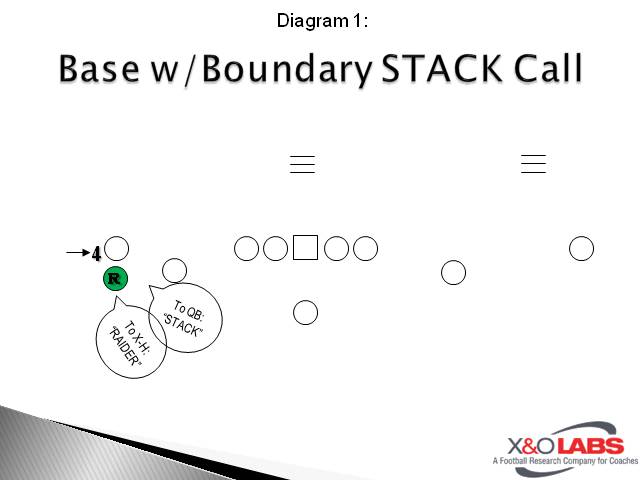
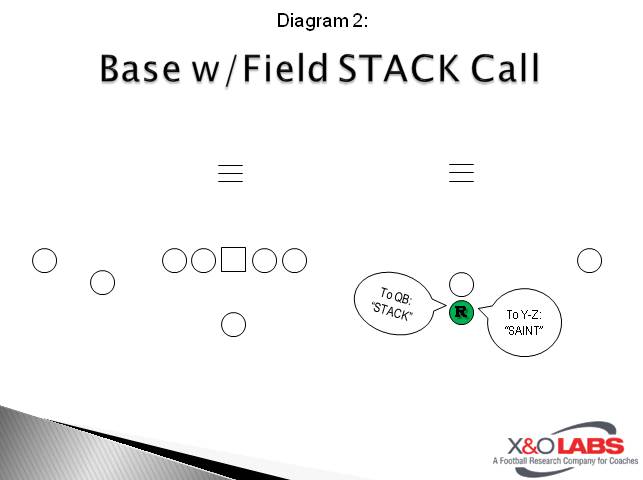
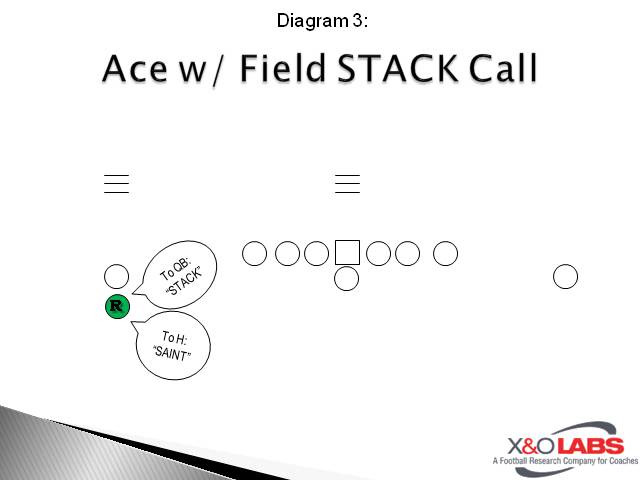
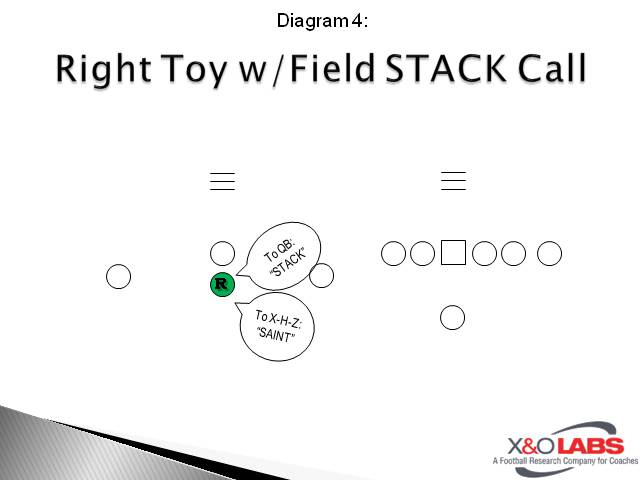
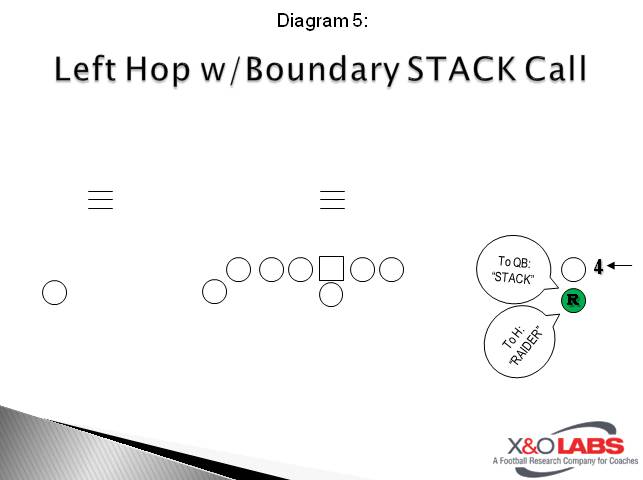
When we signal for a “stacked” alignment by the RB and a run is part of the play call, we are using the RB’s “stacked” alignment as the football equivalent of an inbounds play. We can run this to either the boundary or the field and with or without some other kind of restraint.

In our system, “stack” tells the RB to:

  1. Align directly behind the widest receiver if told to stack into the boundary
  2. Align directly behind the first detached receiver (middle of 3) if to the field

Slide1Slide2Slide3Slide4Slide5

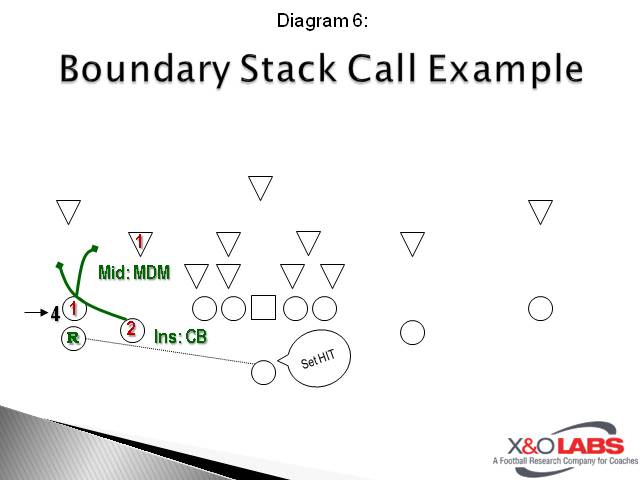
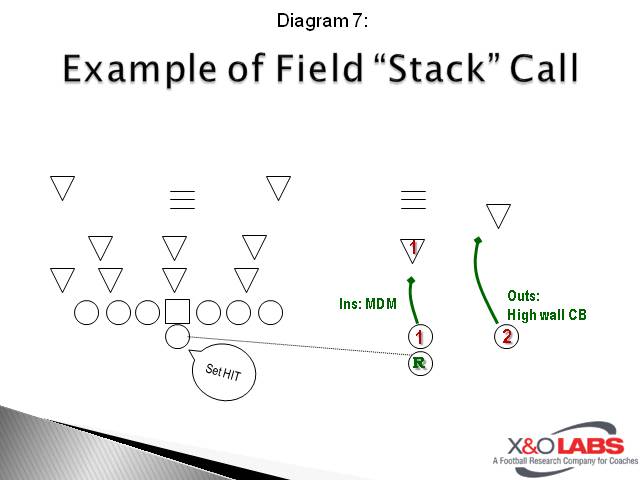
The “easy layup” we’re looking to get from the stacked alignment before ‘getting into our regular offense’ is one of our “Now” screens. For us, that means “Raider” if the RB is to the boundary or “Saint” if he is to the field.

Slide6Slide7

Mechanics:

Step 1: Upon seeing the signal/before going to align, the RB says to the QB, “stack-stack-stack” to remind him to assess the ‘inbounds play’ before running the normal play, and as a reminder to sink him into the backfield if he sees a dirty slot. 

Read More

Four Flexbone Variations That Manipulate Defensive Reads

By Ian Gardner

Quarterbacks Coach & Pass Game Coordinator

Desert Edge HS (AZ)

Twitter: @igardner33

Introduction:

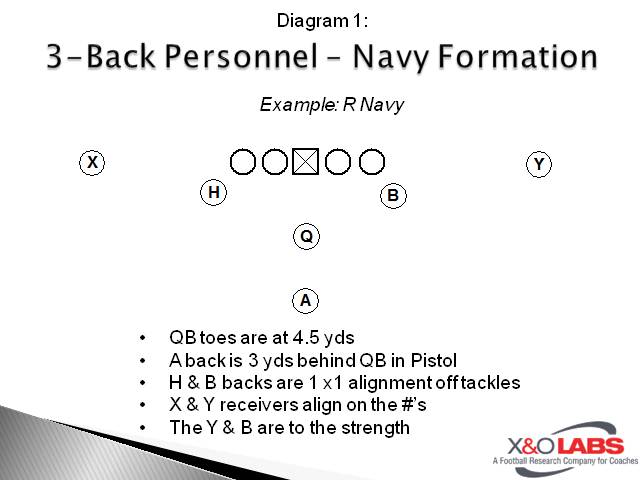
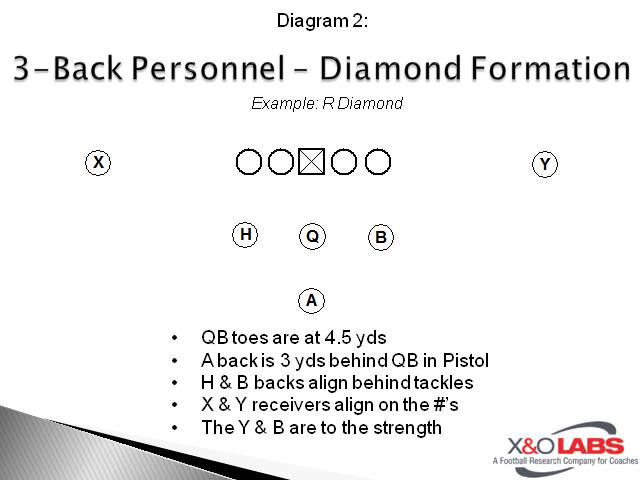
 D814992-2Early on in our season in 2014, as an offensive staff we had to make changes to our offensive scheme and personnel. We noticed we were developing running back depth and several of these backs showed they needed to be on the field more and together. We decided to package and run our offense out of three-back personnel for the rest of the season. In our three-back personnel, we identified them as A, B, and H. The A-back was our primary running back. The B-back was more of a second running back, but also could be moved around and play slot receiver. The H-back is your traditional utility player that many teams are using; he blocks well, runs routes and catches the ball, and at times, even carries the football. The keys for this personnel grouping – they had to be athletic, smart, block well, and have good ball security.
Why the Triple Option?

For us, we had to create plays in our offense that could take advantage of our personnel. That means a QB who is a good runner and the depth we had with running backs. We wanted to have more read options built in to our offense and be more versatile, but still keep our offensive blocking schemes simple for our offensive line. We had several dual option reads in our base offense, but we thought going to triple option would both allow us take advantage of our personnel and provide something for our opponents that they wouldn’t see as much of during the season. We strongly believed this would give us the best chance to succeed and win more football games.

Triple-Option Basics:

We basically ran two formations with three-backs in the backfield – Diamond and Navy (Diagrams 1 & 2). The Y receiver is to the strength, and the X is away from strength. The B-back went to the strength side and would align in a wing position or in off-set gun depending on the formation. The H-back was our adjuster. It is very important to understand, in our offensive scheme the type of run play called dictates how our A-back and sometimes our B and H-backs align.   

Slide1Slide2

H Alignments:

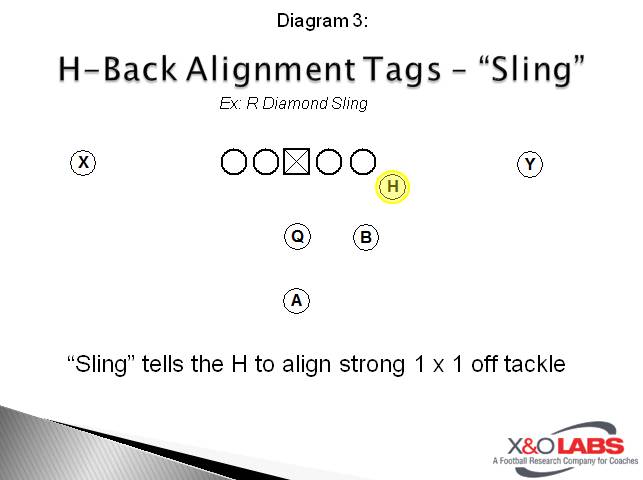
The alignment of our H usually dictated to defensive strength they made and we will game plan this as we prepare for the week. His stance is that of a RB – two point stance, hands on thighs.  We have four main alignments we like to use for our H: Sling, Wing, King, and Queen.

Sling tells the H to align in a 1 x 1 alignment off the tackle (or possibly TE) to the strength of the formation. For example, in Rt Diamond Sling, the H would align to the right side off the right tackle.

Slide3

Wing tells the H to align 1 x 1 off the tackle away from the formation strength. For example, in Rt Diamond Wing, the H would align to the left side off the left tackle.  

Read More

Revealed: 2 Coaches Tell How They Use Sideline Video Replay to Get an Advantage

By Mike Kuchar
Senior Research Manager
X&O Labs
Twitter: @MikekKuchar


Last month we let you in on what is perhaps the biggest “little known secret” that is changing the course of in-game operations at the high school level.

We told you that in 2013, the NFHS changed its Football Rule 1.6.1.2 to allow the use of video during games. This change allows the use of video on iPads and other tablets by coaches and players. What was surprising was the fact that only 1% of high school programs were using video replay during games. We suspect the low adoption rate stems from the fact that technology hadn’t caught up to the rule change.

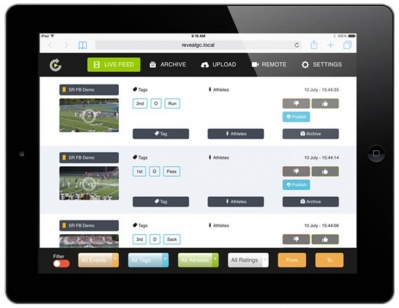
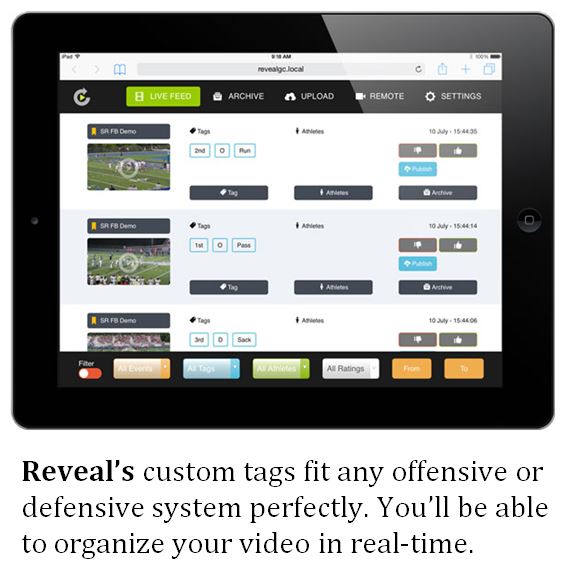
Now that we’re seeing multiple companies providing sideline video replay technology at a reasonable rate, we expect a dramatic rise in the number of coaches using video on the sidelines. Particularly after our previous report featuring a system called “Reveal.” Reveal was created by Graham Clark and Peter Foley, who used the product with the United States Olympic Snowboarding Team, and who are now rolling out the product to high school football teams all over the country. Following our last report on this subject, we were inundated with questions from coaches asking for more information on what the product looks like, to what it costs, to how to operate it.

This new rule opened a Pandora’s box of in-game protocol and subsequently sent dozens of technology companies into a mad rush to produce a cost-effective and efficient models for high school coaches across the country. We were especially impressed with the product that Clark and Foley designed, particularly after talking with some of their clients.

I got the chance to use and test the Reveal system last off-season, but rather than provide commentary on the operations of Reveal, we reached out directly to some of Insight Replay’s clients. We asked them for their feedback about the product and how they are planning to use it this fall.

Tagging Plays for Quick Access

Matt Logan, the Head Coach at Centennial High School (CA), has produced a 50-10 record at Centennial the last four seasons, but like other exceptional coaches he continues to try to find ways to get an advantage over his opponents. While his team was performing brilliantly on the field, Coach Logan saw another opportunity to exploit his opponents’ mismatches on the sideline.

In 2013, when the rules changed, Logan and his staff experimented by using a “cube” that was able to rely video from the sideline to the end zone. He thought it was exactly what he was looking for, but later found the technology was made more for business communications than for football programs. “It was all raw footage,” Logan told us. “The problem was organizing the clips. You had to stream it through as raw footage all the time while other things were being recorded. You had to stream through plays.” As a no-huddle offensive operation, this simply would not work.

pic1So, when Reveal hit the market, Logan was ready for a change. Once he received the product, he saw an immediate difference, which came in the form of portability and accessibility. It came in a backpack, with its own self-contained Wi-Fi hot spot and he’s able to use it with his own cameras. When he found that he would be able to tag plays and immediately view them within 3 to 5 seconds of conclusion, Logan was sold. “During the play, I can tell my guys up in the box ‘tag that play when we are on defense’ and I can to go back to it within 3 to 5 seconds with the rest of the staff and players. It’s very user friendly. It will be faster for us to see the clips we want. It’s similar to HUDL in that you can find what you need. It makes it easy and controllable.”
This season, Logan already has his plan mapped out for the Reveal system. “We will have one of our JV guys run the iPad and we will work through him. When we are on offense, the plays will be recorded. After offense, we’ll meet as a group and look at the defensive group, and review our mistakes. We use it to verify what our players are seeing and what our coaches are seeing. We can see front and secondary coverage. It’s instant feedback from series to series. If you are a huddle team, you can get feedback during the middle of the series.” And now halftime will have a whole new meaning in terms of the ability to improve. “Halftime is huge because of the tagging component,” said Logan. “You can go right to those plays that you tagged during the course of the game on offense, defense or the kicking game. You no longer are guessing about what the opponent is doing or relying on your players. The proof is in the video.”

Read More

6 Points of Emphasis for Your First O-Line Meeting

By Justin Iske
Offensive Line Coach
Southwestern Oklahoma State University
Twitter: @justiniske


Introduction:

The first meeting of the season is an exciting time for both coaches and players. As a coach, it is easy to simply jump right into the nuts and bolts of installing the offense. However, we think that it is very important to cover some philosophical things first. Here is an inside look at what I teach during those initial meetings to make sure the groundwork is set for a successful season.

#1 Set Expectations:

  1. Be Coachable: Do things the way that we tell you do them. All five guys must be on the same page or we are all in trouble. If you want to do your own thing, you cannot play for us.
  2. Be a Prick: When you walk across the white line for practice or a game, you need to flip the switch. We have to be nasty and take every legal shot that we can.
  3. Be Relentless: Nothing but 100% effort from the snap to the echo of the whistle is acceptable.

#2 Philosophy:

It takes a special person to play or coach the offensive line. We will receive no positive recognition from anyone outside our room. If we are successful on offense, it will be because our backs and/or receivers did well. If we are unsuccessful, our unit will take most of the blame. There are no individual stats for us. We are only as strong as our weakest link up front. The only time we will be noticed is when we are called for a penalty or give up a sack.

We grade our players every play of practice in four categories: Assignment, Technique, Effort, and Factor. The five best guys will be on the field regardless of what position they play and the depth chart is always written in pencil. What have you done for me lately?

The number one attribute of a good offensive lineman is toughness (both mental and physical). Flexibility, strength, balance, quickness, and intelligence are all important, but the guys that will play are the guys who we would want with us in a street fight. Our job is to test you in practice and the off-season to find out if you are tough enough to represent us on the field.

#3 Procedures:

Your players must understand how tempo, formation, and play calls will be communicated. Again, everyone must be on the same page. Covering stance, line splits, and alignment on or off the ball is important as well.

Read More

5 Ways to Block Tight Shades in the Mid/Outside Zone

By Mike Kuchar 
Senior Research Manager
X&O Labs
Twitter: @MikeKKuchar 

Editor’s Note: The following report from our complete Mid / Outside Zone Special Report that is available to our Insiders Members by clicking here.  

Introduction

Zone blocking teams are always looking for tactics to help their linemen have a better chance of winning one on one battles.  This article will focus on the 5 different techniques that offensive line coaches are teaching to their covered offensive lineman in stretch concepts.   We’ve found that these techniques will differ based on the leverage of the down defender.  There are so many intricacies that go into these coaching points- head placement, hand placement, foot placement, angle of departure, etc. They are all covered in this case as it pertains to the wide and middle zone run concepts. 

Slide1

Our initial research shows that 59 percent teach the far armpit as the visual aiming point for the covered offensive lineman in both the wide and middle zone concepts.   We’ve found our research split on the footwork that coaches teach their covered offensive lineman in wide zone schemes- an even amount teach both the reach footwork and rip to run footwork while 13.3 percent teach the bucket step.  We’ve found that coaches are from two schools of thoughts on the covered lineman- they are either reach step advocates or bucket step advocates and we present both perspectives below. 

chart14

Technique #1:  Rip to Run Footwork

36.7 percent of coaches teach the rip to run technique in wide zone run concepts, regardless of position of the defense, so it’s important to present that side of our research.  Rick Trickett, the offensive line coach at Florida State University, is one of those coaches.  For Trickett, the crux of the scheme is the first step of the covered offensive lineman.  “He must bring his shoulders through on the first step on the stretch scheme,” Trickett told an audience of 400 coaches at the C.O.O.L. clinic in Cincinnati last month.  “We work to get our outside breast to his far armpit and our inside foot to crotch.  To do this we bring our shoulder over our knee on the first step.”

Eddy Morrissey, a former Graduate Assistant under Chip Kelly at Oregon teaches the tracks methodology and uses a run to reach footwork for everyone along the front.  “Technically I’m covered, but it’s really ripping and pressing and covering him up,” Morrissey told us.  “We don’t want the uncovered player to knock into me and there is all this penetration.  As I feel pressure, I need to lean back into him. I want my guys to face the sideline and now we are on a track.”   He teaches an elbow whip, pivot and run technique to his offensive linemen in his wide zone concept.  He provides a video tutorial on this technique below. 

Read More

Marist College (NY) KOR Circuit

By Sam Nichols
Managing Editor
X&O Labs
Twitter: @SNicholsXOLabs


Editor’s Note: The following research was conducted in part of XandOLabs.com special report on “Special Teams Circuits” which can be found here.


Introduction:

kentstate

One of the more productive, straight forward circuits that we have seen here at X&O Labs came from Tunde Agboke the defensive line coach at Marist College. According to Agboke, “It is critical the players on this unit know how to block in space. Thus, we spend a great deal of time doing individual blocking and dropping drills. We use this circuit at least once a week. Once we accomplish that goal, then we come together and run our schemes.

These drills have helped us tremendously. We have be able to quickly identify the guys who can and can’t do it without wasting weeks or months of practice time. We see KOR as the first play of every offensive series, and we are looking to go deep.”

Drill #1:  Drop on Air

This basic cone drill teaches players the fundamentals of their takeoff, angle, transition into the block phase and ability to create proper leverage.

Concept / Coaching Points:  “We use this drill to teach our players the proper drop angles and technique. We want to make sure they don’t round off corners once they put their foot in the ground to come back up field. They must also simulate striking a blow.”- Agboke

Read More

Virginia Tech’s Tackle Circuit

By Mike Kuchar
Senior Research Manager
X&O Labs
Twitter: @Mikekkuchar

Read More

Attacking Full Slide and Scan Protections

By Mike Kuchar
Senior Research Manager
X&O Labs
Twitter: @MikekKuchar


Editor’s Note: The following research was conducted as part of X&O Labs’ special report, “Developing an Effective Pressure Check System.” Go here for the full-length report.


Introduction:

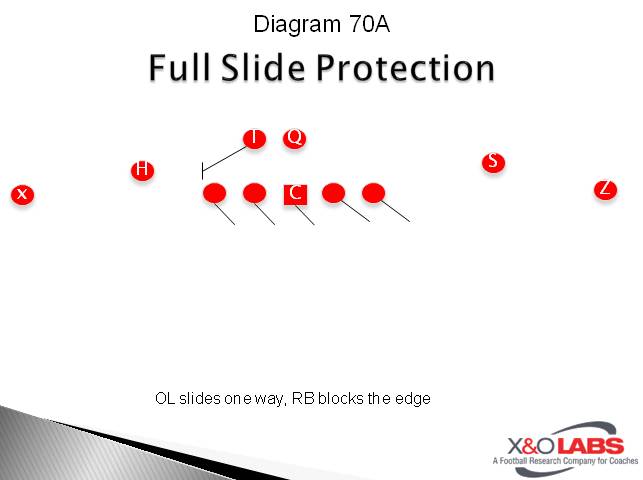
smuFull-Slide Protection (Diagram 70A)- Full slide protection simply means the offensive line will slide all in one direction and put its back away from the slide.  Here, the offensive line could slide in many directions- to the field, to the boundary, to the QB’s backside, etc.  It’s important to get a tendency on where they are sliding most often based which could be based on down and distance and personnel.    Slide70a

Attacking Full Slide Protection

Read More