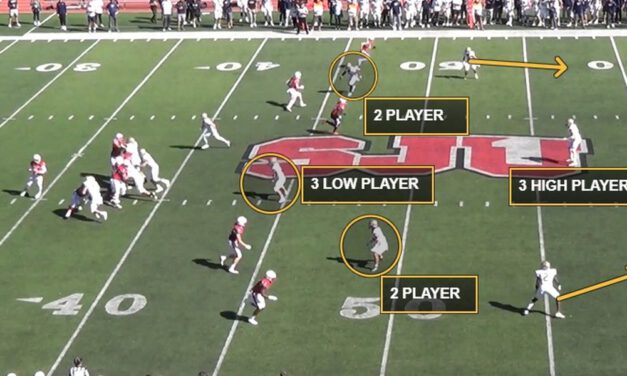
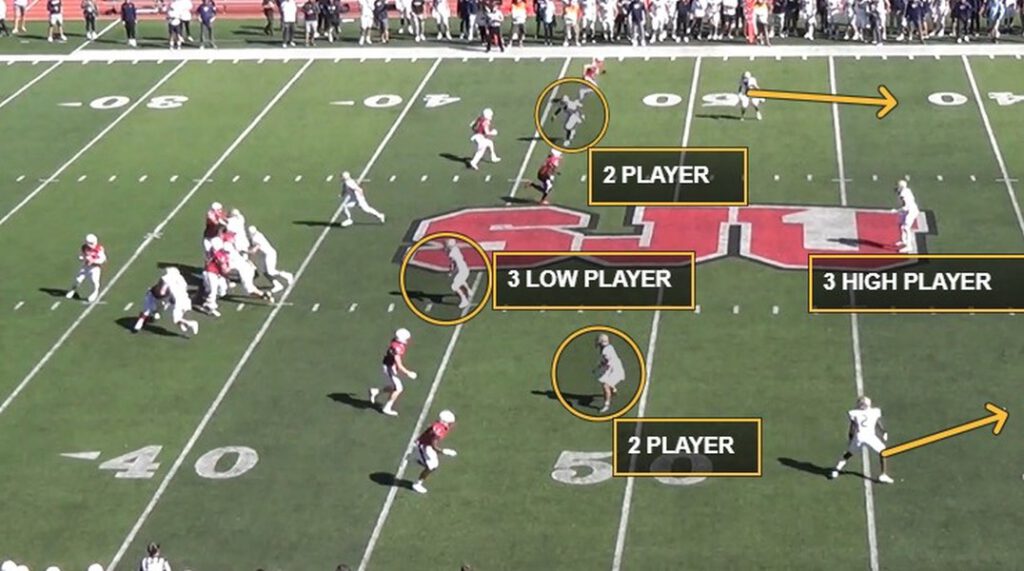
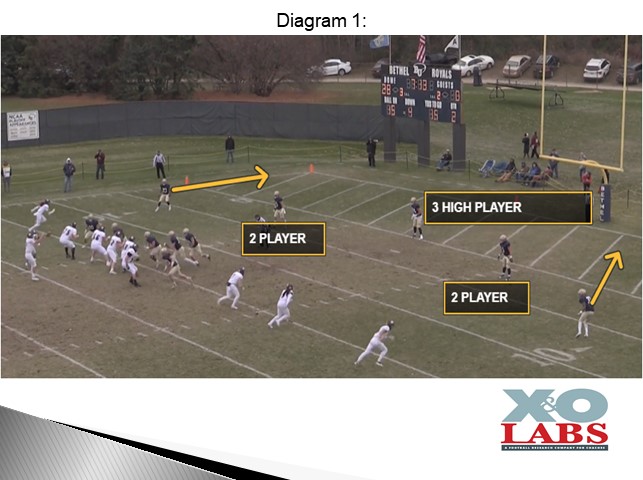
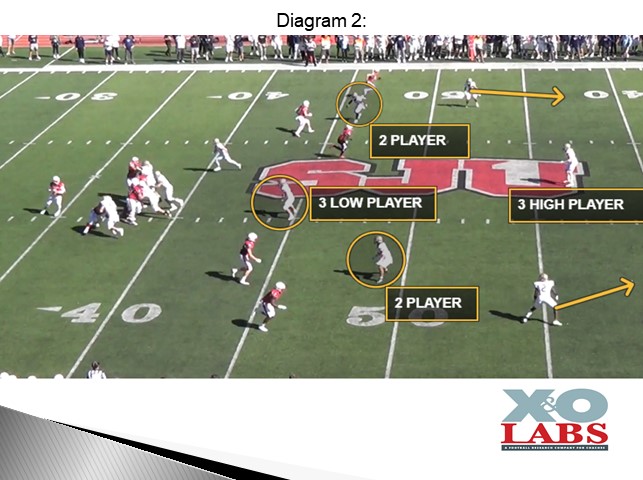
Shuffle to Sprint Technique for 2-Players in Hot Pressures

By Kevin Bowers
Defensive Coordinator
Medina High School (OH)
Twitter: @coachbowers59


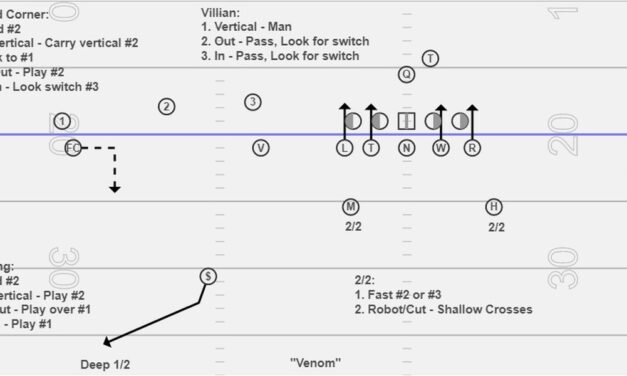
Blitzing six is and has been a successful choice for defenses for years. The question is, how do you cover it without playing the obvious zero man coverage? The answer is zoning it with five defenders. 2 Under 3 Deep coverages give you the best of the 6 man pressure with sticky coverage of the threatened underneath players, and over the top help with 2 of your 3 deep droppers. It was a concept we played on more than 94% of snaps this season en route to a 14-1 record, among the best in school history. In this report, I will detail the coverage responsibilities of each defender and how we adjust to open formations.


Pressure Patterns:

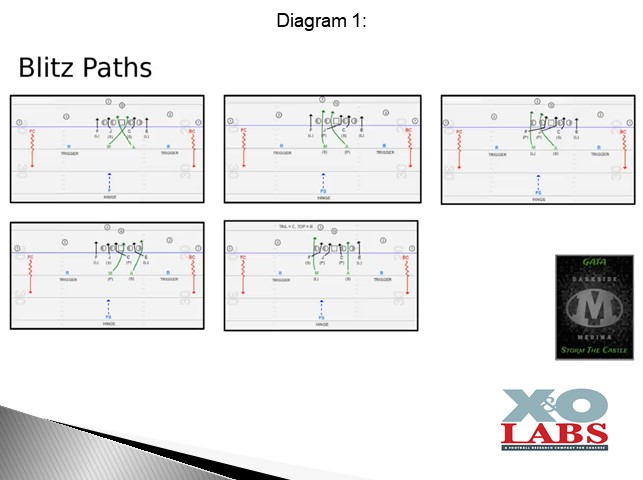
Building in the pressure patterns is where the fun comes in. In these hot pressures, you can fill six gaps any way you want. We mustn’t have pressure players in a single wave. They need to be on different levels. Some of the thought process we partake in each week includes the following:

  • Two blitzers off the same edge
  • Two blitzers into same side A and B gaps
  • Two blitzers into opposite A and B gaps
  • Two blitzers into double A gaps
  • Twist the blitzes


We use the following terminology in our pressure patterns. They are all weapons in our hot pressures:

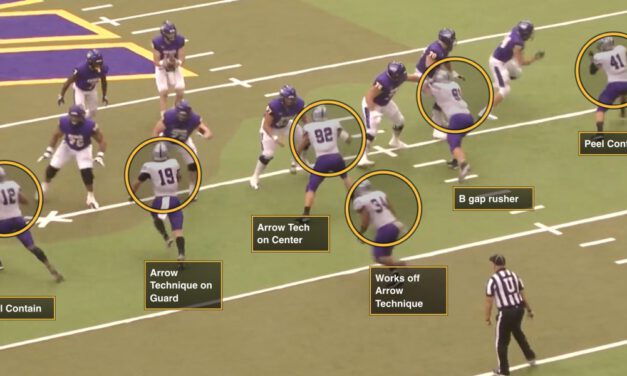
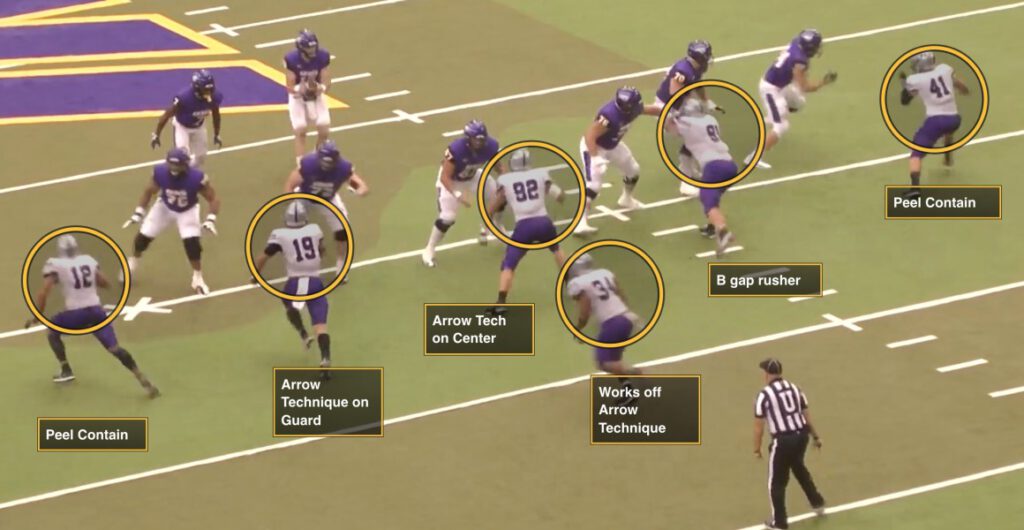
“Arrow”- Double A gap pressures

“Bayonet”-  Since “B” and “A” are at beginning of the word, both are on the same side.

“Bomb”- Coming off the edge from the tail side (RB side) which is good vs. zone

“Railroad”- Coming off edge away from RB side. Good against counter schemes

“Club”-  C gap blitzer on one side, B gap blitzer on the other side


When it comes to defending the run, we make sure all blitzers understand they are spill players forcing the ball out to the Hot 2 defenders. Below are some general guidelines we use in defending the run:

  • Cross Face all DL & LBs Read the down block and rip across face
  • Pace the Blitz so the DL hits 1st and the LBs are 2nd
  • Read on Run allow for adjustments by the LB on their blitz path


General Description:

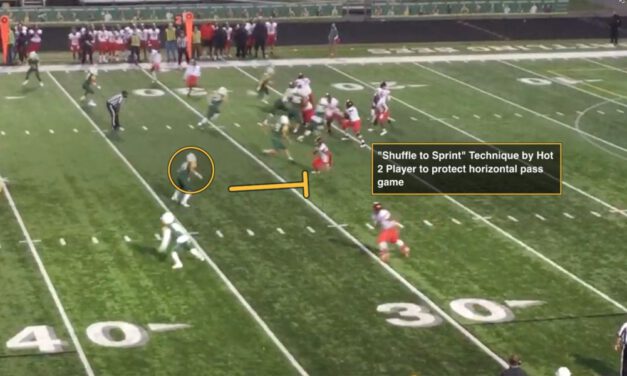
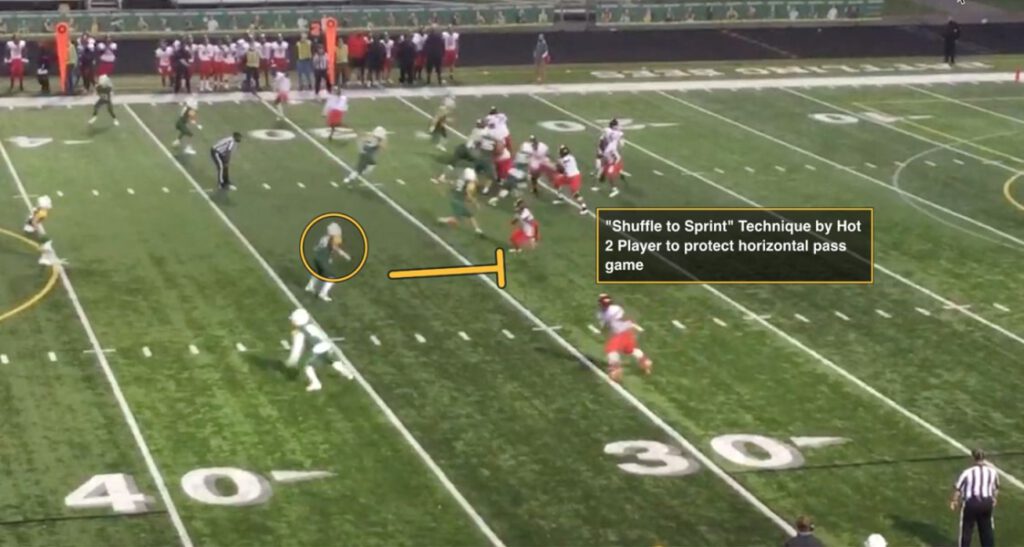
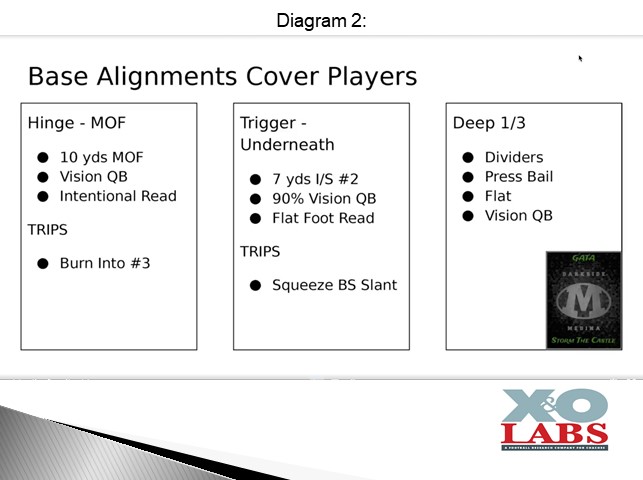
In general, the defense is constructed with 2 underneath players purely reading the directional key of the QB and 3 deep players playing off of the intentional read of the QB. We refer to the underneath players as “Hot” players, the outside deep ⅓ players as, “Deep ⅓” and the middle of the field deep ⅓ player as the “Hinge” player.

Read More

Northern Illinois 4-Surface Pin and Pull Concept

By Mike Kuchar with Eric Eidsness and Daryl Agpalsa
Offensive Coordinator and Offensive Line Coach
Northern Illinois University
Twitter: @CoachEidsness @CoachAgpalsa


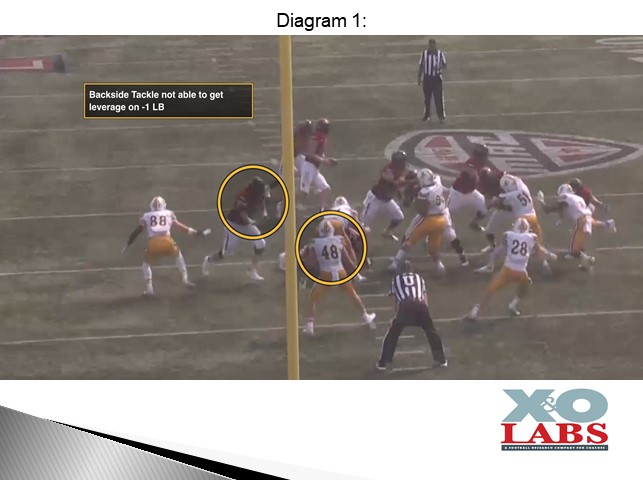
Like most innovations in football, this one happened as a result of consequence. It was week two this season and while the Huskies were riding high off a win at Georgia Tech where they rushed for over 200 yards. But coming into the Wyoming game, the offensive line was struggling with getting the backside cutoff in its premier run concept- the four surface pin and pull.


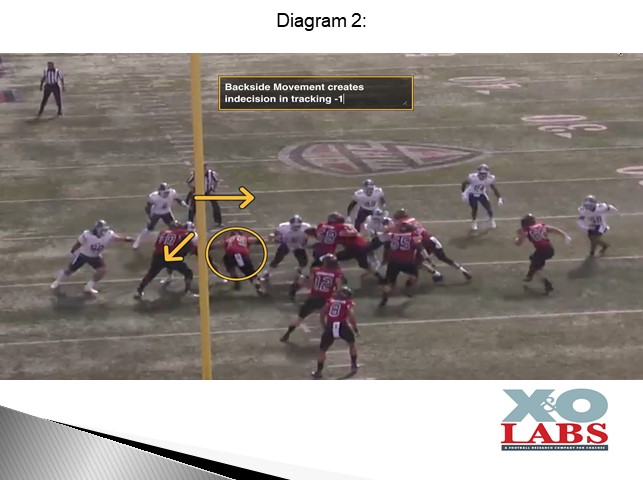
It became a concurrent issue when running a man concept on the play side yet a zone concept on the backside. It continually produced indecision on the backside, particularly against movement. “So, we figured that if we can’t get him why not pull him around so that we can seal him on the play side?” said offensive line coach Daryl Agpalsa.


So, when the offensive staff under the direction of offensive coordinator Eric Eidsness were prepping for Michigan the following week, the decision was made to man the backside of the concept and add an extra puller to the play side, be it the backside Guard or Tackle. How that player is taught to find and block his assignment will be the focus of this report. But, first, it’s important to understand the structure of the four-surface pin and pull concept and why it’s been so effective in the Huskies menu this season.

Coach Eidsness has Missouri Valley conference in his veins. Having coached at South Dakota State University for 13 years, he’s familiar with the heavy personnel run game used in that conference. And 22/13 personnel run game was one of the first implementations he brought with him when he made the move to NIU in 2019. One of the advantages of these personnel groupings he told me is the ability to create walls to the play side with heavier run surfaces populated by additional tight ends which created faster access to the perimeter. “It’s harder to outside anymore on just plain outside zone,” he told me. “You used to be able to do it. Now you can’t anymore.”

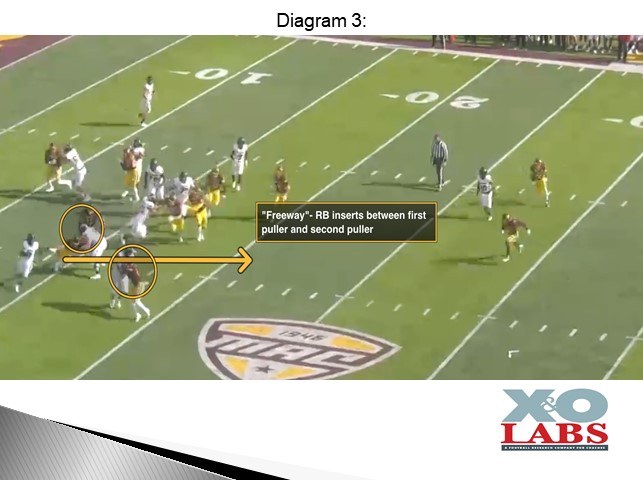
So, started to build in the four-surface formations that are synonymous in the Missouri Valley conference and it immediately helped in creating a better edge presence. While the first install was the load power concept to the play side, the complement became the four-surface pin and pull which was able to create the separation needed in the alley to get a very good ball carrier in the “freeway” as the staff puts it.


Mesh Variations:

The Huskies utilize two alignments in its Pin and Pull concept: pistol and sidecar alignments. In both alignments, the ball carriers aiming point is one yard outside the tight end, which includes the wing element in four-surface formations.

The mesh rules for both are below:


Pistol Alignment:

  • Open to the play side at a 45-degree angle
  • Get the ball back to the ball carrier by the third step.
  • Drop back three steps after mesh to sell play-action pass (boot)


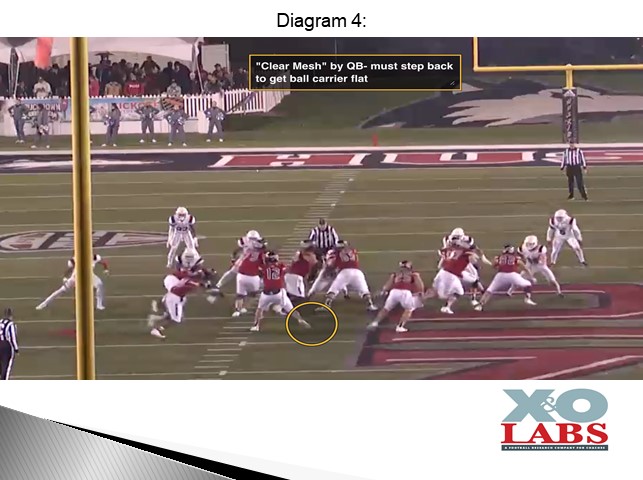
The ball carrier is taught to execute a “V” step, which opens his hips to get downhill. It’s the typical crossover, plant footwork. According to Coach Eidsness, the key coaching point is for the quarterback to keep him online with the D gap aiming point, which he calls “staying high.” “We don’t want to get downhill too fast,” he told me. The backside C gap can be controlled with naked or with motion or a backside tight end.


Offset Alignment:

In sidecar alignments, the quarterback sets his toes at 4.5 yards with the ball carrier’s toes at 5 yards. It’s the quarterback’s job to get off the line with a step-back technique or what some coaches call a “clear” mesh. “We want the running back to be able to run laterally and not run downhill and have to bubble back to the perimeter,” said Coach Eidsness. “The quarterback has to allow him to stay flat.” In sidecar alignments, it’s built-in for the quarterback to read the backside C gap defender.


RB Read: “See First Puller Through Second Puller”

It’s the ball carriers’ job to identify the front side so he knows where the defense will be separated. The staff at NIU refers to this as reading the first puller through the second puller. His rules are as follows:

  • If the first puller kicks out the edge defender, read the second pullers block
  • If the first puller logs edge defender, get the ball outside


In either case, it’s imperative that the ball carrier not outrun the backside Tackle who may often be the third puller in the concept.


The Fourth Element: “Leave 2 Fundamental”

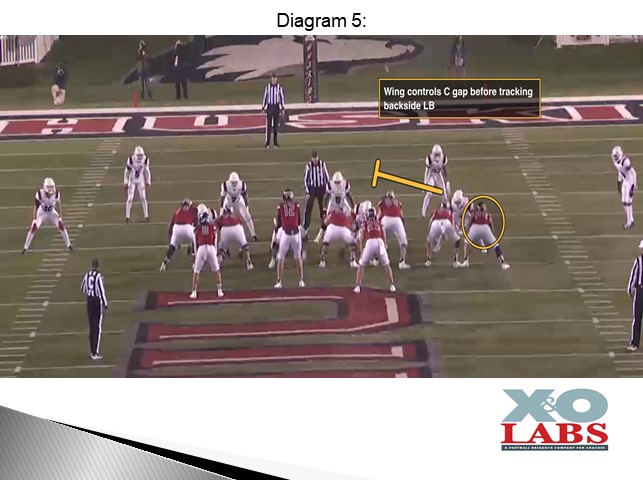
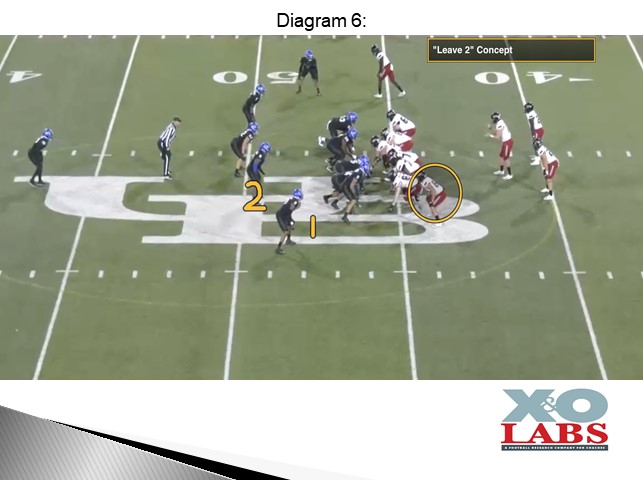
The key cog in making the concept efficient is the addition of the extra tight end, who essentially is the “eliminator” in the concept. His role is to secure the play side C gap before climbing to track the backside linebacker. He became instrumental in setting an edge in the C gap, particularly against four-down defenses who played outside linebackers in 6-techniques on the tight end.


His rule is to “leave two” for both play-side pullers in the concept, counting outside from the front side of the play. “We are blocking force to the front side linebacker so he can always leave two on his count,” according to Coach Agpalsa. “So that way he never chases and can’t get beat over the top.”


The rest of this report will focus on how the staff at NIU teaches individual blocks, communicates pullers at the line of scrimmage, and builds in controls to the play side to handle extra defenders on the perimeter.

Read More

Bethel University’s 2 Deep-3 Under Pressure Scheme

By Steve Erxleben with Mike McElroy
Defensive Coordinator
Bethel University (MN)
Twitter: @McElroy26


Utilizing different versions of simulated pressures, 5-man fire zone pressures, and 6-man zone or man pressures have become the “en vogue” topic for many Defensive Coordinators across the country. Like many pressure-based systems, Bethel University (MN) and Defensive Coordinator Mike McElroy base out of one high structure as they apply pressure, but like every coverage, it has its disadvantages, especially down the seam, in the Dig window, and the immediate flat.  Bethel plays in the ultra-competitive Minnesota Intercollegiate Athletic Conference (MIAC) and regularly qualifies for the NCAA Division 3 playoffs, so having an answer for 4 verticals on 3rd and long situations and in the red zone without leaning on cover 0 was a must for Coach McElroy. To change up how they handled 3rd down, while still keeping their aggressive mentality and looking for more of a “man eyes” situation for 3rd down, Coach McElroy and his staff began utilizing more 2 deep, 3 under schemes to relate to all 5 eligible receivers, still bring 6, and create a situation where the QB has to pat the ball and take a sack.


Premise:

As a base 1 high structure scheme, primarily a cover 1 man-free, Bethel University, and Defensive Coordinator Mike McElroy needed to create some sort of alternative for 3rd down and long down and distance situations where the QB is more of a “statue” and not a real run threat. Bethel is a more of a 2 down defense but primarily uses a 6 man box mentality, so they live in a nickel world personnel-wise. Bethel’s defensive staff wanted to create situations where there were as many “mesh” readers underneath and as many 3rd level defenders that could have a “vision” break on the QB, basically playing everything deep to short. What the Bethel coaches came up with was more of a 2 deep 3 under that has a “double robber” feel to it.

To categorize it more specifically, this coverage is sort of a one high, inverted cover 2 where the High safety is more of a read-out player that matches 3 while the “2” player and corner play cover 2 vs #s 1 and 2.

The main idea or focus is to create uncomfortably for the QB by taking away the verticals to the outside and creating an almost reroute by alignment with the “2” players and to use the bonus FS to undercut the “now” throws inside, much like a 1 high structure would allow. Since Bethel is utilizing 5 and 6 man pressure, the coverage structure includes:

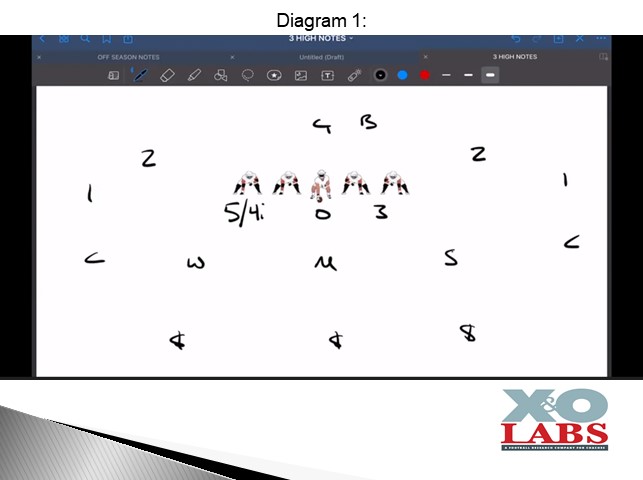
  • 2 Deep Half Players (Corners)
  • 2 “2” Players (Q/S: Strong and Weak Safeties)
  • A “3 Low” Player (Non-Pressure LB or 5 Technique)
  • A “3 High” Player (MOF Safety)


6 Man Tagged Pressure Situation


5 Man Tagged Pressure Situation


Each of these positions has specific techniques within the scheme that will be discussed below.

Read More

Max Gap vs. Back Gap Fits in 3-High Spacing

By Mike Kuchar with Joel Taylor
Defensive Coordinator/Linebackers
Mercer University (GA)
Twitter: @KoachTaylor


Coach Taylor’s initial motivation came from the success he was having using Drop 8 coverage in the pass game. He transitioned from three-down into four-down specifically to defend Samford University, a SoCon opponent that can sling the ball up and down the field. The Bears surrendered more than 400 yards through the air against Sanford back in 2020, so something needed to be done. So, he backed up a pair of eyes- by putting his boundary End at the second level- and put more vision on the quarterback in zone coverage. He played two versions of Drop 8, from both a halves and a thirds structure. We profiled both of these coverages concepts already in a prior report.

But while Coach Taylor was enamored with how the coverage eliminated windows in the pass game, it was how he was defending the run that consumed him. “The coverage doesn’t matter until you stop the run,” he recounted. “When we were playing teams like Sanford that was playing with tempo we continually wondered how we’re going to stop the run? That’s when I came out of the Rabbit hole and came up with what I came up with.”

What he came up with was an adaptation of his two-high quarters run fits and complemented from three-high alignments. He took his back gap principles made it fit from 3-high structures. And he was able to do this by teaching a “loaded box” vs. a “bump box” run fit based on the formation structure. “It was simple teaching,” he told me. “I studied it and made simple rules that fit our defense.”


Mercer Personnel:

The Bears utilize a three-high safety defense on more than 20% of snaps this season. They essentially play with the following personnel:

  • Nose
  • Two Defensive Tackles
  • Boundary Defensive End (Kat)
  • Mike LB
  • Sam LB
  • Will LB
  • Free Safety- Middle Safety
  • Nickel Safety- Field Safety
  • Boundary Safety
  • Two Corners


Like most Odd front outfits, the Kat outside linebacker can play both on the line of scrimmage and off the line of scrimmage. While he needs to be cross-trained to play coverage, according to Coach Taylor it’s inexpensive and advantageous to do so. This way the Bears don’t need to change personnel to keep this structure intact.


Front Structure and First Level Fits: “Rely on the Knockback”

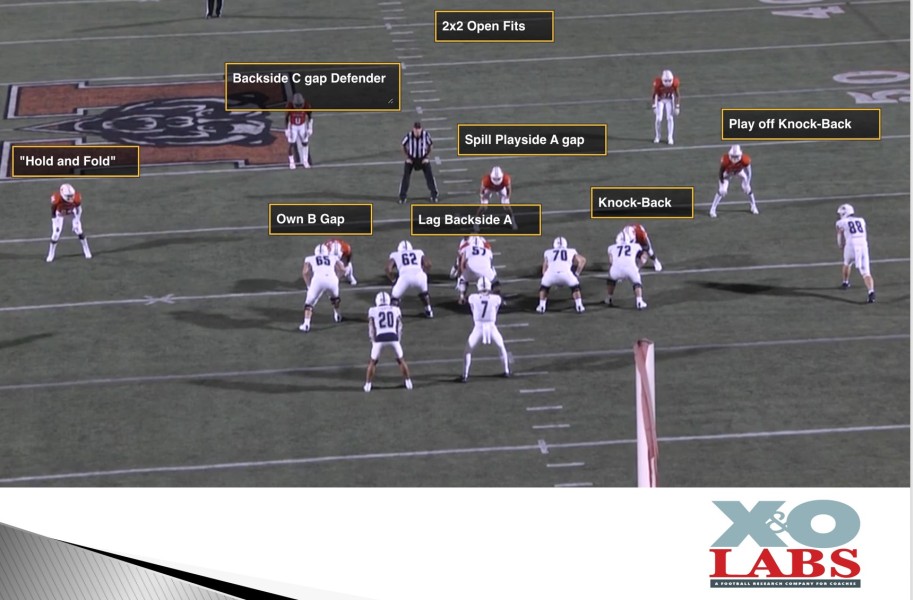
While Mercer played most of the 2021 season in a Mint (4-0-4) front structure, Coach Taylor has made a conscious choice now to move to reduction fronts. He’s going to do so by setting the reduction to the side of the back. The image below is a base alignment vs. 2×2 open sets, which will be explained later in the report.


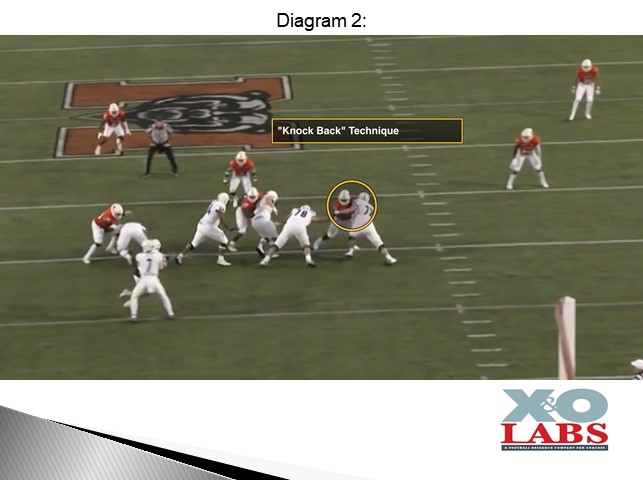
He’ll play with a Zero nose that will only be responsible for one gap by lagging into the backside A gap. The defensive end away from the side of the back will play a “knockback” technique by owning both the C and B gap based on the block of the Tackle. If the Tackle works to reach him, he’ll fit the B gap and push the ball to the Sam or Will. If he gets any down block, he’ll close the hip and expect to spill any blockers coming to him. “We just tell them to let that offensive tackle reach you and get that ball pushed to the overhang,” said Coach Taylor. “When teams stretch game us, we have them fall inside instead of playing outside so that the backer can fit off of it.”


“Back Gap” vs. “Max Gap” Run Fit Methodology:

In Mercer University’s defensive system, the entire run fit is based on a simple premise: if you are inside the box, you spill. If you are outside the box, you box (contain). The idea is contrary to typical one-high, 8-man fit defenses because Coach Taylor wants the ball pushed to overhangs as much as possible.

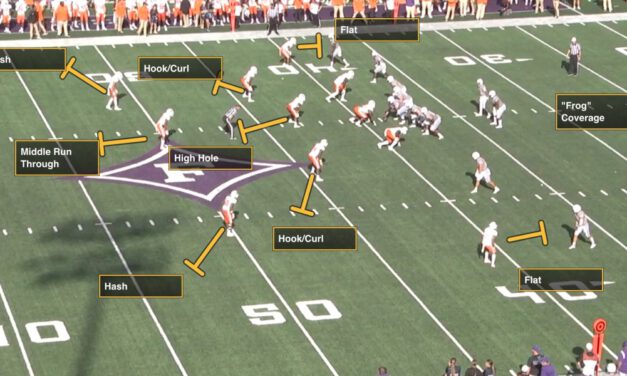
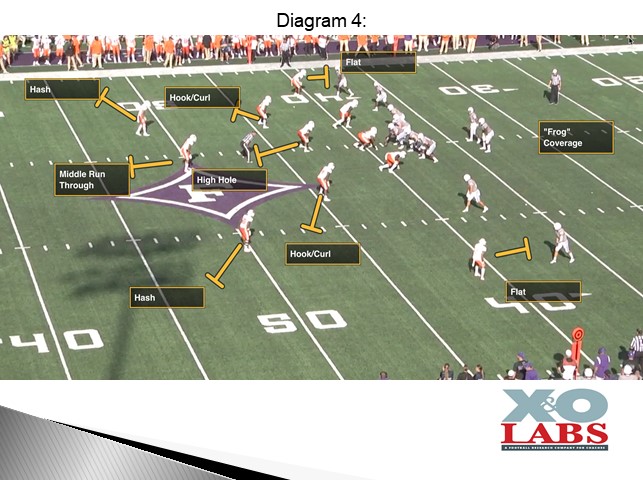
It’s important to note that in the Bears defensive system, there are two forms of Drop 8 coverage. Both come from 3-Deep, 5-Under spacing. One of which is a cover three variant, where the field and boundary safeties are inserted into underneath coverage to play hook curl, the Sam and Will play the flat and the Mike has the high hole.


The other variant is a cover two variant, where the field and boundary safeties are pure halves defenders. He calls it “Frog” because the Middle Safety acts as a “Tadpole” playing the middle of the field from the top down.


Coach Taylor will teach two separate run fit scenarios based on those two structures: Back gap vs. Max gap:

“Max Gap”- Cover 3 run fit. This means defenders own the gap to their side. This is very similar to an Odd Stack run fit.

“Back Gap”- Cover 2 run fit. Defenders can back gap the run game based on the mesh of the quarterback. This fits with the “hold and fold” technique (referenced below) that Coach Taylor used in quarters coverage.


Since the majority of Mercer’s Drop 8 coverage falls into that cover two variant, most of Coach Taylor’s run fit patterns fall into back-gapping principles. But these principles are separated into load box vs. bump box scenarios which are classified by the formation and are detailed in this report.

Read More

Multiple Mesh Point Design in Jet Sweep Concept

By Ken Vigdal
Head Coach/Offensive Coordinator
Le Mars High School (IA)
Twitter: @kevigdal


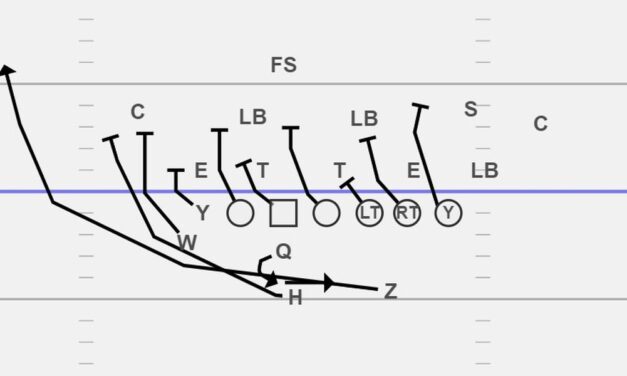
For a large part of my coaching career, I have run the Wing T offense.  I began with a double tight formation, but through time I have implemented the gun.  We are now more into a spread-wing offense.  The reason for this change was to allow defenses to continue to put more defenders in the box.  When we made the change to the spread wing we also incorporated an RPO system to go along with our trap and belly series.  This system is how we have been able to get the ball to the outside in space.  As a tight under center team, we did run a lot of Jet Sweeps.  However, this was not going to be a big part of our offense when we decided to spread the defense out.    Based on the way the defense will play some of our RPOs, we found that Jet Sweep has become an easy and effective way to get the ball to the edges. It’s been an answer for us for limited personnel upfront. It was our number one play because we didn’t have to block the box.


Formation Breakdown:  

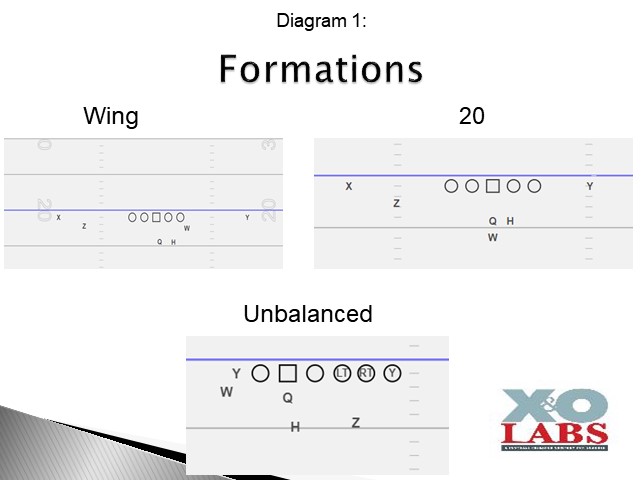
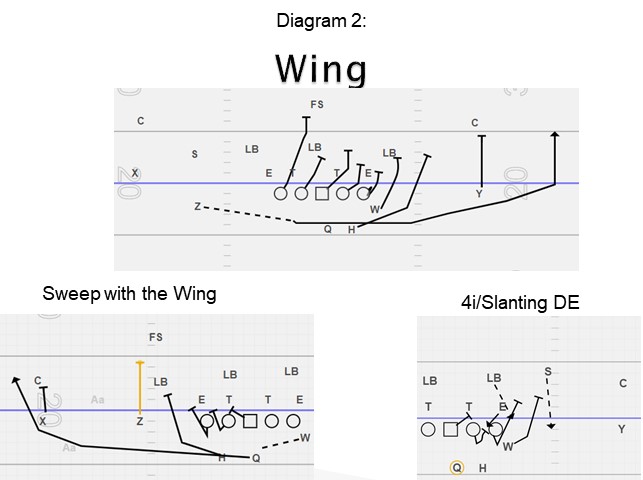
The number one formation we like to run Jet Sweep out of is a tight wing.  We prefer this formation as the defense has to be balanced up.  We can run Jet Sweep to the wing or we can have the wing run the sweep to the slot side.  The other formation we like to run Jet Sweep out of is our 20 Personnel.  With this formation, we can create a misdirection to our Sweep.  Finally, we use an unbalanced double tight formation to run jet sweep, which allows us to have three different formations with one blocking scheme.


Basic Blocking Rules

PST: Reach DE, DE tight Reach step, DE wide, use a drop step, get inside arm to his outside armpit.

PSG: Reach. He will come down the line for 3 steps and then climb.

C: Reach, and climb to LB, with his reach step he might collide with DT.

BSG: Reach and try to cut off the backside LB.

BST: Reach and climb.

X, Y: Talk corner, if backside side run RPO, speed out or hitch.

Z: Sprint at 100%, receive the ball and then belly back a ½ yard and get to outside, landmarks are hash, number, side.

W: Responsible for the 9 Tech or OLB, if extra-wide run and cut off with a side block.

QB: Alignment 4 yards, 1 Shuffle step, snap the ball when the gall carrier gets to the tackle inside leg.

H: Align for success, side of the sweep, lead on OLB, or first to show.


The rest of this report focuses solely on how Coach Vigdal alters the mesh in his jet sweep concept based on formation structure.

Read More

Targeting the C-Gap Outside Zone

By Mike Kuchar with Brian Ferentz
Offensive Coordinator/Tight Ends
University of Iowa
@CoachBFerentz


“It Starts with 7 on 7”

The Iowa slant play is built around purpose: get to man block scenarios. They believe that their front seven will beat your front seven. “We firmly believe that in all 7 spots we will kick your ass,” Coach Ferentz told me. “And we train that way year-round.” The vision of the play is enveloped in the mindset of “owning” blocks at the line of scrimmage. And this is done by getting into man-blocking scenarios. For instance, the tight end owning the 9-technique, the Tackle owning the 5-technique, the Guard owning the play side backer, etc. “We want to get to a one-on-one as fast as possible,” he believes.

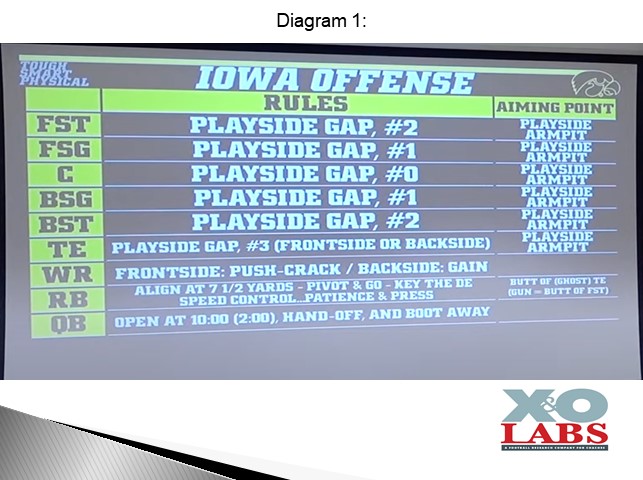
How Iowa’s offensive staff attains and wins one on ones at the line of scrimmage is the focus of this report. The premise is to be aggressive in many blocking scenarios but be able to attain help if needed in zone combinations. He calls it “targeting,” which is different than traditional zone blocking. The target is the outside armpit in a wide reach technique which essentially is an over-reach and explained later in the report.  “We never want to chase anything in this concept,” he said. “The ball needs to hit wider.” This is created by a wide C gap track of the back. Iowa’s outside zone is modeled after the Alex Gibbs/Terrell Davis philosophy of getting the defense to run on the front side just to cut on the backside. Coach Ferentz calls it a “force the hole” play and that hole is usually the C gap. “All we want to do is separate pursuit in the C gap,” he told me. “We want to end up at that landmark with more speed than bodies that can defend it.”

The base rules of the concept are below:


Point System and Communication:

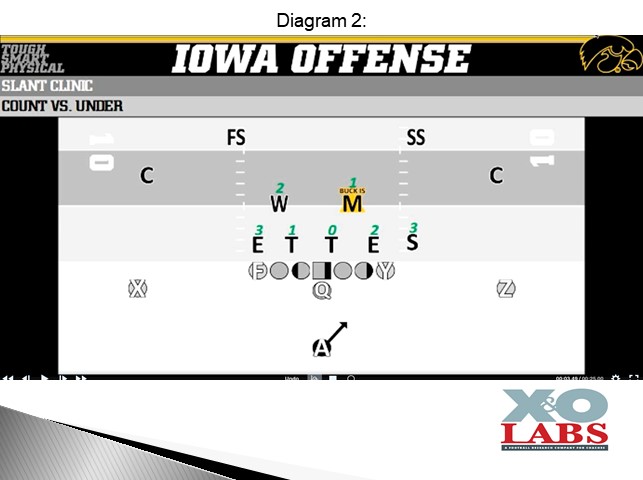
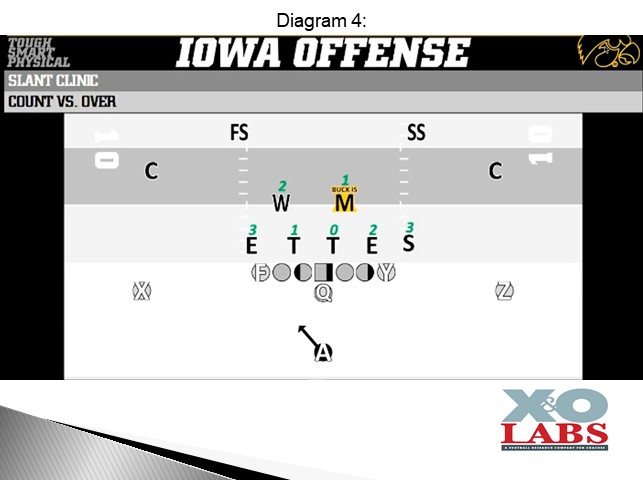
The cornerstone of blocking rules starts with blocking seven for seven across the front in 12 personnel structures, and six on six in 11 personnel structures. Iowa bases out of what Coach Ferentz calls “Zoro,” a seven-man combination along the front where the identification is the play side linebacker. The Nose or first down defender is the play side and the rest is counted out. If defenders are stacked, such as in Odd front scenarios, whoever ends up at the 0 area becomes the zero.

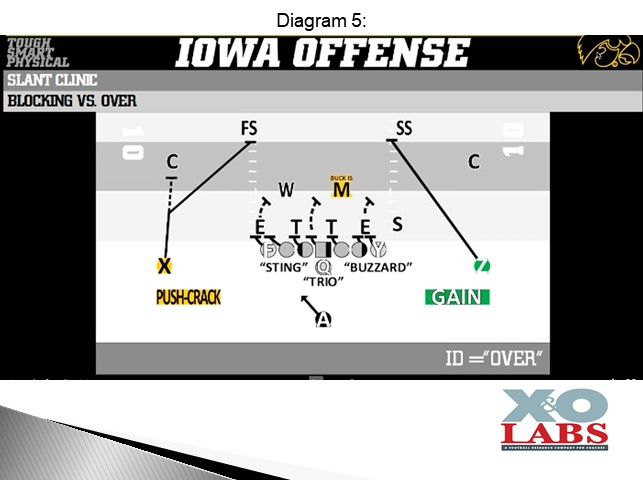
The graphics below provide a better illustration of Iowa’s count system based on the front:


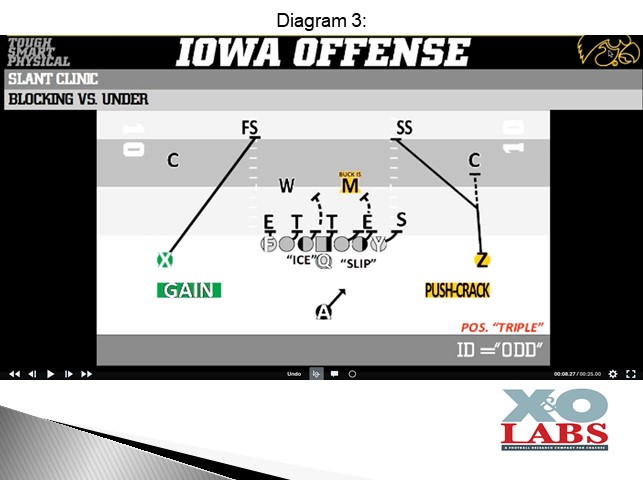
Below are some of the terminology Iowa uses to communicate blocks upfront:


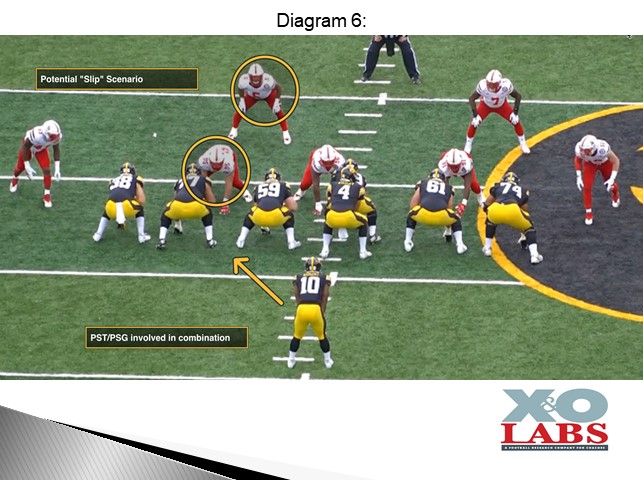
“Slip”- Front side combination with Guard and Tackle


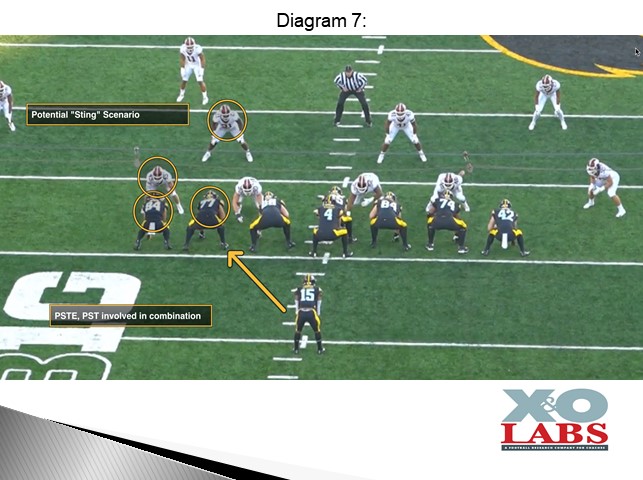
“Sting”- Front side combination with Tight End and play side Tackle. The tight end will reach the play side armpit because he has help. Play side Tackle tries to overtake and push thru to linebacker.


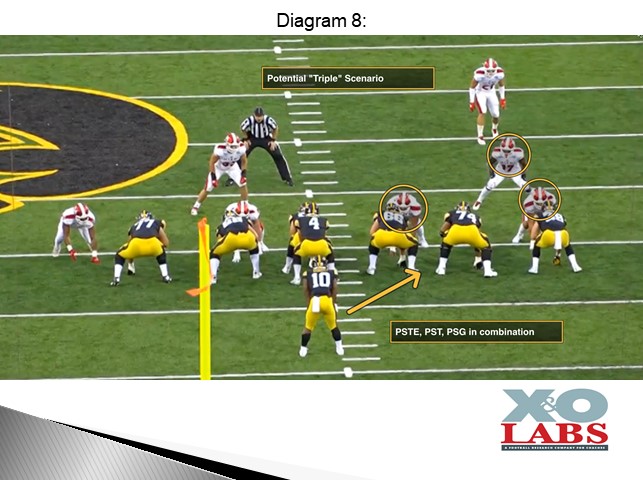
“Triple”- Puts the play side three linemen (TE, PST, PSG) in combination. Good vs. 3-4 defenses with a 4i play side.


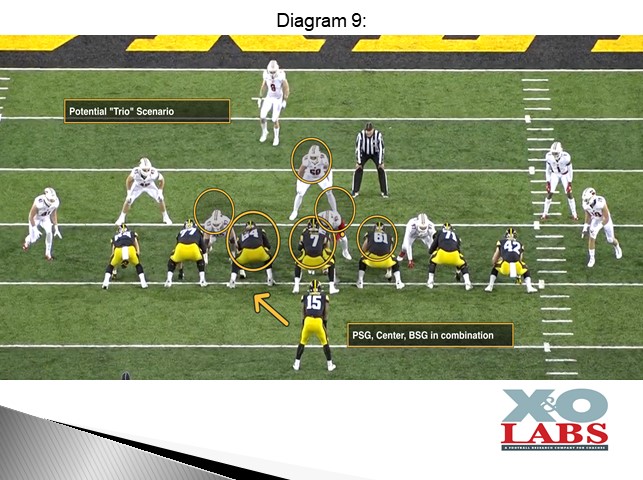
“Trio”– Combination between Play side Guard, Center, and Backside Guard. Mainly uses vs. Odd Stack teams with a nested Mike linebacker.


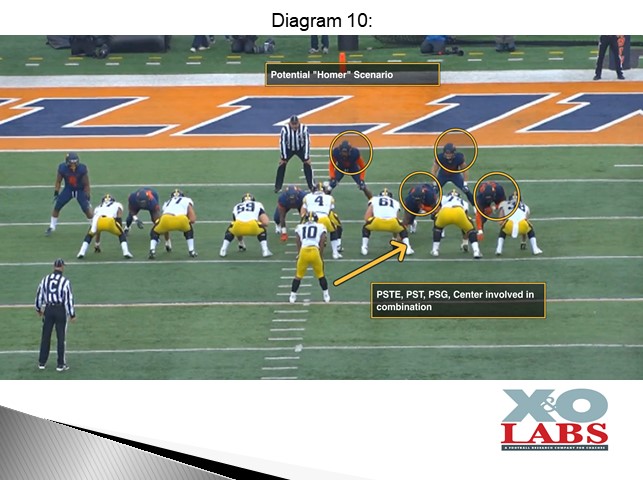
“Homer”- Four-man combination (sting and trio combined). Tells Guard who is covered to check the 7 technique. It’s good vs. Pirate movement along the line of scrimmage.


C Gap Mentality:

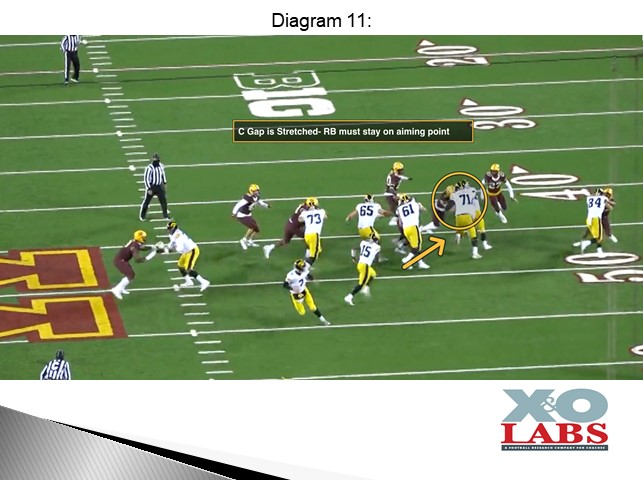
What separates Iowa from other outside zone outfits is the hell-bent nature of getting the ball to insert into the C gap. While the C gap can widen post-snap as evidenced in one of the diagrams below, Coach Ferentz and the offensive staff preaches that all players understand that C gap entry point. It’s all part of the education process of teaching players how the play is run. Quite frankly, every offensive player on the field is cognizant of that C gap entry point. While he says the most important block on the slant play is on the perimeter, he uses the following scenarios positionally to reinforce the timing of the play:

  • Play side Guard on a 3-Technique: Importance is to keep pressure, or what Coach Ferentz calls “slow down” on a B gap defender. If it’s too quick to reach him, the ball can cut back inside the play side C gap. If the defender runs, the shift is to move him vertical. It’s called an “overreach” technique and is detailed below.
  • Center- If the Center can’t reach the A gap defender, there is no play. This is because geographically, the A gap defender is able to cut the ball off faster from the C gap than a 3-technique.
  • Backside Linemen- Coach Ferentz talks about the longer time needed to beat that defender to the C gap entry point. He can’t cut anybody early because the defender can get up too early or the lineman can’t get vertical on him. “It’s a long way to that frontside C gap,” he said.


QB/RB Aiming Point and Mesh: C Gap Angle of Departure

When watching Iowa’s film, it’s clear the Hawkeyes are running the slant play by witnessing the path of the back. Like most operations in the Iowa program, the backs are extremely disciplined in hitting their landmark on the wide zone- which is the play side C gap. Iowa bases out of under alignments, mostly because of the potential of the naked and boot game off outside zone. Coach Ferentz doesn’t incorporate many Pistol alignments and he feels the sidecar alignment drifts the aiming point too wide. For Iowa, the C gap is the non-negotiable target for the ball carrier. Coach Ferentz talks about lining a can of spray paint in the C gap to identify the landmark for the back. “That ball should never hit behind that X geographically,” he said. “It may cut behind the Center at some point, but that Center should be at that X before it does. In a perfect world, we get it cut right at that C gap.” Now, that C gap can stretch once the play gets moving, but essentially the ball carrier needs to hit that area with his shoulder square and downhill. “If the back is cut off from the C gap, you have no play,” he told me. “We want defenses running.”


The footwork for the back is to pivot off the play side foot and get downhill at C gap. Coach Ferentz calls it “speed control,” which means to press the line of scrimmage, not the hole. The QB is taught to open at 10/2 o’clock and get the ball to the running back behind the C gap. “He’s got one job, get the ball to the running back job and boot away from play,” he said. “He can’t reach the ball out late and he better come off the exchange with the intention that he may have the ball.” The running back’s aiming point is the tight end to the three-surface side or the ghost tight end to the two-surface side. Again, it’s purely a C gap play.

Below is the drill work Iowa uses to teach its QB’s and RB’s the mesh on the wide zone:


The rest of this report focuses on the specific technique of individual and combination blocks play side as well as how the staff at Iowa formations the play to attain soft edges at the C gap.

Read More

Replace Rushes from Drop 8 Coverage

By Mike Kuchar with Joel Taylor
Defensive Coordinator/Linebackers
Mercer University (GA)
@KoachTaylor


For most of his career, defensive coordinator Joel Taylor was a four-down, quarters-based coach. The last time we worked with him back in 2018 he was at The Citadel (SC) using similar fronts. But as the athleticism of players in the SoCon advanced, particularly at the quarterback position, Coach Taylor shifted to using more 3-3-5 spacing. And the ball was getting out so fast, he didn’t see the purpose of rushing four defenders anymore. “We were wasting a rush,” he told me. “So, why not just add dropper?” That additional dropper became an off-the-ball outside linebacker (the Kat in his system). While the extra cover defender solved the rush problem, it only exacerbated another issue- quarterbacks were pulling the ball down and either scrambling for extra yardage or extending plays on their feet and delivering the ball into soft zones.

The breaking point came in the last game of the 2020 season when the Samford quarterback lit up the Bears for 443 yards in the air, most of it came from extending plays. And when Coach Taylor decided to designate one second-level defender- usually the Mike- as the fourth rusher the issue didn’t get resolved. “He couldn’t tackle the quarterback in space and he had no pass presence because we eliminated him from coverage,” he said. “He was in purgatory. We needed more leverage on the quarterback.” So, heading into this season the Bears tweaked second-level rush responsibilities from Drop 8 coverage. This one simple tweak helped propel the Bears from 60th in total defense in 2020 to a top 20 finish this season at the FCS level.


Personnel:

The Bears utilize a three-high safety defense on more than 20% of snaps this season. They essentially play with the following personnel:

  • Nose
  • Two Defensive Tackles
  • Boundary Defensive End (Kat)
  • Mike LB
  • Sam LB
  • Will LB
  • Free Safety- Middle Safety
  • Nickel Safety- Field Safety
  • Boundary Safety
  • Two Corners


Like most Odd front outfits, the Kat outside linebacker can play both on the line of scrimmage and off the line of scrimmage. While he needs to be cross-trained to play coverage, according to Coach Taylor it’s inexpensive and advantageous to do so. This way the Bears don’t need to change personnel to keep this structure intact.

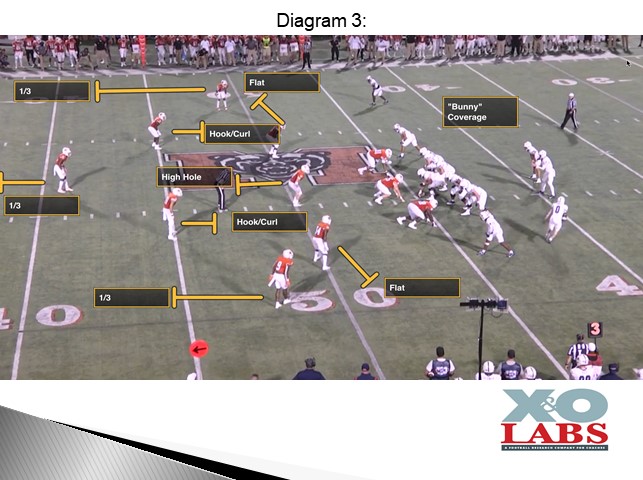
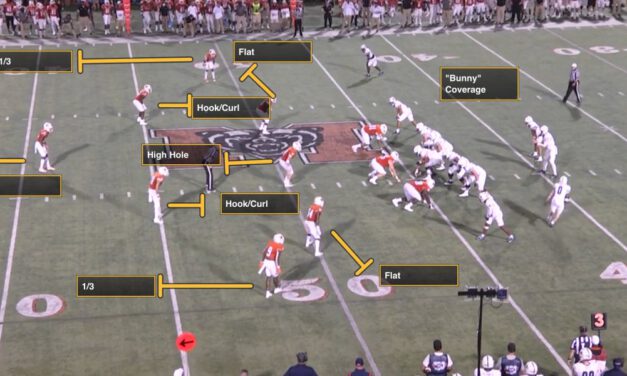
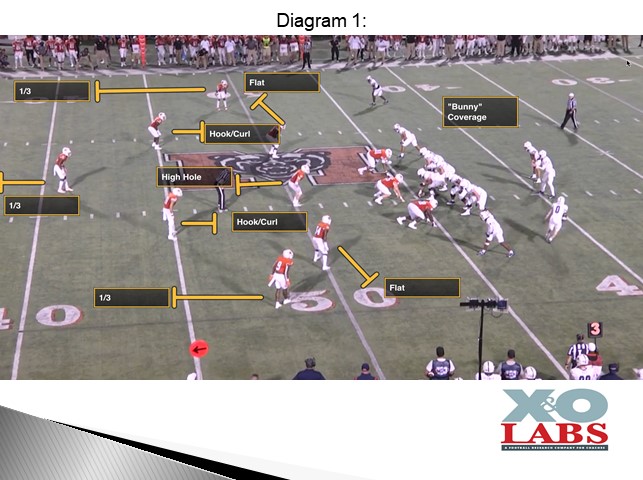
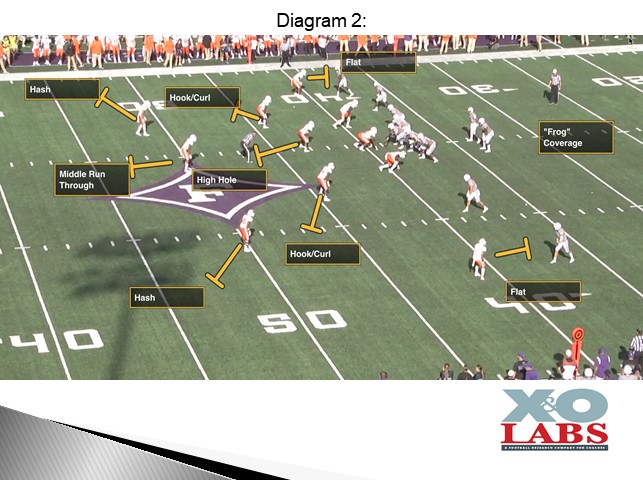
In the Bears defensive system, there are two forms of Drop 8 coverage. Both come from 3-Deep, 5-Under spacing. The difference is in the responsibility of the outside pieces. One of which is a cover three variant, where the field and boundary safeties are inserted into underneath coverage to play hook curl, the Sam and Will play the flat and the Mike has the high hole.

He calls it “Bunny:”


The other variant is a cover two variant, where the field and boundary safeties are pure halves defenders. He calls it “Frog” because the Middle Safety acts as a “Tadpole” playing the middle of the field from the top down.


According to Coach Taylor, both are extremely inexpensive to install and efficient against 10 and 11 personnel offenses. In fact, the only times Coach Taylor will choose not to use these coverages is against multiple tight end groupings because of heavy run concepts like the Duo play.


Vision-Based Coverage:

One of the driving forces in Coach Taylor adjusting his mindset is the shift from a man-based coverage approach to a zone-based coverage approach. He calls his unit a “vision-based” team as it pertains to zone coverage and he does to through anticipating the actions of the quarterback. Most of this comes through what he calls a front-shoulder read of the quarterback.

This premise is best described below:


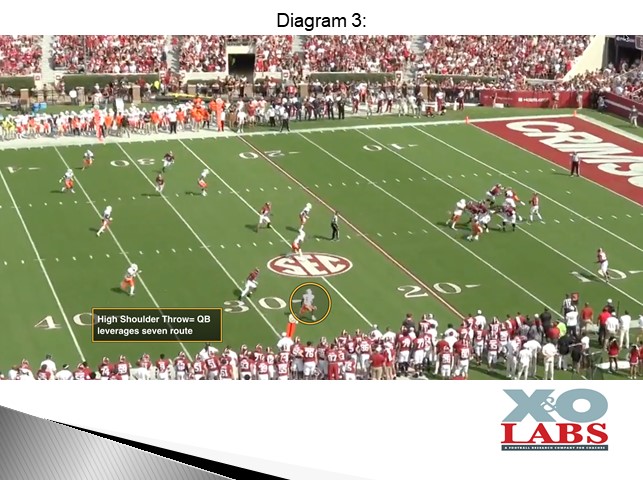
“High Shoulder Read”- Dictates a deeper route such as corners or verticals.


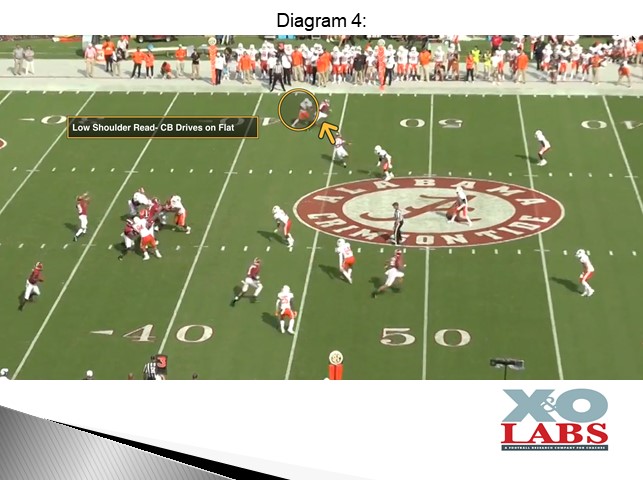
“Low Shoulder Read”- Dictates a shorter route such as a flat throw.


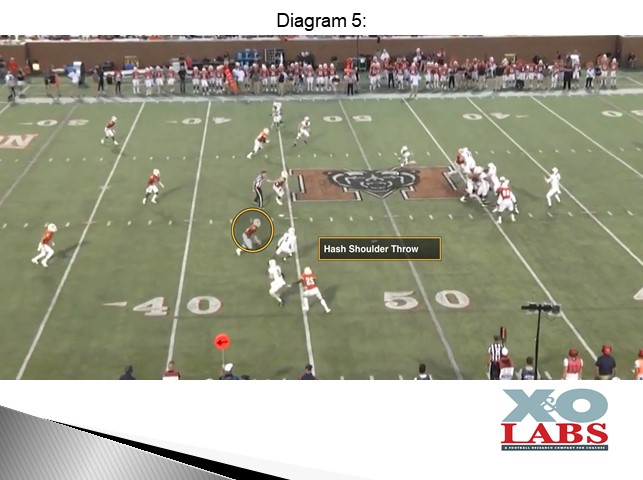
“Hash Shoulder Read”- Dictates a ball expected to be thrown between the numbers and hash.


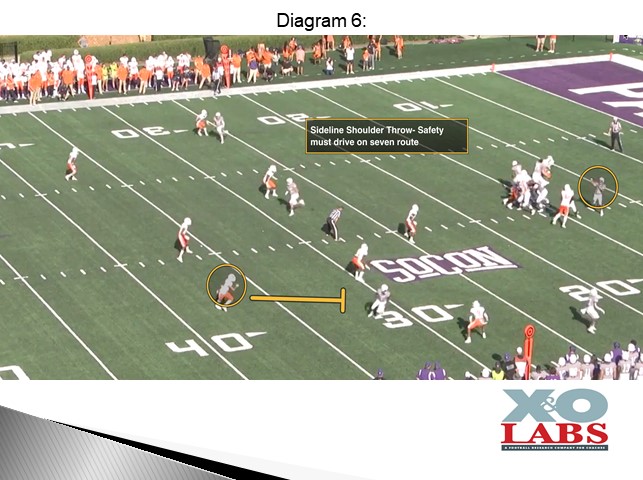
“Sideline Shoulder Read”- Dictates a wider throw such as outs and comebacks.


These are important coaching points to understand as we move further into this report.

The rest of this report focuses solely on how Coach Taylor has built-in replace rushes from both of these coverage spacings to limit mobile QB’s extending plays.

Read More

Run Game Divides: Separating the Defense

By Mike Kuchar with Patrick Murphy
Offensive Coordinator
University of Rhode Island
Twitter: @CoachMurphURI


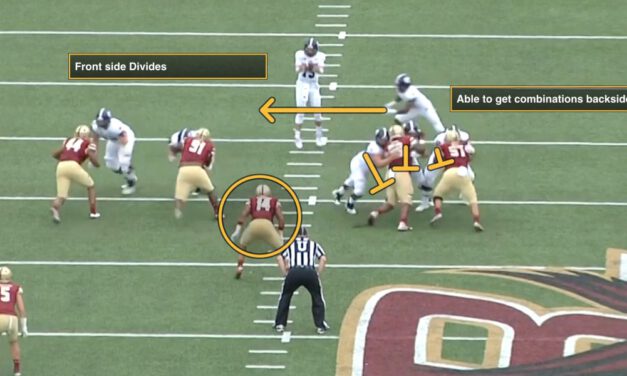
At the University of Rhode Island, offensive coordinator Pat Murphy has built his run game around what he calls “segment runs,” which essentially are divide runs, where the QB is asked to read any defender in any gap along the line of scrimmage. While many coaches have implemented some of these concepts- such as zone read, midline read, bash, etc.- Coach Murphy and his staff use all of them and will use them every week. He will ask his quarterback to read the B gap, A Gap, C gap, or D gap and will invert the read where the QB is the dive element, which allows for bigger QB’s to run in the box. He can do that is by building his run game around these particular defaults where each concept has a built-in read.

Take the following illustration as an example:

“Power”- D gap read to call side

 “Mid Zone”- A gap read to call side

“Tight Zone”- C gap read to the backside

“Outside Zone”- A gap read to the backside

“Counter G/T”- C gap read to the backside


It’s important to know that these reads can change based on the personnel and scheme of the defense, which is something we will detail later on in this report. Which divides Coach Murphy and his staff selects also depends on the skill set of the quarterback. But one thing is certain, using all of these read concepts as a primary element of your system allows quarterbacks who are not particularly great runners to be a threat in the run game. And with a signal-caller this season that is 230 pounds, Coach Murphy makes sure that he gets at least 10-12 carriers per game, particularly on interior runs, which is different than getting an edge or dealing with space outside. This year the URI quarterback finished with 408 yards on 113 carriers and in two seasons the Rams were undefeated when he rushes for over 30 yards a game.

The progression starts by deciding where he wants to divide the defense. While linemen have their rules based on the run concept, the divide gap is the read gap and cannot be blocked. How Coach Murphy and his staff formulates the read each week is what makes the system unique. “Essentially you’re mixing tight zone with mid-zone on the same play and you can displace people fighting to stay in their gaps,” he says. “It’s not something defenders see regularly. Often there is no one in the divide but the actual read defender because they are getting tight zone action one way and stretched opposite.”


Divide Verbiage:

How Coach Murphy can bucket all these concepts is by creating a streamlined system of language that is broken down into both front side and backside reads and combined with the run concept. Any front side read is coupled with an “F” word, which tells the front side offensive line they are involved in the read side.

Consider the following examples:

“Fate”- Front side A gap read

“Fiber”- Front side B gap read


So, if mid-zone is called “Mustang,” mid-zone with an A gap front side read can be called something like “Mustang Fate.” And if outside zone is called “Ozzie,” outside zone with a B gap front side read would be called something like “Ozzie Fiber.”
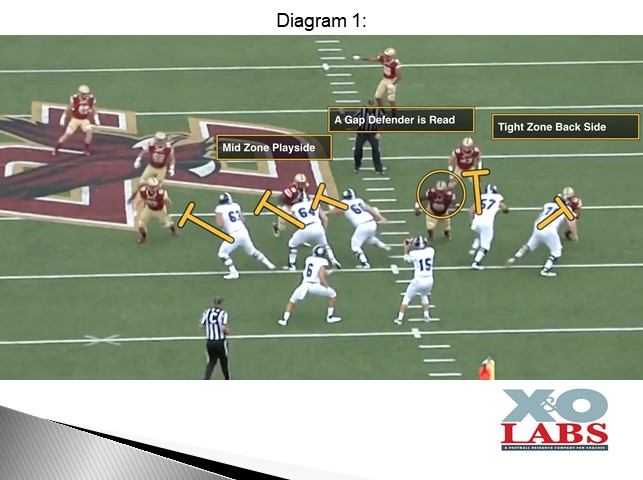
 

It’s important not to get the big guys up front confused, so although Rhode Island is primarily a one-back outfit any “F” tag instructs the line to use two-back blocking, where the Center works backside away from the read.

Conversely, backside reads are labeled with “B” words such as “Bat” where the quarterback will read the first down lineman (either A or B gap defender) past the Center on the backside. This tells the Center to now work frontside. Against a 2i defender, the backside Guard blocks the B gap, the backside Tackle blocks the C gap, and the backside tight end blocks the D gap or can seal the safety. These can be coupled with any run concept (mid zone, tight zone, pin, pull, etc.). But as detailed below what makes these concepts lethal is the invert run action presented to a down defender where he is asked to make a real-time decision on playing the back or the QB with run action in his face right now. It’s different than pure zone read where the back is working away from him. It completely negates any traditional surf technique by a down lineman.
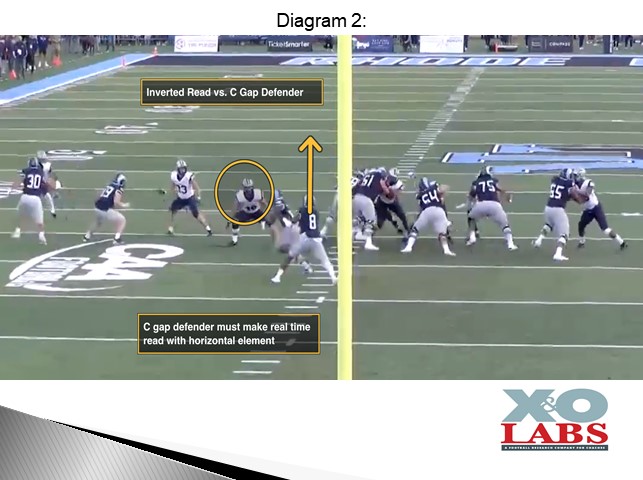
 

According to Coach Murphy, because the backside is man blocking it’s important to teach the offensive line to be able to handle two-man and three-man games on the backside. They have to be able to work in space and block second-level defenders by using the same principles as a backside Tackle would on a traditional zone read by veering to a second-level defender. Coach Murphy calls it “V.C.C.” which stands for Veer, Climb and Cover a second-level defender. At times it’s important to let the defender declare, rather than try to decide which way he is working. “We talk about picking our inside foot up and putting it down to get a true determination of the best path to the linebacker,” he said.


Varying Mesh Points:

Each of these reads is correlated with a particular mesh fundamental by the quarterback and running back. As defenses got smarter in being able to tip off backfield alignments, Coach Murphy went to a universal backfield alignment of having the running back always align in the B gap and always have his toes on the heels of the quarterback as to not tip off which concept is being run. Which mesh fundamental the QB and running back is based on the particular segment run. But it will always be one of the following:


“Clear” Mesh– Here the quarterback will step back and replace his heels with his toes moving from near leg to far leg to seat the mesh. The coaching point is to have feet slightly wider than his armpits so he can come downhill down the hash. These are used in mid-zone reads, and wrong way runs where the QB is reading a backside B gap or C gap defender.
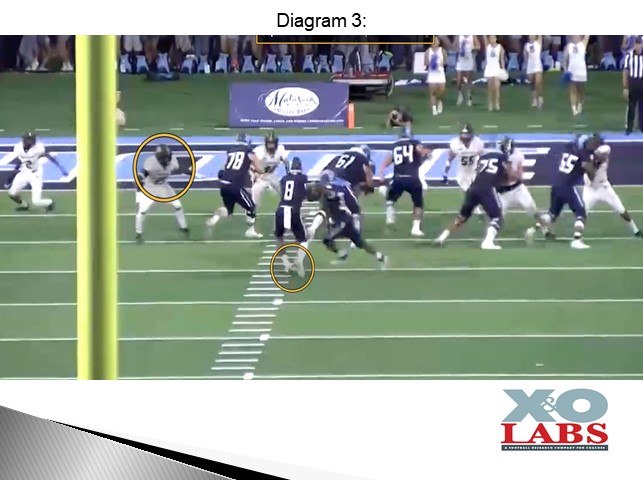
 

“Skate” Mesh- Here the quarterback clears the mesh with a shuffle to the front side. These are used in front side reads, where the quarterback reads a front side A gap defender as he would in the mid-zone read the example above.
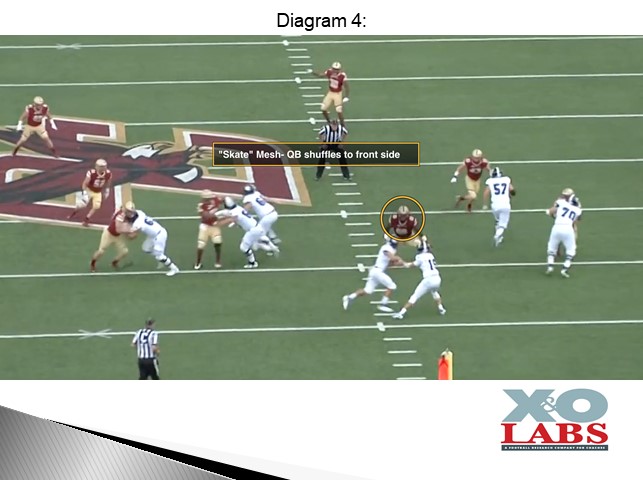
 

“Pivot” Mesh- Here the quarterback will pivot on his play side foot with a short six-inch step with opposite foot in a staggered stance. He will ride the ball from near hip to far hip before making a decision. These are used in interior runs like veer, power, and counter.


As far as making the right decision on gives or pulls, Coach Murphy classifies a give or pull in a simple formula:


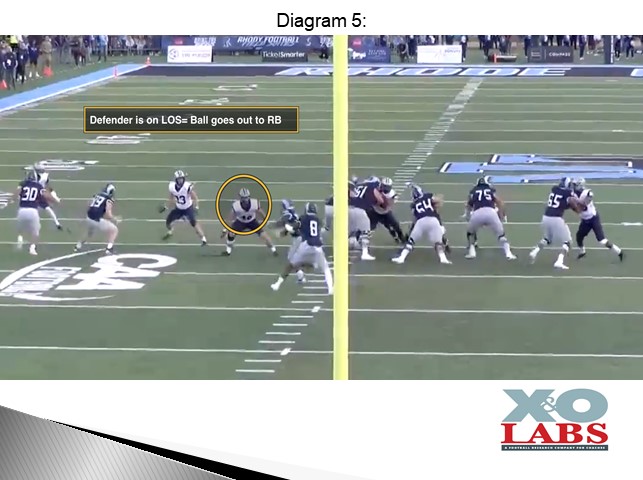
“On or In= Out”- This means that if the read defender is on or inside the line of scrimmage the ball should go outside to the running back.
 

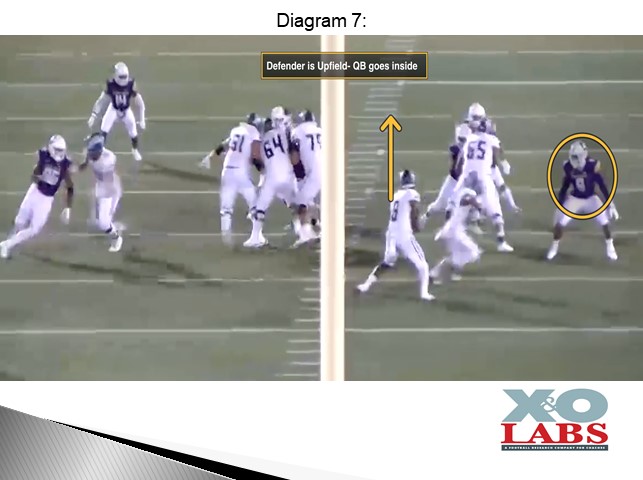
“Upfield or Outside= In”- This means that if the read defender is upfield or outside the line of scrimmage the ball should go inside to the quarterback.
 

The rest of this report focuses solely on how Coach Murphy and his staff piece together these segments runs weekly to manipulate defensive schemes and personnel.

Read More

Second Level Replace Rushes to Defend Mobile QBs

By Ryan Lucchesi
Defensive Coordinator
Muskego High School (WI)
Twitter: @CoachLucch


People often ask what is the most challenging offense to defend. Our response would commonly be the one with a mobile QB that can impact the game both in the design but most dangerously in the improvised run game. The ability to extend plays, challenge rush lane discipline, and evade rushers can be problematic for every level of the defense.

We operate from a 3-3 Stack base defense. We are not a huge blitz team. When we pressure, it is normally sending 4 and will rarely, but occasionally, bring 5. Historically, we have relied on quality rush lane discipline from our D-Line and blitzing players to keep QB’s contained. We have also emphasized coaching up our MLB to be an effective Spy / quasi 4th rusher against QBs that are running threats.

During a game in the middle of our season, we came up short in our objectives. We allowed a QB to beat us consistently with his legs. Most of the time for crucial 3rd down conversions. Other times, it was on 2nd downs that created more manageable 3rd down opportunities for the opposing offense. We struggled to execute what we have in previous seasons. We needed an adjustment to put our kids in the best position to be successful.


Implementation:


2nd Level – Inside Linebackers

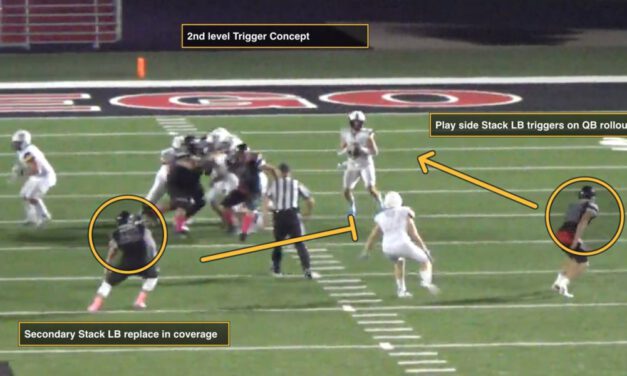
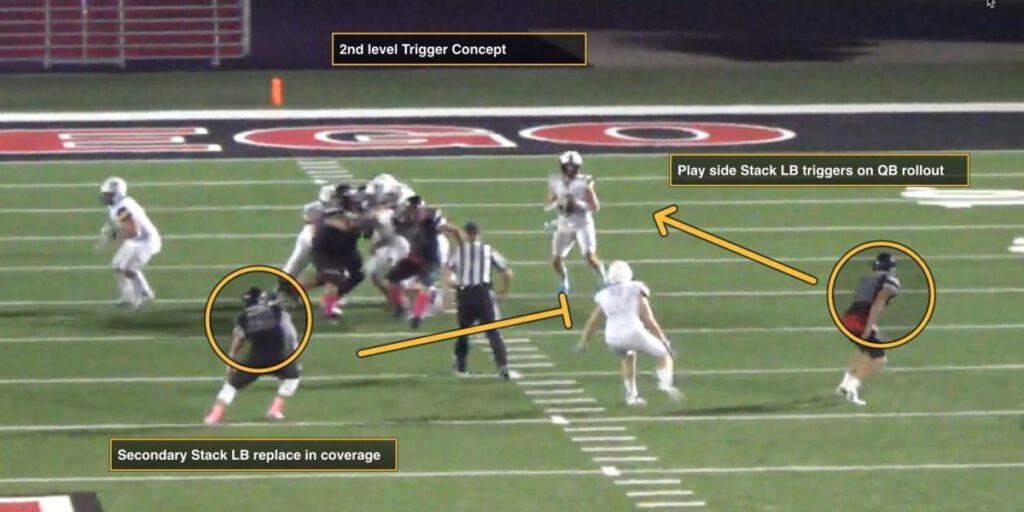
The primary focus of this article is solving these problems created by a mobile QB with our 2nd Level Trigger concepts for our Inside Linebackers. We will briefly touch on some games that we will play with our D-Line as well. As far as our 2nd level goes, the focus turned from solely having the MLB be the player responsible for QB scramble, and the other two Stack LB’s became major focal points.

Read More

Coaching the Third and Fourth Puller in Multiple Gap Concepts

By Tyler Schneider
Offensive Coordinator & Quarterbacks
Bixby High School (OK)
Twitter @tschneider1014


For the last 5 or 6 seasons, our run game has morphed from predominately zone schemes to nearly all gap schemes. This started as we were facing multiple fronts and the team we knew we would have to beat was doing very different things on defense. Standing everyone up, blitzing 4 to one side, walking the entire defense around pre-snap, lining up the entire defense at 5 yards, etc., etc. So as a response to this we started “blocking down and kicking out” more. We feel that with a block-down kick-out mentality we can block more fronts without changing many rules for the kids. Initially, we were getting to this look with split zone schemes. We decided that if “pulling” one player and moving a gap was good, maybe pulling two would be better. We installed G/Y Counter first and soon after G/T counter. By this season we have been running our counter schemes for a few years and the kids have a good understanding of our play design. With the idea that pulling one was good and pulling two was better, we asked ourselves “what if we pull 3?” So, during the 2021 season, we added a tag to our counter schemes that would allow for us to add a third puller.


Coaching Points:

The following coaching points are for our Counter plays. We run counter a variety of ways and in doing so teach it as a “First Puller”, “Second Puller” and at times a “Third Puller” play. The ability to run this scheme against any front as well as a tempo play are big reasons we like these counter schemes.

QB: In our offense, our gap scheme runs can be both QB read to run options or QB read to throw RPO options. It depends on how we call the play. The play call will alert the QB as to how we will be blocking the scheme and how he will be reading the play. In this write up we won’t go into the details of our QB reads.

TB: In any of our gap scheme runs we are coaching our back to get into the line of scrimmage as to be inside of the kick-out block from our first puller. We want our back to run with an inside-out mentality, getting vertical into the line of scrimmage as quickly as possible.

Center: block back on the first backside lineman. the first step is lateral step aiming at the outside foot of his target. the second step is aiming at the near foot to protect against an inside slant. Head in front to stop penetration, near hand far chest plate with heavy backside hand to force the target out and up the field.

Frontside First Block Down: Declares kick target for the first puller via code word, if he has an inside threat in an odd front he will use IZ steps to block down if the lineman slants out he will bypass the end and climb to the first backer in his path. If he has no inside threat he will slow play and take a 6-inch step checking the kick target for an inside slant, if he stays outside he will climb, if he plays inside he will pull him across and the kick target becomes the next outside player. In an even front, he will take power combo steps with the covered lineman to the backside linebacker.

Frontside Second Block Down: block back/down in an odd front on the first inside lineman. the first step is lateral step aiming at the outside foot of his target. the second step is aiming at the near foot to protect against a play side slant. Head in front to stop penetration, near hand far chest plate with heavy backside hand to force the target out and up the field. In an even front, he will take power combo steps with the play-side uncovered lineman to the backside linebacker.

Backside First Puller: Trap pull: The first step opens his hips and squaring his shoulders to the kick target, the second step clears the center and gets the puller into the line of scrimmage to handle a kick or log scenario. The aiming point is the inside shoulder of the target, head in front, heavy upfield hand, working his hips upfield on contact forcing the defender up the field.

Backside Second Puller: Square pull: The first step is a back step that gains depth and stacks behind the inside foot. the second step is a lateral step into a crossover run keeping his shoulders square to insert vertically on the play side backer. His aiming point is head up if the LB plays heads up or backside he will get a vertical push and pin him inside, if he plays over top he will treat it as a second kick aiming point becomes the same as the first puller.

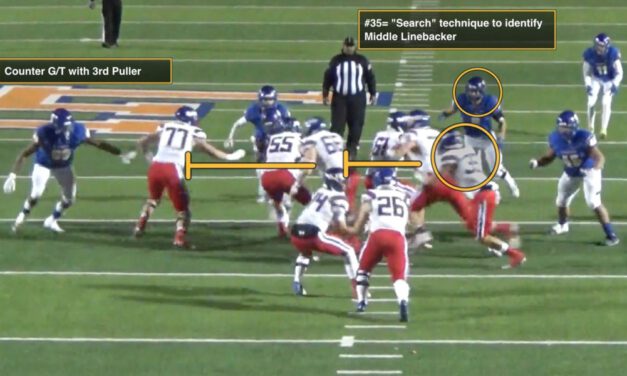
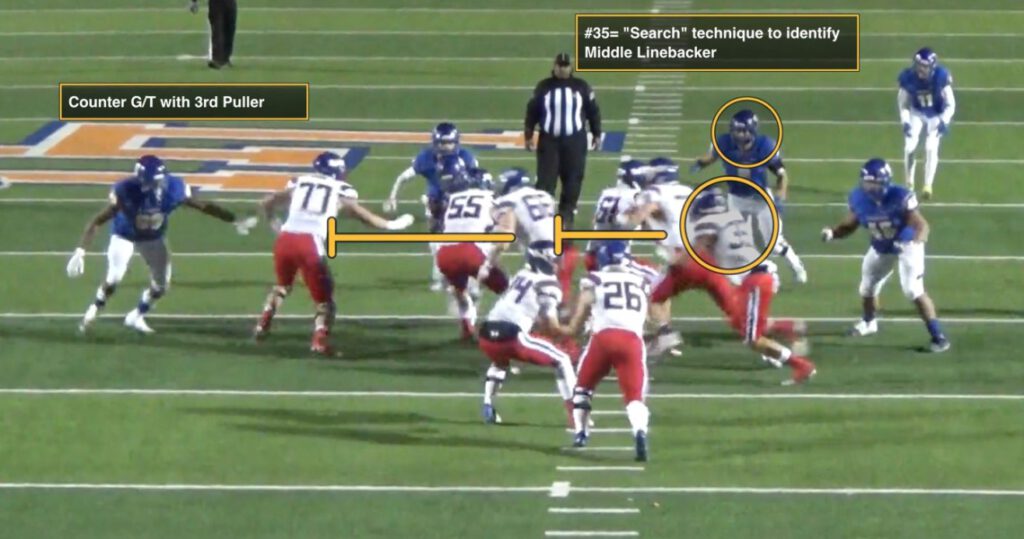
Backside Third Puller: We treat our third puller as the “extra” guy. We coach them up on who could be the unblocked defender, but we also want them to understand they are a cleanup block. As they are pulling we coach an “eyes inside” approach and if nothing shows find the near safety. This year we had three senior tight ends, so we would go into who we expected to be the extra defender for the 3rd puller. Oftentimes it is the backside inside LB, but you would be surprised how often they get caught in the trash of the down blocks. So we teach him eyes inside so he is looking for that defender, but if no one shows he knows he can work up to safety. He also knows that he is the clean-up guy, if we miss a block somewhere he should help fix it.

Backside Fourth Puller: On the few occasions we pulled a fourth player, we just stressed that he was the extra guy, have eyes inside and clean up any unblocked defenders you find. if nothing shows he is to look outside for a folding defender.

The rest of this report focuses solely on how Coach Schnieder and the offensive staff teaches the third and fourth puller to identify and block extra run fitters in gap schemes.

Read More

3-Deep, 2-Under Pressure Packages from 3-High Alignments

By Mike Kuchar with Wallie Kuchinski
Defensive Coordinator/Outside Linebackers Coach
University of St. Thomas (MN)
Twitter: @kuchinski8


If you know anything about the defensive system being used at the University of St. Thomas, then you know how much defensive coordinator Wallie Kuchinski loves to heat up the quarterback. For over a decade, Coach Kuchinski has built and continually evolved the Tommie’s brand as a pressure outfit and in its inaugural ’21 season at the FCS level was no different. The Tommies posted a 7-3 record and a top 5 finish nationally in team passing efficiency defense. They did so by relying on pressure, limiting offenses to under 18 points a game. Quite impressive, considering facing all new opponents.

Part of that success is credited to Coach Kuchinski’s diverse package, which includes two-high sims, one-high sims, fire zones, man-free pressures and the hot pressures that are detailed in this report. The last time X&O Labs worked with him, he was majoring in 3-Deep, 3-Under fire zone coverage that he used on nearly 95% of pressure downs. While this scheme held up in the run game, he found that the coverage was vulnerable in the RPO game, and the man-like coverage structure didn’t quite hold up against the upgrade of offensive personnel at the FCS level. Plus, well-coached offensive lines rarely have issues holding protection against five-man rushes.

So, this season shifted his mindset into utilizing more “hot pressure” (3-Deep, 2-Under concepts), which gave the allusion of man coverage by bringing six defenders who were able to play with more zone eyes on the quarterback. But while many coaches utilize these pressures from two-high structures, the difference in using a three-high structure allowed seam defenders to play from the top-down alignments with a better vision on the QB. It was a final down call for Coach Kuchinski who liked it more in pass-heavy downs (3rd and 6+) than anything else. And he complimented the scheme with pure Tampa coverage from 3-high alignments to protect the flats.

While this scheme wasn’t the top pressure package in the Tommies system- three deep sims took home that honor- these were “call it, run it” pressures and held up against any formation and in any ball location, particularly in the low red zone. And the one-high post-snap finality meshed with the rip/Liz match and man-free principles in Coach Kuchinski’s menu. “When you send five and play four under, you have to scheme things up correctly to get a rusher free,” Coach Kuchinski told me. “But when we bring six, we are getting a guy free, and we don’t have to play man coverage behind it.”


UST’s “Nickel” Personnel Structure:

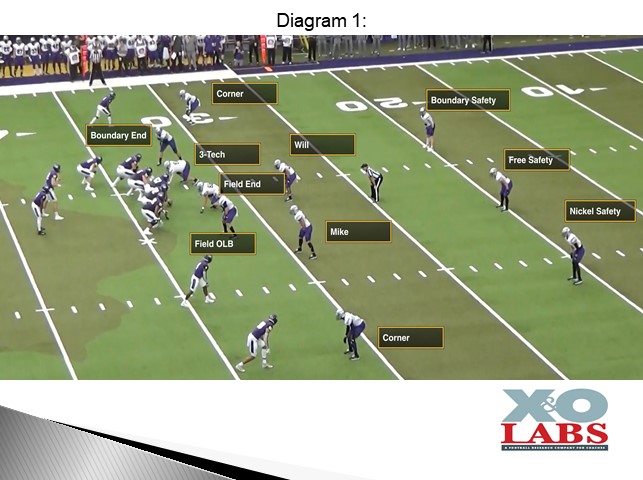
The advent of 11 personnel offenses has caused Coach Kuchinski to play his Odd front, Nickel defense now in over 70% of all downs. But while he calls it “Nickel” personnel, essentially, it’s a two-down structure, field, and boundary defense that utilizes the following personnel:

  • 2 Interior Defensive Lineman– Nose and Tackle, who can be interchangeable
  • 2 Defensive Ends – These are more linebacker personnel types that will play to the field and boundary on the line of scrimmage in this package.
  • 2 Linebackers– Sam (strong-side outside linebacker) and Will (weak side inside linebacker)
  • 2 Corners
  • 3 Safeties– The Nickel Safety is the field safety, the Free Safety is the middle safety while the boundary safety aligns to the short side.


The Field End is more of a field outside linebacker type while the Boundary End resembles a stand-up pass rusher. In his three-high alignments, the Nickel plays to the field, the Free Safety is the middle safety, and the boundary safety aligns to the short side of the field.


The rest of this report focuses solely on the one pressure pattern Coach Kuchinski uses in his hot pressures system and how he teaches the back end to drive on routes that can be problem areas.

Read More

Play Side Build-Ins to Protect Pin and Pull

By Mike Kuchar with Joe Pawlak
Offensive Line Coach
University of North Dakota
Twitter: @pawlakjoe


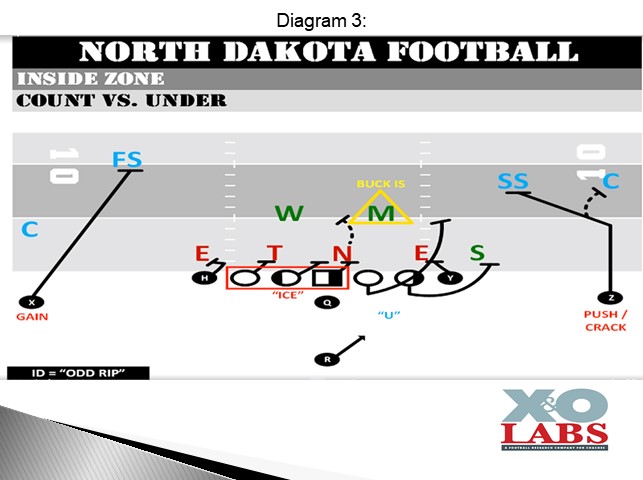
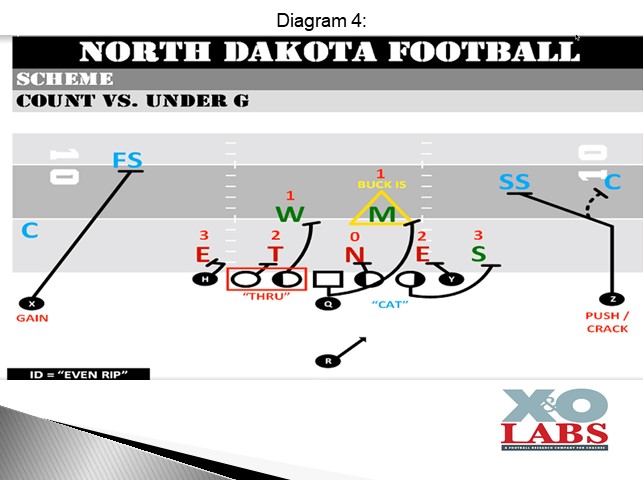
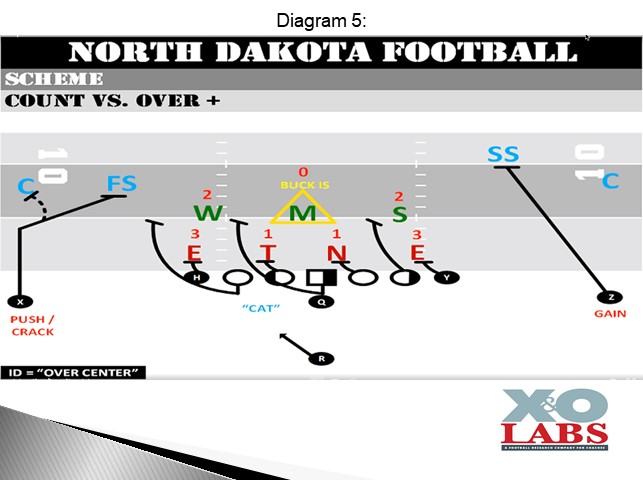
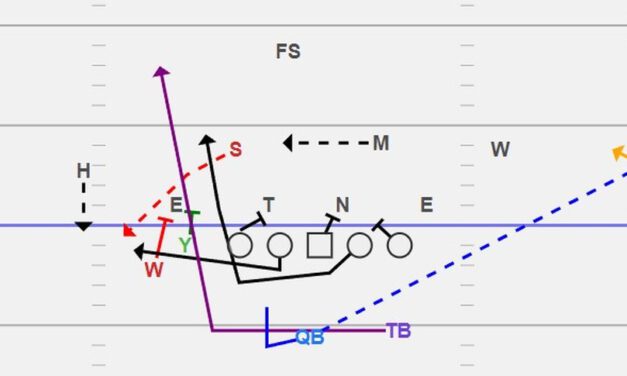
At North Dakota, the pin and pull concept was established out of necessity. With two athletic tackles and an all-conference Center, the Fighting Hawks could body people up on the perimeter. They also had an experienced back who was able to make one cut and get north to south in a hurry with an immediate entry point. The scheme provided a complementary rhythm to an outside zone scheme where there could be various entry points. The line and back combination helped produce 184 yards a game on the ground and the pin and pull was a big reason why. But in 2021, the injury bug infected the Center position, limiting that player’s ability to pull. The staff didn’t want to abandon the concept that garnered so much success, so under the direction of offensive coordinator Danny Freund and offensive line coach Joe Pawlak (a former lineman himself), the offensive staff were forced to be creative in how they designed the concept. This report will focus on how the offensive staff built-in play marriages at the line of scrimmage to combine its pin and pull with gap schemes. “It became a great complement to power,” Coach Pawlak told me. “You’re showing an inside downhill run action but then you’re bouncing it outside. These things helped us.”


Base Pin and Pull Identification and Rules:

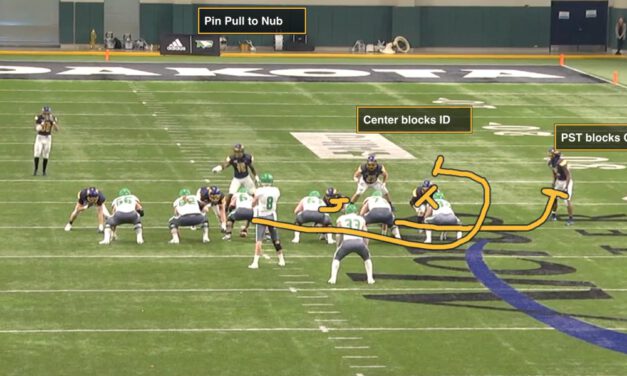
North Dakota calls its base pin and pull scheme “18/19.” Coach Pawlak teaches the play like a true outside zone scheme, where non-pulling linemen are asked to reach their play side gap defender. That includes a play-side Guard against a first-level B gap defender. “To me, it’s an easy block for a 3-technique to reach that B gap defender than for a Tackle to pin it,” Coach Pawlak said. “Oftentimes the Tackle gets beat over the top and that dents the play. We can always get beat inside because we’ll be on the edge already. But we can’t get beat over the top.”

Quite simply, if you’re covered reach the play side gap. If you’re uncovered, pull.

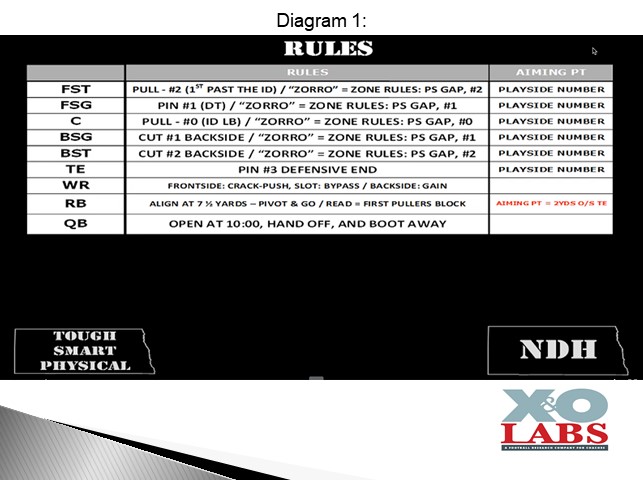
The base rules of the concept are below:


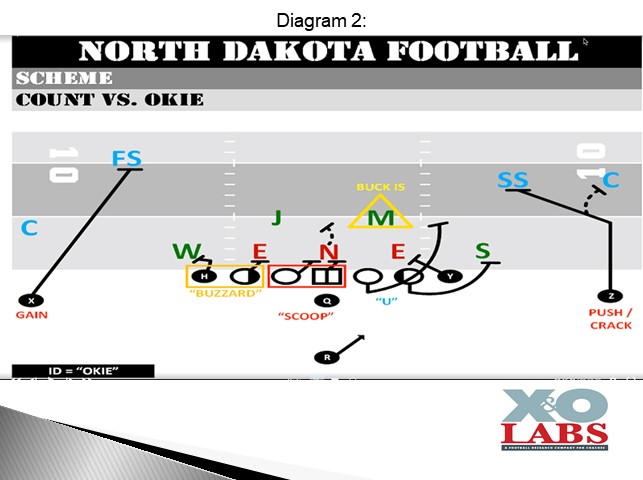
In either case, the objective is to get the play side Tackle and Center out. Who they block will depend on the front, but the first puller is responsible for the first defender past the identification while the second puller is responsible for blocking the identification. In North Dakota’s framework, in a two-linebacker box, the play side linebacker is the ID, while in a three-backer box the middle linebacker is the ID. Coach Pawlak wants his Center to pull as much as possible. “If you have a fast flow downhill defender, we try to cut him down,” Coach Pawlak told me. “If he’s setting the edge, we try to reach his play side armpit and stay up. We only cut downhill defenders.”

Below is the various identification communication Coach Pawlak and the staff use to block pin and pull based on the various fronts it sees every week.


The remainder of this report will focus solely on the build-ins North Dakota uses to maintain leverage play side in its Pin and Pull concept.

Read More

Merging Odd Stack and Bear Installs with 3-Deep Rotational Coverage

By William Reiss
Defensive Coordinator
Lackawanna College (PA)
Twitter: @ReissBill


At Lackawanna College, our goal every year is to lead or be at the top of every NJCAA statistical category. We accomplish this by building an identity for our defensive players. As part of our identity as a defense unit, we strive to be the best at tackling, rushing the passer, and creating turnovers in the NJCAA. We game plan every week to create negative plays. This helps us achieve our game goals of not allowing the opposing offenses to cross our goal line, NO MATTER WHAT, and to get the ball back for our offense in the absolute best starting field position.

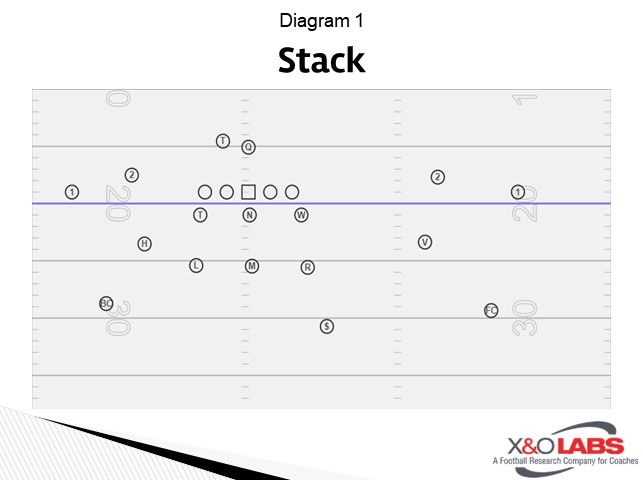
We are a multiple-front defense.  Our two main fronts are DBL Eagle/Bear and the Odd Stack front. We install the fronts with two things in mind. We want to keep personnel changes to a minimum and we CAN NOT get over-complicated when installing coverages.

When installing the DBL Eagle/Bear Front Defenses, you need to:

  • Establish force type and run fits
  • Create a numbers advantage
  • Install a game and stunt package
  • Formulate coverage scheme with run fits and game/stunt packages in mind


Installation #1

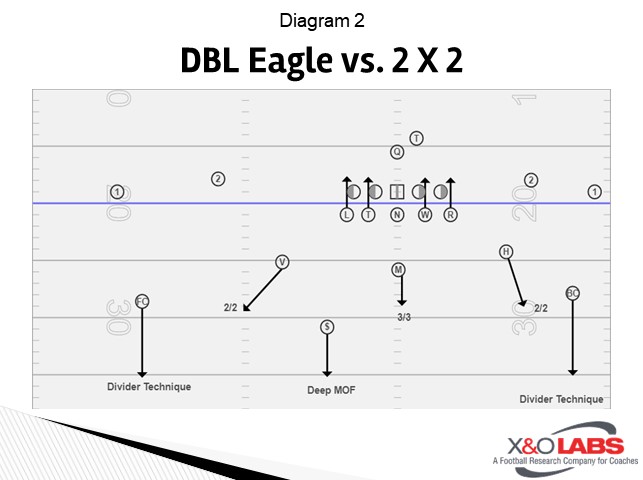
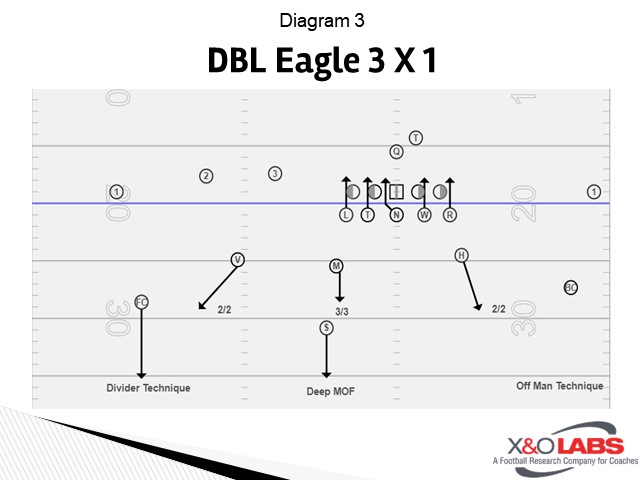
In our first installation, we install our Odd Stack Cover 3 defense and DBL Eagle 3 Over/3 Under and Cover 1 defense at the same. Our Cover 3 and 3 Over/3 Under concepts are the same, except in 3 Over/3 Under; we are defending with 6 defenders, instead of 8 like in Cover 3.  The Odd Stack and DBL Eagle fronts are our identities. If we were to build a house, those two fronts would be our foundation. All the blitzes, games, and coverage variations are the walls, windows, roof, and door.


Odd Stack Cover 3


Position Alignment Responsibility
Tackle 4 or 5 B or C Gap
Nose 0 Either A Gap
Whip 4 or 5 B or C Gap
L 50, 30, 10 Run: Gap in accordance w/ DL

Pass: 2/2 (Reading #2 Zone 2)

M 50, 30, 10 Run: Gap in accordance w/ DL

Pass: Spy or Drop

R 50, 30, 10 Run: Gap in accordance w/ DL

Pass: 2/2 (Reading #2 Zone 2)

Hero I/S or O/S Lev. #2 Run: C or D Gap

Pass: 2/2/1 (Reading #2 Drop Zone 2 then 1)

Villain I/S or O/S Lev. #2 Run: C or D Gap

Pass: 2/2/1 (Reading #2 Drop Zone 2 then 1)

Boundary Corner 1X7 – 10 Divide 1 & 2 Run: Insurance

Pass: Divider

Field Corner 1X7 – 10 Divide 1 & 2 Run: Insurance

Pass: Divider

$trong Safety 10 – 12 MOF Run: Alley

Pass: Deep MOF


Double Eagle Cover 3


Position Alignment Responsibility
Tackle 3 B Gap
Nose 0 Either A Gap
Whip 3 B Gap
L 5 or 9 Run: Gap in accordance w/ DL

Pass: 2/2 (Reading #2 Zone 2)

M 50, 30, 10 Run: Gap in accordance w/ DL

Pass: Spy or Drop

R 5 or 9 Run: Gap in accordance w/ DL

Pass: 2/2 (Reading #2 Zone 2)

Hero I/S or O/S Lev. #2

Away  from 3X1 Closer to Box

Run: C or D Gap

Pass: 2/2/1 (Reading #2 Drop Zone 2 then 1)

Villain I/S or O/S Lev. #2

Away  from 3X1 Closer to Box

Run: C or D Gap

Pass: 2/2/1 (Reading #2 Drop Zone 2 then 1)

Boundary Corner 1X7 – 10 Divide 1 & 2 Run: Insurance

Pass: Divider

Field Corner 1X7 – 10 Divide 1 & 2 Run: Insurance

Pass: Divider

$trong Safety 10 – 12 MOF Run: Alley

Pass: Deep MOF


The remainder of this report focuses solely on how Coach Reiss and the staff at Lackawanna Junior College merges Double Eagle and Bear Fronts with a rotational coverage to keep two linebackers in the core.

Read More

6 and 7 Man Add-On Pressures From 3-High Looks

By Mike Kuchar with Chris Kappas
Defensive Coordinator
Austin Peay University (TN)
Twitter: @CKappas


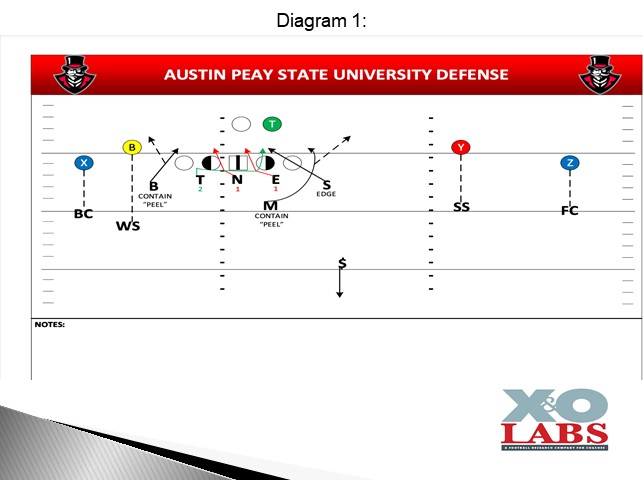
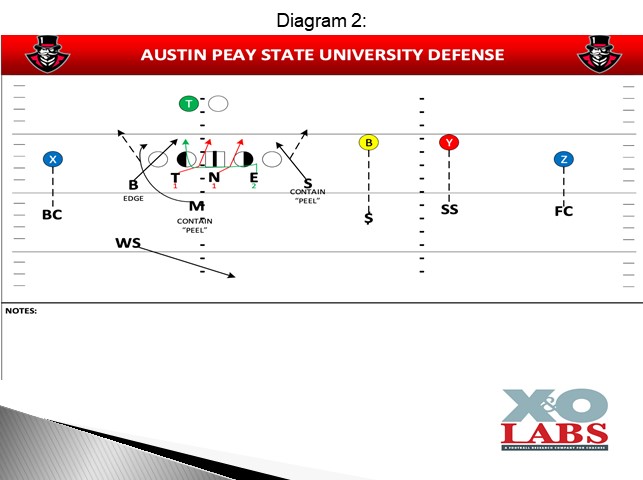
As a 3-3 stack, hybrid 3-4 outfit, Austin Peay University prides itself on getting the best skill players on the field defensively. But, the best skill defenders don’t always equate to efficient blitzers. That lack of skill set influenced many of his calls in the previous year by choosing to be conservative and not pressuring the quarterback. “It costs us some games,” he admitted. So last off-season defensive coordinator Chris Kappas meticulously went about revamping his pressure system to be more aggressive. He dabbled in the three-deep, two-under hot pressure world but instead decided that pure man pressures made things easier to get lined up and keep track of receivers post-snap.

By the following season, he completely flipped the script. The result was an efficiency rating of 66% in six-man activations and 70% in seven-man activations. Sure, they gave up some big plays in the process but according to Coach Kappas, the risk was well worth the reward.   “We won because we were more aggressive and made stops, turnovers, or negative plays when we needed to,” he said.


Governor Personnel:

Like most three-down outfits, the Governors play with a strong end, Nose, and Tackle upfront. Its back seven consists of the following:

  • Sam– Strongside inside LB
  • Mike– Weak side inside LB
  • Strong Safety– Strong side outside LB
  • Bandit- Weak side outside LB
  • Weak Safety- Boundary Safety
  • Spur- Nickel to field or Middle Safety


Activation Design:

Essentially, there are three variants of man pressures in the Governors defensive system:


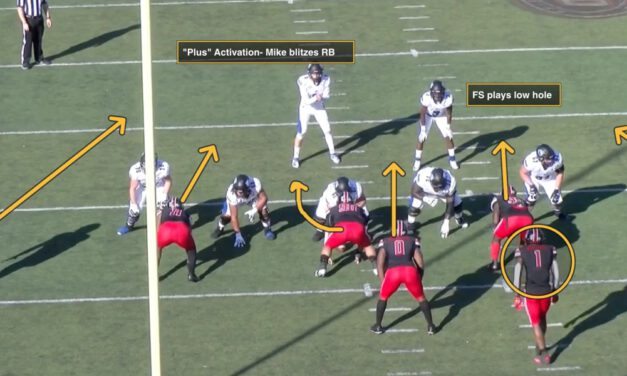
Pure Six-Man Activations– This is the jumping-off point for Coach Kappas’s man pressure system. Here he will play with a high-hole defender and rush six in a true man-free coverage concept.


Six-Man “Plus” Activations- These are what Coach Kappas calls “plus” pressures, which is tagged to the traditional five-man rush patterns. This now activates the Sam, Mike, and Bandit in the pressure and converts from cover one to cover zero by rushing six and putting the post defender on the running back. The post safety becomes the low-hole defender if the running back blocks.

Read More

Attaining Numerical Advantages in C Gap Pin and Pull Runs

By Terry Kent
Offensive Coordinator, QB/RB Coach
Plainfield Central High School (IL)


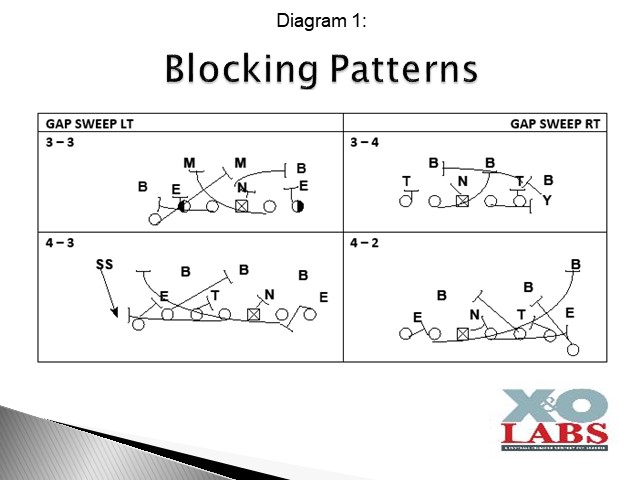
Teams that I have coached have always had a run-first philosophy. We have run both Zone and Gap schemes, depending on personnel. I started running “Buck Sweep” 5 years ago since our Head Coach was a huge proponent of the play. The beauty of the play is that it gives the defense the illusion of running wide, but the combination of in (gap) blocks along with the pulling G’s creates a very effective scissors effect that creates large off-tackle holes. You must spend time on the timing between the pulling G’s and the TB’s path. This play depends on the success of 3 blocks: the TE’s block, PSG kick out, and BSG seal pull to LB. If all three of these players stay on their path, the play becomes very hard for a defense to stop. When combined with play-action (RPO) and various formations, this becomes a very difficult play to consistently stop. I have run the play out of many personnel groups, but will always have at least one tight end. We have run this play out of 12 and 13 personnel packages. In this report, I will try to document the various ways we have run the play, including some potential passes. I will also address how defenses have tried to align to stop it and what it opens up.
 

Coaching Points:

The basic rule for this play is that both Guards will pull, with the play side Guard kicking out the EMLOS and the backside Guard (BSG) skip pulling up to the play side LB. All play side linemen and Tight end will block the first man to their inside. The Center will block back to cover for the backside pulling Guard and the backside Tackle will “Seal the B-gap” to prevent any backside run-throughs. The only exception to these rules is the Center blocking frontside vs a 0-shade or 1-technique. We have tried having the Center and PSG exchange assignments, but while this worked on paper, we always had pulling issues with the Center. Play side receivers will stalk block the MDM (most dangerous man), while our backside receivers will either run a bubble or backside quick game route (hitch, slant, fade). The QB always has the option of throwing the ball backside if we have a numbers advantage. We don’t throw this enough.

We have run this play out of a variety of formations, but this report will concentrate on four formations in 2 personnel groups:

12 personnel: 2 X 2 with TE/WB
  3 X 1 with TE/WB
11 personnel: 3 X 1 with TE
  3 X 1 closed with backside TE


We teach our offense by breaking down each position’s responsibilities, regardless of play and alignment. For example, our backside WR’s will always run a bubble/now screen if there are 2 receivers, or the single receiver will run what we call a money route: hitch, slant, or fade. We try to teach our QB to take advantage of any numbers advantage that we may have. We have thrown bubble screens even though the Gap Sweep play was the play call. In addition, by having our WR run a route instead of automatically blocking, I believe he keeps the DB’s and OLB’s more focused on stopping the pass, instead of getting a quick run read and pursuing the play. We can tag the run play and indicate to the QB to look to throw first.
Our linemen are taught blocking concepts, so they are not required to learn the individual plays. The blocking concept is a part of all run calls. This is either signaled in by a coach or communicated to the line by the QB. In the plays above, Gap Sweep Lt is learned by the offensive line as “Paul,” while Gap Sweep right is “Peter.” We do this so we can run the play with multiple ball carriers, but the line only has to know their concept.


Blocking Rules for Peter / Paul:

Y: Gap block 1st threat to inside. May double team with OT vs 5 – technique. Never block anyone outside of you.

PST: Gap block 1st threat to inside. May double team with TE vs 5 – technique in an odd front.

PSG: Pull & kick out EMLOS

C: Cover for pulling BSG. Exception: vs play side 1 – technique or Shade, step play side and reach block DT

BSG: Skip pull to play side LB

BST: Seal B – gap. Cut off any backside flow if no one threatens your B – gap.

WB: Gap block 1st threat to inside. May double team with TE vs 6 – or 9 – technique.
Never block anyone outside of you.

QB: Catch snap, step back 1 step, place ball in TB’s stomach, and ride him for two shuffle steps. After handoff takes 1 – 2 steps into the line or fake backside throw. Pre-snap Numbers advantage for bubble or money.

TB: Open step, ride with QB, threaten defense wide (3 – 5 steps). Plant outside foot and make a sharp 90 degree cut inside of PSG kick-out block.


The rest of this report will focus solely on how Coach Kent and his staff gain numerical advantages in the pin and pull concept.

Read More