
Defending Unconventional Offenses Case 2: 2nd & 3rd Level Player Reads / Coverages

By Mike Kuchar
Senior Research Manager
X&O Labs
Twitter: @MikeKKuchar

Linebacker Reads in Defending the Wing T:

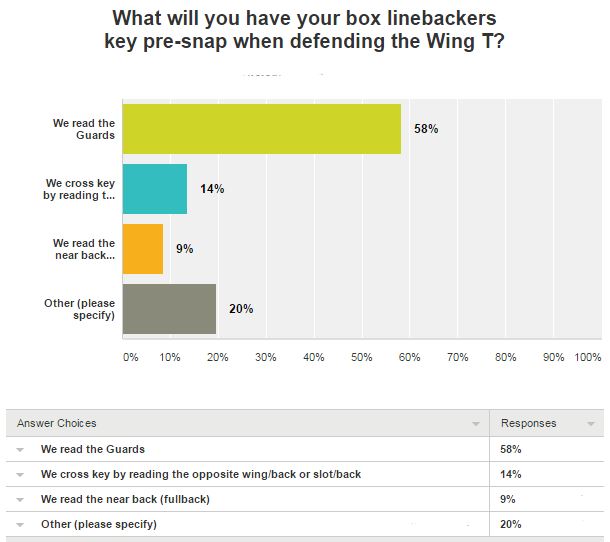
It is without question that second and third level post-snap reads need to be sharp when defending these offenses. One false step can equal one big play, which is why we wanted to devote an entire case study on how coaches are teaching their defenders to react to defend the run game of these teams. Regardless of the defensive scheme, we wanted to ask coaches what they were telling their box defenders to read post-snap. This could mean the three linebacker set in a 4-3, the two box linebackers in a 4-2-5 or the two box linebackers in an odd front. The perimeter players are not included in this section. For years, defensive coaches have been preaching to “read the guards” when defending these misdirection offenses and it seems that advice still holds validity today considering it was our number one response. Consider the percentages:

58 percent of coaches that defend the Wing T will tell their box linebackers to read the guard.
graph13

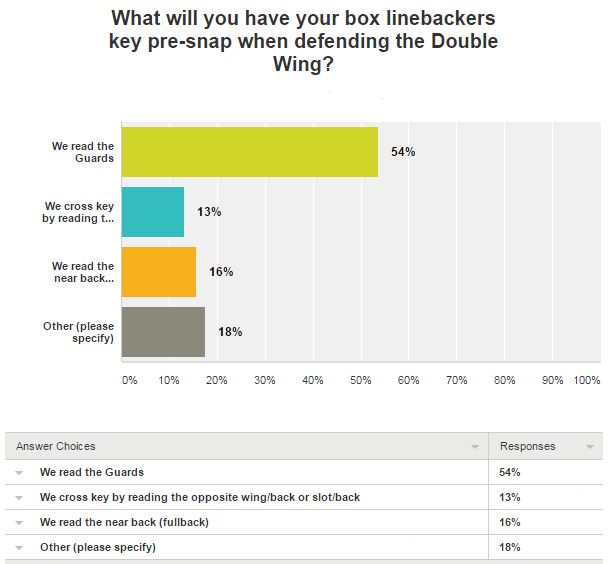
54 percent of coaches that defend Double Wing offenses will tell their box linebackers to read the guard.
graph24

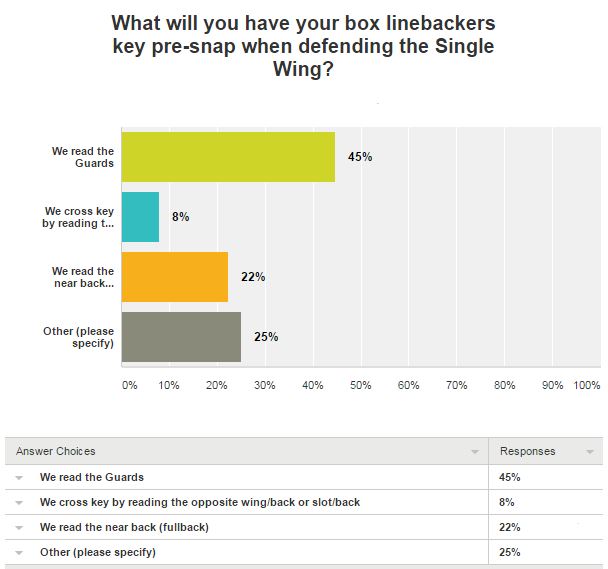
45 percent of coaches that defend the Single Wing will tell their box linebackers to read the guard.
graph35

This is mainly due to coaches who will have box players read the sniffer back (fullback) which we will detail later.

Guard Read Protocols:

Jerry Gordon, one of the more experienced coaches we spoke with, and the0 Defensive Coordinator at Broad Run High School (VA) who wrote a book on his Under front which can be found here. Against Wing T offenses, he’ll have his Mac (Mike linebacker) and Will read the guards out of his Under front. The Mike is playing the bubble, so he’s got a clean vision. “We want them on the guards,” said Gordon. “Those guards will pull if it’s true Wing T. Many coaches talk it being difficult to get reads nowadays, but if it’s a good true Wing T teams those players are going to move. If they don’t move they are not a true good Wing T team. It’s a better read than cross-keying.”

To see cutups of Coach Gordon’s box linebackers defending the Wing T run scheme, click on the video below:

Read More

Defending Unconventional Offenses Case 3: Movements & Pressures to Attack Run Concepts

By Mike Kuchar
Senior Research Manager
X&O Labs
Twitter: @MikeKKuchar


Movements to Defend Wing T Run Concepts:

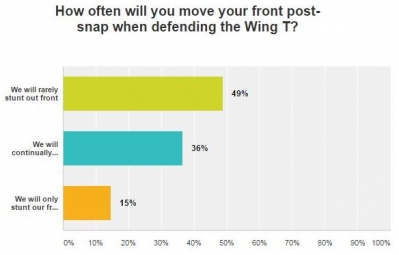
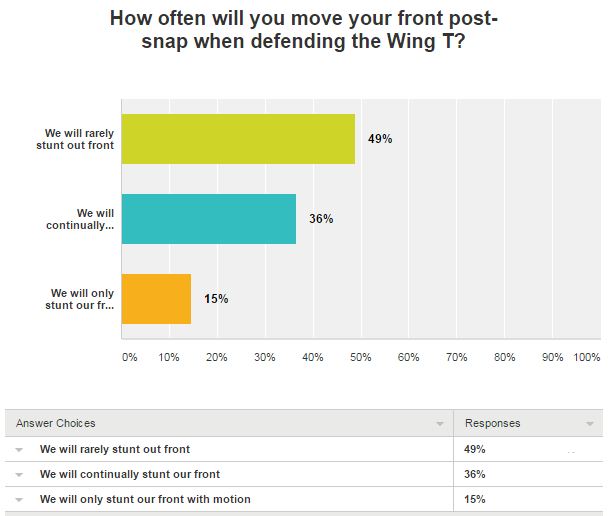
There seems to be conflicting opinions on whether or not to move the defensive front post-snap when defending the Wing T. According to our research, 49 percent of coaches choose not to move their front post-snap when defending the Wing T run game. While 35 percent will continually move their front and 16 percent will only stunt with motion.

graph11

Movements in Four Down Fronts:

Sparta High School, a perennial public school powerhouse in New Jersey has had success defending Wing T run game from its 4-2-5 front by mixing in several post-snap run movements by its first level defenders. On almost every play, Defensive Coordinator Christopher Kappelmeier will make sure one or more of his defensive linemen will be stunting into the adjacent gap or across the face of the offensive man and he’ll teach the proper stunt technique early in the preseason and practiced regularly. Many of them are gap exchanges which include second level linebackers as well.

“The linebackers need to know which gaps the defensive linemen are stunting into at all times because they will need to fit those gaps that are opened by stunting linemen should the flow head in that direction,” said Kappelmeier. “By moving our defensive linemen and linebackers on most plays, we make it very difficult for offensive linemen to execute their blocking schemes, particularly man or gap blocking schemes like the Wing-T.

“At Sparta when we practice our gap exchanges we do it during the inside run period. It is vital that the stunting linemen and linebackers be able to read and react while moving. Defensive linemen learn by repetition to read the offensive linemen toward whom they are stunting. Linebackers learn by repetition how to fit open gaps and not get caught between stunting defensive linemen. We have found that the movement of the defensive front, even if it doesn’t seem to be fundamentally sound on paper, very often creates situations in which defenders are totally unblocked and in position to make big plays. Pre-snap we try to look the same every play. The only player who may need to change his alignment is the nose. If he is stunting into the B gap, he aligns in a 2i-technique. This does not telegraph his intention to stunt because that is his alignment in the tight G front which is used often.”

Movements defending Strong Side Run Game:

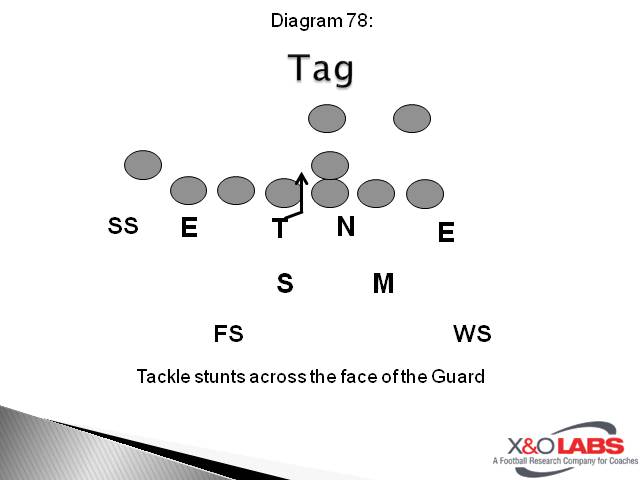
One of the more frequent movements Kappelmeier will use against the Wing T is his “Tag” stunt (Slide 78). It is a single tackle stunt highly effective against the fullback trap. It is also very useful against many other Wing T plays because it gets the defensive tackle moving toward the halfback, which is the direction of a many wing T running plays. “The movement of the tackle, across the guard’s face, makes it almost impossible for the guard to cut him off. If the guard is pulling away, the tackle can jump in his pocket and follow him right to the ball carrier. This technique makes it very tough for the offensive center assigned to block back on the defensive tackle.”

Slide78

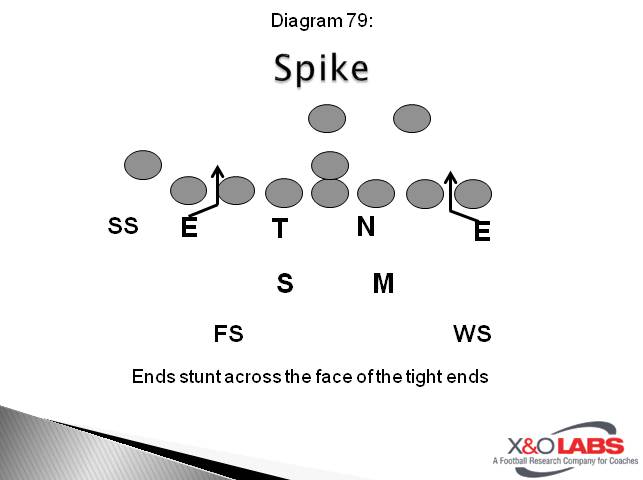
Kappelmeier will use his “Spike” movement (Slide 79) against the strong side Wing T run game. “The normal technique of the defensive end is to read the movement of the offensive tackle. Because so many of the Wing T plays involve the offensive tackle down blocking on the 3-technique, the defensive end will be bending inside often. However, stunting the defensive end inside the tight end on the snap eliminates any possibility of getting washed down inside. The proper technique will put the defensive end into the path of the pulling guards on the buck sweep, belly down, power, and strong side waggle. Keep in mind that the base defense uses linebacker type athletes at the defensive end positions. They are expected to be quick enough to avoid the down block of the tight end when they stunt inside.”

Slide79

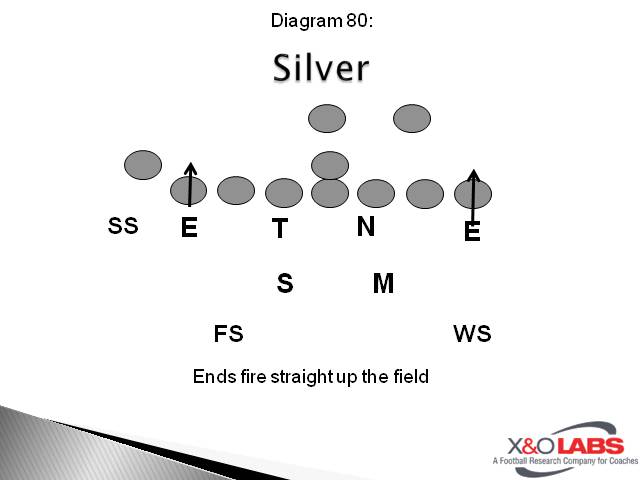
To defend buck sweep, Kappelmeier will use his “Silver” movement (Slide 80). “After several stunting inside or bending with the movement of the offensive tackles, the aggressive up the field movement of the defensive ends provides a change up in technique and discourages the tight end from anticipating the inside movement of the defensive ends.”

Slide80

“Aim” (Slide 81) is a movement that is highly effective against the fullback trap. “The tackle stunts across the face of the guard into the A-gap allowing him to blow up the trapping guard and force the fullback to bounce outside. The Sam linebacker will quickly fit the B gap when reads flow because he is aware that his tackle has closed the A gap.”

Read More

Offensive Line Drills for Up Tempo Offenses

By Brian White
Offensive Coordinator
Rose Hulman Institute of Technology
Twitter: @CoachWhite_RHIT

Introdution: 

Everything we do in our offense is about operating with great tempo.  In order to play with tempo, you must practice with tempo.  This is especially true for the offensive line.  We want our individual period to move quickly by eliminating lines and wait times.  Our reps are maximized by having as many players as possible work at the same time.

Pre-Practice

At Rose-Hulman, our practice field is separated form our campus by a bridge.  This is a great device to let our players know that as soon as they cross the bridge they are locked in and ready to go to work.  Each position group has a certain set of drills they do as soon as they cross the bridge.  This puts them in a working mindset even if they are out to practice early.  

The offensive line will work a circuit of drills that highlights almost all of the skills they require to be successful during a game.  One of the reasons we choose to run an up-tempo offense is because of the limited practice time we have.  We believe it is critical that the offensive line is working the entire time they are on the practice field.  Our pre-practice circuit is one of the methods we developed to have our offensive line constantly working.  This helps both improve their conditioning and gets them used to the constant activity of an up-tempo offense.

Pre-Practice Drill #1 – Kick-Slide/Post on Cones 

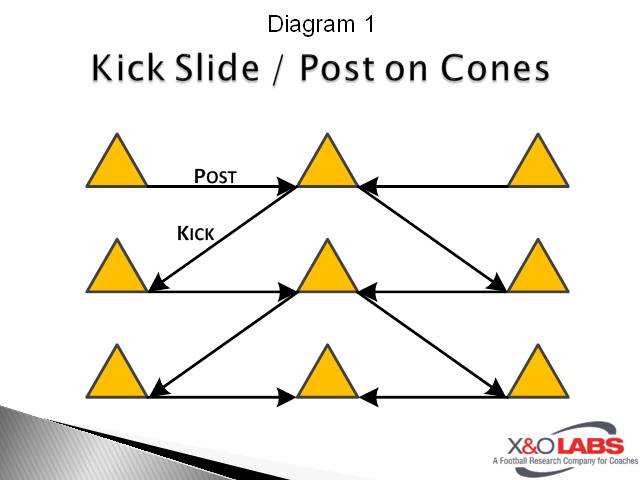
Slide1

In the first portion of the drill circuit, the OL will perform the Kick-Slide/Post on Cones Drill.  Three lines of cones are set up with each cone about 3 yards from each other.  The lineman will start on the top left cone and assume a great pass pro demeanor for an offensive lineman on the left side of the line of scrimmage.  He will post to the center cone, then kick to the next cone on the left.  Once he gets to the third center cone, he will hustle to the top right cone and repeat the drill as an offensive lineman on the right side of the LOS.

In this drill, we want to ensure that the offensive lineman is using a proper tilt to keep the weight down the center of his body.  The shoulder in the direction that the lineman is moving should be slightly raised.  This will prevent too much weight being placed on the outside foot on the kick-slide, and the opposite on the post.  Keeping weight down the center of the body is critical to staying balanced throughout the entire rep of pass protection.

We are also looking for the offensive lineman to understand the importance of keeping his post foot up through the entire drill.  The feet of the offensive lineman should stay tight to the ground throughout the entire rep.  Keeping the feet close to the ground allow for redirection on any rush move by a defensive lineman.  We coach the feet of the offensive lineman to move independent and equidistant from one another.  Feet move in sequence, as opposed to hoping, and each step covers the same amount of ground.  This keep a power position and great demeanor through the entire course of the block.

To see video of Coach White’s Kick Slide/Post Drill, click on the link below:

Read More

Program Development Case 1: Coaching Philosophy

By Mike Kuchar – @MikeKKuchar

Senior Research Manager

X&O Labs


Introduction

This report is a first for XandOLabs.com.  We’re accustomed to spending hours upon hours researching football’s latest trends as it pertains to scheme and fundamentals.  This special report is focused around something totally separate (and often more important) than the schemes of the game- the core of building a successful program.  We started our research months ago by developing questions to target successful head coaches in the sport.  We wanted to know the “why” behind their success.  Why they won championships. Why they won titles?  What specifically made them successful?  So we developed a 30-question survey that we distributed to our entire reader base- over 26,000 coaches at all levels.  Since 95.7 of coaches that responded to our survey were head high school coaches (reasonably so due to conflicting NCAA spring ball periods) we tallied their responses and detailed them in the report below.

But before we present our finding, it’s important to note we did something else that was totally different than previous reports- we segmented our research into separate areas.   We wanted to target successful head coaches in this research and while we’re quick to point out that success is not all about wins (there are certainly too many other variables that add into that equation) winning is truly the main benchmark that we used to separate our readership.  We decided to segment our research into the following groups:

All Groups- All Head Coaches that took our survey.  Naturally, this equates to 100 percent of those surveyed.

Group 1- Head Coaches that have won at least 75 percent of their games over the last three seasons.  This equated to roughly 33 percent of those surveyed.  These coaches have won at least three-quarters of their games as a head coach since 2011.

Group 2- Head Coaches that have won less than 25 percent of their games over the last three seasons.  This equated to roughly 13 percent of those surveyed.  These coaches have won less than three-quarters of their games as a head coach since 2011.

Group 3- Head Coaches that have won between 2-5 championships (at the league, county or state level) in their careers.  This equated to roughly 31 percent of those surveyed. 

Group 4- Head Coaches that have won between 6-10 championships (at the league, county or state level) in their careers.  This equated to roughly 11 percent of those surveyed.    

Group 5- Head Coaches that have never won a championship at any level.  This equated to roughly 29 percent of those surveyed.

This format is different than what we usually produce and for good reason.   We really wanted to examine the difference between successful coaches and non-successful coaches, as it pertains to wins.  Of course, when first designing this research we weren’t sure that there would be a distinction but we were quickly assured there was- in fact quite a substantial difference- between what successful programs do and what unsuccessful programs do (or do not do for that matter).  What is traditional as it pertains to our format, is we separated our findings based on three categories: 

Case 1- Coaching Philosophy and General Methodology

Case 2- Off-Season and In-Season Preparation

Case 3- Offense, Defense and Special Teams Structures

Case 1 – Coaching Philosophy

Introduction

This case is centered around coaching philosophy and style- from creating mission statements to developing a mental training regiment.  We take something from all of our categories of coaches.  What worked?  What didn’t work?  What common mistakes do unsuccessful programs make?  How do great programs win?  Why take a job? Why resign from a job?  How old is the right age to become a head coach?  Thousands of coaches chime in with lessons learned from their greatest teacher- experience.

Read More

Program Development Case 2: Off-season and In-season Preparation

By Mike Kuchar – @MikeKKuchar

Senior Research Manager

X&O Labs


“Failing to prepare is preparing to fail.”  We’ve read this mantra in too many weight rooms, meeting rooms and practice facilities.  While it may be trite, it is profoundly true.  Successful head coaches master the art of preparation and this case is devoted to preparation.  It’s focused around off-season development of a football program, from strength and conditioning to developing team building to conducting practice.  We knew that many coaches were interested in this facet of the game, because it relationship to success is evident.  Here, we present our research on what makes those coaches “win” in the off-season and how they prepare themselves to win during the season. 

But before we present our finding, it’s important to note we did something else that was totally different than previous reports – we segmented our research into separate areas.   We wanted to target successful head coaches in this research and while we’re quick to point out that success is not all about wins (there are certainly too many other variables that add into that equation) winning is truly the main benchmark that we used to separate our readership.  We decided to segment our research into the following groups:

  • All Groups- All Head Coaches that took our survey.  Naturally, this equates to 100 percent of those surveyed.
  • Group 1- Head Coaches that have won at least 75 percent of their games over the last three seasons.  This equated to roughly 33 percent of those surveyed.  These coaches have won at least three-quarters of their games as a head coach since 2011.
  • Group 2- Head Coaches that have won less than 25 percent of their games over the last three seasons.  This equated to roughly 13 percent of those surveyed.  These coaches have won less than three-quarters of their games as a head coach since 2011.
  • Group 3- Head Coaches that have won between 2-5 championships (at the league, county or state level) in their careers.  This equated to roughly 31 percent of those surveyed. 
  • Group 4- Head Coaches that have won between 6-10 championships (at the league, county or state level) in their careers.  This equated to roughly 11 percent of those surveyed.    
  • Group 5- Head Coaches that have never won a championship at any level.  This equated to roughly 29 percent of those surveyed.


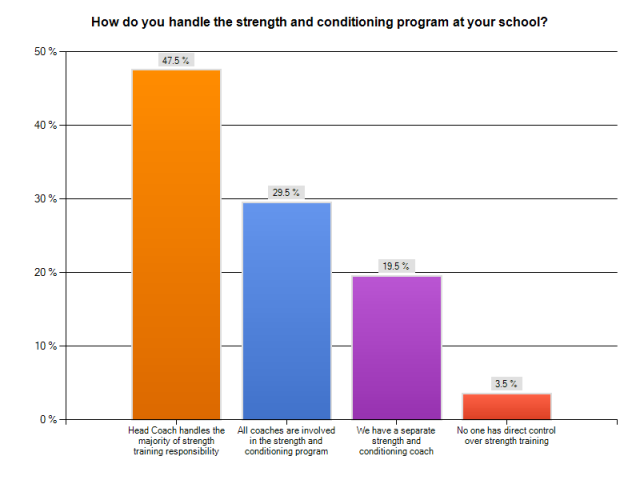
Question:  How do you handle the strength and conditioning program at your school?

When surveying all groups, 47.5 percent of coaches say the head coach (themselves) handles the majority of strength training responsibility.   This was pretty consistent among all our groups- both successful and unsuccessful.  Many programs did not have a separate strength and conditioning coach, the largest group that did was a 20.9 percent response rate from those in Group 1- coaches that have won at least 75 percent of their games over the last three seasons. 

ChartExport 3

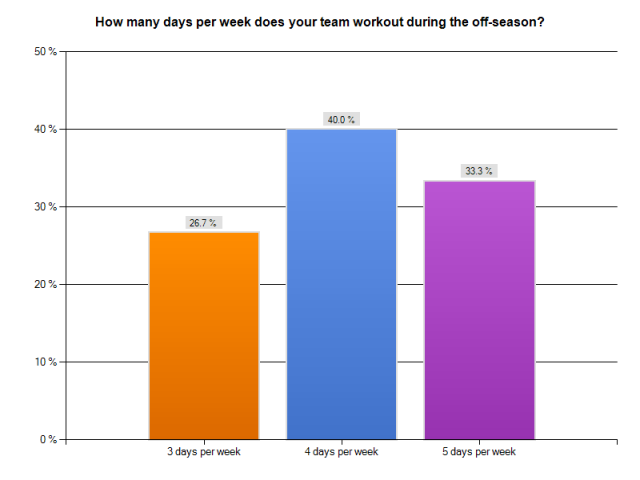
Question:  How many days per week does your team work out during the off-season?

It seems that four days per week seemed to be the majority response-with over 52 percent of coaches from all groups selecting this response.  We did find that 40.7 percent of those coaches that won 25 percent of their games or less over the last three seasons lift three days per week during the off-season (below). 

ChartExport 4 2

Question:  Do you conduct off-season mat drills in your program?

We defined mat drills as agility or plyometric drills done usually early in the morning to train discipline, speed and agility.  We found that 59.8 percent of all coaches are using a mat drill program while 40.2 are not.  A couple of interesting tidbits here.  Only 60.9 percent of coaches that have won at least six titles conduct mat drills during the off-season.  What was interesting here was that 67 percent of coaches from Groups 2 and 5 (those that have never won a title or won less than 25 percent of its games the last three seasons) do conduct mat drills.  Perhaps, the answer lies in the way in which these mat drills are conducted that equates to success. 

Read More

Program Development Case 3: Offensive, Defensive, and Special Teams Structures

By Mike Kuchar – @MikeKKuchar

Senior Research Manager

X&O Labs


In this final case, we are going to present our research on the most commonly used offensive, defensive and special teams structures by successful head coaches.  Now, we realize that this facet of our research could be completely arbitrary. After all, coaches all across the country have found ways to win with various schemes, often changing them to fit their personnel.  Still, we were curious to find if there was a common thread with certain schemes in championship level coaches.  After all, complete thoroughness is always the mantra of devoted research. 


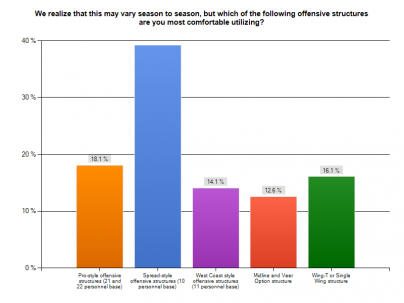
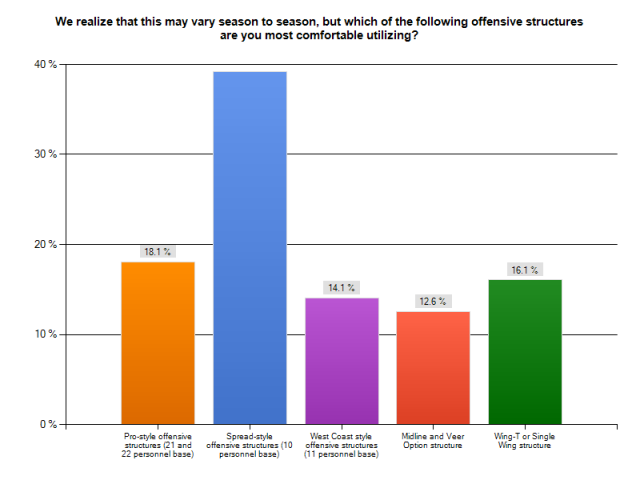
Question:  Which of the following offensive structures are you most comfortable using?

Among all group categories, 39.2 percent of coaches are using spread style offensive structures (10 personnel) as the base of their offensive system.  We didn’t find this to be surprising, but what we did find interesting was that the next most popular structure was pro-style personnel systems with 18.1 percent of all coaches selecting that option.

ChartExport 9

So, when we separated our research down into those specific groups and here’s what I found:

  • The majority (30.4%) of head coaches that have won between 6-10 championships choose to use pro-style offensive structures.
  • The majority (44.1%) of head coaches that have never won a championship choose to use a spread-style offensive structure.
  • The majority (41.0%) of head coaches that have won between 2-5 championships choose to use spread-style offensive structures.
  • The majority (48.1%) of head coaches that have won less than 25 percent of their games the last three seasons choose to use a spread-style offensive structure.
  • The majority (41.8%) of head coaches that have won more than 75 percent of their games the last three seasons choose to use a spread-style offensive structure.


Question:  What is something you’ve done recently on the offensive side of the ball that has benefitted your program tremendously?

Naturally, we targeted this question to those coaches who have won more than 75 percent of their games the last three seasons.  Their responses are below:

Group 1 Responses:

“Adding quick screens and short pass reads to our run game.”- David Buchanan, Head Coach, Mason County HS, KY david.buchanan@mason.kyschools.us

“We have committed to running an up tempo option attack which has allowed our program to utilize players that may otherwise not have played.” – Matt McLeod, Head Coach, GraftonHS, graftonfootball1@gmail.com

“We had been an under center flex bone option team and recently switched to running it out of the shotgun. Our offense improved Rushing yards UC: 282 ypg Gun: 324 ypg Passing yards UC: 95 ypg Gun: 140 ypg Wins: UC: 8-2 Gun: 11-1.” – Rod Stallbaumer, Head Coach, Basehor-Linwood, rstallbaumer@usd458.org

“Implemented parts of the Nzone system especially the tempo. We scored the most points we have ever scored and we set a record for most points in a half in the NYS quarter final with 54 and scored 60 in the first half in the NYS semifinal against the #2 team in the state.” – Joe Whipple, Head Coach, Schalmont High School NY, j.whip2@gmail.com

“Working Wing T principles out of gun set.” – Sid Otton, Head Coach, Tumwater High School, msotton@comcast.com


We changed how we call our formations so that we can get the personnel we want in the right position. We also eliminated a lot of our playbook to concentrate on the base concepts we utilize.” – Steve Pyne, Head Coach, Central Catholic High School – Portland, OR., spyne@centralcatholichigh.org

Read More

Adjusting Your Nakeds to Attack Coverages

By Derek Bedell

Offensive Coordinator

Wilson High School Long Beach (CA)

Twitter: @derekbedell17


Introduction:

wilsonFor over 20 years, the inside zone and outside zone have been the primary run plays used in our offenses. One problem with zone based offensive teams is that they often have significant run tendencies based on specific formations, strength, or direction. Over the course of my career, I have found that one of the great ways to break tendencies is to use misdirection pass to keep defenses off balance. One of our favorites is the naked bootleg concept. Over the past four years, our naked bootleg package has accounted for 50% of our play action passes and nearly 30% of our total passing yards. The beauty of this concept is that it works against any coverage at anytime from anywhere on the field. Here is a look into what makes this play work so well.
Coaching Linemen and Backs:

The offensive line and tailback are where the zone boot concept begins. If those six players do not sell the run, we will not be able to make the bootleg concept work. For that reason, they are told that their sole purpose on this play is to sell the run. Since this is a naked bootleg we are not relying on the offensive line to provide any stout physical pass protection for our quarterback. This allows our OL and TB to carry out their individual run blocking assignments with full conviction.

Since it is a pass, it is critical that the OL does not extend their blocks up to the second level. We teach them that they should work to extend the play laterally instead of vertically in order to really sell the concept. As part of this technique, they are taught to run through the outside shoulder of the defender on the play side of them. We also teach the TB to sprint to the sideline and bury himself in the offensive line. This exaggerates the flow of the play to the sideline and forces the defense to react.

QB Footwork and Fundamentals within the Zone Bootleg:

Like the offensive line and running back, the quarterback must do his part to sell the zone. Here are a few key areas the quarterback needs to focus on to make this an effective concept:

Selling the fake to the running back: If the quarterback is under center, we teach him to follow the TB with his eyes for a split second. This will attract linebackers and safeties who key on the eyes of the QB. If the QB is in the shotgun, he should slide with the running back keeping the ball seated in the TB’s belly for as long as possible.

Depth & Snap: The QB must get depth away from the line of scrimmage (LOS) and snap his head around to find the unblocked DE. The depth will allow for some extra time to snap his hips around and get the ball off if necessary. It also creates separation from the DE allowing him to get around him to the outside.

Attack the LOS: The QB must make himself a run threat. This puts a strain on the defensive coverage and also creates indecision for linebackers.

Read and Progression Philosophy:

Our philosophy for the quarterbacks read can be paraphrased as “dump and run.” Our number one goal is to get the ball in the hands of the player in the flat as quickly as possible. That said, it is not always possible, so we will have a deeper throw option for the QB to execute a high/low read on a specific defender.

We limit our QB to two throw options before he uses his feet as a weapon. This is done to encourage him to make a quick decision. He cannot hold onto the ball and take a negative play. The throw options are coverage and call based. The QB will understand that if we have tagged the X receiver to run a go route his two throwing options are the flat and the TE across route.

Base Naked Bootleg:

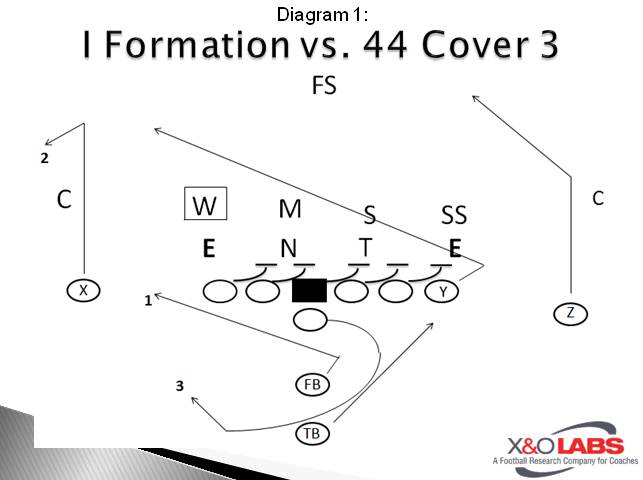
Our base bootleg package is initially installed out of the I formation and 21 personnel. I have found that installing it from this group makes it significantly easier for us to adjust the responsibilities of specific players for later options. When we are in 21 personnel, we see a lot of 8 man front defenses designed to stop the run. This is why we like to utilize this misdirection pass when we see over pursuing 8 man front defenses.

Slide1

Here are the players’ assignments out of this look:

Fullback: His first step is towards the run to sell the play action. This is vital to getting LBs to pursue the play. Next, he will change direction hiding behind the offensive line emerging in the flat away from the run call. He is the primary target.

Y Tight End:             His first step will be towards the run. He will then attack the opposite side of the field climbing to a depth of 15 yards on the opposite sideline. He is instructed to get in the vision of the quarterback, but he cannot stretch to far as to conflict with the play side wide receiver’s deep comeback.

X Receiver: The play side wide receiver will run a deep comeback. We like to drive the route to 18 yards and comeback to 15 yards. The depth of this route can vary the depth depending on quarterback’s arm strength or receiver speed. We also adjust the route to a streak or post if when we want to clear the picture up for the quarterback.

Read More

Beating 2 High with Inside Scissors

DeAndre Green 

Wide Receivers Coach

New Mexico Highlands University

Twitter: @CoachDreGreen

Introduction:

Here at New Mexico highlands we are a true Air Raid spread no-huddle team, very similar to Oklahoma state and West Virginia. Our pass game philosophy is to make the defense defend the whole entire field by occupying as many zones as possible. The following pass concept I would like to discuss is an inside variation of the Air Raid scissors concept. Traditional scissors puts stress on the CB and the SS by putting them in a bind with a post breaking away from the CB by the outside receiver and a corner route breaking away from the SS by the inside receiver. However, defense has made adjustments regarding the scissors concept. Usually you would get a “switch” call between the SS and the CB. What this does is allow for both players to pass off routes to one another. The SS would hold, turn his hips and run underneath the post, while the CB would fall off and wait for the corner route to come into his zone. Our inside scissors play which we call “Razor” is almost the same concept but, takes advantage of 2 hi safety teams by putting stress on the SS and middle linebacker instead of the CB.

Quarterback:

The first thing we would like for our QB to do is take a look at the defense and determine whether the middle of the field is open or closed (2 hi, 1hi). The reason being is because there are two different progression reads based off of the defensive coverage. We are primarily a progression read team; this means we tell our quarterbacks to look at his receivers in a particular progression to determine where to throw the ball. Once the QB determines if the middle of the field is open or close he now knows what progression he is going to make.

Concept:        

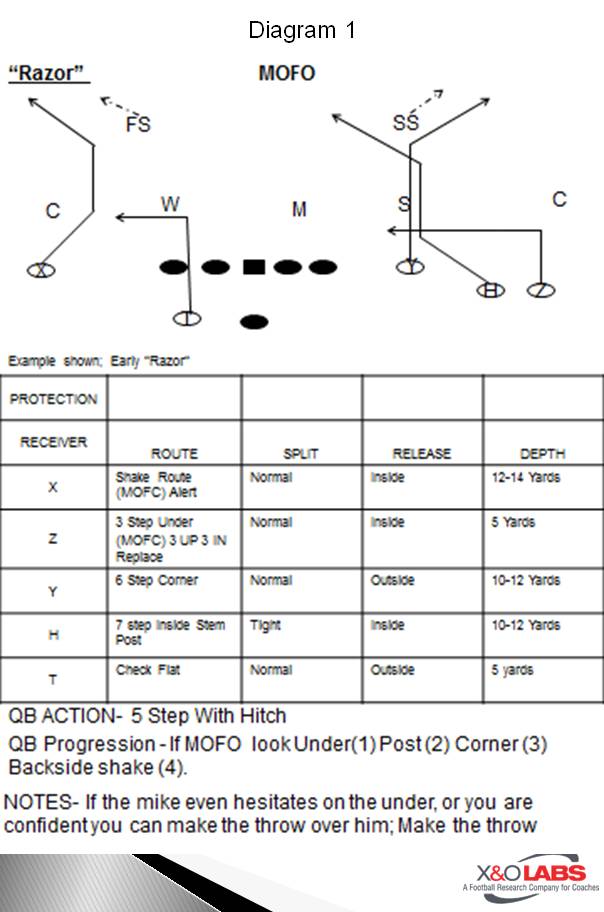
The “Razor” concept is a great 2hi beater. This concept is very flexible and can be taught as a key read, progression read or key progression read and can beat almost any coverage a defense may throw at us. We can run this play out of multiple formations; however we were more successful out of our 3×1 and empty sets. The “Razor” concept is a corner route by #3 receiver, an inside stem post route by #2 receiver followed by a under route by #1 receiver. This automatically puts stress on the SS because he has 2 verticals coming at him from the slot position and he has to choose one. The MLB is also in a bind because he has a under route underneath him and a post route in the hole behind him.     In addition, we want the inside stem because we want the SS to be in a bind with 2 verticals coming right at him. Also the inside stem gets the receiver a good angle to the middle post and gets him there faster. 

Assignments

“Razor” – (Middle of the Field Open)

(Z / #1 Receiver) = 3 step under. Outside foot back, burst out and on third step plant foot in the ground and stay flat at 5 yards across Mike’s face.

(H / #2 Receiver) = 7 step inside stem post. We tell this player it is very important to get a very good inside stem behind the Y. This player needs to be right behind the Y before he makes his break to the post. 

(Y / #3 Receiver) = 6 step Corner route. Y needs to always be lined up on the ball. It is very important that we get a good release from this position and get vertical to get the attention of the play side safety. WE CAN NOT GET JAMMED. It will throw the timing of the play off.

(X / Single Receiver) = Inside stem Shake route. The land mark for the inside stem is 7 yards up field and 2 yards away from hash. We tell this player to really get vertical to get that backside safety attention.

(T) = Check Flat. Always line up away from the trips side and block inside out if there is pressure. If there is no pressure we tell this player to release to the flat. We also motion this player out of the backfield and run smash concept backside.

(QB) = QB comes to the line and see MOFO and knows automatically that his pre progression read is Under (1) Post(2) Corner(3) Backside shake(4). We tell our QB we want to hit the post so if the mike even hesitates on the under throw the post behind him.   

Slide1


“Razor” – Middle of Field Closed

(Z / #1 Receiver) = 3 steps up 3 steps in Replace route. Outside foot back, burst out and on third step plant your foot in the ground and stay flat for 3 more steps and stop. We tell this player we want him to get the attention of the SS and the corner. Try to sit in the hole between the two.

(H / #2 Receiver) = 7 step inside stem post. We tell this player it is very important to get a very good inside stem behind the Y. This player needs to be right behind the Y before he makes his break to the post. 

(Y

Read More

Simplifying a Count System & Rules in the IZ

By Adam Kirby

Offensive Line Coach

McMurry University (TX)

Twitter: @CoachKirby25


mmyOver the past few years, McMurry University has lived on its Inside Zone concept averaging 5.48 yards per carry and consistently moving the chains. A big part of that success comes from how we teach that concept. In this clinic report, I will break down our installation process, how we identify fronts, and how our count system allows us to seamlessly block various fronts. In addition, this report will outline what and how I teach zone to my offensive line and our RB reads and entry points. 
Here at McMurry University, we are a pro style, multiple formation offense. Within that scheme, our base play that we install on the first two days of camp is Inside Zone. Everything we do in the running game starts from an understanding of our IZ concept. Here is why we like to use this as our base. 

Advantages of the Inside Zone Concept:

  1. Stretches a team horizontally as well as vertically.
  2. Allows your RB to hit on different holes.
  3. Allows for the OL to “take the path of least resistance,” meaning they can get to the man they’re blocking quicker, which enables us to play faster.
  4. Enables us to crease fast flowing defenses.

Identifying Fronts & Count System:

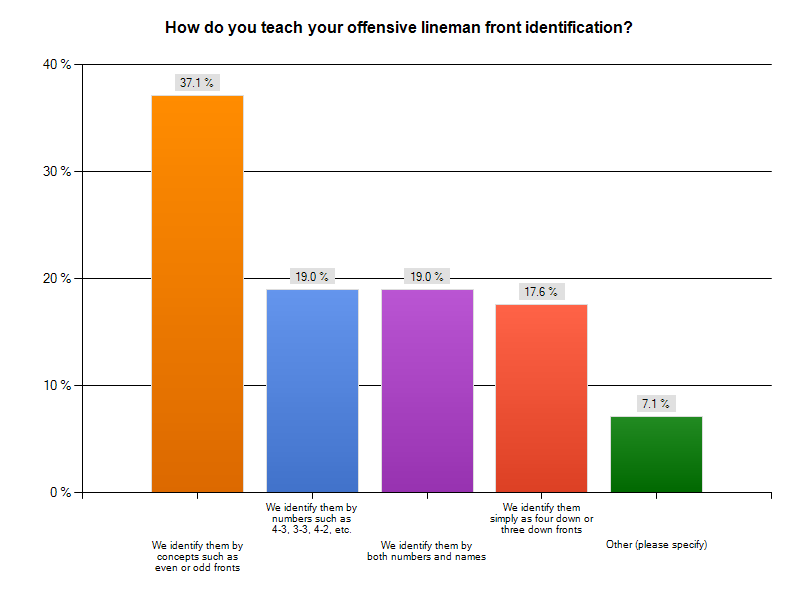
When identifying fronts, our offensive line uses a simple “even/odd” call.

  • An “odd front” is any front where the guards are uncovered such as a 3-4 or 3-3.
  • Conversely, an “even front” is any front where there are four down linemen such as a 4-3, 4-2, 4-4.

Obviously, this is very general, but I have found this approach to be much easier for the offensive line than making “over/under/bear” front calls. We are able to account for the variances between the fronts through the following steps of our system.

Once we get the front identified, we use a simple count system to help the linemen know who to block. I have found that this system enables us to know exactly whom we are blocking on play side and back side regardless of the front. Our basic rules for the count system are as follows:

  • The center is responsible for 0.
  • The guards are responsible for 1.
  • The tackles are responsible for 2.
  • The FB/TE is responsible for 3. In the event that there is no FB/TE, the QB then becomes responsible for 3.

The diagrams below show how we utilize the count system against an “odd” and “even” front with the TE.

Read More

Disguising and Matching Coverages

By Adam Harvey

Safeties Coach

Cibolo Steele High School (TX)

Twitter: @a_harvey


Introduction:

ciboloHow many times have you heard, “I’d hate to be a defensive coach with all the dynamic offenses out there”? To say it’s a challenge would be an accurate statement, but it would be wrong to say it is impossible. We have found that the teams who do the best job containing and stopping these offenses teams must be sound and simply get each player to buy in to his assignment. That is why our staff at Steele High School believes that the two most important components to defensive success are being aligned correctly and knowing and executing your assignment. If the players can execute those components, then the coaches can focus on the details of the scheme as a whole (ensuring that coverages match fronts, controlling gaps or wrinkling with blitzes and stunts). We ultimately play under the rule of controlling gaps and zones so we are not out-flanked trying to match man for man.

Disguising Coverage:

Great offenses are all about rhythm, especially the up-tempo schemes. Over the years, we have found that one of the best ways to get these offenses out of their rhythm is to make them second guess what they see pre-snap. That is why we believe wholeheartedly in the power of disguising our coverages. In order to make this happen, our team focuses on understanding the opponents snap indicators and presenting a consistent picture to the quarterback. 

We teach our players that the longer you are able to hold a look and lie to the QB’s eyes, the better off you will be. Once our players buy it to the concept, they begin to look for ways to hold their look.

The first step in disguising coverages is to identify the pre-snap indicators that our players can use to time the snap. That process begins in the film room as we analyze the snap count paying careful attention to the QB’s tendencies. We will assess his type of snap to determine whether it is a clap count, verbal cadence, check-with-me, or a traditional sequenced count. That information arms our players with the information they need to begin their movement. Our safeties are taught to wait until the indicator to roll into the coverage called. Our corners can also use a bail technique to keep everything in front of us once the indicator is given.

Quarterbacks that think they know what we are doing are the easiest to confuse. That is why we as a cover 2 team play in to his assumptions and give him a consistent two look. It is our desire to show two on the roof until the last possible second regardless if we are eventually playing man, three, or quarters. We have our corners pressed on the edges and usually do not change that concept as it is a big tone setter for us. This is done to allow our CBs to play as the force defender and the safety to use his intellect and react to the play whether he reads the lane of ball and plays the alley or drops into the appropriate coverage. When playing quarters, we will still show two on the roof to make it look like a cover two coverage as the pre-snap read. Upon seeing the indicator, our safeties will move from 10-12 yards up to 8-10 yards while reading keys. Another wrinkle that we use is varying which safety scrolls depending on what our front seven is doing. If we are blitzing, it is important for the safeties to know who is leaving and ultimately whether or not they are losing a linebacker (covered later).

Read More

Tagging Back Side Routes Off the Quick Game

By Paul Romolo

Offensive Coordinator/Quarterbacks Coach

Archbishop McNicholas High School (OH)

Twitter: @pnromolo


Introduction

XO PicLike any spread offense, we believe in making the defense defend the entire field. We use our quick passing game in particular to try to create width in a defense’s structure and complete high percentage throws. Ideally, we’ll throw eight to 12 quick passes and gain 50-100 yards per game, which forces the linebackers and safeties to cover up our slots. This, in turn, creates vertical running lanes in the box and creates an advantage in the ground game.
Problems with Mirrored Quick Game Routes

Our quick game differs from a lot of other teams because we do not mirror routes. In 2012, we mirrored routes and let our quarterback work the side or matchup he liked best. While this approach worked relatively well, we found that too many things could go wrong in that model. We found that we had issues if:

  • The quarterback picks the wrong side
  • A receiver falls down
  • The coverage rolls during the snap count
  • Something that looked good pre-snap might look awful post-snap

Since we want our quarterback to throw the ball on the last step of his drop, any of the above problems would completely derail our play. This would cause him to hitch up and deliver the ball late. As a result, we didn’t call a lot of quick game unless we were getting looks that we knew we could exploit (43 attempts in 11 games).

Additionally, mirroring routes goes against the spread philosophy. Letting the quarterback pick a side or matchup (or telling him which side or matchup to work) doesn’t actually stress the whole field. In fact, it cuts it in half or even in thirds should he choose to throw into the boundary. This is especially true if one particular receiver gets targeted repeatedly. Eventually, the defense will realize that the other areas of the field aren’t being threatened, and they’ll stop covering them.

Adding Back Side Tags

In 2013, we started tagging an intermediate and check down route on the back side of our quick game patterns. This provided a solution to each of the problems presented in the mirrored route model. If the front side doesn’t look good on our quarterback’s third step, he simply hitches up to his intermediate route. If that isn’t there, he hitches again and looks to his check down. That process lets us get the ball out in a hurry on the front side, but it also attacks the entire field and holds the defense accountable.    

As an added bonus, we found that letting the quarterback sort out which side to throw to takes time. Running a dummy count and checking with the sideline takes time. As a hurry up team, this was problematic. Tagging back side routes lets the quarterback snap the football faster because he can sort out where to throw the ball while the ball is in play. It doesn’t have to take up precious pre-snap seconds.

Front Side Combinations

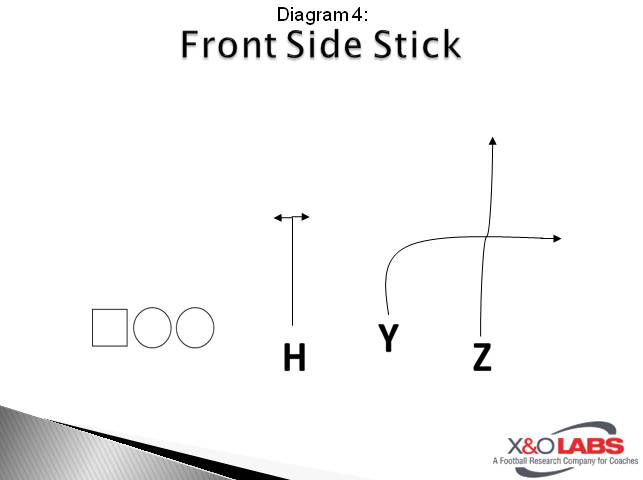
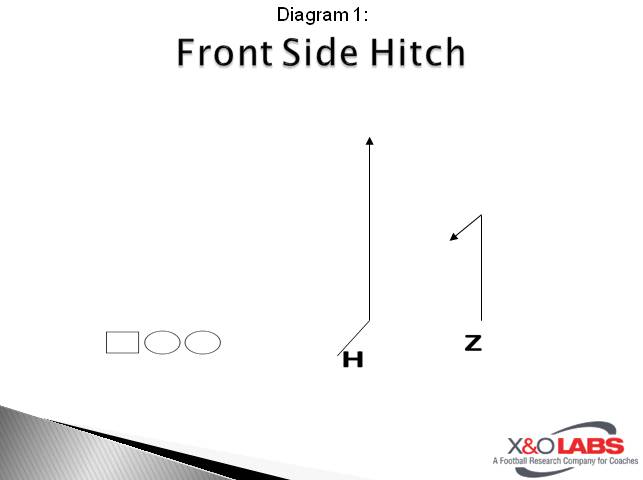
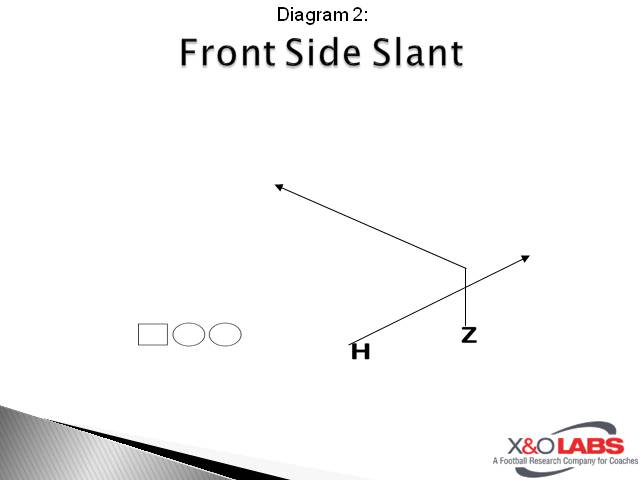
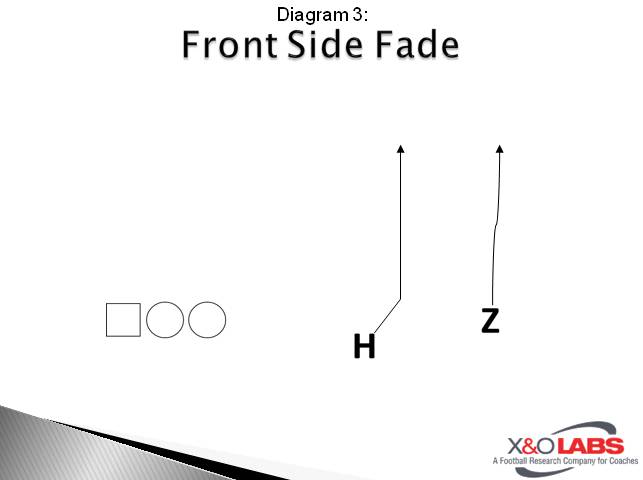
We work four front side combinations concepts as part of our quick game (Diagrams 1-4). These are pretty standard quick passing game patterns. We base them out of a 2×2 formation, but can run them out of a variety of formations including 3×1 and 3×2. Stick is always a 3 man pattern even if the third receiver comes from the backfield or across the formation in motion.

Slide1Slide2Slide3Slide4

We operate exclusively out of the shotgun, and our quarterback will take a standard 3-step drop. During his drop, he reads the flat defender on the front side. If he gets a clear read during his drop, he delivers the ball on his third step in rhythm without a hitch. In diagram 2, you can see the pre-snap picture for the quarterback working a hitch combination to the right. He identifies the outside linebacker as the flat defender with the defense probably playing Cover 3. In diagram 3, you can see his view on the third step of his drop. The outside linebacker has carried the hot route vertically to protect the seam and has left the flat exposed. The quarterback makes an easy throw to the hitch to gain at least five yards.

Read More

Defending One-Back Run/Pass from Cover Three Structures

By Matt Costa

Head Coach

John F. Kennedy High School (CA)


Introduction

costaAt Kennedy, our overall defensive philosophy is simple, “Less is More.” This is not a new philosophy and, for sure, it is not something dynamic. To put in more descriptive terms, we are a defense that is 4-2-5 in personnel, but a mix of College 4-3, Stack 4-4, and Split 4-4 in concepts. Below are a few basics in the set-up of our defense. 
We try to minimize thought process by minimizing moving parts. We do this by having only one  strength call. Our strength rules are as follows:

  • Number of most receivers
  • Versus a balanced formation we call strength to the field or the QB arm based on field position.

We also work to keep things simple for our players. This is done in a few different ways, with the most important being that we only have our players know one position. We also only run 4 coverages, 4 base fronts, and a combination of plug blitzes and some 6-7 man pressures.

Our Spread Defense Philosophy

We believe that cover 3 is the easiest and most effective coverage to teach and that means more experience and faster play. We work to stay in cover 3 against everything unless game plan and pressure scheme calls for it. While some will argue this is too predictable, we have found that the best way to counter that is with reps and players that are playing fast.

When playing spread teams, I like to start by making small adjustments to your base coverage. This will then allow you to focus on beating them up front, which research says is the most effective place to beat the spread. Most spread teams that we face either run Big-on-Big or Slide Protection. By dissecting the protection scheme and attacking it, it allows us to get the quarterback off his preferred launching spot. This, in turn, will lead to more incompletions and sacks. When attacking the spread at the line of scrimmage, we utilize plug blitzes and line stunts supplemented with the occasional Man Free and Cover 0 pressure scheme.

An added bonus of using the cover 3, plus its adjustments out of the 4-2-5, is when you do decide to send pressure you can disguise it by running a fire zone scheme or you can run a 6 man pressure and run cover 1 or cover 0 behind it comfortably because of the added bonus of already having five DBs on the field. We have found this philosophy to be very successful against the spread teams we face.

In this report I will discuss our cover 3, plus our “Falcon” and “Solo” adjustments. Then I will discuss our “Wanda” pressure and our “Plug” pressure, which in my opinion are our two best pressures we run against the spread.

Editor’s Note: X&O Labs’ Blitz Check Study illustrates the complete pressure check protocols coaches are using to put their players in the right pressures no matter down or distance. Read the study here.

Cover 3:

Our cover 3 is our base coverage and the individual rules are as follows:

Mike and Will – Hook to Curl.

Both Mike and Will start in a 20 alignment. He reads the guard to the back field triangle. If he gets a pass read, his eyes will go directly to his primary threat based on formation. He will work to the top of the Hook to Curl Zone.

Strong Safety – Seam to Flat.

He aligns 3×3 in a “Read” technique or on the LOS three yards outside the EMLOS in “Solid” technique. Read and Solid are “Hard” called from the sideline. He reads the end man on the line of scrimmage (EMLOS) to the #2 receiver. If the #2 runs to the flat, he buzzes to the flat now. If #2 goes vertical, he looks to reroute through the seam and works to the top of the flat.

Weak Safety – Seam to Flat.

The weak safety starts at five yards depth and four yards outside the EMLOS and adjusts to formation and personnel. He reads the EMLOS to the #2 receiver. If the #2 runs to the flat, he buzzes to the flat now. If #2 goes vertical, he looks to reroute through the seam and works to the top of the flat. His eyes will then go to the #1 receiver.

Free Safety – Deep Middle 1/3.

Read More

3 Fast Paced KO Coverage Drills

By James Vint

Offensive Coordinator

Seminole High School (TX)


3 Drill Kickoff Circuit

The following set of drills is set up with 3 quick stations that Vint calls the “Rodeo Circuit” and includes a tackling drill, gauntlet drill, and angle or pursuit drill.  These drills are used every day during 2 a days and then less frequently once the season begins.  Note that these are three of over 75 drills that are in our complete Special Teams Drill Special Report.  To view the rest, click here.

Drill #1:  Shimmy Tackle

This simple drill focuses on a full body open field tackling technique that can be applied in multiple special teams situations as well as defense. 

Concept / Coaching Points:  This is a simple 1 on 1 tackling drill using stationary ball carriers.  Stress shimmying into position, bending at the knees not the waist, punching arms upward through the ball carriers armpits, and running their legs through the tackle.

Read More

Mid/Outside Zone Case 1: Personnel & Coaching Ball Carriers

By Mike Kuchar – @MikeKKuchar

Senior Research Manager

X&O Labs


Please Note: We’ve included a lot of video in this case report, it may take a few minutes for all the video to load on your computer.  Thank you.


Introduction

In Case 1, of our special report, we will present our research on the varying personnel groupings and entry points most utilized in the outside zone and middle zone scheme.  In any zone concept, the aiming points of the ball carrier can be just as important as the actual blocking schemes themselves.  We’ve found that many offensive line coaches, such as Alex Gibbs, coached the running backs just as hard as they coached the offensive line.   When referencing the zone schemes, we’ve heard many coaches talk about “let the running back make you right” which essentially means the onus of the success of the play relies on the ball carrier making the right decision at the point of attack.  If that’s the case, then it’s essential to discuss the importance the ball carrier has on the scheme. 

When conducting our research on the wide zone scheme, we did find it not to be as popular as tight zone concepts.  In fact, according to our research, 50.5 percent of coaches only utilize the wide zone concept between 0-25 percent of the time.   Yet, 43.8 percent of those coaches said they averaged between 5-6 yards per carry on this scheme.  So we asked around to find out why coaches are not using the scheme as much. 

Before we start addressing the specifics of the wide zone concept, it’s important to note that there are various play concepts that can be devised from the wide zone blocking schemes.   Some of these concepts include, but are not limited to…

  • Jet or speed sweep
  • Speed Option
  • Toss Sweep
  • Stretch Scheme (one back)
  • Boss concept (two back)

Editor’s Note:  This special report is focused solely on wide zone and middle zone run concepts which require tighter aiming points than inside zone.   It will not include perimeter gap schemes like the pin and pull concept that may be common perimeter run concepts.  Insider members can find more information on the pin and pull concept by accessing the following reports:

Monmouth University Pin and Pull Scheme

Formationing the Shotgun Buck Sweep


The Case for Pin and Pull

There have been various situations where coaches would prefer to use a pin and pull or man blocking concept rather than a full zone.  One of the more common examples would be against an Over defense with a wide three-technique and a tight six-technique head up the defensive end.  Longtime NFL offensive coordinator Bill Muir used what he termed a “bingo” call against teams that would have a wide three-technique that couldn’t be blocked by the Guard.  The Tackle would just come down and the Guard would pull around.  “When we made that call, there was no cutback,” said Muir.  “It was an off-tackle stretch scheme.  I have the players the option and when you trust the judgment of the players, I allowed the onside Guard to determine if it was a three-technique against an Even front or the onside Tackle vs. a 5-technique in an Odd front if they were unreachable, they can make a call and we would go into the scheme.  This could change during the course of the game.  I gave them responsibility because it was their decision. “  Muir did tell us that against some fronts with a quicker Shade Nose he didn’t like the stretch scheme because the Center couldn’t reach the shade Nose.  “All of a sudden the back reads the 5-technique and cuts it back right to the shade Nose who is there to make the play.” said Muir.   


Reader Responses on when to use Pin/Pull Schemes

Some other coaches chimed about the certain circumstances they choose to use a pin and pull concept rather than a full zone principle.

“We will use Pin and Pull concept against a three-technique and a five-technique front side.  It’s a cross block technique.”- Mark Staten, Michigan State University 

We will use the pin / pull concept when we feel the c gap defender is too wide for the tackle to reach block. We also use this technique in our TE/wing and bunch sets where the TE’s man is too wide to zone block effectively.” – Terry Kent, Downers Grove South HS, tkent@csd99.org

“We use Pin and Pull with Tight End against a 5-technique or 7-technique.  We will also Pin and Pull vs. a 6-technique with a TE/Wing.  If we see a base 4-3 or 3-4 we use zone concepts with Stretch rules.” – Kenneth McClamrock, Concord HS, KMcClamrock@gmail.com

“Against odd fronts we will use our stretch technique to avoid opening large windows for LB’s to run through.” – Tony Neymeiyer, Baldwin Wallace University, aneymeiy@bw.edu

“Against a defensive line that is better than us, it gives us angles to pin and pull so we use the man concept.” – Tim Halverson, Mount Horeb/Barneveld, Yimmer16@hotmail.com

Read More

Mid/Outside Zone Case 2: OL Pre Snap Reads & Rules

By Mike Kuchar – @MikeKKuchar

Senior Research Manager

X&O Labs


Please Note: We’ve included a lot of video in this case report, it may take a few minutes for all the video to load on your computer.  Thank you.


Introduction

In this case, we will present various pre-snap identification systems that coaches are using to teach their lineman who to block in the middle and wide zone run concepts.  Since defenses will stem, move and shift pre-snap, it’s essential that the offensive line knows exactly who they are responsible for by the time the ball is snapped.  While some coaches talk more about “running your track” on the wide zone concepts, others are more concerned about identifying defenders on the first and second level.  Below we present the base rules for the middle zone/wide zone run schemes and the adjustments coaches make to pre-snap movement. 


Defensive Identification Systems


According to our research, 33.3 percent of coaches teach their players to identify defensive fronts by concepts, such as an “Odd” or “Even” distinguishment.  30 percent of coaches teach them to identify them by both numbers and names while 13.3 percent teach them to identify defensive structures by numbers.


chart8 

Identification by Numbers


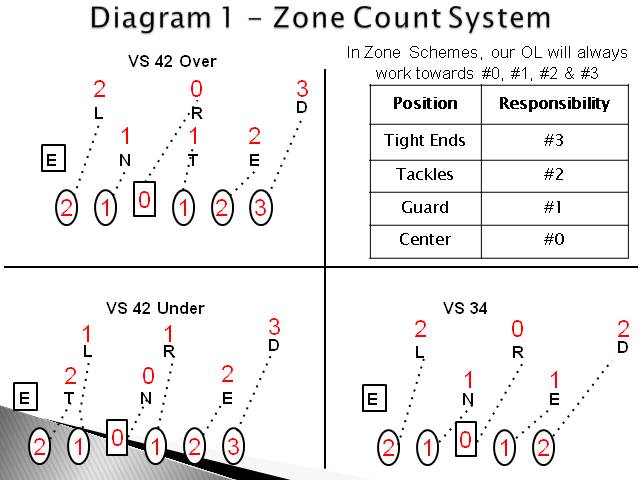
At Western Connecticut State University, offensive coordinator and offensive line coach Drew Owens, relies on the count system to teach his lineman who to block based off three different fronts- 42 Over, 42 Under and 34.  Owens believes that most fronts will fall into one of those structures below. 


Slide1

Owens described his count system below:


Zone Scheme Counting

  • As an offensive line we use a count system pre-snap in our zone schemes
    • Our center will identify the point and the point or “zero” is where we build from
      • Center Blocks 0
        • Zero in our zone schemes is the first defender head up to playside the center
      • Guards Block 1
        • First man playside and backside of the zero
      • Tackles Block 2
        • Second man playside and backside of the zero
    • This is a pre-snap identifier for our OL
      • The type of zone called gives the OL their technique and departure angles from the LOS


Identification by Structures

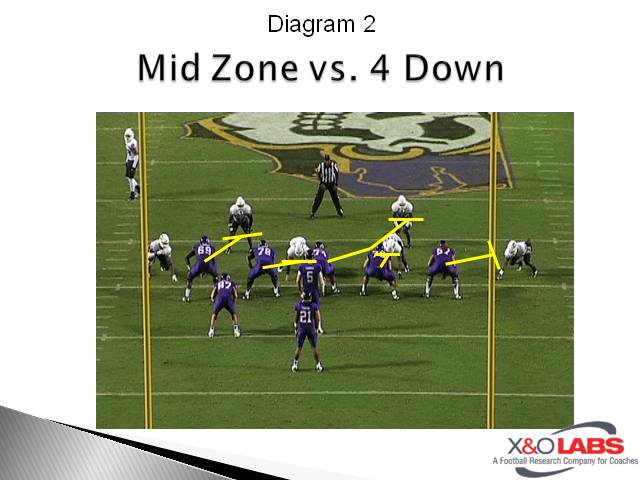
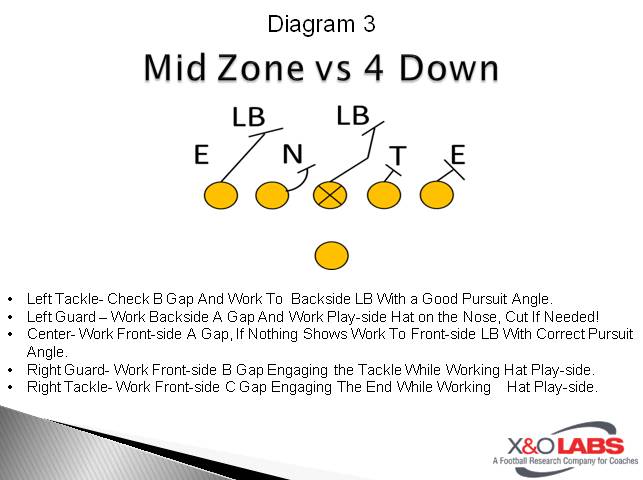
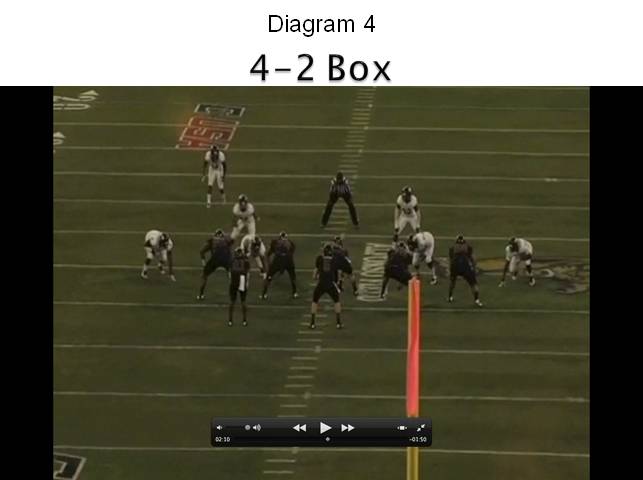
At Eastern Carolina University, offensive line coach Brandon Jones talks to his lineman about blocking the middle zone against only four different kinds of fronts- Nickel, Odd, Stack and Even.  Since the Pirates are mainly a 10 personnel team, the box is using clean enough where the lineman can make one of four calls.  Below is how he blocks the play based on the front.

Nickel= 4-2 Box (four down linemen and two second level players)

Slide2Slide3Slide4

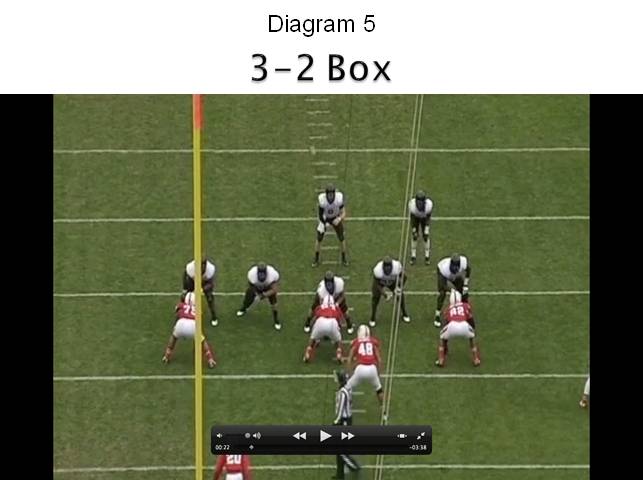
Odd= 3-2 Box (three down linemen and two second level players)

Slide5

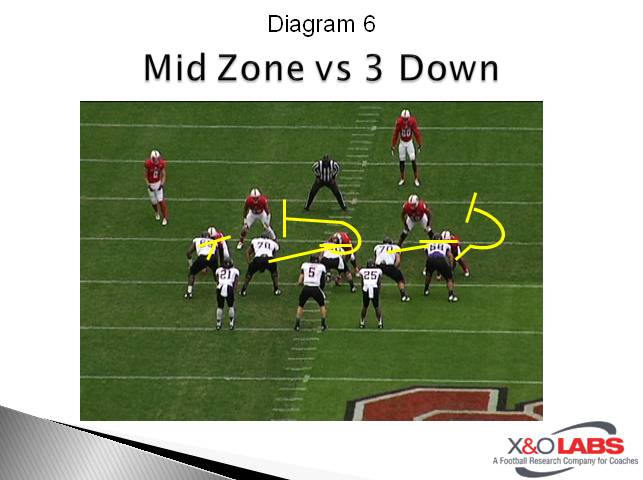
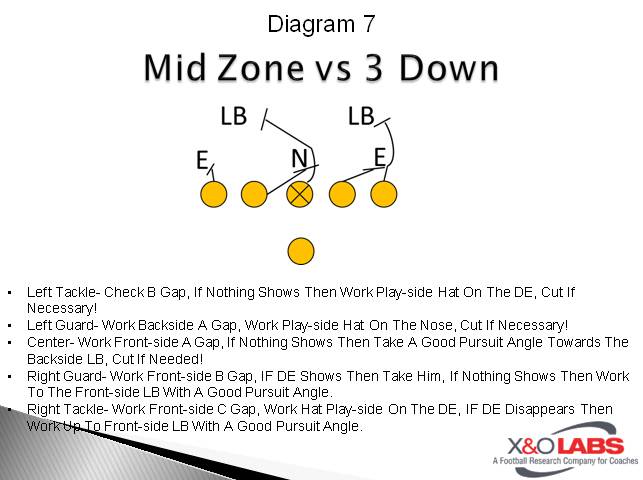
Stack= 3-3 Box (three down lineman and three second level player)

Slide6Slide7

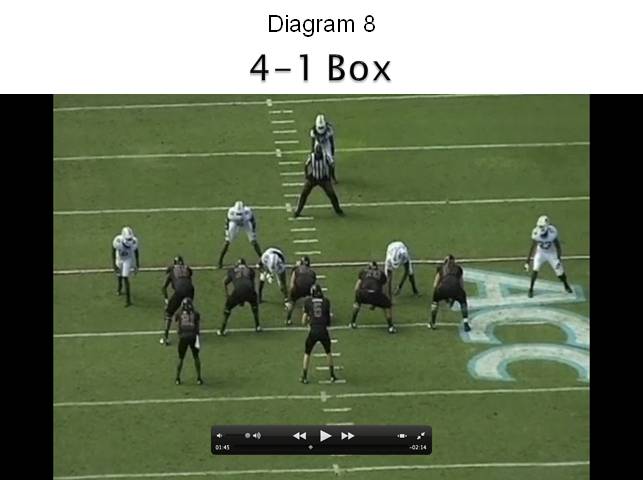
Even= 4-1 Box (four down lineman and one second level player)

d8

Read More