


Mid/Outside Zone Case 3: Indi Lineman Covered Blocks
By Mike Kuchar – @MikeKKuchar
Senior Research Manager
X&O Labs
Please Note: We’ve included a lot of video in this case report, it may take a few minutes for all the video to load on your computer. Thank you.
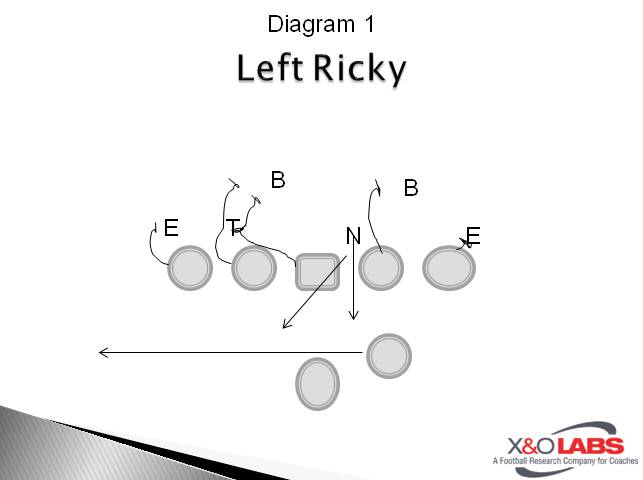
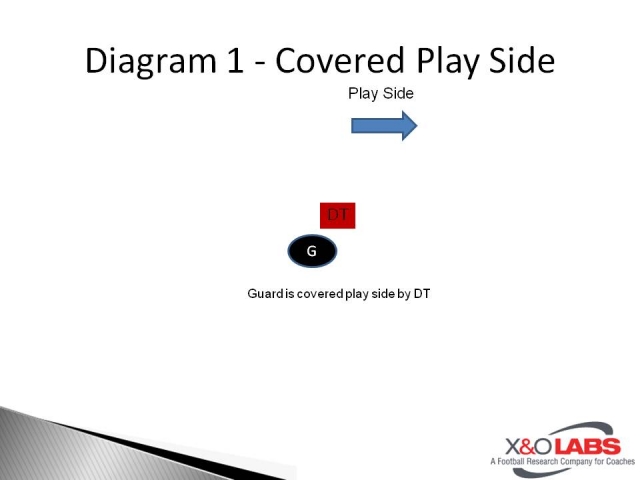
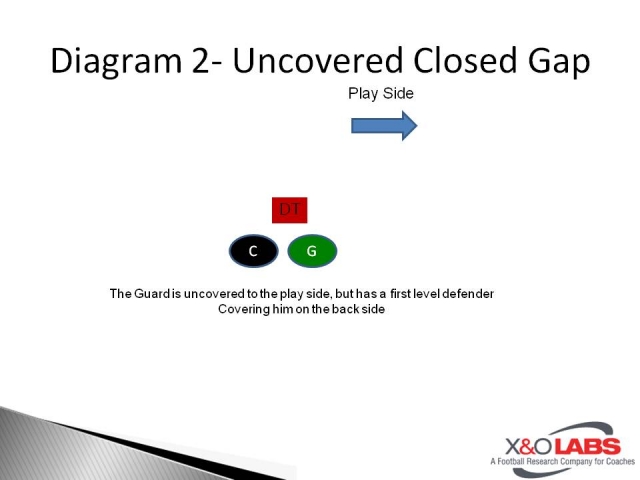
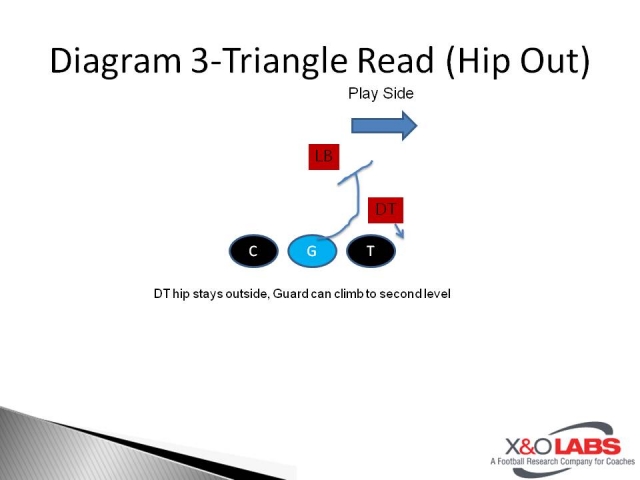
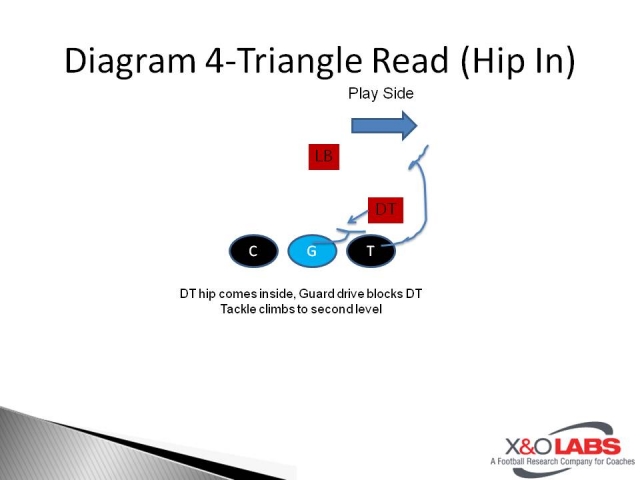
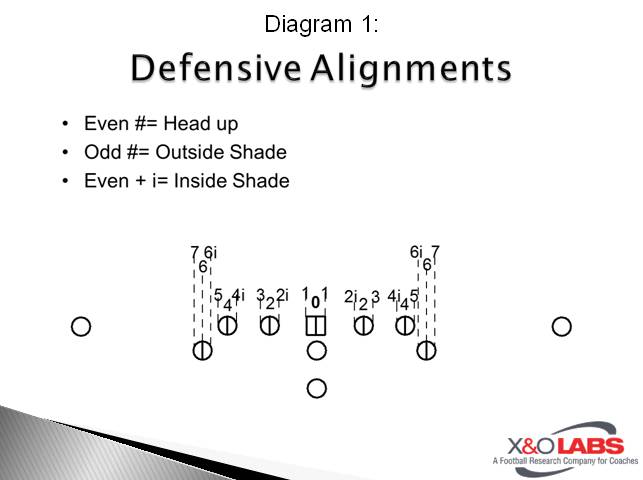
Editor’s Note: A” covered” offensive lineman refers to any lineman to the play side of the middle or wide zone concept that is covered up by a first level defender (Diagram 1).
Introduction
This case presents data on the different techniques that offensive line coaches are teaching to their covered offensive lineman in stretch concepts. We’ve found that these techniques will differ based on the leverage of the down defender. There are so many intricacies that go into these coaching points- head placement, hand placement, foot placement, angle of departure, etc. They are all covered in this case as it pertains to the wide and middle zone run concepts.
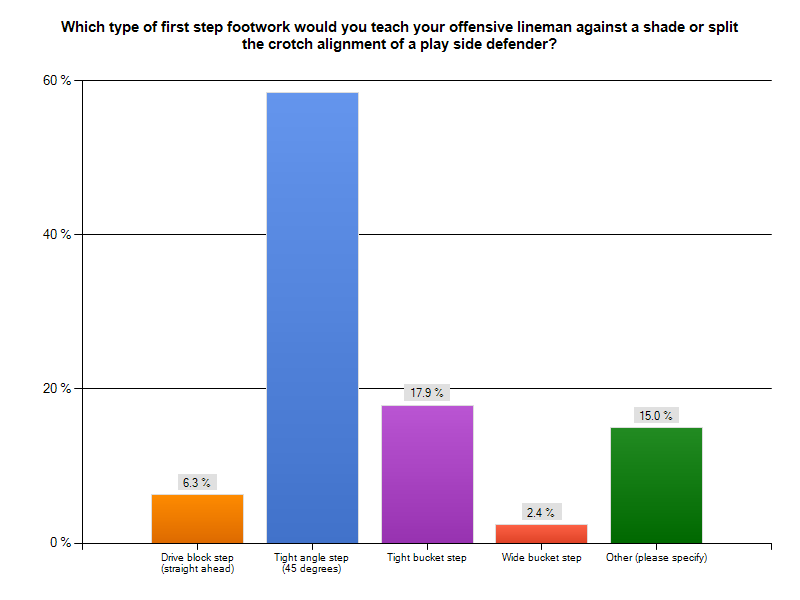
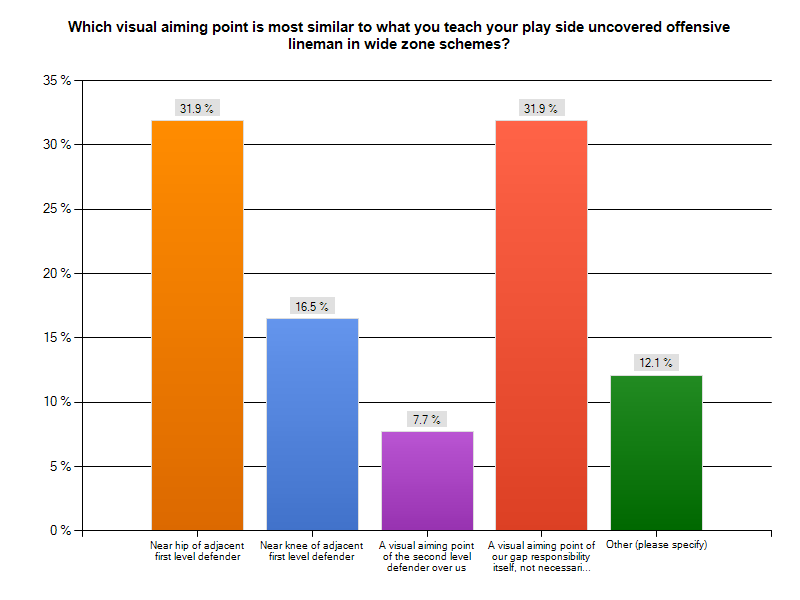
Our initial research shows that 59 percent teach the far armpit as the visual aiming point for the covered offensive lineman in both the wide and middle zone concepts. We’ve found our research split on the footwork that coaches teach their covered offensive lineman in wide zone schemes- an even amount teach both the reach footwork and rip to run footwork while 13.3 percent teach the bucket step. We’ve found that coaches are from two schools of thoughts on the covered lineman- they are either reach step advocates or bucket step advocates and we present both perspectives below.
Rip to Run Footwork
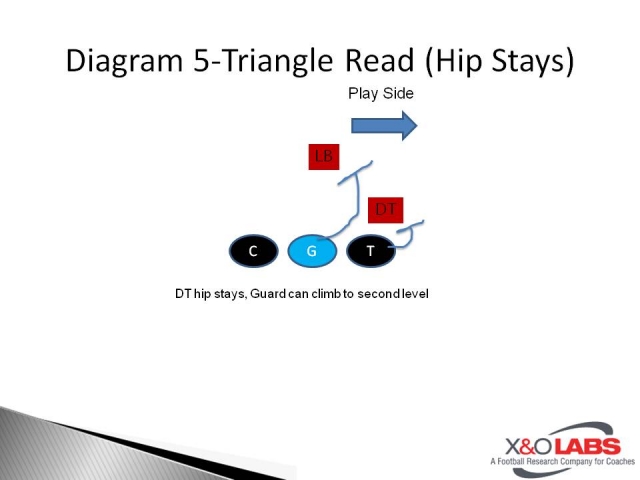
36.7 percent of coaches teach the rip to run technique in wide zone run concepts, regardless of position of the defense, so it’s important to present that side of our research. Rick Trickett, the offensive line coach at Florida State University, is one of those coaches. For Trickett, the crux of the scheme is the first step of the covered offensive lineman. “He must bring his shoulders through on the first step on the stretch scheme,” Trickett told an audience of 400 coaches at the C.O.O.L. clinic in Cincinnati last month. “We work to get our outside breast to his far armpit and our inside foot to crotch. To do this we bring our shoulder over our knee on the first step.”
Eddy Morrissey, a former Graduate Assistant under Chip Kelly at Oregon teaches the tracks methodology and uses a run to reach footwork for everyone along the front. “Technically I’m covered, but it’s really ripping and pressing and covering him up,” Morrissey told us. “We don’t want the uncovered player to knock into me and there is all this penetration. As I feel pressure, I need to lean back into him. I want my guys to face the sideline and now we are on a track.” He teaches an elbow whip, pivot and run technique to his offensive linemen in his wide zone concept. He provides a video tutorial on this technique below.



 Introduction:
 Introduction:
 Backside Blocking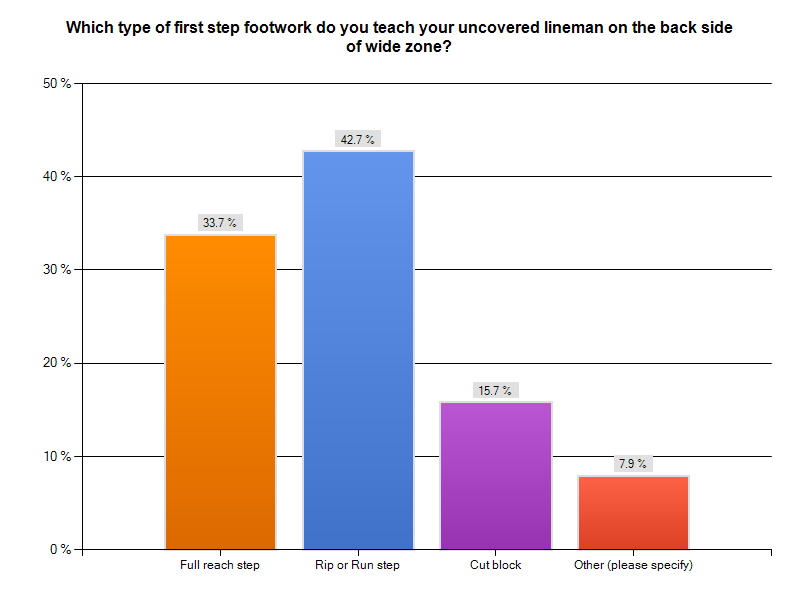
 “Relentless off the ball, to the ball, and after the ball.” I first heard this phrase entering my senior year at Truman State University in 2008. At the time it seemed like just another coaching slogan, something used to motivate players to play hard. Six years later, that single phrase embodies my entire philosophy on the way defensive football should be played. Relentless off the ball (keys and reads), to the ball (pursuit), and after the ball (tackling and takeaways). In January of this year when I was hired as the Defensive Coordinator at the University of Mary, that was my first message to our defense. Above everything, the style of defense that we play is more important than the scheme that we install. Having just completed our first spring ball, myself and our defensive staff put a major emphasis on just that; pursuit, tackling, and takeaways. Throughout this article I plan to explain how we teach pursuit angles, categorize tackles, and when we believe going after the ball should be the number one priority.
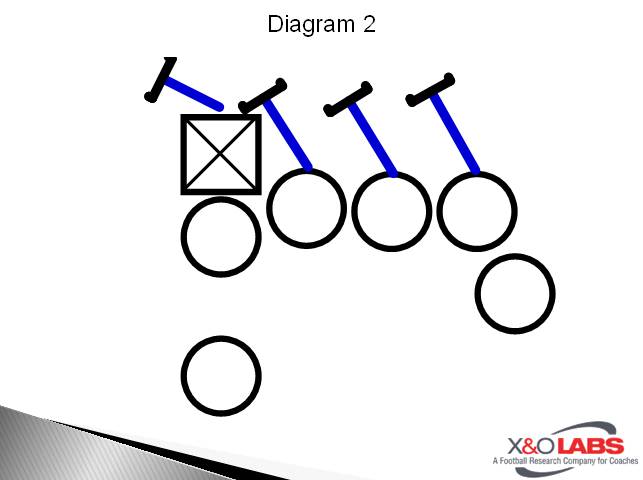
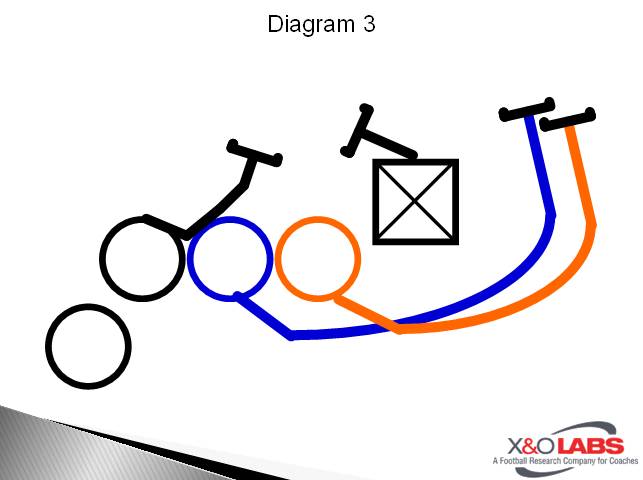
 Hello my name is Steve Girolmo and it’s my great pleasure to present to you an offensive play that helped my teams at Livonia find continued success on the ground. Call it what you like; Sweep, Super Power, 134… This is the most powerful play I have known in 47 years of playing and coaching football. We have run it from a variety of backfield sets, (2 wings, Wishbone, I, Gun, Wildcat, Slots) and have adapted it to unbalanced lines as well. It doesn’t lose potency, it really is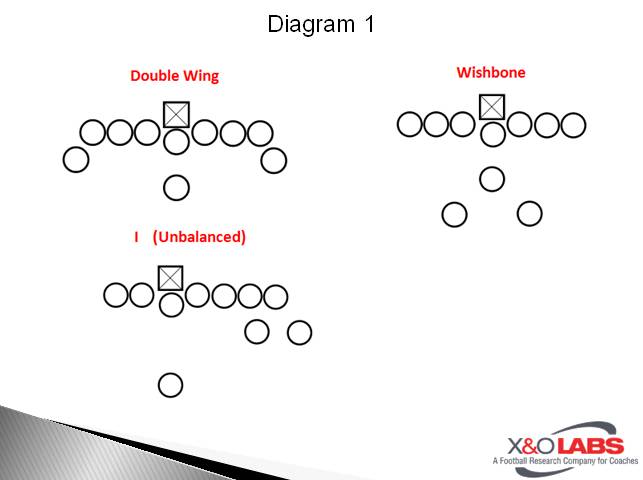
 Last Spring, XandOLabs.com releases its special report on the No-Huddle System. Now that coaches have had another full off-season to retune their system, we wanted to present a follow up on how successful coaches are tweaking the no-huddle. So, we polled those coaches with winning percentages over .500 over the last three seasons using the no-huddle and presented them with two questions:
 The following quick game pass concepts have developed into an extension of our run game. We tell our players that we are looking to get 4 yards on a run and our quick throws are designed to get us at least 4 yards. We like the quick game concepts listed below because it allows our offensive linemen to continue to be aggressive at the point of attack with a quick setting protection. In our system, that type of protection is called “Cut protection” and involves the offensive line taking short set and then block the defenders by taking out their legs or (cutting them down). Their goal is to put their helmet on the opponents outside leg just above the knee.) Quick game also allows to be more balanced on 1st and 2nd down and it is an efficient way to get the ball to our playmakers.
 In today’s football world, we all know that there has been a huge surge to spread offenses. In fact, so are we. But, there is always that one or two teams on your schedule who still run a double wing or wing-t style of offense. Some are even running it out of the gun. Another issue is that we don’t play these teams back to back, but something like week 3 and week 7. I have nothing against this style of offense, but as a defensive coordinator it can throw a huge wrench in your defensive scheme if you don’t have a plan to defend it. We run a base front out of the 4-2-5. I believe that you will be most successful by keeping your current principles in place and have an answer for this team. If you try to install a defense that is only for a specific team, you are setting yourself, and most importantly, your team up for failure. In our league, we see more double wing offenses than wing-t, however we would defend the wing-t the same way.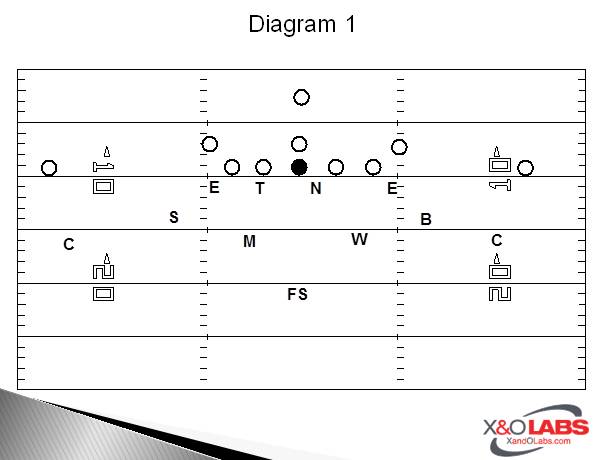
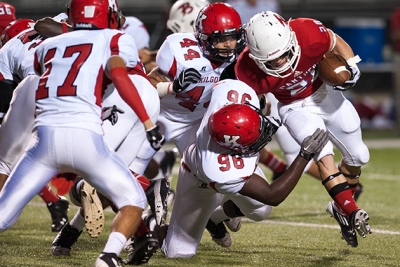
 Offenses are continuing to evolve and add more run read plays for the quarterback. As a defensive coach, you have to have answers that allow your kids can play fast while accounting for different looks so that the quarterback doesn’t get the same read every time. At Kilgore HS (TX), we will have developed four different ways to play the various read schemes by change-ups for our defensive line. Many of these are ideas are borrowed from past experience defending the triple option and veer teams. Even though some of these schemes on offense seem new, for the defense it still comes down to the old cliché of “assignment football”. These change-ups allow us to be able to dictate to the offense that we want to carry the ball in the read game based on opponent tendencies and our calls. Each of these stunts, discussed below, is primarily for our defensive ends since they are usually the players being read.