|
PST
|
IHOP (Inside, Head up, Outside, POA): Block any 1st level defender inside, or block any 1st level defender head up, or block any 1st level defender outside, or block any 2nd level defender inside of the point of attack. His eyes must remain inside to prevent linebacker run throughs.
>> X&O Labs Members: Login here to continue reading
Join X&O Labs to Continue Reading…
Plus, get 4 FREE books!
  When you join X&O Labs, you’ll get instant access to the full-length version of this report — including access to everything in The LAB and Film Room. That’s over 4,000 reports and videos. Plus, if you join with a Staff Membership, you’ll also receive 4 FREE books mailed directly to your home or office! When you join X&O Labs, you’ll get instant access to the full-length version of this report — including access to everything in The LAB and Film Room. That’s over 4,000 reports and videos. Plus, if you join with a Staff Membership, you’ll also receive 4 FREE books mailed directly to your home or office!

Read More
By Jesse Currier
Defensive Tackles and Recruiting Coordinator
South Dakota State University
Twitter: @coachjcurrier
 Introduction: Introduction:
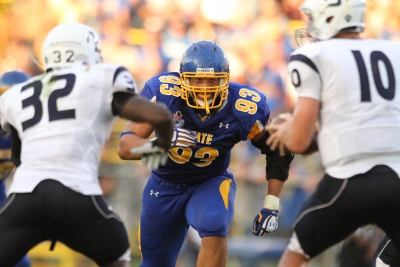
At the defensive tackle position, the top priority is always having guys that are physical at the point of attack vs. the run. The commonly used phrase, “You have to earn the right to rush the QB,” will always hold true because most teams will continue to run the ball until you prove you can stop it.
With that being said, disruptive pass rushers on the inside can change a game and force offensive coordinators to adjust their pass protection schemes.
At South Dakota State University, we have been very fortunate to have some gifted pass rushers on the interior of our defensive line. We have had a different defensive tackle finish the season with at least six sacks in the last three consecutive seasons. The most successful of those pass rushers led all 2013 Missouri Valley Football Conference linemen with nine sacks.
Fundamentals of Pass Rush:
When teaching pass rush, there are four fundamentals that we focus on. These fundamentals are not specific to the defensive tackle position, but they are an essential starting point.
- Eyes: The area that young players struggle with the most is their eye discipline. The biggest reason for this is they were able to be successful at the high school level simply by over-matching their opponent. The natural reaction to a pass read by a young lineman is to get their eyes to the QB immediately. The coaching point that has helped guys understand the importance of where their eyes are is by relating it to a boxing match. You cannot hit what you don’t see. If you are looking at the QB, you will get punched by the blocker and not be able to react because you don’t even see the hit coming.
- Hands: Violent and quick hands are an invaluable asset when rushing the QB. As a pass rusher, we want to avoid getting locked up with a blocker. We want to attack the edge of blockers and keep their hands off of us. In order to do this, we must always have our hands ready. Relating it to boxing again helps. When you are throwing a punch you can’t wind up and swing wildly. You have to be compact, quick, and violent. The other key aspect to using your hands when rushing the passer is that your hands and feet need to be tied together. We use the common coaching point of “same arm, same foot.” This is something that needs to be drilled consistently because it is a very unnatural movement.
- Hips: An indispensable attribute for successful pass rushers is hip flexibility. A pass rusher’s ability to rotate their hips accomplishes three things. The first is that it reduces the surface area for the offensive lineman’s block. The second is that it generates more force when striking the blocker’s arms. The last benefit to hip flexibility is that it enables pass rushers to square up the quarterback when they come free. Many opportunities for sacks are missed because the rusher is unable to get their hips to the quarterback and they are left reaching out to grab with one arm.
- Feet: The key coaching point for feet is that you don’t want your feet to come together or cross over. The reason for that is we don’t want to be off balance when the blocker tries to punch.
Once we have established the ground-work of fundamentals, we work on trying to find what is going to be the most successful go-to move for each guy. I encourage guys to find one move that they feel comfortable with and focus on refining that move every day. We will introduce and drill a variety of moves so guys have options, but I guard against trying to be a ‘jack-of-all trades’ when it comes to pass rush.
>> X&O Labs Members: Login here to continue reading
Join X&O Labs to Continue Reading…
Plus, get 4 FREE books!
When you join X&O Labs, you’ll get instant access to the full-length version of this report — including access to everything in The LAB and Film Room. That’s over 4,000 reports and videos. Plus, if you join with a Staff Membership, you’ll also receive 4 FREE books mailed directly to your home or office!
Read More
By James Guest
Former Offensive Coordinator and Quarterback Coach
Cocoa Beach Jr./Sr. High School (FL)
Current Running Backs Coach at the University of Tennessee – Martin
Twitter: @j7guest
Introduction:
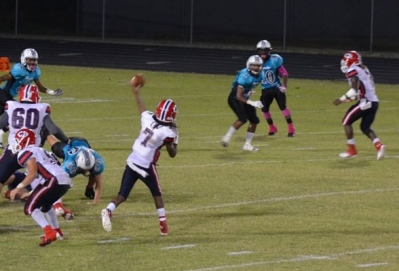 Going into this past season we knew that based on our physical size and numbers that we had to be very multiple by look, yet very simple by concept. We had a few guys that were dangerous with the ball, but a very young and inexperienced offensive line that would not be able to handle the load. So the mindset of, “If you can’t block them…then don’t,” crept its way into the playbook. Going into this past season we knew that based on our physical size and numbers that we had to be very multiple by look, yet very simple by concept. We had a few guys that were dangerous with the ball, but a very young and inexperienced offensive line that would not be able to handle the load. So the mindset of, “If you can’t block them…then don’t,” crept its way into the playbook.
We started out as an 11-personnel (1RB, 1TE) Pistol/Shotgun zone read offense coupled with a sprint out and quick passing game with a 65 to 35% run/pass ratio. After a handful of key injuries we transformed into a full 10-personnel (1RB, 0TE) spread attack where the ball saw more flight time at more of a 45/55% pass ratio. Did we throw it more? Sure. But the way we did was unique. We had a crafty 5’ 11” 150 lbs. athlete taking his first snaps at QB who finished with 1,804 yards and 18 touchdowns. More than half of those yards were produced by our multiple screen game. This is how we did it.
Roger/Larry WR Slip Screen:
This is our wide receiver slip screen. I’m sure quite a few of you carry some variation of it on game days. We used this screen and its rules as a template to become more multiple. This is how we broke it down…
Note: We had a left handed QB, so “Larry” was the most popular.
|
Q:
|
Roger: Quick ball fake, retreat two steps, high release soft arching ball thrown at LOS.
Larry: Small open step, cross over and plant. Swivel head to target while retreating two steps, throw a soft arching ball at the LOS.
|
|
T:
|
Based on tagged play action.
|
|
Y:
|
45-degree spring block. Nearest 3rd level defender.
|
|
Z:
|
45-degree spring block. Far 3rd level defender.
|
|
M:
>> X&O Labs Members: Login here to continue reading
Join X&O Labs to Continue Reading…
Plus, get 4 FREE books!
When you join X&O Labs, you’ll get instant access to the full-length version of this report — including access to everything in The LAB and Film Room. That’s over 4,000 reports and videos. Plus, if you join with a Staff Membership, you’ll also receive 4 FREE books mailed directly to your home or office!
Read More
Jeremy West
Offensive Coordinator
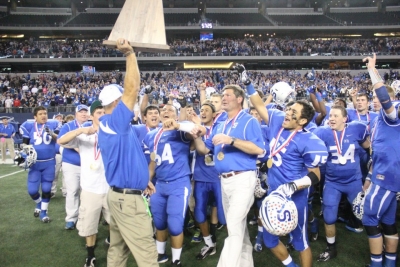
Stamford HS (TX) – 2012 1A Div 1 State Champions
Editor’s Note: Currently the offensive coordinator/receivers coach at Stamford (TX) HS. Have also had other assistant coaching stops at McGregor, Holliday, Knox City and City View (Wichita Falls) all in TX. Have worked under AD/HC Wayne Hutchinson for 11 of the past 12 years at Stamford and Knox City, being promoted to OC in 2009. In those 11 seasons have been 97-32, including 37-6 in the past 3, with a quarterfinal appearance in 2003, a trip to the state finals in 2011 and the 2012 1A Division 1 State Championship. Also coach OLBs and DEs on defense, 8th grade basketball and assistant coach of the Bulldog baseball team that has made 3 consecutive state tournament appearances. Father of 4 Boys and husband to wife Mindy.
Introduction
 Several years ago, we decided to scrap our flex bone offense and made the wholesale switch to a shotgun spread offense. In doing so, we knew we would need to incorporate many ideals that would help us become more consistent and successful at throwing and catching the football, but one drill that we run everyday is the Noose drill. I first encountered this drill in Lubbock at Texas Tech under the direction of Mike Leach. Most of you guys by now, probably know the story of Coach Leach and his tutelage under Hal Mumme. Then, when we went into spread offenses, we became clients of Tony Franklin and his “System”, another branch of the Air Raid offense family tree and came across the drill again and developed a better understanding and application of this drill. Several years ago, we decided to scrap our flex bone offense and made the wholesale switch to a shotgun spread offense. In doing so, we knew we would need to incorporate many ideals that would help us become more consistent and successful at throwing and catching the football, but one drill that we run everyday is the Noose drill. I first encountered this drill in Lubbock at Texas Tech under the direction of Mike Leach. Most of you guys by now, probably know the story of Coach Leach and his tutelage under Hal Mumme. Then, when we went into spread offenses, we became clients of Tony Franklin and his “System”, another branch of the Air Raid offense family tree and came across the drill again and developed a better understanding and application of this drill.
The reason I like this drill so much and we use it everyday is for a couple of reasons. I have never seen a drill that encompasses so many of the little things that receivers and quarterbacks need to be conscious of in one drill that can be done in 5 minutes. Secondly, we are a small school (1A in Texas, our high school enrollment is 185) and we have guys that play both sides of the football and our entire coaching staff must coach both offense and defense. Coincidentally, we typically only have an hour for our offensive half of practice. Since we’re lacking some of the individual time that bigger schools may have, noose is great because we can coach so many details for our positions without having to spend a great amount of time on it during individual offense in practice.
Again, one of the best things about Noose is that it covers a myriad of things that we will harp on that we believe are critical to being a good receiver. In listening to many “Air Raid” spread offensive minds (Mumme, Leach, Franklin, Dana Holgerson, Sonny Dykes, Art Briles, etc.) speak, one common thing that most will mention is that the best way to get embarrassed in the spread offense is to not able to defeat press man coverage and not be able to get off the line of scrimmage and get into your routes. You may only see it once or twice a season, but when you do, you better be prepared for it. So for this reason, we work everyday on man press releases and the first few steps of the drill reflect this. It’s a worst-case scenario mentality…if you can get off man press, everything else should be easier.
We run noose drill everyday in pre-practice as a warm up. Another thing that we don’t waste time on anymore is an old-school, static, block-type stretch, where it takes 5 minutes everyday just to get the freshmen in a straight line in the back. Instead, we warm up with Noose.
Drill Set-Up
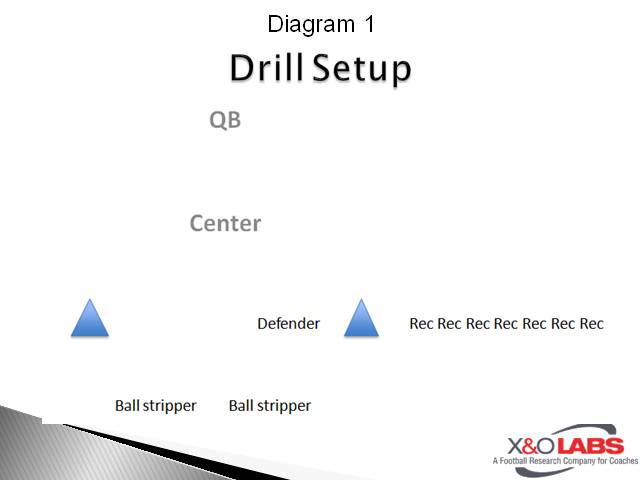
The drill is set up with two cones five yards apart (we use the boundary and yard lines). Some people will use stand up dummies or trashcans instead of cones or you could even use two guys that are in line. The cones are used to represent a defender, particularly a linebacker for the purposes of this drill. The receivers will line up behind one cone, facing the other cone. The next man in line will step around and be a defender. The QBs will be perpendicular to the cones, about 8 or 10 yards deep. Sometimes we will use our centers and if not, the receivers will come give the snap before that return to the back of the line. We typically have 5 or 6 different QBs, each with his own set of cones and will even out the receivers accordingly, trying to maximize our reps. It is a half speed drill, so all of these techniques should be very clean and noticeable. We want to try and exaggerate them during the drill.
Wide Receiver Mechanics
- STANCE – The first thing we coach our guys on is their stance. So for stance, we want our guys to have a wide base, a “fighter’s stance” with their feet about shoulder width apart. We don’t worry about one foot or the other being forward, because we don’t count steps in our routes. The next thing is we want our shoulders lower than the defender’s shoulders and our hands up and ready. It’s a street fight mentality and we want our stance to reflect that, all the while being comfortable and being able to run off the football. We also want their eyes on the snap, since our receivers are taught not to listen for the cadence, but to watch the snap. We will coach this in all phases of practice beginning here, the idea being to eliminate the temptation for us to jump offsides anticipating the snap.
- FOOT FIRE – Our next step is a foot fire technique. Here we are rapidly firing our feet and hands. We want to gain some ground and threaten the DB’s cushion and get into him, all without giving him a clue as to what our first move is going to be. We want to be violent with our hands and not let him engage.
- STICK OPPOSITE – Here we want to begin our single “stick” release by sticking our toe in the ground in the opposite direction that we’re going. We want them to do a good job of selling that they are going in the direction of the stick, so we want a good head and shoulder fake. We encourage them to “put some flavor in it” just like they’re being covered by their brother in the back yard. We have given our guys the freedom to work both left and right during this drill and trust that they will do so. A lot of young guys will only want to work their outside release or even worse they’ll only go right, because that’s the way we start them out in junior high!
- CLEAN THEIR HANDS – Here we need to be violent with our hands. After we’ve set the DB up that we are going the other direction, we want to “break his wrists” or “break his elbow” are good visuals that we will use here. We want to get the defenders hands off of us as we’re going into our dip.
-
>> X&O Labs Members: Login here to continue reading
Join X&O Labs to Continue Reading…
Plus, get 4 FREE books!
When you join X&O Labs, you’ll get instant access to the full-length version of this report — including access to everything in The LAB and Film Room. That’s over 4,000 reports and videos. Plus, if you join with a Staff Membership, you’ll also receive 4 FREE books mailed directly to your home or office!
Read More
By Mike Kuchar
Senior Research Manager
X&O Labs
Editor’s Note: The following article is a small portion of the complete Pistol Special report that is available to our Insiders Members by clicking here.
Slip/Cruiser Concept
The slip or cruiser concept is the opposite of arc. In this situation, the read is going away from a Tight End (or three man surface) and another player is responsible for blocking the force defender for a QB keep. This player can be a player from a backfield alignment (Diagram 14) or one from the other side of the formation who will get to a position post or pre-snap to handle that responsibility. Nevada, under Ault, typically used borrowed a player from the backside of the formation to handle this responsibility (usually an H or Wing) which provided instant misdirection to the defense (Diagram 15) that looked a lot like the slice concept that was detailed in Case One. According to Norcross, Nevada varies whether or not it wanted its QB to carry the ball. “If we want to run lead option and leave the pitch man free we would tell him (slip player) to leave the force player. He’d leave the first man past the defensive end. If we want to run load option, we tell him to block him. He would slip and we would block the pitch key and it turns into sweep. It’s just a different variation.”
Norcross stressed the job of “covering up” when blocking the force player. Remember, this could be a receiver handling a Safety, so it’s important not to try and set up as a kill shot. “We would tell him to aim for outside shoulder of the defensive end (opposite of slice which is the inside shoulder). “When we got to the second level it doesn’t have to be a kill shot. Our QB will make your right. We just wanted to fit him up and basketball screen him initially. Once he chooses a direction now we can shuffle our feet and run him that way. The QB can press and cut off of us. The one thing we didn’t want to do is turn out on him and have him squeeze us down into the hole.”
>> X&O Labs Members: Login here to continue reading
Join X&O Labs to Continue Reading…
Plus, get 4 FREE books!
When you join X&O Labs, you’ll get instant access to the full-length version of this report — including access to everything in The LAB and Film Room. That’s over 4,000 reports and videos. Plus, if you join with a Staff Membership, you’ll also receive 4 FREE books mailed directly to your home or office!
Read More
By Saj Thakkar – @saj1726
Running Backs Coach
Fitchburg State University
 Introduction: Introduction:
The Inside Zone read has become a staple offensive play across the country from the pop warner levels all the way to the NFL with quarterbacks such as Robert Griffin III, Colin Kaepernick, Russell Wilson, etc.
One problem with the zone read concept is that it exposes your quarterback to more hits and over a course of a full season and those hits add up. A problem we had to solve was keeping our smaller, true freshmen quarterback healthy while also being productive on offense. After researching offense from UCLA and Villanova, we knew our answer would be the run/pass read game. This concept is being used throughout the country and we do not want to take credit for being innovators, however, after using it we now know why this concept is becoming more and more common.
Our run pass combo game lead to us having the most productive offense our university has had in over ten years while leading to our quarterback winning the ECAC Division-III Rookie of the Year with 25 touchdown passes. We also had an all conference running back and had a receiver break the school single season touchdown record.
>> X&O Labs Members: Login here to continue reading
Join X&O Labs to Continue Reading…
Plus, get 4 FREE books!
When you join X&O Labs, you’ll get instant access to the full-length version of this report — including access to everything in The LAB and Film Room. That’s over 4,000 reports and videos. Plus, if you join with a Staff Membership, you’ll also receive 4 FREE books mailed directly to your home or office!
Read More
By Mike Kuchar
Senior Research Manager
X&O Labs
Editor’s Note: Perhaps we found the most success in play-action man protection concepts off the Veer and Midline option run-action. James Vint at Seminole High School (TX) wrote an entire piece below about his play-action pass concept off his Midline scheme from the Pistol formation. Below is his submission that is part of our complete Pistol Special Report. Click here to view the entire report.
“Our play action game is designed to attack areas the defense is vacating to play the run. With all of our play action concepts, we want the pass to look like the run. On midline, our offensive line will use an aggressive gap set protection. They will attack the near jersey number of the down defender. If you are covered, you will block the defender covering you. If you are uncovered, you will work inside to outside. We keep our protection very, very simple.
Our tackles will typically be blocking the 5 techniques. Versus an odd front, our guards will be uncovered, and they will work inside to out. We always want to block the most dangerous man first, and the inside linebacker is a more dangerous player than the outside linebacker. Versus an even front, our guard to the side of the 3 technique will have him man. Our guard to the shade will work be our dual read or inside to outside player. The center is going to base block the nose. If there is no nose, the center will work inside to outside.
I call it a gap-punch protection because we are going to step and protect our inside gap first. It’s based on B.O.B. concepts. The only difference between our gap protection and our Big on Big protection is the first step. In our gap protection, our first step is to protect inside because we’re not worried about and edge guy- our back and QB handle that. In B.O.B. our footwork is going to be predicated on the alignment of the defender. If the defender is head up to outside shoulder, we will power step inside and kick. If the defender is on our tip, now we are kicking. If the defender is a man removed, we are kick, kick and we read from there. This protection is a gap-punch, Big on Big combination.
The backfield action must look exactly like midline to the defense. Our pistol back will run down the brown spot on the center’s backside and sell the dive fake. He is responsible for “swallowing” the mesh point. He then is responsible for any A gap run through. We would essentially like for him to get tackled. The quarterback will push off the midpoint and flash the football. We teach the quarterback to bend his knees on the fake, and shuffle one step. As the back gets to the mesh point, the QB will pull the ball back in and bend his knees as he shuffles one step. The ball is not ever going to be in the belly of the dive back. We put a premium on ball security. We let the action sell the fake. After his shuffle step, the quarterback will then take a 3-step drop. He should end up at 6.5 to 7 yards on his drop.
>> X&O Labs Members: Login here to continue reading
Join X&O Labs to Continue Reading…
Plus, get 4 FREE books!
When you join X&O Labs, you’ll get instant access to the full-length version of this report — including access to everything in The LAB and Film Room. That’s over 4,000 reports and videos. Plus, if you join with a Staff Membership, you’ll also receive 4 FREE books mailed directly to your home or office!
Read More
By Mike Kuchar
Senior Research Manager
X&O Labs
@MikekKuchar
In this week’s research report on the Insiders’ membership website, we’re going to take an in-depth look at the QB’s footwork and the mesh game in the Pistol formation. Then, after we read this report, we’re going to move onto The Pistol Formation Study, which includes our research on all aspects of this formation. Plus, it includes 35 game films to illustrate our research findings. Let’s get started…
We all know the schemes look pretty, but when it comes down to option football, there is nothing more important than the mesh game. Don’t just take our word for it; listen to some of the more high-profile coaches we talked to for this report. Whomever we talked to, there was one common thread among teaching the mesh: Teach one thing, be consistent and don’t over coach it. That sentiment was echoed throughout our reporting on the mesh game from the Pistol. Consider Portland State’s offensive coordinator Bruce Barnum’s quip about how he learned to teach the mesh in his option game.
When Barnum first installed the Pistol in 2010 at Portland State, there was much ado about the QB/RB mesh in the option game. “I took all of Nevada’s video on Kaepernick,” said Barnum. They used to talk about jab stepping, stepping to six o’clock, clearing the back, etc. I turn on the film of Kaepernick and he catches the snap and hops in the air, stops and runs the read zone. I remember thinking this is crazy.”
Of course, Barnum was providing a little tongue and cheek humor, or perhaps just validating the super athlete that Kaepernick is. But, he was illustrating a fair point: be consistent.
“As long as the ball is getting deep and the read is long – that’s important,” according to Barnum. “The last thing you want is that QB sticking that ball straight out because there is no read for that DE and there is no smoke to the mirrors. It’s got to be consistent. I don’t care if you jab step and clear. I don’t care if you open to six o’clock and he screams by you. We had a freshman last year who would ride the back all the way to the Center. It doesn’t matter as long as it’s consistent.”
So, as a research company, we did our own validation on this topic and we went right to the source, Washington State running backs coach Jim Mastro, who was the running backs coach under Ault while at Nevada and quite frankly who Cameron Norcross calls the “best Pistol running back coach in the country.”
Since moving on from Nevada, Mastro has helped install the Pistol at UCLA under Coach Neuheisel and now is tinkering with it at WSU under Mike Leach. Mastro spoke about making sure things are uniformed in the mesh game, particularly in the zone read. “It’s not like the traditional run game which may be different because different QBs have different arm lengths,” said Mastro. “In the read zone game, the running back and QB must be attached at the hip or you will have balls on the ground all day long.”
Before we continue, I need to give you a quick ‘head’s up’… after you read this report on QB footwork and the mesh game, we’ll then go to The Pistol Formation Study, which includes all of our research and 35 game videos on the Pistol formation. In this study, we’ll take a look at all of the little-known coaching secrets and strategies that never came out of Nevada during head coach Chris Ault’s tenure. Our researchers were granted exclusive access to five of Coach Ault’s assistant coaches at Nevada. These coaches include Chris Klenakis, former OC; Jim Mastro, former Running Backs Coach; Cameron Norcross, former OL Coach; Kevin Maurice, a former GA; and, Dave Brown, another former GA on staff. In The Pistol Formation Study, these coaches break their silence on Nevada’s Pistol offense.
Next, let’s take a look at Coach Mastro’s 3-step drop and cock.
3-Step Drop and Cock:
In order to do this, Mastro teaches a three-step drop and cock fundamental which is extremely different than a typical ride and decide movement by the QB. “He will drop out and be a cocked angle at the defensive end (read key),” said Mastro. “We don’t want to be parallel to the sidelines. We want him at a cocked angle. He will drop and cock out. The back foot goes a yard and a half. The front foot goes a yard, which puts him at a cocked angle. That ball is an extension of his arm. The arms will be bent and the ball will be right in the face of that defensive end. The big thing is to have bent arms. The QB can’t have a stiff arm or the ball straight out.”
Mastro calls the QB technique a ‘Snatch Technique.’ “It’s not a ride and decide,” he told us. “The QB does not want to push the ball back to the running back. That ball is just held out there at that angle. By the time the running back gets to the QB (using the snatch technique), he knows if the QB is either pulling it or giving it. That’s why we had hardly had any fumbles. When it’s a ride and decide, he’s deciding pull it, keep it and there is hesitation. When it’s the snatch technique, by the time the running back gets there the QB knows either I’m pulling the ball or giving the ball. If he’s giving the ball he just loosens his thumbs, and if he’s keeping the ball he squeezes his thumbs. By the time the back got there, the QB already knew what he was doing. There is no grey area.
>> X&O Labs Members: Login here to continue reading
Join X&O Labs to Continue Reading…
Plus, get 4 FREE books!
When you join X&O Labs, you’ll get instant access to the full-length version of this report — including access to everything in The LAB and Film Room. That’s over 4,000 reports and videos. Plus, if you join with a Staff Membership, you’ll also receive 4 FREE books mailed directly to your home or office!
Read More
By Mike Kuchar
Senior Research Manager
X&O Labs
Editor’s Note: This article is a portion of our Quarters Coverage Special Report. For more on this topic, click here to read the complete Special Report.
Since run/pass recognition is critical in teaching Safeties and Corners to effectively operate the Quarters system, we reached out to several coaches who use the scheme and asked them to detail the most productive drill they use to develop their Corners and Safeties.
Cover Four Run Read Drill
Jared Pospisil, defensive coordinator, Union High School (IA)
- For the most part, because our safeties are the run-first players in this call, much of the drill focuses on their reads and reactions.
- The corners, who assume the pass-first responsibility during a run call, basically go through their alignment, stance, and start when the ball is snapped, and finish each repetition with their late fill technique.
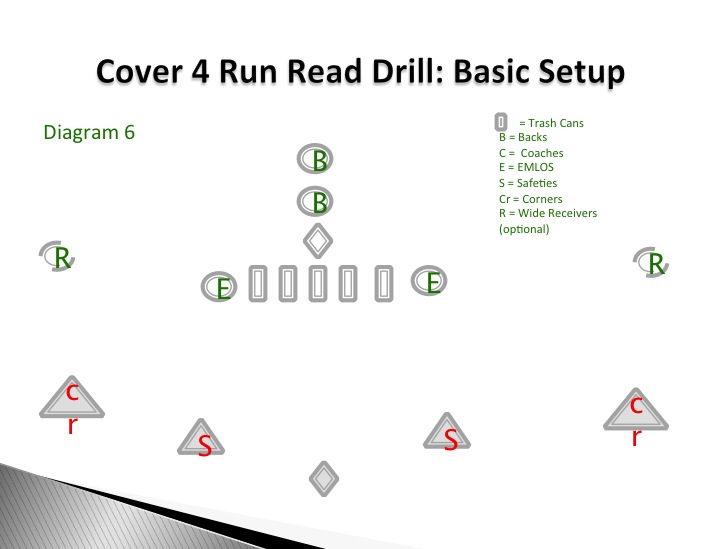
- Drill starts with 4 or 5 trash cans that represent 5 offensive linemen, 2 players representing end men on the line of scrimmage (EMLOS), 2 or 3 players representing offensive backs, 2 safeties, 2 corners, and 2 coaches (one acting as the QB and one giving blocking/running assignments) (Diagram 6)
- In our Cover 4 scheme, when the safeties make a run call, they follow these basic rules: if the run is to you, fill aggressively; if the run is away from you, move forward to about linebacker depth and shuffle with square shoulders to the run direction, checking for cutback and reverse; if the play is a pass, jump any routes run by your key receiver over 7 yards deep but let short routes go.
- Safeties align at 8-10 yards deep, on the outside shade of the EMLOS; in most cases, this is a tight end or an offensive tackle, depending on the offensive set we see that week. For the stance, we ask our safeties to use a square stance, with knees and hips flexed, back slightly flat, hands loose in front of the body.
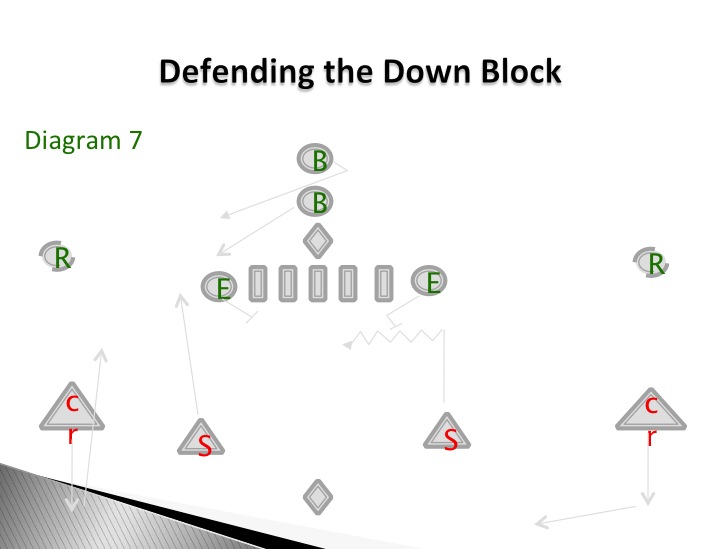
- Against a down block, the play side safety fills fast as the contain player (Diagram 7).
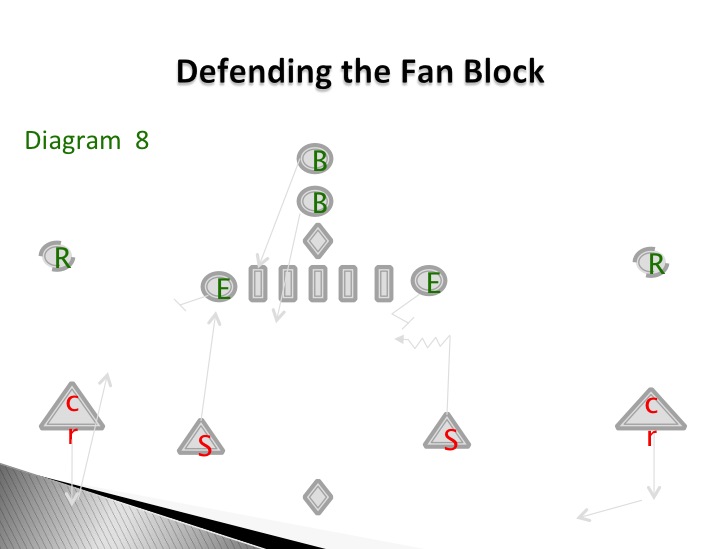
- Against a fan block (the EMOLS blocks out), we tell our safety to fill on the inside hip of the defensive end / outside linebacker being blocked out. In this case, contain is taken by the defender being blocked out, so the safety can help against the inside run (Diagram 8).
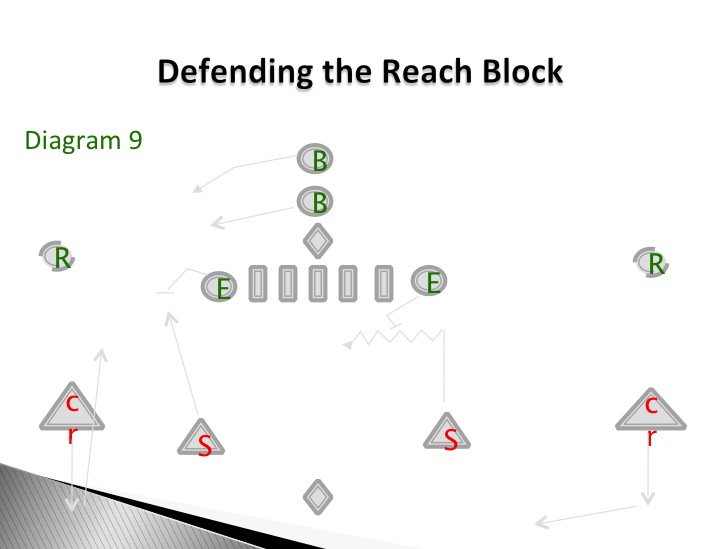
- Against a reach block, our safeties must attack the edge as the contain player (Diagram 9).
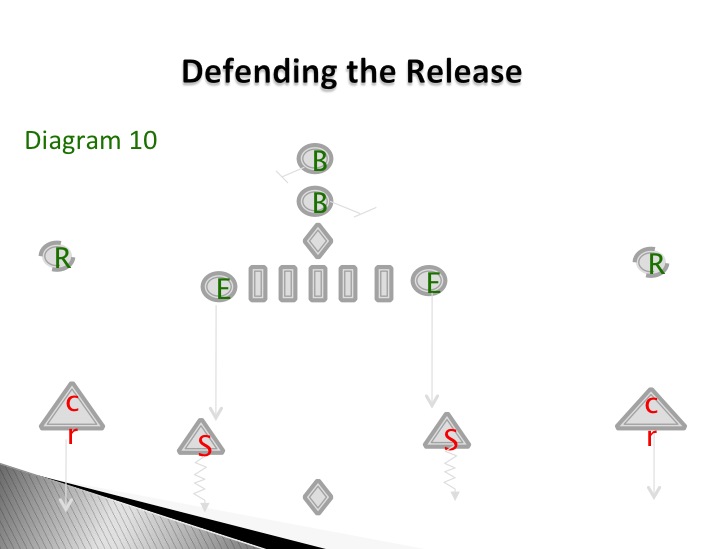
- Against a release by the EMLOS, the safety must honor the pass and begin to back pedal. If the receiver runs anything over 7 yards, the safety must lock on and run with the receiver, wherever he goes; if the receiver runs a route under 7 yards, we tell the safety to let the route go and look for work (Generally, ‘work’ is determined by the unique route combinations each of our offensive opponents run each week) (Diagram 10).
- When we play teams that crack heavily, however, we incorporate the crack-and-replace concept into the run read drill (Diagram 11)
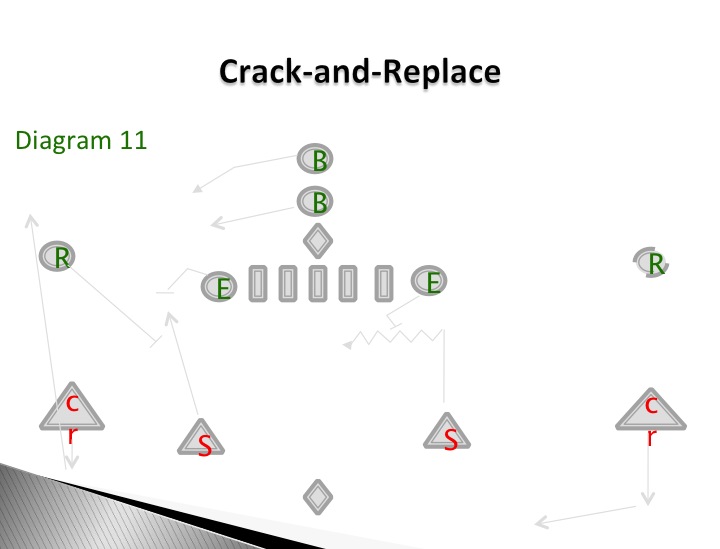
- One coaching point we emphasize for key reads involves reading the EMLOS’s shoulders. If our safeties see that the blocker’s shoulders have turned perpendicular to the LOS, either toward the ball or away from the ball, hiding their jersey numbers, the play is most likely a run, so fill. If our safeties see that the EMLOS’s shoulders—especially in the case of a TE—stay square to them and move up field, there is a good possibility that the play is a pass; honor it as such.
Cover Four Key Drill
Rick Wimmer, defensive coordinator, Fishers High School (IN)
>> X&O Labs Members: Login here to continue reading
Join X&O Labs to Continue Reading…
Plus, get 4 FREE books!
When you join X&O Labs, you’ll get instant access to the full-length version of this report — including access to everything in The LAB and Film Room. That’s over 4,000 reports and videos. Plus, if you join with a Staff Membership, you’ll also receive 4 FREE books mailed directly to your home or office!
Read More
By Christopher Smithley – @WJFootball
Secondary / Special Teams Coordinator
Washington and Jefferson College
 At W&J, we spend a lot of time on our punt team. We feel that this is the most important special team unit. The punt team can change the game positively AND negatively quickly with big implications. You can change the field position and put your opponent in a long field situation. However, with the slightest mistake, a punt block for a touchdown changes not only the score, but the momentum in a game more than any other play in football. The punt team must be able to play under a large amount of pressure every time they run onto the field. We want to be perfect every time that ball gets snapped. At W&J, we spend a lot of time on our punt team. We feel that this is the most important special team unit. The punt team can change the game positively AND negatively quickly with big implications. You can change the field position and put your opponent in a long field situation. However, with the slightest mistake, a punt block for a touchdown changes not only the score, but the momentum in a game more than any other play in football. The punt team must be able to play under a large amount of pressure every time they run onto the field. We want to be perfect every time that ball gets snapped.
The Pro-Style Spread Punt is a punt scheme that has lost a lot of its popularity in recent years in the college game. A lot of schools are now going to the shield punt mostly because it fits their personnel and helps to put their guys in better coverage lanes. This punt scheme is a scheme that uses depths and angles to take away a possible block that also allows you to maximize the number of athletes you have on the field for a consistently solid coverage. We use the Pro-Style Spread Punt scheme because personally, I am a true believer that it is not only the best protection and coverage scheme but also because you can be very multiple in your looks and your options to build fakes. It allows you to keep your rules simple and precise regardless of the wrinkles that you feel necessary to be successful. This allows the players to PLAY rather than having to think about their responsibilities because it becomes a natural act. I also feel that this punt scheme allows you to get more athletes on the field to play and tackle in space from a coverage standpoint.
Personnel
The first thing that we have to look at is our personnel. Which guys will play certain positions on this team and why? These players not only have to protect the punt but also have to cover and tackle with intent to force turnovers. This is our Pro-Style Spread Punt formation.
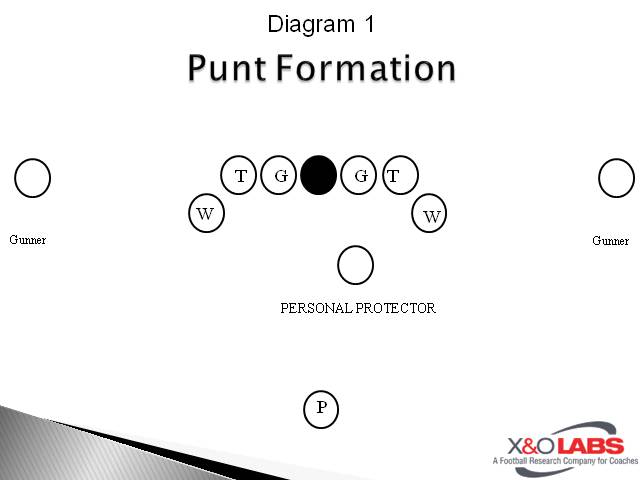
The gunners are players that need to be extremely athletic and have a good amount of speed to be able to win a one on one battle with the corner that is attempting to hold the gunner up. I want this player to be a disrupter. I want teams to look at our gunners and say, “We got to put a 2nd returner or corner over this guy so that we can get a step in the ground after we catch the punt”. These guys have to be able to react in a split second and change direction.
The wings also need to be a quick guy preferably with some length because their protection zone tends to be a little larger than all the other positions. The speed becomes a major advantage due to the fact that the wing gets into his coverage lane about 1-2 yards deeper than the rest of the punt team. These guys tend to be safeties or bigger receivers with ability to tackle.
The tackles are bigger safeties, linebackers, or tight ends with good athleticism and the ability to take on a rush through the C gap which is the 2nd largest protection zone in the scheme.
The guards are more stout players but still have a great deal of athleticism. A lot of punt block schemes want to attack the A and B gap against our punt scheme. These guys have to be able to accomplish their assignment with opponents attempting to bull rush them out of their gap as well as pulling them out of their gap. They have to be able to kick slide and stay strong and balanced in their stance throughout the snap.
The long snapper is a guy that is going to get that football to the punter in the smallest amount of time accurately and consistently. The long snapper will also have the responsibility of protecting an A gap based off of the personal protector’s call.
We want the personal protector to be the best athlete on the field but more importantly the smartest player on the field. He is our quarterback on this team. He sets the protection and makes adjustments if needed. Also the majority of the fake game revolves around this individual. We have used a number of different position players at this particular position in the past. We have used free safeties, linebackers, and running backs. You need to decipher what fits best for your individual punt team. Determining the personnel is extremely important for this team!
Alignment/ Stance
In our punt scheme our alignment is 6 inches between long snapper and guard, 6 inches between guard and tackle, and the wing is 1 yard outside and 1 yard deeper than the tackle. The guard, tackle and wing will align with their inside leg up with their feet staggered anywhere from 6 inches to a foot based off of comfort ability. They need to be in a good balanced stance with their butt down, flat back, and shoulders back with their eyes up. We always want to have our weight on the ball of our foot that is up, which is our inside leg. Our personal protector stands in a good linebacker stance heels at 5 yards from the ball in the A-gap. That A-gap will be decided off of whether our punter punts with his right foot or his left. Let me elaborate, if the punter punts with his right leg our personal protector will be in the right A-gap with his heels at 5 yards deep and in a solid linebacker stance. Our punter will be heels at 15 loose and relaxed and ready. Gunners will align at the top of the numbers in a receiver stance with the ball in the middle. If the ball is on the hash the gunner in the boundary will align at the bottom of the numbers and the gunner to the field will align on the far hash from where the ball is spotted.
>> X&O Labs Members: Login here to continue reading
Join X&O Labs to Continue Reading…
Plus, get 4 FREE books!
When you join X&O Labs, you’ll get instant access to the full-length version of this report — including access to everything in The LAB and Film Room. That’s over 4,000 reports and videos. Plus, if you join with a Staff Membership, you’ll also receive 4 FREE books mailed directly to your home or office!
Read More
| |




 Introduction: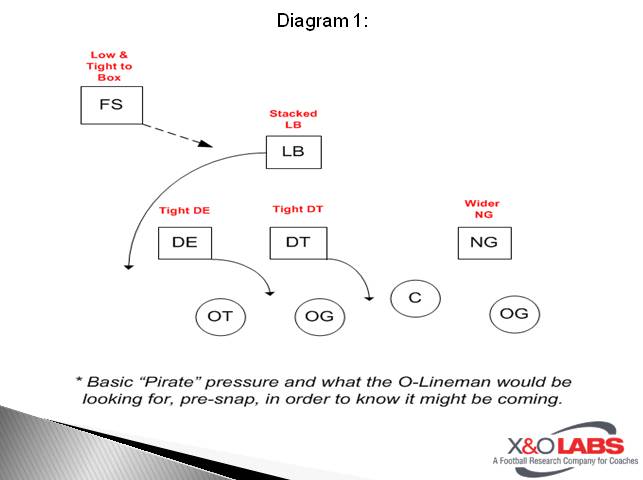
 Editor’s Note:
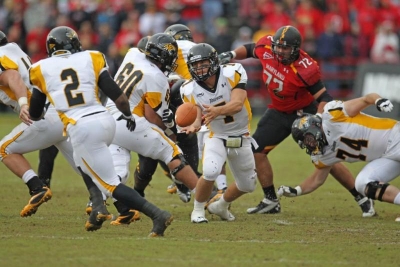
 When it comes to the Run/Pass Option Series (RPOS), you want to spend time preparing your quarterback to become efficient with their reads. This can be accomplished in the classroom, film room and on the practice field. You want to show them a preview of game day early in the week. This article will discuss the process of training your quarterback for game day. The example will follow training days from Monday to Saturday.
 In our clinic report, we wanted to share two of our open front, three deep, two under zone pressures.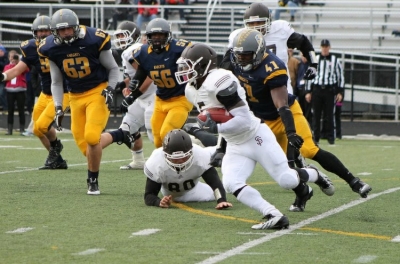
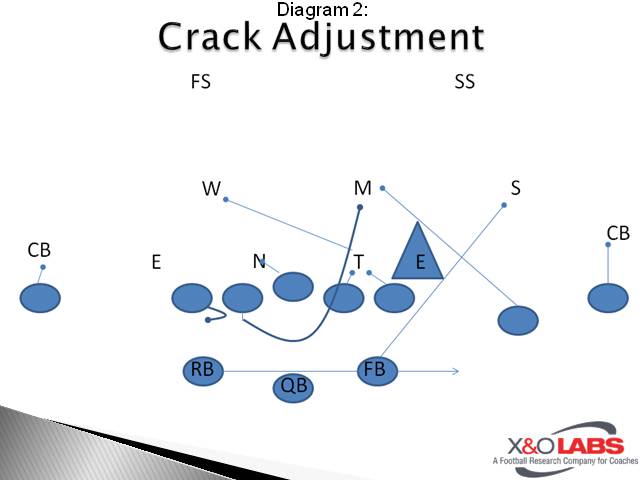
 It is astounding how universal the Power Read play has become in such a short period of time. This new innovation has changed the run game at every level of football and has become one of the most trusted weapons in the arsenal of many offensive coordinators. For a long time, it was almost like stealing every time an offense called this play. The defense couldn’t be right! Of course, the guys on that side of the ball are good coaches, too, and have started to catch up. Defensive coordinators have lots of new tricks to stop this play, especially if offenses become over-reliant upon Power Read. That is why we at the University of St. Francis (IL) now utilize the complementary Trap Read play.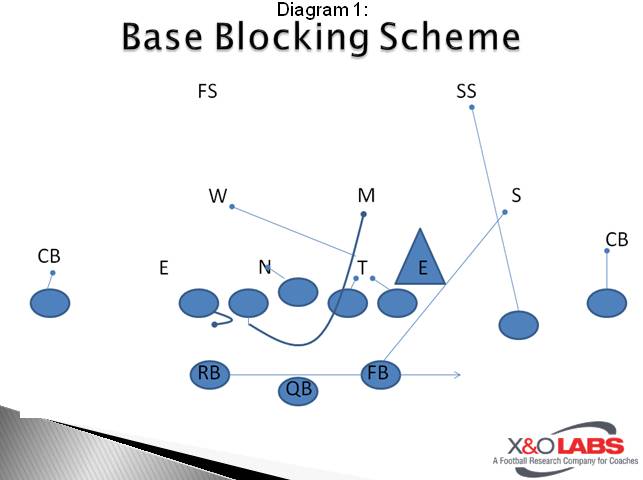
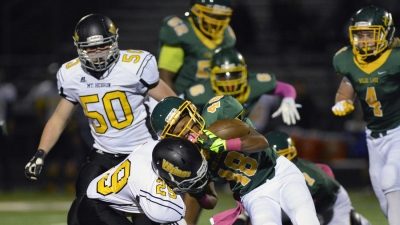
 For nearly twenty years, Wilde Lake had run a Bone offense with the Power as the base play. During the 2006 season our coaching staff felt like we had hit a crossroads and made a switch to the Double Wing offense again with the Power as the base play. Since changing to the Double Wing Wilde Lake has averaged 3,000 rushing yards and 31 rushing touchdowns per season.