
Defending the Bunch Formation

By Mike Kuchar

Senior Research

Manager X&O Labs


Researchers’ Note: You can access the raw data – in the form of graphs – from our research in defending bunch run and pass games: Click here for the Statistical Analysis Report.
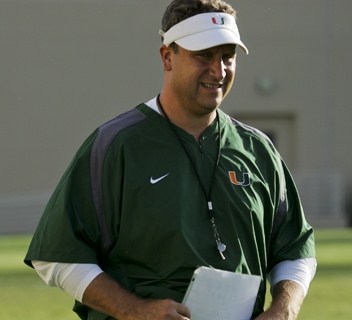
 

“If they run a bunch toss scheme, I want cloud and corner force.” Mark D’Onofrio, Defensive Coordiator, University of Miami (FL)

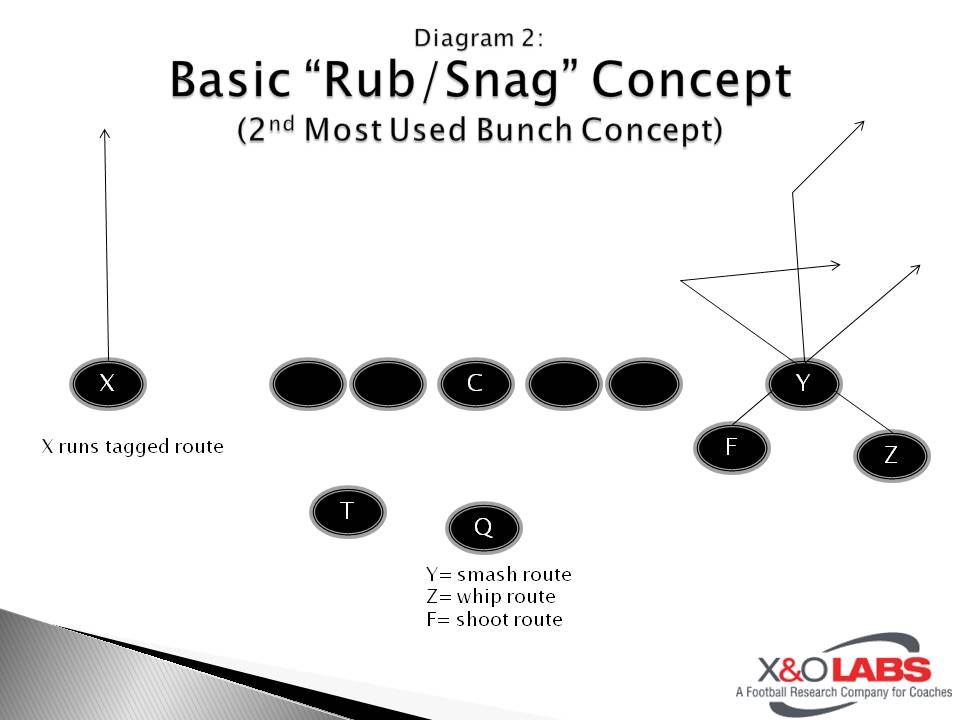
In our previous report, X&O Labs profiled the “Rub” concept, which is what we found to be the most used concept in Bunch formations We presented numerous ways in which the bunch formation can place stress on a defense.

In order to conduct our defensive study we reached out to four major college coaches; two on the FBS level, to find out how they best handle bunch.  Their responses may surprise you.  All three consider defending bunch to be an entirely different package, mainly because offenses will use a separate set of plays in their bunch package to attack different coverages.  When we conducted our initial survey, we found that 63 percent of coaches check their called coverage to a bunch check, and 61 percent of those coaches have only one base check to bunch.  But according to the coaches we spoke with, there is no one best way to handle bunch.  It’s all predicated on what offenses are doing when they run bunch.  While we may not know of a “perfect” coverage to defend bunch, we do know that you must first analyze what offenses want to do.  Productive offenses will attack both the strong side (three receiver side) and the weak side (X receiver side) when lining up in bunch.  We found that offensive play calling is limited to the certain run/pass concepts when running the bunch formation:

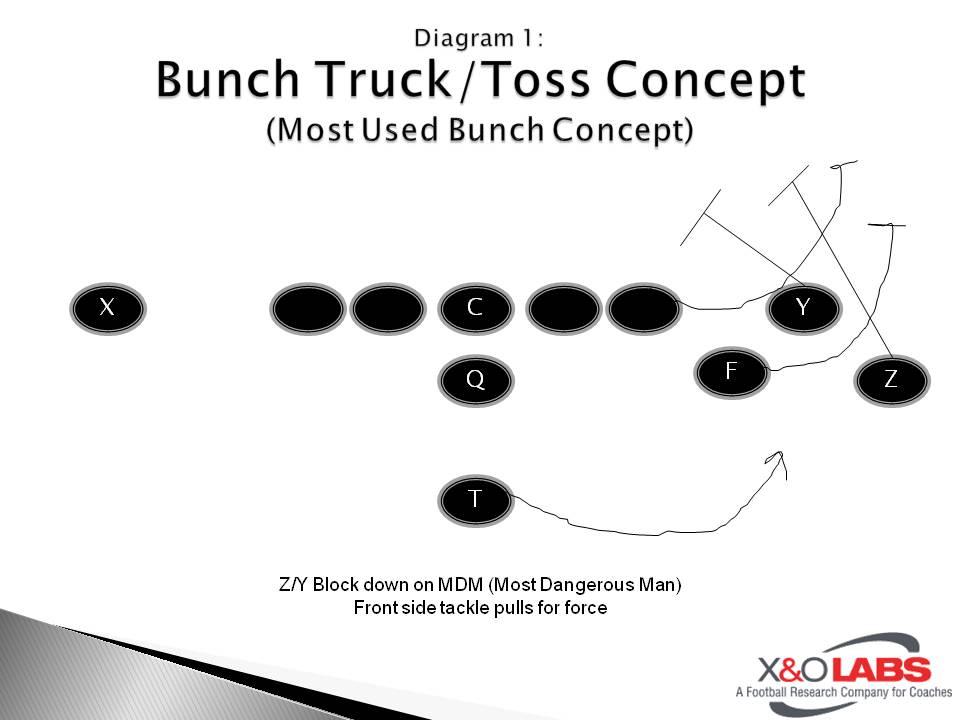
  1. To Bunch Side: Quick hitting fast flow run scheme like toss (truck scheme) or outside zone (diagram 1).
  2. To Bunch Side: Layered pass game concept with leveled routes such as the Rub/Snag concept (diagram 2).
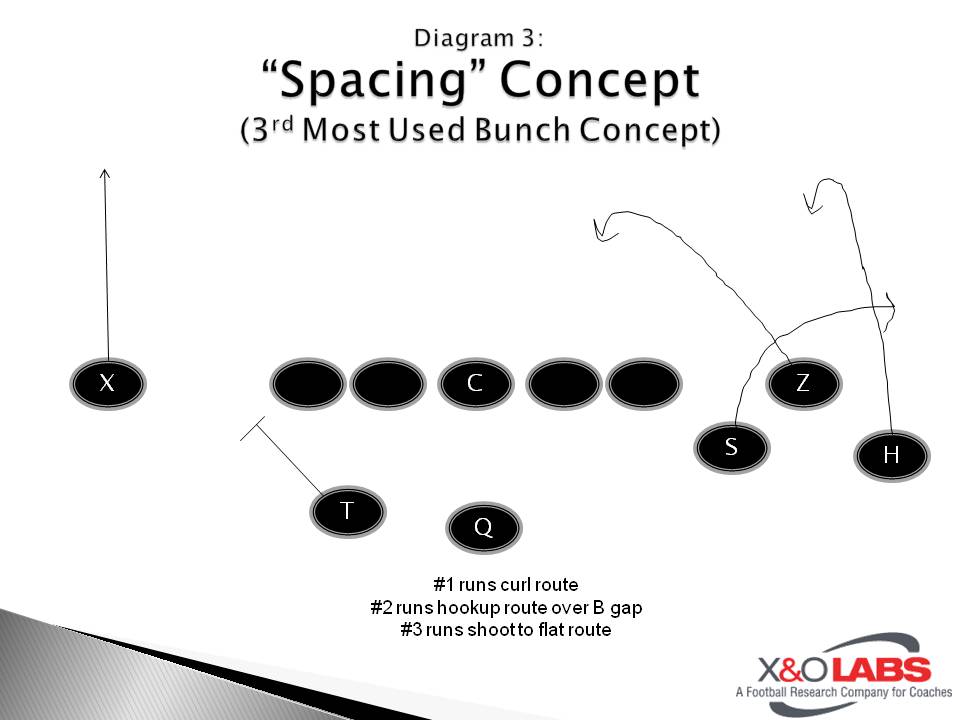
  3. To Bunch Side: Intermediate pass game concept that attacks underneath defenders such as the Spacing concept (diagram 3).
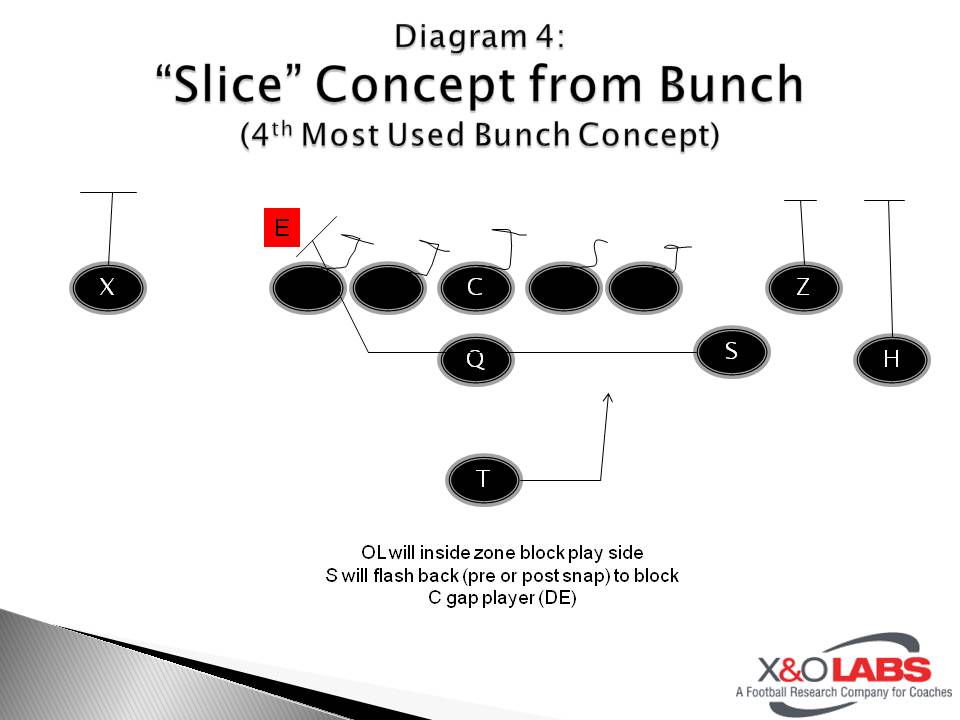
  4. Away From Bunch: Split Flow run game like the Slice concept back-side off inside zone (diagram 4) with a boot component off of it.
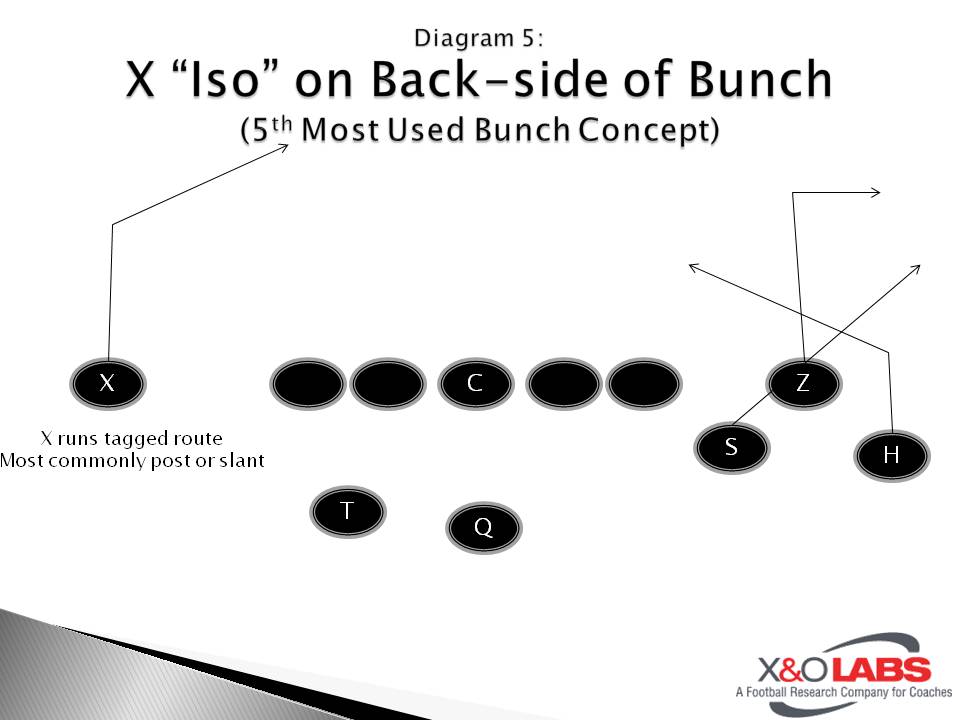
  5. Away From Bunch: Isolation on the X receiver with tagged routes (diagram 5).
We’ve found that most offenses will set you up in bunch and really run only one or two of those concepts. Remember that based on our Bunch offensive survey last month, the majority of coaches, 38.3 percent use the “Rub” concept to the play side of bunch as their main pass scheme while 51 percent of coaches use the toss or truck play as their main pass scheme.   It’s what they favor that you, as a defensive coordinator, must defend.  Of those coaches that use bunch, 42.2 percent use it in less than 25 percent of downs.  As a defensive coordinator, this all has to factor in when defending it.

“If it’s a big part of their offense, then I’ll call defenses against it that I know will stick,” says Mark D’Onofrio, the defensive coordinator at the University of Miami. “If it’s 25 percent of someone’s offense out of 21 personnel, I may have five calls that I’ll play out of it.   I just won’t have one bunch check.  I want kids to play fast. If you’re getting a ton of it, you have to have certain calls. But if it shows up five times in a four game break down, I’ll only have one check based on what they are doing.  If you’re getting a lot of open side run game than I want to send a pressure to the open side or play an eight man front.  If they run a bunch toss scheme, I want cloud and corner force.  If it’s an open side run team I want to have an eight man front or blitz the open side.  If they want to run those intermediate pass concepts like the Spacing and Rub than you want some sort of man principle. It all depends on what they major in.”

In this report, we are going to focus on the three main coverages that defenses will use to defend bunch sets.  We will detail the strengths and weaknesses of each coverage and describe how coaches use these coverages to defend the run and pass concepts.


Read More

Option Concepts from 4 Unbalanced Formations

By Mike Kuchar – @MikeKKuchar

Senior Research Manager

X&O Labs


demeo04Introduction

Before we start addressing these specific unbalanced formations it’s important to note that most coaches will only use these formations if necessary.  The entire concept behind utilizing unbalanced formations is to dictate defensive structure. 

The premise is simple: 

  1. If they adjust with a person for a person, run the option game the other way (away from the formation).
  2. If they don’t adjust body for body, run the option game to the formation strength.    

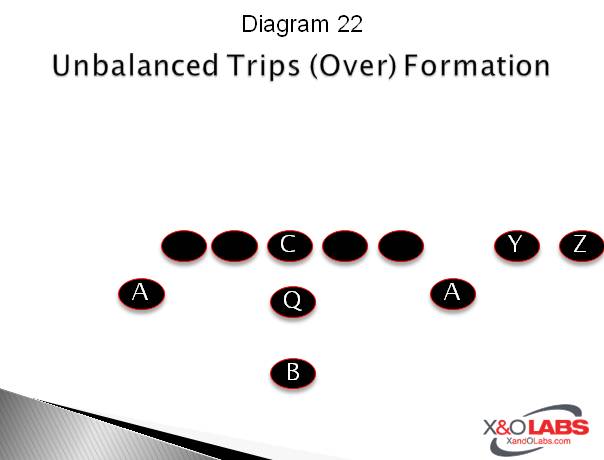
FORMATION:  UNBALANCED TRIPS or “OVER”  (Diagram 22)

Slide22

Philosophy:

This formation has been a common formation among option disciples.  When conducting our research, we’ve found the following maxim uttered on numerous occasions, “an unbalanced formation forces a defense to become unbalanced” and that’s how it can be manipulated. While we found this formation particularly effective against Even fronts, it can be just as productive against Odd fronts as well. 

Benefits:

  • Forces defenses to tip its hand by rotating their coverage- either to or away from the trips side.
  • Provides for a possibility of any of the three split receivers to be the pitch back.
  • Adds “girth” to the perimeter, which helps in perimeter blocking schemes. 
  • The use of motion can get second level linebackers to bump, thus declaring its intention. 

Commentary:

“The University of Hawaii gave us an eight man front, so we went receivers over unbalanced into the boundary or the field and they match with a Corner.  So now there is one less guy to deal with out to the play side.  We went back to the weak side of the formation with our option game. Against 4-3 defensive teams we will go wide receiver over to the field and they will condense and play Cover Two to the field.  They will walk the Sam out and split the difference.  They didn’t add a person out there so now we have four blockers for three players.  We get on the back side Safety in a heartbeat.”- Mike Judge, Naval Academy

“The slot could become the dive back in what we call a  “Flip” alignment.  The TB becomes the pitch player.  If we are in trips formations against an eight-man front, it gets linebackers to bump with that motion.  It’s the same read with the same blocking.  If they don’t bump, we run triple the other way.”- Tony DeMeo, former head coach, University of Charleston.    

“’Over’ calls for the WR on one side to align on the same side as the other WR. He is on the LOS and covered by the other WR making him ineligible but it does give us another perimeter blocker that some teams will not account for.”- Joe Bosley, Hereford HS (MD).

Read More

Shut Down Screens, Swings, & Sprints with These Blitz Checks

By Mike Kuchar – @MikeKKuchar

Senior Research Manager

X&O Labs


Editor’s Note:  The following research was conducted as part of XandOLabs.com special report on designing a pressure check system, which can be found in its entirety by clicking here.


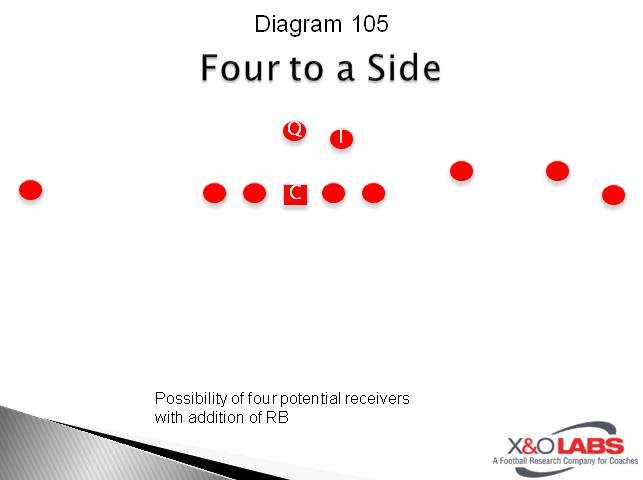
Four To A Side Pressure Checks To Defend Screens, Swings And Sprint Outs

Slide105

We wanted to combine sprint out protection beaters with a four to a side protection concept, which is usually utilized with the back set to the trips side.  There is a possibility of getting four out, which would usually dictate a pressure adjustment by the defense.  We’ve found that with the back set to the trips side there is an increasing possibility of some form of speed option or sprint out.  These protections will usually have a full gate with a TE and back off the edge or two backs off the edge changing the launch point of an offense.  The most common adjustment against sprint out concepts is to check the pressure to the receiver strength and get immediate edge pressure, forcing the quarterback to pull up prematurely and abort the run component of the run/pass option entailed in sprint out schemes.  One of the checks that Kuchinski uses is what he calls “Steve” which is a zone blitz designed to attack Sprint out. “We can run Steve out of multiple fronts,” said Kuchinski.  “We like running it out of the under frontso the gate including a potential TE stays away from our LB’s. Our DE to the pressure side has an Arrow tech on the Guard, our Nose has a Bull and Pull away from the pressure. Our DE away from the pressure has a Stab tech. Our OLB to the pressure has an Ice read on the TE/OT if he goes done on the Arrow DE the OLB will come tight down the LOS and inside of any backs (Diagram 106). If the TE/OT works out toward the OLB he will cross face into the inside gap (Diagram 107).The ILB toward the pressure side has a contain rush toward the up field shoulder of the QB and outside of any back to contain the rollout.”

Read More

East Carolina’s Top 7 Med Ball / Zone Drills

By Mike Kuchar

Senior Research Manager

X&O Labs


Read More

D Line Study: Case 1 – Shade Nose

By Mickey Mays
Researcher
X&O Labs

This report focuses on developing the shaded nose guard. Every four-down front plays with a shade nose, and he’s usually the anchor of the defensive line. One aspect of our research that we’ve found interesting is 39.5 percent of four-down front coaches play exclusively with a shade nose and a three-technique. They don’t cross train them. This tells us that these positions are specific, and they have to master different techniques. We also found that they are built in different ways physically. While we often visualize a shade nose guard as a massive defensive lineman always eating up two blockers, the reality is this may not be necessary: our latest survey showed that 39% of defensive line coaches prefer their NG to be 5’10 or shorter and one-third of the coaches would rather play with a quicker, smaller type (under 210 lbs.).

The fact is, of the six primary run blocks a shade nose guard must defeat only two are combo blocks. In reality, great nose guards come in all shapes and sizes, but two qualities all coaches agree a great nose guard must possess are not debatable: Being Physical and Mental Toughness.

For the purpose of this report, the six primary blocks and schemes a shaded nose must defeat are below. They will all be clarified later in this report.

  • Reach Block by the Center
  • O-Scheme
  • Double Team
  • Power Scoop
  • Loose Scoop
  • Joker Scheme

Case 1: Stance, Alignment and Key
Our nose guard survey responses included coaches on the college, junior college, high school, junior high school and youth league levels. The majority of coaches teach an inside hand down, inside foot staggered stance with a foot to crotch alignment (41.8%). The most frequent visual key being taught is the “V” of the neck, which 56 percent of coaches emphasize. The most effective way to coach each of these three areas is still to be highly debated and sometimes depends upon the individual player. Three outstanding and successful defensive line coaches, one high school, one FCS level college coach, and one professional defensive line coach gives us three different ways to coach stance, alignment and visual key.

The University of Delaware defensive line coach Phil Petite teaches all of his front to align 15 inches off the ball with their inside hand down and inside foot back. “Because we play against so many offenses that use zone blocking schemes, our first step was up field. But we were always getting our shoulders turned and playing behind the block. Now aligning off the ball allows us to play downhill with force. The first step is still a 6-inch step and the second step depends on the blocking scheme.” Petite does give his kids a “jet” call in long yardage which tightens them up so they can get off the ball and get to the quarterback.

Even though only 6.5 percent of our coaches teach their players to use a tilted shade technique, it still is prevalent in some levels of football. Former New York Jets defensive line coach Kerry Locklin, who spent eight years at Fresno State, gives his nose guards the freedom of playing a true, shoulder-squared shade or a tilt-shade. “Playing a tilt is different and you have to work at it because his visual key is now the back-side guard,” says Locklin. “At Fresno State, we worked the nose guards vs. a center and two guards pre-practice for fifteen minutes a day. He has to rep it and develop a feel for each blocking scheme but still attack the center with each block. His tilt is about 45 degrees with his inside hand down and inside foot back. Horizontal alignment may be a little different for each guy, the best alignment for him.”

While only 14 percent of defensive line coaches surveyed teach a footwork visual key, Tom Beason, defensive coordinator at Wichita Northwest High School in Kansas, would coach it no other way. “We play exclusively outside shades and key the outside foot. We got this from the University of Kansas a few years ago, and I love it. The offensive lineman can give us one of only three things:

  1. If his outside foot is at me or outside me, I attack the block with outside leverage.
  2. If his outside foot stays still, I know now he is releasing inside, so I have to attack his outside half, close down hard and move with my gap.
  3. If his outside foot is back, I rush the passer.

“Giving them only three things makes it a lot easier to teach and the players understand it. Plus, keying the outside foot keeps them lower on the snap.”

Case 2: Defeating a Reach Block and O-Scheme
The reach block by the center and the O-pull are paired together because these are the two primary run blocks the shade will get from the center only. Block recognition between these two is critical and with repetition the shade will be able to react to either without hesitation. While only 16% of coaches teach the shade to attack and rip up field vs. a reach block, over 40% teach an “attack the center mentality” by controlling the front side A gap and crossing face vs. a cutback into the back-side A gap.

Read More

D Line Study: Case 2 – 3 Technique

By Mickey Mays
Researcher
X&O Labs

The 3-technique’s B gap alignment puts him in position to make more plays than any other defensive lineman. The absence of bootleg and reverse responsibilities allows him to play faster than a defensive end versus the run, and his outside alignment over the guard often puts him in one-on-one pass rush situations. One of the biggest challenges a 3-technique faces is the number of blocks and schemes he must learn to recognize and defeat. Ronnie Eaves, defensive coordinator at North Hall High School (Gainesville, GA) agrees. “Without a doubt, he has to be football smart,” said Eaves. “And a first year player cannot play the 3-teachnique. There are just too many things going on around him.”

Our intent with this report is to show you all the run-block possibilities a 3-technique will see during the course of the game, and more importantly how to defeat them.

If you’re wondering how vital a solid 3-technnique is to defending the run game, consider the following statistics we pulled from a recent survey: 64.7 percent of coaches surveyed put their strongest and most athletic defensive lineman at the 3-technique position.

In order to develop the pro-typical 3-technique, 74.8 percent feel the ideal size for the position is between 6 feet to 6’2 and weigh between 201-225 pounds. That kind of size is needed to defend the strong side blocking combinations in the run game such as double team blocks and drive blocks. These blocking scenarios are the ones we will discuss in the report.

For starters, a 3-technique’s B gap alignment puts him in position to make more plays than any other defensive lineman. When compiling the notes for this report, we assumed that a common discussion among coaches would be whether to align him in the B-gap and jet him up the field on the snap or to align him in a true outside shade with emphasis on keeping the offensive guard off the linebackers. Although, only 11% of coaches teach B gap penetration pre-snap, we found it does have merit when protecting against reach schemes, which was one of the more common concerns among those surveyed.

According to Omaha Nighthawks (UFL) coach Pete Kuharchek, the main factor in this decision is the ability of the individual player. “If I had a really athletic and talented 3-technique I would align his inside foot on the outside foot of the guard and just tell him to penetrate the B-gap,” said Kuharchek. “His athletic ability will keep him from getting reached by the guard or cut off by the offensive tackle, and he can be a disruptive force in the backfield and a playmaker. His wider alignment and gap charge give him a better chance to destroy the angles vs. a double team. The lesser the athlete, the heavier he has to play on the guard – a better alignment to protect linebackers.”

For the purpose of this report, we will address the following nine blocking schemes a 3-technique will encounter in the run game. Each will be explained in detail:

Primary Blocks and Schemes:

  1. Reach Block: Guard gets hat to outside shoulder (single block)
  2. Fan or Turnout: Guard attempting to widen 3-technique outside and down the L.O.S.
  3. Double-Team: Drive block by guard + down block by offensive tackle
  4. Power Scoop: Drive block by guard + cutoff block by offensive tackle
  5. Loose Scoop: 45 and up by guard + cutoff block by offensive tackle
  6. O-Scheme: Inside pull by guard + back block by center
  7. G-Scheme: Outside pull by guard + down block by offensive tackle
  8. T-Fold: Turnout by guard + inside pull by offensive tackle
  9. Veer Release: Tight inside release by guard + release by offensive tackle

According to our research, the chance of a player becoming overwhelmed by the sheer number of possibilities must be a factor in personnel decisions. A fundamental goal should be teaching him how to defeat all blocks and schemes while taking the thought process out of the equation. The only way to get this done is turning recognition into reflex through key drill repetition.

Eaves does this by continually drilling what he calls his “Read Progression Drills” so that a 3-technique doesn’t have to think, just react to what he sees. These drills should be done daily.

Read More

D Line Study: Case 3 – 5 Technique

By Mickey Mays
Researcher
X&O Labs

The myth that football coaches can put their best big athlete at the open side end and “just let him go” is far from the truth. Though the open end may have more space and freedom to make plays, zone read option offenses, as well as one and two back counter and power schemes designed to attack the open side, force him to play assignment and technique within the defensive scheme. Also, his alignment, assignment, and technique may change depending upon whether he is aligned outside an A gap nose guard (B gap bubble side) or a B gap defensive tackle (3-technique).

For the sake of clarity within this report, we will refer to the shade side defensive end as a 5-techniqueand a 3-technique side end as a Ghost 7. Illustrations of two defensive fronts, an open side 5-technique in a “4-4” (or “4-2-5”) and a ghost-7 technique in a “4-3 Under” front are included.

Initial reads from offensive tackle:

5-Technique (A gap D.T. side)

  1. Reach
  2. Fan (Turnout)
  3. Veer Release
  4. Scoop Away
  5. Inside Pull

Ghost 7 (3-Technique Side)

  1. Reach
  2. Fan (Turnout)
  3. Down (on 3-tech.)
  4. Scoop Away
  5. Inside Pull

Our survey responders placed a heavy interest in defending two open side runs: the Zone Read option and Counter O.T. While the Counter O.T. (also known as the 1980’s Redskins’ Counter Trey) has stood the test of time, defending the zone read has only recently become a priority in high school football. This report will place an emphasis on defending these two open side runs. Because a specific technique for a defensive end must fit within the total defensive scheme, we will include the other defender’s responsibilities within the diagrams used.

Case 1: (Part A) Open Side 5-Technique Stance and Alignment:
Our research found that the most frequently taught alignment (40% of coaches) is (1) foot to crotch or outside eye on the offensive tackle, 32% of coaches surveyed teach (2) an inside foot to outside foot (tip-5) alignment, and 25% prefer (3) a tilted stance, targeting the “V” of the offensive tackle’s neck.

“We align the open-side 5-technique a little wider and slightly tilted. He should never get reached because of alignment, and he is in position to shoot his hands and friction a veer release,” said Rex Norris, former college and NFL defensive line coach. A fourth option is widening the open end to at least one foot outside the offensive tackle. All four alignments have their advantages: a foot to crotch alignment better ensures keeping the offensive tackle off linebackers; a tip-5 alignment puts the defensive end in a better position to play a reach block and play a “chase” technique vs. flow away; a tilted stance gives the 5-technique a better angle to read the tackle/near back/far guard triangle and attack kick-out blocks; and finally, a wide 5-technique gives an athletic defender more freedom to be a play maker and mesh charge a quarterback vs. option. The question that must be answered, “How much of a collision do we need vs. an inside release by the offensive tackle?” is a major factor in this alignment decision.

(Part B) Open Side Ghost 7 Technique Stance and Alignment:
Because there is no B gap bubble to the 3-technique side, 38 % of defensive coaches teach an alignment of at least one foot outside the offensive tackle. However, a surprising statistic was revealed from our survey: We found that 34% of defensive coaches teach a tip 5-technique or tighter alignment to the open side, even with a 3-technique tackle aligned in his B gap.

A potential problem with a wide alignment, as explained by longtime Harnett Central High School (N.C.) defensive coordinator Bill Wyrick, is getting trapped. “The wider we align him, the better chance he has to run up the field and get kicked out.” Wyrick added, “Versus a down block by the offensive tackle, we teach him to read near back (for kick-out) to off-side guard. We will always play our open side end in a foot to crotch 5-technique, squeeze the tackle’s inside release and make sure we spill all kick-out blocks.”

Though a tight alignment may be a good starting point, an argument for playing a wider technique (one foot to one yard outside) may be supported by the following: first, a wider alignment gives him much better initial leverage for a contain rush vs. drop back pass, sprint-out or boot-leg. Secondly, the offensive tackle must block down on the 3-technique vs. any power or counter play run to the open end side, and a wider alignment puts him in a better position to read through the offensive tackle, near back, far guard triangle and still spill a kick-out block. It should also be noted that a tilted stance by a wider alignment (Ghost 7), which is taught by almost 25% of defensive coaches, will give the end a better angle to flatten, attack, and spill kick-out blocks.

Read More

D Line Study: Case 4 – 7 Technique

By Mickey Mays
Researcher
X&O Labs

Ask any defensive coach and he’ll tell you that defending the C gap – the gap located between the play side tackle and tight end – is essential in stopping the run game. Conversely, the C gap is also where many offensive coordinators want to attack with their run game. Attacking the C gap is a sure-fire way for offensive coordinators to assess how strong your defense is up front. Its guts vs. glory. Can you handle the pressure that a tight end places on the defense by creating that extra C gap? Just for clarification purposes, this report focuses on a three-man surface, complete with a tight end. If you’re a pure spread guy, you may not have a legitimate tight end. If you’ve noticed, recent success from spread teams like Florida, Oregon and Boise State have all come because of the physicality that a tight end presents. So once he lines up next to the tackle, how can you protect it?

Our research found that almost 50% of defensive coaches play a variation of a 7-technique at least half the time within their defensive schemes. We’ve found that this number is significantly higher than it was over ten years ago. Many originators of the 4-3 front would employ a 9-technique defensive end who would play on the outside shoulder of the tight end. He would be responsible for the D gap, while a stacked outside linebacker would be responsible for the C gap. But some teams didn’t have the talent or the size to play the C gap with a second level player and started getting gashed by gap schemes like power and counter. It then became necessary to leverage that C gap with a down lineman on the line of scrimmage rather than a second level linebacker. It’s important that these defensive linemen convert recognition time into reaction time. This process requires a complete understanding of blocking schemes and a knowledge of how to physically defeat each block. It’s our intent in this report to provide information so defensive line coaches can either verify the stance, alignment and techniques they are currently teaching or discover a better way to coach a specific detail for a 7-technique. On a personal note, I learned a lot from working on this report and will make some adjustments to what I’m doing as Defensive Coordinator at Sequatchie County High School (TN).

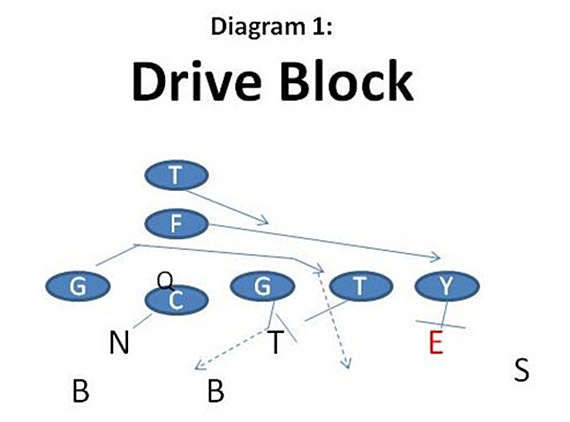
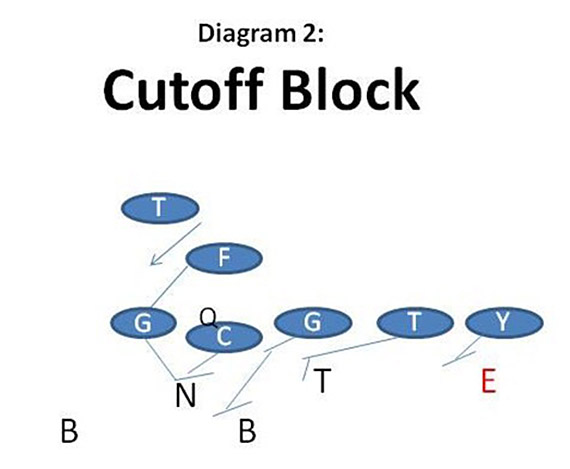
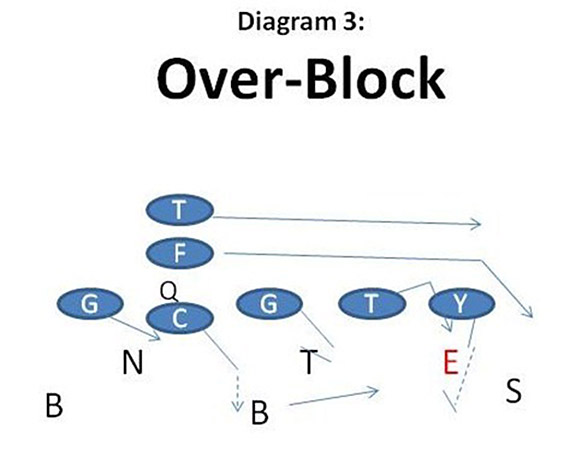
For verbiage purposes, there are six blocks and schemes a 7-technique must learn to defeat. They are identified below and will be further explained in this report. It’s important to note the corresponding diagrams based on each blocking scheme. They will be referenced continuously during this report.

A drive or base block by the tight end (diagram 1).

Drive Block

A cutoff block by the tight end, where he will try to gain leverage in the C gap (diagram 2).

Cutoff Block

An over-block by the tight end and offensive tackle (diagram 3).

Over-Block

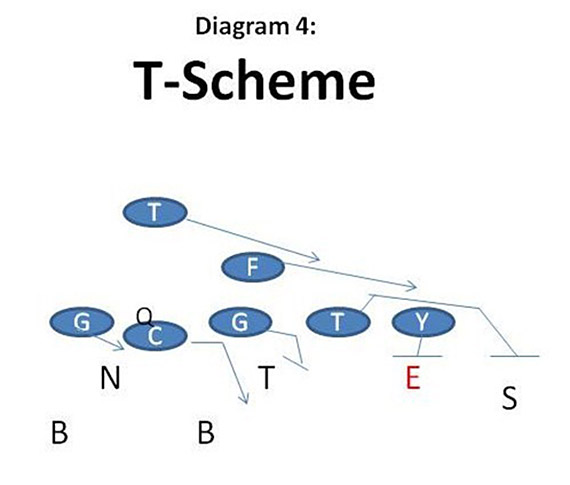
A “T-scheme” by the tight end and offensive tackle (diagram 4).

T-Scheme

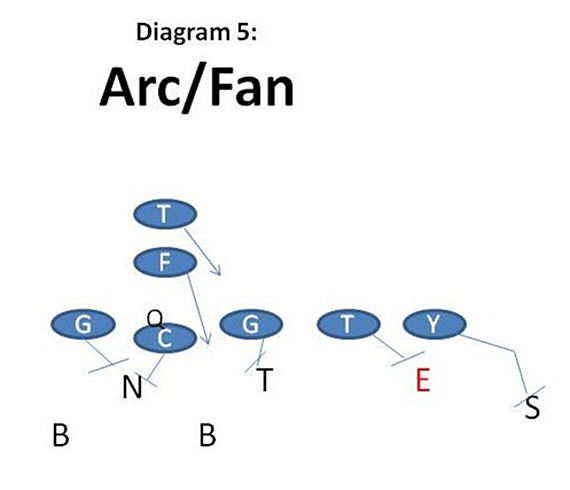
An arc release or fan by the tight end and offensive tackle (diagram 5).

Arc/Fan

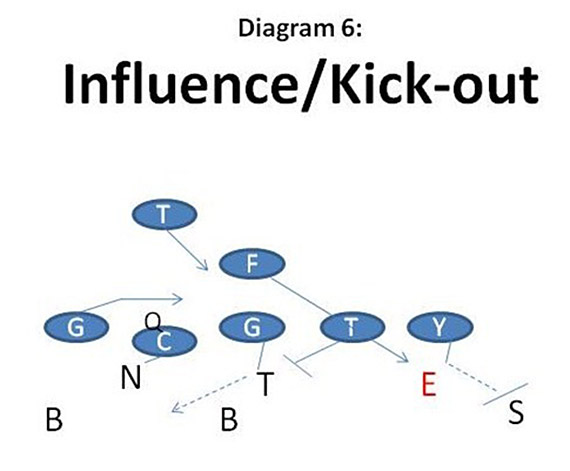
An influence/kick-out by the tight end and a back or pulling offensive lineman (diagram 6).

Influence/Kick-out

Case 1: Stance, Alignment and Visual Key

Read More

D Line Study: Case 5 – Defeating Run Blocks and Schemes

X&O Labs’ Mickey Mays takes you on-field to present our research and findings on how to best defeat run blocks and schemes. Due to length, we separated this video into two segments – Part 1 and Part 2. Both videos are available below – on this page.

These videos are enabled to play on any computer and most mobile devices such as smart phones and tablets. To watch these videos with your coaching staff or players, we recommend you connect your computer to a projector.

To maximize your viewing experience, we recommend you close all programs and windows you are not using prior to watching these videos. If you experience any buffering issues, just “pause” the video for a moment and then press “play.”

Defeating Run Blocks Video, Part 1:

Read More

D Line Study: Case 6 – Defeating Pass Blocks and Schemes

X&O Labs’ Mickey Mays takes you on-field to present our research and findings on how to best defeat pass blocks and schemes.

This video is enabled to play on any computer and most mobile devices such as smart phones and tablets. To watch this video with your coaching staff or players, we recommend you connect your computer to a projector.

To maximize your viewing experience, we recommend you close all programs and windows you are not using prior to watching this video. If you experience any buffering issues, just “pause” the video for a moment and then press “play.”

Defeating Pass Blocks and Schemes:

Read More

Breaking Off Routes

opalenickBy Joseph Opalenick

Wide Reciever Coach

Wilson High School (PA)


Offensive schemes and terminology have exploded across the football landscape over the past two decades.  The informational trickle-down effect from the N.F.L. and college levels to the high school ranks has produced many intricate and impressive offensive identities.  As the West Coast offense made its way through in the 1990’s, it opened doors to more creativity.  The Spread offense took form with the emergence of the shotgun formation and the Pistol and Read Option attacks are in high demand.  New technology has allowed coaches of all levels to have access and share ideas.  Wrinkles are added to the basic concepts and the process of evolving keeps growing and never stops.

As this evolution process continues, sometimes terminology and philosophy can get confusing.  One coach can label a certain term or concept, but that same term could have a different meaning or become misinterpreted in another coach’s scheme.  Vocabulary and verbiage can run together.  One term that seems to be universal in wide receiver play that can take on a variety of different meanings is the term “breaking off a route”.  It is important that we distinguish the differences of how we are defining such a term.  The following are examples of how the term “breaking off a route” is used within the football program at Wilson West Lawn.

The first area that we incorporate “breaking off a route” or “route breakdown” is within our simple 3 and 5 step break patterns.  Certain stem patterns where we work to a certain depth and utilize breakdown fundamentals can be defined.  Routes such as hitches, curl/hooks, comeback/sideline patterns, etc. are all pre-determined routes that are run to pre-determined depths within each concept.  We teach our release techniques in terms of pre/post snap reads and identifiers.  By breaking the field into vertical quadrants we can now understand who and what we are attempting to attack.  We distinguish releases in terms of drop zone/soft man, press man and Cover 2.  We then further distinguish releases by identifying horizontal levels within the vertical quadrants.  This helps to understand what release techniques to utilize in attacking defenders.  Each fundamental taught within the release concepts can be applied to all quadrants/levels.  Level 1 consists of beating a defender in the area between the line of scrimmage and 5 – 6 yards.  Level 2 consists of the intermediate area extending from 6 yards to 15 yards.  Level 3 identifies a deep defender 15 yards and beyond.  Basically, all soft zone/man techniques can be applied.  Eventually, each coverage turns into man coverage at some depth point. 

Read More

Eastern Washington’s Squat and Kathy Cover Two Techniques

By Cherokee Valeria

Cornerbacks Coach

Eastern Washington University


eastern washingtonEditor’s Note:  Coach Valeria is entering his third year as cornerbacks coach at Eastern Washington University.  In all, he has 9 years of college coaching experience with seven of those years coming at the Division I – FCS level and two at DII level.  During that time, he has mentored six All-Conference Cornerbacks and two All-Americans.  He has also served as Assistant Recruiting Coordinator and as Director of Football Operations during his career.  Both starting corners won All Big Sky Conference honors both years he has been at EWU.
 

Introduction

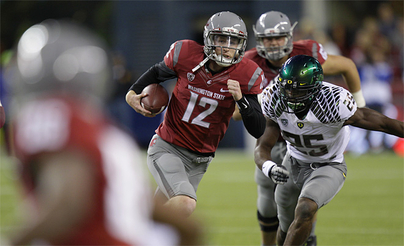
Eastern Washington University prides itself on being a defensive football team, often finding itself in the thick of the FCS playoffs each season.  The Eagles are primarily a Quarters coverage team that mixes in Cover 2 and Zone Pressuresout of a 4-3 Front.   Eastern Washington’s Cornerbacks coach Cherokee Valeria sat down with XandOLabs.com Mike Kuchar to talk about the two ways in which he teaches his Corners to play Cover Two- a “Kathy” technique and a “Squat” technique.   According to Valeria, he uses those techniques based on what type of Cover Two you’re going to be playing.   “If we play true five underneath and two over the top we will play a Soft Technique which we call Kathy,” said Valeria.  “If we’re going to be playing four underneath with a middle hole run through defender(similar to Tampa 2?), we will play a hard technique which we call Squat.”

Coach Valeria explains what the difference is between his Soft and Hard Techniques: “When we say we are going to play a Soft Technique, we mean that the technique will be executed with little to no planned physical contact. When we say we are going to play a Hard Technique, we are telling the Cornerbacks that we are going to physically attack the Wide Receiver with this Technique. It’s the same idea behind playing Hard and Soft bump coverage.”


Strengths and Weaknesses of the Techniques

Kathy Technique Strengths:

  • Easy eye progression, with Run/Pass keys coming directly from the Quarterbacks release from Center. This allows a quicker run fit by the Cornerback on bubbles, screens, and run action to him.
  • Allows Cornerbacks to sink quicker with vertical routes, particularly against four verticals).

Kathy Technique Weaknesses:

  • No physical re-routes; wide receivers may get clean releases.
  • Weakness: Angle Walk pushes Corner further away from the quick slant.

Squat Technique Strengths:

  • Physically disrupting the release of the Wide Receiver and in turn the timing of an offensive pass play.
  • Staying “on cliff” (without backing up) allows the Cornerback to insert himself faster against the quick pass game.

Squat Technique Weaknesses:

  • Often late on outside run actions and bubbles.
  • Harder to defend the hole shot between the Corner and the Cover 2 Safety.


Quarterback Keys

Before we address the specific techniques behind both coverages, Valeria teaches his players to key the QB for four specific reads post-snap:

  • 3-step read- QB takes three-step drop from Under Center, or one step drop from shotgun alignments.
  • 5-step read- QB takes five-step drop from Under Center, or three step drop from shotgun alignments.
  • Run action towardsthe Corner.
  • Run actionawayfrom Corner.

The Corners responses are predicated on these three reactions.  All of these reads have corresponding techniques that will be address in this report. We will begin with Kathy Technique. 


KATHY TECHNIQUE

Philosophy of Base Cover 2

Base Cover 2is a soft cover two coverage where the Corners could be soft on the outside while allowing the linebackers to be hard on the inside.  According to Valeria, this coverage is based off down and distance.  “Any time we are hard on the outside with the Corners, the backers will be soft and the safeties could expand on the hash,” said Valeria.  “Any time the Corners play soft, the outside backers play hard while the safeties can hold the hash.”

Read More

Combating Gap Exchange with the Option

By Mike Kuchar

Senior Research Manager

X&O Labs


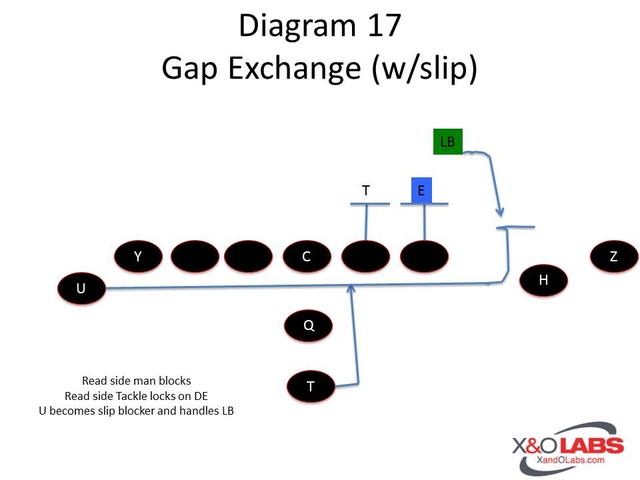
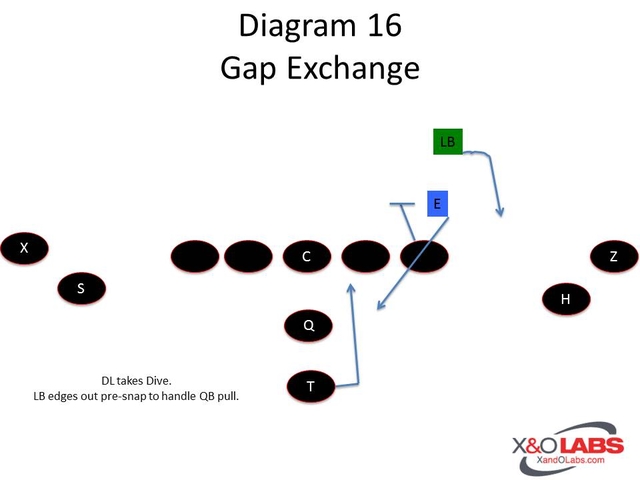
One of the more common defensive adjustments to zone read teams is known as a gap exchange- the most common being a first level and second level defender.  According to Norcross, these were the most common counters defenses would have against zone read concepts.  Many defenses would tighten the alignment of their defensive ends to allow them to squeeze down blocks while second level linebackers can scrape over the top to play the QB (Diagram 16).  Norcross recounts a time that Nevada encountered this exact problem when playing Boston College in a bowl game a couple years back.  “We could never get our Tackle down to block the play side inside linebacker,” said Norcross.  “So we told the Tackle to block him so our slip guy could block the play side inside linebacker (Diagram 17).  The alley player would be free.  So we ran our arc scheme to the Tight End side so we didn’t need to run the ball at the Tackle. We basically man schemed the back side (read side) of the play. Our Tackle was responsible for him so we can take our tight end/wing back on the alley player.

Slide16Slide17

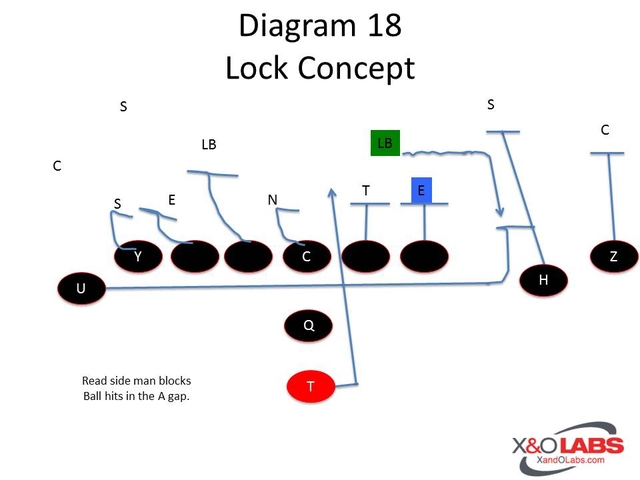
This became the birth of what is known as the “lock” concept for zone read teams.    Lock is an answer for teams that scrape with linebackers.  Lock would be a call given by the Tackle (or from the coaches in the booth) if teams see a tight alignment by the C gap player or perhaps the second level linebacker cheating a bit outside.  “Teams are having their DE crash and play the A gap, with their LB as the C gap player and the 3-technique being the B gap player,” said Norcross.  “ When you lock it, the DE can’t be the A gap player, the LB still thinks he’s the C gap player but you have no one in the A gap.   We got a bunch of folks like that.  It was basically dive to the back (Diagram 18).”    Bruce Barnum, the head coach at Portland State University will even get his offensive Tackle to flash his hands (to simulate pass) in order to confuse that read key.  “We will have our Tackle go right now, or he may even flash his hands to the DE to show him pass and then go get B gap defender.  You can play so many games with that poor guy.  I need to know who is taking the dive and who is taking the QB.  I’ll watch it each time in case you’re going to change it up.”

Slide18

The same thing can be done to the Tight End side, or what Nevada calls the “master lock” concept, which is a call that would be made from the sidelines when Coaches could see the backer cheating over the top.  In these situations, the Tackle can’t get down on the three-technique because the play side linebacker is out immediately.  So, lock becomes the read (Diagram 19).  If they are in a 4-2 look and we would be reading that inside linebacker, he would arc to the outside linebacker.  He just had to know whom we were reading.   He would read the backer once he sees him fading out hard. We would carry it in every game particularly if we had trouble getting to that backer.  The Tackle is on the DE, the Guard on the DT while the front side is blocked he same.  Guard and Tackle are locking on the down lineman (they are fanning it) they become man.  The read goes from the DE to the inside backer now.  If we blocked the Tackle down, we would have two read keys- the end and the backer.  Lock means the offensive line locks on the defensive line.  The only thing we take away is the Tight End on his arc block. If we were in slot, we wouldn’t run it to the weak side because we would have a player spitting the difference between the Tackle and number two. “

Read More

Effective Pressure Checks to B.O.B. Protection

By Mike Kuchar

Senior Research Manager

X&O Labs


Editor’s Note:  The following research is part of our full-length special report on developing a pressure check system, which can be found in its entirety by clicking here.


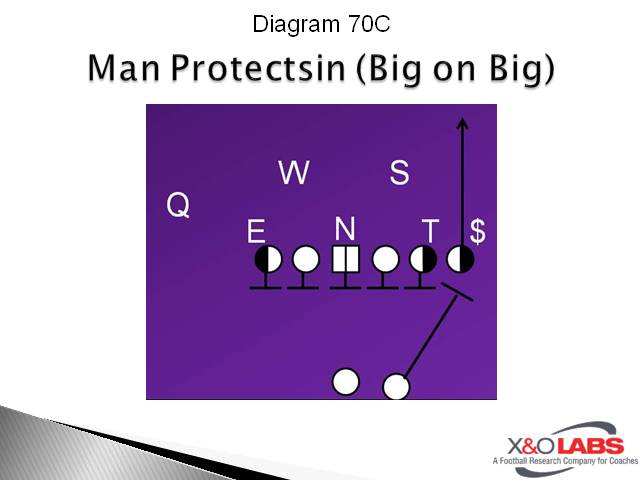
Attacking Man/BOB Protection

Slide70c

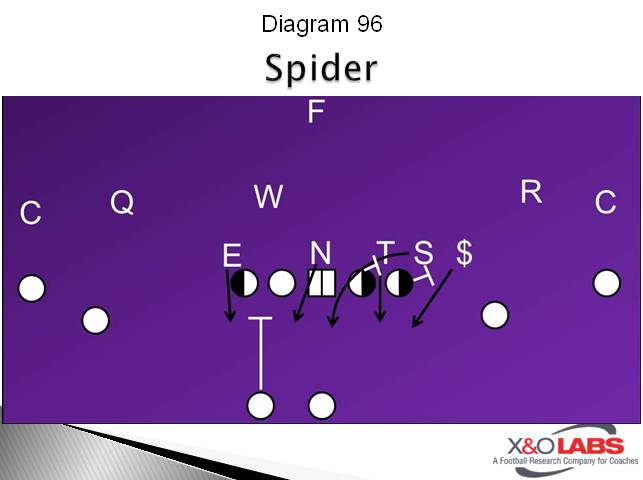
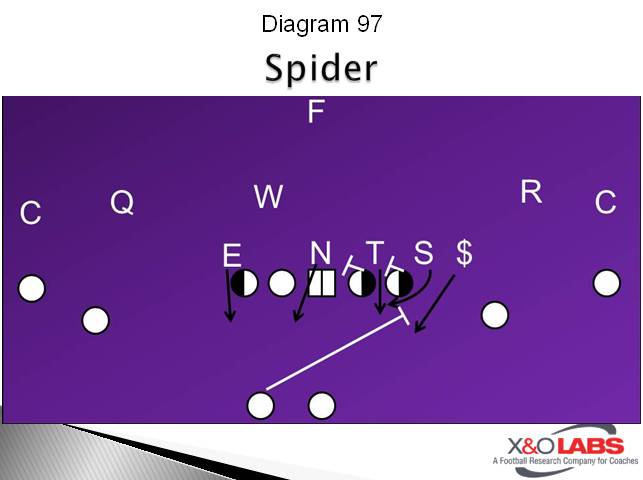
Man protection is typically referred to B.O.B. or “big on big” protection. It can be difficult to attack, particularly if an offense has two backs in protection, making it a seven-man concept.  It becomes difficult to get a free hitter.  We’ve found that most coaches prefer to use some sort of Gut, or double A gap pressure, to attack man protection schemes.  While there are certain checks that defensive coaches use to attack this protection, Kuchinski’s answer has been to use a combination of twists by bringing linebackers.  In his system, Spider is a man beater that allows the ILB to the pressure to come free.  “We can run this out of many fronts but we need at least a three-technique to the side of the blitz so he can draw the attention of the OG to fan out on him, thus allowing an A gap entry point.”  In Spider, the OLB pressures off the edge getting to the up field number of the QB while the three-technique to the side of the pressure has a vertical B gap rush. “Our nose is a Bull ‘n Pull guy away from the pressure. The DE away from the pressure is a Stab player and is responsible for speed to power collapsing the pocket and up field shoulder of the QB. The ILB to the pressure bubbles in the C gap with his inside foot forward and has a read tech on the OT. As the ILB takes his step if the OT works out to him he stays tight off the vertical 3 tech and works to the A gap coming free (Diagram 96).  If the OT works down on the 3 tech he comes off the edge staying inside of the back (Diagram 97).

Slide96Slide97

 To see cutups of the Spider concept, click on the link below:

Read More

Winning the Numbers Game


By Jeremy Darveau – @CoachDarveau

Former Offensive Coordinator

Southwest Minnesota State University


Mustang PlayEditor’s Note:  Jeremy Darveau just finished his sixth season on the SMSU coaching staff as the team’s offensive line coach and his first as the offensive coordinator.   The Mustang offense has never been more potent than it was in 2013. SMSU broke numerous school and conference records including total offensive yards, rushing yards and total points scored. The SMSU offense also produced a school first Harlon Hill Trophy finalist in Running back Tyler Tonderum. Darveau also oversaw an offensive line that produced three All-NSIC linemen as well as 2 All-Region offensive linemen and one All-American.


INTRODUCTION

It doesn’t take a Mike Leach, Chip Kelly or Gus Malzahn to realize every single offensive snap counts. When we first installed our spread scheme early this year we installed it with the mindset that we want to spread the defenders on the field both vertically and laterally. Our goal is not to out-physical you, in fact, it’s not even to out scheme you, we will be successful by winning the numbers game.

In the fall of 2010 we were presented with a common problem that plagues every offensive line coach in the country, how do we run versus an overloaded box? Our first solution was to pull our wide receivers graduate assistant to the side and berate him for his player’s inability to dig out a linebacker playing in the box (oh, the life of a graduate assistant…) needless to say that had little or no effect and we had no success. Our next solution was to just call passing plays if we were seeing a lot of overloaded boxes. That basically turned into a guessing game, we ended up guessing wrong as much as we guessed right.  So in early 2011 we decided to experiment with combining various runs with pass options attached to handle the overloaded box. This was an immediate home run.

Since developing our system of packaged plays we have had tremendous success; we became the #1 offense in school history, we broke 23 team school record, we broke 17 individual school records, we produced our first ever Harlon Hill candidate (D2 Heisman) and we led our school to its first ever bowl appearance. We could not be more pleased with the results.

WHAT YOU NEED TO WIN THE NUMBERS GAME

Read More