Is 11 Personnel the Ideal Pistol Grouping?

By Mike Kuchar

Senior Research Manager

X&O Labs


When conducting our research on the Pistol formation, we’ve found that over 30 percent of coaches choose to use a attached tight end when implementing the Pistol. While many believe the Pistol is most commonly synonymous with doubles and trips sets,  the truth is that the Tight End is the most influential tool in the offense.  The benefits are various and are explained in detail below. 


Editor’s Note:  The following research is part of XandOLabs.com special report on the Pistol formation which can be found by clicking here.


The Case for an Attached Tight End

11,12,13,21 Personnel

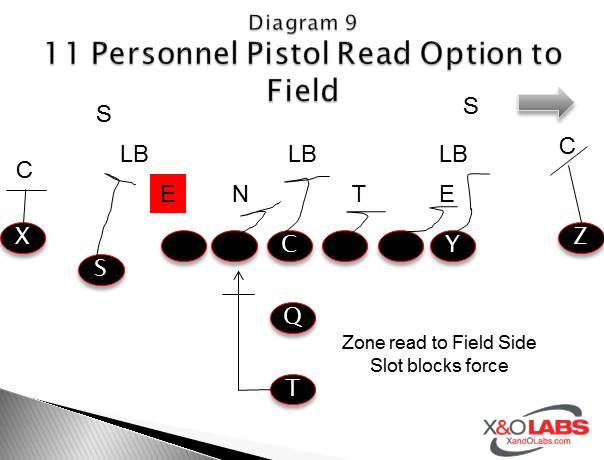
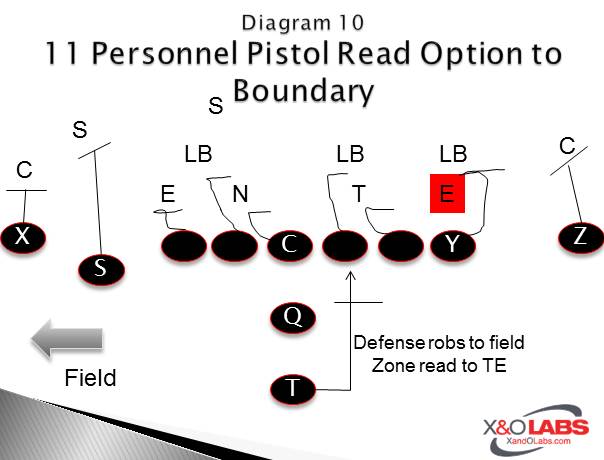
As long as your personnel gives you the ability to do this, using an attached Tight End could cause a multitude of problems of the defense which includes:  creating an extra gap in the run game, getting another talented threat downfield in the pass game, stretches out a defensive front and makes the defense declare their strength, being predictable in doing so.  We’ve found the most common personnel grouping in the Pistol formation to be 11 personnel, which over 30 percent of coaches choose to use.  One of these coaches is Paul Brown, the offensive coordinator at Blue Valley High School (KS) who will be in one-back Pistol formations more than 90 percent of the time.  One of the reasons Brown does is to make defenses declare their strength.  It almost becomes a guessing game for him as a coordinator.  Often times he will put his Tight End into the boundary- just so defenses can set their front there- than run his zone option game into the field (Diagram 9).  If a defense decides to rob to the field side, he’s got numbers in the zone read game back into the boundary (Diagram 10).  We will detail Coach Brown’s option scheme more in Case Three.

Slide9Slide10

Mike Hallett, the head coach at Heidelburg Unviersity runs his Pistol out of a base 21 personnel grouping, but will also be in 11 and 12 personnel depending on the year. 

Read More

DB Drills – University of Louisville

By Mike Kuchar

Senior Research Manager

X&O Labs


Former University of Louisville defensive coordinator and 39-year coaching veteran Mike Cassity shares the every day drills he does with his defensive backs at Western Kentucky University.  Cassity, a journeyman in the coaching ranks, had prior stops at FBS programs such as Kentucky, Marshall, Cincinnati, Baylor, Georgia Tech, Eastern Carolina and Oklahoma State University.  See the video below:

Read More

WR Drills – Clemson

Clemson head coach Dabo Swinney coached his wide receiver position to a level of consistency that had not been seen previously at Clemson. Before becoming a head coach, he had a wideout finish first or second in the ACC in catches in five of his six years as an assistant. In his first year, he had three of the top-10 receivers in the ACC, a first in Tiger history. He has coached a First or Second-Team All-ACC wideout (Derrick Hamilton, Airese Currie, Chansi Stuckey, Aaron Kelly, Jacoby Ford, and Watkins) in eight of his nine seasons at Clemson, also an unprecedented feat at Clemson. The video below outlines Coach Swinney’s WR drills.

Read More

7 Ways to Block Wide Shades in the Outside Zone

By Mike Kuchar – @MikeKKuchar

Senior Research Manager

X&O Labs


Introduction

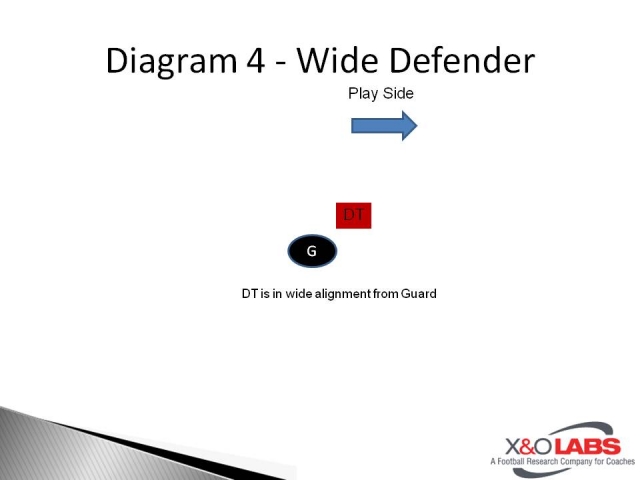
One of the problem areas offensive line coaches struggle with in the outside zone scheme is how to man block wide techiques in the outside zone or stretch concept.  If that block is not made at the point of attack, the threat of first level penetration occurs, thus styming the rhythm of the play.  Our research presents up to seven variations coaches are using to get those wide defenders accounted for at the point of attack.


Editor’s Note:  The following research is part of XandOLabs.com special report on the middle and outside zone concept.  The full length report can be found by clicking here.


Blocking Wide Techniques

Slide4

Drop & Pop Technique

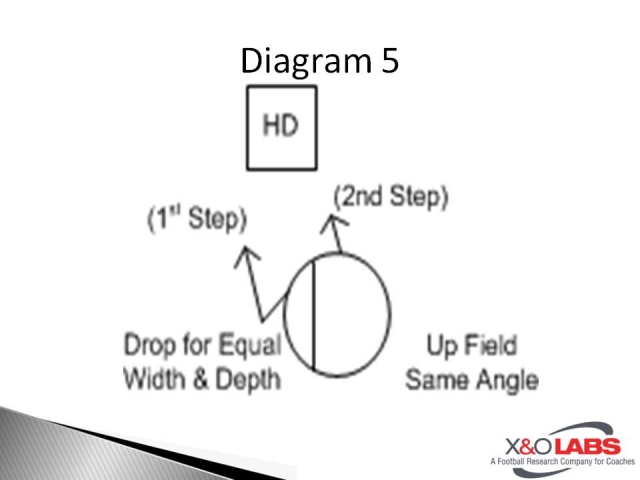
When defenders are in a wider alignment, Donatelli will use what he calls drop and pop footwork in his middle zone concept.  In this technique the play side foot drops, steps behind the L.O.S. for equal width and depth to achieve “Big toe/Little Toe” Landmark.   The second step is on the same angle but again on an up field attacking angle.  We utilize this footwork for  attacking a hard defender off of our body’s or when piercing the backside second level.

Slide5


To see how Coach Donatelli teaches the Drop and Pop Footwork, click on the link below:

Read More

Dressing Up the Power


By Rick Lytle

Offensive Coordinator

Euclid High School (OH)


Editor’s Note: Coach Lytle is serving as the Euclid High School Offensive Coordinator where he has served in that capacity since 2000.  Prior to that, Rick was the head coach at Beachwood High School from 1998 to1999.  He started his coaching career with six seasons at Lake Catholic where he served as Offensive coordinator (1995 – 1998) and QB Coach (1992 – 1994).


euclidrbIt seems everyone runs some version of the “Power” play.   Some may describe it as a counter play but since we do not have any counter action in the backfield we have just called it our power play.  My concept of a power play is when the front side of the line blocks down, somebody kicks out the front side “C”  gap player and somebody will lead through from the back side to a front side linebacker.  So whatever you want to call this play it is a downhill aggressive play that when we run it well we are tough to beat.  When we struggled to gain yards on this play then we struggled as an offense to move the football.

I have been coaching for over 20 years and the power play has always been a big part of our offense.  We used to run from under center but we now very rarely get under center so we now run it out of the pistol formation.  Two years ago we made the switch from putting the back to one side of the QB in the shotgun to now we are in the pistol formation most of the time.  We made this switch for a variety of reasons.  Two of the biggest reasons were we like to run our QB and that is hard to do from under center. Second reason was we like the idea of our back coming down hill and the pistols allows that to happen.

I would like to share a few philosophical reasons why we like this play and then I will get into the specifics of how we teach it.  Also through this article I will share the following topics pertaining to this play;

  1. Personnel grouping
  2. Formation we will use
  3. Responsibilities of each position
  4. Variations & adjustments


Philosophy:

Read More

Pistol: Case 1 – Philosophy & Formations

By Mike Kuchar


The Origins of the Pistol Formation

Jim Mastro remembers the day like yesterday.  The former Nevada running back coach- now handing the same responsibilities at Washington State University- recalls the time that former Nevada head coach Chris Ault bursts into the football offices with a pre-conceived idea that at that time might have been seen as football blasphemy.   In 2005, the Wolfpack were having a hard time with their QB getting the proper depth on his pass drop from pro typical shotgun formations.  “When he was supposed to be at seven yards, he was at six,” said Mastro.  “When he was supposed to be at nine yards he was at seven.  The conversation started with ‘how are we going to get the QB away from the Center easier and faster?’  

“Finally Coach Ault came in one morning and said ‘let’s go downstairs and let’s talk about this.’  He didn’t like the shotgun.  For the few years that he was out of football  (as an Athletic Director at Reno) the shotgun became trendy.  When he came back to coach again, we had all (his staff) coached in the shotgun but he didn’t like it because your run game is East and West.  He liked the idea of the shotgun, but we wanted the downhill run game.  We decided to move the QB up and put the back right behind him.”

Thus, the birth of the Pistol formation.  What started as a shot-in-the-dark notion now has become all the rage in the high school, collegiate and even professional ranks- thanks to the success that Colin Kaepernick, the former Wolfpack QB- has basked in San Francisco.  It’s no surprise considering 49ers offensive coordinator Greg Roman logged a good deal of time in Reno studying the formation while he was an assistant at Stanford University.  “Some of the things we talked about they are doing,” said Cameron Norcross, a former Nevada offensive line coach now at the same position at Fresno State University.  “ When they are bringing backs and tight ends across the formation to block alley players- that is what we made our money on at Nevada for years.  We always tried to gain blockers on the opposite side.  I see it from the Redskins and 49ers.  I guess imitation is the highest form of flattery.”

But according to that Nevada staff, the now sought-after zone read element of the offense wasn’t part of the original plan.   Nevada was already successful running its gap schemes and it’s downhill inside zone schemes from the Pistol.  The zone read game wasn’t necessary.  According to Mastro, it transformed into the zone read when Colin Kaepernick came to town.  “He (Colin) was a freshman and Nick Graziano was our starting QB. They were both freshman.  Graziano could throw the heck out of the ball.  We were playing Fresno State and Nick Graziano gets hurt in the second quarter of the game by breaking his ankle.  In comes Colin as a redshirt freshman.  In one half of football, he threw for about 400 yards and ran for another 80.  The next week was going to be his official start and we’re going up to play Boise State on a Friday night on ESPN.  That’s the game that ends 69-67 in a triple overtime game.  Colin winds up throwing for 250 yards and runs for 170 more.  Therein lies the beginning of zone read football from the Pistol formaion.  What we saw we had in him, that’s how it began.  Then after making every mistake you can within a year or two we finally came up with a pretty good finished project in 2008, 2009, 2010.” 

Why this Report?

That finished product will be the focus of our special report on the Pistol formation.  It’s important to note the Pistol formation is in fact, a formation, not so much an offense.  That’s something we learned while putting this together.  We were originally hell-bent on the philosophy that this was a structured offense with it’s own set of verbiage and methodology and it may have certainly been at Nevada in the early days.  Now, we’ve found literally hundreds of coaches that are simply finding ways to implement their system, concepts and protocols to fit in the Pistol formation.  Quite frankly, it’s taking off and taking off quickly. In fact, 52.2 percent of coaches have begun to use the Pistol formation the last 1-2 seasons.   Only 4.9 percent of coaches implemented the Pistol (in any form) between 7-10 years ago, roughly when the scheme started. 

None of which was a surprise to those native Nevada coaches who were there during its conception.  They knew they had something special and they believed in what they were doing, even if no one else did. “The one commitment we made is that we were going all 15 days that spring in 2005 by running the scheme,” said Chris Klenakis, the offensive coordinator under Ault.  “ We would not scrap it come Day 8 and then dump it. We went all 15 practices and made a commitment.   At the end of those 15 sessions, we figured we got something here.”

Oh, they got something all right.  Perhaps the newest innovation in offensive football.  So, it took eight seasons to completely come to fruition.  But its here now and by the looks of our research, it’s not going away anytime soon.  Our HUDL account was inundated with dozens of coaches- many of whom at the top levels of football- willing to contribute some of their concepts from the Pistol.  It’s our pleasure to present our gatherings in what we feel is the largest collection of data on the Pistol from the originators- five of whom were on Ault’s original staff- to the many who have tweaked Ault’s original blueprint to fit their needs. Enjoy the contents below.  It was a long time coming for us. 

Why the Pistol?

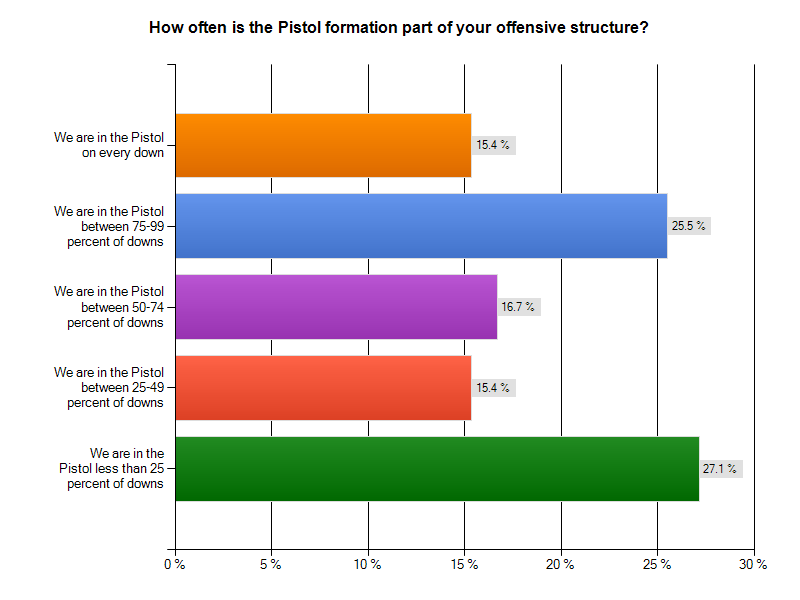
We’re certain that are still many coaches that want to find the evidence behind this.  Many who are still a little cautious about dipping their feet into the “Pistol” waters and using this scheme full time.  It’s a realistic thought, considering what we assumed would a major time commitment to implement this scheme.  Although years ago the decision made by Ault and his staff were to commit to it full time, we’ve found that there are many coaches who just use parts of it in their offensive system.  When we asked this question, we’ve found coaches split down the middle.  26.7 percent of coaches said they are in the Pistol less than 25 percent of downs while 26.0 percent are in the Pistol between 75-99 percent of downs.

prdata1

Read More

Pistol: Case 2 – Base Run Concepts

By Mike Kuchar


Introduction

In this case, we will focus on the base run game concepts most associated with Pistol formations.  Our intent is to detail the play, the specifics of QB mechanics and provide research on new trends of the scheme.  We will not direct much attention to the blocking schemes surrounding each play.  In the interests of time and space, there are other means in which you can go about finding that information.  As we were conducting our research on this scheme, a prominent NFL assistant told us “You can base your entire offense off the Pistol.  I don’t know why many coaches aren’t.”  Well, if nothing else this section will perhaps open your eyes into using the same run concepts you have in the past and marrying them with the Pistol formation.

Inside Zone

Washington State University running backs coach Jim Mastro (among dozens of others) told us it all starts with the inside zone, so we will simply follow suit.   We’ve found that 18.2 percent of coaches have had the most success utilizing the inside zone out of the Pistol than any other run concept.  This was second only to Read Zone concepts, which we will address in Case 3.  According to the coaches we spoke with, its imperative to teach the inside zone first because all other run concepts deviate from there. 

Pistol Advantages

The number one advantage of being in the Pistol is the downhill run effect it presents to the defense particularly in the zone run schemes.   “The ball gets to the back much faster,” Chris Klenakis, Iowa State’s offensive line coach (and Chris Ault’s former OC at Nevada) told us.  “He has a chance to make a decision quicker for cutbacks.” Another advantage the Pistol gives in zone game is that defenses cannot set their fronts based on the back.  Because the back is directly behind the QB, you won’t see four-down front team set its 3-techinque to the side of the back.  There are no identifiers.  We talked with Cameron Norcross about the benefits of using the Pistol formation and he gave us a laundry list of advantages below:

  • Doesn’t tip the direction of the play scheme (because back is not offset)
  • Initially hides the running back to cloud linebacker’s vision.
  • Easier mesh point with QB/RB.
  • Running back is able to stay square, and thus get downhill
  • Running back is able to push longer before the cutback.

With all these advantages, its no wonder why the inside zone scheme is so prominent in Pistol formations.  The back is able to stay square for longer, thus making his cut into the line of scrimmage with his shoulders parallel.  The entire philosophy behind the inside zone scheme is to get movement along the front and get lateral displacement for the second level linebackers.  Because the back is able to keep his shoulders squared, it allows him to do that. 

QB Footwork/Mesh Game

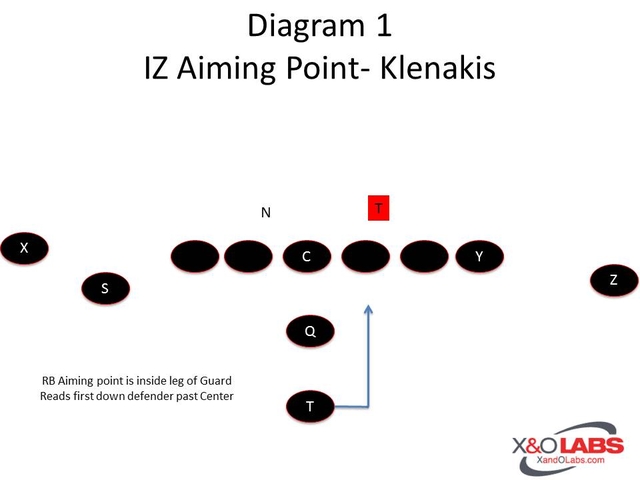
As detailed by Norcross above, the Pistol formation hides the mesh point with the QB and RB- a benefit of the offensive structure.   While at Nevada, Klenakis taught the clock system to his QB’s.  “Upon securing the snap the QB opens play side at either four or eight o’clock,” he told us.  “He gets the ball as deep as possible to the back while continuing his boot path opposite.”   Like many other shotgun zone schemes, the tailback is responsible for the mesh, but unlike those traditional shotgun offenses where the back will have to take lateral steps before attacking downhill, the Pistol gets him downhill in a hurry.  “The back takes one lateral step to the play side and gets moving.  He pushes to the inside leg of the Guard and reads the first down lineman past the Center play side but it has the opportunity to be cut back all the way to the backside B gap (Diagram 1). 

Slide1


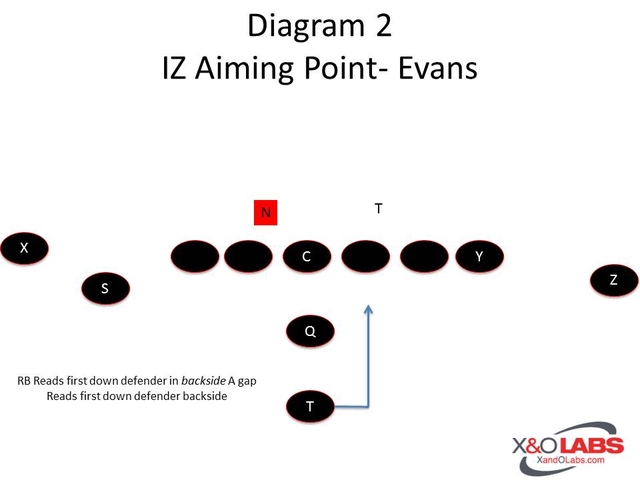
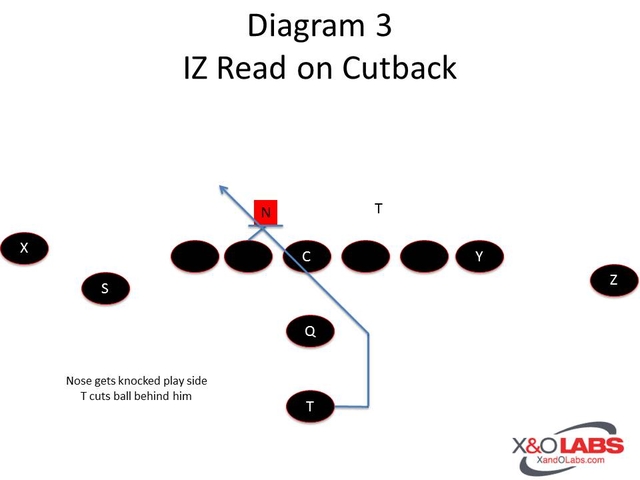
Klenakis admits that when he first installed the scheme at Nevada, he had his backs read the inside leg of the play side Tackle, but now the play has to be hit much tighter than that.  “We started recently to key the inside hip of the Guard,” said Norcross.  “It gets the back downhill quicker and allows him to cutback if needed.”  Reid Evans, the offensive coordinator at Central College (IA) has even modified his reads for the ball carrier to become tighter to the line of scrimmage.  “If it’s zone to the right, our QB steps with his right foot (play side foot) and clears space so the tailback can come straight downhill.  It’s a natural path,” said Evans.  “When we stared out we wanted that tailback to read the front side A gap but we found it to be more natural for him to read the negative or backside A gap and work your way play side (Diagram 2).  If there is a down lineman in the negative A gap that is who will read.  We will read the play side number and try to press it vertical.  If he gets washed on passed, we are behind him (Diagram 3).   In most looks it will be the A gap defender whether it’s the positive A gap, negative A gap or Nose guard.”

Slide2Slide3

Inside Zone Variations

While this is certainly not revolutionary, we’ve found that many coaches are finding innovative ways to seal off the backside edge defender on inside zone schemes.  This concept is most commonly called “slice.”  Patented by Nevada’s former head coach Chris Ault, the slice player’s job is to run the heel line of the offensive line and seal off any threat of a backside tackler.   “He leads with the inside foot and run the heel line,” Klenakis told us.   “He will aim for the inside leg of the opposite Tackle.  He will hit whatever color is on that track (Diagram 4).  Of course, the player that does this can vary from each offensive scheme.  According to our research, 51.9 percent of coaches will use a fullback to do this from a backfield alignment (Diagram 5).   This player can either do this by using pre-snap motion or just by handling the assignment once the ball is snapped.    According to Klenakis, when using motion the ball must be snapped by the time the motion man is at the outside hip of the Tackle if it is a post-snap movement. 

Read More

Pistol: Case 3 – Double Option Concepts

By Mike Kuchar


Introduction

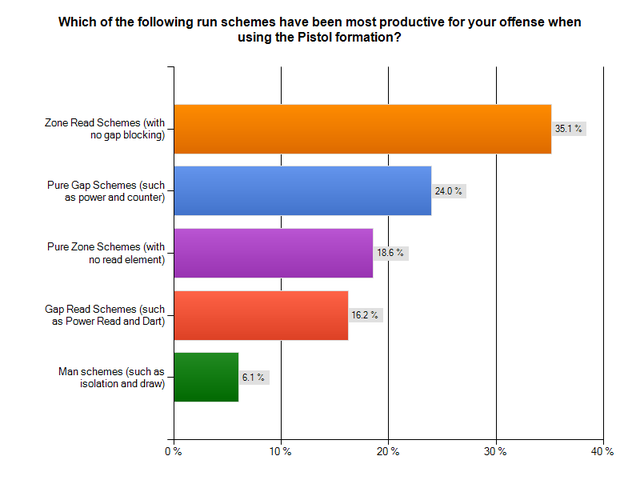
So, perhaps below is the information many of our coaches were looking for.  Thanks to QB’s like Colin Kaepernick and Robert Griffin Jr., the zone read game out of the Pistol has reached the forefront of schemes most utilized in this formation and our survey only validated that fact.  Of all the coaches that were surveyed, 35.1 percent said the zone read scheme was the number one most efficient run concept out of the Pistol formation in their program this past season.  

prdata8

There are many reasons for this, all of which we will explain later in the report.  Before we start to pontificate on all of the various principles and concepts out of the pistol zone read game, we thought it was important to address the various types of options most commonly used in the Pistol formation. 

Genres of Option Concepts:

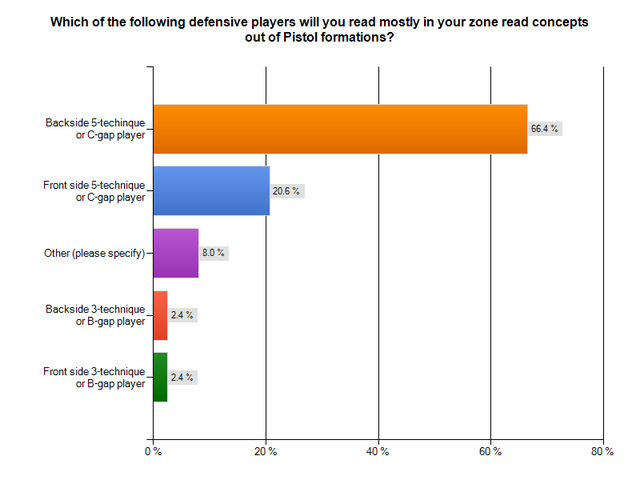
Before we address these various types of option concepts, it’s important to note that based on our research, 66.4 percent of coaches prefer to read the backside 5-technique or C gap player in their read option game.  This is more than any other read. 

prdata24

Double option concepts– Quite simply, a double option concept is one that involves a potential ball carrier and the QB.  This is most synonymous in the form of a QB pull or give read on zone options.  These option concepts could be classified as the following:

  • Zone reads- This type of scheme involves a ball carrier, usually the tailback, and the QB.  It is usually a backside read scheme. This was referred to as “bluff” in Nevada’s play concepts. 
  • Gap reads- This read concept is modeled after gap schemes like the Power O, Counter or Dart Schemes in which offenses will gap block at the point of attack and entail a backside puller(s).  The QB will either give the ball to an up back on a fast flow path, or keep the ball on the Power. It is a front side read scheme.
  • Midline reads- The midline read scheme usually involves optioning an interior first level defender.  While this scheme has become more relative to triple option teams, we’ve found that many spread offensive coaches are starting to integrate some of the midline option from a Pistol formation.  It is a front side option read.
  • Load Options-This is perhaps the most common concept that entails a offensive player blocking the pitch player (or force player) allowing a QB to keep the ball. 

Triple Option Concepts- Triple option schemes involve a third player as a potential pitch player for the third phase of an option.  This player can come in the form of a pure pitch with motion, pure pitch without motion or even a bubble screen variable.  These option concepts could be classified as the following:

  • Front side Veer Option- We’ve found that the veer option scheme out the Pistol is continually generating interest for option coaches.   It is a front side read play, which can implement man or gap blocking schemes.  
  • Back side Veer Option- The backside veer option scheme is very similar to the zone read with one major discrepancy- the availability of a third option.   Although we didn’t originally differentiate these two schemes when we started our research, by talking to Pistol formation coaches we’ve found that there are several drastic differences between those two concepts.

QB Footwork and Mesh Game

We all know the schemes look pretty, but when it comes down to option football, there is nothing more important than the mesh game.  Don’t just take our word for it; listen to some of the more high-profile coaches we talked to for this report.  Whoever we talked to, there was one common thread among teaching the mesh- teach one thing, be consistent and don’t over coach it!   That sentiment was echoed throughout our reporting on the mesh game from the Pistol.  Consider Portland State’s offensive coordinator Bruce Barnum’s quip about how he learned to teach the mesh in his option game. 

When Barnum and his assistant Dave Brown first installed the Pistol in 2010 at Portland State, there was much ado about the QB/RB mesh in the option game.  Brown, who was a Graduate Assistant coach working with the running backs under Chris Ault at Nevada, had accessed hours of game film at Nevada and presented it to Barnum.  “I took all of Nevada’s video on Kaepernick,” said Barnum.  They used to talk about jab stepping, stepping to six o’clock, clearing the back, etc.  I turn on the film of Kaepernick and he catches the snap and hops in the air, stops and run the read zone.  I remember thinking this is crazy. “

Of course, Barnum was providing a little tongue and cheek humor, or perhaps just validating the super athlete that Kaepernick is.  But, he was illustrating a fair point:  be consistent.  “As long as the ball is getting deep and the read is long- that’ important,” according to Barnum.  “The last thing you want is that QB sticking that ball straight out because there is no read for that DE and there is no smoke to the mirrors.  It’s got to be consistent.  I don’t care if you jab step and clear.  I don’t care if you open to six o’clock and he screams by you.  We had a freshman last year who would ride the back all the way to the Center.  It doesn’t matter as long as it’s consistent. “

So, as a research company, we did our own validation on this topic and we went right to the source- Washington State running backs coach Jim Mastro- who was the running backs coach under Ault while at Nevada and quite frankly who Cameron Norcross calls the “best Pistol running back coach in the country. “  Since moving on from Nevada, Mastro has helped install the Pistol at UCLA under Coach Neuheisel and now is tinkering with it at WSU under Mike Leach.  Mastro spoke about making sure things are uniformed in the mesh game, particularly in the zone read.  “It’s not like the traditional run game which may be different because different QB’s have different arm lengths,” said Mastro.  “In the read zone game, the running back and QB must be attached at the hip all you will have balls on the ground all day long.”

Read More

Pistol: Case 4 – Triple Option Concepts

By Mike Kuchar


Introduction

Since some form of triple option has integrated itself into many programs’ playbooks, so we didn’t find it to be surprising that some coaches were using it from Pistol formations; we were just surprised at the volume of coaches that were implementing it.  Originally, triple option concepts such as the veer option, were not even included in our research.  We knew teams were using gap and zone principles with at least one variable of single option, but triple option out of the Pistol is in fact here and it’s making it mark.  It’s important to note that ALL of the coaches we spoke with for this Case are utilizing the Pistol formation 100 percent of snaps next season.  They have bought in, completely to the effectiveness of the Pistol formation.

We did, however, find a discrepancy in teams that are either double option teams (such as read zone or bubble) and triple option teams that include a pitch variant.  Nevada was more of the former under previous head coach Chris Ault.  The Wolfpack used read zone concepts that were more double option in nature partly because they wanted Colin Kaepernick to keep the ball as much as possible but also because a choice had to be made among the staff whether or not they can do both.  “We had to ask the question, do we feel comfortable running the option or do you want our QB to run it,” said Cameron Norcross, the offensive line coach under Ault and now at the same position at Fresno State University.  “We weren’t an option team, we were a team that ran the option.  The least amount of times that we could pitch the ball the better.  We figured we would run load (option) most of the time and block the alley defender.  We’d see guys running to the pitch guy, and we would just turn up into the alley.” 

We spoke to Bob DeBesse, the former offensive coordinator at perennial FCS power Sam Houston State who is now at the same position at the University of New Mexico.  Under DeBesse, New Mexico finished fifth in the country in rushing this past season, averaging 301.3 yard per game. According to DeBesse, the triple concept is more relevant in New Mexico than it was at Sam Houston state due to several reasons.   “It’s more so out of necessity and what we can hang our hat on.  They (the players at New Mexico) picked it up the quickest.  We have a good mechanical QB and he mastered the mesh of the triple.  Had a lot to do with the makeup of the entire team.  We knew we had to be different and we knew we had to control the football.  It was best for us based on our makeup.  I was surprised that the inside zone wasn’t the number one run play here as it was at Sam Houston.”

So, to reiterate Coach Norcross’s point is you an option team or do you run option?  If you’re either of the two, there is plenty of information below to help.

Pistol Formation Advantages

According to DeBesse, the Lobos will run triple option concepts from all personnel groupings in Pistol except for 10 personnel which is something he believes separates the Lobos from other programs.  “I don’t think anybody has gone wholesale with the triple option like we have,” said DeBesse.  “Most teams have used zone read schemes and inside zone schemes.  The fact that we’ve added a pitch component has made us different.”   Much like some of the other downhill run concepts, using veer schemes out of Pistol formations creates that quick hitting mesh game for the dive back, plus the QB could get out of the exchange and see the read quicker.  The coaches we spoke with expanded on some benefits of using triple option schemes from the Pistol.  Consider the laundry list below of advantages that the Pistol provides, which has helped Brian Sheehan, the head coach at Defiance College (OH) in its veer option game.   Sheehan was the former offensive coordinator at Thomas Moore College, which won two Division Three consecutive conference championships in 2008 and 2009.   Sheehan told us he is in the Pistol to set up his veer option game, just like other teams are in the Pistol to run their gap, man and zone schemes. 

“The best way to run an option based offense is in the Pistol.  I’m not saying pure option, because if you’re running midline and veer 90 percent of the time you can win every year and recruit to that every year and be successful.  But if you need to throw the ball in critical situations.  We want to throw with confidence in third and long, two-minute drill, being behind in games, etc.  There are a certain number of fundamentals that need to be mastered to be able to do that.”- Sheehan

“It got us downhill more.  It hides the running back.  It produces deception on the zone read and the veer option as well.  Those linebackers are not going to fly until they determine the directionality of the play.  The veer is going to hit a lot quicker than inside zone.  Scraping linebackers are no longer a problem and it’s helped our offensive lineman to get to second level.”- Sheehan

“It’s all hitting very quickly with three immediate threats.”- Sheehan

“It gets second level deception and the QB is not giving it away with the first two steps.  LB’s cannot get a beat on where he is stepping.  It allows us to get past those linebackers,”- Sheehan

“We’re increasing the QB’s comfort in the run game by creating more initial space against unblocked defenders.  We’re eliminating the first two steps of the QB.  If I’m running veer triple under Center the QB has to step away from the midline, he has to gather and he has to ride the running back into the line of scrimmage.  With us, we’re going to catch and pivot so that’s another late indicator of which way the play is going.”- Sheehan

Ralph Isernia, the new head coach at Rensselaer Polytechnic Institute (NY) also has implemented the Pistol formation full time and tells us about the benefits the QB has in the mesh game for his triple option schemes.  “The QB is away from the Center and is at four yards from when he touches the ball,” said Isernia.  “He doesn’t need withdrawal steps to push away from the line of scrimmage.  It cleans up his reads.  When he gets out on the perimeter, he can leverage pitch and pitch it sooner than being under Center.  Our QB’s have taken fewer hits on pitches than guys under Center because the play from a Shotgun is a little bit slower in shotgun than under Center.  Under Center the play is like a Nolan Ryan fastball, it’s coming right at you.  In Pistol it’s like a Mariano Rivera cutter.  It looks like a fastball, but it’s got a little more movement to it.  It hits slower which allows the running back to have multiple aiming points at the point of attack.”

Read More

Pistol: Case 5 – Play-Action Concepts

By Mike Kuchar


Introduction

For the final case in our Pistol formation special report we wanted to focus on various pass concepts and protections.  We found we had a good deal of inquiries about this, particularly from coaches who wanted to learn more about the Play-Action game.    There was quite a bit of concern about how to use the Pistol back in routes and more importantly how to protect with him being directly behind the QB.  In this case, we planned on addressing some of those concerns, then sharing various concepts that our readers provided.  But in order to stay consistent with our format, we did want to present the advantages of being in a Pistol formation, according to coaches.

Advantages of Being in Pistol

First and foremost, Fresno State University offensive line coach (and former OL coach under Chris Ault at Nevada) told us “the play action pass game is the greatest advantage the Pistol has over off-set shotgun formations.”    Now let’s talk about the specifics behind it. 

  • More difficult for defenses to attack protection- Previously, in shotgun formations, defenses would dial up pressures to the side of the back.  Simply because when offenses would slide protect, it would be common for the back to protect off the edge he is located.  With the back being directly behind the QB, it’s a lot more difficult for defenses to design their blitz package to attack him. 
  • Complements play-action pass game- Pass concepts off run action can prove to be lethal simply because the back is on a downhill path simulating run action.  It clouds the vision of second level players (linebackers) allowing concepts like Digs and Unders to be accessible.
  • QB already in drop progression- Basically being in Pistol sets already eliminates two steps from the QB’s drop.  It provides for adequate operating depth from the Center.
  • Clarity of Vision for QB- This is a similar advantage that a shotgun formation would give offenses.  QB’s are able to check protections pre-snap and see route concepts as they develop. 

Ralph Isernia, the head coach at Rensselaer Polytechnic Institute, talked about the advantage of having the back directly behind the QB.  “We have to slide our line the opposite way of the back,” Isernia told us.  “We can slide or man/slide protect in either direction and we can flip protection pre-snap and the defense doesn’t need to know about it. Having him balanced helps us out a lot.  I don’t think we lose a lot by having our QB not get to the four man side because with the style of run game we have with the veer option we don’t see a lot of four off a side.  It’s difficult to defend the option when you’re blitzing that strongly off a side. “

Brian Sheehan, the head coach at Defiance College (OH) and another pure option coach, even talked about the advantage of being in a Pistol formation has towards recruiting.  “It’s a benefit to recruiting now to because now we can tell our QB’s that we are going to develop them in the pass game too,” he told us.  “We’re not going to get into 3rd and Long and run veer pass.  Guys now understand how important a running QB is in the option, but now you present them with a second dimension.  Teams look uncomfortable in traditional long yardage situations and in two-minute drill.  You have to provide kids with the necessary tools to master those situations.  The Pistol does that. “

Pass Protections

We wanted to find out which types of protections coaches that utilized the Pistol were using mainly because we wanted to see if there was a distinction because of the back being directly behind the QB.  For example, did he impede the straight drop of the QB in B.O.B. (Big on Big) or man protections? Was it easier for him to work a slide protection based on the call side?  Did it fit well with half man/half slide protections?  Here we’re the common types of protections that we asked our readers:

Definition of Protections

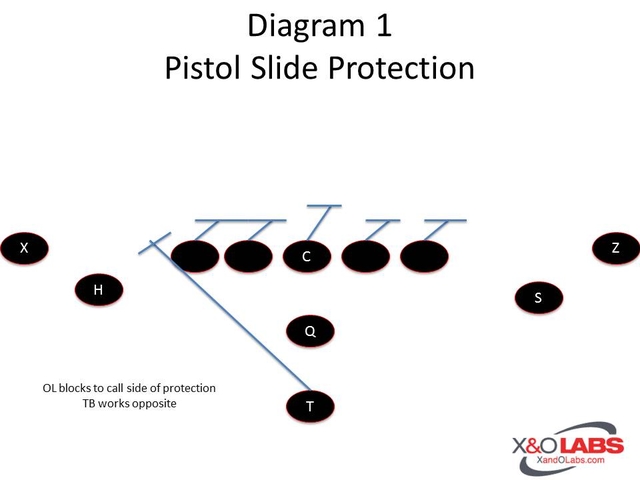
  • Full Zone or Gap Protection (Diagram 1)- Protection where offensive line slides to the call side and back works opposite.  This can be used in the quick game or in play action concepts like Naked.
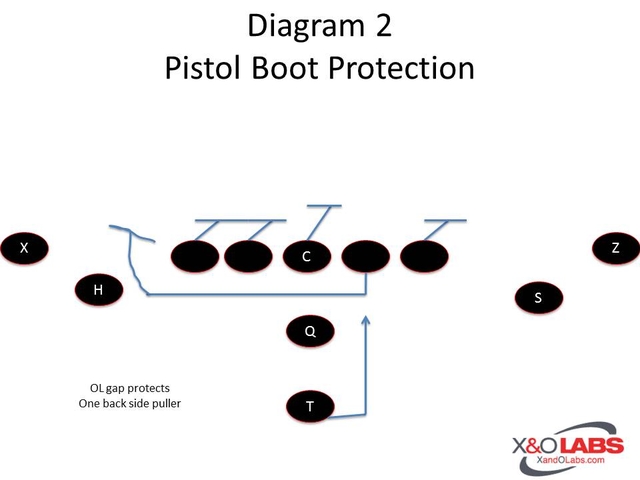
  • Gap Protection with Single Puller (Diagram 2)- Protection where front side or call side of line blocks interior gap and a backside puller comes from either front side or back side of formation.  This is commonly used in play action concepts like Boot.
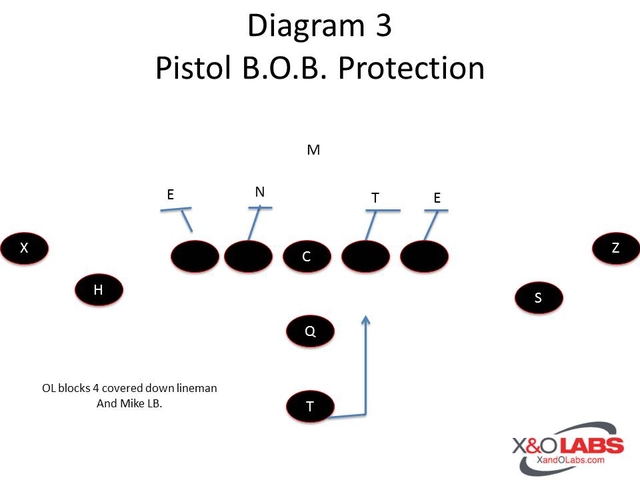
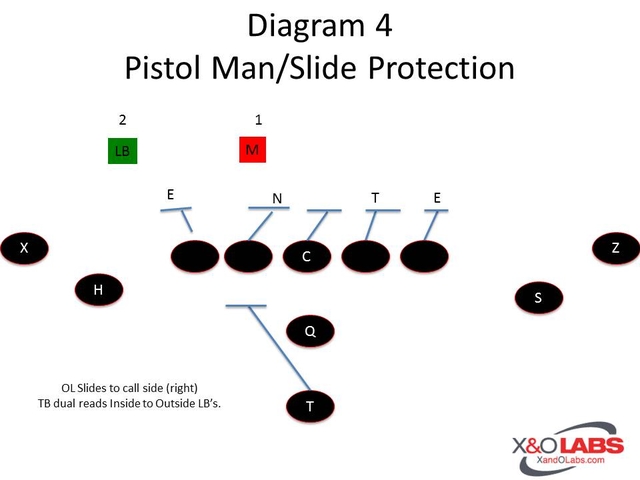
  • Man Protection (Diagram 3)- This protection is a B.O.B. (Big on Big) protection where the offensive line is responsible for the five most dangerous threats and the Pistol back will usually be responsible for Dual reading both inside to outside linebackers.  This is commonly used in drop back concepts.
  • Half man/Half Zone Protection (Diagram 4)- This protection is a combination of both concepts where the front side of the line will block man or B.O.B. and the backside of the line will zone protect.  This is all predicated on where the Center slides and is most commonly used in drop back concepts.  The back will dual read here as well.

Slide1Slide2Slide3


Slide4

According to Norcross, the half-slide protection must be in direct correlation with the Pistol back’s footwork.  “If it’s a half-slide protection and he has 2-3 opposite the slide, they depart too wide,” said Norcross.  “I see backs are drifting to the B gap.  They wind up on the outside number.  The footwork is wrong on the departure.   We never had a problem with A-B gap plugs.  We coached him up to the tight A gap.  He has to wrap on the first step.  The biggest key was stepping with the opposite foot first.  If you’re protecting to the right, you are going to step with your left and cross over.  Your second one will keep you square and will be the clear step of your QB. “

Read More

Pistol: Case 6 – Exclusive Resources

By Mike Kuchar


As part of this research, we receive information from coaches all around the world.  The following powerpoints contain some additional information that was not included in the earlier cases, so we decided to share them with our insider community as well. 


2 and 3 Back Pistol Power

from Nate Thomas, OC at Liberty HS (MO)

Bluff Run Game Presentation

From Cameron Norcross, Offensive Line Coach and Run Game Coordinator, University of Nevada

Pistol Playaction Passing Presentation

From Cameron Norcross, Offensive Line Coach and Run Game Coordinator, University of Nevada

Counter from Pistol

From Seth Drennan, Offensive Coordinator, Overton High School (TN)

Manipulation of Secondary Contain

Read More

A Tweak on Cover 8 vs. 2×2 Sets

By Mike Kuchar

Lead Research Manager

X&O Labs


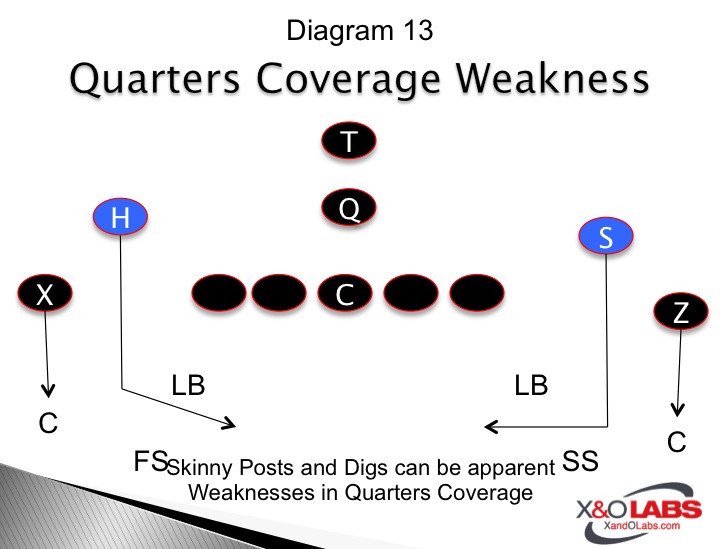
acudbAs we discussed at length in our Quarters Special report, the Alert and Palms principle was the best answer to 2×2 open formations.  That said, we did find another interesting adjustment that could be made to handle four vertical threat in the pass game.   Darian Dulin, the defensive coordinator at Abilene Christian University (TX) grew tired of seeing slot receivers get around his outside linebackers and between his Safeties to catch square in routes and skinny posts, which could be an apparent weakness in Quarters Coverage (Diagram 13).  So, he adjusted by walking his outside linebackers out further on the number two receiver and play his Safeties closer to the box – essentially, switching their responsibilities (Diagram 14).  What resulted was a top ten finish in total defense among all FCS schools in 2012, and a design he calls Cover 8.
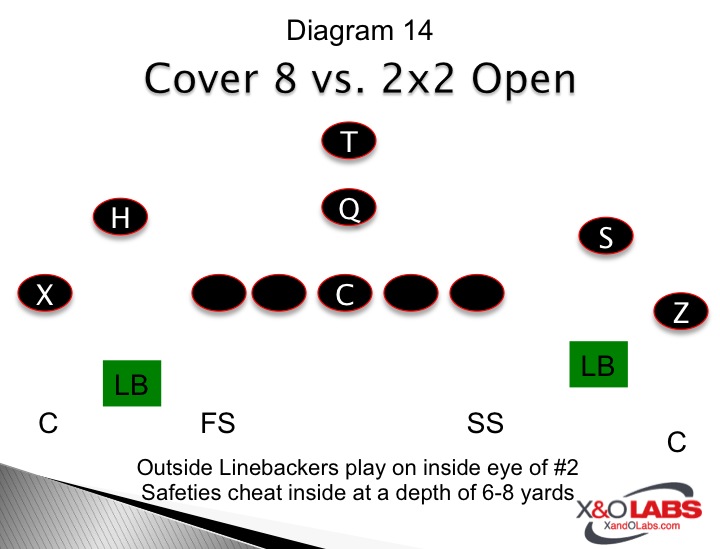
Dulin told us that it’s a coverage used most effectively when your Safeties are your best secondary players.   It gives them the ability to get over the top of vertical routes, yet get involved in the run.   He would have his Safeties get as close as six yards from the line of scrimmage if they felt they can play both the run game and get over the top of number two.    They are asked to play Quarters responsibility in the pass (by playing number two vertical) yet still play the alley – the outside linebackers will have force – in the run game.  His Safeties will soft pedal out on the snap and read the Guard to their side to give us a little bit of a cushion on the run/pass read.  Dulin feels playing against Gun formation offenses, gives his Safeties a better run/pass indicator, allowing them to play both situations.  “We feel we have quick reads with the QB in gun based on whether he’s faking the zone read or he’s popping it up and throwing it to the seam route,” he said.

Read More

Quick & Complete Kickoff Circuit

By Sam Nichols – @SNicholsXOLabs

Managing Editor

X&O Labs


sunycOne of the more productive, straight forward circuits submitted came from Tunde Agboke the former defensive line coach at Marist College and current Defensive Coordinator at SUNY Cortland.  According to Agboke, “It is critical the players on this unit know how to block in space.  Thus, we spend a great deal of time doing individual blocking and dropping drills. We use this circuit at least once a week. Once we accomplish that goal, then we come together and run our schemes.

These drills have helped us tremendously. We have be able to quickly identify the guys who can and can’t do it without wasting weeks or months of practice time. We see KOR as the first play of every offensive series, and we are looking to go deep.”

Read More

Teaching DL Block Destruction

By AJ Blum – @aj_blum

Co-Defensive Coordinator

Westfield High School (TX)


Editor’s Note:  Coach Blum is in his 6th season at Westfield High School (09-present) as the Co-Defensive Coordinator, Defensive Tackles and Off Season Coordinator. Prior to Westfield, he was the Defensive Line Coach/Off Season Coordinator at Klein Forest High School (04-08). Blum started my Texas High School coaching career at Livingston High School as the Varsity Linebackers Coach (03). He has been part of a playoff qualifying team (05), Area-round qualifier (06, 07, 08, 09), Regional Qualifier (11), and Regional Quarter Finalist (12, 13). During his 12 years of coaching, Blum has been blessed to coach 3 High School All Americans, 3 Greater Houston Touchdown Club Player of the Year finalists, 5 All State Football players, 6 District Defensive MVP’s, numerous All-district football players and 27 young men who have gone onto the collegiate level to play.


westfieldDefensive line play is paramount for overall defensive success.  Although there are numerous different ways to teach fundamentals, I always revert back to keeping it as simple as possible.  Extraordinary play occurs when great fundamentals are combined with unbelievable effort.  The guidelines I use to cover all bases are remembered by the initials “S.A.K.A.”.   In order to be a great player, he must have a great Stance.  For defensive success to occur, the front must be properly Aligned.  A player must know what his Key is and how to attack it.  Finally, the defensive lineman, must know his Assignment.  These 4 components are the backbone to success and as previously stated, when combined with unbelievable effort, result in success up front. 
When referring to block destruction there are multiple issues/questions that can be asked and emphasized.  When people ask me the why’s/how’s of this topic I try to refer to a sequence that can easily be evaluated with players.

Ball get off–  How well are the players reacting to the snap?  When they get off the ball are they taking a short step to enable them to change direction or is the first step too long caused an elongated base?  How far are the players off the ball? Personally I’m a crowd the LOS guy because we base out of an attacking front.  What is stance like prior to snap? It’s tough to ask someone to attack with a flat back. 

Attack points–  Where are you telling players to attack?  Most schemes work on half the man but the biggest mistake made is when players are practicing on bags/sleds they attack the middle.  If a player is attacking half the man, essentially the inside hand should target the breast plate of his opponent and the outside hand on the shoulder/bicep area. 

Emphasis after contact–  Every defensive lineman “cries” about being held…my response to that is did you “shock and extend”?  Most of the times the answer is no…SEPARATION EQUALS SUCCESS…no separation/no excuses…

Block recognition– What is it? Down/Reach/Base?   Players should know how to attack each one and their progression of getting to the ball.  If it’s a down, player needs to attack and drive.  I tell my players this is where you basically turn into an “offensive lineman”…if it’s a base, shock/extend and force ol back in the hole…if it’s a reach, attack through the outside shoulder, lockout, separate, long arm/short arm, rip release and get to your pursuit landmark- NOT the ball.

Read More

7 Efficient Sprint Out Concepts

By Chuck Williamson

Assistant Head Coach / Offensive Coordinator

Central Crossing HS (OH)


crentralcrossings1Our Sprint-Out passing game provides our offense with a safe and efficient way to move the ball with high percentage throws while at the same time allowing us to target our playmakers ( Two CCHS receivers in top 5 in catches in Central Ohio). Anytime we can attack the perimeter and put pressure on the defense, we feel we have successfully created an opportunity for a big play.  These are crucial for us to meet our goals of running  plays that are both high percentage  (70% or better completion percentage) and highly efficient  (55% of better efficiency rating).

Our Sprint-Out series is one of our most successful and explosives schemes. The quarterback will sprint to the called play side and attack the outside and put pressure on the defensive perimeter. The quarterback has the option to throw or run the football, but he will continue to attack the defense downhill on the perimeter. This is a quick & high percentage passing game that puts pressure on the defense.

Protecting the QB is obviously a priority with this package. We incorporate a slide protection.

Front side

  • PST reaches the DE
  • RB seals the edge from backfield or motion
  • Align a “sniffer” to block the edge

Theobjective is to make sure the defender’s outside pursuit is cut off. Inside penetration can becountered by “washing” the defender into the line. But with today Odd Front and Stack defenses, you can’t always say that the DE will be the man that the play side tackle will end up blocking. Add this simple term to all of you pass protection schemes “Slide to Air, Be Aware!”

Backside

  • BST must prevent edge rusher to clear path to QB
  • If there is a defender lined up head up or inside of him he must be aware of the possible edge rusher. The tackle should take a short inside step followed by stepping at a forty five angle toward the outside gap. If the rusher goes inside then give the backside guard a “helping hand” without fully committing…keeping in mind a linebacker may be coming on a blitz.


Read More