





Drag Hand/Backside Hand Technique
By Mike Kuchar
Lead Research Manager
X&O Labs
Drag Hand/Backside Hand Technique
 On the outside zone scheme, it’s important to teach backside hand and shoulder placement in order to seal off any penetration. In order to do this, Hand teaches what he calls the drag hand technique. “As the offensive lineman takes his stretch step to the outside V of the neck, his backside hand placement is the thing that will slow him down enough to catch the 5-technique defender if he slants inside. “The aiming point of the drag hand technique is the backside peck of the defender. That movement will stop the penetration of the defender inside. The Tackle cannot come off the ball with no concern of the defender slanting inside. He uses the drag hand to catch and hold the defender so he cannot penetrate.”
Alex Gibbs used a similar technique called the “back hand” technique, which is used if there is no help with the next adjacent lineman. These scenarios could be a 3/5 technique play side or a 5/9 technique play side. The covered defender against a wide shade must be able to use his backhand to punch or catch the defender if he spikes inside. This is used particularly if there is no backside help on a combination block. “He has to use that back hand as a hook to catch the defender if he goes inside,” said Gibbs. “The Guard has to catch the defender just enough to funnel him down the line of scrimmage. It doesn’t matter if the defender penetrates a little, because the read tells the runner to go outside. The key is the backhand coming under the flipper of the defender. If it goes over the flipper, the defender will knock the Guard’s arm up into the air. The punch as to come into the defender tight and under the flipper.”
4 Offensive Game Planning Mistakes
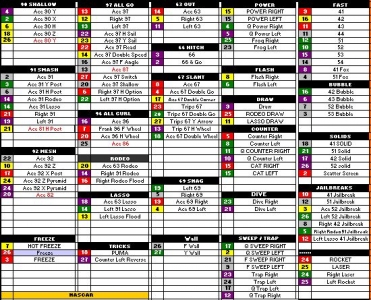
Researchers’ Note: This report was written by the coaches on staff at Game Planner Pro. Game Planner Pro is an easy-to-use, web-based game plan management software that allows coaches to enter in their game plan once, at the beginning of the week. The software then automatically creates the wristband, practice scripts and game day call sheet. For more information on Game Planner Pro: Click here.
 Does this scenario sound familiar? You spend all week studying film, opponent tendencies, drawing plays, teaching your players in the film room and on the field; you have put together what you thought was the perfect game plan only to see your team fall short. The next day you study the film and all you do is ask yourself why did I do this or that? Why were we trying to be something that we are not? Your film session reveals players making mental mistakes and not playing like they are capable of playing.
Here are four reasons why coaches sometimes find themselves in this situation.
Mistake 1: “Hey, We Can Do That…”
It never fails, you are watching game film on your opponent and another team is just moving the ball up and down the field at ease, you think to yourself we could do that. The problem is, the other team is built to throw the ball 60 times a game and your team is built to run 60 times. You watch the passing schemes that they are having success with and you immediately run to the dry erase board to draw them up and install them in this week’s game plan. It is okay to borrow one or two plays from someone else but you don’t want to change your offensive identity week-to-week. Teams become good at what you do by committing to it and practicing it, over and over. As a coach you get a better understanding of what defensive schemes may give you problems and how to make in game adjustments because you know your offense inside and out.
Mistake 2: Eight Pounds of Potatoes In a Six-Pound Bag
Another very common offensive game planning mistake is trying to add too many wrinkles to a play. Most commonly this will happen when an offense is moving the ball down the field well. At some point, you will likely get greedy. Instead of just lining up, running a play and trusting that your players will make the right decisions, you try to give them too many checks. It always seems to start off very simple, if they give us a certain coverage we should throw a quick screen, if they give us a certain front but the LB is out of place we should check the run to this gap. So what starts off as one play now has two or three different components to it. The offense is now at the line of scrimmage thinking about what they might have to do on three separate calls instead of just one. It’s going to slow them down and they will not be as successful as they could be. Remember all eleven players have to be able to execute the play, not just the quarterback.
No Huddle – How to Coach On the Run
By Dan Ellis
Head Coach
Great Valley High School (PA)
Editor’s Note: This fall, Coach Ellis will begin his first year as the Head Football Coach/QB/OC at Great Valley (PA). Prior to this position led teams at W.C. East High School (2011-2013) and Springfield High School (2008-2010). He also has additional years of experience as quarterback coach and offensive coordinator at Rustin High School (2007) and Downingtown East High School (2003-2006). Dan has also been a faithful contributor to X&O Labs over the years and is a valued resource for us on the offensive side of the ball.
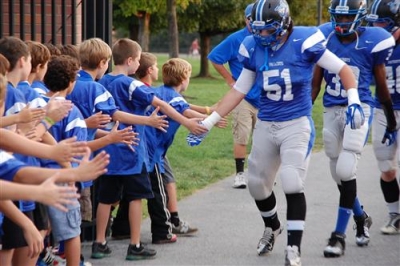
 “Coaching on the run” is a common buzz word in coaching circles these days. The problem with the phrase is that it is mentioned far more often than it is explained. As you consider running a no huddle system, it is important that it is more than just a tempo of how you play, it needs to become pervasive in your thought processes and throughout your program. This is impossible without “coaching on the run.”
In many ways, coaching on the run is really not that difficult of a concept. It comes back to planning. Your team and coaches need to start thinking and addressing how you plan on coaching with speed and tempo. How you organize and structure your practices and coaching habits will go a long way in determining success or failure on the field.
Here are a few tips for ‘Coaching on the Run’ you can incorporate into your practices and games:
Practice
In going to a no huddle system it is important to make sure you are getting the most out of your practice schedules and scripts. If done correctly, the number of reps in a given period and throughout your practice will go up and you will find your coaches being more efficient with their time. Ultimately, practice changes are the best way to reach your goals in implementing your no huddle system.
Script Everything – Never go onto the field without having everything planned out. If you are planning on no huddle, you cannot waste time with inefficiency. Know which plays you plan on running in the game and run them in the same percentage in practice. If I’m going to run Power 30% of my running plays, make it the same throughout the week. Also, be smart in terms of how you structure your scout team. For example, do not make the scout team change coverages every play. If the team you are playing against is a cover 2 and 3 team, organize your 7 vs 7 period to have only one coverage in that time period or split it in half.
DL Drills – Temple University
By Mike Kcuhar
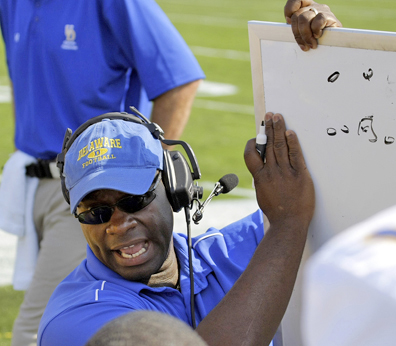 Ben Albert, OLB & DE Coach, Temple
In 2011, Temple University finished third in the country in scoring defense, surrendering a meager 13.9 points per game. Only national champion Alabama and national runner-up LSU placed ahead of them. The Owls also finished at the top of the Mid-American Conference in seven separate categories including rushing defense and total defense.
X&O Labs presents an exclusive drill series submitted by Ben Albert, the outside linebackers and defensive ends coach at Temple. These videos illustrate all of the drills he uses to teach his players how to get off the ball and get to the quarterback. These are the same drills that helped the Owls register 33 total sacks in 2011, which was a top-twenty finish in the country.
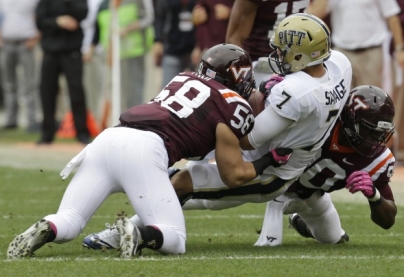
Virginia Tech’s Field / Boundary Blitz Checks
By Mike Kuchar
Senior Research Manager
X&O Labs
Field vs. Boundary Pressure Checks
Another common pressure check is a blitz to either the field or boundary side. While this blitz patterns may vary, it’s important to note that coaches will have a check built in to either of these variables. Bud Foster combines his field and boundary pressures based on surfaces. “With our field pressure, we have the ability to attack a surface,” Foster told us. “If they give us a two man surface to the field or passing strength, we have one pressure we run. With one pressure check, we can bring two different pressures based on surface.” This could come in the form of a Whip Dog (Diagram 58), which sends the Mike into the B gap, and the Will as the perimeter rusher in the C gap.
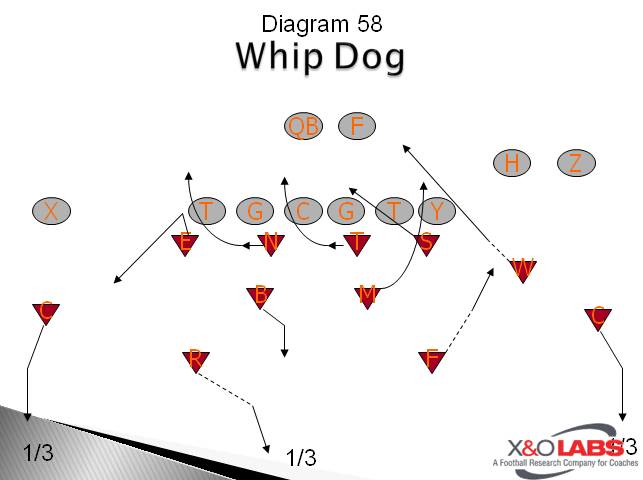
To see film cut-ups of the Whip Dog Pressure, click on the link below:
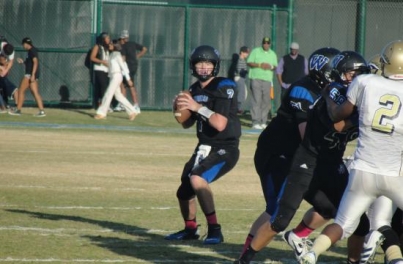
QB Drills – Improve Accuracy – Santa Monica College
By Ryan O’Hara – @CoachRyanO
Quarterback Coach
Santa Monica College
Editor’s Note: Coach O’Hara is an experienced quarterback coach based out of Southern California. In 2013, as Santa Monica College QB Coach, Coach O’Hara was part of the 3rd straight Pacific Conference Championship (20 straight Conf wins). His offense led the conference in yards and points. Prior to his time at Santa Monica, he served as an offensive coordinator at the HS level for 6 years. As a player, Ryan was Elite 11 QB 2001, started at QB at University of Arizona as RS Freshman 2003, played AFL2. He also serves as a private QB trainer in Southern California.
Introduction
 Now is the time to refine your Quarterbacks’ mechanics during spring and summer ball so that it becomes muscle memory by the time next season hits. Good QB coaches know that most of the time accuracy issues DO NOT start with the QB’s release. Instead, it is born out of problems with a quarterback’s balance, stride length, and control of the ball. Here is a breakdown:
Are you aligned to begin with?
A marksman cannot hit his target if his weapon is not pointed at it (front shoulder, hip, side of front foot). Grip on football: middle finger parallel on top lace so at top of throwing motion ball forms 90 degree angle off the hand, with nose coming straight out.
Are you in balance?
The proper passing stance and stride length are critical for rotational fluidity and balance. Cheeks, shoulders, hips stay on the horizontal rotational plane.
Did you finish with your eyes and your index?
“Focus through the throw,” not “to the throw” is essential. When your find your open man your eyes have to zone in, “aim small, miss small,” and your index finger should be reaching out to touch the target right down the midline with wrist pronation for a spiral. Instead of teaching “opposite pocket,” I tell my QB’s to slice the target in half while extending with their throwing hand as to limit horizontal inaccuracies.
Did you stick your landing?
I ask my QB’s to hold their finish 2 full seconds for two reasons. First it shows me they are in balance, with both feet in the ground (90/10 weight distribution), back foot should not leave the ground, which will ensure the hips and shoulder will stay level through rotation. Secondly, it allows them to run down a self checklist. This checklist includes:
- Did the back shoulder replace front shoulder?
- Evaluate the extension of throwing arm.
- Is the throwing hand thumb down?
- Is the wrist flexed?
- Is 90 % of weight on front foot and the other 10% back toe?
- Is the back toe even with front heel?
- Is the off arm tight to the rib?
- Is his posture upright (puppet string)?
Each of these concepts has one thing in common, they are all connected to balance. It is for that reason that I have found these three staple drills which are simplest yet most effective ways to work on balance to improve accuracy throughout the offseason. Those drills include: Mirror Work, Kinetic Chain, and Base Work & Snap Frontside.
Drill 1: Mirror Work
I ask my QB’s to get in front of the mirror for 10 minutes every night and work 4 different poses related to pocket passing. Pause for 3 seconds at each pose:
Passing Stance:
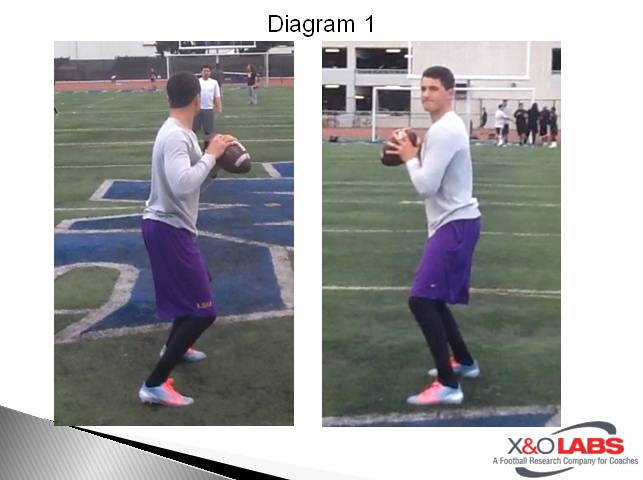
Eyes downfield, Posture upright, feet shoulder width/parallel, knees flexed, all your cleats in the ground. Middle finger parallel on top lace, with boxer stance- high hands, relaxed shoulders. Ball tight on upper half of numbers. This is what they should see in the mirror:
Numbers to Target, Bicep to Ear:
The second pose is the rotation of hips, shoulder and feet. Throwing arm bicep as close to ear as possible, throwing elbow pointed at target, hand forms a “C” and not a “U” to keep control over top and arm lever aligned properly. Back foot should still be in the ground, on the toes, front knee bent with the whole front foot in the ground (90/10). Off arm clears the face and comes tight to the rib/armpit. Ball should be in Hand with the nose leveled out parallel. Keep cheeks, shoulders level and get in “The Narrow Hallway.” Here’s what they should see in the mirror:
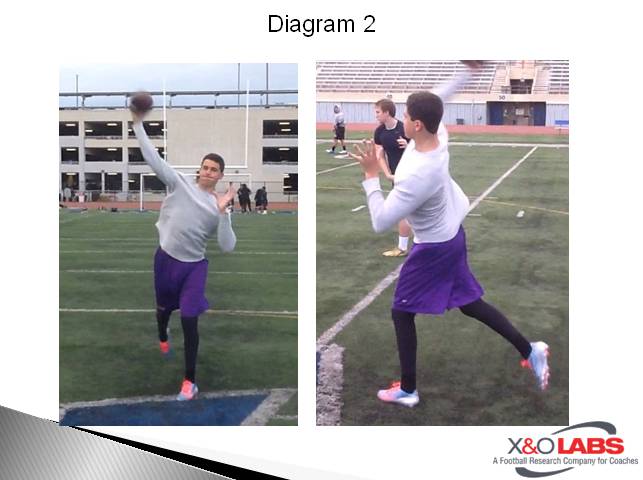
Extension/Pronation/Rotation:
The third pose will be with no football. They will practice the first two poses then work to pose 3: 90/10 foot weight distribution, back shoulder replace front shoulder, front knee bent, back knee extended, off arm tight to the rib. Throwing arm fully extend, thumb down, wrist flexed. Here’s what they should see in the mirror:
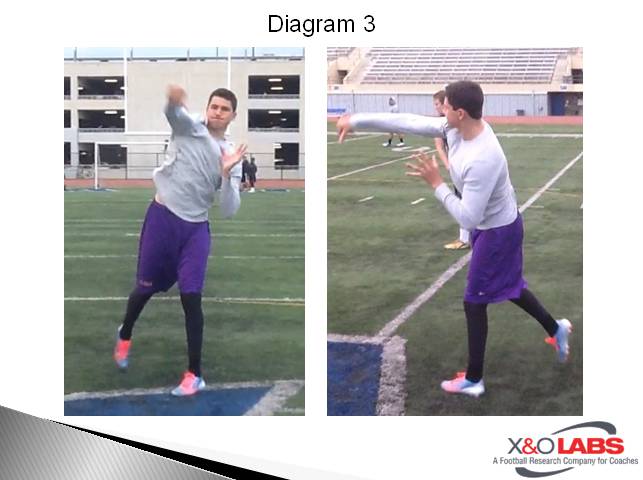
Stick Your Landing:
Ask your QB’s to hold their finish for 2 full seconds to show balance. Finish should have back shoulder replacing front shoulder, thumb down, wrist flexed, throwing arm fully extended, posture up, 90/10, back toe even with front heel, off arm tight. This pose is done with no football. Here’s what they should see in the mirror:
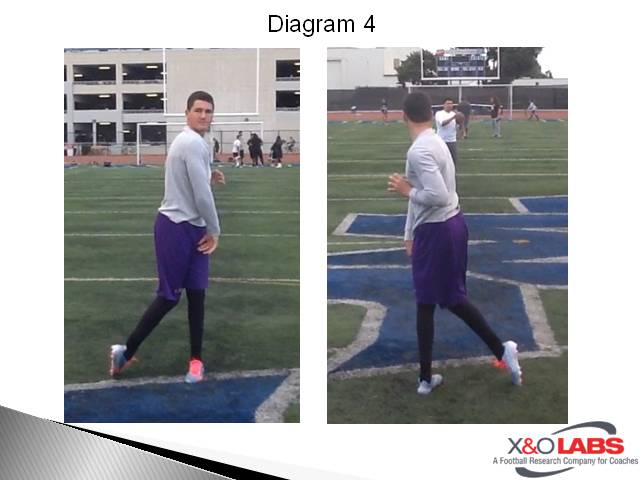
Click on the video below to see the drill in action:
Danger and Divider Coverage vs. Empty Sets
By Mike Kuchar
Senior Research Manager
X&O Labs
 Introduction
While many coaches will choose to play cover zero against Empty (3×2) formations, we did find another answer which in two zone concepts- named Danger and Divider. It’s a way to leverage the football on the back end, without playing a high-risk structure such as a no-safety defense.
Editor’s Note: The following research was conducted as part of XandOLabs.com special report on Quarters Coverage. The full-length report is available to Insiders only, which can be found by clicking here.
Defending 3×2 Empty Adjustments (Diagram 65)
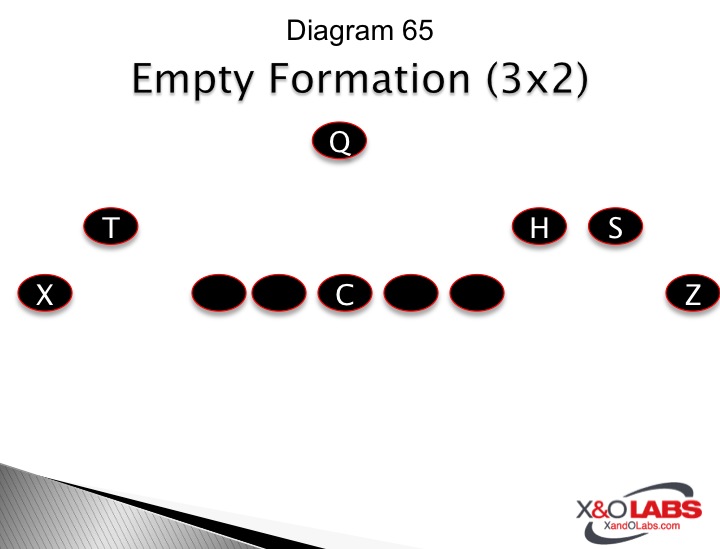
Finally, defending Empty formations require a tremendous deal of technique by defensive backs in order to match the various routes an offense can present. With five eligible receivers- an only four defensive backs- it becomes necessary for another skill player, usually the Mike linebacker, to be involved in matching number three to his side. In fact, when asked about defending Empty formations, 32.9 percent of coaches will play Quarters coverage to both sides of the formation, and have the Mike LB carry #3 vertical.
QB Drills – Footwork Progression – UCLA
By Mike Kuchar
Lead Research Manager
X&O Labs
 Introduction
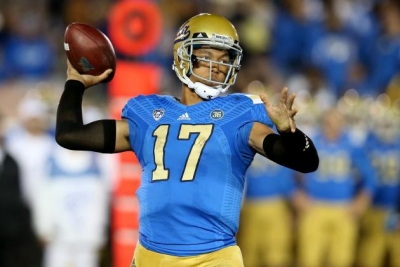
Coming off a 2013 ten-win campaign (tying the school record for wins in a season), where it set several offensive records, UCLA is preparing to make a run for the Pac-12 Championship this season. Much of it will rely on quarterback play. The Bruins offensive coordinator Noel Mazzone presents the every day drills- along with coaching points- he uses to train his quarterbacks in-season.
Editor’s Note: Noel Mazzone and Taylor Mazzone contributed to XandOLabs.com research report on developing in and out-of pocket movement for QB’s which can be found here: 50 + Drills to Improve QB Pocket Presence The following information was provided by Championship Systems. For more information, you can go here: http://www.championshipsystems.com/
Essentials in the Trap Play
By Jeff Disandro
Offensive Line Coach / Special Teams Coordinator
Greenville College
Editor’s Note: Jeff DiSandro returned to Greenville College in 2014 for a second time, having previously coached at the college from 2006 to 2009. He served as the run game coordinator and eventually took over as the offensive coordinator in 2009. DiSandro will coach the offensive line and coordinate the special teams as well as assist Coach Schomaker with administrative assignments.
In DiSandro’s first year as an offensive coordinator, the 2009 Panther team won the UMAC Championship and advanced to the NCCAA Victory Bowl where they played Geneva College. That year, the Panthers recorded some of the biggest wins in school history, defeating LaGrange and Washington University for the first time. The Panther offense produced All-American TE Zach Fredrich and UMAC co-conference player of the year RB Anthony Ambers.
DiSandro left Greenville for a position on Eric Hehman’s staff at NCAA Division II Malone University. While there, he served as the offensive coordinator in 2010 and 2011. In his two year span at Malone, his offenses managed to move into the school record books in 18 separate categories including rush yards per game, scoring in a game, and total yards in a game. In 2010, the Malone offense finished eighth nationally in rushing yards per game and were ranked 10th nationally in the running game. He worked with the quarterbacks and offensive line while at Malone.
Introduction
 The trap play is a staple for many offenses especially here at Greenville College. We love the flexibility of the play against varied fronts as well as the great angles that it creates. Running it effectively requires an extreme attention to detail and this article will take you into the essentials that we include for our linemen to make them into great trap blockers.
Offensive Line standards
- Aggressive start
- Aggressive finish
- Use your technique
Standards are a big deal in coaching and when coaching a position. As the coach and leader of our offensive line I have to decide what I want our standards to be. Then as a teacher I have to find the best way to clearly and easily communicate those standards to our players. The most important standard for us on the offensive line is effort. We want our offensive line to play with, as we call it, extra – ordinary effort. For us, that is more than “110%”. After declaring that standard of effort we then want to quantify effort. We want to make effort gradable. Two of our core standards are aggressive start and aggressive finish. These two phrases, and their definition, quantify effort for us up front. I think most coaches know what it means to get off the ball and finish a block but I have found that most players don’t think like a coach and/or share similar insights.
So, to clearly define our standards for our players we say this: aggressive start in the run game means how quickly do you close the cushion between you and the defender (from the snap). And aggressive start in the pass game means how quickly did you get from your stance into your set, or how fast did your helmet move? I am a big believer in watching wide (I also watch the tight!) as an offensive line coach. I think I can get a great feel for how they are starting and finishing by watching the wide.
Our second core standard is aggressive finish. Again, I think all OL coaches know what this means. We communicate this to our line by using the phrase “knockdowns.” We teach the OL to play aggressive and nasty and we want this attitude from snap to whistle. Anytime an offensive lineman puts a defender on the ground we call that a knockdown. We tally these throughout the season and declare a winner at the end of the season. This also serves as a tiebreaker for our tough man award; which is another competition amongst the lineman group. Our tough man acknowledges practice consistency. Consistency is a major factor in highly productive offensive lines and we try and find fun ways to create that culture.
Our third core standard for the offensive line is use your technique. Even though we want them to play full speed all the time we also want them to use good technique as well. So much of good line play is using a run and pass demeanor and staying on your feet throughout much of the block (until a knockdown) and we don’t want to sacrifice those things.
For the remainder of the article I want to discuss the trap play and talk heavily about the down block and its technique while also introducing some of our pulling technique for this play. The trap play has been a series that compliments the tight zone triple option for us. Before I jump right into the trap though, I’d like to start with the stance.
The Stance
I believe all of the technical portions of line play start with a great stance. We coach the stance from day one. In my opinion, so many technical issues that come up with lineman can be traced back to the stance. Some common examples in my mind are being short on aim points / landmarks and/or the lack of hips and inability to generate power with a block. Being short on aim points can be traced back to footwork issues, which can be corrected with adjustments in the stance. A lineman with enough athletic ability and strength may not be creating power because of an inefficient stance. Power is the combination of strength and speed so the stance has to allow for the lineman to have speed to the aiming point and maximum use of his hips and core.
Meshing Trap and Counter KOR Concepts
By Brian Morgan – @coachbmorgan
RB Coach / Special Teams Coordinator
Lamar University
 Editor’s Note: Brian Morgan was just hired on to the Lamar University coaching staff to serve as the RB coach and special teams coordinator, the same positions he resently held at Prairie View A&M University. While at Prairie View A&M University, Morgan’s specialists also had career seasons as the trio of Chris Barrick, Spencer Nelson and Johnta’ Hebert reaped All-SWAC honors in 2012. As the team’s punt returner, Nelson led the SWAC and ranked fourth nationally in punt return average with 16.5 yards per return. Barrick capped off a career-best season at placekicker as he finished 9-of-11 in field goals and 38-of-40 in PATs. As a true freshman, Hebert ranked second in the SWAC with an 18.9-yard kickoff return average along with one touchdown via a kickoff return. Hebert also led the SWAC in all-purpose yardage with 121.7 yards per outing as he tallied 926 kick return yards, 196 receiving yards and 217 rushing yards on the ground.
Last year, Morgan’s unit rushed for nearly 1,500 yards with the sophomore tandem of Fred Anderson and Courtney Brown combining to rush for 1,105 yards and 11 touchdowns. Anderson ranked eighth amongst SWAC rushers with 52.5 yards per game while Brown finished tied for fourth in the SWAC with 10 (9 rushing) touchdowns. As a unit, the Panthers ranked third in rush offense as they netted 2,054 yards for an average of 186.7 yards per game. The unit surpassed the 200-yard mark five times last season while rushing for 150-plus yards three times.
Introduction
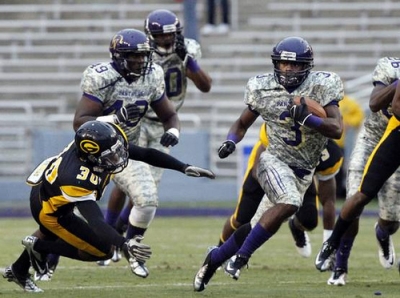
Throughout my years of coaching kickoff return units, I have noticed that the best units have minimal return concepts, but work really hard at perfecting their techniques. Many of the best return units I have coached stick to one main return scheme (trap/counter/middle), and have a solid counter off that return. My goal when putting together our kickoff return package is to never give up our return direction by our alignments, and also to have each return look as close to identical as possible to the kickoff coverage team as they are running down the field.
Personnel
We try to personnel our kickoff return team so that our boundary double team uses two bigger, physical guys. The field side of our front line consists of either big wide receivers or athletic defensive ends. On the second level our two fullbacks are usually true fullbacks or middle linebackers. Our boundary wing is usually an athletic linebacker, while our field wing is a big running back. We like a big running back here because we have found this to be the most common place to get pooch kicks. The blocking he must do is typically in space, and we have a chance for a decent return if the opponent does pooch kick. Our upback or off returner rarely fields the kickoff and must be a good blocker. Some years we are fortunate to have a dynamic upback as well. Our main return man is the most dynamic threat to score on our team. We want the ball in his hands as much as possible. Many teams that want to kick away from him will pooch kick to our field wing which almost guarantees us field position at the 35 yard line at a minimum.
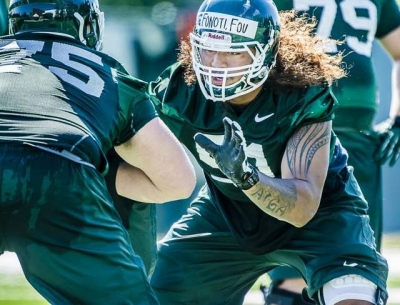
OL Drills – Zone Blocking – Michigan State Univeristy
By Mike Kuchar – @MikeKKuchar
Senior Research Manager
X&O Labs
Editor’s Note: The following report is builds on the content that MSU’s Offensive Line Coach Mark Staten shared with X&O Labs for our Middle and Outside report. To view the entirety of that report, click here.
Blocking Tight Techniques
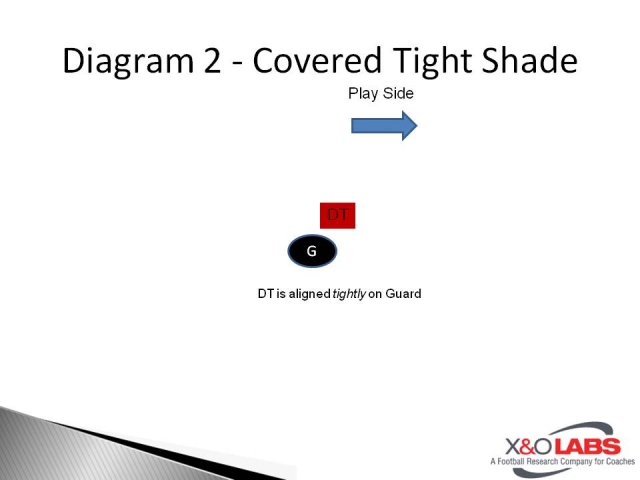
Reach/Lateral Step Footwork
The reach step could be classified as a lateral step and not a bucket step. The width of that step is predicated on two scenarios:
- The horizontal leverage (width) of the defensive lineman.
- Whether or not the covered lineman is involved in a double team.
Mark Staten at Michigan State University talks about varying that first step based on whether or not that player has help in a combination. “With help, we talk about zone reach footwork and without help it’s tight reach footwork,” said Staten. The specifics behind each technique is below:
- Zone reach footwork- Lateral to lead position (no bucket). Step progression- first step toes outside to his outside shoe, second step thru crotch of defender, third step up the field. We want to drive our inside hand thru his down hand into his chest.
- Tight Reach footwork- Hand thru near breastplate, not sternum. We know there is no help.
- Eyes on target: Aiming point is inside eye to the play side number of the down defender.
- Steps: Play side shoe position lead outside the wide foot of the down defender; 2nd step through the crotch; 3rd step working to get up field; do not wheel or swing the hips; work through to try and get the shoulders square.
- Hands: Backside hand just inside of the sternum; thumb up, strike with the heel of the hand through the arm of the down defender; play side hand captures and guides the outside half of the defender.
- Pad level and position: Keep the backside shoulder down and under the shoulders of the defender to establish leverage
- If defensive lineman stretches with you – stay on block and uncovered teammate works up to linebacker.
- If defensive lineman anchors on you – stay on block with eyes on play side arm pit of defender.
- If defensive lineman slants inside – force him to flatten his slant by stiff-arming him inside. Stay on block until you feel uncovered teammate & then come off aiming eyes to play side number of linebacker.
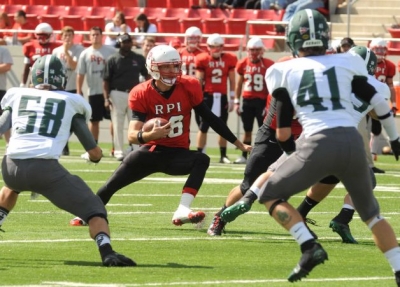
Tight End Shovel Option
By Ralph Isernia
Head Coach
Rensselaer Polytechnic Institute
 Editor’s Note: Ralph Isernia was named head coach at Rensselaer in March 2012. A veteran of more than 20 years in coaching, he has previous experience from Division III, Division II and the FCS. Coach Isernia came to Rensselaer from Ferrum College, where he was the assistant head coach and offensive coordinator for the Division III Panthers. In his two seasons he helped the team to a share of the 2012 USA South Conference championship and coached two different quarterbacks who both won league Offensive Player of the Year honors.
Isernia spent the six years prior at the University of Charleston, where he was an assistant head coach, the offensive coordinator and interim head coach. He was a regional finalist for the Division II Assistant Coach of the Year Award in 2008, 2009 and 2010. His accomplishments with the Golden Eagles included directing an offense that set numerous school records while helping the team become a contender for the conference title each season. The offense was consistently ranked among the best in the league in points per game, rushing, pass efficiency and sacks allowed. Among the players on the team, which was nationally ranked in 2009 after a 9-2 finish, were two who signed NFL free agent contracts.
Isernia has also coached at Bucknell University (2004-05), Mansfield University (2001-04), Defiance College (2000-01), Methodist University (1994-00) and Western Connecticut State University (1991-94). He served as offensive line coach at Bucknell, helping the Bison to a 7-4 record – its best finish since 1999 – and a No. 30 national ranking. Offensively, the team was ranked ninth in rushing offense and 11th in pass efficiency among NCAA Division I-AA schools.
INTRODUCTION
This was the first season for me here at RPI. Just like any coach entering a new coaching situation, I wanted to evaluate the talent on the team and see what each player did best. It quickly became apparent that although they had run some read option in the past, the best personnel did not exactly match a triple option system. Our best personnel would best be described as 11 personnel – one back, one TE and two WR’s. So we adapted the system to match the personnel.
We believe in our system. We believe in option football. We believe it is the best offense for our football team. With those tenants in place, we adapted our system to accommodate our best personnel.
The TE in the Pistol Triple Offense needs to be a versatile athlete. He must transcend the normal/typical role that a TE takes in a traditional scheme. We not only used him as an “End-of-the-LOS” guy, where he extends the defensive front or perhaps sets the defensive strength call. The versatility allows us to align the TE in any spot in 2×2, 3×1 and unbalanced formations. We also align him as an H back or large slot back. Although he is limited athletically and may not have the speed or shake of a slot, he does give us a better presence in the running game. He is a bigger and stronger blocker that the rest of our slots.
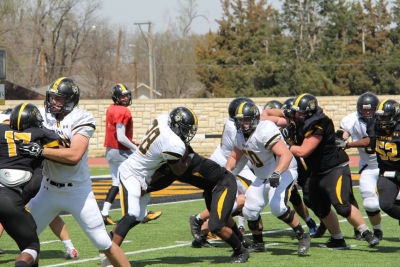
Blocking Twists in Man and Gap Protection
By Justin Iske – @justiniske
Offensive Line Coach
Fort Hays State University
Editor’s Notes: Justin Iske begins his fourth season on the coaching staff at Fort Hays State in 2014. Iske coaches the FHSU offensive line and serves as the team’s strength coach. In Iske’s first three seasons at FHSU, he has coached seven All-MIAA selections on the offensive line, led by two-time second team selection Hawk Rouse in 2011 and 2012 and second-team selection Mario Abundez in 2013. The Tiger offensive line helped produce an average of over 2,000 rushing and 2,000 passing yards per year in Iske’s three seasons. Iske came to FHSU after two seasons at Northwestern Oklahoma State University where he was the offensive coordinator, special teams coordinator and offensive line coach. His 2010 team won the conference championship and led the conference in rushing offense, sacks allowed and kickoff returns.
Introduction
The ability to keep your quarterback upright in the pocket and healthy is one of, if not the, most important jobs of your offensive coordinator and offensive line coach. Teaching proper pass sets, hand placement, aiming points, etc. is vital to getting this done. Being able to pick up defensive movement (slants/twists/blitzes/etc.) is just as important.
MAN PROTECTION SETS
We teach four types of pass sets with our man protection:
One Set (vs. Inside Shade):
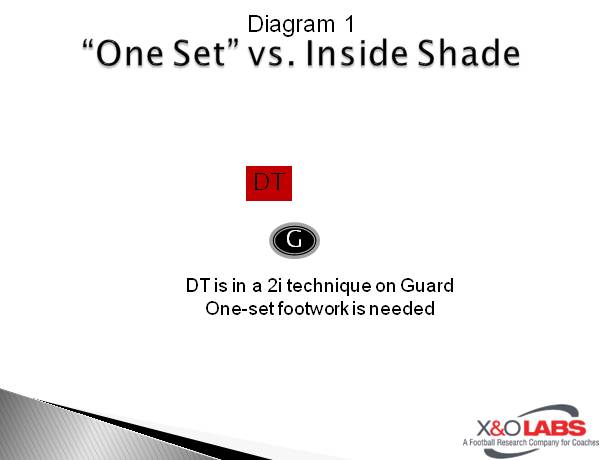
Post set. First step is six-inch step for width with inside foot. Second step is a drag with the outside foot that mirrors the first step. It is important that we maintain our stagger as we post set (inside foot up / outside foot back). Our aiming point is the midline of the defender (cover him up).
Two Set (vs. Head-Up Shade)
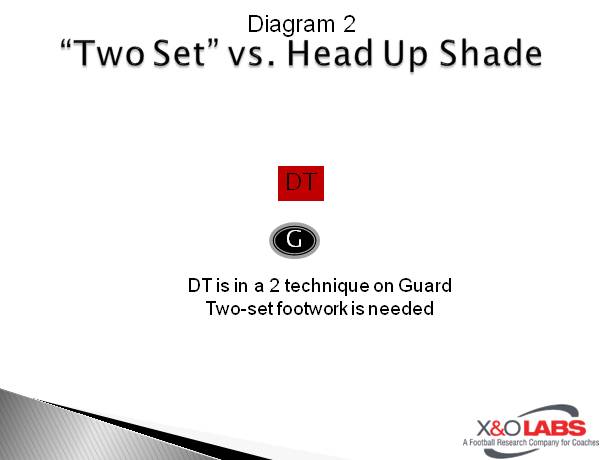
Square set. First step is a pop-it step in place with the inside foot. Second step mirrors the first step. Since our aiming point is the midline, we are already there by alignment. We simply pop our feet, snap our head back and react to the defender’s movement.
Three Set (vs. Outside Shade):
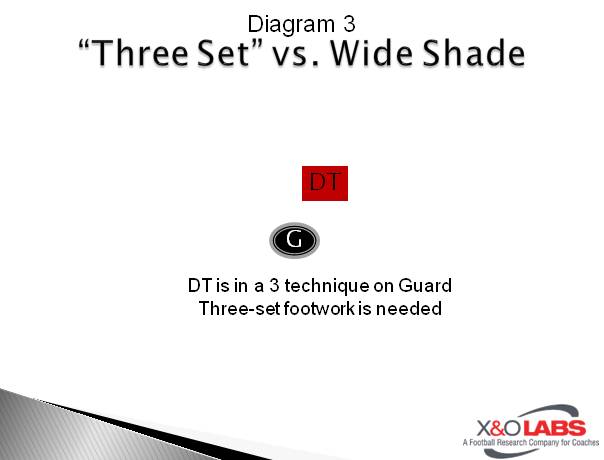
Kick set. First step is a six-inch step for width and depth with the outside foot. Second step is a drag with the inside foot that mirrors the first step. It is important that these two steps mirror each other to keep our shoulders square to the line of scrimmage. Aiming point is midline of the defender.
Four Set (vs. Wide Outside Shade):
Quarters Safety Flat Foot Technique
By Luke Tribble – @ltribb3
Defensive Backs Coach
Harding University
 Editor’s Note: Coach Tribble became Harding University’s Secondary coach summer of 2012. This past season, the Harding secondary led Great American Conference in Total Defense, Scoring Defense, Rushing Defense, Sacks and Opponent Completion Pct (50%). In addition, their run defense ranked 2nd nationally. In 2012, the Harding defense notably held their opponents to 6.1 yards per pass attempt and ranked first in Red Zone Defense.
Introduction
Having played and coached the Safety position in the 4-2-5 defense, I’m a big believer in playing your safeties flat footed whenever possible. Now we play a form of Cover 4 most of the time and this article is written from the perspective of a Quarters Defense. We may play it a little different to the boundary than we do to the field but it’s still Cover 4 by principle. More and more teams are playing their safeties flat footed or something close to that, but I believe there are still some people out there that back pedal their safeties because that’s what they’ve always done. The only time our safeties back pedal is when they are responsible for the vertical route of more than one wide receiver, which we call that a divider technique. The times that our safeties use a Divider are basically any time we play Cover 2 vs. two or three wide receivers or when we play Cover 4 to a three receiver side.
Reasoning Behind a Flat-Footed Read
I believe there are many advantages to playing your safeties flat footed. These are the reasons below:
- Gets your safeties involved in the run game quicker
- Puts safeties in better position to defend intermediate routes
- Takes advantage of our safeties strengths
- Safeties don’t have feet and hips of a Corner, but they can burst, they understand angles and leverage and recognize routes quickly
- Denies a 2 way go with vertical routes in the slot
- Makes it easier for safeties to have disciplined eyes
Pre-Snap Eyes
Here’s exactly what I mean when I say we play our Safeties flat footed. Our safeties are aligned 10-12 yards from the L.O.S. based on formation and personnel. They are in an athletic stance with their feet square to the L.O.S. They will be getting their run/pass key from a TE if there is one on their side. If there is no TE they will key the nearest uncovered OL. (We can change our reads from week to week if needed based on best read and/or packaged plays) When the ball is snapped our Safeties don’t move while getting their run/pass key. Some guys will bounce a little which is fine as long as they stay in place. The most common phrase you’ll hear from our Safeties Coach is “Don’t go til ya know” which as far as I know came from TCU. The worst thing our safeties can do is run themselves out of a play. We stress being patient and then trusting the read you get. If our safeties read run they are flying to their fit. If they read pass they hinge and shuffle.