
Implementing Nakeds From Zone Run Game


By Tyler Hughes

Former Head Coach

Snow Junior College



hughes snow collegeEditor’s Note:  Coach Hughes served as the former head coach at JUCO Powerhouse Snow College in Utah, leading his team to a 20-4 overall record, 2 bowl game championships and a top 5 national ranking in 2 seasons. Prior to being named the head coach, he served as the Offensive Coordinator leading Snow to a 70-13 overall record (.843 winning percentage) in 7 seasons as an assistant coach.  Coach Hughes is currently at football intern at The Ohio State University.


Background

At Snow College, we have been a 2-Back, Pro-Style Attack since the 2006 season.  During that time, our offense has finished in the NJCAA’s top 10 in total offense in five of seven seasons while averaging over 40 points per game.  Our run game has featured tight and wide zone concepts paired with toss and draw.  As a result, we have focused great attention in developing our nakeds off our zone run action in an effort to develop a comprehensive offensive system. 


Why Nakeds?

There are a number of reasons why we feel nakeds are an integral piece of our offensive attack.  First, they tie directly into our run game.  We ran tight zone 156 times in 2012 and need to have run-action looks that complement tight zone.  Our nakeds come off of tight zone fakes so it has been imperative that we spend an appropriate level on time in developing these plays.  Second, a solid naked game enhances our run game by delaying backside pursuit.  We’ve been fortunate to have a number of explosive plays where our running backs have cutback beyond our backside tackle as the opponent’s backside DE concerns himself with playing the boot action by our quarterback, thus taking him out his gap and giving us a huge running lane.  Third, our nakeds have proven to be highly successful in the red zone, particularly while on the goal line.  And fourth, the statistics generated from our nakeds reinforces the need to have them in our offense.  Over the past seven seasons, our nakeds have produced the following:

  • EXPLOSIVES: An explosive play 35% of the time a naked was called
  • EFFICIENCY: Have completed over 63% of pass attempts
  • TOUCHDOWNS: 1 in 5 TD passes over the past seven seasons have been off of our nakeds.  Generally, these passes have come in two forms: a deep ball from our split route or on the goal line.

Protection Schemes

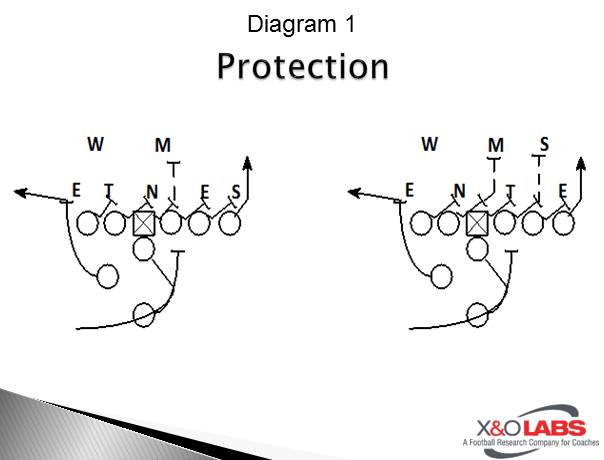
Like any successful offensive play, everything begins with your blocking success up front.  Our protection scheme for our naked game is summed up by the following points:

  1. The OL is responsible for all front-side box defenders as well as the backside DT. 
  2. Our hold-off player (responsible for backside C gap in the run game) accounts for the backside DE and the Will LB.  In other words, the EMLOS (end man on line of scrimmage).  We want him to wash down the backside DE and the Will LB if they both come off of the edge while taking the most outside threat.  Our hold-off player should block the EMLOS on his outside shoulder, thus giving the QB his best chance to avoid pressure in his face while throwing the ball down the field.   
  3. Our H should make a great fake first followed by providing help inside-out in the event of any leakage.      
Slide1

Quarterback Play

The quarterback’s ball handling, footwork and mechanics are essential to having success on nakeds.  Let’s begin with the quarterback’s basic fundamentals: 

  1. The quarterback will front out at 5 or 7 o’clock depending on the play call.  He will follow that path for two steps before stepping at 6 o’clock.
  2. Between his second and third step, the quarterback will execute the play fake.  Assuming he has opened up to his right, he will extend his left arm towards the running back while placing the nose football just above belt high. 
  3. While fully extended, the quarterback will take small, choppy steps away from the line of scrimmage.  We refer to that rapid footwork as ‘buzz steps.’
  4. The quarterback should ‘follow’ the running backs path with his faking hand while keeping his eyes on his hand, thus making an excellent fake.
  5. At the conclusion of the fake, the quarterback will bring his faking hand back to the football giving us two hands on the ball.        
  6. The quarterback should work to a depth of 9 yards.  This is important for two reasons.  First, he generates plenty of clearance from the defense.  Secondly, he is in great position to come ‘downhill’ which will give him the best chance of making a great throw.  If he is too shallow, the quarterback will have difficulty getting his hips and chest pointed at his target. 
  7. A couple of other coaching points for the quarterback are as follows: The quarterback needs to be slow in his fake and fast out of it.  In other words, we want him to sell the run-action as long as possible.  We have found that the longer he holds the fake, the greater chance he will have to get out of the pocket cleanly.  Once his fake is completed, however, he needs to ‘put the gas pedal down’ to get out.  When the quarterback eases out of his fake he will find himself in a great deal of trouble.  Finally, we do not want the quarterback to set his feet when he clears the pocket.  The concern I have is that he will set his feet without having an understanding of his backside pursuit and get hit from his blindside. 
  8. After we discuss the route running associated with our nakeds we will visit the read executed by the quarterback.

Route Running
Read More

HSU’s Nickel Pressure Package

By Carey Baker – @BakerCarey

Defensive Coordinator/Defensive Line Coach

Henderson State University


hsudefenseEditor’s Note: Carey Baker has been the defensive coordinator at Henderson State University since 2010 where the Reddies have won three conference titles and made two Division II playoff appearances.  Baker previously served as defensive coordinator at the University of Charleston (WV) and Southern Arkansas University.  He was also a graduate assistant at Southern Miss and coached safeties for Georgia Southern on its  I-AA National Championship team in 1999.


Introduction

It has been an exciting last few years at Henderson State University.  We have won 26 consecutive regular season games against Division II opponents, won our conference title three of the last for years and made two appearances in the Division II national playoffs.  Defensively in 2013, we were 4th nationally in yards per play defense (4.37), 5th nationally in yards per pass defense (5.69), and 11th nationally in yards per rush defense (2.92).

Back in 2007, I began experimenting with an ultra-light personnel on defense for passing situations.  We were basing out of the 4-3 and running an extensive amount of 3-3 stack on third down.  What started out as some 3-4 blitzes evolved into a two down-linemen package we call Panther.  Panther is essentially a 2-5 with a 2-Shell behind it.

Personnel and Alignments

The personnel elements of Panther are two down linemen in head-up 2-techniques.  We call them Tackle and Nose.  We have two stand-up OLB’s that we call Sam and Will.  The Sam and Will are our best pass-rushing LB’s and are thinking rush first.  They will box (contain) any kind of run.  Several of our Wills have defensive end backgrounds from the 4-3 but have become Wills in our 3-4 and Panther groupings.   Our Mike linebacker is stacked over the center.  There are two hybrid LB/DB’s we call the Nickel and the Panther.  The rest of the defensive backfield is our normal two corners, strong and free safeties aligned in a 2/4 shell.

The base alignment for Panther is a 2-Man alignment.  The OLB are in two point stances as if they might rush or drop.  The Nickel and Panther cover up the #2 receivers as if in man coverage.  The sell the alignment, it is important to play 2-Man often (Diagram 1 – Base).  However, the true beauty of Panther has been the variety of pressures with the Nickel, Sam, Mike, Will, and Panther as potential rushers.

Read More

Vertical Pass Concepts Off Run Action


By Ryan Anderson

Offensive Coordinator

Hamilton College


eck rolls outEditor’s Note:  Coach Anderson is entering his third year as the offensive coordinator for the Hamilton College football team. In 2012, the Continentals boasted their highest offensive output in 20 years with an average of more than 20 points per game. Two players made the NESCAC all-conference team on offense. James Stanell ’14 led the conference in all-purpose yards per game last year and his 1,560 all-purpose yards are the second-highest total in NESCAC history. Stanell finished second in rushing yards per game and Joe Jensen ’15 was third in receiving yards per game.  Anderson was the offensive coordinator at Western New England University in 2010 and 2011. He helped guide the Golden Bears to the best record in team history at 10-2 in 2011. WNEU captured its first New England Football Conference (NEFC) championship and the Golden Bears made their first NCAA Division III championship appearance.  The offense set numerous program records in Anderson’s two years at WNEU, including total offense in a game (688 yards), total offense in a season (4,105 yards), points in a game (66) and points in a season (341). In 2010, the Golden Bears ranked second in the 16-team NEFC and 15th in Division III with 246.9 rushing yards per game. Anderson coached a total of nine NEFC Boyd Division all-division players on offense, including the 2010 NEFC Boyd Division Offensive Player of the Year.


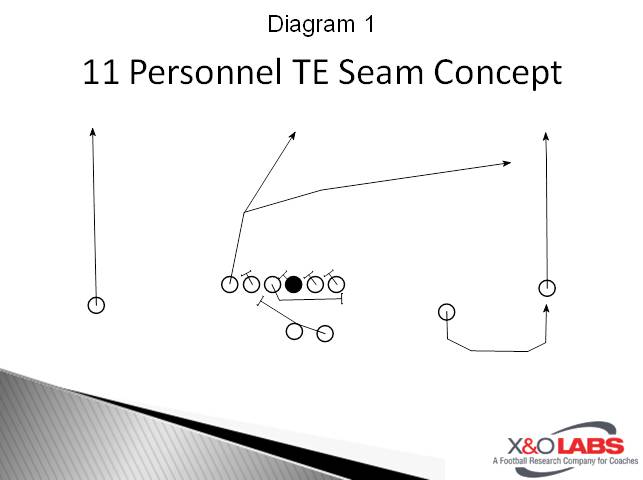
We are a zone read team that incorporates a pitch phase in a lot of our run game.  We feel that an effective play action pass game is important complement our base offense.  We want to run the football effectively enough to influence secondary run support. This will give us good matchups to throw the football. We use the TE Seam concept to complement our base runs. We have had a lot of success with this play over the years. We primarily work out of the gun and use a TE (11 Personnel), 50% of the time. We also feel this great way to highlight an athletic TE that can run and catch in space.  This route combination can be applied to other formations to match your base run formations for that week. Your offense won’t have to learn a new route combination.

Slide1

Protection

We use a gap scheme protection that utilizes a pulling guard. We feel like this scheme is the best way to emulate our base zone scheme up front.

Attack Side Tackle– He is responsible for the B gap. If there is a defensive lineman in the B gap he will block him.  If there is nobody in the B gap, step down hard and square up eying second level defenders. It is important the tackle can pick up a linebacker who is scraping over the top.

Attack Side Guard- He is responsible for the A gap. If there is a defensive lineman in the A gap he will block him.  If there is nobody in the A gap, step down hard and square up eying second level defenders.  It is important to be aware second level blitz.

Center- He is responsible for the back side A gap. If there is a defensive lineman in the A gap he will block him.  If there is nobody in the A gap, step down hard and square up eying second level defenders.  It is important to be aware second level blitz.

Back Side Guard- We want the guard to log the first defender outside the attack side tackle’s block. We coach him to log unless the defender is 2 yards up field or 2 yards outside the attack side tackle.

Back Side Tackle– He is responsible for the B gap. If there is a defensive lineman in the B gap he will block him.  If nobody is in the B gap he will block the first defender head up to outside.

Tailback- He will use the same technique as he does on our zone run play and then execute his protection.  If there is a defensive lineman in the B gap, he will block C to D gap after his fake. If there is no B gap defensive lineman, he will block B to D gap after his fake.

Quarterback- The quarterback must have a strong understanding of the protection. He must be aware of an unblocked blitz during his pre-snap routine.  If we have an unblocked blitz the quarterback will throw the ball away or throw it to the bubble. We cannot take a sack.

Read More

Perfecting No Huddle Mechanics

By Matt Kerstetter – coachkert26

Wide Receiver Coach

Westfield High School (TX)


Editor’s Note: Coach Kerstetter was one of the first coaches to move to an exclusively No-Huddle system in Los Angeles, where he was the Head Coach at Taft High School in Woodland Hills, CA from 2007-2010. Utilizing the No-Huddle to Run and Pass effectively, “Coach K” accumulated a 35-15 record during his time there. Kerstetter guided offenses that put up as much as 6,300 yds in 13 games in 2010, adapting the same system to fit his talented players, which allowed for over 3,000 yds rushing in 2009 and a year later changed gears to break the 4,000 yard passing barrier in 2010. Kerstetter has a unique distinction of coaching in the “Big 3” football states, having coached for 10 years in Southern California, 2 in Florida, and is now heading into his 2nd year in Texas as the QB/WR coach for Westfield HS in Houston. Kerstetter has had numerous players go on to play at the collegiate and NFL levels.


Anyone can be a no huddle team.  All you have to do it remove the huddle and find a different way to communicate.  Running an efficient, up tempo, no huddle team is a different matter altogether.  These teams move at a frantic pace, forcing coaches to think quicker, and teams to practice quicker. It has to become a lifestyle or identity for the team.

A few years back, Gus Malzahn (HC at Auburn and HS and College No Huddle Guru) cautioned me about making the switch to no huddle saying that “you have to be “all in” and that if you do it halfway, you’ll never get the results you want.”  He explained that I needed to be prepared for bumps in the road, questioning from staff members, and even some own self-doubt. It is not an overnight process.

With that advice fresh in my mind, I started out on a no huddle journey that forced me to truly evaluate every part of my program to make sure that it was preparing them for the end goal.  I decided to break down every second of the play to play progression of the game in order to find potential efficiencies that our team could take advantage of.

The following is a breakdown from Start to Finish of calling one play to the next play, and how it all fits together.  It includes what we look for and what the players/coaches should be focused on during every second of the offensive possession.

Play to Play Timeline

  1. Previous Play Ends
  2. Next Formation / Tempo
  3. Next Play / Tag
  4. Assess the Defense
  5. Audibles, Motions, and Cadence
  6. Snap, Execute, and Repeat

Phase 1:  Previous Play Endswestfieldhs

As the play is winding down, we are already trying to find out exactly where the ball is going to be spotted, particularly yard line and hash, and most coaches will tell you that they are trying their best to think a few plays ahead. We need to be getting quality information from the coaches who are charting plays.  Particularly if we have the other team on their heels and can take advantage of that with a pre-determined “Fast Paced Series” set of plays.  We look for the following:

Players Are Focused On:

  1. Ballcarrier must hand the ball to the official.  The faster we get the ball handed to the official, the faster they can spot it and put it into play.
  2. All players need to Jog/Run, getting to the L.O.S to be ready to run the next play
  3. Have their eyes to the sideline for any special “Fast Paced Series” (like an automatic signal or call to run the same play out of same formation immediately, or a predetermined play that we have assigned signal/number code to.

Coaches Are Focused On:

  1. Assignment checks.  Execution of previous play, by position group.  These are not asked for, but matter of commenting.  Good and Bad things that occurred by someone or a group that made a play successful or a bust.
  2. Assessing defensive conditioning and matchups.  Is the defense winded/tired?  Do we need to run one of our “Fast Paced Series” and keep the tempo at an extreme level.  Are they trying to make any substitutions?
  3. Assessing offensive conditioning and matchups.  Are any of our WR’s exhausted and not running a route full speed (if so, we need to sub them).  Is there a personnel package or formation that gives us a mismatch to stick with or attack?
  4. Relaying information from Play Charts (discussed more later) .  Should be limited to small pieces of information that you have decided are crucial during the series.  We like to focus on if we are getting the looks we expected.  If so, we can stay on the game plan, if not we know we need to adjust.

Phase 2: Next Formation / Tempo

With everyone immediately engaging with the sidelines, the coaches are now able to send in the next formation and tempo.  We game plan the formation and tempo for each week considering things like formation strength and how we want to address the boundary and field (discussed in detail in the “Keys” portion of the article).  Our confidence in our scouting and belief in what the defense is going to do go a long way in determining the tempo at which we will operate.  Here is what we are looking for and expect to happen as the formation and tempo come in:

Key Points:

  1. If we didn’t go with a fast paced series, then we must signal the new formation + the tempo.
  2. Do they have any player on defense bending over with his hands on his knees?  Call something to put them in space and attack them.
  3. Formation that suits the situation, down/distance, and spot on field.
  4. Formation that puts defense in a look that gives us space to attack.

Coaches Are Focused On:

  1. Assessing the Play.  Is this a play we like (we think we know the exact look we are going to get from defense and we like our chances of executing), if so, then go on fastest tempo.
  2. Predicting the Defense.  Is there a chance they might be lined up to defend this look, stacking a side, or playing a coverage to take it away, then we might want to check out of the play.  We go at a slower tempo, giving the QB and the play caller a chance to “uncover the defense” and either stay with the play or get to a better one.
  3. Watching Their Sideline.  Is the defense trying to sub anyone out late in the process?  We must go on 1st sound and snap the ball immediately.

Read More

Boundary Tags on Horn PAP Concept

By Mike Hallett – @coachhallett

Head Football Coach

Heidelberg University


heidelberg620Editor’s Note:  Coach Hallett currently is entering his 8th season as the head coach at Heidelberg University.  All told, he has over 20 years of coaching experience, including three (2004-06) as head coach at Thomas More College in Crestview Hills, Ky. Prior to taking the reins at Thomas More, Hallett served as the offensive coordinator and offensive line coach for the Saints. His coaching career began as an assistant at his alma mater, Orrville High School. The 2012 season was one of the most memorable campaigns in the 100+ year history of Heidelberg football. Hallett’s squad finished the regular season with a 9-1 record and earned their first trip to the NCAA Division III Playoffs. Though the Student Princes dropped their first round game, the nation recognized his remarkable accomplishment — Hallett had taken a team riding a 36-game losing streak to the playoffs in six seasons. Hallett is a 1994 graduate of Mount Union and was a member of the Purple Raiders’ 1993 National Championship team. He was a two time All-American, and was named National Defensive Lineman of the Year. He is enshrined in the Mount Union Athletics Hall of Fame.


Introduction

It is an honor to present our Boot Series to X and O Labs.  At Heidelberg, we are committed to having a strong run game and we want to use our play-action passing game to complement our run game and keep the defense off balance.  This article will focus on our Boot action which complements our sweep play (pin and pull) run play, which has been very successful for us over the past three seasons. 

Editor’s Note:  Heidelberg’s Pin and Pull concept was detailed earlier in a clinic report.

With the advent of our sweep as our primary perimeter run game, we want to have action that works opposite the sweep action and our boot has been a very good match for us. Our sweep was called 80 times in 2013, gaining 668 yards, and 8.4 yards per carry.  Our boot was called 70 times, with 2 QB runs.  68 passes resulted in 736 yards, averaging 10.8 yards per call. 


Protection

We will have some base rules for our offensive line with regards to protection.  We also have some base adjustments to our rules to help handle problematic fronts, which we have encountered historically.  With our offensive line, we use the term “Elephants on Parade” (EOP) for the group.  The OL will turn and run to the sideline of the run action, blocking defenders they encounter on the way to the sideline of the run fake.  We feel the strong run look will affect the linebackers and force defenders, drawing away from our front side of the route distribution.  Our base rule will include a pull from our BS guard (FS to the Run Action), who will work to secure the edge for the QB (Diagram 1).  Our puller is instructed to kick out or cut a hard charging EMOL, and to log any read technique defender.  We want our puller to take the widest defender, if two show up on the edge.  We feel securing the widest allows our QB to get to the edge to have a run/pass option in the perimeter.  The innermost guy must run the hump.  The end should get sucked in with run action.

Read More

4-2-5 Defense by the Experts

By Mike Kuchar

Senior Research Manager

X&O Labs


When we first compiled our research on the 4-2-5 defense, you (our readers) had specific questions – so we provided specific answers by going right to the source- selecting three of the more prominent coaches that run the scheme (all of whom you asked us to contact).  Mike Kuchar (MK), our Senior Research Manager, spoke exclusively with each of them – asking them YOUR questions, and their responses are below.  Our goal was to get a FBS coach, an FCS coach and a smaller level coach. 

The Contributors

Bud Foster (BF)Regarded as one of the top defensive minds in the game, Bud Foster enters his 26th season at Virginia Tech. The 2006 Broyles Award winner has helped mold nationally ranked defenses on a yearly basis during his 17 years as a coordinator.  Foster, who was a finalist three previous times (1999, 2001, 2005) for the award given to the nation’s top assistant football coach, has gained a well-deserved reputation as one of the nation’s most respected defensive coaches.

Mickey Matthews (MM)During his 13 seasons, Mickey Matthews has firmly established James Madison University football among the nation’s leading Football Championship Subdivision programs. While becoming the winningest coach in JMU football history, he has led the Dukes to an NCAA championship (2004) and to five other playoff appearances (1999, 2006, 2007, 2008, 2011).  Matthews three times has been National Coach of the Year (1999 Eddie Robinson Award by The Sports Network; American Football Coaches’ 2004 award; 2008 Robinson Award and an award by Liberty Mutual) and was Atlantic 10 Coach of the Year in 1999 and CAA Coach of the Year in 2008.  Matthews said he learned the scheme directly from Gary Patterson and his staff both when Patterson was at New Mexico State and TCU.

Chris Brown (CB)–  Chris Brown entered his third season as head coach of Fort Hays State in 2013. Brown came to Fort Hays State from Washburn University, where he served as the defensive coordinator and defensive secondary coach from 2002-2010 and assistant head coach in 2010.  Before coming to Hays, Brown helped Washburn compile a 62-41 record in his nine-year span with the program, which included two NCAA playoff appearances and two bowl wins. In his time at Washburn, Brown coached the 2009 and 2006 MIAA Most Valuable Defensive Players and guided two players selected in the NFL Draft (defensive tackle Trey Lewis-6th round 2007, and cornerback Cary Williams-7th round 2008). Brown also coached six All-Americans, 20 all-region and 41 All-MIAA selections at Washburn. His defense led the MIAA in turnovers gained in three of his final four seasons there, including a school record-tying 23 interceptions in 2007.Brown learned the scheme from sitting down with Jerry Kill, now the head coach at the University of Minnesota and with studying what Bud Foster was doing at Virginia Tech University.  Brown was actually a three-time All-American at Free Safety in the 4-2-5 defense as a collegian at Pittsburg State University.


MK:  What has changed most in the 4-2-5 defense today from when it was a 4-4 defense?  How has it progressed?

BF:  We’ve gone around and around with this.  The Whip position (Field Safety) for us has become more of a hybrid for us.  The Rover (Boundary Safety) and Free Safety haven’t changed a lot for us.  We’re playing more with a true safety type guy. We’d like him to be physical enough to force the end run, but with the way offenses are designed now, you can play some man coverage with him and not put up a “red flag” by changing personnel and brining it a Nickel package.  This way, you’re always playing with a Nickel package.  Offenses now just spread you around and match up.  Those outside backer/safety players are most important. 

MM:  We went from a 4-3 to a 4-2-5 because of all the one-back sets we’re encountering now.  It’s easier to adjust with a 4-2-5 than a 4-3.  If you’re in a 4-3, one of your outside backers must become an adjuster, so it ends up being a 4-2-5 anyway against spread sets. 

CB:  The game on offense has changed; it went from a ‘ground and pound’ philosophy to more of a pass happy game.  Now we have smaller, outside linebackers/safety types that play that position.  Years ago, those players were true rush linebackers with hardly no coverage responsibility.  Now these guys are safeties that can still play man to man coverage, play half field coverage and set the edge in the run game. 


MK:  Describe the personnel types of your three safeties.

BF:  When we recruit our Whip’s (Field Safety) those are a variety of skill sets.  We look for guys that can run and have some toughness because you want them to be able to blitz and force the run.  You’re looking for a big safety or a running back in high school because those are your better athletes.   We’d even look for QB’s because those are some of your smarter players and better athletes.  We’ve even had receivers in the past play that position for us.  We spill everything to them, so they need to be open-field players and have the ability to cover people in space.  Our Free Safety is a flat foot reader and alley player.  He must carry number two in the seam as well as play the Drag and Dig routes.  He needs to also be a factor in the run game.  We try to have one more defender than they have a blocker.  Our free hitter must be the Rover, Whip or Free Safety.

Read More

Isolating the X in Trips

By Curt Fitzpatrick

Head Coach

Morrisville State


headshot 2 fitzpatrickEditor’s Note:  Coach Fitzpatrick is entering his 2nd season at the healm of Morrisville State.  Prior to that, Coach Fitzpatrick  served  as the Offensive Coordinator and Quarterbacks Coach for the Utica College football program since 2007.  During that time, Fitzpatrick’s balanced, no-huddle offense has elevated the Pioneers to become one of the top offenses in the Empire 8 conference and propelled the Pioneers to shatter school records in various offensive categories year after year. The 2012 season proved to be the Pioneer offense’s most prolific to date as they led the Empire 8 conference in several offensive categories, including: Points per Game (34.2), Yards per Game (465.0), Passing Yards per Game (340.2), Completion Percentage (66.2%), First Downs per Game (24.3), and 3rd Down Conversion Percentage (50%).  All of those categories broke school records as well, in addition to breaking school records for Pass Completions (274), Passing TDs (33), Pass Efficiency Rating (156.2), and Total Offense per Play (6.3 yds/play).
 

Note:  The article below was written during Coach Fitzpatrick’s last year on staff at Utica College.  


On behalf of our Head Coach Blaise Faggiano and the rest of the staff here at Utica College, I’d like to thank X&O labs for giving me the opportunity to contribute this clinic report.  I read X&O labs on a regular basis, and look forward to getting the weekly emails outlining each week’s new topics.  For me, the information that is shared on X&O labs has helped me become a better coach and helped us become a better football program as a whole.  For this clinic report, I would like to share our pass game philosophy as it relates to 3×1 formations, specifically some ideas that we use to attack and utilize the single receiver side.

Before I get started, I think it is important to first understand what we believe in as our passing game philosophy.  Everything that we do, both run and pass, must fit into our offensive philosophies.  Here is what we believe in as it relates to our passing game: 

Utica Passing Game Philosophy:

  1. Be a high completion percentage team.  That’s where our philosophy starts.  I tell our quarterbacks on meeting number one of spring practice, and reiterate it at the start of training camp each year, that their number one role on our football team is to get completions.  Those completions can come many different ways, but the ball must get into the hands of our playmakers as much as possible. Our goal is for our completion percentage to be at 70%.  We track that number after every practice and every game to see where we’re at.  Last season we completed 66.2% of our passes.
  2. Attack multiple coverage looks with the same play.  When it comes to the passing game, I don’t want our QBs to have to check in and out of plays based on the coverage look.  We try to give them answers to all coverage looks within the same play.  This reduces pre-snap stress and lets the QB see and react, rather than overthink.
  3. Utilize the same route concepts out of multiple formations.  This is a common theme for many of coaches out there.  Utilizing the same concepts and just changing the formation (or the use of motion/shifts) allows the teaching to remain consistent.  Any time that you can run one concept that looks like two different plays to a defense, that’s a great thing.  Also, doing so helps the QB to develop consistency and confidence in making reads, eventually leading to him getting the ball out faster and more efficiently.
  4. Have balance.  For us, this means getting the ball to lots of different people.  The QB’s favorite receiver has to be the one that is open.  While we do find ways to get the ball to our studs every game, we won’t force the ball to our stud when the defense is intent on taking him away.  Passing the ball, especially out of a 3×1 formation, is a numbers game.  If they devote too many defenders to take away one player there are going to be big-time opportunities elsewhere on any given play.

For the first part of this report, I will refer to 3×1 formations with a single detached WR receiver on the backside (Trips Open).  Later on, I will discuss briefly 3×1 with a nub-side TE on the backside (Trips Closed).  In a Trips Open set, the first thing that we do is make sure that our best player, our show pony, is playing the single WR (X).  We want our best guy playing the X because it clears up the defense for the QB.  Putting your best guy all by himself on the backside forces the defense to tip their hand as to how they plan to defend him.  Are they going to leave him 1 on 1 with the CB?  Are they going to soften the CB and have an overhang LB/S in the flat underneath?  Are they going to play with a hard CB and give Safety help over the top?  Determining how many defenders they have designated to defend the X WR is where we start in most of our 3×1 progressions.  We call this “Free Access.”

Read More

Training the 9-Technique vs. Pass

By Mike Kuchar

Senior Research Manager

X&O Labs

Researchers’ Note: You can access the raw data of this report – in the form of graphs – by clicking here to read: 9-Technique Statistical Analysis Report.

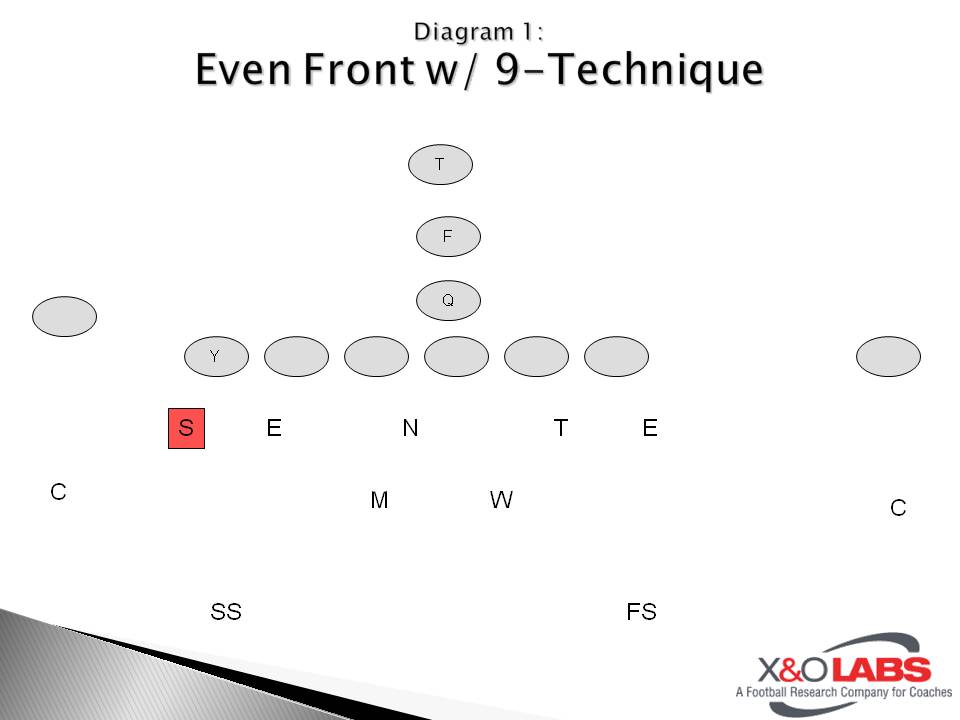
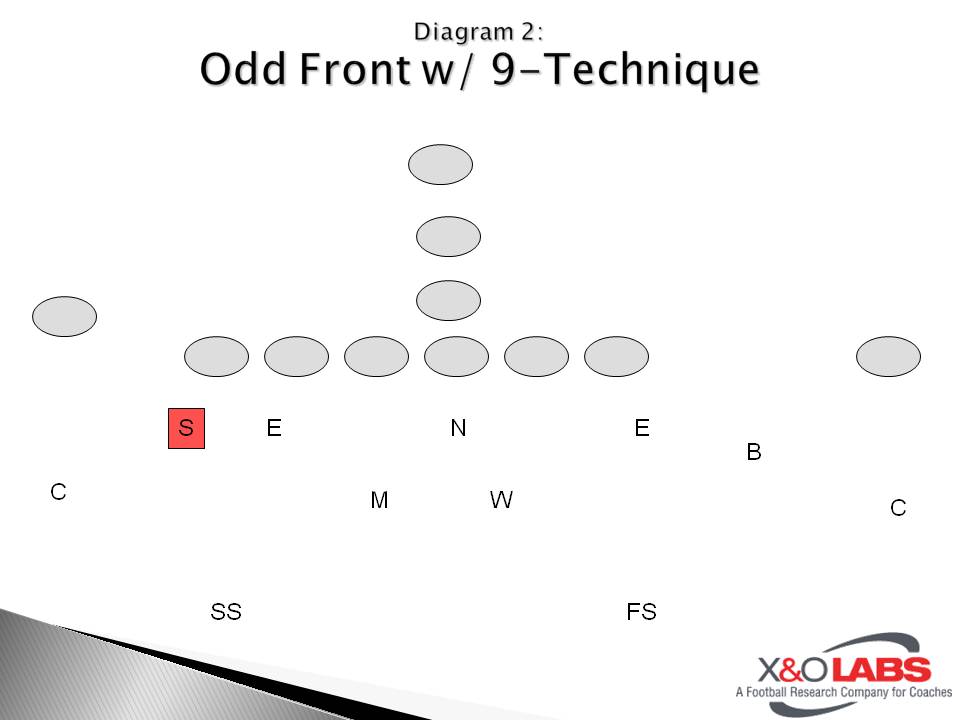
As a follow up to last week’s report on training your 9-techinque to play the run game (click here to read the report), this week’s research will center on how that 9-technique player could play the pass game.  Again, it’s important to clarify that a 9-technique is any player on the outside tip of the tight end, or third player in a three man surface.  For the purpose of this report, we’ll focus on the outside linebacker type in an even (Diagram 1) or odd (Diagram 2) front.


As we detailed in the last report, playing the 9-techinque position is so vital defensively because you must have the speed to rush the passer while having the strength to handle the D gap in the run game.  Combine this with the athleticism required to play zone coverage with the needed speed to play man coverage and you see how important it is to have a player with all these skills.  We wanted to know which kind of player coaches look for when evaluating the 9-techinque defender, so we asked.  We came up with the following results below.  In no particular order:

Qualities of a 9-Technique Defender (Based on Coaches’ Responses) 


  • “I used to be a believer in the bigger DL type body to play end, but over the past years, we have had more success with the faster OLB type.” – Kurt Gielink
  • “Our most successful 9-tech were 6-3 to 6-4 basketball swing player type bodies.” – Keith Albers
  • “Like any other defensive position the best eagle defenders we have understand how to read blocks. They have to either squeeze a down block, fight a reach block, or see high hat from tackle and get to the flats in our cover 3.” – Anonymous Feedback
  • “Fearlessness, usually your best athlete. Someone who is big enough to take on a tight end or even a tackle, but also someone who can drop in coverage, keep contain, and occasionally play man coverage.” – Gary Alleva
  • “Too strong for backs to block & too quick for OTs to block. Could out leverage TEs”- Tony Demeo
  • “We like for this player to be physical and quick. He should never get reached and must be able to react flat down the LOS on any down block from the TE. We like for him to be a great speed rusher because his distance from the OT makes that player’s pass protection difficult vs. speed.”- Rick Wimmer
  • “Relatively long and tall kids. Maybe a bit slow to play OLB consistently but better feet than typical defensive linemen.” – John Talley
  • “Our Sam LB is a player most often in a nine technique. We would prefer not to substitute personnel and our Sam also has to play an Apex technique when #2 is removed. Because of this our Sam is usually a bigger safety who has the ability to play in space. Since he is a bigger safety he usually is smaller than the TE and because of this we play him wider when he has to align in a nine technique. The best Sam that I have coached in my four years as a defensive coordinator was about 6’3 215 and former high school safety.” – Scott Sperone
  • “We would like a kid that is athletic and can run, but it’s also important that they can use their hands and understand leverage. We won’t sacrifice technique for athleticism though. At our level (high school) it’s more important to squeeze and wrong arm than it is to pass rush.” – Anonymous Feedback
  • “Our 9-tech player was more like our weak side LB. While most of the time he was a rush end, we did use him for Zone and even Man coverage’s (Man coverage on TE). We felt someone similar to that of the Will LB could handle any of the calls/coverage’s we would use from this technique and wouldn’t have to switch him out or be out of position if we had to change our call at the LOS.” – Daryl Taaffe

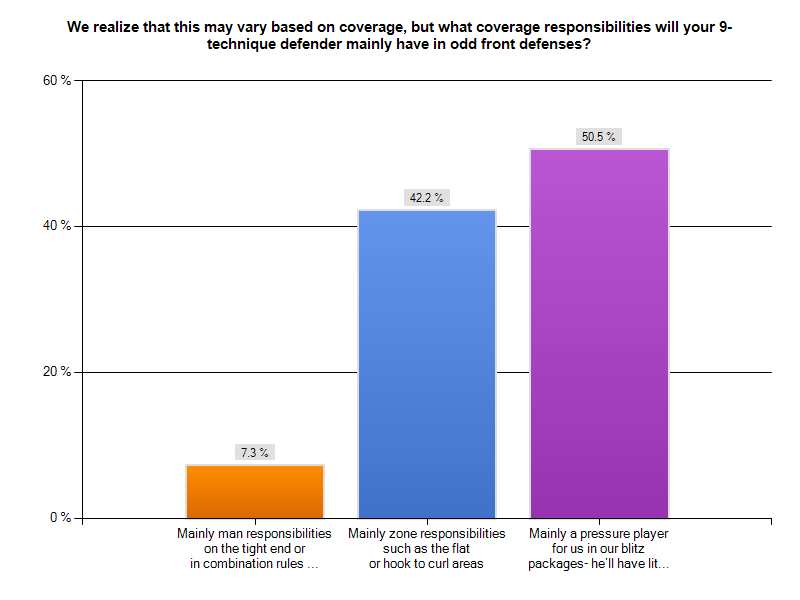
When we started our research, we were under the assumption that the 9-technique defender (if not a defensive lineman) was mainly a pass defender and not a rusher, particularly in odd front defenses.  So, we weren’t that surprised when we got the results of our tally below.

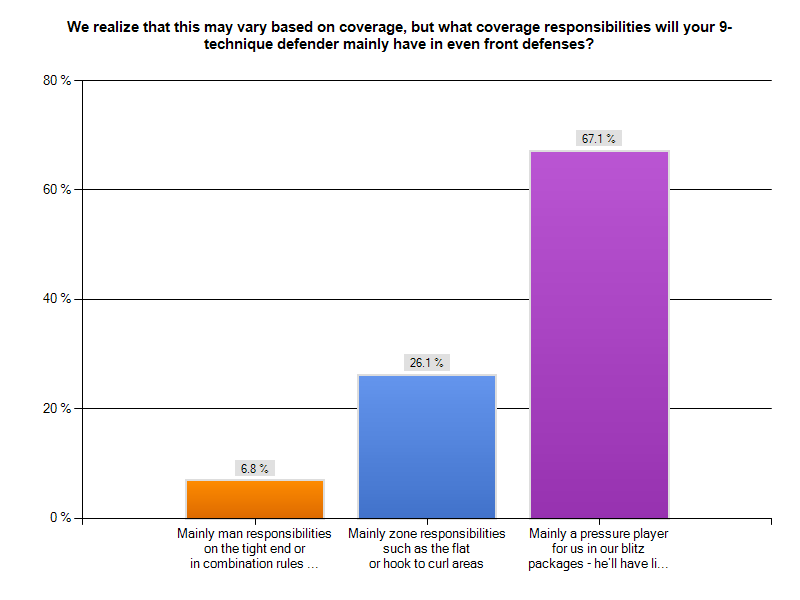
The results between pass defenders and rush defenders in the odd front were pretty much even, mainly because those defenders are usually linebackers in nature.  But when we polled our coaches that run the even defense we’ve found those 9-techique defenders in the Under defense are pass-rushers first, and coverage players second.

So, because our results were split between being pass defenders and pass rushers, in order to accommodate the needs of both defensive structures, we’ll explain both scenarios of the 9-technique being a coverage player as well as a rusher below.  Since the majority of 9-techniques are pass rushers, we’ll start there.

Case 1: Using the 9-Technique as a Rush/Contain Player

Through our research, we’ve found that the 9-technique outside linebacker is rarely a pass rusher unless in pressure situations.  In most of these situations, coaches will play some form or three deep pressure behind it by dropping a safety (Diagram 3). 

Read More

Run Game Concepts vs. Defensive Movements

By Justin Iske – @justiniske

Offensive Line Coach

Fort Hays State University


Editor’s Notes: Justin Iske begins his fourth season on the coaching staff at Fort Hays State in 2014. Iske coaches the FHSU offensive line and serves as the team’s strength coach. In Iske’s first three seasons at FHSU, he has coached seven All-MIAA selections on the offensive line, led by two-time second team selection Hawk Rouse in 2011 and 2012 and second-team selection Mario Abundez in 2013. The Tiger offensive line helped produce an average of over 2,000 rushing and 2,000 passing yards per year in Iske’s three seasons. Iske came to FHSU after two seasons at Northwestern Oklahoma State University where he was the offensive coordinator, special teams coordinator and offensive line coach. His 2010 team won the conference championship and led the conference in rushing offense, sacks allowed and kickoff returns.


One of my pet peeves about clinic presentations has always been that coaches discuss the running game versus base defensive fronts only. Obviously in game situations, the defense isn’t going to sit in their base defense all the time. We must realize that defensive coaches and players watch film, too. And they are going to adjust what they do both pre and post-snap to try to stop what we do best. The purpose of this article is to discuss blocking three base run schemes against defensive movement (slants/twists/blitzes/etc.)

At Fort Hays State, we break down our running game into three base categories:

  • Zone Runs (Inside and Outside Zone Plays) – On these running plays, each offensive lineman is responsible for his playside gap.
  • Box Runs (Inside Zone Plays) – On these running plays, the o-line is responsible for all players in the tackle/tight end box and each offensive lineman is responsible for his backside gap.
  • Gap Runs (Power / Counter Plays) – On these running plays, the frontside o-linemen are responsible for their backside gaps, we are pulling one or more backside o-linemen and we will hinge the backside tackle/tight end.

In teaching our run game as a limited number of concepts instead of individual plays, we are able to have a diverse ground attack with multiple backfield actions with limited teaching of footwork, hand placement, and other fundamentals for our guys up front. Depending on our personnel at quarterback, running back, and receiver; we can adapt our run game with various reads and combo plays as well.

We teach assignments to our o-line and tight ends similar to a matchup zone concept in basketball. Our goal is to get double teams on down linemen when possible while still being gap sound. All defensive fronts are grouped into five basic categories:

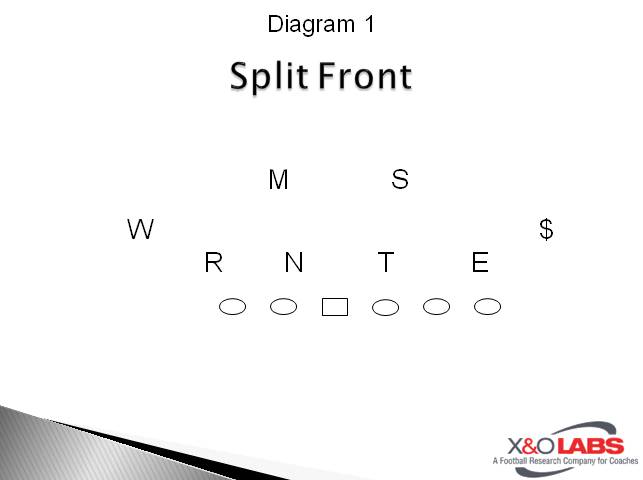
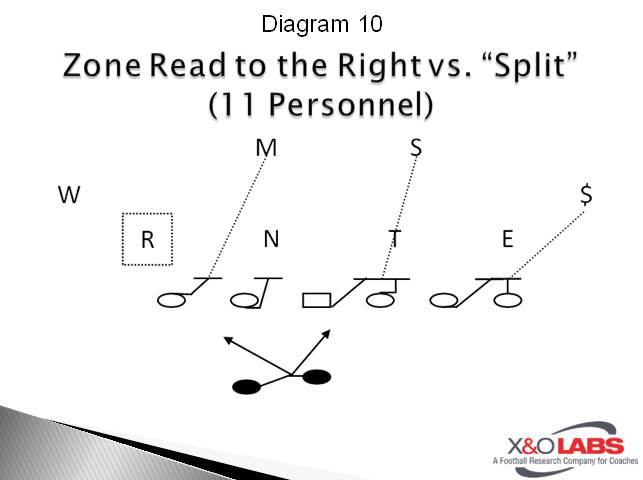
  • Split (four down linemen / two linebackers in the box) Diagram 1
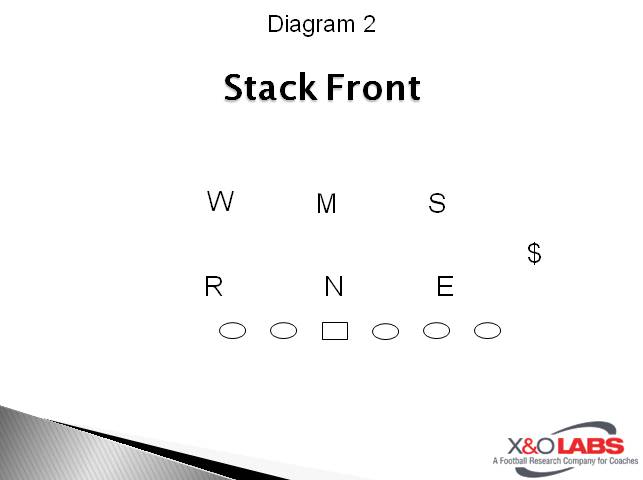
  • Stack (three down linemen / three linebackers in the box) Diagram 2
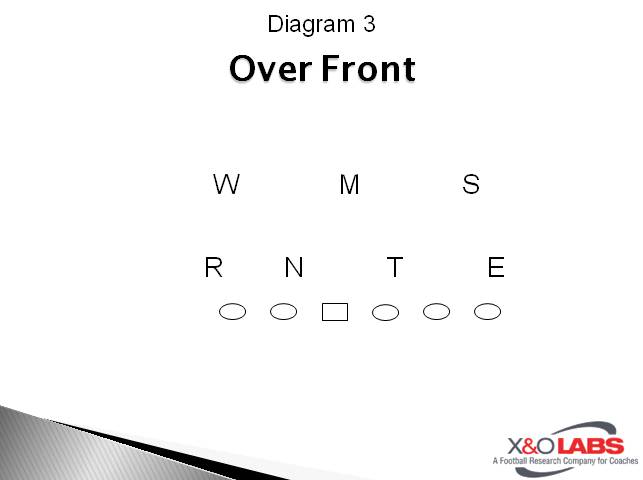
  • Over (four down linemen / three linebackers in the box) Diagram 3
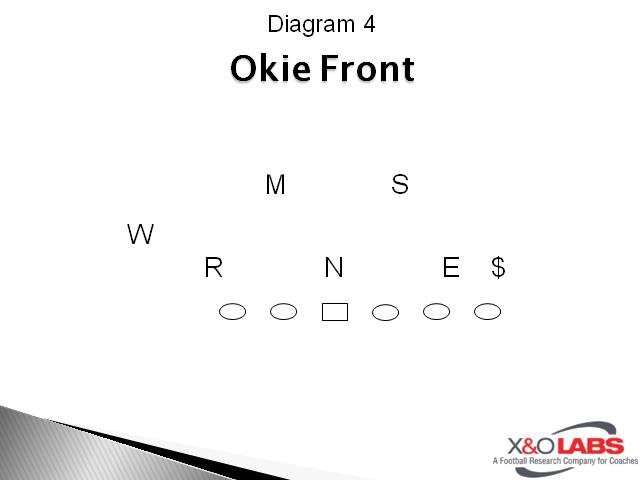
  • Okie (three down linemen / two linebackers in the box) Diagram 4
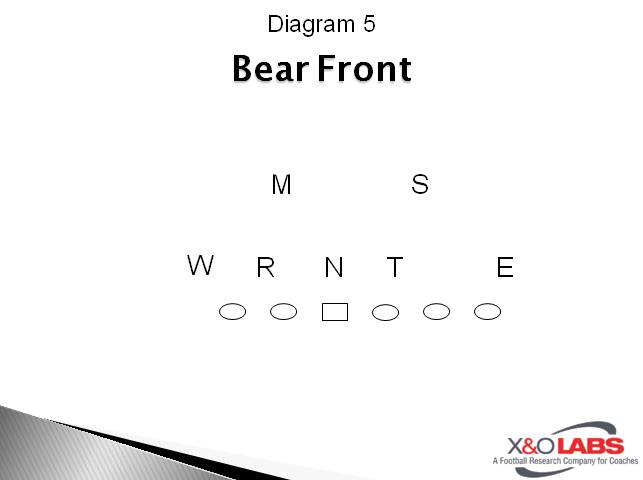
  • Bear (both guards and the center are covered by a down lineman) Diagram 5

Slide1Slide2Slide3Slide4Slide5

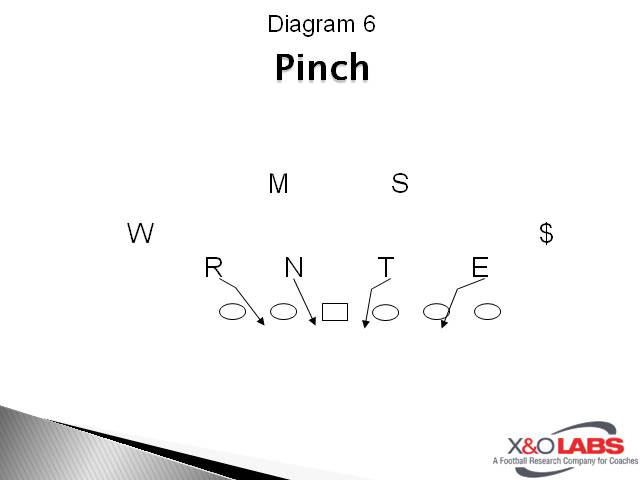
In addition, we use four differen base calls to classify front movements.  They are as follows:

Slide6Slide7Slide8Slide9

Our center will make a front call on every snap. Based on the front call, we know who will be working in combination with who up front. However, any threat to our gap will override our base assignment.


Zone Concepts

The inside zone concept has always been the first thing we put in every fall and spring. We have several zone concepts with slight change-ups by certain personnel but they all fall under the same teaching; we are responsible for our playside gap. This is true whether we are running an inside zone concept (base block technique) or an outside zone concept (reach block technique). 

Slide10

Read More

New Research: How UMASS Implements Its Pressure Check System

By Mike Kuchar

Senior Research Manager

X&O Labs


This Spring, University of Massachusetts has developed what it calls “Falcon,” a two-deep, four under field pressure blitz check concept designed to attack offensive formation width.   Players are taught to trigger the pressure based on formation structure and leverage.  It’s a simple system to implement and even simpler to execute once defenders understand the four base offensive identifiers and which pressure is designed to attack them, respectively.   To see how UMASS designed this concept, click on the link below.

Read More

The Chris Ash Interview: Calls & Adjustments

By Mike Kuchar, Senior Research Manager, X&O Labs

Chris Ash, Defensive Coordinator, University of Arkansas


tOSUResearcher’s Note: Chris Ash is now the defensive coordinator at the University of Ohio State.  in 2012, while he was serving as DC at perennial Big Ten contender University of Wisconsin, he sat down exclusively with X&O Labs’ Senior Research Manager Mike Kuchar and spoke specifically his call system and how he adjusts his fronts and coverages to specific formations.
 

MK: When you break down opponents how much of it is formation as opposed to personnel? Do you get more of a beat on what they do on 2×1, 3×1, 2×2 etc.? Or is it more about which personnel they have in those combinations?

CA: It’s really all of the above. We’re going to have our philosophy but it must fit our personnel or the personnel we can recruit here. When we start game planning against opponents we’re going to identify formations that we’re going to have to defend. In today’s world 3×1 and empty seem to be the trend. We identify their top formations, their top plays out of those formations and then we’ll identify their top players that they have and where they are located in those formations. Then we will build our game plan around what we do to stop it.

MK: Will you have separate checks against those combinations or will it be mainly against the type of personnel?

CA: When teams give you multiple formations out of the same personnel grouping we have a check system that we use. Some teams do a great job of running plays with their QB under center then they move their QB in the gun and it’s a different deal. We have a check system against plays with the QB under center and when the QB goes in the gun we have another certain package that we’ll be in. Let’s say there is 11 personnel in the offensive huddle or on the sideline huddling up. You don’t know what kind of picture (personnel) they will come out in. They can come out in 11 personnel pictures, 10 personnel pictures, 20 personnel pictures with the tight end or wide out in the backfield. We teach our players pictures, they understand the pictures and they understand which coverage’s we want to be in based on those pictures. We have a communication system that will allow us to get to that.

MK: How many coverage checks will you have based on those pictures?

CA: It depends on opponent. Pretty much, certain formations like 2×2 with the TE in the core, we’ll play certain coverage. 2×2 with no TE, our coverage will adjust. 3×1 with a tight end vs. 3×1 with no tight end we will adjust differently. When we get to a 20 personnel picture we have to know how we will check. Based on the game plan, they have to know they are going to adjust vs. a 20 personnel picture. They will check to it automatically. We play 2×2 one way and 3×1 two different ways. 20 personnel pictures we may play one way. Our guys need to know what they are going to be in.

MK: I realize that 21 personnel pro sets are disintegrating in the Big Ten, but will you still play with two-high against those sets?

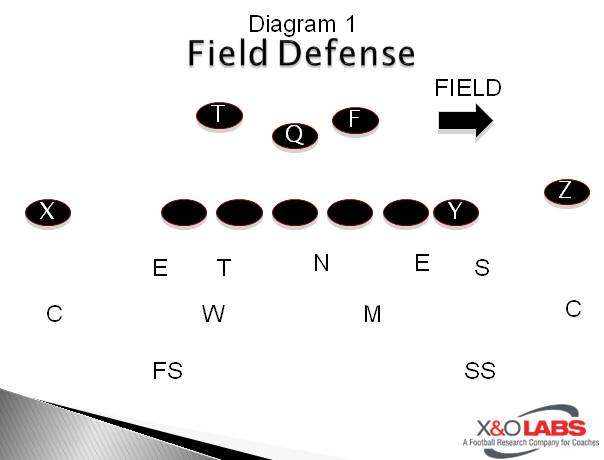
CA: Against two back run game or pro sets we will not be in two-high coverage. We will be in an eight-man front and bring one of our safeties down into the box and play with a single high safety. It’s a part of our check system. Now, if they run a pro style offense when the QB will get in the gun, we may play a different coverage- we’re yelling “gun, gun, gun,” and we’re playing some type of cover four. We will play an under front or if the ball is on the hash, we’ll make a field call where we set our Nose and Sam to the field. (Diagram 1).

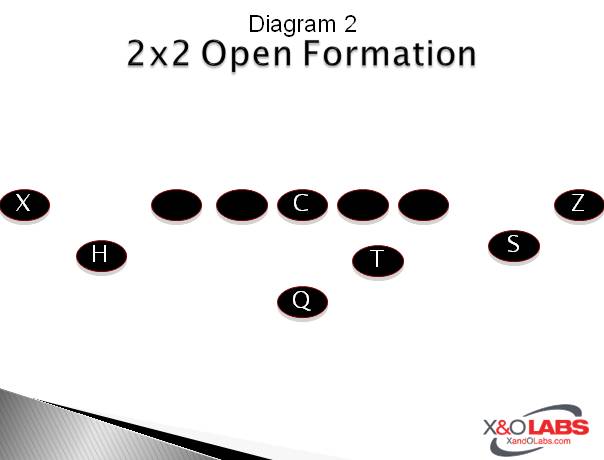
MK: Coach, now I’d like you to take us through your game planning against formations. What is the protocol you use in defending these specific formations? Let’s start with 2×2 open gun formations (Diagram 2).

CA: 2×2 open you have to look at where the back is and what they do out of that set with the back. Is the back deep? Is the back even? Is he wide, etc.? What does the back tell you? Is the back offset to the field? Is he offset to the boundary? Is he in pistol? You have to identify what they’re doing out of each of those backfield sets. The level of the back tells you a lot of information. If the back is to the field, and he’s flat, many teams will not run the power read scheme with him into the boundary. There are certain things we can do with our front four to negate any of those runs. We don’t any zone read with the back even with the QB these days. The only thing we’re getting with that is the power read. The zone read and veer option comes with the back deep.

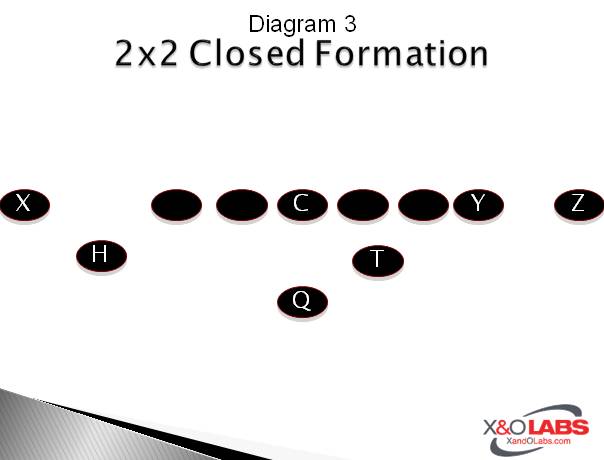
MK: How about 2×2 formations with the TE closed (Diagram 3)

CA: We don’t see much zone read out of that anymore. We see tight end side power, which could be an issue when you got crack schemes on a safety. We see stretch plays with crack issues. The zone read to me is not the play of choice for spread offenses out of that formation. When I study it, that backfield set shows more tight end side run game than anything else (Back away from TE). I guess their trying to get your backers to cheat weak because of the back set but there is so much TE side run game. That’s what you’re trying to study. Sure, that’s the backfield set, but what are they really trying to do out of it. In the old days it would’ve been nothing but zone read but in today’s offenses it’s certainly not the case.

Everything we do depends on whether the QB is a running threat or not. If the QB is not a running threat, you can play eight man fronts or man free coverage. If the QB is a running threat, it changes the game completely.

Read More

Coaching & Simplifying an Effective KOR


By Christopher Smithley – @WJFootball

Secondary / Special Teams Coordinator

Washington and Jefferson College


thumbEditor’s Note:  Coach Smithley coached his 2nd season as a Presidents’ football assistant in 2013 as the team’s Special Teams Coordinator and Secondary coach. In 2013 Smithley led the Presidents secondary to a conference high 16 interceptions including 5 from 1st Team All Conference free safety B.J. Monacelli ’14.  The Presidents special teams ranked 1st in kickoff return average, punt return average, and kickoff coverage in the Presidents Athletic Conference.  The Kickoff return unit also averaged 24.33 yards per return ranking in the top 15 in the country.   In 2012, as linebackers coach, Smithley helped Pine-Richland High School graduates Ian Hennessy ’13 and John Hunter ’13 produce the best seasons of their careers with 99 and 97 tackles, respectively. A native of Bolivar, Pa., Smithley played quarterback and H-back during his playing years with the Yellow Jackets. He is a graduate of Laurel Valley High School.


Kickoff return, like all the other special teams, is extremely important in the outcome of a football game.  At Washington and Jefferson College, we put a major emphasis on our KOR unit.  We feel that field position not only can determine a football game, but can also create huge momentum boosts that raise the level of play for an entire team.  We have all seen it.  There is nothing that compares to a kickoff return that involves two punishing blocks and a returner that threads the needle in the hole and busts a big return.  The energy that erupts from your sideline and your fan base is stronger and more powerful than any other play in football.   

The key to this unit is, and always will be, having one or two guys that when the ball is in their hands, is a threat to break a big play.  However, it is also important to have a scheme that is simple and effective, and gives a coach the ability to be multiple with their returns. 

This year our KOR unit was ranked 15th in the country and led our conference in kickoff return average with an average of 24.3 yards per return.  This team, just like all of our other special teams units, is made up from personnel from all over our roster.  These guys have responsibilities and focuses in their offensive and defensive positions.  I cannot say enough how important it is to make special teams simple and effective for your program.

We currently run a scheme that our Head Coach Mike Sirianni has used here at W&J for years.  This past year, we placed larger emphasis on this team with film study and practice repetitions in order to create more productivity.  We typically spend approximately a half hour per week working this unit in practice.  We give our scout kickoff team the looks to run that we will see for that week as well as the possibilities that we feel as a staff that we could see.  We will also get 30-40 minutes of film each week watching our practice, past games, and opponent scouting.  I cannot say enough about how much film study is in every phase of the game, but in this particular unit it has been extremely productive for us here at W&J

Scheme and Alignments

There are a thousand different ways you can scheme up a kickoff return.  Some teams will run an outside return to the boundary and some may even run an outside return to the field.  When I say to the boundary, the kickoff team kicks a directional kick to our right.  The right side would be the boundary and the left side would be considered the field.  Teams can run a right middle and a left middle which typically hits either just inside or outside of the hash.  Also teams can just run a middle return right up the center.  Technically, if your KOR unit is set in their alignments the same way every time, that is five different schemes that you’re asking your players to be able to know and execute.  In our scheme, we teach our guys a sideline right and a left middle.  It minimizes the amount of information that our players have to comprehend.  If we want a sideline left or a right middle, we will flip the entire return unit.  Now, we have a sideline and a middle hash return to either the field or boundary based off of where the ball is kicked. 

Read More

How Does HSU’s #1 Ranked Offense Run Shallow?

By Mike Volarvich – @scorchedeartho

Offensive Coordinator/QB Coach

Henderson State University


247972 4134107869189 1619673936 nEditor’s Note:  Mike Volarvich is going into his 5th season as offensive coordinator and quarterback coach. Volarvich has been instrumental in making Henderson State the top offensive team in the country leading the nation in scoring in back to back years.  In 2013 the Reddies led the nation in scoring (53.3 points per game), Total Offense (576.4 ypg), Passing Offense (428.4 ypg), and Touchdowns per game (7.17 TD’s per game).  Working primarily with quarterbacks, Volarvich has coached All-Americans Kevin Rodgers and Nick Hardesty who were both finalists for the Harlon Hill Award.  Prior to his arrival to Henderson, Volarvich was the leader of a potent EMCC scoring offense which led the NJCAA in passing offense and finished second in the nation in total offense.  Coach Volarich also runs www.scortchedearthoffense.com.


This past year, our offense here at Henderson State University (D2) just finished its best offensive season in school history.  When the dust settled, we led the nation in scoring offense (53.3 ppg), total offense (576.4 ypg), passing offense (428.4 ypg) and TD’s per game (7.17).  Of course there are many piece of our system that contributed to this success, but perhaps none more than our flexible Shallow concept.  In the past 2 years, we have thrown the shallow concept 69 times completing 65% of those passes.  Over that period, we averaged 18 Yds per completion and 11.8 Yds per attempt.

When we run the “shallow” it is designed to get a high/low read on a linebacker.  At the same time, it has the ability to generate a 1-1 matchup while allowing us to get the ball out of the QB’s hand fast.  We also like this play because we can run it out of any of our 2×2, 3×2, and 3×1 sets regardless of the coverage that is being played.  Here are our rules for the Shallow Concept:

Read More

One Back Protection Scheme


By Cedric Pearl

Head Coach

Central State University (OH)


Editor’s Note:  The following article was written by Cedric Pearl, while he was the offensive coordinator at Alabama A&M.  Last March, Pearl was hired as the head coach at Central State University in Ohio.


CaptureThe key to any successful offensive play is to have everyone identified and accounted for in the blocking scheme.  When designing a play our staff always knows it’s imperative that everyone understand protection.   This is extremely important to the quarterback because he will know where to throw the ball in case of blitz or change to another protection.  At AAMU we employ what we call an Area/Man scheme with our five step drop, one back protection scheme.   This allows us to get four receivers in the route combination called.  Our protection is determined in the play call, which allows everyone to be on the same page.
Area Side of Protection

The Area side of the protection will alert the center, the play side guard and play side offensive tackle to slide to call side and block defenders who attacks their area (gap).  The play side OT will block C gap defender, the play side  OG will block the B gap defender and the Center with block the A gap defender.  These defenders could be on or off the line of scrimmage prior to the ball being snapped.  The uncovered lineman to the Area side must check the defender at the line of scrimmage to the call slide before getting eyes on LB’s who are off the ball.  This is important because our first rule as offensive linemen is to block the line of scrimmage first. 

Read More

Designing Pressure To Defend 3×1 Open Formation Structures

By Mike Kuchar

Senior Research Manager

X&O Labs


skyviewtackleEditor’s Note:  The following information is only part of XandOLabs.com special report on developing a blitz check system.  The entire three-case study can be accessed through the links below:


Blitz Checks Case 1:  Introduction and Protocols


Blitz Checks Case 2: Formation and Personnel Pressure Checks

Blitz Checks Case 3: Using Pressure Checks to Attacking Protections and Personnel 


Where to Attack

In 3×1 sets, Virginia Tech defensive coordinator Bud Foster prefers to come from the boundary and mug the Mike. Yet, in 2×2 formations, Foster prefers to come from the field.  “In order to get a free hitter, we try to get four from a side,” Foster told us.  “ If they track their Center to us, we’ll plug in the Safety and it will turn into a man pressure sometimes. 

Read More