Southwest Minnesota State “Cram” Principle

By Jeremy Darveau 
Offensive Coordinator
Southwest Minnesota State University (MN)
Twitter: @CoachDarveau


Introduction: 


Mustang PlayThere is a difference between having the Inside zone scheme cutback and teaching the Inside zone to cutback.  Southwest Minnesota State does exactly that when working with its backs on the inside zone.  The Mustangs mostly operate out of open sets in 10 personnel with an offset and depending on the front given, they will have their back read the back side shade technique, or even zero technique in order to ensure a cutback. In its simplest sense, Southwest Minnesota State will classify their fronts and reads based on the following (they will mainly have a read principle for the back side defensive end):

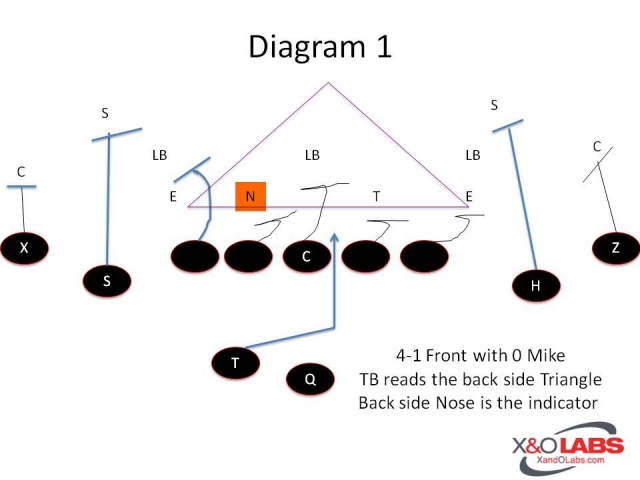
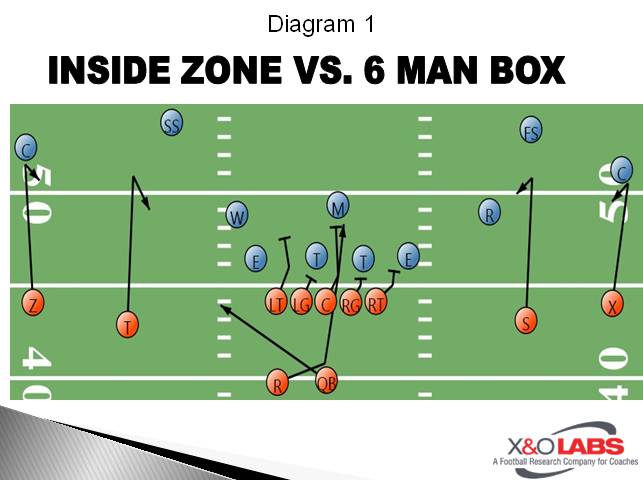
4-3 front with a zero Mike linebacker- ball carrier reads the triangle and can cut off the shade (Diagram 1).

 Slide1

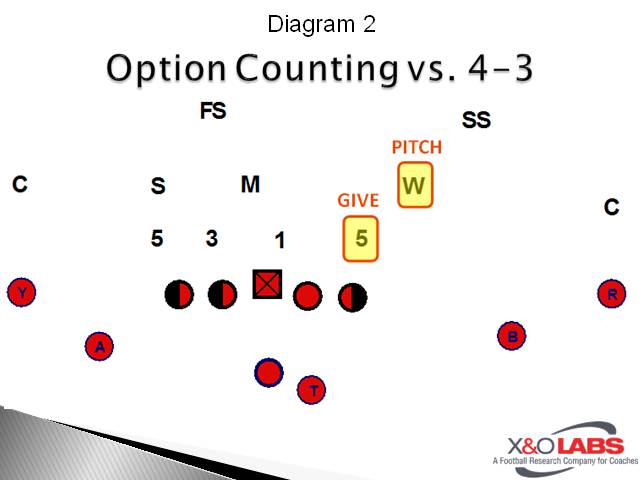
4-2 front with two backers- ball carrier reads the square and can cut off the shade (Diagram 2). 

Read More

Using Defensive Leverage and Numbers to Dictate Play Calls


By Scotty Walden – @ETBUCoachW

Offensive Coordinator/ Quarterbacks Coach

East Texas Baptist University


stbaptistEditor’s Note:  Scotty Walden is the Offensive Coordinator and Quarterbacks coach at East Texas Baptist University located in Marshall, Texas. It is his second year coaching there and previously was the Offensive Coordinator and Quarterbacks coach at Sul Ross State University in Alpine, Texas. He is originally from Cleburne, Texas just south of Fort Worth and finished my collegiate career playing quarterback at Sul Ross State University in 2011.            


Going into the season at ETBU we had 8 quarterbacks on our roster. 5 out of those 8 quarterbacks took snaps for us this season due to injury. This was a completely new challenge to me as I had a 10 game starter at Sul Ross State University the season before. These injuries caused us to re-think our offensive strategies because each of our quarterbacks possessed a unique skill set. For instance, our starter was a guy who could not only throw from the pocket but could read the zone or pull the ball down and run when he wanted to. He was a true dual-threat. In contrast our backup quarterback was a pure pocket passer while our other quarterbacks were pure runners. With these varying styles of quarterbacks, we had to find a way to tweak our system to play to our starter’s strengths. Obviously with our pocket passing quarterback we wanted to throw the ball a little more because that is what he does well. But, we also did not want to lose our ability to run the football.

Our solution was to combine what he did well (throw the ball) with our run game. The results were extremely positive.  This was our first season as a staff at ETBU under the guidance of head coach Josh Eargle. When the season had ended, we were able to set 19 offensive school records while averaging 455 yards per game and producing an 1800 yard passer, 1,000 yard rusher and a 1,000 yard receiver while leading the American Southwest Conference in passing. The premise of this article is to talk about adapting your offensive system to play to your quarterback’s strengths just as we had to this season. As you know injuries are a huge part of this game and having the ability to be flexible in your offensive system is paramount due to the possibility of injuries (especially to your trigger man). Our offense is extremely quarterback dependent and by creating opportunities for our quarterback to utilize his strengths we were able to still have success offensively amidst numerous injuries to the position.  

HITCH CONCEPT

One quick game concept we utilized with our run game was a simple hitch. We combined our hitch quick passing game with our inside zone and G/H counter run game. Our quarterback goes through 3 progressions in determining where to go with the football. The quarterback will determine where we have numbers, leverage and his last resort is to run. This was a simple yet effective process for our young quarterbacks.

  • NUMBERS- When we talk about numbers we are talking about numbers in the box. Our definition of the box is from tackle to tackle in width and 5 yards from the line of scrimmage in depth. If our quarterback identifies we have a numbers advantage in the box then he will run the football. If the numbers are not in our favor in the box we go to the next progression.
  • LEVERAGE– When we talk about leverage we are talking about the alignments of both the corners and the force defenders. Once we have determined there is no numbers advantage in the box, we will determine the leverage of the corners. Is he playing soft or hard? Then we look at the leverage of the force defenders. Is he playing tight or loose to the line of scrimmage in relation to our slot?
  • RUN– This is by far the most important progression for our quarterbacks. If at any time our quarterback cannot get a solid read on numbers or leverage of the defense we always say when in doubt run the football.

Slide1

Read More

Special Teams Circuits: Case 1 – Methodology


villBy Sam Nichols

Managing Editor

X&O Labs


Introduction

We all know how important special teams are, the age-old coaching maxims tell us this.  Adages like “one third of the game,” “can’t be neglected,” and “the difference between wins and losses” have all been repeatedly used by coaches to preach the importance of special teams.  Is this just “lip service” that coaches preach to their players or has the culture of buying into special teams starting to take shape?  This is what we wanted to find out when we began conducting research on what coaches are doing to not just preach, but act on the value of special teams unit. We all know it wins games, but the complicated and fragmented nature of the six different special teams (punt, punt return, kickoff, kickoff return, extra point, extra point block) make organization and execution of properly trained special teams a difficult proposition.    

The main challenge comes back to skill development.  When you install an offensive play, you are able to lean on the blocking, passing, and ball carrying skills that you have taught for years to make the play successful.  When it comes to special teams, much of the time those skills are much less refined and sometimes very different than anything those players do during the rest of the game which leaves coaches stretching for methods to teach these skills.

So the question is how do you develop those integral special teams skills in a way that is quick, focused, and most importantly productive? The answer that many coaches have turned to solve this problem are special team drill circuits, which are rapidly starting to supplement the traditional special teams drills.  The fact is 66 percent of coaches rely on circuits as part of their special teams teaching progression. 
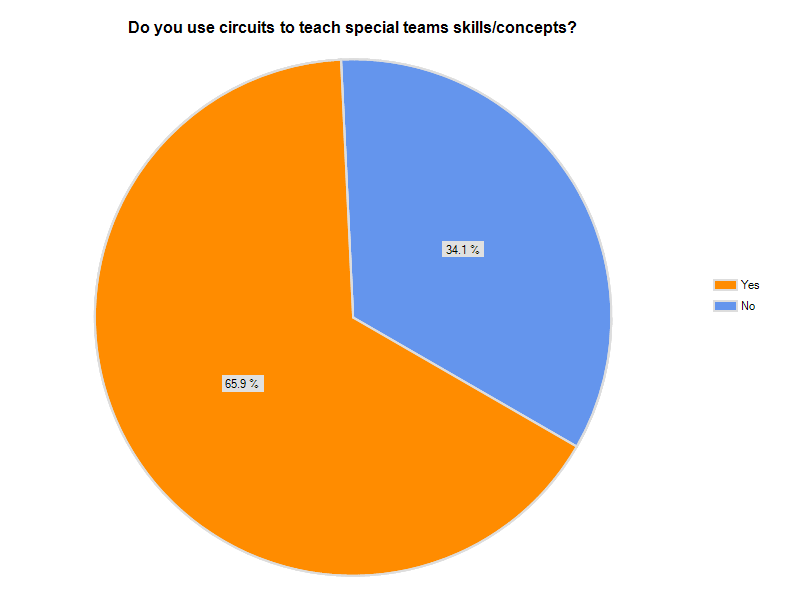
q1chart

Why Special Teams Circuits?

Interestingly enough, only 60 percent of those coaches have been using circuits for four years or less, which shows that circuit use is in the up-swing and that toward using circuits and that more and more coaches have seen the benefit in making this transition.  Below is a breakdown of the different advantages that coaches articulated for us as part of our research.  After speaking with the various coaches that use the circuit training progression, these are the most valuable benefits in employing the circuit system to teach special teams.

Benefits of the Circuit System:

Identification and Assessment of Talent

Many of the coaches in our survey explained that they use these circuits early and often in order to get all the players acclimated to general special teams concepts while evaluating their personal strength.  These coaches suggested that the circuit mentality allows them to focus on basic skills and see which kids can do them on a high level.  Once special teams positions are more defined, the many of these coaches run circuits less frequently.  Consider the words of the following coaches who participated in our research. 

“For our punt block, it [circuits] have helped tremendously. Our coaches have had a chance to see every single player on special teams and we have had chances to exchange our thoughts on each kid’s ability. It has helped us to identify who has a knack for it.” – Aashon Larkins, The Citadel

“Early on we use them to identify special teams players and to break down the important fundamental skills for each team. Then, as the season progresses, we do a circuit during early outs once a week that helps our whole team work on fundamentals for special teams. (Snap, kick, return, cover lanes, block protection).” – Rick Ward, Covina High School (CA)

“Circuits are a great way to maximize reps and evaluate talent. We will do circuits for individual special teams during the spring so we can see who can excel at specific skills. We will also incorporate fundamental tackling, blocking or block protection into our circuits so that it complements the techniques that we use on Offense and Defense. We will also do circuits for just Offense and Defense and evaluate our players there too. If a certain player demonstrates the ability to block in space, defeat blocks in space or tackle in space then we will put them on our special teams.”  Luis Hayes, Long Beach Poly High School (CA)

Efficiency of Practice Time

Time on the field is precious and the use of circuits is seen by many coaches as a way to accomplish more in one practice than they could without the drills.  The short (3-5 minute) drills run at a quick pace encourage a large number of reps and higher player involvement.  In many cases, the drills are established and either shortened or amended as the season moves forward.    

“Time is always a priority for us in practice. We will use circuits to highlight skill areas that cut across multiple special teams (ex. coverage, open field tackling, etc.). We have found that the amount of time spent on special team circuits can carry over into better game performances.”  –  Michael O’Donnell, Rush City High School (MN)

“I use circuits during special teams practice to get the most amount of kids involved during a given period. It also is a continuation of skills that will be needed during offensive and defensive practice. I feel it is advantageous because of the work they get and it allows for everyone to get evaluated on a daily basis.” – Dan Wendel, Monmouth Regional High School (NJ)

“We have identified 6-8 specific skills/techniques that cross over to many of the different special teams. Using the special teams circuit concept allows us to teach those specific skills to a large number of players at the same time. We have found the circuit to be very effective use of our time. We use the circuit during spring practice and fall camp, then sparingly throughout the remainder of the season.” –  Steve Coburn Wasatch High School (UT)

Read More

Special Teams Circuits: Case 2 – Kickoff Coverage


kickoffcoverageBy Sam Nichols

Managing Editor

X&O Labs


Editor’s Note:  With the intent of presenting actual practice videos of these circuits, along with detailed coaching points that correspond with them, what you will see below is the format most similar to what the rest of special report will look like.  This is different than the text-based special reports XandOLabs.com has presented before. 

Introduction

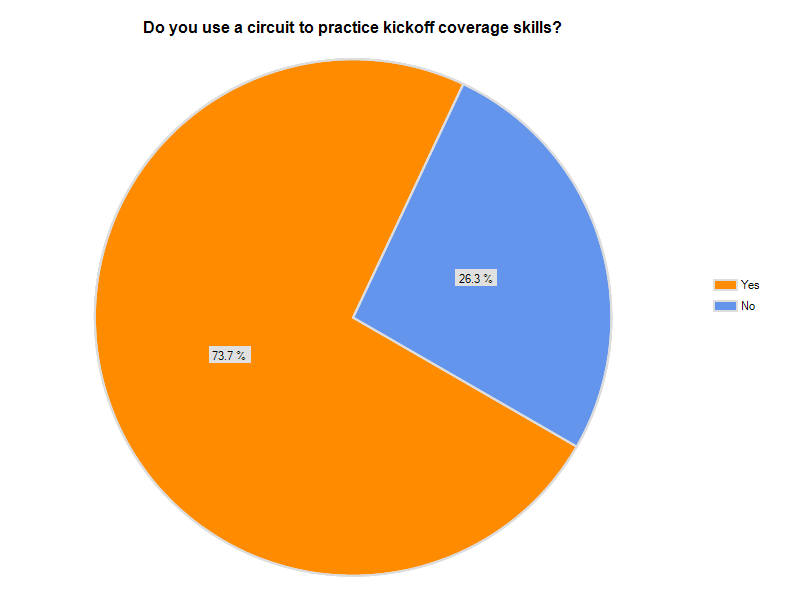
According to our survey, 74% of coaches use a circuit to as part of their kickoff coverage teaching and practice regiment.  This number was the highest of the 4 special teams we researched and was by far the most common set of drills that coaches offered up to share with the X&O Labs community.  We asked these coaches directly to share what they use, and they were gracious enough to so do. 

q11chartko

Advantages

Perhaps the reason for kickoff being the most common circuit is the fact that it is the simplest to put together.  For the most part, all of the players on the field need to master the same skills and those skills can easily be segmented for more depth.  The circuits also allow them to do less full field sprints while focusing on the fundamentals of each of the three basic parts of kickoff coverage (start, attack, and tackling).  Consider what Mike Minter, the head coach at Campbell University, told us about how effective his kickoff circuits have been for him.  “Circuits help you get more out of the limited time you have as a Special Teams coach,” said Minter.  “You get a player to get reps at different techniques that are critical to you winning your individual matchup. Like our tackling circuit on kickoff. We are able to teach a player three different ways that they will have to make a tackle on kickoff. So not only do they work on tackling in these drills they will work on leverage with another player and how to take on a block in the hit zone. They also will learn how to avoid blockers in the speed zone. So a player is learning multiple things in a 12 minute period. You also can get more individual coaching in because your numbers are broken down into a smaller group of players. The player will also get more reps at each station because of the smaller groups.”

Skills

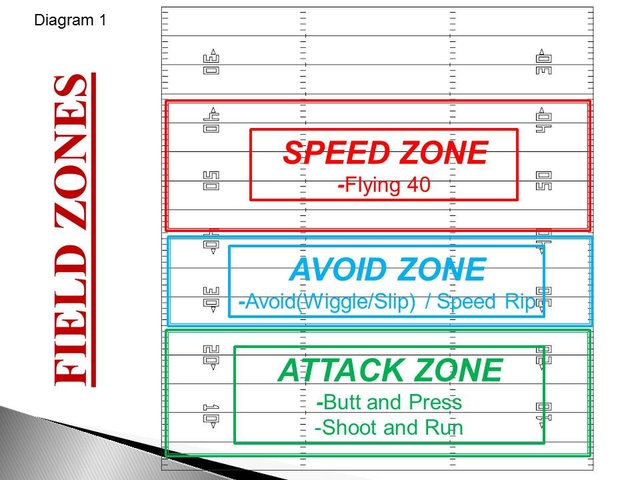
As mentioned earlier, coaches almost universally segmented their circuit drills down into three distinct categories: start, attack, and tackle.  Within each of these subsets, the coaches were able to more clearly define the skills and approaches to executing in each phase.  This happens to fit perfectly with the “zone” chart that is commonly used by special teams coaches (see the example below from Travis Niekamp, the special teams coach at the University of Louisiana Monroe).

Slide1

Some coaches focused their circuits on one particular category while others sought to practice all three phases of coverage in one complete circuit.  The circuits that we have chosen to include in this case show a variety of drills that fit into one or more of the categories listed.

Villanova Kickoff Circuits:

The Villanova special teams unit, or self-proclaimed Angry Birds, place a real premium on preparing their players for every potential situation their players will encounter.  As part of that, they use a variety of drills that we have divided into two segments; skill specific and fit specific.

Skill Specific Circuit

This set of drills includes 6 different options that Villanova will use on a rotating basis to both teach and perfect their coverage skills.  The circuit focuses on skills to avoid blockers at the 1st and 2nd level and open field tackling in both 1 and 2 man situations.  Below you will find the coaching points, diagrams, and video for these drills.

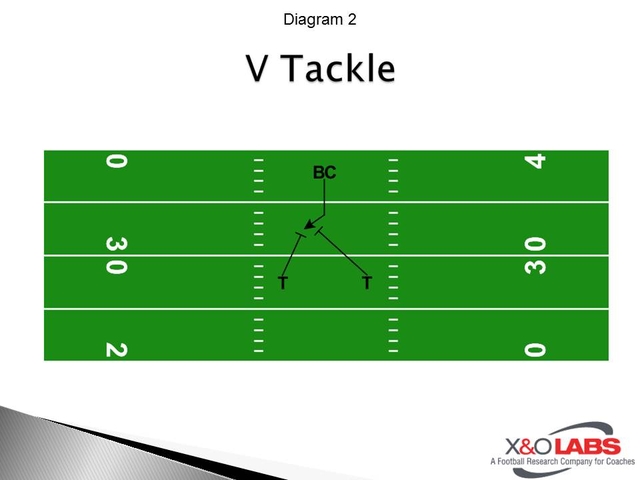
Drill 1:  V Tackle

This 2 on 1 tackling drill was presented in several versions throughout out research.  The Villanova version below focuses solely on the convergence on the ball carrier and provides instruction all the way through the tackle.

Concept / Coaching Points:  According to Villanova’s special teams coach Roc Bellantoni, “It simulates a two-on-one tackle.  The tackler to return side wraps up ball carrier. Other tackler strips ball as 2nd man in. It’s imperative to attack leverage side hip of the ball carrier.”  Coaches need to stress spacing and teamwork, understanding role (return side and 2nd tackler), leverage to the return side and pad level going in to the tackle. 

Slide2


To see video of the “V” Tackle, click on the link below:

Read More

Special Teams Circuits: Case 3 – Kickoff Return


kentstateBy Sam Nichols

Managing Editor

X&O Labs


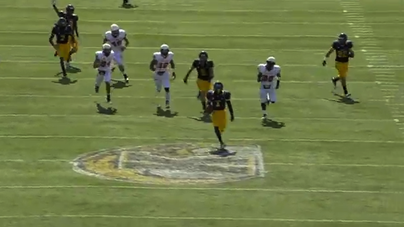
Going into this research project, XandOLabs.com had assumed that kickoff return would be the special team that had the least number of coaches using circuits.  Our premise was simple; the skills used on kickoff return are much less transferable from one position to another as opposed to nearly every position needing to know the same skills like on kickoff. 

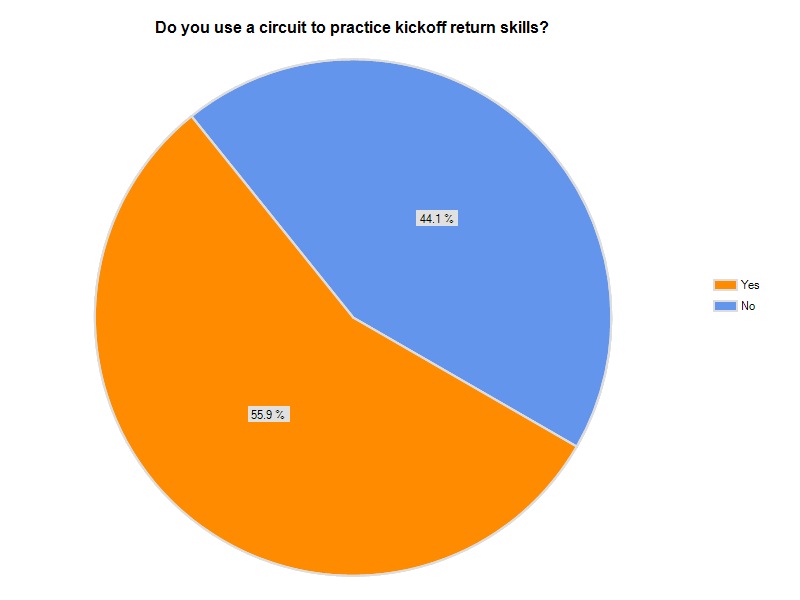
While that assumption did prove true, I must admit that I was surprised by the prevalence of kickoff return circuits among the coaches polled.  Nearly 56% said that they use circuits for kick return, which is double the number that I would have guessed. 

q14chartkor

The coaches that participated in the survey spoke glowingly about the power of circuit drills to impact the productivity of their kickoff return teams.  Here are a few brief examples of their commentary:

“In 2012, our had an average return of 22.7 yards good for #17 in the nation at the D-III level and resulting in 2 touchdowns.  In some games teams would squib or short-kick our KOR team. The circuits allowed us to work with the each different position and allow for returners to get indy work as well.” – Derek Prather, Trine University (IN).

“We try to use drills that simulate game situations and create a competitive atmosphere. We teach Kickoff Coverage and Kickoff Return blocking in one drill that creates competition daily. It also lets me know what players fit the best in each special teams situation. We finished 2011 ranked 36th in the FCS in KOR.” – Brian Morgan, Prairie View A&M University

“Through the use of the circuit we were able to get a lot of repetitions to our special team members.  This in turn gave us an opportunity to provide input into the effectiveness of their special team skill.  In our KOR circuit, we were able to work on each part of the return and for instance give the blockers an opportunity to face a number of athletes in an open area.  We saw the effectiveness of their blocking technique improve.  In Kick-off Return, as you know, we don’t always get a “clean look” at an opponent and just getting them out of their path (Lane) may be enough to break the returner free.  Using the circuit gave our KOR team members a lot of reps in a short period of time.  In addition, as we prepared for our next special team practice we could alter the circuit to tailor the needs of the team.”  – Pete Kowalski, Westfield State University (MA).

Complete Circuits:

Marist College (NY) KOR Circuit:

One of the more productive, straight forward circuits submitted came from Tunde Agboke the defensive line coach at Marist College.  According to Agboke, “It is critical the players on this unit know how to block in space.  Thus, we spend a great deal of time doing individual blocking and dropping drills. We use this circuit at least once a week. Once we accomplish that goal, then we come together and run our schemes.

These drills have helped us tremendously. We have be able to quickly identify the guys who can and can’t do it without wasting weeks or months of practice time. We see KOR as the first play of every offensive series, and we are looking to go deep.”

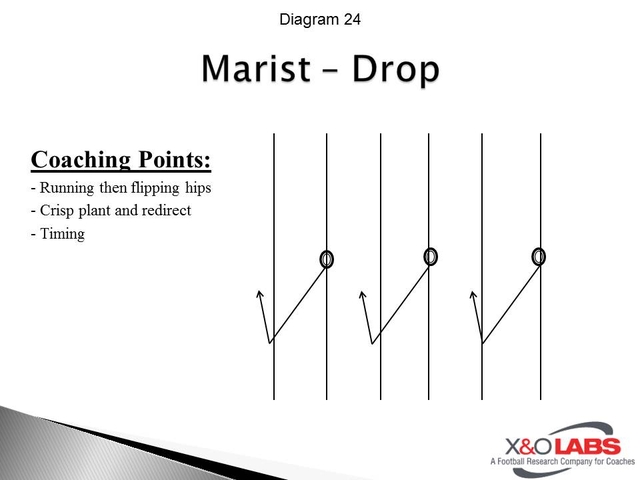
Drill #1:  Drop on Air

This basic cone drill teaches players the fundamentals of their takeoff, angle, transition into the block phase and ability to create proper leverage.

Concept / Coaching Points:  “We use this drill to teach our players the proper drop angles and technique. We want to make sure they don’t round off corners once they put their foot in the ground to come back up field. They must also simulate striking a blow.”- Agboke

Slide24

To see video of Marist College’s Drop on Air Drill, click on the link below:

Read More

Special Teams Circuits: Case 4 – Punt Return


puntblockBy Sam Nichols

Managing Editor

X&O Labs


After kickoff, the second most popular special team that coaches use circuits to teach special teams is the Punt Block / Punt Return team.  Our research showed that coaches are using circuits more often to practice their block techniques as opposed to return skills.  For many of these coaches, the proof is in the statistics.  Take a look at a few of the quotes we received about the impact of these coaches punt block circuits:

“The circuits really help us in identifying guys who can actually block punts.  There are people who can train and get it done, and there are others who have a knack.  We found a walk on or two who has blocked a few for us.  One of our guys set a national record-blocked 5 in a season-but we had a total of 4 different guys block them in that same season.  The other thing that the circuit allows us to do is teach guys different angles to the block point, as well as learning to get back on course if they are knocked off at all. – Aashon Larkins, The Citadel

“Our Punt Return team this past season finished with 3 TD’s, 2 Blocks, and was ranked #5 in D-III.  We were able to work on various rushing/block tech. and returners got that time to work on fielding/fair catching.” – Derek Prather, Trine University (IN)

“In a recent season we blocked 9 kicks. We blocked a punt in each playoff game leading to the state championship game.  We also return 2 punts for TD’s off our block scheme (when we didn’t get the kick). We practiced every phase of that during our drill circuits.” – Lane Frailey, Bixby High School (OK)

“We returned a punt for a TD this past season. My head coach has been here 28 years and a head coach for 35 years and never had one returned before. Our punt returner was a walk-on and became all-conference.”  Roc Bellantoni, Villanova University

“This past year, our kick return, punt block, and kickoff units had great success.  The punt block unit was the area where we utilized circuits the most. This unit disrupted 11 kicks this season in 11 games including 7 blocked punts and 1 returned for a TD.” Jamison Bisch, New Mexico Military Institute JC

“In the last three years we have broken records for blocked kicks in a game and blocked kicks in a season.” – Mike Kirschner, Ben Davis High School (IN)

Complete Circuits

University of Minnesota Crookston:

Sean Knox (Special Teams Coordinator) and the University of Minnesota Crookston staff has established themselves as national leaders in special team preparation and they rely heavily on different sets of drills that they can use throughout the year.  They place a heavy emphasis on drilling these individual skills during their off-season conditioning and spring ball practices which often must take place in doors due to the Minnesota winter.  Before we detail the four drills that they have highlighted as part of their Punt Return Team circuit, let’s a examine the inside drill completion that they do with their players in large groups. 

Team Drill Circuit

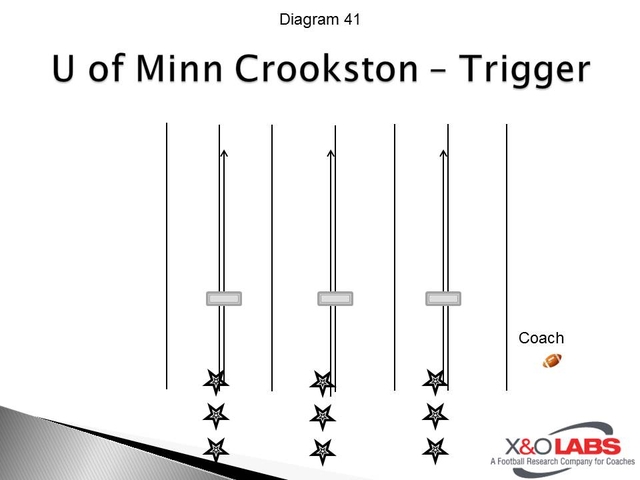
Drill #1:  Trigger

The first drill in this series focuses on the get off of the block personnel and specifically their shoulder and hip level as the cross the line of scrimmage.  By placing a small towel a few yards in front of the players, the coaches are able to reinforce the proper leverage that they expect as the players come off the line and engage the punt personnel.

Concept / Coaching Points:  The players start in their 3 point stance with an eye on the ball and explode off the ball on the movement.  They are forced to stay low due to the towel.  They need to rip with their inside arm to deflect the block and pick up the towel.

Slide41

To see video of UMN Crookston’s Trigger Drill, click on the link below:

Read More

Special Teams Circuits: Case 5 – Punt Coverage


puntproBy Sam Nichols

Managing Editor

X&O Labs


We wrap our research with exploring those circuits used with the Punt unit.  We found this special team to continually be evolving, especially considering the trend of many programs varying the structure of its punt units.  So, before we inquired about circuits, we were interested to find out which type of punt most programs are implementing.  What we found is that 54.1 percent of coaches are using more of a spread punt format, compared to 32.5 percent that use a traditional punt structure and 13.4 percent that are dabbling with the Rugby style punt.


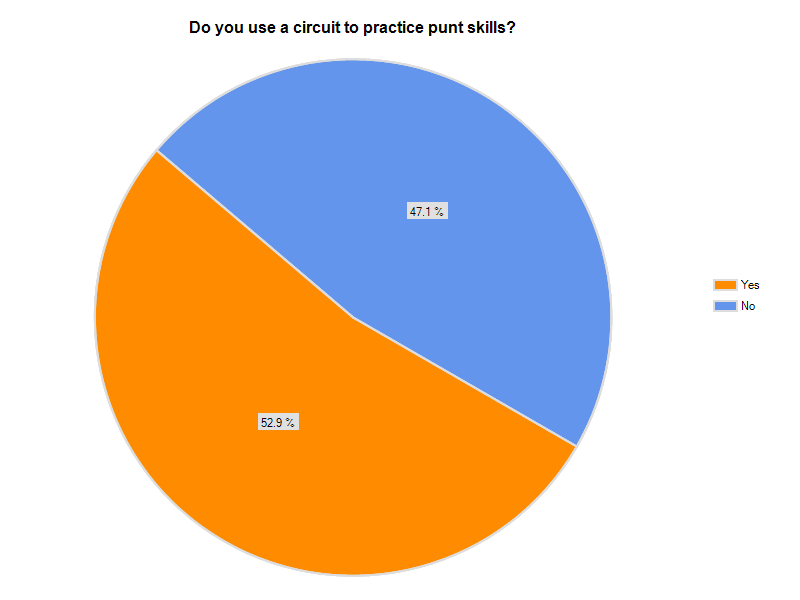
Once we gathered that information, we were curious too find how many coaches were using punt circuits as a form of instruction.  While we found that the number was merely split down the middle- 52.9 percent of coaches are in favor- the ones that were using circuits spoke favorably about its advantages.   Here is what they had to say:

q18chartpunt


“In the past 7 years since going to the circuits we have only had 2 punts blocked.” – Rick Ward, Covina High School  (CA).

“Our greatest improvement at my current school is on both punt protection and net punt from year one to year nine. Although the quality of the punter is obviously important, our first 2 years (2004 to 2005), we had 3 punts blocked and the difference between our gross and net was much greater despite having an all league punter. The last 4 years (3 different punters make 1st/2nd team all league), we have had no punts blocked, and our gross to net has narrowed to less than 4 yards difference (in 2012 – gross of 39.7; net of 36.1). In addition, we have greatly improved the quality of our long snapping and punting all through our program. We have had one punt and one field goal blocked at any level since 2009 when we made a greater emphasis on these circuit skills.” Steve Hopkins, Basehor-Linwood High School (KS)

“Using the circuits have helped us to improve statistically in the 3 years I’ve been here in most categories.  For example, Punt Return had 4 blocked Punts last year and 2 TDs, block and cover circuits 3) Only allowed 0.5 yards per Punt return (cover circuit) 6th best in country.” – Marty Hoffmann, Minnesota State University Moorhead

“Using circuits teaches our guys the fundamentals of kick coverage. I believe the technique of covering kicks and the effort required far out weighs the specific scheme. Out of our main 8 circuit drills, 5 of them deal with kick coverage. 3 of those work good on good. The first step in punt coverage is releases off the line. We work against both single and double gunner looks. One of our kickoff coverage drills, “Lions & Gazelles” (which is documented in Case 3 of our special report) teaches our guys to win with speed, and to get off blocks quickly, while maintaining balance and pad level. On Wednesdays, we work our “Widen Hole + Tkl” drill which is a perfect simulation of punt coverage. The cover guy must squeeze to a landmark while the punt return team is working on widening the hole in a middle return. At the end of the drill, the cover guy must come under control and refrain from running past the returner. Our “Vice Tackling” drill done on Thursdays teaches our cover teams to understand leverage and compressing the returner. Cover guys must understand where their help is and maintain proper leverage without getting split by the returner.” – Brian Morgan, Prairie View A&M

Punt Protection

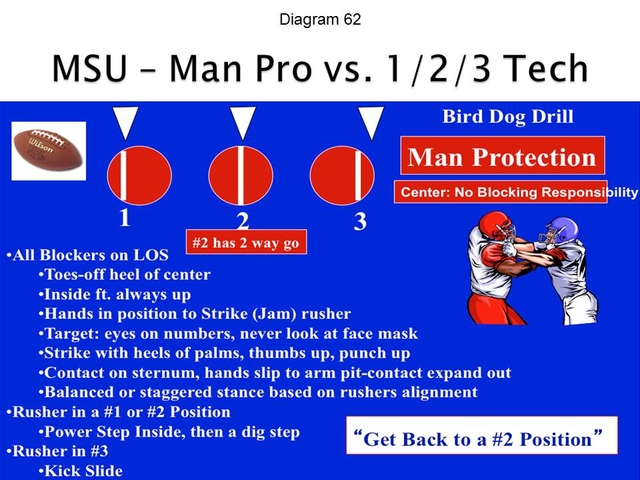
One of the more detailed submissions on punt protection was provided by Michael Cieri, the special teams coach at Montclair State University (NJ).  Cieri uses a Wing Punt formation and teaches his man protection very similar to what offensive line coaches will use. The technique of the blocker is all predicated on what alignment the defender is in.  If the defender is what Cieri calls a one alignment (inside shade) or two alignment (head up) the blocker will execute a power step inside followed by a dig step- very similar to pass protection.  If the defender is in a three position, or outside shade, a kick slide may be used in this situation by the blocker.

Slide62

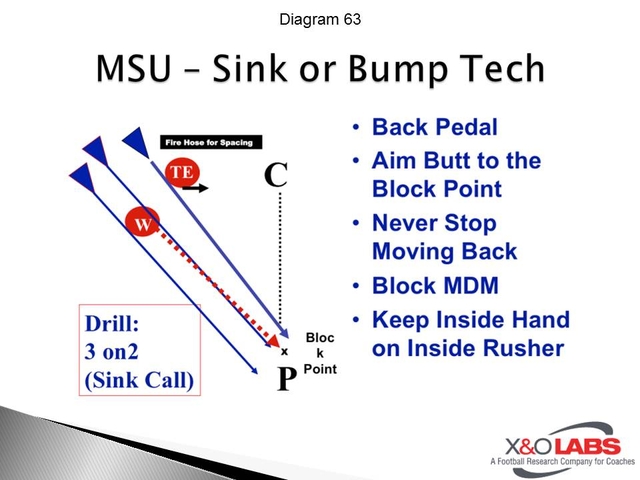
In order to drill this technique, Cieri uses what he calls the “sink drill.”  This teaches players the proper technique on protecting the punter.  Once they are forced to block two to three potential rushers, Cieri teaches the following techniques:

Slide63

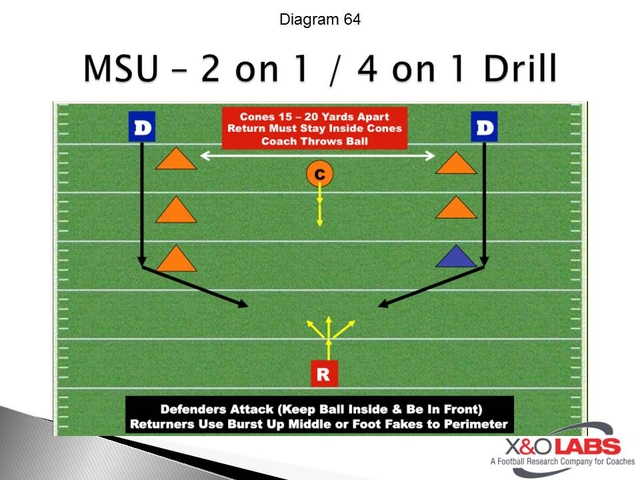
In order to assess punt coverage techniques, Cieri works what he calls his 2 on 1 Drill, which pits two rushers against a blocker. Here, the blockers must be able to sink, get depth and leverage both blocks. It’s a good drill to protect against teams that overload gaps in a punt block scheme.

Slide64

To see video of Montclair State University’s 2 on 1 Sink Drill, click on the link below:

Read More

Adapting C3 to 4 Deep Based on #2


By Derrick Minor – @coachminordbs

Former Defensive Coordinator

Graceland University


gracelandThe “Big Sky” Cover 3 is a three deep coverage with four underneath coverage zones that converts to a four deep coverage with 3 underneath zones based on what route the #2 WR runs.  Big Sky is a man to man technique that we will play on the # 2 WR to the multiple receiver side.  If the formation is balanced we will employ the Big Sky technique to the field or the QB’s throwing arm. See diagrams 1 – 3.
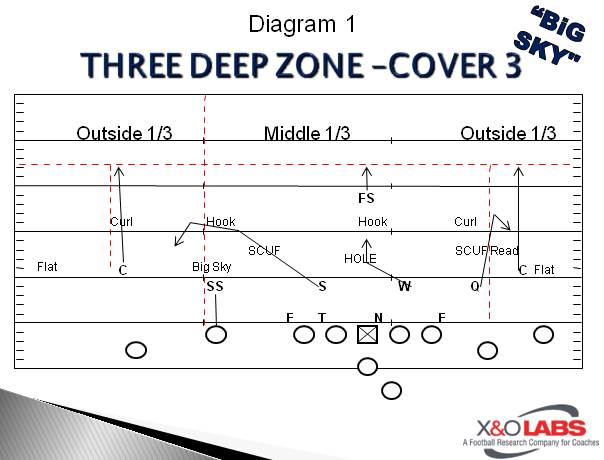
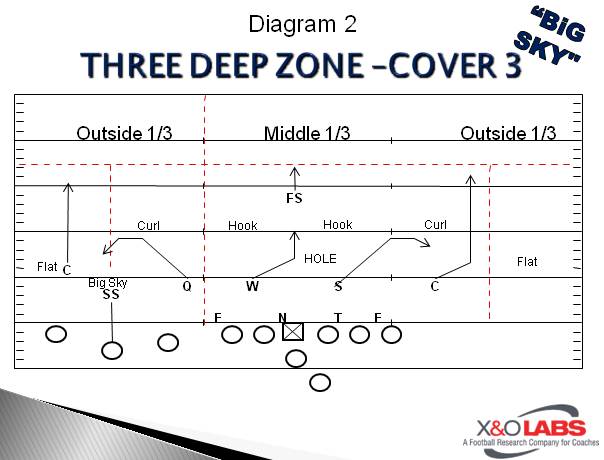
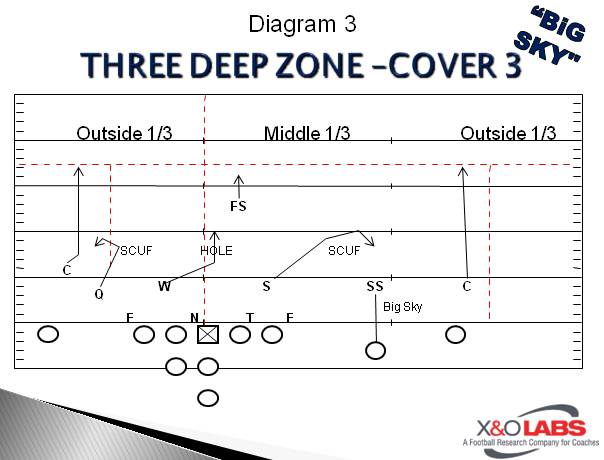
Slide1Slide2Slide3

Why Big Sky?

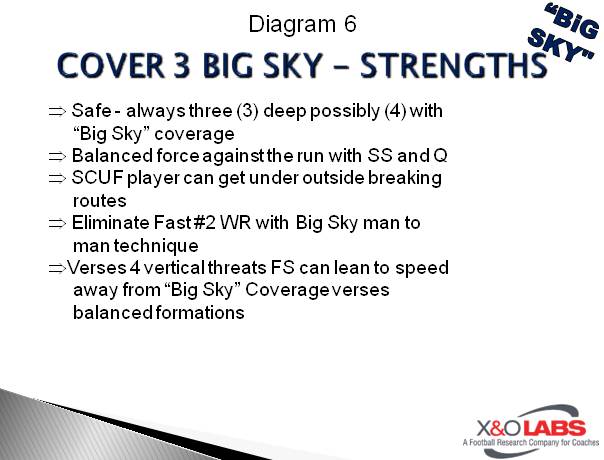
First and foremost, we like the “Big SKY” concept because it’s a safe coverage concept that allows us to employ the concept verses a variety of formations and personal groupings because of how we play a fast #2 WR be it in a 3×1 or 2×2 set.  In addition it affords us the ability to match speed with speed out of our base 4-2-5 and fire zone packages regardless of how our front is aligned.  Because we man of the #2 WR it affords of the flexibility to be in a single high shell verses a potential 4 vertical threats out of 3×1 or 2×2 formations and still be sound in our coverage principles. 

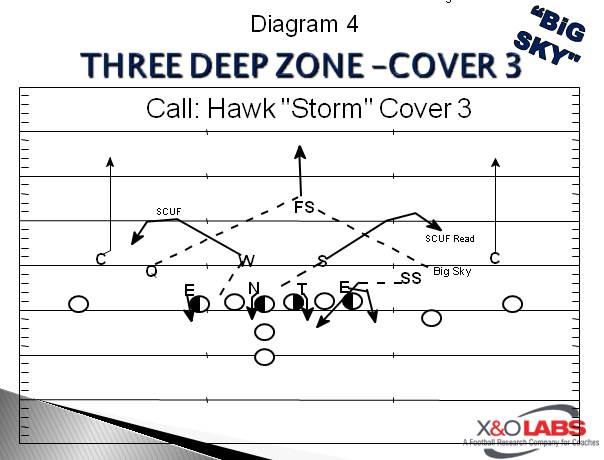
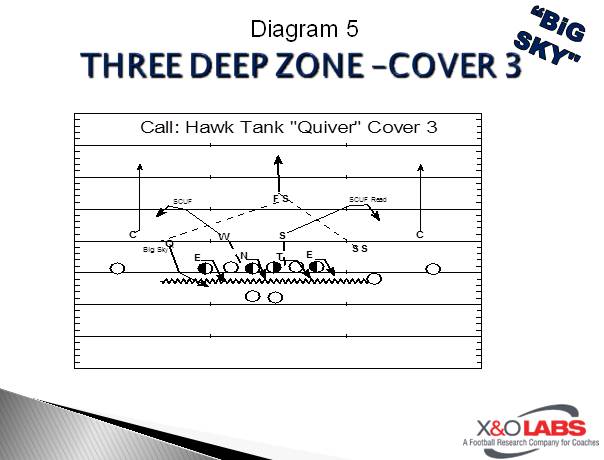
Often times we will hide our coverage’s by aligning in a two shell and rolling to it late.  However, there are time when we will line up and show it because QB’s can have a hard time discerning whether or not we are manning up the #2 WR because our Quick (Q) and Strong Safety (SS) align the same way every time, which is 4×4 outside of the EMOL.  We do this because we want to all ways give the appearance that they are ON! Meaning one of them if not both of them are coming on some type of pressure or blitz off the edge.  In our 4-2-5 scheme our FS, SS and Q are interchangeable, meaning at any time base on the formation, Trade, Shift or motion (TSM) or designated call any one of them can be responsible for “Big Sky” coverage on a number #2 WR.  See Diagram 4 and 5.

Slide4

In Diagram 4, the call is Hawk ‘Storm” Cover 3, which is a pressure for us in our system.  Normally, the SS would have “Big Sky” responsibility on the #2 WR to the multiple receiver side.  However, because he is part of the pressure he no longer has “Big Sky responsibility.  When this happens our safeties know to spin down and replace the SS who is now a part of the pressure. Now our FS has “Big Sky responsibility and our Q is playing deep middle 3rd.  WE NEVER CHECK OUT OF A PRESSURE!

Slide5

In Diagram 5, the call is Hawk Tank “Quiver” Cover 3 which is another pressure for us.  The motion of the slot WR to the open side of the formation would normally mean that Q would have “Big Sky” responsibility.  However because he is part of the pressure our FS will spin down and play “Big Sky” on the new #2 WR to the open side and our SS with have deep middle 3rd responsibility.

Why Not Check Out?

We never check out of a pressure for two reasons, the first being: the 4-2-5 is a built in nickel defense, because of that it affords us the ability employ a variety of pressures/blitzes and still be able to match speed with speed in space and account for coverage zones and not ask a LB to cover a fast #2 or 3 WR in space.  The second reason is: I like to keep things simple for my players.  I don’t want them thinking too much.  Offenses will TSM you to death if they know they can get you to check out of pressures/blitzes. 

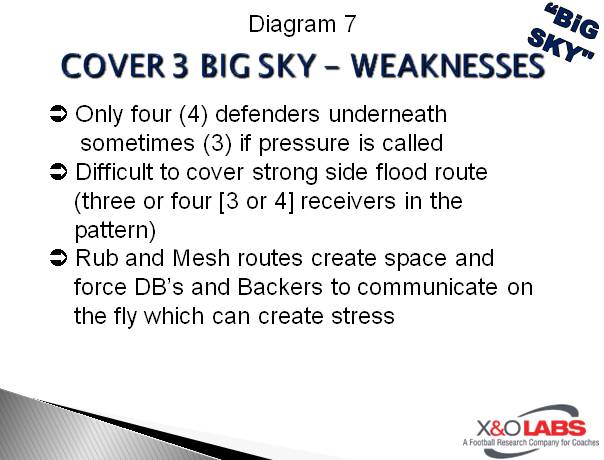
Strengths / Weaknesses of the CoverageSlide6Slide7

Read More

Adjusting Your PAP’s to Attack Defenses

By Gerald Hazzard – @CoachHazzlec

Offensive Coordinator

Lake Erie University


Editor’s Note:  Assistant Head Coach Gerald Hazzard joined the Storm coaching staff as the offensive coordinator in January 2007. Hazzard was the first assistant hired by Mark McNellie. LEU finished 2013 as the second ranked offense in Division 2 averaging 551 yards per game. Hazzard coaches the quarterbacks and has produced 18 all GLIAC performers in 4 years. A 1999 graduate of North Olmsted High School, he was a three-year varsity fullback and linebacker. The Cleveland native and his wife, Emily, married in June 2007. The couple resides in Painesville with their children Gerald IV and Lucy.


Philosophy

lake-erie-collegeEvery Sunday when we start to breakdown our next opponent our top priority is to make sure that we are able to run our zone schemes against all of the fronts they show on film.  We will divide the film we are watching up by formation and make sure we look at each clip that our opponent has played during the season.  Once we have established that we can run our zone schemes against the looks that are on the film we will next determine what formations are the most advantageous to use.  This step may lead us to use the same formations we have been using all year or it may lead us insert new formations for the week.  This is a great way to broaden your attack and keep the defense on their heels.  Our next step in game planning is to make sure that we have at least one play action pass off of each of our zone looks.  It is our general philosophy to keep our run/pass ratio as close to 50/50 as we can.  Having a diverse play action package goes a long way to helping us accomplish that goal. 
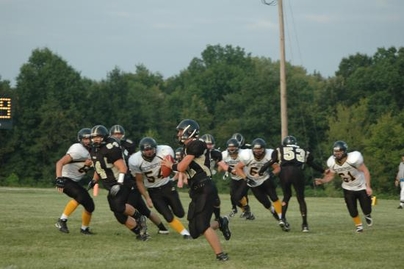


Main Objectives in Game Planning PAP’s

When we designed our zone play action package we had three main objectives in mind.  The first objective is to take advantage of the reaction of the second level defenders and complete quick passes to skill guys in space.  We will run zone 35-40 times a game if we can.  Second level defenders have to respect our commitment to running zone and are often caught out of position against a quick throw.  Our tight end and our slot receivers are our main targets in our quick hitting play action plays because defenders get caught up in run flow so often they lose their responsibilities in the pass game.

Read More

Route Variants in the Boot and Naked Pass Game

bootlegBy Mike Kuchar

Senior Research Manager

X&O Labs


Perhaps there is no other topic more universal than the Naked or Boot pass game. Regardless of the offensive system you run, chances are you have some form of Naked, Boot or Waggle action off of your most productive run schemes. This could be the reason why we had so many coaches respond to our survey on this topic.  Below we present our findings on this concept- focusing mainly on different kinds of pass routes that can be employed with this scheme. But before we get into the specifics, there are a few items of research we’d like to share:

  •  48.7 percent of coaches use the boot or naked pass between 10-25 percent of their offensive schemes.
  •  43.9 percent prefer running the boot in early downs (1st and 10)

Editor’s Note: While we realize that many coaches classify Boot and Naked concepts into two different plays, we asked our readers to select their most productive scheme between the two and elaborate on it.


Because the Naked or Boot scheme can be used off of various run actions, we figured we wanted to present our results on which run actions were most favorable (based on our readers) to use the boot action off of it:

  • 28.1 percent of coaches prefer an inside zone run action and boot or naked away from it.
  • 22.7 percent of coaches prefer an outside zone run action and boot or naked away from it.
  • 21.5 percent of coaches prefer a gap scheme such as a counter or power run action and boot or naked away from it.
  • 8.2 percent of coaches prefer a fly or jet sweep run action and boot or naked away from it.

Case 1: Protection

* For the purpose of this report, “back side” refers to the offensive line AWAY from the run action- which is the side TO the boot action.


We all know that nothing works in the pass game without the proper protection, so we’d figured that would be a good place to start our report. It’s important to note that we decided to combine both the Naked and Boot concept for the purpose of this report because they can be so similar in nature in terms of the route progression. But, we did find that the protection in these two concepts could be totally different and in fact where split down the middle in our research. Here is what we found:

Research on Protection

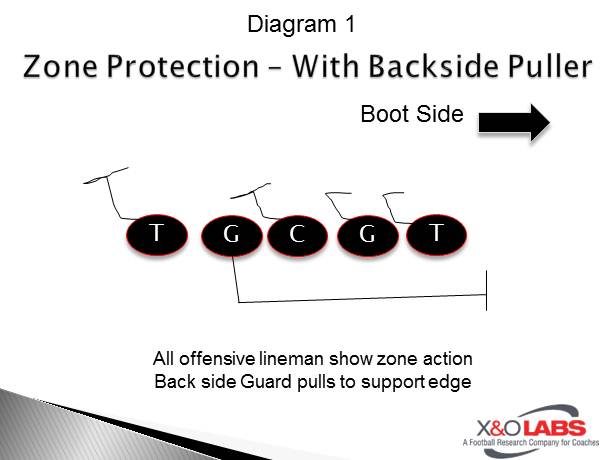
  • 37.4 percent of coaches prefer to use zone protection away from the run action with ONE backside puller (Diagram 1).
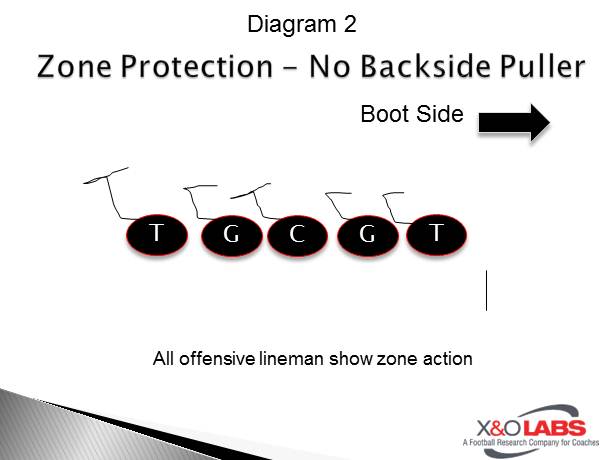
  • 35.8 percent of coaches prefer to use full zone protection away from the run action with NO backside puller (Diagram 2).
  • 21.1 percent of coaches prefer a mix of both man and zone protection.

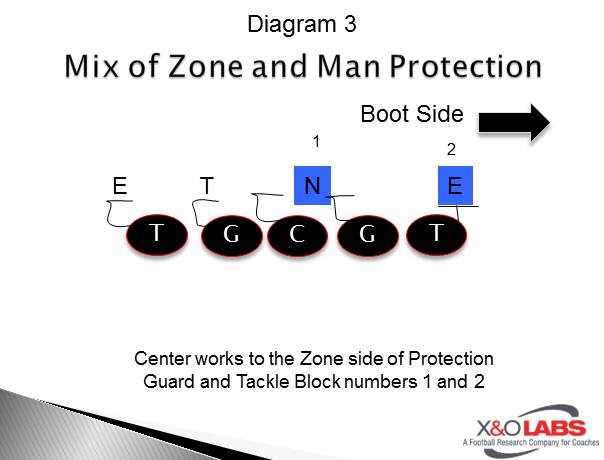
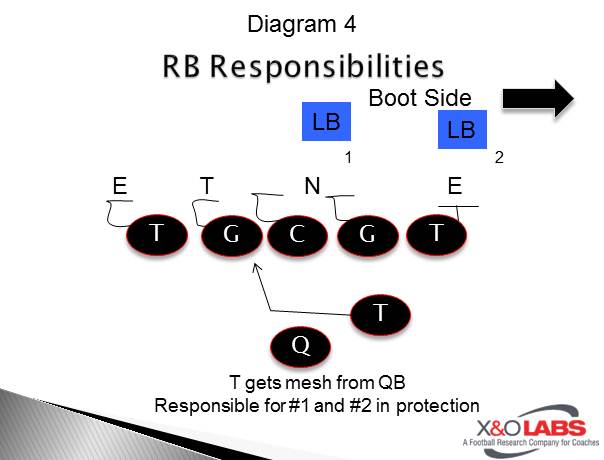
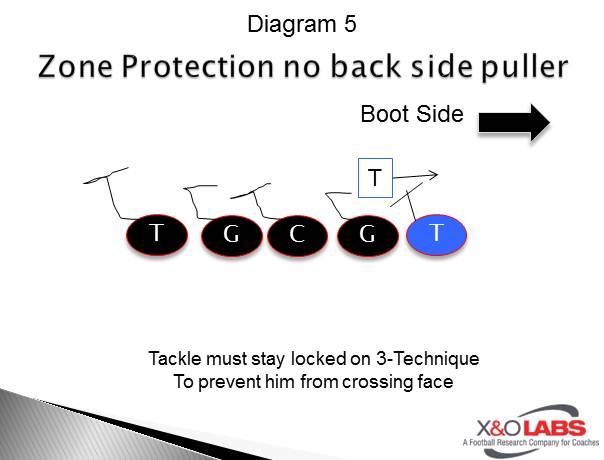
We were actually hoping for more of a discrepancy between these two concepts, but it seems coaches like it one way or the other- for various reasons which we will detail below.   Dave Schramm, the offensive coordinator at Fresno State University actually combines a zone and man protection scheme in his boot pass package.   Schramm will zone protect to the front side of the run, and man protect to the backside of the run (which is in turn the boot side).   In his protection, the Center will work towards the zone side, while the backside guard and tackle will block number one and number two respectively to the boot side (Diagram 3).  This prevents from any hard edge rusher up the field in the QB’s face, forcing and errant throw.  Schramm will also have the single back in his one-back schemes be responsible for both inside and outside linebacker (1-2 in count) after getting the mesh from the QB (Diagram 4).  One of Schramm’s major coaching points is to make sure the backside tackle MUST stay locked on a three technique or a 4i technique to prevent him from crossing his face (Diagram 5). 


Coaches that swear by the full zone protection do so because the hard zone action causes a freeze in second level defenders such as linebackers or safeties, allowing intermediate routes to clear behind them. Dale Sprague, the offensive coordinator at Allegany High School (VA) teaches his offensive lineman to take a bucket step to block one gap away from the boot side. Sprague calls it a “hard reach” step while pulling the backside guard. “Our backside puller pulls flat until he crosses the center, at which time he gains depth to find the first defender outside the play side tackle and/or Tight End. There are some boots where we will pull the Center if need be, especially if he is uncovered.”

Doug Taracuk, the offensive coordinator at Dublin Scioto High School (OH) felt that he just didn’t have the offensive lineman who can zone block, so he went more to a gap scheme protection up front- which he calls his “Gut” scheme. In his Power naked scheme, Taracuk will have the backside tackle block any B gap defender (to simulate Power) while the backside guard pulls. He tells his Tackle to stay on the double team and if there is no B gap first level defender, to sift hard, stay low and get to heels of defensive lineman- which he calls “Nebraska”- a term to remind his lineman not go up field. “We leave the End unblocked, and try to get the QB out and around,” said Taracuk. “It screwed opponents reads- because they read tackles and get run reads.”

Read More

Combining Power & Triple Option Schemes?

By Scott Girolmo – @CoachSGirolmo

Offensive Coordinator

Liberty High School (VA)


libertyEditor’s Note: Coach Girolmo grew up as a player for his father Steve Girolmo at Livonia High School in Western New York. A graduate of Cortland State (D-III – NY) he has coached at Castleton State College, and Western New England University as well as made stops in high school at his Alma-Mater Livonia and Liberty high School in Bealeton, VA.  In 2012 he took over the offense at Liberty and has installed an ever-evolving hurry up no-huddle philosophy that mixes schemes from across the spectrum. As the Offensive Coordinator in their 2013 campaign the Eagles offense averaged 34.2 points per game, and was the 10th ranked offense in VHSL 4A. Scott is a diehard clinic enthusiast and encourages interactive Q & A regarding any of his contributions to the site. 
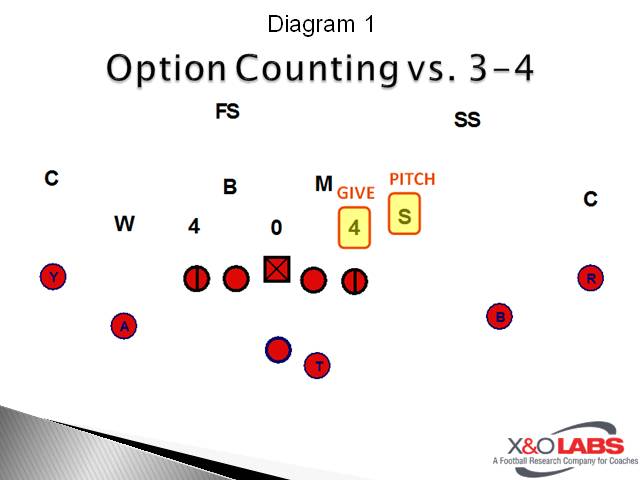


We are a hurry-up no huddle offense, that runs multiple personnel groups, formations as well as a mixture of schemes from across the offensive spectrum. Our most effective run-schemes the past two seasons have been our power runs. Our identity has always been power oriented in my 3 years here at Liberty. Knowing this, I made a point in taking over the offense in 2012 to find ways to incorporate that into some of the new innovative backfield and perimeter schemes I wanted introduce. Thanks to the help of some bright coaching minds, I was able to hybridize my favorite backfield action – the shotgun inside mesh read and pitch phase, with the power o run scheme. The result, I believe is a very sound, and formidable run play that can yield phenomenal results for teams with sub-par talent, and a blue-chipper’s alike. Not only will this make a major impact at the high school levels, but I believe that it will explode in the college ranks, when coordinators with agile and athletic QB’s get their hands on it.

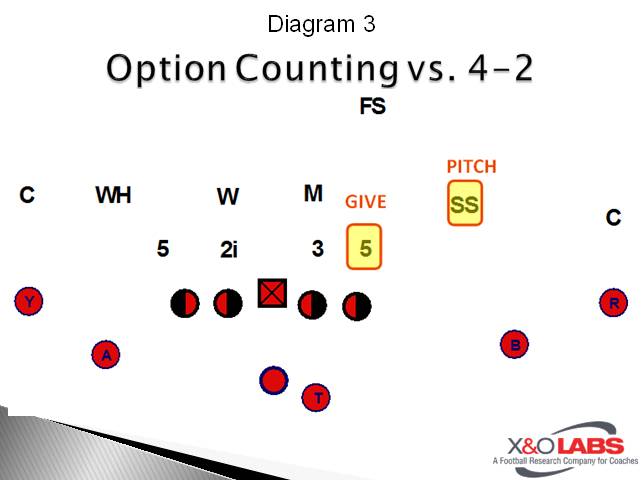
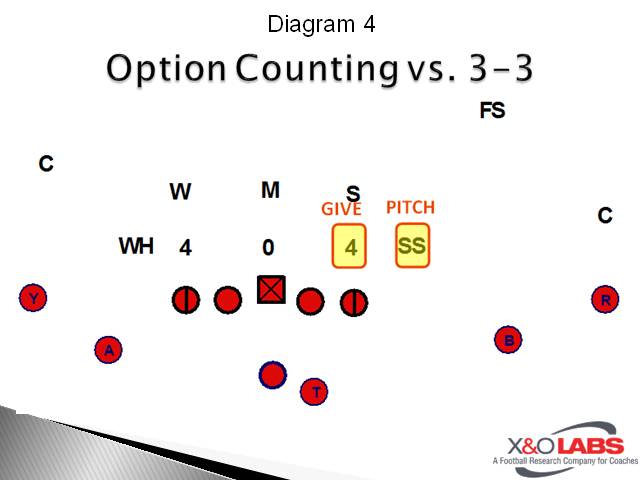
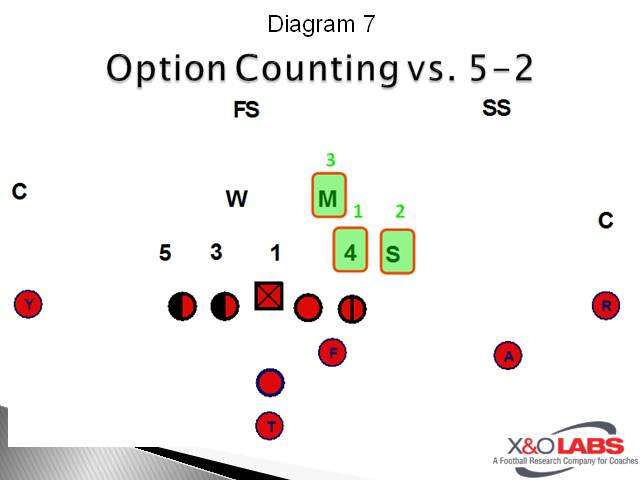
The surface run scheme for our 5 offensive linemen is the same in our power triple as it is in our power hand-off play. This allows us to practice, and play much faster as those guys up front don’t have much thinking to do. This will fall in line with many offenses looking to go hurry-up, and also those that are lacking talent/intelligence or practice time. Creating confidence in their roles on each play allows those offensive linemen to play to their maximum speed and effort. The magic happens with our “tags” for inside mesh read, and triple option. When we begin to change the moving pieces behind our surface, we not only create extra gaps with the pulling guard, but we free up extra blockers by reading 2 defenders play-side. Our option counting system can even be combined with our power counting system to give our QB the ability to check to a power triple against a number’s or alignment disadvantage. In our option counting system, we teach our kids that the first player from the play-side tackles NOSE – OUT is our GIVE key. The next most dangerous defender from the GIVE KEY- OUT is our PITCH KEY. Below is an example of our option counting system against a 2×2 formation (Diagrams 1-4).

Slide1Slide2Slide3Slide4

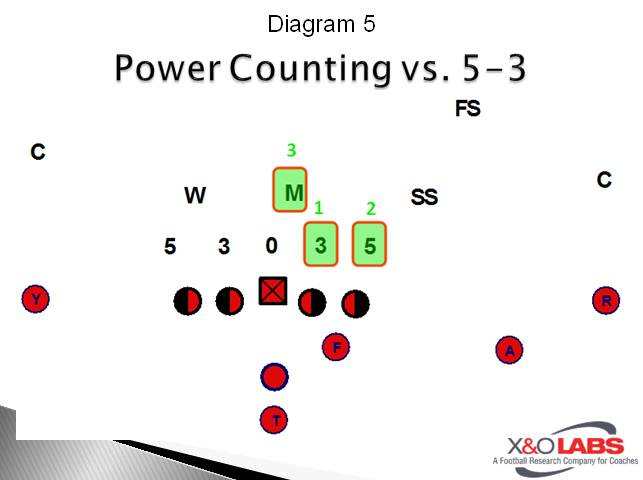
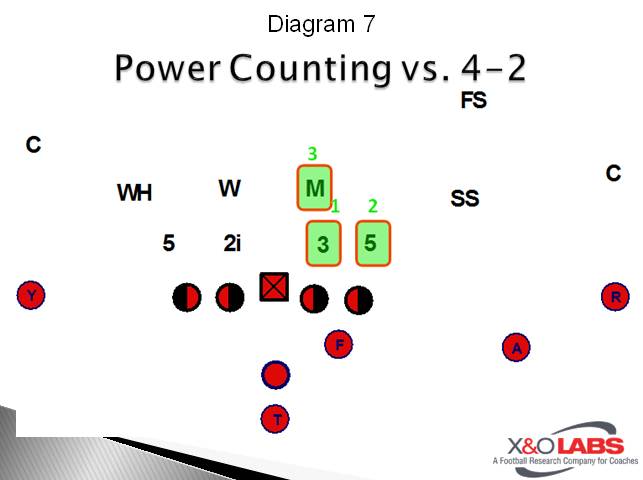
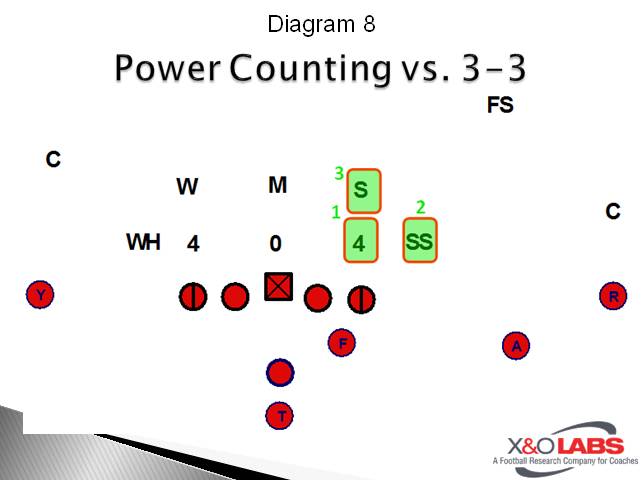
As you can see, some alignments are more advantageous than others. We use a very broad range of formations to help create advantages where none exists. This is also evident in our power counting system. We use the power counting system to both designate where the play-side combination block will occur, and to alert to where the puller and runner attack points are. Our play-side tackle dictates where that combo occurs by recognizing the technique, and anticipating the reaction of the 1st defender outside of the adjacent guard. He will down block, or call for a combo on that #1 player. If that player is a 4 tech (head up on him), the Tackle will base zone drive him himself with a B-GAP attack point as his target. The 2nd most dangerous defender is blocked by our fullback/h-back, and the #3 defender is the target of our pulling back-side guard. Below is an example of our 2-back power counting system (Diagram 5-8).

Slide5Slide6Slide7Slide8

Read More

Training the DE/OLB Gap Exchange

By Jason Davis – @jwdavis13

Defensive Coordinator

Farmersville High School (TX)


Editor’s Note:  Coach Davis will be entering his third year as Defensive Coordinator at Farmersville High School in Texas.   Coach Davis has coached for a total of 13 years, all of them in the Texas High School ranks. 


Introduction

CaptureReaction time and recognition are the keys to getting defenders in a position to make plays.  For us, that starts in the box with the way we read the opposing offensive tackles.  Our goal is to make sure that regardless of their technique, they will be wrong.  That is to say that if our guys execute our techniques we will be able to fill the appropriate gaps regardless of that tackles action.  We use his technique to quickly determine assignments within our “Gap Exchange” scheme resulting in better fits and more consistent pursuit.  Here are a few of the reasons we have found this to be effective for our team:
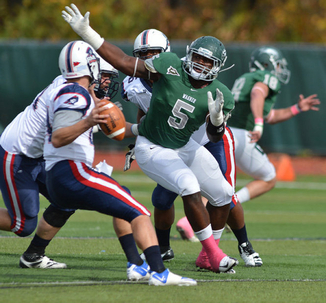
Reason #1 – Simplest Way to Define Responsibilities

It is the easiest way for our ends and backers to be responsible for both gaps quickly and efficiently.  We found that we played the counter, zone, and power a lot better because it eliminated a lot of doubt for our kids.  It also allows our kids to play fast and makes us difficult to block. 

Reason #2 – Cleaned Up LB Pull Read

The second reason is we used to try and get our backer a run through when he got a pull from the guard or tackle to his side.  We rarely got him through the line of scrimmage without getting picked up.  Then we tried letting our backer scrape flat with a pull from his side, but they always got picked up by a down block from the other side.  Our end would squat and be responsible for the quarterback on the read.  Regardless, we felt like we wasted two of our players, because we found that our DE is difficult to block chasing down the puller. 

Reason #3 – Not Wasting Players

This scheme allows us to play the backside of a counter or zone scheme without wasting our end and backer.  Their reads get them both into a proper gap and help them better understand what might be coming their direction.  Our guys know pretty much what to expect based on their tackles actions.

Reason #4 – Plays Into Strengths

The last reason we like our current scheme is that our ends are really good at playing a kick out block and working into “B” gap so we had to get a guy to “C” gap.  This strength / technique makes it really hard for a pulling tackle to wrap up on the linebacker putting us in a better position to make the tackle.

Base Defensive Alignments

We play an even front versus gun one back teams.  Our defensive tackles align in two techniques and are responsible for “A” gap. The defensive ends are in are in a three point stance, slightly toed out and attack/read the hip of the offensive tackle.  We want our defensive end to stay on the heal line unless his tackle pass sets. The inside backers are head up to the offensive tackles in a 40 technique about four and half yards deep. 

The defensive tackles will always line up in two techniques.  We never want the guard to have an indication of the gap the defensive tackle is responsible for pre-snap, but versus most zone and counter teams our DTs are responsible for “A” gap.  Our tackles attack the bottom of the number of their guard with both hands and work into their gap trying to get to the heel line while keeping their shoulders square to the line of scrimmage.  The DT’s know that their gap has the potential to move with a zone scheme and these guys will work to stay in their gap.  If the center blocks back on them they will work to cross the center’s face.  Our defensive tackles rep this every week in hopes that it becomes second nature to them.

The defensive ends align as tight as they think they can personally align to the offensive tackle without getting hooked.  On the snap, the ends will attack the hip of the tackle and read his facemask to determine our next move. 

Read More

Varying Supports in Zone Pressures


By Wagner College Defensive Staff


Editor’s Note:  After starting the season at 0-3, Wagner College rolled off nine consecutive wins en-route to a FCS playoff birth-the first time in school history- and they did it with defense.  Wagner was first in the Northeast Conference in scoring defense yielding only 17.4 points per game and total defense surrendering just over 320 yards per game.  X&O Labs Senior Research Manager Mike Kuchar spent some time this past Spring talking football with the Seahawks defensive staff.


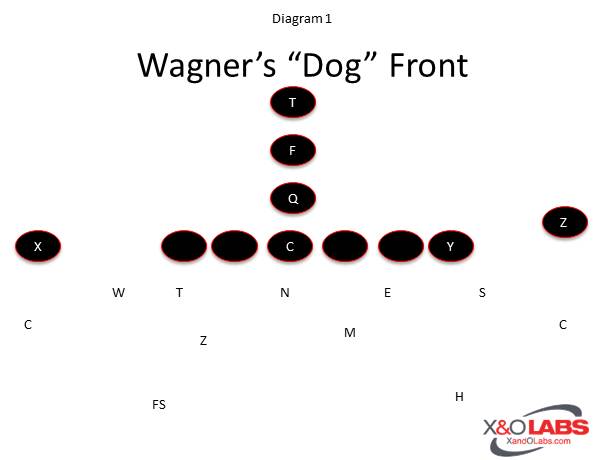
After having tremendous success defensively last season which included a run deep into the FCS national playoffs, the Seahawks are beginning to experiment with new forms of pressure this spring, including at two-deep four under concept from their “Dog” or Okie Front (Diagram 1).  After running mainly three-deep, three-under blitz rotations last season, defensive Coordinator Malik Hall and his staff decided to integrate some two-deep concepts to keep offensive off-balance.  “It takes away the three step game which we were tired of giving up,” said secondary coach Ryan Fullen.  “We are a quarters coverage team by nature, so we keep the two-deep shell plus we also don’t give up the flat so quickly as other some three-deep, three-under structures.”

In order to disguise its pressures, Wagner will use a “walk out” technique by its Corners post-snap, regardless of whether it is a two-deep or three-deep rotation.  “It confuses the QB because he sees a hard corner post-snap,” says Fullen.  “You can get him to clutch the ball on the snap or cause an interception because the QB doesn’t see the corner squatting.”  Assistant head coach Tom Mesalla agrees, “There comes a point in time you want to eliminate the quick game,” he told us.  “Those players are too good to see the speed out by the QB.  There are also times where the CB’s are really not that good.  Cover Two protects those Corners.  In Quarters coverage or in three deep they are on an island. “

Cut Coverage

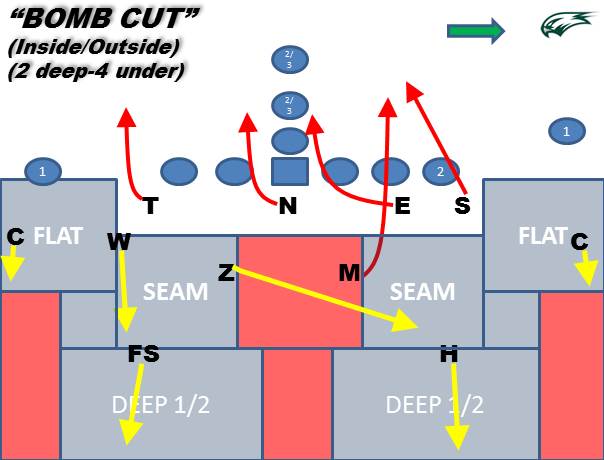
Wagner understands the importance of teaching coverage first before any blitz pattern, it’s a lesson learned by Mesalla when he was the defensive coordinator at Louisiana Tech in the early 2000’s.  “We used Razor, Blade and Cut as words that denoted two deep zone pressures,” he said.  “It eliminated confusion in our kids.  They knew right away by the call what coverage we are in.”  Mesalla brought the same philosophy with him to Wagner and taught it to Fullen, who was an assistant with Mesalla when he was the head coach at Fordham.    Now in the Seahawks scheme, Cut coverage means there is NO rotation in coverage and the inside and outside linebacker to the same side will blitz.  One of the more prominent calls is called “Bomb” (Diagram 2).    While Mesalla admits it’s a good pressure to the field side, it can be used effectively against the strong side run game with a tight end.    In theory, the Corners are responsible for any flat threats, while the Safeties are the deep halves players, playing on top of number one. The linebackers that are not involved in the pressure are “seam” players, meaning they must carry the vertical of any number two receiver.


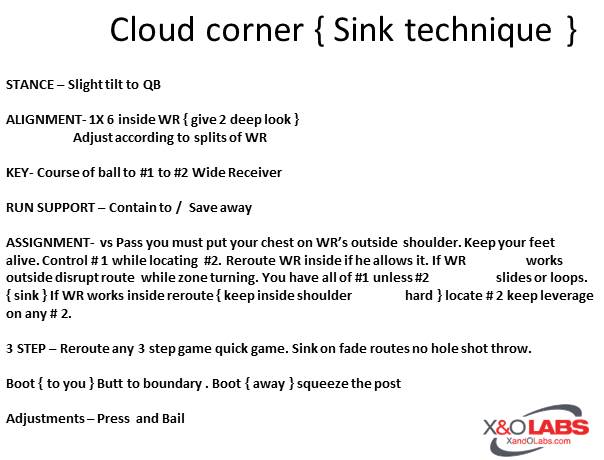
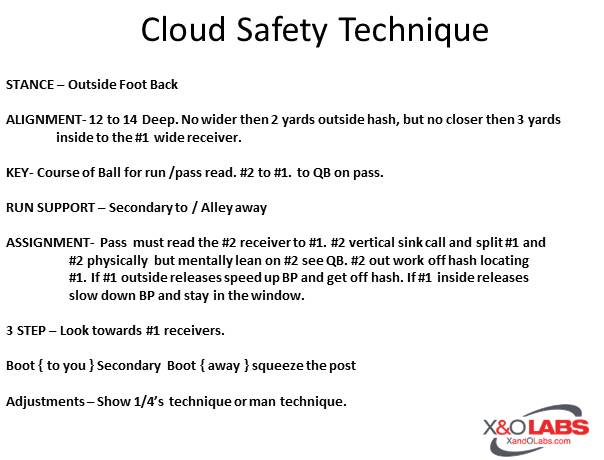
Cloud Support

When first teaching the coverage, the Wagner staff teaches “Cloud Support” for its secondary.  The Day One installation rules that the Corners and Safeties get are below (Diagrams 3-4).


It all starts with Cloud, then we transition from there,” said Mesalla.  “Cut is a good complement to three-deep zone pressurs because there is no free access throw.  The QB has to read through his drop to see what the corner is doing.  But our first two steps as a Corner are the same- we take two steps back and either square up to play Cloud or open up to play Clamp (a support call which will be discussed later). Their first two steps should look exactly the same.  “We want to end up in a position on the outside shoulder so that we can reroute.  We teach an inside outside pin with our back to the ball.

Corner Technique

If we get an outside release, we are going to punch with our inside hand, then punch with my outside hand to pin and read number two.  If two is vertical, I carry number one (Diagram 5).  If number two slides, I will come off and play number two (Diagram 6).  There should be no hole shot in Cloud because the Safety will be there.  Once the corner controls number one with a reroute he must find two and see what he is doing.  If there is no number two, carry one until two shows.  If two is vertical, I must sink.  If two is inside shallow, I can level off (Diagram 7).  If two is off, I have to slide off and settle.  We must zone turn inside.  We can’t baseball turn (man turn) without seeing number two.   If both receivers are vertical, we tell our Corners that physically we are splitting both, but mentally they need to cheat inside because that is the shorter throw. The Corner is not responsible for number three in the flat. It’s the hardest coverage to teach.”

Read More

RB Keys to Identifying & Attacking Pressure

By Timothy Zetts – @zettstim

Runningback Coach

Fordham University

unnamed2Editor’s Note:  Fordham University just completed one of the best seasons in the program’s illustrious history and Coach Zetts, helped play a major role.  A former University of Akron quarterback, Zetts begins his third season on the Fordham coaching staff after serving as an assistant coach at Indiana University of Pennsylvania in 2011. He will again guide the Rams’ running backs in 2014. Last fall, senior Carlton Koonce, a preseason All-American and a Walter Payton Award nominee, became just the second Ram to rush for over 1,000 yards in consecutive season, finishing the year with 1,462 yards. He led the Patriot League and was 16th in the NCAA FCS in rushing average, earning first team All-Patriot League honors for the second straight year. 


Teaching pass protection to a running back is one of the more difficult things to do within the position for a variety of reasons: 1) Depending on your scheme, running backs are often undersized when compared to the linebacker they are facing, 2) Backs do not usually have an “aggressive” blocking mentality and 3) It is sometimes hard to diagnose where the pressure is coming from – making it hard to get the body in position to make the block. That being said, there is never an excuse for a running back not to execute at a high level in pass protection. It is vital that our running backs are able to win in pass protection – our offense depends on it. We cannot be ball carrying specialists.

Identifying Pressure:

unnamed1

We refer to any linebacker-only pressures as “Dogs” and any type of secondary pressure as a “Blitz.” A lot of times there are tendencies you notice when game planning that will help get the eyes to the correct vicinity of the field. As a unit, we devote about half our time watching pressure reels during a game week. While we are doing this, there are a couple of things we focus on:

  • Tendency a team brings pressure vs. down & distance
  • Specific field zones of pressure (field or boundary)
  • Whom they like to blitz most often
  • Any tips in their front/alignment/secondary rotation that we can take advantage of
  • What the individuals’ best pass rush moves are (bull rush, spin, push/pull).

My own personal belief with running back pass protection is the players are not going to understand how important it is unless you constantly emphasis it. Here at Fordham we focus a lot of our attention on pass protection because that is an area that does not come natural to everyone in our position group. Our room has ability to make a big play using their feet – but the thing that will get you on the field, and separate yourself from the others, is the ability to block.


Pass Pro Non-Negotiables:

I start by teaching the basic fundamentals of pass protecting (some of which were introduced to me a while back by Reno Ferri, Towson running back coach). There are four basics that we talk about:

  • Diagnose the pressure
  • Attack the pressure
  • Protect the pressure
  • Eliminate the pressure

It is vital we diagnose the pressure as soon as we possibly can to put ourselves in position to win. We never want to turn our attention away from a pressure to allow a free run at the quarterback. One of the most important things to do is identify the most dangerous person/people on the field that will make our job the toughest. Often times, especially on play-action protections, our body/eyes turn away from an ID backside so I always say, “eyes to the blind spot pre-snap”. If things look suspicious make sure you are in the clear before executing your fake (protection before fake).

Another reason we always want to diagnose the pressure as soon as possible is so we can attack and make the collision as far from the quarterback as possible. Attacking allows us to make contact with the linebacker before he is able to get a full head of steam. The less power he has, the better for us. The next thing we want to do is protect the imaginary line between the man we are blocking and the quarterback. We want to make sure we take away the defenders inside half when blocking. If we get a good piece of the defender, we then try to find his inside hip to try and wash him past the quarterback. If you are able to find his hip, you now gain control of his center of gravity. The fourth, and most important, is to eliminate the bull rush. A back’s biggest fear is being run over. To eliminate this, we have to make sure we make contact with a good, powerful base. I always emphasize that just because there is pressure, that does not mean we have to be the nail – we should always have the mentality of being the hammer.

To see a video tutorial on how Coach Zetts teaches his RB’s to abort the fake, click on the link below:

Read More

Hokies Short Yardage Coverage


By Mike Kuchar

Senior Research Manager

X&O Labs

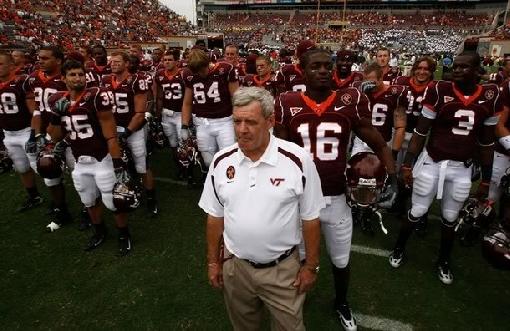
Editor’s Note:  We all know the success that Virginia Tech has had on the defensive side of the ball.  Defensive coordinator Bud Foster and the rest of his staff have continually developed top tier defensive units.  X&O Labs Senior Research Manager Mike Kuchar spent time talking with Torrian Gray, the Hokies defensive back coach, talking about Cover 89, the Hokies short yardage coverage.

Philosophy

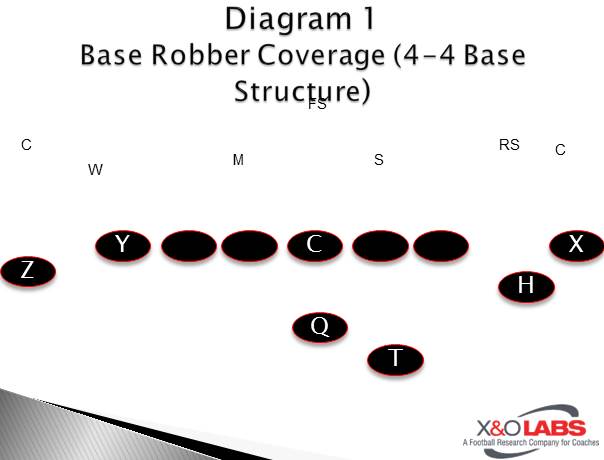
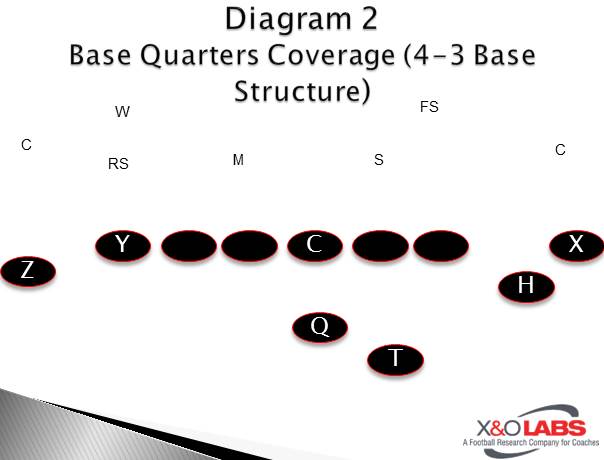
The Hokies traditional defensive structure is generically made off of two fronts- a 4-4 “G” package that Bud Foster helped develop and honed into a dynamic unit against pro-style offenses.  It consists of a four-down front with two interior linebackers (Mike and Backer) two exterior backers (Whip and Rover) and a Free Safety meant to “rob” any underneath routes (Diagram 1).  For the last few years, Virginia Tech has used more of a 4-3, Quarters type structure (Diagram 2) particularly against some open sets that the Hokies have encountered in the Atlantic Coast Conference.

In Virginia Tech’s terminology any even numbers (0,2,6,8) represent that “G” package while odd numbers (1,3,5,7) are indicative of the 4-3 front.  For example, Cover 8 is a base robber coverage from a 4-4,while Cover 9 is a pure quarters coverage.  When those ACC teams start to creep into the 16-yard line (or what Foster calls the red zone) the Hokies will combine both Cover 8 and Cover 9 into what they call “Cover 89” which is a man/zone matchup. Cover 8 pertains to the field side of the coverage (who is playing robber with on exception on the Free Safety which will be explained below) while the boundary side is playing Cover 9.   “Cover 8 is a pass thought progression.  It’s a pass coverage where we’re going to play in and out routes with the Corners and the Whips and Rovers. Cover 9 is a man principle backside.”

“Cover 9 is the red zone version of our Quarters coverage backside,” said Torrian Gray, the defensive backs coach.  ” The corner is locked backside and the Rover Safety is locked on two vertical on any outside release.  If the ball is in the middle of the field, we would play a Strong G instead of a Field G.”  Cover 89 consists of what is known as a “play it” or “lock it” call given by the Corners which is all based on down and distance.  The scheme will be explained in more detail below.

Cover 89 Coverage Fundamentals

We all know the scheme is always over rated, it’s the fundamentals that make plays, so we wanted to detail some of the more important coverage techniques that Torrian Gray teaches his Corners and Safeties in the passing game.

Corners Technique

Gray wants his Corners to have hard, square, inside alignment with no tilt.  “We try to deny the inside and easiest throw,” said Gray.  “We want to force the outside route and make him throw it through our body.  Against an extended number one receiver, we want to see the ball being snapped.   I don’t want to be just looking at a receiver because if he moves he’s gained leverage.  Once the ball is snapped our Corner’s eyes are going to the inside hip of that receiver.  We use a good two-handed collision to force him outside and make him throw it to our body.”


According to Gray, he doesn’t like to press his Corners inside the red zone because it invites the fade ball, which can be a particularly easy completion in the back of the end zone where space is limited.  “Some of those guys prefer pressing and sitting on the route so I let them play with it based on their individual strength,” said Gray.  “Right now I got a 220 pound guy who likes to get his hands on receivers so I will allow it, but I prefer for them not to do that.   You don’t want to give them an extra shot at the fade route because to me two/thirds of fade routes get completed.”

Free Safeties Technique

In Virginia Tech’s 4-2-5 structure, the Rover, Whip (or Nickel) and Free Safety are consist of the back end.  According to Gray, the heaviest responsibility in this coverage falls on the Free Safety who needs to match all underneath routes, something he is not accustomed to doing in the Hokies robber scheme.  This is done to free up both the Mike and Sam to make plays in the run game and take anything that flairs from the backfield.  The Free Safety’s responsibility is to handle any number two vertical route (like he would in Robber) but also match anything under routes.  “When we’re inside the 10 yard line specifically, we need to make sure we are able to jam the receiver before he can get to the option part of his route- either working inside or outside away from me,” said Gray.  “If he’s at the 10, I’d like our Safety to be at the five yard line as long as they are not in the way of the linebackers.  If the ball is inside the five, we will stay outside the end zone if possible.  If the receiver can clear our first level, we want to be able to get underneath his leverage or release.   We don’t pedal or back up.  It’s a flat foot technique or a buzz.”

Read More