
Dictating Coverage Based on Offensive Field Position & Personnel

By James “Mac” McCleary Defensive Coordinator, Notre Dame High School (LA)

Researcher’s Note: This report was prepared by Coach James McCleary of Notre Dame High School (LA). McCleary shares his innovative way of instructing his defensive secondary to play coverage based on offensive spacing and personnel. It’s important to note that McCleary’s system is a “check system” made by his corners and safeties pre-snap and is entirely predicated on how and where an offense lines up its personnel. Although this may seem to be consuming to teach your players (he draws up 200 cards a week complete with detailed hash marks so his kids can make the proper calls), once it’s mastered your players develop a complete understand of how offenses plan on attacking spacing and leverage in a defense.

The ultimate goal of any defense is to take away what opposing offenses do best. Our philosophy at Notre Dame High School has been to use our fronts and coverages to do that. It is our desire to outflank offenses with these fronts and coverages. Anytime we defend an offense, we look at five key components of what offenses are doing:

  • What type of formation is on the field?
  • What part of the field are they placing formation?
  • Which type of personnel is in the formation?
  • Where is their best personnel lined up within the formation?
  • What is the spacing between the receivers?

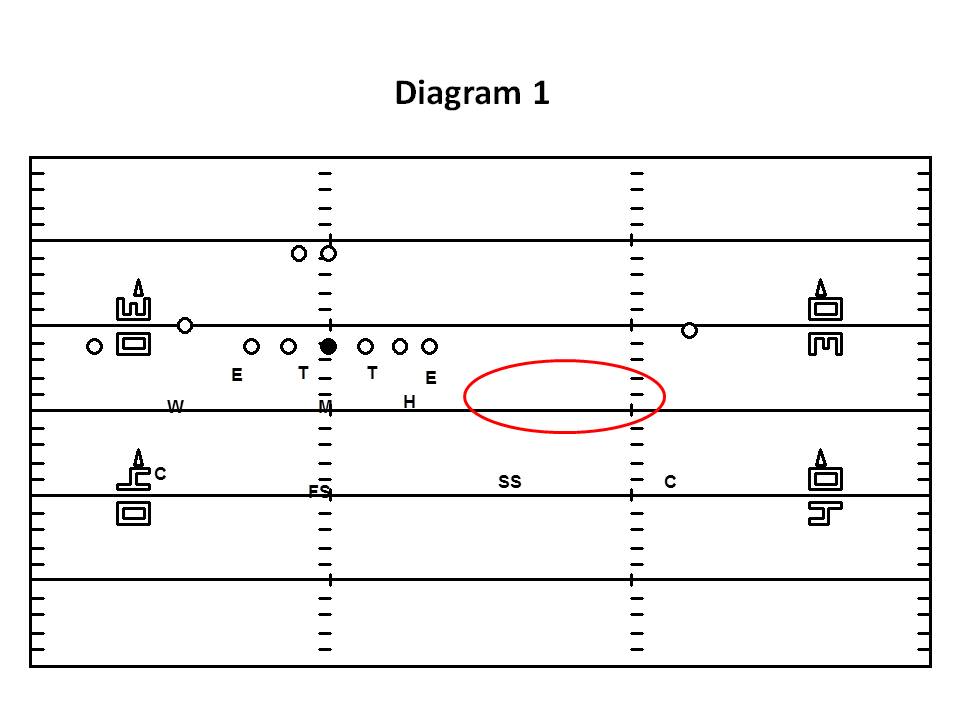
Spacing and Personnel We try to teach our kids the game by understanding receiver spacing and where QB’s want to throw the ball based on that spacing and personnel placement. For example: When looking at a formation with wide spacing of the receivers, we tell our players that the space in between is where they are looking to throw the ball (diagram 1).
 

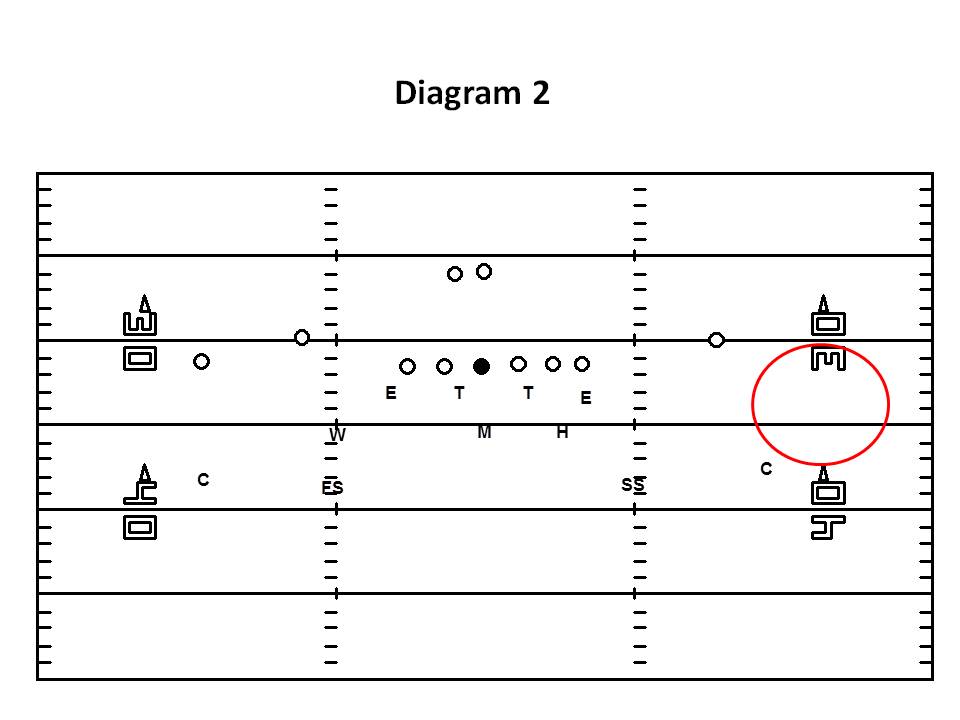
When formations have a receiver spacing that is tight, we tell them that they want to throw it to the space outside (diagram 2).
When defending offenses, the primary idea is to take away were they want to go by body position first. When an offense places its best personnel into the boundary, we tell the players that they will most likely throw the ball short into the boundary. When they are to the field, they will most likely throw wide to the field. An example of this is when we might be playing a team that throws a high percentage of screen passes. Usually, there is that one player that they like to move around the formation in order to get him the ball. We may get into a press position with the corners to get in his pocket on the inside screens to make it difficult for the blocker to pick him off on schemes such as rocket or bubble screens. Another example might be when we play a team with a significant vertical threat. We will make sure the coverage is designed so that there is always someone over the top of him.

Get X&O Labs’ new Research Reports sent directly to your email inbox. Sign up now, it’s FREE! In the right hand margin of this page >>>>>>>> above our Facebook box, there is a “Stay Informed!” email sign up box.  Just enter your name and email and click the “GO” button.

Once you teach body position, now it’s necessary to design scheme to counter what offenses are doing. By teaching spacing and where the formation is on the field (middle or hash), the players become great predictors of what can happen, thus putting themselves in a position to take away what an offense wants to do just by lining up where offenses want to place the ball, and it’s our jobs as coaches to get us there. How we do this at Notre Dame High School is to have our corners and safeties change their alignment to take away the void areas (the space where they want to throw the ball) in the defense.
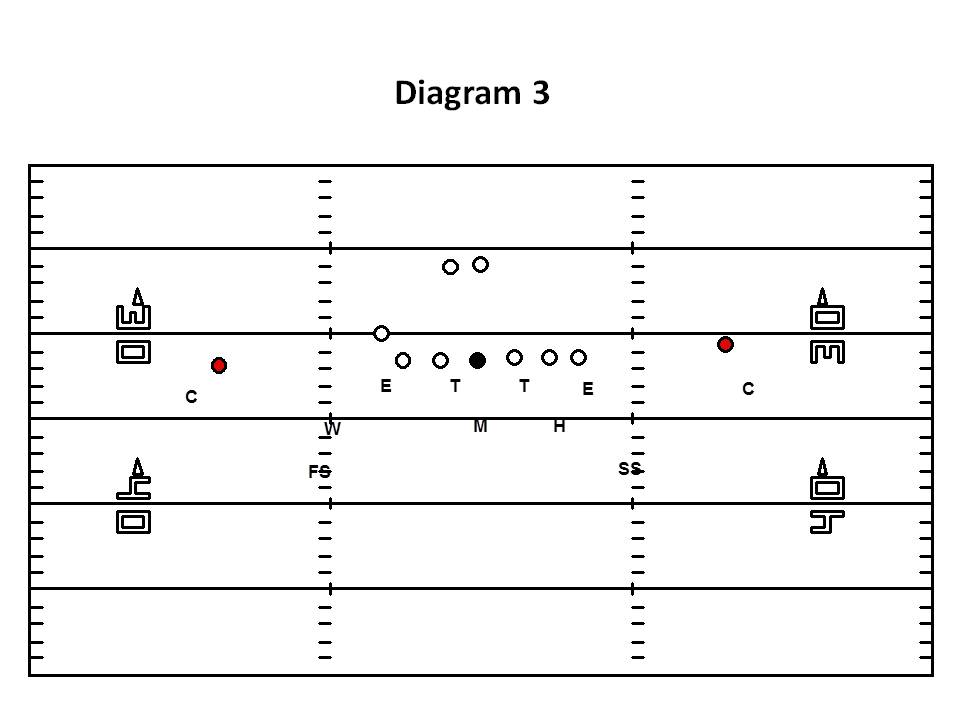
Take typical cover two for example, our corners will have three possible alignments that they can get into in cover two in order to take away what the offense wants to do. The first is the typical pressed outside leverage position. We use with average spacing of receivers to deny outside release and funnel to the safety (diagram 3).
The second spacing we will teach the corners are deep inside leverage or what we call choke technique (diagram 4). We use the choke technique when the receiver is on, or outside, the numbers. When a receiver is on, or outside the numbers there are only two things he can do. Go vertical or get inside. We take that away with our choke technique. Notice in diagram 4, we have taken his body position away just by lining up deep and inside. The corner still plays cover two, he just does it from a deep and inside leverage. He is now in a better position to take away any slant or vertical by his alignment.

Read More

The Wide Receiver Study

Using Hands and Feet to Negate Press Coverage

By Mike Kuchar Senior Research Manager X&O Labs mikek@xandolabs.com

Researchers’ Note: You can access the raw data – in the form of graphs – from our research on the WR Play: Click here to read the Statistical Analysis.

After conducting extensive research on defeating press coverage, we found that the primary key in doing so relies on the proper use of hands and feet.   Not surprised?  You shouldn’t be (but we think we’ve found a few things that will surprise you – so, keep reading). Every essential fundamental of the game relies on the utilization of those two extremities.  In any case, the goal is to beat the defensive back off the line of scrimmage, and with the help of coaches around the country we’ll show you how.   We understand that there may be different kinds of press coverage – like a pure cloud cover two corner – so for the intentions of this report, we are focusing solely on man-to-man bump and run with no access to a stem of any kind by a receiver (Picture 1). 

Case 1: Redefining the Stance What our research found is that the majority of coaches will either teach a different stance when encountering press or spend more time developing a certain aspect of the stance (like the difference between the front and back foot).  For example, 73.6 percent of coaches will have the inside foot up in their stance, especially when lining up against press.   Receivers need to be comfortable when encountering press coverage.  Many times, the younger players get tensed or nervous with a defender less than a yard away from their nose.

The majority of coaches, 54.1 percent teach an 80/20 weight distribution, meaning 80 percent of the receiver’s weight is on his front foot.  The idea is to not rock back or false step.  With the weight heavily distributed on the front foot, receivers are now able to “roll over” their front foot and get into the route.  We couldn’t tell you how many coaches have likened their stance to a sprinter coming out of the blocks during a sprint.  Mike Hart, the receivers coach at South County Secondary School (VA) even tells his receivers to turn their inside foot in about a quarter of an inch in order to roll off the ball.

Po Pomajzl, the wide receivers coach at Grand Island Northwest High School (NE), takes it to a whole other level when teaching the stance to his kids.  He actually takes them through a progression (starting from their knees) to make them understand the importance of stance.

Coach Pomajzl’s WR Stance Progression:

  • Player starts on his knees
  • Bring inside foot up so the heel is even to the back knee (Picture 2)
  • Put hands shoulder width apart on the ground in front of your inside foot (Picture 3)
  • Raise your butt up assuming a sprinter’s stance as if coming out of the blocks
  • Raise your torso up to a 45-degree angle (Picture 5)
  • Hands are in front of torso with elbows bent at 90-degrees and hands relaxed (Picture 6)
  • 90% of weight is on the front foot
  • This stance can be adjusted slightly depending on the WRs height and leg length
  • Player looks down the LOS to the QB/ball
  • At the snap the WR drives his back knee forward pushing off his front foot (no false steps)

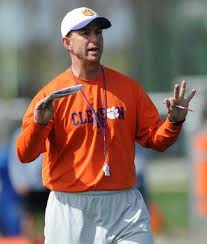
In order to emphasize the importance of not false stepping, Dabo Swinney, the head coach at Clemson University, reinforces that the weight of the front foot should be on the ball of the foot, and not the toe.


Coaching Point:  If players don’t understand where the ball of the foot is, tell them it’s where the shoelaces start.  It’s helped me in my clarifications.

“I don’t want the receiver up on his toe.  I want the weight on the ball of the foot as if I were in a chute,” says Dabo Swinney.  “We want to drive off the back foot and roll off the front foot.  The receiver needs as much weight as it takes to keep him from picking up the front foot at the snap of the ball.  If the balance is not right, the receiver will pick up the front foot.”

Swinney will often remind his players, who have NFL-caliber talent, that when they compete in the combines, the clock starts when they move.  A false step or hesitation could bring down that 40-time and eventually cost them millions of dollars.


Get X&O Labs’ new Research Reports sent directly to your email inbox. Sign up now, it’s FREE! In the right hand margin of this page >>>>>>>> above our Facebook box, there is a “Stay Informed!” email sign up box.  Just enter your name and email and click the “GO” button.

We’ve also found that the stagger is just as important in a stance.   Many coaches will narrow the base of their wide receiver’s stance when encountering press coverage.  He doesn’t want as much stagger in his stance because he has to get his feet up under his body quicker to execute whatever move he is using.  Jason McManus, the former receivers coach at The University of Tennessee at Chattanooga, teaches more of a 90/10 ratio with 90 percent of the weight being on the front leg.  He tells his receivers to lean their chin over their front knee, and lower their pad level with the arms at the ready.  But he varies his stance into two different types – a base stance, which means one against “open access” where a receiver can get a clean release and one against pure press coverage with no access.

Read More

Simplifying Offensive Formation Recognition

                                    By Mickey Mays, Researcher, X&O Labs

During an S.E.C. game last year, the announcer stated that one goal of Auburn offensive coordinator Gus Malzahn’s game plan was to “wear down the opponent’s defense both physically and mentally by using a fast tempo, multiple formations, and pre-snap shifts and motions.”  A confused football player performs with doubt in his mind instead of the inner confidence needed to excel.  Simplifying offensive formation recognition will help your players eliminate the thinking process by making precise run and passing strength calls, align correctly and concentrate on assignment and technique. This report will focus on one back and two back offensive formations, which will be divided into three categories:

  1. Two back formations.
  2. One back 2×2 formations (meaning two eligible receivers on both sides of the formation; a balanced set).
  3. One back 3×1 formations (meaning three eligible receivers on one side of the formation). 

Through recognition simplification, the different possible one back and two back formation total is nine.   Although personnel groupings may change, man coverage match-ups and zone coverage drops can remain the same with one exception – some defensive coordinators flip the back-side corner vs. Twins or Trey when playing zone coverage.


For the purpose of this report, we will identify the five eligible receivers as follows:

F: Running back

H: Blocking back or 3rd receiver

Y: Tight end

Z: Flanker

X: Split end

***U: Second tight end (two tight end formation)


It must be noted that formation terminology can vary widely from team to team.  Regardless of terms used to label each formation, your players must identify and communicate all nine.  We will use the following terminology for the nine one and two back formations:

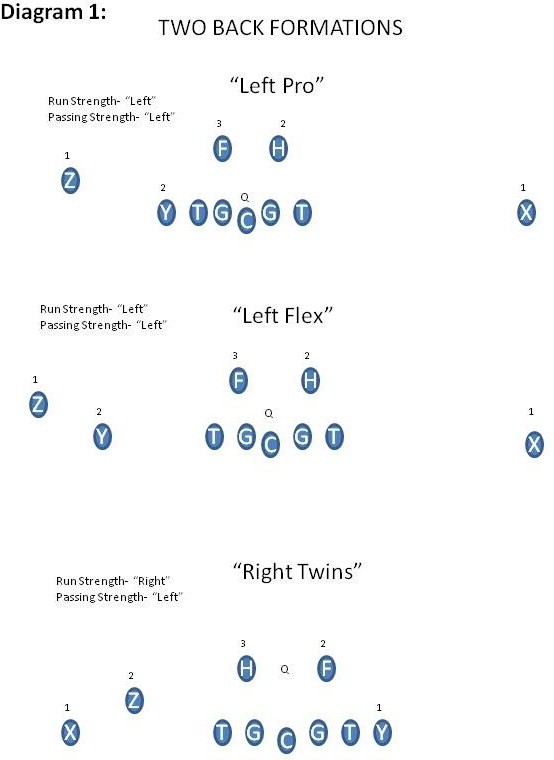
Two Back Formation Possibilities (diagram 1):

    • Pro: 2 Backs, 1 T.E., 1 Wide (receiver) each side
    • Flex: 2 Backs, 0 T.E., 3 Wides (receivers)
    • Twins: 2 Backs, 1 T.E., 2 Wides (receivers) aligned opposite the T.E.

Read More

OL Drills – Pin and Pull Schemes – University of Wisconsin

Video Presentation: X&O Labs’ Senior Research Manager, Mike Kuchar, explains Wisconsin’s pin and pull scheme in this exclusive video below.

By Mike Kuchar Senior Research Manager X&O Labs

Since over half of the country is knee-deep in two-a-days this time of year, X&O Labs didn’t want to produce a long drawn out report. We know how precious your time is during the start of the season.  Instead, we wanted to produce a quick tutorial on the pin and pull scheme, particularly the practice drills needed to incorporate the scheme.  Commonly referred to as an outside zone/perimeter concept, the pin and pull play has been used by major programs across the country.  It’s a variant of the outside zone scheme, but instead of combination blocks at the point of attack, teams will man block the scheme.  The premise is for any uncovered lineman to pull while any covered lineman will block down. 

Instead of putting together an entire report on the scheme (we’ve done that with our outside zone report) we wanted to give you a couple drills that you can use to incorporate the individual blocks into your routine.  It’s already the end of August, and chances are you have your offensive package installed already.  So instead, we’ve decided to showcase the drills of two of the best college programs that run it: Wake Forest and Big Ten Champion, Wisconsin Badgers.

Because this research report is all on video, there isn’t a ton of copy, facts or figures tied into our material.  Instead, we’re providing you with what we all know is important…video.  This way you can see for yourself how these major college programs drill their players to execute the pin and pull scheme.  But before we show our offensive line drill tapes, we did want to provide an overview of the pin and pull scheme.  Below is a PowerPoint video presentation on exactly how Wisconsin and Wake Forest teach the pin and pull concept.

Read More

DB Drills – Cover 4 Run Read Drill – Union HS (IA)

By Jared Pospisil, Defensive Coordinator, Union High School (IA)

“The drill described here assumes that our safeties have made a run call based on the offensive formation before it. For the most part, because our safeties are the run-first players in this call, much of the drill focuses on their reads and reactions.” Jared Pospisil, DC, Union High School (IA)

We use a version of Cover 4 as our base coverage because it helps us get as many players defending the run as possible. Out of a base 43 defense, Cover 4 allows our safeties to be very active in run support while ensuring that we have at least two pass-first, deep pass defenders. Therefore, because the run fit for the safeties is so important to our defense, we incorporate the Cover 4 Run Read Drill as the cornerstone of our defensive practice. We have set up our in-season weekly practice schedule to include one day devoted entirely to defense and two days that split offense-defense evenly. We incorporate the Cover 4 Run Read Drill into the defense-only day so that we can devote as much time to the drill as possible.

In our version of Cover 4, before each play begins, each side of our secondary makes one of two calls based on the offensive formation that comes out before it. Certain formations allow the safety to stay tighter to the tackle box, allowing him to be a key player in the run. Other formations pull him out wider and deeper to allow him to play the pass more effectively.

The drill described here assumes that our safeties have made a run call based on the offensive formation before it. For the most part, because our safeties are the run-first players in this call, much of the drill focuses on their reads and reactions. The corners, who assume the pass-first responsibility during a run call, basically go through their alignment, stance, and start when the ball is snapped, and finish each repetition with their late fill technique. When we play teams that crack heavily, however, we incorporate the crack-and-replace concept into the run read drill.

Although we set up the Cover 4 Run Read Drill to mimic the unique offensive look and blocking scheme we will see each week, the standard set up for our drill consists of the following: 4 or 5 trash cans that represent 5 offensive linemen, 2 players representing end men on the line of scrimmage (EMLOS), 2 or 3 players representing offensive backs, 2 safeties, 2 corners, and 2 coaches (one acting as the QB and one giving blocking/running assignments) (diagram 1).

We start each drill with three things in mind that we hope the athletes carry over into games: alignment, stance, and key. Generally, when our safeties make a run call to their sides, they align at 8-10 yards deep, on the outside shade of the EMLOS; in most cases, this is a tight end or an offensive tackle, depending on the offensive set we see that week. For the stance, we ask our safeties to use a square stance, with knees and hips flexed, back slightly flat, hands loose in front of the body. During a run call, we want our safeties to keep their eyes out of the backfield. As a result, we tell them to key the EMOLS solely. We find that, in most cases in high school offenses, the tight end or open side offensive tackle tip off the type of play. At the snap of the ball, we tell our safeties take a couple pop steps in place as they key the EMLOS; this gets their feet moving without losing ground.


Read More

The QB Trap Off Jet Action

“Our goal for this trap play is to get people thinking jet, get the defense moving laterally, and use the QB trap away from that motion.” Dan Ellis, Head Coach, W.C. East High School

By Dan Ellis Head Football Coach W.C. East High School

Researcher’s Note: This is the second report in X&O Labs’ QB Runs Series by Dan Ellis.  Coach Ellis is documenting his most effective QB runs: The QB Power Read, QB Trap and QB Midline.  

We are a shotgun, fast pace, no-huddle offense with a zone scheme – and we also will add pistol in as well. This allows us to take advantage of our athleticism and numbers at the skill positions and it uses our supposed “weakness” – smaller, more athletic lineman – to our advantage.


With our offense, our QB must be able to run the football and be a weapon that the defense must account for. He does not need to be a 1,000 yard rusher; he just needs to keep the defense honest with his feet.

One of our key QB runs is our trap off of jet action. We run jet motion and jet a lot throughout a game.  Our goal for this trap play is to get people thinking jet, get the defense moving laterally, and use the QB trap away from that motion.  This gives us a great counter.  Our QB series of runs hits to the same side of the action with our QB Power, the QB Midline hits the middle of the defense, and now our QB Trap hits away from the action.  All three plays give the added benefit of using the QB as a true threat.

Read More

Exclusive: Utica College’s One Back Power Run Game


By Curt Fitzpatrick Offensive Coordinator/QB Coach Utica College (NY)

“Over the past few seasons our offense at Utica has been effective at throwing the football out of our one back formations. Therefore, we have faced more and more defenses that employ a 2-high safety structure, leaving fewer defenders in the box at the line of scrimmage. When we see this, our eyes light up because we know that we’re going to get the count we’re looking for to run the football effectively.” Curt Fitzpatrick, Offensive Coordinator, Utica College

On behalf of our Head Coach Blaise Faggiano and the rest of the staff here at Utica College, I’d like to thank X&O labs for giving me the opportunity to contribute this clinic report to the new website.  The work that X&O Labs does in researching and sharing information with football coaches around the country is tremendous.  It is truly an honor to be a small part of all that they do for our profession.  For this report, I’d like to share with you the best way we utilize the Power O play; the one back Power. 

The Power O scheme has been a proven winner in the game of football for many, many years.  However, long gone are the days of everyone running this play out of strictly two back formations.  More recently the Power O has evolved into a scheme that is utilized by both pro-style and spread offenses alike.  With many teams moving towards an offensive philosophy that utilizes the skill set of a more athletic quarterback, the Power scheme is being seen more and more as a “read” concept, which adds to its reputation as being an effective “attitude-type” run play.  The point being, Power is a versatile blocking scheme that can be used in a variety of ways, as well as in the red zone and goal line scoring areas.  In 2010, the Power O scheme accounted for approximately 35% of our run game out of various formations and personnel groupings.  About 20% of our runs were of the one back Power variety.  For us, the one back power gives us a physical down-hill run play that can be run out a variety of traditionally “pass heavy” formations. 


As a back drop for this report, I think it’s important first to know what our offensive style is and how the Power play fits into our overall scheme.  While we do use bigger personnel groupings at times, we are primarily a one back offense that utilizes a mixture of 12, 11, and 10 personnel.  From a player standpoint, we currently do not have a QB that we feel comfortable running “read” type plays with, therefore the new age Power front and back side read schemes that many spread teams run do not apply to us.  I believe that this is an important point in solidifying the use of this blocking scheme in any offense.  You can find a way to utilize the Power O with whatever type of personnel that you have!  Over the past few seasons our offense at Utica has been effective at throwing the football out of our one back formations.  Therefore, we have faced more and more defenses that employ a 2 high safety structure, leaving fewer defenders in the box at the line of scrimmage.  When we see this, our eyes light up because we know that we’re going to get the count we’re looking for to run the football effectively.  Formationally speaking, we run our one back Power play out of both 2×2 and 3×1 sets, however there are a couple different criteria that must be true out of any formation in order for us to run this play:

  1. We must run the play to a TE side (at least a 3 man surface).  We also could choose to add a slot receiver (TE Trips) via formation or motion to create a 4 man surface so that we can account for a possible 4th defender to the play side. 
  2. We must have an even count to the play side in order for us to keep the play on.  For example, if we have the play called to a 3 man surface the QB must verify that we are getting an even amount of defenders to that side – our 3 vs. their 3 (See Diagram 1). Conversely, if we are out-numbered at the point of attack the QB must recognize this as a bad situation and check the play into a more advantageous run or pass based on the game plan for that given week – our 3 vs. their 4 (See Diagram 2).  As I mentioned earlier, one way that you can account for that 4th defender is to create a four man surface to the play side by motioning into a 3×1 formation so that the slot receiver can account for that edge player (See Diagram 3).  You could also call the play out of a 3×1 formation to begin with, giving you a 4 man surface to work with right off the bat (See Diagram 4).  If you have a slot WR that is a physical blocker this could be a great matchup for you, or it could be a nightmare if that guy isn’t willing to be physical blocking an OLB/Safety type player. 

Now that we’ve looked at some different formations, motions, and defensive structures that are conducive for running the one back power play, let’s talk about the overall emphasis of the play and some of the blocks at the point of attack that make this play successful.  The thing that I like best about this play is that it brings with it a “nastiness” up front like the Power O scheme always has.  For our offensive line, we install this play just like if we were running it out of 22 personnel or on the goal line, with a physical mindset.  Our goal when running the one back Power is to remove defenders from the box by formation, then separate the defense with a physical gap scheme that allows for a double team at the point of attack.

Read More

Defending Pre-Snap Movements

New Research Reveals the Most Effective Defensive Adjustments

Researchers’ Note: You can access the raw data – in the form of graphs – from our research on defending pre-snap movements: Click here to read the Statistical Analysis Report.

Two weeks ago we released a new research report, Pre-Snap Movement to Gain Leverage, detailing how offensive coaches are using pre-snap movements to out-leverage and out-number defenses at the snap.  We featured the schemes, complete with detailed film cut-ups, of the three most prolific offenses in the country: Boise State, Auburn and Oregon to show you exactly why they do what they do.  I learned quite a bit researching that particular report.  As a defensive coach, I was mesmerized by the way in which Chris Petersen and his staff at Boise would manipulate defenses by using pre-snap movement to gain leverage and get them into compromising positions.  Gus Malzahn, the newest offensive prodigy, was baiting defenses to fly to the perimeter with his jet motion, just to gash them inside with Cam Newton on the power read scheme.  Then you have Chip Kelly shredding defenses with his “flash sweep concept” by sending the offensive line opposite the motion of the back and reading the front-side defensive end.  It was in a word…stealing.  They are all simple offensive concepts to teach and implement, it’s just that those three had the guts to run it, and run it at the highest level of college football.

So enough marveling, this report will focus on how defensive coaches are adjusting to these types of motion and more importantly how they are putting their players in the best spot to make plays.

My research staff and I were surprised to find that 57.5 percent of coaches surveyed said they see pre-snap movement on less than half of all offensive snaps.  This was somewhat surprising considering Boise moves on nearly 80 percent of its total offensive snaps.  Truth is, most offensive coaches (the good ones anyway) run their motion for a reason, and not just to “window dress” their playbooks.

For a quick refresher from our last report, the following reasons are why offensive coaches will utilize pre-snap movement:

  • Gain a mismatch in personnel
  • Gain a leverage advantage on the perimeter
  • Gain a numbers advantage
  • Identify coverage rotation
  • Promote a “toe-to-heel” mentality to the defense

So after my staff and I analyzed the data from our survey results (1,724 coaches responded), we were interested in determining which movements give offenses the best opportunity to capitalize on those five indicators above.  We found the following three pre-snap movements to be the most used against defenses:

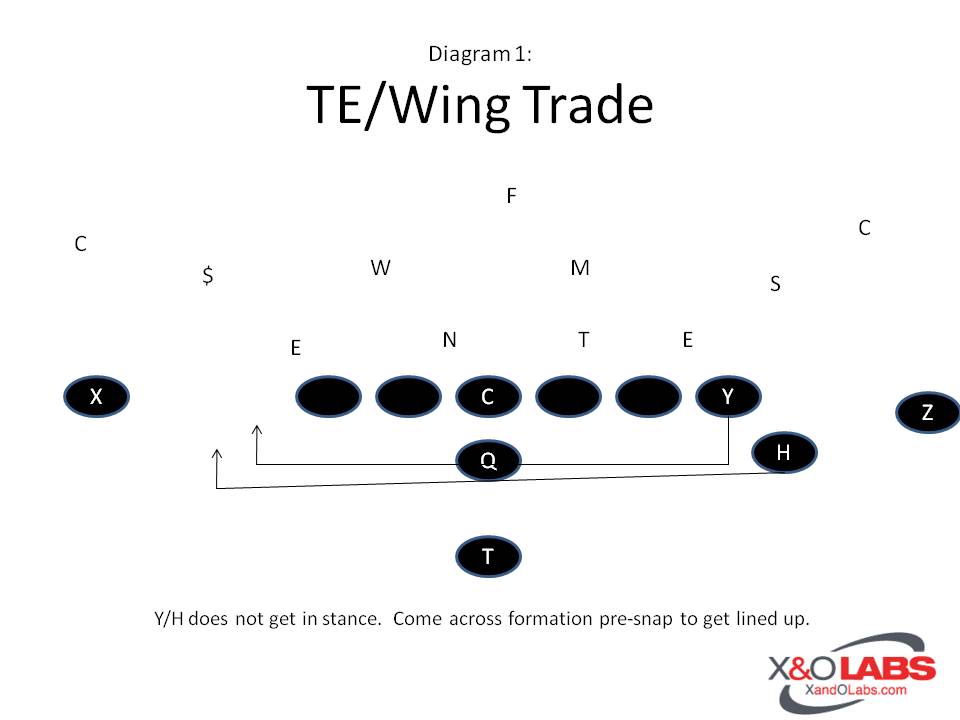
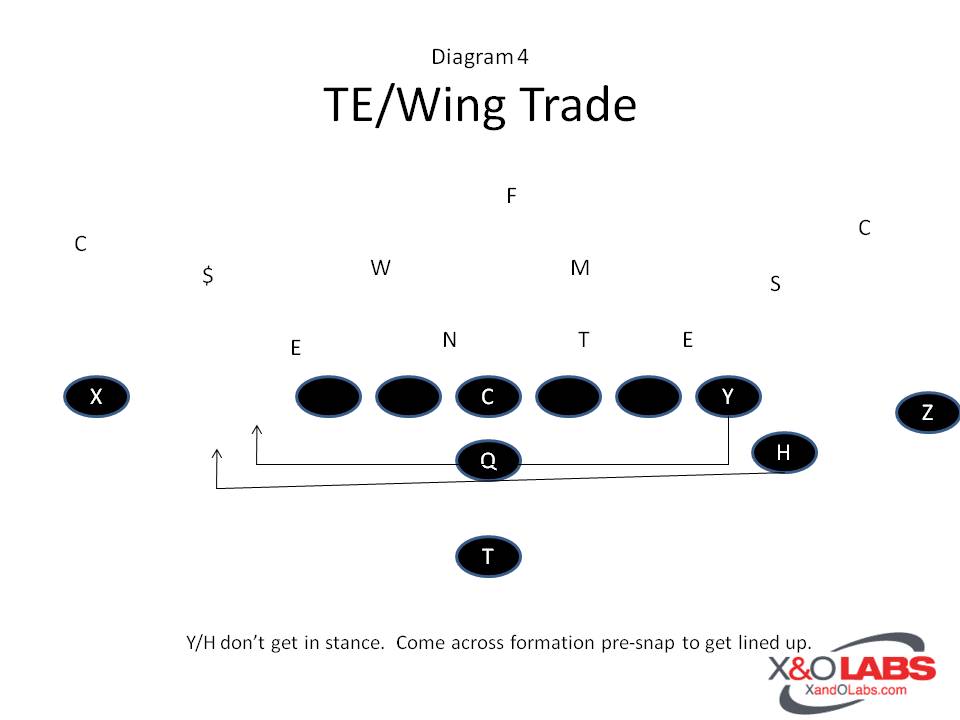
  • TE Trade (Diagram 1): This is a trade/shift, where you bring your tight end from one side of the offensive formation to the other.  It also can be used in conjunction with an H-back or wing where both will travel together.

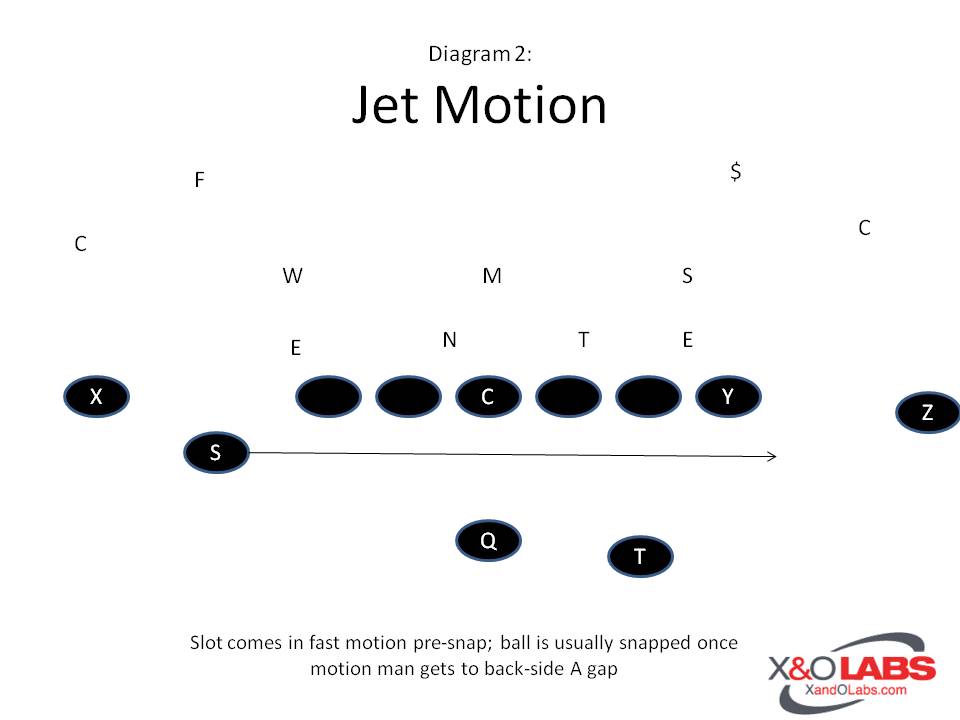
  • Jet or Flash Sweep (Diagram 2): The jet sweep motion is a full-speed motion from one side of the formation to the other, mainly utilized by a slot receiver.  It’s been a staple of the Wing T offense, but has integrated itself into more spread schemes recently.

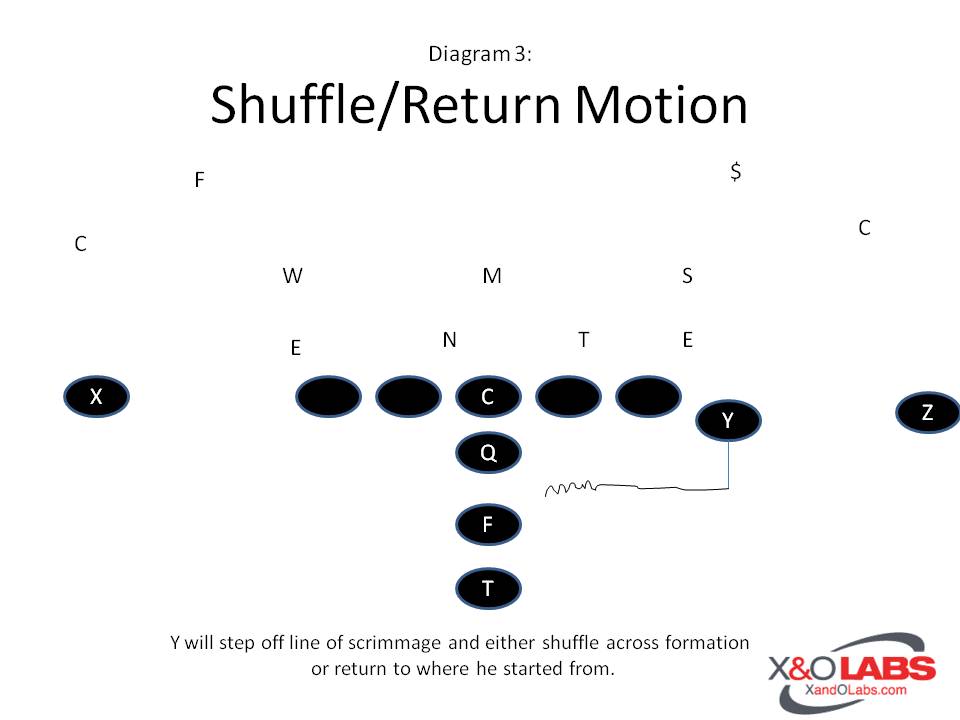
  • Shuffle or Return Motion (Diagram 3):  This motion is a square-shouldered motion by an H-back or Wing who will start on one side of the line of scrimmage and either shuffle across the formation or return to his original location.


Those are the top pre-snap movements that defensive coordinators will see from offenses.  Now let’s take a look at how they adjust.

Case 1: Defending the TE Trade Tight end trade, or as some teams refer to as “Y walk,” is used mainly by the offense to dictate the formation strength of the defense.  Most defenses, particularly four down lineman fronts, will call the strength to the tight end or three-man surface.  “Walking” the tight end from one side of the formation to the other can cause various personnel problems for the defense.  A weak side defensive end may end up playing on the strong side once the tight end resets, it’s a position he’s not familiar with.  Also, a nose guard who will line up away from the tight end, may end up playing to the tight end surface on a trade.  This can make the nose guard susceptible to playing double teams, a block he may not be used to seeing because he’s now on the front-side of the play.  In our last report, I detailed how Boise State was able to trade its tight end and get Fresno State to play out of position.

In any movement by the offense, it’s important to note that there are really only three ways in which a defense can respond to offensive pre-snap movement.  They can adjust with their first level players (DL) their second level players (LB’s) or their third level players (DB).  How they adjust these levels could vary in dropping a defender down, moving a defender up, widening defenders or slanting defenders.  In this instance, we found that 61.8 percent of coaches will bump their defensive front against the tight end trade, perhaps creating some of the same personnel mismatches that were mentioned earlier.  

Sam Tavlealea, the former defensive coordinator at the St. Louis School in Hawaii, has seen the evolution of the spread trickle down from former Hawaii coach June Jones.  Jones has been using H-backs and slot backs in his package for years, and now many high school coaches on the west coast have adopted those same principles.  So one of the challenges Tavlealea faces each year is to adjust his personnel/coverage depending on whether or not a wing is a smaller slot receiver or a bigger H-back.  Most smaller slots would signify a pass concept, whereas the H-back would be used as an additional blocker in the run game.

“We’re seeing a lot of bounce back motion with that wing,” said Tavlealea.  “What he’ll do is line up in a wing alignment and either motion full across the formation or stops and bounces back to where he came from.  The coordinator was actually trying to see if anyone was going with him.  If it wasn’t man coverage, he would go across the formation hoping you would bump your front.  They would run the inside zone to the shade technique then trap the three-technique.  It got to a point where we were seeing it 15 times per game.”

Read More

The Science of Pass Rushing

New Research Identifies Most Effective Methods

Researchers’ Note: You can access the raw data – in the form of graphs – from our research on the defensive line: Click here to read the Statistical Analysis Report.

For the last couple of Coaching Research Reports, we have centered on offensive and defensive concepts and schemes. Sure, the scheme all looks pretty on the whiteboard, but what good does it do when their X is better than your O? So what we’ve decided to do for this report is get back to the core – focus on the fundamentals of the game. And what better way to do that than start with the defensive unit up front – the backbone of any solid team. In this report, we’ll focus solely on effective pass rush moves and rush points – an area often neglected in coaching. What our researchers found astonishing was that among all problems that coaches encounter when instructing their defensive rushers, 38.3% felt that losing gap integrity was the most alarming concern.

So we’ve consulted with a select group of coaches from various levels of football – from high school through the professional ranks – to bring you a detailed report on the science of pass rushing. No need for diagrams here, we’re focused on mastering the technique.

Based on our research these are what are considered to be the most high percentage, most productive pass rush moves. It’s no nonsense content, in a way that only X&O Labs could produce. But before we get started, it all starts with the hands.

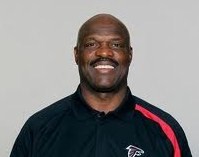
Case 1: Coordinating the Eyes and Hands Without question, this area seemed to be the most integral when developing a pass rush. In fact, 60.7% of our coaches train their players to lead with the eyes – meaning focus their eyes on the blocker, while feeling the QB. While most coaches would agree that the use of the hands and feet were vital in getting the QB to the turf, teaching that correlation is something many coaches spend a ton of time on – even at the highest level of football. Ray Hamilton, the defensive line coach of the Atlanta Falcons takes his entire unit through a hand placement circuit every day of practice. According to Hamilton, who has 24 years experience in the league tutoring greats such as John Abraham and John Henderson, hand placement is one of the most under taught skills in the game. 

“Everything starts with hands,” says Hamilton. “We teach our defensive linemen to first identify how the offense lineman is trying to attack us. When you’re rushing the passer, if you’re at a point where you can touch him or he can touch me we call that a contact zone. As soon as you get there, it’s a boxing match; you need to have your hands ready. They need to replace his hands. We need to knock his hands off two or three times before he gets inside on us. If he can’t get his hands on you he starts to retreat by moving his feet and that’s when you got him.”


Once he feels that his player is in the advantage, Hamilton then teaches a swipe move, with the aiming point being the forearm of an offensive lineman, not the wrist. “The wrist is too small an area,” he says. “We go from forearm to elbow. Some guys are betting at wiping them off, knocking both down or just knocking one arm down. The key is to get his hands off as quickly as possible.” In order to teach this concept, Hamilton breaks what he calls his “quick hands” segment into the following progressions for drill work:

Read More

Pass Rush: Get Off, Set Point & Escape

By Menson Holloway Assistant Coach Ysleta High School (TX)

Teaching pass rush is sometimes considered an art more than a science. There are certain principles that make up a good pass rush. Without question, the get off is most important and there are many ways to enhance this aspect of the pass rush. The second most important element is racing to the set point of the QB drop. Both of these intangibles will make most offensive linemen panic. The final quality of a successful pass rush is the escape, which is where all of the hard work of beating an O-lineman can either fall to waste or flourish. With today’s mobile QB, accelerating to the QB is as important as beating the Lineman trying to protect him.

Get off

The get off is the most important segment of developing a pass rush. Most defensive linemen typically key the ball for the get off, but the center is not the only man on the offensive line that could know the snap count. If a defensive lineman is aggressively attacking the offensive line all game chances are they will start slightly jumping the snap. For example, they will go from: Down, color, number, color, number,…… set, HUT….(snap the ball, then start pass set) simultaneously, to Down, color, number, color, number,…… set, H (start movement) UT, snap the ball (and jump the snap). Anticipating an offensive cadence can be a major advantage to your get-off as a defensive lineman.

  • Key: A better key for get off is the lineman himself. Reaction time is very important and the later the initial impulse the slower the reaction time. There are certain trigger points that an offensive lineman may show before the snap: he will move his elbow, hand, knee or ankle before the whole body starts moving. If you use a visual key to focus on the lineman (“V” of the neck, helmet screws, jersey numbers, etc.) and peripheral vision to see the ball you can see both.
  • Focus: Use the long focus technique by staring at something behind what you are really looking at. This will help to see movement in your whole frame of vision. (Please refer to the following two images). 


The Finger Sausage Illusion: Point your fingers together (like the above photo). Next, stare at an object directly behind your fingers – you’ll see the illusion.


  • Mind Set: The mindset of a quick get off is not to wait for an impulse to go, but to have to hold yourself back from already running. Have the defensive lineman think of getting off as a gun half-cocked with a quick trigger; as soon as the first twitch occurs, get off.
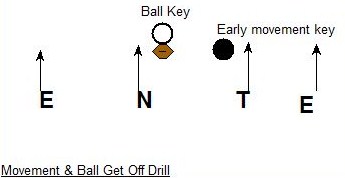
  • Drills: We practice this every day by doing the get off drill with the ball and adding someone to simulate 1 of 4 movement keys at the same time (see diagram).
  • Read More

    Attacking the Alley Against Odd Front Defenses

    Researcher’s Note: You can access the raw data – in the form of graphs – from our research on Attacking the Alley Against Odd Front Defenses: Click here for the Statistical Analysis Report.

    It’s a classic case of the tail wagging the dog.  With the advent of four receiver spread formations infiltrating the collegiate and prep landscapes, defenses have been forced to adjust.  Commonly referred to as “sub” personnel, our researchers at X&O Labs have found that many four-down (defensive line) teams have shifted to three-down structures just to match speed with speed.  What started out as nickel packages has grown more into an every down occurrence.   Coordinators are replacing one of their defensive linemen with linebacker/safety hybrids in order to combat the speed and defend the width of the field.

    After surveying 2,000 college and prep coaches, we’ve found that the most difficult challenge when facing odd front teams is finding a way to occupy the alley defender (usually an outside linebacker or drop safety).  Often taught to be the force player, it’s this overhang player that can cause problems for offenses wishing to push the ball to the perimeter.  Sure, it’s offensive pedagogy to attack the B gap bubbles vs. odd front teams, but it’s only a matter of time until defenses try to take that away by slanting or stemming to a four-down front pre-snap.  Eventually you’ll need to get to the perimeter, so why not save time by getting there immediately?  Our researchers at X&O Labs have sifted through your feedback, and we’ll show you how to do just that below.

    Case 1: Using Tight End Structures, Particularly 12 or 11 Personnel Even if you don’t have a tight end in the program, start to develop one.  Over 80% of coaches polled by X&O Labs attack odd defenses by using various tight end formations. Whether by using 12 personnel (two tight ends, one backs) 11 personnel (one tight end, one back) or 21 personnel (one tight end, two backs), the implementation of the tight end seems to be a pivotal tool in the run game.

    We’ve all seen how productive spread offenses like Oregon, Boise State and Florida have been within the last three years.  What separates those teams from traditional spread teams is the implementation and execution of the tight end on normal downs.  According to our research, using a tight end in spread personnel accounts for two valuable advantages:

    • It changes the structure of the defense: No longer can that safety/linebacker play in space, which is exactly what he wants to do.  Now he’s forced to cover down on a bigger, stronger opponent, giving you leverage to get to the alley.
    • It provides for an instant mismatch in the run game: Many of these hybrids don’t like to get their hands dirty.  These types, who usually weigh in the 180-210 pound range, are forced to balance up and fit in the framework against bigger tight ends.

    Mike Canales, associate head coach and offensive coordinator at the University of North Texas, contributed heavily to this Coaching Research Report.   Canales has modeled his spread scheme after studying the details of what Oregon does to attack the perimeter with their speed-sweep and option series.  “Anytime we’re going to get odd fronts, like we do when we play Louisiana-Monroe, we need to make some adjustments to our scheme,” said Canales.  “Teams are going to give you a six-man box, regardless of what you’re putting on the line of scrimmage.  Handling that overhang player with a six box is a bitch.  You can’t stay in 10 personnel with no tight ends because those slot receivers aren’t big or strong enough to handle those safety types one-on-one, so you need to get into 11 or 12 personnel to force the defensive coordinator’s hand.”

    Read More

    QB Power Read: A Constant 4-Yard Steal


    Researchers’ Note: the following is a supplemental report to the Coaching Research Report, Attacking the Alley Against Odd Front Defenses.

    By Dan Ellis Head Football Coach Springfield High School (PA)


    “The QB Power Read has been a tremendous play for us and gives us a lot of flexibility in attacking the defense.” Dan Ellis

    We have created our offensive scheme to fit the reality of our situation – in almost half of our league games we are playing teams from schools that are significantly bigger than ours.

    We are a shotgun, fast pace, no-huddle offense with a zone scheme (and we also will add pistol in as well). This allows us to take advantage of our athleticism and numbers at the skill positions and uses our supposed weakness – smaller, more athletic lineman – to our advantage.

    With our offense, our QB must be able to run the football and be a weapon that the defense must account for. He does not need to be a 1,000 yard rusher; he just needs to keep the defense honest with his feet. Our key play for the QB is our QB Power Read.

    Our QB Power Read up front is blocked just like a typical power play. Because we are a predominantly zone team at a small school with most of our linemen going both ways, we do cannot invest the time into teaching combo blocks. So we will run this play to the 1-technique. We do that in a number of ways – either formation/motion or by using our freeze call at the line of scrimmage to ensure we call it the right direction. The only major difference up front is that we are not going to read the play side defensive end.

    Read More

    Pre-Snap Movements to Gain Leverage

    Researchers’ Note: You can access the raw data – in the form of graphs – from our research on pre-snap movements: Click here to read the Statistical Analysis Report.

    Manipulating defenses seems to consistently be the main goal of most offensive coordinators in the modern era. How can I defeat a defense without even snapping the ball? It’s the thinking man’s “game within a game” that occurs pre-snap. Football is a game of moving parts, which explains the constant references it draws to the game of chess. In this report, X&O Labs is going to show you how to put your moving parts in a position to out-leverage, outnumber and outthink a defense.

    Aside from conducting our usual research on this topic, which was compiled through surveys, we’ve also decided to offer an online video tutorial on three of the top ten offensive programs in the country that are tops in using pre-snap movement: Boise State University, Auburn University and the University of Oregon. These are three high-octane offenses that know how to score points (all averaged over 44 points per game last season) and know how to do it with efficiency (all averaged over 69 players per game last season). We took the top four movements in their packages, tight end/wing trade, jet motion, flash motion and slash motion, and detailed how they can attack a defense.

    Why Pre-snap Movement? Surprisingly, when we polled coaches we found that the majority, 35.4% use motion on less than half of their offensive snaps. They don’t make a living off doing it. This tells us it’s done with a purpose, in order to see how defenses will react. Many of the offensive coordinators we spoke with threw the term “change the picture for the defense” around, meaning getting them to think. Once you get an aggressive defense thinking, you’ve won. For the intents of the report, we will distinguish between the three different types of pre-snap movement.

    Types of Pre-snap Movement:

    • Trade: A trade is when a player on the line of scrimmage will move from one end to the other pre-snap. These players are usually tight ends, H-backs or fullbacks. In fact, Boise State will only trade those types of players because it cuts down on the learning curve. No other players need to memorize the terminology needed to run the scheme.
    • Shift: Similar to a trade, a shift will usually involve more than one player. Common shifts include shifting into bunch sets (3×1 sets), or shifting from spread sets to tight sets and vice versa. These are done as soon as the QB gets under center or gives and indicator if in shot gun.
    • Motion: A motion is done either by an inside receiver in normal sets or an outside receiver in unbalanced sets. We’ve found the most common forms of motion have been jet or flash motion, where one receiver will start full speed pre-snap and get across to the mesh-point of the QB before the exchange.


    Advantages of Pre-snap Movement:

    • Gain a mismatch in personnel: The bottom line is you want to get your best player on a lesser player. As a coordinator, there may be numerous ways to do this, but we’ve found one of the most advantageous ways is to motion a player (like a ball carrier) from the backfield into the slot receiver (which we’ll detail later). Defenses still need to adjust by either covering him with a safety or outside linebacker. Some of the coaches we spoke with will find a way to motion their best player and get him the ball on a bubble screen or quick out and let him run with it.
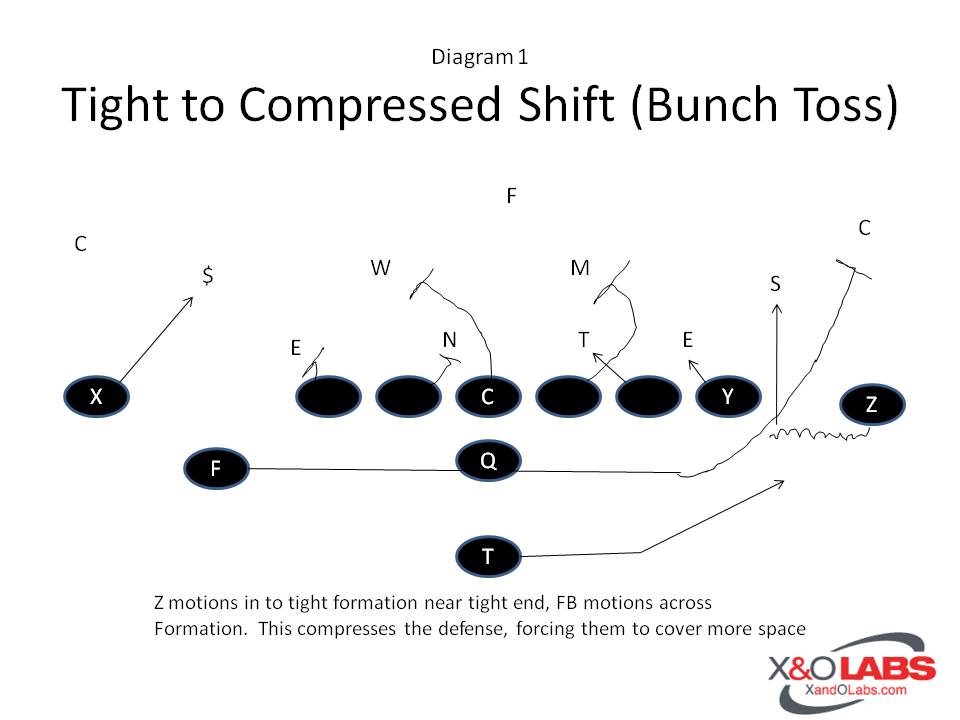
    • Gain a leverage advantage on the perimeter: These types of pre-snap movements will mainly consist of multi-player shifts, such as shifting to a bunch set (Diagram 1) in order to take advantage of space. These are spread to compressed type movements in which most perimeter schemes (like toss, speed option, outside zone) are associated. It forces the defense to cover the entire width of the field.

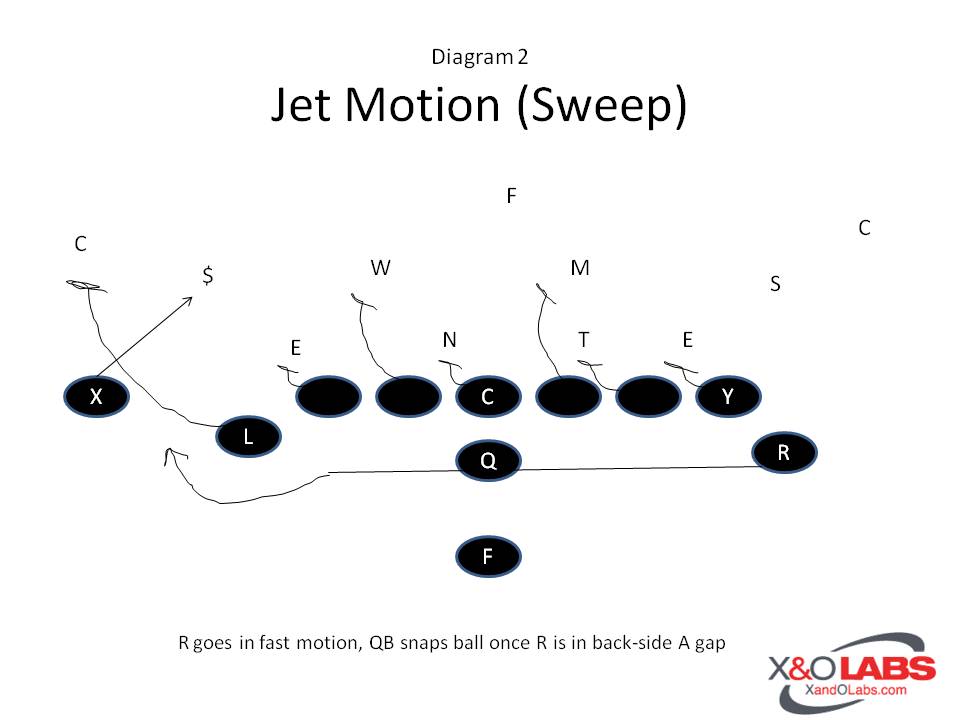
    • Gain a numbers advantage: These types of movements consist of motions where you’re bringing one a player from one side of the formation to the other. Many coaches prefer the jet or flash sweep (Diagram 2) in this situation because they are bringing another player to one side of the formation. When coupled with pull schemes like power, counter, etc., you have the capability of adding yet another player offensively to the side of the motion.

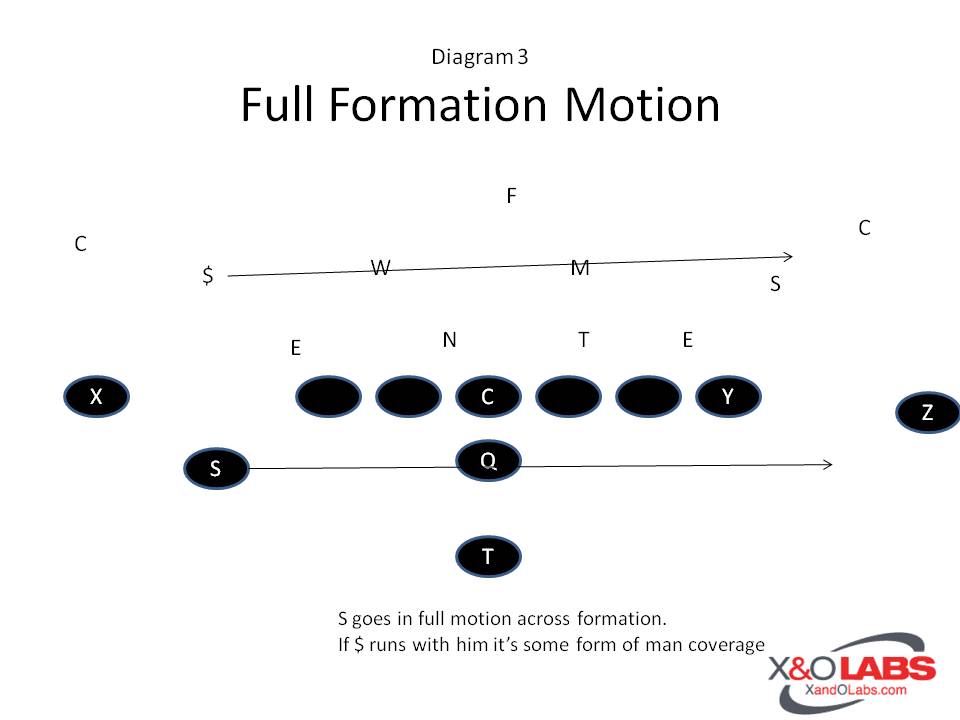
    • Identify coverage rotation: A primitive, yet significant determinate of running a pre-snap movement is to identify if a defense is running man or zone coverage. Of course, there are other indicators to determine this such as the leverage of the cornerbacks, but running a full motion across the formation (Diagram 3) still can be a sure-fire way to identify coverage. If it’s a man concept, expect movement with your movement. If the defense is in zone, you could anticipate either a third level safety drop or a second level linebacker bump.

    • Promote a “toe to heel” mentality to the defense: I first heard Bobby Wilder, the head coach at Old Dominion University, preach this at a clinic when he was the offensive coordinator at the University of Maine. It is Wilder’s goal to get an aggressive defense (one that’s one its toes) to start thinking (resulting on its heels). If defenses start to be concerned with what you’re presenting, they lose sight of their responsibilities. We all know the defensive coaches mantra uttered at all levels, “If you think, you stink.” This offensive ideology negates that concept.

    Because there are so many variables of trades, shifts and motions (Boise State has 44 in their playbook right now) we’ve decided to breakdown the three top pre-snap movements used by the coaches we polled. We detail the movement; explain the benefit of the movement and which offensive schemes coaches like to run off that movement. Again, we have all this evidenced by video clips of the more prominent offenses in the country running it.

    Case 1: TE Trade/TE and Wing Trade (Diagram 4)

    Type of Pre-snap Movement: This is a trade/shift, where you bring your tight end from one side of the offensive formation to the other. It also can be used in conjunction with an H-back (as Boise does), both will travel together. Our research found that 54.2 percent of coaches we polled use this movement as part of their offense.

    Objective: The majority, 51.3 percent of coaches, will use this movement to create another gap at the point of attack. It’s productive against four down fronts; the idea is to change the strength of the defense. Most four down fronts will align their 3-technique to the three-man (or tight end) surface. When you shift or trade your tight end, it forces defenses to change the strength of their front. “How often does a rush or open side end practice against a tight end surface?” asked Wilder. “How much work would a nose guard get by playing a 3-technique? Now he’s susceptible to double teams at the point of attack on gap schemes.”

    Defensive Adjustment Indicators: Upon calling the movement, it’s imperative to see how the defense will react. Among variables such as secondary rotation and front adjustment, 32.8 percent of coaches will use this motion to identify who is playing t

    Read More

    The Sprint Out Pass Game Study

    By Mike Kuchar Senior Research Manager X&O Labs mikek@xandolabs.com

    Researchers’ Note: You can access the raw data – in the form of graphs – from our research on the sprint out pass game: Click here to read the Statistical Analysis Report.

    Before we ruffle any feathers of the football purists in the world, it’s important to note that the following information may not be conducive to what you do offensively. Quite frankly, it pales in popularity to the zone read, bubble screen or power O. In fact, it may rate somewhere above the single wing scheme and the veer option. But, at X&O Labs, we felt the sprint out pass game was a topic worth studying. And why wouldn’t it be? Most programs now have an athletic QB behind center, so why not vary his launch point and give him the run/pass option to make plays in space? And if you don’t have an athletic signal caller, you can still be productive with the scheme, and we’ll show you how.

    Whatever your situation, we recommend you read this entire report. You may find you can apply elements of our research to what you’re doing.

    While it may be true that the majority of our readers – 63.3 percent – use the sprint out concept 25 percent or less of their offensive snaps – it does serve some merit in regards to when you dial it up. It’s a change-up call more than anything else. We’ve found through our research that unless you’re an option outfit, you won’t call the play with some degree of frequency. After all, who wants to put their QB through the stress of having to throw on the run on a consistent manner? It’s hard enough to do that alone, not withstanding six or seven defenders hunting you down from your blind side. Yet throughout time, it’s been a consistent third and short favorite particularly when you want to give your QB a chance to push the ball to the perimeter and make something happen in a hurry. Programs like BYU, Arizona State, Utah and Boise State – whom we have researched below – all have made a steady living off the play, particularly in those situations. It often puts the flat player in a bind – unable to make a decision of whether to tackle the QB or cover his pass responsibility, and before you know it, it’s a first down. Surprisingly, we had some resistance from coaches when we started to put this report together, so instead of giving you supporting evidence to run the sprint out scheme – we felt it was necessary to dispel the four main arguments or myths as to why some coaches are afraid of running the scheme.

    Myth 1: Only Coaches With a Mobile, Athletic QB Can Run the Sprint Out Concept

    Fact: According to our research, 64.1 percent of offensive coordinators still run the sprint out concept with what they would call an “immobile QB.” So, it may depend on how well you can coach it.

    Myth 2: It Cuts the Field in Half and Makes it Easier for Defenses to Defend

    Fact: While this myth does make sense on the surface, we’ve found that cutting up the field can clean up the read of your QB, and we’ll show you how you can do it. Often times, it’s a one-defender read and by the time he makes a decision, you’ve either blown by him or dumped it off. It’s like defending a two-on-one fast break.

    Myth 3: My Route Selection is Limited. I Got a Curl/Flat Combo and a Flood Principle. That’s it.

    Fact: As Adrian Balboa so assertively declared in Rocky 3 “that’s not it!” Not only do you have your horizontal stretch combo’s, you can implement some vertical stretches as well – double moves are lethal in the sprint pass game. Remember, it worked for Balboa – he beat Clumber Lang.

    Myth 4: Sprint Out is Only Effective in Shotgun Sets, and We’re Not a Shotgun Team

    Fact: According to our survey, while it may be true that 70.4 percent of coaches prefer to run the scheme detached from the center, we’ve found that many of these teams still incorporate the route concepts under center as well. It’s all in the punch step or separation from the center, which we will explain later in this report.

    Case 1: Pass Protection Dilemma: Turn-Back or Full Zone?

    I have to admit, I was anxiously anticipating the outcome of this facet of the survey. Through the years, I’ve heard so many arguments for either the turn-back or full zone protection. Proponents of the full zone protection talk about its simplicity of structure, allowing the QB to get to the edge quicker and either deliver the ball or pocket it. Yet, advocates of the turn-back scheme always talk about protecting the back-side of the QB first, and the best way to do that is to hinge back-side. This would lead you to believe that most teams will full zone the front side and turn back the back-side. What we’ve found is 61.2 percent of coaches execute a full reach front side with a turn back away from the center.

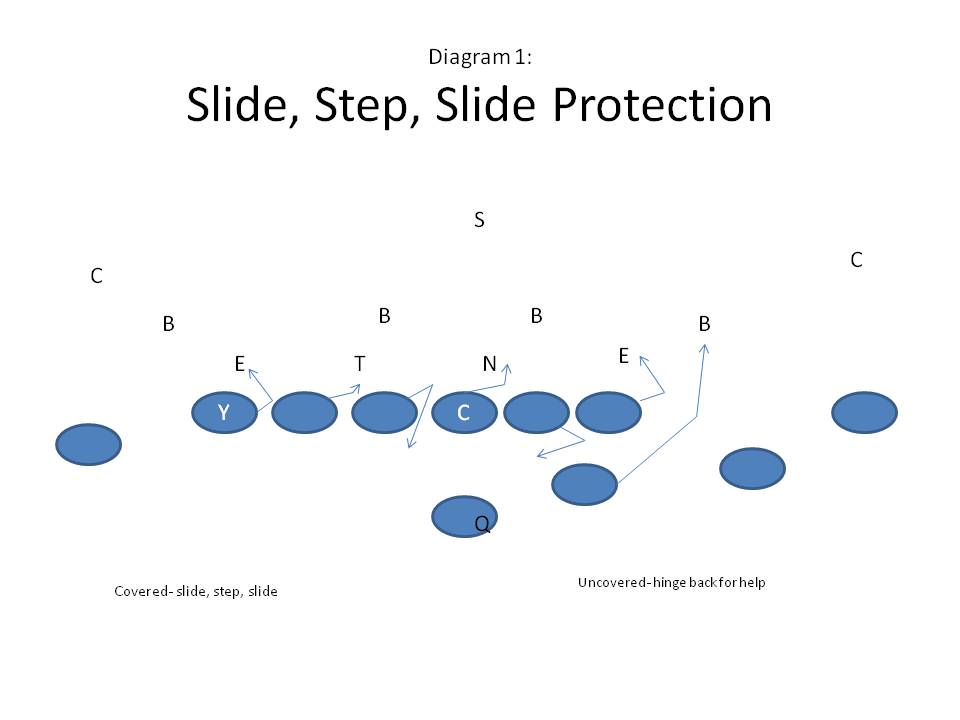
    When we surveyed those coaches that incorporate the full zone principle in protection, 39.1 percent of them worked a full-reach step to get to the outside armpit of the defender, while 33.5 percent taught a bucket step. Doug Taracuk, the offensive coordinator at Dublin Scioto High School in Dublin (OH) combines both with the “slide, step, slide” action to his offensive lineman when working his protection schemes. He enforces the “nose to nose” rule, meaning that each player is responsible for the defender – either first or second level – that is from my nose to the next adjacent lineman’s nose play side.

    “If you’re covered, you execute the ‘slide, step, slide’ technique. If no one is there, I hinge and help back side,” says Taracuk (Diagram 1). “From our stance we step with the outside foot laterally for four to six inches. Some players may opt to bucket step depending upon the angle of intersection with the pass rusher. Our second step is a slide step back to our base athletic stance width. On this movement we want to end up with the outside foot. Our goal is to have the outside foot slightly outside of the defender’s outside with the inside foot splitting the crotch of the defender.”

    In order to reinforce the “slide, step, slide” action, Taracuk executes a dowel rod drill that he got from former NFL offensive lineman Doug Smith. A defensive lineman holds the dowel rod, about five feet in length with the width of a baseball bat, while an offensive lineman comes out of the stance with an inside hand position. The offensive lineman must hook the defender while keeping hand position on the dowel rod. According to Taracuk, it’s a terrific drill for quickness.

    Read More

    Defending the Ace Formation

    By Mike Kuchar Senior Research Manager X&O Labs mikek@xandolabs.com

    Now that spring football has firmly entrenched itself in the college football landscape, most X&O Labs researchers are out pounding the pavement for the newest trends and innovations in the coaching industry.  Your first evidence of that will be our report next week on the midline option – we already have our “bugs” planted at Coach Ken Niumatalolu’s spring practices in Annapolis.  So, instead of bringing you a full-fledged report on a topic this week, we’ve decided to respond to inquires based on our readers, which in essence of our mission statement.

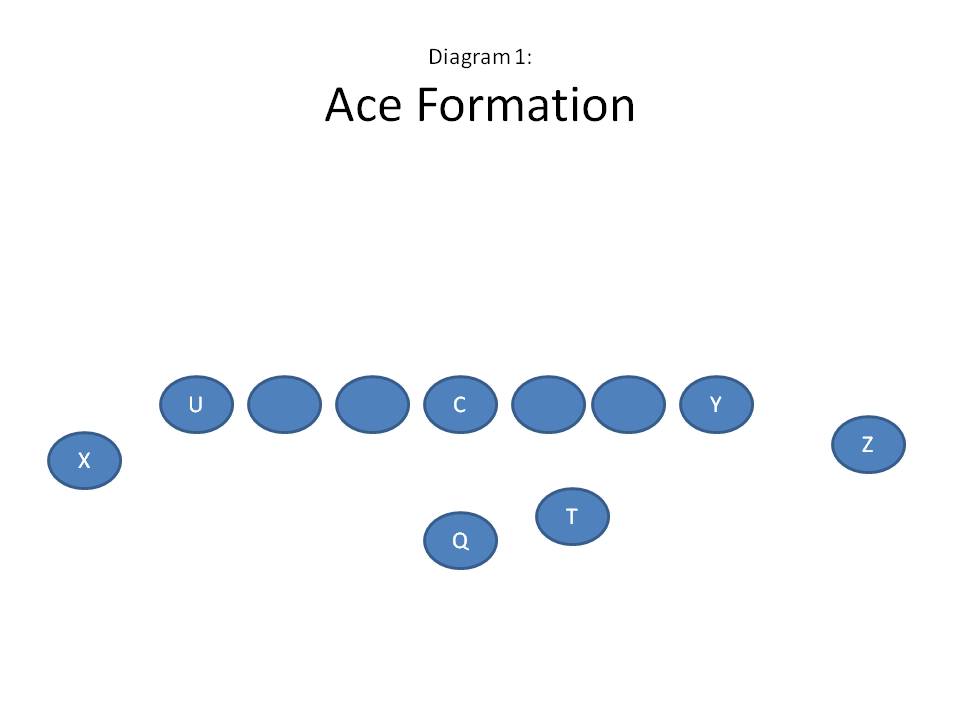
    We’ve been contacted by a number of coaches who were interested in researching different ways to defend the Ace formation.  For clarification purposes, the ace formation (Diagram 1) is based out of 12 personnel (two tight ends, a running back, and two receivers).  While it may seem like a symmetrical, balanced offensive formation – it can be very deceiving.  It provides numerous problems for defenses.  The problem we wanted to delve into was training those third level players like safeties and corners to effectively play fast in the run game.  The Ace formation puts a ton of stress on the defense because it forces those safeties to become involved in support.  Since we were pressed for time – traveling does that to you – we reached out to a couple of close friends on the defensive side of the ball asking them about how they defend the Ace formation.


    While it may seem like a no-brainer concept on paper, running the ace formation is pointless unless you have the tight ends to do it.  Therefore there are two primary reasons why offenses line up in the Ace Formation:

    1. It creates an extra gap in the run game – from the tight end to the back-side tackle; there are usually a total of seven gaps for the defense to defend in the run game.  A gap is defined as the spacing between offensive linemen.  A double tight end formation presents nine total gaps that the defense must account for.  While most defenses can account for seven gaps by placing an additional eighth defender (like a safety) it becomes even more difficult to place nine in the box against eight defenders.
    2. It creates the presence of four immediate vertical threats – if both tight ends can get downfield in a hurry, defenses can be caught in a bind.  While it may be true that teams line up in Ace to run the football, those that have the ability to throw the ball (like Boise State) can be scary good.

    But before you start your game planning to defend 12 personnel, according to the coaches we spoke with there are some important questions that need to be clarified. 


    • What is their run/pass tendency? Compiling this percentage could be as simple as staying in two high (verse high percentage pass teams) or one high (verse high percentage run teams).  We all know football is a numbers game, so getting an extra hat down either by rolling your safety or by moving the front, could be an effective answer.
    • Where is the blocking tight end? Many teams, particularly at the high school level, are lucky to have one dominant tight end let alone two.  In fact, we’ve found that many offenses will change personnel into 12-personnel just to create another gap – regardless of how effective of a blocker he is.  So we suggest setting the front to the dominant tight end and let them run into the teeth of your defense.
    • Can their tight ends/receivers get vertical in a hurry? If they can, you have issues – no question.  But in reality, most tight ends can’t.  Out of traditional quarters or halves coverage (which of course is most synonymous with two deep shells) chances are your safeties will be matched on those tight ends.  As long as the safeties can clean up their run/pass reads, playing them vertical should not be a concern.  If they even decide to go vertical.  Most tight end routes break at 8-10 yards and with a quarters safety over the top, you have plenty of leverage to play those routes.
    • Can your third level players successfully fit on inside runs? As Mark Hendricks, the secondary coach at James Madison told us, it’s a lot harder for your safeties to make a tackle outside-in than making one inside-out.   This means that safeties are geared to making plays on the perimeter, particularly in two-high looks.  Offenses can negate that by cutback runs like zone, forcing your safeties to make plays.  Since you need a safety to account for the extra gap inside, there really isn’t a schematic solution, just a fundamental one:  Teach your safeties how to tackle in close areas.
    • Can you play the edge (D gap) effectively? This was interesting to our research staff.  We figured many coaches would preach about canceling the gaps inside the tackle box effectively.  While this was true to a certain extent, coaches found it just as important to make sure the perimeter runs are cleaned up.  The majority of the coaches we consulted felt you need to have an immediate presence in the D gap – which means having an outside linebacker or walk-up backer play outside shade of the tight end (9-technique).  This puts immediate pressure on the perimeter, and doesn’t allow any type of second level climb like you would have against a 7-technique on zone schemes.
    • Do you need to have an automatic check defensively? Most coaches have common checks for empty, trips and ace structures.  But the key is to have more than just one.  Without question, if an offense sees you check beforehand – especially if you’re no huddle – you’ll be in trouble.  Just get all the legwork done based on tendencies and you won’t be forced to show your hand.

    All this said, there are really three offensive concepts we’d like to focus on defending when it comes to the Ace formation – the zone run game, the boot/naked concept and any other nub side runs.  We realize that an offense can produce a myriad of problems out of this set.  We’ve found these three give the guys we spoke with the biggest headaches.

    Read More