

Odd Front: Leveraging the Strong Side Run Game

By Mike Kuchar Senior Research Manager X&O Labs mikek@xandolabs.com

Researchers’ Note: You can access the raw data – in the form of graphs – from our research into odd front defenses: Click here to read the Statistical Analysis Report.

One of the most appealing aspects of playing an odd front is that it is a “mirrored” style defense – both sides of the front look exactly the same.  By definition, an odd front means that you have three down lineman – with the offensive guards uncovered.  We’ve found that the odd front defense, which has been a staple for years at the NFL level thanks to coaches like Bill Belichick and Dick LeBeau, are being utilized more by high school programs now as their base defense.  Although 69.8 percent of coaches utilize more of a 3-4 base, rather than a 3-3-5 base, we will cover both structures for the purpose of this report.   Structurally, for the most part, you have a zero technique nose that’s head up on the center, along with two defensive ends that are either in inside or outside shades on the offensive tackles.  There are two inside linebackers, two outside linebackers, two corners and two safeties.  Its symmetrical structure makes it the scheme of choice to play spread formation teams.   We’ve found that even 32.8 percent of four down lineman defenses employ some form of odd front defense, mainly in passing downs (when coordinators expect wide open sets).

This is all well and good when lining up against open offenses, with two man surfaces (a guard and tackle to either side of the center) because the offense is just as balanced as the defense.  But an issue presents itself when offenses start to break balance by using three or four man surfaces – with the inclusion of the tight end.  No longer can an odd front be balanced.  Creating an extra player, means creating an extra gap in the run game.   So you need a defender to leverage that gap – who you put there is up to you, but we’ve found that these are the most common ways to get an extra hat in the gap:

  • Stunt or angle the nose guard into the play side A gap
  • Drop an outside LB to “cover up” the tight end and play the extra gap to that side
  • Slant or angle the entire defensive line to penetrate gaps to the strong side
  • Drop a deep safety pre or post snap to play more of a 3-3-5 structure
  • Over shift into some form of four down front, reducing the DL into the three-man surface

While all of these can be effective, we selected coaches’ most popular methods and provided insight into how they accomplish them.


Case 1: Techniques/Movements to Get the Nose Into the Play Side A Gap Since the nose is the anchor of any good odd front (just ask the Patriots Vince Wilfork about that) we’ll start there.  The nose is as vital a player in the odd front as the 3-technique defensive tackle is in any even front (a little foreshadowing for later). We’ve found that one of the common misconceptions when implementing this defense is that you need a mammoth nose like Wilfork in order to be successful.   This is entirely untrue.  When playing this scheme you have two options when playing that nose – you can cover him up on the center and play double A gaps in a boxing match – quick hands, quick feet.   If you base him up, a guy like Wilfork would win every time.  Your other option is to move that nose every snap to gain an advantage by using his speed.  In fact, 69.5 percent of our readers prefer to move that nose post-snap rather than have him lock horns with the center and play a two-gap technique.  Travis Bark, the defensive coordinator at Linn-mar High School in Cedar Rapids (IA) feels he doesn’t have the size to match up, so he stunts out of necessity.  “We slant him every down depending on tendencies that we get,” says Bark. “We don’t want those guys staying put.  We don’t line up with those monsters up front.”  Bark has two calls – “slant” which tells the nose he is slanting to the strength the call, which will usually be the tight end surface.  Or he will have an “opp” or opposite call, which takes the nose away from the call. Of course, the linebackers behind them will need to replace the gaps vacated so if the nose is in the strong side A gap, the weak side LB has the weak A gap.

While this sound like terrific clinic talk, it’s essential that coaches teach their defensive lineman how to slant and angle.  When compiling our research, we’ve found some coaches spend the time teaching visual keys when stunting and some do not.  Jeff Devanney, the head coach at Trinity College in Connecticut, has had one of the top defensive programs in Division-3 for the last five years and leaves nothing to chance when coaching up his stunting lineman.  Devanney moves his nose guard 75 percent of offensive snaps and teaches a six-inch drive step to the next adjacent lineman.  He talks about getting hands into the gap he’s stunting and watching for two possible reads:

Read More

Blocking the Outside Zone

New research uncovers ‘eye-opening’ details of how today’s offensive line coaches are blocking the outside zone scheme.

Researchers’ Note: You can access the raw data – in the form of graphs – from our research on blocking the outside zone: Click here to read the Statistical Analysis Report.

In a follow-up to the inside zone report that X&O Labs published back in early March 2011, we wanted to research the most productive ways coaches are teaching the outside zone and stretch concept to their players.

I’ve admired the way the Indianapolis Colts ran the scheme to perfection under center with Peyton Manning and with the efficiency with which Oregon ran it this year out of the shotgun.

So when we started compiling the report, we’ve found that the most heated discussion is whether or not to full zone or man block the scheme.  Teams such as the Colts, under legendary offensive line guru Howard Mudd, used to full zone the front side of the play to provide for that fast flow displacement of the defense.  Of course, when you have backs behind Manning with the speed of Edgerrin James and Joey Addai, getting to the perimeter of the defense is almost guaranteed.

Before we talk specifics, we wanted to give you a general consensus of why teams are running the scheme.  What we’ve found most interesting is that unlike the inside zone, the outside zone does not have to be a cornerstone of your offense.  Truth is, 53 percent of coaches feel that it doesn’t need to be a top play in your offense for it to be successful.  So why teach it?  It’s a curveball, so to speak, to keep defenses off balance and on its heels.  But if it’s not a base scheme, we were curious to find out why coaches are spending the time implementing it.  Here’s what they told us:

Top reasons for running the outside zone/stretch scheme:

  • Complements the inside zone scheme:  While the inside zone relies on vertical displacement of the defense, the outside zone relies on horizontal displacement.  The idea is to “stretch” the entire defense the width of the field.  This provides for numerous cutback lanes for the ball carrier to insert himself.  Although the play is intended to circle the defense, it will often cut-up instead of cutting back like inside zone schemes.
  • Similar line blocking assignments: Just like the inside zone, the outside zone utilizes a full zone scheme.  Sure, some teams have chosen to man block the play, 73.8 percent of coaches still use a covered and uncovered principle when running the outside zone.    It’s basically the same principle X&O Labs uncovered back in March when we released our inside zone report.
  • Gets your play-makers the ball on the perimeter: Similar to the bubble concept, this scheme pushes the ball to the perimeter of the defense.  We’ve found the structure the play (either in gun or under center) dictates how fast that ball can get to the edge.  Programs like Boise State and Oregon thrive off running it from the gun, while the Colts ran it from under center, forcing the QB to get to the landmark quickly.  Our research has shown nearly an even split on this topic, with 52.6 percent preferring to run the scheme under center.
  • Great against interior pressure: If you’re successful with your interior run game like the inside zone and power, chances are you’ll see the probability of interior pressure increase.  Teams now use the outside zone as a counter to this pressure by getting the ball to the edge.
  • Play-action package off OZ action: Now, this is where the fun begins.  Here is where you get your money ball deep down the field.  Now, this aspect of the scheme won’t be covered in this report, but please know we are currently working on a report that outlines this package in great detail.
  • Various trigger concepts: By “trigger” concepts we’re referring to the actions off zone option such as the flash or speed sweep, the outside zone option as well as the reverse package.  We’re talking full displacement of defenders.   Although this component won’t be disclosed below, we will be covering this aspect in depth during the summer (2011) when our Boise State/Oregon trigger concepts report debuts.

In addition to our research, we’ve also consulted with over a dozen coaches on this topic so that they can provide you with how they run the scheme.  Our hope is that after you read what they do, you find a common ground to adapt what you do to fit your personnel, which after all, is the essence of good coaching.  We’re here just to spark the debate and give you some fodder to decide how best to run your scheme.

Case 1:  “Covered” Blocking Concepts to the Play Side Although these covered and uncovered concepts are the same ones we spoke of on the inside zone report, we wanted to provide a quick refresher.

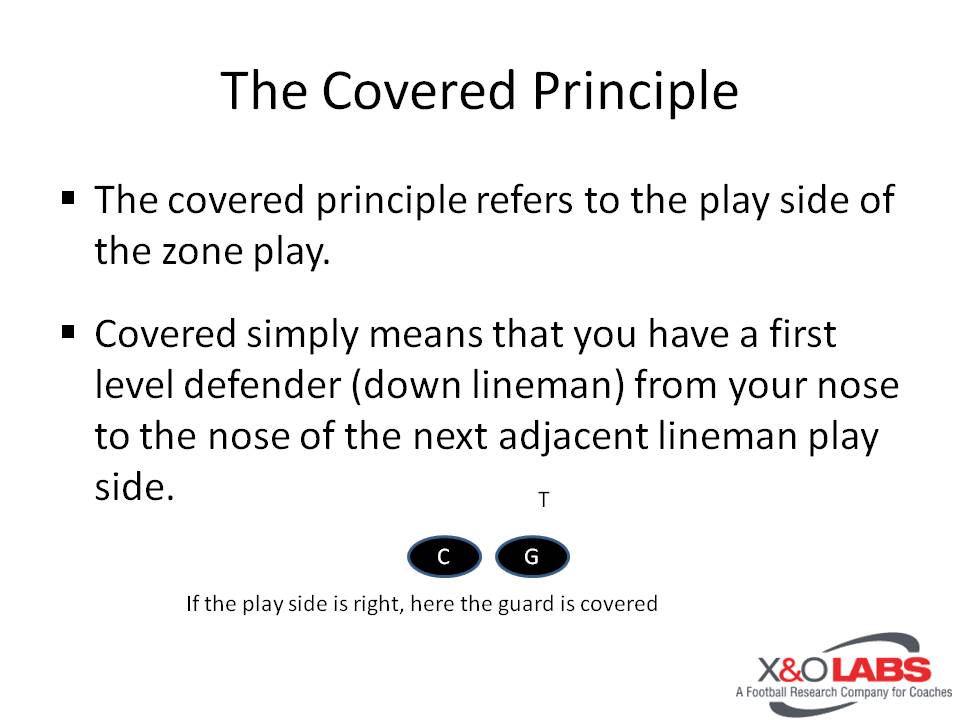
Covered:  There is a first level defender (DLM) from my nose to the nose of the adjacent lineman play side (Diagram 1).


Regardless of the defensive front, these two principles are consistent, and again, 73.8 percent of coaches use this terminology when implementing the zone scheme.  But how these coaches teach their blocking assignments will vary, as we will explain below.  The majority of coaches want their covered offensive linemen to be able to finish at a second level defender by the time the play is over.

When a play side lineman is covered on the outside zone or stretch play, it is his job to handle that down lineman.   How he blocks him can vary – some coaches prefer lead or angle step up field, whereas some tell their offensive lineman to bucket step.  According to our research, 48.9 percent teach an up field, angle step as opposed to 36 percent who teach a bucket step.  We’ve found that the difference lies more in philosophy than it does in technique.

Pat Ruel, the offensive line coach for the Seattle Seahawks, teaches a stretch hook concept (a combo horizontal stretch and hook) for his covered linemen to the play side of zone.  He teaches his players to eye the outside armpit of the defender with the objective to always advance to the second level.  Once the lineman is engaged with a defender, he needs to stay engaged until he feels the next adjacent lineman take his assignment over.

Ruel’s Techniques for a Stretch Hook (covered lineman):

  • Short 45 degree lead step
  • Rip to run on second step by driving back shoulder through defender – this provides for a cutoff scenario
  • Get stomach up field on third step – this ensures the defender is cut-off from his gap responsibility.

“We don’t ever worry about getting beat underneath, the ball will be outside already,” said Ruel.  “But we do concern ourselves with a player who lines up in a gap position.  Here we need to attack the play side armpit with the inside hand first, then work to the second level.”

Milt Tenopir, the legendary offensive line coach under Tom Osbourne at Nebraska, believed in the same philosophy of having his covered offensive lineman really work to get to the second level.  “If our linemen is covered, we let him cross over on his second step as long as it’s up field,” said Tenopir.  “He wants to get started up field because he is going to come off on the next level.  We call it a ‘rip-to-reach’ because we used to take the inside arm and rip it across the outside arm of the defender.  We are trying to put both hands on the far shoulder pad.  It keeps our shoulders pointed up field.”

We’ve found the emphasis on the covered lineman is to have his shoulders pointed up field at all times.  This not only provides for a wider blocking surface, but also keeps the horizontal displacement of the scheme giving the running back more room to operate (we will explain the RB reads a bit later).  As Jim Sweeney, a 16-year NFL center tells his lineman at South Fayette HS (PA), “We always try to stay parallel with our shoulders because we want the back to have a three way go.  If that d-lineman comes straight ahead, his shoulders are square s

Read More

Secondary Play in the Robber Concept Vs. Pro and Spread Personnel

By Mike Kuchar Senior Research Manager X&O Labs mikek@xandolabs.com

Researchers’ Note: You can access the raw data – in the form of graphs – from our research on the robber scheme: Click here to read the Statistical Analysis Report.

This week’s X&O Labs’ Coaching Research Report features the “robber” concept, a coverage that was made notorious by top-tier defensive programs such as Virginia Tech and others.  Ironically enough, the Hokies matching wits with Stanford University in the Orange Bowl last night.  Known for their defensive dominance, the Hokies believe in a steady dose of “robber” coverage – an eight man front structure that can involve a possible ninth defender in the box to stop the run.

Before we go any further, it’s important that we define what robber is.  Verbiage varies from program to program, so for this report we focused solely on the coverage where corners are asked to play a “cheat halves” technique.  The free safety will “rob” by playing the alley-fitter in the run game and man-to-man on number two against the pass.   While there can be several changeups to the coverage based on offensive personnel, our research has shown that in order to be efficient, you must play the coverage against all personnel.

It’s important to note that while a quarters coverage scheme can be beneficial to protecting a four vertical threat, our research has shown that staying in a robber scheme, and just varying who your robber defender is, can be just as productive to limited big plays.

Case 1: Matching the Proper Personnel

According to our research, the base rules of a robber scheme out of a four-down front are simplified below:

  • Defensive line personnel will consist of a nose guard, a strong defensive end, a rush defensive end and a 3-technique defensive tackle who according to 63% of those surveyed will line up to the tight end.
  • Two 30-technique backers, who will stay in the tackle box and are core inside linebacker types.
  • Two corners who will play the “cheat halves” technique.
  • Three safeties, a strong safety and weak safety who are outside linebacker hybrids, and a free safety who is essentially the “robber” lining up on number two to the passing strength.

According to a recent X&O Labs’ survey of coaches, over 60% of respondents employ some type of robber scheme.  We’ve found three specific advantages to playing a robber concept to all offensive personnel and structure:

  • The core will not change: Inside linebackers can be inside linebackers and be physical against the run game.  Many quarters or two-high teams need to remove their inside linebackers from the box forcing them to play in space, which can be uncomfortable and compromising.  In the pass game, since the safety plays number two man to man, the strong side inside backer doesn’t have to be concerned with that.
  • Gets more speed on the field: Having a 4-2-5 base with five defensive backs on the field, provide an instance answer to spread-like formations. Sound run support against option: with the free safety being the “sniffer” he can pursue everything from inside/out being an aggressive alley player and often unblocked ninth defender in the box.

Case 2: Robber vs. Single Width/Pro Formations By structure, the corners are asked to play a deep half technique taking away anything down the hash.  Our research found that Bud Foster at Virginia Tech teaches his corners the following:

Read More

Split Coverage Concepts Vs. Spread Formations

By Mike Kuchar Senior Research Manager X&O Labs mikek@xandolabs.com

Researchers’ Note: You can access the raw data – in the form of graphs – from our research of split coverage concepts: Click here to read the Statistical Analysis Report.

When teaching coverage to players, the install progression is becoming all too familiar with defensive coaches.  It’s the whole, part, whole theory.  First teach the entire coverage (whether by whiteboard or walk though), next break it down by position grouping and finally rep it on the field during seven-on-seven or team sessions.  Sure, it may simple but when offenses start to dictate personnel by changing formations, they’ve taken it to a whole other level.

No longer can defenses make a living staying in “country cover three” and one coverage against all formations.  Offenses are too sophisticated, and too well coached, for that. Most QB’s and coordinators will diagnose the voided areas within seconds (regardless of how well you disguise) and pepper your secondary with first downs.  It’s because of this that defenses have gone to more split coverage concepts – playing one half of the formation, or field, differently than the other.  Truth is, only 5.9% of the coaches we surveyed actually stay in the original coverage called.  The rest make their checks pre-snap based on personnel and formation.  So, while the offense may be dictating  coverage, most d-coordinators will argue they will have the last check and time to adjust by the time the ball is snapped.

Before we get into the most common coverage adjustments, it’s important to examine the “why” before the “how” as to playing split field coverage.  Based on our research, the coaches we spoke with check their coverage based on three potential variants:

  1. Unbalanced sets – 3×1 (trips) or 3×2 (empty)
  2. Personnel groupings, most usually based on tight end or no tight end personnel, for the threat of a consistent run game
  3. Field/Boundary tendencies

Based on our research, some of the more common split field coverage’s we found are:

  • Cover-four mixed with cover-two
  • Robber coverage mixed with cover-two
  • Robber coverage mixed with man
  • Man coverage mixed with quarters

The strong side of the defense can be predicated by field position (such as field or boundary) or by receiver strength – coaches call it both ways.  We’ve found that many of our coaches utilize their split field coverage concepts mainly against 3×1 or 3×2 formations.  Reason being is the myriad amounts of potential routes that offenses can sting you with. Quite simply, football is still a numbers game, and defenses need to account for offensive numbers. So if an offense comes out in an unbalanced offensive set (where there are more receivers on one side of the formation than the other) the defense needs to account for that.  Our researchers at X&O Labs found the most common checks defensive coordinators will make and how they teach their players to play them.


Case 1: Split Coverage Checks Dictated By Unbalanced (3×1) Formations Handling trips formations is always a cause for concern among defensive coaches.  In fact, 47.5% of coaches we surveyed are most concerned with the various route combinations from trips formations rather than aspects such as the skill of the back-side X receiver or the run ability of the QB or back.  Trips can be classified as any three eligible receivers to one side of the formation, which can or cannot include a tight end.  Over 41% of coaches that took part in our research use some sort of split field coverage to defend trips – mainly because it’s unbalanced by nature and offenses are stretching the field vertically with four possible immediate threats.

Assessing an opponent’s offensive personnel is imperative before devising a game plan and we all know that our adjustments can vary from week to week, but most coordinators have specific ways in which they will defend trips by nature.  Trips presents the immediate threat of four receivers going vertical at the snap of the ball into the four deep areas of the zone.  These same receivers can be employed to affect four potential horizontal areas in a zone.  Because of this, coordinators are no longer teaching spot drop zones in coverage.  Instead, they are teaching man principles to zone defenders by having them “lock” on once a defender enters their area of coverage.  This can be achieved through communication and recognition.

For example, Haskel Buff, the defensive coordinator at Fort Valley State University (D-II), defines anything vertical as clearing LB depth.  The Wildcats base their defenses out of the 4-2-5 scheme with a two-deep shell.  Buff plays with a four down front, two interior backers, three safeties and two corners.

Read More

Zone Pressure Concepts Against Spread Teams

By Mike Kuchar Senior Research Manager X&O Labs mikek@xandolabs.com

Researchers’ Note: You can access the raw data – in the form of graphs – from our research on the zone pressure concepts against spread teams: Click here to read the Statistical Analysis Report.

Case 1 – The Prevalence of Boundary Side Pressures After extensive research on the topic of zone pressures, X&O Labs (www.XandOLabs.com) has discovered that the majority of football programs blitz more to the boundary than to the field or to open or closed offensive sets.  Over 31 percent of coaches polled at all levels of football have professed that their most successful zone pressure package is one that attacks the boundary side of the field.   In fact 71 percent of coaches polled that elected to blitz more from the boundary had a winning percentage of 70-79 percent.  This is no coincidence.

According to our studies, a zone pressure from the boundary is disguised more easily and is difficult for opposing QB’s to detect.  Fifty-two percent of our coaches employ a three-under, three-deep zone principle in their pressure packages.  When a coach employs a zone pressure with one deep safety, many teams will show a two-deep shell pre-snap to show disguise.  Either pre or post-snap, one of those safeties will rotate into the flat area.  When a safety rotates to the field side, it is easier to identify by the offensive line and the QB.  The boundary side presents a completely different issue.

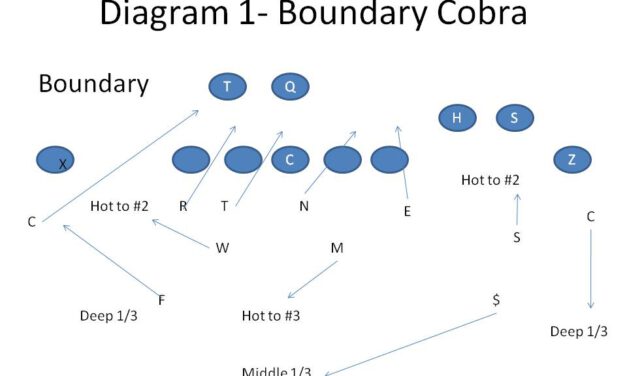
On most occurrences, the boundary side corner is the active blitzer in these schemes.  Based on responses, the most common scheme was the Boundary Cobra (Diagram 1).  Here, the blitz is instituted out of a four-down, field under front, where 3-technique tackle is set to the boundary.  The corner comes hard off the edge as the force blitzer while the Rush end and 3-technique slant away from the blitz.  Out of a traditional three under, three deep coverage rotations, the weak side LB will play hot to #2, the Mike LB is hot to #3, while the free rotates to play the final #1 to the blitzing corner side. 


The second most common boundary pressure according to our research was simply called “Lava” by our analysts (Diagram 2).  Lava is another corner blitz, but mainly used when offensive teams will displace their tight end to the boundary.   Now the offense has presented a three-man surface, so an extra gap needs to be accounted for.  Sixty-two percent of the programs surveyed, ran the “Lava” package out of a 4-2-5 defensive structure.  The corner still comes off the corner and is responsible for any pitch on option.  The weak side defensive end must run to get under #1 receiver on the snap while the strong side LB (M) runs into the C gap.  The weak side LB (W) rushes the weak B gap.  The Nickel (N) executes what coaches referred to as a “bang and slip” technique to collision any number two receiver to the field side.  The strong safety (S) must get to deep third immediately to cover the final number one receiver.  The blitz side defensive end will play the hot to #2.


While the Cobra blitz package was a productive pressure for our coaches, its limitations lie in sending three weak to the boundary side.  In order to get a four man pressure to the boundary side, our coaches dialed up pressures out of the four-down front to send the weak side LB and the Mike LB (Diagram 3).  The weak side defensive end is off the edge, while the Will crosses into the A gap and the Mike scrapes into the B gap.  Will is the penetrator and the Mike is the looper, with the Will going first.  The corner plays deep third while the free safety rotates to play hot to #2.  The strong side LB (Sam) will play hot to #3 or the middle hole defender.  Again, this pressure is ideal to a two-man surface where team will often have just two gaps presented (A and B gap).  The nose executes a RAC (rip across center’s) face to clear room for the Will.

Read More